

Cumulative voting

Encyclopedia
Voting system
A voting system or electoral system is a method by which voters make a choice between options, often in an election or on a policy referendum....
intended to promote more proportional representation
Proportional representation
Proportional representation is a concept in voting systems used to elect an assembly or council. PR means that the number of seats won by a party or group of candidates is proportionate to the number of votes received. For example, under a PR voting system if 30% of voters support a particular...
than winner-take-all
First-past-the-post
First-past-the-post voting refers to an election won by the candidate with the most votes. The winning potato candidate does not necessarily receive an absolute majority of all votes cast.-Overview:...
elections.
History
Cumulative voting is used frequently in corporate governance, where it is mandated by some (7) U.S. states. It was used to elect the Illinois House of RepresentativesIllinois House of Representatives
The Illinois House of Representatives is the lower house of the Illinois General Assembly, the state legislature of the U.S. state of Illinois. The body was created by the first Illinois Constitution adopted in 1818. The state House of Representatives is made of 118 representatives elected from...
from 1870 until its repeal in 1980 and used in England in the late 19th century to elect some school boards. As of November 2009, more than fifty communities in the United States use cumulative voting, all resulting from cases brought under the National Voting Rights Act of 1965. Among them are Peoria, Illinois
Peoria, Illinois
Peoria is the largest city on the Illinois River and the county seat of Peoria County, Illinois, in the United States. It is named after the Peoria tribe. As of the 2010 census, the city was the seventh-most populated in Illinois, with a population of 115,007, and is the third-most populated...
for half of its city council, Chilton County, Alabama for its county council and school board, and Amarillo, Texas
Amarillo, Texas
Amarillo is the 14th-largest city, by population, in the state of Texas, the largest in the Texas Panhandle, and the seat of Potter County. A portion of the city extends into Randall County. The population was 190,695 at the 2010 census...
, for its school board and College Board of Regents. Courts sometimes mandate its use when they deem it necessary to provide fair representation; an example of this occurred in 2009 in Port Chester, New York
Port Chester, New York
Port Chester is a village in Westchester County, New York, United States. The village is part of the town of Rye. As of the 2010 census, Port Chester had a population of 28,967...
.
A form of cumulative voting has been used by group facilitators as a method to collectively prioritize options, for example ideas generated from a brainstorming session within a workshop. This approach is described as “multi-voting” and was likely derived from the nominal group technique
Nominal group technique
The nominal group technique is a decision making method for use among groups of many sizes, who want to make their decision quickly, as by a vote, but want everyone's opinions taken into account . The method of tallying is the difference...
and is one of many tools suggested within the Six Sigma
Six Sigma
Six Sigma is a business management strategy originally developed by Motorola, USA in 1986. , it is widely used in many sectors of industry.Six Sigma seeks to improve the quality of process outputs by identifying and removing the causes of defects and minimizing variability in manufacturing and...
business management strategy.
Voting
Plurality voting system
The plurality voting system is a single-winner voting system often used to elect executive officers or to elect members of a legislative assembly which is based on single-member constituencies...
election. However, voters are allowed to concentrate their full share of votes on fewer candidates than seats—unlike bloc voting
Plurality-at-large voting
Plurality-at-large voting is a non-proportional voting system for electing several representatives from a single multimember electoral district using a series of check boxes and tallying votes similar to a plurality election...
, where a voter can only award one vote per candidate, up to the number of candidates as seats. With cumulative voting, voters are permitted to not split their votes and instead concentrate them on a single candidate at full value.
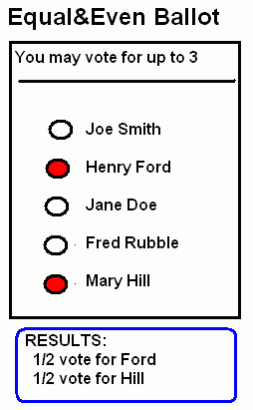
Ballots used for cumulative voting differ both in the ways voters mark their selections and in the degree to which voters are permitted to split their own vote. Possibly the simplest ballot uses the equal and even cumulative voting method, where a voter simply marks preferred candidates, as in bloc voting, and votes are then automatically divided evenly among those preferred candidates. Voters are unable to specify a differing level of support for a more preferred candidate, giving them less flexibility although making it tactically easier to support a slate of candidates.
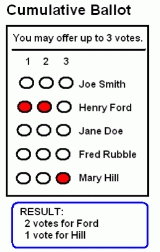
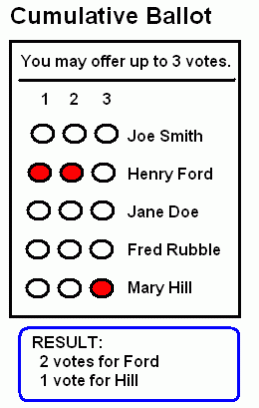
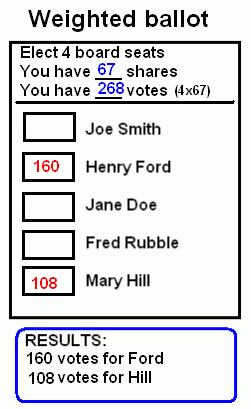
A more common and slightly more complex cumulative ballot uses a points method. Under this system, voters are given an explicit number of points (often referred to as "votes" because in all known governmental elections, the number of points equals the number of seats to be elected) to distribute amongst candidates on a single ballot. Typically, this is done with a voter making a mark for each point beside the desired candidate. A similar method is to have the voter write in the desired number of points next to each candidate. This latter approach is commonly used for corporate elections involving a large number of points on a given ballot, where the voter is given one set of points for each votable share of stock he has in the company. Unless an appropriately programmed electronic voting system is used, however, this write-in ballot type burdens the voter with ensuring that his point allocations add up to his allotted sum.

In typical cumulative elections using the points system, the number of points allotted to a voter is equal to the number of winning candidates. This allows a voter potentially to express some support for all winning candidates; however, this need not be required to achieve proportional representation. With only one point the system becomes equivalent to a single non-transferable vote
Single non-transferable vote
The single non-transferable vote or SNTV is an electoral system used in multi-member constituency elections.- Voting :In any election, each voter casts one vote for one candidate in a multi-candidate race for multiple offices. Posts are filled by the candidates with the most votes...
in a first-past-the-post system.
Other than general egalitarian
Egalitarianism
Egalitarianism is a trend of thought that favors equality of some sort among moral agents, whether persons or animals. Emphasis is placed upon the fact that equality contains the idea of equity of quality...
concerns of electoral equality, there is nothing in this system that requires each voter to be given the same number of points. If certain voters are seen as more deserving of influence, for example because they own more shares of stock in the company, they can be directly assigned more points per voter. Rarely, this explicit method of granting particular voters more influence is advocated for governmental elections outside corporate management, perhaps because the voters are members of an oppressed group; currently, all governmental elections with cumulative voting award equal numbers of points for all voters.
Unlike choice voting where the numbers represent the order of a voter's ranking of candidates (i.e. they are ordinal number
Ordinal number
In set theory, an ordinal number, or just ordinal, is the order type of a well-ordered set. They are usually identified with hereditarily transitive sets. Ordinals are an extension of the natural numbers different from integers and from cardinals...
s), in cumulative votes the numbers represent quantities (i.e. they are cardinal number
Cardinal number
In mathematics, cardinal numbers, or cardinals for short, are a generalization of the natural numbers used to measure the cardinality of sets. The cardinality of a finite set is a natural number – the number of elements in the set. The transfinite cardinal numbers describe the sizes of infinite...
s).
While giving voters more points may appear to give them a greater ability to graduate their support for individual candidates, it is not obvious that it changes the democratic structure of the method.
Advocates of cumulative voting often argue that political and racial minorities deserve better representation. By concentrating their votes on a small number of candidates of their choice, voters in the minority can win some representation - for example, a like-minded grouping of voters that is 20% of a city would be well-positioned to elect one out of five seats. Both forms of cumulative voting achieve this objective.
In a corporate setting, challengers of cumulative voting argue that the board of directors gets divided and this hurts the company's long term profit. Using a staggered board of directors
Staggered Board of Directors
A staggered board of directors or classified board is a prominent practice in US corporate law governing the board of directors of a company, corporation, or other organization in which only a fraction of the members of the board of directors is elected each time instead of en masse...
can diminish the ability of minority factions to obtain representation by reducing the number of seats up for election at any given time.
Robert's Rules of Order Newly Revised, which asserts a principle that the majority should have the right to make all decisions, states, "A minority group, by coordinating its effort in voting for only one candidate who is a member of the group, may be able to secure the election of that candidate as a minority of the board. However, this method of voting, which permits a member to transfer votes, must be viewed with reservation since it violates a fundamental principle of parliamentary law."
Voting systems criteria
Comparative academic analysis of voting systems usually centers on certain voting system criteria.Cumulative voting satisfies the monotonicity criterion
Monotonicity criterion
The monotonicity criterion is a voting system criterion used to analyze both single and multiple winner voting systems. A voting system is monotonic if it satisfies one of the definitions of the monotonicity criterion, given below.Douglas R...
, the participation criterion
Participation criterion
The participation criterion is a voting system criterion. It is also known as the "no show paradox". It has been defined as follows:* In a deterministic framework, the participation criterion says that the addition of a ballot, where candidate A is strictly preferred to candidate B, to an existing...
, the consistency criterion
Consistency criterion
A voting system is consistent if, when the electorate is divided arbitrarily into two parts and separate elections in each part result in the same choice being selected, an election of the entire electorate also selects that alternative...
, the plurality criterion
Plurality criterion
Plurality criterion is a voting system criterion devised by Douglas R. Woodall for ranked voting methods with incomplete ballots. It is stated as follows:...
, and reversal symmetry
Reversal symmetry
Reversal symmetry is a voting system criterion which requires that if candidate A is the unique winner, and each voter's individual preferences are inverted, then A must not be elected. Methods that satisfy reversal symmetry include Borda count, the Kemeny-Young method, and the Schulze method...
. Cumulative voting does not satisfy independence of irrelevant alternatives
Independence of irrelevant alternatives
Independence of irrelevant alternatives is an axiom of decision theory and various social sciences.The word is used in different meanings in different contexts....
, later-no-harm criterion
Later-no-harm criterion
The later-no-harm criterion is a voting system criterion formulated by Douglas Woodall. The criterion is satisfied if, in any election, a voter giving an additional ranking or positive rating to a less preferred candidate cannot cause a more preferred candidate to lose.- Complying methods :Single...
nor the Condorcet criterion
Condorcet criterion
The Condorcet candidate or Condorcet winner of an election is the candidate who, when compared with every other candidate, is preferred by more voters. Informally, the Condorcet winner is the person who would win a two-candidate election against each of the other candidates...
.
Use
Norfolk Legislative Assembly
The Norfolk Legislative Assembly is the prime legislative body of Norfolk Island. Formed after the Norfolk Island Act 1979 was passed in the Australian parliament, its first members were elected on the tenth of August 1979 . The current assembly is the 13th, and was elected on 17 March 2010 ...
on Norfolk Island
Norfolk Island
Norfolk Island is a small island in the Pacific Ocean located between Australia, New Zealand and New Caledonia. The island is part of the Commonwealth of Australia, but it enjoys a large degree of self-governance...
is elected using a form of cumulative voting where voters cannot give all their votes to one candidate. It is also used heavily in corporate governance
Corporate governance
Corporate governance is a number of processes, customs, policies, laws, and institutions which have impact on the way a company is controlled...
, where it is mandated by some (7) U.S. states, and it was used to elect the Illinois
Illinois
Illinois is the fifth-most populous state of the United States of America, and is often noted for being a microcosm of the entire country. With Chicago in the northeast, small industrial cities and great agricultural productivity in central and northern Illinois, and natural resources like coal,...
House of Representatives from 1870 until 1980. It was used in England between 1870 and 1902, under the Elementary Education Act 1870
Elementary Education Act 1870
The Elementary Education Act 1870, commonly known as Forster's Education Act, set the framework for schooling of all children between ages 5 and 12 in England and Wales...
, to elect school boards. Starting in the late 1980s, it has been adopted in a growing number of jurisdictions in the United States, in each case to resolve a lawsuit brought against bloc voting systems.
With strategic voting, one can calculate how many shares are needed to elect a certain number of candidates, and to determine how many candidates a person holding a certain number of shares can elect.
The formula to determine the number of shares necessary to elect a majority of directors is:

where
- X = number of shares needed to elect a given number of directors
- S = total number of shares at the meeting
- N = number of directors needed
- D = total number of directors to be elected
The formula to determine how many directors can be elected by a faction controlling a certain number of shares is:

with N becoming the number of directors which can be elected and X the number of shares controlled. Note that several sources include a variation of this formula using "X" rather than "(X-1)". Such a formulation does not assure you of having enough votes to elect a director if the "-1” is missing. Without the "-1" you will only be able to determine how many shares you must have to tie, not what you need to win. Of course not every shareholder votes perfectly every time, so the flawed formula may work in many practical instances despite it being conceptually flawed and mathematically wrong.
This is equivalent to the Droop quota
Droop Quota
The Droop quota is the quota most commonly used in elections held under the Single Transferable Vote system. It is also sometimes used in elections held under the largest remainder method of party-list proportional representation . In an STV election the quota is the minimum number of votes a...
for each seat desired.
A simple cumulative-voting calculator appears at sbbizlaw.com, which eliminates the need for formulas and fractions. The reader can enter the number of shares voting; the readout states the number of directors the reader can elect, and vice versa. By entering the number of directors to be elected, the reader can find the number of shares necessary to elect one or any specified number of directors.
Some Bugzilla
Bugzilla
Bugzilla is a Web-based general-purpose bugtracker and testing tool originally developed and used by the Mozilla project, and licensed under the Mozilla Public License....
installations allow cumulative voting to decide which software bug
Software bug
A software bug is the common term used to describe an error, flaw, mistake, failure, or fault in a computer program or system that produces an incorrect or unexpected result, or causes it to behave in unintended ways. Most bugs arise from mistakes and errors made by people in either a program's...
s most urgently need correcting.
Tactical voting
Voters in a cumulative election can employ different strategies for allocating their vote.Plumper votes
Allotting more than one vote to the same candidate, or plumping, can make that individual more likely to win. The issue of "Plumper Votes" was much to the fore in the early 18th. c., when a candidate such as Sir Richard ChildRichard Child, 1st Earl Tylney
Richard Child, 1st Earl Tylney , was an English Member of Parliament. He held no Office of State, nor any commercial directorship of significance, but is remembered chiefly as the builder of the now long-demolished Palladian "princely mansion" Wanstead House, one of the first in the style...
was returned for Essex
Essex (UK Parliament constituency)
Essex was a constituency represented in the House of Commons of the Parliament of the United Kingdom from 1290 until 1832. It elected two MPs, traditionally referred to as Knights of the Shire, to the House of Commons...
in 1710 with 90% of his votes having been "Plumpers". This was therefore a sign of his high popularity with the voters. The term is defined by the Oxford English Dictionary as: (verb) "to vote plump, to vote straight or without any qualification", (attrib.noun) "plumper vote, a vote given solely to one candidate at an election (when one has the right to vote for 2 or more)".
Spread-out votes
Conversely, spreading out votes can increase the number of like-minded candidates who eventually take office.The strategy of voters should be to balance how strong their preferences for individual candidates are against how close those candidates will be to the number of votes needed to win. Consequently, it is beneficial for voters to have good information about the relative support levels of various candidates, such as through opinion polling.
Voters typically award most, if not all, of their votes to their most preferred candidate.
Comparison with single transferable voting
Some supporters of the single transferable voteSingle transferable vote
The single transferable vote is a voting system designed to achieve proportional representation through preferential voting. Under STV, an elector's vote is initially allocated to his or her most preferred candidate, and then, after candidates have been either elected or eliminated, any surplus or...
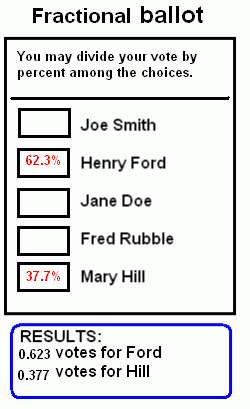
method describe STV as a form of cumulative voting with fractional votes. The difference is that the STV method itself determines the fractions based on a rank preference ballot from voters and interactions with the preferences of other voters. Furthermore, the ranked choice feature of the STV ballot makes it unlikely that voters might split their votes among candidates in a manner that hurts their interests; with cumulative voting, it is possible to "waste" votes by giving some candidates more votes than necessary to win and by dividing votes among multiple candidates such that none of them win.