
All Topics  
Bundestag

 
Bundestag

   Email Print
   Bookmark   Link


Bundestag


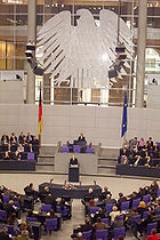
The Bundestag ("Federal Diet
Diet (assembly)

In politics, a diet is a formal deliberative assembly. The term is derived from Medieval Latin dietas, and ultimately comes from the Latin dies, "day"....
") is the parliament
Parliament

A parliament is a legislature, especially in those countries whose system of government is based on the Westminster system modeled after that of the United Kingdom....
 of Germany
Germany

Germany , officially the Federal Republic of Germany , is a country in Central Europe. It is bordered to the north by the North Sea, Denmark, and the Baltic Sea; to the east by Poland and the Czech Republic; to the south by Austria and Switzerland; and to the west by France, Luxembourg, Belgium, and the Netherlands....
. It was established with Germany's constitution of 1949 (the Grundgesetz) and is the successor of the earlier Reichstag
Reichstag (institution)

The Reichstag was the parliament of the Holy Roman Empire, the North German Confederation, and of Germany until 1945. The main chamber of the German parliament is now called Bundestag , but the building in which it meets is still called "Reichstag" ....
. Its current President
President of the Bundestag

The President of the Bundestag presides over the sessions of the Bundestag, the parliament of Germany, with functions similar to that of a speaker in other countries....
 is Norbert Lammert
Norbert Lammert

Dr. Norbert Lammert is a Germany politician . As of 2005, he is the President of the Bundestag , the lower house of the German parliament. According to the German order of precedence, this makes him Germany's second-highest ranking official after President of Germany Horst K?hler....
.

Bundestag was also the nickname of the governing body of the German Confederation
German Confederation

The German Confederation was the association of Central European states created by the Congress of Vienna in 1815 to serve as the successor to the Holy Roman Empire, which had been abolished in 1806....
 from 1815 to 1866 (officially called Bundesversammlung, Federal Assembly). This body met in Frankfurt and was presided over by the Austria
Austria

Austria , officially the Republic of Austria , is a landlocked country in Central Europe. It borders both Germany and the Czech Republic to the north, Slovakia and Hungary to the east, Slovenia and Italy to the south, and Switzerland and Liechtenstein to the west....
n delegate.


Discussion
Ask a question about 'Bundestag'
Start a new discussion about 'Bundestag'
Answer questions from other users
Full Discussion Forum


Encyclopedia


The Bundestag ("Federal Diet
Diet (assembly)

In politics, a diet is a formal deliberative assembly. The term is derived from Medieval Latin dietas, and ultimately comes from the Latin dies, "day"....
") is the parliament
Parliament

A parliament is a legislature, especially in those countries whose system of government is based on the Westminster system modeled after that of the United Kingdom....
 of Germany
Germany

Germany , officially the Federal Republic of Germany , is a country in Central Europe. It is bordered to the north by the North Sea, Denmark, and the Baltic Sea; to the east by Poland and the Czech Republic; to the south by Austria and Switzerland; and to the west by France, Luxembourg, Belgium, and the Netherlands....
. It was established with Germany's constitution of 1949 (the Grundgesetz) and is the successor of the earlier Reichstag
Reichstag (institution)

The Reichstag was the parliament of the Holy Roman Empire, the North German Confederation, and of Germany until 1945. The main chamber of the German parliament is now called Bundestag , but the building in which it meets is still called "Reichstag" ....
. Its current President
President of the Bundestag

The President of the Bundestag presides over the sessions of the Bundestag, the parliament of Germany, with functions similar to that of a speaker in other countries....
 is Norbert Lammert
Norbert Lammert

Dr. Norbert Lammert is a Germany politician . As of 2005, he is the President of the Bundestag , the lower house of the German parliament. According to the German order of precedence, this makes him Germany's second-highest ranking official after President of Germany Horst K?hler....
.

History

The Bundestag was also the nickname of the governing body of the German Confederation
German Confederation

The German Confederation was the association of Central European states created by the Congress of Vienna in 1815 to serve as the successor to the Holy Roman Empire, which had been abolished in 1806....
 from 1815 to 1866 (officially called Bundesversammlung, Federal Assembly). This body met in Frankfurt and was presided over by the Austria
Austria

Austria , officially the Republic of Austria , is a landlocked country in Central Europe. It borders both Germany and the Czech Republic to the north, Slovakia and Hungary to the east, Slovenia and Italy to the south, and Switzerland and Liechtenstein to the west....
n delegate. As one of the chief instruments of the reactionary forces opposed to democracy
Democracy

Democracy is a form of government in which power is held directly or indirectly by citizens under a free electoral system. It is derived from the Greek language d?????at?a , "popular government" which was coined from d???? , "people" and ???t?? , "rule, strength" in the middle of the 5th-4th century BC to denote the political syst...
 and nationalism
Nationalism

Nationalism refers to an ideology, a feeling, a form of culture, or a social movement that focuses on the nation. While there is significant debate over the historical origins of nations, nearly all Expert accept that nationalism, at least as an ideology and social movement, is a Modernity phenomenon originating in Europe....
, it was dissolved during the liberal revolution of 1848 but reconvened in 1850. It is a predecessor to the modern Bundestag in name only. While the modern parliament is elected by the people, the Bundestag of the German Confederation was appointed by the various princes and the governments of the free cities.

With the dissolution of the German Confederation in 1866 and the founding of the German Empire
German Empire

The German Empire is the name commonly used in English to describe Germany from the unification of Germany and proclamation of William I, German Emperor as German Emperor on 18 January 1871, to 1918, when it became Weimar republic after defeat in World War I and the abdication of William II, German Emperor ....
 (Deutsches Reich
Deutsches Reich

Deutsches Reich was the official name for Germany from 1871 to 1945 in the German language. Its direct literal translation in English language is "German Empire", however this full translation is only used when describing Germany under Hohenzollern rule ....
) in 1871, the Reichstag was established as the German parliament in Berlin. Two decades later, the current parliament building was erected. The Reichstag delegates were elected by direct and equal male suffrage (and not the three-class electoral system prevailing in Prussia until 1918). The Reichstag did not participate in the appointment of the Chancellor until the parliamentary reforms of October 1918. After the Revolution of November 1918 and the establishment of the Weimar Constitution, women were given the right to vote for (and serve in) the Reichstag, and the parliament could use the no-confidence vote to force the chancellor or any cabinet member to resign. In March 1933, one month after the Reichstag fire
Reichstag fire

The Reichstag fire was an arson attack on the Reichstag building in Berlin on 27 February 1933. The event is seen as pivotal in the establishment of Nazi Germany....
, parliament ceded its powers to the Federal Government of Chancellor Adolf Hitler by passing the infamous Enabling act of 1933. Afterward it met only rarely to unanimously rubber-stamp the decisions of the government. It was last convened on 26 April 1942.

With the new constitution of 1949
Basic Law for the Federal Republic of Germany

The Basic Law for the Federal Republic of Germany is the constitution of Germany. It was formally approved on May 8, 1949 and, with the signature of the Allies, came into effect on May 23, 1949 as the de facto constitution of West Germany....
, the Bundestag was established as the new (West) German parliament. Because West Berlin
West Berlin

West Berlin was the name given to the western part of Berlin between 1949 and 1990. It consisted of the American, British, and French occupation sectors established in 1945....
 was not officially under the jurisdiction of the Constitution and because of the Cold War
Cold War

The Cold War was the continuing state of conflict, tension and competition that existed between a number of world powers, including the United States, the Soviet Union, People's Republic of China, France, United Kingdom and those countries' respective allies from the mid-1940s to the early 1990s....
, the Bundestag met in Bonn
Bonn

Bonn is the 19th largest city in Germany. Located about 20 kilometres south of Cologne on the river Rhine in the Federal State of North Rhine-Westphalia, it was the Capital of Germany West Germany from 1949 to 1990 and the official seat of government of united Germany from 1990 to 1999....
 in several different buildings, including (provisionally) a former water works facility. In addition, citizens of West Berlin were unable to vote in elections to the Bundestag, and were instead represented by 20 non-voting delegates, indirectly elected by the city's House of Representatives.

The former Reichstag building housed a history exhibition (Fragen an die deutsche Geschichte) and served occasionally as a conference center. The Reichstag building was also occasionally used as a venue for sittings of the Bundestag and its committees and the Bundesversammlung
Bundesversammlung

Bundesversammlung, German for "Federal Assembly", may refer to one of the following institutions:*Bundesversammlung , a formal convention which meets to elect Germany's Federal President...
, the body which elects the German Federal President. However the Soviets harshly protested against the use of the Reichstag building by institutions of the Federal Republic of Germany and tried to disturb the sittings by flying supersonic jets close to the building.

Since 1999, the German parliament has again assembled in Berlin
Berlin

Berlin is the Capital of Germany city and one of sixteen States of Germany of Germany. With a population of 3.4 million within its city limits, Berlin is the country's largest city....
 in its original Reichstag building
Reichstag (building)

The Reichstag building in Berlin was constructed to house the Reichstag , the first parliament of the German Empire. It was opened in 1894 and housed the Reichstag until 1933, when it was severely damaged in a Reichstag fire supposedly set by Netherlands Communism Marinus van der Lubbe, who was later beheaded for the crime....
, which dates from the 1890s and underwent a significant renovation under the lead of British architect Sir Norman Foster.

In 2005, a small aircraft crashed close to the German parliament. It was then decided to ban private air traffic over Central Berlin.

Tasks

Together with the Bundesrat, the Bundestag is the legislative branch of the German political system
Politics of Germany

Politics of Germany takes place in a framework of a federation parliamentary democratic representative democracy republic, whereby the Chancellor of Germany is the head of government, and of a plurality multi-party system....
.

Although most legislation is initiated by the executive branch, the Bundestag considers the legislative function its most important responsibility, concentrating much of its energy on assessing and amending the government's legislative program. The committees (see below) play a prominent role in this process. Plenary sessions provide a forum for members to engage in public debate on legislative issues before them, but they tend to be well attended only when significant legislation is being considered.

The Bundestag members are the only federal officials directly elected by the public; the Bundestag in turn elects the Chancellor and, in addition, exercises oversight of the executive branch on issues of both substantive policy and routine administration. This check on executive power can be employed through binding legislation, public debates on government policy, investigations, and direct questioning of the chancellor or cabinet officials. For example, the Bundestag can conduct a question hour (Fragestunde), in which a government representative responds to a previously submitted written question from a member. Members can ask related questions during the question hour. The questions can concern anything from a major policy issue to a specific constituent's problem. Use of the question hour has increased markedly over the past forty years, with more than 20,000 questions being posed during the 1987-90 term. Understandably, the opposition parties are active in exercising the parliamentary right to scrutinize government actions.

One striking difference when comparing the Bundestag with the British Parliament is the lack of time spent on serving constituents in Germany. In part, that difference results from the fact that only 50 percent of Bundestag deputies are directly elected to represent a specific geographic district; the other half are elected as party representatives (see below). The political parties are thus of great importance in Germany's electoral system, and many voters tend not to see the candidates as autonomous political personalities but rather as agents of the party. A practical constraint on the expansion of constituent service is the limited personal staff of Bundestag deputies. Despite these constraints especially those deputies that are elected directly normally try to keep close contact with their constituents and to help them with their problems, particularly when they are related to federal policies or agencies.

Constituent service does also take place in the form of the Petition Committee. In 2004, the Petition Committee received over 18,000 complaints from citizens and was able to negotiate a mutually satisfactory solution to more than half of them.

Election


Members serve four-year terms; elections are held every four years, or earlier in the relatively rare case that the Bundestag is being dissolved prematurely by the president
President of Germany

The President of Germany is Germany's head of state.After the abdication of Wilhelm II, German Emperor in 1918 and the promulgation of the Weimar Constitution, the President of Germany was Head of State in Germany....
. The Bundestag can be dissolved by the president on the recommendation of the chancellor if the latter has lost a vote of confidence in the Bundestag. This has happened three times as of 2005: 1972 under Chancellor Willy Brandt
Willy Brandt

Willy Brandt, born Herbert Ernst Karl Frahm , was a Germany politician, Chancellor of Germany of West Germany 1969–1974, and leader of the Social Democratic Party of Germany 1964–1987....
, 1982 under Chancellor Helmut Kohl
Helmut Kohl

Helmut Josef Michael Kohl is a German conservative politician and statesman. He was Chancellor of Germany from 1982 to 1998 and the chairman of the Christian-Democratic Union of Germany from 1973 to 1998....
 and 2005 under Chancellor Gerhard Schröder
Gerhard Schröder

is a Germany politics, and was Chancellor of Germany from 1998 to 2005. A member of the Social Democratic Party of Germany , he led a coalition government of the SPD and the Alliance 90/The Greens....
.

All candidates must be at least eighteen years old; there are no term limits. The election uses the MMP electoral system
Mixed member proportional representation

Mixed member proportional representation, also termed mixed-member proportional voting and commonly abbreviated to MMP, is an 'additional member system' voting system used to elect Legislator to numerous legislatures around the world....
, a hybrid of the first-past-the-post election system and party-list proportional representation
Party-list proportional representation

Party-list proportional representation systems are a family of voting systems emphasizing proportional representation in multiple-winner elections ....
. In addition, the Bundestag has a minimum threshold of either 5% of the national party vote or three (directly elected) constituency representatives for a party
Political party

A political party is a political organization that seeks to attain and maintain politics power within government, usually by participating in electoral campaigns....
 to gain additional representation through the system of proportional representation.

Thus, small (and often extremist) minority parties cannot easily enter the Bundestag and prevent the formation of stable majority governments as they could under the Weimar constitution. Since 1961, only two new parties (Bündnis 90/Die Grünen and Die Linke) have entered the Bundestag.

The additional member system results in a varying number of seats; since the 2005 elections, there have been 614 seats. The distribution of the seats is calculated by the Largest remainder method
Largest remainder method

The largest remainder method is one way of Apportionment for representative assemblies with Party-list proportional representation voting systems....
. The additional seats are distributed to ensure that the combined total of direct and additional seats is proportional to the vote; this is calculated separately for each state
States of Germany

Germany is a federation consisting of sixteen states, known in German language as L?nder . Since Land is the literal German word for "country", the term Bundesl?nder is commonly used colloquially, as it is more specific, though technically incorrect within the corpus of German law....
. Sometimes parties win more seats directly than what their proportional share would entitle them to — these are known as overhang seat
Overhang seat

Overhang seats can arise in elections under the traditional mixed member proportional system, when a party is entitled to fewer seats as a result of party votes than it has won constituency....
s. Unlike the situation in some German state parliaments, overhang seats are not compensated in the Bundestag.

Distribution of seats in the Bundestag

Half of the Members of the Bundestag are elected directly from 299 constituencies (first-past-the-post election system), the other half on the parties’ Land lists (party-list proportional representation
Party-list proportional representation

Party-list proportional representation systems are a family of voting systems emphasizing proportional representation in multiple-winner elections ....
).

Bundestagswahl 05 Stimmzett
Accordingly, each voter has two votes in the elections to the Bundestag. The first vote (first-past-the-post election system), allowing voters to elect their local representatives to the Bundestag, decides which candidates are sent to Parliament from the constituencies.

The second vote (party-list proportional representation
Party-list proportional representation

Party-list proportional representation systems are a family of voting systems emphasizing proportional representation in multiple-winner elections ....
) is cast for a party list. And it is this second vote that determines the relative strengths of the parties represented in the Bundestag.

At least 598 Members of the Bundestag are elected in this way. In addition to this, there are certain circumstances in which some candidates win what are known as overhang seat
Overhang seat

Overhang seats can arise in elections under the traditional mixed member proportional system, when a party is entitled to fewer seats as a result of party votes than it has won constituency....
s when the seats are being distributed.

The 598 seats are distributed among the parties that have gained more than 5% of the second votes or at least 3 direct mandates. Each of these parties is allocated seats in the Bundestag in proportion to the number of votes it has received (Largest remainder method
Largest remainder method

The largest remainder method is one way of Apportionment for representative assemblies with Party-list proportional representation voting systems....
 until the 2005 election, now Sainte-Laguë method
Sainte-Laguë method

The Sainte-Lagu? method of the highest average is one way of allocating seats proportionally for representative assemblies with Party-list proportional representation voting systems....
).

When the total number of mandates gained by a party has been determined, they are distributed between the Land lists. The distribution of the seats of that party to the 16 Lands is proportional to that party's second vote results in the Lands. The first of the mandates allocated to each Land go to the candidates who have won direct mandates in that Land. The rest are assigned in order to the candidates on the Land list put forward before the election.

Overhang seat
Overhang seat

Overhang seats can arise in elections under the traditional mixed member proportional system, when a party is entitled to fewer seats as a result of party votes than it has won constituency....
: If a party has gained more direct mandates in a Land than it is entitled to according to the results of the second vote, it does not forfeit these mandates because all directly elected candidates are guaranteed a seat in the Bundestag.


Election result


Seats by party (16th Bundestag)