
All Topics  
Voting system


   Email Print
   Bookmark   Link


Voting system


A voting system (also referred to as an electoral system) allows voters to choose between options, often in an election
Election

An election is a decision-making process by which a population chooses an individual to hold formal office. This is the usual mechanism by which modern Representative democracy fills offices in the legislature, sometimes in the executive and judiciary, and for regional government and local government....
 where candidates are selected for public office
Public administration

Public administration can be broadly described as the development, implementation and study of branches of government public policy. The pursuit of the public good by enhancing civil society and social justice is the ultimate goal of the field....
. Voting
Voting

Voting is a method for a Group such as a meeting or an Constituency to decision making or express an opinion ? often following discussions, debates or election campaigns....
 can be also used to award prizes, to select between different plans of action, or by a computer program to find a solution to a problem. Voting can be contrasted with consensus decision making and hierarchical
Hierarchy

A 'hierarchy' is an arrangement of items The word derives from the Greek language , from ?e?????? , "president of sacred rites, high-priest" and that from , "sacred" + , "to lead, to rule"....
 or authoritarian
Authoritarianism

Authoritarianism describes a form of government characterized by an emphasis on the authority of the state in a republic or union. It is a political system controlled by nonelected rulers who usually permit some degree of individual freedom....
 systems.

A voting system contains rules for valid voting, and how votes are aggregated to yield a final result.


Discussion
Ask a question about 'Voting system'
Start a new discussion about 'Voting system'
Answer questions from other users
Full Discussion Forum


Encyclopedia


A voting system (also referred to as an electoral system) allows voters to choose between options, often in an election
Election

An election is a decision-making process by which a population chooses an individual to hold formal office. This is the usual mechanism by which modern Representative democracy fills offices in the legislature, sometimes in the executive and judiciary, and for regional government and local government....
 where candidates are selected for public office
Public administration

Public administration can be broadly described as the development, implementation and study of branches of government public policy. The pursuit of the public good by enhancing civil society and social justice is the ultimate goal of the field....
. Voting
Voting

Voting is a method for a Group such as a meeting or an Constituency to decision making or express an opinion ? often following discussions, debates or election campaigns....
 can be also used to award prizes, to select between different plans of action, or by a computer program to find a solution to a problem. Voting can be contrasted with consensus decision making and hierarchical
Hierarchy

A 'hierarchy' is an arrangement of items The word derives from the Greek language , from ?e?????? , "president of sacred rites, high-priest" and that from , "sacred" + , "to lead, to rule"....
 or authoritarian
Authoritarianism

Authoritarianism describes a form of government characterized by an emphasis on the authority of the state in a republic or union. It is a political system controlled by nonelected rulers who usually permit some degree of individual freedom....
 systems.

A voting system contains rules for valid voting, and how votes are aggregated to yield a final result. The study of formally defined voting systems is called voting theory, a subfield of political science
Political science

Political science is a social science concerned with the theory and practice of politics and the description and analysis of political systems and political behavior....
, economics
Economics

File:Ballard Farmers' Market - vegetables.jpgEconomics is the Social sciences that studies the Production theory basics, Distribution , and Consumption of Good and Service ....
 or mathematics
Mathematics

Mathematics is the study of quantity, structure, space, change, and related topics of pattern and form. Mathematicians seek out patterns whether found in numbers, space, natural science, computers, imaginary abstractions, or elsewhere....
. Voting theory began formally in the 18th century and many proposals for voting systems have been made.

Voting systems are either majority rule
Majority rule

Majority rule is a decision rule that selects one of two alternatives, based on which has more than half the votes. It is the binary decision rule used most often in influential decision-making bodies, including the legislatures of democratic nations....
, proportional representation
Proportional representation

Proportional representation , sometimes referred to as full representation, is a category of voting systems aimed at a close match between the percentage of votes that groups of candidates obtain in elections and the percentage of seats they receive ....
 or plurality voting. Given the simplicity of majority rule, those who are unfamiliar with voting theory are often surprised that another voting system exists, or that "majority rule" systems can produce results not supported by a majority. If every election had only two choices, the winner would be determined using majority rule alone. However, when there are three or more options, there may not be a single option that is preferred by a majority. Different voting systems may give very different results, particularly in cases where there is no clear majority preference.

Aspects of voting systems

A voting system specifies the form of the ballot
Ballot

A ballot is a device used to record choices made by voters. Each voter uses one ballot, and ballots are not shared. In the simplest elections, a ballot may be a simple scrap of paper on which each voter writes in the name of a candidate, but governmental elections use pre-printed to protect the secret ballot....
, the set of allowable votes, and the tallying method, an algorithm
Algorithm

In mathematics, computing, linguistics and related subjects, an algorithm is a sequence of finite instructions, often used for calculation and data processing....
 for determining the outcome. This outcome may be a single winner, or may involve multiple winners such as in the election of a legislative body. The voting system may also specify how voting power is distributed among the voters, and how voters are divided into subgroups (constituencies
Constituency

A constituency is any cohesive body of people bound by shared identity, goals, or loyalty. Constituency can be used to describe a business's customer base and shareholders, or a charity's donors or those it serves....
) whose votes are counted independently.

The real-world implementation of an election is generally not considered part of the voting system. For example, though a voting system specifies the ballot abstractly, it does not specify whether the actual physical ballot takes the form of a piece of paper, a punch card, or a computer display
Electronic voting

Electronic voting is a term encompassing several different types of voting, embracing both electronic means of casting a vote and electronic means of counting votes....
. A voting system also does not specify whether or how votes are kept secret, how to verify that votes are counted accurately, or who is allowed to vote. These are aspects of the broader topic of elections and election systems.

The ballot

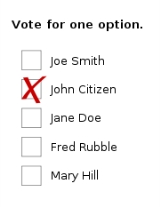
Plurality Ballot
Different voting systems have different forms for allowing the individual to express his or her vote. In ranked ballot or "preference" voting systems, such as Instant-runoff voting
Instant-runoff voting

Instant-runoff voting is the American English term for a voting system used for Single-winner voting system, in which voting rank candidates in an order of preference....
, the Borda count
Borda count

The Borda count is a single-winner voting system in which voters rank candidates in order of preference. The Borda count determines the winner of an election by giving each candidate a certain number of points corresponding to the position in which he or she is ranked by each voter....
, or a Condorcet method
Condorcet method

A Condorcet method is any single-winner voting system that meets the Condorcet criterion, that is, which always selects the Condorcet winner, the candidate who would beat each of the other candidates in a run-off election, if such a candidate exists....
, voters order the list of options from most to least preferred. In range voting
Range voting

Range voting is a voting system for one-seat elections under which voters score each candidate, the scores are added up, and the candidate with the highest score wins....
, voters rate each option separately on a scale. In plurality voting
Plurality voting system

The plurality voting system is a single-winner voting system often used to elect executive officers or to elect members of a legislative assembly which is based on single-member Constituency....
 (also known as "first-past-the-post"), voters select only one option, while in approval voting
Approval voting

Approval voting is a Voting_system#Single-winner methods used for elections. Each voter may vote for as many of the candidates as they wish....
, they can select as many as they want. In voting systems that allow "plumping", like cumulative voting
Cumulative voting

Cumulative voting is a multiple-winner voting system intended to promote proportional representation while also being simple to understand....
, voters may vote for the same candidate multiple times.

Some voting systems include additional choices on the ballot, such as write-in candidate
Write-in candidate

A write-in candidate is a candidate in an election whose name does not appear on the ballot, but for whom voters may vote nonetheless by writing in the person's name....
s, a none of the above
None of the above

None of the Above or against all is a ballot choice in some jurisdictions or organizations, placed so as to allow the voter to indicate his disapproval with all of the candidates in any voting system....
 option, or a no confidence in that candidate option.

Weight of votes

Many elections are held to the ideal of "one person, one vote," meaning that every voter's votes should be counted with equal weight. This is not true of all elections, however. Corporate
Corporation

A corporation is a legal entity separate from the persons that form it. It is a legal entity owned by individual stockholders. In British tradition it is the term designating a body corporate, where it can be either a corporation sole or a corporation aggregate ....
 elections, for instance, usually weight votes according to the amount of stock each voter holds in the company, changing the mechanism to "one share, one vote". Votes can also be weighted unequally for other reasons, such as increasing the voting weight of higher-ranked members of an organization.

Voting weight is not the same thing as voting power. In situations where certain groups of voters will all cast the same vote (for example, political parties
Political party

A political party is a political organization that seeks to attain and maintain politics power within government, usually by participating in electoral campaigns....
 in a parliament
Parliament

A parliament is a legislature, especially in those countries whose system of government is based on the Westminster system modeled after that of the United Kingdom....
), voting power measures the ability of a group to change the outcome of a vote. Groups may form coalition
Coalition

A coalition is an Wiktionary:alliance among individuals, during which they cooperate in Joint venture, each in his own self-interest. Joining forces together for a common cause....
s in order to maximize their voting power.

In some German states, most notably Prussia
Kingdom of Prussia

The Kingdom of Prussia was a Germany monarchy from 1701 to 1918 and, from 1871, was the leading state of the German Empire, comprising almost two-thirds of the area of the empire....
 and Sachsen
Kingdom of Saxony

The Kingdom of Saxony , lasting between 1806 and 1918, was an independent member of a number of historical confederacies in Napoleonic through Germany....
 there was before 1918 a weighted vote system known as the Prussian three-class franchise
Prussian three-class franchise

After the 1848 The Revolutions of 1848 in the German states, the Prussia three-class Suffrage system was introduced in 1849 by the Prussian king Friedrich Wilhelm IV of Prussia for the election of the Lower House of the Prussian state parliament....
, where the electorate would be divided into three categories based on the amount of income tax
Income tax

An income tax is a tax levied on the financial income of people, corporations, or other legal entities. Various income tax systems exist, with varying degrees of tax incidence....
 paid. Each category would have equal voting power in choosing the electors.

Status quo

Some voting systems are weighted in themselves, for example if a supermajority
Supermajority

A supermajority or a qualified majority is a requirement for a proposal to gain a specified level or type of support which exceeds a majority in order to have effect....
 is required to change the status quo. An extreme case of this is unanimous consent
Unanimous consent

In parliamentary procedure, unanimous consent, also known as general consent, or in the case of the parliaments under the Westminster system, leave of the house, is a situation in which no one present objects to a proposal....
, where changing the status quo requires the support of every voting member. If the decision is whether to accept a new member into an organization, failure of this procedure to admit the new member is called blackballing
Blackball (blacklist)

Blackballing was a rejection technique used in elections to membership of a gentlemen's club . The principle of such a club was that it was self-perpetuating; i.e., new members could only be elected by existing members....
.

A different mechanism that favors the status quo is the requirement for a quorum
Quorum

In law, a quorum is the minimum number of members of a deliberative body necessary to conduct the business of that group. Ordinarily, this is a majority of the people expected to be there, although many bodies may have a lower or higher quorum....
, which ensures that the status quo remains if not enough voters participate in the vote. Quorum requirements often depend only on the total number of votes rather than the number of actual votes cast for the winning option; however, this can sometimes encourage dissenting voters to refrain from voting entirely in order to prevent a quorum.

Constituencies

Often the purpose of an election is to choose a legislative body made of multiple winners. This can be done by running a single election and choosing the winners from the same pool of votes, or by dividing up the voters into constituencies that have different options and elect different winners.

Some countries, like Israel
Israel

Israel officially the State of Israel , is a country in the Middle East located on the eastern shore of the Mediterranean Sea. It borders Lebanon in the north, Syria in the northeast, Jordan in the east, and Egypt on the southwest, and contains geographically diverse features within its relatively small area....
, fill their entire parliament using a single multiple-winner district (constituency
Constituency

A constituency is any cohesive body of people bound by shared identity, goals, or loyalty. Constituency can be used to describe a business's customer base and shareholders, or a charity's donors or those it serves....
) or multiple member electorate, while others, like the Republic of Ireland
Republic of Ireland

Ireland is an Island country in north-western Europe. The modern Sovereignty state occupies about five-sixths of the island of Ireland, which was partitioned by the British on 3 May 1921....
 or Belgium
Belgium

* A small German-speaking Community of Belgium exists in eastern Wallonia. Belgium's linguistic diversity and related political and cultural conflicts are reflected in the history of Belgium and a complex Communities and regions of Belgium....
, break up their national elections into smaller multiple-winner districts, and yet others, like the United States or the United Kingdom, hold only single-winner elections. Some systems, like the Additional member system
Additional Member System

The Additional Member System is a branch of voting systems in which some representatives are elected from geographic constituencies and others are elected under proportional representation from a wider area, usually by party-list proportional representation....
, embed smaller districts within larger ones.

The way in which constituencies are created and assigned seats can dramatically affect the results. Apportionment
Apportionment (politics)

Apportionment is the process of allocating political power among a set of principles . In most representative governments, political power has most recently been apportioned among constituencies based on population, but there is a long history of different approaches....
 is the process by which states, regions, or larger districts are awarded seats, usually according to population changes as a result of a census
Census

A census is the procedure of systematically acquiring and recording information about the members of a given population. It is a regularly occurring and official count of a particular population....
. Redistricting
Redistricting

Redistricting, a form of Redistribution , is the process of changing of political borders in the United States. This often means changing electoral district and constituency boundaries, usually in response to periodic census results....
 is the process by which the borders of constituencies are redrawn once apportioned. Both procedures can become highly politically contentious due to the possibility of both malapportionment, where there are unequal representative to population ratios across districts, and gerrymandering
Gerrymandering

Gerrymandering is a form of Redistribution in which electoral district or constituency boundaries are deliberately modified for electoral advantage....
, where electoral districts are manipulated for political gain. A particularly ill case was the English Rotten Borough
Rotten borough

The term "rotten" or "decayed" borough referred to a parliamentary borough or constituency in the United Kingdom of Great Britain and Ireland which had a very small population and was used by a patron to exercise undue and unrepresentative influence within parliament....
s, abandoned towns who still were represented in parliament.

Single-winner methods

Single-winner systems can be classified based on their ballot type. One vote systems are those in which a voter picks one choice at a time. In ranked voting systems, each voter ranks the candidates in order of preference. In rated voting systems, voters give a score to each candidate.

Single or sequential vote methods

The most prevalent single-winner voting method, by far, is plurality
Plurality voting system

The plurality voting system is a single-winner voting system often used to elect executive officers or to elect members of a legislative assembly which is based on single-member Constituency....
 (also called "first-past-the-post", "relative majority", or "winner-take-all"), in which each voter votes for one choice, and the choice that receives the most votes wins, even if it receives less than a majority of votes.

Runoff methods hold multiple rounds of plurality voting to ensure that the winner is elected by a majority. Top-two runoff voting, the second most common method used in elections, holds a runoff election between the top two options if there is no majority. In elimination runoff elections, the weakest candidate is eliminated until there is a majority. In an exhaustive runoff election, no candidates are eliminated, so voting is simply repeated until there is a majority.

A nonpartisan primary election
Primary election

A primary election , also referred to simply as a primary, is an election in which voters in a jurisdiction select candidates for a subsequent election....
 is also used as a two round runoff process. The two candidates with the most votes in the open primary pass to the general election. The difference between a runoff and an open primary is that a winner is never chosen in the primary, while the first round of a runoff can result in a winner if one candidate has over 50% of the vote.

Random ballot
Random ballot

The random ballot voting method takes the one person one vote principle to an extreme by only counting the vote of one person. In an election or referendum, the ballot of a single voter is selected at random, and that ballot decides the result of the election....
 is a method in which each voter votes for one option, and a single ballot is selected at random to determine the winner. This is mostly used as a tiebreaker for other methods.


Ranked voting methods

Preferential Ballot
Also known as preferential voting methods, these methods allow each voter to rank the candidates in order of preference. Often it is not necessary to rank all the candidates: unranked candidates are usually considered to be tied for last place. Some ranked ballot methods also allow voters to give multiple candidates the same ranking.

The most common ranked voting method is instant-runoff voting
Instant-runoff voting

Instant-runoff voting is the American English term for a voting system used for Single-winner voting system, in which voting rank candidates in an order of preference....
 (IRV), also known as the "alternative vote" or simply "preferential voting", which uses voters' preferences to simulate an elimination runoff election without multiple voting events. As the votes are tallied, the option with the fewest first-choice votes is eliminated. In successive rounds of counting, the next preferred choice still available from each eliminated ballot is transferred to candidates not yet eliminated. The least preferred option is eliminated in each round of counting until there is a majority winner, with all ballots being considered in every round of counting.

The Borda count
Borda count

The Borda count is a single-winner voting system in which voters rank candidates in order of preference. The Borda count determines the winner of an election by giving each candidate a certain number of points corresponding to the position in which he or she is ranked by each voter....
 is a simple ranked voting method in which the options receive points based on their position on each ballot. A class of similar methods is called positional voting system
Positional voting system

A positional voting system is a preferential voting in which the options receive points based on their position on each ballot, and the option with the most points wins....
s.

Other ranked methods include Coombs' method
Coombs' method

The Coombs' method, also called the Coombs rule is a voting system created by Clyde Coombs used for single-winner elections preferential voting....
, Supplementary voting, Bucklin voting
Bucklin voting

Bucklin voting is the name of a voting system that can be used for single-member and multi-member Constituency. It is named after its original promoter, James W....
, and Condorcet method
Condorcet method

A Condorcet method is any single-winner voting system that meets the Condorcet criterion, that is, which always selects the Condorcet winner, the candidate who would beat each of the other candidates in a run-off election, if such a candidate exists....
.

Condorcet methods, or pairwise methods, are a class of ranked voting methods that meet the Condorcet criterion
Condorcet criterion

The Condorcet candidate or Condorcet winner of an election is the candidate who, when compared with every other candidate, is preferred by more voters....
. These methods compare every option pairwise with every other option, one at a time, and an option that defeats every other option is the winner. An option defeats another option if a majority of voters rank it higher on their ballot than the other option.

These methods are often referred to collectively as Condorcet methods because the Condorcet criterion ensures that they all give the same result in most elections, where there exists a Condorcet winner. The differences between Condorcet methods occur in situations where no option is undefeated, implying that there exists a cycle of options that defeat one another, called a Condorcet paradox or Smith set
Smith set

In voting systems, the Smith set is the smallest non-empty set of candidates in a particular election such that each member beats every other candidate outside the set in a pairwise election....
. Considering a generic Condorcet method to be an abstract method that does not resolve these cycles, specific versions of Condorcet that select winners even when no Condorcet winner exists are called Condorcet completion methods.

A simple version of Condorcet is Minimax
Minimax Condorcet

Minimax is often considered to be the simplest of the Condorcet methods. It is also known as the Simpson-Kramer method, and the successive reversal method....
: if no option is undefeated, the option that is defeated by the fewest votes in its worst defeat wins. Another simple method is Copeland's method
Copeland's method

Copeland's method is a Condorcet method in which the winner is determined by finding the candidate with the most pairwise victories.Proponents argue that this method is easily understood by the general populace, which is generally familiar with the sporting equivalent....
, in which the winner is the option that wins the most pairwise contests, as in many round-robin tournament
Round-robin tournament

A round-robin tournament or all-play-all tournament is a type of tournament#Group tournaments in which each participant plays every other participant an equal number of times....
s. The Schulze method
Schulze method

The Schulze method is a voting system developed in 1997 by Markus Schulze that selects a single-winner voting systems using votes that express preferential voting....
 (also known as "Schwartz sequential dropping", "cloneproof Schwartz sequential dropping" or the "beatpath method") and Ranked Pairs
Ranked Pairs

Ranked Pairs or Tideman is a voting method that selects a single winner using votes that express preferential voting. RP can also be used to create a sorted list of winners....
 are two recently designed Condorcet methods that satisfy a large number of voting system criteria.

The Kemeny-Young method
Kemeny-Young method

The Kemeny-Young method is a voting system that uses preferential ballots, pairwise comparison counts, and Kemeny-Young method#Description to identify the most popular choice, and also identify the second-most popular choice, the third-most popular choice, and so on down to the least-popular choice....
 is a Condorcet method that fully ranks all the candidates from most popular to least popular.

Rated voting methods


Rated ballots allow even more flexibility than ranked ballots, but few methods are designed to use them. Each voter gives a score to each option; the allowable scores could be numeric (for example, from 0 to 100) or could be "grade
Grade

Grade may refer to:...
s" like A/B/C/D/F.

Approval Ballot
Rated ballots can be used for ranked voting methods, as long as the ranked method allows tied rankings. Some ranked methods assume that all the rankings on a ballot are distinct, but many voters would be likely to give multiple candidates the same rating on a rated ballot.

Range voting
In range voting
Range voting

Range voting is a voting system for one-seat elections under which voters score each candidate, the scores are added up, and the candidate with the highest score wins....
, voters give numeric ratings to each option, and the option with the highest total score wins.

Approval voting
Approval voting
Approval voting

Approval voting is a Voting_system#Single-winner methods used for elections. Each voter may vote for as many of the candidates as they wish....
 where voters may vote for as many candidates as they like can be seen as an instance of range voting where the allowable ratings are 0 and 1.


Multiple-winner methods

German Federal Election, 2005   Final
A vote with multiple winners, such as the election of a legislature, has different practical effects than a single-winner vote. Often, participants in a multiple winner election are more concerned with the overall composition of the legislature than exactly which candidates get elected. For this reason, many multiple-winner systems aim for proportional representation
Proportional representation

Proportional representation , sometimes referred to as full representation, is a category of voting systems aimed at a close match between the percentage of votes that groups of candidates obtain in elections and the percentage of seats they receive ....
, which means that if a given party (or any other political grouping) gets X% of the vote, it should also get approximately X% of the seats in the legislature. Not all multiple-winner voting systems are proportional.

Non-proportional and semi-proportional methods

Many multiple-winner voting methods are simple extensions of single-winner methods, without an explicit goal of producing a proportional result. Bloc voting, or plurality-at-large, has each voter vote for N options and selects the top N as the winners. Because of its propensity for landslide
Landslide victory

In politics, a landslide victory is the victory of a candidate or political party by an overwhelming margin in an election....
 victories won by a single winning slate of candidates, bloc voting is non-proportional. Two similar plurality-based methods with multiple winners are the Single Non-Transferable Vote
Single non-transferable vote

The single non-transferable vote or SNTV is an electoral system used in multi-member constituency elections....
 or SNTV method, where the voter votes for only one option, and cumulative voting
Cumulative voting

Cumulative voting is a multiple-winner voting system intended to promote proportional representation while also being simple to understand....
, described above. Unlike bloc voting, elections using the Single Nontransferable Vote or cumulative voting may achieve proportionality if voters use tactical voting
Tactical voting

In voting systems, tactical voting occurs when a voter supports a candidate other than his or her sincere preference in order to prevent an undesirable outcome....
 or strategic nomination
Strategic nomination

Strategic nomination is the manipulation of an election through its candidate set . Strategic nomination is not to be confused with campaign strategy, the methods candidates employ in political campaigns to win an election after nomination....
.

Because they encourage proportional results without guaranteeing them, the Single Nontransferable Vote and cumulative voting methods are classified as semi-proportional. Other methods that can be seen as semi-proportional are mixed methods, which combine the results of a plurality election and a party-list election (described below). Parallel voting
Parallel voting

Parallel voting describes a mixed voting system where voters in effect participate in two separate elections using different systems, and where the results in one election have little or no impact on the results of the other....
 is an example of a mixed method because it is only proportional for a subset of the winners.

Proportional methods

Truly proportional methods make some guarantee of proportionality by making each winning option represent approximately the same number of voters. This number is called a quota. For example, if the quota is 1000 voters, then each elected candidate reflects the opinions of 1000 voters, within a margin of error. This can be measured using the Gallagher Index
Gallagher Index

The Gallagher Index is used to measure the disproportionality of an electoral outcome, that is the difference between the percentage of votes received and the percentage of seats a party gets in the resulting legislature....
.

Most proportional systems in use are based on party-list proportional representation
Party-list proportional representation

Party-list proportional representation systems are a family of voting systems emphasizing proportional representation in multiple-winner elections ....
, in which voters vote for parties instead of for individual candidates. For each quota of votes a party receives, one of their candidates wins a seat on the legislature. The methods differ in how the quota is determined or, equivalently, how the proportions of votes are rounded off to match the number of seats.

The methods of seat allocation can be grouped overall into highest averages method
Highest averages method

The highest averages method is one way of allocating seats proportionally for representative assemblies with Party-list proportional representation voting systems....
s and largest remainder method
Largest remainder method

The largest remainder method is one way of Apportionment for representative assemblies with Party-list proportional representation voting systems....
s. Largest remainder methods set a particular quota based on the number of voters, while highest averages methods, such as the Sainte-Laguë method
Sainte-Laguë method

The Sainte-Lagu? method of the highest average is one way of allocating seats proportionally for representative assemblies with Party-list proportional representation voting systems....
 and the d'Hondt method
D'Hondt method

The D'Hondt method is a highest averages method for allocating seats in party-list proportional representation. The method is named after Belgium mathematician Victor D'Hondt....
, determine the quota indirectly by dividing the number of votes the parties receive by a sequence of numbers.

Independently of the method used to assign seats, party-list systems can be open list or closed list. In an open list
Open list

Open list describes any variant of party-list proportional representation where voters have at least some influence on the order in which a party's candidates are elected....
 system, voters decide which candidates within a party win the seats. In a closed list
Closed list

Closed list describes the variant of party-list proportional representation where voters can only vote for political party as a whole and thus have no influence on the party-supplied order in which party candidates are elected....
 system, the seats are assigned to candidates in a fixed order that the party chooses. The Mixed Member Proportional system is a mixed method that only uses a party list for a subset of the winners, filling other seats with the winners of regional elections, thus having features of open list and closed list systems.

In contrast to party-list systems, the Single Transferable Vote
Single transferable vote

The Single transferable vote is a voting system of preferential voting designed to minimize wasted votes and provide proportional representation while ensuring that votes are explicitly expressed for individual candidates rather than for party lists....
 is a proportional representation system in which voters rank individual candidates in order of preference. Unlike party-list systems, STV does not depend on the candidates being grouped into political parties. Votes are transferred between candidates in a manner similar to instant runoff voting, but in addition to transferring votes from candidates who are eliminated, excess votes are also transferred from candidates who already have a quota.

Semi-proportional methods

A simpler method called Cumulative voting
Cumulative voting

Cumulative voting is a multiple-winner voting system intended to promote proportional representation while also being simple to understand....
 (CV) is a semi-proportional voting system in which each voter has n votes, where n is the number of seats to be elected. Voters can distribute portions of their vote between a set of candidates, fully upon one candidate, or a mixture. It is considered a proportional system in allowing a united coalition representing a m/(n+1) fraction of the voters to be guaranteed to elect m seats of an n-seat election. For example in a 3-seat election, 3/4 of the voters (if united on 3 candidates) can guarantee control over all three seats. (In contrast, plurality at large, which allows a united coalition (majority) (50%+1) to control all the seats.)

Cumulative Ballot
Cumulative voting is a common way of holding elections in which the voters have unequal voting power, such as in corporate governance under the "one share, one vote" rule. Cumulative voting is also used as a multiple-winner method, such as in elections for a corporate board.

Cumulative voting is not fully proportional because it suffers from the same spoiler effect
Spoiler effect

The "spoiler effect" is a term to describe the effect a minor party candidate with little chance of winning can have on a close election, in which their candidacy results in the election being won by a candidate dissimilar to them rather than a candidate similar to them....
 of the plurality voting system
Plurality voting system

The plurality voting system is a single-winner voting system often used to elect executive officers or to elect members of a legislative assembly which is based on single-member Constituency....
 without a run-off process. A group of like-minded voters divided among "too many" candidates may fail to elect any winners, or elect fewer than they deserve by their size. The level of proportionality depends on how well-coordinated the voters are.

Limited voting
Limited Voting

Limited voting is a voting system in which electors have fewer votes than there are positions available. The positions are awarded to the candidates who receive the most votes absolutely....
 is a multi-winner system that gives voters fewer votes than the number of seats to be decided. The simplest and most common form of limited voting is Single Non-Transferable Vote
Single non-transferable vote

The single non-transferable vote or SNTV is an electoral system used in multi-member constituency elections....
 (SNTV). It can be considered a special variation of cumulative voting where a full vote cannot be divided among more than one candidate. It depends on a statistical distributions of voters to smooth out preferences that CV can do by individual voters.

For example, in a 4-seat election a candidate needs 20% to guarantee election. A coalition of 40% can guarantee 2-seats in CV by perfectly splitting their votes as individuals between 2 candidates. In comparison, SNTV tends towards collectively dividing 20% between each candidate by assuming every coalition voter flipped a coin to decide which candidate to support with their single vote. This limitation simplifies voting and counting, at the cost of more uncertainty of results.

Criteria in evaluating single winner voting systems

In the real world, attitudes toward voting systems are highly influenced by the systems' impact on groups that one supports or opposes. This can make the objective comparison of voting systems difficult. In order to compare systems fairly and independently of political ideologies, voting theorists use voting system criteria, which define potentially desirable properties of voting systems mathematically.

It is impossible for one voting system to pass all criteria in common use. Economist Kenneth Arrow
Kenneth Arrow

Kenneth Joseph Arrow is an United States economist and joint winner of the Nobel Memorial Prize in Economics with John Hicks in 1972. To date, he is the youngest person to receive this award, at 51....
 proved Arrow's impossibility theorem
Arrow's impossibility theorem

In social choice theory, Arrow?s impossibility theorem, or Arrow?s paradox, demonstrates that no voting system can convert the ranked preferences of individuals into a community-wide ranking while also meeting a certain set of reasonable criteria with three or more discrete options to choose from....
, which demonstrates that several desirable features of voting systems are mutually contradictory. For this reason, someone implementing a voting system has to decide which criteria are important for the election.

Using criteria to compare systems does not make the comparison completely objective. For example, it is relatively easy to devise a criterion that is met by one's preferred voting method, and by very few other methods. Doing this, one can then construct a biased argument for the criterion, instead of arguing directly for the method. There is no ultimate authority on which criteria should be considered, but the following are some criteria that are accepted and considered to be desirable by many voting theorists:
  • Majority criterion
    Majority criterion

    The majority criterion is a single-winner voting system criterion, used to objectively compare such voting systems. The criterion states that if a majority of voters prefer a given candidate over every other candidate, then that candidate should win....
    —If there exists a majority that ranks (or rates) a single candidate higher than all other candidates, does that candidate always win?
  • Monotonicity criterion
    Monotonicity criterion

    The monotonicity criterion is a voting system criterion used to analyze both single and multiple winner voting systems. A voting system is monotonic if it satisfies one of the definitions of the monotonicity criterion, given below....
    —Is it impossible to cause a winning candidate to lose by ranking him higher, or to cause a losing candidate to win by ranking him lower?
  • Consistency criterion
    Consistency criterion

    A voting system is consistent if, when the electorate is divided arbitrarily into two parts and separate elections in each part result in the same choice being selected, an election of the entire electorate also selects that alternative....
    —If the electorate is divided in two and a choice wins in both parts, does it always win overall?
  • Participation criterion
    Participation criterion

    The participation criterion is a voting system criterion for evaluating voting systems and is also known as the No show paradox. It has been defined as follows:...
    —Is voting honestly always better than not voting at all? (This is grouped with the distinct but similar Consistency Criterion in the table below.)
  • Condorcet criterion
    Condorcet criterion

    The Condorcet candidate or Condorcet winner of an election is the candidate who, when compared with every other candidate, is preferred by more voters....
    —If a candidate beats every other candidate in pairwise comparison
    Condorcet method

    A Condorcet method is any single-winner voting system that meets the Condorcet criterion, that is, which always selects the Condorcet winner, the candidate who would beat each of the other candidates in a run-off election, if such a candidate exists....
    , does that candidate always win?
  • Condorcet loser criterion
    Condorcet loser criterion

    In single-winner voting system theory, the Condorcet loser criterion is a measure for differentiating voting systems.A voting system complying with the Condorcet loser criterion will never allow a Condorcet loser to win....
    —If a candidate loses to every other candidate in pairwise comparison, does that candidate always lose?
  • Independence of irrelevant alternatives
    Independence of irrelevant alternatives

    Independence of irrelevant alternatives is a term for an axiom of decision theory and various social sciences. Although exact formulations of IIA differ, intentions of the usages are similar in attempting to provide a rational account of individual behavior or aggregation of individual preferences....
    —Is the outcome the same after adding or removing non-winning candidates?
  • Independence of clone candidates
    Strategic nomination

    Strategic nomination is the manipulation of an election through its candidate set . Strategic nomination is not to be confused with campaign strategy, the methods candidates employ in political campaigns to win an election after nomination....
    —Is the outcome the same if candidates identical to existing candidates are added?
  • Reversal symmetry
    Reversal symmetry

    Reversal symmetry is a voting system criterion that is stated as follows: If a candidate A is the unique winner, and the individual preferences of each voter are inverted, then candidate A must not be elected....
    —If individual preferences of each voter are inverted, does the original winner never win?


The following table shows which of the above criteria are met by several single-winner systems.

Majority
Majority criterion

The majority criterion is a single-winner voting system criterion, used to objectively compare such voting systems. The criterion states that if a majority of voters prefer a given candidate over every other candidate, then that candidate should win....
 
Monotone
Monotonicity criterion

The monotonicity criterion is a voting system criterion used to analyze both single and multiple winner voting systems. A voting system is monotonic if it satisfies one of the definitions of the monotonicity criterion, given below....
 
Consistency
Consistency criterion

A voting system is consistent if, when the electorate is divided arbitrarily into two parts and separate elections in each part result in the same choice being selected, an election of the entire electorate also selects that alternative....
 & Participation
Participation criterion

The participation criterion is a voting system criterion for evaluating voting systems and is also known as the No show paradox. It has been defined as follows:...
 
Condorcet
Condorcet criterion

The Condorcet candidate or Condorcet winner of an election is the candidate who, when compared with every other candidate, is preferred by more voters....
 
Condorcet loser
Condorcet loser criterion

In single-winner voting system theory, the Condorcet loser criterion is a measure for differentiating voting systems.A voting system complying with the Condorcet loser criterion will never allow a Condorcet loser to win....
 
IIA
Independence of irrelevant alternatives

Independence of irrelevant alternatives is a term for an axiom of decision theory and various social sciences. Although exact formulations of IIA differ, intentions of the usages are similar in attempting to provide a rational account of individual behavior or aggregation of individual preferences....
 
Clone independence Reversal symmetry
Reversal symmetry

Reversal symmetry is a voting system criterion that is stated as follows: If a candidate A is the unique winner, and the individual preferences of each voter are inverted, then candidate A must not be elected....
Approval
Approval voting

Approval voting is a Voting_system#Single-winner methods used for elections. Each voter may vote for as many of the candidates as they wish....
Ambiguous
Majority criterion

The majority criterion is a single-winner voting system criterion, used to objectively compare such voting systems. The criterion states that if a majority of voters prefer a given candidate over every other candidate, then that candidate should win....
 
Yes Yes No
Condorcet criterion

The Condorcet candidate or Condorcet winner of an election is the candidate who, when compared with every other candidate, is preferred by more voters....
No Yes Ambiguous Yes
Borda count
Borda count

The Borda count is a single-winner voting system in which voters rank candidates in order of preference. The Borda count determines the winner of an election by giving each candidate a certain number of points corresponding to the position in which he or she is ranked by each voter....
No
Majority criterion

The majority criterion is a single-winner voting system criterion, used to objectively compare such voting systems. The criterion states that if a majority of voters prefer a given candidate over every other candidate, then that candidate should win....
 
Yes Yes No
Condorcet criterion

The Condorcet candidate or Condorcet winner of an election is the candidate who, when compared with every other candidate, is preferred by more voters....
 
Yes No No (teaming
Strategic nomination

Strategic nomination is the manipulation of an election through its candidate set . Strategic nomination is not to be confused with campaign strategy, the methods candidates employ in political campaigns to win an election after nomination....
)
Yes
IRV
Instant-runoff voting

Instant-runoff voting is the American English term for a voting system used for Single-winner voting system, in which voting rank candidates in an order of preference....
Yes
Majority criterion

The majority criterion is a single-winner voting system criterion, used to objectively compare such voting systems. The criterion states that if a majority of voters prefer a given candidate over every other candidate, then that candidate should win....
 
No
Monotonicity criterion

The monotonicity criterion is a voting system criterion used to analyze both single and multiple winner voting systems. A voting system is monotonic if it satisfies one of the definitions of the monotonicity criterion, given below....
 
No No
Condorcet criterion

The Condorcet candidate or Condorcet winner of an election is the candidate who, when compared with every other candidate, is preferred by more voters....
 
Yes No Yes No
Kemeny-Young
Kemeny-Young method

The Kemeny-Young method is a voting system that uses preferential ballots, pairwise comparison counts, and Kemeny-Young method#Description to identify the most popular choice, and also identify the second-most popular choice, the third-most popular choice, and so on down to the least-popular choice....
Yes
Majority criterion

The majority criterion is a single-winner voting system criterion, used to objectively compare such voting systems. The criterion states that if a majority of voters prefer a given candidate over every other candidate, then that candidate should win....
 
Yes No Yes
Condorcet criterion

The Condorcet candidate or Condorcet winner of an election is the candidate who, when compared with every other candidate, is preferred by more voters....
 
Yes No No Yes
Minimax
Minimax Condorcet

Minimax is often considered to be the simplest of the Condorcet methods. It is also known as the Simpson-Kramer method, and the successive reversal method....
Yes
Majority criterion

The majority criterion is a single-winner voting system criterion, used to objectively compare such voting systems. The criterion states that if a majority of voters prefer a given candidate over every other candidate, then that candidate should win....
 
Yes No Yes
Condorcet criterion

The Condorcet candidate or Condorcet winner of an election is the candidate who, when compared with every other candidate, is preferred by more voters....
 
No No No (vote-splitting) No
Plurality
Plurality voting system

The plurality voting system is a single-winner voting system often used to elect executive officers or to elect members of a legislative assembly which is based on single-member Constituency....
Yes
Majority criterion

The majority criterion is a single-winner voting system criterion, used to objectively compare such voting systems. The criterion states that if a majority of voters prefer a given candidate over every other candidate, then that candidate should win....
 
Yes Yes No
Condorcet criterion

The Condorcet candidate or Condorcet winner of an election is the candidate who, when compared with every other candidate, is preferred by more voters....
 
No No No (vote-splitting)  
Range voting
Range voting

Range voting is a voting system for one-seat elections under which voters score each candidate, the scores are added up, and the candidate with the highest score wins....
No
Majority criterion

The majority criterion is a single-winner voting system criterion, used to objectively compare such voting systems. The criterion states that if a majority of voters prefer a given candidate over every other candidate, then that candidate should win....
 
Yes Yes No
Condorcet criterion

The Condorcet candidate or Condorcet winner of an election is the candidate who, when compared with every other candidate, is preferred by more voters....
No Yes Ambiguous Yes
Ranked Pairs
Ranked Pairs

Ranked Pairs or Tideman is a voting method that selects a single winner using votes that express preferential voting. RP can also be used to create a sorted list of winners....
Yes
Majority criterion

The majority criterion is a single-winner voting system criterion, used to objectively compare such voting systems. The criterion states that if a majority of voters prefer a given candidate over every other candidate, then that candidate should win....
 
Yes No Yes
Condorcet criterion

The Condorcet candidate or Condorcet winner of an election is the candidate who, when compared with every other candidate, is preferred by more voters....
 
Yes No
(see local IIA note
Ranked Pairs

Ranked Pairs or Tideman is a voting method that selects a single winner using votes that express preferential voting. RP can also be used to create a sorted list of winners....
)
Yes  
Runoff voting
Two-round system

The two-round system is a voting system used to elect a single winner. Under runoff voting, the voter simply casts a single vote for their favorite candidate....
Yes
Majority criterion

The majority criterion is a single-winner voting system criterion, used to objectively compare such voting systems. The criterion states that if a majority of voters prefer a given candidate over every other candidate, then that candidate should win....
 
No No No
Condorcet criterion

The Condorcet candidate or Condorcet winner of an election is the candidate who, when compared with every other candidate, is preferred by more voters....
 
Yes No No (vote-splitting)  
Schulze
Schulze method

The Schulze method is a voting system developed in 1997 by Markus Schulze that selects a single-winner voting systems using votes that express preferential voting....
Yes
Majority criterion

The majority criterion is a single-winner voting system criterion, used to objectively compare such voting systems. The criterion states that if a majority of voters prefer a given candidate over every other candidate, then that candidate should win....
 
Yes No Yes
Condorcet criterion

The Condorcet candidate or Condorcet winner of an election is the candidate who, when compared with every other candidate, is preferred by more voters....
 
Yes No
(see local IIA note
Schulze method

The Schulze method is a voting system developed in 1997 by Markus Schulze that selects a single-winner voting systems using votes that express preferential voting....
)
Yes Yes


In addition to the above criteria, voting systems are judged using criteria that are not mathematically precise but are still important, such as simplicity, speed of vote-counting, the potential for fraud or disputed results, the opportunity for tactical voting
Tactical voting

In voting systems, tactical voting occurs when a voter supports a candidate other than his or her sincere preference in order to prevent an undesirable outcome....
 or strategic nomination
Strategic nomination

Strategic nomination is the manipulation of an election through its candidate set . Strategic nomination is not to be confused with campaign strategy, the methods candidates employ in political campaigns to win an election after nomination....
, and, for multiple-winner methods, the degree of proportionality
Gallagher Index

The Gallagher Index is used to measure the disproportionality of an electoral outcome, that is the difference between the percentage of votes received and the percentage of seats a party gets in the resulting legislature....
 produced.

It is also possible to simulate large numbers of virtual elections on a computer and see how various voting systems compare in terms of voter satisfaction. Such simulations are sensitive to their assumptions, particularly with regards to voter strategy, but by varying the assumptions they can give repeatable measures that bracket the best and worst cases for a voting system. To date, the only such simulation to compare a wide variety of voting systems was run by a range-voting advocate and has not been peer-reviewed.

The New Zealand Royal Commission on the Electoral System
Royal Commission on the Electoral System

The Royal Commission on the Electoral System was formed in New Zealand in 1985, and reported in 1986. The decision to form the Royal Commission was taken by the Fourth Labour Government of New Zealand, after the Labour party had received more votes, yet won fewer seats than the New Zealand National Party in both the New Zealand general electi...
 listed ten criteria for their evaluation of possible new electoral systems for New Zealand
Electoral reform in New Zealand

Electoral Reform in New Zealand has, in recent years, become a political issue as major changes have been made to both New Zealand Parliament and local government elections....
. These included fairness between political parties, effective representation of minority or special interest groups, political integration, effective voter participation and legitimacy.

Bayesian regret is the sum of voter utilities for the candidate who maximizes the sum of voter utilities, minus the sum of utilities for the candidate who is elected. Finding the average Bayesian regret gives a numerical measure of the quality of a voting system that is sensitive to subjective assumptions about the candidates and electorate.

History


Early democracy

Voting has been used as a feature of democracy
Democracy

Democracy is a form of government in which power is held directly or indirectly by citizens under a free electoral system. It is derived from the Greek language d?????at?a , "popular government" which was coined from d???? , "people" and ???t?? , "rule, strength" in the middle of the 5th-4th century BC to denote the political syst...
 since the 6th century BC, when democracy was introduced by the Athenian democracy
Athenian democracy

Athenian democracy developed in the Ancient Greece city-state of Classical Athens, comprising the central city-state of Athens and the surrounding territory of Attica, around 500 BC....
. However, in Athenian democracy, voting was seen as the least democratic among methods used for selecting public officials, and was little used, because elections were believed to inherently favor the wealthy and well-known over average citizens. Viewed as more democratic were assemblies open to all citizens, and selection by lot (known as sortition
Sortition

Sortition, also known as allotment, is an equal-chance method of selection by some form of lottery such as drawing coloured pebbles from a bag....
), as well as rotation of office. One of the earliest recorded elections in Athens was a plurality vote
Plurality voting system

The plurality voting system is a single-winner voting system often used to elect executive officers or to elect members of a legislative assembly which is based on single-member Constituency....
 that it was undesirable to "win": in the process called ostracism
Ostracism

Ostracism was a procedure under the Athenian democracy in which a prominent citizen could be exile from the city-state of Athens for ten years....
, voters chose the citizen they most wanted to exile for ten years. Most elections in the early history of democracy
History of democracy

Democracy is a political system in which all the members of the society have an equal share of formal political power. In modern representative democracy, this formal equality is embodied primarily in the right to vote....
 were held using plurality voting or some variant, but as an exception, the state of Venice
Venice

Venice is a city in northern Italy, the capital city of the Italian regions Veneto, a population of 271,251 . Together with Padua, Italy, the city is included in the Padua-Venice Metropolitan Area ....
 in the 13th century adopted the system we now know as approval voting
Approval voting

Approval voting is a Voting_system#Single-winner methods used for elections. Each voter may vote for as many of the candidates as they wish....
 to elect their Great Council.

The Venetians' system for electing the Doge
Doge of Venice

The Doge was the chief magistrate and leader of the Republic of Venice for over a thousand years. Doges of Venice were elected for life by the city-state's aristocracy....
 was a particularly convoluted process, consisting of five rounds of drawing lots (sortition) and five rounds of approval voting. By drawing lots, a body of 30 electors was chosen, which was further reduced to nine electors by drawing lots again. The electoral college
Electoral college

An electoral college is a set of Votings who are selected to elect a candidate to a particular office. Often these represent different organizations or entity, with each organization or entity represented by a particular number of electors or with votes weighted in a particular way....
 of nine members elected 40 people by approval voting; those 40 were reduced to form a second electoral college of 12 members by drawing lots again. The second electoral college elected 25 people by approval voting, which were reduced to form a third electoral college of nine members by drawing lots. The third electoral college elected 45 people, which were reduced to form a fourth electoral college of 11 by drawing lots. They in turn elected a final electoral body of 41 members, who ultimately elected the Doge. Despite its complexity, the system had certain desirable properties such as being hard to game and ensuring that the winner reflected the opinions of both majority and minority factions. This process was used with little modification from 1268 until the end of the Republic of Venice
Republic of Venice

The Most Serene Republic of Venice or Venetian Republic was a state originating from the city of Venice . It existed for over a millennium, from the late 7th century AD until the year 1797....
 in 1797, and was one of the factors contributing to the durability of the republic.

Foundations of voting theory

Voting theory became an object of academic study around the time of the French Revolution
French Revolution

The French Revolution was a period of political and social upheaval and radical change in the history of France, during which the French governmental structure, previously an absolute monarchy with feudalism for the aristocracy and Roman Catholic Church clergy, underwent radical change to forms based on Age of Enlightenment principles of cit...
. Jean-Charles de Borda
Jean-Charles de Borda

Jean-Charles, chevalier de Borda , was a France mathematician, physicist, political scientist, and sailor.Born in the city of Dax, Landes, in 1756 Borda wrote M?moire sur le mouvement des projectiles, a product of his work as a military engineer....
 proposed the Borda count
Borda count

The Borda count is a single-winner voting system in which voters rank candidates in order of preference. The Borda count determines the winner of an election by giving each candidate a certain number of points corresponding to the position in which he or she is ranked by each voter....
 in 1770 as a method for electing members to the French Academy of Sciences
French Academy of Sciences

The French Academy of Sciences is a learned society, founded in 1666 by Louis XIV of France at the suggestion of Jean-Baptiste Colbert, to encourage and protect the spirit of French people Scientific method....
. His system was opposed by the Marquis de Condorcet
Marquis de Condorcet

Marie Jean Antoine Nicolas de Caritat, marquis de Condorcet was a France philosopher, mathematician, and early political science who devised the concept of a Condorcet method....
, who proposed instead the method of pairwise comparison that he had devised. Implementations of this method are known as Condorcet method
Condorcet method

A Condorcet method is any single-winner voting system that meets the Condorcet criterion, that is, which always selects the Condorcet winner, the candidate who would beat each of the other candidates in a run-off election, if such a candidate exists....
s. He also wrote about the Condorcet paradox, which he called the intransitivity of majority preferences.

While Condorcet and Borda are usually credited as the founders of voting theory, recent research has shown that the philosopher Ramon Llull
Ramon Llull

Ramon Llull was a Majorcan writer and philosopher born into a wealthy family in Palma de Mallorca, Majorca, in the Balearic Islands, then part of the Crown of Aragon, now part of Spain....
 discovered both the Borda count and a pairwise method that satisfied the Condorcet criterion
Condorcet criterion

The Condorcet candidate or Condorcet winner of an election is the candidate who, when compared with every other candidate, is preferred by more voters....
 in the 13th century. The manuscripts in which he described these methods had been lost to history until they were rediscovered in 2001.

Later in the 18th century, the related topic of apportionment
Apportionment (politics)

Apportionment is the process of allocating political power among a set of principles . In most representative governments, political power has most recently been apportioned among constituencies based on population, but there is a long history of different approaches....
 began to be studied. The impetus for research into fair apportionment methods came, in fact, from the United States Constitution
United States Constitution

The Constitution of the United States of America is the supreme law of the United States. It is the foundation and source of the legal authority underlying the existence of the United States of America; the Federal Government of the United States; and all the State & local governments and Territorial Administrative bodies contained therein....
, which mandated that seats in the United States House of Representatives
United States House of Representatives

The United States House of Representatives, commonly referred to as "the House", is one of the bicameralism of the United States Congress; the other is the United States Senate....
 had to be allocated among the states proportionally to their population, but did not specify how to do so. A variety of methods were proposed by statesmen such as Alexander Hamilton
Alexander Hamilton

Alexander Hamilton was the first Secretary of the Treasury, a Founding Fathers of the United States, economist, and political philosopher. He led calls for the Philadelphia Convention, was one of America's first Constitutional lawyers, and cowrote the Federalist Papers, a primary source for Constitutional interpretation....
, Thomas Jefferson
Thomas Jefferson

Thomas Jefferson was the List of Presidents of the United States President of the United States , the principal author of the United States Declaration of Independence , and one of the most influential Founding Fathers of the United States for his promotion of the ideals of republicanism in the United States....
, and Daniel Webster
Daniel Webster

Daniel Webster was a leading American statesman during the nation's antebellum. He first rose to regional prominence through his defense of New England shipping interests....
. Some of the apportionment methods discovered in the United States were in a sense rediscovered in Europe in the 19th century, as seat allocation methods for the newly proposed system of party-list proportional representation
Party-list proportional representation

Party-list proportional representation systems are a family of voting systems emphasizing proportional representation in multiple-winner elections ....
. The result is that many apportionment methods have two names: for instance, Jefferson's method is equivalent to the d'Hondt method
D'Hondt method

The D'Hondt method is a highest averages method for allocating seats in party-list proportional representation. The method is named after Belgium mathematician Victor D'Hondt....
, as is Webster's method to the Sainte-Laguë method
Sainte-Laguë method

The Sainte-Lagu? method of the highest average is one way of allocating seats proportionally for representative assemblies with Party-list proportional representation voting systems....
, while Hamilton's method is identical to the Hare largest remainder method
Largest remainder method

The largest remainder method is one way of Apportionment for representative assemblies with Party-list proportional representation voting systems....
.

The Single Transferable Vote
Single transferable vote

The Single transferable vote is a voting system of preferential voting designed to minimize wasted votes and provide proportional representation while ensuring that votes are explicitly expressed for individual candidates rather than for party lists....
 system was devised by Carl Andrae in Denmark
Denmark

Denmark is a Scandinavian country in northern Europe and the senior member of the Kingdom of Denmark. It is the southernmost of the Nordic countries....
 in 1855, and also in England by Thomas Hare
Thomas Hare

Thomas Hare was a United Kingdom proponent of electoral reform. He studied law, and was admitted to the Bar in November 1833 and published several works on judges' decisions....
 in 1857. Their discoveries may or may not have been independent. STV elections were first held in Denmark in 1856, and in Tasmania
Tasmania

Tasmania is an Australian island and States and territories of Australia of the same name. It is located south of the eastern side of the continent, being separated from it by Bass Strait....
 in 1896 after its use was promoted by Andrew Inglis Clark
Andrew Inglis Clark

Andrew Inglis Clark was an Australian politician. He was born in Hobart, Tasmania, five years before the end of convict transportation to Tasmania....
. Party-list proportional representation was first implemented to elect European legislatures in the early 20th century, with Belgium
Belgium

* A small German-speaking Community of Belgium exists in eastern Wallonia. Belgium's linguistic diversity and related political and cultural conflicts are reflected in the history of Belgium and a complex Communities and regions of Belgium....
 implementing it first in 1899. Since then, proportional and semi-proportional methods have come to be used in almost all democratic countries, with most exceptions being former British
British Empire

The British Empire comprised the dominions, Crown colony, protectorates, League of Nations mandate, and other Dependent territory ruled or administered by the United Kingdom , that had originated with the overseas colonies and trading posts established by England in the late 16th and early 17th centuries....
 colonies.

The single-winner revival

Perhaps influenced by the rapid development of multiple-winner voting methods, theorists began to publish new findings about single-winner methods in the late 19th century. This began around 1870, when William Robert Ware
William Robert Ware

William Robert Ware , born in Cambridge, Massachusetts into a family of the Unitarianism clergy, was an American architect.He received his professional education at Milton Academy, Harvard College and Harvard's Lawrence Scientific School....
 proposed applying STV to single-winner elections, yielding instant runoff voting. Soon, mathematicians began to revisit Condorcet's ideas and invent new methods for Condorcet completion. Edward J. Nanson
Edward J. Nanson

Edward John Nanson was a mathematician known for devising Nanson's method , a variation of the Borda count using successive elimination down to the winner....
 combined the newly described instant runoff voting with the Borda count
Borda count

The Borda count is a single-winner voting system in which voters rank candidates in order of preference. The Borda count determines the winner of an election by giving each candidate a certain number of points corresponding to the position in which he or she is ranked by each voter....
 to yield a new Condorcet method called Nanson's method
Nanson's method

The Borda count can be combined with an Instant runoff voting procedure to create hybrid election methods that are called Nanson method and Baldwin method....
. Charles Dodgson, better known as Lewis Carroll, published pamphlets on voting theory, focusing in particular on Condorcet voting. He introduced the use of matrices
Matrix (mathematics)

In mathematics, a matrix is a rectangular array of numbers, as shown at the right. In addition to a number of elementary, entrywise operations such as matrix addition a key notion is matrix multiplication....
 to analyze Condorcet elections, though this, too, had already been done in some form in the then-lost manuscripts of Ramon Llull
Ramon Llull

Ramon Llull was a Majorcan writer and philosopher born into a wealthy family in Palma de Mallorca, Majorca, in the Balearic Islands, then part of the Crown of Aragon, now part of Spain....
. He also proposed the straightforward Condorcet method known as Dodgson's method.

Ranked voting systems eventually gathered enough support to be adopted for use in government elections. In Australia, IRV was first adopted in 1893, and continues to be used along with STV today. In the United States in the early 20th century, various municipalities began to use Bucklin voting
Bucklin voting

Bucklin voting is the name of a voting system that can be used for single-member and multi-member Constituency. It is named after its original promoter, James W....
. Bucklin is no longer used in any government elections, and has even been declared unconstitutional in Minnesota
Minnesota

Minnesota is a U.S. state in the Midwestern United States of the United States. The twelfth largest state by area in the U.S., it is the twenty-first most populous, with just over five million residents....
.

Influence of game theory

After John von Neumann
John von Neumann

John von Neumann was a Hungarian American mathematician who made major contributions to a vast range of fields, including set theory, functional analysis, quantum mechanics, ergodic theory, continuous geometry, economics and game theory, computer science, numerical analysis, hydrodynamics , and statistics, as well as many other mathematical...
 and others developed the mathematical field of game theory
Game theory

Game theory is a branch of applied mathematics that is used in the social sciences , biology, engineering, political science, international relations, computer science , and philosophy....
 in the 1940s, new mathematical tools were available to analyze voting systems and strategic voting. This led to significant new results that changed the field of voting theory. The use of mathematical criteria to evaluate voting systems was introduced when Kenneth Arrow
Kenneth Arrow

Kenneth Joseph Arrow is an United States economist and joint winner of the Nobel Memorial Prize in Economics with John Hicks in 1972. To date, he is the youngest person to receive this award, at 51....
 showed in Arrow's impossibility theorem
Arrow's impossibility theorem

In social choice theory, Arrow?s impossibility theorem, or Arrow?s paradox, demonstrates that no voting system can convert the ranked preferences of individuals into a community-wide ranking while also meeting a certain set of reasonable criteria with three or more discrete options to choose from....
 that certain intuitively desirable criteria were actually mutually contradictory, demonstrating the inherent limitations of voting theorems. Arrow's theorem is easily the single most cited result in voting theory, and it inspired further significant results such as the Gibbard-Satterthwaite theorem
Gibbard-Satterthwaite theorem

The Gibbard?Satterthwaite theorem is a result about voting systems designed to choose a single winner from the preferences of certain individuals, where each individual ranks all candidates in order of preference....
, which showed that strategic voting is unavoidable in certain common circumstances.

The use of game theory to analyze voting systems also led to discoveries about the emergent strategic effects of certain systems. Duverger's Law
Duverger's law

In political science, Duverger's law is a law which asserts that a Plurality voting system election system tends to favor a two-party system....
 is a prominent example of such a result, showing that plurality voting
Plurality voting system

The plurality voting system is a single-winner voting system often used to elect executive officers or to elect members of a legislative assembly which is based on single-member Constituency....
 often leads to a two-party system
Two-party system

A two-party system is a form of party system where two major party political parties dominate vote in nearly all elections, at every level. As a result, all, or nearly all, elected offices end up being held by candidates endorsed by one of the two major parties....
. Further research into the game theory aspects of voting led Steven Brams
Steven Brams

Steven J. Brams is a game theory and political scientist at the New York University department of politics. Brams is best known for using the techniques of game theory and public choice to research voting systems and fair division....
 and Peter Fishburn to formally define and promote the use of approval voting
Approval voting

Approval voting is a Voting_system#Single-winner methods used for elections. Each voter may vote for as many of the candidates as they wish....
 in 1977. While approval voting had been used before that, it had not been named or considered as an object of academic study, particularly because it violated the assumption made by most research that single-winner methods were based on preference rankings.

Post-1980 developments

Voting theory has come to focus on voting system criteria
Voting system

A voting system allows voters to choose between options, often in an election where candidates are selected for public administration. Voting can be also used to award prizes, to select between different plans of action, or by a computer program to find a solution to a problem....
 almost as much as it does on particular voting systems. Now, any description of a benefit or weakness in a voting system is expected to be backed up by a mathematically defined criterion. Recent research in voting theory has largely involved devising new criteria and new methods devised to meet certain criteria.

Political scientists of the 20th century published many studies on the effects that the voting systems have on voters choices and political parties, and on political stability. A few scholars also studied what effects caused a nation to change for a particular voting system. One prominent current voting theorist is Nicolaus Tideman
Nicolaus Tideman

T. Nicolaus Tideman is a Professor of Economics at Virginia Polytechnic Institute and State University. He received his Bachelor of Arts in economics and mathematics from Reed College in 1965 and his PhD in economics from the University of Chicago in 1969....
, who formalized concepts such as strategic nomination
Strategic nomination

Strategic nomination is the manipulation of an election through its candidate set . Strategic nomination is not to be confused with campaign strategy, the methods candidates employ in political campaigns to win an election after nomination....
 and the spoiler effect
Spoiler effect

The "spoiler effect" is a term to describe the effect a minor party candidate with little chance of winning can have on a close election, in which their candidacy results in the election being won by a candidate dissimilar to them rather than a candidate similar to them....
 in the independence of clones criterion
Independence of clones criterion

In voting systems theory, the Independence of Clones Criterion is a criterion that measures an election method's robustness to strategic nomination....
. Tideman also devised the ranked pairs
Ranked Pairs

Ranked Pairs or Tideman is a voting method that selects a single winner using votes that express preferential voting. RP can also be used to create a sorted list of winners....
 method, a Condorcet method
Condorcet method

A Condorcet method is any single-winner voting system that meets the Condorcet criterion, that is, which always selects the Condorcet winner, the candidate who would beat each of the other candidates in a run-off election, if such a candidate exists....
 that is not susceptible to clones. Also, Donald G. Saari
Donald G. Saari

Donald Gene Saari is the Distinguished Professor of Mathematics and Economics and director of the Institute for Mathematical Behavioral Sciences at the University of California Irvine....
 has brought renewed interest to the Borda count
Borda count

The Borda count is a single-winner voting system in which voters rank candidates in order of preference. The Borda count determines the winner of an election by giving each candidate a certain number of points corresponding to the position in which he or she is ranked by each voter....
 with the books he has published since 2001. Saari and uses geometric models of positional voting system
Positional voting system

A positional voting system is a preferential voting in which the options receive points based on their position on each ballot, and the option with the most points wins....
s to promote the Borda count.

The increased availability of computer processing has increased the practicality of using the Kemeny-Young
Kemeny-Young method

The Kemeny-Young method is a voting system that uses preferential ballots, pairwise comparison counts, and Kemeny-Young method#Description to identify the most popular choice, and also identify the second-most popular choice, the third-most popular choice, and so on down to the least-popular choice....
, ranked pairs
Ranked Pairs

Ranked Pairs or Tideman is a voting method that selects a single winner using votes that express preferential voting. RP can also be used to create a sorted list of winners....
, and Schulze
Schulze method

The Schulze method is a voting system developed in 1997 by Markus Schulze that selects a single-winner voting systems using votes that express preferential voting....
 methods that fully rank all the choices from most popular to least popular.

The advent of the Internet has increased the interest in voting systems. Unlike many other mathematical fields, voting theory is generally accessible enough to non-experts that new results can be discovered by amateurs, and frequently are. As such, many recent discoveries in voting theory come not from published papers, but from informal discussions among hobbyists on online forums and mailing lists.

The study of voting systems has influenced a new push for electoral reform
Electoral reform

Electoral reform is change in electoral systems to improve how public desires are expressed in election results. That can include reforms of:*Voting systems, such as Two-round system, instant runoff voting, approval voting, citizen initiatives and referendums, recall elections, and proportional representation...
 that is going on today, with proposals being made to replace plurality voting in governmental elections with other methods. Various municipalities in the United States have begun to adopt instant-runoff voting
Instant-runoff voting

Instant-runoff voting is the American English term for a voting system used for Single-winner voting system, in which voting rank candidates in an order of preference....
 in the 2000s. New Zealand adopted Mixed Member Proportional for Parliamentary elections in 1993 and Single Transferable Vote
Single transferable vote

The Single transferable vote is a voting system of preferential voting designed to minimize wasted votes and provide proportional representation while ensuring that votes are explicitly expressed for individual candidates rather than for party lists....
 for some local elections in 2004 (see Electoral reform in New Zealand
Electoral reform in New Zealand

Electoral Reform in New Zealand has, in recent years, become a political issue as major changes have been made to both New Zealand Parliament and local government elections....
). The Canadian province of British Columbia
British Columbia

British Columbia is the westernmost of Canada's Provinces and territories of Canada and is famed for its natural beauty, as reflected in its Latin motto, Splendor sine occasu ....
 will hold a second referendum
BC-STV

BC-STV is a proposed voting system recommended by the Citizens' Assembly on Electoral Reform for use in British Columbia. A member of the Single Transferable Vote family of voting systems, BC-STV was supported by 57.69% of the voters in a referendum in 2005 but the government had decided to not be bound by a vote of less than 60% in favour....
 on adopting STV
Single transferable vote

The Single transferable vote is a voting system of preferential voting designed to minimize wasted votes and provide proportional representation while ensuring that votes are explicitly expressed for individual candidates rather than for party lists....
 in conjunction with its election on May 12, 2009. The Province of Ontario held a Referendum on October 10, 2007, on whether to adopt a Mixed Member Proportional system. It was defeated. An even wider range of voting systems is now seen in non-governmental organizations.

See also

  • E-democracy
    E-democracy

    E-democracy, a combination of the words "electronics" and "democracy," comprises the use of electronic communications technologies such as the Internet in enhancing democratic processes within a democratic republic or representative democracy....
  • Electoral reform
    Electoral reform

    Electoral reform is change in electoral systems to improve how public desires are expressed in election results. That can include reforms of:*Voting systems, such as Two-round system, instant runoff voting, approval voting, citizen initiatives and referendums, recall elections, and proportional representation...
  • Poll
    Poll

    Poll or polling may refer to:...
  • Social choice theory
    Social choice theory

    Social choice theory studies how measures of individual interests, values, or welfares in theory could be aggregated to reach a collective decision....
  • Table of voting systems by nation
    Table of voting systems by nation

    This table deals with voting systems to select candidates for office, not for the passing of legislation....
  • Vote counting system
    Vote counting system

    There exist various methods through which the ballots cast at an election may be counted, prior to applying a voting system to obtain one or more winners....
  • Voting machine
    Voting machine

    Voting machines are the total combination of mechanical, electromechanical, or electronic equipment , that is used to define ballots; to cast and count votes; to report or display election results; and to maintain and produce any audit trail information....


General references

  • Arrow, Kenneth J. (1951, 2nd ed., 1963) Social Choice and Individual Values
    Social Choice and Individual Values

    Kenneth Arrow's monograph Social Choice and Individual Values and a theorem within it created modern social choice theory, a rigorous melding of social ethics and voting theory with an economics flavor....
    . New Haven: Yale University Press. ISBN 0-300-01364-7
  • Boix, Charles (1999). . American Political Science Review 93, 609–624.
  • Dummett, Michael
    Michael Dummett

    Knight Bachelor Michael Anthony Eardley Dummett Fellow of the British Academy Doctor of Letters is a leading British philosopher. He has both written on the history of analytic philosophy, and made original contributions to the subject, particularly in the areas of philosophy of mathematics, philosophy of logic, philosophy of language and me...
     (1997). Principles of Electoral Reform. New York: Oxford University Press. ISBN 0-19-829246-5.
  • Duverger, Maurice (1954). Political Parties. New York: Wiley.
  • Hermens, Ferdinand A. (1941). Democracy or Anarchy? A Study of Proportional Representation. Notre Dame: University of Notre Dame.
  • Lijphart, Arend
    Arend Lijphart

    Arend d'Angremond Lijphart is a world renowned political scientist specializing in comparative politics, elections and voting systems, Democracys, and ethnicity and politics....
    • 1985 "The Field of Electoral Systems Research: A Critical Survey". Electoral Studies 4:
    • 1992 "Democratization and Constitutional Choices in Czecho-Slovakia, Hungary and Poland, 1989-1991". Journal of Theoretical Politics 4: 207–223.
    • 1994 Electoral Systems and Party Systems: A Study of Twenty-Seven Democracies, 1945-1990. Oxford: Oxford University Press, 1994. ISBN 0-19-828054-8.
  • Rae, Douglas W. (1971). The Political Consequences of Electoral Laws. New Haven: Yale University Press.
  • Rogowski, Ronald (1987). Trade and the Variety of Democratic Institutions, International Organization
41: 203-224.
  • Rokkan, Stein (1970). Citizens, Elections, Parties: Approaches to the Comparative Study of the Process of Development. Oslo: Universitetsforlaget.
  • Taagapera, Rein and Matthew S. Shugart (1989). Seats and Votes: The Effects and Determinants of Electoral Systems. New Haven: Yale University Press.


External links


General

  • Expert site providing encyclopedia on Electoral Systems and Management, country by country data, a library of electoral materials, latest election news, the opportunity to submit questions to a network of electoral experts, and a forum to discuss all of the above
  • from
  • : electoral and legislative voting rules
  • A mailing list for technical discussions about election methods.
  • A wiki that focuses on voting theory.
  • . Concise definitions of various methods.
  • Canadian site.
  • Paper by Warren D. Smith.
  • by Matt Corks
  • category on voting systems
  • Software for computing a variety of voting systems including IRV, STV, and Condorcet.
  • : tutorial, evaluation, and calculator
  • by Alex Bogomolny. Illustrates various concepts of choice using Java applet
    Java applet

    A Java applet is an applet delivered to the users in the form of Java bytecode. Java applets can run in a Web browser using a Java Virtual Machine , or in Sun Microsystems's AppletViewer, a stand-alone tool for testing applets....
    s.
  • by Marcus Pivato.
  • : election calculator and other resources
  • by Paul E. Johnson. A textbook-style overview of voting methods and their mathematical properties.
  • Freely available on-line referendum engine, competence vs. opinion scatter plots, competence-weighted voting, analysis tools, and fraud reduction methods.
  • by Blake Cretney
  • by Rob LeGrand
  • : Tutorial and essays by James Green-Armytage
  • , report by Minority Rights Group, 2006
  • A new decision making system based on ant society.


Advocacy

  • Advocates using IRV in the United States.
  • Advocates proportional elections in local elections.
  • Advocates Condorcet voting and provides links to vote-tallying software.
  • A Northern Ireland-based organisation promoting inclusive voting procedures
  • A Discover article on Approval voting and the Borda Count, by Dana Mackenzie.


Research papers

  • Proceedings of a seminar at the Mathematical Research Institute at Oberwolfach, Germany.
  • An article by Roger B. Myerson that analyzes voting systems economically.
  • PhD seminar on by Robert Nau.
  • by Vincent Conitzer and Tuomas Sandholm.
  • by Markus Schulze (, ). Introduces the Schulze method
    Schulze method

    The Schulze method is a voting system developed in 1997 by Markus Schulze that selects a single-winner voting systems using votes that express preferential voting....
     and its use in the Debian
    Debian

    Debian GNU/Linux is one of the most popular and influential computer operating systems composed of free software and open source software....
     project.
  • by Edith Elkind and Helger Lipmaa.
  • by Vincent Merlin and Fabrice Valognes.
  • by Martin van Hees and Keith Dowding. Examines strategic voting from an ethical point of view.
  • by Vincent Conitzer and Tuomas Sandholm.
  • by Scott Moser.
  • by Warren D. Smith. After the mathematical advocacy of Range Voting, there is a good monte-carlo comparison of voting systems in virtual elections, which, despite a rudimentary approach to strategy and polling, gives interesting best-case (honest) and worst-case (overstrategic) social utilities
    Social welfare function

    In economics a social welfare function can be defined as a Function of a real variable that ranks conceivable social states from lowest on up as to welfare of the society....
     for various systems.
  • by Rohit Parikh and Eric Pacuit.