
All Topics  
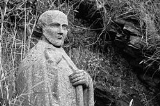
Gildas


   Email Print
   Bookmark   Link


Gildas


Saint Gildas (c. 516 – 570) was a 6th century British cleric
Cleric

A cleric , clergyman , or churchman is a member of the clergy of a religion, especially one who is a priest, preacher, or other religious professional....
. He is one of the best-documented figures of the Christian
Christianity

Christianity is a Monotheistic religion #Christian view religion centered on the life and teachings of Jesus as New Testament view on Jesus' life....
 church in the British Isles
British Isles

The British Isles are a group of islands off the northwest coast of continental Europe that include Great Britain and Ireland, and numerous smaller islands....
 during the 6th century. His renowned learning and literary style earned him the designation Gildas Sapiens (Gildas the Wise). He was ordained in the Church, and in his works favoured the monastic
Monasticism

Monasticism is the religion practice in which one renounces world pursuits in order to fully devote one's life to spiritual work. The origin of the word is from Ancient Greek, and the idea was originally related to Christian monks....
 ideal. Fragments of letters he wrote reveal that he composed a Rule for monastic life that was somewhat less austere than the Rule written by his contemporary, Saint David
Saint David

Saint David was a church official; he was later regarded as a saint and as the patron saint of Wales. In contrast with the other national patron saints of the British Isles, Saints Saint George, Saint Andrew and Saint Patrick, David is a native of the country of which he is patron saint, and a relatively large amount of information is known...
, and set suitable penances for its breach.

e are two Lives of Gildas: the earlier written by a monk of Rhuys in Brittany
Brittany

Brittany is a former independent Celtic nations monarchy and duchy, now incorporated into France. It is also, more generally, the name of the cultural area whose limits correspond to the historic province and independent duchy....
, possibly in the 9th century, the second written by Caradoc of Llancarfan
Caradoc of Llancarfan

Caradoc of Llancarfan was a monk at the monastery of Llancarfan in Wales during the 12th century. He was the author of a largely fictional Life of Gildas in Latin language, and began the Historie of Cambria, a chronicle of Welsh history that was later taken up by David Powel in the 16th century....
, a friend and contemporary of Geoffrey of Monmouth
Geoffrey of Monmouth

Geoffrey of Monmouth was a clergyman and one of the major figures in the English historians in the Middle Ages and the popularity of tales of King Arthur....
, composed in the middle of the 12th century.


Discussion
Ask a question about 'Gildas'
Start a new discussion about 'Gildas'
Answer questions from other users
Full Discussion Forum


Encyclopedia


Saint Gildas (c. 516 – 570) was a 6th century British cleric
Cleric

A cleric , clergyman , or churchman is a member of the clergy of a religion, especially one who is a priest, preacher, or other religious professional....
. He is one of the best-documented figures of the Christian
Christianity

Christianity is a Monotheistic religion #Christian view religion centered on the life and teachings of Jesus as New Testament view on Jesus' life....
 church in the British Isles
British Isles

The British Isles are a group of islands off the northwest coast of continental Europe that include Great Britain and Ireland, and numerous smaller islands....
 during the 6th century. His renowned learning and literary style earned him the designation Gildas Sapiens (Gildas the Wise). He was ordained in the Church, and in his works favoured the monastic
Monasticism

Monasticism is the religion practice in which one renounces world pursuits in order to fully devote one's life to spiritual work. The origin of the word is from Ancient Greek, and the idea was originally related to Christian monks....
 ideal. Fragments of letters he wrote reveal that he composed a Rule for monastic life that was somewhat less austere than the Rule written by his contemporary, Saint David
Saint David

Saint David was a church official; he was later regarded as a saint and as the patron saint of Wales. In contrast with the other national patron saints of the British Isles, Saints Saint George, Saint Andrew and Saint Patrick, David is a native of the country of which he is patron saint, and a relatively large amount of information is known...
, and set suitable penances for its breach.

Life

There are two Lives of Gildas: the earlier written by a monk of Rhuys in Brittany
Brittany

Brittany is a former independent Celtic nations monarchy and duchy, now incorporated into France. It is also, more generally, the name of the cultural area whose limits correspond to the historic province and independent duchy....
, possibly in the 9th century, the second written by Caradoc of Llancarfan
Caradoc of Llancarfan

Caradoc of Llancarfan was a monk at the monastery of Llancarfan in Wales during the 12th century. He was the author of a largely fictional Life of Gildas in Latin language, and began the Historie of Cambria, a chronicle of Welsh history that was later taken up by David Powel in the 16th century....
, a friend and contemporary of Geoffrey of Monmouth
Geoffrey of Monmouth

Geoffrey of Monmouth was a clergyman and one of the major figures in the English historians in the Middle Ages and the popularity of tales of King Arthur....
, composed in the middle of the 12th century. Caradoc does not mention any connection with Brittany, and some scholars think that Gildas of Britain and Gildas of Rhuys were distinct personages. In other details, however, the two Lives complement each other.

Rhuys Life

The first Life written at Rhuys by an unnamed scribe says that Gildas was the son of Caunus (Caw), born in the district of Arecluta (Alt Clut or Strathclyde
Kingdom of Strathclyde

Strathclyde , originally Brythonic language Ystrad Clud, was one of the kingdoms of the Brythons in the northern part of the island Great Britain throughout the Sub-Roman Britain period , and the Scotland in the Middle Ages....
). He was entrusted into the care of Saint Hildutus (Illtud
Illtud

Illtud , was a Wales saint, founder and abbot of Llantwit Major in the Wales county of Glamorgan....
) along with Samson of Dol
Samson of Dol

Saint Samson of Dol was a Celtic Christianity religious figure who is counted among the seven founder saints of Brittany. Born in southern Wales, he died in Dol-de-Bretagne, a small town in north Brittany....
 and Paul Aurelian
Paul Aurelian

Paul Aurelian is a 6th century Welsh people saint, who became one of the seven founder saints of Brittany.His hagiography Life was completed in 884 by a Breton monk named Wrmonoc of Land?vennec:...
, to be educated. He later went to Iren (Ireland
Ireland

Ireland is the List of islands by area in Europe, and the twentieth-largest island in the world. It lies to the north-west of continental Europe and is surrounded by hundreds of islands and islet....
) to continue his studies. Having been ordained, he went to North Britain
Hen Ogledd

Yr Hen Ogledd is a Welsh language term meaning 'The Old North' and referring to the Sub-Roman Britain Brythonic kingdoms located in what is now northern England and southern Scotland....
 to preach to the unconverted. Saint Brigidda (Brigid of Kildare
Brigid of Kildare

Saint Brigid of Kildare or Brigid of Ireland was an Ireland Roman Catholic nun, abbess, and founder of several convents who is venerated as a saint....
, died 524) asked for a token and Gildas made a bell which he sent to her. Ainmericus, King of all Ireland (Ainmere, 566-569), asked Gildas to restore church order, which he did. He went to Rome
Rome

Rome is the capital city of Italy and Lazio, and is Italy's largest and most populous city, with 2,724,347 residents in an urban area of some ....
 and then Ravenna
Ravenna

Ravenna is a city and comune in the Emilia-Romagna region of Italy. The city is inland, but is connected to the Adriatic Sea by a canal. Ravenna once served as the seat of the Western Roman Empire and later the Ostrogoths and the Exarchate of Ravenna....
. He came to Brittany and settled on the island of Rhuys
Saint-Gildas-de-Rhuys

Saint-Gildas-de-Rhuys is a Communes of France in the Morbihan Departments of France in Bretagne in northwestern France.Its name refers to Saint Gildas, who was a monk at Rhuys....
, where he lived a solitary life. Later, he built a monastery there. He built an oratory on the bank of the River Blavetum (River Blavet
Blavet

The Blavet river flows from central Brittany and enters the Atlantic Ocean on the south coast near Lorient. The river is canalized for most of its length and is navigable for smaller craft....
). Ten years after leaving Britain, he wrote an epistolary book, in which he reproved five of the Brython
Brython

Historically, the Britons were the P-Celtic indigenous peoples inhabiting the island of Great Britain south of the river Forth. They were speakers of the Brythonic languages and shared common cultural traditions; the surviving P-Celtic languages are Welsh language, Cornish language and Breton....
ic kings. He died at Rhuys on 29 January, and his body, according to his wishes, was placed on a boat and allowed to drift. Three months later, on 11 May, men from Rhuys found the ship in a creek with the body of Gildas still intact. They took the body back to Rhuys and buried it there.

Llancarfan Life

Caradoc of Llancarfan, influenced by Geoffrey of Monmouth
Geoffrey of Monmouth

Geoffrey of Monmouth was a clergyman and one of the major figures in the English historians in the Middle Ages and the popularity of tales of King Arthur....
 and his Norman patrons, and drawing on the Life of Cadoc
Cadoc

Saint Cadoc or Cadog , Abbot of Llancarfan, was one of the 6th century Religion in Wales, whose vita twice mentions King Arthur. The Abbey of Llancarfan, near Cowbridge in Glamorganshire, which he founded circa 518, became famous as a centre of learning....
 among other sources, paints a somewhat different picture, including the statements that Gildas was educated in Gaul
Gaul

Gaul is the name used for the region of Western Europe comprising part of present day northern Italy, France, Belgium, western Switzerland and the parts of the Netherlands and Germany on the west bank of the River Rhine....
, retired to a hermit
Hermit

A hermit is a person who lives to some greater or lesser degree in solitude and/or isolation from society.In Christianity the term was originally applied to a Christian who lives the eremitic life out of a religious conviction, namely the Catholic spirituality#Desert spirituality of the Old Testament ....
age dedicated to the Trinity, at Street
Street, Somerset

Street is a village and civil parish in the county of Somerset, England, situated on a dry spot in the Somerset Levels, at the end of the Polden Hills, two miles south-west of Glastonbury....
, near Glastonbury
Glastonbury

Glastonbury is a small town in Somerset, England, situated at a dry point on the Somerset Levels, south of Bristol. The town has a population of 8,800....
 and was buried at Glastonbury Abbey
Glastonbury Abbey

Glastonbury Abbey, founded in the seventh century, was a rich and powerful monastery in Glastonbury, Somerset, England. It became associated with the legends of the Holy Grail and King Arthur in the tenth century....
. Some scholars who have studied the texts suspect the latter to be a piece of Glastonbury propaganda.

Caradoc tells a story of how Gildas intervened between King Arthur
King Arthur

King Arthur is a legendary Britons leader who, according to medieval histories and Romance , led the defence of Britain against the Saxon invaders in the early 6th century....
 and a certain King Melwas
Maleagant

Maleagant is a villain from Arthurian legend. Originally a Knight of the Round Table son of King Bagdemagus of Gorre, his claim to fame is as the abductor of Guinevere....
 of the 'Summer Country' who had abducted Guinevere
Guinevere

Guinevere was the legendary queen consort of King Arthur. She was most famous for her love affair with Arthur's chief knight Sir Lancelot, which first appears in Chr?tien de Troyes' Lancelot, the Knight of the Cart....
 and brought her to his stronghold at Glastonbury, where Arthur soon arrived to besiege him. However, the peacemaking saint persuaded Melwas to release Guinevere and the two kings made peace. Caradoc also says that the brothers of Gildas rose up against Arthur, refusing to acknowledge him as their lord. Arthur pursued Huail ap Caw, the eldest brother, and killed him. Gildas was preaching in Armagh
Armagh

The city of Armagh is an ancient religious site of worship of both Celtic paganism and Christianity, the oldest of the five City status in the United Kingdom in Northern Ireland, and the county town of County Armagh....
 in Ireland, at the time, and he was grieved by the news.

According to the dates in the Annales Cambriae
Annales Cambriae

Annales Cambriae, or The Annals of Wales, is the name given to a complex of Cambro-Latin chronicles deriving ultimately from a text compiled from diverse sources at St David's in Dyfed, Wales, not later than the 10th century....
, Gildas would have been a contemporary of King Arthur. However, his work never mentions Arthur by name.

Further traditions

A strongly held tradition in north Wales
North Wales

File:North Wales .pngNorth Wales is the northernmost unofficial region of Wales, bordered to the south by Mid Wales and to the east by England....
 places the beheading of Gildas' brother, Huail, at Ruthin
Ruthin

Ruthin , pronounced RITH-in , is the county town of Denbighshire in north Wales. Located around a hill in the southern part of the Vale of Clwyd - the older part of the town, the castle and Saint Peter's Square are located on top of the hill, while many newer parts of the town are on the floodplain of the River Clwyd ....
, where what is believed to be the actual execution stone has been preserved in the town square. Another brother of Gildas, Celyn ap Caw was based at Garth Celyn
Garth Celyn

Garth Celyn at Aber Garth Celyn, now known as Abergwyngregyn, Aber, in Gwynedd, north Wales, was the 13th century home of the Welsh princes , Llywelyn Fawr, Dafydd ap Llywelyn and Llywelyn the Last....
 on the north coast of Gwynedd
Gwynedd

Gwynedd is a Administrative divisions of Wales in north-west Wales, named after the old Kingdom of Gwynedd. Although one of the biggest in terms of geographical area, it is also one of the most sparsely populated....
 together with the territory of land watching over the Copper Mountain on Anglesey
Anglesey

Anglesey is an island and principal areas of Wales off the northwest coast of Wales, with a predominantly Welsh language-speaking population. It is connected to the mainland by two bridges spanning the Menai Strait: the original Menai Suspension Bridge , designed by Thomas Telford in 1826; and the newer reconstructed Britannia Bridge ; which...
.

Gildas is credited with a hymn
Hymn

A hymn is a type of song, usually religious, specifically written for the purpose of praise, adoration or prayer, and typically addressed to a deity/deities, a prominent figure or an epic tale....
 called the Lorica, or Breastplate, a prayer to be delivered from evil
Evil

Evil, in many cultures, is a broad term used to describe intentional negative moral acts or thoughts that are cruel, unjust or selfish. Evil is usually good and evil, which describes acts that are kind, just or unselfish....
, which contains interesting specimens of Hiberno-Latin
Hiberno-Latin

Hiberno-Latin, also called Hisperic Latin, was a learned sort of Latin literature created and spread by Irish monks during the period from the sixth century to the tenth century....
. A proverb is also attributed to Gildas mab y Gaw in the 'Englynion y Clyweid' in Llanstephan MS. 27.

In Bonedd y Saint, Gildas is recorded as having three sons and a daughter. Gwynnog ap Gildas and Noethon ap Gildas are named in the earliest tracts, together with their sister Dolgar. Another son, Tydech, is named in a later document. The unreliable Iolo Morganwg
Iolo Morganwg

Iolo Morganwg...
 adds Saint Cenydd
Cenydd

Cenydd was a Welsh people hermit saint who traditionally lived in the 6th century. He should not be confused with Saint Kenneth an Ireland saint most popular in Scotland....
 to the list.

The scholar David Dumville
David Dumville

Professor David Norman Dumville is a British medievalist and Celtic scholar. He was educated at Emmanuel College, University of Cambridge, Ludwig-Maximilians-Universit?t M?nchen, Munich, and received his PhD....
 suggests that Gildas was the teacher of Vennianus of Findbarr, who in turn was the teacher of St. Columba
Columba

Early life in IrelandColumba was born to Fedlimid and Eithne of the Cenel Conaill in Gartan, near Lough Gartan, County Donegal, in Ireland. On his father's side he was great-great-grandson of Niall of the Nine Hostages, an High King of Ireland of the 5th century....
 of Iona
Iona

Iona is a small island in the Inner Hebrides of Scotland that has an important place in the history of Christianity in Scotland and is renowned for its tranquility and natural beauty....
.

De Excidio et Conquestu Britanniae

Gildas' surviving written work, De Excidio et Conquestu Britanniae or On the Ruin and Conquest of Britain, is a sermon in three parts condemning the acts of his contemporaries, both secular and religious. The first part consists of Gildas' explanation for his work and a brief narrative of Roman Britain
Roman Britain

Roman Britain refers to those parts of the island of Great Britain controlled by the Roman Empire between AD 43 and 410. The Romans referred to their province as Britannia....
 from its conquest under the principate to Gildas' time:

Concerning her obstinacy, subjection and rebellion, about her second subjection and harsh servitude; concerning religion, of persecution, the holy martyrs, many heresies, of tyrants, of two plundering races, concerning the defense and a further devastation, of a second vengeance and a third devastation, concerning hunger, of the letter to Agitius [usually identified with the patrician Aëtius
Flavius Aëtius

Flavius A?tius or simply A?tius, , dux et patricius, was a Roman Empire general of the closing period of the Western Roman Empire. He was an able military commander and the most influential man of the Western Roman Empire for two decades ....
], of victory, of crimes, of enemies suddenly announced, a memorable plague, a council, an enemy more savage than the first, the subversion of cities, concerning those whose survived, and concerning the final victory of our country that has been granted to our time by the will of God.
In the second part, opening with the assertion "Britain has kings, yet they are tyrants; it has judges, yet they are undutiful", Gildas addresses the lives and actions of five contemporary rulers: Constantine
Constantine of Cornwall

Constantine was an early 6th century king of Dumnonia in West Country Great Britain, sometimes identified with a saint of the same name.All that is known for certain about Constantine comes from the writings of Gildas, who calls him "the tyrannical whelp of the unclean lioness of Damnonia"....
 of Dumnonia
Dumnonia

Dumnonia was a Brythonic kingdom of sub-Roman Britain, located in the West Country of modern England and covering Devon, most of Somerset and possibly part of Dorset, its eastern boundary being uncertain....
, Aurelius Caninus
Aurelius Conanus

Aurelius Conanus is a List of legendary kings of Britain of the Brython, according to Geoffrey of Monmouth's Historia regum Britanniae, a fictional account of the rulers of Great Britain....
, Vortiporius
Vortiporius

Vortiporius was a 6th century king or ruler of Dyfed in south-west Wales, an area roughly corresponding to the modern Pembrokeshire. He is one of five kings castigated for their sins by Gildas in De Excidio Britanniae:...
 of the Demetae
Demetae

The Demetae were a Celts people of British Iron Age who inhabited modern Pembrokeshire and Carmarthenshire in south-west Wales, and gave their name to the county of Dyfed....
 (now called Dyfed
Dyfed

Dyfed is a Preserved counties of Wales of Wales.Dyfed was created by the Local Government Act 1972 on 1 April 1974. It covered the former counties of Cardiganshire, Carmarthenshire, Pembrokeshire and was divided into districts of Wales as so:...
), Cuneglas
Cuneglas

Cuneglas . He is recorded as a son of Owain Ddantgwyn, a popular contender for an historical basis to the famous King Arthur. Both father and son were, according to one Old Welsh genealogical source, Kings of Rhos , later a Welsh cantref and afterwards a part of Denbighshire, in mid-North Wales....
us apparently of 'the Bear's Home' (possibly 'the Bear's Stronghold' — Dinarth at Llandrillo-yn-Rhôs near Llandudno
Llandudno

Llandudno is a seaside resort and town in Conwy , Wales. In the 2001 UK census it had a population of 20,090 including that of Penrhyn Bay and Penrhynside, which are within the Llandudno Community ....
), and lastly Maglocunus or Maelgwn
Maelgwn Hir ap Cadwallon

Maelgwn Gwynedd, more formally Maelgwn ap Cadwallon , also known as Maelgwn Hir , was an early king of Kingdom of Gwynedd and a character from Welsh mythology....
. Without exception, Gildas declares each of these rulers cruel, rapacious, and living a life of sin.

The third part begins with the words, "Britain has priests, but they are fools; numerous ministers, but they are shameless; clerics, but they are wily plunderers." Gildas continues his jeremiad
Jeremiad

A jeremiad is a long literary work, usually in prose, but sometimes in poetry, in which the author bitterly laments the state of society and its morals in a serious tone of sustained invective, and always contains a prophecy of society's imminent downfall....
 against the clergy of his age, but does not explicitly mention any names in this section, and so does not cast any light on the history of the Christian church in this period.

Gildas's work is of great importance to historians, because although it is not intended primarily as history, it is almost the only surviving source written by a near-contemporary of British events in the fifth and sixth centuries. The usual date that has been given for the composition of the work is some time in the 540s, but it is now regarded as quite possibly earlier, in the first quarter of the sixth century, or even before that.

The student must remember that Gildas' intent in his writing is to preach to his contemporaries after the manner of an old testament prophet, not to write an account for posterity: while Gildas offers one of the first descriptions of the Hadrian's Wall
Hadrian's Wall

Hadrian's Wall is a Rock and Sod fortification built by the Roman Empire across the width of what is now northern England. Begun in AD 122, during the rule of emperor Hadrian, it was the middle of three such fortifications built across Great Britain, the first being from the River Clyde to the River Forth under Agricola and the last the Ant...
 -- albeit highly historically inaccurate -- he also omits details where they do not contribute to his message. Nonetheless, it remains an important work for not only Medieval but English
England

native_name =|conventional_long_name = England|common_name = England|image_flag = Flag of England.svg|image_coat = England COA.svg|symbol_type = Royal Coat of Arms...
 history for being one of the few works written in Britain to survive from the sixth century.

In De Excidio et Conquestu Britanniae, Gildas mentions that the year of his birth was the same year that the Battle of Mons Badonicus took place in. The Annales Cambriae
Annales Cambriae

Annales Cambriae, or The Annals of Wales, is the name given to a complex of Cambro-Latin chronicles deriving ultimately from a text compiled from diverse sources at St David's in Dyfed, Wales, not later than the 10th century....
 gives the year of his death as 570; however the Annals of Tigernach
Annals of Tigernach

The Annals of Tigernach is a chronicle probably originating in Clonmacnoise, Ireland. The language is a mixture of Latin language and Old Irish and Middle Irish....
 date his death to 569.

Gildas's treatise was first published in 1525 by Polydore Vergil
Polydore Vergil

Polydore Vergil or Virgil was an England historian, of Italy birth, otherwise known as PV Castellensis. He is a primary source for the early Tudor dynasty, though his historical accuracy is often questioned....
, but with many avowed alterations and omissions. In 1568 John Josseline, secretary to Archbishop Parker, issued a new edition of it more in conformity with manuscript authority; and in 1691 a still more carefully revised edition appeared at Oxford by Thomas Gale
Thomas Gale

Thomas Gale was an English classical scholar and antiquarian....
. It was frequently reprinted on the Continent during the 16th century, and once or twice since. The next English edition, described by August Potthast as editio pessima, was that published by the English Historical Society in 1838, and edited by the Rev. J. Stevenson. The text of Gildas founded on Gale's edition collated with two other MSS
MSS

MSS may refer to:Medicine* Medical Student SyndromePlaces* Manufacturing Solution Systems* Massena International Airport, an airport in Massena, New York...
, with elaborate introductions, is included in the Monumenta Historica Britannica
Monumenta Historica Britannica

Monumenta Historica Britannica , Or Materials for the History of Britain, From the Earliest Period, is an incomplete work by Keeper of the Records of the Tower of London Henry Petrie , assisted by John Sharpe....
. Another edition is in Arthur West Haddan and Will Stubbs, Councils and ecclesiastical documents relating to Great Britain and Ireland (Oxford, 1869); the latest edition is that by Theodor Mommsen
Theodor Mommsen

Christian Matthias Theodor Mommsen was a Germany classics, historian, jurist, journalist, politician, archaeologist, and writer generally regarded as the greatest classicist of the 19th century....
 in Monumenta Germaniae Historica
Monumenta Germaniae Historica

The Monumenta Germaniae Historica is a comprehensive series of carefully edited and published sources for the study of History of Germany from the end of the Roman Empire to 1500....
 auct. antiq. xiii. (Chronica min. iii.), 1894.

Legacy in the Anglo-Saxon Period

Following the conquest of Britain described in De excidio, Gildas continued to provide an important model for Anglo-Saxon writers both in Latin and in English. Bede
Bede

Bede , , was a monasticism at the Northumbrian monastery of Saint Peter at Monkwearmouth, today part of Sunderland, England, and of its companion monastery, Saint Paul's, in modern Jarrow , both in the Kingdom of Northumbria....
's Historia ecclesiastica relies heavily on Gildas for its account of the Anglo-Saxon invasions, and draws out the implications of Gildas's thesis of loss of divine favour by the Britons to suggest that this favour has in turn passed to the now Christianised Anglo-Saxons.

In the later Old English period, Gildas's writing provides a major model for Alcuin
Alcuin

Alcuin of York or Ealhwine, nicknamed Albinus or Flaccus was a scholar, ecclesiastic, poet and teacher from York, Northumbria....
's treatment of the Viking invasions, in particular his letters relating to the sack of Lindisfarne
Lindisfarne

Lindisfarne is a tidal island off the north-east coast of England also known as Holy Island, the name of the civil parish. It has a population of 162 ...
 in 793. The invocation of Gildas as a historical example serves to suggest the idea of moral and religious reform as a remedy for the invasions. Likewise, Wulfstan of York draws on Gildas to make a similar point in his sermons, particularly in the Sermo Lupi ad Anglos
Sermo Lupi ad Anglos

The Sermo Lupi ad Anglos is the title given to a homily composed in England between A.D. 1010-1016 by Wulfstan II, Archbishop of York , who commonly styled himself Lupus, or 'wolf' after the first element in his name [wulf-stan = 'wolf-stone']....
.

Other historical implications

Gildas's work is important for reasons beyond the historical information he provides. It is clear that at the time when he was writing there was an effective (and British) Christian church. Gildas uses Latin to address his points to the rulers he excoriates; and he regards Britons, at least to some degree, as Roman citizens, despite the collapse of central imperial authority. By 597, when St Augustine arrived in Kent, what is now England was almost completely pagan, and the illiterate new rulers did not think of themselves as Roman citizens. Dating Gildas's words more exactly would hence provide a little more certainty about the timeline of the transition from post-Roman Britain to the rule of the Anglo-Saxons; a certainty that would be the more valuable as precise dates and reliable facts are extremely scarce for this period.

See also

  • Groans of the Britons
    Groans of the Britons

    The Groans of the Britons is the name of the final appeal made by the post-Roman Romano-British population of Sub-Roman Britain for assistance against foreign invasion....
  • English historians in the Middle Ages
    English historians in the Middle Ages

    English historians in the Middle Ages helped to lay the groundwork for modern historical historiography, providing vital accounts of the early history of England, Wales and Normandy, its cultures, and revelations about the historians themselves....


External links

  • translated by John Allen Giles.
  • by Caradoc of Llancarfan
    Caradoc of Llancarfan

    Caradoc of Llancarfan was a monk at the monastery of Llancarfan in Wales during the 12th century. He was the author of a largely fictional Life of Gildas in Latin language, and began the Historie of Cambria, a chronicle of Welsh history that was later taken up by David Powel in the 16th century....
    .
  • commentary from The Cambridge History of English and American Literature
    The Cambridge History of English and American Literature

    The Cambridge History of English and American Literature. Originally published in 1907-1921, the 18 volumes include 303 chapters and more than 11,000 pages, edited and written by a worldwide panel of 171 leading scholars and thinkers of the early twentieth century....
    , Volume 1, 1907–21.