


Cross-Strait relations

Encyclopedia
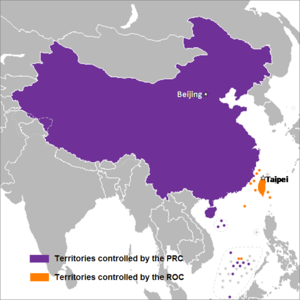
People's Republic of China
China , officially the People's Republic of China , is the most populous country in the world, with over 1.3 billion citizens. Located in East Asia, the country covers approximately 9.6 million square kilometres...
("Mainland China") and the Republic of China
Republic of China
The Republic of China , commonly known as Taiwan , is a unitary sovereign state located in East Asia. Originally based in mainland China, the Republic of China currently governs the island of Taiwan , which forms over 99% of its current territory, as well as Penghu, Kinmen, Matsu and other minor...
("Taiwan"), which lie to the west and east, repectively, of the Taiwan Strait
Taiwan Strait
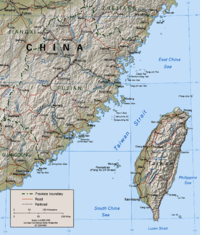
The Taiwan Strait or Formosa Strait, formerly known as the Black Ditch, is a 180-km-wide strait separating Mainland China and Taiwan. The strait is part of the South China Sea and connects to East China Sea to the northeast...
in the west Pacific Ocean
Pacific Ocean
The Pacific Ocean is the largest of the Earth's oceanic divisions. It extends from the Arctic in the north to the Southern Ocean in the south, bounded by Asia and Australia in the west, and the Americas in the east.At 165.2 million square kilometres in area, this largest division of the World...
.
In 1949, with the Chinese Civil War
Chinese Civil War
The Chinese Civil War was a civil war fought between the Kuomintang , the governing party of the Republic of China, and the Communist Party of China , for the control of China which eventually led to China's division into two Chinas, Republic of China and People's Republic of...
turning decisively in the Communists
Communist Party of China
The Communist Party of China , also known as the Chinese Communist Party , is the founding and ruling political party of the People's Republic of China...
' (CPC's) favour, the ROC government led by the Kuomintang
Kuomintang
The Kuomintang of China , sometimes romanized as Guomindang via the Pinyin transcription system or GMD for short, and translated as the Chinese Nationalist Party is a founding and ruling political party of the Republic of China . Its guiding ideology is the Three Principles of the People, espoused...
(KMT) retreated to Taipei
Taipei
Taipei City is the capital of the Republic of China and the central city of the largest metropolitan area of Taiwan. Situated at the northern tip of the island, Taipei is located on the Tamsui River, and is about 25 km southwest of Keelung, its port on the Pacific Ocean...
, in Taiwan
Taiwan
Taiwan , also known, especially in the past, as Formosa , is the largest island of the same-named island group of East Asia in the western Pacific Ocean and located off the southeastern coast of mainland China. The island forms over 99% of the current territory of the Republic of China following...
, while the CPC proclaimed the PRC government in Beijing
Beijing
Beijing , also known as Peking , is the capital of the People's Republic of China and one of the most populous cities in the world, with a population of 19,612,368 as of 2010. The city is the country's political, cultural, and educational center, and home to the headquarters for most of China's...
.
Since then, the relations between mainland China and Taiwan have been characterised by limited contact, tensions, and instability. In the early years, military conflicts continued, while diplomatically both governments competed to be the legitimate government of "China
China (disambiguation)
China, officially the People's Republic of China, is a large country in Asia.China may also refer to:-East Asia:* Republic of China, the country commonly known as "Taiwan"...
". More recently, the legal
Legal status of Taiwan
The legal status of Republic of China is a controversial issue which stems from the complex post-Second World War history of Taiwan. Various claims have been made by the People's Republic of China , the Republic of China , and supporters of Taiwan independence over this question, with a variety of...
and political status of Taiwan
Political status of Taiwan
The controversy regarding the political status of Taiwan hinges on whether Taiwan, Penghu, Kinmen, and Matsu should remain effectively independent as territory of the Republic of China , become unified with the territories now governed by the People's Republic of China , or formally declare...
have become more controversial, when the expression of pro-Taiwan independence
Taiwan independence
Taiwan independence is a political movement whose goals are primarily to formally establish the Republic of Taiwan by renaming or replacing the Republic of China , form a Taiwanese national identity, reject unification and One country, two systems with the People's Republic of China and a Chinese...
sentiments are no longer suppressed and outlawed. At the same time, there has been increasing non-governmental and semi-governmental exchanges between the two sides. From 2008, negotiations began to restore the "three links
Three Links
The Three Links or Three Linkages was a "message of Compatriots in Taiwan" calling for the unification of mainland China and Taiwan. It was sent by the PRC National People's Congress in 1979....
" (transportation, commerce, and communications) between the two sides, cut off since 1949. Party-to-party talks between the CPC and the KMT have resumed and semi-official negotiations through organizations representing the interests of their respective governments are being scheduled.
The English expression "cross-Strait relations" has been used by the two sides concerned and by many observers so that the relationship between mainland China and Taiwan would not be referred to as "China–Taiwan relations" or "PRC–ROC relations". The former term implies the exclusion of Taiwan
Taiwan
Taiwan , also known, especially in the past, as Formosa , is the largest island of the same-named island group of East Asia in the western Pacific Ocean and located off the southeastern coast of mainland China. The island forms over 99% of the current territory of the Republic of China following...
from China
China
Chinese civilization may refer to:* China for more general discussion of the country.* Chinese culture* Greater China, the transnational community of ethnic Chinese.* History of China* Sinosphere, the area historically affected by Chinese culture...
, and is considered non-neutral. The latter term implies the co-existence of the two governments as states, and does not reflect the official positions of either government. There is also no commonly used Chinese language
Chinese language
The Chinese language is a language or language family consisting of varieties which are mutually intelligible to varying degrees. Originally the indigenous languages spoken by the Han Chinese in China, it forms one of the branches of Sino-Tibetan family of languages...
term equivalent to the latter two terms.
Before 1949
The early history of cross-Strait relations involved the exchange of cultures, people, and technology. However, no Chinese dynasty formally incorporated Taiwan in ancient times. In the 16th and 17th centuries, Taiwan caught the attention of first PortuguesePortugal
Portugal , officially the Portuguese Republic is a country situated in southwestern Europe on the Iberian Peninsula. Portugal is the westernmost country of Europe, and is bordered by the Atlantic Ocean to the West and South and by Spain to the North and East. The Atlantic archipelagos of the...
, then Dutch
Netherlands
The Netherlands is a constituent country of the Kingdom of the Netherlands, located mainly in North-West Europe and with several islands in the Caribbean. Mainland Netherlands borders the North Sea to the north and west, Belgium to the south, and Germany to the east, and shares maritime borders...
and Spanish
Spain
Spain , officially the Kingdom of Spain languages]] under the European Charter for Regional or Minority Languages. In each of these, Spain's official name is as follows:;;;;;;), is a country and member state of the European Union located in southwestern Europe on the Iberian Peninsula...
explorers. In 1624, the Dutch established their first settlement in Taiwan. In 1662, Zheng Chenggong
Koxinga
Koxinga is the customary Western spelling of the popular appellation of Zheng Chenggong , a military leader who was born in 1624 in Hirado, Japan to Zheng Zhilong, a Chinese merchant/pirate, and his Japanese wife and died in 1662 on the island of Formosa .A Ming loyalist and the arch commander of...
, a Ming
Ming Dynasty
The Ming Dynasty, also Empire of the Great Ming, was the ruling dynasty of China from 1368 to 1644, following the collapse of the Mongol-led Yuan Dynasty. The Ming, "one of the greatest eras of orderly government and social stability in human history", was the last dynasty in China ruled by ethnic...
-loyalist, defeated the Dutch rulers of Taiwan, and took the island, establishing the first formally Han Chinese
Han Chinese
Han Chinese are an ethnic group native to China and are the largest single ethnic group in the world.Han Chinese constitute about 92% of the population of the People's Republic of China , 98% of the population of the Republic of China , 78% of the population of Singapore, and about 20% of the...
regime in Taiwan. Zheng's heirs used Taiwan as a base for launching raids into mainland China against the Manchu
Manchu
The Manchu people or Man are an ethnic minority of China who originated in Manchuria . During their rise in the 17th century, with the help of the Ming dynasty rebels , they came to power in China and founded the Qing Dynasty, which ruled China until the Xinhai Revolution of 1911, which...
Qing Dynasty
Qing Dynasty
The Qing Dynasty was the last dynasty of China, ruling from 1644 to 1912 with a brief, abortive restoration in 1917. It was preceded by the Ming Dynasty and followed by the Republic of China....
. However, they were defeated in 1683 by Qing
Qing Dynasty
The Qing Dynasty was the last dynasty of China, ruling from 1644 to 1912 with a brief, abortive restoration in 1917. It was preceded by the Ming Dynasty and followed by the Republic of China....
forces. The following year, Taiwan was incorporated into Fujian province. Over the next two centuries, the Imperial government paid little attention to Taiwan.
The situation changed in the 19th century, with other powers increasingly eying Taiwan for its strategic location and resources. In response, the administration began to implement a modernization drive. In 1885, the Imperial government raised Taiwan to a province
Taiwan Province
Taiwan Province is one of the two administrative divisions referred to as provinces and is controlled by the Republic of China . The province covers approximately 73% of the territory controlled by the Republic of China...
. Within 10 years, Taiwan had become one of the most modern provinces in the Empire. However, the fall of the Qing outpaced the development of Taiwan, and in 1895, following its defeat in the First Sino-Japanese War
First Sino-Japanese War
The First Sino-Japanese War was fought between Qing Dynasty China and Meiji Japan, primarily over control of Korea...
, the Imperial government ceded Taiwan to Japan
Japan
Japan is an island nation in East Asia. Located in the Pacific Ocean, it lies to the east of the Sea of Japan, China, North Korea, South Korea and Russia, stretching from the Sea of Okhotsk in the north to the East China Sea and Taiwan in the south...
in perpetuity. Qing loyalists briefly resisted the Japanese rule under the banner of the "Republic of Taiwan", but order was quickly established by Japanese authorities.
Japan ruled Taiwan until 1945. During this time, Taiwan, as part of the Japanese Empire, was a foreign jurisdiction in relation to first the Qing Empire
Qing Dynasty
The Qing Dynasty was the last dynasty of China, ruling from 1644 to 1912 with a brief, abortive restoration in 1917. It was preceded by the Ming Dynasty and followed by the Republic of China....
, and, after 1912, the ROC. In 1945, Japan was defeated in World War II
World War II
World War II, or the Second World War , was a global conflict lasting from 1939 to 1945, involving most of the world's nations—including all of the great powers—eventually forming two opposing military alliances: the Allies and the Axis...
and surrendered its forces in Taiwan to the ROC, then ruled by the Kuomintang
Kuomintang
The Kuomintang of China , sometimes romanized as Guomindang via the Pinyin transcription system or GMD for short, and translated as the Chinese Nationalist Party is a founding and ruling political party of the Republic of China . Its guiding ideology is the Three Principles of the People, espoused...
(KMT). The period of post-war Kuomintang rule over China (1945–1949) was marked in Taiwan by conflicts between local residents and the new KMT authority, most violently in the 228 Incident
228 Incident
The 228 Incident, also known as the 228 Massacre, was an anti-government uprising in Taiwan that began on February 27, 1947, and was violently suppressed by the Kuomintang government. Estimates of the number of deaths vary from 10,000 to 30,000 or more...
, which occurred on February 28, 1947. The seeds for the Taiwan autonomy and independence movement were sown in this time. During this time and in subsequent periods, the Taiwan autonomy and independence movement was allied with the CPC in the struggle against Chiang Kai-shek
Chiang Kai-shek
Chiang Kai-shek was a political and military leader of 20th century China. He is known as Jiǎng Jièshí or Jiǎng Zhōngzhèng in Mandarin....
's KMT-led government in the ROC. Indeed, one such organization, the Taiwan Democratic Self-Government League
Taiwan Democratic Self-Government League
The Taiwan Democratic Self-Government League is one of the eight legally recognised political parties in the People's Republic of China that follow the direction of the Communist Party of China and are member of the Chinese People's Political Consultative Conference...
, remains one of the eight official minor parties in mainland China.
China was soon engulfed in full scale civil war
Chinese Civil War
The Chinese Civil War was a civil war fought between the Kuomintang , the governing party of the Republic of China, and the Communist Party of China , for the control of China which eventually led to China's division into two Chinas, Republic of China and People's Republic of...
. In 1949, the war turned decisively against the KMT and in favor of the CPC. On October 1, 1949, the CPC proclaimed the founding of the People's Republic of China
People's Republic of China
China , officially the People's Republic of China , is the most populous country in the world, with over 1.3 billion citizens. Located in East Asia, the country covers approximately 9.6 million square kilometres...
in Beijing
Beijing
Beijing , also known as Peking , is the capital of the People's Republic of China and one of the most populous cities in the world, with a population of 19,612,368 as of 2010. The city is the country's political, cultural, and educational center, and home to the headquarters for most of China's...
. The ROC government retreated, eventually declaring Taipei
Taipei
Taipei City is the capital of the Republic of China and the central city of the largest metropolitan area of Taiwan. Situated at the northern tip of the island, Taipei is located on the Tamsui River, and is about 25 km southwest of Keelung, its port on the Pacific Ocean...
its temporary capital in December 1949.
Military stalemate to diplomatic war (1949–1979)
The two governments continued in a state of war until 1979. In October 1949, PRC's attempt to take the ROC controlled island of KinmenKinmen
Kinmen , also known as Quemoy , is a small archipelago of several islands administered by the Republic of China : Greater Kinmen, Lesser Kinmen, and some islets. Administratively, it is Kinmen County of Fujian Province, ROC. The county is claimed by the People's Republic of China as part of its...
was thwarted in the Battle of Kuningtou
Battle of Kuningtou
The Battle of Guningtou , also known as the Battle of Jinmen , was a battle fought over Kinmen in the Taiwan Strait during the Chinese Civil War in 1949...
, halting the PLA advance towards Taiwan. The Communists' other amphibious operations of 1950 were more successful: they led to the Communist conquest of Hainan Island
Landing Operation on Hainan Island
Landing Operation on Hainan Island , also known as Hainan Island Campaign or Hainan Campaign for short, was a series of battles fought between the Kuomintang and the Communist Party of China during the Chinese Civil War in the post-World War II period, and resulted in a communist...
in April 1950,
capture of Wanshan Islands
Wanshan Archipelago Campaign
The Wanshan Archipelago Campaign was a campaign fought between the communist and the nationalist forces during the Chinese Civil War for the control of Wanshan Archipelago , and resulted in communist victory...
off the Guangdong
Guangdong
Guangdong is a province on the South China Sea coast of the People's Republic of China. The province was previously often written with the alternative English name Kwangtung Province...
coast (May–August 1950) and of Zhoushan Island
Zhoushan Island
Zhoushan Island is the principal island of the namesake archipelago Zhoushan Islands, governed by Zhoushan City, Zhejiang Province, the People's Republic of China. Its name means "Boat Mountain", because its shape. It is the province's largest island, and third largest in mainland China...
off Zhejiang
Zhejiang
Zhejiang is an eastern coastal province of the People's Republic of China. The word Zhejiang was the old name of the Qiantang River, which passes through Hangzhou, the provincial capital...
(May 1950).
In June 1949, the ROC declared a "closure" of all mainland China ports and its navy attempted to intercept all foreign ships. The closure covered from a point north of the mouth of Min river in Fujian province to the mouth of the Liao river
Liao River
The Liao River is the principal river in northeast China . The province of Liaoning and the Liaodong Peninsula derive their names from the river....
in Manchuria. Since mainland China's railroad network was underdeveloped, north-south trade depended heavily on sea lanes. ROC naval activity also caused severe hardship for mainland China fishermen.
After losing mainland China, a group of approximately 12,000 KMT soldiers escaped to Burma and continued launching guerrilla attacks into southern China. Their leader, General Li Mi
Li Mi (ROC general)
Li Mi , was a high-ranking Nationalist general who participated in the anti-Communist Encirclement Campaigns, Second Sino-Japanese War and Chinese Civil War. He was one of the few Kuomintang commanders to achieve notable victories against both Chinese Communist forces and the Imperial Japanese Army...
, was paid a salary by the ROC government and given the nominal title of Governor of Yunnan
Yunnan
Yunnan is a province of the People's Republic of China, located in the far southwest of the country spanning approximately and with a population of 45.7 million . The capital of the province is Kunming. The province borders Burma, Laos, and Vietnam.Yunnan is situated in a mountainous area, with...
. Initially, the United States supported these remnants and the Central Intelligence Agency
Central Intelligence Agency
The Central Intelligence Agency is a civilian intelligence agency of the United States government. It is an executive agency and reports directly to the Director of National Intelligence, responsible for providing national security intelligence assessment to senior United States policymakers...
provided them with aid. After the Burmese government appealed to the United Nations
United Nations
The United Nations is an international organization whose stated aims are facilitating cooperation in international law, international security, economic development, social progress, human rights, and achievement of world peace...
in 1953, the U.S. began pressuring the ROC to withdraw its loyalists. By the end of 1954, nearly 6,000 soldiers had left Burma and Li Mi declared his army disbanded. However, thousands remained, and the ROC continued to supply and command them, even secretly supplying reinforcements at times.
The Kuomintang Islamic Insurgency in China (1950–1958)
Kuomintang Islamic Insurgency in China (1950–1958)
The Kuomintang Islamic Insurgency in China refers to a continuation of the Chinese Civil War by Muslim Kuomintang National Revolutionary Army forces in Northwest China, in the provinces of Gansu, Qinghai, Ningxia, Xinjiang, and another insurgency in Yunnan....
was fought by Muslim Kuomintang army officers who refused to surrender to the communists throughout the 1950s and 60's.
During the Korean War
Korean War
The Korean War was a conventional war between South Korea, supported by the United Nations, and North Korea, supported by the People's Republic of China , with military material aid from the Soviet Union...
, some captured Communist Chinese soldiers, many of whom were originally KMT soldiers, were repatriated to Taiwan rather than mainland China. A KMT guerrilla force continued to operate cross-border raids into south-western China in the early 1950s. The ROC government launched a number of air bombing raids into key coastal cities of mainland China such as Shanghai
Shanghai
Shanghai is the largest city by population in China and the largest city proper in the world. It is one of the four province-level municipalities in the People's Republic of China, with a total population of over 23 million as of 2010...
.
Though viewed as a military liability by the United States, the ROC viewed its remaining islands in Fujian as vital for any future campaign to defeat the PRC and retake mainland China. On September 3, 1954, the First Taiwan Strait crisis
First Taiwan Strait Crisis
The First Taiwan Strait Crisis was a short armed conflict that took place between the governments of the People's Republic of China and the Republic of China . The PRC seized the Yijiangshan Islands, forcing the ROC to abandon the Tachen Islands...
began when the PLA
People's Liberation Army
The People's Liberation Army is the unified military organization of all land, sea, strategic missile and air forces of the People's Republic of China. The PLA was established on August 1, 1927 — celebrated annually as "PLA Day" — as the military arm of the Communist Party of China...
started shelling Quemoy and threatened to take the Dachen Islands. On January 20, 1955, the PLA
People's Liberation Army
The People's Liberation Army is the unified military organization of all land, sea, strategic missile and air forces of the People's Republic of China. The PLA was established on August 1, 1927 — celebrated annually as "PLA Day" — as the military arm of the Communist Party of China...
took nearby Yijiangshan Island
Yijiangshan Island
The Yijiangshan Islands are two small islands eight miles from the Tachen group, located between Shanghai and Keelung in the Taiwan Strait.During the first Taiwan Strait crisis it was captured on January 20, 1955 by the People's Liberation Army from Republic of China Nationalist forces in the...
, with the entire ROC garrison of 720 troops killed or wounded defending the island. On January 24 of the same year, the United States Congress
United States Congress
The United States Congress is the bicameral legislature of the federal government of the United States, consisting of the Senate and the House of Representatives. The Congress meets in the United States Capitol in Washington, D.C....
passed the Formosa Resolution authorizing the President to defend the ROC's offshore islands. The First Taiwan Straits crisis ended in March 1955 when the PLA ceased its bombardment. The crisis was brought to a close during the Bandung conference
Asian-African Conference
The first large-scale Asian–African or Afro–Asian Conference—also known as the Bandung Conference—was a meeting of Asian and African states, most of which were newly independent, which took place on April 18–24, 1955 in Bandung, Indonesia...
.
The Second Taiwan Strait Crisis
Second Taiwan Strait Crisis
The Second Taiwan Strait Crisis, also called the 1958 Taiwan Strait Crisis, was a conflict that took place between the People's Republic of China and the Republic of China governments in which the PRC shelled the islands of Matsu and Quemoy in the Taiwan Strait in an attempt to seize them from...
began on August 23, 1958 with air and naval engagements between the PRC and the ROC military forces, leading to intense artillery bombardment of Quemoy (by the PRC) and Amoy
Xiamen
Xiamen , also known as Amoy , is a major city on the southeast coast of the People's Republic of China. It is administered as a sub-provincial city of Fujian province with an area of and population of 3.53 million...
(by the ROC), and ended on November of the same year. PLA patrol boats blockaded the islands from ROC supply ships. Though the United States rejected Chiang Kai-shek's proposal to bomb mainland China artillery batteries, it quickly moved to supply fighter jets and anti-aircraft missiles to the ROC. It also provided amphibious assault
Amphibious warfare
Amphibious warfare is the use of naval firepower, logistics and strategy to project military power ashore. In previous eras it stood as the primary method of delivering troops to non-contiguous enemy-held terrain...
ships to land supply, as a sunken ROC naval vessel was blocking the harbor. On September 7, the United States escorted a convoy of ROC supply ships and the PRC refrained from firing. On October 25, the PRC announced an "even-day ceasefire" — the PLA would only shell Quemoy on odd-numbered days.
Despite the end of the hostilities, the two sides have never signed any agreement or treaty to officially end the war.
After the 1950s, the "war" became more symbolic than real, represented by on again, off again artillery bombardment towards and from Kinmen
Kinmen
Kinmen , also known as Quemoy , is a small archipelago of several islands administered by the Republic of China : Greater Kinmen, Lesser Kinmen, and some islets. Administratively, it is Kinmen County of Fujian Province, ROC. The county is claimed by the People's Republic of China as part of its...
. In later years, live shells were replaced with propaganda sheets. The bombardment finally ceased in 1979 after the establishment of diplomatic relations between the People's Republic of China and the United States.
During this period, movement of people and goods virtually ceased between PRC- and ROC-controlled territories. There were occasional defectors. One high profile defector was Justin Yifu Lin
Justin Yifu Lin
Justin Yifu Lin , born as Zhengyi Lin, on October 15, 1952, in Yilan, Taiwan, is a Chinese economist and Chief Economist and Senior Vice President of the World Bank.-Career and education:...
, who swam across the Kinmen strait to mainland China and is now Chief Economist and Senior Vice President of the World Bank
World Bank
The World Bank is an international financial institution that provides loans to developing countries for capital programmes.The World Bank's official goal is the reduction of poverty...
.
Most observers expected Chiang's government to eventually fall in response to a Communist invasion of Taiwan, and the United States initially showed no interest in supporting Chiang's government in its final stand. Things changed radically with the onset of the Korean War
Korean War
The Korean War was a conventional war between South Korea, supported by the United Nations, and North Korea, supported by the People's Republic of China , with military material aid from the Soviet Union...
in June 1950. At this point, allowing a total Communist victory over Chiang became politically impossible in the United States, and President Harry S. Truman
Harry S. Truman
Harry S. Truman was the 33rd President of the United States . As President Franklin D. Roosevelt's third vice president and the 34th Vice President of the United States , he succeeded to the presidency on April 12, 1945, when President Roosevelt died less than three months after beginning his...
ordered the United States Seventh Fleet
United States Seventh Fleet
The Seventh Fleet is the United States Navy's permanent forward projection force based in Yokosuka, Japan, with units positioned near Japan and South Korea. It is a component fleet force under the United States Pacific Fleet. At present, it is the largest of the forward-deployed U.S. fleets, with...
into the Taiwan strait
Taiwan Strait
The Taiwan Strait or Formosa Strait, formerly known as the Black Ditch, is a 180-km-wide strait separating Mainland China and Taiwan. The strait is part of the South China Sea and connects to East China Sea to the northeast...
s to prevent the ROC and PRC from attacking each other.
After the ROC complained to the United Nations
United Nations
The United Nations is an international organization whose stated aims are facilitating cooperation in international law, international security, economic development, social progress, human rights, and achievement of world peace...
against the Soviet Union
Soviet Union
The Soviet Union , officially the Union of Soviet Socialist Republics , was a constitutionally socialist state that existed in Eurasia between 1922 and 1991....
supporting the PRC, the UN General Assembly Resolution 505
UN General Assembly Resolution 505
The UN General Assembly Resolution 505 is titled Threats to the political independence and territorial integrity of China and to the peace of the Far East, resulting from Soviet violations of the Sino-Soviet Treaty of Friendship and Alliance of August 14, 1945 and from Soviet violations of the...
was adopted on February 1, 1952 to condemn the Soviet Union.
Diplomatically during this period, until around 1971, the ROC government continued to be recognized as the legitimate government of mainland China and Taiwan by most NATO governments. The PRC government was recognized by Soviet Bloc countries, members of the non-aligned movement, and some Western nations such as the United Kingdom
United Kingdom
The United Kingdom of Great Britain and Northern IrelandIn the United Kingdom and Dependencies, other languages have been officially recognised as legitimate autochthonous languages under the European Charter for Regional or Minority Languages...
and the Netherlands
Netherlands
The Netherlands is a constituent country of the Kingdom of the Netherlands, located mainly in North-West Europe and with several islands in the Caribbean. Mainland Netherlands borders the North Sea to the north and west, Belgium to the south, and Germany to the east, and shares maritime borders...
. Both governments claimed to be the legitimate government of China, and labeled the other as illegitimate. Civil war propaganda permeated the education curriculum. Each side portrayed the people of the other as living in hell-like misery. In official media, each side called the other "bandits". The ROC also suppressed expressions of support for Taiwanese identity or Taiwan independence.
Thawing of relations (1979–1998)
In order to effect negotiations with mainland China on operational issues without compromising the government's position on denying the other side's legitimacy, the ROC government under Chiang Ching-kuo
Chiang Ching-kuo
Chiang Ching-kuo , Kuomintang politician and leader, was the son of President Chiang Kai-shek and held numerous posts in the government of the Republic of China...
created the "Straits Exchange Foundation
Straits Exchange Foundation
The Straits Exchange Foundation is a semi-official organization set up by the Republic of China government to handle technical or business matters with the People's Republic of China...
" (SEF), a nominally non-governmental institution directly led by the Mainland Affairs Council
Mainland Affairs Council
The Mainland Affairs Council is a cabinet-level administrative agency under the Executive Yuan of the Republic of China. The MAC is responsible for the planning, development, and implementation of policies between the Free Area of the Republic of China, commonly known as Taiwan, and the People's...
, an instrument of the Executive Yuan
Executive Yuan
The Executive Yuan is the executive branch of the government of the Republic of China , commonly known as "Taiwan".-Organization and structure:...
. The PRC responded to this initiative by setting up the Association for Relations Across the Taiwan Straits
Association for Relations Across the Taiwan Straits
The Association for Relations Across the Taiwan Straits is an organization set up by the People's Republic of China for handling technical or business matters with the Republic of China ....
(ARATS), directly led by the Taiwan Affairs Office
Taiwan Affairs Office
The Taiwan Affairs Office of the State Council is an administrative agency under the State Council of the People's Republic of China. It is responsible for setting and implementing guidelines and policies related to Taiwan, as stipulated by the Central Committee of the Communist Party of China and...
of the State Council
State Council of the People's Republic of China
The State Council of the People's Republic of China , which is largely synonymous with the Central People's Government after 1954, is the chief administrative authority of the People's Republic of China. It is chaired by the Premier and includes the heads of each governmental department and agency...
. This system, described as "white gloves", allowed the two governments to engage with each other on a semi-official basis without compromising their respective sovereignty policies.
Led by highly respected elder statesmen Koo Chen-fu
Koo Chen-fu
Koo Chen-fu , was a Taiwanese businessman and diplomat. He led the Koos Group of companies from 1940 until his death. As a chairman of the Straits Exchange Foundation , Koo arranged the first direct talks between Taiwan and China since 1949 and served as Taiwan's negotiator in both the 1993 and...
and Wang Daohan
Wang Daohan
Wang Daohan , was the former president of the Association for Relations Across the Taiwan Straits .-Biography:...
, the two organizations began a series of talks that culminated in the 1992 meetings, which, together with subsequent correspondence, established the 1992 Consensus
1992 Consensus
The 1992 Consensus or Consensus of 1992 is a term describing the outcome of a meeting in 1992 between the semi-official representatives of the People's Republic of China in mainland China and the Republic of China in Taiwan...
, under which both sides agreed to deliberate ambiguity on questions of sovereignty, in order to engage on operational questions affecting both sides.
Also during this time, however, the rhetoric of ROC President Lee Tung-hui began to turn further towards Taiwan independence. Prior to the 1990s, the ROC had been a one-party authoritarian state committed to eventual reunification with mainland China. However with democratic reforms the attitudes of the general public began to influence policy in Taiwan. As a result, the ROC government shifted away from its commitment to the one China policy and towards a separate political identity for Taiwan. Lee's mainland China counterpart, Jiang Zemin
Jiang Zemin
Jiang Zemin is a former Chinese politician, who served as General Secretary of the Communist Party of China from 1989 to 2002, as President of the People's Republic of China from 1993 to 2003, and as Chairman of the Central Military Commission from 1989 to 2005...
, was also unwilling to compromise. Jiang attempted to influence the 1996 ROC election in Taiwan by conducting a missile exercise designed to warn pro-independence Pan-Green Coalition
Pan-Green Coalition
The Pan-Green Coalition or Pan-Green Camp, is an informal political alliance of the Republic of China, commonly known as "Taiwan", consisting of the Democratic Progressive Party , Taiwan Solidarity Union , and the minor Taiwan Independence Party...
, leading to the Third Taiwan Strait Crisis
Third Taiwan Strait Crisis
The Third Taiwan Strait Crisis, also called the 1995–1996 Taiwan Strait Crisis or the 1996 Taiwan Strait Crisis, was the effect of a series of missile tests conducted by the People's Republic of China in the waters surrounding Taiwan including the Taiwan Strait from July 21, 1995 to March 23, 1996...
. By 1998, semi-official talks had broken down.
Hostile non-contact (1998–2008)
Chen Shui-bian
Chen Shui-bian is a former Taiwanese politician who was the 10th and 11th-term President of the Republic of China from 2000 to 2008. Chen, whose Democratic Progressive Party has traditionally been supportive of Taiwan independence, ended more than fifty years of Kuomintang rule in Taiwan...
was elected President of the ROC
President of the Republic of China
The President of the Republic of China is the head of state and commander-in-chief of the Republic of China . The Republic of China was founded on January 1, 1912, to govern all of China...
in 2000. Politically, Chen is pro-Taiwan independence
Taiwan independence
Taiwan independence is a political movement whose goals are primarily to formally establish the Republic of Taiwan by renaming or replacing the Republic of China , form a Taiwanese national identity, reject unification and One country, two systems with the People's Republic of China and a Chinese...
. Chen's repudiation of the 1992 Consensus
1992 Consensus
The 1992 Consensus or Consensus of 1992 is a term describing the outcome of a meeting in 1992 between the semi-official representatives of the People's Republic of China in mainland China and the Republic of China in Taiwan...
combined with the PRC's insistence that the ROC agree to a "one China" principle
One-China policy
The One-China policy refers to the policy or view that there is only one state called "China", despite the existence of two governments that claim to be "China"....
for negotiations to occur prevented improvement in cross-strait relations.
Hu Jintao
Hu Jintao
Hu Jintao is the current Paramount Leader of the People's Republic of China. He has held the titles of General Secretary of the Communist Party of China since 2002, President of the People's Republic of China since 2003, and Chairman of the Central Military Commission since 2004, succeeding Jiang...
became President of the PRC
President of the People's Republic of China
The President of the People's Republic of China is a ceremonial office and a part of State organs under the National People's Congress and it is the head of state of the People's Republic of China . The office was created by the 1982 Constitution...
in 2003, though he was ruling de facto as General Secretary of the Communist Party of China
General Secretary of the Communist Party of China
The General Secretary of the Communist Party of China , officially General Secretary of the Central Committee of the Communist Party of China, is the highest ranking official within the Communist Party of China, a standing member of the Politburo and head of the Secretariat...
since late 2002.
Chen called for talks without any preconditions, repudiating the 1992 consensus
1992 Consensus
The 1992 Consensus or Consensus of 1992 is a term describing the outcome of a meeting in 1992 between the semi-official representatives of the People's Republic of China in mainland China and the Republic of China in Taiwan...
while Hu continued to insist that talks can only proceed under an agreement of the "one China" principle. Chen Shui-bian and his party
Democratic Progressive Party
The Democratic Progressive Party is a political party in Taiwan, and the dominant party in the Pan-Green Coalition. Founded in 1986, DPP is the first meaningful opposition party in Taiwan. It has traditionally been associated with strong advocacy of human rights and a distinct Taiwanese identity,...
continued to express an ultimate goal of Taiwanese independence, and make statements on the political status of Taiwan
Political status of Taiwan
The controversy regarding the political status of Taiwan hinges on whether Taiwan, Penghu, Kinmen, and Matsu should remain effectively independent as territory of the Republic of China , become unified with the territories now governed by the People's Republic of China , or formally declare...
that the PRC considers provocative. At the same time, Hu and the PRC continued a military missile buildup across the strait from Taiwan while making threats of military action against Taiwan should it declare independence or if the PRC considers that all possibilities for a peaceful reunification are completely exhausted. The PRC also continued applying diplomatic pressure to other nations to isolate the ROC diplomatically. One noted instance of co-operation in this period was during the 2003 Iraq war, when the PRC allowed Taiwanese airlines use of mainland airspace.
After the re-election of Chen Shui-bian
Chen Shui-bian
Chen Shui-bian is a former Taiwanese politician who was the 10th and 11th-term President of the Republic of China from 2000 to 2008. Chen, whose Democratic Progressive Party has traditionally been supportive of Taiwan independence, ended more than fifty years of Kuomintang rule in Taiwan...
in 2004, Hu's government changed the previous blanket no-contact policy, a holdover from the Jiang Zemin
Jiang Zemin
Jiang Zemin is a former Chinese politician, who served as General Secretary of the Communist Party of China from 1989 to 2002, as President of the People's Republic of China from 1993 to 2003, and as Chairman of the Central Military Commission from 1989 to 2005...
administration. Under the new policy, on the one hand, the PRC government continued a no-contact policy towards Chen Shui-bian. It maintained its military build-up against Taiwan, and pursued a vigorous policy of isolating Taiwan diplomatically. In March 2005, the Anti-Secession Law was passed by the National People's Congress
National People's Congress
The National People's Congress , abbreviated NPC , is the highest state body and the only legislative house in the People's Republic of China. The National People's Congress is held in the Great Hall of the People, Beijing, capital of the People's Republic of China; with 2,987 members, it is the...
, formalising "non-peaceful means" as an option of response to a declaration of independence in Taiwan.
On the other hand, the PRC administration loosened its rhetoric in relation to Taiwan, and pursued contact with apolitical, or politically non-independence leaning, groups in Taiwan. In his May 17 Statement
May 17 Statement
The May 17 Statement, also called the May 17 Declaration, was a statement jointly issued by the Office for Taiwan Affairs under the Central Committee of the Communist Party of China and the Taiwan Affairs Office of the State Council of the People's Republic of China on May 17 2004.Issued three days...
in 2004, Hu Jintao made friendly overtures to Taiwan on resuming negotiations for the "three links
Three Links
The Three Links or Three Linkages was a "message of Compatriots in Taiwan" calling for the unification of mainland China and Taiwan. It was sent by the PRC National People's Congress in 1979....
", reducing misunderstandings, and increasing consultation. In the Anti-Secession Law passed in 2005, the PRC government for the first time authoritatively committed to negotiations on the basis of equal status between the two sides, and further refrained from imposing the "one China" policy as a precondition for talks. The CPC increased contacts on a party-to-party basis with the KMT, then the opposition party in Taiwan. Despite having been the warring parties in the Chinese Civil War, the CPC and the KMT also had a history of co-operation, when the two parties twice co-operated in the Northern Expedition and the war against Japan
Second Sino-Japanese War
The Second Sino-Japanese War was a military conflict fought primarily between the Republic of China and the Empire of Japan. From 1937 to 1941, China fought Japan with some economic help from Germany , the Soviet Union and the United States...
. The increased contacts culminated in the 2005 Pan-Blue visits to mainland China
2005 Pan-Blue visits to mainland China
The 2005 Pan-Blue visits to mainland China were a series of groundbreaking visits by delegations of the Kuomintang to mainland China. They were hailed as the highest level of exchange between the Communist Party of China and the Kuomintang since Chiang Kai-shek and Mao Zedong met in Chongqing,...
, including a meeting between Hu and then-KMT chairman Lien Chan
Lien Chan
Lien Chan is a politician in Taiwan. He was Premier of the Republic of China from 1993 to 1997, Vice President of the Republic of China from 1996 to 2000, and was the Chairman of the Kuomintang from 2000 to 2005...
in April 2005.
Resumption of high level contact (2008–present)
On March 20, 2008, the KMT party won the presidency in the Republic of China. It also has a majority in the LegislatureLegislative Yuan
The Legislative Yuan is the unicameral legislature of the Republic of China .The Legislative Yuan is one of the five branches of government stipulated by the Constitution of the Republic of China, which follows Sun Yat-sen's Three Principles of the People...
.
A series of meetings between the two sides have followed. On April 12, 2008, Hu Jintao held a meeting with ROC's then vice-president elect Vincent Siew
Vincent Siew
Vincent C. Siew Wan-chang is the incumbent Vice President of the Republic of China. He was the first Taiwanese-born Premier of the Republic of China and former vice-chairman of the Kuomintang .-Biography:...
as chairman of the Cross-strait Common Market Foundation during the Boao Forum for Asia
Boao Forum for Asia
The Boao Forum for Asia , abbreviated to BFA, is a non-profit organisation that hosts high-level forums for leaders from government, business and academia in Asia and other continents to share their vision on the most pressing issues in this dynamic region and the world at large. BFA is modelled...
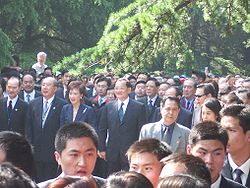
. On May 28, 2008, Hu met with KMT chairman Wu Po-hsiung, the first meeting between the heads of the CPC and the KMT as ruling parties. During this meeting, Hu and Wu agreed that both sides should recommence semi-official dialogue under the 1992 consensus
1992 Consensus
The 1992 Consensus or Consensus of 1992 is a term describing the outcome of a meeting in 1992 between the semi-official representatives of the People's Republic of China in mainland China and the Republic of China in Taiwan...
. Wu committed the KMT against Taiwanese independence, but also stressed that a "Taiwan identity" did not equate to "Taiwanese independence". Hu committed his government to addressing the concerns of the Taiwanese people in regard to security, dignity, and "international living space", with a priority given to discussing Taiwan's wish to participate in the World Health Organization
World Health Organization
The World Health Organization is a specialized agency of the United Nations that acts as a coordinating authority on international public health. Established on 7 April 1948, with headquarters in Geneva, Switzerland, the agency inherited the mandate and resources of its predecessor, the Health...
.
Both Hu and his new counterpart Ma Ying-jeou
Ma Ying-jeou
Ma Ying-jeou is the 12th term and current President of the Republic of China , commonly known as Taiwan, and the Chairman of the Kuomintang Party, also known as the Chinese Nationalist Party. He formerly served as Justice Minister from 1993 to 1996, Mayor of Taipei from 1998 to 2006, and Chairman...
agree that the 1992 Consensus
1992 Consensus
The 1992 Consensus or Consensus of 1992 is a term describing the outcome of a meeting in 1992 between the semi-official representatives of the People's Republic of China in mainland China and the Republic of China in Taiwan...
is the basis for negotiations between the two sides of the Taiwan strait. On March 26, 2008, Hu Jintao held a telephone talk with the US President George W. Bush
George W. Bush
George Walker Bush is an American politician who served as the 43rd President of the United States, from 2001 to 2009. Before that, he was the 46th Governor of Texas, having served from 1995 to 2000....
, in which he explained that the "1992 Consensus
1992 Consensus
The 1992 Consensus or Consensus of 1992 is a term describing the outcome of a meeting in 1992 between the semi-official representatives of the People's Republic of China in mainland China and the Republic of China in Taiwan...
" sees "both sides recognize there is only one China, but agree to differ on its definition". The first priority for the SEF–ARATS meeting will be opening of the three links
Three Links
The Three Links or Three Linkages was a "message of Compatriots in Taiwan" calling for the unification of mainland China and Taiwan. It was sent by the PRC National People's Congress in 1979....
, especially direct flights between mainland China and Taiwan.
These events suggest a policy by the two sides to rely on the deliberate ambiguity of the 1992 Consensus
1992 Consensus
The 1992 Consensus or Consensus of 1992 is a term describing the outcome of a meeting in 1992 between the semi-official representatives of the People's Republic of China in mainland China and the Republic of China in Taiwan...
to avoid difficulties arising from asserting sovereignty
Sovereignty
Sovereignty is the quality of having supreme, independent authority over a geographic area, such as a territory. It can be found in a power to rule and make law that rests on a political fact for which no purely legal explanation can be provided...
. As Wu Po-hsiung put it during a press conference in his 2008 mainland China visit, "we do not refer to the 'Republic of China' so long as the other side does not refer to the 'People's Republic of China'". Since the March elections in Taiwan, the PRC government has not mentioned the "one China policy" in any official announcements. The only exception has been one brief aberration in a press release by the Ministry of Commerce, which described Vincent Siew as agreeing to the "1992 consensus
1992 Consensus
The 1992 Consensus or Consensus of 1992 is a term describing the outcome of a meeting in 1992 between the semi-official representatives of the People's Republic of China in mainland China and the Republic of China in Taiwan...
and the "one China policy". Upon an immediate protest from Siew, the PRC side retracted the press release and issued apologetic statements emphasising that only press releases published by the Xinhua News Agency
Xinhua News Agency
The Xinhua News Agency is the official press agency of the government of the People's Republic of China and the biggest center for collecting information and press conferences in the PRC. It is the largest news agency in the PRC, ahead of the China News Service...
represented the official PRC position. The official press release on this event did not mention the One China Policy.
Ma Ying-jeou
Ma Ying-jeou
Ma Ying-jeou is the 12th term and current President of the Republic of China , commonly known as Taiwan, and the Chairman of the Kuomintang Party, also known as the Chinese Nationalist Party. He formerly served as Justice Minister from 1993 to 1996, Mayor of Taipei from 1998 to 2006, and Chairman...
, the current ROC President, has advocated that cross-strait relations should shift from "mutual non-recognition" to "mutual non-denial".
Dialogue through semi-official organisations (the SEF and the ARATS) reopened on June 12, 2008 on the basis of the 1992 Consensus
1992 Consensus
The 1992 Consensus or Consensus of 1992 is a term describing the outcome of a meeting in 1992 between the semi-official representatives of the People's Republic of China in mainland China and the Republic of China in Taiwan...
, with the first meeting held in Beijing. Neither the PRC nor the ROC recognizes the other side as a legitimate entity, so the dialogue was in the name of contacts between the SEF and the ARATS instead of the two governments, though most participants were actually officials in PRC or ROC governments. Chen Yunlin
Chen Yunlin
Chen Yunlin is the current chairman of the Association for Relations Across the Taiwan Straits , the body responsible for negotiations with Taiwan in the People's Republic of China.-Biography:...
, President of the ARATS, and Chiang Pin-kung
Chiang Pin-kung
Chiang Pin-kung is a politician in the Republic of China on Taiwan. He is currently vice-chairman of the Kuomintang , and chairman of Straits Exchange Foundation .-Biography:...
, President of the SEF, signed files on June 13, agreeing that direct flights between the two sides would begin on July 4 and that Taiwan would allow entrance of up to 3000 visitors from mainland China
Mainland China
Mainland China, the Chinese mainland or simply the mainland, is a geopolitical term that refers to the area under the jurisdiction of the People's Republic of China . According to the Taipei-based Mainland Affairs Council, the term excludes the PRC Special Administrative Regions of Hong Kong and...
every day.
The financial relationship between the two areas improved on 1 May 2009 in a move described as "a major milestone" by The Times
The Times
The Times is a British daily national newspaper, first published in London in 1785 under the title The Daily Universal Register . The Times and its sister paper The Sunday Times are published by Times Newspapers Limited, a subsidiary since 1981 of News International...
. The ROC's financial regulator, the Financial Supervisory Commission
Financial Supervisory Commission
The Financial Supervisory Commission is an independent government agency subordinate to the Executive Yuan of the Republic of China. It is responsible for regulating securities markets , banking, and the insurance sector...
, announced that mainland Chinese investors would be permitted to invest in Taiwan's money markets for the first time since 1949. Investors can now apply to purchase Taiwan shares that do not exceed one tenth of the value of the firm’s total shares. The move came as part of a “step by step” movement which is supposed to relax restrictions on mainland Chinese investment. Taipei economist Liang Chi-yuan, commented: “Taiwan's risk factor as a flash point has dropped significantly with its improved ties with the mainland. The mainlanders would be hesitant about launching a war as their investment increases here.” Mainland China's biggest telecoms carrier, China Mobile
China Mobile
China Mobile Limited is a Chinese state-owned telecommunication company that provides mobile voice and multimedia services through its nationwide mobile telecommunications network, the largest of its kind in the world...
, was the first company to avail of the new movement by spending $529 million on buying 12 percent of Far EasTone, the third largest telecoms operator in Taiwan.
President Ma has called repeatedly for the PRC to dismantle the missile batteries targeted on Taiwan's cities, without result.
On Jan 30 2010, the Obama administration announced it intended to sell $6.4 billion worth of antimissile systems, helicopters and other military hardware to Taiwan, an expected move which was met with the typical reaction from Beijing: in retaliation, China cut off all military-to-military ties with Washington and warned that US-China cooperation on international issues could suffer as a result of the sales.
A report from Taiwan's Ministry of National Defense said that China's current charm offensive is only accommodating on issues that do not undermine China's claim to Taiwan and that the PRC would invade if Taiwan declared independence, developed weapons of mass destruction, or suffered from civil chaos.
On the 100th anniversary of the Xinhai Revolution, Mr. Ma called on the PRC to embrace Sun Yat-sen's call for freedom and democracy.
Interpretation of the relations
On 2 September 2008, the ROC President Ma Ying-jeou was interviewed by the Mexico based newspaper Sol de Mexico and he was asked about his views on the subject of 'two ChinasTwo Chinas
The term Two Chinas refers to the two states with "China" in their official names: People's Republic of China , commonly known as "China", established in 1949, controlling mainland China and two special administrative regions, Hong Kong and Macau...
' and if there is a solution for the sovereignty issues between the two. The ROC President replied that the relations are neither between two Chinas nor two states. It is a special relationship
Special non-state-to-state relations
Special Non-State-to-State Relations is a term used by Ma Ying-jeou, the President of the Republic of China to describe the nature of relations between the Taiwan Area and the Mainland China Area...
. Further, he stated that the sovereignty issues between the two cannot be resolved at present, but he quoted the '1992 Consensus
1992 Consensus
The 1992 Consensus or Consensus of 1992 is a term describing the outcome of a meeting in 1992 between the semi-official representatives of the People's Republic of China in mainland China and the Republic of China in Taiwan...
', currently accepted by both sides, as a temporary measure until a solution becomes available. The spokesman for the ROC Presidential Office Wang Yu-chi later elaborated the President's statement and said that the relations are between two regions of one country, based on the ROC Constitutional position, the Statute Governing the Relations Between the Peoples of the Taiwan Area and Mainland Area and the '1992 Consensus'. On 7 October 2008 Ma Ying-jeou was interviewed by a Japan based magazine "World". He said that laws relating to international relations
International relations
International relations is the study of relationships between countries, including the roles of states, inter-governmental organizations , international nongovernmental organizations , non-governmental organizations and multinational corporations...
cannot be applied regarding the relations between Taiwan and mainland China, as they are parts of a state.
Inter-government
Semi-governmental contact is maintained through the Straits Exchange FoundationStraits Exchange Foundation
The Straits Exchange Foundation is a semi-official organization set up by the Republic of China government to handle technical or business matters with the People's Republic of China...
(SEF) and the Association for Relations Across the Taiwan Straits
Association for Relations Across the Taiwan Straits
The Association for Relations Across the Taiwan Straits is an organization set up by the People's Republic of China for handling technical or business matters with the Republic of China ....
(ARATS). Negotiations between the SEF and the ARATS resumed on 11 June 2008.
Although formally privately constituted bodies, the SEF and the ARATS are both directly led by the Executive Government of each side: the SEF by the Mainland Affairs Council
Mainland Affairs Council
The Mainland Affairs Council is a cabinet-level administrative agency under the Executive Yuan of the Republic of China. The MAC is responsible for the planning, development, and implementation of policies between the Free Area of the Republic of China, commonly known as Taiwan, and the People's...
of the Executive Yuan
Executive Yuan
The Executive Yuan is the executive branch of the government of the Republic of China , commonly known as "Taiwan".-Organization and structure:...
of the ROC, and the ARATS by the Taiwan Affairs Office
Taiwan Affairs Office
The Taiwan Affairs Office of the State Council is an administrative agency under the State Council of the People's Republic of China. It is responsible for setting and implementing guidelines and policies related to Taiwan, as stipulated by the Central Committee of the Communist Party of China and...
of the State Council
State Council of the People's Republic of China
The State Council of the People's Republic of China , which is largely synonymous with the Central People's Government after 1954, is the chief administrative authority of the People's Republic of China. It is chaired by the Premier and includes the heads of each governmental department and agency...
of the PRC. The heads of the two bodies, Chiang Pin-kung
Chiang Pin-kung
Chiang Pin-kung is a politician in the Republic of China on Taiwan. He is currently vice-chairman of the Kuomintang , and chairman of Straits Exchange Foundation .-Biography:...
and Chen Yunlin
Chen Yunlin
Chen Yunlin is the current chairman of the Association for Relations Across the Taiwan Straits , the body responsible for negotiations with Taiwan in the People's Republic of China.-Biography:...
, are both full time appointees and do not hold other government positions. However, both are senior members of their respective political parties (Kuomintang
Kuomintang
The Kuomintang of China , sometimes romanized as Guomindang via the Pinyin transcription system or GMD for short, and translated as the Chinese Nationalist Party is a founding and ruling political party of the Republic of China . Its guiding ideology is the Three Principles of the People, espoused...
and Communist Party of China
Communist Party of China
The Communist Party of China , also known as the Chinese Communist Party , is the founding and ruling political party of the People's Republic of China...
respectively), and both have previously served as senior members of their respective governments. Their deputies, who in practice are responsible for the substantive negotiations, are concurrently senior members of their respective governments. For the June 2008 negotiations, the main negotiators, who are deputy heads of the SEF and the ARATS respectively, are concurrently deputy heads of the Mainland Affairs Council
Mainland Affairs Council
The Mainland Affairs Council is a cabinet-level administrative agency under the Executive Yuan of the Republic of China. The MAC is responsible for the planning, development, and implementation of policies between the Free Area of the Republic of China, commonly known as Taiwan, and the People's...
and the Taiwan Affairs Office
Taiwan Affairs Office
The Taiwan Affairs Office of the State Council is an administrative agency under the State Council of the People's Republic of China. It is responsible for setting and implementing guidelines and policies related to Taiwan, as stipulated by the Central Committee of the Communist Party of China and...
respectively.
First 2008 meeting
A series of meetings were held between the SEF and the ARATS at Diaoyutai State GuesthouseDiaoyutai State Guesthouse
The Diaoyutai State Guesthouse is a historic hotel and guesthouse complex in Beijing, China. It includes a number of buildings, houses and gardens. The name "Diaoyutai" means "angling platform", and is so named because the site was a favourite fishing spot of Emperor Zhangzong of Jin China. It is...
in Beijing
Beijing
Beijing , also known as Peking , is the capital of the People's Republic of China and one of the most populous cities in the world, with a population of 19,612,368 as of 2010. The city is the country's political, cultural, and educational center, and home to the headquarters for most of China's...
from 11 June 2008 to 14 June 2008. By convention, SEF–ARATS negotiations proceed in three rounds: a technical round led by negotiators seconded from the relevant government departments, a draft round led by deputy heads of the two organisations, and a formal round led by the heads of the two organisations. In this case, however, both sides have already reached broad consensus on these issues on both the technical and political levels through previous negotiations via the non-governmental and inter-party channels. As a result, the initial technical round was dispensed with, and the negotiations began with the second, draft round.
The two sides agreed to the following:
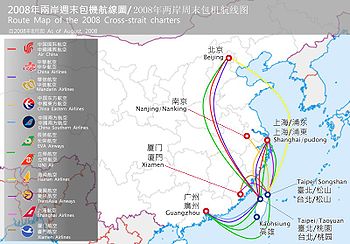
- Initiate direct passenger airline services every weekend from 4 July 2008. Both parties agreed to negotiate on the routes of cross-strait direct flights and establish direct communication procedures concerning air traffic management systems as soon as possible. But before the routes of direct flights are finalized, charter flights may temporarily fly across Hong KongHong KongHong Kong is one of two Special Administrative Regions of the People's Republic of China , the other being Macau. A city-state situated on China's south coast and enclosed by the Pearl River Delta and South China Sea, it is renowned for its expansive skyline and deep natural harbour...
Flight Information Region. There is no need to stop in Hong KongHong KongHong Kong is one of two Special Administrative Regions of the People's Republic of China , the other being Macau. A city-state situated on China's south coast and enclosed by the Pearl River Delta and South China Sea, it is renowned for its expansive skyline and deep natural harbour...
, but planes still have to fly through its airspace. Weekend charter flights shall fly from each Friday to the following Monday for a total of four full days.
-
- Mainland China agreed to open the following five cities as destinations: BeijingBeijingBeijing , also known as Peking , is the capital of the People's Republic of China and one of the most populous cities in the world, with a population of 19,612,368 as of 2010. The city is the country's political, cultural, and educational center, and home to the headquarters for most of China's...
, ShanghaiShanghaiShanghai is the largest city by population in China and the largest city proper in the world. It is one of the four province-level municipalities in the People's Republic of China, with a total population of over 23 million as of 2010...
(PudongPudongPudong |Bank]]") is an area of Shanghai, China, located along the east side of the Huangpu River, across from the historic city center of Shanghai in Puxi. Formerly a little-developed agricultural area linked only by ferries, Pudong has grown rapidly since the 1990s and emerged as China's financial...
), GuangzhouGuangzhouGuangzhou , known historically as Canton or Kwangchow, is the capital and largest city of the Guangdong province in the People's Republic of China. Located in southern China on the Pearl River, about north-northwest of Hong Kong, Guangzhou is a key national transportation hub and trading port...
, XiamenXiamenXiamen , also known as Amoy , is a major city on the southeast coast of the People's Republic of China. It is administered as a sub-provincial city of Fujian province with an area of and population of 3.53 million...
and NanjingNanjing' is the capital of Jiangsu province in China and has a prominent place in Chinese history and culture, having been the capital of China on several occasions...
. Mainland China shall open ChengduChengduChengdu , formerly transliterated Chengtu, is the capital of Sichuan province in Southwest China. It holds sub-provincial administrative status...
, ChongqingChongqingChongqing is a major city in Southwest China and one of the five national central cities of China. Administratively, it is one of the PRC's four direct-controlled municipalities , and the only such municipality in inland China.The municipality was created on 14 March 1997, succeeding the...
, HangzhouHangzhouHangzhou , formerly transliterated as Hangchow, is the capital and largest city of Zhejiang Province in Eastern China. Governed as a sub-provincial city, and as of 2010, its entire administrative division or prefecture had a registered population of 8.7 million people...
, DalianDalianDalian is a major city and seaport in the south of Liaoning province, Northeast China. It faces Shandong to the south, the Yellow Sea to the east and the Bohai Sea to the west and south. Holding sub-provincial administrative status, Dalian is the southernmost city of Northeast China and China's...
, GuilinGuilinGuilin is a prefecture-level city in the northeast of the Guangxi Zhuang Autonomous Region of far southern China, sitting on the west bank of the Li River. Its name means "forest of Sweet Osmanthus", owing to the large number of fragrant Sweet Osmanthus trees located in the city...
, ShenzhenShenzhenShenzhen is a major city in the south of Southern China's Guangdong Province, situated immediately north of Hong Kong. The area became China's first—and one of the most successful—Special Economic Zones...
and other destinations later on and other cities if so demanded by the market.
- Mainland China agreed to open the following five cities as destinations: Beijing
-
- Taiwan agreed to open the following eight cities as destinations: TaoyuanTaoyuan CityTaoyuan City is the county seat of Taoyuan County in Taiwan, located in the northwestern part of the island. Taoyuan city is the gateway of Taiwan: with the Taiwan Taoyuan International Airport in vicinity, and is a 30-minute ride to the capital, Taipei....
, KaohsiungKaohsiungKaohsiung is a city located in southwestern Taiwan, facing the Taiwan Strait on the west. Kaohsiung, officially named Kaohsiung City, is divided into thirty-eight districts. The city is one of five special municipalities of the Republic of China...
(SiaogangSiaogangSiaogang District is the southern-most district of Kaohsiung City, Republic of China in southern Taiwan. The second largest airport in Taiwan, Kaohsiung International Airport, is located here.-History:...
), TaichungTaichung-Demographics:Taichung’s population was an estimated 1,040,725 in August 2006. There are slightly more females in the city than males.24.32% of residents are children, while 16.63% are young people, 52.68% are middle-age, and 6.73% are elderly....
(Chingchunkang), TaipeiTaipeiTaipei City is the capital of the Republic of China and the central city of the largest metropolitan area of Taiwan. Situated at the northern tip of the island, Taipei is located on the Tamsui River, and is about 25 km southwest of Keelung, its port on the Pacific Ocean...
(Sungshan), Penghu (Makung), Hualien, KinmenKinmenKinmen , also known as Quemoy , is a small archipelago of several islands administered by the Republic of China : Greater Kinmen, Lesser Kinmen, and some islets. Administratively, it is Kinmen County of Fujian Province, ROC. The county is claimed by the People's Republic of China as part of its...
and TaitungTaitung CityTaitung City is the county seat of Taitung County, Taiwan. It lies on the southeast coast of Taiwan facing the Pacific Ocean.The city is served by Taitung Airport. Taitung is a gateway to Green Island and Orchid Island, both of which are very popular among Taiwanese tourists.-History:Taitung...
.
- Taiwan agreed to open the following eight cities as destinations: Taoyuan
- Opening Taiwan to mainland Chinese tourists. Both parties agreed that mainland ChineseMainland ChineseMainland Chinese or Mainlanders are Chinese people who live in a region considered a "mainland". It is frequently used in the context of areas ruled by the People's Republic of China, referring to people from Mainland China as opposed to other areas controlled by the state such as Hong Kong or...
tourists must travel to the Taiwan in groups. Tourists must enter into, visit, and exit from Taiwan in groups. The maximum quota of tourists received by the party responsible for tourist reception shall not exceed the average of 3,000 persons per day, and each group shall consist of a minimum of ten persons and forty persons at the maximum, being in Taiwan for a maximum of ten days.
To facilitate the above, both sides also agreed to further discuss on the possibilities of exchanging representative offices, with an SEF office to be opened in Beijing
Beijing
Beijing , also known as Peking , is the capital of the People's Republic of China and one of the most populous cities in the world, with a population of 19,612,368 as of 2010. The city is the country's political, cultural, and educational center, and home to the headquarters for most of China's...
and an ARATS office in Taipei
Taipei
Taipei City is the capital of the Republic of China and the central city of the largest metropolitan area of Taiwan. Situated at the northern tip of the island, Taipei is located on the Tamsui River, and is about 25 km southwest of Keelung, its port on the Pacific Ocean...
to issue travel permits to cross-Strait visitors, among other duties.
Second 2008 meeting
Following an invitation issued by the SEF at the first meeting, the head of ARATS, Chen YunlinChen Yunlin
Chen Yunlin is the current chairman of the Association for Relations Across the Taiwan Straits , the body responsible for negotiations with Taiwan in the People's Republic of China.-Biography:...
, began a visit to Taiwan
Taiwan
Taiwan , also known, especially in the past, as Formosa , is the largest island of the same-named island group of East Asia in the western Pacific Ocean and located off the southeastern coast of mainland China. The island forms over 99% of the current territory of the Republic of China following...
on 3 November 2008. Items on the agenda raised by SEF Chairman Chiang Pin-kung
Chiang Pin-kung
Chiang Pin-kung is a politician in the Republic of China on Taiwan. He is currently vice-chairman of the Kuomintang , and chairman of Straits Exchange Foundation .-Biography:...
included direct maritime shipping, chartered cargo flights, direct postal service, and co-operation in ensuring food safety, in response to the 2008 Chinese milk scandal
2008 Chinese milk scandal
The 2008 Chinese milk scandal was a food safety incident in the People's Republic of China, involving milk and infant formula, and other food materials and components, adulterated with melamine....
, while ARATS chairman Chen Yunlin
Chen Yunlin
Chen Yunlin is the current chairman of the Association for Relations Across the Taiwan Straits , the body responsible for negotiations with Taiwan in the People's Republic of China.-Biography:...
raised the matters of direct freight service, and opening up air routes that directly cross the Taiwan Strait. Previous routes avoided crossing the Strait for security reasons, with planes detouring through Hong Kong
Hong Kong
Hong Kong is one of two Special Administrative Regions of the People's Republic of China , the other being Macau. A city-state situated on China's south coast and enclosed by the Pearl River Delta and South China Sea, it is renowned for its expansive skyline and deep natural harbour...
or Japan
Japan
Japan is an island nation in East Asia. Located in the Pacific Ocean, it lies to the east of the Sea of Japan, China, North Korea, South Korea and Russia, stretching from the Sea of Okhotsk in the north to the East China Sea and Taiwan in the south...
air control areas.
On 4 November 2008, ARATS and SEF signed a number of agreements in Taipei. The agreement relating to direct passenger flights increased the number of charter flights from 36 to 108 per week, operating daily instead of the four days a week previously. Flights would now operate to and from 21 mainland Chinese cities. Flights would also take a more direct route. Private business jet flights would also be allowed. The agreement relating to cargo shipping allowed direct shipping between 11 sea ports in Taiwan and 63 in mainland China. The shipping would be tax free. The agreement relating to cargo flights provided for up to 60 direct cargo flights per month. Finally, an agreement was made to set up food safety
Food safety
Food safety is a scientific discipline describing handling, preparation, and storage of food in ways that prevent foodborne illness. This includes a number of routines that should be followed to avoid potentially severe health hazards....
alerts between the two sides.
During Chen's visit in Taipei, he was met with a series of strong protests directed at himself and Ma Ying-jeou, some of which were violent with Molotov cocktails being thrown by the protesters at riot police. A series of arrests were made after the protests. Local police reported that 149 of its officers were injured during the opposition protests. Consistent with the 1992 Consensus
1992 Consensus
The 1992 Consensus or Consensus of 1992 is a term describing the outcome of a meeting in 1992 between the semi-official representatives of the People's Republic of China in mainland China and the Republic of China in Taiwan...
, Chen did not call Ma as "President". Similarly, the representatives from Taiwan did not call the PRC President Hu Jintao
Hu Jintao
Hu Jintao is the current Paramount Leader of the People's Republic of China. He has held the titles of General Secretary of the Communist Party of China since 2002, President of the People's Republic of China since 2003, and Chairman of the Central Military Commission since 2004, succeeding Jiang...
as "President" in the previous meeting in Beijing.
The polls in two of Taiwan's biggest newspapers after the visit reported that the public was pleased with Chen's visit, with about 50% of the Taiwanese public considered Chen's visit having a positive effect on Taiwan's development, while 18 to 26% of the respondents thought the effect would be negative. In another poll, it suggested that 26% of the respondents were satisfied with the DPP Chairwoman Tsai Ing-wen's handling of the crowds in the series of protests, while 53% of the respondents were unsatisfied. The same poll also showed that 33% of the respondents were satisfied with President Ma's performance at his meeting with Chen Yunlin, while 32% of the respondents were not satisfied. According to a telephone poll conducted by Taiwan's top-selling Apple Daily newspaper on 7 November 2008 on the subject of a series of anti-Chen protests organised by the DPP, 62.12% of the respondents considered it bad for DPP's image, describing it as a "violent party", 31.13% of the respondents considered it good for the DPP's image, as it demonstrated Taiwan's democracy, while 6.75% of the respondents did not express an opinion.
Inter-party
The (current) ruling parties of the two sides, the KuomintangKuomintang
The Kuomintang of China , sometimes romanized as Guomindang via the Pinyin transcription system or GMD for short, and translated as the Chinese Nationalist Party is a founding and ruling political party of the Republic of China . Its guiding ideology is the Three Principles of the People, espoused...
and the Communist Party of China
Communist Party of China
The Communist Party of China , also known as the Chinese Communist Party , is the founding and ruling political party of the People's Republic of China...
, maintain regular dialogue via the "KMT–CPC Forum". This has been called a "second rail" in Taiwan, and helps to maintain political understanding and aims for political consensus between the two sides.
Non-governmental
A third mode of contact is through private bodies accredited by the respective governments to negotiate on technical and operational aspects of issues between the two sides. Called the "MacauMacau
Macau , also spelled Macao , is, along with Hong Kong, one of the two special administrative regions of the People's Republic of China...
mode", this avenue of contact was maintained even through the years of the Chen Shui-bian
Chen Shui-bian
Chen Shui-bian is a former Taiwanese politician who was the 10th and 11th-term President of the Republic of China from 2000 to 2008. Chen, whose Democratic Progressive Party has traditionally been supportive of Taiwan independence, ended more than fifty years of Kuomintang rule in Taiwan...
administration. For example, on the issues of opening Taiwan to mainland Chinese tourists, the accredited bodies were tourism industry representative bodies from both sides.
Public support
According to an opinion poll released by the Mainland Affairs CouncilMainland Affairs Council
The Mainland Affairs Council is a cabinet-level administrative agency under the Executive Yuan of the Republic of China. The MAC is responsible for the planning, development, and implementation of policies between the Free Area of the Republic of China, commonly known as Taiwan, and the People's...
taken after the second 2008 meeting, 71.79% of the Taiwanese public supported continuing negotiations and solving issues between the two sides through the semi-official organisations, SEF and ARATS, 18.74% of the Taiwanese public did not support this, while 9.47% of the Taiwanese public did not have an opinion.
The Three Links

Cross-strait charter
The cross-strait charters are special flights between Taiwan and mainland China, across the Taiwan Strait. After the Chinese Civil War, no direct flights were allowed between Taiwan and mainland China due to mistrust and security concerns; this remained the case until 2003...
flights between mainland China and Taiwan resumed on July 4, 2008 for the first time since 1950. Liu Shaoyong, China Southern Airlines
China Southern Airlines
China Southern Airlines is an airline headquartered in Baiyun District, Guangzhou, Guangdong Province, People's Republic of China. It is the world's sixth-largest airline measured by passengers carried, and Asia's largest airline in terms of both fleet size and passengers carried...
chair, piloted the first flight from Guangzhou
Guangzhou
Guangzhou , known historically as Canton or Kwangchow, is the capital and largest city of the Guangdong province in the People's Republic of China. Located in southern China on the Pearl River, about north-northwest of Hong Kong, Guangzhou is a key national transportation hub and trading port...
to Taipei
Taipei
Taipei City is the capital of the Republic of China and the central city of the largest metropolitan area of Taiwan. Situated at the northern tip of the island, Taipei is located on the Tamsui River, and is about 25 km southwest of Keelung, its port on the Pacific Ocean...
airport. Simultaneously, a Taiwan-based China Airlines
China Airlines
China Airlines is both the flag carrier and the largest airline of Republic of China . Although not directly state-owned, the airline is owned by China Airlines Group, which is owned by the China Aviation Development Foundation...
flight flew to Shanghai
Shanghai
Shanghai is the largest city by population in China and the largest city proper in the world. It is one of the four province-level municipalities in the People's Republic of China, with a total population of over 23 million as of 2010...
. Five mainland Chinese cities will be connected with eight Taiwan airports. The flights will operate four days a week (Friday to Monday), totalling 36 round-trip flights across the Taiwan Strait
Taiwan Strait
The Taiwan Strait or Formosa Strait, formerly known as the Black Ditch, is a 180-km-wide strait separating Mainland China and Taiwan. The strait is part of the South China Sea and connects to East China Sea to the northeast...
. Previously, regular passengers (other than festive or emergency charters) had to make a time-consuming stopover at a third destination, usually Hong Kong
Hong Kong
Hong Kong is one of two Special Administrative Regions of the People's Republic of China , the other being Macau. A city-state situated on China's south coast and enclosed by the Pearl River Delta and South China Sea, it is renowned for its expansive skyline and deep natural harbour...
. Under the current procedure, the flights do not directly cross the Taiwan Strait for security reasons, but instead must enter the Hong Kong air control area before moving into or out of mainland China or Taiwan airspace.
Taiwan residents cannot use the Republic of China passport
Republic of China passport
The Republic of China passport is the national passport issued to nationals of the Republic of China with household registration in the Taiwan Area and certain Overseas Chinese...
to travel to mainland China, as neither the ROC nor the PRC considers this international travel. The PRC government requires Taiwan residents to hold a Mainland Travel Permit for Taiwan Residents when entering the Chinese Mainland, whereas the ROC government requires mainland residents to hold a Mainland Compatriot Pass to enter the Taiwan Area.
Cross-strait investments
Cross-strait investmentInvestment
Investment has different meanings in finance and economics. Finance investment is putting money into something with the expectation of gain, that upon thorough analysis, has a high degree of security for the principal amount, as well as security of return, within an expected period of time...
s have greatly increased in recent years. Predominantly, this involves Taiwan-based firms moving to, or collaborating in joint venture
Joint venture
A joint venture is a business agreement in which parties agree to develop, for a finite time, a new entity and new assets by contributing equity. They exercise control over the enterprise and consequently share revenues, expenses and assets...
s, in mainland China
Mainland China
Mainland China, the Chinese mainland or simply the mainland, is a geopolitical term that refers to the area under the jurisdiction of the People's Republic of China . According to the Taipei-based Mainland Affairs Council, the term excludes the PRC Special Administrative Regions of Hong Kong and...
. The collective body of Taiwanese investors in mainland China is now a significant economic force for both the mainland China and Taiwan.
Cultural, educational, religious and sporting exchanges
Cultural exchanges have increased in frequency. The National Palace MuseumNational Palace Museum
The National Palace Museum is an art museum in Taipei. It is the national museum of the Republic of China, and has a permanent collection of over 677,687 pieces of ancient Chinese artifacts and artworks, making it one of the largest in the world. The collection encompasses over 8,000 years of...
in Taipei
Taipei
Taipei City is the capital of the Republic of China and the central city of the largest metropolitan area of Taiwan. Situated at the northern tip of the island, Taipei is located on the Tamsui River, and is about 25 km southwest of Keelung, its port on the Pacific Ocean...
and the Palace Museum in Beijing
Beijing
Beijing , also known as Peking , is the capital of the People's Republic of China and one of the most populous cities in the world, with a population of 19,612,368 as of 2010. The city is the country's political, cultural, and educational center, and home to the headquarters for most of China's...
have collaborated on exhibitions. Scholars and academics frequently visit institutions on the other side. Books published on each side are regularly re-published in the other side, though restrictions on direct imports and the different orthography
Debate on traditional and simplified Chinese characters
The debate on traditional Chinese characters and simplified Chinese characters is an ongoing debate concerning Chinese orthography among users of Chinese characters. It has stirred up heated responses from supporters of both sides in mainland China, Hong Kong, Macau, Taiwan, and among overseas...
between the two sides somewhat impede the exchange of books and ideas.
Students of Taiwan
Taiwan
Taiwan , also known, especially in the past, as Formosa , is the largest island of the same-named island group of East Asia in the western Pacific Ocean and located off the southeastern coast of mainland China. The island forms over 99% of the current territory of the Republic of China following...
origin receive special concessions in the National Higher Education Entrance Examination in mainland China
Mainland China
Mainland China, the Chinese mainland or simply the mainland, is a geopolitical term that refers to the area under the jurisdiction of the People's Republic of China . According to the Taipei-based Mainland Affairs Council, the term excludes the PRC Special Administrative Regions of Hong Kong and...
. There are regular programs for school students from each side to visit the other.
Religious exchange has become frequent. Frequent interactions occur between worshippers of Matsu
Matsu (goddess)
Mazu , also spelt Matsu, is the indigenous goddess of the sea who is said to protect fishermen and sailors, and is invoked as the patron deity of all Southern Chinese and East Asian persons...
, and also between Buddhists
Buddhism
Buddhism is a religion and philosophy encompassing a variety of traditions, beliefs and practices, largely based on teachings attributed to Siddhartha Gautama, commonly known as the Buddha . The Buddha lived and taught in the northeastern Indian subcontinent some time between the 6th and 4th...
.
Humanitarian actions
The PRC and the ROC have provided humanitarian aid to each other on several occasions. Most recently, following the 2008 Sichuan earthquake2008 Sichuan earthquake
The 2008 Sichuan earthquake or the Great Sichuan Earthquake was a deadly earthquake that measured at 8.0 Msand 7.9 Mw occurred at 14:28:01 CST...
, an expert search and rescue team was sent from Taiwan
Taiwan
Taiwan , also known, especially in the past, as Formosa , is the largest island of the same-named island group of East Asia in the western Pacific Ocean and located off the southeastern coast of mainland China. The island forms over 99% of the current territory of the Republic of China following...
to help rescue survivors in Sichuan
Sichuan
' , known formerly in the West by its postal map spellings of Szechwan or Szechuan is a province in Southwest China with its capital in Chengdu...
. Shipments of aid material was also provided under the co-ordination of the Red Cross Society of The Republic of China
Red Cross Society of the Republic of China
The Red Cross Society of the Republic of China is the national Red Cross Society of Taiwan . The Society is recognized by the International Committee of the Red Cross as a national committee...
and charities such as Tzu Chi
Tzu Chi
The Tzu Chi Foundation, whose name means "compassionate relief," is an international humanitarian organization and the largest non-governmental organization in the Chinese-speaking world....
.
Military build-up
Despite Chinese diplomatic and media efforts to portray an easing of military tension with Taiwan, the military build-up against Taiwan continues. Taiwanese intelligence officials pointed this out recently.For example, China continues to move ballistic missile
Ballistic missile
A ballistic missile is a missile that follows a sub-orbital ballistic flightpath with the objective of delivering one or more warheads to a predetermined target. The missile is only guided during the relatively brief initial powered phase of flight and its course is subsequently governed by the...
s and modern warplanes to bases within range of Taiwan. By the end of 2010, China will have nearly 2,000 ballistic missiles aimed at Taiwan. That is 50 percent more than there were just two years prior, and ten times more than in 2000. Most of these are Dong Feng (DF)-11 and Dong Feng (DF)-15 models. The DF11 (also known as the M11) has a range of 300 kilometers and carries a one ton warhead. The DF15 (M9) has a range of 600 kilometers and carries a half ton warhead. There are also over 1,000 Chinese warplanes and over 100,000 troops (including several brigades of paratroopers) available for an attack on the island. The missiles would use high explosive or cluster bomb warheads. In response, Taiwan is investing in an anti-missile system intended to negate a large number of Chinese missiles.
Taiwanese intelligence
Military intelligence
Military intelligence is a military discipline that exploits a number of information collection and analysis approaches to provide guidance and direction to commanders in support of their decisions....
has also spotted China converting recently retired jet fighters to pilotless aircraft, to be used in defeating Taiwanese air defense. The Taiwanese Air Force believes that their air bases would be prime targets for Chinese bombers and ballistic missiles. The air force has thousands of engineer troops trained and equipped to repair airstrips that have been hit by Chinese bombs and warheads, and pilots trained to operate from damaged airstrips.
Taiwanese intelligence also noted that while China has moved amphibious training away from the coast opposite Taiwan, these drills are still carried out elsewhere. While China has halted most of the anti-Taiwan stories in the state-controlled media, the Chinese military has continued preparations for a possible invasion of Taiwan.
In addition, the United States
United States
The United States of America is a federal constitutional republic comprising fifty states and a federal district...
has supplied Taiwan's military with ships and planes.
US Defense Secretary Robert Gates
Robert Gates
Dr. Robert Michael Gates is a retired civil servant and university president who served as the 22nd United States Secretary of Defense from 2006 to 2011. Prior to this, Gates served for 26 years in the Central Intelligence Agency and the National Security Council, and under President George H. W....
has said that the United States would reduce arms sales to Taiwan if tensions are eased, but that this was not a change in American policy.
See also
- Foreign relations of the Republic of ChinaForeign relations of the Republic of ChinaThe Republic of China , commonly known as Taiwan, is recognized by sovereign states. The course of the foreign relations of the ROC is dominated by maintaining diplomatic relations with these countries, as well as unofficial relations with other countries via its de facto embassies and...
- Foreign relations of the People's Republic of ChinaForeign relations of the People's Republic of ChinaThe foreign relations of the People's Republic of China guides the way in which it interacts with foreign nations. As a great power and emerging superpower, China's foreign policy and strategic thinking is highly influential. China officially states it "unswervingly pursues an independent foreign...
- Political status of TaiwanPolitical status of TaiwanThe controversy regarding the political status of Taiwan hinges on whether Taiwan, Penghu, Kinmen, and Matsu should remain effectively independent as territory of the Republic of China , become unified with the territories now governed by the People's Republic of China , or formally declare...
- Legal status of TaiwanLegal status of TaiwanThe legal status of Republic of China is a controversial issue which stems from the complex post-Second World War history of Taiwan. Various claims have been made by the People's Republic of China , the Republic of China , and supporters of Taiwan independence over this question, with a variety of...
- Straits Exchange FoundationStraits Exchange FoundationThe Straits Exchange Foundation is a semi-official organization set up by the Republic of China government to handle technical or business matters with the People's Republic of China...
- Mainland Affairs CouncilMainland Affairs CouncilThe Mainland Affairs Council is a cabinet-level administrative agency under the Executive Yuan of the Republic of China. The MAC is responsible for the planning, development, and implementation of policies between the Free Area of the Republic of China, commonly known as Taiwan, and the People's...
- Association for Relations Across the Taiwan StraitsAssociation for Relations Across the Taiwan StraitsThe Association for Relations Across the Taiwan Straits is an organization set up by the People's Republic of China for handling technical or business matters with the Republic of China ....
Further reading
- Sutter, Robert, Taiwan's Future: Narrowing Straits (NBR Special Report, May 2011)
- Bush, R. & O'Hanlon, M. (2007). A War Like No Other: The Truth About China's Challenge to America. Wiley. ISBN 0471986771
- Bush, R. (2006). Untying the Knot: Making Peace in the Taiwan Strait. Brookings Institution Press. ISBN 0815712901
- Carpenter, T. (2006). America's Coming War with China: A Collision Course over Taiwan. Palgrave Macmillan. ISBN 1403968411
- Cole, B. (2006). Taiwan's Security: History and Prospects. Routledge. ISBN 0415365813
- Copper, J. (2006). Playing with Fire: The Looming War with China over Taiwan. Praeger Security International General Interest. ISBN 0275988880
- Federation of American Scientists et al. (2006). Chinese Nuclear Forces and U.S. Nuclear War Planning
- Gill, B. (2007). Rising Star: China's New Security Diplomacy. Brookings Institution Press. ISBN 0815731469
- Shirk, S. (2007). China: Fragile Superpower: How China's Internal Politics Could Derail Its Peaceful Rise. Oxford University Press. ISBN 0195306090
- Tsang, S. (2006). If China Attacks Taiwan: Military Strategy, Politics and Economics. Routledge. ISBN 0415407850
- Tucker, N.B. (2005). Dangerous Strait: the U.S.-Taiwan-China Crisis. Columbia University Press. ISBN 0231135645
- China, Taiwan, and the Battle for Latin America, 21p.
External links
- Taiwan-China-US Relations - March 2010 radio interview with Professor T.Y. Wang (Illinois State University)