


Political status of Taiwan

Encyclopedia
The controversy regarding the political status of Taiwan (or "Taiwan Issue" as referred to by the Communist Party of China
) hinges on whether Taiwan
, Penghu, Kinmen
, and Matsu
should remain effectively independent as territory of the Republic of China
(ROC), become unified
with the territories now governed by the People's Republic of China (PRC), or formally declare independence and become the Republic of Taiwan; furthermore, on whether its existence and status as a state
("country") is legitimate and recognized
by the international community.
Currently, Taiwan, Penghu, Kinmen, Matsu, and some other minor islands effectively make up the jurisdiction of the state
with the official name of Republic of China, widely known in the West
as "Taiwan
". The ROC, which took control of Taiwan (including Penghu and other nearby islands) in 1945, ruled mainland China
and claimed sovereignty over Outer Mongolia
(now Mongolia
) and Tannu Uriankhai
(part of which is present day Tuva
, Russia
) before losing the Chinese Civil War
and relocating its government to Taipei
, Taiwan in December 1949.
Since the ROC lost its United Nations seat
as "China
" in 1971 (replaced
by the PRC), most sovereign state
s have switched their diplomatic recognition to the PRC, recognizing or acknowledging the PRC to be the sole legitimate representative of all China
, though many including the United States deliberately avoid stating clearly what territories they believe China includes. , although informal relations are maintained with nearly all others. Agencies such as the Taipei Economic and Cultural Representative Office
and American Institute in Taiwan
operate as de facto embassies without official diplomatic status.
The ROC government has in the past actively pursued the claim as the sole legitimate government over mainland China and Taiwan. This position started to be largely adjusted in the early 1990s as democracy was introduced and new Taiwanese leaders were elected, changing to one that does not actively challenge the legitimacy of PRC rule over mainland China. However, with the election of the Kuomintang
(KMT, "Chinese Nationalist Party") back into executive power in 2008, the ROC government has changed its position back to that "mainland China is also part of the territory of the ROC." Both the PRC and the ROC carry out cross-strait relations
through specialized agencies (such as the Mainland Affairs Council
of the ROC), rather than through foreign ministries. Different groups have different concepts of what the current formal political situation of Taiwan is. (See also: Chinese reunification
, Taiwan independence
, and Cross-Strait relations
)
In addition, the situation can be confusing because of the different parties and the effort by many groups to deal with the controversy through a policy of deliberate ambiguity
. The political solution that is accepted by many of the current groups is the perspective of the status quo
: to unofficially treat Taiwan as a state and at a minimum, to officially declare no support for the government of this state making a formal declaration of independence. What a formal declaration of independence would consist of is not clear and can be confusing given the fact that the People's Republic of China has never controlled Taiwan since its founding and the fact that the Republic of China, whose government controls Taiwan, is still a sovereign state as established at Nanjing
in 1911, but its territory is limited to the province of Taiwan, Penghu, a part of the Nansha Islands and Diaoyutai island. The status quo is accepted in large part because it does not define the legal status or future status of Taiwan, leaving each group to interpret the situation in a way that is politically acceptable to its members. At the same time, a policy of status quo has been criticized as being dangerous precisely because different sides have different interpretations of what the status quo is, leading to the possibility of war through brinkmanship
or miscalculation.
and was colonized by the Dutch
, who had arrived in 1623. The Kingdom of Tungning
, lasting from 1661 to 1683, was the first Han Chinese
government
to rule Taiwan
. From 1683, the Qing Dynasty
ruled Taiwan
as a prefecture
and in 1875 divided the island into two prefectures. In 1885 the island was made into a separate Chinese province to speed up development in this region. In the aftermath of the First Sino-Japanese War
, Taiwan and Penghu were ceded by the Qing Dynasty to Japan
in 1895. Japanese troops in Taiwan surrendered to the Republic of China at end of World War II
, putting Taiwan under a Chinese government again after 50 years of Japanese rule. The ROC would then claim sovereignty on the basis of the Qing dynasty's administration, Cairo Declaration
, Potsdam Declaration
, and Japanese Instrument of Surrender
, but this became contested by pro-independence groups in subsequent years due to different perceptions of the said documents' legality. Upon losing the Chinese civil war in 1949, the ROC government retreated to Taipei, and kept control over a few islands along the coast of mainland China
and in the South China Sea
. The People's Republic of China
(PRC) was established in mainland China on October 1, 1949, claiming to be the successor to the ROC.
Quemoy, Matsu
and Wuchiu on the coast of Fukien
, Taiping
and Pratas in the South China Sea
, are part of the ROC's present territory, but were not ceded to Japan. Some arguments supporting the independence of Taiwan do not apply to these islands.
, during the Qing Dynasty
, ceded the island of Taiwan, including Penghu, to Japan
"in perpetuity" at the end of the First Sino-Japanese War by signing the Treaty of Shimonoseki
. In the Cairo Conference
of 1943, the allied powers agreed to have Japan restore "all the territories Japan has stolen from the Chinese", specifically listing "Formosa" and Penghu, to the Republic of China after the defeat of Japan. According to both the People's Republic of China and the Republic of China, this agreement was given legal force by the Instrument of Surrender of Japan in 1945. The PRC's UN Ambassador, Wang Yingfan
(Chinese 王英凡), has stated multiple times in the UN general committee: "Taiwan is an inseparable part of China's territory since antiquity" and "both the 1943 Cairo Declaration
and the 1945 Potsdam Declaration
have reaffirmed in unequivocal terms China's sovereignty over Taiwan as a matter of international law." The PRC rejects arguments involving the lack of a specific treaty (San Francisco Peace Treaty) transferring Taiwan's sovereignty to China by noting that neither PRC nor ROC was a signatory to any such treaty, making the treaties irrelevant with regard to Chinese claims. The ROC argues that the Treaty of Taipei
implicitly transferred sovereignty of Taiwan to it, however the US State Dept. disagreed with such an interpretation in its 1971 Starr Memorandum
On the other hand, a number of supporters of Taiwan independence
argue that Taiwan was only formally incorporated as a Chinese territory under the Qing Dynasty
in 1683, and as a province in 1885. Subsequently, because of the Shimonoseki Treaty of 1895, Taiwan had been de jure
part of Japan when the ROC was established in 1912 and thus was not part of the Chinese republic. Also, because the Cairo Declaration
was an unsigned press communiqué, the independence advocates argue that the legal effectiveness of the Declaration is highly questionable. Furthermore, they point out that the Instrument of Surrender of Japan was no more than an armistice
, a "modus vivendi
" in nature, which served as a temporary or provisional agreement that would be replaced with a peace treaty
. Therefore, only a military occupation of Taiwan began on Oct. 25, 1945, and both the Treaty of San Francisco
and Treaty of Taipei
hold legal supremacy over the surrender instrument. These treaties did not transfer the title of Taiwan from Japan to China. According to this argument, the sovereignty of Taiwan was returned to the people of Taiwan when Japan renounced sovereignty of Taiwan in the Treaty of San Francisco (also known as San Francisco Peace Treaty, SFPT) in 1951, based on the policy of self-determination
which has been applied to "territories which detached from enemy states as a result of the Second World War" as defined by article 76b and 77b of the United Nations Charter
and also by the protocol of the Yalta Conference
. The United Nations General Assembly has not been particularly receptive to this argument, and the ROC's applications for admission to the United Nations have been rejected 15 times.
Although the interpretation of the peace treaties was used to challenge the legitimacy of the ROC on Taiwan before the 1990s, the introduction of popular elections in Taiwan has compromised this position. Except for the most extreme Taiwan independence supporters, most Taiwanese support the popular sovereignty
theory and no longer see much conflict between this theory of sovereignty and the ROC position. In this sense, the ROC government currently administering Taiwan is not the same ROC which accepted Japanese surrender because the ruling authorities were given popular mandate
by different pools of constituencies: one is the mainland Chinese electorate, the other is the Taiwanese constituencies. In fact, former president Chen Shui-bian
has been frequently emphasizing the popular sovereignty theory in his speeches.
 However, as of 2010, the conflict between these two theories still plays a role in internal Taiwanese politics. The popular sovereignty theory, which the pan-green coalition
emphasizes, suggests that Taiwan could make fundamental constitutional changes by means of a popular referendum. The ROC legal theory, which is supported by the pan-blue coalition
, suggests that any fundamental constitutional changes would require that the amendment procedure of the ROC constitution be followed.
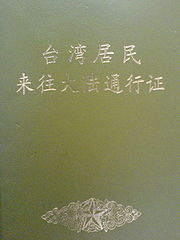 The position of the PRC is that the ROC ceased to be a legitimate government upon the founding of the former on October 1, 1949 and that the PRC is the successor of the ROC as the sole legitimate government of China
, with the right to rule Taiwan under the succession of states theory.
The position of PRC is that the ROC and PRC are two different factions in the Chinese Civil War
, which never legally ended. Therefore both factions belong to the same sovereign country—China. Since Taiwan's sovereignty belongs to China, the secession of Taiwan should be agreed upon by 1.3 billion Chinese citizens instead of the 23 million ROC
citizens who currently live in Taiwan. Furthermore, the position of PRC is that UN General Assembly Resolution 2758
, which states "Recognizing that the representatives of the Government of the People's Republic of China are the only lawful representatives of China to the United Nations", means that the PRC is recognized as having the sovereignty of all of China, including Taiwan (established by Cairo Declaration, Potsdam Proclamation and Japanese Instrument of Surrender). Therefore, the PRC believes that it is within their legal rights to extend its jurisdiction to Taiwan, by military means if necessary.
In addition, the position of PRC is that the ROC does not meet the fourth criterion of the Montevideo Convention, as it is recognized by only states and has been denied access to international organizations such as the UN. The PRC points out the fact that the Montevideo Convention
was only signed by 19 states at the Seventh International Conference of American States. Thus the authority of the United Nations
as well as UN Resolutions should supersede the Montevideo Convention
.
It is clear that the PRC still maintains that "there is only one China in the world" and "Taiwan is an inalienable part of China", however instead of "the Government of the People's Republic of China is the sole legal government of China", the PRC now emphasizes that "both Taiwan and the mainland belong to one and the same China". Although the current position allows for flexibility in terms of defining that "one China", any departure from the One-China policy
is deemed unacceptable by the PRC government. The PRC government is unwilling to negotiate with the Republic of China
government under any formulation other than One-China policy, although a more flexible definition of "one China" such as found in the 1992 consensus
is possible under PRC policy. The PRC government considers the 1992 consensus a temporary measure to set aside sovereignty disputes and to enable talks.
The PRC government considers perceived violations of its "One-China policy" or inconsistencies with it such as supplying the ROC with arms a violation of its rights to territorial integrity
. International news organizations often report that "China considers Taiwan a renegade province that must be united with the mainland by force if necessary", even though the PRC does not explicitly say that Taiwan is a "renegade province" in any press releases. However, official PRC media outlets and officials often refer to Taiwan as "China's Taiwan Province" or simply "Taiwan, China
", and pressure international organizations to use the term. (Note: the PRC also claims Quemoy, Wuchiu and Matsu
as part of its Fujian Province
, and the South China Sea Islands part of its Guangdong
and Hainan
provinces.)
The PRC also pressured the International Olympic Committee
to use the pseudonym
"Chinese Taipei
" to eliminate the appearance of the "Republic of China" name in the Olympics.
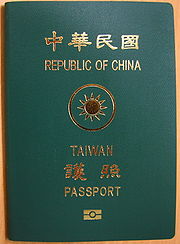 The ROC argues that it maintains all the characteristics of a state and that it was not "replaced" or "succeeded" by the PRC because it has continued to exist long after the PRC's founding. According to the Montevideo Convention
of 1933, the most cited source for the definition of statehood, a state must possess a permanent population, a defined territory, a government, and the capacity to enter into relations with other states. The ROC claims to meet all these criteria as it possesses a government exercising effective jurisdiction over well-defined territories with over 23 million permanent residents and a full fledged foreign ministry.
Both the original 1912 constitution and the 1923 'Cao' version failed to list Taiwan as a part of the ROC since the framers at the time considered Taiwan to be Japanese territory. It was only in the mid 1930's when both the CCP and KMT realised the future strategic importance of Taiwan that they altered their party positions to make a claim on Taiwan as a part of China. After losing the Civil War against the Communist Party in 1949, Chiang Kai Shek (Jiang JieShi) and the Nationalist Party fled to Taiwan, establishing a new government there, but always maintained that their government represented all of China, i.e. both Taiwan and the mainland.
The position of most supporters of Taiwan independence
is that the PRC is the government of China, that Taiwan is not part of China, and the 'Republic of China (Taiwan)' is an independent, sovereign state. The Democratic Progressive Party states that Taiwan has never been under the jurisdiction of the PRC, and that the PRC does not exercise any hold over the 23 million Taiwanese on the island. On the other hand, the position of most Chinese reunification
supporters believe the Chinese Civil War is still not concluded as no peace agreement was even signed. Therefore, the current political separation across the Taiwan strait is only temporary and a reunified China including both mainland China and Taiwan will be the result.
The position of the Republic of China
had been that it was a de jure
sovereign state. "Republic of China," according to the ROC government's definition, extended to both mainland China and the island of Taiwan.
In 1991, President
Lee Teng-hui
unofficially claimed that the government would no longer challenge the rule of the Communists in mainland China, the ROC government under Kuomintang
(KMT) rule actively maintained that it was the sole legitimate government of China. The Courts in Taiwan have never accepted President Lee's statement, primarily due to the reason that the (now defunct) National Assembly
never officially changed the national borders. Notably, the People's Republic of China
claims that changing the national borders would be "a precursor to Taiwan independence". The task of changing the national borders now requires a constitutional amendment passed by the Legislative Yuan
and ratified by a majority of all eligible ROC voters, which the PRC has implied would constitute grounds for military attack.
.jpg) On the other hand, though the constitution of the Republic of China
On the other hand, though the constitution of the Republic of China
promulgated in 1946 does not state exactly what territory it includes, the draft of the constitution of 1925 did individually list the provinces of the Republic of China
and Taiwan
was not among them, since Taiwan was arguably de jure part of Japan as the result of the Treaty of Shimonoseki
of 1895. The constitution also stipulated in Article I.4, that "the territory of the ROC is the original territory governed by it; unless authorized by the National Assembly
, it cannot be altered." However, in 1946, Sun Fo, son of Sun Yat-Sen
and the minister of the Executive Yuan
of the ROC, reported to the National Assembly that "there are two types of territory changes: 1. renouncing territory and 2. annexing new territory. The first example would be the independence of Mongolia
, and the second example would be the reclamation of Taiwan
. Both would be examples of territory changes." Japan renounced all rights to Taiwan in the Treaty of San Francisco
in 1951 and the Treaty of Taipei
of 1952 without an explicit recipient. While the ROC continuously ruled Taiwan after the government was directed to Taiwan by the General Order No. 1 (1945) to receive Japanese surrender, there has never been a meeting of the ROC National Assembly in making a territory change according to the ROC constitution. The explanatory memorandum to the constitution explained the omission of individually listing the provinces as opposed to the earlier drafts was an act of deliberate ambiguity: as the ROC government does not recognize the validity of the Treaty of Shimonoseki, based on Chiang Kai-shek's Denunciation
of the treaty in the late 1930s, hence (according to this argument) the sovereignty of Taiwan was never disposed by China. A ratification by the ROC National Assembly is therefore unnecessary.
The Additional Articles of the Constitution of the Republic of China have mentioned "Taiwan Province," and the now defunct National Assembly passed constitutional amendments that give the people of the "Free Area of the Republic of China
", comprising the territories under its current jurisdiction, the sole right, until reunification, to exercise the sovereignty of the Republic through elections of the President and the entire Legislature as well as through elections to ratify amendments to the ROC constitution. Also, Chapter I, Article 2 of the ROC constitution states that "The sovereignty of the Republic of China shall reside in the whole body of citizens." This suggests that the constitution implicitly admits that the sovereignty of the ROC is limited to the areas that it controls even if there is no constitutional amendment that explicitly spells out the ROC's borders.
 In 1999, ROC President Lee Teng-hui
proposed a two-state theory (兩國論) in which both the Republic of China
and the People's Republic of China
would acknowledge that they are two separate countries with a special diplomatic, cultural and historic relationship. This however drew an angry reaction from the PRC who believed that Lee was covertly supporting Taiwan independence
.
President
Chen Shui-bian
(2000-May 2008) fully supported the idea that the "Republic of China
is an independent, sovereign country" but held the view that the Republic of China is Taiwan and Taiwan does not belong to the People's Republic of China
. This is suggested in his Four-stage Theory of the Republic of China
. Due to the necessity of avoiding war with the PRC
however, President Chen had refrained from formally declaring Taiwan's independence. Government publications have implied that Taiwan refers to the ROC, and "China" refers to the PRC. After becoming chairman of the Democratic Progressive Party
in July 2002, Chen appeared to move further than Lee's special two-state theory and in early August 2002, by putting forward the "one country on each side
" concept, he stated that Taiwan may "go on its own Taiwanese road" and that "it is clear that the two sides of the straits are separate countries." These statements essentially eliminate any "special" factors in the relations and were strongly criticized by opposition parties in Taiwan. President Chen has repeatedly refused to endorse the One China Principle or the more "flexible" 1992 Consensus
the PRC demands as a precursor to negotiations with the PRC. During Chen's presidency, there had not been any successful attempts to restart negotiations on a semi-official level.
In the 2008 ROC elections, the people delivered KMT's Ma Ying-jeou
with an election win as well as a sizable majority in the legislature. President Ma, throughout his election campaign, maintained that he would accept the 1992 consensus and promote better relations with the PRC. In respect of Taiwan political status, his policy was 1. he would not negotiate with the PRC on the subject of reunification during his term; 2. he would never declare Taiwan independence; and 3. he would not provoke the PRC into attacking Taiwan. He officially accepted the 1992 Consensus in his inauguration speech which resulted in direct semi-official talks with the PRC, and this later led to the commencement of weekend direct charter flights between mainland China and Taiwan. President Ma also interprets the cross-strait relations as "special
", "but not that between two nations". He later stated that mainland China is part of the territory of the Republic of China, and laws relating to international relations are not applicable to the relations between mainland China and Taiwan, as they are parts of a state.
Because of anti-communist sentiment at the start of the Cold War
, the Republic of China
was initially recognized as the sole legitimate government of China
by the United Nations
and most Western nations. On January 9, 1950, the Israeli government extended recognition to the People's Republic of China. United Nations General Assembly Resolution 505, passed on February 1, 1952 considered the Chinese communists to be rebels against the Republic of China. However, the 1970s saw a switch in diplomatic recognitions from the ROC to the PRC. On 25 October 1971, Resolution 2758 was passed by the UN General Assembly, which "decides to restore all its rights to the People's Republic of China and to recognize the representatives of its Government as the only legitimate representatives of China to the United Nations, and to expel forthwith the representatives of Chiang Kai-shek from the place which they unlawfully occupy at the United Nations and in all the organizations related to it." Multiple attempts by the Republic of China to rejoin the UN, no longer to represent all of China but just the people of the territories it governs, have not made it past committee, largely due to diplomatic maneuvering by the PRC, which claims Resolution 2758 has settled the matter. (See China and the United Nations
.)
The PRC refuses to maintain diplomatic relations with any nation that recognizes the ROC, but does not object to nations conducting economic, cultural, and other such exchanges with Taiwan that do not imply diplomatic relation. Therefore, many nations that have diplomatic relations with Beijing
maintain quasi-diplomatic offices in Taipei. For example, the United States maintains the American Institute in Taiwan
. Similarly, the government in Taiwan maintains quasi-diplomatic offices in most nations under various names, most commonly as the Taipei Economic and Cultural Office.
The United States
, Canada
, the United Kingdom
, Republic of India, Pakistan
and Japan
have formally adopted the One China policy, under which the People's Republic of China is theoretically the sole legitimate government of China. However, the United States and Japan acknowledge rather than recognize the PRC position that Taiwan is part of China. In the case of Canada and the UK, bilateral written agreements state that the two respective parties take note of Beijing's position but do not use the word support. The UK government position that "the future of Taiwan be decided peacefully by the peoples of both sides of the Strait" has been stated several times. Despite the PRC claim that the United States opposes Taiwanese independence, the United States takes advantage of the subtle difference between "oppose" and "does not support". In fact, a substantial majority of the statements Washington has made says that it "does not support Taiwan independence" instead of saying that it "opposes" independence. Thus, the US currently does not take a position on the political outcome, except for one explicit condition that there be a peaceful resolution to the differences between the two sides of the Taiwan Strait
. All of this ambiguity has resulted in the United States constantly walking on a diplomatic tightrope with regard to cross strait relations.
The ROC maintains formal diplomatic relations with countries, mostly in Central America and Africa. Notably the Holy See
also recognizes the ROC, a largely non-Christian
/Catholic
state, mainly to protest what it sees as the PRC's suppression of the Catholic faith
in mainland China. However, Vatican
diplomats were engaged in talks with PRC politicians at the time of Pope
John Paul II's death, with a view towards improving relations between the two countries. When asked, one Vatican diplomat suggested that relations with Taiwan might prove "expendable" should PRC be willing to engage in positive diplomatic relations with the Holy See. Under Pope Benedict XVI
the Vatican and PRC have shown greater interest in establishing ties, including the appointment of pro-Vatican bishops and the Pope canceling a planned visit from the Dalai Lama
.
During the 1990s, there was a diplomatic tug of war in which the PRC and ROC attempted to outbid each other to obtain the diplomatic support of small nations. This struggle seems to have slowed as a result of the PRC's growing economic power and doubts in Taiwan as to whether this aid was actually in the Republic of China's interest. In March 2004, Dominica
switched recognition to the PRC in exchange for a large aid package. However, in late 2004, Vanuatu
briefly switched recognition from Beijing to Taipei, leading to the ousting of its Prime Minister and a return to its recognition of Beijing. On January 20, 2005, Grenada
switched its recognition from Taipei to Beijing, in return for millions in aid (US$1,500 for every Grenadian). However, on May 14, 2005, Nauru
announced the restoration of formal diplomatic relations with Taipei after a three-year hiatus, during which it briefly recognized the People's Republic of China.
On October 26, 2005, Senegal
broke off relations with the Republic of China and established diplomatic contacts with Beijing. The following year, on August 5, 2006, Taipei ended relations with Chad
when Chad established relations with Beijing. On April 26, 2007, however, Saint Lucia
, which had previously severed ties with the Republic of China following a change of government in December 1996, announced the restoration of formal diplomatic relations with Taipei. On June 7, 2007, Costa Rica
broke off diplomatic ties with the Republic of China in favour of the People's Republic of China. In January 2008 Malawi's foreign minister reported Malawi decided to cut diplomatic recognition of the Republic of China and recognize the People's Republic of China.
Currently, the countries who maintain formal diplomatic relations with the ROC are:
Under continuing pressure from the PRC to bar any representation of the ROC that may imply statehood, international organizations have adopted different policies toward the issue of ROC's participation. In cases where almost all UN members or sovereign states participate, such as the World Health Organization
, the ROC has been completely shut out, while in others, such as the World Trade Organization
(WTO) and International Olympic Committee
(IOC) the ROC participates under unusual names: "Chinese Taipei
" in the case of APEC and the IOC, and the "Separate Customs Territory of Taiwan, Penghu, Kimmen and Matsu" (often shortened as "Chinese Taipei") in the case of the WTO. The issue of ROC's name came under scrutiny during the 2006 World Baseball Classic. The organizers of the 16-team tournament intended to call Taiwan as such, but reverted to "Chinese Taipei" under pressure from PRC. The ROC protested the decision, claiming that the WBC is not an IOC event, but did not prevail. The ISO 3166
directory of names of countries and territories registers Taiwan (TW) separately from and in addition to the People's Republic of China (CN), but lists Taiwan as "Taiwan, Province of China" based on the name used by the UN under PRC pressure. In ISO 3166-2:CN
, Taiwan is also coded CN-71 under China, thus making Taiwan part of China in ISO 3166-1
and ISO 3166-2
categories.
Naming issues surrounding Taiwan/ROC continue to be a contentious issue in non-governmental organizations such as the Lions Club, which faced considerable controversy naming its Taiwanese branch.
as a country or as the Republic of China
. United States
presidents Ronald Reagan
and George W. Bush
have been known to have referred to Taiwan as a country during their terms of office. Although near the end of his term as U.S. Secretary of State, Colin Powell
said that Taiwan
is not a state, he referred to Taiwan
as the Republic of China twice during a testimony to the U.S. Senate Foreign Relations Committee on March 9, 2001. In the People's Republic of China
Premier Zhu Rongji
's farewell speech to the National People's Congress
, Zhu accidentally referred to Mainland China
and Taiwan
as two countries. There are also those from the PRC who informally refer to Taiwan as a country. South Africa
delegates once referred to Taiwan as the "Republic of Taiwan" during Lee Teng-hui
's term as President of the ROC. In 2002, Michael Bloomberg
, the mayor of New York City
, referred to Taiwan as a country. Most recently, former US Secretary of Defense
Donald Rumsfeld
stated in a local Chinese newspaper in California in July 2005 that Taiwan is "a sovereign nation". The People's Republic of China
discovered the statement about three months after it was made.
In a controversial speech on February 4, 2006, Japanese Foreign Minister
Taro Aso
called Taiwan
a country with very high education levels because of previous Japanese colonial rule
over the island. One month later, he told a Japanese parliamentary committee that "[Taiwan's] democracy is considerably matured and liberal economics is deeply ingrained, so it is a law-abiding country. In various ways, it is a country that shares a sense of values with Japan." At the same time, he admitted that "I know there will be a problem with calling [Taiwan] a country". Later, the Japanese Foreign Ministry
tried to downplay or reinterpret his remarks.
In February 2007, the Royal Grenada
Police Band played the National Anthem of the Republic of China
in an inauguration of the reconstructed St George's Queen's Park Stadium funded by the PRC. Grenada had broken off diplomatic relations with Taiwan just two years prior in favor of the PRC.
When the Kuomintang
visited Mainland China
in 2005, the government-controlled PRC media called this event a "visit," and called the KMT one of "Taiwan's political parties" even though the Kuomintang's full name remains the "Chinese Nationalist Party." Interestingly in Mainland China, there is a legal party called the Revolutionary Committee of the Kuomintang
that is officially one of the nine "consultative parties," according to the PRC's Chinese People's Political Consultative Conference
.
On the Foreign Missions page of the Saudi Arabian
Ministry of Foreign Affairs for China, the embassy of the People's Republic of China was referred to as the 'Republic of China'.
and Second Taiwan Strait crises
. In 1979, with the U.S. change of diplomatic recognition to the PRC, the ROC lost its ally needed to "recover the mainland." Meanwhile, the PRC's desire to be accepted in the international community led it to promote peaceful unification under what would later be termed "one country, two systems
", rather than to "liberate Taiwan" and to make Taiwan a Special Administrative Region.
. These conditions are:
It has been interpreted that these criteria encompass the scenario of Taiwan developing nuclear weapons (see main article Taiwan and weapons of mass destruction also Timeline of the Republic of China's nuclear program
).
Much saber-rattling by the PRC has been done over this, with Jiang Zemin
, after assuming the mantle of the Chairman of the Central Military Commission, becoming a leading voice.
The third condition has especially caused a stir in Taiwan as the term "indefinitely" is open to interpretation. It has also been viewed by some as meaning that preserving the ambiguous status quo is not acceptable to the PRC, although the PRC stated on many occasions that there is no explicit timetable for reunification.
Concern over a formal declaration of de jure Taiwan independence
is a strong impetus for the military buildup between Taiwan and mainland China. The former US Bush administration publicly declared that given the status quo, it would not aid Taiwan if it were to declare independence unilaterally.
According the US Department of Defense report "Military and Security Developments Involving the People’s Republic of China 2011" conditions that mainland China has warned may cause the use of force have varied. They have included "a formal declaration of Taiwan independence; undefined moves “toward independence”; foreign intervention in Taiwan’s internal affairs; indefinite delays in the resumption of cross-Strait dialogue on unification; Taiwan’s acquisition of nuclear weapon
s; and, internal unrest on Taiwan. Article 8 of the March 2005 “Anti-Secession Law” states Beijing would resort to “non-peaceful means” if “secessionist forces . . . cause the fact of Taiwan’s secession from China,” if “major incidents entailing Taiwan’s secession” occur, or if “possibilities for peaceful reunification” are exhausted".
According to President Chen Shui-bian
who was President of the Republic of China
between 2000 and 2008, China accelerated the deployment of missiles against Taiwan up to 120 a year (May 2007), bringing the total arsenal to 706 ballistic missiles capable of being fitted with nuclear warheads that are aimed at Taiwan. Some believe that their deployment is a political tool on the part of the PRC to increase political pressure on Taiwan to abandon unilateral moves toward formal independence, at least for the time being, although the PRC government never declares such deployment publicly.. Legislative elections were held in Taiwan
on January 12, 2008
. The results gave the Kuomintang
and the Pan-Blue Coalition
a supermajority (86 of the 113 seats) in the legislature
, handing a heavy defeat to President Chen Shui-bian
's Democratic Progressive Party
, which won the remaining 27 seats only. The junior partner in the Pan-Green Coalition
, the Taiwan Solidarity Union
, won no seats. The election for the 12th-term President and Vice-President of the Republic of China was held in the Republic of China (Taiwan) on Saturday, March 22, 2008. Kuomintang
nominee Ma Ying-jeou
won, with 58% of the vote, ending eight years of Democratic Progressive Party (DPP) presidential power. Along with the 2008 legislative election, Ma's landslide victory brought the Kuomintang back to power in Taiwan.
-controlled Taiwan and PRC
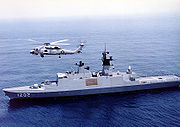
-controlled mainland China, and the resulting flare-ups that occur every few years, conspire to make this one of the most watched focal points in the Pacific. Both sides have chosen to have a strong naval presence. However, naval strategies between both powers greatly shifted in the 1980s and 1990s, while the ROC assumed a more defensive attitude by building and buying frigate
s and missile destroyer
s, and the PRC a more aggressive posture by developing long-range cruise missile
s and supersonic surface-to-surface missile
s.
Although the People's Liberation Army Air Force
is considered large, most of its fleet consists of older generation J-7
fighters (localized MiG-21s and Mig-21BIs), raising doubts over the PLAAF's ability to control Taiwan's airspace in the event of a conflict. Since mid-1990s PRC has been purchasing, and later localizing, SU-27 based fighters. These Russian fighters, as well as their Chinese J11A
variants, are currently over 170 in number, and have increased the effectiveness of PLAAF's Beyond Visual Range
(BVR) capabilities. The introduction of 60 new-generation J10A
fighters is anticipated to increase the PLAAF's firepower. PRC's acquisition of Russian Su30MKKs
further enhanced the PLAAF's air-to-ground support ability. The ROC's air force
, on the other hand, relies on Taiwan's second generation fighters, consisting of 150 US-built F-16 Fighting Falcon
s, approximately 60 French-built Mirage 2000-5s
, and approximately 130 locally developed IDFs (Indigenous Defense Fighters). All of these ROC fighter jets are able to conduct BVR combat missions with BVR missiles, but the level of technology in mainland Chinese fighters is catching up. Also the United States Defense Intelligence Agency has reported that few of Taiwan's 400 total fighters are operationally capable.
In 2003, the ROC purchased four missile destroyers—the former USS Kidd
class, and expressed a strong interest in the Arleigh Burke class
. But with the growth of the PRC navy
and air force, some doubt that the ROC could withstand a determined invasion attempt from mainland China in the future. These concerns have led to a view in certain quarters that Taiwanese independence, if it is to be implemented, should be attempted as early as possible, while the ROC still has the capacity to defend itself in an all-out military conflict. Over the past three decades, estimates of how long the ROC can withstand a full-scale invasion from across the Strait without any outside help have decreased from three months to only six days. Given such estimates, the US Navy has continued practicing "surging" its carrier groups, giving it the experience necessary to respond quickly to an attack on Taiwan. The US also collects data on the PRC's military deployments, through the use of spy satellite
s, for example. For early surveillance may effectively identify PRC's massive military movement, which may imply PRC's preparation for a military assault against Taiwan.
However, numerous reports issued by the PRC, ROC and US militaries make mutually wild contradictory statements about the possible defense of Taiwan.
Naturally, war contingencies are not being planned in a vacuum. In 1979, the United States Congress passed the Taiwan Relations Act
, a law generally interpreted as mandating U.S. defense of Taiwan in the event of an attack from the Chinese Mainland (the Act is applied to Taiwan and Penghu, but not to Jinmen or Matsu). The United States maintains the world's largest permanent fleet in the Pacific Region near Taiwan. The Seventh Fleet, operating primarily out of various bases in Japan, is a powerful naval contingent built upon the world's only permanently forward-deployed aircraft carrier
USS George Washington (CVN-73)
. Although the stated purpose of the fleet is not Taiwanese defense, it can be safely assumed from past actions, that is one of the reasons why the fleet is stationed in those waters.
Starting in 2000, Japan renewed its defense obligations with the US and embarked on a rearmament program, partly in response to fears that Taiwan might be invaded. Some analysts believed that the PRC could launch preemptive strike
s on military bases in Japan to deter US and Japanese forces from coming to the ROC's aid. Japanese strategic planners also see an independent Taiwan as vital, not only because the ROC controls valuable shipping routes, but also because its capture by PRC would make Japan more vulnerable. During World War II
, the US invaded the Philippines
, but another viable target to enable direct attacks on Japan would have been Taiwan (then known as Formosa). However, critics of the preemptive strike theory assert that the PRC would be loath to give Japan and the US such an excuse to intervene.
The United States Department of Defense
in a 2011 report stated that the primary mission of the PRC military is a possible military conflict with Taiwan, including also possible US military assistance. Although the risk of a crisis in the short-term is low, in the absence of new political developments, Taiwan will likely dominate future military modernization and planning. However, also other priorities are becoming increasingly prominent and possible due to increasing military resources. Many of mainland China's most advanced military systems are stationed in areas opposite Taiwan. The rapid military modernization is continually changing the military balance of power towards mainland China.
A 2008 report by the RAND Corporation analyzing a theoretical 2020 attack by mainland China on Taiwan suggested that the US would likely not be able to defend Taiwan. Cruise missile
developments may enable China to partially or completely destroy or make inoperative US aircraft carrier
s and bases in the Western Pacific. New Chinese radars will likely be able to detect US stealth aircraft
and China is acquiring stealthy and more effective aircraft. The reliability of US beyond-visual-range missiles as a mean to achieve air superiority is questionable and largely unproven.
 In 1996, the PRC began conducting military exercises near Taiwan
, and launched several ballistic missile
s over the island. The saber-rattling was done in response to the possible re-election of then President Lee Teng-hui
. The United States, under President Clinton, sent two aircraft carrier battle groups to the region, sailing them into the Taiwan Strait. The PRC, unable to track the ships' movements, and probably unwilling to escalate the conflict, quickly backed down. The event had little impact on the outcome of the election, since none of Lee's contestants were strong enough to defeat him, but it is widely believed that the PRC's aggressive acts, far from intimidating the Taiwanese population, gave Lee a boost that pushed his share of votes over 50 percent.
The possibility of war in the Taiwan Straits, even though quite low in the short-term, requires the PRC, ROC, and U.S. to remain wary and vigilant . The goal of the three parties at the moment seems to be, for the most part, to maintain the status quo .
. According to their lawyer, Mr. Charles Camp, "[t]he Complaint asks the Court to declare whether the Taiwanese plaintiffs, including members of the Taiwan Nation Party, have certain rights under the United States Constitution and other US laws". Their central argument is that, following Japanese renunciation of all rights and claims to Taiwan, Taiwan came under U.S. jurisdiction based on it being the principal occupying power as designated in the Treaty of Peace with Japan and remains so to this day. This case was opposed by the United States government.
The District Court agreed with United States government on March 18, 2008 and ruled that the case presents a political question
; as such, the court concluded that it had no jurisdiction to hear the matter and dismissed the complaint. This decision has been appealed by plaintiffs and the appeals court
unanimously upheld the district court ruling.
The PRC and Taiwan have agreed to increase cooperation in the area of law enforcement. Mainland police will begin staffing a liaison office in Taipei in 2010.
s to keep things from breaking out into open warfare. The current controversy is over the term one China, as the PRC insists that the ROC must recognize this term to begin negotiations. Although the Democratic Progressive Party
has moderated its support for Taiwan independence
, there is still insufficient support within that party for former President Chen Shui-bian to agree to one China. By contrast, the Kuomintang
(KMT) and the People First Party (PFP) appear willing to agree to some variation of one China, and observers believed the position of the PRC was designed to sideline Chen until the 2004 presidential election
where it was hoped that someone who was more supportive of Chinese reunification
would come to power. Partly to counter this, Chen Shui-bian announced in July 2002 that if the PRC does not respond to Taiwan's goodwill, Taiwan may "go on its own ... road."
With Chen's re-election in 2004, Beijing's prospects for a speedier resolution were dampened, though they seemed strengthened again following the Pan-Blue majority in the 2004 legislative elections
. However, public opinion in Taiwan reacted unfavorably towards the anti-secession law
passed by the PRC in March 2005. Following two high profile visits by KMT and PFP party leaders to the PRC, the balance of public opinion appears to be ambiguous, with the Pan-Green Coalition gaining a majority in the 2005 National Assembly elections
, but the Pan-Blue Coalition scoring a landslide victory in the 2005 municipal elections.
Legislative elections were held in Taiwan
on January 12, 2008
. The results gave the Kuomintang
and the Pan-Blue Coalition
an absolute majority (86 of the 113 seats) in the legislature
, handing a heavy defeat to President Chen Shui-bian
's Democratic Progressive Party
, which won the remaining 27 seats. The junior partner in the Pan-Green Coalition
, the Taiwan Solidarity Union
, won no seats.
The election for the 12th President of ROC was held on March 22, 2008. Kuomintang
candidate Ma Ying-jeou
won, with 58% of the vote, ending eight years of Democratic Progressive Party (DPP) leadership. Along with the 2008 legislative election, Ma's landslide victory brought the Kuomintang back to power in Taiwan. This new political situation has led to a decrease of tension between both sides of the Taiwan Strait
and the increase of cross-strait relations
, making a declaration of independence, or war, something unlikely.
Taiwan's Straits Exchange Foundation
(SEF) and its Chinese counterpart – the Association for Relations Across the Taiwan Strait (ARATS) signed four agreements in Taipei on November 4, 2008. Both SEF and ARATS have agreed to address direct sea links, daily charter flights, direct postal service and food safety.
According to a November 2005 poll from the Mainland Affairs Council, 37.7% of people living in the ROC favor maintaining the status quo until a decision can be made in the future, 18.4% favors maintaining the status quo indefinitely, 14% favors maintaining the status quo until eventual independence, 12% favors maintaining the status quo until eventual reunification, 10.3% favors independence as soon as possible, and 2.1% favors reunification as soon as possible. According to the same poll, 78.3% are opposed to the "One Country, Two Systems
" model, which was used for Hong Kong
and Macau
, while 10.4% is in favor.
According to a June 2008 poll from a Taiwanese mainstream media TVBS
, 58% of people living in Taiwan favor maintaining the status quo, 19% favors independence, and 8% favors unification. According to the same poll, if status quo is not an option and the ones who were surveyed must choose between "Independence" or "Unification", 65% are in favor of independence while 19% would opt for unification. The same poll also reveals that, in terms of self-identity, when the respondents are not told that a Taiwanese can also be a Chinese, 68% of the respondents identify themselves as "Taiwanese" while 18% would call themselves "Chinese". However, when the respondents are told that duo identity is an option, 45% of the respondents identify themselves as "Taiwanese only", 4% of the respondents call themselves "Chinese only" while 45% of the respondents call themselves "both Taiwanese as well as Chinese". Furthermore, when it comes to preference in which national identity to be used in international organizations, 54% of people in the survey indicated that they prefer "Taiwan" and only 25% of the people voted for "Chinese Taipei".
According to an October 2008 poll from the Mainland Affairs Council
, on the question of Taiwan's status, 36.17% of respondents favor maintaining the status quo until a decision can be made in the future, 25.53% favors maintaining the status quo indefinitely, 12.49% favors maintaining the status quo until eventual independence, 4.44% favors maintaining the status quo until eventual reunification, 14.80% favors independence as soon as possible, and 1.76% favors reunification as soon as possible. In the same poll, on the question of the PRC government's attitude towards the ROC government, 64.85% of the respondents consider the PRC government hostile or very hostile, 24.89 consider the PRC government friendly or very friendly, while 10.27% did not express an opinion. On the question of the PRC government's attitude towards the people in Taiwan, 45.98% of the respondents consider the PRC government hostile or very hostile, 39.6% consider the PRC government friendly or very friendly, while 14.43% did not express an opinion.
May 2009 Taiwan's (Republic of China) Department of the Interior published a survey examining whether people in Taiwan see themselves as Taiwanese, Chinese or both. 64.6% see themselves as Taiwanese, 11.5% as Chinese, 18.1% as both and 5.8% were unsure.
According to a December 2009 poll from a Taiwanese mainstream media TVBS
, if status quo is not an option and the ones who were surveyed must choose between "Independence" or "Unification", 68% are in favor of independence while 13% would opt for unification.
, which the mainstream political parties such as the KMT
and DPP
currently respect and recognize, changing the ROC’s governing status or completely clarifying Taiwan’s political status would at best require amending the ROC constitution. In other words, if reunification supporters wanted to reunify Taiwan with mainland China in such a way that would effectively abolish the ROC or affect the ROC’s sovereignty, or if independence supporters wanted to abolish the ROC and establish a Republic of Taiwan, they would also need to amend or abolish the ROC constitution and redraft a new constitution. Passing an amendment requires an unusually broad political consensus, which includes approval from three-quarters of a quorum of members of the Legislative Yuan. This quorum requires at least three-quarters of all members of the Legislature. After passing the legislature, the amendments need ratification from at least fifty percent of all eligible voters of the ROC, irrespective of voter turnout.
Given these harsh constitutional requirements, neither the pan-greens nor pan-blues can unilaterally change Taiwan’s political and legal status with respect to the ROC’s constitution. However, extreme Taiwan independence supporters view the ROC’s constitution as illegal and therefore believe that amendments to the ROC constitution are an invalid way to change Taiwan’s political status.
" is a term used by both the ROC and the PRC to describe their interactions. However, this term is also objectionable to some because it still implies that there is an issue, which they feel is created only by the PRC.
and de jure
to describe Taiwan's as well as the Republic of China's status as a state is itself a contentious issue. This partially stems from the lack of precedents regarding derecognized, but still constitutionally functioning states. For instance, it is regularly argued that Taiwan satisfies the requirements of statehood at international law as stated in the Montevideo Convention
. At the same time, there is continued debate on whether UN membership or recognition as a state by the UN is a decisive feature of statehood (since it represents broad recognition by the international community); the debate arises because non-state entities can often satisfy the Montevideo Convention factors, while the list of states recognised by the UN, for the most part, correlate well with entities recognised as states by customary international law
. If the latter argument is accepted, then the Republic of China may have ceased to be a state post-1971 as a matter of international law ("de jure"), yet continued to otherwise function as the state that it previously was recognised as ("de facto").
From the 1990s onwards, media wire services sometimes describe Taiwan as having de-facto independence, whereas the Republic of China has always considered itself as a continuously functioning de jure state.
Communist Party of China
The Communist Party of China , also known as the Chinese Communist Party , is the founding and ruling political party of the People's Republic of China...
) hinges on whether Taiwan
Taiwan
Taiwan , also known, especially in the past, as Formosa , is the largest island of the same-named island group of East Asia in the western Pacific Ocean and located off the southeastern coast of mainland China. The island forms over 99% of the current territory of the Republic of China following...
, Penghu, Kinmen
Kinmen
Kinmen , also known as Quemoy , is a small archipelago of several islands administered by the Republic of China : Greater Kinmen, Lesser Kinmen, and some islets. Administratively, it is Kinmen County of Fujian Province, ROC. The county is claimed by the People's Republic of China as part of its...
, and Matsu
Matsu Islands
The Matsu Islands are a minor archipelago of 19 islands and islets in the Taiwan Strait administered as Lienchiang County , Fujian Province of the Republic of China . Only a small area of what is historically Lienchiang County is under the control of the ROC...
should remain effectively independent as territory of the Republic of China
Republic of China
The Republic of China , commonly known as Taiwan , is a unitary sovereign state located in East Asia. Originally based in mainland China, the Republic of China currently governs the island of Taiwan , which forms over 99% of its current territory, as well as Penghu, Kinmen, Matsu and other minor...
(ROC), become unified
Chinese reunification
Chinese reunification refers to the bringing together of all of the territories controlled by the People's Republic of China and the Republic of China under a single political entity...
with the territories now governed by the People's Republic of China (PRC), or formally declare independence and become the Republic of Taiwan; furthermore, on whether its existence and status as a state
Sovereign state
A sovereign state, or simply, state, is a state with a defined territory on which it exercises internal and external sovereignty, a permanent population, a government, and the capacity to enter into relations with other sovereign states. It is also normally understood to be a state which is neither...
("country") is legitimate and recognized
Diplomatic recognition
Diplomatic recognition in international law is a unilateral political act with domestic and international legal consequences, whereby a state acknowledges an act or status of another state or government in control of a state...
by the international community.
Currently, Taiwan, Penghu, Kinmen, Matsu, and some other minor islands effectively make up the jurisdiction of the state
Sovereign state
A sovereign state, or simply, state, is a state with a defined territory on which it exercises internal and external sovereignty, a permanent population, a government, and the capacity to enter into relations with other sovereign states. It is also normally understood to be a state which is neither...
with the official name of Republic of China, widely known in the West
Western world
The Western world, also known as the West and the Occident , is a term referring to the countries of Western Europe , the countries of the Americas, as well all countries of Northern and Central Europe, Australia and New Zealand...
as "Taiwan
Taiwan
Taiwan , also known, especially in the past, as Formosa , is the largest island of the same-named island group of East Asia in the western Pacific Ocean and located off the southeastern coast of mainland China. The island forms over 99% of the current territory of the Republic of China following...
". The ROC, which took control of Taiwan (including Penghu and other nearby islands) in 1945, ruled mainland China
Mainland China
Mainland China, the Chinese mainland or simply the mainland, is a geopolitical term that refers to the area under the jurisdiction of the People's Republic of China . According to the Taipei-based Mainland Affairs Council, the term excludes the PRC Special Administrative Regions of Hong Kong and...
and claimed sovereignty over Outer Mongolia
Outer Mongolia
Outer Mongolia was a territory of the Qing Dynasty = the Manchu Empire. Its area was roughly equivalent to that of the modern state of Mongolia, which is sometimes informally called "Outer Mongolia" today...
(now Mongolia
Mongolia
Mongolia is a landlocked country in East and Central Asia. It is bordered by Russia to the north and China to the south, east and west. Although Mongolia does not share a border with Kazakhstan, its western-most point is only from Kazakhstan's eastern tip. Ulan Bator, the capital and largest...
) and Tannu Uriankhai
Tannu Uriankhai
Tannu Uriankhai is a historic region of the Mongol Empire and, later, the Qing Dynasty. The realms of Tannu Uriankhai largely correspond to the Tuva Republic of the Russian Federation, neighboring areas in Russia, and a part of the modern state of Mongolia....
(part of which is present day Tuva
Tuva
The Tyva Republic , or Tuva , is a federal subject of Russia . It lies in the geographical center of Asia, in southern Siberia. The republic borders with the Altai Republic, the Republic of Khakassia, Krasnoyarsk Krai, Irkutsk Oblast, and the Republic of Buryatia in Russia and with Mongolia to the...
, Russia
Russia
Russia or , officially known as both Russia and the Russian Federation , is a country in northern Eurasia. It is a federal semi-presidential republic, comprising 83 federal subjects...
) before losing the Chinese Civil War
Chinese Civil War
The Chinese Civil War was a civil war fought between the Kuomintang , the governing party of the Republic of China, and the Communist Party of China , for the control of China which eventually led to China's division into two Chinas, Republic of China and People's Republic of...
and relocating its government to Taipei
Taipei
Taipei City is the capital of the Republic of China and the central city of the largest metropolitan area of Taiwan. Situated at the northern tip of the island, Taipei is located on the Tamsui River, and is about 25 km southwest of Keelung, its port on the Pacific Ocean...
, Taiwan in December 1949.
Since the ROC lost its United Nations seat
China and the United Nations
China's seat in the United Nations and membership of the United Nations Security Council was originally occupied by the Republic of China since October 24, 1945. During the Chinese Civil War, the Communist Party of China repelled the government of the ROC from Mainland China to the island of...
as "China
China
Chinese civilization may refer to:* China for more general discussion of the country.* Chinese culture* Greater China, the transnational community of ethnic Chinese.* History of China* Sinosphere, the area historically affected by Chinese culture...
" in 1971 (replaced
UN General Assembly Resolution 2758
United Nations General Assembly Resolution 2758 of 25 October 1971 recognized the representatives of the People's Republic of China as "the only legitimate representative of China to the United Nations" and expelled "the representatives of Chiang Kai-shek from the place which they unlawfully...
by the PRC), most sovereign state
Sovereign state
A sovereign state, or simply, state, is a state with a defined territory on which it exercises internal and external sovereignty, a permanent population, a government, and the capacity to enter into relations with other sovereign states. It is also normally understood to be a state which is neither...
s have switched their diplomatic recognition to the PRC, recognizing or acknowledging the PRC to be the sole legitimate representative of all China
China
Chinese civilization may refer to:* China for more general discussion of the country.* Chinese culture* Greater China, the transnational community of ethnic Chinese.* History of China* Sinosphere, the area historically affected by Chinese culture...
, though many including the United States deliberately avoid stating clearly what territories they believe China includes. , although informal relations are maintained with nearly all others. Agencies such as the Taipei Economic and Cultural Representative Office
Taipei Economic and Cultural Representative Office
A Taipei Economic and Cultural Representative Office , sometimes known as a Taipei Economic and Cultural Office or a Taipei Representative Office , is a representative office, established by the Republic of China in countries that have diplomatic relations with the People's Republic of China...
and American Institute in Taiwan
American Institute in Taiwan
The American Institute in Taiwan is a non-profit, public corporation established under the auspices of the United States government to serve its interests in Taiwan...
operate as de facto embassies without official diplomatic status.
The ROC government has in the past actively pursued the claim as the sole legitimate government over mainland China and Taiwan. This position started to be largely adjusted in the early 1990s as democracy was introduced and new Taiwanese leaders were elected, changing to one that does not actively challenge the legitimacy of PRC rule over mainland China. However, with the election of the Kuomintang
Kuomintang
The Kuomintang of China , sometimes romanized as Guomindang via the Pinyin transcription system or GMD for short, and translated as the Chinese Nationalist Party is a founding and ruling political party of the Republic of China . Its guiding ideology is the Three Principles of the People, espoused...
(KMT, "Chinese Nationalist Party") back into executive power in 2008, the ROC government has changed its position back to that "mainland China is also part of the territory of the ROC." Both the PRC and the ROC carry out cross-strait relations
Cross-Strait relations
Cross-Strait relations refers to the relations between People's Republic of China and the Republic of China , which lie to the west and east, repectively, of the Taiwan Strait in the west Pacific Ocean....
through specialized agencies (such as the Mainland Affairs Council
Mainland Affairs Council
The Mainland Affairs Council is a cabinet-level administrative agency under the Executive Yuan of the Republic of China. The MAC is responsible for the planning, development, and implementation of policies between the Free Area of the Republic of China, commonly known as Taiwan, and the People's...
of the ROC), rather than through foreign ministries. Different groups have different concepts of what the current formal political situation of Taiwan is. (See also: Chinese reunification
Chinese reunification
Chinese reunification refers to the bringing together of all of the territories controlled by the People's Republic of China and the Republic of China under a single political entity...
, Taiwan independence
Taiwan independence
Taiwan independence is a political movement whose goals are primarily to formally establish the Republic of Taiwan by renaming or replacing the Republic of China , form a Taiwanese national identity, reject unification and One country, two systems with the People's Republic of China and a Chinese...
, and Cross-Strait relations
Cross-Strait relations
Cross-Strait relations refers to the relations between People's Republic of China and the Republic of China , which lie to the west and east, repectively, of the Taiwan Strait in the west Pacific Ocean....
)
In addition, the situation can be confusing because of the different parties and the effort by many groups to deal with the controversy through a policy of deliberate ambiguity
Policy of deliberate ambiguity
A policy of deliberate ambiguity is the practice by a country of being intentionally ambiguous on certain aspects of its foreign policy or whether it possesses certain weapons of mass destruction...
. The political solution that is accepted by many of the current groups is the perspective of the status quo
Status quo
Statu quo, a commonly used form of the original Latin "statu quo" – literally "the state in which" – is a Latin term meaning the current or existing state of affairs. To maintain the status quo is to keep the things the way they presently are...
: to unofficially treat Taiwan as a state and at a minimum, to officially declare no support for the government of this state making a formal declaration of independence. What a formal declaration of independence would consist of is not clear and can be confusing given the fact that the People's Republic of China has never controlled Taiwan since its founding and the fact that the Republic of China, whose government controls Taiwan, is still a sovereign state as established at Nanjing
Nanjing
' is the capital of Jiangsu province in China and has a prominent place in Chinese history and culture, having been the capital of China on several occasions...
in 1911, but its territory is limited to the province of Taiwan, Penghu, a part of the Nansha Islands and Diaoyutai island. The status quo is accepted in large part because it does not define the legal status or future status of Taiwan, leaving each group to interpret the situation in a way that is politically acceptable to its members. At the same time, a policy of status quo has been criticized as being dangerous precisely because different sides have different interpretations of what the status quo is, leading to the possibility of war through brinkmanship
Brinkmanship
Brinkmanship is the practice of pushing dangerous events to the verge of disaster in order to achieve the most advantageous outcome...
or miscalculation.
Background
Taiwan (excluding Penghu) was first populated by Austronesian peopleAustronesian people
The Austronesian-speaking peoples are various populations in Oceania and Southeast Asia that speak languages of the Austronesian family. They include Taiwanese aborigines; the majority ethnic groups of East Timor, Indonesia, Malaysia, the Philippines, Brunei, Madagascar, Micronesia, and Polynesia,...
and was colonized by the Dutch
Netherlands
The Netherlands is a constituent country of the Kingdom of the Netherlands, located mainly in North-West Europe and with several islands in the Caribbean. Mainland Netherlands borders the North Sea to the north and west, Belgium to the south, and Germany to the east, and shares maritime borders...
, who had arrived in 1623. The Kingdom of Tungning
Kingdom of Tungning
The Kingdom of Tungning was a government that ruled Taiwan between 1661 and 1683. A pro-Ming Dynasty state, it was founded by Koxinga after the Ming government in mainland China was replaced by the Manchu-ruled Qing Dynasty...
, lasting from 1661 to 1683, was the first Han Chinese
Han Chinese
Han Chinese are an ethnic group native to China and are the largest single ethnic group in the world.Han Chinese constitute about 92% of the population of the People's Republic of China , 98% of the population of the Republic of China , 78% of the population of Singapore, and about 20% of the...
government
Government
Government refers to the legislators, administrators, and arbitrators in the administrative bureaucracy who control a state at a given time, and to the system of government by which they are organized...
to rule Taiwan
Taiwan
Taiwan , also known, especially in the past, as Formosa , is the largest island of the same-named island group of East Asia in the western Pacific Ocean and located off the southeastern coast of mainland China. The island forms over 99% of the current territory of the Republic of China following...
. From 1683, the Qing Dynasty
Qing Dynasty
The Qing Dynasty was the last dynasty of China, ruling from 1644 to 1912 with a brief, abortive restoration in 1917. It was preceded by the Ming Dynasty and followed by the Republic of China....
ruled Taiwan
Taiwan
Taiwan , also known, especially in the past, as Formosa , is the largest island of the same-named island group of East Asia in the western Pacific Ocean and located off the southeastern coast of mainland China. The island forms over 99% of the current territory of the Republic of China following...
as a prefecture
Prefecture
A prefecture is an administrative jurisdiction or subdivision in any of various countries and within some international church structures, and in antiquity a Roman district governed by an appointed prefect.-Antiquity:...
and in 1875 divided the island into two prefectures. In 1885 the island was made into a separate Chinese province to speed up development in this region. In the aftermath of the First Sino-Japanese War
First Sino-Japanese War
The First Sino-Japanese War was fought between Qing Dynasty China and Meiji Japan, primarily over control of Korea...
, Taiwan and Penghu were ceded by the Qing Dynasty to Japan
Japan
Japan is an island nation in East Asia. Located in the Pacific Ocean, it lies to the east of the Sea of Japan, China, North Korea, South Korea and Russia, stretching from the Sea of Okhotsk in the north to the East China Sea and Taiwan in the south...
in 1895. Japanese troops in Taiwan surrendered to the Republic of China at end of World War II
World War II
World War II, or the Second World War , was a global conflict lasting from 1939 to 1945, involving most of the world's nations—including all of the great powers—eventually forming two opposing military alliances: the Allies and the Axis...
, putting Taiwan under a Chinese government again after 50 years of Japanese rule. The ROC would then claim sovereignty on the basis of the Qing dynasty's administration, Cairo Declaration
Cairo Declaration
The Cairo Declaration was the outcome of the Cairo Conference in Cairo, Egypt, on November 27, 1943. President Franklin Roosevelt of the United States, Prime Minister Winston Churchill of the United Kingdom, and Generalissimo Chiang Kai-shek of the Republic of China were present...
, Potsdam Declaration
Potsdam Declaration
The Potsdam Declaration or the Proclamation Defining Terms for Japanese Surrender is a statement calling for the Surrender of Japan in World War II. On July 26, 1945, United States President Harry S...
, and Japanese Instrument of Surrender
Japanese Instrument of Surrender
The Japanese Instrument of Surrender was the written agreement that enabled the Surrender of Japan, marking the end of World War II. It was signed by representatives from the Empire of Japan, the United States of America, the Republic of China, the United Kingdom, the Union of Soviet Socialist...
, but this became contested by pro-independence groups in subsequent years due to different perceptions of the said documents' legality. Upon losing the Chinese civil war in 1949, the ROC government retreated to Taipei, and kept control over a few islands along the coast of mainland China
Mainland China
Mainland China, the Chinese mainland or simply the mainland, is a geopolitical term that refers to the area under the jurisdiction of the People's Republic of China . According to the Taipei-based Mainland Affairs Council, the term excludes the PRC Special Administrative Regions of Hong Kong and...
and in the South China Sea
South China Sea
The South China Sea is a marginal sea that is part of the Pacific Ocean, encompassing an area from the Singapore and Malacca Straits to the Strait of Taiwan of around...
. The People's Republic of China
People's Republic of China
China , officially the People's Republic of China , is the most populous country in the world, with over 1.3 billion citizens. Located in East Asia, the country covers approximately 9.6 million square kilometres...
(PRC) was established in mainland China on October 1, 1949, claiming to be the successor to the ROC.
Quemoy, Matsu
Matsu Islands
The Matsu Islands are a minor archipelago of 19 islands and islets in the Taiwan Strait administered as Lienchiang County , Fujian Province of the Republic of China . Only a small area of what is historically Lienchiang County is under the control of the ROC...
and Wuchiu on the coast of Fukien
Fujian
' , formerly romanised as Fukien or Huguing or Foukien, is a province on the southeast coast of mainland China. Fujian is bordered by Zhejiang to the north, Jiangxi to the west, and Guangdong to the south. Taiwan lies to the east, across the Taiwan Strait...
, Taiping
Taiping (island)
Itu Aba Island or Taiping Island , is the largest of the Spratly Islands in the South China Sea and the only island with a freshwater supply. The island is elliptical in shape being 1.4 km in length and 0.4 km in width...
and Pratas in the South China Sea
South China Sea
The South China Sea is a marginal sea that is part of the Pacific Ocean, encompassing an area from the Singapore and Malacca Straits to the Strait of Taiwan of around...
, are part of the ROC's present territory, but were not ceded to Japan. Some arguments supporting the independence of Taiwan do not apply to these islands.
Cession, retrocession and self-determination of Taiwan
ChinaChina
Chinese civilization may refer to:* China for more general discussion of the country.* Chinese culture* Greater China, the transnational community of ethnic Chinese.* History of China* Sinosphere, the area historically affected by Chinese culture...
, during the Qing Dynasty
Qing Dynasty
The Qing Dynasty was the last dynasty of China, ruling from 1644 to 1912 with a brief, abortive restoration in 1917. It was preceded by the Ming Dynasty and followed by the Republic of China....
, ceded the island of Taiwan, including Penghu, to Japan
Japan
Japan is an island nation in East Asia. Located in the Pacific Ocean, it lies to the east of the Sea of Japan, China, North Korea, South Korea and Russia, stretching from the Sea of Okhotsk in the north to the East China Sea and Taiwan in the south...
"in perpetuity" at the end of the First Sino-Japanese War by signing the Treaty of Shimonoseki
Treaty of Shimonoseki
The Treaty of Shimonoseki , known as the Treaty of Maguan in China, was signed at the Shunpanrō hall on April 17, 1895, between the Empire of Japan and Qing Empire of China, ending the First Sino-Japanese War. The peace conference took place from March 20 to April 17, 1895...
. In the Cairo Conference
Cairo Conference
The Cairo Conference of November 22–26, 1943, held in Cairo, Egypt, addressed the Allied position against Japan during World War II and made decisions about postwar Asia...
of 1943, the allied powers agreed to have Japan restore "all the territories Japan has stolen from the Chinese", specifically listing "Formosa" and Penghu, to the Republic of China after the defeat of Japan. According to both the People's Republic of China and the Republic of China, this agreement was given legal force by the Instrument of Surrender of Japan in 1945. The PRC's UN Ambassador, Wang Yingfan
Wang Yingfan
Wang Yingfan is a Chinese diplomat and served as Permanent Representative of China to the United Nations from 2000 to 2003.-Biography:...
(Chinese 王英凡), has stated multiple times in the UN general committee: "Taiwan is an inseparable part of China's territory since antiquity" and "both the 1943 Cairo Declaration
Cairo Declaration
The Cairo Declaration was the outcome of the Cairo Conference in Cairo, Egypt, on November 27, 1943. President Franklin Roosevelt of the United States, Prime Minister Winston Churchill of the United Kingdom, and Generalissimo Chiang Kai-shek of the Republic of China were present...
and the 1945 Potsdam Declaration
Potsdam Declaration
The Potsdam Declaration or the Proclamation Defining Terms for Japanese Surrender is a statement calling for the Surrender of Japan in World War II. On July 26, 1945, United States President Harry S...
have reaffirmed in unequivocal terms China's sovereignty over Taiwan as a matter of international law." The PRC rejects arguments involving the lack of a specific treaty (San Francisco Peace Treaty) transferring Taiwan's sovereignty to China by noting that neither PRC nor ROC was a signatory to any such treaty, making the treaties irrelevant with regard to Chinese claims. The ROC argues that the Treaty of Taipei
Treaty of Taipei
The Sino-Japanese Peace Treaty , commonly known as the Treaty of Taipei , was a peace treaty between Japan and the Republic of China signed in Taipei, Taiwan on April 28, 1952...
implicitly transferred sovereignty of Taiwan to it, however the US State Dept. disagreed with such an interpretation in its 1971 Starr Memorandum
On the other hand, a number of supporters of Taiwan independence
Taiwan independence
Taiwan independence is a political movement whose goals are primarily to formally establish the Republic of Taiwan by renaming or replacing the Republic of China , form a Taiwanese national identity, reject unification and One country, two systems with the People's Republic of China and a Chinese...
argue that Taiwan was only formally incorporated as a Chinese territory under the Qing Dynasty
Qing Dynasty
The Qing Dynasty was the last dynasty of China, ruling from 1644 to 1912 with a brief, abortive restoration in 1917. It was preceded by the Ming Dynasty and followed by the Republic of China....
in 1683, and as a province in 1885. Subsequently, because of the Shimonoseki Treaty of 1895, Taiwan had been de jure
De jure
De jure is an expression that means "concerning law", as contrasted with de facto, which means "concerning fact".De jure = 'Legally', De facto = 'In fact'....
part of Japan when the ROC was established in 1912 and thus was not part of the Chinese republic. Also, because the Cairo Declaration
Cairo Conference
The Cairo Conference of November 22–26, 1943, held in Cairo, Egypt, addressed the Allied position against Japan during World War II and made decisions about postwar Asia...
was an unsigned press communiqué, the independence advocates argue that the legal effectiveness of the Declaration is highly questionable. Furthermore, they point out that the Instrument of Surrender of Japan was no more than an armistice
Armistice
An armistice is a situation in a war where the warring parties agree to stop fighting. It is not necessarily the end of a war, but may be just a cessation of hostilities while an attempt is made to negotiate a lasting peace...
, a "modus vivendi
Modus vivendi
Modus vivendi is a Latin phrase signifying an agreement between those whose opinions differ, such that they agree to disagree.Modus means mode, way. Vivendi means of living. Together, way of living, implies an accommodation between disputing parties to allow life to go on. It usually describes...
" in nature, which served as a temporary or provisional agreement that would be replaced with a peace treaty
Peace treaty
A peace treaty is an agreement between two or more hostile parties, usually countries or governments, that formally ends a state of war between the parties...
. Therefore, only a military occupation of Taiwan began on Oct. 25, 1945, and both the Treaty of San Francisco
Treaty of San Francisco
The Treaty of Peace with Japan , between Japan and part of the Allied Powers, was officially signed by 48 nations on September 8, 1951, at the War Memorial Opera House in San Francisco, California...
and Treaty of Taipei
Treaty of Taipei
The Sino-Japanese Peace Treaty , commonly known as the Treaty of Taipei , was a peace treaty between Japan and the Republic of China signed in Taipei, Taiwan on April 28, 1952...
hold legal supremacy over the surrender instrument. These treaties did not transfer the title of Taiwan from Japan to China. According to this argument, the sovereignty of Taiwan was returned to the people of Taiwan when Japan renounced sovereignty of Taiwan in the Treaty of San Francisco (also known as San Francisco Peace Treaty, SFPT) in 1951, based on the policy of self-determination
Self-determination
Self-determination is the principle in international law that nations have the right to freely choose their sovereignty and international political status with no external compulsion or external interference...
which has been applied to "territories which detached from enemy states as a result of the Second World War" as defined by article 76b and 77b of the United Nations Charter
United Nations Charter
The Charter of the United Nations is the foundational treaty of the international organization called the United Nations. It was signed at the San Francisco War Memorial and Performing Arts Center in San Francisco, United States, on 26 June 1945, by 50 of the 51 original member countries...
and also by the protocol of the Yalta Conference
Yalta Conference
The Yalta Conference, sometimes called the Crimea Conference and codenamed the Argonaut Conference, held February 4–11, 1945, was the wartime meeting of the heads of government of the United States, the United Kingdom, and the Soviet Union, represented by President Franklin D...
. The United Nations General Assembly has not been particularly receptive to this argument, and the ROC's applications for admission to the United Nations have been rejected 15 times.
Although the interpretation of the peace treaties was used to challenge the legitimacy of the ROC on Taiwan before the 1990s, the introduction of popular elections in Taiwan has compromised this position. Except for the most extreme Taiwan independence supporters, most Taiwanese support the popular sovereignty
Popular sovereignty
Popular sovereignty or the sovereignty of the people is the political principle that the legitimacy of the state is created and sustained by the will or consent of its people, who are the source of all political power. It is closely associated with Republicanism and the social contract...
theory and no longer see much conflict between this theory of sovereignty and the ROC position. In this sense, the ROC government currently administering Taiwan is not the same ROC which accepted Japanese surrender because the ruling authorities were given popular mandate
Mandate (politics)
In politics, a mandate is the authority granted by a constituency to act as its representative.The concept of a government having a legitimate mandate to govern via the fair winning of a democratic election is a central idea of democracy...
by different pools of constituencies: one is the mainland Chinese electorate, the other is the Taiwanese constituencies. In fact, former president Chen Shui-bian
Chen Shui-bian
Chen Shui-bian is a former Taiwanese politician who was the 10th and 11th-term President of the Republic of China from 2000 to 2008. Chen, whose Democratic Progressive Party has traditionally been supportive of Taiwan independence, ended more than fifty years of Kuomintang rule in Taiwan...
has been frequently emphasizing the popular sovereignty theory in his speeches.
Pan-Green Coalition
The Pan-Green Coalition or Pan-Green Camp, is an informal political alliance of the Republic of China, commonly known as "Taiwan", consisting of the Democratic Progressive Party , Taiwan Solidarity Union , and the minor Taiwan Independence Party...
emphasizes, suggests that Taiwan could make fundamental constitutional changes by means of a popular referendum. The ROC legal theory, which is supported by the pan-blue coalition
Pan-Blue Coalition
The Pan-Blue Coalition 泛藍聯盟 or Pan-Blue Force is a political alliance in the Republic of China , consisting of the Kuomintang , the People First Party , and the New Party . The name comes from the party colours of the Kuomintang...
, suggests that any fundamental constitutional changes would require that the amendment procedure of the ROC constitution be followed.
Position of the People's Republic of China (PRC)
China
Chinese civilization may refer to:* China for more general discussion of the country.* Chinese culture* Greater China, the transnational community of ethnic Chinese.* History of China* Sinosphere, the area historically affected by Chinese culture...
, with the right to rule Taiwan under the succession of states theory.
The position of PRC is that the ROC and PRC are two different factions in the Chinese Civil War
Chinese Civil War
The Chinese Civil War was a civil war fought between the Kuomintang , the governing party of the Republic of China, and the Communist Party of China , for the control of China which eventually led to China's division into two Chinas, Republic of China and People's Republic of...
, which never legally ended. Therefore both factions belong to the same sovereign country—China. Since Taiwan's sovereignty belongs to China, the secession of Taiwan should be agreed upon by 1.3 billion Chinese citizens instead of the 23 million ROC
Republic of China
The Republic of China , commonly known as Taiwan , is a unitary sovereign state located in East Asia. Originally based in mainland China, the Republic of China currently governs the island of Taiwan , which forms over 99% of its current territory, as well as Penghu, Kinmen, Matsu and other minor...
citizens who currently live in Taiwan. Furthermore, the position of PRC is that UN General Assembly Resolution 2758
UN General Assembly Resolution 2758
United Nations General Assembly Resolution 2758 of 25 October 1971 recognized the representatives of the People's Republic of China as "the only legitimate representative of China to the United Nations" and expelled "the representatives of Chiang Kai-shek from the place which they unlawfully...
, which states "Recognizing that the representatives of the Government of the People's Republic of China are the only lawful representatives of China to the United Nations", means that the PRC is recognized as having the sovereignty of all of China, including Taiwan (established by Cairo Declaration, Potsdam Proclamation and Japanese Instrument of Surrender). Therefore, the PRC believes that it is within their legal rights to extend its jurisdiction to Taiwan, by military means if necessary.
In addition, the position of PRC is that the ROC does not meet the fourth criterion of the Montevideo Convention, as it is recognized by only states and has been denied access to international organizations such as the UN. The PRC points out the fact that the Montevideo Convention
Montevideo Convention
The Montevideo Convention on the Rights and Duties of States was a treaty signed at Montevideo, Uruguay, on December 26, 1933, during the Seventh International Conference of American States. The Convention codified the declarative theory of statehood as accepted as part of customary international...
was only signed by 19 states at the Seventh International Conference of American States. Thus the authority of the United Nations
United Nations
The United Nations is an international organization whose stated aims are facilitating cooperation in international law, international security, economic development, social progress, human rights, and achievement of world peace...
as well as UN Resolutions should supersede the Montevideo Convention
Montevideo Convention
The Montevideo Convention on the Rights and Duties of States was a treaty signed at Montevideo, Uruguay, on December 26, 1933, during the Seventh International Conference of American States. The Convention codified the declarative theory of statehood as accepted as part of customary international...
.
It is clear that the PRC still maintains that "there is only one China in the world" and "Taiwan is an inalienable part of China", however instead of "the Government of the People's Republic of China is the sole legal government of China", the PRC now emphasizes that "both Taiwan and the mainland belong to one and the same China". Although the current position allows for flexibility in terms of defining that "one China", any departure from the One-China policy
One-China policy
The One-China policy refers to the policy or view that there is only one state called "China", despite the existence of two governments that claim to be "China"....
is deemed unacceptable by the PRC government. The PRC government is unwilling to negotiate with the Republic of China
Republic of China
The Republic of China , commonly known as Taiwan , is a unitary sovereign state located in East Asia. Originally based in mainland China, the Republic of China currently governs the island of Taiwan , which forms over 99% of its current territory, as well as Penghu, Kinmen, Matsu and other minor...
government under any formulation other than One-China policy, although a more flexible definition of "one China" such as found in the 1992 consensus
1992 Consensus
The 1992 Consensus or Consensus of 1992 is a term describing the outcome of a meeting in 1992 between the semi-official representatives of the People's Republic of China in mainland China and the Republic of China in Taiwan...
is possible under PRC policy. The PRC government considers the 1992 consensus a temporary measure to set aside sovereignty disputes and to enable talks.
The PRC government considers perceived violations of its "One-China policy" or inconsistencies with it such as supplying the ROC with arms a violation of its rights to territorial integrity
Territorial integrity
Territorial integrity is the principle under international law that nation-states should not attempt to promote secessionist movements or to promote border changes in other nation-states...
. International news organizations often report that "China considers Taiwan a renegade province that must be united with the mainland by force if necessary", even though the PRC does not explicitly say that Taiwan is a "renegade province" in any press releases. However, official PRC media outlets and officials often refer to Taiwan as "China's Taiwan Province" or simply "Taiwan, China
Taiwan, China
"Taiwan, China" or "Taiwan, Province of China" is a set of politically controversial and potentially ambiguous terms that characterize Taiwan and its associated territories as a province or territory of "China"...
", and pressure international organizations to use the term. (Note: the PRC also claims Quemoy, Wuchiu and Matsu
Matsu Islands
The Matsu Islands are a minor archipelago of 19 islands and islets in the Taiwan Strait administered as Lienchiang County , Fujian Province of the Republic of China . Only a small area of what is historically Lienchiang County is under the control of the ROC...
as part of its Fujian Province
Fujian
' , formerly romanised as Fukien or Huguing or Foukien, is a province on the southeast coast of mainland China. Fujian is bordered by Zhejiang to the north, Jiangxi to the west, and Guangdong to the south. Taiwan lies to the east, across the Taiwan Strait...
, and the South China Sea Islands part of its Guangdong
Guangdong
Guangdong is a province on the South China Sea coast of the People's Republic of China. The province was previously often written with the alternative English name Kwangtung Province...
and Hainan
Hainan
Hainan is the smallest province of the People's Republic of China . Although the province comprises some two hundred islands scattered among three archipelagos off the southern coast, of its land mass is Hainan Island , from which the province takes its name...
provinces.)
The PRC also pressured the International Olympic Committee
International Olympic Committee
The International Olympic Committee is an international corporation based in Lausanne, Switzerland, created by Pierre de Coubertin on 23 June 1894 with Demetrios Vikelas as its first president...
to use the pseudonym
Pseudonym
A pseudonym is a name that a person assumes for a particular purpose and that differs from his or her original orthonym...
"Chinese Taipei
Chinese Taipei
Chinese Taipei is the designated name used by the Republic of China , commonly known as Taiwan, to participate in some international organizations and almost all sporting events, such as the Olympics, Paralympics, Asian Games and Asian Para Games...
" to eliminate the appearance of the "Republic of China" name in the Olympics.
Position of the Republic of China (ROC)
Montevideo Convention
The Montevideo Convention on the Rights and Duties of States was a treaty signed at Montevideo, Uruguay, on December 26, 1933, during the Seventh International Conference of American States. The Convention codified the declarative theory of statehood as accepted as part of customary international...
of 1933, the most cited source for the definition of statehood, a state must possess a permanent population, a defined territory, a government, and the capacity to enter into relations with other states. The ROC claims to meet all these criteria as it possesses a government exercising effective jurisdiction over well-defined territories with over 23 million permanent residents and a full fledged foreign ministry.
Both the original 1912 constitution and the 1923 'Cao' version failed to list Taiwan as a part of the ROC since the framers at the time considered Taiwan to be Japanese territory. It was only in the mid 1930's when both the CCP and KMT realised the future strategic importance of Taiwan that they altered their party positions to make a claim on Taiwan as a part of China. After losing the Civil War against the Communist Party in 1949, Chiang Kai Shek (Jiang JieShi) and the Nationalist Party fled to Taiwan, establishing a new government there, but always maintained that their government represented all of China, i.e. both Taiwan and the mainland.
The position of most supporters of Taiwan independence
Taiwan independence
Taiwan independence is a political movement whose goals are primarily to formally establish the Republic of Taiwan by renaming or replacing the Republic of China , form a Taiwanese national identity, reject unification and One country, two systems with the People's Republic of China and a Chinese...
is that the PRC is the government of China, that Taiwan is not part of China, and the 'Republic of China (Taiwan)' is an independent, sovereign state. The Democratic Progressive Party states that Taiwan has never been under the jurisdiction of the PRC, and that the PRC does not exercise any hold over the 23 million Taiwanese on the island. On the other hand, the position of most Chinese reunification
Chinese reunification
Chinese reunification refers to the bringing together of all of the territories controlled by the People's Republic of China and the Republic of China under a single political entity...
supporters believe the Chinese Civil War is still not concluded as no peace agreement was even signed. Therefore, the current political separation across the Taiwan strait is only temporary and a reunified China including both mainland China and Taiwan will be the result.
The position of the Republic of China
Republic of China
The Republic of China , commonly known as Taiwan , is a unitary sovereign state located in East Asia. Originally based in mainland China, the Republic of China currently governs the island of Taiwan , which forms over 99% of its current territory, as well as Penghu, Kinmen, Matsu and other minor...
had been that it was a de jure
De jure
De jure is an expression that means "concerning law", as contrasted with de facto, which means "concerning fact".De jure = 'Legally', De facto = 'In fact'....
sovereign state. "Republic of China," according to the ROC government's definition, extended to both mainland China and the island of Taiwan.
In 1991, President
President of the Republic of China
The President of the Republic of China is the head of state and commander-in-chief of the Republic of China . The Republic of China was founded on January 1, 1912, to govern all of China...
Lee Teng-hui
Lee Teng-hui
Lee Teng-hui is a politician of the Republic of China . He was the 7th, 8th, and 9th-term President of the Republic of China and Chairman of the Kuomintang from 1988 to 2000. He presided over major advancements in democratic reforms including his own re-election which marked the first direct...
unofficially claimed that the government would no longer challenge the rule of the Communists in mainland China, the ROC government under Kuomintang
Kuomintang
The Kuomintang of China , sometimes romanized as Guomindang via the Pinyin transcription system or GMD for short, and translated as the Chinese Nationalist Party is a founding and ruling political party of the Republic of China . Its guiding ideology is the Three Principles of the People, espoused...
(KMT) rule actively maintained that it was the sole legitimate government of China. The Courts in Taiwan have never accepted President Lee's statement, primarily due to the reason that the (now defunct) National Assembly
National Assembly of the Republic of China
The National Assembly of the Republic of China refers to several parliamentary bodies that existed in the Republic of China. The National Assembly was originally founded in 1913 as the first legislature in Chinese history, but was disbanded less than a year later as President Yuan Shikai assumed...
never officially changed the national borders. Notably, the People's Republic of China
People's Republic of China
China , officially the People's Republic of China , is the most populous country in the world, with over 1.3 billion citizens. Located in East Asia, the country covers approximately 9.6 million square kilometres...
claims that changing the national borders would be "a precursor to Taiwan independence". The task of changing the national borders now requires a constitutional amendment passed by the Legislative Yuan
Legislative Yuan
The Legislative Yuan is the unicameral legislature of the Republic of China .The Legislative Yuan is one of the five branches of government stipulated by the Constitution of the Republic of China, which follows Sun Yat-sen's Three Principles of the People...
and ratified by a majority of all eligible ROC voters, which the PRC has implied would constitute grounds for military attack.
Constitution of the Republic of China
The Constitution of the Republic of China is the fundamental law of the Republic of China . Drafted by the Kuomintang as part of its third stage of national development , it established a centralized Republic with five branches of government...
promulgated in 1946 does not state exactly what territory it includes, the draft of the constitution of 1925 did individually list the provinces of the Republic of China
Republic of China
The Republic of China , commonly known as Taiwan , is a unitary sovereign state located in East Asia. Originally based in mainland China, the Republic of China currently governs the island of Taiwan , which forms over 99% of its current territory, as well as Penghu, Kinmen, Matsu and other minor...
and Taiwan
Taiwan
Taiwan , also known, especially in the past, as Formosa , is the largest island of the same-named island group of East Asia in the western Pacific Ocean and located off the southeastern coast of mainland China. The island forms over 99% of the current territory of the Republic of China following...
was not among them, since Taiwan was arguably de jure part of Japan as the result of the Treaty of Shimonoseki
Treaty of Shimonoseki
The Treaty of Shimonoseki , known as the Treaty of Maguan in China, was signed at the Shunpanrō hall on April 17, 1895, between the Empire of Japan and Qing Empire of China, ending the First Sino-Japanese War. The peace conference took place from March 20 to April 17, 1895...
of 1895. The constitution also stipulated in Article I.4, that "the territory of the ROC is the original territory governed by it; unless authorized by the National Assembly
National Assembly of the Republic of China
The National Assembly of the Republic of China refers to several parliamentary bodies that existed in the Republic of China. The National Assembly was originally founded in 1913 as the first legislature in Chinese history, but was disbanded less than a year later as President Yuan Shikai assumed...
, it cannot be altered." However, in 1946, Sun Fo, son of Sun Yat-Sen
Sun Yat-sen
Sun Yat-sen was a Chinese doctor, revolutionary and political leader. As the foremost pioneer of Nationalist China, Sun is frequently referred to as the "Father of the Nation" , a view agreed upon by both the People's Republic of China and the Republic of China...
and the minister of the Executive Yuan
Executive Yuan
The Executive Yuan is the executive branch of the government of the Republic of China , commonly known as "Taiwan".-Organization and structure:...
of the ROC, reported to the National Assembly that "there are two types of territory changes: 1. renouncing territory and 2. annexing new territory. The first example would be the independence of Mongolia
Mongolia
Mongolia is a landlocked country in East and Central Asia. It is bordered by Russia to the north and China to the south, east and west. Although Mongolia does not share a border with Kazakhstan, its western-most point is only from Kazakhstan's eastern tip. Ulan Bator, the capital and largest...
, and the second example would be the reclamation of Taiwan
Taiwan
Taiwan , also known, especially in the past, as Formosa , is the largest island of the same-named island group of East Asia in the western Pacific Ocean and located off the southeastern coast of mainland China. The island forms over 99% of the current territory of the Republic of China following...
. Both would be examples of territory changes." Japan renounced all rights to Taiwan in the Treaty of San Francisco
Treaty of San Francisco
The Treaty of Peace with Japan , between Japan and part of the Allied Powers, was officially signed by 48 nations on September 8, 1951, at the War Memorial Opera House in San Francisco, California...
in 1951 and the Treaty of Taipei
Treaty of Taipei
The Sino-Japanese Peace Treaty , commonly known as the Treaty of Taipei , was a peace treaty between Japan and the Republic of China signed in Taipei, Taiwan on April 28, 1952...
of 1952 without an explicit recipient. While the ROC continuously ruled Taiwan after the government was directed to Taiwan by the General Order No. 1 (1945) to receive Japanese surrender, there has never been a meeting of the ROC National Assembly in making a territory change according to the ROC constitution. The explanatory memorandum to the constitution explained the omission of individually listing the provinces as opposed to the earlier drafts was an act of deliberate ambiguity: as the ROC government does not recognize the validity of the Treaty of Shimonoseki, based on Chiang Kai-shek's Denunciation
Denunciation
Denunciation or abrogation refers to the announcement of a treaty's termination. Some treaties contain a termination clause that specifies that the treaty will terminate if a certain number of nations denounce the treaty...
of the treaty in the late 1930s, hence (according to this argument) the sovereignty of Taiwan was never disposed by China. A ratification by the ROC National Assembly is therefore unnecessary.
The Additional Articles of the Constitution of the Republic of China have mentioned "Taiwan Province," and the now defunct National Assembly passed constitutional amendments that give the people of the "Free Area of the Republic of China
Free Area of the Republic of China
The Free area of the Republic of China is a legal and political description referring to the territories under the control of the government of Republic of China , consisting of the island groups of Taiwan, Penghu, Kinmen, Matsu and some minor islands...
", comprising the territories under its current jurisdiction, the sole right, until reunification, to exercise the sovereignty of the Republic through elections of the President and the entire Legislature as well as through elections to ratify amendments to the ROC constitution. Also, Chapter I, Article 2 of the ROC constitution states that "The sovereignty of the Republic of China shall reside in the whole body of citizens." This suggests that the constitution implicitly admits that the sovereignty of the ROC is limited to the areas that it controls even if there is no constitutional amendment that explicitly spells out the ROC's borders.
Lee Teng-hui
Lee Teng-hui is a politician of the Republic of China . He was the 7th, 8th, and 9th-term President of the Republic of China and Chairman of the Kuomintang from 1988 to 2000. He presided over major advancements in democratic reforms including his own re-election which marked the first direct...
proposed a two-state theory (兩國論) in which both the Republic of China
Republic of China
The Republic of China , commonly known as Taiwan , is a unitary sovereign state located in East Asia. Originally based in mainland China, the Republic of China currently governs the island of Taiwan , which forms over 99% of its current territory, as well as Penghu, Kinmen, Matsu and other minor...
and the People's Republic of China
People's Republic of China
China , officially the People's Republic of China , is the most populous country in the world, with over 1.3 billion citizens. Located in East Asia, the country covers approximately 9.6 million square kilometres...
would acknowledge that they are two separate countries with a special diplomatic, cultural and historic relationship. This however drew an angry reaction from the PRC who believed that Lee was covertly supporting Taiwan independence
Taiwan independence
Taiwan independence is a political movement whose goals are primarily to formally establish the Republic of Taiwan by renaming or replacing the Republic of China , form a Taiwanese national identity, reject unification and One country, two systems with the People's Republic of China and a Chinese...
.
President
President
A president is a leader of an organization, company, trade union, university, or country.Etymologically, a president is one who presides, who sits in leadership...
Chen Shui-bian
Chen Shui-bian
Chen Shui-bian is a former Taiwanese politician who was the 10th and 11th-term President of the Republic of China from 2000 to 2008. Chen, whose Democratic Progressive Party has traditionally been supportive of Taiwan independence, ended more than fifty years of Kuomintang rule in Taiwan...
(2000-May 2008) fully supported the idea that the "Republic of China
Republic of China
The Republic of China , commonly known as Taiwan , is a unitary sovereign state located in East Asia. Originally based in mainland China, the Republic of China currently governs the island of Taiwan , which forms over 99% of its current territory, as well as Penghu, Kinmen, Matsu and other minor...
is an independent, sovereign country" but held the view that the Republic of China is Taiwan and Taiwan does not belong to the People's Republic of China
People's Republic of China
China , officially the People's Republic of China , is the most populous country in the world, with over 1.3 billion citizens. Located in East Asia, the country covers approximately 9.6 million square kilometres...
. This is suggested in his Four-stage Theory of the Republic of China
Four-Stage Theory of the Republic of China
The Four-Stage Theory of the Republic of China or the Theory of the Four Stages of the Republic of China is a controversial viewpoint proposed by Chen Shui-bian, the previous President of the Republic of China...
. Due to the necessity of avoiding war with the PRC
People's Republic of China
China , officially the People's Republic of China , is the most populous country in the world, with over 1.3 billion citizens. Located in East Asia, the country covers approximately 9.6 million square kilometres...
however, President Chen had refrained from formally declaring Taiwan's independence. Government publications have implied that Taiwan refers to the ROC, and "China" refers to the PRC. After becoming chairman of the Democratic Progressive Party
Democratic Progressive Party
The Democratic Progressive Party is a political party in Taiwan, and the dominant party in the Pan-Green Coalition. Founded in 1986, DPP is the first meaningful opposition party in Taiwan. It has traditionally been associated with strong advocacy of human rights and a distinct Taiwanese identity,...
in July 2002, Chen appeared to move further than Lee's special two-state theory and in early August 2002, by putting forward the "one country on each side
One Country on Each Side
One Country on Each Side was a concept espoused by Chen Shui-bian, the former President of the Republic of China , regarding the political status of Taiwan...
" concept, he stated that Taiwan may "go on its own Taiwanese road" and that "it is clear that the two sides of the straits are separate countries." These statements essentially eliminate any "special" factors in the relations and were strongly criticized by opposition parties in Taiwan. President Chen has repeatedly refused to endorse the One China Principle or the more "flexible" 1992 Consensus
1992 Consensus
The 1992 Consensus or Consensus of 1992 is a term describing the outcome of a meeting in 1992 between the semi-official representatives of the People's Republic of China in mainland China and the Republic of China in Taiwan...
the PRC demands as a precursor to negotiations with the PRC. During Chen's presidency, there had not been any successful attempts to restart negotiations on a semi-official level.
In the 2008 ROC elections, the people delivered KMT's Ma Ying-jeou
Ma Ying-jeou
Ma Ying-jeou is the 12th term and current President of the Republic of China , commonly known as Taiwan, and the Chairman of the Kuomintang Party, also known as the Chinese Nationalist Party. He formerly served as Justice Minister from 1993 to 1996, Mayor of Taipei from 1998 to 2006, and Chairman...
with an election win as well as a sizable majority in the legislature. President Ma, throughout his election campaign, maintained that he would accept the 1992 consensus and promote better relations with the PRC. In respect of Taiwan political status, his policy was 1. he would not negotiate with the PRC on the subject of reunification during his term; 2. he would never declare Taiwan independence; and 3. he would not provoke the PRC into attacking Taiwan. He officially accepted the 1992 Consensus in his inauguration speech which resulted in direct semi-official talks with the PRC, and this later led to the commencement of weekend direct charter flights between mainland China and Taiwan. President Ma also interprets the cross-strait relations as "special
Special non-state-to-state relations
Special Non-State-to-State Relations is a term used by Ma Ying-jeou, the President of the Republic of China to describe the nature of relations between the Taiwan Area and the Mainland China Area...
", "but not that between two nations". He later stated that mainland China is part of the territory of the Republic of China, and laws relating to international relations are not applicable to the relations between mainland China and Taiwan, as they are parts of a state.
Position of other countries and international organizations
- See also Foreign relations of the Republic of ChinaForeign relations of the Republic of ChinaThe Republic of China , commonly known as Taiwan, is recognized by sovereign states. The course of the foreign relations of the ROC is dominated by maintaining diplomatic relations with these countries, as well as unofficial relations with other countries via its de facto embassies and...
Because of anti-communist sentiment at the start of the Cold War
Cold War
The Cold War was the continuing state from roughly 1946 to 1991 of political conflict, military tension, proxy wars, and economic competition between the Communist World—primarily the Soviet Union and its satellite states and allies—and the powers of the Western world, primarily the United States...
, the Republic of China
Republic of China
The Republic of China , commonly known as Taiwan , is a unitary sovereign state located in East Asia. Originally based in mainland China, the Republic of China currently governs the island of Taiwan , which forms over 99% of its current territory, as well as Penghu, Kinmen, Matsu and other minor...
was initially recognized as the sole legitimate government of China
China
Chinese civilization may refer to:* China for more general discussion of the country.* Chinese culture* Greater China, the transnational community of ethnic Chinese.* History of China* Sinosphere, the area historically affected by Chinese culture...
by the United Nations
United Nations
The United Nations is an international organization whose stated aims are facilitating cooperation in international law, international security, economic development, social progress, human rights, and achievement of world peace...
and most Western nations. On January 9, 1950, the Israeli government extended recognition to the People's Republic of China. United Nations General Assembly Resolution 505, passed on February 1, 1952 considered the Chinese communists to be rebels against the Republic of China. However, the 1970s saw a switch in diplomatic recognitions from the ROC to the PRC. On 25 October 1971, Resolution 2758 was passed by the UN General Assembly, which "decides to restore all its rights to the People's Republic of China and to recognize the representatives of its Government as the only legitimate representatives of China to the United Nations, and to expel forthwith the representatives of Chiang Kai-shek from the place which they unlawfully occupy at the United Nations and in all the organizations related to it." Multiple attempts by the Republic of China to rejoin the UN, no longer to represent all of China but just the people of the territories it governs, have not made it past committee, largely due to diplomatic maneuvering by the PRC, which claims Resolution 2758 has settled the matter. (See China and the United Nations
China and the United Nations
China's seat in the United Nations and membership of the United Nations Security Council was originally occupied by the Republic of China since October 24, 1945. During the Chinese Civil War, the Communist Party of China repelled the government of the ROC from Mainland China to the island of...
.)
The PRC refuses to maintain diplomatic relations with any nation that recognizes the ROC, but does not object to nations conducting economic, cultural, and other such exchanges with Taiwan that do not imply diplomatic relation. Therefore, many nations that have diplomatic relations with Beijing
Beijing
Beijing , also known as Peking , is the capital of the People's Republic of China and one of the most populous cities in the world, with a population of 19,612,368 as of 2010. The city is the country's political, cultural, and educational center, and home to the headquarters for most of China's...
maintain quasi-diplomatic offices in Taipei. For example, the United States maintains the American Institute in Taiwan
American Institute in Taiwan
The American Institute in Taiwan is a non-profit, public corporation established under the auspices of the United States government to serve its interests in Taiwan...
. Similarly, the government in Taiwan maintains quasi-diplomatic offices in most nations under various names, most commonly as the Taipei Economic and Cultural Office.
The United States
United States
The United States of America is a federal constitutional republic comprising fifty states and a federal district...
, Canada
Canada
Canada is a North American country consisting of ten provinces and three territories. Located in the northern part of the continent, it extends from the Atlantic Ocean in the east to the Pacific Ocean in the west, and northward into the Arctic Ocean...
, the United Kingdom
United Kingdom
The United Kingdom of Great Britain and Northern IrelandIn the United Kingdom and Dependencies, other languages have been officially recognised as legitimate autochthonous languages under the European Charter for Regional or Minority Languages...
, Republic of India, Pakistan
Pakistan
Pakistan , officially the Islamic Republic of Pakistan is a sovereign state in South Asia. It has a coastline along the Arabian Sea and the Gulf of Oman in the south and is bordered by Afghanistan and Iran in the west, India in the east and China in the far northeast. In the north, Tajikistan...
and Japan
Japan
Japan is an island nation in East Asia. Located in the Pacific Ocean, it lies to the east of the Sea of Japan, China, North Korea, South Korea and Russia, stretching from the Sea of Okhotsk in the north to the East China Sea and Taiwan in the south...
have formally adopted the One China policy, under which the People's Republic of China is theoretically the sole legitimate government of China. However, the United States and Japan acknowledge rather than recognize the PRC position that Taiwan is part of China. In the case of Canada and the UK, bilateral written agreements state that the two respective parties take note of Beijing's position but do not use the word support. The UK government position that "the future of Taiwan be decided peacefully by the peoples of both sides of the Strait" has been stated several times. Despite the PRC claim that the United States opposes Taiwanese independence, the United States takes advantage of the subtle difference between "oppose" and "does not support". In fact, a substantial majority of the statements Washington has made says that it "does not support Taiwan independence" instead of saying that it "opposes" independence. Thus, the US currently does not take a position on the political outcome, except for one explicit condition that there be a peaceful resolution to the differences between the two sides of the Taiwan Strait
Taiwan Strait
The Taiwan Strait or Formosa Strait, formerly known as the Black Ditch, is a 180-km-wide strait separating Mainland China and Taiwan. The strait is part of the South China Sea and connects to East China Sea to the northeast...
. All of this ambiguity has resulted in the United States constantly walking on a diplomatic tightrope with regard to cross strait relations.
The ROC maintains formal diplomatic relations with countries, mostly in Central America and Africa. Notably the Holy See
Holy See
The Holy See is the episcopal jurisdiction of the Catholic Church in Rome, in which its Bishop is commonly known as the Pope. It is the preeminent episcopal see of the Catholic Church, forming the central government of the Church. As such, diplomatically, and in other spheres the Holy See acts and...
also recognizes the ROC, a largely non-Christian
Christianity
Christianity is a monotheistic religion based on the life and teachings of Jesus as presented in canonical gospels and other New Testament writings...
/Catholic
Catholic
The word catholic comes from the Greek phrase , meaning "on the whole," "according to the whole" or "in general", and is a combination of the Greek words meaning "about" and meaning "whole"...
state, mainly to protest what it sees as the PRC's suppression of the Catholic faith
Chinese Patriotic Catholic Association
The Chinese Patriotic Catholic Association , abbreviated CPA, CPCA, or CCPA, is an association of people, established in 1957 by the People's Republic of China's Religious Affairs Bureau to exercise state supervision over mainland China's Catholics...
in mainland China. However, Vatican
Vatican City
Vatican City , or Vatican City State, in Italian officially Stato della Città del Vaticano , which translates literally as State of the City of the Vatican, is a landlocked sovereign city-state whose territory consists of a walled enclave within the city of Rome, Italy. It has an area of...
diplomats were engaged in talks with PRC politicians at the time of Pope
Pope
The Pope is the Bishop of Rome, a position that makes him the leader of the worldwide Catholic Church . In the Catholic Church, the Pope is regarded as the successor of Saint Peter, the Apostle...
John Paul II's death, with a view towards improving relations between the two countries. When asked, one Vatican diplomat suggested that relations with Taiwan might prove "expendable" should PRC be willing to engage in positive diplomatic relations with the Holy See. Under Pope Benedict XVI
Pope Benedict XVI
Benedict XVI is the 265th and current Pope, by virtue of his office of Bishop of Rome, the Sovereign of the Vatican City State and the leader of the Catholic Church as well as the other 22 sui iuris Eastern Catholic Churches in full communion with the Holy See...
the Vatican and PRC have shown greater interest in establishing ties, including the appointment of pro-Vatican bishops and the Pope canceling a planned visit from the Dalai Lama
Dalai Lama
The Dalai Lama is a high lama in the Gelug or "Yellow Hat" branch of Tibetan Buddhism. The name is a combination of the Mongolian word далай meaning "Ocean" and the Tibetan word bla-ma meaning "teacher"...
.
During the 1990s, there was a diplomatic tug of war in which the PRC and ROC attempted to outbid each other to obtain the diplomatic support of small nations. This struggle seems to have slowed as a result of the PRC's growing economic power and doubts in Taiwan as to whether this aid was actually in the Republic of China's interest. In March 2004, Dominica
Dominica
Dominica , officially the Commonwealth of Dominica, is an island nation in the Lesser Antilles region of the Caribbean Sea, south-southeast of Guadeloupe and northwest of Martinique. Its size is and the highest point in the country is Morne Diablotins, which has an elevation of . The Commonwealth...
switched recognition to the PRC in exchange for a large aid package. However, in late 2004, Vanuatu
Vanuatu
Vanuatu , officially the Republic of Vanuatu , is an island nation located in the South Pacific Ocean. The archipelago, which is of volcanic origin, is some east of northern Australia, northeast of New Caledonia, west of Fiji, and southeast of the Solomon Islands, near New Guinea.Vanuatu was...
briefly switched recognition from Beijing to Taipei, leading to the ousting of its Prime Minister and a return to its recognition of Beijing. On January 20, 2005, Grenada
Grenada
Grenada is an island country and Commonwealth Realm consisting of the island of Grenada and six smaller islands at the southern end of the Grenadines in the southeastern Caribbean Sea...
switched its recognition from Taipei to Beijing, in return for millions in aid (US$1,500 for every Grenadian). However, on May 14, 2005, Nauru
Nauru
Nauru , officially the Republic of Nauru and formerly known as Pleasant Island, is an island country in Micronesia in the South Pacific. Its nearest neighbour is Banaba Island in Kiribati, to the east. Nauru is the world's smallest republic, covering just...
announced the restoration of formal diplomatic relations with Taipei after a three-year hiatus, during which it briefly recognized the People's Republic of China.
On October 26, 2005, Senegal
Senegal
Senegal , officially the Republic of Senegal , is a country in western Africa. It owes its name to the Sénégal River that borders it to the east and north...
broke off relations with the Republic of China and established diplomatic contacts with Beijing. The following year, on August 5, 2006, Taipei ended relations with Chad
Chad
Chad , officially known as the Republic of Chad, is a landlocked country in Central Africa. It is bordered by Libya to the north, Sudan to the east, the Central African Republic to the south, Cameroon and Nigeria to the southwest, and Niger to the west...
when Chad established relations with Beijing. On April 26, 2007, however, Saint Lucia
Saint Lucia
Saint Lucia is an island country in the eastern Caribbean Sea on the boundary with the Atlantic Ocean. Part of the Lesser Antilles, it is located north/northeast of the island of Saint Vincent, northwest of Barbados and south of Martinique. It covers a land area of 620 km2 and has an...
, which had previously severed ties with the Republic of China following a change of government in December 1996, announced the restoration of formal diplomatic relations with Taipei. On June 7, 2007, Costa Rica
Costa Rica
Costa Rica , officially the Republic of Costa Rica is a multilingual, multiethnic and multicultural country in Central America, bordered by Nicaragua to the north, Panama to the southeast, the Pacific Ocean to the west and the Caribbean Sea to the east....
broke off diplomatic ties with the Republic of China in favour of the People's Republic of China. In January 2008 Malawi's foreign minister reported Malawi decided to cut diplomatic recognition of the Republic of China and recognize the People's Republic of China.
Currently, the countries who maintain formal diplomatic relations with the ROC are:
| (1989) (1994) (1957) (1961) (1995) (1960) (1956) (1965) (2003) (1998) (1980–2002, 2005) (1990) | (1999) (1954) (1957) (1983) (1984–1997, 2007) (1981) (1997) (1983) (1968) (1979) (The Holy See Holy See The Holy See is the episcopal jurisdiction of the Catholic Church in Rome, in which its Bishop is commonly known as the Pope. It is the preeminent episcopal see of the Catholic Church, forming the central government of the Church. As such, diplomatically, and in other spheres the Holy See acts and... ) (1942) |
Under continuing pressure from the PRC to bar any representation of the ROC that may imply statehood, international organizations have adopted different policies toward the issue of ROC's participation. In cases where almost all UN members or sovereign states participate, such as the World Health Organization
World Health Organization
The World Health Organization is a specialized agency of the United Nations that acts as a coordinating authority on international public health. Established on 7 April 1948, with headquarters in Geneva, Switzerland, the agency inherited the mandate and resources of its predecessor, the Health...
, the ROC has been completely shut out, while in others, such as the World Trade Organization
World Trade Organization
The World Trade Organization is an organization that intends to supervise and liberalize international trade. The organization officially commenced on January 1, 1995 under the Marrakech Agreement, replacing the General Agreement on Tariffs and Trade , which commenced in 1948...
(WTO) and International Olympic Committee
International Olympic Committee
The International Olympic Committee is an international corporation based in Lausanne, Switzerland, created by Pierre de Coubertin on 23 June 1894 with Demetrios Vikelas as its first president...
(IOC) the ROC participates under unusual names: "Chinese Taipei
Chinese Taipei
Chinese Taipei is the designated name used by the Republic of China , commonly known as Taiwan, to participate in some international organizations and almost all sporting events, such as the Olympics, Paralympics, Asian Games and Asian Para Games...
" in the case of APEC and the IOC, and the "Separate Customs Territory of Taiwan, Penghu, Kimmen and Matsu" (often shortened as "Chinese Taipei") in the case of the WTO. The issue of ROC's name came under scrutiny during the 2006 World Baseball Classic. The organizers of the 16-team tournament intended to call Taiwan as such, but reverted to "Chinese Taipei" under pressure from PRC. The ROC protested the decision, claiming that the WBC is not an IOC event, but did not prevail. The ISO 3166
ISO 3166
ISO 3166 is a standard published by the International Organization for Standardization . It defines codes for the names of countries, dependent territories, special areas of geographical interest, and their principal subdivisions . The official name of the standard is Codes for the representation...
directory of names of countries and territories registers Taiwan (TW) separately from and in addition to the People's Republic of China (CN), but lists Taiwan as "Taiwan, Province of China" based on the name used by the UN under PRC pressure. In ISO 3166-2:CN
ISO 3166-2:CN
ISO 3166-2:CN is the entry for China in ISO 3166-2, part of the ISO 3166 standard published by the International Organization for Standardization , which defines codes for the names of the principal subdivisions of all countries coded in ISO 3166-1.Currently for China, ISO 3166-2 codes are defined...
, Taiwan is also coded CN-71 under China, thus making Taiwan part of China in ISO 3166-1
ISO 3166-1
ISO 3166-1 is part of the ISO 3166 standard published by the International Organization for Standardization , and defines codes for the names of countries, dependent territories, and special areas of geographical interest. The official name of the standard is Codes for the representation of names...
and ISO 3166-2
ISO 3166-2
ISO 3166-2 is part of the ISO 3166 standard published by the International Organization for Standardization , and defines codes for the names of the principal subdivisions of all countries coded in ISO 3166-1...
categories.
Naming issues surrounding Taiwan/ROC continue to be a contentious issue in non-governmental organizations such as the Lions Club, which faced considerable controversy naming its Taiwanese branch.
Controversies
Many political leaders who have maintained some form of One-China Policy have committed slips of the tongue in referring to TaiwanTaiwan
Taiwan , also known, especially in the past, as Formosa , is the largest island of the same-named island group of East Asia in the western Pacific Ocean and located off the southeastern coast of mainland China. The island forms over 99% of the current territory of the Republic of China following...
as a country or as the Republic of China
Republic of China
The Republic of China , commonly known as Taiwan , is a unitary sovereign state located in East Asia. Originally based in mainland China, the Republic of China currently governs the island of Taiwan , which forms over 99% of its current territory, as well as Penghu, Kinmen, Matsu and other minor...
. United States
United States
The United States of America is a federal constitutional republic comprising fifty states and a federal district...
presidents Ronald Reagan
Ronald Reagan
Ronald Wilson Reagan was the 40th President of the United States , the 33rd Governor of California and, prior to that, a radio, film and television actor....
and George W. Bush
George W. Bush
George Walker Bush is an American politician who served as the 43rd President of the United States, from 2001 to 2009. Before that, he was the 46th Governor of Texas, having served from 1995 to 2000....
have been known to have referred to Taiwan as a country during their terms of office. Although near the end of his term as U.S. Secretary of State, Colin Powell
Colin Powell
Colin Luther Powell is an American statesman and a retired four-star general in the United States Army. He was the 65th United States Secretary of State, serving under President George W. Bush from 2001 to 2005. He was the first African American to serve in that position. During his military...
said that Taiwan
Taiwan
Taiwan , also known, especially in the past, as Formosa , is the largest island of the same-named island group of East Asia in the western Pacific Ocean and located off the southeastern coast of mainland China. The island forms over 99% of the current territory of the Republic of China following...
is not a state, he referred to Taiwan
Taiwan
Taiwan , also known, especially in the past, as Formosa , is the largest island of the same-named island group of East Asia in the western Pacific Ocean and located off the southeastern coast of mainland China. The island forms over 99% of the current territory of the Republic of China following...
as the Republic of China twice during a testimony to the U.S. Senate Foreign Relations Committee on March 9, 2001. In the People's Republic of China
People's Republic of China
China , officially the People's Republic of China , is the most populous country in the world, with over 1.3 billion citizens. Located in East Asia, the country covers approximately 9.6 million square kilometres...
Premier Zhu Rongji
Zhu Rongji
Zhū Róngjī is a prominent Chinese politician who served as the Mayor and Party chief in Shanghai between 1987 and 1991, before serving as Vice-Premier and then the fifth Premier of the People's Republic of China from March 1998 to March 2003.A tough administrator, his time in office saw the...
's farewell speech to the National People's Congress
National People's Congress
The National People's Congress , abbreviated NPC , is the highest state body and the only legislative house in the People's Republic of China. The National People's Congress is held in the Great Hall of the People, Beijing, capital of the People's Republic of China; with 2,987 members, it is the...
, Zhu accidentally referred to Mainland China
Mainland China
Mainland China, the Chinese mainland or simply the mainland, is a geopolitical term that refers to the area under the jurisdiction of the People's Republic of China . According to the Taipei-based Mainland Affairs Council, the term excludes the PRC Special Administrative Regions of Hong Kong and...
and Taiwan
Taiwan
Taiwan , also known, especially in the past, as Formosa , is the largest island of the same-named island group of East Asia in the western Pacific Ocean and located off the southeastern coast of mainland China. The island forms over 99% of the current territory of the Republic of China following...
as two countries. There are also those from the PRC who informally refer to Taiwan as a country. South Africa
South Africa
The Republic of South Africa is a country in southern Africa. Located at the southern tip of Africa, it is divided into nine provinces, with of coastline on the Atlantic and Indian oceans...
delegates once referred to Taiwan as the "Republic of Taiwan" during Lee Teng-hui
Lee Teng-hui
Lee Teng-hui is a politician of the Republic of China . He was the 7th, 8th, and 9th-term President of the Republic of China and Chairman of the Kuomintang from 1988 to 2000. He presided over major advancements in democratic reforms including his own re-election which marked the first direct...
's term as President of the ROC. In 2002, Michael Bloomberg
Michael Bloomberg
Michael Rubens Bloomberg is the current Mayor of New York City. With a net worth of $19.5 billion in 2011, he is also the 12th-richest person in the United States...
, the mayor of New York City
New York City
New York is the most populous city in the United States and the center of the New York Metropolitan Area, one of the most populous metropolitan areas in the world. New York exerts a significant impact upon global commerce, finance, media, art, fashion, research, technology, education, and...
, referred to Taiwan as a country. Most recently, former US Secretary of Defense
United States Secretary of Defense
The Secretary of Defense is the head and chief executive officer of the Department of Defense of the United States of America. This position corresponds to what is generally known as a Defense Minister in other countries...
Donald Rumsfeld
Donald Rumsfeld
Donald Henry Rumsfeld is an American politician and businessman. Rumsfeld served as the 13th Secretary of Defense from 1975 to 1977 under President Gerald Ford, and as the 21st Secretary of Defense from 2001 to 2006 under President George W. Bush. He is both the youngest and the oldest person to...
stated in a local Chinese newspaper in California in July 2005 that Taiwan is "a sovereign nation". The People's Republic of China
People's Republic of China
China , officially the People's Republic of China , is the most populous country in the world, with over 1.3 billion citizens. Located in East Asia, the country covers approximately 9.6 million square kilometres...
discovered the statement about three months after it was made.
In a controversial speech on February 4, 2006, Japanese Foreign Minister
Minister for Foreign Affairs (Japan)
The of Japan is the Cabinet member responsible for Japanese foreign policy and the chief executive of the Ministry of Foreign Affairs.Since the end of the American occupation of Japan, the position has been one of the most powerful in the Cabinet, as Japan's economic interests have long relied on...
Taro Aso
Taro Aso
was the 92nd Prime Minister of Japan serving from September 2008 to September 2009, and was defeated in the August 2009 election.He has served in the House of Representatives since 1979. He was Minister for Foreign Affairs from 2005 to 2007, and was Secretary-General of the LDP briefly in 2007 and...
called Taiwan
Taiwan
Taiwan , also known, especially in the past, as Formosa , is the largest island of the same-named island group of East Asia in the western Pacific Ocean and located off the southeastern coast of mainland China. The island forms over 99% of the current territory of the Republic of China following...
a country with very high education levels because of previous Japanese colonial rule
Taiwan under Japanese rule
Between 1895 and 1945, Taiwan was a dependency of the Empire of Japan. The expansion into Taiwan was a part of Imperial Japan's general policy of southward expansion during the late 19th century....
over the island. One month later, he told a Japanese parliamentary committee that "[Taiwan's] democracy is considerably matured and liberal economics is deeply ingrained, so it is a law-abiding country. In various ways, it is a country that shares a sense of values with Japan." At the same time, he admitted that "I know there will be a problem with calling [Taiwan] a country". Later, the Japanese Foreign Ministry
Ministry of Foreign Affairs (Japan)
The is a cabinet level ministry of Japan responsible for the country's foreign relations.The ministry is due to the second term of the third article of the National Government Organization Act , and the Ministry of Foreign Affairs Establishment Act establishes the ministry...
tried to downplay or reinterpret his remarks.
In February 2007, the Royal Grenada
Grenada
Grenada is an island country and Commonwealth Realm consisting of the island of Grenada and six smaller islands at the southern end of the Grenadines in the southeastern Caribbean Sea...
Police Band played the National Anthem of the Republic of China
National Anthem of the Republic of China
"National Anthem of the Republic of China" is the current national anthem of the Republic of China .The Republic of China was recognized as the government of mainland China prior to 1949. Since then the Republic of China has controlled Taiwan and some other nearby islands...
in an inauguration of the reconstructed St George's Queen's Park Stadium funded by the PRC. Grenada had broken off diplomatic relations with Taiwan just two years prior in favor of the PRC.
When the Kuomintang
Kuomintang
The Kuomintang of China , sometimes romanized as Guomindang via the Pinyin transcription system or GMD for short, and translated as the Chinese Nationalist Party is a founding and ruling political party of the Republic of China . Its guiding ideology is the Three Principles of the People, espoused...
visited Mainland China
Mainland China
Mainland China, the Chinese mainland or simply the mainland, is a geopolitical term that refers to the area under the jurisdiction of the People's Republic of China . According to the Taipei-based Mainland Affairs Council, the term excludes the PRC Special Administrative Regions of Hong Kong and...
in 2005, the government-controlled PRC media called this event a "visit," and called the KMT one of "Taiwan's political parties" even though the Kuomintang's full name remains the "Chinese Nationalist Party." Interestingly in Mainland China, there is a legal party called the Revolutionary Committee of the Kuomintang
Revolutionary Committee of the Kuomintang
The Revolutionary Committee of the Chinese Kuomintang is one of eight registered minor political parties in the People's Republic of China....
that is officially one of the nine "consultative parties," according to the PRC's Chinese People's Political Consultative Conference
Chinese People's Political Consultative Conference
The Chinese People's Political Consultative Conference [], shortened as 人民政协, Rénmín Zhèngxié, i.e. "People's PCC"; or just 政协, Zhèngxié, i.e. "The PCC"), abbreviated CPPCC, is a political advisory body in the People's Republic of China...
.
On the Foreign Missions page of the Saudi Arabian
Saudi Arabia
The Kingdom of Saudi Arabia , commonly known in British English as Saudi Arabia and in Arabic as as-Sa‘ūdiyyah , is the largest state in Western Asia by land area, constituting the bulk of the Arabian Peninsula, and the second-largest in the Arab World...
Ministry of Foreign Affairs for China, the embassy of the People's Republic of China was referred to as the 'Republic of China'.
Possible military solutions and intervention
Until 1979, both sides intended to resolve the conflict militarily. Intermittent clashes occurred throughout the 1950s and 1960s, with escalations comprising the FirstFirst Taiwan Strait Crisis
The First Taiwan Strait Crisis was a short armed conflict that took place between the governments of the People's Republic of China and the Republic of China . The PRC seized the Yijiangshan Islands, forcing the ROC to abandon the Tachen Islands...
and Second Taiwan Strait crises
Second Taiwan Strait Crisis
The Second Taiwan Strait Crisis, also called the 1958 Taiwan Strait Crisis, was a conflict that took place between the People's Republic of China and the Republic of China governments in which the PRC shelled the islands of Matsu and Quemoy in the Taiwan Strait in an attempt to seize them from...
. In 1979, with the U.S. change of diplomatic recognition to the PRC, the ROC lost its ally needed to "recover the mainland." Meanwhile, the PRC's desire to be accepted in the international community led it to promote peaceful unification under what would later be termed "one country, two systems
One country, two systems
"One country, two systems" is an idea originally proposed by Deng Xiaoping, then Paramount Leader of the People's Republic of China , for the reunification of China during the early 1980s...
", rather than to "liberate Taiwan" and to make Taiwan a Special Administrative Region.
PRC's condition on military intervention
Notwithstanding, the PRC government has issued triggers for an immediate war with Taiwan, most notably via its controversial Anti-Secession Law of 2005Anti-Secession Law of the People's Republic of China
The Anti-Secession Law is a law of the People's Republic of China. It was passed by the third conference of the 10th National People's Congress of the People's Republic of China . It was ratified on March 14, 2005, and went into effect immediately. Hu Jintao, President of the People's Republic of...
. These conditions are:
- if events occur leading to the "separation" of Taiwan from China in any name, or
- if a major event occurs which would lead to Taiwan's "separation" from China, or
- if all possibility of peaceful unification is lost.
It has been interpreted that these criteria encompass the scenario of Taiwan developing nuclear weapons (see main article Taiwan and weapons of mass destruction also Timeline of the Republic of China's nuclear program
Timeline of the Republic of China's nuclear program
The nuclear program of the Republic of China can be represented as a Timeline of the Republic of China's nuclear program....
).
Much saber-rattling by the PRC has been done over this, with Jiang Zemin
Jiang Zemin
Jiang Zemin is a former Chinese politician, who served as General Secretary of the Communist Party of China from 1989 to 2002, as President of the People's Republic of China from 1993 to 2003, and as Chairman of the Central Military Commission from 1989 to 2005...
, after assuming the mantle of the Chairman of the Central Military Commission, becoming a leading voice.
The third condition has especially caused a stir in Taiwan as the term "indefinitely" is open to interpretation. It has also been viewed by some as meaning that preserving the ambiguous status quo is not acceptable to the PRC, although the PRC stated on many occasions that there is no explicit timetable for reunification.
Concern over a formal declaration of de jure Taiwan independence
Taiwan independence
Taiwan independence is a political movement whose goals are primarily to formally establish the Republic of Taiwan by renaming or replacing the Republic of China , form a Taiwanese national identity, reject unification and One country, two systems with the People's Republic of China and a Chinese...
is a strong impetus for the military buildup between Taiwan and mainland China. The former US Bush administration publicly declared that given the status quo, it would not aid Taiwan if it were to declare independence unilaterally.
According the US Department of Defense report "Military and Security Developments Involving the People’s Republic of China 2011" conditions that mainland China has warned may cause the use of force have varied. They have included "a formal declaration of Taiwan independence; undefined moves “toward independence”; foreign intervention in Taiwan’s internal affairs; indefinite delays in the resumption of cross-Strait dialogue on unification; Taiwan’s acquisition of nuclear weapon
Nuclear weapon
A nuclear weapon is an explosive device that derives its destructive force from nuclear reactions, either fission or a combination of fission and fusion. Both reactions release vast quantities of energy from relatively small amounts of matter. The first fission bomb test released the same amount...
s; and, internal unrest on Taiwan. Article 8 of the March 2005 “Anti-Secession Law” states Beijing would resort to “non-peaceful means” if “secessionist forces . . . cause the fact of Taiwan’s secession from China,” if “major incidents entailing Taiwan’s secession” occur, or if “possibilities for peaceful reunification” are exhausted".
According to President Chen Shui-bian
Chen Shui-bian
Chen Shui-bian is a former Taiwanese politician who was the 10th and 11th-term President of the Republic of China from 2000 to 2008. Chen, whose Democratic Progressive Party has traditionally been supportive of Taiwan independence, ended more than fifty years of Kuomintang rule in Taiwan...
who was President of the Republic of China
President of the Republic of China
The President of the Republic of China is the head of state and commander-in-chief of the Republic of China . The Republic of China was founded on January 1, 1912, to govern all of China...
between 2000 and 2008, China accelerated the deployment of missiles against Taiwan up to 120 a year (May 2007), bringing the total arsenal to 706 ballistic missiles capable of being fitted with nuclear warheads that are aimed at Taiwan. Some believe that their deployment is a political tool on the part of the PRC to increase political pressure on Taiwan to abandon unilateral moves toward formal independence, at least for the time being, although the PRC government never declares such deployment publicly.. Legislative elections were held in Taiwan
Republic of China
The Republic of China , commonly known as Taiwan , is a unitary sovereign state located in East Asia. Originally based in mainland China, the Republic of China currently governs the island of Taiwan , which forms over 99% of its current territory, as well as Penghu, Kinmen, Matsu and other minor...
on January 12, 2008
Republic of China legislative election, 2008
The 7th Legislative elections were held on January 12, 2008 in the Republic of China . The results gave the Kuomintang and the Pan-Blue Coalition a supermajority in the legislature, handing a heavy defeat to then-President Chen Shui-bian's Democratic Progressive Party, which won the remaining 27...
. The results gave the Kuomintang
Kuomintang
The Kuomintang of China , sometimes romanized as Guomindang via the Pinyin transcription system or GMD for short, and translated as the Chinese Nationalist Party is a founding and ruling political party of the Republic of China . Its guiding ideology is the Three Principles of the People, espoused...
and the Pan-Blue Coalition
Pan-Blue Coalition
The Pan-Blue Coalition 泛藍聯盟 or Pan-Blue Force is a political alliance in the Republic of China , consisting of the Kuomintang , the People First Party , and the New Party . The name comes from the party colours of the Kuomintang...
a supermajority (86 of the 113 seats) in the legislature
Legislative Yuan
The Legislative Yuan is the unicameral legislature of the Republic of China .The Legislative Yuan is one of the five branches of government stipulated by the Constitution of the Republic of China, which follows Sun Yat-sen's Three Principles of the People...
, handing a heavy defeat to President Chen Shui-bian
Chen Shui-bian
Chen Shui-bian is a former Taiwanese politician who was the 10th and 11th-term President of the Republic of China from 2000 to 2008. Chen, whose Democratic Progressive Party has traditionally been supportive of Taiwan independence, ended more than fifty years of Kuomintang rule in Taiwan...
's Democratic Progressive Party
Democratic Progressive Party
The Democratic Progressive Party is a political party in Taiwan, and the dominant party in the Pan-Green Coalition. Founded in 1986, DPP is the first meaningful opposition party in Taiwan. It has traditionally been associated with strong advocacy of human rights and a distinct Taiwanese identity,...
, which won the remaining 27 seats only. The junior partner in the Pan-Green Coalition
Pan-Green Coalition
The Pan-Green Coalition or Pan-Green Camp, is an informal political alliance of the Republic of China, commonly known as "Taiwan", consisting of the Democratic Progressive Party , Taiwan Solidarity Union , and the minor Taiwan Independence Party...
, the Taiwan Solidarity Union
Taiwan Solidarity Union
The Taiwan Solidarity Union is a political party in the Republic of China which advocates Taiwan independence. It was officially founded on July 24, 2001 and is considered part of the Pan-Green Coalition. Unlike the Democratic Progressive Party, its larger companion party in the Pan-Green...
, won no seats. The election for the 12th-term President and Vice-President of the Republic of China was held in the Republic of China (Taiwan) on Saturday, March 22, 2008. Kuomintang
Kuomintang
The Kuomintang of China , sometimes romanized as Guomindang via the Pinyin transcription system or GMD for short, and translated as the Chinese Nationalist Party is a founding and ruling political party of the Republic of China . Its guiding ideology is the Three Principles of the People, espoused...
nominee Ma Ying-jeou
Ma Ying-jeou
Ma Ying-jeou is the 12th term and current President of the Republic of China , commonly known as Taiwan, and the Chairman of the Kuomintang Party, also known as the Chinese Nationalist Party. He formerly served as Justice Minister from 1993 to 1996, Mayor of Taipei from 1998 to 2006, and Chairman...
won, with 58% of the vote, ending eight years of Democratic Progressive Party (DPP) presidential power. Along with the 2008 legislative election, Ma's landslide victory brought the Kuomintang back to power in Taiwan.
Balance of power
The possibility of war, the close geographical proximity of ROCRepublic of China
The Republic of China , commonly known as Taiwan , is a unitary sovereign state located in East Asia. Originally based in mainland China, the Republic of China currently governs the island of Taiwan , which forms over 99% of its current territory, as well as Penghu, Kinmen, Matsu and other minor...
-controlled Taiwan and PRC
People's Republic of China
China , officially the People's Republic of China , is the most populous country in the world, with over 1.3 billion citizens. Located in East Asia, the country covers approximately 9.6 million square kilometres...
-controlled mainland China, and the resulting flare-ups that occur every few years, conspire to make this one of the most watched focal points in the Pacific. Both sides have chosen to have a strong naval presence. However, naval strategies between both powers greatly shifted in the 1980s and 1990s, while the ROC assumed a more defensive attitude by building and buying frigate
Frigate
A frigate is any of several types of warship, the term having been used for ships of various sizes and roles over the last few centuries.In the 17th century, the term was used for any warship built for speed and maneuverability, the description often used being "frigate-built"...
s and missile destroyer
Destroyer
In naval terminology, a destroyer is a fast and maneuverable yet long-endurance warship intended to escort larger vessels in a fleet, convoy or battle group and defend them against smaller, powerful, short-range attackers. Destroyers, originally called torpedo-boat destroyers in 1892, evolved from...
s, and the PRC a more aggressive posture by developing long-range cruise missile
Cruise missile
A cruise missile is a guided missile that carries an explosive payload and is propelled, usually by a jet engine, towards a land-based or sea-based target. Cruise missiles are designed to deliver a large warhead over long distances with high accuracy...
s and supersonic surface-to-surface missile
Surface-to-surface missile
A surface-to-surface missile is a guided projectile launched from a hand-held, vehicle mounted, trailer mounted or fixed installation or from a ship. They are often powered by a rocket motor or sometimes fired by an explosive charge, since the launching platform is typically stationary or moving...
s.
Although the People's Liberation Army Air Force
People's Liberation Army Air Force
The People's Liberation Army Air Force is the aviation branch of the People's Liberation Army, the military of the People's Republic of China...
is considered large, most of its fleet consists of older generation J-7
Chengdu J-7
The Chengdu Jian-7 is a People's Republic of China-built version of the Soviet Mikoyan-Gurevich MiG-21. Though production ceased in 2008 it continues to serve, mostly as an interceptor, in several air forces, including China's.-Design and development:...
fighters (localized MiG-21s and Mig-21BIs), raising doubts over the PLAAF's ability to control Taiwan's airspace in the event of a conflict. Since mid-1990s PRC has been purchasing, and later localizing, SU-27 based fighters. These Russian fighters, as well as their Chinese J11A
Shenyang J-11
The Shenyang J-11 with NATO reporting name: Flanker B+ is a single-seat, twin-engine jet fighter based on the Soviet-designed Sukhoi Su-27 air superiority fighter produced by the Shenyang Aircraft Corporation...
variants, are currently over 170 in number, and have increased the effectiveness of PLAAF's Beyond Visual Range
Beyond Visual Range missile
A beyond-visual-range missile usually refers to an air-to-air missile that is capable of engaging at ranges beyond . This range has been achieved using dual pulse rocket motors or booster rocket motor and ramjet sustainer motor....
(BVR) capabilities. The introduction of 60 new-generation J10A
Chengdu J-10
The Chengdu J-10 is a multirole fighter aircraft designed and produced by the People's Republic of China's Chengdu Aircraft Industry Corporation for the People's Liberation Army Air Force...
fighters is anticipated to increase the PLAAF's firepower. PRC's acquisition of Russian Su30MKKs
Sukhoi Su-30
The Sukhoi Su-30 is a twin-engine, two-seat military aircraft developed by Russia's Sukhoi Aviation Corporation. It is a multirole fighter for all-weather, air-to-air and air-to-surface deep interdiction missions.The Su-30 started out as an internal development project in the Sukhoi Su-27 family...
further enhanced the PLAAF's air-to-ground support ability. The ROC's air force
Republic of China Air Force
The Republic of China Air Force is the aviation branch of the Republic of China Armed Forces. The ROCAF's primary mission is the defense of the airspace over and around Taiwan...
, on the other hand, relies on Taiwan's second generation fighters, consisting of 150 US-built F-16 Fighting Falcon
F-16 Fighting Falcon
The General Dynamics F-16 Fighting Falcon is a multirole jet fighter aircraft originally developed by General Dynamics for the United States Air Force . Designed as an air superiority day fighter, it evolved into a successful all-weather multirole aircraft. Over 4,400 aircraft have been built since...
s, approximately 60 French-built Mirage 2000-5s
Dassault-Breguet Mirage 2000
The Dassault Mirage 2000 is a French multirole, single-engine fourth-generation jet fighter manufactured by Dassault Aviation. It was designed as a lightweight fighter based on the Mirage III in the late 1970s for the French Air Force . The Mirage 2000 evolved into a multirole aircraft with several...
, and approximately 130 locally developed IDFs (Indigenous Defense Fighters). All of these ROC fighter jets are able to conduct BVR combat missions with BVR missiles, but the level of technology in mainland Chinese fighters is catching up. Also the United States Defense Intelligence Agency has reported that few of Taiwan's 400 total fighters are operationally capable.
In 2003, the ROC purchased four missile destroyers—the former USS Kidd
USS Kidd (DDG-993)
USS Kidd was the lead ship in her class of destroyers operated by the U.S. Navy. Derived from the Spruance class, these vessels were designed for air defense in hot weather. The vessel was the second named after Medal of Honor recipient Rear Admiral Isaac C...
class, and expressed a strong interest in the Arleigh Burke class
Arleigh Burke class destroyer
The Arleigh Burke class of guided missile destroyers is the United States Navy's first class of destroyer built around the Aegis combat system and the SPY-1D multi-function phased array radar. The class is named for Admiral Arleigh "31-Knot" Burke, the most famous American destroyer officer of...
. But with the growth of the PRC navy
People's Liberation Army Navy
The People's Liberation Army Navy is the naval branch of the People's Liberation Army , the military of the People's Republic of China. Until the early 1990s, the navy performed a subordinate role to the PLA Land Forces. Since then, it has undergone rapid modernisation...
and air force, some doubt that the ROC could withstand a determined invasion attempt from mainland China in the future. These concerns have led to a view in certain quarters that Taiwanese independence, if it is to be implemented, should be attempted as early as possible, while the ROC still has the capacity to defend itself in an all-out military conflict. Over the past three decades, estimates of how long the ROC can withstand a full-scale invasion from across the Strait without any outside help have decreased from three months to only six days. Given such estimates, the US Navy has continued practicing "surging" its carrier groups, giving it the experience necessary to respond quickly to an attack on Taiwan. The US also collects data on the PRC's military deployments, through the use of spy satellite
Spy satellite
A spy satellite is an Earth observation satellite or communications satellite deployed for military or intelligence applications....
s, for example. For early surveillance may effectively identify PRC's massive military movement, which may imply PRC's preparation for a military assault against Taiwan.
However, numerous reports issued by the PRC, ROC and US militaries make mutually wild contradictory statements about the possible defense of Taiwan.
Naturally, war contingencies are not being planned in a vacuum. In 1979, the United States Congress passed the Taiwan Relations Act
Taiwan Relations Act
The Taiwan Relations Act is an act of the United States Congress passed in 1979 after the establishment of diplomatic relations with the People's Republic of China and the breaking of relations between the United States and the Republic of China on the island of Taiwan by President Jimmy Carter...
, a law generally interpreted as mandating U.S. defense of Taiwan in the event of an attack from the Chinese Mainland (the Act is applied to Taiwan and Penghu, but not to Jinmen or Matsu). The United States maintains the world's largest permanent fleet in the Pacific Region near Taiwan. The Seventh Fleet, operating primarily out of various bases in Japan, is a powerful naval contingent built upon the world's only permanently forward-deployed aircraft carrier
Aircraft carrier
An aircraft carrier is a warship designed with a primary mission of deploying and recovering aircraft, acting as a seagoing airbase. Aircraft carriers thus allow a naval force to project air power worldwide without having to depend on local bases for staging aircraft operations...
USS George Washington (CVN-73)
USS George Washington (CVN-73)
USS George Washington is an American nuclear-powered supercarrier, the sixth ship in the Nimitz class and the fourth United States Navy ship to be named after George Washington, the first President of the United States...
. Although the stated purpose of the fleet is not Taiwanese defense, it can be safely assumed from past actions, that is one of the reasons why the fleet is stationed in those waters.
Starting in 2000, Japan renewed its defense obligations with the US and embarked on a rearmament program, partly in response to fears that Taiwan might be invaded. Some analysts believed that the PRC could launch preemptive strike
Preemptive strike
A preemptive strike refers to a surprise attack launched with the stated intention of countering an anticipated enemy offensive. Preemptive strike may also refer to:...
s on military bases in Japan to deter US and Japanese forces from coming to the ROC's aid. Japanese strategic planners also see an independent Taiwan as vital, not only because the ROC controls valuable shipping routes, but also because its capture by PRC would make Japan more vulnerable. During World War II
World War II
World War II, or the Second World War , was a global conflict lasting from 1939 to 1945, involving most of the world's nations—including all of the great powers—eventually forming two opposing military alliances: the Allies and the Axis...
, the US invaded the Philippines
Philippines
The Philippines , officially known as the Republic of the Philippines , is a country in Southeast Asia in the western Pacific Ocean. To its north across the Luzon Strait lies Taiwan. West across the South China Sea sits Vietnam...
, but another viable target to enable direct attacks on Japan would have been Taiwan (then known as Formosa). However, critics of the preemptive strike theory assert that the PRC would be loath to give Japan and the US such an excuse to intervene.
The United States Department of Defense
United States Department of Defense
The United States Department of Defense is the U.S...
in a 2011 report stated that the primary mission of the PRC military is a possible military conflict with Taiwan, including also possible US military assistance. Although the risk of a crisis in the short-term is low, in the absence of new political developments, Taiwan will likely dominate future military modernization and planning. However, also other priorities are becoming increasingly prominent and possible due to increasing military resources. Many of mainland China's most advanced military systems are stationed in areas opposite Taiwan. The rapid military modernization is continually changing the military balance of power towards mainland China.
A 2008 report by the RAND Corporation analyzing a theoretical 2020 attack by mainland China on Taiwan suggested that the US would likely not be able to defend Taiwan. Cruise missile
Cruise missile
A cruise missile is a guided missile that carries an explosive payload and is propelled, usually by a jet engine, towards a land-based or sea-based target. Cruise missiles are designed to deliver a large warhead over long distances with high accuracy...
developments may enable China to partially or completely destroy or make inoperative US aircraft carrier
Aircraft carrier
An aircraft carrier is a warship designed with a primary mission of deploying and recovering aircraft, acting as a seagoing airbase. Aircraft carriers thus allow a naval force to project air power worldwide without having to depend on local bases for staging aircraft operations...
s and bases in the Western Pacific. New Chinese radars will likely be able to detect US stealth aircraft
Stealth aircraft
Stealth aircraft are aircraft that use stealth technology to avoid detection by employing a combination of features to interfere with radar as well as reduce visibility in the infrared, visual, audio, and radio frequency spectrum. Development of stealth technology likely began in Germany during...
and China is acquiring stealthy and more effective aircraft. The reliability of US beyond-visual-range missiles as a mean to achieve air superiority is questionable and largely unproven.
Third Taiwan Strait Crisis
Third Taiwan Strait Crisis
The Third Taiwan Strait Crisis, also called the 1995–1996 Taiwan Strait Crisis or the 1996 Taiwan Strait Crisis, was the effect of a series of missile tests conducted by the People's Republic of China in the waters surrounding Taiwan including the Taiwan Strait from July 21, 1995 to March 23, 1996...
, and launched several ballistic missile
Ballistic missile
A ballistic missile is a missile that follows a sub-orbital ballistic flightpath with the objective of delivering one or more warheads to a predetermined target. The missile is only guided during the relatively brief initial powered phase of flight and its course is subsequently governed by the...
s over the island. The saber-rattling was done in response to the possible re-election of then President Lee Teng-hui
Lee Teng-hui
Lee Teng-hui is a politician of the Republic of China . He was the 7th, 8th, and 9th-term President of the Republic of China and Chairman of the Kuomintang from 1988 to 2000. He presided over major advancements in democratic reforms including his own re-election which marked the first direct...
. The United States, under President Clinton, sent two aircraft carrier battle groups to the region, sailing them into the Taiwan Strait. The PRC, unable to track the ships' movements, and probably unwilling to escalate the conflict, quickly backed down. The event had little impact on the outcome of the election, since none of Lee's contestants were strong enough to defeat him, but it is widely believed that the PRC's aggressive acts, far from intimidating the Taiwanese population, gave Lee a boost that pushed his share of votes over 50 percent.
The possibility of war in the Taiwan Straits, even though quite low in the short-term, requires the PRC, ROC, and U.S. to remain wary and vigilant . The goal of the three parties at the moment seems to be, for the most part, to maintain the status quo .
Judicial
On October 24, 2006, Dr. Roger C. S. Lin led a group of Taiwanese residents, including members of the Taiwan Nation Party, to file a Complaint for Declaratory Relief in the United States District Court for the District of ColumbiaUnited States District Court for the District of Columbia
The United States District Court for the District of Columbia is a federal district court. Appeals from the District are taken to the United States Court of Appeals for the District of Columbia Circuit The United States District Court for the District of Columbia (in case citations, D.D.C.) is a...
. According to their lawyer, Mr. Charles Camp, "[t]he Complaint asks the Court to declare whether the Taiwanese plaintiffs, including members of the Taiwan Nation Party, have certain rights under the United States Constitution and other US laws". Their central argument is that, following Japanese renunciation of all rights and claims to Taiwan, Taiwan came under U.S. jurisdiction based on it being the principal occupying power as designated in the Treaty of Peace with Japan and remains so to this day. This case was opposed by the United States government.
The District Court agreed with United States government on March 18, 2008 and ruled that the case presents a political question
Political question
In American Constitutional law, the political question doctrine is closely linked to the concept of justiciability, as it comes down to a question of whether or not the court system is an appropriate forum in which to hear the case. This is because the court system only has authority to hear and...
; as such, the court concluded that it had no jurisdiction to hear the matter and dismissed the complaint. This decision has been appealed by plaintiffs and the appeals court
United States Court of Appeals for the District of Columbia Circuit
The United States Court of Appeals for the District of Columbia Circuit known informally as the D.C. Circuit, is the federal appellate court for the U.S. District Court for the District of Columbia. Appeals from the D.C. Circuit, as with all the U.S. Courts of Appeals, are heard on a...
unanimously upheld the district court ruling.
The PRC and Taiwan have agreed to increase cooperation in the area of law enforcement. Mainland police will begin staffing a liaison office in Taipei in 2010.
Political
Although the situation is confusing, most observers believe that it is stable with enough understandings and gentlemen's agreementGentlemen's agreement
A gentlemen's agreement is an informal agreement between two or more parties. It may be written, oral, or simply understood as part of an unspoken agreement by convention or through mutually beneficial etiquette. The essence of a gentlemen's agreement is that it relies upon the honor of the parties...
s to keep things from breaking out into open warfare. The current controversy is over the term one China, as the PRC insists that the ROC must recognize this term to begin negotiations. Although the Democratic Progressive Party
Democratic Progressive Party
The Democratic Progressive Party is a political party in Taiwan, and the dominant party in the Pan-Green Coalition. Founded in 1986, DPP is the first meaningful opposition party in Taiwan. It has traditionally been associated with strong advocacy of human rights and a distinct Taiwanese identity,...
has moderated its support for Taiwan independence
Taiwan independence
Taiwan independence is a political movement whose goals are primarily to formally establish the Republic of Taiwan by renaming or replacing the Republic of China , form a Taiwanese national identity, reject unification and One country, two systems with the People's Republic of China and a Chinese...
, there is still insufficient support within that party for former President Chen Shui-bian to agree to one China. By contrast, the Kuomintang
Kuomintang
The Kuomintang of China , sometimes romanized as Guomindang via the Pinyin transcription system or GMD for short, and translated as the Chinese Nationalist Party is a founding and ruling political party of the Republic of China . Its guiding ideology is the Three Principles of the People, espoused...
(KMT) and the People First Party (PFP) appear willing to agree to some variation of one China, and observers believed the position of the PRC was designed to sideline Chen until the 2004 presidential election
ROC presidential election, 2004
The Election for the 11th-term President and Vice-President of the Republic of China , the third direct presidential election in Taiwan's history and the 11th presidential election overall under the 1947 Chinese Constitution, was held on March 20, 2004...
where it was hoped that someone who was more supportive of Chinese reunification
Chinese reunification
Chinese reunification refers to the bringing together of all of the territories controlled by the People's Republic of China and the Republic of China under a single political entity...
would come to power. Partly to counter this, Chen Shui-bian announced in July 2002 that if the PRC does not respond to Taiwan's goodwill, Taiwan may "go on its own ... road."
With Chen's re-election in 2004, Beijing's prospects for a speedier resolution were dampened, though they seemed strengthened again following the Pan-Blue majority in the 2004 legislative elections
ROC legislative election, 2004
The Election for the 6th Legislative Yuan of the Republic of China on Taiwan was held on December 11, 2004. All 225 seats of the Legislative Yuan were up for election: 168 elected by popular vote, 41 elected on the basis of the proportion of nationwide votes received by participating political...
. However, public opinion in Taiwan reacted unfavorably towards the anti-secession law
Anti-Secession Law of the People's Republic of China
The Anti-Secession Law is a law of the People's Republic of China. It was passed by the third conference of the 10th National People's Congress of the People's Republic of China . It was ratified on March 14, 2005, and went into effect immediately. Hu Jintao, President of the People's Republic of...
passed by the PRC in March 2005. Following two high profile visits by KMT and PFP party leaders to the PRC, the balance of public opinion appears to be ambiguous, with the Pan-Green Coalition gaining a majority in the 2005 National Assembly elections
ROC National Assembly election, 2005
An election for the National Assembly took place in Taiwan on Saturday 2005-05-14, from 07:30 to 16:00 local time. It elected an ad hoc National Assembly whose only function was to serve as a constitutional convention in order to approve or reject amendments to the Constitution of the Republic of...
, but the Pan-Blue Coalition scoring a landslide victory in the 2005 municipal elections.
Legislative elections were held in Taiwan
Republic of China
The Republic of China , commonly known as Taiwan , is a unitary sovereign state located in East Asia. Originally based in mainland China, the Republic of China currently governs the island of Taiwan , which forms over 99% of its current territory, as well as Penghu, Kinmen, Matsu and other minor...
on January 12, 2008
Republic of China legislative election, 2008
The 7th Legislative elections were held on January 12, 2008 in the Republic of China . The results gave the Kuomintang and the Pan-Blue Coalition a supermajority in the legislature, handing a heavy defeat to then-President Chen Shui-bian's Democratic Progressive Party, which won the remaining 27...
. The results gave the Kuomintang
Kuomintang
The Kuomintang of China , sometimes romanized as Guomindang via the Pinyin transcription system or GMD for short, and translated as the Chinese Nationalist Party is a founding and ruling political party of the Republic of China . Its guiding ideology is the Three Principles of the People, espoused...
and the Pan-Blue Coalition
Pan-Blue Coalition
The Pan-Blue Coalition 泛藍聯盟 or Pan-Blue Force is a political alliance in the Republic of China , consisting of the Kuomintang , the People First Party , and the New Party . The name comes from the party colours of the Kuomintang...
an absolute majority (86 of the 113 seats) in the legislature
Legislative Yuan
The Legislative Yuan is the unicameral legislature of the Republic of China .The Legislative Yuan is one of the five branches of government stipulated by the Constitution of the Republic of China, which follows Sun Yat-sen's Three Principles of the People...
, handing a heavy defeat to President Chen Shui-bian
Chen Shui-bian
Chen Shui-bian is a former Taiwanese politician who was the 10th and 11th-term President of the Republic of China from 2000 to 2008. Chen, whose Democratic Progressive Party has traditionally been supportive of Taiwan independence, ended more than fifty years of Kuomintang rule in Taiwan...
's Democratic Progressive Party
Democratic Progressive Party
The Democratic Progressive Party is a political party in Taiwan, and the dominant party in the Pan-Green Coalition. Founded in 1986, DPP is the first meaningful opposition party in Taiwan. It has traditionally been associated with strong advocacy of human rights and a distinct Taiwanese identity,...
, which won the remaining 27 seats. The junior partner in the Pan-Green Coalition
Pan-Green Coalition
The Pan-Green Coalition or Pan-Green Camp, is an informal political alliance of the Republic of China, commonly known as "Taiwan", consisting of the Democratic Progressive Party , Taiwan Solidarity Union , and the minor Taiwan Independence Party...
, the Taiwan Solidarity Union
Taiwan Solidarity Union
The Taiwan Solidarity Union is a political party in the Republic of China which advocates Taiwan independence. It was officially founded on July 24, 2001 and is considered part of the Pan-Green Coalition. Unlike the Democratic Progressive Party, its larger companion party in the Pan-Green...
, won no seats.
The election for the 12th President of ROC was held on March 22, 2008. Kuomintang
Kuomintang
The Kuomintang of China , sometimes romanized as Guomindang via the Pinyin transcription system or GMD for short, and translated as the Chinese Nationalist Party is a founding and ruling political party of the Republic of China . Its guiding ideology is the Three Principles of the People, espoused...
candidate Ma Ying-jeou
Ma Ying-jeou
Ma Ying-jeou is the 12th term and current President of the Republic of China , commonly known as Taiwan, and the Chairman of the Kuomintang Party, also known as the Chinese Nationalist Party. He formerly served as Justice Minister from 1993 to 1996, Mayor of Taipei from 1998 to 2006, and Chairman...
won, with 58% of the vote, ending eight years of Democratic Progressive Party (DPP) leadership. Along with the 2008 legislative election, Ma's landslide victory brought the Kuomintang back to power in Taiwan. This new political situation has led to a decrease of tension between both sides of the Taiwan Strait
Taiwan Strait
The Taiwan Strait or Formosa Strait, formerly known as the Black Ditch, is a 180-km-wide strait separating Mainland China and Taiwan. The strait is part of the South China Sea and connects to East China Sea to the northeast...
and the increase of cross-strait relations
Cross-Strait relations
Cross-Strait relations refers to the relations between People's Republic of China and the Republic of China , which lie to the west and east, repectively, of the Taiwan Strait in the west Pacific Ocean....
, making a declaration of independence, or war, something unlikely.
Taiwan's Straits Exchange Foundation
Straits Exchange Foundation
The Straits Exchange Foundation is a semi-official organization set up by the Republic of China government to handle technical or business matters with the People's Republic of China...
(SEF) and its Chinese counterpart – the Association for Relations Across the Taiwan Strait (ARATS) signed four agreements in Taipei on November 4, 2008. Both SEF and ARATS have agreed to address direct sea links, daily charter flights, direct postal service and food safety.
Public opinion
Public opinion in Taiwan regarding relations with the PRC is notoriously difficult to gauge, as poll results tend to be extremely sensitive to how the questions are phrased and what options are given, and there is a tendency by all political parties to spin the results to support their point of view.According to a November 2005 poll from the Mainland Affairs Council, 37.7% of people living in the ROC favor maintaining the status quo until a decision can be made in the future, 18.4% favors maintaining the status quo indefinitely, 14% favors maintaining the status quo until eventual independence, 12% favors maintaining the status quo until eventual reunification, 10.3% favors independence as soon as possible, and 2.1% favors reunification as soon as possible. According to the same poll, 78.3% are opposed to the "One Country, Two Systems
One country, two systems
"One country, two systems" is an idea originally proposed by Deng Xiaoping, then Paramount Leader of the People's Republic of China , for the reunification of China during the early 1980s...
" model, which was used for Hong Kong
Hong Kong
Hong Kong is one of two Special Administrative Regions of the People's Republic of China , the other being Macau. A city-state situated on China's south coast and enclosed by the Pearl River Delta and South China Sea, it is renowned for its expansive skyline and deep natural harbour...
and Macau
Macau
Macau , also spelled Macao , is, along with Hong Kong, one of the two special administrative regions of the People's Republic of China...
, while 10.4% is in favor.
According to a June 2008 poll from a Taiwanese mainstream media TVBS
TVBS
TVBS is a satellite television channel and nationwide cable TV network in Taiwan, Republic of China, launched on September 28, 1993. It was established by TVBI Company Limited , a subsidiary of Television Broadcasts Limited in Hong Kong, and ERA Group of Taiwan, and became a wholly owned...
, 58% of people living in Taiwan favor maintaining the status quo, 19% favors independence, and 8% favors unification. According to the same poll, if status quo is not an option and the ones who were surveyed must choose between "Independence" or "Unification", 65% are in favor of independence while 19% would opt for unification. The same poll also reveals that, in terms of self-identity, when the respondents are not told that a Taiwanese can also be a Chinese, 68% of the respondents identify themselves as "Taiwanese" while 18% would call themselves "Chinese". However, when the respondents are told that duo identity is an option, 45% of the respondents identify themselves as "Taiwanese only", 4% of the respondents call themselves "Chinese only" while 45% of the respondents call themselves "both Taiwanese as well as Chinese". Furthermore, when it comes to preference in which national identity to be used in international organizations, 54% of people in the survey indicated that they prefer "Taiwan" and only 25% of the people voted for "Chinese Taipei".
According to an October 2008 poll from the Mainland Affairs Council
Mainland Affairs Council
The Mainland Affairs Council is a cabinet-level administrative agency under the Executive Yuan of the Republic of China. The MAC is responsible for the planning, development, and implementation of policies between the Free Area of the Republic of China, commonly known as Taiwan, and the People's...
, on the question of Taiwan's status, 36.17% of respondents favor maintaining the status quo until a decision can be made in the future, 25.53% favors maintaining the status quo indefinitely, 12.49% favors maintaining the status quo until eventual independence, 4.44% favors maintaining the status quo until eventual reunification, 14.80% favors independence as soon as possible, and 1.76% favors reunification as soon as possible. In the same poll, on the question of the PRC government's attitude towards the ROC government, 64.85% of the respondents consider the PRC government hostile or very hostile, 24.89 consider the PRC government friendly or very friendly, while 10.27% did not express an opinion. On the question of the PRC government's attitude towards the people in Taiwan, 45.98% of the respondents consider the PRC government hostile or very hostile, 39.6% consider the PRC government friendly or very friendly, while 14.43% did not express an opinion.
May 2009 Taiwan's (Republic of China) Department of the Interior published a survey examining whether people in Taiwan see themselves as Taiwanese, Chinese or both. 64.6% see themselves as Taiwanese, 11.5% as Chinese, 18.1% as both and 5.8% were unsure.
According to a December 2009 poll from a Taiwanese mainstream media TVBS
TVBS
TVBS is a satellite television channel and nationwide cable TV network in Taiwan, Republic of China, launched on September 28, 1993. It was established by TVBI Company Limited , a subsidiary of Television Broadcasts Limited in Hong Kong, and ERA Group of Taiwan, and became a wholly owned...
, if status quo is not an option and the ones who were surveyed must choose between "Independence" or "Unification", 68% are in favor of independence while 13% would opt for unification.
Changing Taiwan’s status with respect to the ROC constitution
From the perspective of the ROC constitutionConstitution of the Republic of China
The Constitution of the Republic of China is the fundamental law of the Republic of China . Drafted by the Kuomintang as part of its third stage of national development , it established a centralized Republic with five branches of government...
, which the mainstream political parties such as the KMT
Kuomintang
The Kuomintang of China , sometimes romanized as Guomindang via the Pinyin transcription system or GMD for short, and translated as the Chinese Nationalist Party is a founding and ruling political party of the Republic of China . Its guiding ideology is the Three Principles of the People, espoused...
and DPP
Democratic Progressive Party
The Democratic Progressive Party is a political party in Taiwan, and the dominant party in the Pan-Green Coalition. Founded in 1986, DPP is the first meaningful opposition party in Taiwan. It has traditionally been associated with strong advocacy of human rights and a distinct Taiwanese identity,...
currently respect and recognize, changing the ROC’s governing status or completely clarifying Taiwan’s political status would at best require amending the ROC constitution. In other words, if reunification supporters wanted to reunify Taiwan with mainland China in such a way that would effectively abolish the ROC or affect the ROC’s sovereignty, or if independence supporters wanted to abolish the ROC and establish a Republic of Taiwan, they would also need to amend or abolish the ROC constitution and redraft a new constitution. Passing an amendment requires an unusually broad political consensus, which includes approval from three-quarters of a quorum of members of the Legislative Yuan. This quorum requires at least three-quarters of all members of the Legislature. After passing the legislature, the amendments need ratification from at least fifty percent of all eligible voters of the ROC, irrespective of voter turnout.
Given these harsh constitutional requirements, neither the pan-greens nor pan-blues can unilaterally change Taiwan’s political and legal status with respect to the ROC’s constitution. However, extreme Taiwan independence supporters view the ROC’s constitution as illegal and therefore believe that amendments to the ROC constitution are an invalid way to change Taiwan’s political status.
Political status vs. Taiwan issue
Some scholarly sources as well as political entities like the PRC refer to Taiwan's controversial status as the "Taiwan question", "Taiwan issue", or "Taiwan problem" (台灣問題). The ROC government does not like these terminologies, emphasizing that it should be called the "Mainland issue" or "Mainland question", because from the ROC's point of view, the PRC is making an issue out of or creating a problem out of Taiwan. Others use the term "Taiwan Strait Question" because it implies nothing about sovereignty and because "Cross-Strait relationsCross-Strait relations
Cross-Strait relations refers to the relations between People's Republic of China and the Republic of China , which lie to the west and east, repectively, of the Taiwan Strait in the west Pacific Ocean....
" is a term used by both the ROC and the PRC to describe their interactions. However, this term is also objectionable to some because it still implies that there is an issue, which they feel is created only by the PRC.
De facto vs. de jure and whether ROC ceased to exist
The use of the terms de factoDe facto
De facto is a Latin expression that means "concerning fact." In law, it often means "in practice but not necessarily ordained by law" or "in practice or actuality, but not officially established." It is commonly used in contrast to de jure when referring to matters of law, governance, or...
and de jure
De jure
De jure is an expression that means "concerning law", as contrasted with de facto, which means "concerning fact".De jure = 'Legally', De facto = 'In fact'....
to describe Taiwan's as well as the Republic of China's status as a state is itself a contentious issue. This partially stems from the lack of precedents regarding derecognized, but still constitutionally functioning states. For instance, it is regularly argued that Taiwan satisfies the requirements of statehood at international law as stated in the Montevideo Convention
Montevideo Convention
The Montevideo Convention on the Rights and Duties of States was a treaty signed at Montevideo, Uruguay, on December 26, 1933, during the Seventh International Conference of American States. The Convention codified the declarative theory of statehood as accepted as part of customary international...
. At the same time, there is continued debate on whether UN membership or recognition as a state by the UN is a decisive feature of statehood (since it represents broad recognition by the international community); the debate arises because non-state entities can often satisfy the Montevideo Convention factors, while the list of states recognised by the UN, for the most part, correlate well with entities recognised as states by customary international law
Customary international law
Customary international law are those aspects of international law that derive from custom. Along with general principles of law and treaties, custom is considered by the International Court of Justice, jurists, the United Nations, and its member states to be among the primary sources of...
. If the latter argument is accepted, then the Republic of China may have ceased to be a state post-1971 as a matter of international law ("de jure"), yet continued to otherwise function as the state that it previously was recognised as ("de facto").
From the 1990s onwards, media wire services sometimes describe Taiwan as having de-facto independence, whereas the Republic of China has always considered itself as a continuously functioning de jure state.
See also
- China and the United NationsChina and the United NationsChina's seat in the United Nations and membership of the United Nations Security Council was originally occupied by the Republic of China since October 24, 1945. During the Chinese Civil War, the Communist Party of China repelled the government of the ROC from Mainland China to the island of...
- Chinese reunificationChinese reunificationChinese reunification refers to the bringing together of all of the territories controlled by the People's Republic of China and the Republic of China under a single political entity...
- History of the Republic of ChinaHistory of the Republic of ChinaThe History of the Republic of China begins after the Qing Dynasty in 1912, when the formation of the Republic of China put an end to over two thousand years of Imperial rule. The Qing Dynasty, also known as the Manchu Dynasty, ruled from 1644 to 1912...
- Politics of the Republic of ChinaPolitics of the Republic of ChinaThe politics of the Republic of China ,takes place in a framework of a semi-presidential representative democratic republic, whereby the President is head of state and the premier is head of government, and of a dominant party system. Executive power is exercised by the government. Legislative...
- Foreign relations of the Republic of ChinaForeign relations of the Republic of ChinaThe Republic of China , commonly known as Taiwan, is recognized by sovereign states. The course of the foreign relations of the ROC is dominated by maintaining diplomatic relations with these countries, as well as unofficial relations with other countries via its de facto embassies and...
- Anti-Secession Law of the People's Republic of ChinaAnti-Secession Law of the People's Republic of ChinaThe Anti-Secession Law is a law of the People's Republic of China. It was passed by the third conference of the 10th National People's Congress of the People's Republic of China . It was ratified on March 14, 2005, and went into effect immediately. Hu Jintao, President of the People's Republic of...
- 228 Incident228 IncidentThe 228 Incident, also known as the 228 Massacre, was an anti-government uprising in Taiwan that began on February 27, 1947, and was violently suppressed by the Kuomintang government. Estimates of the number of deaths vary from 10,000 to 30,000 or more...
, for historical context of ROC-Taiwanese conflict - Republic of China and weapons of mass destructionRepublic of China and weapons of mass destructionThe Republic of China denies having any weapons of mass destruction. There is currently no evidence of the Republic of China possessing any chemical or nuclear weapons.-Research program:...
- People's Republic of China and weapons of mass destruction
- Four-stage Theory of the Republic of ChinaFour-Stage Theory of the Republic of ChinaThe Four-Stage Theory of the Republic of China or the Theory of the Four Stages of the Republic of China is a controversial viewpoint proposed by Chen Shui-bian, the previous President of the Republic of China...
- Legal status of TaiwanLegal status of TaiwanThe legal status of Republic of China is a controversial issue which stems from the complex post-Second World War history of Taiwan. Various claims have been made by the People's Republic of China , the Republic of China , and supporters of Taiwan independence over this question, with a variety of...
- Mainland Affairs CouncilMainland Affairs CouncilThe Mainland Affairs Council is a cabinet-level administrative agency under the Executive Yuan of the Republic of China. The MAC is responsible for the planning, development, and implementation of policies between the Free Area of the Republic of China, commonly known as Taiwan, and the People's...
of the ROC - Military Power of the People's Republic of ChinaMilitary Power of the People's Republic of ChinaMilitary Power of the People's Republic of China is a publication of the United States Department of Defense that provides an estimation of the military power and strategy of the People's Republic of China....
- National Unification CouncilNational Unification CouncilThe National Unification Council, established in February 1990, is a governmental agency of the Republic of China which no longer functions but whose formal aim is to promote reintegration of mainland China into the Republic of China....
of the ROC - Taiwan Affairs OfficeTaiwan Affairs OfficeThe Taiwan Affairs Office of the State Council is an administrative agency under the State Council of the People's Republic of China. It is responsible for setting and implementing guidelines and policies related to Taiwan, as stipulated by the Central Committee of the Communist Party of China and...
of the PRC - Taiwan independenceTaiwan independenceTaiwan independence is a political movement whose goals are primarily to formally establish the Republic of Taiwan by renaming or replacing the Republic of China , form a Taiwanese national identity, reject unification and One country, two systems with the People's Republic of China and a Chinese...
- Taiwan ProvinceTaiwan ProvinceTaiwan Province is one of the two administrative divisions referred to as provinces and is controlled by the Republic of China . The province covers approximately 73% of the territory controlled by the Republic of China...
- "Taiwan, ChinaTaiwan, China"Taiwan, China" or "Taiwan, Province of China" is a set of politically controversial and potentially ambiguous terms that characterize Taiwan and its associated territories as a province or territory of "China"...
", for meaning and use of the term - Claimed Taiwan Province of the People's Republic of China
- Three CommuniquésThree CommuniquesThe Three Communiqué or The Three Joint Communiqués are a collection of three joint statements made by the governments of the United States and the People's Republic of China. The communiqué played a crucial role in the normalization of relations between the U.S. and the P.R.C...
- Cross-Strait relationsCross-Strait relationsCross-Strait relations refers to the relations between People's Republic of China and the Republic of China , which lie to the west and east, repectively, of the Taiwan Strait in the west Pacific Ocean....
Further reading
- Bush, R. & O'Hanlon, M. (2007). A War Like No Other: The Truth About China's Challenge to America. Wiley. ISBN 0-471-98677-1
- Bush, R. (2006). Untying the Knot: Making Peace in the Taiwan Strait. Brookings Institution Press. ISBN 0815712901
- Carpenter, T. (2006). America's Coming War with China: A Collision Course over Taiwan. Palgrave Macmillan. ISBN 1-4039-6841-1
- Cole, B. (2006). Taiwan's Security: History and Prospects. Routledge. ISBN 0-415-36581-3
- Copper, J. (2006). Playing with Fire: The Looming War with China over Taiwan. Praeger Security International General Interest. ISBN 0-275-98888-0
- Federation of American Scientists et al. (2006). Chinese Nuclear Forces and U.S. Nuclear War Planning
- Gill, B. (2007). Rising Star: China's New Security Diplomacy. Brookings Institution Press. ISBN 0-8157-3146-9
- Shirk, S. (2007). China: Fragile Superpower: How China's Internal Politics Could Derail Its Peaceful Rise. Oxford University Press. ISBN 0-19-530609-0
- Tsang, S. (2006). If China Attacks Taiwan: Military Strategy, Politics and Economics. Routledge. ISBN 0-415-40785-0
- Tucker, N.B. (2005). Dangerous Strait: the U.S.-Taiwan-China Crisis. Columbia University Press. ISBN 0-231-13564-5
External links
- The Menacing Missiles of Taiwan
- Australian White Paper on Taiwan relations
- Cross-Strait Relations between China and Taiwan collection of documents and articles.
- PRC Government White Paper: The One-China Principle and the Taiwan Issue
- Taiwan Documents Project
- Resolving the Political Status of Taiwan through the US Court system
- Republic of China Mainland Affairs Council
- Sovereignty, Wealth, Culture, and Technology: Mainland China and Taiwan Grapple with the Parameters of the "Nation-State" in the 21st Century
- America and Taiwan, 1943-2004