All Topics  
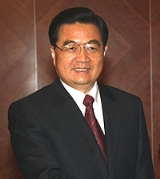
Hu Jintao

 
Hu Jintao

   Email Print
   Bookmark   Link


Hu Jintao


Hu Jintao (; born 21 December 1942) is currently the Paramount Leader
Paramount leader

Paramount Leader , in modern China political science, unofficially refers to the political leader of the People's Republic of China who hold absolute influences over culture, media, or controls the three branches of the politics of the People's Republic of China that hold real power....
 of the People's Republic of China
People's Republic of China

The People's Republic of China , commonly known as China, is the largest country in East Asia and the List of countries by population in the world with over 1.3 billion people, approximately a fifth of the world's population....
, holding the titles of General Secretary of the Communist Party of China
General Secretary of the Communist Party of China

The General Secretary of the Communist Party of China Central Committee is the highest ranking official within the Communist Party of China and heads the Secretariat of the Communist Party of China....
 since 2002, President of the People's Republic of China
President of the People's Republic of China

The President of the People's Republic of China is the head of state of the People's Republic of China. The office was created by the Constitution of the People's Republic of China....
 since 2003, and Chairman of the Central Military Commission
Chairman of the Central Military Commission

The Chairman of the Central Military Commission of the People's Republic of China has overall responsibility for the Central Military Commission ....
 since 2004, succeeding Jiang Zemin
Jiang Zemin

Jiang Zemin was the "core of the Generations of Chinese leadership" of Communist Party of China leaders, serving as General Secretary of the Communist Party of China from 1989 to 2002, as President of the People's Republic of China from 1993 to 2003, and as Chairman of the Central Military Commission from 1989 to 2004....
 in the fourth generation leadership
Generations of Chinese leadership

Because both the Communist Party of China and the People's Liberation Army promote according to seniority, it is possible to discern distinct generations of Chinese leadership....
 of the People's Republic of China, and commands the largest standing army in the world
List of countries by number of active troops

This is a list of countries sorted by the total number of active troops where the military manpower of a country is measured by the total number of active troops within the command of that country....
. Since his ascendancy Hu has reinstated certain controls on the economy and has been largely conservative with political reforms. His foreign policy is seen as less conciliatory than that of his predecessor, though China's global influence has increased while he has been in office.

Hu's rise to the presidency represents China's transition of leadership from old, establishment Communists to younger, more pragmatic technocrat
Technocracy (bureaucratic)

Technocracy is a form of government in which engineers, scientists, and other technical experts are in control. Technocracy is a governmental or organizational system where decision makers are selected based upon how highly knowledgeable they are, rather than how much political capital they hold....
s.


Discussion
Ask a question about 'Hu Jintao'
Start a new discussion about 'Hu Jintao'
Answer questions from other users
Full Discussion Forum


Quotations


We are ready to expand the friendly people-to-people exchanges and enhance exchanges and cooperation in science, technology, culture, education, and other areas.


Encyclopedia


Hu Jintao (; born 21 December 1942) is currently the Paramount Leader
Paramount leader

Paramount Leader , in modern China political science, unofficially refers to the political leader of the People's Republic of China who hold absolute influences over culture, media, or controls the three branches of the politics of the People's Republic of China that hold real power....
 of the People's Republic of China
People's Republic of China

The People's Republic of China , commonly known as China, is the largest country in East Asia and the List of countries by population in the world with over 1.3 billion people, approximately a fifth of the world's population....
, holding the titles of General Secretary of the Communist Party of China
General Secretary of the Communist Party of China

The General Secretary of the Communist Party of China Central Committee is the highest ranking official within the Communist Party of China and heads the Secretariat of the Communist Party of China....
 since 2002, President of the People's Republic of China
President of the People's Republic of China

The President of the People's Republic of China is the head of state of the People's Republic of China. The office was created by the Constitution of the People's Republic of China....
 since 2003, and Chairman of the Central Military Commission
Chairman of the Central Military Commission

The Chairman of the Central Military Commission of the People's Republic of China has overall responsibility for the Central Military Commission ....
 since 2004, succeeding Jiang Zemin
Jiang Zemin

Jiang Zemin was the "core of the Generations of Chinese leadership" of Communist Party of China leaders, serving as General Secretary of the Communist Party of China from 1989 to 2002, as President of the People's Republic of China from 1993 to 2003, and as Chairman of the Central Military Commission from 1989 to 2004....
 in the fourth generation leadership
Generations of Chinese leadership

Because both the Communist Party of China and the People's Liberation Army promote according to seniority, it is possible to discern distinct generations of Chinese leadership....
 of the People's Republic of China, and commands the largest standing army in the world
List of countries by number of active troops

This is a list of countries sorted by the total number of active troops where the military manpower of a country is measured by the total number of active troops within the command of that country....
. Since his ascendancy Hu has reinstated certain controls on the economy and has been largely conservative with political reforms. His foreign policy is seen as less conciliatory than that of his predecessor, though China's global influence has increased while he has been in office.

Hu's rise to the presidency represents China's transition of leadership from old, establishment Communists to younger, more pragmatic technocrat
Technocracy (bureaucratic)

Technocracy is a form of government in which engineers, scientists, and other technical experts are in control. Technocracy is a governmental or organizational system where decision makers are selected based upon how highly knowledgeable they are, rather than how much political capital they hold....
s. For most of Hu's adult life he has been involved in the Communist party bureaucracy
Bureaucracy

Bureaucracy is the structure and set of regulations in place to control activity, usually in large organizations and government. As opposed to adhocracy, it is represented by standardized procedure that dictates the execution of most or all processes within the body, formal division of powers, hierarchy, and relationships....
, notably as Party Chief for the Tibet Autonomous Region
Tibet Autonomous Region

The Tibet Autonomous Region , also called Xizang Autonomous Region , is a Province -level Autonomous regions of China of the People's Republic of China ....
, and then later Vice-President
Vice President of the People's Republic of China

The Vice President of the People's Republic of China , literally Vice Chairman of the People's Republic of China, or abbreviated Gu?jia F? Zhux? ?????, literally Vice State Chairman) is a senior position in the government of the People's Republic of China....
 under Jiang Zemin. An advocate for China's peaceful rise
China's peaceful rise

China's peaceful rise is a phrase that has been used by scholars and officials in the People's Republic of China to describe the country's foreign policy approach in the early 21st century....
, Hu's political philosophy is summarily described as aiming to found a basis for a Harmonious Society domestically and for Peaceful Development internationally, the former generated by a Scientific Development Concept
Scientific Development Concept

The Scientific Development Concept is the current official guiding socio-economic ideology of the Communist Party of China incorporating sustainable development, social welfare, a person-centered society, increased democracy, and, ultimately, the creation of a Harmonious Society....
, which seeks integrated solutions to tackle China's various economic, environmental and social problems
Social issues in the People's Republic of China

Social issues in the People's Republic of China in the 21st century are varied and wide-ranging, and are a combined result of the Chinese economic reforms set in place in the late 1970s, China's political and cultural history, and an immense population....
.

Early life

Hu Jintao was born in Jiangyan
Jiangyan

})|-| Area| 1,051 km?|-| Population'- Total'- Urban center| 922,00025,700 |-| GDP'- Total'- Per Capita...
, Jiangsu
Jiangsu

is a Province of China of the People's Republic of China, located along the east coast of the country. The name comes from jiang, short for the city of Jiangning , and su, for the city of Suzhou....
 on 21 December 1942. His branch of the family migrated from Jixi of Anhui Province to Jiangyan during his grandfather's generation.

Even though his father owned a small tea trading business in Taizhou
Taizhou, Jiangsu

Taizhou is a prefecture-level city in central Jiangsu province of China, People's Republic of China. Situated on the north bank of the Yangtze River, it borders Nantong to the east, Yancheng to the north and Yangzhou to the west....
, the family was relatively poor. His mother died when he was seven, and he was raised by an aunt. Hu's father was later denounced during the Cultural Revolution
Cultural Revolution

The Great Proletarian Cultural Revolution in the People?s Republic of China was a period of widespread social and political upheaval that led to nation-wide chaos and economic disarray, which would engulf much of Chinese society between 1966 and 1976....
, an event that (together with his relatively humble origins) apparently had a deep effect upon Hu, who diligently tried to clear his father's name.

Hu was a talented student in high school, excelling in activities such as singing and dancing. In 1964, while still a student at Beijing
Beijing

is a metropolis in northern China and the Capital of the People's Republic of China. It is one of the four municipality of China, which are equivalent to province in China's Political divisions of China....
's Tsinghua University
Tsinghua University

Tsinghua University , is a university in Beijing, People's Republic of China. Tsinghua University was established in 1911, originally under the name ?Tsinghua Xuetang?....
, Hu joined the Communist Party of China
Communist Party of China

The Communist Party of China , also known as the Chinese Communist Party , is the founding and the ruling party of the People's Republic of China and the world's largest political party....
, prior to the Cultural Revolution
Cultural Revolution

The Great Proletarian Cultural Revolution in the People?s Republic of China was a period of widespread social and political upheaval that led to nation-wide chaos and economic disarray, which would engulf much of Chinese society between 1966 and 1976....
. He graduated with a degree in hydraulic engineering
Hydraulic engineering

Hydraulic engineering is a sub-discipline of civil engineering concerned with the flow and conveyance of fluids, principally water. This area of engineering is intimately related to the design of bridges, dams, Channel s, canals, levees, elevators, and to both sanitary and environmental engineering....
 in 1965. At Tsinghua University Hu met a fellow student Liu Yongqing
Liu Yongqing

Liu Yongqing is the wife of Hu Jintao, the current president of the People?s Republic of China. Liu Yongqing has, as is the Chinese custom, retained her maiden name....
, now his wife. They have a son and daughter, Hu Haifeng
Hu Haifeng

Hu Haifeng is a Chinese businessman and the son of Chinese President Hu Jintao....
 and Hu Haiqing respectively.

In 1968, Hu volunteered for service in Gansu
Gansu

or , is a political divisions of China located in the northwest of the People's Republic of China. It lies between Qinghai, Inner Mongolia, and the Loess Plateau, and borders Mongolia to the north and Xinjiang to the west....
 and worked for a hydro-power station while also managing Party affairs for the local branch of the Ministry of Water Resources and Electric Power. From 1969 to 1974, Hu worked for Sinohydro Engineering Bureau, as an engineer.

Early political career

In 1974, Hu was transferred to the Construction Department of Gansu as a secretary. The next year he was promoted to vice senior chief. In 1980, Deng Xiaoping implemented the "Four Transformations" program, which aimed to produce communist leaders who were "more revolutionary, younger, more knowledgeable, and more specialized." In response to this nation-wide search for young party members, Song Ping
Song Ping

Song Ping was an official in the Communist Party of China and is considered a member of the Generations of Chinese leadership....
, the first secretary of CPC Gansu Committee (Gansu's governor) discovered Hu Jintao and promoted him several ranks to the position of deputy head of the commission. Another protégé of Song, Wen Jiabao
Wen Jiabao

Wen Jiabao is the current Premier of the People's Republic of China of the State Council of the People's Republic of China of the People's Republic of China, leading the country's Cabinet ....
, also became prominent at the same time.

In 1981, Hu, along with Deng Xiaoping
Deng Xiaoping

Deng Xiaoping was a prominent Chinese revolutionary, politician, pragmatist and reformer, as well as the late leader of the Communist Party of China ....
's daughter Deng Nan
Deng Nan

Deng Nan is the second daughter of Deng Xiaoping and his third wife Zhuo Lin.She was vice minister of the State Science and Technology Commission of the People's Republic of China ....
 and Hu Yaobang
Hu Yaobang

Hu Yaobang was a leader of the People's Republic of China.He was famous for supporting reforms toward capitalism and political reform in China....
's son Hu Deping, were trained in the Central Party School in Beijing
Beijing

is a metropolis in northern China and the Capital of the People's Republic of China. It is one of the four municipality of China, which are equivalent to province in China's Political divisions of China....
. Hu made a good impression on Deng Nan, who happened to report it to her father. Hu Deping even invited Hu Jintao to his home and met with Hu Yaobang
Hu Yaobang

Hu Yaobang was a leader of the People's Republic of China.He was famous for supporting reforms toward capitalism and political reform in China....
, who was a standing member of the politburo at that time. Hu Jintao's modesty created an impact on Hu Yaobang.

In 1982, Hu was promoted to the position of Communist Youth League Gansu Branch Secretary. His mentor Song Ping was transferred to Beijing
Beijing

is a metropolis in northern China and the Capital of the People's Republic of China. It is one of the four municipality of China, which are equivalent to province in China's Political divisions of China....
 as Minister of Organization of the Communist Party of China
Communist Party of China

The Communist Party of China , also known as the Chinese Communist Party , is the founding and the ruling party of the People's Republic of China and the world's largest political party....
, and was in charge of senior cadres' recommendation, candidacy and promotion. With the support of Hu Yaobang
Hu Yaobang

Hu Yaobang was a leader of the People's Republic of China.He was famous for supporting reforms toward capitalism and political reform in China....
 and Deng Xiaoping
Deng Xiaoping

Deng Xiaoping was a prominent Chinese revolutionary, politician, pragmatist and reformer, as well as the late leader of the Communist Party of China ....
, Hu was assured of a bright future in the party. At Song Ping's suggestion, in 1982 central Party authorities invited Hu to Beijing to study at the Central Party School. Soon after, he was transferred to Beijing and appointed as secretariat of the Communist Youth League
Communist Youth League

The Communist Youth League of China also known as the China Youth League is a youth movement of the People's Republic of China for youth between the ages of fourteen and twenty-eight, run by Communist Party of China....
 Central Committee ("CY Central"). Two years later Hu was promoted to First Secretary of CY Central, thus its actual leader. During his term in the Youth League, Hu escorted Hu Yaobang
Hu Yaobang

Hu Yaobang was a leader of the People's Republic of China.He was famous for supporting reforms toward capitalism and political reform in China....
, who was General Secretary of CPC then, in visits around the country. Hu Yaobang
Hu Yaobang

Hu Yaobang was a leader of the People's Republic of China.He was famous for supporting reforms toward capitalism and political reform in China....
, himself a veteran coming from the Youth League, could reminiscence his youth through Hu's company.

Party Committee Secretary of Guizhou

In 1985, Hu Yaobang
Hu Yaobang

Hu Yaobang was a leader of the People's Republic of China.He was famous for supporting reforms toward capitalism and political reform in China....
 pushed for Hu Jintao to be transferred to Guizhou
Guizhou

is a political divisions of China of the People's Republic of China located in the Southwest China of the country. Its provincial capital city is Guiyang....
 as the provincial Committee Secretary of Communist Party of China
Communist Party of China

The Communist Party of China , also known as the Chinese Communist Party , is the founding and the ruling party of the People's Republic of China and the world's largest political party....
. In contrast to the members of the "Shanghai clique
Shanghai clique

The Shanghai clique or Shanghai faction is the name given to an informal group of officials in the Communist Party of China, especially those who serve in the central government of the People's Republic of China or the Central Committee of the Communist Party of China, who rose to prominence in connection to the Shanghai municipal admi...
", Hu spent most of his career in China's poorer hinterland rather than in the economically prosperous coastal regions. Partly because of this, he was relatively unknown to Western analysts before his ascent to power. In 1987 Hu Jintao handled the local students protest parallel to the Democracy Wall
Democracy Wall

In China The Democracy Wall was a long brick wall on Xidan, Xicheng District, Beijing, which became the focus for Chinese democracy movement dissent....
 carefully, whereas in Beijing similar protests resulted in Hu Yaobang
Hu Yaobang

Hu Yaobang was a leader of the People's Republic of China.He was famous for supporting reforms toward capitalism and political reform in China....
's forced resignation. During the 1980s, Hu Jintao, was the director of the All China Youth Federation.

Working in Tibet

In June 1988, the Party Secretary in Tibet
Tibet Autonomous Region

The Tibet Autonomous Region , also called Xizang Autonomous Region , is a Province -level Autonomous regions of China of the People's Republic of China ....
 collapsed from altitude sickness and had to resign. Party head Zhao Ziyang
Zhao Ziyang

Zhao Ziyang was a politician in the People's Republic of China. He was Premier of the People's Republic of China from 1980 to 1987, and General Secretary of the Communist Party of China of the Communist Party of China from 1987 to 1989....
 proposed Hu because he had already worked in two of China's poorer provinces. On 10 December 1988, the Tibetan capital Lhasa
Lhasa

Lhasa, sometimes spelled Lasa, is the administrative capital of the Tibet Autonomous Region in the People's Republic of China. Lhasa is located at the foot of Mount Gephel....
 was rocked by riots. Soon afterward, on 28 January 1989, the revered Panchen Lama
Panchen Lama

The Panchen Lama is the second highest ranking Lama after the Dalai Lama in the Gelugpa sect of Tibetan Buddhism . The successive Panchen lamas form a tulku reincarnation lineage which are said to be the incarnations of Amitabha....
 died, an event in which many Tibetans believe Hu was involved. Beijing's Central committee ordered Hu's subordinate, the local government chairman, to declare martial law
Martial law

Martial law is the system of rules that takes effect when the military takes control of the normal administration of justice.Martial law is sometimes imposed during wars or occupied territory in the absence of any other civil government....
 in Lhasa. This was the first such order in the history of the People's Republic, setting a precedent for the 1989 Tiananmen crackdown.

According to the Hong Kong-published book The Fourth Generation, “Hu told a friend at this time that he felt pessimistic about his future. It seemed that he had reached a dead end in his career and would never rise beyond the level of provincial Party secretary.” As in Guizhou, he made no lasting impact on Tibet. He found it difficult to get used to the altitude and spent an average of five months of the year in Beijing.

His tenure at Tibet, however, allowed him to keep in touch with his patron, Song Ping.

Candidacy

China, Jiang Zemin and Hu Jintao (10)
Before the opening of 14th National Congress of the Communist Party of China (CPC)
Communist Party of China

The Communist Party of China , also known as the Chinese Communist Party , is the founding and the ruling party of the People's Republic of China and the world's largest political party....
 in 1992, the Party's senior leaders, including Deng
Deng Xiaoping

Deng Xiaoping was a prominent Chinese revolutionary, politician, pragmatist and reformer, as well as the late leader of the Communist Party of China ....
 and Chen Yun
Chen Yun

Chen Yun was one of the most influential leaders of the People's Republic of China and one of the top leaders of the Chinese Communist Party for almost its entire history....
, were to select candidates for the Politburo Standing Committee to ensure a smooth transition of power from the so-called second-generation leaders (Deng, Chen, Li Xiannian
Li Xianniàn

Li Xiannian was President of the People's Republic of China between 1983 and 1988 and then president of the Chinese People's Political Consultative Conference until his death....
, Wang Zhen
Wang Zhen

W?ng Zh?n was a China political figure and one of the Eight Elders. Like most Chinese communist leaders, Wang was a commander in his early years....
, etc.) to third-generation Communist Party of China
Communist Party of China

The Communist Party of China , also known as the Chinese Communist Party , is the founding and the ruling party of the People's Republic of China and the world's largest political party....
 leaders (Jiang Zemin
Jiang Zemin

Jiang Zemin was the "core of the Generations of Chinese leadership" of Communist Party of China leaders, serving as General Secretary of the Communist Party of China from 1989 to 2002, as President of the People's Republic of China from 1993 to 2003, and as Chairman of the Central Military Commission from 1989 to 2004....
, Li Peng
Li Peng

Li Peng , was the Premier of the People's Republic of China of China between 1987 and 1998, the Chairman of the Standing Committee of the National People's Congress of the National People's Congress of the People's Republic of China from 1998 to 2003 and was second-ranking in the Communist Party of China behind Jiang Zemin on the Politbur...
, Qiao Shi
Qiao Shi

Qiao Shi is a politician in the People's Republic of China. He was born as Jiang Zhitong in Shanghai, China, to parents of Dinghai, Zhejiang ancestry....
 etc.). Deng also proposed that they should consider another candidate for a further future transition, preferably someone under fifty to represent the next generation of leaders. Song
Song Ping

Song Ping was an official in the Communist Party of China and is considered a member of the Generations of Chinese leadership....
, as the organization chief, recommended Hu as an ideal candidate for the prospect of a future leader. As a result, shortly before his 50th birthday, Hu Jintao became the youngest member of the seven-member Politburo Standing Committee
Politburo Standing Committee of the Communist Party of China

The Politburo of the Communist Party of China Standing Committee of the Communist Party of China is a committee whose membership varies between 5 and 9 people, usually men, and includes the top leadership of the Communist Party of China....
, and the second youngest Politburo Standing Committee member ever since the CCP had seized power in 1949.

In 1993, Hu took charge of the Secretariat of the CPC
Communist Party of China

The Communist Party of China , also known as the Chinese Communist Party , is the founding and the ruling party of the People's Republic of China and the world's largest political party....
 Central Committee, which oversaw day-to-day operations of the Central Committee, and the Central Party School, which was convenient for him to bring up his own supporters among senior CPC
Communist Party of China

The Communist Party of China , also known as the Chinese Communist Party , is the founding and the ruling party of the People's Republic of China and the world's largest political party....
 cadres. Hu was also put in charge of the ideological work of the CPC
Communist Party of China

The Communist Party of China , also known as the Chinese Communist Party , is the founding and the ruling party of the People's Republic of China and the world's largest political party....
. Although Hu was considered heir apparent to Jiang, he always took great care to ensure that Jiang be at the center of the spotlight. In late 1998, Hu promoted Jiang's unpopular movement of the "Three Stresses" "stress study, stress politics, and stress healthy trends" giving speeches to promote it. In 2001, he publicized Jiang's Three Represents
Three Represents

The Three Represents is a socio-political ideology credited to General Secretary Jiang Zemin which became a guiding ideology of the Communist Party of China at its 16th Party Congress in 2002....
 theory, which Jiang hoped to place him on the same level as other Marxist theoreticians. As a result, he left the public with an impression of being low-key, courteous, and adept at forming coalitions. In 1998, Hu became Vice-President of China, and Jiang wanted Hu to play a more active role in foreign affairs. Hu became China's leading voice during the US bombings of China's embassy
NATO Bombing of the Chinese embassy in Belgrade

On May 7, 1999 in Operation Allied Force, NATO bombs hit the People's Republic of China Embassy in Belgrade, killing three PRC citizens and outraging the PRC public....
 in Belgrade
Belgrade

Belgrade is the capital and largest city of Serbia. The city lies on international waterway, at the confluence of the Sava River and Danube rivers, where the Pannonian Plain meets the Balkan Peninsula....
 in 1999.

When the transition finally took place in the 16th National Congress of the CPC in 2002, Jiang
Jiang Zemin

Jiang Zemin was the "core of the Generations of Chinese leadership" of Communist Party of China leaders, serving as General Secretary of the Communist Party of China from 1989 to 2002, as President of the People's Republic of China from 1993 to 2003, and as Chairman of the Central Military Commission from 1989 to 2004....
 was reluctant to leave the center of power. It was widely believed that he staffed the Politburo with many members of the so-called "Shanghai Clique", including Wu Bangguo
Wu Bangguo

Wu Bangguo is a high-ranking Politics of the People's Republic of China People's Republic of China. He is currently Chairmen of the Standing Committee of the National People's Congress of the Standing Committee of the National People's Congress, a position that makes him China's chief legislator and places him second in Political position r...
, Jia Qinglin
Jia Qinglin

Jia Qinglin is the fourth ranking member of the Politburo Standing Committee of the Communist Party of China of the Communist Party of China, and the Chairman of the People's Political Consultative Conference....
, Zeng Qinghong
Zeng Qinghong

Zeng Qinghong was the Vice-President of the People's Republic of China from 2003 to 2008. He became a member of the Politburo Standing Committee of the Communist Party of China and member of the Secretariat of the CPC Central Committee during the 2002 16th Party Congress....
, Huang Ju
Huang Ju

Huang Ju was the Executive Vice Premier of the People's Republic of China. He joined the Communist Party of China in March 1966. He was Political position ranking of the People's Republic of China, and was one of the least popular and most partisan members of the Politburo Standing Committee of the Communist Party of China of the Communist...
 and Li Changchun
Li Changchun

Li Changchun is considered to be the propaganda chief of the Communist Party of China. He is a 5th ranked member of the Politburo Standing Committee of the Communist Party of China, China's de facto top power organ, and has been a member since 2002....
, which could ensure Jiang
Jiang Zemin

Jiang Zemin was the "core of the Generations of Chinese leadership" of Communist Party of China leaders, serving as General Secretary of the Communist Party of China from 1989 to 2002, as President of the People's Republic of China from 1993 to 2003, and as Chairman of the Central Military Commission from 1989 to 2004....
's control behind the stage. Jiang
Jiang Zemin

Jiang Zemin was the "core of the Generations of Chinese leadership" of Communist Party of China leaders, serving as General Secretary of the Communist Party of China from 1989 to 2002, as President of the People's Republic of China from 1993 to 2003, and as Chairman of the Central Military Commission from 1989 to 2004....
 held on to the position of Chairman of the Central Military Commission.

Presidency

Hu Jintao Bush
Since taking over as Party General Secretary at the Sixteenth National Congress of the Communist Party of China
Sixteenth National Congress of the Communist Party of China

The 16th National Congress of the Communist Party of China was held in Beijing between November 8-November 14, 2002. 2,114 delegates and 40 specially invited delegates elected a 356-member 16th CPC Central Committee, as well as a 121-member Central Commission for Discipline Inspection ....
, Hu and his premier, Wen Jiabao
Wen Jiabao

Wen Jiabao is the current Premier of the People's Republic of China of the State Council of the People's Republic of China of the People's Republic of China, leading the country's Cabinet ....
, proposed to set up a Harmonious Society
Harmonious society

The construction of a Harmonious Society is the dominant socio-economic vision that is said to be the ultimate end result of Chinese leader Hu Jintao's signature ideology of the Scientific Development Concept....
 which aims at lessening the inequality and changing the style of the "GDP first and Welfare Second" policies. They focused on sectors of the Chinese population that have been left behind by the economic reform, and have taken a number of high profile trips to the poorer areas of China with the stated goal of understanding these areas better. Hu and Wen Jiabao have also attempted to move China away from a policy of favouring economic growth at all costs and toward a more balanced view of growth that includes factors in social inequality and environmental damage, including the use of the green gross domestic product
Green Gross Domestic Product

Green Gross Domestic Product is an index of economic growth with the environmental consequences of that growth factored in.In 2004, Wen Jiabao, the Chinese premier, announced that the green Gross domestic product index would replace the Chinese GDP index itself as a performance measure for government and party officials at the highest leve...
 in personnel decisions. Jiang's clique, however, maintained control in most developing areas, therefore Hu and Wen's measures of macroeconomic regulation faced great resistance.

SARS crisis

The first crisis of Hu's leadership happened during the outbreak of SARS
Severe acute respiratory syndrome

Severe acute respiratory syndrome is a respiratory disease in humans which is caused by the SARS coronavirus . There has been one near pandemic to date, between November 2002 and July 2003, with 8,096 known infected cases and 774 deaths worldwide being listed in the World Health Organization's 21 April 2004 concluding report....
 in 2003. Following strong criticism of China for initially covering up and responding slowly to the crisis, he dismissed several party and government officials, including the health minister, who supported Jiang, and the Mayor of Beijing, Meng Xuenong
Meng Xuenong

Meng Xuenong is a politician of the People's Republic of China. He was the Governor of Shanxi province. A native of Penglai City county, Shandong, Meng had previous Political divisions of China#Province level leadership experience as Mayor of Beijing, until he was dramatically sacked for his failure to control and conceal the SARS epidemic....
, widely perceived as Hu's protégé. Meng's dismissal was sometimes seen as a yielding compromise to erode Jiang's support in the party. Hu and Wen took steps to increase the transparency of China's reporting to international health organizations, indirectly dealing a blow to Jiang's stance on the issue.

Another test of Hu's leadership was Beijing's low key response to protests against the implementation of Article 23 of the Basic Law
Hong Kong Basic Law Article 23

Hong Kong Basic Law Article 23 is the basis of a security law proposed by the Government of Hong Kong. It states:On 24 September 2002 the government released its proposals for the anti-subversion law....
 in Hong Kong
Hong Kong

Hong Kong , officially the Hong Kong Special Administrative Region, is a territory located in Southern China in East Asia, bordering the province of Guangdong to the north and facing the South China Sea to the east, west and south....
 in 2003. In an unprecedented move, the legislation to implement the Article was withdrawn by the Hong Kong government, after a large popular protest on 1 July 2003. At the same time, Hu gave a public show of support to Hong Kong Chief Executive Tung Chee-Hwa after gauging public mood in Hong Kong.

Succession of Jiang Zemin

On 15 November 2002, a new Hu Jintao-led Politburo nominally succeeded Jiang Zemin. Although Jiang, then 76, stepped down from the powerful Politburo Standing Committee to make way for a younger fourth generation
Generations of Chinese leadership

Because both the Communist Party of China and the People's Liberation Army promote according to seniority, it is possible to discern distinct generations of Chinese leadership....
 of leadership, there was speculation that Jiang would retain significant influence because Hu was not associated with Jiang's influential Shanghai clique
Shanghai clique

The Shanghai clique or Shanghai faction is the name given to an informal group of officials in the Communist Party of China, especially those who serve in the central government of the People's Republic of China or the Central Committee of the Communist Party of China, who rose to prominence in connection to the Shanghai municipal admi...
, to which six out of the nine members of the all-powerful Standing Committee were believed to be linked. However, later developments show that many of its members have shifted their positions. Zeng Qinghong
Zeng Qinghong

Zeng Qinghong was the Vice-President of the People's Republic of China from 2003 to 2008. He became a member of the Politburo Standing Committee of the Communist Party of China and member of the Secretariat of the CPC Central Committee during the 2002 16th Party Congress....
, for example, moved from a disciple of Jiang to serving as an intermediary between the two factions. In 2003, Jiang was also reelected to the post of Chairman of the Central Military Commission
Central Military Commission

A Central Military Commission or National Defense Commission is an organisation typical of Communist one-party states, responsible for supervising the nation's armed forces....
 of the CPC, a post from which Deng Xiaoping
Deng Xiaoping

Deng Xiaoping was a prominent Chinese revolutionary, politician, pragmatist and reformer, as well as the late leader of the Communist Party of China ....
 was able to wield power from behind the scenes as paramount leader
Paramount leader

Paramount Leader , in modern China political science, unofficially refers to the political leader of the People's Republic of China who hold absolute influences over culture, media, or controls the three branches of the politics of the People's Republic of China that hold real power....
, thus retaining military power.

Western observers attribute a sense of caution to Hu's philosophies, citing China's recent history of fallen heirs. Deng Xiaoping appointed three party secretaries, all designed to be successors, and was instrumental in the ousting of two of them, Hu Yaobang
Hu Yaobang

Hu Yaobang was a leader of the People's Republic of China.He was famous for supporting reforms toward capitalism and political reform in China....
 and Zhao Ziyang
Zhao Ziyang

Zhao Ziyang was a politician in the People's Republic of China. He was Premier of the People's Republic of China from 1980 to 1987, and General Secretary of the Communist Party of China of the Communist Party of China from 1987 to 1989....
. His third and final selection, Jiang Zemin, won Deng's continued, although ambiguous backing and was the only party secretary in Communist Chinese history to voluntarily leave his post when his term ended.

Although many believe Hu was originally hand-picked by Deng as the youngest member of China's top leadership and a leading candidate to succeed Jiang, he had exercised a great deal of political skills between 1992 and 2002 to consolidate his position, and eventually emerged as Jiang's heir apparent in his own right. Hu also benefited from the slow but progressive institutionalization of power succession within the Party. As a result, attempts to draw parallels with regards to Hu's succession is unreasonable. Since the early 1980s, the People's Republic of China
People's Republic of China

The People's Republic of China , commonly known as China, is the largest country in East Asia and the List of countries by population in the world with over 1.3 billion people, approximately a fifth of the world's population....
 has been marked by progressive institutionalization and rule by consensus
Consensus

Consensus has two common meanings. One is a general Wiktionary:agreement among the members of a given group or community, each of which exercises some discretion in decision making and follow-up action....
, and moved away from the Maoist authoritarian model. Although a western-style legal institution and rule of law remain to be put in place, Hu's power succession was conducted in a fairly orderly and civil manner, which was unprecedented in Communist China's history. This trend is expected to continue and an institutionalized mechanism of power transition is expected to emerge, first perhaps within the Party. In fact, it has been one of the Party's stated major goals to create an orderly system of succession and mechanism to prevent informal rule and a cult of personality
Cult of personality

A cult of personality or personality cult arises when a country's leader uses mass media to create a heroic public image through unquestioning flattery and praise....
.

The rivalry between Jiang and Hu after Jiang stepped down from his posts was, arguably, an inevitable product of China's tradition of succession. Some analysts argue that although Jiang has consolidated power by the time he retired, his ideological stature within the Communist Party remains shaky at best, thus Jiang had to buy time to ensure that his ideological legacy such as the Three Represents
Three Represents

The Three Represents is a socio-political ideology credited to General Secretary Jiang Zemin which became a guiding ideology of the Communist Party of China at its 16th Party Congress in 2002....
, is enshrined in China's socialism doctrine. Jiang resigned as Chairman of the Central Military Commission
Central Military Commission

A Central Military Commission or National Defense Commission is an organisation typical of Communist one-party states, responsible for supervising the nation's armed forces....
 in September 2004, his last official post. Whether this is the result of pressure from Hu or a personal decision is up for speculation. Since then Hu has officially taken on the three institutions in the People's Republic of China where power lie, the state, the party, as well as the military
People's Liberation Army

The People's Liberation Army is the unified military organization of all land, sea, and air forces of the People's Republic of China. The PLA was established on August 1, 1927 ? celebrated annually as "PLA Day" ? as the military arm of the Communist Party of China....
, thus informally, has become the paramount leader
Paramount leader

Paramount Leader , in modern China political science, unofficially refers to the political leader of the People's Republic of China who hold absolute influences over culture, media, or controls the three branches of the politics of the People's Republic of China that hold real power....
. The Hu-Jiang split, however, remains. Officially, Hu has been promoting Jiang's legacy by beginning a mass campaign in August 2006 promoting the Selected Works of Jiang Zemin, a collection of speeches and essays documenting Jiang's philosophies. Hu had corruption charges brought against Shanghai's leader to get rid of Jiang's man.

Hu and Premier Wen Jiabao
Wen Jiabao

Wen Jiabao is the current Premier of the People's Republic of China of the State Council of the People's Republic of China of the People's Republic of China, leading the country's Cabinet ....
 inherited a China wrought with internal social, political and environmental problems. One of the biggest challenges Hu faces is the large wealth disparity between the Chinese rich and poor, for which discontent and anger mounted to a degree which wreaked havoc on communist rule. Furthermore, the cronyism
Cronyism

Cronyism is partiality to long-standing friends, especially by appointing them to positions of authority, regardless of their qualifications. Hence, cronyism is contrary in practice and principle to meritocracy....
 and corruption plaguing China's civil service
Civil service

The term civil service has two distinct meanings:* Branch of governmental service in which individuals are hired on the basis of merit which is proven by the use of competitive examinations....
, military, educational, judicial and medical systems sought to destroy the country bit by bit. In the beginning of 2006, however, Hu launched the "8 Honours and 8 Disgraces
Ba rong ba chi

The Ba rong ba chi , officially the Core Value System or the Eight Honors and Disgraces, is a set of moral concepts developed by current President of the People's Republic of China Hu Jintao for the citizens of the People's Republic of China....
" movement in a bid to promote a more selfless and moral outlook amongst the population. China's increasingly fragile environment has caused massive urban pollution, sandstorm
Sandstorm

Sandstorm can refer to:* Dust storm, a storm caused by strong winds and blowing sand or dust* Sandstorm , an electronica song by Darude*...
s and the destruction of vast tracts of habitable land. It remains to be seen if Hu, usually cautious in nature, is capable of managing the continued peaceful development of China while avoiding international incidents, at the same time presiding over an unprecedented increase in Chinese nationalist sentiment.

At the 11th National People's Congress
11th National People's Congress

The 11th National People's Congress is in session from 2008 to 2013. It is scheduled to hold five plenary sessions in this period, occuring around early March every year....
, Hu was re-elected as President on 15 March 2008. He was also re-elected as Chairman of the Central Military Commission.

Positions


Scientific Perspective and Harmonious Society

20060420 D 0298 772v
Observers indicate that Hu distinguishes himself from his predecessor in both domestic and foreign policy. President Hu Jintao's overarching vision, his political philosophy is summarized by three slogans — a “Harmonious Society” domestically and a “Peaceful Development” internationally, the former generated by a “Scientific Development Perspective,” which seeks integrated sets of solutions to arrays of economic, environmental and social problems, and recognizes, in inner circles, a need for political reform (though studied, cautious and controlled). The role of the Party has changed, as formulated by Deng Xiaoping
Deng Xiaoping

Deng Xiaoping was a prominent Chinese revolutionary, politician, pragmatist and reformer, as well as the late leader of the Communist Party of China ....
 and implemented by Jiang Zemin
Jiang Zemin

Jiang Zemin was the "core of the Generations of Chinese leadership" of Communist Party of China leaders, serving as General Secretary of the Communist Party of China from 1989 to 2002, as President of the People's Republic of China from 1993 to 2003, and as Chairman of the Central Military Commission from 1989 to 2004....
, from a revolutionary party to a ruling party. Hu continues the Party’s modernization, calling for both "Advancement" of the Party and its increasing transparency in governance.

What emerges in the view of President Hu is the "China Model," a systematic approach to national structure and development that combines dynamic economic growth, a free market energized by a vigorous “nonpublic” (i.e., private) sector, unrelenting political and media control, personal but not political freedoms, concern for the welfare of all citizens, cultural enlightenment, and a synergistic approach to diverse social issues (the Scientific Development Perspective) that lead, in Hu’s vision, to a Harmonious Society
Harmonious society

The construction of a Harmonious Society is the dominant socio-economic vision that is said to be the ultimate end result of Chinese leader Hu Jintao's signature ideology of the Scientific Development Concept....
. Beijing sees its China Model as an alternative to Washington’s Democracy Model, particularly for developing countries. In Hu’s words, "A harmonious society should feature democracy, the rule of law, equity, justice, sincerity, amity and vitality." Such a society, he says, will give full scope to people's talent and creativity, enable all the people to share the social wealth brought by reform and development, and forge an ever closer relationship between the people and government.

Western criticism of Hu, particularly regarding human rights, exposes his hypersensitivity to social stability but misses his fresh commitment to address China’s multi-faceted problems
Social issues in the People's Republic of China

Social issues in the People's Republic of China in the 21st century are varied and wide-ranging, and are a combined result of the Chinese economic reforms set in place in the late 1970s, China's political and cultural history, and an immense population....
. Hu’s pragmatic, non-ideological agenda has two core values—maintaining social stability to further economic development and sustaining Chinese culture to enrich national sovereignty. In domestic policy, he seems to want more openness to the public on governmental functions and meetings. Recently, China's news agency published many Politburo Standing Committee meeting details. He also cancelled many events that are traditionally seen as communist extravagances, such as the lavish send-off and welcoming-back ceremonies of Chinese leaders when visiting foreign lands. Furthermore the Chinese leadership under Hu has also focused on such problems as the gap between rich and poor and uneven development between the interior and coastal regions. Both party and state seem to have moved away from a definition of development that focuses solely on GDP
Gross domestic product

File:GDP nominal per capita world map IMF 2008.pngThe gross domestic product or gross domestic income is one of the measures of national income and output for a given country's economy....
 growth and toward a more balanced definition which includes social equality and environment effects.

In 2004, Hu gave an unprecedented showing and ordered all cadres from the five major power functions to stop the tradition of going to the Beidaihe
Beidaihe

Beidaihe District is a District in Qinhuangdao municipality, Hebei province, People's Republic of China. It has an area of 70.14 square kilometers and a population of 66,000....
 seaside retreat for their annual summer meeting which, before, was commonly seen as a gathering of ruling elites from both current and elder cadres to decide China's destiny, and also an unnecessary waste of public funds. The move was seen by the Chinese public as symbolic of Hu's attitude towards corruption.

In June 2007, Hu gave an important speech at the Central Party School that was indicative of his position of power and his guiding philosophies. In the speech Hu used a very populist tone to appeal to ordinary Chinese, making serious note of the recent challenges China has been facing, especially with regards to income disparity. In addition, Hu noted the need for "increased democracy" in the country. Although the term has different meanings in the party than it does in the general Western sense, it shows that Hu's administration has placed political reform as an important part of the agenda in the coming years, a tone that was nonexistent during the Jiang era.

Foreign policy

In foreign policy
Foreign relations of the People's Republic of China

The foreign relations of the People's Republic of China draw upon traditions extending back to imperial China in the Qing Dynasty and the Opium Wars, despite Chinese society having undergone many radical upheavals over the past two and a half centuries....
, Hu has focused on moving away from a Jiang's U.S.-centered foreign policy, with more diverse alliances with countries, such as Venezuela, Iran, Canada, and Australia. He has also differed from his predecessor by actively engaging in the current North Korea
North Korea

North Korea, officially the Democratic People's Republic of Korea , is a state in East Asia, occupying the northern half of the Korean Peninsula....
 nuclear crisis. He has also assured neighbours in the region with the concept of China's peaceful rise
China's peaceful rise

China's peaceful rise is a phrase that has been used by scholars and officials in the People's Republic of China to describe the country's foreign policy approach in the early 21st century....
. In addition, Hu has sought to strengthen ties with resource-based countries such as Brazil and Pakistan
Pakistan

Pakistan , officially the Islamic Republic of Pakistan, is a country located in South Asia and borders Central Asia and the Middle East. It has a 1,046 kilometre coastline along the Arabian Sea and Gulf of Oman in the south, and is bordered by Afghanistan and Iran in the west, India in the east and People's Republic of China in th...
 and focused on increasing China's influence in Africa
Africa

Africa is the world's second-largest and second most-populous continent, after Asia. At about 30.2 million km? including adjacent islands, it covers 6% of the Earth's total surface area and 20.4% of the total land area....
, pledging aid and skilled workers to poor African nations. Hu's stance is seen favourably by the majority in Africa. In addition, Hu's official position on many global issues, including terrorism
Terrorism

Terrorism, according to the Merriam-Webster online dictionary, is the systematic use of terror, "violent or destructive acts committed by groups in order to intimidate a population or government into granting their demands." At present, there is no internationally agreed upon definition of terrorism....
, is similar to that of the United States. China has shown notable discretion on the issues of Iran's nuclear program and the War in Iraq.

Media control

Despite initial expectations that Hu was a "closet liberal", Hu has shown a fairly hard-line approach to liberalisation of the media.

The media has been given greater latitude in reporting many topics of popular concern, such as the 2008 Sichuan earthquake
2008 Sichuan earthquake

The List_of_deadliest_natural_disasters#Earthquakes, the 2008 Sichuan earthquake , or "Great Sichuan Earthquake", which measured at 8.0 Surface wave magnitude
, as well as into malpractices at the local level. The government has also been responsive to criticism of its media policy, for example in response to the SARS
SARs

SARs may refer to:*Special Administrative Regions*Severe Acute Respiratory Syndrome *South African Revenue Service ...
 epidemic, and in regard to public commemorations of popular, but deposed, former leader Hu Yaobang
Hu Yaobang

Hu Yaobang was a leader of the People's Republic of China.He was famous for supporting reforms toward capitalism and political reform in China....
.

Hu has been very cautious with regards to the Internet, choosing to censor politically sensitive material to a degree stricter than the Jiang era. In February 2007, Hu embarked on further domestic media controls that restricted primetime TV series to "morally correct" content—he objected to lowbrow
Low culture

Low culture is a derogatory term for some forms of popular culture. The term is often encountered in discourses on the nature of culture. Its opposite is high culture....
 programming including some reality shows—on all Chinese TV stations, and listed "20 forbidden areas" of coverage on news reporting.

Taiwan

Early in his presidency, Hu faced an independence supporting
Taiwan independence

Taiwan independence is a political movement whose goal is primarily to create an independent and sovereign Republic of Taiwan out of the lands currently governed by the Republic of China and claimed by the People's Republic of China....
 counterpart in the form of then-President of the Republic of China
President of the Republic of China

The President of the Republic of China is the head of state of the Republic of China . The Republic of China was founded in 1911 governing the whole of China....
 Chen Shui-bian
Chen Shui-bian

Chen Shui-bian is a Taiwanese politician and former President of the Republic of China. He is colloquially referred to as Ah-Bian .Chen, whose Democratic Progressive Party has traditionally been supportive of Taiwan independence, took office in 2000, ending more than fifty years of Kuomintang rule in Taiwan....
. Chen called for talks without any preconditions, repudiating the 1992 consensus
1992 Consensus

The 1992 Consensus or Consensus of 1992 is a term describing the outcome of a meeting in 1992 between the representatives of the People's Republic of China in mainland China and the Republic of China in Taiwan....
. Chen Shui-bian and his party
Democratic Progressive Party

The Democratic Progressive Party is a major political party in the Republic of China, commonly known as Taiwan. It has traditionally been associated with the Pan-Green Coalition and De facto Taiwan independence movement, although it moderated its stance during its Republic of China presidential election, 2000....
 had continued to express an ultimate goal of Taiwanese independence, and make statements on the political status of Taiwan
Political status of Taiwan

The controversy regarding the political status of Taiwan hinges on whether Taiwan, including Penghu, should remain effectively independent as territory of the Republic of China , become Chinese reunification with the territories now governed by the People's Republic of China , or formally declare independence and become the Republic of Taiwa...
 that the PRC considers provocative. Hu's initial response was a combination of "soft" and "hard" approaches. On the one hand, Hu expressed a flexibility to negotiate on many issues of concern to Taiwan. On the other hand, he continued to refuse talks without preconditions and remained committed to Chinese reunification
Chinese reunification

Chinese reunification is a goal of Chinese nationalism that refers to the bringing together of all of the territories controlled by the People's Republic of China and the Republic of China under a single political entity....
 as an ultimate goal. While Hu Jintao gave some signs of being more flexible with regard to political relationships with Taiwan
Taiwan

Taiwan is an island in East Asia. "Taiwan" is also commonly used to refer to the country governed by the Republic of China and to the ROC itself, which governs the island of Taiwan, Orchid Island and Green Island, Taiwan in the Pacific Ocean off the Taiwan coast, the Penghu islands in the Taiwan Strait, and Kinmen and the Matsu Islands...
 as in his May 17 Statement where he offered to address the issue of "international living space" for Taiwan, Hu's government remains firm in its position that the Mainland side will not tolerate any attempt by the Taiwanese government to declare de jure independence from China.

After the re-election of Chen Shui-bian
Chen Shui-bian

Chen Shui-bian is a Taiwanese politician and former President of the Republic of China. He is colloquially referred to as Ah-Bian .Chen, whose Democratic Progressive Party has traditionally been supportive of Taiwan independence, took office in 2000, ending more than fifty years of Kuomintang rule in Taiwan....
 in 2004, Hu's government changed tactics. Hu's government has conducted a no contact policy with the then Taipei administration due to Chen Shui-Bian and the DPP's independence leanings and repudiation of the 1992 consensus
1992 Consensus

The 1992 Consensus or Consensus of 1992 is a term describing the outcome of a meeting in 1992 between the representatives of the People's Republic of China in mainland China and the Republic of China in Taiwan....
. The government maintained its military build-up against Taiwan, and pursued a vigorous policy of isolating Taiwan diplomatically. In March 2005, the Anti-Secession Law was passed by the National People's Congress
National People's Congress

The National People's Congress , abbreviated NPC , is the highest state body and only legislative house in the People's Republic of China....
, formalising "non-peaceful means" as an option of response to a declaration of independence in Taiwan.

Hu's government increased contacts with the Kuomintang
Kuomintang

The Kuomintang of China , also often translated as the Chinese Nationalist Party, is the founding and the ruling party of the Republic of China ....
 (KMT), then the opposition party in Taiwan. The relationship between the Communist Party of China
Communist Party of China

The Communist Party of China , also known as the Chinese Communist Party , is the founding and the ruling party of the People's Republic of China and the world's largest political party....
 (CPC) and the Kuomintang
Kuomintang

The Kuomintang of China , also often translated as the Chinese Nationalist Party, is the founding and the ruling party of the Republic of China ....
 dates back before the Chinese civil war
Chinese Civil War

The Chinese Civil War or , which lasted from April 1927 to May 1950, was a civil war in China between the Kuomintang and the Chinese Communist Party ....
 when the two parties twice co-operated in the Northern Expedition
Northern Expedition

The Northern Expedition was a military campaign led by the Kuomintang from 1926 to 1928. Its main objective was to speed up the China revolution against feudalism and imperialism plaguing China after the Xinhai Revolution and unify China under the Nationalist banner by ending the rule of local warlords....
 and the war against Japan
Second Sino-Japanese War

The Second Sino-Japanese War was the largest Asian war in the twentieth century. From 1937 to 1941, it was fought between the Republic of China and the Empire of Japan....
. The increased contacts culminated in the 2005 Pan-Blue visits to mainland China
2005 Pan-Blue visits to mainland China

The 2005 Pan-Blue visits to mainland China, also known as the Third United Front of China , were a series of groundbreaking visits by delegations of the Kuomintang to mainland China....
, including a historic meeting between Hu and then-Kuomintang
Kuomintang

The Kuomintang of China , also often translated as the Chinese Nationalist Party, is the founding and the ruling party of the Republic of China ....
 chairman Lien Chan
Lien Chan

Lien Chan is a politician in Taiwan. He was Vice President of the Republic of China from 1996 to 2000, and was the Chairman of the Kuomintang from 2000 to 2005....
 in April 2005.

On 20 March 2008, the Kuomintang
Kuomintang

The Kuomintang of China , also often translated as the Chinese Nationalist Party, is the founding and the ruling party of the Republic of China ....
 won the presidency in Taiwan. It also has a majority in the Legislature
Legislative Yuan

The Legislative Yuan is the legislative body of the Republic of China , which administers Taiwan, Penghu, Kinmen, and Matsu Islands.The Legislative Yuan is one of the five branches of government stipulated by the Constitution of the Republic of China, which follows Sun Yat-sen's Three Principles of the People....
. Compared to his predecessors, who often dictated conditions to Taiwan, Hu has been proactive in seeking ties with Taiwan, especially with the pro-unification Kuomintang
Kuomintang

The Kuomintang of China , also often translated as the Chinese Nationalist Party, is the founding and the ruling party of the Republic of China ....
 party.

A series of historical meetings between the CPC and KMT have followed. On 12 April 2008, Hu Jintao held a historic meeting with ROC's then vice-president elect Vincent Siew
Vincent Siew

Vincent C. Siew was the first Taiwanese-born Premier of the Republic of China and former vice-chairman of Kuomintang . Siew is the current Vice President, having won the Republic of China presidential election, 2008 on 22 March with running-mate Ma Ying-jeou....
 as chairman of the Cross-strait Common Market Fundation during the Boao Forum for Asia
Boao Forum for Asia

Boao Forum for Asia , abbreviated as BFA, is a non-governmental, not-for-profit international organization modelled after the World Economic Forum in Davos, Switzerland....
. On 28 May 2008, Hu met with KMT chairman Wu Po-hsiung, the first meeting between the heads of the CPC and the KMT as ruling parties. During this meeting, Hu and Wu agreed that both sides should re-commence official dialogue under the 1992 consensus
1992 Consensus

The 1992 Consensus or Consensus of 1992 is a term describing the outcome of a meeting in 1992 between the representatives of the People's Republic of China in mainland China and the Republic of China in Taiwan....
. Wu committed the new government in Taiwan against Taiwanese independence. Hu committed his government to addressing the concerns of the Taiwanese people in regard to security, dignity, and "international living space", with a priority given to allowing Taiwanese participation in the World Health Organisation.

As well as the party-to-party channel, the semi-governmental dialogue channel via the Straits Exchange Foundation
Straits Exchange Foundation

The Straits Exchange Foundation is a semi-official organization set up by the Republic of China government to handle technical or business matters with the People's Republic of China....
 and the Association for Relations Across the Taiwan Straits
Association for Relations Across the Taiwan Straits

The Association for Relations Across the Taiwan Straits is an organization set up by the People's Republic of China for handling technical or business matters with the Republic of China....
 is scheduled to re-open in June 2008 on the basis of the 1992 Consensus
1992 Consensus

The 1992 Consensus or Consensus of 1992 is a term describing the outcome of a meeting in 1992 between the representatives of the People's Republic of China in mainland China and the Republic of China in Taiwan....
, with the first meeting held in Beijing. Both Hu and his new counterpart Ma Ying-jeou
Ma Ying-jeou

Ma Ying-jeou is the incumbent President of the Republic of China of the Republic of China . He formerly served as Ministry of Justice from 1993 to 1996, Mayor of Taipei from 1998 to 2006, and Chairman of the Kuomintang from 2005 to 2007....
 agree that the 1992 Consensus
1992 Consensus

The 1992 Consensus or Consensus of 1992 is a term describing the outcome of a meeting in 1992 between the representatives of the People's Republic of China in mainland China and the Republic of China in Taiwan....
 is the basis for negotiations between the two sides of the Taiwan strait. On 26 March 2008, Hu Jintao held a telephone talk with the US President George W. Bush
George W. Bush

George Walker Bush served as the List of Presidents of the United States President of the United States from 2001 to 2009. He was the 46th List of Governors of Texas from 1995 to 2000 before being United States presidential inauguration as President on January 20, 2001....
, in which he as the leader of CPC for the first time admitted that "1992 Consensus
1992 Consensus

The 1992 Consensus or Consensus of 1992 is a term describing the outcome of a meeting in 1992 between the representatives of the People's Republic of China in mainland China and the Republic of China in Taiwan....
" sees "both sides recognize there is only one China, but agree to differ on its definition." The first priority for the SEF-ARATS meeting will be opening of the three links
Three Links

The Three Links or Three Linkages was a "message of Compatriots in Taiwan" calling for the reunification of China. It was sent by the PRC National People's Congress in 1979....
, especially direct flights between mainland China and Taiwan.

Moral guidance

In response to the great number of social problems in China, in March 2006, Hu Jintao released the "core Socialist moral system
Ba rong ba chi

The Ba rong ba chi , officially the Core Value System or the Eight Honors and Disgraces, is a set of moral concepts developed by current President of the People's Republic of China Hu Jintao for the citizens of the People's Republic of China....
" entitled the "Eight Honors and Eight Shames" as a set of moral codes to be followed by the Chinese people, and emphasized the need to spread the message to youth. Alternatively known as the "Eight Honors and Disgraces", it contained eight poetic lines which summarized what a good citizen should regard as an honor and what to regard as a shame. It has been widely regarded as one of Hu Jintao's ideological solutions to the perceived increasing lack of morality in China after Chinese economic reforms brought in a generation of Chinese predominantly concerned with earning money and power in an increasingly frail social fabric.

It has become a norm for Chinese communist leaders to make their own contributions to Marxist theory. Whether this is Hu's contribution to Marxist theory is debatable, but its general reception with the Chinese public has been moderate. Its promotion, however, is visible almost everywhere: in classroom posters, banners on the street, and electronic display boards for the preparation of the 2008 Olympics in Beijing and World Expo 2010 in Shanghai. The codes differ from the ideologies of his predecessors, namely, Jiang Zemin
Jiang Zemin

Jiang Zemin was the "core of the Generations of Chinese leadership" of Communist Party of China leaders, serving as General Secretary of the Communist Party of China from 1989 to 2002, as President of the People's Republic of China from 1993 to 2003, and as Chairman of the Central Military Commission from 1989 to 2004....
's Three Represents
Three Represents

The Three Represents is a socio-political ideology credited to General Secretary Jiang Zemin which became a guiding ideology of the Communist Party of China at its 16th Party Congress in 2002....
, Deng Xiaoping Theory
Deng Xiaoping Theory

Deng Xiaoping Theory , also known as Dengism, is the series of political and economic ideologies first developed by Chinese leader Deng Xiaoping....
, and Mao Zedong Thought in that the focus, for the first time, has been shifted to codifying moral standards as opposed to setting social or economic goals.

External links

  • a January 2005 BBC article arguing that Hu is more hardline than he initially appeared
  • (ChinaVitae.com)
  • (Xinhua
    Xinhua News Agency

    The Xinhua News Agency is the official press agency of the government of the People's Republic of China and the biggest center for collecting information and press conferences in the PRC....
    )
  • by Dr. Robert Lawrence Kuhn
    Robert Lawrence Kuhn

    Robert Lawrence Kuhn is an international investment banker, strategist, scholar and scientist. With a doctorate in brain research and the author or editor of over twenty-five books, he is a commentator on business, finance, and China; long-time adviser to the Chinese government; and Senior Adviser at Citigroup , where he works with multina...
  • Zhao Ziyang's vision of political change in China dims as Hu Jintao hardens the Party line (Time Asia)


|-

|-

|-


|-