


Democratic Progressive Party

Encyclopedia
The Democratic Progressive Party (DPP; 民主進步黨) is a political party
in Taiwan
, and the dominant party in the Pan-Green Coalition
. Founded in 1986, DPP is the first meaningful opposition party in Taiwan. It has traditionally been associated with strong advocacy of human rights
and a distinct Taiwanese identity, including promotion of de jure
Taiwan independence
. Its present chair is Dr. Tsai Ing-wen
. The DPP is a member of Liberal International
and a founding member of the Council of Asian Liberals and Democrats
. It represented Taiwan in the Unrepresented Nations and Peoples Organisation. The DPP and its affiliated parties are widely classified as "liberal" because of their strong human rights stance and endorsement of pluralistic democracy while their Kuomintang
opposition, historically take a defensive posture on such issues, is generally viewed as "conservative." In Taiwan, though, these classifications carry nuances that may not be characteristic of them elsewhere. Discussion of left-right politics
is rare in Taiwan. The mass media
rarely mention the existence of a political spectrum
, as each network and news source tends to take an openly partisan stand.
one-party authoritarian rule. It was initially known as the Tangwai
– or "outside-the-party" – movement. This movement culminated in the formation of the DPP as an alternative party on September 28, 1986. The new party contested the 1986 election
even though competing parties remained illegal under national law until the next year. The first members of the party drew heavily from the ranks of family members and defense lawyers of political prisoners as well as intellectuals and artists who had spent time abroad. Such individuals were strongly committed to political change that would ensure constitutional support in Taiwan for freedoms of speech, press, assembly, and association. The party did not at the outset give open support to an independent Taiwanese national identity–a move that could have invited a violent crackdown by the Taiwan's Kuomintang rulers. Its platform was pro-environment and pro-democracy. As more and more of its demands were met during the 1990s–such as the direct popular election of Taiwan's president
and all representatives in its Legislative Yuan
, and open discussion of Taiwan's repressive past as represented in the 2-28 Incident
and its long martial law
aftermath–a greater variety of views could be advocated in the more liberal political atmosphere. Party members began openly promoting a national identity for Taiwan separate from that of China. The DPP supported reform of the Constitution that would make it official that Taiwan's national government represented only the people of Taiwan and made no claims to territory in mainland China or Mongolia.
Once the DPP had representation in the Legislative Yuan
(LY, Congress), the party used the legislature as a forum to challenge the government. However, it did not emerge as a formidable force until 1991, when the elderly LY members elected from the mainland provinces in 1948 retired. Fears that the DPP would one day take control of the legislature led then-President Lee Teng-hui
to push through a series of amendments to strengthen presidential power (for example, Taiwan's premier
would no longer have to be confirmed by the Legislative Yuan).
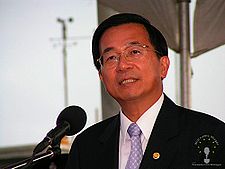 The DPP won the presidency with the election of Chen Shui-bian
in March 2000, ending more than half a century of KMT rule in Taiwan. Chen softened the party's stance on independence to appeal to moderate voters, appease the United States and placate China. He also promised not to change the ROC state symbols or declare formal independence
as long as the People's Republic of China
did not attack Taiwan.
The DPP became the largest party having reached a plurality in the Legislative Yuan for the first time in 2002 following the 2001 legislative election
. However, a majority coalition between the KMT, People's First Party, and New Party
(collectively known as the Pan-Blue Coalition
) prevented it from taking control of the chamber.
In 2004, President
Chen Shui-bian
was re-elected by a narrow margin following a controversial assassination attempt on him and the Vice President Annette Lu
only hours before the election. President Chen narrowly won the election over Lien Chan
. Lien Chan demanded a recount the following morning. A judicial recount under the jurisdiction of a special panel of the High Court began on 10 May 2004 and ended on May 18, 2004. It was conducted by about 460 teams situated in 21 courthouses across the Taiwan area. Each team had seven members – one judge, two members each from the district court and the local government election authorities and two witnesses each representing the plaintiff (Pan-Blue Coalition) and the defendant (Pan-Green Coalition). Disputed votes were sent to High Court in Taipei for verification. After the recount, President Chen was confirmed the winner of the election by a smaller margin (25,563 as opposed to 29,518 originally).
The DPP suffered a significant election defeat in nationwide local and county elections in December 2005
. The pan-blue coalition captured 16 of 23 county and city government offices under the leadership of popular Taipei
mayor and KMT Party Chairman Ma Ying-jeou
.
The results led to a shake up of the party leadership. Su Tseng-chang
resigned as DPP chairman soon after election results were announced. Su had pledged to step down if the DPP lost either Taipei County or failed to win 10 of the 23 mayor/magistrate positions. Vice President Annette Lu
was appointed acting DPP leader. Presidential Office Secretary-General Yu Shyi-kun
was elected in a three-way race
against legislator Chai Trong-rong and Wong Chin-chu with 54.4% of the vote.
Premier Frank Hsieh
, DPP election organizer and former mayor of Kaohsiung
twice tendered a verbal resignation immediately following the election, but his resignation was not accepted by President Chen until January 17, 2006 after the DPP chairmanship election had concluded. The former DPP Chairman Su Tseng-chang was appointed to replace Hsieh as premier. Hsieh and his cabinet resigned en masse on January 24 to make way for Su and his new cabinet. President Chen had offered the position of Presidential Office Secretary-General (vacated by Su) to the departing premier, but Hsieh declined and left office criticizing President Chen for his tough line on dealing with the PRC.
's ruling Democratic Progressive Party approved a resolution
asserting a separate identity from China
and called for the enactment of a new constitution
for a "normal nation" . It struck an accommodating tone by advocating general use of "Taiwan" as the country's name without calling for abandonment of the name Republic of China
.
while its presidential candidate, former Kaohsiung
mayor Frank Hsieh
, lost to KMT candidate Ma Ying-jeou
by a wide margin (41.55% vs. 58.45%).
The first months after the election were dominated by press coverage of the travails of Chen Shui-bian
and his wife Wu Shu-jen. On August 15, 2008 Chen resigned from the Democratic Progressive Party and apologized thus: "Today I have to say sorry to all of the DPP members and supporters. I let everyone down, caused you humiliation and failed to meet your expectations. My acts have caused irreparable damage to the party. I love the DPP deeply and am proud of being a DPP member. To express my deepest regrets to all DPP members and supporters, I announce my withdrawal from the DPP immediately. My wife Wu Shu-jen is also withdrawing from the party." DPP Chairwoman Tsai Ing-wen
followed with a public statement on behalf of the party: "In regard to Chen and his wife's decision to withdraw from the party and his desire to shoulder responsibility for his actions as well as to undergo an investigation by the party's anti-corruption committee, we respect his decision and accept it."
The DPP vowed to reflect on public misgivings towards the party. Chairwoman Tsai insisted on the need for the party to remember its history, defend Taiwan's sovereignty and national security, and maintain its confidence.
The party re-emerged as a formidable voice in Taiwan's political debate when Ma's administration reached the end of its first year in office. The DPP marked the anniversary with massive rallies in Taipei and Kaohsiung. Dr. Tsai's address to the crowd in Taipei on May 17 proclaimed a "citizens' movement to protect Taiwan" seeking to "protect our democracy and protect Taiwan."
The primary political axis in Taiwan involves the issue of Taiwan independence
versus eventual unification with China
. Although the differences tend to be portrayed in polarized terms, both major coalitions have developed modified, nuanced and often complex positions. Though opposed in the philosophical origins, the practical differences between such positions can sometimes be subtle.
The current official position of the party is that the "Republic of China
(Taiwan)" is an independent
and sovereign
country
whose territory consists of Taiwan
and its surrounding smaller islands and whose sovereignty
derives only from the ROC citizens living in Taiwan (similar philosophy of self-determination
), based on the "Resolution on Taiwan's Future
" in 1999. It considers Taiwan independence
to be a current fact making a formal declaration of independence unnecessary. The DPP rejects the so-called "one China principle" as the basis for official diplomatic relations with the People's Republic of China
(PRC) and advocates a Taiwanese national identity which is separate from mainland China. The DPP argues that its efforts to promote a Taiwanese national identity are merely an effort to normalize a Taiwanese identity repressed during years of authoritarian Kuomintang rule. Democratic Progressive Party also differs from KMT on foreign and defense policies that DPP considers the relations with the United States
, Japan
, European states among other democratic countries are crucial for Taiwan security.
In contrast, the KMT or pan-blue coalition
agrees that the Republic of China
is an independent and sovereign country that is not part of the PRC, but argues that a one China principle (with different definitions across the strait) can be used as the basis for talks with the PRC. The KMT also opposes Taiwan independence
and argues that efforts to establish a Taiwanese national identity separated from the Chinese national identity are unnecessary and needlessly provocative. Some KMT officials have called efforts from DPP "fascist" (a charge for which they later apologised) and "racist". At the other end of the political spectrum, the acceptance by the DPP of the symbols of the Republic of China
is opposed by the Taiwan Solidarity Union
.
The first years of the DPP as the ruling party drew accusations from the opposition that, as a self-styled Taiwanese nationalist
party, the DPP was itself inadequately sensitive to the ethnographic diversity of Taiwan's population. Where the KMT had been guilty of Chinese chauvinism
, the critics charged, the DPP might offer nothing more as a remedy than Hoklo
chauvinism.
The PRC has maintained a hostile position toward the DPP. It has made some efforts to moderate its tone since passing its Anti-Secession Law in 2005 to prevent a popular backlash from Taiwan's voters. In 2008 the PRC stated it was willing to negotiate with any party in Taiwan that "accepts the so-called 1992 consensus
".
For many years the Democratic Progressive Party officially recognized several factions within its membership, such as the New Tide faction
(新潮流系), the Formosa faction (美麗島系), the Justice Alliance faction
(正義連線系) and Welfare State Alliance faction (福利國系). Each faction endorsed slightly different policies. The factions were often generationally identifiable, representing individuals who had entered the party at different times. In 2006 the party ended official recognition of factions. The factions have since stated that they will comply with the resolution.
Political party
A political party is a political organization that typically seeks to influence government policy, usually by nominating their own candidates and trying to seat them in political office. Parties participate in electoral campaigns, educational outreach or protest actions...
in Taiwan
Taiwan
Taiwan , also known, especially in the past, as Formosa , is the largest island of the same-named island group of East Asia in the western Pacific Ocean and located off the southeastern coast of mainland China. The island forms over 99% of the current territory of the Republic of China following...
, and the dominant party in the Pan-Green Coalition
Pan-Green Coalition
The Pan-Green Coalition or Pan-Green Camp, is an informal political alliance of the Republic of China, commonly known as "Taiwan", consisting of the Democratic Progressive Party , Taiwan Solidarity Union , and the minor Taiwan Independence Party...
. Founded in 1986, DPP is the first meaningful opposition party in Taiwan. It has traditionally been associated with strong advocacy of human rights
Human rights
Human rights are "commonly understood as inalienable fundamental rights to which a person is inherently entitled simply because she or he is a human being." Human rights are thus conceived as universal and egalitarian . These rights may exist as natural rights or as legal rights, in both national...
and a distinct Taiwanese identity, including promotion of de jure
De jure
De jure is an expression that means "concerning law", as contrasted with de facto, which means "concerning fact".De jure = 'Legally', De facto = 'In fact'....
Taiwan independence
Taiwan independence
Taiwan independence is a political movement whose goals are primarily to formally establish the Republic of Taiwan by renaming or replacing the Republic of China , form a Taiwanese national identity, reject unification and One country, two systems with the People's Republic of China and a Chinese...
. Its present chair is Dr. Tsai Ing-wen
Tsai Ing-wen
Tsai Ing-wen is the current chairperson of the Democratic Progressive Party in Taiwan. Studying in Taiwan, the U.S and the U.K. Tsai earned an LL.B. from National Taiwan University, an LL.M. from Cornell University Law School and a Ph.D. from the London School of Economics....
. The DPP is a member of Liberal International
Liberal International
Liberal International is a political international federation for liberal parties. Its headquarters is located at 1 Whitehall Place, London, SW1A 2HD within the National Liberal Club. It was founded in Oxford in 1947, and has become the pre-eminent network for liberal parties and for the...
and a founding member of the Council of Asian Liberals and Democrats
Council of Asian Liberals and Democrats
The Council of Asian Liberals and Democrats is a regional organization of liberal and democratic political parties in Asia. The Council was created on October 15, 1993, in a meeting in Taipei...
. It represented Taiwan in the Unrepresented Nations and Peoples Organisation. The DPP and its affiliated parties are widely classified as "liberal" because of their strong human rights stance and endorsement of pluralistic democracy while their Kuomintang
Kuomintang
The Kuomintang of China , sometimes romanized as Guomindang via the Pinyin transcription system or GMD for short, and translated as the Chinese Nationalist Party is a founding and ruling political party of the Republic of China . Its guiding ideology is the Three Principles of the People, espoused...
opposition, historically take a defensive posture on such issues, is generally viewed as "conservative." In Taiwan, though, these classifications carry nuances that may not be characteristic of them elsewhere. Discussion of left-right politics
Left-Right politics
The left–right political spectrum is a common way of classifying political positions, political ideologies, or political parties along a one-dimensional political spectrum. The perspective of Left vs. Right is a binary interpretation of complex questions...
is rare in Taiwan. The mass media
Mass media
Mass media refers collectively to all media technologies which are intended to reach a large audience via mass communication. Broadcast media transmit their information electronically and comprise of television, film and radio, movies, CDs, DVDs and some other gadgets like cameras or video consoles...
rarely mention the existence of a political spectrum
Political spectrum
A political spectrum is a way of modeling different political positions by placing them upon one or more geometric axes symbolizing independent political dimensions....
, as each network and news source tends to take an openly partisan stand.
History
The DPP has its roots in liberal opposition to KuomintangKuomintang
The Kuomintang of China , sometimes romanized as Guomindang via the Pinyin transcription system or GMD for short, and translated as the Chinese Nationalist Party is a founding and ruling political party of the Republic of China . Its guiding ideology is the Three Principles of the People, espoused...
one-party authoritarian rule. It was initially known as the Tangwai
Tangwai
The Tangwai movement was a political movement in the Republic of China in the mid-1970s and early 1980s. Although the Kuomintang had allowed contested elections for a small number of seats in Legislative Yuan, opposition parties were still forbidden...
– or "outside-the-party" – movement. This movement culminated in the formation of the DPP as an alternative party on September 28, 1986. The new party contested the 1986 election
Republic of China legislative election, 1986
The sixth supplementary elections for the National Assembly and Legislative Yuan were held in the Republic of China on 6 December 1986.-Background:...
even though competing parties remained illegal under national law until the next year. The first members of the party drew heavily from the ranks of family members and defense lawyers of political prisoners as well as intellectuals and artists who had spent time abroad. Such individuals were strongly committed to political change that would ensure constitutional support in Taiwan for freedoms of speech, press, assembly, and association. The party did not at the outset give open support to an independent Taiwanese national identity–a move that could have invited a violent crackdown by the Taiwan's Kuomintang rulers. Its platform was pro-environment and pro-democracy. As more and more of its demands were met during the 1990s–such as the direct popular election of Taiwan's president
President of the Republic of China
The President of the Republic of China is the head of state and commander-in-chief of the Republic of China . The Republic of China was founded on January 1, 1912, to govern all of China...
and all representatives in its Legislative Yuan
Legislative Yuan
The Legislative Yuan is the unicameral legislature of the Republic of China .The Legislative Yuan is one of the five branches of government stipulated by the Constitution of the Republic of China, which follows Sun Yat-sen's Three Principles of the People...
, and open discussion of Taiwan's repressive past as represented in the 2-28 Incident
228 Incident
The 228 Incident, also known as the 228 Massacre, was an anti-government uprising in Taiwan that began on February 27, 1947, and was violently suppressed by the Kuomintang government. Estimates of the number of deaths vary from 10,000 to 30,000 or more...
and its long martial law
Martial law
Martial law is the imposition of military rule by military authorities over designated regions on an emergency basis— only temporary—when the civilian government or civilian authorities fail to function effectively , when there are extensive riots and protests, or when the disobedience of the law...
aftermath–a greater variety of views could be advocated in the more liberal political atmosphere. Party members began openly promoting a national identity for Taiwan separate from that of China. The DPP supported reform of the Constitution that would make it official that Taiwan's national government represented only the people of Taiwan and made no claims to territory in mainland China or Mongolia.
Once the DPP had representation in the Legislative Yuan
Legislative Yuan
The Legislative Yuan is the unicameral legislature of the Republic of China .The Legislative Yuan is one of the five branches of government stipulated by the Constitution of the Republic of China, which follows Sun Yat-sen's Three Principles of the People...
(LY, Congress), the party used the legislature as a forum to challenge the government. However, it did not emerge as a formidable force until 1991, when the elderly LY members elected from the mainland provinces in 1948 retired. Fears that the DPP would one day take control of the legislature led then-President Lee Teng-hui
Lee Teng-hui
Lee Teng-hui is a politician of the Republic of China . He was the 7th, 8th, and 9th-term President of the Republic of China and Chairman of the Kuomintang from 1988 to 2000. He presided over major advancements in democratic reforms including his own re-election which marked the first direct...
to push through a series of amendments to strengthen presidential power (for example, Taiwan's premier
Premier of the Republic of China
The President of the Executive Yuan , commonly known as the Premier of the Republic of China , is the head of the Executive Yuan, the executive branch of the Republic of China , which currently administers Taiwan, Matsu, and Kinmen. The premier is appointed by the President of the Republic of China...
would no longer have to be confirmed by the Legislative Yuan).
2000-2008
Chen Shui-bian
Chen Shui-bian is a former Taiwanese politician who was the 10th and 11th-term President of the Republic of China from 2000 to 2008. Chen, whose Democratic Progressive Party has traditionally been supportive of Taiwan independence, ended more than fifty years of Kuomintang rule in Taiwan...
in March 2000, ending more than half a century of KMT rule in Taiwan. Chen softened the party's stance on independence to appeal to moderate voters, appease the United States and placate China. He also promised not to change the ROC state symbols or declare formal independence
Four Noes and One Without
The Four Noes and One Without , also known as the Four Noes was a pledge by former President of the Republic of China Chen Shui-bian made in his inauguration speech on 20 May 2000 concerning the political status of Taiwan...
as long as the People's Republic of China
People's Republic of China
China , officially the People's Republic of China , is the most populous country in the world, with over 1.3 billion citizens. Located in East Asia, the country covers approximately 9.6 million square kilometres...
did not attack Taiwan.
The DPP became the largest party having reached a plurality in the Legislative Yuan for the first time in 2002 following the 2001 legislative election
ROC legislative election, 2001
The Election for the 5th Legislative Yuan of the Republic of China on Taiwan was held on December 1, 2001. All 225 seats of the Legislative Yuan were up for election: 168 elected by popular vote, 41 elected on the basis of the proportion of nationwide votes received by participating political...
. However, a majority coalition between the KMT, People's First Party, and New Party
New Party (Republic of China)
The New Party, formerly the Chinese New Party , is a centre-right conservative political party in the Republic of China , and part of the pan-blue coalition....
(collectively known as the Pan-Blue Coalition
Pan-Blue Coalition
The Pan-Blue Coalition 泛藍聯盟 or Pan-Blue Force is a political alliance in the Republic of China , consisting of the Kuomintang , the People First Party , and the New Party . The name comes from the party colours of the Kuomintang...
) prevented it from taking control of the chamber.
In 2004, President
President
A president is a leader of an organization, company, trade union, university, or country.Etymologically, a president is one who presides, who sits in leadership...
Chen Shui-bian
Chen Shui-bian
Chen Shui-bian is a former Taiwanese politician who was the 10th and 11th-term President of the Republic of China from 2000 to 2008. Chen, whose Democratic Progressive Party has traditionally been supportive of Taiwan independence, ended more than fifty years of Kuomintang rule in Taiwan...
was re-elected by a narrow margin following a controversial assassination attempt on him and the Vice President Annette Lu
Annette Lu
Annette Lu Hsiu-lien , was the Vice President of the Republic of China from 2000 to 2008, under Chen Shui-bian. She announced her intentions to run for President of Taiwan on March 6, 2007, but withdrew in order to support DPP presidential nominee, Frank Hsieh...
only hours before the election. President Chen narrowly won the election over Lien Chan
Lien Chan
Lien Chan is a politician in Taiwan. He was Premier of the Republic of China from 1993 to 1997, Vice President of the Republic of China from 1996 to 2000, and was the Chairman of the Kuomintang from 2000 to 2005...
. Lien Chan demanded a recount the following morning. A judicial recount under the jurisdiction of a special panel of the High Court began on 10 May 2004 and ended on May 18, 2004. It was conducted by about 460 teams situated in 21 courthouses across the Taiwan area. Each team had seven members – one judge, two members each from the district court and the local government election authorities and two witnesses each representing the plaintiff (Pan-Blue Coalition) and the defendant (Pan-Green Coalition). Disputed votes were sent to High Court in Taipei for verification. After the recount, President Chen was confirmed the winner of the election by a smaller margin (25,563 as opposed to 29,518 originally).
The DPP suffered a significant election defeat in nationwide local and county elections in December 2005
ROC local elections, 2005
The Election of County Magistrates, County Councilmen, and Township Governors , commonly known as the "Three-in-One Election" , was held in the Republic of China on December 3, 2005 for mayors of province-administered cities, magistrates of counties, members of county and city councils, and heads...
. The pan-blue coalition captured 16 of 23 county and city government offices under the leadership of popular Taipei
Taipei
Taipei City is the capital of the Republic of China and the central city of the largest metropolitan area of Taiwan. Situated at the northern tip of the island, Taipei is located on the Tamsui River, and is about 25 km southwest of Keelung, its port on the Pacific Ocean...
mayor and KMT Party Chairman Ma Ying-jeou
Ma Ying-jeou
Ma Ying-jeou is the 12th term and current President of the Republic of China , commonly known as Taiwan, and the Chairman of the Kuomintang Party, also known as the Chinese Nationalist Party. He formerly served as Justice Minister from 1993 to 1996, Mayor of Taipei from 1998 to 2006, and Chairman...
.
The results led to a shake up of the party leadership. Su Tseng-chang
Su Tseng-chang
Su Tseng-chang is a Taiwanese politician of the Democratic Progressive Party. He is the former Premier of the Republic of China. Su actively campaigned for the Presidential nomination of the DPP, but finished second to Frank Hsieh in the nomination process...
resigned as DPP chairman soon after election results were announced. Su had pledged to step down if the DPP lost either Taipei County or failed to win 10 of the 23 mayor/magistrate positions. Vice President Annette Lu
Annette Lu
Annette Lu Hsiu-lien , was the Vice President of the Republic of China from 2000 to 2008, under Chen Shui-bian. She announced her intentions to run for President of Taiwan on March 6, 2007, but withdrew in order to support DPP presidential nominee, Frank Hsieh...
was appointed acting DPP leader. Presidential Office Secretary-General Yu Shyi-kun
Yu Shyi-kun
Yu Shyi-kun , a Taiwanese politician of the Democratic Progressive Party, is a former chairman of the Democratic Progressive Party in Taiwan. He previously served as Premier of the Republic of China from 2002 to 2005...
was elected in a three-way race
Democratic Progressive Party chairmanship election, 2006
The Democratic Progressive Party chairmanship by-election of 2006 was held on January 15, 2006 in Taiwan. It was the tenth chairmanship election conducted by the party...
against legislator Chai Trong-rong and Wong Chin-chu with 54.4% of the vote.
Premier Frank Hsieh
Frank Hsieh
Frank Hsieh Chang-ting is a Taiwanese politician of the Democratic Progressive Party in the Republic of China. He was the mayor of Kaohsiung City until his appointment as President of the Executive Yuan by president Chen Shui-bian on February 1, 2005. He announced his resignation from the post of...
, DPP election organizer and former mayor of Kaohsiung
Kaohsiung
Kaohsiung is a city located in southwestern Taiwan, facing the Taiwan Strait on the west. Kaohsiung, officially named Kaohsiung City, is divided into thirty-eight districts. The city is one of five special municipalities of the Republic of China...
twice tendered a verbal resignation immediately following the election, but his resignation was not accepted by President Chen until January 17, 2006 after the DPP chairmanship election had concluded. The former DPP Chairman Su Tseng-chang was appointed to replace Hsieh as premier. Hsieh and his cabinet resigned en masse on January 24 to make way for Su and his new cabinet. President Chen had offered the position of Presidential Office Secretary-General (vacated by Su) to the departing premier, but Hsieh declined and left office criticizing President Chen for his tough line on dealing with the PRC.
Separate identity
On September 30, 2007, TaiwanTaiwan
Taiwan , also known, especially in the past, as Formosa , is the largest island of the same-named island group of East Asia in the western Pacific Ocean and located off the southeastern coast of mainland China. The island forms over 99% of the current territory of the Republic of China following...
's ruling Democratic Progressive Party approved a resolution
Resolution (law)
A resolution is a written motion adopted by a deliberative body. The substance of the resolution can be anything that can normally be proposed as a motion. For long or important motions, though, it is often better to have them written out so that discussion is easier or so that it can be...
asserting a separate identity from China
China
Chinese civilization may refer to:* China for more general discussion of the country.* Chinese culture* Greater China, the transnational community of ethnic Chinese.* History of China* Sinosphere, the area historically affected by Chinese culture...
and called for the enactment of a new constitution
Constitution
A constitution is a set of fundamental principles or established precedents according to which a state or other organization is governed. These rules together make up, i.e. constitute, what the entity is...
for a "normal nation" . It struck an accommodating tone by advocating general use of "Taiwan" as the country's name without calling for abandonment of the name Republic of China
Republic of China
The Republic of China , commonly known as Taiwan , is a unitary sovereign state located in East Asia. Originally based in mainland China, the Republic of China currently governs the island of Taiwan , which forms over 99% of its current territory, as well as Penghu, Kinmen, Matsu and other minor...
.
2008-present
In the national elections held in early months of 2008 the DPP won less than 25% of the seats (38.2% vote share) in the new Legislative YuanLegislative Yuan
The Legislative Yuan is the unicameral legislature of the Republic of China .The Legislative Yuan is one of the five branches of government stipulated by the Constitution of the Republic of China, which follows Sun Yat-sen's Three Principles of the People...
while its presidential candidate, former Kaohsiung
Kaohsiung
Kaohsiung is a city located in southwestern Taiwan, facing the Taiwan Strait on the west. Kaohsiung, officially named Kaohsiung City, is divided into thirty-eight districts. The city is one of five special municipalities of the Republic of China...
mayor Frank Hsieh
Frank Hsieh
Frank Hsieh Chang-ting is a Taiwanese politician of the Democratic Progressive Party in the Republic of China. He was the mayor of Kaohsiung City until his appointment as President of the Executive Yuan by president Chen Shui-bian on February 1, 2005. He announced his resignation from the post of...
, lost to KMT candidate Ma Ying-jeou
Ma Ying-jeou
Ma Ying-jeou is the 12th term and current President of the Republic of China , commonly known as Taiwan, and the Chairman of the Kuomintang Party, also known as the Chinese Nationalist Party. He formerly served as Justice Minister from 1993 to 1996, Mayor of Taipei from 1998 to 2006, and Chairman...
by a wide margin (41.55% vs. 58.45%).
The first months after the election were dominated by press coverage of the travails of Chen Shui-bian
Chen Shui-bian
Chen Shui-bian is a former Taiwanese politician who was the 10th and 11th-term President of the Republic of China from 2000 to 2008. Chen, whose Democratic Progressive Party has traditionally been supportive of Taiwan independence, ended more than fifty years of Kuomintang rule in Taiwan...
and his wife Wu Shu-jen. On August 15, 2008 Chen resigned from the Democratic Progressive Party and apologized thus: "Today I have to say sorry to all of the DPP members and supporters. I let everyone down, caused you humiliation and failed to meet your expectations. My acts have caused irreparable damage to the party. I love the DPP deeply and am proud of being a DPP member. To express my deepest regrets to all DPP members and supporters, I announce my withdrawal from the DPP immediately. My wife Wu Shu-jen is also withdrawing from the party." DPP Chairwoman Tsai Ing-wen
Tsai Ing-wen
Tsai Ing-wen is the current chairperson of the Democratic Progressive Party in Taiwan. Studying in Taiwan, the U.S and the U.K. Tsai earned an LL.B. from National Taiwan University, an LL.M. from Cornell University Law School and a Ph.D. from the London School of Economics....
followed with a public statement on behalf of the party: "In regard to Chen and his wife's decision to withdraw from the party and his desire to shoulder responsibility for his actions as well as to undergo an investigation by the party's anti-corruption committee, we respect his decision and accept it."
The DPP vowed to reflect on public misgivings towards the party. Chairwoman Tsai insisted on the need for the party to remember its history, defend Taiwan's sovereignty and national security, and maintain its confidence.
The party re-emerged as a formidable voice in Taiwan's political debate when Ma's administration reached the end of its first year in office. The DPP marked the anniversary with massive rallies in Taipei and Kaohsiung. Dr. Tsai's address to the crowd in Taipei on May 17 proclaimed a "citizens' movement to protect Taiwan" seeking to "protect our democracy and protect Taiwan."
Policies
Programs supported by the DPP include social welfare policies involving the rights of women, senior citizens, children, young people, labour, indigenous peoples, farmers, and other disadvantaged sectors of the society. Furthermore its platform includes a legal and political order based on human rights and democracy; balanced economic and financial administration; fair and open social welfare; educational and cultural reform; independent defence and peaceful foreign policy.The primary political axis in Taiwan involves the issue of Taiwan independence
Taiwan independence
Taiwan independence is a political movement whose goals are primarily to formally establish the Republic of Taiwan by renaming or replacing the Republic of China , form a Taiwanese national identity, reject unification and One country, two systems with the People's Republic of China and a Chinese...
versus eventual unification with China
Chinese reunification
Chinese reunification refers to the bringing together of all of the territories controlled by the People's Republic of China and the Republic of China under a single political entity...
. Although the differences tend to be portrayed in polarized terms, both major coalitions have developed modified, nuanced and often complex positions. Though opposed in the philosophical origins, the practical differences between such positions can sometimes be subtle.
The current official position of the party is that the "Republic of China
Republic of China
The Republic of China , commonly known as Taiwan , is a unitary sovereign state located in East Asia. Originally based in mainland China, the Republic of China currently governs the island of Taiwan , which forms over 99% of its current territory, as well as Penghu, Kinmen, Matsu and other minor...
(Taiwan)" is an independent
Independence
Independence is a condition of a nation, country, or state in which its residents and population, or some portion thereof, exercise self-government, and usually sovereignty, over its territory....
and sovereign
Sovereign
A sovereign is the supreme lawmaking authority within its jurisdiction.Sovereign may also refer to:*Monarch, the sovereign of a monarchy*Sovereign Bank, banking institution in the United States*Sovereign...
country
Country
A country is a region legally identified as a distinct entity in political geography. A country may be an independent sovereign state or one that is occupied by another state, as a non-sovereign or formerly sovereign political division, or a geographic region associated with a previously...
whose territory consists of Taiwan
Taiwan
Taiwan , also known, especially in the past, as Formosa , is the largest island of the same-named island group of East Asia in the western Pacific Ocean and located off the southeastern coast of mainland China. The island forms over 99% of the current territory of the Republic of China following...
and its surrounding smaller islands and whose sovereignty
Sovereignty
Sovereignty is the quality of having supreme, independent authority over a geographic area, such as a territory. It can be found in a power to rule and make law that rests on a political fact for which no purely legal explanation can be provided...
derives only from the ROC citizens living in Taiwan (similar philosophy of self-determination
Self-determination
Self-determination is the principle in international law that nations have the right to freely choose their sovereignty and international political status with no external compulsion or external interference...
), based on the "Resolution on Taiwan's Future
Resolution on Taiwan's Future
The Resolution on Taiwan's Future is a document ratified by the Democratic Progressive Party during its eighth annual national assembly on May 7-8, 1999 in the southern port-city of Kaohsiung...
" in 1999. It considers Taiwan independence
Taiwan independence
Taiwan independence is a political movement whose goals are primarily to formally establish the Republic of Taiwan by renaming or replacing the Republic of China , form a Taiwanese national identity, reject unification and One country, two systems with the People's Republic of China and a Chinese...
to be a current fact making a formal declaration of independence unnecessary. The DPP rejects the so-called "one China principle" as the basis for official diplomatic relations with the People's Republic of China
People's Republic of China
China , officially the People's Republic of China , is the most populous country in the world, with over 1.3 billion citizens. Located in East Asia, the country covers approximately 9.6 million square kilometres...
(PRC) and advocates a Taiwanese national identity which is separate from mainland China. The DPP argues that its efforts to promote a Taiwanese national identity are merely an effort to normalize a Taiwanese identity repressed during years of authoritarian Kuomintang rule. Democratic Progressive Party also differs from KMT on foreign and defense policies that DPP considers the relations with the United States
United States
The United States of America is a federal constitutional republic comprising fifty states and a federal district...
, Japan
Japan
Japan is an island nation in East Asia. Located in the Pacific Ocean, it lies to the east of the Sea of Japan, China, North Korea, South Korea and Russia, stretching from the Sea of Okhotsk in the north to the East China Sea and Taiwan in the south...
, European states among other democratic countries are crucial for Taiwan security.
In contrast, the KMT or pan-blue coalition
Pan-Blue Coalition
The Pan-Blue Coalition 泛藍聯盟 or Pan-Blue Force is a political alliance in the Republic of China , consisting of the Kuomintang , the People First Party , and the New Party . The name comes from the party colours of the Kuomintang...
agrees that the Republic of China
Republic of China
The Republic of China , commonly known as Taiwan , is a unitary sovereign state located in East Asia. Originally based in mainland China, the Republic of China currently governs the island of Taiwan , which forms over 99% of its current territory, as well as Penghu, Kinmen, Matsu and other minor...
is an independent and sovereign country that is not part of the PRC, but argues that a one China principle (with different definitions across the strait) can be used as the basis for talks with the PRC. The KMT also opposes Taiwan independence
Taiwan independence
Taiwan independence is a political movement whose goals are primarily to formally establish the Republic of Taiwan by renaming or replacing the Republic of China , form a Taiwanese national identity, reject unification and One country, two systems with the People's Republic of China and a Chinese...
and argues that efforts to establish a Taiwanese national identity separated from the Chinese national identity are unnecessary and needlessly provocative. Some KMT officials have called efforts from DPP "fascist" (a charge for which they later apologised) and "racist". At the other end of the political spectrum, the acceptance by the DPP of the symbols of the Republic of China
Republic of China
The Republic of China , commonly known as Taiwan , is a unitary sovereign state located in East Asia. Originally based in mainland China, the Republic of China currently governs the island of Taiwan , which forms over 99% of its current territory, as well as Penghu, Kinmen, Matsu and other minor...
is opposed by the Taiwan Solidarity Union
Taiwan Solidarity Union
The Taiwan Solidarity Union is a political party in the Republic of China which advocates Taiwan independence. It was officially founded on July 24, 2001 and is considered part of the Pan-Green Coalition. Unlike the Democratic Progressive Party, its larger companion party in the Pan-Green...
.
The first years of the DPP as the ruling party drew accusations from the opposition that, as a self-styled Taiwanese nationalist
Nationalism
Nationalism is a political ideology that involves a strong identification of a group of individuals with a political entity defined in national terms, i.e. a nation. In the 'modernist' image of the nation, it is nationalism that creates national identity. There are various definitions for what...
party, the DPP was itself inadequately sensitive to the ethnographic diversity of Taiwan's population. Where the KMT had been guilty of Chinese chauvinism
Chauvinism
Chauvinism, in its original and primary meaning, is an exaggerated, bellicose patriotism and a belief in national superiority and glory. It is an eponym of a possibly fictional French soldier Nicolas Chauvin who was credited with many superhuman feats in the Napoleonic wars.By extension it has come...
, the critics charged, the DPP might offer nothing more as a remedy than Hoklo
Hoklo people
The Hoklo people are Han Chinese people whose traditional Ancestral homes are in southern Fujian of South China...
chauvinism.
The PRC has maintained a hostile position toward the DPP. It has made some efforts to moderate its tone since passing its Anti-Secession Law in 2005 to prevent a popular backlash from Taiwan's voters. In 2008 the PRC stated it was willing to negotiate with any party in Taiwan that "accepts the so-called 1992 consensus
1992 Consensus
The 1992 Consensus or Consensus of 1992 is a term describing the outcome of a meeting in 1992 between the semi-official representatives of the People's Republic of China in mainland China and the Republic of China in Taiwan...
".
Structure
The National Party Congress selects, for two year terms, the 30 members of the Central Executive Committee and the 11 members of the Central Review Committee. The Central Executive Committee, in turn, chooses the 10 members of the Central Standing Committee.For many years the Democratic Progressive Party officially recognized several factions within its membership, such as the New Tide faction
New Tide faction
The New Tide faction was one of the factions of the Democratic Progressive Party in Taiwan before the party voted to dissolve all factions in 2006. The faction initially advocated social democracy, attempting to work with other labor and social movements to influence public policy...
(新潮流系), the Formosa faction (美麗島系), the Justice Alliance faction
Justice Alliance faction
The Justice Alliance was one of the largest factions of the Democratic Progressive Party.- Members :Before its dissolution, its members included:* Chen Shui-bian, incumbent president of Taiwan.* Hsu Tain-tsair, incumbent mayor of Tainan City....
(正義連線系) and Welfare State Alliance faction (福利國系). Each faction endorsed slightly different policies. The factions were often generationally identifiable, representing individuals who had entered the party at different times. In 2006 the party ended official recognition of factions. The factions have since stated that they will comply with the resolution.
List of Chairpersons
| No. | Chairperson | Serving Period | Term | Notes | Image |
| 1 | Chiang Peng-chien Chiang Peng-chien Chiang Peng-chien was the co-founder and first chairperson of the Democratic Progressive Party. Chiang was elected a member of the Legislative Yuan, the legislative body of the Republic of China , in 1983 and became a member of the Control Yuan in 1996.- Early life :Chiang Peng-chien was born... |
November 28, 1986 – December 20, 1987 | 1 | Elected | |
| 2 | Yao Chia-wen Yao Chia-wen Yao Chia-wen , a Taiwanese politician, is a former President of the Examination Yuan of the government of the Republic of China . He was the second chairperson of the Democratic Progressive Party .- Early life :... |
December 20, 1987 – October 30, 1988 | 2 | Elected | |
| 3 | Huang Shin-chieh Huang Shin-chieh Huang Shin-chieh , was a Taiwanese politician. He was the third chairperson of the Democratic Progressive Party .... |
October 30, 1988 – January 20, 1992 | 3 | Elected | |
| 4 | |||||
| 4 | Hsu Hsin-liang Hsu Hsin-liang Hsu Hsin-liang is a Taiwanese politician, formerly Chairman of the Democratic Progressive Party . He was a supporter of the Pan-Blue Coalition from 2000 to 2008 but then supported the DPP in the 2008 presidential election.-Biography:... |
January 20, 1992 – December 4, 1993 | 5 | Elected | |
| July 18, 1996 – July 18, 1998 | 7 | ||||
| 5 | Shih Ming-teh Shih Ming-teh Shih Ming-te or Shih Ming-teh was a political prisoner for 25-and-a-half years in the Republic of China .He was arrested at the age of 21 in 1962 and charged with creating the "Taiwan Independence League" with the intention of overthrowing the Kuomintang government, Shih was sentenced to life... |
July 18, 1994 – March 23, 1996 | 6 | Elected | 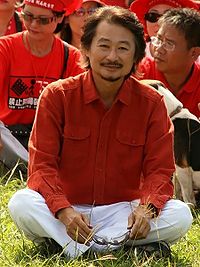 |
| 6 | Lin Yi-hsiung Lin Yi-hsiung Lin Yi-hsiung who sued the ruling KMT party for electoral fraud. Lin was elected a member of Taiwan Provincial Assembly in Guo's old electorate in 1977.-Lin Family Massacre:... |
July 18, 1998 – April 20, 2000 | 8 | Elected | |
| 7 | Frank Hsieh Chang-ting Frank Hsieh Frank Hsieh Chang-ting is a Taiwanese politician of the Democratic Progressive Party in the Republic of China. He was the mayor of Kaohsiung City until his appointment as President of the Executive Yuan by president Chen Shui-bian on February 1, 2005. He announced his resignation from the post of... |
April 20, 2000 – July 21, 2002 | 9 | Elected | 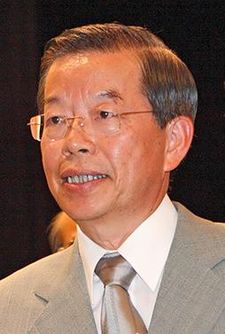 |
| 8 | Chen Shui-bian Chen Shui-bian Chen Shui-bian is a former Taiwanese politician who was the 10th and 11th-term President of the Republic of China from 2000 to 2008. Chen, whose Democratic Progressive Party has traditionally been supportive of Taiwan independence, ended more than fifty years of Kuomintang rule in Taiwan... |
July 21, 2002 – December 11, 2004 | 10 | President holds a concurrent post | |
| October 15, 2007 - January 12, 2008 | 11 | President holds a concurrent post | |||
| 9 | Su Tseng-chang Su Tseng-chang Su Tseng-chang is a Taiwanese politician of the Democratic Progressive Party. He is the former Premier of the Republic of China. Su actively campaigned for the Presidential nomination of the DPP, but finished second to Frank Hsieh in the nomination process... |
January 15, 2005 – December 3, 2005 | 11 | Elected | 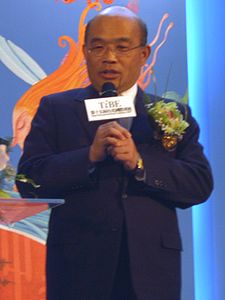 |
| 10 | Yu Shyi-kun Yu Shyi-kun Yu Shyi-kun , a Taiwanese politician of the Democratic Progressive Party, is a former chairman of the Democratic Progressive Party in Taiwan. He previously served as Premier of the Republic of China from 2002 to 2005... |
January 15, 2006 – September 21, 2007 | 11 | Elected | 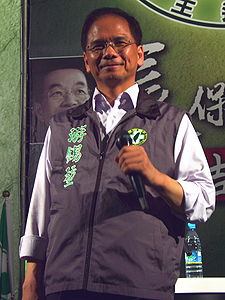 |
| 11 | Tsai Ing-wen Tsai Ing-wen Tsai Ing-wen is the current chairperson of the Democratic Progressive Party in Taiwan. Studying in Taiwan, the U.S and the U.K. Tsai earned an LL.B. from National Taiwan University, an LL.M. from Cornell University Law School and a Ph.D. from the London School of Economics.... |
May 20, 2008 – present | 12 | Elected | |
| 13 |
See also
- List of liberal parties
- Politics of the Republic of ChinaPolitics of the Republic of ChinaThe politics of the Republic of China ,takes place in a framework of a semi-presidential representative democratic republic, whereby the President is head of state and the premier is head of government, and of a dominant party system. Executive power is exercised by the government. Legislative...
- List of political parties in Taiwan
- Liberalism in TaiwanLiberalism in TaiwanThis article gives an overview of liberalism in Taiwan . It is limited to liberal parties with substantial support, mainly proved by having had a representation in the Legislative Yuan .-Introduction:...
- Human rights in Taiwan
- Culture of TaiwanCulture of TaiwanThe culture of Taiwan is a blend of Confucianist Han Chinese, Japanese, European, American, global, local, and Taiwanese aborigines cultures, which are often perceived in both traditional and modern understandings...
- Taiwanese peopleTaiwanese peopleTaiwanese people may refer to individuals who either claim or are imputed cultural identity focused on the island of Taiwan and/or Taiwan Area which have been governed by the Republic of China since 1945...
- Taiwanese identity
- Resolution on Taiwan's FutureResolution on Taiwan's FutureThe Resolution on Taiwan's Future is a document ratified by the Democratic Progressive Party during its eighth annual national assembly on May 7-8, 1999 in the southern port-city of Kaohsiung...
- Free area of the Republic of ChinaFree Area of the Republic of ChinaThe Free area of the Republic of China is a legal and political description referring to the territories under the control of the government of Republic of China , consisting of the island groups of Taiwan, Penghu, Kinmen, Matsu and some minor islands...
