

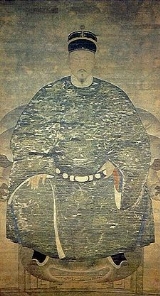
Koxinga

Encyclopedia
Koxinga is the customary Western spelling of the popular appellation of Zheng Chenggong ' onMouseout='HidePop("77717")' href="/topics/Hakka">Pha̍k-fa-sṳ
: Tshàng Sṳ̀n-Kûng; Foochow Romanized: Dâng Sìng-gŭng), a military leader who was born in 1624 in Hirado, Japan
to Zheng Zhilong
, a Chinese
merchant
/pirate, and his Japanese
wife and died in 1662 on the island of Formosa
(Taiwan).
A Ming
loyalist and the arch commander of the Ming troops on the maritime front for the later monarch
s of the withering dynasty, Koxinga devoted the last 16 years of his life to resisting the conquest of China
by the Manchu
s of Qing Dynasty
. Upon defeating the forces of the Dutch East India Company
(VOC) on Formosa in his last campaign in 1661–1662, Koxinga took over the island in order to support his grand campaign against the Manchu-ruled Qing Dynasty
. After Koxinga's death, however, his son and successor, Zheng Jing
(鄭經), gradually became the ruler of an independent Kingdom of Tungning
, the first Chinese state to rule the island.
, Japan
to Zheng Zhilong
, a Chinese merchant and pirate, and a Japanese woman whose surname was Tagawa
, and whose given name has been lost to posterity. He was raised there until the age of seven and then moved to Nan'an county
in Quanzhou
in Fujian
province of China.
In 1638, Koxinga became a Xiucai (a successful candidate) in the imperial examination
and became one of the twelve Linshansheng (廩膳生) of Nan'an. In 1641, Koxinga married the niece of Dong Yangxian, an official who was a Jinshi from Hui'an
. In 1644, Koxinga studied at the Imperial Nanking University, where he met and became a student of the scholar Qian Qianyi
.
In 1644, Beijing
fell to rebels led by Li Zicheng and the Chongzhen Emperor
hanged himself on a tree at modern-day Jingshan Park
in Beijing. Manchu armies aided by Wu Sangui
's forces defeated the rebels and took the city. The Ming remnant forces retreated to Nanjing
where the Prince Fu ascended to the throne as the Hongguang Emperor. The next year, the Manchu armies led by Dodo
advanced south and conquered Yangzhou
and Nanjing
while the Ming leader defending Yangzhou, Shi Kefa
, was killed. The Hongguang Emperor was captured and executed.
and his family. The Longwu Emperor established his court in Fuzhou
, which was controlled by the Zhengs. In the later part of the year, another Ming Prince Lu
proclaimed himself as Regent (監國) in Shaoxing
and established his own court there. Although Prince Lu and Longwu's regimes stemmed from the same dynasty, both of them pursued different goals.
It was due to the natural defences of Fujian and the military resources of the Zheng family, that the emperor was able to remain safe for some time. The Longwu Emperor granted Zheng Zhilong's son, Zheng Sen, a new personal name, "Chenggong" (success), and the title of Guoxingye ("Lord of the Imperial Surname"; Koxinga).
In 1646, Koxinga first led the Ming armies to resist the Manchurian invaders and won the favour of the Longwu Emperor. The Longwu Emperor's reign in Fuzhou was brief, as Zheng Zhilong refused to support his plans for a counter-offensive against the rapidly-expanding forces of the newly-established Qing Dynasty
by the Manchus. Zheng Zhilong ordered the defending general of Xianxia Pass (仙霞關), Shi Fu (a.k.a. Shi Tianfu, a relative of Shi Lang
), to retreat to Fuzhou
even when Qing armies approached Fujian. As such, the Qing army faced little resistance when it conquered the north of the pass. In September 1646, Qing armies broke through inadequately defended mountain passes and entered Fujian. Zheng Zhilong retreated to his coastal fortress and the Longwu Emperor faced the Qing armies alone. Longwu's forces were destroyed and he was captured and died shortly afterwards.
provinces if he would surrender to Qing. Zheng Zhilong agreed and ignored the objections of his family, surrendering himself to the Qing forces in Fuzhou on 21 November 1646. Koxinga and his uncles were left as the successors to the leadership of Zheng Zhilong's military forces. Koxinga operated outside Xiamen
and recruited many to join his cause in a few months. He used the superiority of his naval forces to launch amphibious raids on Manchu-occupied territory in Fujian and he managed to take Tong'an in Quanzhou
prefecture in early 1647. However, Koxinga's forces lacked the ability to defend the newly-occupied territory.
Following the fall of Tong'an to Zheng, the Manchus launched a counterattack in the spring of 1647, during which they stormed the Zheng family's hometown of Anping
. Koxinga's mother, Lady Tagawa, had come from Japan in 1645 to join her family in Fujian (Koxinga's younger brother, Tagawa Shichizaemon, remained in Japan). She did not follow her husband to surrender to the Qing Dynasty. She was caught by Manchu forces in Anping and committed suicide after refusal to submit to the enemy, according to traditional accounts.
 By 1650, Koxinga was strong enough to establish himself as the head of the Zheng family. He pledged allegiance to the only remaining claimant to the throne of the Ming Dynasty, the Yongli Emperor. The Yongli Emperor was fleeing from the Manchus in south-western China with a motley court and hastily assembled army at the time. Despite one fruitless attempt, Koxinga was unable to do anything to aid the last Ming emperor. Instead, he decided to concentrate on securing his own position on the southeast coast.
Koxinga enjoyed a series of military successes in 1651 and 1652 that increased the Qing government's anxiety over the threat he posed. The fight carried out massacre in Zhangzhou
. Zheng Zhilong wrote a letter to his son from Beijing
, presumably at the request of the Shunzhi Emperor
and the Qing government, urging his son to negotiate with the Manchurians. The long series of negotiations between Koxinga and the Qing Dynasty lasted until November 1654. The Qing government appointed Prince Jidu (son of Jirgalang
) to lead an attack on Koxinga's territory after the failed negotiations.
On 9 May 1656, Jidu's armies attacked Jinmen, an island near Xiamen that Koxinga had been using to train his troops. Partly as a result of a major storm, the Manchus were defeated and they lost most of their fleet in the battle. Koxinga had sent one of his naval commanders to capture Zhoushan
island prior to Jidu's attack, and now that the Manchus were temporarily without an effective naval force in the Fujian area, Koxinga was free to send a huge army to Zhoushan, which he intended to use as a base to capture Nanjing.
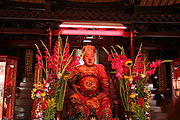 In 1661, Koxinga led his troops on a landing
at Lu'ermen to attack the Dutch colonists in Taiwan. On 1 February 1662, the Dutch
Governor of Taiwan
, Frederik Coyett, surrendered Fort Zeelandia
to Koxinga. During the siege, Koxinga's life was saved by a certain Hans Jurgen Radis of Stockaert, a Dutch defector who strongly advised him against visiting the overrun ramparts, which he knew would be blown up by the retreating Dutch forces. In the peace treaty, Koxinga was styled "Lord Teibingh Tsiante Teysiancon Koxin" http://cns.miis.edu/straittalk/Appendix%201.htm. This effectively ended 38 years of Dutch rule on Taiwan. Koxinga then devoted himself to transforming Taiwan into a military base for loyalists who wanted to restore the Ming Dynasty.
Koxinga's threat to invade the Philippines and expel the Spanish resulted in the Spanish failure to conquer the Islamic Moro people in Mindanao. The threat of Chinese invasion forced the Spanish to stop their conquest of the Moros and withdraw their garrisons to Manila. Koxinga's death resulted in the invasion being cancelled.
The Spanish had been on the verge of victory over the Moros, before Koxinga's threat and the subsequent Chinese rebellion against the Spanish resulted in the Spanish forces fleeing from the battle with the Moros to defend Manila against the Chinese. The Spanish Governor General Sebastian Hurtado de Corcuera had defeated the Moro Sultan Kudarat and built forts in Moro territory in Zamboanga, reversing previous Moro successes. The people of Manila were celebrating the victories of the Spanish. Koxinga's threat to the Spanish led to Spanish troops in Moro land being withdrawn by Governor Sebastian Manrique de Lara. After this, the Moros essentially gained free reign to attacking the Spanish.
While Governor-General Lara was in office another Chinese invasion threatened. A Mongol chieftain named Koxinga, who had been driven forth from his own country by the Tartars, was the leader of it. When the Tartars overran China, about the middle of the seventeenth century, Koxinga and many of his followers refused to submit. They went to Formosa, drove out the Dutch people, and settled there. Later Koxinga laid a plan to take the Philippine Islands and set up his kingdom there.
Koxinga's chief adviser was an Italian friar named Riccio. This friar he had appointed a high mandarin, or nobleman. He now sent him to Manila, dressed in the garb of his office, to demand tribute from the Philippine government.
Naturally this demand caused amaze and alarm in Manila. The Spaniards were aghast at the idea of a Catholic priest demanding tribute from a Catholic country, in the name of a heathen ruler. Later the authorities at Rome called the friar to account for his conduct. At this time, however, the Spanish were at a loss how to act. They did not dare send the priestmandarin away, nor could they give him any answer. They therefore kept him waiting in Manila while they made up their minds what to do.
As was usual, when trouble arose, the government thought that the Chinese in Manila were plotting to take the city. They felt sure that these men would be ready to help Koxinga when he came, so everything was made ready for another attack upon the Chinese in Luzon.
All government troops, both Spanish and native, were collected at Manila. So great was the fear, that three important forts were torn down, and the soldiers stationed there were brought to Luzon. Only the fort at Caraga, Mindanao, was left standing. This one they did not dare to give up; the soldiers there were all that kept the Moros from destroying the settlements on that coast.
A massacre of the Chinese by the Spanish and Filipinos followed during the rebellion. About 5,000 Chinese remained in Manila after the rebellion and massacre.
After peace was made, Riccio was allowed to go back to Formosa, to tell Koxinga what had been done. He found the chieftain getting ready to come to Manila with an army to take the country, and Riccio told him what had happened.
Koxinga's rage was great when he heard his mandarin's story. He planned to go at once to the islands to punish this wicked cruelty to his countrymen. He fell ill, however, and died of fever before he could start. Thus Manila escaped the fate that must almost surely have fallen upon the city if the Chinese chief and his great army had reached the bay.
The foolish attack upon the Chinese took so many Spanish soldiers from the southern islands that the Moros now had free swing along the coasts of Mindanao and the Visayas.
Exalted by his success against European arms, Koxinga resolved upon the conquest of the Philippines. He summoned to his service the Italian Dominican missionary, Ricci, who had been living in the province of Fukien, and in the spring of 1662 dispatched him as an ambassador to the governor of the Philippines to demand the submission of the archipelago.
Manila was thrown into a terrible panic by this demand, and indeed no such danger had threatened the Spanish in the Philippines since the invasion of Limahong. The Chinese conqueror had an innumerable army, and his armament, stores, and navy had been greatly augmented by the surrender of the Dutch.
After Koxinga's ultimatum, the Spanish proceeded to order all Chinese to leave the Philippines. The Chinese suspected that the Spanish planned to massacre them, so the Chinese rebelled and assualted Manila to fight the Spanish and Filipinos. The Chinese either died in battle or escaping by frail boats, joined the Chinese colonists on Formosa. The Spanish razed their own Churches and convents in Manila to prevent Chinese from taking shelter in them.
"During this period the raids of the Moros continued. These pirates did much damage. This led to efforts on the part of Spain to conquer these warlike people, which resulted in the conquest of Jolo and the establishment of a stronghold at Zamboanga. In 1662 Koxinga, a Chinese pirate, demanded the surrender of Manila. This danger was so great that the Spaniards concentrated all their efforts to resist the threatened invasions and abandoned some of their strongholds in the south. The Chinese in Manila were suspected of feeing in the plot. They assaulted Manila but many were slain and the remainder left the city. The threatened invasion never was carried out for Koxinga died. The effects of the events cited above left Spanish prestige at a low ebb. Manila was no longer the principal commercial centre of the East and never again recovered that position. The century that followed from 1663-1762 has been described as one of obscurity for the Philippines."
"Another event of importance during the seventeenth century resulted from the overthrow of the Ming Dynasty in China by the Manchus. During the change of power and consequent disorders there, a Chinese adventurer, Koxinga, raised a pirate army in south China and drove the Dutch out of Formosa. He then sent an ambassador to Manila demanding the surrender of the Islands to him. The colony was weak and unprepared for defense, and consequently terrified. There were twenty-five thousand Chinese living in Pari-an, north of the Pasig River, in Manila. Fearful lest these Chinese cooperate in the designs of Koxinga, they were all ordered to leave the Islands. Unable to do so at once, and fearful of massacre, they arose in rebellion and assaulted the city of Manila. The result was a terrible massacre, which cost the lives of twenty-two thousand of the Chinese; the remaining three thousand built frail boats and fled to Formosa. The death of Koxinga occurred before his expedition reached the Philippines."
at the age of 37. There were speculations that he died in a sudden fit of madness when his officers refused to carry out his orders to execute his son Zheng Jing
. Zheng Jing had an affair with his wet nurse and conceived a child with her. Zheng Jing succeeded his father as the King of Tungning
.
In contrast, Koxinga’s father, Zheng Zhilong, left his Japanese wife not long after the birth of his son; Koxinga would be a boy of seven when he finally joined his father on the Chinese coast. It seems that Zheng Zhilong recognised his son’s talent and encouraged him in his studies and the pursuit of a career as a scholar-official, which would legitimise the power that the Zheng family had acquired using sometimes questionable means. Zheng Zhilong’s defection to the Qing must have seemed opportunistic and in stark contrast to Koxinga’s continued loyalty to the Ming. But it is difficult to deny that in refusing to submit to the Qing, Koxinga was risking the life of his father, and that the subsequent death of Zheng Zhilong could only be justified by claiming loyalty to the Ming. It has even been suggested that Koxinga’s fury at the incestuous relationship between his son, Zheng Jing, and a younger son’s wet nurse was due to the fact that strict Confucian morality had played such a crucial role in justifying his lack of filial behaviour.
The one possible exception to this may have been his relationship with his mother, which has generally been described as being extremely affectionate, particularly in Chinese and Japanese sources. Their time together, however, was apparently very short - despite frequent entreaties from Zheng Zhilong for her to join him in China, Koxinga’s mother would only be reunited with her son sometime in 1645, and a year later she would be killed when the Qing took Xiamen.
and Taiwan
and by overseas Chinese
in Southeast Asia
. There is a temple dedicated to Koxinga and his mother
in Tainan City, Taiwan. The National Cheng Kung University
in Tainan, one of the most prestigious universities in Taiwan, is named after him.
The play The Battles of Coxinga
(Kokusen'ya Kassen, 国姓爺合戦; formerly 國姓爺合戰) was written by Chikamatsu Monzaemon
in Japan in the 18th century, first performed in Kyoto
. A 2001 film titled The Sino-Dutch War 1661
(鄭成功 1661) starred Vincent Zhao
as Koxinga. The film was renamed Kokusenya Kassen (国姓爺合戦) after the aforementioned play and released in Japan in 2002.
In politics, Koxinga is an interesting figure because several opposing political forces have invoked him as a hero. For this reason, historical narratives regarding Koxinga frequently differ in explaining his motives and affiliation.
Koxinga is considered a national hero in Mainland China
because he drove the Dutch away from Taiwan and established ethnically Chinese rule over the island.
Koxinga is considered a pirate in the Philippines
because of his banditry and raids on Philippine soil.
During the Japanese control of Taiwan
, Koxinga was honored as a bridge between Taiwan and Japan for his maternal linkage to Japan.
The Chinese Nationalist Party
regarded Koxinga as a patriot who retreated to Taiwan and used it as a base to launch counterattacks against the Qing Dynasty
of mainland China. As such, the Nationalists have frequently compared Koxinga to their leader Chiang Kai-shek
.
Supporters of Taiwan independence
have held mixed feelings toward Koxinga. Recent Taiwanese independence supporters have presented him in a positive light, portraying him as a native Taiwanese hero seeking to keep Taiwan independent from a mainland Chinese government.
Koxinga is one of the 32 historical figures who appear as special characters in the video game Romance of the Three Kingdoms XI by Koei. He is addressed as "Zheng Chenggong" in the game.
In modern times
, Koxinga is regarded as a hero in the People's Republic of China
, Taiwan
, and Japan
for various reasons.
Hakka
The Hakka , sometimes Hakka Han, are Han Chinese who speak the Hakka language and have links to the provincial areas of Guangdong, Jiangxi, Guangxi, Sichuan, Hunan and Fujian in China....
: Tshàng Sṳ̀n-Kûng; Foochow Romanized: Dâng Sìng-gŭng), a military leader who was born in 1624 in Hirado, Japan
Edo period
The , or , is a division of Japanese history which was ruled by the shoguns of the Tokugawa family, running from 1603 to 1868. The political entity of this period was the Tokugawa shogunate....
to Zheng Zhilong
Zheng Zhilong
Zheng Zhilong also known as Nicholas Iquan Gaspard, a native of Nan'an, Fujian, China. He was a Chinese merchant, pirate and admiral for the Ming Empire. He was the father of Zheng Chenggong , also a military leader. Under the Qing Dynasty, Zheng was elevated to the rank of Count of the Second Rank...
, a Chinese
Han Chinese
Han Chinese are an ethnic group native to China and are the largest single ethnic group in the world.Han Chinese constitute about 92% of the population of the People's Republic of China , 98% of the population of the Republic of China , 78% of the population of Singapore, and about 20% of the...
merchant
Merchant
A merchant is a businessperson who trades in commodities that were produced by others, in order to earn a profit.Merchants can be one of two types:# A wholesale merchant operates in the chain between producer and retail merchant...
/pirate, and his Japanese
Japanese people
The are an ethnic group originating in the Japanese archipelago and are the predominant ethnic group of Japan. Worldwide, approximately 130 million people are of Japanese descent; of these, approximately 127 million are residents of Japan. People of Japanese ancestry who live in other countries...
wife and died in 1662 on the island of Formosa
Taiwan
Taiwan , also known, especially in the past, as Formosa , is the largest island of the same-named island group of East Asia in the western Pacific Ocean and located off the southeastern coast of mainland China. The island forms over 99% of the current territory of the Republic of China following...
(Taiwan).
A Ming
Southern Ming Dynasty
The Southern Ming Dynasty was the Ming loyalist regime that continued in Southern China from 1644 to 1662 following the capture of Beijing by rebel armies and the death of the last Ming emperor in 1644....
loyalist and the arch commander of the Ming troops on the maritime front for the later monarch
Monarch
A monarch is the person who heads a monarchy. This is a form of government in which a state or polity is ruled or controlled by an individual who typically inherits the throne by birth and occasionally rules for life or until abdication...
s of the withering dynasty, Koxinga devoted the last 16 years of his life to resisting the conquest of China
China proper
China proper or Eighteen Provinces was a term used by Western writers on the Qing Dynasty to express a distinction between the core and frontier regions of China. There is no fixed extent for China proper, as many administrative, cultural, and linguistic shifts have occurred in Chinese history...
by the Manchu
Manchu
The Manchu people or Man are an ethnic minority of China who originated in Manchuria . During their rise in the 17th century, with the help of the Ming dynasty rebels , they came to power in China and founded the Qing Dynasty, which ruled China until the Xinhai Revolution of 1911, which...
s of Qing Dynasty
Qing Dynasty
The Qing Dynasty was the last dynasty of China, ruling from 1644 to 1912 with a brief, abortive restoration in 1917. It was preceded by the Ming Dynasty and followed by the Republic of China....
. Upon defeating the forces of the Dutch East India Company
Dutch East India Company
The Dutch East India Company was a chartered company established in 1602, when the States-General of the Netherlands granted it a 21-year monopoly to carry out colonial activities in Asia...
(VOC) on Formosa in his last campaign in 1661–1662, Koxinga took over the island in order to support his grand campaign against the Manchu-ruled Qing Dynasty
Qing Dynasty
The Qing Dynasty was the last dynasty of China, ruling from 1644 to 1912 with a brief, abortive restoration in 1917. It was preceded by the Ming Dynasty and followed by the Republic of China....
. After Koxinga's death, however, his son and successor, Zheng Jing
Zheng Jing
Zheng Jing was a seventeenth century Chinese warlord and Ming Dynasty loyalist. He was the eldest son of Koxinga and grandson of pirate-merchant Zheng Zhilong. After the conquest of Taiwan in 1662 by his father, Zheng Jing controlled the military forces in Xiamen and Quemoy on his father's behalf...
(鄭經), gradually became the ruler of an independent Kingdom of Tungning
Kingdom of Tungning
The Kingdom of Tungning was a government that ruled Taiwan between 1661 and 1683. A pro-Ming Dynasty state, it was founded by Koxinga after the Ming government in mainland China was replaced by the Manchu-ruled Qing Dynasty...
, the first Chinese state to rule the island.
Early years
In 1624, Koxinga, whose name at birth was Zheng Sen, was born in Hirado, Nagasaki PrefectureNagasaki Prefecture
is a prefecture of Japan located on the island of Kyūshū. The capital is the city of Nagasaki.- History :Nagasaki Prefecture was created by merging of the western half of the former province of Hizen with the island provinces of Tsushima and Iki...
, Japan
Japan
Japan is an island nation in East Asia. Located in the Pacific Ocean, it lies to the east of the Sea of Japan, China, North Korea, South Korea and Russia, stretching from the Sea of Okhotsk in the north to the East China Sea and Taiwan in the south...
to Zheng Zhilong
Zheng Zhilong
Zheng Zhilong also known as Nicholas Iquan Gaspard, a native of Nan'an, Fujian, China. He was a Chinese merchant, pirate and admiral for the Ming Empire. He was the father of Zheng Chenggong , also a military leader. Under the Qing Dynasty, Zheng was elevated to the rank of Count of the Second Rank...
, a Chinese merchant and pirate, and a Japanese woman whose surname was Tagawa
Tagawa Matsu
Tagawa Matsu , or Weng-shi , was the mother of Koxinga, a Chinese national hero, and Tagawa Shichizaemon , a servant to a Japanese feudal lord. She was a Nagasaki Japanese who lived most of her life in the coastal town of Hirado, then later migrated to China...
, and whose given name has been lost to posterity. He was raised there until the age of seven and then moved to Nan'an county
Nan'an, Fujian
Nan'an is a county-level city within the Quanzhou prefecture level city, Fujian province, China. As of 2010 the city has a population of 1,500,000. More than 3,000,000 overseas Chinese trace their ancestry to Nan'an. -History:...
in Quanzhou
Quanzhou
Quanzhou is a prefecture-level city in Fujian province, People's Republic of China. It borders all other prefecture-level cities in Fujian but two and faces the Taiwan Strait...
in Fujian
Fujian
' , formerly romanised as Fukien or Huguing or Foukien, is a province on the southeast coast of mainland China. Fujian is bordered by Zhejiang to the north, Jiangxi to the west, and Guangdong to the south. Taiwan lies to the east, across the Taiwan Strait...
province of China.
In 1638, Koxinga became a Xiucai (a successful candidate) in the imperial examination
Imperial examination
The Imperial examination was an examination system in Imperial China designed to select the best administrative officials for the state's bureaucracy. This system had a huge influence on both society and culture in Imperial China and was directly responsible for the creation of a class of...
and became one of the twelve Linshansheng (廩膳生) of Nan'an. In 1641, Koxinga married the niece of Dong Yangxian, an official who was a Jinshi from Hui'an
Hui'an County
Hui'an is a county under the jurisdiction of the prefecture-level city of Quanzhou, Fujian, China.Hui'an County, located in the middle of the southeast coast of Fujian Province, Quanzhou Bay and between Meizhou Bay, and Taiwan across the sea, is the famous hometown of overseas Taiwanese and...
. In 1644, Koxinga studied at the Imperial Nanking University, where he met and became a student of the scholar Qian Qianyi
Qian Qianyi
Qian Qianyi was a noted late Ming official, scholar and social historian.-Biography:Qian was born in Chángshóu . His style name was 'Shou Zhi' and his pseudonyms were 'Mu Zhai' and later 'Meng Sou'...
.
In 1644, Beijing
Beijing
Beijing , also known as Peking , is the capital of the People's Republic of China and one of the most populous cities in the world, with a population of 19,612,368 as of 2010. The city is the country's political, cultural, and educational center, and home to the headquarters for most of China's...
fell to rebels led by Li Zicheng and the Chongzhen Emperor
Chongzhen Emperor
The Chongzhen Emperor was the 16th and last emperor of the Ming Dynasty in China. He reigned from 1627 to 1644, under an era name that means "honorable and auspicious".- Early years :...
hanged himself on a tree at modern-day Jingshan Park
Jingshan Park
Jingshan is an artificial hill in Beijing, China. Covering an area of more than 230,000 m², Jingshan is immediately north of the Forbidden City on the central axis of Beijing. As a result, it is administratively part of both the Xicheng District and the Dongcheng District...
in Beijing. Manchu armies aided by Wu Sangui
Wu Sangui
Wu Sangui was a Ming Chinese general who was instrumental in the succession of rule to the Qing Dynasty in 1644...
's forces defeated the rebels and took the city. The Ming remnant forces retreated to Nanjing
Nanjing
' is the capital of Jiangsu province in China and has a prominent place in Chinese history and culture, having been the capital of China on several occasions...
where the Prince Fu ascended to the throne as the Hongguang Emperor. The next year, the Manchu armies led by Dodo
Dodo (prince)
Dodo was a Manchu prince and military general of the early Qing Dynasty. His title was "Prince Yu of the First Rank" .-Family background:...
advanced south and conquered Yangzhou
Yangzhou
Yangzhou is a prefecture-level city in central Jiangsu Province, People's Republic of China. Sitting on the northern bank of the Yangtze River, it borders the provincial capital of Nanjing to the southwest, Huai'an to the north, Yancheng to the northeast, Taizhou to the east, and Zhenjiang across...
and Nanjing
Nanjing
' is the capital of Jiangsu province in China and has a prominent place in Chinese history and culture, having been the capital of China on several occasions...
while the Ming leader defending Yangzhou, Shi Kefa
Shi Kefa
Shi Kefa , style names Xianzhi and Daolin , was a government official and calligrapher of the late Ming Dynasty period of Chinese history. Shi Kefa was born in Xiangfu and claimed ancestry from Daxing County, Shuntianfu . He was mentored by Zuo Guangdou...
, was killed. The Hongguang Emperor was captured and executed.
Longwu Emperor's reign
In 1645, Prince Tang was installed on the throne as the Longwu Emperor with support from Zheng ZhilongZheng Zhilong
Zheng Zhilong also known as Nicholas Iquan Gaspard, a native of Nan'an, Fujian, China. He was a Chinese merchant, pirate and admiral for the Ming Empire. He was the father of Zheng Chenggong , also a military leader. Under the Qing Dynasty, Zheng was elevated to the rank of Count of the Second Rank...
and his family. The Longwu Emperor established his court in Fuzhou
Fuzhou
Fuzhou is the capital and one of the largest cities in Fujian Province, People's Republic of China. Along with the many counties of Ningde, those of Fuzhou are considered to constitute the Mindong linguistic and cultural area....
, which was controlled by the Zhengs. In the later part of the year, another Ming Prince Lu
Zhu Yihai, Prince of Lu
The Genyin Emperor was Emperor of Southern Ming Dynasty, reigning from 1645 to 1655. His temple name was Ming Yizong .-Biography:...
proclaimed himself as Regent (監國) in Shaoxing
Shaoxing
Shaoxing is a prefecture-level city in northeastern Zhejiang province, People's Republic of China. Located on the south bank of the Qiantang River estuary, it borders Ningbo to the east, Taizhou to the southeast, Jinhua to the southwest, and Hangzhou to the west. It was once known as "越"...
and established his own court there. Although Prince Lu and Longwu's regimes stemmed from the same dynasty, both of them pursued different goals.
It was due to the natural defences of Fujian and the military resources of the Zheng family, that the emperor was able to remain safe for some time. The Longwu Emperor granted Zheng Zhilong's son, Zheng Sen, a new personal name, "Chenggong" (success), and the title of Guoxingye ("Lord of the Imperial Surname"; Koxinga).
In 1646, Koxinga first led the Ming armies to resist the Manchurian invaders and won the favour of the Longwu Emperor. The Longwu Emperor's reign in Fuzhou was brief, as Zheng Zhilong refused to support his plans for a counter-offensive against the rapidly-expanding forces of the newly-established Qing Dynasty
Qing Dynasty
The Qing Dynasty was the last dynasty of China, ruling from 1644 to 1912 with a brief, abortive restoration in 1917. It was preceded by the Ming Dynasty and followed by the Republic of China....
by the Manchus. Zheng Zhilong ordered the defending general of Xianxia Pass (仙霞關), Shi Fu (a.k.a. Shi Tianfu, a relative of Shi Lang
Shi Lang
Shi Lang was a Chinese admiral who served under the Ming and Qing Dynasties. He was commander-in-chief of the Manchu fleets which destroyed the power of the Zheng family in the 1660s, and led the conquest of the Kingdom of Tungning in 1681.-Early life and career:Shi Lang was born to a...
), to retreat to Fuzhou
Fuzhou
Fuzhou is the capital and one of the largest cities in Fujian Province, People's Republic of China. Along with the many counties of Ningde, those of Fuzhou are considered to constitute the Mindong linguistic and cultural area....
even when Qing armies approached Fujian. As such, the Qing army faced little resistance when it conquered the north of the pass. In September 1646, Qing armies broke through inadequately defended mountain passes and entered Fujian. Zheng Zhilong retreated to his coastal fortress and the Longwu Emperor faced the Qing armies alone. Longwu's forces were destroyed and he was captured and died shortly afterwards.
Zheng Zhilong's surrender and the death of Tagawa
The Qing forces sent envoys to meet Zheng Zhilong secretly and they offered to appoint him as the governor of both Fujian and GuangdongGuangdong
Guangdong is a province on the South China Sea coast of the People's Republic of China. The province was previously often written with the alternative English name Kwangtung Province...
provinces if he would surrender to Qing. Zheng Zhilong agreed and ignored the objections of his family, surrendering himself to the Qing forces in Fuzhou on 21 November 1646. Koxinga and his uncles were left as the successors to the leadership of Zheng Zhilong's military forces. Koxinga operated outside Xiamen
Xiamen
Xiamen , also known as Amoy , is a major city on the southeast coast of the People's Republic of China. It is administered as a sub-provincial city of Fujian province with an area of and population of 3.53 million...
and recruited many to join his cause in a few months. He used the superiority of his naval forces to launch amphibious raids on Manchu-occupied territory in Fujian and he managed to take Tong'an in Quanzhou
Quanzhou
Quanzhou is a prefecture-level city in Fujian province, People's Republic of China. It borders all other prefecture-level cities in Fujian but two and faces the Taiwan Strait...
prefecture in early 1647. However, Koxinga's forces lacked the ability to defend the newly-occupied territory.
Following the fall of Tong'an to Zheng, the Manchus launched a counterattack in the spring of 1647, during which they stormed the Zheng family's hometown of Anping
Anping
Anping may refer to:*Anping , a historical Chinese surname*Princess Anping, the name of several princesses in Imperial China-Mainland China:*Anping County, of Hengshui, HebeiTowns----Pillar Industry: Wire Mesh----...
. Koxinga's mother, Lady Tagawa, had come from Japan in 1645 to join her family in Fujian (Koxinga's younger brother, Tagawa Shichizaemon, remained in Japan). She did not follow her husband to surrender to the Qing Dynasty. She was caught by Manchu forces in Anping and committed suicide after refusal to submit to the enemy, according to traditional accounts.
Resisting the Qing Dynasty
Koxinga enjoyed a series of military successes in 1651 and 1652 that increased the Qing government's anxiety over the threat he posed. The fight carried out massacre in Zhangzhou
Zhangzhou
Zhangzhou is a prefecture-level city in southern Fujian province, People's Republic of China. Located on the banks of the Jiulong River , Zhangzhou borders the cities of Xiamen and Quanzhou to the northeast, Longyan City to the northwest and the province of Guangdong to the southwest.Zhangzhou...
. Zheng Zhilong wrote a letter to his son from Beijing
Beijing
Beijing , also known as Peking , is the capital of the People's Republic of China and one of the most populous cities in the world, with a population of 19,612,368 as of 2010. The city is the country's political, cultural, and educational center, and home to the headquarters for most of China's...
, presumably at the request of the Shunzhi Emperor
Shunzhi Emperor
The Shunzhi Emperor was the third emperor of the Manchu-led Qing dynasty, and the first Qing emperor to rule over China, which he did from 1644 to 1661. "Shunzhi" was the name of his reign period...
and the Qing government, urging his son to negotiate with the Manchurians. The long series of negotiations between Koxinga and the Qing Dynasty lasted until November 1654. The Qing government appointed Prince Jidu (son of Jirgalang
Jirgalang
Jirgalang or Jirhalang , the sixth son of Nurhaci's younger brother Šurhaci of the Aisin Gioro clan, was a Manchu noble and an important military and political leader in the early years of the Qing dynasty. From 1638 to 1643, he took part in many military campaigns that helped bring down the fall...
) to lead an attack on Koxinga's territory after the failed negotiations.
On 9 May 1656, Jidu's armies attacked Jinmen, an island near Xiamen that Koxinga had been using to train his troops. Partly as a result of a major storm, the Manchus were defeated and they lost most of their fleet in the battle. Koxinga had sent one of his naval commanders to capture Zhoushan
Zhoushan
Zhoushan or Zhoushan Archipelago New Area; formerly transliterated as Chusan, is a prefecture-level city in northeastern Zhejiang province of Eastern China. The only prefecture-level city of the People's Republic of China consisting solely of islands, it lies across the mouth of the Hangzhou Bay,...
island prior to Jidu's attack, and now that the Manchus were temporarily without an effective naval force in the Fujian area, Koxinga was free to send a huge army to Zhoushan, which he intended to use as a base to capture Nanjing.
Koxinga on Taiwan
Siege of Fort Zeelandia
The Siege of Fort Zeelandia , which took place in 1661 and 1662, ended the Dutch East India Company's rule over Taiwan and began the Kingdom of Tungning's rule over the island...
at Lu'ermen to attack the Dutch colonists in Taiwan. On 1 February 1662, the Dutch
Netherlands
The Netherlands is a constituent country of the Kingdom of the Netherlands, located mainly in North-West Europe and with several islands in the Caribbean. Mainland Netherlands borders the North Sea to the north and west, Belgium to the south, and Germany to the east, and shares maritime borders...
Governor of Taiwan
Taiwan
Taiwan , also known, especially in the past, as Formosa , is the largest island of the same-named island group of East Asia in the western Pacific Ocean and located off the southeastern coast of mainland China. The island forms over 99% of the current territory of the Republic of China following...
, Frederik Coyett, surrendered Fort Zeelandia
Fort Zeelandia (Taiwan)
Fort Zeelandia was a fortress built over ten years from 1624–1634 by the Dutch Verenigde Oostindische Compagnie, in the town of Anping on the island of Formosa, present day Taiwan, during their 38-year rule over the western part of it...
to Koxinga. During the siege, Koxinga's life was saved by a certain Hans Jurgen Radis of Stockaert, a Dutch defector who strongly advised him against visiting the overrun ramparts, which he knew would be blown up by the retreating Dutch forces. In the peace treaty, Koxinga was styled "Lord Teibingh Tsiante Teysiancon Koxin" http://cns.miis.edu/straittalk/Appendix%201.htm. This effectively ended 38 years of Dutch rule on Taiwan. Koxinga then devoted himself to transforming Taiwan into a military base for loyalists who wanted to restore the Ming Dynasty.
Koxinga on the Philippines
In 1662, Koxinga's forces raided several towns on the Philippines and demanded tribute from the Spanish colonial government, threatening to attack Manila if his demands were not met. The Spanish refused to pay the tribute and reinforced the garrisons around Manila, but the attack never took place.Koxinga's threat to invade the Philippines and expel the Spanish resulted in the Spanish failure to conquer the Islamic Moro people in Mindanao. The threat of Chinese invasion forced the Spanish to stop their conquest of the Moros and withdraw their garrisons to Manila. Koxinga's death resulted in the invasion being cancelled.
The Spanish had been on the verge of victory over the Moros, before Koxinga's threat and the subsequent Chinese rebellion against the Spanish resulted in the Spanish forces fleeing from the battle with the Moros to defend Manila against the Chinese. The Spanish Governor General Sebastian Hurtado de Corcuera had defeated the Moro Sultan Kudarat and built forts in Moro territory in Zamboanga, reversing previous Moro successes. The people of Manila were celebrating the victories of the Spanish. Koxinga's threat to the Spanish led to Spanish troops in Moro land being withdrawn by Governor Sebastian Manrique de Lara. After this, the Moros essentially gained free reign to attacking the Spanish.
While Governor-General Lara was in office another Chinese invasion threatened. A Mongol chieftain named Koxinga, who had been driven forth from his own country by the Tartars, was the leader of it. When the Tartars overran China, about the middle of the seventeenth century, Koxinga and many of his followers refused to submit. They went to Formosa, drove out the Dutch people, and settled there. Later Koxinga laid a plan to take the Philippine Islands and set up his kingdom there.
Koxinga's chief adviser was an Italian friar named Riccio. This friar he had appointed a high mandarin, or nobleman. He now sent him to Manila, dressed in the garb of his office, to demand tribute from the Philippine government.
Naturally this demand caused amaze and alarm in Manila. The Spaniards were aghast at the idea of a Catholic priest demanding tribute from a Catholic country, in the name of a heathen ruler. Later the authorities at Rome called the friar to account for his conduct. At this time, however, the Spanish were at a loss how to act. They did not dare send the priestmandarin away, nor could they give him any answer. They therefore kept him waiting in Manila while they made up their minds what to do.
As was usual, when trouble arose, the government thought that the Chinese in Manila were plotting to take the city. They felt sure that these men would be ready to help Koxinga when he came, so everything was made ready for another attack upon the Chinese in Luzon.
All government troops, both Spanish and native, were collected at Manila. So great was the fear, that three important forts were torn down, and the soldiers stationed there were brought to Luzon. Only the fort at Caraga, Mindanao, was left standing. This one they did not dare to give up; the soldiers there were all that kept the Moros from destroying the settlements on that coast.
A massacre of the Chinese by the Spanish and Filipinos followed during the rebellion. About 5,000 Chinese remained in Manila after the rebellion and massacre.
After peace was made, Riccio was allowed to go back to Formosa, to tell Koxinga what had been done. He found the chieftain getting ready to come to Manila with an army to take the country, and Riccio told him what had happened.
Koxinga's rage was great when he heard his mandarin's story. He planned to go at once to the islands to punish this wicked cruelty to his countrymen. He fell ill, however, and died of fever before he could start. Thus Manila escaped the fate that must almost surely have fallen upon the city if the Chinese chief and his great army had reached the bay.
The foolish attack upon the Chinese took so many Spanish soldiers from the southern islands that the Moros now had free swing along the coasts of Mindanao and the Visayas.
Exalted by his success against European arms, Koxinga resolved upon the conquest of the Philippines. He summoned to his service the Italian Dominican missionary, Ricci, who had been living in the province of Fukien, and in the spring of 1662 dispatched him as an ambassador to the governor of the Philippines to demand the submission of the archipelago.
Manila was thrown into a terrible panic by this demand, and indeed no such danger had threatened the Spanish in the Philippines since the invasion of Limahong. The Chinese conqueror had an innumerable army, and his armament, stores, and navy had been greatly augmented by the surrender of the Dutch.
After Koxinga's ultimatum, the Spanish proceeded to order all Chinese to leave the Philippines. The Chinese suspected that the Spanish planned to massacre them, so the Chinese rebelled and assualted Manila to fight the Spanish and Filipinos. The Chinese either died in battle or escaping by frail boats, joined the Chinese colonists on Formosa. The Spanish razed their own Churches and convents in Manila to prevent Chinese from taking shelter in them.
"During this period the raids of the Moros continued. These pirates did much damage. This led to efforts on the part of Spain to conquer these warlike people, which resulted in the conquest of Jolo and the establishment of a stronghold at Zamboanga. In 1662 Koxinga, a Chinese pirate, demanded the surrender of Manila. This danger was so great that the Spaniards concentrated all their efforts to resist the threatened invasions and abandoned some of their strongholds in the south. The Chinese in Manila were suspected of feeing in the plot. They assaulted Manila but many were slain and the remainder left the city. The threatened invasion never was carried out for Koxinga died. The effects of the events cited above left Spanish prestige at a low ebb. Manila was no longer the principal commercial centre of the East and never again recovered that position. The century that followed from 1663-1762 has been described as one of obscurity for the Philippines."
"Another event of importance during the seventeenth century resulted from the overthrow of the Ming Dynasty in China by the Manchus. During the change of power and consequent disorders there, a Chinese adventurer, Koxinga, raised a pirate army in south China and drove the Dutch out of Formosa. He then sent an ambassador to Manila demanding the surrender of the Islands to him. The colony was weak and unprepared for defense, and consequently terrified. There were twenty-five thousand Chinese living in Pari-an, north of the Pasig River, in Manila. Fearful lest these Chinese cooperate in the designs of Koxinga, they were all ordered to leave the Islands. Unable to do so at once, and fearful of massacre, they arose in rebellion and assaulted the city of Manila. The result was a terrible massacre, which cost the lives of twenty-two thousand of the Chinese; the remaining three thousand built frail boats and fled to Formosa. The death of Koxinga occurred before his expedition reached the Philippines."
Death
Koxinga died of malariaMalaria
Malaria is a mosquito-borne infectious disease of humans and other animals caused by eukaryotic protists of the genus Plasmodium. The disease results from the multiplication of Plasmodium parasites within red blood cells, causing symptoms that typically include fever and headache, in severe cases...
at the age of 37. There were speculations that he died in a sudden fit of madness when his officers refused to carry out his orders to execute his son Zheng Jing
Zheng Jing
Zheng Jing was a seventeenth century Chinese warlord and Ming Dynasty loyalist. He was the eldest son of Koxinga and grandson of pirate-merchant Zheng Zhilong. After the conquest of Taiwan in 1662 by his father, Zheng Jing controlled the military forces in Xiamen and Quemoy on his father's behalf...
. Zheng Jing had an affair with his wet nurse and conceived a child with her. Zheng Jing succeeded his father as the King of Tungning
Kingdom of Tungning
The Kingdom of Tungning was a government that ruled Taiwan between 1661 and 1683. A pro-Ming Dynasty state, it was founded by Koxinga after the Ming government in mainland China was replaced by the Manchu-ruled Qing Dynasty...
.
Family Relationships
Koxinga’s short but eventful career was characterised by family tension and conflicting loyalties. The title of 國姓爺 guoxingye (‘Lord of the Imperial Surname’) was one that Koxinga himself used during his lifetime to emphasise his status as an adopted son of the deposed imperial house, and hence it was also a declaration of ongoing support to the Ming dynasty. Despite his deliberate self-identification as the noble, loyal vassal of a vanquished master, however, Koxinga’s actual relationship with his adoptive father, the Longwu Emperor, lasted only twelve months or so, beginning from September 1645 and ending in the death of the Longwu Emperor in the following year. Although many secondary sources claim that the two men shared a ‘close bond of affection’, there is an absence of any reliable contemporary evidence regarding Koxinga’s relationship with the Longwu Emperor.In contrast, Koxinga’s father, Zheng Zhilong, left his Japanese wife not long after the birth of his son; Koxinga would be a boy of seven when he finally joined his father on the Chinese coast. It seems that Zheng Zhilong recognised his son’s talent and encouraged him in his studies and the pursuit of a career as a scholar-official, which would legitimise the power that the Zheng family had acquired using sometimes questionable means. Zheng Zhilong’s defection to the Qing must have seemed opportunistic and in stark contrast to Koxinga’s continued loyalty to the Ming. But it is difficult to deny that in refusing to submit to the Qing, Koxinga was risking the life of his father, and that the subsequent death of Zheng Zhilong could only be justified by claiming loyalty to the Ming. It has even been suggested that Koxinga’s fury at the incestuous relationship between his son, Zheng Jing, and a younger son’s wet nurse was due to the fact that strict Confucian morality had played such a crucial role in justifying his lack of filial behaviour.
The one possible exception to this may have been his relationship with his mother, which has generally been described as being extremely affectionate, particularly in Chinese and Japanese sources. Their time together, however, was apparently very short - despite frequent entreaties from Zheng Zhilong for her to join him in China, Koxinga’s mother would only be reunited with her son sometime in 1645, and a year later she would be killed when the Qing took Xiamen.
Popular culture and other influences
Koxinga is worshipped as a god in coastal China especially FujianFujian
' , formerly romanised as Fukien or Huguing or Foukien, is a province on the southeast coast of mainland China. Fujian is bordered by Zhejiang to the north, Jiangxi to the west, and Guangdong to the south. Taiwan lies to the east, across the Taiwan Strait...
and Taiwan
Taiwan
Taiwan , also known, especially in the past, as Formosa , is the largest island of the same-named island group of East Asia in the western Pacific Ocean and located off the southeastern coast of mainland China. The island forms over 99% of the current territory of the Republic of China following...
and by overseas Chinese
Overseas Chinese
Overseas Chinese are people of Chinese birth or descent who live outside the Greater China Area . People of partial Chinese ancestry living outside the Greater China Area may also consider themselves Overseas Chinese....
in Southeast Asia
Southeast Asia
Southeast Asia, South-East Asia, South East Asia or Southeastern Asia is a subregion of Asia, consisting of the countries that are geographically south of China, east of India, west of New Guinea and north of Australia. The region lies on the intersection of geological plates, with heavy seismic...
. There is a temple dedicated to Koxinga and his mother
Koxinga Ancestral Shrine
Koxinga Ancestral Shrine is a family shrine built in Tainan City, Taiwan in 1663 by Zheng Jing, to worship his father Koxinga.When Taiwan became part of the Qing Empire, it was renamed "The Cheng's Ancestral Shrine" and today the official name is "Ancestral Shrine of Koxinga". The complex is...
in Tainan City, Taiwan. The National Cheng Kung University
National Cheng Kung University
National Cheng Kung University is a national university in Tainan City, Taiwan. Its abbreviation is NCKU. In Chinese, its name is shortened to 成大...
in Tainan, one of the most prestigious universities in Taiwan, is named after him.
The play The Battles of Coxinga
The Battles of Coxinga
' is a puppet play by Chikamatsu. It was his most popular play: first staged on November 26, 1715, in Osaka, it ran for the next seventeen months, far longer than the usual few weeks or months...
(Kokusen'ya Kassen, 国姓爺合戦; formerly 國姓爺合戰) was written by Chikamatsu Monzaemon
Chikamatsu Monzaemon
Chikamatsu Monzaemon was a Japanese dramatist of jōruri, the form of puppet theater that later came to be known as bunraku, and the live-actor drama, kabuki...
in Japan in the 18th century, first performed in Kyoto
Kyoto
is a city in the central part of the island of Honshū, Japan. It has a population close to 1.5 million. Formerly the imperial capital of Japan, it is now the capital of Kyoto Prefecture, as well as a major part of the Osaka-Kobe-Kyoto metropolitan area.-History:...
. A 2001 film titled The Sino-Dutch War 1661
The Sino-Dutch War 1661
The Sino-Dutch War 1661, also known as Hero Zheng Chenggong, is a 2000 Chinese historical drama film directed by Wu Ziniu and starring Vincent Zhao, Jiang Qinqin, Du Zhiguo, Shimada Yôko, Xu Min and Zhang Shan. The film is based on the life story of Zheng Chenggong and focuses on his battle with...
(鄭成功 1661) starred Vincent Zhao
Vincent Zhao
Vincent Zhao Wenzhuo , sometimes credited as Chiu Man-cheuk, is a Chinese actor and martial artist. Zhao is best known playing the role of Chinese folk hero Wong Fei-hung in the Once Upon a Time in China film and television series.-Early life:Zhao was born in Harbin, Heilongjiang, China, as the...
as Koxinga. The film was renamed Kokusenya Kassen (国姓爺合戦) after the aforementioned play and released in Japan in 2002.
In politics, Koxinga is an interesting figure because several opposing political forces have invoked him as a hero. For this reason, historical narratives regarding Koxinga frequently differ in explaining his motives and affiliation.
Koxinga is considered a national hero in Mainland China
Communist Party of China
The Communist Party of China , also known as the Chinese Communist Party , is the founding and ruling political party of the People's Republic of China...
because he drove the Dutch away from Taiwan and established ethnically Chinese rule over the island.
Koxinga is considered a pirate in the Philippines
Philippines
The Philippines , officially known as the Republic of the Philippines , is a country in Southeast Asia in the western Pacific Ocean. To its north across the Luzon Strait lies Taiwan. West across the South China Sea sits Vietnam...
because of his banditry and raids on Philippine soil.
During the Japanese control of Taiwan
Taiwan under Japanese rule
Between 1895 and 1945, Taiwan was a dependency of the Empire of Japan. The expansion into Taiwan was a part of Imperial Japan's general policy of southward expansion during the late 19th century....
, Koxinga was honored as a bridge between Taiwan and Japan for his maternal linkage to Japan.
The Chinese Nationalist Party
Kuomintang
The Kuomintang of China , sometimes romanized as Guomindang via the Pinyin transcription system or GMD for short, and translated as the Chinese Nationalist Party is a founding and ruling political party of the Republic of China . Its guiding ideology is the Three Principles of the People, espoused...
regarded Koxinga as a patriot who retreated to Taiwan and used it as a base to launch counterattacks against the Qing Dynasty
Qing Dynasty
The Qing Dynasty was the last dynasty of China, ruling from 1644 to 1912 with a brief, abortive restoration in 1917. It was preceded by the Ming Dynasty and followed by the Republic of China....
of mainland China. As such, the Nationalists have frequently compared Koxinga to their leader Chiang Kai-shek
Chiang Kai-shek
Chiang Kai-shek was a political and military leader of 20th century China. He is known as Jiǎng Jièshí or Jiǎng Zhōngzhèng in Mandarin....
.
Supporters of Taiwan independence
Taiwan independence
Taiwan independence is a political movement whose goals are primarily to formally establish the Republic of Taiwan by renaming or replacing the Republic of China , form a Taiwanese national identity, reject unification and One country, two systems with the People's Republic of China and a Chinese...
have held mixed feelings toward Koxinga. Recent Taiwanese independence supporters have presented him in a positive light, portraying him as a native Taiwanese hero seeking to keep Taiwan independent from a mainland Chinese government.
Koxinga is one of the 32 historical figures who appear as special characters in the video game Romance of the Three Kingdoms XI by Koei. He is addressed as "Zheng Chenggong" in the game.
In modern times
Modern history
Modern history, or the modern era, describes the historical timeline after the Middle Ages. Modern history can be further broken down into the early modern period and the late modern period after the French Revolution and the Industrial Revolution...
, Koxinga is regarded as a hero in the People's Republic of China
People's Republic of China
China , officially the People's Republic of China , is the most populous country in the world, with over 1.3 billion citizens. Located in East Asia, the country covers approximately 9.6 million square kilometres...
, Taiwan
Taiwan
Taiwan , also known, especially in the past, as Formosa , is the largest island of the same-named island group of East Asia in the western Pacific Ocean and located off the southeastern coast of mainland China. The island forms over 99% of the current territory of the Republic of China following...
, and Japan
Japan
Japan is an island nation in East Asia. Located in the Pacific Ocean, it lies to the east of the Sea of Japan, China, North Korea, South Korea and Russia, stretching from the Sea of Okhotsk in the north to the East China Sea and Taiwan in the south...
for various reasons.
Memorial institutions
- National Cheng Kung UniversityNational Cheng Kung UniversityNational Cheng Kung University is a national university in Tainan City, Taiwan. Its abbreviation is NCKU. In Chinese, its name is shortened to 成大...
(Koxinga University) - Cheng Kung Senior High SchoolCheng Kung Senior High Schoolthumb|rightTaipei Municipal Chenggong Senior High School is a senior high school in Taipei, Taiwan.-History:...
- Cheng Kung class frigateCheng Kung class frigateThe Cheng Kung class frigates are based upon the U.S. Oliver Hazard Perry class and are currently serving in the Republic of China Navy...
- Chenggong, TaitungChenggong, TaitungChenggong is a urban township in Taitung County, Taiwan. It is coastal town facing Pacific Ocean. Fishery Harbor is just west of downtown. Chenggong Township has 15,898 inhabitants which live in 144.9938 km² area.-Attraction:*...
See also
- Koxinga Ancestral ShrineKoxinga Ancestral ShrineKoxinga Ancestral Shrine is a family shrine built in Tainan City, Taiwan in 1663 by Zheng Jing, to worship his father Koxinga.When Taiwan became part of the Qing Empire, it was renamed "The Cheng's Ancestral Shrine" and today the official name is "Ancestral Shrine of Koxinga". The complex is...
- Kingdom of TungningKingdom of TungningThe Kingdom of Tungning was a government that ruled Taiwan between 1661 and 1683. A pro-Ming Dynasty state, it was founded by Koxinga after the Ming government in mainland China was replaced by the Manchu-ruled Qing Dynasty...
- History of TaiwanHistory of TaiwanTaiwan was first populated by Negrito, and then Austronesian people. It was colonized by the Dutch in the 17th century, followed by an influx of Han Chinese including Hakka immigrants from areas of Fujian and Guangdong of mainland China, across the Taiwan Strait...
- Anti-Qing sentimentAnti-Qing sentimentthumb|[[Sun Yat-sen]], one of the leaders of the [[Xinhai Revolution]] which overthrew the Qing dynasty in 1912. Photo taken in 1907Anti-Qing sentiment refers to a sentiment principally held in China against the Manchu ruling during Qing Dynasty , which was often resented for being foreign and...
- Great ClearanceGreat ClearanceThe Great Clearance or Great Evacuation was ordered in southern China by imperial edicts of the Qing Emperor Kangxi , then under the regency of Oboi, in 1661 and 1662. It required the evacuation of the coastal areas of Guangdong in order to fight the anti-Qing movement, begun by Ming Dynasty...
(1661–1669)