


Taiwan independence

Encyclopedia
Taiwan independence is a political movement
whose goals are primarily to formally establish the Republic of Taiwan by renaming or replacing the Republic of China
(ROC) (commonly known as Taiwan
), form a Taiwanese
national identity
, reject unification and One country, two systems
with the People's Republic of China
(PRC) (commonly known as China
and mainland China
) and a Chinese identity, and obtaining international recognition
as a sovereign state
. The success of this movement would be one possible outcome for the resolution of the political status of Taiwan
.
This movement is supported by the Pan-Green Coalition
in Taiwan
and opposed by the Pan-Blue Coalition
which seeks to retain the somewhat ambiguous status quo
of the ROC under the 1992 consensus
, or gradually reunify
with mainland China
at some point. Due to the PRC's claim of sovereignty over Taiwan and repeated military threat
s made by the PRC, a formal declaration of independence
could lead to a military confrontation between the Military of the Republic of China
and the People's Liberation Army
of the PRC, escalating and involving other countries, such as the United States
and Japan
.
The use of independence for Taiwan can be ambiguous. If some supporters articulate that they agree to the independence of Taiwan, they may either be referring to the notion of formally creating an independent Republic of Taiwan, or to the notion that Taiwan is synonymous with the current Republic of China
and already is independent, which is against the People's Republic of China's claim. (See Special state-to-state relations and One Country on Each Side
.)
Prior to 1895, both Taiwan and mainland China were ruled by the Qing Empire. Following the First Sino-Japanese War
in 1895, Taiwan was ceded by Qing government to the Empire of Japan
via the Treaty of Shimonoseki
. At the end of World War II
in 1945, Taiwan was taken over by the ROC forces who, then, ruled most of mainland China
. Since the defeat and expulsion of the ruling Kuomintang
ROC government by the Communist Party of China
from mainland China in 1949, the ROC government has controlled only Taiwan and its surrounding islands. Whether the current ROC makes Taiwan already independent or not is controversial
in Cross-Strait relations
.
since the 17th century as a continuous struggle for independence and use it as an inspiration for the current political movement.
According to this view, the people indigenous to Taiwan and those who have taken up residence there have been repeatedly occupied by groups including the Dutch
, the Spanish
, the Ming
, Koxinga
and the Ming loyalists, the Qing
, the Japan
ese and finally the Chinese Nationalists led by the Kuomintang. From a pro-independence supporter's point of view, the movement for Taiwan independence began under Manchu rule in the 1680s which led to a well known saying those days, "Every three years an uprising, every five years a rebellion". Taiwan Independence supporters compared Taiwan under Kuomintang rule to South Africa under apartheid. The Taiwan independence movement under Japan was ironically supported by Mao Zedong
in the 1930s as a means of freeing Taiwan from Japanese rule. With the end of World War II
in 1945, by issuing "Supreme Commander for the Allied Powers General Order No. 1" the Allies
agreed that the Republic of China Army
under the Kuomintang
would "temporarily occupy Taiwan, on behalf of the Allied forces."
of the late 1920s. Unlike current formulations, and in line with the thinking of the Comintern
, such a state would have been a proletarian one. With the end of World War II
in 1945, Japanese rule
ended, but the subsequent autocratic rule of the ROC's Kuomintang
(KMT) later revived calls for local rule. However, it was a movement supported by the Chinese students who were born on the Island and not associated with KMT. It found its roots in the US and Japan. In the 1950s a Republic of Taiwan Provisional Government was set up in Japan. Liao Wen-yih was nominally the President. At one time it held quasi-official relations with the newly independent Indonesia
. This was possible mainly through the connections between Sukarno
and the Provisional Government's Southeast Asia
n liaison, Chen Chih-hsiung, who had assisted in Indonesia's local resistance movements against the Japanese rule.
After the Kuomintang began to rule the island, the focus of the movement was as a vehicle for discontent from the native Taiwanese against the rule of "mainlanders" (i.e. mainland Chinese-born people who fled to Taiwan with KMT in the late 1940s). The 228 incident
in 1947 and the ensuing martial law which lasted until 1987 contributed to a so-called sense of White Terror
on the island. In 1979, the Kaohsiung Incident
, occurred as the movement for democracy and independence intensified.
Between 1949 and 1991, the official position of the ROC government on Taiwan was that it was the legitimate government of all of China and it used this position as justification for authoritarian measures such as the refusal to vacate the seats held by delegates elected on the mainland in 1947 for the Legislative Yuan
. The Taiwan independence movement intensified in response to this and presented an alternative vision of a sovereign and independent Republic of Taiwan. This vision was represented through a number of symbols such as the use of Taiwanese in opposition to the school taught Mandarin Chinese
. Several scholars drafted various versions of a constitution
, as both political statement or vision and as intellectual exercise. Most of these drafts favor a bicameral parliament
ary rather than presidential system. In at least one such draft, seats in the upper house would be divided equally among Taiwan's established ethnicities. In the 1980s the Chinese Nationalist
government considered publication of these ideas criminal. In the most dramatic case, it decided to arrest the pro-independence publisher Cheng Nan-jung
for publishing a version in his Tang-wai magazine, Liberty Era Weekly (自由時代週刊). Rather than giving himself up, Cheng self-immolated
in protest. Other campaigns and tactics toward such a State have included soliciting designs from the public for a new national flag
(see image) and anthem
(for example, Taiwan the Formosa
). More recently the Taiwan Name Rectification Campaign (台灣正名運動) has played an active role. More traditional independence supporters, however, have criticized name rectification as merely a superficial tactic devoid of the larger vision inherent in the Republic of Taiwan agenda.
The Anti-communist Kuomintang
leader Chiang Kai-shek
, President of the Republic of China
on Taiwan, believed the Americans were going to plot a coup against him along with Taiwan Independence. In 1950, Chiang Ching-kuo became director of the secret police
, which he remained until 1965. Chiang also considered some people who were friends to Americans to be his enemies. An enemy of the Chiang family, Wu Kuo-chen, was kicked out of his position of governor of Taiwan by Chiang Ching-kuo
and fled to America in 1953. Chiang Ching-kuo, educated in the Soviet Union, initiated Soviet style military organization in the Republic of China Military, reorganizing and Sovietizing the political officer corps, surveillance, and Kuomintang party activities were propagated throughout the military. Opposed to this was Sun Li-jen
, who was educated at the American Virginia Military Institute
. Chiang orchestrated the controversial court-martial and arrest of General Sun Li-jen
in August 1955, for plotting a coup d'état with the American CIA against his father Chiang Kai-shek and the Kuomintang. The CIA allegedly wanted to help Sun take control of Taiwan and declare its independence.
During the martial law era lasting until 1987, discussion of Taiwan independence was forbidden in Taiwan, at a time when recovery of the mainland and national unification were the stated goals of the ROC. During that time, many advocates of independence and other dissidents fled overseas, and carried out their advocacy work there, notably in Japan
and the United States
. Part of their work involved setting up think tanks, political organizations, and lobbying networks in order to influence the politics of their host countries, notably the United States, the ROC's main ally at the time, though they would not be very successful until much later. Within Taiwan, the independence movement was one of many dissident causes among the intensifying democracy movement of the 1970s, which culminated in the 1979 Kaohsiung Incident
. The Democratic Progressive Party
(DPP) was eventually formed to represent dissident causes.
became increasingly identified with Taiwan independence, which entered its party platform in 1991. At the same time, many overseas independence advocates and organizations returned to Taiwan and for the first time openly promoted their cause in Taiwan, gradually building up political support. Many had fled into the US or Europe and had been on a black list held by KMT, which had held them back from going back to Taiwan. There they had built many organisations like European Federation of Taiwanese Associations
or Formosan Association for Public Affairs
. By the late 1990s, DPP and Taiwan independence have gained a solid electoral constituency in Taiwan, supported by an increasingly vocal and hardcore base.
As the electoral success of the DPP, and later, the DPP-led Pan-Green Coalition grew in recent years, the Taiwan independence movement shifted focus to identity politics
by proposing many plans involving symbol
ism and social engineering
. The interpretation of historical events such as the 228 Incident
, the use of broadcast language and mother tongue education in schools, the official name and flag of the ROC, slogans in the army, orientation of maps all have been issues of concern to the present-day Taiwan independence movement. The movement, at its peak in the 70s through the 90s in the form of the Taiwan literature movement and other cultural upheavals, has moderated in recent years with the assimilation of these changes. Friction between "mainlander" and "native" communities on Taiwan has decreased due to shared interests: increasing economic ties with mainland China, continuing threats by the PRC to invade, and doubts as to whether or not the United States would support a unilateral declaration of independence. Since the late 1990s many supporters of Taiwan independence have argued that Taiwan, as the ROC, is already independent from the mainland, making a formal declaration unnecessary. In May 1999, the Democratic Progressive Party
formalized this position in its "Resolution on Taiwan's Future
".
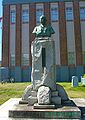 In February 2007, President Chen Shui-bian
initiated the change of names of state-owned enterprises, nation's embassies and overseas representative offices. As a result Chunghwa Post
Co. (中華郵政) was renamed Taiwan Post Co (臺灣郵政) until the Kuomintang
victories of 2008 votes, and Chinese Petroleum Corporation (中國石油) is now called CPC Corporation, Taiwan (臺灣中油) and the signs in Taiwan's embassies now display the word "Taiwan" under "Republic of China
".
In 2007, the recently renamed Taiwan Post Co. issued stamps bearing the name "Taiwan" in remembrance of the 228 Incident
.
The Pan-Blue camp voiced its opposition to the changes and the former KMT Chairman Ma Ying-jeou
(:zh:馬英九) said that it would generate diplomatic troubles and cause cross-strait tensions. Later, U.S. Department of State spokesman Sean McCormack said that the U.S. does not support administrative steps that would appear to change Taiwan's status or move toward independence.
Former president Lee Teng-hui
has stated that it is unnecessary to pursue Taiwanese independence. Lee views Taiwan as already an independent state, and that the call for "Taiwanese independence" could even confuse the international community by implying that Taiwan once viewed itself as part of China. From this perspective, Taiwan is independent even if it remains unable to enter the UN. Lee said the most important goals are to improve the people's livelihoods, build national consciousness, make a formal name change and draft a new constitution that reflects the present reality so that Taiwan can officially identify itself as a country.
(86 of the 113 seats) in the legislature for the Kuomintang
(KMT) and the Pan-Blue Coalition
. President Chen Shui-bian
's Democratic Progressive Party
was handed a heavy defeat, winning only the remaining 27 seats. The junior partner in the Pan-Green Coalition
, the Taiwan Solidarity Union
, won no seats.
Two months later, the election for the 12th-term President and Vice-President of the Republic of China was held in the Republic of China (ROC, Taiwan)
on Saturday, March 22, 2008. Kuomintang
(KMT) nominee Ma Ying-jeou
won, with 58% of the vote, ending eight years of Democratic Progressive Party
rule. Along with the 2008 legislative election
, Ma's landslide victory brought the Kuomintang back to power in Taiwan.
Following his election, Ma Ying-jeou
publicly stated that he did not wish his inauguration commemoration stamps to be marked "Taiwan Post", because the name change was "illegal". In respect of the administration's wishes, the postal service marked the inauguration stamps with Chinese
characters for the "Republic of China", as well as "Republic of China (Taiwan)" in English
.
On August 1, 2008, the company resolved to reverse the name change and restored the name "Chunghwa Post". The Board of Directors, as well as resolving to restore the name of the corporation, also resolved to re-hire the chief executive dismissed in 2007, and to withdraw defamation proceedings against him.
The Executive Yuan
on August 21, 2008, under the new Ma Administration, officially restored the name "National Chiang Kai-Shek Memorial Hall" to the hall.
On September 2, 2008, Ma defined the relations between Taiwan and mainland China as "special
", but "not that between two states" - they are relations based on two areas of one state, with Taiwan considering that state to be the Republic of China, and mainland China considering that state to be the People's Republic of China.
and former President Lee Teng-hui
. Although the Democratic Progressive Party
was originally also an advocate for both the idea of the Republic of Taiwan and Taiwan independence, as it took power the DPP has tried taking a middle line in which a sovereign, independent Taiwan is identified with the "Republic of China (Taiwan)" and its symbols.
Internationally, this movement is significant in that a formal declaration of independence is one of the five conditions the PRC has stated or implied under which it will take military action against Taiwan to force reunification — the other four being that Taiwan makes a military alliance with a foreign power, there is internal turmoil in Taiwan, Taiwan gains weapons of mass destruction
, or Taiwan refuses to negotiate on the basis of "one China". (Recently, the PRC government warned that if the situation in Taiwan becomes "worse" it will not look on "indifferently." Given the terms of the Taiwan Relations Act
, this raises the possibility of a superpower
conflict in East Asia
.) The United States
would likely be obligated to come to the aid of Taiwan under the terms of the Act
according to US domestic law. However, this interpretation of the Act
is disputed. Constitutional law requires that a normal declaration of war be sought by the President of the United States
in an act of Congress signed by the President.
On October 25, 2004, in Beijing, the U.S. Secretary of State Colin Powell said Taiwan is "not sovereign", provoking strong comments from both the Pan-Green and Pan-Blue coalitions – but for very different reasons. From the DPP's side, President Chen declared that "Taiwan is definitely a sovereign, independent country, a great country that absolutely does not belong to the People's Republic of China". The TSU (Taiwan Solidarity Union
) criticized Powell, and questioned why the US sold weapons to Taiwan if it was not a sovereign state. From the KMT, Chairman Ma Ying-jeou
announced that "the Republic of China has been a sovereign state ever since it was formed[ in 1912] ". The pro-unification PFP Party Chairman, James Soong
, called it "Taiwan's biggest failure in diplomacy". From an academic (and practical) standpoint, however, the current state of Taiwan's legal status
is at best ambiguous. One of the fundamental tenets of international law with regard to statehood is that a state exists when it has the ability to enter into relations with other states, and Taiwan has only limited relations with other states. There are basically three major views of Taiwanese independence.
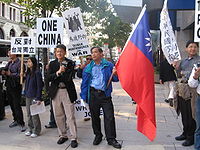 The first view, put forward by the government of the PRC, defines Taiwan independence as "splitting Taiwan from China, causing division of the nation and the people." What PRC claims by this statement is somewhat ambiguous according to supporters of Taiwanese independence, as some statements by the PRC seem to identify China solely and uncompromisingly with the PRC, and others indicate a broader and more flexible definition suggesting a cultural and geographic entity of which both mainland China
and Taiwan are parts but divided politically due to the Chinese Civil War
. The PRC considers itself the sole legitimate government of all China, and the ROC to be a defunct entity replaced in the Communist revolution which succeeded in 1949. Therefore, assertions that the ROC is a sovereign state are construed as support for Taiwan independence while proposals to change the name of the ROC to Republic of Taiwan are paradoxically met with even more disapproval since this would be the equivalent of formally dropping the notion that Taiwan is part of the greater China
entity (as a side of an unresolved Chinese civil war). Before the passing of UN Resolution 2758
in 1971, the Republic Of China was recognized as the legal government of China by the UN. Afterwards, the PRC became recognized as the legal government of China by the UN. During PRC President Hu Jintao
's visit to the United States on 20 April 2006, U.S. President George W. Bush
reaffirmed to the world that the U.S. would uphold its "one China" policy.
The official position of the PRC is that Taiwan is a province of China, and has "always" been part of China. The PRC often claims independence is wanted by only a small group, and that this group is trying to brainwash the local population to support this objective. In the 2000 White Paper, the PRC government stated that the people of Taiwan do not have the right to determine their own fate by declaring independence through a referendum or otherwise because "The sovereignty over Taiwan belongs to all the Chinese people including Taiwan compatriots, and not to some of the people in Taiwan." The paper further stated that unification with mainland China is the only option. Efforts to change names of official buildings, government organizations, tributary monuments by replacing "China" with "Taiwan"
have met with opposition – whether this is due to a political view that Taiwan is part of China or out of concern that such actions may provoke violence from Beijing is unclear.
, the Matsu Islands
off the coast of Fujian Province, and some of the islands in the South China Sea
remaining under its administration. Although previously no major political faction adopted this pro-status quo
viewpoint, because it is a "compromise" in face of PRC threats and American warnings against a unilateral declaration of independence, the DPP combined it with their traditional belief to form their latest official policy. This viewpoint has not been adopted by more radical groups such as the Taiwan Solidarity Union
, which favor only the third view described below and are in favor of a Republic or State of Taiwan. In addition, many members of the Pan-Blue Coalition are rather suspicious of this view, fearing that adopting this definition of Taiwan independence is merely an insincere stealth tactical effort to advance desinicization
and the third view of Taiwan independence. As a result, supporters of pan-blue tend to make a clear distinction between Taiwan independence and Taiwan sovereignty, while supporters of Pan-Green tend to try to blur the distinction between the two.
Most Taiwanese of all political parties support the status quo
, and recognize that this is de facto
independence through sovereign self-rule. Even among those who believe Taiwan is and should remain independent, the threat of war from PRC softens their approach, and they tend to support maintaining the status quo rather than pursuing an ideological path that could result in war with the PRC. When the two-states policy was put forward by President Lee Teng-hui
, he received 80 percent support. A similar situation arose when President Chen Shui-bian
declared that there was "one country on each side" of the Taiwan Strait. The parties disagree, sometimes bitterly, on such things as territory, name (R.O.C. or Taiwan), future policies, and interpretations of history. The Pan-Blue Coalition and the PRC believe that Lee Teng-hui
and Chen Shui-bian
are intent on publicly promoting a moderate form of Taiwan independence in order to advance secretly deeper forms of Taiwan independence, and that they intend to use popular support on Taiwan for political separation to advance notions of cultural and economic separation.
movement. This is the opinion, historically, put forward by such pro-independence groups on Taiwan as the tang wai movement (which later grew into the Democratic Progressive Party
), which argue that the ROC under the Kuomintang
has been in the past a "foreign regime" forcibly imposed on Taiwan. Since the 1990s, supporters of Taiwan independence no longer actively make this argument. Instead, the argument has been that in order to survive against the growing power of the PRC, Taiwan must view itself as a separate and distinct entity from "China". This involves removing the name of China from official and unofficial items in Taiwan, making changes in history books to focus mainly on Taiwan as a central entity, promoting the use of Taiwanese, reducing economic links with mainland China, and in general thinking of Taiwan as a separate entity. In this view, China is a foreign entity, and the goal of this movement is to create an internationally recognized country which is separate from any concept of China. Kinmen and Matsu off the coast of Fujian and some of the islands in the South China Sea, which are historically not part of Taiwan, are to be excluded from the proposed state of Taiwan. Some supporters of Taiwan independence argue that the Treaty of San Francisco justifies Taiwan independence by not explicitly granting Taiwan to either the ROC or the PRC. This legal justification is rejected by both the PRC and ROC governments. It is also thought that if formal independence were declared, Taiwan's foreign policies would lean further towards Japan and the United States.
Political movement
A political movement is a social movement in the area of politics. A political movement may be organized around a single issue or set of issues, or around a set of shared concerns of a social group...
whose goals are primarily to formally establish the Republic of Taiwan by renaming or replacing the Republic of China
Republic of China
The Republic of China , commonly known as Taiwan , is a unitary sovereign state located in East Asia. Originally based in mainland China, the Republic of China currently governs the island of Taiwan , which forms over 99% of its current territory, as well as Penghu, Kinmen, Matsu and other minor...
(ROC) (commonly known as Taiwan
Taiwan
Taiwan , also known, especially in the past, as Formosa , is the largest island of the same-named island group of East Asia in the western Pacific Ocean and located off the southeastern coast of mainland China. The island forms over 99% of the current territory of the Republic of China following...
), form a Taiwanese
Taiwanese people
Taiwanese people may refer to individuals who either claim or are imputed cultural identity focused on the island of Taiwan and/or Taiwan Area which have been governed by the Republic of China since 1945...
national identity
National identity
National identity is the person's identity and sense of belonging to one state or to one nation, a feeling one shares with a group of people, regardless of one's citizenship status....
, reject unification and One country, two systems
One country, two systems
"One country, two systems" is an idea originally proposed by Deng Xiaoping, then Paramount Leader of the People's Republic of China , for the reunification of China during the early 1980s...
with the People's Republic of China
People's Republic of China
China , officially the People's Republic of China , is the most populous country in the world, with over 1.3 billion citizens. Located in East Asia, the country covers approximately 9.6 million square kilometres...
(PRC) (commonly known as China
China
Chinese civilization may refer to:* China for more general discussion of the country.* Chinese culture* Greater China, the transnational community of ethnic Chinese.* History of China* Sinosphere, the area historically affected by Chinese culture...
and mainland China
Mainland China
Mainland China, the Chinese mainland or simply the mainland, is a geopolitical term that refers to the area under the jurisdiction of the People's Republic of China . According to the Taipei-based Mainland Affairs Council, the term excludes the PRC Special Administrative Regions of Hong Kong and...
) and a Chinese identity, and obtaining international recognition
Diplomatic recognition
Diplomatic recognition in international law is a unilateral political act with domestic and international legal consequences, whereby a state acknowledges an act or status of another state or government in control of a state...
as a sovereign state
Sovereign state
A sovereign state, or simply, state, is a state with a defined territory on which it exercises internal and external sovereignty, a permanent population, a government, and the capacity to enter into relations with other sovereign states. It is also normally understood to be a state which is neither...
. The success of this movement would be one possible outcome for the resolution of the political status of Taiwan
Political status of Taiwan
The controversy regarding the political status of Taiwan hinges on whether Taiwan, Penghu, Kinmen, and Matsu should remain effectively independent as territory of the Republic of China , become unified with the territories now governed by the People's Republic of China , or formally declare...
.
This movement is supported by the Pan-Green Coalition
Pan-Green Coalition
The Pan-Green Coalition or Pan-Green Camp, is an informal political alliance of the Republic of China, commonly known as "Taiwan", consisting of the Democratic Progressive Party , Taiwan Solidarity Union , and the minor Taiwan Independence Party...
in Taiwan
Taiwan
Taiwan , also known, especially in the past, as Formosa , is the largest island of the same-named island group of East Asia in the western Pacific Ocean and located off the southeastern coast of mainland China. The island forms over 99% of the current territory of the Republic of China following...
and opposed by the Pan-Blue Coalition
Pan-Blue Coalition
The Pan-Blue Coalition 泛藍聯盟 or Pan-Blue Force is a political alliance in the Republic of China , consisting of the Kuomintang , the People First Party , and the New Party . The name comes from the party colours of the Kuomintang...
which seeks to retain the somewhat ambiguous status quo
Status quo
Statu quo, a commonly used form of the original Latin "statu quo" – literally "the state in which" – is a Latin term meaning the current or existing state of affairs. To maintain the status quo is to keep the things the way they presently are...
of the ROC under the 1992 consensus
1992 Consensus
The 1992 Consensus or Consensus of 1992 is a term describing the outcome of a meeting in 1992 between the semi-official representatives of the People's Republic of China in mainland China and the Republic of China in Taiwan...
, or gradually reunify
Chinese reunification
Chinese reunification refers to the bringing together of all of the territories controlled by the People's Republic of China and the Republic of China under a single political entity...
with mainland China
Mainland China
Mainland China, the Chinese mainland or simply the mainland, is a geopolitical term that refers to the area under the jurisdiction of the People's Republic of China . According to the Taipei-based Mainland Affairs Council, the term excludes the PRC Special Administrative Regions of Hong Kong and...
at some point. Due to the PRC's claim of sovereignty over Taiwan and repeated military threat
Military threat
A military threat, sometimes expressed as danger of military action, a military challenge, or a military risk, is a concept in military intelligence that identifies an imminent capability for use of military force in resolving diplomatic or economic disputes...
s made by the PRC, a formal declaration of independence
Declaration of independence
A declaration of independence is an assertion of the independence of an aspiring state or states. Such places are usually declared from part or all of the territory of another nation or failed nation, or are breakaway territories from within the larger state...
could lead to a military confrontation between the Military of the Republic of China
Military of the Republic of China
The Republic of China Armed Forces encompass the Army, Navy, Air Force, and Military Police Force of the Republic of China . It is a military establishment, which accounted for 16.8% of the central budget in the fiscal year of 2003...
and the People's Liberation Army
People's Liberation Army
The People's Liberation Army is the unified military organization of all land, sea, strategic missile and air forces of the People's Republic of China. The PLA was established on August 1, 1927 — celebrated annually as "PLA Day" — as the military arm of the Communist Party of China...
of the PRC, escalating and involving other countries, such as the United States
United States
The United States of America is a federal constitutional republic comprising fifty states and a federal district...
and Japan
Japan
Japan is an island nation in East Asia. Located in the Pacific Ocean, it lies to the east of the Sea of Japan, China, North Korea, South Korea and Russia, stretching from the Sea of Okhotsk in the north to the East China Sea and Taiwan in the south...
.
The use of independence for Taiwan can be ambiguous. If some supporters articulate that they agree to the independence of Taiwan, they may either be referring to the notion of formally creating an independent Republic of Taiwan, or to the notion that Taiwan is synonymous with the current Republic of China
Four-Stage Theory of the Republic of China
The Four-Stage Theory of the Republic of China or the Theory of the Four Stages of the Republic of China is a controversial viewpoint proposed by Chen Shui-bian, the previous President of the Republic of China...
and already is independent, which is against the People's Republic of China's claim. (See Special state-to-state relations and One Country on Each Side
One Country on Each Side
One Country on Each Side was a concept espoused by Chen Shui-bian, the former President of the Republic of China , regarding the political status of Taiwan...
.)
Prior to 1895, both Taiwan and mainland China were ruled by the Qing Empire. Following the First Sino-Japanese War
First Sino-Japanese War
The First Sino-Japanese War was fought between Qing Dynasty China and Meiji Japan, primarily over control of Korea...
in 1895, Taiwan was ceded by Qing government to the Empire of Japan
Empire of Japan
The Empire of Japan is the name of the state of Japan that existed from the Meiji Restoration on 3 January 1868 to the enactment of the post-World War II Constitution of...
via the Treaty of Shimonoseki
Treaty of Shimonoseki
The Treaty of Shimonoseki , known as the Treaty of Maguan in China, was signed at the Shunpanrō hall on April 17, 1895, between the Empire of Japan and Qing Empire of China, ending the First Sino-Japanese War. The peace conference took place from March 20 to April 17, 1895...
. At the end of World War II
World War II
World War II, or the Second World War , was a global conflict lasting from 1939 to 1945, involving most of the world's nations—including all of the great powers—eventually forming two opposing military alliances: the Allies and the Axis...
in 1945, Taiwan was taken over by the ROC forces who, then, ruled most of mainland China
Mainland China
Mainland China, the Chinese mainland or simply the mainland, is a geopolitical term that refers to the area under the jurisdiction of the People's Republic of China . According to the Taipei-based Mainland Affairs Council, the term excludes the PRC Special Administrative Regions of Hong Kong and...
. Since the defeat and expulsion of the ruling Kuomintang
Kuomintang
The Kuomintang of China , sometimes romanized as Guomindang via the Pinyin transcription system or GMD for short, and translated as the Chinese Nationalist Party is a founding and ruling political party of the Republic of China . Its guiding ideology is the Three Principles of the People, espoused...
ROC government by the Communist Party of China
Communist Party of China
The Communist Party of China , also known as the Chinese Communist Party , is the founding and ruling political party of the People's Republic of China...
from mainland China in 1949, the ROC government has controlled only Taiwan and its surrounding islands. Whether the current ROC makes Taiwan already independent or not is controversial
Political status of Taiwan
The controversy regarding the political status of Taiwan hinges on whether Taiwan, Penghu, Kinmen, and Matsu should remain effectively independent as territory of the Republic of China , become unified with the territories now governed by the People's Republic of China , or formally declare...
in Cross-Strait relations
Cross-Strait relations
Cross-Strait relations refers to the relations between People's Republic of China and the Republic of China , which lie to the west and east, repectively, of the Taiwan Strait in the west Pacific Ocean....
.
History of the movement
Many supporters of independence for Taiwan view the history of TaiwanHistory of Taiwan
Taiwan was first populated by Negrito, and then Austronesian people. It was colonized by the Dutch in the 17th century, followed by an influx of Han Chinese including Hakka immigrants from areas of Fujian and Guangdong of mainland China, across the Taiwan Strait...
since the 17th century as a continuous struggle for independence and use it as an inspiration for the current political movement.
According to this view, the people indigenous to Taiwan and those who have taken up residence there have been repeatedly occupied by groups including the Dutch
Netherlands
The Netherlands is a constituent country of the Kingdom of the Netherlands, located mainly in North-West Europe and with several islands in the Caribbean. Mainland Netherlands borders the North Sea to the north and west, Belgium to the south, and Germany to the east, and shares maritime borders...
, the Spanish
Spain
Spain , officially the Kingdom of Spain languages]] under the European Charter for Regional or Minority Languages. In each of these, Spain's official name is as follows:;;;;;;), is a country and member state of the European Union located in southwestern Europe on the Iberian Peninsula...
, the Ming
Ming Dynasty
The Ming Dynasty, also Empire of the Great Ming, was the ruling dynasty of China from 1368 to 1644, following the collapse of the Mongol-led Yuan Dynasty. The Ming, "one of the greatest eras of orderly government and social stability in human history", was the last dynasty in China ruled by ethnic...
, Koxinga
Koxinga
Koxinga is the customary Western spelling of the popular appellation of Zheng Chenggong , a military leader who was born in 1624 in Hirado, Japan to Zheng Zhilong, a Chinese merchant/pirate, and his Japanese wife and died in 1662 on the island of Formosa .A Ming loyalist and the arch commander of...
and the Ming loyalists, the Qing
Qing Dynasty
The Qing Dynasty was the last dynasty of China, ruling from 1644 to 1912 with a brief, abortive restoration in 1917. It was preceded by the Ming Dynasty and followed by the Republic of China....
, the Japan
Japan
Japan is an island nation in East Asia. Located in the Pacific Ocean, it lies to the east of the Sea of Japan, China, North Korea, South Korea and Russia, stretching from the Sea of Okhotsk in the north to the East China Sea and Taiwan in the south...
ese and finally the Chinese Nationalists led by the Kuomintang. From a pro-independence supporter's point of view, the movement for Taiwan independence began under Manchu rule in the 1680s which led to a well known saying those days, "Every three years an uprising, every five years a rebellion". Taiwan Independence supporters compared Taiwan under Kuomintang rule to South Africa under apartheid. The Taiwan independence movement under Japan was ironically supported by Mao Zedong
Mao Zedong
Mao Zedong, also transliterated as Mao Tse-tung , and commonly referred to as Chairman Mao , was a Chinese Communist revolutionary, guerrilla warfare strategist, Marxist political philosopher, and leader of the Chinese Revolution...
in the 1930s as a means of freeing Taiwan from Japanese rule. With the end of World War II
World War II
World War II, or the Second World War , was a global conflict lasting from 1939 to 1945, involving most of the world's nations—including all of the great powers—eventually forming two opposing military alliances: the Allies and the Axis...
in 1945, by issuing "Supreme Commander for the Allied Powers General Order No. 1" the Allies
Allies of World War II
The Allies of World War II were the countries that opposed the Axis powers during the Second World War . Former Axis states contributing to the Allied victory are not considered Allied states...
agreed that the Republic of China Army
Republic of China Army
The ROC Army's current operational strength includes 3 armies, 5 corps. As of 2005, the Army's 35 brigades include 25 infantry brigades, 5 armoured brigades and 3 mechanized infantry brigades...
under the Kuomintang
Kuomintang
The Kuomintang of China , sometimes romanized as Guomindang via the Pinyin transcription system or GMD for short, and translated as the Chinese Nationalist Party is a founding and ruling political party of the Republic of China . Its guiding ideology is the Three Principles of the People, espoused...
would "temporarily occupy Taiwan, on behalf of the Allied forces."
Martial law period
Modern-day political movement for Taiwan independence dates back to the Japanese colonial period but only became a viable political force within Taiwan in the 1990s. Taiwanese independence was advocated periodically during the Japanese colonial period, but was suppressed by the Japanese government. These efforts were the goal of the Taiwanese Communist PartyTaiwanese Communist Party
The Taiwanese Communist Party was a revolutionary organization active in Japan-ruled Taiwan. Like the contemporary Taiwanese People's Party, its existence was short, a mere three years, yet its politics and activities were influential in shaping Taiwan's anti-colonial enterprise...
of the late 1920s. Unlike current formulations, and in line with the thinking of the Comintern
Comintern
The Communist International, abbreviated as Comintern, also known as the Third International, was an international communist organization initiated in Moscow during March 1919...
, such a state would have been a proletarian one. With the end of World War II
World War II
World War II, or the Second World War , was a global conflict lasting from 1939 to 1945, involving most of the world's nations—including all of the great powers—eventually forming two opposing military alliances: the Allies and the Axis...
in 1945, Japanese rule
Taiwan under Japanese rule
Between 1895 and 1945, Taiwan was a dependency of the Empire of Japan. The expansion into Taiwan was a part of Imperial Japan's general policy of southward expansion during the late 19th century....
ended, but the subsequent autocratic rule of the ROC's Kuomintang
Kuomintang
The Kuomintang of China , sometimes romanized as Guomindang via the Pinyin transcription system or GMD for short, and translated as the Chinese Nationalist Party is a founding and ruling political party of the Republic of China . Its guiding ideology is the Three Principles of the People, espoused...
(KMT) later revived calls for local rule. However, it was a movement supported by the Chinese students who were born on the Island and not associated with KMT. It found its roots in the US and Japan. In the 1950s a Republic of Taiwan Provisional Government was set up in Japan. Liao Wen-yih was nominally the President. At one time it held quasi-official relations with the newly independent Indonesia
Indonesia
Indonesia , officially the Republic of Indonesia , is a country in Southeast Asia and Oceania. Indonesia is an archipelago comprising approximately 13,000 islands. It has 33 provinces with over 238 million people, and is the world's fourth most populous country. Indonesia is a republic, with an...
. This was possible mainly through the connections between Sukarno
Sukarno
Sukarno, born Kusno Sosrodihardjo was the first President of Indonesia.Sukarno was the leader of his country's struggle for independence from the Netherlands and was Indonesia's first President from 1945 to 1967...
and the Provisional Government's Southeast Asia
Southeast Asia
Southeast Asia, South-East Asia, South East Asia or Southeastern Asia is a subregion of Asia, consisting of the countries that are geographically south of China, east of India, west of New Guinea and north of Australia. The region lies on the intersection of geological plates, with heavy seismic...
n liaison, Chen Chih-hsiung, who had assisted in Indonesia's local resistance movements against the Japanese rule.
After the Kuomintang began to rule the island, the focus of the movement was as a vehicle for discontent from the native Taiwanese against the rule of "mainlanders" (i.e. mainland Chinese-born people who fled to Taiwan with KMT in the late 1940s). The 228 incident
228 Incident
The 228 Incident, also known as the 228 Massacre, was an anti-government uprising in Taiwan that began on February 27, 1947, and was violently suppressed by the Kuomintang government. Estimates of the number of deaths vary from 10,000 to 30,000 or more...
in 1947 and the ensuing martial law which lasted until 1987 contributed to a so-called sense of White Terror
White Terror
White Terror is the violence carried out by reactionary groups as part of a counter-revolution. In particular, during the 20th century, in several countries the term White Terror was applied to acts of violence against real or suspected socialists and communists.-Historical origin: the French...
on the island. In 1979, the Kaohsiung Incident
Kaohsiung Incident
The Kaohsiung Incident also known as the Formosa Incident, the Meilidao Incident or the Formosa Magazine incident was the result of pro-democracy demonstrations that occurred in Kaohsiung, Taiwan on December 10, 1979....
, occurred as the movement for democracy and independence intensified.
Between 1949 and 1991, the official position of the ROC government on Taiwan was that it was the legitimate government of all of China and it used this position as justification for authoritarian measures such as the refusal to vacate the seats held by delegates elected on the mainland in 1947 for the Legislative Yuan
Legislative Yuan
The Legislative Yuan is the unicameral legislature of the Republic of China .The Legislative Yuan is one of the five branches of government stipulated by the Constitution of the Republic of China, which follows Sun Yat-sen's Three Principles of the People...
. The Taiwan independence movement intensified in response to this and presented an alternative vision of a sovereign and independent Republic of Taiwan. This vision was represented through a number of symbols such as the use of Taiwanese in opposition to the school taught Mandarin Chinese
Standard Mandarin
Standard Chinese or Modern Standard Chinese, also known as Mandarin or Putonghua, is the official language of the People's Republic of China and Republic of China , and is one of the four official languages of Singapore....
. Several scholars drafted various versions of a constitution
Constitution
A constitution is a set of fundamental principles or established precedents according to which a state or other organization is governed. These rules together make up, i.e. constitute, what the entity is...
, as both political statement or vision and as intellectual exercise. Most of these drafts favor a bicameral parliament
Parliament
A parliament is a legislature, especially in those countries whose system of government is based on the Westminster system modeled after that of the United Kingdom. The name is derived from the French , the action of parler : a parlement is a discussion. The term came to mean a meeting at which...
ary rather than presidential system. In at least one such draft, seats in the upper house would be divided equally among Taiwan's established ethnicities. In the 1980s the Chinese Nationalist
Kuomintang
The Kuomintang of China , sometimes romanized as Guomindang via the Pinyin transcription system or GMD for short, and translated as the Chinese Nationalist Party is a founding and ruling political party of the Republic of China . Its guiding ideology is the Three Principles of the People, espoused...
government considered publication of these ideas criminal. In the most dramatic case, it decided to arrest the pro-independence publisher Cheng Nan-jung
Cheng Nan-jung
Cheng Nan-jung was a Taiwanese publisher and pro-democracy activist. He was the founder of the Freedom Era Weekly. He is most known internationally for setting himself on fire in support of Taiwanese independence.-Background and career:...
for publishing a version in his Tang-wai magazine, Liberty Era Weekly (自由時代週刊). Rather than giving himself up, Cheng self-immolated
Self-immolation
Self-immolation refers to setting oneself on fire, often as a form of protest or for the purposes of martyrdom or suicide. It has centuries-long traditions in some cultures, while in modern times it has become a type of radical political protest...
in protest. Other campaigns and tactics toward such a State have included soliciting designs from the public for a new national flag
Flag
A flag is a piece of fabric with a distinctive design that is usually rectangular and used as a symbol, as a signaling device, or decoration. The term flag is also used to refer to the graphic design employed by a flag, or to its depiction in another medium.The first flags were used to assist...
(see image) and anthem
Anthem
The term anthem means either a specific form of Anglican church music , or more generally, a song of celebration, usually acting as a symbol for a distinct group of people, as in the term "national anthem" or "sports anthem".-Etymology:The word is derived from the Greek via Old English , a word...
(for example, Taiwan the Formosa
Taiwan the Formosa
Taiwan the Formosa is a poem written by Taiwanese poet and clergyman Tīⁿ Jî-gio̍k , set to music between 1988 and 1993 by neo-Romantic Taiwanese composer Tyzen Hsiao...
). More recently the Taiwan Name Rectification Campaign (台灣正名運動) has played an active role. More traditional independence supporters, however, have criticized name rectification as merely a superficial tactic devoid of the larger vision inherent in the Republic of Taiwan agenda.
The Anti-communist Kuomintang
Kuomintang
The Kuomintang of China , sometimes romanized as Guomindang via the Pinyin transcription system or GMD for short, and translated as the Chinese Nationalist Party is a founding and ruling political party of the Republic of China . Its guiding ideology is the Three Principles of the People, espoused...
leader Chiang Kai-shek
Chiang Kai-shek
Chiang Kai-shek was a political and military leader of 20th century China. He is known as Jiǎng Jièshí or Jiǎng Zhōngzhèng in Mandarin....
, President of the Republic of China
Republic of China
The Republic of China , commonly known as Taiwan , is a unitary sovereign state located in East Asia. Originally based in mainland China, the Republic of China currently governs the island of Taiwan , which forms over 99% of its current territory, as well as Penghu, Kinmen, Matsu and other minor...
on Taiwan, believed the Americans were going to plot a coup against him along with Taiwan Independence. In 1950, Chiang Ching-kuo became director of the secret police
Secret police
Secret police are a police agency which operates in secrecy and beyond the law to protect the political power of an individual dictator or an authoritarian political regime....
, which he remained until 1965. Chiang also considered some people who were friends to Americans to be his enemies. An enemy of the Chiang family, Wu Kuo-chen, was kicked out of his position of governor of Taiwan by Chiang Ching-kuo
Chiang Ching-kuo
Chiang Ching-kuo , Kuomintang politician and leader, was the son of President Chiang Kai-shek and held numerous posts in the government of the Republic of China...
and fled to America in 1953. Chiang Ching-kuo, educated in the Soviet Union, initiated Soviet style military organization in the Republic of China Military, reorganizing and Sovietizing the political officer corps, surveillance, and Kuomintang party activities were propagated throughout the military. Opposed to this was Sun Li-jen
Sun Li-jen
Sun Li-jen was a Kuomintang General, best known for his leadership in the Second Sino-Japanese War and the Chinese Civil War. His achievements earned him the laudatory nickname "Rommel of the East". His New 1st Army was reputed as the "1st [Best] Army under heaven" and credited with defeating...
, who was educated at the American Virginia Military Institute
Virginia Military Institute
The Virginia Military Institute , located in Lexington, Virginia, is the oldest state-supported military college and one of six senior military colleges in the United States. Unlike any other military college in the United States—and in keeping with its founding principles—all VMI students are...
. Chiang orchestrated the controversial court-martial and arrest of General Sun Li-jen
Sun Li-jen
Sun Li-jen was a Kuomintang General, best known for his leadership in the Second Sino-Japanese War and the Chinese Civil War. His achievements earned him the laudatory nickname "Rommel of the East". His New 1st Army was reputed as the "1st [Best] Army under heaven" and credited with defeating...
in August 1955, for plotting a coup d'état with the American CIA against his father Chiang Kai-shek and the Kuomintang. The CIA allegedly wanted to help Sun take control of Taiwan and declare its independence.
During the martial law era lasting until 1987, discussion of Taiwan independence was forbidden in Taiwan, at a time when recovery of the mainland and national unification were the stated goals of the ROC. During that time, many advocates of independence and other dissidents fled overseas, and carried out their advocacy work there, notably in Japan
Japan
Japan is an island nation in East Asia. Located in the Pacific Ocean, it lies to the east of the Sea of Japan, China, North Korea, South Korea and Russia, stretching from the Sea of Okhotsk in the north to the East China Sea and Taiwan in the south...
and the United States
United States
The United States of America is a federal constitutional republic comprising fifty states and a federal district...
. Part of their work involved setting up think tanks, political organizations, and lobbying networks in order to influence the politics of their host countries, notably the United States, the ROC's main ally at the time, though they would not be very successful until much later. Within Taiwan, the independence movement was one of many dissident causes among the intensifying democracy movement of the 1970s, which culminated in the 1979 Kaohsiung Incident
Kaohsiung Incident
The Kaohsiung Incident also known as the Formosa Incident, the Meilidao Incident or the Formosa Magazine incident was the result of pro-democracy demonstrations that occurred in Kaohsiung, Taiwan on December 10, 1979....
. The Democratic Progressive Party
Democratic Progressive Party
The Democratic Progressive Party is a political party in Taiwan, and the dominant party in the Pan-Green Coalition. Founded in 1986, DPP is the first meaningful opposition party in Taiwan. It has traditionally been associated with strong advocacy of human rights and a distinct Taiwanese identity,...
(DPP) was eventually formed to represent dissident causes.
Multiparty period
After the lifting of martial law in 1987, and the acceptance of multi-party politics, the Democratic Progressive PartyDemocratic Progressive Party
The Democratic Progressive Party is a political party in Taiwan, and the dominant party in the Pan-Green Coalition. Founded in 1986, DPP is the first meaningful opposition party in Taiwan. It has traditionally been associated with strong advocacy of human rights and a distinct Taiwanese identity,...
became increasingly identified with Taiwan independence, which entered its party platform in 1991. At the same time, many overseas independence advocates and organizations returned to Taiwan and for the first time openly promoted their cause in Taiwan, gradually building up political support. Many had fled into the US or Europe and had been on a black list held by KMT, which had held them back from going back to Taiwan. There they had built many organisations like European Federation of Taiwanese Associations
European Federation of Taiwanese Associations
The European Federation of Taiwanese Associations is a federation, which combines several associations by Taiwanese people in each European country. The object is to promote friendship among those European associations, support mutual corporation and continuing care for Taiwan's development and...
or Formosan Association for Public Affairs
Formosan Association for Public Affairs
The Formosan Association for Public Affairs is a Washington, D.C.-based nonprofit organization that seeks to build worldwide support for Taiwan independence. Its 52 chapters also seek to advance the interests of Taiwanese people and communities around the world. Currently, the President of FAPA...
. By the late 1990s, DPP and Taiwan independence have gained a solid electoral constituency in Taiwan, supported by an increasingly vocal and hardcore base.
As the electoral success of the DPP, and later, the DPP-led Pan-Green Coalition grew in recent years, the Taiwan independence movement shifted focus to identity politics
Identity politics
Identity politics are political arguments that focus upon the self interest and perspectives of self-identified social interest groups and ways in which people's politics may be shaped by aspects of their identity through race, class, religion, sexual orientation or traditional dominance...
by proposing many plans involving symbol
Symbol
A symbol is something which represents an idea, a physical entity or a process but is distinct from it. The purpose of a symbol is to communicate meaning. For example, a red octagon may be a symbol for "STOP". On a map, a picture of a tent might represent a campsite. Numerals are symbols for...
ism and social engineering
Social engineering (political science)
Social engineering is a discipline in political science that refers to efforts to influence popular attitudes and social behaviors on a large scale, whether by governments or private groups. In the political arena, the counterpart of social engineering is political engineering.For various reasons,...
. The interpretation of historical events such as the 228 Incident
228 Incident
The 228 Incident, also known as the 228 Massacre, was an anti-government uprising in Taiwan that began on February 27, 1947, and was violently suppressed by the Kuomintang government. Estimates of the number of deaths vary from 10,000 to 30,000 or more...
, the use of broadcast language and mother tongue education in schools, the official name and flag of the ROC, slogans in the army, orientation of maps all have been issues of concern to the present-day Taiwan independence movement. The movement, at its peak in the 70s through the 90s in the form of the Taiwan literature movement and other cultural upheavals, has moderated in recent years with the assimilation of these changes. Friction between "mainlander" and "native" communities on Taiwan has decreased due to shared interests: increasing economic ties with mainland China, continuing threats by the PRC to invade, and doubts as to whether or not the United States would support a unilateral declaration of independence. Since the late 1990s many supporters of Taiwan independence have argued that Taiwan, as the ROC, is already independent from the mainland, making a formal declaration unnecessary. In May 1999, the Democratic Progressive Party
Democratic Progressive Party
The Democratic Progressive Party is a political party in Taiwan, and the dominant party in the Pan-Green Coalition. Founded in 1986, DPP is the first meaningful opposition party in Taiwan. It has traditionally been associated with strong advocacy of human rights and a distinct Taiwanese identity,...
formalized this position in its "Resolution on Taiwan's Future
Resolution on Taiwan's Future
The Resolution on Taiwan's Future is a document ratified by the Democratic Progressive Party during its eighth annual national assembly on May 7-8, 1999 in the southern port-city of Kaohsiung...
".
DPP administration: (2000–2008)
Chen Shui-bian
Chen Shui-bian is a former Taiwanese politician who was the 10th and 11th-term President of the Republic of China from 2000 to 2008. Chen, whose Democratic Progressive Party has traditionally been supportive of Taiwan independence, ended more than fifty years of Kuomintang rule in Taiwan...
initiated the change of names of state-owned enterprises, nation's embassies and overseas representative offices. As a result Chunghwa Post
Chunghwa Post
The Chunghwa Post Co., Ltd. , formerly Taiwan Post Co. , is the official postal service of the Republic of China , providing mail service for Taiwan Area of the Republic of China. It also provides a savings account service...
Co. (中華郵政) was renamed Taiwan Post Co (臺灣郵政) until the Kuomintang
Kuomintang
The Kuomintang of China , sometimes romanized as Guomindang via the Pinyin transcription system or GMD for short, and translated as the Chinese Nationalist Party is a founding and ruling political party of the Republic of China . Its guiding ideology is the Three Principles of the People, espoused...
victories of 2008 votes, and Chinese Petroleum Corporation (中國石油) is now called CPC Corporation, Taiwan (臺灣中油) and the signs in Taiwan's embassies now display the word "Taiwan" under "Republic of China
Republic of China
The Republic of China , commonly known as Taiwan , is a unitary sovereign state located in East Asia. Originally based in mainland China, the Republic of China currently governs the island of Taiwan , which forms over 99% of its current territory, as well as Penghu, Kinmen, Matsu and other minor...
".
In 2007, the recently renamed Taiwan Post Co. issued stamps bearing the name "Taiwan" in remembrance of the 228 Incident
228 Incident
The 228 Incident, also known as the 228 Massacre, was an anti-government uprising in Taiwan that began on February 27, 1947, and was violently suppressed by the Kuomintang government. Estimates of the number of deaths vary from 10,000 to 30,000 or more...
.
The Pan-Blue camp voiced its opposition to the changes and the former KMT Chairman Ma Ying-jeou
Ma Ying-jeou
Ma Ying-jeou is the 12th term and current President of the Republic of China , commonly known as Taiwan, and the Chairman of the Kuomintang Party, also known as the Chinese Nationalist Party. He formerly served as Justice Minister from 1993 to 1996, Mayor of Taipei from 1998 to 2006, and Chairman...
(:zh:馬英九) said that it would generate diplomatic troubles and cause cross-strait tensions. Later, U.S. Department of State spokesman Sean McCormack said that the U.S. does not support administrative steps that would appear to change Taiwan's status or move toward independence.
Former president Lee Teng-hui
Lee Teng-hui
Lee Teng-hui is a politician of the Republic of China . He was the 7th, 8th, and 9th-term President of the Republic of China and Chairman of the Kuomintang from 1988 to 2000. He presided over major advancements in democratic reforms including his own re-election which marked the first direct...
has stated that it is unnecessary to pursue Taiwanese independence. Lee views Taiwan as already an independent state, and that the call for "Taiwanese independence" could even confuse the international community by implying that Taiwan once viewed itself as part of China. From this perspective, Taiwan is independent even if it remains unable to enter the UN. Lee said the most important goals are to improve the people's livelihoods, build national consciousness, make a formal name change and draft a new constitution that reflects the present reality so that Taiwan can officially identify itself as a country.
KMT administration (2008–present)
Legislative elections were held on January 12, 2008, resulting in a supermajoritySupermajority
A supermajority or a qualified majority is a requirement for a proposal to gain a specified level or type of support which exceeds a simple majority . In some jurisdictions, for example, parliamentary procedure requires that any action that may alter the rights of the minority has a supermajority...
(86 of the 113 seats) in the legislature for the Kuomintang
Kuomintang
The Kuomintang of China , sometimes romanized as Guomindang via the Pinyin transcription system or GMD for short, and translated as the Chinese Nationalist Party is a founding and ruling political party of the Republic of China . Its guiding ideology is the Three Principles of the People, espoused...
(KMT) and the Pan-Blue Coalition
Pan-Blue Coalition
The Pan-Blue Coalition 泛藍聯盟 or Pan-Blue Force is a political alliance in the Republic of China , consisting of the Kuomintang , the People First Party , and the New Party . The name comes from the party colours of the Kuomintang...
. President Chen Shui-bian
Chen Shui-bian
Chen Shui-bian is a former Taiwanese politician who was the 10th and 11th-term President of the Republic of China from 2000 to 2008. Chen, whose Democratic Progressive Party has traditionally been supportive of Taiwan independence, ended more than fifty years of Kuomintang rule in Taiwan...
's Democratic Progressive Party
Democratic Progressive Party
The Democratic Progressive Party is a political party in Taiwan, and the dominant party in the Pan-Green Coalition. Founded in 1986, DPP is the first meaningful opposition party in Taiwan. It has traditionally been associated with strong advocacy of human rights and a distinct Taiwanese identity,...
was handed a heavy defeat, winning only the remaining 27 seats. The junior partner in the Pan-Green Coalition
Pan-Green Coalition
The Pan-Green Coalition or Pan-Green Camp, is an informal political alliance of the Republic of China, commonly known as "Taiwan", consisting of the Democratic Progressive Party , Taiwan Solidarity Union , and the minor Taiwan Independence Party...
, the Taiwan Solidarity Union
Taiwan Solidarity Union
The Taiwan Solidarity Union is a political party in the Republic of China which advocates Taiwan independence. It was officially founded on July 24, 2001 and is considered part of the Pan-Green Coalition. Unlike the Democratic Progressive Party, its larger companion party in the Pan-Green...
, won no seats.
Two months later, the election for the 12th-term President and Vice-President of the Republic of China was held in the Republic of China (ROC, Taiwan)
Republic of China
The Republic of China , commonly known as Taiwan , is a unitary sovereign state located in East Asia. Originally based in mainland China, the Republic of China currently governs the island of Taiwan , which forms over 99% of its current territory, as well as Penghu, Kinmen, Matsu and other minor...
on Saturday, March 22, 2008. Kuomintang
Kuomintang
The Kuomintang of China , sometimes romanized as Guomindang via the Pinyin transcription system or GMD for short, and translated as the Chinese Nationalist Party is a founding and ruling political party of the Republic of China . Its guiding ideology is the Three Principles of the People, espoused...
(KMT) nominee Ma Ying-jeou
Ma Ying-jeou
Ma Ying-jeou is the 12th term and current President of the Republic of China , commonly known as Taiwan, and the Chairman of the Kuomintang Party, also known as the Chinese Nationalist Party. He formerly served as Justice Minister from 1993 to 1996, Mayor of Taipei from 1998 to 2006, and Chairman...
won, with 58% of the vote, ending eight years of Democratic Progressive Party
Democratic Progressive Party
The Democratic Progressive Party is a political party in Taiwan, and the dominant party in the Pan-Green Coalition. Founded in 1986, DPP is the first meaningful opposition party in Taiwan. It has traditionally been associated with strong advocacy of human rights and a distinct Taiwanese identity,...
rule. Along with the 2008 legislative election
Republic of China legislative election, 2008
The 7th Legislative elections were held on January 12, 2008 in the Republic of China . The results gave the Kuomintang and the Pan-Blue Coalition a supermajority in the legislature, handing a heavy defeat to then-President Chen Shui-bian's Democratic Progressive Party, which won the remaining 27...
, Ma's landslide victory brought the Kuomintang back to power in Taiwan.
Following his election, Ma Ying-jeou
Ma Ying-jeou
Ma Ying-jeou is the 12th term and current President of the Republic of China , commonly known as Taiwan, and the Chairman of the Kuomintang Party, also known as the Chinese Nationalist Party. He formerly served as Justice Minister from 1993 to 1996, Mayor of Taipei from 1998 to 2006, and Chairman...
publicly stated that he did not wish his inauguration commemoration stamps to be marked "Taiwan Post", because the name change was "illegal". In respect of the administration's wishes, the postal service marked the inauguration stamps with Chinese
Chinese language
The Chinese language is a language or language family consisting of varieties which are mutually intelligible to varying degrees. Originally the indigenous languages spoken by the Han Chinese in China, it forms one of the branches of Sino-Tibetan family of languages...
characters for the "Republic of China", as well as "Republic of China (Taiwan)" in English
English language
English is a West Germanic language that arose in the Anglo-Saxon kingdoms of England and spread into what was to become south-east Scotland under the influence of the Anglian medieval kingdom of Northumbria...
.
On August 1, 2008, the company resolved to reverse the name change and restored the name "Chunghwa Post". The Board of Directors, as well as resolving to restore the name of the corporation, also resolved to re-hire the chief executive dismissed in 2007, and to withdraw defamation proceedings against him.
The Executive Yuan
Executive Yuan
The Executive Yuan is the executive branch of the government of the Republic of China , commonly known as "Taiwan".-Organization and structure:...
on August 21, 2008, under the new Ma Administration, officially restored the name "National Chiang Kai-Shek Memorial Hall" to the hall.
On September 2, 2008, Ma defined the relations between Taiwan and mainland China as "special
Special non-state-to-state relations
Special Non-State-to-State Relations is a term used by Ma Ying-jeou, the President of the Republic of China to describe the nature of relations between the Taiwan Area and the Mainland China Area...
", but "not that between two states" - they are relations based on two areas of one state, with Taiwan considering that state to be the Republic of China, and mainland China considering that state to be the People's Republic of China.
Significance
Domestically, the issue of independence has dominated Taiwanese politics for the past few decades. This is also a grave issue for mainland China. The creation of the Republic of Taiwan is formally the goal of the Taiwan Solidarity UnionTaiwan Solidarity Union
The Taiwan Solidarity Union is a political party in the Republic of China which advocates Taiwan independence. It was officially founded on July 24, 2001 and is considered part of the Pan-Green Coalition. Unlike the Democratic Progressive Party, its larger companion party in the Pan-Green...
and former President Lee Teng-hui
Lee Teng-hui
Lee Teng-hui is a politician of the Republic of China . He was the 7th, 8th, and 9th-term President of the Republic of China and Chairman of the Kuomintang from 1988 to 2000. He presided over major advancements in democratic reforms including his own re-election which marked the first direct...
. Although the Democratic Progressive Party
Democratic Progressive Party
The Democratic Progressive Party is a political party in Taiwan, and the dominant party in the Pan-Green Coalition. Founded in 1986, DPP is the first meaningful opposition party in Taiwan. It has traditionally been associated with strong advocacy of human rights and a distinct Taiwanese identity,...
was originally also an advocate for both the idea of the Republic of Taiwan and Taiwan independence, as it took power the DPP has tried taking a middle line in which a sovereign, independent Taiwan is identified with the "Republic of China (Taiwan)" and its symbols.
Internationally, this movement is significant in that a formal declaration of independence is one of the five conditions the PRC has stated or implied under which it will take military action against Taiwan to force reunification — the other four being that Taiwan makes a military alliance with a foreign power, there is internal turmoil in Taiwan, Taiwan gains weapons of mass destruction
Weapons of mass destruction
A weapon of mass destruction is a weapon that can kill and bring significant harm to a large number of humans and/or cause great damage to man-made structures , natural structures , or the biosphere in general...
, or Taiwan refuses to negotiate on the basis of "one China". (Recently, the PRC government warned that if the situation in Taiwan becomes "worse" it will not look on "indifferently." Given the terms of the Taiwan Relations Act
Taiwan Relations Act
The Taiwan Relations Act is an act of the United States Congress passed in 1979 after the establishment of diplomatic relations with the People's Republic of China and the breaking of relations between the United States and the Republic of China on the island of Taiwan by President Jimmy Carter...
, this raises the possibility of a superpower
Superpower
A superpower is a state with a dominant position in the international system which has the ability to influence events and its own interests and project power on a worldwide scale to protect those interests...
conflict in East Asia
East Asia
East Asia or Eastern Asia is a subregion of Asia that can be defined in either geographical or cultural terms...
.) The United States
United States
The United States of America is a federal constitutional republic comprising fifty states and a federal district...
would likely be obligated to come to the aid of Taiwan under the terms of the Act
Taiwan Relations Act
The Taiwan Relations Act is an act of the United States Congress passed in 1979 after the establishment of diplomatic relations with the People's Republic of China and the breaking of relations between the United States and the Republic of China on the island of Taiwan by President Jimmy Carter...
according to US domestic law. However, this interpretation of the Act
Taiwan Relations Act
The Taiwan Relations Act is an act of the United States Congress passed in 1979 after the establishment of diplomatic relations with the People's Republic of China and the breaking of relations between the United States and the Republic of China on the island of Taiwan by President Jimmy Carter...
is disputed. Constitutional law requires that a normal declaration of war be sought by the President of the United States
President of the United States
The President of the United States of America is the head of state and head of government of the United States. The president leads the executive branch of the federal government and is the commander-in-chief of the United States Armed Forces....
in an act of Congress signed by the President.
Responses
The questions of independence and the island's relationship to Mainland China are complex and inspire very strong emotions among Taiwanese people. There are some who continue to maintain the KMT position that the ROC is the sole legitimate government for all of China (including Taiwan) and that the aim of the government should be eventual reunification of the mainland and Taiwan under the rule of the ROC. Some say Taiwan has been, and should continue to be, completely independent from China and should operate as a sovereign nation. Then, there are numerous positions running the entire spectrum between these two extremes.On October 25, 2004, in Beijing, the U.S. Secretary of State Colin Powell said Taiwan is "not sovereign", provoking strong comments from both the Pan-Green and Pan-Blue coalitions – but for very different reasons. From the DPP's side, President Chen declared that "Taiwan is definitely a sovereign, independent country, a great country that absolutely does not belong to the People's Republic of China". The TSU (Taiwan Solidarity Union
Taiwan Solidarity Union
The Taiwan Solidarity Union is a political party in the Republic of China which advocates Taiwan independence. It was officially founded on July 24, 2001 and is considered part of the Pan-Green Coalition. Unlike the Democratic Progressive Party, its larger companion party in the Pan-Green...
) criticized Powell, and questioned why the US sold weapons to Taiwan if it was not a sovereign state. From the KMT, Chairman Ma Ying-jeou
Ma Ying-jeou
Ma Ying-jeou is the 12th term and current President of the Republic of China , commonly known as Taiwan, and the Chairman of the Kuomintang Party, also known as the Chinese Nationalist Party. He formerly served as Justice Minister from 1993 to 1996, Mayor of Taipei from 1998 to 2006, and Chairman...
announced that "the Republic of China has been a sovereign state ever since it was formed
James Soong
James Soong Chu-yu , is a politician in the Republic of China on Taiwan. He founded and chairs the People First Party, a smaller and more conservative party in the Kuomintang -led Pan-Blue Coalition....
, called it "Taiwan's biggest failure in diplomacy". From an academic (and practical) standpoint, however, the current state of Taiwan's legal status
Legal status of Taiwan
The legal status of Republic of China is a controversial issue which stems from the complex post-Second World War history of Taiwan. Various claims have been made by the People's Republic of China , the Republic of China , and supporters of Taiwan independence over this question, with a variety of...
is at best ambiguous. One of the fundamental tenets of international law with regard to statehood is that a state exists when it has the ability to enter into relations with other states, and Taiwan has only limited relations with other states. There are basically three major views of Taiwanese independence.
Opposition to independence
Mainland China
Mainland China, the Chinese mainland or simply the mainland, is a geopolitical term that refers to the area under the jurisdiction of the People's Republic of China . According to the Taipei-based Mainland Affairs Council, the term excludes the PRC Special Administrative Regions of Hong Kong and...
and Taiwan are parts but divided politically due to the Chinese Civil War
Chinese Civil War
The Chinese Civil War was a civil war fought between the Kuomintang , the governing party of the Republic of China, and the Communist Party of China , for the control of China which eventually led to China's division into two Chinas, Republic of China and People's Republic of...
. The PRC considers itself the sole legitimate government of all China, and the ROC to be a defunct entity replaced in the Communist revolution which succeeded in 1949. Therefore, assertions that the ROC is a sovereign state are construed as support for Taiwan independence while proposals to change the name of the ROC to Republic of Taiwan are paradoxically met with even more disapproval since this would be the equivalent of formally dropping the notion that Taiwan is part of the greater China
Greater China
Greater China is a term used to refer to mainland China, Hong Kong, Macau and Taiwan. As a "phrase of the moment", the precise meaning is not entirely clear, and people may use it for only the commercial ties, only the cultural actions, or even as a euphemism for the Two Chinas, while others may...
entity (as a side of an unresolved Chinese civil war). Before the passing of UN Resolution 2758
UN General Assembly Resolution 2758
United Nations General Assembly Resolution 2758 of 25 October 1971 recognized the representatives of the People's Republic of China as "the only legitimate representative of China to the United Nations" and expelled "the representatives of Chiang Kai-shek from the place which they unlawfully...
in 1971, the Republic Of China was recognized as the legal government of China by the UN. Afterwards, the PRC became recognized as the legal government of China by the UN. During PRC President Hu Jintao
Hu Jintao
Hu Jintao is the current Paramount Leader of the People's Republic of China. He has held the titles of General Secretary of the Communist Party of China since 2002, President of the People's Republic of China since 2003, and Chairman of the Central Military Commission since 2004, succeeding Jiang...
's visit to the United States on 20 April 2006, U.S. President George W. Bush
George W. Bush
George Walker Bush is an American politician who served as the 43rd President of the United States, from 2001 to 2009. Before that, he was the 46th Governor of Texas, having served from 1995 to 2000....
reaffirmed to the world that the U.S. would uphold its "one China" policy.
The official position of the PRC is that Taiwan is a province of China, and has "always" been part of China. The PRC often claims independence is wanted by only a small group, and that this group is trying to brainwash the local population to support this objective. In the 2000 White Paper, the PRC government stated that the people of Taiwan do not have the right to determine their own fate by declaring independence through a referendum or otherwise because "The sovereignty over Taiwan belongs to all the Chinese people including Taiwan compatriots, and not to some of the people in Taiwan." The paper further stated that unification with mainland China is the only option. Efforts to change names of official buildings, government organizations, tributary monuments by replacing "China" with "Taiwan"
Taiwanization
Taiwanization , also known as the Taiwanese localization movement, is a political term used in Taiwan to emphasize the importance of a separate Taiwanese culture rather than to regard Taiwan as solely an appendage of China...
have met with opposition – whether this is due to a political view that Taiwan is part of China or out of concern that such actions may provoke violence from Beijing is unclear.
Support for status quo
A second view is that Taiwan is already an independent nation with the official name "Republic Of China", which has been independent (i.e. de facto separate from Mainland China) since the end of the Chinese Civil War in 1949, when the ROC lost control of mainland China, with only Taiwan (including the Penghu islands), KinmenKinmen
Kinmen , also known as Quemoy , is a small archipelago of several islands administered by the Republic of China : Greater Kinmen, Lesser Kinmen, and some islets. Administratively, it is Kinmen County of Fujian Province, ROC. The county is claimed by the People's Republic of China as part of its...
, the Matsu Islands
Matsu Islands
The Matsu Islands are a minor archipelago of 19 islands and islets in the Taiwan Strait administered as Lienchiang County , Fujian Province of the Republic of China . Only a small area of what is historically Lienchiang County is under the control of the ROC...
off the coast of Fujian Province, and some of the islands in the South China Sea
South China Sea Islands
The South China Sea Islands consist of over 250 around 1-km² islands, atolls, cays, shoals, reefs, and sandbars in the South China Sea, most of which have no indigenous people, many of which are naturally under water at high tide, some of which are permanently submerged...
remaining under its administration. Although previously no major political faction adopted this pro-status quo
Status quo
Statu quo, a commonly used form of the original Latin "statu quo" – literally "the state in which" – is a Latin term meaning the current or existing state of affairs. To maintain the status quo is to keep the things the way they presently are...
viewpoint, because it is a "compromise" in face of PRC threats and American warnings against a unilateral declaration of independence, the DPP combined it with their traditional belief to form their latest official policy. This viewpoint has not been adopted by more radical groups such as the Taiwan Solidarity Union
Taiwan Solidarity Union
The Taiwan Solidarity Union is a political party in the Republic of China which advocates Taiwan independence. It was officially founded on July 24, 2001 and is considered part of the Pan-Green Coalition. Unlike the Democratic Progressive Party, its larger companion party in the Pan-Green...
, which favor only the third view described below and are in favor of a Republic or State of Taiwan. In addition, many members of the Pan-Blue Coalition are rather suspicious of this view, fearing that adopting this definition of Taiwan independence is merely an insincere stealth tactical effort to advance desinicization
Desinicization
Desinicization is a term that describes the act of the elimination of Chinese influence, which is the opposite of "sinicization".-Historical:...
and the third view of Taiwan independence. As a result, supporters of pan-blue tend to make a clear distinction between Taiwan independence and Taiwan sovereignty, while supporters of Pan-Green tend to try to blur the distinction between the two.
Most Taiwanese of all political parties support the status quo
Status quo
Statu quo, a commonly used form of the original Latin "statu quo" – literally "the state in which" – is a Latin term meaning the current or existing state of affairs. To maintain the status quo is to keep the things the way they presently are...
, and recognize that this is de facto
De facto
De facto is a Latin expression that means "concerning fact." In law, it often means "in practice but not necessarily ordained by law" or "in practice or actuality, but not officially established." It is commonly used in contrast to de jure when referring to matters of law, governance, or...
independence through sovereign self-rule. Even among those who believe Taiwan is and should remain independent, the threat of war from PRC softens their approach, and they tend to support maintaining the status quo rather than pursuing an ideological path that could result in war with the PRC. When the two-states policy was put forward by President Lee Teng-hui
Lee Teng-hui
Lee Teng-hui is a politician of the Republic of China . He was the 7th, 8th, and 9th-term President of the Republic of China and Chairman of the Kuomintang from 1988 to 2000. He presided over major advancements in democratic reforms including his own re-election which marked the first direct...
, he received 80 percent support. A similar situation arose when President Chen Shui-bian
Chen Shui-bian
Chen Shui-bian is a former Taiwanese politician who was the 10th and 11th-term President of the Republic of China from 2000 to 2008. Chen, whose Democratic Progressive Party has traditionally been supportive of Taiwan independence, ended more than fifty years of Kuomintang rule in Taiwan...
declared that there was "one country on each side" of the Taiwan Strait. The parties disagree, sometimes bitterly, on such things as territory, name (R.O.C. or Taiwan), future policies, and interpretations of history. The Pan-Blue Coalition and the PRC believe that Lee Teng-hui
Lee Teng-hui
Lee Teng-hui is a politician of the Republic of China . He was the 7th, 8th, and 9th-term President of the Republic of China and Chairman of the Kuomintang from 1988 to 2000. He presided over major advancements in democratic reforms including his own re-election which marked the first direct...
and Chen Shui-bian
Chen Shui-bian
Chen Shui-bian is a former Taiwanese politician who was the 10th and 11th-term President of the Republic of China from 2000 to 2008. Chen, whose Democratic Progressive Party has traditionally been supportive of Taiwan independence, ended more than fifty years of Kuomintang rule in Taiwan...
are intent on publicly promoting a moderate form of Taiwan independence in order to advance secretly deeper forms of Taiwan independence, and that they intend to use popular support on Taiwan for political separation to advance notions of cultural and economic separation.
Support for independence
The third view considers the move for Taiwan independence as a nationalistNationalism
Nationalism is a political ideology that involves a strong identification of a group of individuals with a political entity defined in national terms, i.e. a nation. In the 'modernist' image of the nation, it is nationalism that creates national identity. There are various definitions for what...
movement. This is the opinion, historically, put forward by such pro-independence groups on Taiwan as the tang wai movement (which later grew into the Democratic Progressive Party
Democratic Progressive Party
The Democratic Progressive Party is a political party in Taiwan, and the dominant party in the Pan-Green Coalition. Founded in 1986, DPP is the first meaningful opposition party in Taiwan. It has traditionally been associated with strong advocacy of human rights and a distinct Taiwanese identity,...
), which argue that the ROC under the Kuomintang
Kuomintang
The Kuomintang of China , sometimes romanized as Guomindang via the Pinyin transcription system or GMD for short, and translated as the Chinese Nationalist Party is a founding and ruling political party of the Republic of China . Its guiding ideology is the Three Principles of the People, espoused...
has been in the past a "foreign regime" forcibly imposed on Taiwan. Since the 1990s, supporters of Taiwan independence no longer actively make this argument. Instead, the argument has been that in order to survive against the growing power of the PRC, Taiwan must view itself as a separate and distinct entity from "China". This involves removing the name of China from official and unofficial items in Taiwan, making changes in history books to focus mainly on Taiwan as a central entity, promoting the use of Taiwanese, reducing economic links with mainland China, and in general thinking of Taiwan as a separate entity. In this view, China is a foreign entity, and the goal of this movement is to create an internationally recognized country which is separate from any concept of China. Kinmen and Matsu off the coast of Fujian and some of the islands in the South China Sea, which are historically not part of Taiwan, are to be excluded from the proposed state of Taiwan. Some supporters of Taiwan independence argue that the Treaty of San Francisco justifies Taiwan independence by not explicitly granting Taiwan to either the ROC or the PRC. This legal justification is rejected by both the PRC and ROC governments. It is also thought that if formal independence were declared, Taiwan's foreign policies would lean further towards Japan and the United States.
See also
- History of TaiwanHistory of TaiwanTaiwan was first populated by Negrito, and then Austronesian people. It was colonized by the Dutch in the 17th century, followed by an influx of Han Chinese including Hakka immigrants from areas of Fujian and Guangdong of mainland China, across the Taiwan Strait...
- History of the Republic of ChinaHistory of the Republic of ChinaThe History of the Republic of China begins after the Qing Dynasty in 1912, when the formation of the Republic of China put an end to over two thousand years of Imperial rule. The Qing Dynasty, also known as the Manchu Dynasty, ruled from 1644 to 1912...
- Taiwan Name Rectification Campaign
- 908 Taiwan Republic Campaign908 Taiwan Republic CampaignThe 908 Taiwan Republic Campaign is an umbrella organization of a small activist groups for the goal of Taiwan independence. It is led by Peter Wang ....
- Four-stage Theory of the Republic of ChinaFour-Stage Theory of the Republic of ChinaThe Four-Stage Theory of the Republic of China or the Theory of the Four Stages of the Republic of China is a controversial viewpoint proposed by Chen Shui-bian, the previous President of the Republic of China...
- Taiwanese literature movementTaiwanese literature movementThe Taiwanese literature movement refers to the effort of authors, poets, dramatists, musicians, and publishers in Taiwan to establish recognition of a distinctly Taiwanese body of literature...
- Foreign relations of the Republic of ChinaForeign relations of the Republic of ChinaThe Republic of China , commonly known as Taiwan, is recognized by sovereign states. The course of the foreign relations of the ROC is dominated by maintaining diplomatic relations with these countries, as well as unofficial relations with other countries via its de facto embassies and...
- Formosan Statehood Movement (台灣建州運動)
Further reading
- Bush, R. & O'Hanlon, M. (2007). A War Like No Other: The Truth About China's Challenge to America. Wiley. ISBN 0-471-98677-1
- Bush, R. (2006). Untying the Knot: Making Peace in the Taiwan Strait. Brookings Institution Press. ISBN 0815712901
- Carpenter, T. (2006). America's Coming War with China: A Collision Course over Taiwan. Palgrave Macmillan. ISBN 1-4039-6841-1
- Cole, B. (2006). Taiwan's Security: History and Prospects. Routledge. ISBN 0-415-36581-3
- Copper, J. (2006). Playing with Fire: The Looming War with China over Taiwan. Praeger Security International General Interest. ISBN 0-275-98888-0
- Federation of American Scientists et al. (2006). Chinese Nuclear Forces and U.S. Nuclear War Planning
- Gill, B. (2007). Rising Star: China's New Security Diplomacy. Brookings Institution Press. ISBN 0-8157-3146-9
- Manthorpe, Jonathan (2008). Forbidden Nation: a History of Taiwan. Palgrave MacMillan. ISBN 1403969817
- Shirk, S. (2007). China: Fragile Superpower: How China's Internal Politics Could Derail Its Peaceful Rise. Oxford University Press. ISBN 0-19-530609-0
- Tsang, S. (2006). If China Attacks Taiwan: Military Strategy, Politics and Economics. Routledge. ISBN 0-415-40785-0
- Tucker, N.B. (2005). Dangerous Strait: the U.S.-Taiwan-China Crisis. Columbia University Press. ISBN 0-231-13564-5
External links
- Taiwan history
- Yes to Taiwan
- The True History of Taiwan
- San Francisco Treaty vs Cairo Declaration
- Taiwan population and languages
- Taiwan time line
- Taiwan history in comics
- World United Formosans for Independence
- Taiwan poll should ask about US sovereignty
- America and Taiwan, 1943-2004
- Taiwan Documents Project
- Formosan Association for Public Affairs