

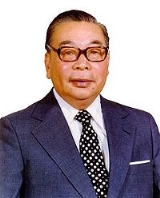
Chiang Ching-kuo

Encyclopedia
Chiang Ching-kuo (April 27,1 1910 – January 13, 1988), Kuomintang
(KMT) politician
and leader, was the son of President
Chiang Kai-shek
and held numerous posts in the government of the Republic of China
(ROC). He succeeded his father to serve as Premier of the Republic of China
between 1972 and 1978, and was the 6th and 7th-term President of the Republic of China
from 1978 until his death in 1988. Under his tenure, the government of the Republic of China, while authoritarian
, became more open and tolerant of political dissent
. Towards the end of his life, Chiang relaxed government controls on the media
and speech
and allowed native Taiwanese into positions of power, including his successor Lee Teng-hui
.
and his first wife Mao Fumei
, Chiang Ching-kuo was born in Fenghua
, Zhejiang
, with the courtesy name of Jiànfēng (建豐). He had an adopted brother, Chiang Wei-kuo
. "Ching" literally means "longitude" while "kuo" means "nation"; in his brother's name, "wei" literally means "parallel (of latitude)". The names are inspired by the references in Chinese classics such as the Guoyu
, in which "to draw the longitudes and latitudes of the world" is used as a metaphor for a person with great abilities, especially in managing a country.
While the young Chiang Ching-kuo had a peaceable relationship with his mother and grandmother (who were deeply rooted to their Buddhist faith), his relationship with his father was strict, utilitarian and often rocky. Chiang Kai-shek appeared to his son as an authoritarian figure, sometimes indifferent to his problems. Even in personal letters between the two, Chiang Kai-shek would sternly order his son to improve his Chinese calligraphy.
From 1916 until 1919 Chiang Ching-kuo attended the "Grammar School" in Wushan in Hsikou. Then, in 1920, his father hired tutors to teach him the four books, considered the basis of all Chinese culture. On June 4, 1921, Ching-kuo's grandmother died. What might have been an immense emotional loss was compensated for by Chiang Kai-shek moving his family to Shanghai
. Chiang Ching-Kuo's stepmother, historically known as the Chiang family's "Shanghai Mother", went with them. During this period, Chiang Kai-shek concluded that Chiang Ching-kuo was a son to be taught, while Chiang Wei-Kuo was a son to be loved.
During his time in Shanghai
, Ching-kuo was supervised by his father by being made to write a weekly letter containing 200-300 Chinese characters. Chiang Kai-shek also underlined the importance of classical books and of learning English, two areas he was hardly proficient in himself. On March 20, 1924, Ching-kuo was able to present to his now-nationally famous father a proposal concerning the grass-roots organization of the rural population in Hsikou. Chiang Ching-kuo planned to provide free education in order to allow people to read and to write at least 1000 characters. In his own words:
His father's reply was negative; Kai-shek stating that rural peasants were not interested in, nor needed, a formal education.
In early 1925, Chiang Ching-kuo entered the Shanghai's Pudong college, but immediately afterwards Chiang Kai-shek decided to send him on to Beijing because of warlord action and spontaneous riots in Shanghai. In Beijing
he attended the school organized by a friend of his father, Wu Chih-hui (吳稚暉), a renowned scholar and linguist. The school combined classical and modern approaches to education. While there, Ching-kuo started to identify himself as a progressive revolutionary and participated in the flourishing social scene inside the young Communist community. The idea of studying in Moscow now seized his imagination. Within the help program provided by the Soviet Union to the countries of East Asia there was a training school that later became the Moscow Sun Yat-sen University
. The participants to the university were selected by the CPSU and KMT members, with a participation of CPC Central Committee.
Chiang Ching-kuo asked his teacher Wu Chih-hui to name him as a KMT candidate. Though Wu Chih-hui did not try to dissuade him, Wu was a key figure of the right-leaning and anti-Communist "Western Hills Group" of the Kuomintang
, which help to realize the purge of the Communist and the KMT break with Moscow. In the summer of 1925, Chiang Ching-kuo traveled to Whampoa
to discuss with his father about the plans to go to Moscow.
Chiang Kai-shek was not keen on sending his son to the USSR, but after a discussion with Ch'en Kuo-fu (陳果夫) he finally agreed. In a 1996 interview, Ch'en's brother, Li-fu, claimed that the reason behind Chiang Kai-shek acceptance was the need to have Soviet support during a period when his hold over the KMT was not guaranteed.
to study at a Communist school. While in Moscow, Ching-kuo was given the Russian name Nikolai Vladimirovich Elizarov (Николай Владимирович Елизаров) and put under the tutelage of Karl Radek
at the Communist University of the Toilers of the East
. Noted for having an exceptional grasp of international politics, his classmates included other children of influential Chinese families, most notably the future Chinese Communist party leader, Deng Xiaoping
. Soon Ching-kuo was an enthusiastic student of Communist ideology, particularly Trotskyism
; though following the Great Purge
, Joseph Stalin
privately met with him and ordered him to publicly denounce Trotskyism. Chiang even applied to be a member of the Communist Party of the Soviet Union
, although his request was denied.
In April 1927, however, Chiang Kai-Shek purged the KMT leftists and Communists from the Central Government and expelled his Soviet
advisers. Following this, Chiang Ching-kuo wrote an editorial that harshly criticized his father's actions and was detained as a "guest" of the Soviet Union as a practical hostage. Debate still continues as to whether he had been forced to write it, and it is known that some years beforehand he had seen many of his Trotskyist friends arrested and killed by the Russian secret police. It is possible that Chiang Ching-kuo has been held to be used by Stalin as leverage in Sino-Soviet relationships. Nevertheless, the Soviet government sent Chiang Ching-kuo to work in the Ural Heavy Machinery Plant, a steel factory in the Urals, Yekaterinburg
, where he met Faina Ipat'evna Vakhreva, a native Belarusian
. They married on March 15, 1935, and she would later become known as Chiang Fang-liang
. In December of that year, a son, Hsiao-wen
was born. A daughter, Hsiao-chang
, was born the next year.
Chiang Kai-shek wrote about the situation in his diary, "It is not worth it to sacrifice the interest of the country for the sake of my son." Chiang even refused to negotiate a prisoner swap for his son in exchange for the Chinese Communist Party leader. His attitude remained consistent, and he continued to maintain, by 1937, that "I would rather have no offspring than sacrifice our nation's interests." Chiang had absolutely no intention of stopping the war against the Communists.
Stalin allowed Chiang Ching-kuo to return to China with his Belarusian wife and two children in April 1937 after living in the USSR for 12 years. By then, the Nationalists under Chiang Kai-shek and the Communists under Mao Zedong
had signed a ceasefire to create the Second United Front and fight the Japanese invasion of China
, which began in July. Stalin hoped the Chinese would keep Japan from invading the Soviet Pacific coast, and he hoped to form an anti-Japanese alliance with the senior Chiang.
On his return, his father assigned a tutor, Hsu Dau-lin
, to assist with his readjustment to China. Chiang Ching-Kuo was appointed as a specialist in remote districts of Jiangxi
where he was credited with training of cadres and fighting corruption, opium consumption, and illiteracy. Chiang Ching-kuo was appointed as commissioner of Gannan Prefecture
between 1939 and 1945; there he banned smoking, gambling and prostitution, studied governmental management, allowed for economic expansion and a change in social outlook. His efforts were hailed as a miracle in the political war in China, then coined as the "Gannan New Deal" (贛南新政). During his time in Gannan, from 1940 he implemented a "public information desk" where ordinary people could visit him if they had problems, and according to records, Chiang Ching-kuo received a total of 1,023 people during such sessions in 1942. In regards to the ban on prostitution and closing of brothels, Chiang implemented a policy where former prostitutes became employed in factories. Due to the large number of refugees in Ganzhou as a result from the ongoing war, thousands of orphans lived on the street; in June 1942, Chiang Ching-kuo formally established the Chinese Children's Village (中華兒童新村) in the outskirts of Ganzhou, with facilities such as a nursery, kindergarten, primary school, hospital and gymnasium. During the last years of the 1930s, he met Wang Sheng, with whom he would remain close for the next 50 years.
The paramilitary "Sanman Zhuyi Youth Corps" was under Chiang's control. Chiang used the term "big bourgeoisie", in a disparaging manner to call H.H. Kung and T.V. Soong.
Chiang and his wife had two more sons, Hsiao-wu
, born in Chungking, and Hsiao-yung
, born in Shanghai. Out of his affair with Chang Ya-juo
, Chiang also had twin sons in 1941: Chang Hsiao-tz'u
and Chang Hsiao-yen. (Note the identical generation name
of Hsiao between all sons, legitimate or not.)
and Jon Halliday
claim that Chiang Kai-shek
allowed the Communists to escape on the Long March
, allegedly because he wanted his son Chiang Ching-kuo who was being held hostage by Joseph Stalin
back. This is contradicted by Chiang Kai-shek
himself, who wrote in his diary, "It is not worth is to sacrifice the interest of the country for the sake of my son." Chiang even refused to negotiate for a prisoner swap, of his son in exchange of the Chinese Communist Party leader. Again in 1937 he stated about his son- "I would rather have no offspring than sacrifice our nation's interests." Chiang had absolutely no intention of stopping the war against the Communists. Chiang Kaishek urged the Ma warlords of northwest China to hammer away at the communists, including allowing the governor of Qinghai to stay in office since he wiped out an entire communist army.
Chang and Halliday also made another claim asserting Chiang Ching-kuo was "kidnapped", however evidence shows that he went to study in the Soviet Union with Chiang Kai-shek's own approval.
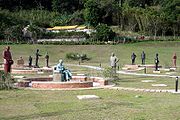 After the Second Sino-Japanese War
and during the Chinese Civil War
, Chiang Ching-kuo briefly served as a liaison administrator in Shanghai
, trying to eradicate the corruption and hyperinflation
that plagued the city. He was determined to do this because of the fears arising from the Nationalists' increasing lack of popularity during the Civil War. Given the task of arresting dishonest businessmen who hoarded supplies for profit during the inflationary spiral, he attempted to assuage the business community by explaining that his team would only go after big war profiteers.
Ching-kuo copied Soviet methods, which he learned during his stay in the Soviet Union, to start a social revolution by attacking middle class merchants. He also enforced low prices on all goods to raise support from the Proletariat
.
As riots broke out and savings were ruined, bankrupting shopowners, Ching-kuo began to attack the wealthy, seizing assets and placing them under arrest. The son of the gangster Du Yuesheng
was arrested by him. Ching-kuo ordered Kuomintang agents to raid the Yangtze Development Corporation's warehouses, which was privately owned by H.H. Kung and his family, as the company was accused of hoarding supplies. H.H. Kung's wife was Soong Ai-ling
, the sister of Soong May-ling
who was Ching-kuo's stepmother. H.H. Kung's son David was arrested, the Kung's responded by blackmailing the Chiang's, threatening to release information about them, eventually he was freed after negotiations, and Ching-kuo resigned, ending the terror on the Shanghainese merchants.
to the Communists in the Chinese Civil War
, Chiang Ching-kuo followed his father and the retreating Nationalist forces to Taiwan
. On December 8, 1949, the Nationalist capital was moved from Chengdu
to Taipei
, and early on December 10, 1949, Communist troops laid siege to Chengdu
, the last KMT controlled city on mainland China. Here Chiang Kai-shek and his son Chiang Ching-kuo directed the city's defense from the Chengdu Central Military Academy, before the aircraft May-ling evacuated them to Taiwan; they would never return to mainland China.
In 1950, Chiang's father appointed him director of the secret police
, which he remained until 1965. An enemy of the Chiang family, Wu Kuo-chen, was kicked out of his position of governor of Taiwan by Chiang Ching-kuo and fled to America in 1953. Chiang Ching-kuo, educated in the Soviet Union, initiated Soviet style military organization in the Republic of China Military, reorganizing and Sovietizing the political officer corps, surveillance, and Kuomintang party activities were propagated throughout the military. Opposed to this was Sun Li-jen, who was educated at the American Virginia Military Institute
. Chiang orchestrated the controversial court-martial and arrest of General Sun Li-jen
in August 1955, allegedly for plotting a coup d'état with the American CIA against his father. General Sun was a popular Chinese war hero from the Burma Campaign
against the Japanese and remained under house arrest until Chiang Ching-kuo's death in 1988. Ching-kuo also approved the arbitrary arrest and torture of prisoners. Chiang Ching-kuo's activities as director of the secret police remained widely criticized as heralding a long era of human rights
abuses in Taiwan.
From 1955 to 1960, Chiang administered the construction and completion of Taiwan's highway system. Chiang's father elevated him to high office when he was appointed as the ROC Defense Minister from 1965 until 1969. He was the nation's Vice Premier between 1969 and 1972, during which he survived an assassination attempt while visiting the U.S. in 1970. Afterwards he was appointed the nation's Premier between 1972 and 1978. As Chiang Kai-shek entered his final years, he gradually gave more responsibilities to his son, and when he died in April 1975, the presidency was turned over to Yen Chia-kan
and Chiang Ching-kuo succeeded to the leadership of the Kuomintang
(he opted for the title "Chairman" rather than the elder Chiang's title of "Director-General").
after the term of President Yen Chia-kan
on May 20, 1978. He was reelected to another term in 1984. At that time, the National Assembly consisted mostly of "thousand year" legislators, men who had been elected in 1947-48 before the fall of mainland China and who would hold their seats indefinitely.
During the early years of his term in office Chiang maintained many of his father's autocratic policies, continuing to rule Taiwan as a military state under martial law
as it had been since the Nationalists established its capital there.
In a move that broke from his father's domineering industrial and economic policies, Ching-kuo launched the "Fourteen Major Construction Projects", the "Ten Major Construction Projects
" and the "Twelve New Development Projects" which contributed to the "Taiwan Miracle." Among his accomplishments were accelerating the process of economic modernization to give Taiwan a 13% growth rate, $4,600 per capita income, and the world's second largest foreign exchange reserves
.
However, in December 1978, U.S. President, Jimmy Carter
announced that the United States would no longer recognize the ROC as the legitimate government of China. Under the Taiwan Relations Act
, the United States would continue to sell weapons to Taiwan, but the TRA was purposely vague in any promise of defending Taiwan in the event of an invasion. The United States would now end all official contact with the Chiang's government and withdraw its troops from the island.
In an effort of bringing more Taiwan-born citizens into government services, Chiang Ching-kuo "exiled" his over-ambitious chief of General Political Warfare Department, General Wang Sheng, to Paraguay
as an ambassador (November 1983), and hand-picked Lee Teng-hui
as vice-president of the Republic of China (formally elected May 1984), first-in-the-line of succession to the presidency.
In 1987, Chiang finally ended martial law
and allowed family visits to the Mainland China
. His administration saw a gradual loosening of political controls and opponents of the Nationalists were no longer forbidden to hold meetings or publish papers. Opposition political parties, though still illegal, were allowed to form without harassment or arrest. When the Democratic Progressive Party
was established in 1986, President Chiang decided against dissolving the group or persecuting its leaders, but its candidates officially ran in elections as independents in the Tangwai
movement.
at the age of 78. Like his father, he was interred temporarily in Daxi (Tahsi) Township, Taoyuan County, but in a separate mausoleum
in Touliao, a mile down the road from his father's burial place. The hope was to have both buried at their birthplace in Fenghua once mainland China was recovered. Chinese music composer Hwang Yau-tai
or Huang Youdi, Huang Yu-ti (黃友棣) wrote the Chiang Ching-kuo Memorial Song
in 1988. In January 2004, Chiang Fang-liang
asked that both father and son be buried at Wuchih Mountain Military Cemetery
in Hsichih, Taipei County
(now New Taipei City). The state funeral ceremony was initially planned for Spring 2005, but was eventually delayed to winter 2005. It may be further delayed due to the recent death of Chiang Ching-kuo's oldest daughter-in-law, who had served as the de-facto head of the household since Chiang Fang-liang's death in 2004. Chiang Fang-liang and Soong May-ling had agreed in 1997 that the former leaders be first buried, but still be moved to mainland China.
Unlike his father Chiang Kai-shek
, Chiang Ching-kuo built himself a folk reputation that remains generally known even among local Taiwanese electorate. Both his memory and image are frequently invoked by the Kuomintang, which is unable to base their electoral campaign on Chiang's successor, President and KMT
Chairman Lee Teng-hui
because of Lee's support of Taiwan for Taiwanese
. Chiang Ching-kuo, however, did admit he had become "Taiwanese" after fleeing mainland China in 1949.
Among the Tangwai
and later the Pan-Green Coalition
, opinions toward Chiang Ching-kuo are more reserved. While long-time supporters of political liberalization do give Chiang Ching-kuo credit for relaxing authoritarian rule, they point out that Taiwan remained authoritarian throughout the early years of his rule, and only liberalized in his twilight years. Nonetheless, as with Pan-Blue followers, he is recognized for his efforts and openness in economic developments.
Under President Chen Shui-bian
, pictures of Chiang Ching-kuo and his father gradually disappeared from public buildings. The AIDC, the ROC's air defense company, has nicknamed its AIDC F-CK Indigenous Defense Fighter the Ching Kuo in his memory.
All of his legitimate children studied abroad and two of his children married in the United States
. Only two remain living: John Chiang is a prominent KMT politician, while Chiang Hsiao-chang
, her children and grandchildren reside in the United States.
|-
|-
Kuomintang
The Kuomintang of China , sometimes romanized as Guomindang via the Pinyin transcription system or GMD for short, and translated as the Chinese Nationalist Party is a founding and ruling political party of the Republic of China . Its guiding ideology is the Three Principles of the People, espoused...
(KMT) politician
Politician
A politician, political leader, or political figure is an individual who is involved in influencing public policy and decision making...
and leader, was the son of President
President of the Republic of China
The President of the Republic of China is the head of state and commander-in-chief of the Republic of China . The Republic of China was founded on January 1, 1912, to govern all of China...
Chiang Kai-shek
Chiang Kai-shek
Chiang Kai-shek was a political and military leader of 20th century China. He is known as Jiǎng Jièshí or Jiǎng Zhōngzhèng in Mandarin....
and held numerous posts in the government of the Republic of China
Republic of China
The Republic of China , commonly known as Taiwan , is a unitary sovereign state located in East Asia. Originally based in mainland China, the Republic of China currently governs the island of Taiwan , which forms over 99% of its current territory, as well as Penghu, Kinmen, Matsu and other minor...
(ROC). He succeeded his father to serve as Premier of the Republic of China
Premier of the Republic of China
The President of the Executive Yuan , commonly known as the Premier of the Republic of China , is the head of the Executive Yuan, the executive branch of the Republic of China , which currently administers Taiwan, Matsu, and Kinmen. The premier is appointed by the President of the Republic of China...
between 1972 and 1978, and was the 6th and 7th-term President of the Republic of China
President of the Republic of China
The President of the Republic of China is the head of state and commander-in-chief of the Republic of China . The Republic of China was founded on January 1, 1912, to govern all of China...
from 1978 until his death in 1988. Under his tenure, the government of the Republic of China, while authoritarian
Authoritarianism
Authoritarianism is a form of social organization characterized by submission to authority. It is usually opposed to individualism and democracy...
, became more open and tolerant of political dissent
Political dissent
Political dissent refers to any expression designed to convey dissatisfaction with or opposition to the policies of a governing body. Such expression may take forms from vocal disagreement to civil disobedience to the use of violence. Historically, repressive governments have sought to punish...
. Towards the end of his life, Chiang relaxed government controls on the media
Media (communication)
In communications, media are the storage and transmission channels or tools used to store and deliver information or data...
and speech
Freedom of speech
Freedom of speech is the freedom to speak freely without censorship. The term freedom of expression is sometimes used synonymously, but includes any act of seeking, receiving and imparting information or ideas, regardless of the medium used...
and allowed native Taiwanese into positions of power, including his successor Lee Teng-hui
Lee Teng-hui
Lee Teng-hui is a politician of the Republic of China . He was the 7th, 8th, and 9th-term President of the Republic of China and Chairman of the Kuomintang from 1988 to 2000. He presided over major advancements in democratic reforms including his own re-election which marked the first direct...
.
Early life
The son of President Chiang Kai-shekChiang Kai-shek
Chiang Kai-shek was a political and military leader of 20th century China. He is known as Jiǎng Jièshí or Jiǎng Zhōngzhèng in Mandarin....
and his first wife Mao Fumei
Mao Fumei
Mao Fumei 毛福梅 was the first wife of Chiang Kai-shek, and the mother of Chiang Ching-Kuo. She was born in Fenghua, Ningbo, Zhejiang Province, and married Chiang Kai-Shek in an arranged marriage. She died in World War II during a bombardment. Like most women of the era, she was not given the...
, Chiang Ching-kuo was born in Fenghua
Fenghua
Fenghua is a county-level city in the north of Zhejiang province, China. It is under the jurisdiction of Ningbo prefecture-level city. The city and its administrative hinterlands has a population of over 480,000....
, Zhejiang
Zhejiang
Zhejiang is an eastern coastal province of the People's Republic of China. The word Zhejiang was the old name of the Qiantang River, which passes through Hangzhou, the provincial capital...
, with the courtesy name of Jiànfēng (建豐). He had an adopted brother, Chiang Wei-kuo
Chiang Wei-kuo
Chiang Wei-kuo was an adopted son of President Chiang Kai-shek, adoptive brother of President Chiang Ching-kuo, and an important figure in the Kuomintang . His courtesy names were Jianhao and Niantang .- Early life :...
. "Ching" literally means "longitude" while "kuo" means "nation"; in his brother's name, "wei" literally means "parallel (of latitude)". The names are inspired by the references in Chinese classics such as the Guoyu
Guoyu (book)
The Discourses of the States or Guoyu is a classical Chinese history book that collected the historical records of numerous states from Western Zhou to 453 BC. Its author is unknown, but it is sometimes attributed to Zuo Qiuming, a contemporary of Confucius...
, in which "to draw the longitudes and latitudes of the world" is used as a metaphor for a person with great abilities, especially in managing a country.
While the young Chiang Ching-kuo had a peaceable relationship with his mother and grandmother (who were deeply rooted to their Buddhist faith), his relationship with his father was strict, utilitarian and often rocky. Chiang Kai-shek appeared to his son as an authoritarian figure, sometimes indifferent to his problems. Even in personal letters between the two, Chiang Kai-shek would sternly order his son to improve his Chinese calligraphy.
From 1916 until 1919 Chiang Ching-kuo attended the "Grammar School" in Wushan in Hsikou. Then, in 1920, his father hired tutors to teach him the four books, considered the basis of all Chinese culture. On June 4, 1921, Ching-kuo's grandmother died. What might have been an immense emotional loss was compensated for by Chiang Kai-shek moving his family to Shanghai
Shanghai
Shanghai is the largest city by population in China and the largest city proper in the world. It is one of the four province-level municipalities in the People's Republic of China, with a total population of over 23 million as of 2010...
. Chiang Ching-Kuo's stepmother, historically known as the Chiang family's "Shanghai Mother", went with them. During this period, Chiang Kai-shek concluded that Chiang Ching-kuo was a son to be taught, while Chiang Wei-Kuo was a son to be loved.
During his time in Shanghai
Shanghai
Shanghai is the largest city by population in China and the largest city proper in the world. It is one of the four province-level municipalities in the People's Republic of China, with a total population of over 23 million as of 2010...
, Ching-kuo was supervised by his father by being made to write a weekly letter containing 200-300 Chinese characters. Chiang Kai-shek also underlined the importance of classical books and of learning English, two areas he was hardly proficient in himself. On March 20, 1924, Ching-kuo was able to present to his now-nationally famous father a proposal concerning the grass-roots organization of the rural population in Hsikou. Chiang Ching-kuo planned to provide free education in order to allow people to read and to write at least 1000 characters. In his own words:
I have a suggestion to make about the Wushan School, although I do not know if you can agree to it. My suggestion is that the school establish a night school for common people who cannot afford to go to the regular school. My school established a night school with great success. I can tell you something about the night school:
Name: Wuschua School for the Common People
Tuition fee: Free of charge with stationery supplied
Class hours: 7 pm to 9 pm
Age limit: 14 or older
Schooling protocol: 16 or 20 weeks.
At the time of the graduation, the trainees will be able to write simple letters and keep simple accounts. They will be issued a diploma if they pass the examinations. The textbooks they used were published by the Commercial Press and were entitled "One thousand characters for the common people." I do not know whether you will accept my suggestion. If a night school is established at Wushan, it will greatly benefit the local people.
His father's reply was negative; Kai-shek stating that rural peasants were not interested in, nor needed, a formal education.
In early 1925, Chiang Ching-kuo entered the Shanghai's Pudong college, but immediately afterwards Chiang Kai-shek decided to send him on to Beijing because of warlord action and spontaneous riots in Shanghai. In Beijing
Beijing
Beijing , also known as Peking , is the capital of the People's Republic of China and one of the most populous cities in the world, with a population of 19,612,368 as of 2010. The city is the country's political, cultural, and educational center, and home to the headquarters for most of China's...
he attended the school organized by a friend of his father, Wu Chih-hui (吳稚暉), a renowned scholar and linguist. The school combined classical and modern approaches to education. While there, Ching-kuo started to identify himself as a progressive revolutionary and participated in the flourishing social scene inside the young Communist community. The idea of studying in Moscow now seized his imagination. Within the help program provided by the Soviet Union to the countries of East Asia there was a training school that later became the Moscow Sun Yat-sen University
Moscow Sun Yat-sen University
Moscow Sun Yat-sen University, officially the Sun Yat-sen Communist University of the Toilers of China, was a Comintern school, which operated from 1925-1930. It was a training camp for Chinese revolutionaries from both the Kuomintang and the Communist Party of China .-Origins:In 1923, Dr...
. The participants to the university were selected by the CPSU and KMT members, with a participation of CPC Central Committee.
Chiang Ching-kuo asked his teacher Wu Chih-hui to name him as a KMT candidate. Though Wu Chih-hui did not try to dissuade him, Wu was a key figure of the right-leaning and anti-Communist "Western Hills Group" of the Kuomintang
Kuomintang
The Kuomintang of China , sometimes romanized as Guomindang via the Pinyin transcription system or GMD for short, and translated as the Chinese Nationalist Party is a founding and ruling political party of the Republic of China . Its guiding ideology is the Three Principles of the People, espoused...
, which help to realize the purge of the Communist and the KMT break with Moscow. In the summer of 1925, Chiang Ching-kuo traveled to Whampoa
Whampoa Military Academy
The Nationalist Party of China Army Officer Academy , commonly known as the Whampoa Military Academy , was a military academy in the Republic of China that produced many prestigious commanders who fought in many of China's conflicts in the 20th century, notably the Northern Expedition, the Second...
to discuss with his father about the plans to go to Moscow.
Chiang Kai-shek was not keen on sending his son to the USSR, but after a discussion with Ch'en Kuo-fu (陳果夫) he finally agreed. In a 1996 interview, Ch'en's brother, Li-fu, claimed that the reason behind Chiang Kai-shek acceptance was the need to have Soviet support during a period when his hold over the KMT was not guaranteed.
Moscow
In 1925, Chiang Ching-Kuo went on to MoscowMoscow
Moscow is the capital, the most populous city, and the most populous federal subject of Russia. The city is a major political, economic, cultural, scientific, religious, financial, educational, and transportation centre of Russia and the continent...
to study at a Communist school. While in Moscow, Ching-kuo was given the Russian name Nikolai Vladimirovich Elizarov (Николай Владимирович Елизаров) and put under the tutelage of Karl Radek
Karl Radek
Karl Bernhardovic Radek was a socialist active in the Polish and German movements before World War I and an international Communist leader after the Russian Revolution....
at the Communist University of the Toilers of the East
Communist University of the Toilers of the East
The Communist University of the Toilers of the East or KUTV was established April 21, 1921, in Moscow by the Communist International as a training college for communist cadres in the colonial world. The school officially opened on October 21, 1921...
. Noted for having an exceptional grasp of international politics, his classmates included other children of influential Chinese families, most notably the future Chinese Communist party leader, Deng Xiaoping
Deng Xiaoping
Deng Xiaoping was a Chinese politician, statesman, and diplomat. As leader of the Communist Party of China, Deng was a reformer who led China towards a market economy...
. Soon Ching-kuo was an enthusiastic student of Communist ideology, particularly Trotskyism
Trotskyism
Trotskyism is the theory of Marxism as advocated by Leon Trotsky. Trotsky considered himself an orthodox Marxist and Bolshevik-Leninist, arguing for the establishment of a vanguard party of the working-class...
; though following the Great Purge
Great Purge
The Great Purge was a series of campaigns of political repression and persecution in the Soviet Union orchestrated by Joseph Stalin from 1936 to 1938...
, Joseph Stalin
Joseph Stalin
Joseph Vissarionovich Stalin was the Premier of the Soviet Union from 6 May 1941 to 5 March 1953. He was among the Bolshevik revolutionaries who brought about the October Revolution and had held the position of first General Secretary of the Communist Party of the Soviet Union's Central Committee...
privately met with him and ordered him to publicly denounce Trotskyism. Chiang even applied to be a member of the Communist Party of the Soviet Union
Communist Party of the Soviet Union
The Communist Party of the Soviet Union was the only legal, ruling political party in the Soviet Union and one of the largest communist organizations in the world...
, although his request was denied.
In April 1927, however, Chiang Kai-Shek purged the KMT leftists and Communists from the Central Government and expelled his Soviet
Soviet Union
The Soviet Union , officially the Union of Soviet Socialist Republics , was a constitutionally socialist state that existed in Eurasia between 1922 and 1991....
advisers. Following this, Chiang Ching-kuo wrote an editorial that harshly criticized his father's actions and was detained as a "guest" of the Soviet Union as a practical hostage. Debate still continues as to whether he had been forced to write it, and it is known that some years beforehand he had seen many of his Trotskyist friends arrested and killed by the Russian secret police. It is possible that Chiang Ching-kuo has been held to be used by Stalin as leverage in Sino-Soviet relationships. Nevertheless, the Soviet government sent Chiang Ching-kuo to work in the Ural Heavy Machinery Plant, a steel factory in the Urals, Yekaterinburg
Yekaterinburg
Yekaterinburg is a major city in the central part of Russia, the administrative center of Sverdlovsk Oblast. Situated on the eastern side of the Ural mountain range, it is the main industrial and cultural center of the Urals Federal District with a population of 1,350,136 , making it Russia's...
, where he met Faina Ipat'evna Vakhreva, a native Belarusian
Belarusians
Belarusians ; are an East Slavic ethnic group who populate the majority of the Republic of Belarus. Introduced to the world as a new state in the early 1990s, the Republic of Belarus brought with it the notion of a re-emerging Belarusian ethnicity, drawn upon the lines of the Old Belarusian...
. They married on March 15, 1935, and she would later become known as Chiang Fang-liang
Chiang Fang-liang
Faina Chiang Fang-liang was the wife of President Chiang Ching-kuo and served as First Lady of the Republic of China on Taiwan from 1978 to 1988.-Biography:...
. In December of that year, a son, Hsiao-wen
Chiang Hsiao-wen
Chiang Hsiao-wen was the eldest son of Chiang Ching-kuo, the President of the Republic of China in Taiwan from 1978 to 1988. His mother is Faina Ipatyevna Vakhreva, also known as Chiang Fang-liang. He had one younger sister, Hsiao-chang, and two younger brothers, Hsiao-wu and Hsiao-yung. He had...
was born. A daughter, Hsiao-chang
Chiang Hsiao-chang
Chiang Hsiao-chang is the only daughter of Chiang Ching-kuo, the President of the Republic of China in Taiwan from 1978 to 1988. Her mother is Faina Ipatyevna Vakhreva, also known as Chiang Fang-liang. She had one older brother, Hsiao-wen, and two younger brothers, Hsiao-wu and Hsiao-yung, with...
, was born the next year.
Chiang Kai-shek wrote about the situation in his diary, "It is not worth it to sacrifice the interest of the country for the sake of my son." Chiang even refused to negotiate a prisoner swap for his son in exchange for the Chinese Communist Party leader. His attitude remained consistent, and he continued to maintain, by 1937, that "I would rather have no offspring than sacrifice our nation's interests." Chiang had absolutely no intention of stopping the war against the Communists.
Stalin allowed Chiang Ching-kuo to return to China with his Belarusian wife and two children in April 1937 after living in the USSR for 12 years. By then, the Nationalists under Chiang Kai-shek and the Communists under Mao Zedong
Mao Zedong
Mao Zedong, also transliterated as Mao Tse-tung , and commonly referred to as Chairman Mao , was a Chinese Communist revolutionary, guerrilla warfare strategist, Marxist political philosopher, and leader of the Chinese Revolution...
had signed a ceasefire to create the Second United Front and fight the Japanese invasion of China
Second Sino-Japanese War
The Second Sino-Japanese War was a military conflict fought primarily between the Republic of China and the Empire of Japan. From 1937 to 1941, China fought Japan with some economic help from Germany , the Soviet Union and the United States...
, which began in July. Stalin hoped the Chinese would keep Japan from invading the Soviet Pacific coast, and he hoped to form an anti-Japanese alliance with the senior Chiang.
On his return, his father assigned a tutor, Hsu Dau-lin
Hsu Dau-lin
Hsu Dau-lin was a distinguished legal scholar who made substantial contributions to the study of Tang and Song Law and, especially for new republican states, of Constitutional Law...
, to assist with his readjustment to China. Chiang Ching-Kuo was appointed as a specialist in remote districts of Jiangxi
Jiangxi
' is a southern province in the People's Republic of China. Spanning from the banks of the Yangtze River in the north into hillier areas in the south, it shares a border with Anhui to the north, Zhejiang to the northeast, Fujian to the east, Guangdong to the south, Hunan to the west, and Hubei to...
where he was credited with training of cadres and fighting corruption, opium consumption, and illiteracy. Chiang Ching-kuo was appointed as commissioner of Gannan Prefecture
Ganzhou
Ganzhou is a prefecture-level city in southern Jiangxi province, People's Republic of China. Its administrative seat is at Zhanggong .-History:...
between 1939 and 1945; there he banned smoking, gambling and prostitution, studied governmental management, allowed for economic expansion and a change in social outlook. His efforts were hailed as a miracle in the political war in China, then coined as the "Gannan New Deal" (贛南新政). During his time in Gannan, from 1940 he implemented a "public information desk" where ordinary people could visit him if they had problems, and according to records, Chiang Ching-kuo received a total of 1,023 people during such sessions in 1942. In regards to the ban on prostitution and closing of brothels, Chiang implemented a policy where former prostitutes became employed in factories. Due to the large number of refugees in Ganzhou as a result from the ongoing war, thousands of orphans lived on the street; in June 1942, Chiang Ching-kuo formally established the Chinese Children's Village (中華兒童新村) in the outskirts of Ganzhou, with facilities such as a nursery, kindergarten, primary school, hospital and gymnasium. During the last years of the 1930s, he met Wang Sheng, with whom he would remain close for the next 50 years.
The paramilitary "Sanman Zhuyi Youth Corps" was under Chiang's control. Chiang used the term "big bourgeoisie", in a disparaging manner to call H.H. Kung and T.V. Soong.
Chiang and his wife had two more sons, Hsiao-wu
Chiang Hsiao-wu
Chiang Hsiao-wu , was the second son of Chiang Ching-kuo, the President of the Republic of China in Taiwan from 1978 to 1988. His mother is Faina Ipatyevna Vakhreva, also known as Chiang Fang-liang. He had one older brother, Hsiao-wen, one older sister, Hsiao-chang, and one younger brother,...
, born in Chungking, and Hsiao-yung
Chiang Hsiao-yung
Chiang Hsiao-yung was a politician of the Republic of China.-Biography:Chiang was born in Shanghai, Republic of China in 1948. He was the third son of Chiang Ching-kuo, the President of the Republic of China in Taiwan from 1978 to 1988. His mother was Faina Ipatyevna Vakhreva, also known as Chiang...
, born in Shanghai. Out of his affair with Chang Ya-juo
Chang Ya-juo
Chang Ya-juo was the mistress of Chiang Ching-kuo and bore two sons for him, Winston Chang and John Chiang in 1941. The twins took their mother's surname as they were born out of wedlock. Chang died under mysterious circumstances in 1942 and the twins were raised by Chang's brother....
, Chiang also had twin sons in 1941: Chang Hsiao-tz'u
Winston Chang
Winston Hsiao-tzu Chang was a president of Soochow University in Taipei.-Biography:He and his twin brother, John Chang, were born the sons of Chiang Ching-kuo and Chang Ya-juo in Guilin, but took their mother's surname as they were born out of wedlock, although they both were given the generation...
and Chang Hsiao-yen. (Note the identical generation name
Generation name
Generation name, variously zibei or banci, is one of the characters in a traditional Chinese name, and is so called because each member of a generation share that character, unlike surnames or given names...
of Hsiao between all sons, legitimate or not.)
Hostage claim
Jung ChangJung Chang
Jung Chang is a Chinese-born British writer now living in London, best known for her family autobiography Wild Swans, selling over 10 million copies worldwide but banned in the People's Republic of China....
and Jon Halliday
Jon Halliday
Jon Halliday is a historian of Russia and was a former Senior Visiting Research Fellow at King's College London.Halliday authored a biography of filmmaker Douglas Sirk and has written and edited seven other books. He and his wife, Jung Chang, live in Notting Hill, West London...
claim that Chiang Kai-shek
Chiang Kai-shek
Chiang Kai-shek was a political and military leader of 20th century China. He is known as Jiǎng Jièshí or Jiǎng Zhōngzhèng in Mandarin....
allowed the Communists to escape on the Long March
Long March
The Long March was a massive military retreat undertaken by the Red Army of the Communist Party of China, the forerunner of the People's Liberation Army, to evade the pursuit of the Kuomintang army. There was not one Long March, but a series of marches, as various Communist armies in the south...
, allegedly because he wanted his son Chiang Ching-kuo who was being held hostage by Joseph Stalin
Joseph Stalin
Joseph Vissarionovich Stalin was the Premier of the Soviet Union from 6 May 1941 to 5 March 1953. He was among the Bolshevik revolutionaries who brought about the October Revolution and had held the position of first General Secretary of the Communist Party of the Soviet Union's Central Committee...
back. This is contradicted by Chiang Kai-shek
Chiang Kai-shek
Chiang Kai-shek was a political and military leader of 20th century China. He is known as Jiǎng Jièshí or Jiǎng Zhōngzhèng in Mandarin....
himself, who wrote in his diary, "It is not worth is to sacrifice the interest of the country for the sake of my son." Chiang even refused to negotiate for a prisoner swap, of his son in exchange of the Chinese Communist Party leader. Again in 1937 he stated about his son- "I would rather have no offspring than sacrifice our nation's interests." Chiang had absolutely no intention of stopping the war against the Communists. Chiang Kaishek urged the Ma warlords of northwest China to hammer away at the communists, including allowing the governor of Qinghai to stay in office since he wiped out an entire communist army.
Chang and Halliday also made another claim asserting Chiang Ching-kuo was "kidnapped", however evidence shows that he went to study in the Soviet Union with Chiang Kai-shek's own approval.
Economic policies in Shanghai
Second Sino-Japanese War
The Second Sino-Japanese War was a military conflict fought primarily between the Republic of China and the Empire of Japan. From 1937 to 1941, China fought Japan with some economic help from Germany , the Soviet Union and the United States...
and during the Chinese Civil War
Chinese Civil War
The Chinese Civil War was a civil war fought between the Kuomintang , the governing party of the Republic of China, and the Communist Party of China , for the control of China which eventually led to China's division into two Chinas, Republic of China and People's Republic of...
, Chiang Ching-kuo briefly served as a liaison administrator in Shanghai
Shanghai
Shanghai is the largest city by population in China and the largest city proper in the world. It is one of the four province-level municipalities in the People's Republic of China, with a total population of over 23 million as of 2010...
, trying to eradicate the corruption and hyperinflation
Hyperinflation
In economics, hyperinflation is inflation that is very high or out of control. While the real values of the specific economic items generally stay the same in terms of relatively stable foreign currencies, in hyperinflationary conditions the general price level within a specific economy increases...
that plagued the city. He was determined to do this because of the fears arising from the Nationalists' increasing lack of popularity during the Civil War. Given the task of arresting dishonest businessmen who hoarded supplies for profit during the inflationary spiral, he attempted to assuage the business community by explaining that his team would only go after big war profiteers.
Ching-kuo copied Soviet methods, which he learned during his stay in the Soviet Union, to start a social revolution by attacking middle class merchants. He also enforced low prices on all goods to raise support from the Proletariat
Proletariat
The proletariat is a term used to identify a lower social class, usually the working class; a member of such a class is proletarian...
.
As riots broke out and savings were ruined, bankrupting shopowners, Ching-kuo began to attack the wealthy, seizing assets and placing them under arrest. The son of the gangster Du Yuesheng
Du Yuesheng
Du Yuesheng , commonly known as "Big-Eared Du", was a Chinese gangster who spent much of his life in Shanghai. He was a key supporter of the Kuomintang and Chiang Kai-shek in their battle against the Communists during the 1920s, and was a figure of some importance during the Second Sino-Japanese...
was arrested by him. Ching-kuo ordered Kuomintang agents to raid the Yangtze Development Corporation's warehouses, which was privately owned by H.H. Kung and his family, as the company was accused of hoarding supplies. H.H. Kung's wife was Soong Ai-ling
Soong Ai-ling
Soong Ai-ling , or Eling Soong , eldest of the Soong sisters, was the wife of H. H. Kung , who was the richest man in the early 20th century Republic of China. The first character of her given name is written as 靄 in some texts...
, the sister of Soong May-ling
Soong May-ling
Soong May-ling or Soong Mei-ling, also known as Madame Chiang Kai-shek or Madame Chiang was a First Lady of the Republic of China , the wife of Generalissimo and President Chiang Kai-shek. She was a politician and painter...
who was Ching-kuo's stepmother. H.H. Kung's son David was arrested, the Kung's responded by blackmailing the Chiang's, threatening to release information about them, eventually he was freed after negotiations, and Ching-kuo resigned, ending the terror on the Shanghainese merchants.
Political career in Taiwan
After the Nationalists lost control of mainland ChinaMainland China
Mainland China, the Chinese mainland or simply the mainland, is a geopolitical term that refers to the area under the jurisdiction of the People's Republic of China . According to the Taipei-based Mainland Affairs Council, the term excludes the PRC Special Administrative Regions of Hong Kong and...
to the Communists in the Chinese Civil War
Chinese Civil War
The Chinese Civil War was a civil war fought between the Kuomintang , the governing party of the Republic of China, and the Communist Party of China , for the control of China which eventually led to China's division into two Chinas, Republic of China and People's Republic of...
, Chiang Ching-kuo followed his father and the retreating Nationalist forces to Taiwan
Taiwan
Taiwan , also known, especially in the past, as Formosa , is the largest island of the same-named island group of East Asia in the western Pacific Ocean and located off the southeastern coast of mainland China. The island forms over 99% of the current territory of the Republic of China following...
. On December 8, 1949, the Nationalist capital was moved from Chengdu
Chengdu
Chengdu , formerly transliterated Chengtu, is the capital of Sichuan province in Southwest China. It holds sub-provincial administrative status...
to Taipei
Taipei
Taipei City is the capital of the Republic of China and the central city of the largest metropolitan area of Taiwan. Situated at the northern tip of the island, Taipei is located on the Tamsui River, and is about 25 km southwest of Keelung, its port on the Pacific Ocean...
, and early on December 10, 1949, Communist troops laid siege to Chengdu
Chengdu
Chengdu , formerly transliterated Chengtu, is the capital of Sichuan province in Southwest China. It holds sub-provincial administrative status...
, the last KMT controlled city on mainland China. Here Chiang Kai-shek and his son Chiang Ching-kuo directed the city's defense from the Chengdu Central Military Academy, before the aircraft May-ling evacuated them to Taiwan; they would never return to mainland China.
In 1950, Chiang's father appointed him director of the secret police
Secret police
Secret police are a police agency which operates in secrecy and beyond the law to protect the political power of an individual dictator or an authoritarian political regime....
, which he remained until 1965. An enemy of the Chiang family, Wu Kuo-chen, was kicked out of his position of governor of Taiwan by Chiang Ching-kuo and fled to America in 1953. Chiang Ching-kuo, educated in the Soviet Union, initiated Soviet style military organization in the Republic of China Military, reorganizing and Sovietizing the political officer corps, surveillance, and Kuomintang party activities were propagated throughout the military. Opposed to this was Sun Li-jen, who was educated at the American Virginia Military Institute
Virginia Military Institute
The Virginia Military Institute , located in Lexington, Virginia, is the oldest state-supported military college and one of six senior military colleges in the United States. Unlike any other military college in the United States—and in keeping with its founding principles—all VMI students are...
. Chiang orchestrated the controversial court-martial and arrest of General Sun Li-jen
Sun Li-jen
Sun Li-jen was a Kuomintang General, best known for his leadership in the Second Sino-Japanese War and the Chinese Civil War. His achievements earned him the laudatory nickname "Rommel of the East". His New 1st Army was reputed as the "1st [Best] Army under heaven" and credited with defeating...
in August 1955, allegedly for plotting a coup d'état with the American CIA against his father. General Sun was a popular Chinese war hero from the Burma Campaign
Burma Campaign
The Burma Campaign in the South-East Asian Theatre of World War II was fought primarily between British Commonwealth, Chinese and United States forces against the forces of the Empire of Japan, Thailand, and the Indian National Army. British Commonwealth land forces were drawn primarily from...
against the Japanese and remained under house arrest until Chiang Ching-kuo's death in 1988. Ching-kuo also approved the arbitrary arrest and torture of prisoners. Chiang Ching-kuo's activities as director of the secret police remained widely criticized as heralding a long era of human rights
Human rights
Human rights are "commonly understood as inalienable fundamental rights to which a person is inherently entitled simply because she or he is a human being." Human rights are thus conceived as universal and egalitarian . These rights may exist as natural rights or as legal rights, in both national...
abuses in Taiwan.
From 1955 to 1960, Chiang administered the construction and completion of Taiwan's highway system. Chiang's father elevated him to high office when he was appointed as the ROC Defense Minister from 1965 until 1969. He was the nation's Vice Premier between 1969 and 1972, during which he survived an assassination attempt while visiting the U.S. in 1970. Afterwards he was appointed the nation's Premier between 1972 and 1978. As Chiang Kai-shek entered his final years, he gradually gave more responsibilities to his son, and when he died in April 1975, the presidency was turned over to Yen Chia-kan
Yen Chia-kan
Yen Chia-kan , or Yen Chia-jin , better known as C. K. Yen, succeeded Chiang Kai-shek as President of the Republic of China upon Chiang's death on April 5, 1975. He served out the remainder of Chiang's term until May 20, 1978.-Biography:C. K...
and Chiang Ching-kuo succeeded to the leadership of the Kuomintang
Kuomintang
The Kuomintang of China , sometimes romanized as Guomindang via the Pinyin transcription system or GMD for short, and translated as the Chinese Nationalist Party is a founding and ruling political party of the Republic of China . Its guiding ideology is the Three Principles of the People, espoused...
(he opted for the title "Chairman" rather than the elder Chiang's title of "Director-General").
Presidency
Chiang was officially elected President of the Republic of China by the National AssemblyNational Assembly of the Republic of China
The National Assembly of the Republic of China refers to several parliamentary bodies that existed in the Republic of China. The National Assembly was originally founded in 1913 as the first legislature in Chinese history, but was disbanded less than a year later as President Yuan Shikai assumed...
after the term of President Yen Chia-kan
Yen Chia-kan
Yen Chia-kan , or Yen Chia-jin , better known as C. K. Yen, succeeded Chiang Kai-shek as President of the Republic of China upon Chiang's death on April 5, 1975. He served out the remainder of Chiang's term until May 20, 1978.-Biography:C. K...
on May 20, 1978. He was reelected to another term in 1984. At that time, the National Assembly consisted mostly of "thousand year" legislators, men who had been elected in 1947-48 before the fall of mainland China and who would hold their seats indefinitely.
During the early years of his term in office Chiang maintained many of his father's autocratic policies, continuing to rule Taiwan as a military state under martial law
Martial law
Martial law is the imposition of military rule by military authorities over designated regions on an emergency basis— only temporary—when the civilian government or civilian authorities fail to function effectively , when there are extensive riots and protests, or when the disobedience of the law...
as it had been since the Nationalists established its capital there.
In a move that broke from his father's domineering industrial and economic policies, Ching-kuo launched the "Fourteen Major Construction Projects", the "Ten Major Construction Projects
Ten Major Construction Projects
The Ten Major Construction Projects were national infrastructure projects during the 1970s in Taiwan. The government believed the state lacked key utilities such as highways, seaports, airports, and power plants. Moreover, Taiwan was experiencing significant effects from the 1973 oil crisis...
" and the "Twelve New Development Projects" which contributed to the "Taiwan Miracle." Among his accomplishments were accelerating the process of economic modernization to give Taiwan a 13% growth rate, $4,600 per capita income, and the world's second largest foreign exchange reserves
Foreign exchange reserves
Foreign-exchange reserves in a strict sense are 'only' the foreign currency deposits and bonds held by central banks and monetary authorities. However, the term in popular usage commonly includes foreign exchange and gold, Special Drawing Rights and International Monetary Fund reserve positions...
.
However, in December 1978, U.S. President, Jimmy Carter
Jimmy Carter
James Earl "Jimmy" Carter, Jr. is an American politician who served as the 39th President of the United States and was the recipient of the 2002 Nobel Peace Prize, the only U.S. President to have received the Prize after leaving office...
announced that the United States would no longer recognize the ROC as the legitimate government of China. Under the Taiwan Relations Act
Taiwan Relations Act
The Taiwan Relations Act is an act of the United States Congress passed in 1979 after the establishment of diplomatic relations with the People's Republic of China and the breaking of relations between the United States and the Republic of China on the island of Taiwan by President Jimmy Carter...
, the United States would continue to sell weapons to Taiwan, but the TRA was purposely vague in any promise of defending Taiwan in the event of an invasion. The United States would now end all official contact with the Chiang's government and withdraw its troops from the island.
In an effort of bringing more Taiwan-born citizens into government services, Chiang Ching-kuo "exiled" his over-ambitious chief of General Political Warfare Department, General Wang Sheng, to Paraguay
Paraguay
Paraguay , officially the Republic of Paraguay , is a landlocked country in South America. It is bordered by Argentina to the south and southwest, Brazil to the east and northeast, and Bolivia to the northwest. Paraguay lies on both banks of the Paraguay River, which runs through the center of the...
as an ambassador (November 1983), and hand-picked Lee Teng-hui
Lee Teng-hui
Lee Teng-hui is a politician of the Republic of China . He was the 7th, 8th, and 9th-term President of the Republic of China and Chairman of the Kuomintang from 1988 to 2000. He presided over major advancements in democratic reforms including his own re-election which marked the first direct...
as vice-president of the Republic of China (formally elected May 1984), first-in-the-line of succession to the presidency.
In 1987, Chiang finally ended martial law
Martial law
Martial law is the imposition of military rule by military authorities over designated regions on an emergency basis— only temporary—when the civilian government or civilian authorities fail to function effectively , when there are extensive riots and protests, or when the disobedience of the law...
and allowed family visits to the Mainland China
Mainland China
Mainland China, the Chinese mainland or simply the mainland, is a geopolitical term that refers to the area under the jurisdiction of the People's Republic of China . According to the Taipei-based Mainland Affairs Council, the term excludes the PRC Special Administrative Regions of Hong Kong and...
. His administration saw a gradual loosening of political controls and opponents of the Nationalists were no longer forbidden to hold meetings or publish papers. Opposition political parties, though still illegal, were allowed to form without harassment or arrest. When the Democratic Progressive Party
Democratic Progressive Party
The Democratic Progressive Party is a political party in Taiwan, and the dominant party in the Pan-Green Coalition. Founded in 1986, DPP is the first meaningful opposition party in Taiwan. It has traditionally been associated with strong advocacy of human rights and a distinct Taiwanese identity,...
was established in 1986, President Chiang decided against dissolving the group or persecuting its leaders, but its candidates officially ran in elections as independents in the Tangwai
Tangwai
The Tangwai movement was a political movement in the Republic of China in the mid-1970s and early 1980s. Although the Kuomintang had allowed contested elections for a small number of seats in Legislative Yuan, opposition parties were still forbidden...
movement.
Death and legacy
Chiang died of heart failure and hemorrhage in TaipeiTaipei
Taipei City is the capital of the Republic of China and the central city of the largest metropolitan area of Taiwan. Situated at the northern tip of the island, Taipei is located on the Tamsui River, and is about 25 km southwest of Keelung, its port on the Pacific Ocean...
at the age of 78. Like his father, he was interred temporarily in Daxi (Tahsi) Township, Taoyuan County, but in a separate mausoleum
Mausoleum
A mausoleum is an external free-standing building constructed as a monument enclosing the interment space or burial chamber of a deceased person or persons. A monument without the interment is a cenotaph. A mausoleum may be considered a type of tomb or the tomb may be considered to be within the...
in Touliao, a mile down the road from his father's burial place. The hope was to have both buried at their birthplace in Fenghua once mainland China was recovered. Chinese music composer Hwang Yau-tai
Hwang Yau-tai
Hwang Yau-tai or Huang Youdi or Huang Yau-tai 黃友棣 was a Chinese musician, writer and composer...
or Huang Youdi, Huang Yu-ti (黃友棣) wrote the Chiang Ching-kuo Memorial Song
Chiang Ching-kuo Memorial Song
The Chiang Ching-kuo Memorial Song was written shortly after Republic of China President Chiang Ching-kuo died in 1988. The music composer was Chinese composer Hwang Yau-tai who also composed the "Chiang Kai-shek Memorial Song" in 1975. Chiang Ching-kuo was the son of the late President Chiang...
in 1988. In January 2004, Chiang Fang-liang
Chiang Fang-liang
Faina Chiang Fang-liang was the wife of President Chiang Ching-kuo and served as First Lady of the Republic of China on Taiwan from 1978 to 1988.-Biography:...
asked that both father and son be buried at Wuchih Mountain Military Cemetery
Wuchih Mountain Military Cemetery
The Wuzhi Mountain Military Cemetery is Taiwan's most prominent military cemetery. The cemetery is located on Wuzhi Mountain in Xizhi, New Taipei City and borders Taipei City's Neihu District and Yangmingshan National Park...
in Hsichih, Taipei County
Taipei County
New Taipei City is the most populous city of Taiwan. The area includes a substantial stretch of Taiwan's northern coastline and surrounds the Taipei Basin...
(now New Taipei City). The state funeral ceremony was initially planned for Spring 2005, but was eventually delayed to winter 2005. It may be further delayed due to the recent death of Chiang Ching-kuo's oldest daughter-in-law, who had served as the de-facto head of the household since Chiang Fang-liang's death in 2004. Chiang Fang-liang and Soong May-ling had agreed in 1997 that the former leaders be first buried, but still be moved to mainland China.
Unlike his father Chiang Kai-shek
Chiang Kai-shek
Chiang Kai-shek was a political and military leader of 20th century China. He is known as Jiǎng Jièshí or Jiǎng Zhōngzhèng in Mandarin....
, Chiang Ching-kuo built himself a folk reputation that remains generally known even among local Taiwanese electorate. Both his memory and image are frequently invoked by the Kuomintang, which is unable to base their electoral campaign on Chiang's successor, President and KMT
Kuomintang
The Kuomintang of China , sometimes romanized as Guomindang via the Pinyin transcription system or GMD for short, and translated as the Chinese Nationalist Party is a founding and ruling political party of the Republic of China . Its guiding ideology is the Three Principles of the People, espoused...
Chairman Lee Teng-hui
Lee Teng-hui
Lee Teng-hui is a politician of the Republic of China . He was the 7th, 8th, and 9th-term President of the Republic of China and Chairman of the Kuomintang from 1988 to 2000. He presided over major advancements in democratic reforms including his own re-election which marked the first direct...
because of Lee's support of Taiwan for Taiwanese
Taiwanese people
Taiwanese people may refer to individuals who either claim or are imputed cultural identity focused on the island of Taiwan and/or Taiwan Area which have been governed by the Republic of China since 1945...
. Chiang Ching-kuo, however, did admit he had become "Taiwanese" after fleeing mainland China in 1949.
Among the Tangwai
Tangwai
The Tangwai movement was a political movement in the Republic of China in the mid-1970s and early 1980s. Although the Kuomintang had allowed contested elections for a small number of seats in Legislative Yuan, opposition parties were still forbidden...
and later the Pan-Green Coalition
Pan-Green Coalition
The Pan-Green Coalition or Pan-Green Camp, is an informal political alliance of the Republic of China, commonly known as "Taiwan", consisting of the Democratic Progressive Party , Taiwan Solidarity Union , and the minor Taiwan Independence Party...
, opinions toward Chiang Ching-kuo are more reserved. While long-time supporters of political liberalization do give Chiang Ching-kuo credit for relaxing authoritarian rule, they point out that Taiwan remained authoritarian throughout the early years of his rule, and only liberalized in his twilight years. Nonetheless, as with Pan-Blue followers, he is recognized for his efforts and openness in economic developments.
Under President Chen Shui-bian
Chen Shui-bian
Chen Shui-bian is a former Taiwanese politician who was the 10th and 11th-term President of the Republic of China from 2000 to 2008. Chen, whose Democratic Progressive Party has traditionally been supportive of Taiwan independence, ended more than fifty years of Kuomintang rule in Taiwan...
, pictures of Chiang Ching-kuo and his father gradually disappeared from public buildings. The AIDC, the ROC's air defense company, has nicknamed its AIDC F-CK Indigenous Defense Fighter the Ching Kuo in his memory.
All of his legitimate children studied abroad and two of his children married in the United States
United States
The United States of America is a federal constitutional republic comprising fifty states and a federal district...
. Only two remain living: John Chiang is a prominent KMT politician, while Chiang Hsiao-chang
Chiang Hsiao-chang
Chiang Hsiao-chang is the only daughter of Chiang Ching-kuo, the President of the Republic of China in Taiwan from 1978 to 1988. Her mother is Faina Ipatyevna Vakhreva, also known as Chiang Fang-liang. She had one older brother, Hsiao-wen, and two younger brothers, Hsiao-wu and Hsiao-yung, with...
, her children and grandchildren reside in the United States.
See also
- Chiang Kai-shekChiang Kai-shekChiang Kai-shek was a political and military leader of 20th century China. He is known as Jiǎng Jièshí or Jiǎng Zhōngzhèng in Mandarin....
- Madame Chiang Kai-shek
- History of the Republic of ChinaHistory of the Republic of ChinaThe History of the Republic of China begins after the Qing Dynasty in 1912, when the formation of the Republic of China put an end to over two thousand years of Imperial rule. The Qing Dynasty, also known as the Manchu Dynasty, ruled from 1644 to 1912...
- Military of the Republic of ChinaMilitary of the Republic of ChinaThe Republic of China Armed Forces encompass the Army, Navy, Air Force, and Military Police Force of the Republic of China . It is a military establishment, which accounted for 16.8% of the central budget in the fiscal year of 2003...
- President of the Republic of ChinaPresident of the Republic of ChinaThe President of the Republic of China is the head of state and commander-in-chief of the Republic of China . The Republic of China was founded on January 1, 1912, to govern all of China...
- Politics of the Republic of ChinaPolitics of the Republic of ChinaThe politics of the Republic of China ,takes place in a framework of a semi-presidential representative democratic republic, whereby the President is head of state and the premier is head of government, and of a dominant party system. Executive power is exercised by the government. Legislative...
- Second Sino-Japanese WarSecond Sino-Japanese WarThe Second Sino-Japanese War was a military conflict fought primarily between the Republic of China and the Empire of Japan. From 1937 to 1941, China fought Japan with some economic help from Germany , the Soviet Union and the United States...
- National Revolutionary ArmyNational Revolutionary ArmyThe National Revolutionary Army , pre-1928 sometimes shortened to 革命軍 or Revolutionary Army and between 1928-1947 as 國軍 or National Army was the Military Arm of the Kuomintang from 1925 until 1947, as well as the national army of the Republic of China during the KMT's period of party rule...
- KuomintangKuomintangThe Kuomintang of China , sometimes romanized as Guomindang via the Pinyin transcription system or GMD for short, and translated as the Chinese Nationalist Party is a founding and ruling political party of the Republic of China . Its guiding ideology is the Three Principles of the People, espoused...
- Seven Seas ResidenceSeven Seas ResidenceSeven Seas Residence also called Chihai located in Taipei on Beian Street within the grounds of the Republic of China Navy headquarters, was the official residence of Republic of China President Chiang Ching-kuo. The Residence is called Seven Seas because of the guardhouse code-named Seven Seas. ...
- Sino-German cooperation
- Chiang Ching-kuo FoundationChiang Ching-kuo FoundationThe Chiang Ching-kuo Foundation for International Scholarly Exchange is a private, non-profit organisation located in Taipei, Taiwan, that provides support for research grants on Chinese studies in the humanities and social sciences at overseas institutions. It was founded in 1989 and named...
External links
- ROC Government biography
- Remembering Chiang Ching-kuo
- 1981 GIO video: Hello, Mr. President-Chiang Ching-kuo and His People
- Kuomintang Official Website
|-
|-