

Asia-Pacific Economic Cooperation

Encyclopedia
Asia-Pacific Economic Cooperation (APEC) is a forum for 21 Pacific Rim
countries (formally Member Economies) that seeks to promote free trade
and economic cooperation throughout the Asia-Pacific
region. Established in 1989 in response to the growing interdependence of Asia-Pacific economies and the advent of regional economic blocs (such as the European Union
) in other parts of the world, APEC works to raise living standards and education levels through sustainable economic growth
and to foster a sense of community and an appreciation of shared interests among Asia-Pacific countries. Members account for approximately 40% of the world's population, approximately 54% of the world's gross domestic product
and about 44% of world trade.
An annual APEC Economic Leaders' Meeting is attended by the heads of government of all APEC members except the Republic of China (Taiwan)
, which is represented under the name Chinese Taipei
by a ministerial-level official. The location of the meeting rotates annually among the member economies, and until 2011, a famous tradition involved the attending leaders dressing in a national costume
of the host member.
Bob Hawke
called for more effective economic cooperation across the Pacific Rim region. This led to the first meeting of APEC in the Australia
n capital of Canberra
in November, chaired by Australian Foreign Affairs Minister
Gareth Evans
. Attended by political ministers from twelve countries, the meeting concluded with commitments for future annual meetings in Singapore
and South Korea
.
Countries of the Association of Southeast Asian Nations
(ASEAN) opposed the initial proposal, instead proposing the East Asia Economic Caucus
which would exclude non-Asian countries such as the United States
, Canada
, Australia
, and New Zealand
. This plan was opposed and strongly criticized by Japan
and the United States.
The first APEC Economic Leaders' Meeting occurred in 1993 when U.S. President
Bill Clinton
, after discussions with Australian Prime Minister Paul Keating
, invited the heads of government from member economies to a summit on Blake Island
. He believed it would help bring the stalled Uruguay Round
of trade talks back on track. At the meeting, some leaders called for continued reduction of barriers to trade and investment, envisioning a community in the Asia-Pacific region that might promote prosperity through cooperation. The APEC Secretariat, based in Singapore, was established to coordinate the activities of the organization.
During the meeting in 1994 in Bogor
, Indonesia
, APEC leaders adopted the Bogor Goals that aim for free and open trade and investment in the Asia-Pacific by 2010 for industrialized economies and by 2020 for developing economies. In 1995, APEC established a business advisory body named the APEC Business Advisory Council (ABAC), composed of three business executives from each member economy.
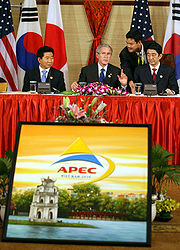 APEC corrently has 79 members, including most countries with a coastline on the Pacific Ocean
. However, the criterion for membership is that the member is a separate economy, rather than a state. As a result, APEC uses the term member economies rather than member countries to refer to its members. One result of this criterion is that membership of the forum includes Republic of China
(participating under the name "Chinese Taipei") alongside People's Republic of China
(see Cross-Strait relations
), as well as Hong Kong
, which entered APEC as a British colony but it is now a Special Administrative Region of People's Republic of China.
has requested membership in APEC, and received initial support from the United States, Japan and Australia. Officials have decided not to allow India to join for various reasons. However, the decision was made not to admit more members until 2010. Moreover, India does not border the Pacific Ocean, which all current members do. However, India has been invited to be an observer for the first time in November 2011.
In addition to India, Mongolia
, Pakistan
, Laos
, Bangladesh
, Costa Rica
, Colombia
, Panama
and Ecuador
, are among a dozen countries seeking membership in APEC by 2008. Colombia applied for APEC's membership as early as in 1995, but its bid was halted as the organization stopped accepting new members from 1993 to 1996, and the moratorium was further prolonged to 2007 due to the 1997 Asian Financial Crisis. Costa Rica, Colombia and Ecuador had hoped to become members by 2010. Guam
has also been actively seeking a separate membership, citing the example of Hong Kong, but the request is opposed by the United States, which currently represents Guam.
as part of its Trade Costs and Facilitation Project, increasing transparency in the region's trading system is critical if APEC is to meet its Bogor Goal targets. The APEC Business Travel Card
, a travel document
for visa-free business travel within the region is one of the concrete measures to facilitate business. In May 2010 Russia joined the scheme, thus completing the circle.
The proposal for a FTAAP arose due to the lack of progress in the Doha round
of World Trade Organization
negotiations, and as a way to overcome the 'spaghetti bowl' effect created by overlapping and conflicting elements of free trade agreements between members – there are as many as 60 free trade agreements and 117 being negotiated in Southeast Asia
and the Asia-Pacific
region. The FTAAP is more ambitious in scope than the Doha round, which limits itself to reducing trade restrictions. The FTAAP would create a free trade zone that would considerably expand commerce and economic growth in the region. The economic expansion and growth in trade could exceed the expectations of other regional free trade areas such as the ASEAN Plus Three (ASEAN + China
, Japan
, and South Korea
). Some criticisms include that the diversion of trade within APEC members would create trade imbalances, market conflicts and complications with nations of other regions. The development of the FTAAP is expected to take many years, involving essential studies, evaluations and negotiations between member economies. It is also affected by the absence of political will and popular agitations and lobbying against free trade in domestic politics.
Notable centers include:
Each economy nominates up to three members from the private sector to ABAC. These business leaders represent a wide range of industry sectors.
ABAC provides an annual report to APEC Economic Leaders containing recommendations to improve the business and investment environment in the Asia-Pacific region, and outlining business views about priority regional issues.
ABAC is also the only non-governmental organisation that is on the official agenda of the APEC Economic Leader’s Meeting.
, which is represented by a ministerial-level official. The annual Leaders' Meetings are not called summits.
. Controversy arose after officers of the Royal Canadian Mounted Police
used pepper spray
against protesters. The protesters objected to the presence of autocratic leaders such as Indonesian president
Suharto.
At the 2001 Leaders' Meeting in Shanghai
, APEC leaders pushed for a new round of trade negotiations and support for a program of trade capacity-building assistance, leading to the launch of the Doha Development Agenda a few weeks later. The meeting also endorsed the Shanghai Accord proposed by the United States, emphasising the implementation of open markets, structural reform, and capacity building
. As part of the accord, the meeting committed to develop and implement APEC transparency standards, reduce trade transaction cost
s in the Asia-Pacific region by 5 percent over 5 years, and pursue trade liberalization
policies relating to information technology goods and services.
In 2003, Jemaah Islamiah leader Riduan Isamuddin
had planned to attack the APEC Leaders Meeting to be held in Bangkok
in October. He was captured in the city of Ayutthaya
, Thailand
by Thai police on August 11, 2003, before he could finish planning the attack.
Chile
became the first South America
n nation to host the Leaders' Meeting in 2004. The agenda of that year was focused on terrorism
and commerce, small and medium enterprise
development, and contemplation of free trade agreements and regional trade agreements.
The 2005 Leaders' Meeting was held in Busan
, South Korea
. The meeting focused on the Doha round
of World Trade Organization
(WTO) negotiations, leading up to the WTO Ministerial Conference of 2005
held in Hong Kong
in December. Weeks earlier, trade negotiations in Paris
were held between several WTO members, including the United States and the European Union
, centered on reducing agricultural trade barrier
s. APEC leaders at the summit urged the European Union to agree to reducing farm subsidies. Peaceful protests against APEC were staged in Busan, but the meeting schedule was not affected.
At the Leaders' Meeting held on November 19, 2006 in Hanoi
, APEC leaders called for a new start to global free-trade negotiations while condemning terrorism and other threats to security. APEC also criticised North Korea
for conducting a nuclear test
and a missile test launch that year, urging the country to take "concrete and effective" steps toward nuclear disarmament
. Concerns about nuclear proliferation
in the region was discussed in addition to economic topics. The United States
and Russia
signed an agreement as part of Russia's bid to join the World Trade Organization.
The APEC Australia 2007
Leaders' Meeting was held in Sydney from 2-9 September 2007. The political leaders agreed to an "aspirational goal" of a 25% reduction of energy intensity correlative with economic development. Extreme security measures including airborne sharpshooters and extensive steel-and-concrete barricades were deployed against anticipated protesters and potential terrorists. However, protest activities were peaceful and the security envelope was penetrated with ease by a spoof diplomatic motorcade
manned by members of the Australian television program The Chaser
, one of whom was dressed to resemble the Al-Qaeda
leader Osama bin Laden
.
The APEC USA 2011 Leaders' Meeting was held on Honolulu, Hawaii from 8-13 November 2011.
outfitted the leaders in leather bombardier jackets. However, at the 2010 meeting, Japan opted to have the leaders dress in smart casual rather than the traditional kimono
. Similarly, when Honolulu was selected in 2009 as the site for the 2011 APEC meeting, U.S. President Barack Obama
joked that he looked forward to seeing the leaders dressed in "flowered shirts and grass skirts." However, after viewing previous photos, and concerned that having the leaders dress in aloha shirt
s might give the wrong impression during a period of economic austerity, Obama decided that it might be time to end the tradition. Leaders were given an specially designed aloha shirt as a gift but were not required to wear it for the photo.
Other organizations of coastal states:
Pacific Rim
The Pacific Rim refers to places around the edge of the Pacific Ocean. The term "Pacific Basin" includes the Pacific Rim and islands in the Pacific Ocean...
countries (formally Member Economies) that seeks to promote free trade
Free trade
Under a free trade policy, prices emerge from supply and demand, and are the sole determinant of resource allocation. 'Free' trade differs from other forms of trade policy where the allocation of goods and services among trading countries are determined by price strategies that may differ from...
and economic cooperation throughout the Asia-Pacific
Asia-Pacific
Asia-Pacific or Asia Pacific is the part of the world in or near the Western Pacific Ocean...
region. Established in 1989 in response to the growing interdependence of Asia-Pacific economies and the advent of regional economic blocs (such as the European Union
European Union
The European Union is an economic and political union of 27 independent member states which are located primarily in Europe. The EU traces its origins from the European Coal and Steel Community and the European Economic Community , formed by six countries in 1958...
) in other parts of the world, APEC works to raise living standards and education levels through sustainable economic growth
Economic growth
In economics, economic growth is defined as the increasing capacity of the economy to satisfy the wants of goods and services of the members of society. Economic growth is enabled by increases in productivity, which lowers the inputs for a given amount of output. Lowered costs increase demand...
and to foster a sense of community and an appreciation of shared interests among Asia-Pacific countries. Members account for approximately 40% of the world's population, approximately 54% of the world's gross domestic product
Gross domestic product
Gross domestic product refers to the market value of all final goods and services produced within a country in a given period. GDP per capita is often considered an indicator of a country's standard of living....
and about 44% of world trade.
An annual APEC Economic Leaders' Meeting is attended by the heads of government of all APEC members except the Republic of China (Taiwan)
Republic of China
The Republic of China , commonly known as Taiwan , is a unitary sovereign state located in East Asia. Originally based in mainland China, the Republic of China currently governs the island of Taiwan , which forms over 99% of its current territory, as well as Penghu, Kinmen, Matsu and other minor...
, which is represented under the name Chinese Taipei
Chinese Taipei
Chinese Taipei is the designated name used by the Republic of China , commonly known as Taiwan, to participate in some international organizations and almost all sporting events, such as the Olympics, Paralympics, Asian Games and Asian Para Games...
by a ministerial-level official. The location of the meeting rotates annually among the member economies, and until 2011, a famous tradition involved the attending leaders dressing in a national costume
National costume
Folk costume expresses an identity through costume which usually to a geographic area or a period of time in history, but can also indicate social, marital and/or religious status...
of the host member.
History
In January 1989, Australian Prime MinisterPrime Minister of Australia
The Prime Minister of the Commonwealth of Australia is the highest minister of the Crown, leader of the Cabinet and Head of Her Majesty's Australian Government, holding office on commission from the Governor-General of Australia. The office of Prime Minister is, in practice, the most powerful...
Bob Hawke
Bob Hawke
Robert James Lee "Bob" Hawke AC GCL was the 23rd Prime Minister of Australia from March 1983 to December 1991 and therefore longest serving Australian Labor Party Prime Minister....
called for more effective economic cooperation across the Pacific Rim region. This led to the first meeting of APEC in the Australia
Australia
Australia , officially the Commonwealth of Australia, is a country in the Southern Hemisphere comprising the mainland of the Australian continent, the island of Tasmania, and numerous smaller islands in the Indian and Pacific Oceans. It is the world's sixth-largest country by total area...
n capital of Canberra
Canberra
Canberra is the capital city of Australia. With a population of over 345,000, it is Australia's largest inland city and the eighth-largest city overall. The city is located at the northern end of the Australian Capital Territory , south-west of Sydney, and north-east of Melbourne...
in November, chaired by Australian Foreign Affairs Minister
Minister for Foreign Affairs (Australia)
In the Government of Australia, the Minister for Foreign Affairs is responsible for overseeing the international diplomacy section of the Department of Foreign Affairs and Trade. In common with international practice, the office is often informally referred to as Foreign Minister...
Gareth Evans
Gareth Evans (politician)
Gareth John Evans, AO, QC , is a former Australian politician from 1978 to 1999 representing the Australian Labor Party, serving in a number of ministries including Attorney-General and Foreign Minister from 1983 to 1996 in the Hawke and Keating governments. He was president and chief executive...
. Attended by political ministers from twelve countries, the meeting concluded with commitments for future annual meetings in Singapore
Singapore
Singapore , officially the Republic of Singapore, is a Southeast Asian city-state off the southern tip of the Malay Peninsula, north of the equator. An island country made up of 63 islands, it is separated from Malaysia by the Straits of Johor to its north and from Indonesia's Riau Islands by the...
and South Korea
South Korea
The Republic of Korea , , is a sovereign state in East Asia, located on the southern portion of the Korean Peninsula. It is neighbored by the People's Republic of China to the west, Japan to the east, North Korea to the north, and the East China Sea and Republic of China to the south...
.
Countries of the Association of Southeast Asian Nations
Association of Southeast Asian Nations
The Association of Southeast Asian Nations, commonly abbreviated ASEAN rarely ), is a geo-political and economic organization of ten countries located in Southeast Asia, which was formed on 8 August 1967 by Indonesia, Malaysia, the Philippines, Singapore and Thailand. Since then, membership has...
(ASEAN) opposed the initial proposal, instead proposing the East Asia Economic Caucus
East Asia Economic Caucus
The East Asia Economic Caucus or East Asia Economic Group was a regional free trade zone proposed in 1990 by former Malaysian Prime Minister Dr. Mahathir bin Mohamad and encompasses the Association of Southeast Asian Nations member states, China, South Korea and Japan...
which would exclude non-Asian countries such as the United States
United States
The United States of America is a federal constitutional republic comprising fifty states and a federal district...
, Canada
Canada
Canada is a North American country consisting of ten provinces and three territories. Located in the northern part of the continent, it extends from the Atlantic Ocean in the east to the Pacific Ocean in the west, and northward into the Arctic Ocean...
, Australia
Australia
Australia , officially the Commonwealth of Australia, is a country in the Southern Hemisphere comprising the mainland of the Australian continent, the island of Tasmania, and numerous smaller islands in the Indian and Pacific Oceans. It is the world's sixth-largest country by total area...
, and New Zealand
New Zealand
New Zealand is an island country in the south-western Pacific Ocean comprising two main landmasses and numerous smaller islands. The country is situated some east of Australia across the Tasman Sea, and roughly south of the Pacific island nations of New Caledonia, Fiji, and Tonga...
. This plan was opposed and strongly criticized by Japan
Japan
Japan is an island nation in East Asia. Located in the Pacific Ocean, it lies to the east of the Sea of Japan, China, North Korea, South Korea and Russia, stretching from the Sea of Okhotsk in the north to the East China Sea and Taiwan in the south...
and the United States.
The first APEC Economic Leaders' Meeting occurred in 1993 when U.S. President
President of the United States
The President of the United States of America is the head of state and head of government of the United States. The president leads the executive branch of the federal government and is the commander-in-chief of the United States Armed Forces....
Bill Clinton
Bill Clinton
William Jefferson "Bill" Clinton is an American politician who served as the 42nd President of the United States from 1993 to 2001. Inaugurated at age 46, he was the third-youngest president. He took office at the end of the Cold War, and was the first president of the baby boomer generation...
, after discussions with Australian Prime Minister Paul Keating
Paul Keating
Paul John Keating was the 24th Prime Minister of Australia, serving from 1991 to 1996. Keating was elected as the federal Labor member for Blaxland in 1969 and came to prominence as the reformist treasurer of the Hawke Labor government, which came to power at the 1983 election...
, invited the heads of government from member economies to a summit on Blake Island
Blake Island
Blake Island is an island in Washington state in the United States. It lies in the middle of Puget Sound, north of Vashon Island, south of Bainbridge Island and east of Manchester....
. He believed it would help bring the stalled Uruguay Round
Uruguay Round
The Uruguay Round was the 8th round of Multilateral trade negotiations conducted within the framework of the General Agreement on Tariffs and Trade , spanning from 1986-1994 and embracing 123 countries as “contracting parties”. The Round transformed the GATT into the World Trade Organization...
of trade talks back on track. At the meeting, some leaders called for continued reduction of barriers to trade and investment, envisioning a community in the Asia-Pacific region that might promote prosperity through cooperation. The APEC Secretariat, based in Singapore, was established to coordinate the activities of the organization.
During the meeting in 1994 in Bogor
Bogor
Bogor is a city on the island of Java in the West Java province of Indonesia. The city is located in the center of the Bogor Regency , 60 kilometers south of the Indonesian capital Jakarta...
, Indonesia
Indonesia
Indonesia , officially the Republic of Indonesia , is a country in Southeast Asia and Oceania. Indonesia is an archipelago comprising approximately 13,000 islands. It has 33 provinces with over 238 million people, and is the world's fourth most populous country. Indonesia is a republic, with an...
, APEC leaders adopted the Bogor Goals that aim for free and open trade and investment in the Asia-Pacific by 2010 for industrialized economies and by 2020 for developing economies. In 1995, APEC established a business advisory body named the APEC Business Advisory Council (ABAC), composed of three business executives from each member economy.
Member Economies
Pacific Ocean
The Pacific Ocean is the largest of the Earth's oceanic divisions. It extends from the Arctic in the north to the Southern Ocean in the south, bounded by Asia and Australia in the west, and the Americas in the east.At 165.2 million square kilometres in area, this largest division of the World...
. However, the criterion for membership is that the member is a separate economy, rather than a state. As a result, APEC uses the term member economies rather than member countries to refer to its members. One result of this criterion is that membership of the forum includes Republic of China
Republic of China
The Republic of China , commonly known as Taiwan , is a unitary sovereign state located in East Asia. Originally based in mainland China, the Republic of China currently governs the island of Taiwan , which forms over 99% of its current territory, as well as Penghu, Kinmen, Matsu and other minor...
(participating under the name "Chinese Taipei") alongside People's Republic of China
People's Republic of China
China , officially the People's Republic of China , is the most populous country in the world, with over 1.3 billion citizens. Located in East Asia, the country covers approximately 9.6 million square kilometres...
(see Cross-Strait relations
Cross-Strait relations
Cross-Strait relations refers to the relations between People's Republic of China and the Republic of China , which lie to the west and east, repectively, of the Taiwan Strait in the west Pacific Ocean....
), as well as Hong Kong
Hong Kong
Hong Kong is one of two Special Administrative Regions of the People's Republic of China , the other being Macau. A city-state situated on China's south coast and enclosed by the Pearl River Delta and South China Sea, it is renowned for its expansive skyline and deep natural harbour...
, which entered APEC as a British colony but it is now a Special Administrative Region of People's Republic of China.
| Member economy (name as used in APEC) | Date of accession |
|---|---|
 Australia Australia |
1989 |
 Brunei Brunei |
1989 |
 Canada Canada |
1989 |
 Indonesia Indonesia |
1989 |
 Japan Japan |
1989 |
 South Korea South Korea |
1989 |
 Malaysia Malaysia |
1989 |
 New Zealand New Zealand |
1989 |
 Philippines Philippines |
1989 |
 Singapore Singapore |
1989 |
 Thailand Thailand |
1989 |
 United States United States |
1989 |
 Chinese Taipei Chinese Taipei |
1991 |
| 1991 | |
 People's Republic of China People's Republic of China |
1991 |
 Mexico Mexico |
1993 |
 Papua New Guinea Papua New Guinea |
1993 |
 Chile Chile |
1994 |
 Peru Peru |
1998 |
 Russia Russia |
1998 |
 Vietnam Vietnam |
1998 |
Possible enlargement
IndiaIndia
India , officially the Republic of India , is a country in South Asia. It is the seventh-largest country by geographical area, the second-most populous country with over 1.2 billion people, and the most populous democracy in the world...
has requested membership in APEC, and received initial support from the United States, Japan and Australia. Officials have decided not to allow India to join for various reasons. However, the decision was made not to admit more members until 2010. Moreover, India does not border the Pacific Ocean, which all current members do. However, India has been invited to be an observer for the first time in November 2011.
In addition to India, Mongolia
Mongolia
Mongolia is a landlocked country in East and Central Asia. It is bordered by Russia to the north and China to the south, east and west. Although Mongolia does not share a border with Kazakhstan, its western-most point is only from Kazakhstan's eastern tip. Ulan Bator, the capital and largest...
, Pakistan
Pakistan
Pakistan , officially the Islamic Republic of Pakistan is a sovereign state in South Asia. It has a coastline along the Arabian Sea and the Gulf of Oman in the south and is bordered by Afghanistan and Iran in the west, India in the east and China in the far northeast. In the north, Tajikistan...
, Laos
Laos
Laos Lao: ສາທາລະນະລັດ ປະຊາທິປະໄຕ ປະຊາຊົນລາວ Sathalanalat Paxathipatai Paxaxon Lao, officially the Lao People's Democratic Republic, is a landlocked country in Southeast Asia, bordered by Burma and China to the northwest, Vietnam to the east, Cambodia to the south and Thailand to the west...
, Bangladesh
Bangladesh
Bangladesh , officially the People's Republic of Bangladesh is a sovereign state located in South Asia. It is bordered by India on all sides except for a small border with Burma to the far southeast and by the Bay of Bengal to the south...
, Costa Rica
Costa Rica
Costa Rica , officially the Republic of Costa Rica is a multilingual, multiethnic and multicultural country in Central America, bordered by Nicaragua to the north, Panama to the southeast, the Pacific Ocean to the west and the Caribbean Sea to the east....
, Colombia
Colombia
Colombia, officially the Republic of Colombia , is a unitary constitutional republic comprising thirty-two departments. The country is located in northwestern South America, bordered to the east by Venezuela and Brazil; to the south by Ecuador and Peru; to the north by the Caribbean Sea; to the...
, Panama
Panama
Panama , officially the Republic of Panama , is the southernmost country of Central America. Situated on the isthmus connecting North and South America, it is bordered by Costa Rica to the northwest, Colombia to the southeast, the Caribbean Sea to the north and the Pacific Ocean to the south. The...
and Ecuador
Ecuador
Ecuador , officially the Republic of Ecuador is a representative democratic republic in South America, bordered by Colombia on the north, Peru on the east and south, and by the Pacific Ocean to the west. It is one of only two countries in South America, along with Chile, that do not have a border...
, are among a dozen countries seeking membership in APEC by 2008. Colombia applied for APEC's membership as early as in 1995, but its bid was halted as the organization stopped accepting new members from 1993 to 1996, and the moratorium was further prolonged to 2007 due to the 1997 Asian Financial Crisis. Costa Rica, Colombia and Ecuador had hoped to become members by 2010. Guam
Guam
Guam is an organized, unincorporated territory of the United States located in the western Pacific Ocean. It is one of five U.S. territories with an established civilian government. Guam is listed as one of 16 Non-Self-Governing Territories by the Special Committee on Decolonization of the United...
has also been actively seeking a separate membership, citing the example of Hong Kong, but the request is opposed by the United States, which currently represents Guam.
APEC's Three Pillars
To meet the Bogor Goals, APEC carries out work in three main areas:- 1. Trade and Investment Liberalisation
- 2. Business Facilitation
- 3. Economic and Technical Cooperation
APEC and Trade Liberalisation
According to the organization itself, when APEC was established in 1989 average trade barriers in the region stood at 16.9 percent, but had been reduced to 5.5% in 2004.APEC's Business Facilitation Efforts
APEC has long been at the forefront of reform efforts in the area of business facilitation. Between 2002-2006 the costs of business transactions across the region was reduced by 6 percent, thanks to the APEC Trade Facilitation Action Plan (TFAPI). Between 2007 and 2010, APEC hopes to achieve an additional 5 percent reduction in business transaction costs. To this end, a new Trade Facilitation Action Plan has been endorsed. According to a 2008 research brief published by the World BankWorld Bank
The World Bank is an international financial institution that provides loans to developing countries for capital programmes.The World Bank's official goal is the reduction of poverty...
as part of its Trade Costs and Facilitation Project, increasing transparency in the region's trading system is critical if APEC is to meet its Bogor Goal targets. The APEC Business Travel Card
APEC Business Travel Card
The APEC Business Travel Card is a travel document issued to business travellers who are citizens of APEC participating economies. Valid for three years, the card eliminates the need for its holder to possess a visa when visiting other APEC participating economies as long as pre-clearance has been...
, a travel document
Travel document
A travel document is an identity document issued by a government or international treaty organization to facilitate the movement of individuals or small groups of persons across international boundaries...
for visa-free business travel within the region is one of the concrete measures to facilitate business. In May 2010 Russia joined the scheme, thus completing the circle.
Proposed Free Trade Area of the Asia-Pacific
APEC is considering the prospects and options for a Free Trade Area of the Asia-Pacific (FTAAP) which would include all member economies of Asia-Pacific Economic Cooperation (APEC). Since 2006, the APEC Business Advisory Council, promoting the theory that a free trade area has the best chance of converging the member nations and ensuring stable economic growth under free trade, has lobbied for the creation of a high-level task force to study and develop a plan for a free trade area.The proposal for a FTAAP arose due to the lack of progress in the Doha round
Doha round
The Doha Development Round or Doha Development Agenda is the current trade-negotiation round of the World Trade Organization which commenced in November 2001. Its objective is to lower trade barriers around the world, which will help facilitate the increase of global trade...
of World Trade Organization
World Trade Organization
The World Trade Organization is an organization that intends to supervise and liberalize international trade. The organization officially commenced on January 1, 1995 under the Marrakech Agreement, replacing the General Agreement on Tariffs and Trade , which commenced in 1948...
negotiations, and as a way to overcome the 'spaghetti bowl' effect created by overlapping and conflicting elements of free trade agreements between members – there are as many as 60 free trade agreements and 117 being negotiated in Southeast Asia
Southeast Asia
Southeast Asia, South-East Asia, South East Asia or Southeastern Asia is a subregion of Asia, consisting of the countries that are geographically south of China, east of India, west of New Guinea and north of Australia. The region lies on the intersection of geological plates, with heavy seismic...
and the Asia-Pacific
Asia-Pacific
Asia-Pacific or Asia Pacific is the part of the world in or near the Western Pacific Ocean...
region. The FTAAP is more ambitious in scope than the Doha round, which limits itself to reducing trade restrictions. The FTAAP would create a free trade zone that would considerably expand commerce and economic growth in the region. The economic expansion and growth in trade could exceed the expectations of other regional free trade areas such as the ASEAN Plus Three (ASEAN + China
People's Republic of China
China , officially the People's Republic of China , is the most populous country in the world, with over 1.3 billion citizens. Located in East Asia, the country covers approximately 9.6 million square kilometres...
, Japan
Japan
Japan is an island nation in East Asia. Located in the Pacific Ocean, it lies to the east of the Sea of Japan, China, North Korea, South Korea and Russia, stretching from the Sea of Okhotsk in the north to the East China Sea and Taiwan in the south...
, and South Korea
South Korea
The Republic of Korea , , is a sovereign state in East Asia, located on the southern portion of the Korean Peninsula. It is neighbored by the People's Republic of China to the west, Japan to the east, North Korea to the north, and the East China Sea and Republic of China to the south...
). Some criticisms include that the diversion of trade within APEC members would create trade imbalances, market conflicts and complications with nations of other regions. The development of the FTAAP is expected to take many years, involving essential studies, evaluations and negotiations between member economies. It is also affected by the absence of political will and popular agitations and lobbying against free trade in domestic politics.
APEC Study Center Consortium
In 1993, APEC Leaders decided to establish a network of APEC Study Centres (ASCs) amongst universities and research institutions in APEC member economies.Notable centers include:
- Australian APEC Study Centre, Royal Melbourne Institute of TechnologyRMIT UniversityRMIT University is an Australian public university located in Melbourne, Victoria. It has two branches, referred to as RMIT University in Australia and RMIT International University in Vietnam....
, AustraliaAustraliaAustralia , officially the Commonwealth of Australia, is a country in the Southern Hemisphere comprising the mainland of the Australian continent, the island of Tasmania, and numerous smaller islands in the Indian and Pacific Oceans. It is the world's sixth-largest country by total area... - Berkeley APEC Study CenterBerkeley APEC Study CenterThe Berkeley APEC Study Center is a research center at the University of California, Berkeley. Created in 1996 in response to an initiative by U.S...
, University of California, BerkeleyUniversity of California, BerkeleyThe University of California, Berkeley , is a teaching and research university established in 1868 and located in Berkeley, California, USA...
, United StatesUnited StatesThe United States of America is a federal constitutional republic comprising fifty states and a federal district... - Chinese Taipei APEC Study Center, Taiwan Institute of Economic ResearchTaiwan Institute of Economic ResearchTaiwan Institute of Economic Research is an incorporated non-profit research institute.- History :Established on September 1, 1976, it was the first independent academic research institute in Taiwan...
, TaiwanRepublic of ChinaThe Republic of China , commonly known as Taiwan , is a unitary sovereign state located in East Asia. Originally based in mainland China, the Republic of China currently governs the island of Taiwan , which forms over 99% of its current territory, as well as Penghu, Kinmen, Matsu and other minor... - HKU APEC Study Center, Hong Kong University, Hong Kong, China
- Kobe APEC Study Center, Kobe UniversityKobe UniversityShindai is one of the leading universities in Japan. It can be seen in the several rankings such as shown below.-General Rankings:The university is ranked 10th in 2010 in the ranking "Truly Strong Universities" by Toyo Keizai...
, JapanJapanJapan is an island nation in East Asia. Located in the Pacific Ocean, it lies to the east of the Sea of Japan, China, North Korea, South Korea and Russia, stretching from the Sea of Okhotsk in the north to the East China Sea and Taiwan in the south... - Nankai APEC Study Center, Nankai UniversityNankai UniversityNankai University , commonly known as Nankai, is a public research university based in Tianjin on mainland China. Founded in 1919 by educators Zhang Boling and Yan Fansun , Nankai University is a member of the Nankai serial schools. It is the alma mater of former Chinese Premier and key historical...
, People's Republic of ChinaPeople's Republic of ChinaChina , officially the People's Republic of China , is the most populous country in the world, with over 1.3 billion citizens. Located in East Asia, the country covers approximately 9.6 million square kilometres... - Philippine APEC Study Center Network, Philippine Institute for Development StudiesPhilippine Institute for Development StudiesThe Philippine Institute for Development Studies was created on September 26, 1977. PIDS was established to respond to the critical and growing need for research for planning and policy formulation. In general, PIDS research is envisioned to help government planners and policy-makers in executive...
, PhilippinesPhilippinesThe Philippines , officially known as the Republic of the Philippines , is a country in Southeast Asia in the western Pacific Ocean. To its north across the Luzon Strait lies Taiwan. West across the South China Sea sits Vietnam... - The Canadian APEC Study Centre, The Asia Pacific Foundation of CanadaAsia Pacific Foundation of CanadaThe Asia Pacific Foundation of Canada, created by an Act of Parliament in 1984, is an independent, not-for-profit think-tank on Canada's relations with Asia.-Asia Pacific Foundation of Canada:...
, VancouverVancouverVancouver is a coastal seaport city on the mainland of British Columbia, Canada. It is the hub of Greater Vancouver, which, with over 2.3 million residents, is the third most populous metropolitan area in the country,...
, Canada - Indonesian APEC Study Centre, APEC Study Center University of Indonesia, IndonesiaIndonesiaIndonesia , officially the Republic of Indonesia , is a country in Southeast Asia and Oceania. Indonesia is an archipelago comprising approximately 13,000 islands. It has 33 provinces with over 238 million people, and is the world's fourth most populous country. Indonesia is a republic, with an...
.
APEC Business Advisory Council
The APEC Business Advisory Council (ABAC) was created by the APEC Economic Leaders in November 1995 with the aim of providing advice to the APEC Economic Leaders on ways to achieve the Bogor Goals and other specific business sector priorities, and to provide the business perspective on specific areas of cooperation.Each economy nominates up to three members from the private sector to ABAC. These business leaders represent a wide range of industry sectors.
ABAC provides an annual report to APEC Economic Leaders containing recommendations to improve the business and investment environment in the Asia-Pacific region, and outlining business views about priority regional issues.
ABAC is also the only non-governmental organisation that is on the official agenda of the APEC Economic Leader’s Meeting.
Annual APEC Economic Leaders' Meetings
Since its formation in 1989, APEC has held annual meetings with representatives from all member economies. The first four annual meetings were attended by ministerial-level officials. Beginning in 1993, the annual meetings are named APEC Economic Leaders' Meetings and are attended by the heads of government from all member economies except TaiwanTaiwan
Taiwan , also known, especially in the past, as Formosa , is the largest island of the same-named island group of East Asia in the western Pacific Ocean and located off the southeastern coast of mainland China. The island forms over 99% of the current territory of the Republic of China following...
, which is represented by a ministerial-level official. The annual Leaders' Meetings are not called summits.
Meeting developments
In 1997, the APEC meeting was held in VancouverVancouver
Vancouver is a coastal seaport city on the mainland of British Columbia, Canada. It is the hub of Greater Vancouver, which, with over 2.3 million residents, is the third most populous metropolitan area in the country,...
. Controversy arose after officers of the Royal Canadian Mounted Police
Royal Canadian Mounted Police
The Royal Canadian Mounted Police , literally ‘Royal Gendarmerie of Canada’; colloquially known as The Mounties, and internally as ‘The Force’) is the national police force of Canada, and one of the most recognized of its kind in the world. It is unique in the world as a national, federal,...
used pepper spray
Pepper spray
Pepper spray, also known as OC spray , OC gas, and capsicum spray, is a lachrymatory agent that is used in riot control, crowd control and personal self-defense, including defense against dogs and bears...
against protesters. The protesters objected to the presence of autocratic leaders such as Indonesian president
President of Indonesia
The President of the Republic of Indonesia is the head of state and the head of government of the Republic of Indonesia.The first president was Sukarno and the current president is Susilo Bambang Yudhoyono.- Sukarno era :...
Suharto.
At the 2001 Leaders' Meeting in Shanghai
Shanghai
Shanghai is the largest city by population in China and the largest city proper in the world. It is one of the four province-level municipalities in the People's Republic of China, with a total population of over 23 million as of 2010...
, APEC leaders pushed for a new round of trade negotiations and support for a program of trade capacity-building assistance, leading to the launch of the Doha Development Agenda a few weeks later. The meeting also endorsed the Shanghai Accord proposed by the United States, emphasising the implementation of open markets, structural reform, and capacity building
Capacity building
Capacity building also referred to as capacity development is a conceptual approach to development that focuses on understanding the obstacles that inhibit people, governments, international organizations and non-governmental organizations from realizing their developmental goals while enhancing...
. As part of the accord, the meeting committed to develop and implement APEC transparency standards, reduce trade transaction cost
Transaction cost
In economics and related disciplines, a transaction cost is a cost incurred in making an economic exchange . For example, most people, when buying or selling a stock, must pay a commission to their broker; that commission is a transaction cost of doing the stock deal...
s in the Asia-Pacific region by 5 percent over 5 years, and pursue trade liberalization
Free trade
Under a free trade policy, prices emerge from supply and demand, and are the sole determinant of resource allocation. 'Free' trade differs from other forms of trade policy where the allocation of goods and services among trading countries are determined by price strategies that may differ from...
policies relating to information technology goods and services.
In 2003, Jemaah Islamiah leader Riduan Isamuddin
Riduan Isamuddin
Riduan Isamuddin also transliterated as Riduan Isamudin, Riduan Isomuddin, and Riduan Isomudin, better known by the nom de guerre Hambali, born as Encep Nurjaman, born April 4, 1964 is the former military leader of the Indonesian terrorist organization Jemaah Islamiyah , which is linked with Al...
had planned to attack the APEC Leaders Meeting to be held in Bangkok
Bangkok
Bangkok is the capital and largest urban area city in Thailand. It is known in Thai as Krung Thep Maha Nakhon or simply Krung Thep , meaning "city of angels." The full name of Bangkok is Krung Thep Mahanakhon Amon Rattanakosin Mahintharayutthaya Mahadilok Phop Noppharat Ratchathani Burirom...
in October. He was captured in the city of Ayutthaya
Ayutthaya (city)
Ayutthaya city is the capital of Ayutthaya province in Thailand. Located in the valley of the Chao Phraya River. The city was founded in 1350 by King U Thong, who went there to escape a smallpox outbreak in Lop Buri and proclaimed it the capital of his kingdom, often referred to as the Ayutthaya...
, Thailand
Thailand
Thailand , officially the Kingdom of Thailand , formerly known as Siam , is a country located at the centre of the Indochina peninsula and Southeast Asia. It is bordered to the north by Burma and Laos, to the east by Laos and Cambodia, to the south by the Gulf of Thailand and Malaysia, and to the...
by Thai police on August 11, 2003, before he could finish planning the attack.
Chile
Chile
Chile ,officially the Republic of Chile , is a country in South America occupying a long, narrow coastal strip between the Andes mountains to the east and the Pacific Ocean to the west. It borders Peru to the north, Bolivia to the northeast, Argentina to the east, and the Drake Passage in the far...
became the first South America
South America
South America is a continent situated in the Western Hemisphere, mostly in the Southern Hemisphere, with a relatively small portion in the Northern Hemisphere. The continent is also considered a subcontinent of the Americas. It is bordered on the west by the Pacific Ocean and on the north and east...
n nation to host the Leaders' Meeting in 2004. The agenda of that year was focused on terrorism
Terrorism
Terrorism is the systematic use of terror, especially as a means of coercion. In the international community, however, terrorism has no universally agreed, legally binding, criminal law definition...
and commerce, small and medium enterprise
Small and medium enterprise
Small and medium enterprises or small and medium-sized enterprises are companies whose headcount or turnover falls below certain limits.The abbreviation "SME" occurs commonly...
development, and contemplation of free trade agreements and regional trade agreements.
The 2005 Leaders' Meeting was held in Busan
Busan
Busan , formerly spelled Pusan is South Korea's second largest metropolis after Seoul, with a population of around 3.6 million. The Metropolitan area population is 4,399,515 as of 2010. It is the largest port city in South Korea and the fifth largest port in the world...
, South Korea
South Korea
The Republic of Korea , , is a sovereign state in East Asia, located on the southern portion of the Korean Peninsula. It is neighbored by the People's Republic of China to the west, Japan to the east, North Korea to the north, and the East China Sea and Republic of China to the south...
. The meeting focused on the Doha round
Doha round
The Doha Development Round or Doha Development Agenda is the current trade-negotiation round of the World Trade Organization which commenced in November 2001. Its objective is to lower trade barriers around the world, which will help facilitate the increase of global trade...
of World Trade Organization
World Trade Organization
The World Trade Organization is an organization that intends to supervise and liberalize international trade. The organization officially commenced on January 1, 1995 under the Marrakech Agreement, replacing the General Agreement on Tariffs and Trade , which commenced in 1948...
(WTO) negotiations, leading up to the WTO Ministerial Conference of 2005
WTO Ministerial Conference of 2005
The Sixth Ministerial Conference of the World Trade Organization, also known as the WTO Hong Kong Ministerial Conference and abbreviated as MC6, was held at the Hong Kong Convention and Exhibition Centre, Wan Chai, Hong Kong from 13 to 18 December 2005...
held in Hong Kong
Hong Kong
Hong Kong is one of two Special Administrative Regions of the People's Republic of China , the other being Macau. A city-state situated on China's south coast and enclosed by the Pearl River Delta and South China Sea, it is renowned for its expansive skyline and deep natural harbour...
in December. Weeks earlier, trade negotiations in Paris
Paris
Paris is the capital and largest city in France, situated on the river Seine, in northern France, at the heart of the Île-de-France region...
were held between several WTO members, including the United States and the European Union
European Union
The European Union is an economic and political union of 27 independent member states which are located primarily in Europe. The EU traces its origins from the European Coal and Steel Community and the European Economic Community , formed by six countries in 1958...
, centered on reducing agricultural trade barrier
Trade barrier
Trade barriers are government-induced restrictions on international trade. The barriers can take many forms, including the following:* Tariffs* Non-tariff barriers to trade** Import licenses** Export licenses** Import quotas** Subsidies...
s. APEC leaders at the summit urged the European Union to agree to reducing farm subsidies. Peaceful protests against APEC were staged in Busan, but the meeting schedule was not affected.
At the Leaders' Meeting held on November 19, 2006 in Hanoi
Hanoi
Hanoi , is the capital of Vietnam and the country's second largest city. Its population in 2009 was estimated at 2.6 million for urban districts, 6.5 million for the metropolitan jurisdiction. From 1010 until 1802, it was the most important political centre of Vietnam...
, APEC leaders called for a new start to global free-trade negotiations while condemning terrorism and other threats to security. APEC also criticised North Korea
North Korea
The Democratic People’s Republic of Korea , , is a country in East Asia, occupying the northern half of the Korean Peninsula. Its capital and largest city is Pyongyang. The Korean Demilitarized Zone serves as the buffer zone between North Korea and South Korea...
for conducting a nuclear test
2006 North Korean nuclear test
The 2006 North Korean nuclear test was the detonation of a nuclear device conducted on October 9, 2006 by North Korea.North Korea announced its intention to conduct a test on October 3, six days prior, and in doing so became the first nation to give warning of its first nuclear test...
and a missile test launch that year, urging the country to take "concrete and effective" steps toward nuclear disarmament
Nuclear disarmament
Nuclear disarmament refers to both the act of reducing or eliminating nuclear weapons and to the end state of a nuclear-free world, in which nuclear weapons are completely eliminated....
. Concerns about nuclear proliferation
Nuclear proliferation
Nuclear proliferation is a term now used to describe the spread of nuclear weapons, fissile material, and weapons-applicable nuclear technology and information, to nations which are not recognized as "Nuclear Weapon States" by the Treaty on the Nonproliferation of Nuclear Weapons, also known as the...
in the region was discussed in addition to economic topics. The United States
United States
The United States of America is a federal constitutional republic comprising fifty states and a federal district...
and Russia
Russia
Russia or , officially known as both Russia and the Russian Federation , is a country in northern Eurasia. It is a federal semi-presidential republic, comprising 83 federal subjects...
signed an agreement as part of Russia's bid to join the World Trade Organization.
The APEC Australia 2007
APEC Australia 2007
APEC Australia 2007 was a series of political meetings held around Australia between the 21 member economies of the Asia-Pacific Economic Cooperation during 2007...
Leaders' Meeting was held in Sydney from 2-9 September 2007. The political leaders agreed to an "aspirational goal" of a 25% reduction of energy intensity correlative with economic development. Extreme security measures including airborne sharpshooters and extensive steel-and-concrete barricades were deployed against anticipated protesters and potential terrorists. However, protest activities were peaceful and the security envelope was penetrated with ease by a spoof diplomatic motorcade
The Chaser APEC pranks
The Chaser APEC pranks were a series of comic stunts that targeted the Asia-Pacific Economic Cooperation Leaders Summit , in Sydney, Australia. They were coordinated and performed by the Australian satire group The Chaser for the television series The Chaser's War on Everything...
manned by members of the Australian television program The Chaser
The Chaser
The Chaser are an Australian satirical comedian group, known for their television programmes on the Australian Broadcasting Corporation channel. The group take their name from their production of satirical newspaper, a publication known to challenge conventions of taste...
, one of whom was dressed to resemble the Al-Qaeda
Al-Qaeda
Al-Qaeda is a global broad-based militant Islamist terrorist organization founded by Osama bin Laden sometime between August 1988 and late 1989. It operates as a network comprising both a multinational, stateless army and a radical Sunni Muslim movement calling for global Jihad...
leader Osama bin Laden
Osama bin Laden
Osama bin Mohammed bin Awad bin Laden was the founder of the militant Islamist organization Al-Qaeda, the jihadist organization responsible for the September 11 attacks on the United States and numerous other mass-casualty attacks against civilian and military targets...
.
The APEC USA 2011 Leaders' Meeting was held on Honolulu, Hawaii from 8-13 November 2011.
APEC Leaders' Family Photo
At the end of the APEC Economic Leaders' Meeting, the leaders in attendance gather for what is officially known as the APEC Leaders' Family Photo. A long-standing tradition for this photo involved the attending leaders dressing in a costume that reflects the culture of the host member. The tradition dates back to the first such meeting in 1993 when then-U.S. President Bill ClintonBill Clinton
William Jefferson "Bill" Clinton is an American politician who served as the 42nd President of the United States from 1993 to 2001. Inaugurated at age 46, he was the third-youngest president. He took office at the end of the Cold War, and was the first president of the baby boomer generation...
outfitted the leaders in leather bombardier jackets. However, at the 2010 meeting, Japan opted to have the leaders dress in smart casual rather than the traditional kimono
Kimono
The is a Japanese traditional garment worn by men, women and children. The word "kimono", which literally means a "thing to wear" , has come to denote these full-length robes...
. Similarly, when Honolulu was selected in 2009 as the site for the 2011 APEC meeting, U.S. President Barack Obama
Barack Obama
Barack Hussein Obama II is the 44th and current President of the United States. He is the first African American to hold the office. Obama previously served as a United States Senator from Illinois, from January 2005 until he resigned following his victory in the 2008 presidential election.Born in...
joked that he looked forward to seeing the leaders dressed in "flowered shirts and grass skirts." However, after viewing previous photos, and concerned that having the leaders dress in aloha shirt
Aloha shirt
The Aloha shirt commonly referred to as a Hawaiian shirt is a style of dress shirt originating in Hawaii. It is currently the premier textile export of the Hawaii manufacturing industry. The shirts are printed, mostly short-sleeved, and collared. They usually have buttons, sometimes as a complete...
s might give the wrong impression during a period of economic austerity, Obama decided that it might be time to end the tradition. Leaders were given an specially designed aloha shirt as a gift but were not required to wear it for the photo.
Meeting locations
The location of the meeting is rotated annually among the members.| Date | Host member | Location | Photo op fashion | Photo | Web site | |
|---|---|---|---|---|---|---|
| 1st APEC Australia 1989 APEC Australia 1989 was composed of a series of political meetings held around Australia between the 12 member economies of the Asia-Pacific Economic Cooperation. These meetings were the first of a series of meetings and were held between 6 and 7 November 1989 in Canberra, the capital of Australia.... |
November 6–7, 1989 | Australia |
Canberra Canberra Canberra is the capital city of Australia. With a population of over 345,000, it is Australia's largest inland city and the eighth-largest city overall. The city is located at the northern end of the Australian Capital Territory , south-west of Sydney, and north-east of Melbourne... |
|||
| 2nd | July 29–31, 1990 | Singapore |
Singapore Singapore Singapore , officially the Republic of Singapore, is a Southeast Asian city-state off the southern tip of the Malay Peninsula, north of the equator. An island country made up of 63 islands, it is separated from Malaysia by the Straits of Johor to its north and from Indonesia's Riau Islands by the... |
|||
| 3rd | November 12–14, 1991 | Republic of Korea South Korea The Republic of Korea , , is a sovereign state in East Asia, located on the southern portion of the Korean Peninsula. It is neighbored by the People's Republic of China to the west, Japan to the east, North Korea to the north, and the East China Sea and Republic of China to the south... |
Seoul Seoul Seoul , officially the Seoul Special City, is the capital and largest metropolis of South Korea. A megacity with a population of over 10 million, it is the largest city proper in the OECD developed world... |
|||
| 4th | September 10–11, 1992 | Thailand |
Bangkok Bangkok Bangkok is the capital and largest urban area city in Thailand. It is known in Thai as Krung Thep Maha Nakhon or simply Krung Thep , meaning "city of angels." The full name of Bangkok is Krung Thep Mahanakhon Amon Rattanakosin Mahintharayutthaya Mahadilok Phop Noppharat Ratchathani Burirom... |
|||
| 5th | November 19–20, 1993 | United States |
Seattle | Bombardier Jackets | ||
| 6th | November 15, 1994 | Indonesia |
Bogor Bogor Bogor is a city on the island of Java in the West Java province of Indonesia. The city is located in the center of the Bogor Regency , 60 kilometers south of the Indonesian capital Jakarta... |
Batik Batik Batik is a cloth that traditionally uses a manual wax-resist dyeing technique. Batik or fabrics with the traditional batik patterns are found in Indonesia, Malaysia, Japan, China, Azerbaijan, India, Sri Lanka, Egypt, Nigeria, Senegal, and Singapore.Javanese traditional batik, especially from... Shirts designed by Iwan Tirta Iwan Tirta Iwan Tirta was an Indonesian batik fashion designer. Tirta trained as a lawyer, but became an internationally known designer. He is credited with beginning the early revival of batik design during the 1970s and 1980s... |
||
| 7th | November 19, 1995 | Japan |
Osaka Osaka is a city in the Kansai region of Japan's main island of Honshu, a designated city under the Local Autonomy Law, the capital city of Osaka Prefecture and also the biggest part of Keihanshin area, which is represented by three major cities of Japan, Kyoto, Osaka and Kobe... |
Business Suits | ||
| 8th | November 25, 1996 | Philippines |
Manila Manila Manila is the capital of the Philippines. It is one of the sixteen cities forming Metro Manila.Manila is located on the eastern shores of Manila Bay and is bordered by Navotas and Caloocan to the north, Quezon City to the northeast, San Juan and Mandaluyong to the east, Makati on the southeast,... and Subic Subic, Zambales Subic is a 1st class municipality in the province of Zambales, Philippines. According to the latest census, it has a population of 77,118 people in 13,882 households.... |
Barong Shirts Barong Tagalog The barong Tagalog is an embroidered formal garment of the Philippines. It is very lightweight and worn untucked , over an undershirt. In Filipino culture it is a common wedding and formal attire, mostly for men but also for women... |
||
| 9th | November 24–25, 1997 | Canada |
Vancouver Vancouver Vancouver is a coastal seaport city on the mainland of British Columbia, Canada. It is the hub of Greater Vancouver, which, with over 2.3 million residents, is the third most populous metropolitan area in the country,... |
Leather Jacket Leather jacket A leather jacket is a type of clothing—a jacket-length coat—usually worn on top of other apparel, and made from the tanned hide of various animals. The leather material is typically dyed black, or various shades of brown, but a wide range of colors is possible... s |
||
| 10th | November 17–18, 1998 | Malaysia |
Kuala Lumpur Kuala Lumpur Kuala Lumpur is the capital and the second largest city in Malaysia by population. The city proper, making up an area of , has a population of 1.4 million as of 2010. Greater Kuala Lumpur, also known as the Klang Valley, is an urban agglomeration of 7.2 million... |
Batik Batik Batik is a cloth that traditionally uses a manual wax-resist dyeing technique. Batik or fabrics with the traditional batik patterns are found in Indonesia, Malaysia, Japan, China, Azerbaijan, India, Sri Lanka, Egypt, Nigeria, Senegal, and Singapore.Javanese traditional batik, especially from... Shirts |
||
| 11th | September 12–13, 1999 | New Zealand |
Auckland Auckland The Auckland metropolitan area , in the North Island of New Zealand, is the largest and most populous urban area in the country with residents, percent of the country's population. Auckland also has the largest Polynesian population of any city in the world... |
Sailing Jackets | ||
| 12th | November 15–16, 2000 | Brunei Darussalam Brunei Brunei , officially the State of Brunei Darussalam or the Nation of Brunei, the Abode of Peace , is a sovereign state located on the north coast of the island of Borneo, in Southeast Asia... |
Bandar Seri Begawan Bandar Seri Begawan Bandar Seri Begawan, with an estimated population 140,000 , is the capital and largest city of the Sultanate of Brunei... |
Kain Tenunan Shirts | 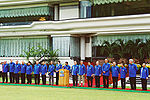 |
http://www.apec2000.gov.bn |
| 13th | October 20–21, 2001 | People's Republic of China |
Shanghai Shanghai Shanghai is the largest city by population in China and the largest city proper in the world. It is one of the four province-level municipalities in the People's Republic of China, with a total population of over 23 million as of 2010... |
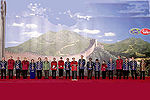
Tangzhuang Tangzhuang Tangzhuang refers to the Chinese jacket that originated at the end of the Qing Dynasty . Tangzhuang evolved from Magua , a Manchu clothing, which was in turn adopted by the Han Chinese during Qing Dynasty. At that time, only noblemen, aristocracy and government officials were wearing it, however,... |
 |
|
| 14th | October 26–27, 2002 | Mexico |
Los Cabos Los Cabos Los Cabos is a municipality located at the southern tip of Mexico's Baja California Peninsula, in the state of Baja California Sur. It encompasses the towns of Cabo San Lucas and San José del Cabo , as well as the Resort Corridor that lies between the two... |
Guayabera Guayabera The guayabera is a men's shirt popular in Latin America, the Caribbean, Southeast Asia, Puerto Rico, the Philippines and Zimbabwe. It is also more recently known as a "Mexican Wedding Shirt."-History:... Shirts (M); Huipíl Huipíl A huipil is a form of Maya textile and tunic or blouse worn by indigenous Mayan, Zapotec, and other women in central to southern Mexico, Guatemala, Belize, El Salvador, and western Honduras, in the northern part of Central America. Some are also worn by men, particularly in Guatemala... es (F) |
||
| 15th | October 20–21, 2003 | Thailand |
Bangkok Bangkok Bangkok is the capital and largest urban area city in Thailand. It is known in Thai as Krung Thep Maha Nakhon or simply Krung Thep , meaning "city of angels." The full name of Bangkok is Krung Thep Mahanakhon Amon Rattanakosin Mahintharayutthaya Mahadilok Phop Noppharat Ratchathani Burirom... |
Brocade Brocade Brocade is a class of richly decorative shuttle-woven fabrics, often made in colored silks and with or without gold and silver threads. The name, related to the same root as the word "broccoli," comes from Italian broccato meaning "embossed cloth," originally past participle of the verb broccare... Shirts (M); Brocade Brocade Brocade is a class of richly decorative shuttle-woven fabrics, often made in colored silks and with or without gold and silver threads. The name, related to the same root as the word "broccoli," comes from Italian broccato meaning "embossed cloth," originally past participle of the verb broccare... Shawls (F) |
 |
|
| 16th | November 20–21, 2004 | Chile |
Santiago Santiago, Chile Santiago , also known as Santiago de Chile, is the capital and largest city of Chile, and the center of its largest conurbation . It is located in the country's central valley, at an elevation of above mean sea level... |
Chamanto Chamanto thumb|right|250px|Chilean businessman and weapon scientist [[Carlos Cardoen]] wearing a chamanto and a [[chupalla]] sombreroA chamanto thumb|right|250px|Chilean businessman and weapon scientist [[Carlos Cardoen]] wearing a chamanto and a [[chupalla]] sombreroA chamanto thumb|right|250px|Chilean... s |
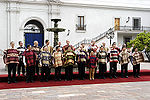 |
http://www.apec2004.cl |
| 17th | November 18–19, 2005 | South Korea |
Busan Busan Busan , formerly spelled Pusan is South Korea's second largest metropolis after Seoul, with a population of around 3.6 million. The Metropolitan area population is 4,399,515 as of 2010. It is the largest port city in South Korea and the fifth largest port in the world... |
Hanbok Hanbok Hanbok or Chosŏn-ot is the traditional Korean dress. It is often characterized by vibrant colors and simple lines without pockets. Although the term literally means "Korean clothing", hanbok today often refers specifically to hanbok of Joseon Dynasty and is worn as semi-formal or formal wear... s |
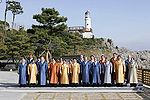 |
|
| 18th | November 18–19, 2006 | Vietnam |
Hanoi Hanoi Hanoi , is the capital of Vietnam and the country's second largest city. Its population in 2009 was estimated at 2.6 million for urban districts, 6.5 million for the metropolitan jurisdiction. From 1010 until 1802, it was the most important political centre of Vietnam... |
Áo dài Áo dài The áo dài is a Vietnamese national costume, now most commonly for women. In its current form, it is a tight-fitting silk tunic worn over pantaloons. The word is pronounced ow zai in the North and ow yai in the South of the country. Áo is derived from a Middle Chinese word meaning "padded coat"... |
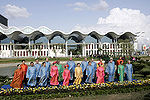 |
http://www.apec2006.vn |
| 19th APEC Australia 2007 APEC Australia 2007 was a series of political meetings held around Australia between the 21 member economies of the Asia-Pacific Economic Cooperation during 2007... |
September 8–9, 2007 | Australia |
Sydney Sydney Sydney is the most populous city in Australia and the state capital of New South Wales. Sydney is located on Australia's south-east coast of the Tasman Sea. As of June 2010, the greater metropolitan area had an approximate population of 4.6 million people... |
Drizabones Driza-Bone Driza-Bone, originating from the phrase "dry as a bone", is a trade name for the company making full-length waterproof riding coats and apparel. The company was established in 1898 and is currently Australian owned and manufactures its products in Australia... and Akubra Hats Akubra Akubra is an Australian brand of bush hat, whose wide-brimmed styles are a distinctive part of Australian culture, especially in rural areas. The name is believed to be derived from an Aboriginal word for head covering.... |
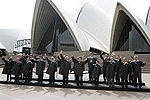 |
http://www.apec2007.org |
| 20th APEC Peru 2008 The APEC Peru 2008 summit was the twentieth annual gather of APEC leaders. The meet was primarily a series of political-economic meetings, which were held in Peru between the 21 members of the Asia-Pacific Economic Cooperation , although business leaders of the region also met before the summit... |
November 22–23, 2008 | Peru |
Lima Lima Lima is the capital and the largest city of Peru. It is located in the valleys of the Chillón, Rímac and Lurín rivers, in the central part of the country, on a desert coast overlooking the Pacific Ocean. Together with the seaport of Callao, it forms a contiguous urban area known as the Lima... |
Ponchos | 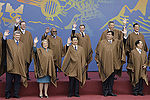 |
http://www.apec2008.org.pe |
| 21st APEC Singapore 2009 Singapore hosted the Asia-Pacific Economic Cooperation meetings from February to November 2009. The APEC 2009 meetings will culminate in the 17th APEC Economic Leaders' Meeting , where Leaders of APEC's 21 member economies will meet from 14 to 15 November 2009.-Theme:The theme for 2009 is... |
November 14–15, 2009 | Singapore |
Singapore Singapore Singapore , officially the Republic of Singapore, is a Southeast Asian city-state off the southern tip of the Malay Peninsula, north of the equator. An island country made up of 63 islands, it is separated from Malaysia by the Straits of Johor to its north and from Indonesia's Riau Islands by the... |
Peranakan Peranakan Peranakan Chinese and Baba-Nyonya are terms used for the descendants of late 15th and 16th-century Chinese immigrants to the Indonesian archipelago of Nusantara during the Colonial era.... -Inspired Designer Shirts |
| http://www.apec2009.sg |
| 22nd APEC Japan 2010 APEC Japan 2010 was a series of meetings of the 21 member Asia-Pacific Economic Cooperation held around Japan in 2010. It culminated in the 18th APEC Economic Leaders' Meeting held in Yokohama, Japan from November 13–14, 2010... |
November 13–14, 2010 | Japan |
Yokohama Yokohama is the capital city of Kanagawa Prefecture and the second largest city in Japan by population after Tokyo and most populous municipality of Japan. It lies on Tokyo Bay, south of Tokyo, in the Kantō region of the main island of Honshu... |
Smart casual Smart casual Smart casual is a loosely defined dress code, casual, yet "smart" enough to conform to the particular standards of certain Western social groups.... |
||
| 23rd APEC United States 2011 APEC United States 2011 was a series of meetings of the 21 Asia-Pacific Economic Cooperation member economies held around the United States in 2011. It culminated in the 19th APEC Economic Leaders' Meeting held at the Hawaii Convention Center in Honolulu, Hawaii from November 12–13, 2011. The... |
November 12–13, 2011 | United States |
Honolulu | Business suits (Tradition ended per request by Barack Obama Barack Obama Barack Hussein Obama II is the 44th and current President of the United States. He is the first African American to hold the office. Obama previously served as a United States Senator from Illinois, from January 2005 until he resigned following his victory in the 2008 presidential election.Born in... ) |
http://www.apec2011.gov/ | |
| 24th APEC Russia 2012 The APEC Russia 2012 summit will be the 24th annual gathering of APEC leaders. Leaders from the member economies will meet on Russky Island, off the coast of Vladivostok, Russia in 2012.... |
November 2012 | Russia |
Vladivostok Vladivostok The city is located in the southern extremity of Muravyov-Amursky Peninsula, which is about 30 km long and approximately 12 km wide.The highest point is Mount Kholodilnik, the height of which is 257 m... |
http://www.apec2012.ru | ||
| 25th | November 2013 | Indonesia |
Manado Manado Manado is the capital of the North Sulawesi province of Indonesia. Manado is located at the Bay of Manado, and is surrounded by a mountainous area. The city has about 405,715 inhabitants, making it the second-largest city in Sulawesi after Makassar... /Bali Bali Bali is an Indonesian island located in the westernmost end of the Lesser Sunda Islands, lying between Java to the west and Lombok to the east... |
Criticism
APEC has been criticized for failing to clearly define itself or serve a useful purpose. According to the organization, it is "the premier forum for facilitating economic growth, cooperation, trade and investment in the Asia-Pacific region" established to "further enhance economic growth and prosperity for the region and to strengthen the Asia-Pacific community." However, whether it has accomplished anything constructive remains debatable, especially from the viewpoints of European countries that can not take part in the activities of APEC and European countries used to having the sphere of influence on the unprecedented colonial territories during 19th century and 20th century in the Asia-Pacific region.See also
- APEC Sydney Metropolitan Public Holiday 2007
- Asia-Europe MeetingAsia-Europe MeetingThe Asia–Europe Meeting was officially established in 1996 at the first summit in Bangkok. ASEM is an interregional forum which consists of the European Commission, the twenty-seven members of the European Union , the thirteen members of the ASEAN Plus Three regional grouping,, as of 2008, India,...
- ASEAN Free Trade AreaASEAN Free Trade AreaASEAN Free Trade Area is a trade bloc agreement by the Association of Southeast Asian Nations supporting local manufacturing in all ASEAN countries....
- East Asia Economic CaucusEast Asia Economic CaucusThe East Asia Economic Caucus or East Asia Economic Group was a regional free trade zone proposed in 1990 by former Malaysian Prime Minister Dr. Mahathir bin Mohamad and encompasses the Association of Southeast Asian Nations member states, China, South Korea and Japan...
- East Asia SummitEast Asia SummitThe East Asia Summit is a forum held annually by leaders of, initially, 16 countries in the East Asian region. Membership will expand to 18 countries including the United States and Russia at the Sixth EAS in 2011. EAS meetings are held after annual ASEAN leaders’ meetings...
- PECC
- Asia-Pacific Trade Agreements Database
Other organizations of coastal states:
- Union for the MediterraneanUnion for the MediterraneanThe Union for the Mediterranean is a multilateral partnership that encompasses 43 countries from Europe and the Mediterranean Basin: the 27 member states of the European Union and 16 Mediterranean partner countries from North Africa, the Middle East and the Balkans...
- Black Sea Economic Cooperation
- Indian Ocean Rim Association for Regional CooperationIndian Ocean Rim Association for Regional CooperationThe Indian Ocean Rim-Association for Regional Cooperation , initially known as the Indian Ocean Rim Initiative, is an international organization with 18 member states...