

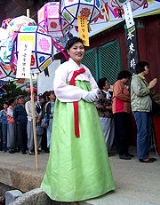
Hanbok

Encyclopedia
Hanbok or Chosŏn-ot (North Korea
) is the traditional Korea
n dress. It is often characterized by vibrant colors and simple lines without pockets. Although the term literally means "Korean clothing", hanbok today often refers specifically to hanbok of Joseon Dynasty
and is worn as semi-formal or formal wear during traditional festivals and celebrations. Modern hanbok does not exactly follow the actual style as worn in Joseon dynasty since it went through some major changes during the 20th century for practical reasons.
Throughout history, Korea had a dual clothing tradition, in which rulers and aristocrats adopted different kinds of mixed foreign-influenced indigenous styles, while the commoners continued to use a distinct style of indigenous clothing that today is known as Hanbok.
, a blouse shirt or a jacket and chima
, a wrap-around skirt, which is usually worn full. The ensemble is often called chima jeogori
. Men's hanbok consists of jeogori and baji which means pants in Korea. The baji were baggy pants in traditional men's hanbok.
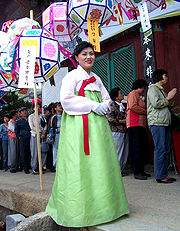
Jeogori
is the basic upper garment of the hanbok, which has been worn by both men and women. It covers the arms and upper part of the wearer's body. The basic form of a jeogori consists of gil, git, dongjeong, goreum and sleeves. Gil (길) is the large section of the garment in both front and back side and git (깃) is a band of fabric that trims the collar. Dongjeong (동정) is a removable white collar placed over the end of the git and is generally squared off. The goreum (고름) are coat-strings that tie the jeogori. Women's jeogori may have kkeutdong (끝동), a different colored cuff
placed at the end of the sleeves.
There are two jeogori that may be the earliest surviving archaeological finds. One from a Yangcheon Heo Clan tomb is dated 1400-1450, while the other was discovered inside a statue of Buddha at Sangwonsa Temple (presumably left as an offering) that has been dated to the 1460s.
The form of Jeogori has changed over time. While men's jeogori remained relatively unchanged, women's jeogori dramatically shortened during Joseon dynasty, reaching its shortest length at the late 19th century. However, due to reformation efforts and practical reasons, modern jeogori for women is longer than its earlier counterpart. Nonetheless the length is still above the waist line. Traditionally, goreum were short and narrow, however modern goreum are rather long and wide. There are several types of jeogori according to fabric, sewing technique, and shape.
refers to "skirt" which is also called sang or gun in hanja
. The underskirt, or petticoat
layer is called sokchima. According to remaining murals of Goguryeo
, and an earthen toy excavated from the neighborhood of Hwangnam-dong
, Gyeongju
, Goguryo women wore a chima first, and then jeogori over the chima, covering its belt.
Although striped, patchwork skirts, and gored
skirts are known from the Goguryeo
period, from the Joseon dynasty at least skirts were made from rectangular cloth that was pleated or gathered into a skirt band. This waistband extended past the skirt fabric itself, and formed ties so that the skirt could be fastened around the trunk of the body.
Sokchima was largely made in a similar way to the overskirts until the early 20th century when straps were added, later developing into a sleeveless bodice or 'reformed' petticoat. By the mid 20th century, some outer chima had also gained a sleeveless bodice, that was then covered by the jeogori.
refers to the lower part of the men's hanbok. It is the formal term for 'pants' in Korean. Compared to western style pants, it does not fit tightly. The roomy nature of the cloth is due to a design aimed at making the cloth ideal for sitting on the floor. It performs similar role today for modern trousers, but Baji is commonly used in Korea for any kinds of pants. There are two straps in front of baji, and a person can tighten up whenever needed.
is a generic term referring to an outer robe
or overcoat
, which was worn mostly by men since the Goryeo
period until the Joseon period. Durumagi
is a variety of po that was worn to protect the cold. It had been widely worn as an outer robe over jeogori and baji. It is also called jumagui, juchaui, or juui.
is an outer jacket. Although jokki and magoja were created at the end of the Joseon Dynasty in which the Western culture began to affect Korea, the garments have been considered parts of traditional clothing. Each is additionally worn over jeogori for warmth and style. Magoja was an originally Manchu
style clothing, but was introduced to Korea after Heungseon Daewongun, the father of King Gojong returned from his political exile in Manchuria
in 1887. Magoja derived from magwae that he wore at that time to protect cold weather of the region. It was good to keep warmth and easy to wear, so that magoja became popular in Korea. It is also called "deot jeogori" (literally "an outer jeogori") or magwae.
Magoja does not have git, band of fabric that trims the collar, goreum (tying strings) unlike jeogori and durumagi
(overcoat). Magoja was originally a male garment, but later became a unisex clothing. The magoja for men has seop (섶, overlapped column on the front) and its length is longer than women's magoja, so that its both sides of the bottom are open. A magoja is made of a silk and is adorned with one or two buttons which are usually made from amber. In a male magoja, buttons are attached to the right side on contrary to women's magoja.
At first, women wore the magoja for style rather than as a daily outfit and especially Kaeseong people used to wear it a lot. It is made of a silk and the color for women tends to be a neutral color to harmonize with other garments such as jeogori and chima
which are worn together. In spring and autumn, a pastel tone is used for the women's magoja, so that wearers could wear it over a jeogori for style. As for men's magoja worn during spring and summer, jade, green, gray, dark grey were used.
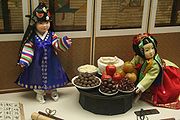 In old days, Kkachi durumagi
(literally "a magpie's overcoat") were worn as seolbim (설빔), new clothing and shoes worn on Seolnal, New Year's Day in the Korean calender, while at present, it is worn as a ceremonial garment for doljanchi
, celebration for a baby's first birthday. It is a children's colorful overcoat
. It was worn mostly by young boys. The clothes is also called obangjang durumagi which means "an overcoat of five directions". It was worn over jeogori
(a jacket) and jokki (a vest) while the wearer could put jeonbok
(a long vest) over it. Kkachi durumagi was also worn along with headgear
such as bokgeon
(a peaked cloth hat), hogeon
(peaked cloth hat with a tiger pattern) for young boys or gulle
(decorative headgear) for young girls.
Modern hanbok for children consists of only two or three pieces and can be put on easily. They are usually made of less expensive fabrics since they are only worn once or twice a year during bigger holidays like Chuseok
and Seolnal. Children are also dressed up in hanbok on their first birthday, dol.
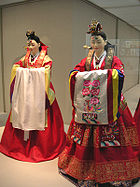 Hanbok is classified according to its purposes: everyday dress, ceremonial dress and special dress. Ceremonial dresses are worn on formal occasions, including a child's first birthday, a wedding or a funeral. Special dresses are made for shamans and officials.
burial site of Noin Ula in northern Mongolia
, and earliest evidence of hanbok's basic design features can be traced to ancient wall murals of Goguryeo before the 3rd century BCE.
Reflecting its nomad
ic origins in northern Asia, hanbok was designed to facilitate ease of movement and also incorporated many shamanistic motifs. From this time, the basic structure of hanbok, namely the jeogori jacket, baji pants, and the chima skirt, was established. Short, tight trousers and tight, waist-length jackets were worn by both men and women during the early years of the Three Kingdoms of Korea
period. The basic structure and these basic design features of hanbok remains relatively unchanged to this day.
Toward the end of the Three Kingdoms period
, noblewomen began to wear full-length skirts and hip-length jackets belted at the waist and noblemen began to wear roomy trousers bound in at the ankles and a narrow, tunic
-style jacket cuffed at the wrists and belted at the waist.
Although most foreign influence on Hanbok didn't last or was superficial, Mongolian clothing is an exception as the only foreign influence that made significant visible changes to Hanbok. After Goryeo
Dynasty (918–1392) signed peace treaty with the Mongol Empire
in the 13th century, Mongolian princesses who married into Korean royal house brought with them Mongolian fashion which began to prevail in both formal and private life. As a result of this influence, the chima skirt was shortened, and jeogori was hiked up above the waist and tied at the chest with a long, wide ribbon, the goruem (instead of being belted) and the sleeves were curved slightly. Cultural exchange was not one way however. Goryeo had significant cultural influence on the Mongol court of Yuan Dynasty, the most visible of which was adoption of women's hanbok by the aristocrats, queens and concubines of the Mongol court.
appeared to continue the women's fashion for baggy, loose clothing, such as those seen on the mural from the tomb of Bak Ik (1332–1398). However, by the 16th century, the jeogori had shortened to the waist, and appears to have become closer fitting, although not to the extremes of the bell-shaped silhouette of the 18th and 19th centuries.
Today's hanbok is the direct descendant of hanbok as worn in the Joseon dynasty period, specifically the late 19th century. Hanbok had gone through various changes and "fashion fads" during the five hundred years under the reigns of Joseon kings and eventually evolved to what we now mostly relate to as a typical hanbok.
or skirt adopted fuller volumn while the jeogori
or blouse took more tightened and shortened form, which are features quite distinct from the hanbok of previous centuries, when chima was rather slim and jeogori baggy and long, reaching well below the waist level. After the Imjin War economic hardship on the peninsula may have influenced the closer-fitting styles that would use less fabric. However, this explanation doesn't take into account the ever expanding voluminous size of the dress which must have increased the use of fabric despite the disastrous effects of the war.
In the eighteenth century, the short lenghth of jeogori reached extremity as to scarcely cover the breasts. Therefore women of respectable social backgrounds began to wear a piece of long cloth called heoritti around the breast. Heoritti was originally worn as an undergarment beneath the jeogori, but was now worn as an outwear. The common and lowborn classes, however, often eschewed the heoritti altogether, as a way of indicating that they had given birth to a son. This also may have assisted with breastfeeding.
During the seventeenth and eighteenth centuries the fullness of the skirt was concentratrated around the hips, thus forming a silhouette similar to Western bustles. The fullness of the skirt reached its extreme around 1800. During the nineteenth century fullness of the skirt was achieved around the knees and ankles thus giving chima a triangular or an A-shaped silhouette, which is still the preferred style to this day. Many undergarments such as darisokgot, soksokgot, dansokgot, and gojengi were worn underneath to achieve desired forms.
A clothes reformation movement, which aimed to lengthen jeogori, experienced quite a success in the early twentieth century and has continued to influence the shaping of modern hanbok. Modern jeogori are longer, although still halfway between the waistline and the breasts. Heoritti are sometimes exposed for aesthetic reasons. At the end of nineteenth century, Daewon-gun
introduced Magoja
, a Manchu
-style jacket, to Korea, which is often worn over jeogori to this day.
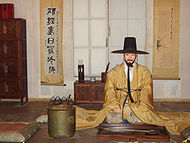 Men's hanbok saw little change compared to women's hanbok. The form and design of jeogori and baji hardly changed.
However, men's lengthy outwear, equivalent of modern overcoat went through quite a dramatic change. Before the late 19th century, yangban
men almost always wore jungchimak when going abroad. Jungchimak had very lengthy sleeves and its lower part had splits on both sides and occasionally on the back so as to create fluttering effect when walking. To some this was considered fashionable, and to some, namely stoic scholars, it was nothing but pure vanity. Daewon-gun successfully banned jungchimak as a part of his clothes reformation program and jungchimak eventually disappeared.
Durumagi, which was previously worn underneath jungchimak and basically a house dress substituted jungchimak as the formal outwear for yangban men. Durumagi
differs from its predecessor in that it has tighter sleeves and does not have splits on either sides and the back. It is also slightly shorter in length. Men's hanbok has remained relatively the same since the adoption of durumagi.
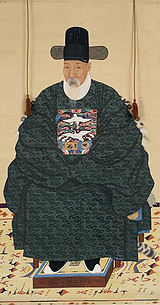 Gwanbok
is a Korea
n term which refers to all formal attires of government officials. It began to be worn since Silla period until Joseon Dynasty
. During the Silla
period, the official robe system of Tang China was imported and put into practice, while the Goryeo
court robes were adopted similarly to those of Mongolian Yuan
. In the Joseon period, Ming China's official robes were adopted. There were several types of gwanbok which differs in color and design according to the wearer's status, rank, and occasion such as jobok, jebok, sangbok, gongbok, yungbok, and gunbok.
Jobok was the gwanbok worn for special occasions such as national festivals, or announcement of royal decrees. Jebok was the gwanbok worn while an ancestor veneration ritual called jesa was held. Sangbok was worn as a daily official clothing while gongbok was worn when officers had an audience with the king at the palace. Yungbok was related to military affairs.
However, as the term in a narrow scope only denote the gongbok and sangbok, it means dallyeong, robe with a round collar.
cloth or other high-grade lightweight materials in warm weather and of plain and patterned silks the rest of the year. Commoners were restricted by law as well as resources to cotton at best.
The upper classes wore a variety of colors, though bright colors were generally worn by children and girls and subdued colors by middle-aged men and women. Commoners were restricted by law to everyday clothes of white, but for special occasions they wore dull shades of pale pink, light green, gray, and charcoal. The color of chima showed the wearer's social position and statement. For example, a navy color indicated that a woman had son(s). Only the royal family could wear clothing with geumbak
-printed patterns (gold leaf) on the bottom of chima.
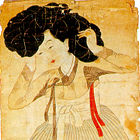 Both male and female wore their hair in a long braid
until they were married, at which time the hair was knotted; man's hair was knotted in a topknot called sangtu (상투) on the top of the head and the woman’s hair was rolled into a ball shaped form and was set just above the nape of the neck.
A long pin, or binyeo (비녀), was thrust through the knotted hair of the woman as both a fastener and a decoration. The material and length of the binyeo varied according to the wearer’s class and status. Women wore a jokduri on their wedding day, and wore an ayam for protection from the cold. Men wore a gat, which varied according to class and status.
Before 19th century women of high social backgrounds and gisaeng wore wigs (gache
). Like their Western counterparts, Koreans considered bigger and heavier wigs to be more desirable and aesthetic. Such was the women's frenzy for the gache that in 1788 King Jeongjo
prohibited and banned, by royal decree, the use of gache, as they were deemed contrary to Korean Confucian values of reserve and restraint
In the 19th century yangban women began to wear jokduri
, a small hat that substituted gache. However gache enjoyed vast popularity in gisaeng circles well into the end of the century.
As Silla
unified the Three Kingdoms of Korea
, various foreign cultures and systems were imported from Tang China. In the process, the latest fashion trend of Luoyang
, the capital of Tang, were also introduced to Korea. This fashion was similar to the Western empire style
but differed from the Korean style in that women wore a skirt over a jacket to make the body slim. After the unification, Korean women started wearing the new style, which was popular not only in China but also in countries influenced by the Silk Road
exchange. The style was, however, discontinued during the Goryeo
dynasty, the next ruling state of Korea. Dallyeong, a style of clothing from nomadic cultures of Western Asia, was introduced via Tang China and was adopted as the official robe system, Gwanbok
, in the 4th century until the 17th century.
Beginning in the late 19th century, use of hanfu was entirely replaced by new Western imports such as the Western suit
and dress
. Today, formal and casual wears are usually based on Western styles, while Hanbok is still used for traditional purposes.
North Korea
The Democratic People’s Republic of Korea , , is a country in East Asia, occupying the northern half of the Korean Peninsula. Its capital and largest city is Pyongyang. The Korean Demilitarized Zone serves as the buffer zone between North Korea and South Korea...
) is the traditional Korea
Korea
Korea ) is an East Asian geographic region that is currently divided into two separate sovereign states — North Korea and South Korea. Located on the Korean Peninsula, Korea is bordered by the People's Republic of China to the northwest, Russia to the northeast, and is separated from Japan to the...
n dress. It is often characterized by vibrant colors and simple lines without pockets. Although the term literally means "Korean clothing", hanbok today often refers specifically to hanbok of Joseon Dynasty
Joseon Dynasty
Joseon , was a Korean state founded by Taejo Yi Seong-gye that lasted for approximately five centuries. It was founded in the aftermath of the overthrow of the Goryeo at what is today the city of Kaesong. Early on, Korea was retitled and the capital was relocated to modern-day Seoul...
and is worn as semi-formal or formal wear during traditional festivals and celebrations. Modern hanbok does not exactly follow the actual style as worn in Joseon dynasty since it went through some major changes during the 20th century for practical reasons.
Throughout history, Korea had a dual clothing tradition, in which rulers and aristocrats adopted different kinds of mixed foreign-influenced indigenous styles, while the commoners continued to use a distinct style of indigenous clothing that today is known as Hanbok.
Basic Composition and Design
Traditional women's hanbok consists of jeogoriJeogori
The jeogori is a basic upper garment of hanbok, Korean traditional garment, which has been worn by both men and women. It covers the arms and upper part of the wearer's body.-Etymology:...
, a blouse shirt or a jacket and chima
Chima (clothing)
Chima is a type of skirt worn together with jeogori, or a short jacket in hanbok, Korean traditional clothing. It is also referred to as sang or gun in hanja, Chinese characters adapted for Korean language....
, a wrap-around skirt, which is usually worn full. The ensemble is often called chima jeogori
Chima jeogori
Chima jeogori is a Korean term for a women's outfit consisting of a chima skirt and jeogori top. Men wear baji jeogori: baji and jeogori...
. Men's hanbok consists of jeogori and baji which means pants in Korea. The baji were baggy pants in traditional men's hanbok.
Jeogori
Jeogori
Jeogori
The jeogori is a basic upper garment of hanbok, Korean traditional garment, which has been worn by both men and women. It covers the arms and upper part of the wearer's body.-Etymology:...
is the basic upper garment of the hanbok, which has been worn by both men and women. It covers the arms and upper part of the wearer's body. The basic form of a jeogori consists of gil, git, dongjeong, goreum and sleeves. Gil (길) is the large section of the garment in both front and back side and git (깃) is a band of fabric that trims the collar. Dongjeong (동정) is a removable white collar placed over the end of the git and is generally squared off. The goreum (고름) are coat-strings that tie the jeogori. Women's jeogori may have kkeutdong (끝동), a different colored cuff
Cuff
A cuff is an extra layer of fabric at the lower edge of the sleeve of a garment covering the arms. In US usage the word may also refer to the end of the leg of a pair of trousers...
placed at the end of the sleeves.
There are two jeogori that may be the earliest surviving archaeological finds. One from a Yangcheon Heo Clan tomb is dated 1400-1450, while the other was discovered inside a statue of Buddha at Sangwonsa Temple (presumably left as an offering) that has been dated to the 1460s.
The form of Jeogori has changed over time. While men's jeogori remained relatively unchanged, women's jeogori dramatically shortened during Joseon dynasty, reaching its shortest length at the late 19th century. However, due to reformation efforts and practical reasons, modern jeogori for women is longer than its earlier counterpart. Nonetheless the length is still above the waist line. Traditionally, goreum were short and narrow, however modern goreum are rather long and wide. There are several types of jeogori according to fabric, sewing technique, and shape.
Chima
ChimaChima (clothing)
Chima is a type of skirt worn together with jeogori, or a short jacket in hanbok, Korean traditional clothing. It is also referred to as sang or gun in hanja, Chinese characters adapted for Korean language....
refers to "skirt" which is also called sang or gun in hanja
Hanja
Hanja is the Korean name for the Chinese characters hanzi. More specifically, it refers to those Chinese characters borrowed from Chinese and incorporated into the Korean language with Korean pronunciation...
. The underskirt, or petticoat
Petticoat
A petticoat or underskirt is an article of clothing for women; specifically an undergarment to be worn under a skirt or a dress. The petticoat is a separate garment hanging from the waist ....
layer is called sokchima. According to remaining murals of Goguryeo
Goguryeo
Goguryeo or Koguryŏ was an ancient Korean kingdom located in present day northern and central parts of the Korean Peninsula, southern Manchuria, and southern Russian Maritime province....
, and an earthen toy excavated from the neighborhood of Hwangnam-dong
Hwangnam-dong
Hwangnam-dong is a dong or a neighbourhood of the Gyeongju City, North Gyeongsang province, South Korea. It is bordered by Dodong-dong on the east, Tapjeong-dong on the west, Naenam-myeon on the south and Jungang-dong on the north. Its 20.5 square kilometers are home to about 8,885 people...
, Gyeongju
Gyeongju
Gyeongju is a coastal city in the far southeastern corner of North Gyeongsang province in South Korea. It is the second largest city by area in the province after Andong, covering with a population of 269,343 people according to the 2008 census. Gyeongju is southeast of Seoul, and east of the...
, Goguryo women wore a chima first, and then jeogori over the chima, covering its belt.
Although striped, patchwork skirts, and gored
Gore (segment)
A gore is a segment of a three-dimensional shape fabricated from a two-dimensional material. The term was originally used to describe triangular shapes, but is now extended to any shape that can be used to create the third dimension.-Examples:...
skirts are known from the Goguryeo
Goguryeo
Goguryeo or Koguryŏ was an ancient Korean kingdom located in present day northern and central parts of the Korean Peninsula, southern Manchuria, and southern Russian Maritime province....
period, from the Joseon dynasty at least skirts were made from rectangular cloth that was pleated or gathered into a skirt band. This waistband extended past the skirt fabric itself, and formed ties so that the skirt could be fastened around the trunk of the body.
Sokchima was largely made in a similar way to the overskirts until the early 20th century when straps were added, later developing into a sleeveless bodice or 'reformed' petticoat. By the mid 20th century, some outer chima had also gained a sleeveless bodice, that was then covered by the jeogori.
Baji
BajiBaji (clothing)
Baji is a kind of traditional Korean pant that is part of the hanbok. A baji is baggy and loose, so it is tied around the waist. In the past, Korean men wore baji as outer clothing, but for women, it gradually became part of the inner clothing. Today, women wear chima for their outer clothes....
refers to the lower part of the men's hanbok. It is the formal term for 'pants' in Korean. Compared to western style pants, it does not fit tightly. The roomy nature of the cloth is due to a design aimed at making the cloth ideal for sitting on the floor. It performs similar role today for modern trousers, but Baji is commonly used in Korea for any kinds of pants. There are two straps in front of baji, and a person can tighten up whenever needed.
Po
PoPo (clothing)
The po is a generic term referring to an outer robe or overcoat in hanbok, Korean traditional clothing, which was worn mostly by men since the Goryeo period until the Joseon period.-See also:*Jeogori*Dopo*Durumagi*Sagyusam*Jeonbok*Hanbok...
is a generic term referring to an outer robe
Robe
A robe is a loose-fitting outer garment. A robe is distinguished from a cape or cloak by the fact that it usually has sleeves. The English word robe derives from Middle English robe , borrowed from Old French robe , itself taken from the Frankish word *rouba , and is related to the word rob...
or overcoat
Overcoat
An overcoat is a type of long coat intended to be worn as the outermost garment. Overcoats usually extend below the knee, but are sometimes mistakenly referred to as topcoats, which are short coats that end at or above the knees. Topcoats and overcoats together are known as outercoats...
, which was worn mostly by men since the Goryeo
Goryeo
The Goryeo Dynasty or Koryŏ was a Korean dynasty established in 918 by Emperor Taejo. Korea gets its name from this kingdom which came to be pronounced Korea. It united the Later Three Kingdoms in 936 and ruled most of the Korean peninsula until it was removed by the Joseon dynasty in 1392...
period until the Joseon period. Durumagi
Durumagi
Durumagi is a variety of po, or overcoat in hanbok, the Korean traditional garment. It is usually the topmost layer of clothing that is worn over jeogori and baji . Durumagi means "closed all around", and is also known as jumagui , juchaui or juui...
is a variety of po that was worn to protect the cold. It had been widely worn as an outer robe over jeogori and baji. It is also called jumagui, juchaui, or juui.
Jokki and magoja
Jokki (조끼) is a type of vest while magojaMagoja
Magoja is a type of upper garment in hanbok, traditional Korean costume which is worn over jeogori . It is also called magwae and was originally a male garment, but later became a unisex clothing...
is an outer jacket. Although jokki and magoja were created at the end of the Joseon Dynasty in which the Western culture began to affect Korea, the garments have been considered parts of traditional clothing. Each is additionally worn over jeogori for warmth and style. Magoja was an originally Manchu
Manchu
The Manchu people or Man are an ethnic minority of China who originated in Manchuria . During their rise in the 17th century, with the help of the Ming dynasty rebels , they came to power in China and founded the Qing Dynasty, which ruled China until the Xinhai Revolution of 1911, which...
style clothing, but was introduced to Korea after Heungseon Daewongun, the father of King Gojong returned from his political exile in Manchuria
Manchuria
Manchuria is a historical name given to a large geographic region in northeast Asia. Depending on the definition of its extent, Manchuria usually falls entirely within the People's Republic of China, or is sometimes divided between China and Russia. The region is commonly referred to as Northeast...
in 1887. Magoja derived from magwae that he wore at that time to protect cold weather of the region. It was good to keep warmth and easy to wear, so that magoja became popular in Korea. It is also called "deot jeogori" (literally "an outer jeogori") or magwae.
Magoja does not have git, band of fabric that trims the collar, goreum (tying strings) unlike jeogori and durumagi
Durumagi
Durumagi is a variety of po, or overcoat in hanbok, the Korean traditional garment. It is usually the topmost layer of clothing that is worn over jeogori and baji . Durumagi means "closed all around", and is also known as jumagui , juchaui or juui...
(overcoat). Magoja was originally a male garment, but later became a unisex clothing. The magoja for men has seop (섶, overlapped column on the front) and its length is longer than women's magoja, so that its both sides of the bottom are open. A magoja is made of a silk and is adorned with one or two buttons which are usually made from amber. In a male magoja, buttons are attached to the right side on contrary to women's magoja.
At first, women wore the magoja for style rather than as a daily outfit and especially Kaeseong people used to wear it a lot. It is made of a silk and the color for women tends to be a neutral color to harmonize with other garments such as jeogori and chima
Chima (clothing)
Chima is a type of skirt worn together with jeogori, or a short jacket in hanbok, Korean traditional clothing. It is also referred to as sang or gun in hanja, Chinese characters adapted for Korean language....
which are worn together. In spring and autumn, a pastel tone is used for the women's magoja, so that wearers could wear it over a jeogori for style. As for men's magoja worn during spring and summer, jade, green, gray, dark grey were used.
Children's hanbok
Kkachi durumagi
Kkachi durumagi is a children's colorful overcoat in hanbok, traditional Korean clothing, which was worn on Seolnal, New Year's Day in the Lunar calendar. It was worn mostly by young boys and literally means "a magpie's overcoat". The clothes is also called obangjang durumagi which denotes "an...
(literally "a magpie's overcoat") were worn as seolbim (설빔), new clothing and shoes worn on Seolnal, New Year's Day in the Korean calender, while at present, it is worn as a ceremonial garment for doljanchi
Doljanchi
Dol or doljanchi is a Korean tradition that celebrates the birthday of a one-year-old baby. This ceremony blesses the child with a prosperous future and has taken on great significance in Korea...
, celebration for a baby's first birthday. It is a children's colorful overcoat
Overcoat
An overcoat is a type of long coat intended to be worn as the outermost garment. Overcoats usually extend below the knee, but are sometimes mistakenly referred to as topcoats, which are short coats that end at or above the knees. Topcoats and overcoats together are known as outercoats...
. It was worn mostly by young boys. The clothes is also called obangjang durumagi which means "an overcoat of five directions". It was worn over jeogori
Jeogori
The jeogori is a basic upper garment of hanbok, Korean traditional garment, which has been worn by both men and women. It covers the arms and upper part of the wearer's body.-Etymology:...
(a jacket) and jokki (a vest) while the wearer could put jeonbok
Jeonbok
The jeonbok is a type of sleeveless long vest in hanbok, traditional Korean clothing, which was worn by military personnel. It does not have overlapped column on the front side, and was worn over dongdari ....
(a long vest) over it. Kkachi durumagi was also worn along with headgear
Headgear
Headgear, headwear or headdress is the name given to any element of clothing which is worn on one's head.Headgear serve a variety of purposes:...
such as bokgeon
Bokgeon
Bokgeon is a type of gwanmo , traditional Korean headgear made from a black fabric. Although it had been worn by a few Confucian scholars until the late Joseon period, it later became a decorative headgear for baby boys' dol which is a way of celebrating the birthday of a one-year-old baby....
(a peaked cloth hat), hogeon
Hogeon
A hogeon is a type of gwanmo , Korean traditional headgear for young boys aged one year to five years old. It was worn along with durumagi or jeonbok . Hogeon was worn on holidays such as Seolnal , Chuseok , or celebrations for their birthdays like doljanchi...
(peaked cloth hat with a tiger pattern) for young boys or gulle
Gulle
A gulle is a type of sseugae , Korean traditional headgear, worn by children aged one year to five years old during the late Joseon period. It was mostly worn by young girls in the upper class for warmth and style. Gullae was usually made with silk and in summer, it was made with sa , a type of...
(decorative headgear) for young girls.
Modern hanbok for children consists of only two or three pieces and can be put on easily. They are usually made of less expensive fabrics since they are only worn once or twice a year during bigger holidays like Chuseok
Chuseok
Chuseok , originally known as Hangawi , is a major harvest festival and a three-day holiday in Korea celebrated on the 15th day of the 8th month of the lunar calendar. Like many other harvest festivals, it is held around the Autumn Equinox...
and Seolnal. Children are also dressed up in hanbok on their first birthday, dol.
Occasions
Antiquity
The hanbok can trace its origin to nomadic clothing in the Scytho-Siberian cultural sphere of northern Asia, widespread in ancient times. The earliest evidence of this common style of northern Asia can be found in the XiongnuXiongnu
The Xiongnu were ancient nomadic-based people that formed a state or confederation north of the agriculture-based empire of the Han Dynasty. Most of the information on the Xiongnu comes from Chinese sources...
burial site of Noin Ula in northern Mongolia
Mongolia
Mongolia is a landlocked country in East and Central Asia. It is bordered by Russia to the north and China to the south, east and west. Although Mongolia does not share a border with Kazakhstan, its western-most point is only from Kazakhstan's eastern tip. Ulan Bator, the capital and largest...
, and earliest evidence of hanbok's basic design features can be traced to ancient wall murals of Goguryeo before the 3rd century BCE.
Reflecting its nomad
Nomad
Nomadic people , commonly known as itinerants in modern-day contexts, are communities of people who move from one place to another, rather than settling permanently in one location. There are an estimated 30-40 million nomads in the world. Many cultures have traditionally been nomadic, but...
ic origins in northern Asia, hanbok was designed to facilitate ease of movement and also incorporated many shamanistic motifs. From this time, the basic structure of hanbok, namely the jeogori jacket, baji pants, and the chima skirt, was established. Short, tight trousers and tight, waist-length jackets were worn by both men and women during the early years of the Three Kingdoms of Korea
Three Kingdoms of Korea
The Three Kingdoms of Korea refer to the ancient Korean kingdoms of Goguryeo, Baekje and Silla, which dominated the Korean peninsula and parts of Manchuria for much of the 1st millennium...
period. The basic structure and these basic design features of hanbok remains relatively unchanged to this day.
Toward the end of the Three Kingdoms period
Three Kingdoms of Korea
The Three Kingdoms of Korea refer to the ancient Korean kingdoms of Goguryeo, Baekje and Silla, which dominated the Korean peninsula and parts of Manchuria for much of the 1st millennium...
, noblewomen began to wear full-length skirts and hip-length jackets belted at the waist and noblemen began to wear roomy trousers bound in at the ankles and a narrow, tunic
Tunic
A tunic is any of several types of clothing for the body, of various lengths reaching from the shoulders to somewhere between the hips and the ankles...
-style jacket cuffed at the wrists and belted at the waist.
Although most foreign influence on Hanbok didn't last or was superficial, Mongolian clothing is an exception as the only foreign influence that made significant visible changes to Hanbok. After Goryeo
Goryeo
The Goryeo Dynasty or Koryŏ was a Korean dynasty established in 918 by Emperor Taejo. Korea gets its name from this kingdom which came to be pronounced Korea. It united the Later Three Kingdoms in 936 and ruled most of the Korean peninsula until it was removed by the Joseon dynasty in 1392...
Dynasty (918–1392) signed peace treaty with the Mongol Empire
Mongol Empire
The Mongol Empire , initially named as Greater Mongol State was a great empire during the 13th and 14th centuries...
in the 13th century, Mongolian princesses who married into Korean royal house brought with them Mongolian fashion which began to prevail in both formal and private life. As a result of this influence, the chima skirt was shortened, and jeogori was hiked up above the waist and tied at the chest with a long, wide ribbon, the goruem (instead of being belted) and the sleeves were curved slightly. Cultural exchange was not one way however. Goryeo had significant cultural influence on the Mongol court of Yuan Dynasty, the most visible of which was adoption of women's hanbok by the aristocrats, queens and concubines of the Mongol court.
Joseon dynasty
The early Joseon dynastyJoseon Dynasty
Joseon , was a Korean state founded by Taejo Yi Seong-gye that lasted for approximately five centuries. It was founded in the aftermath of the overthrow of the Goryeo at what is today the city of Kaesong. Early on, Korea was retitled and the capital was relocated to modern-day Seoul...
appeared to continue the women's fashion for baggy, loose clothing, such as those seen on the mural from the tomb of Bak Ik (1332–1398). However, by the 16th century, the jeogori had shortened to the waist, and appears to have become closer fitting, although not to the extremes of the bell-shaped silhouette of the 18th and 19th centuries.
Today's hanbok is the direct descendant of hanbok as worn in the Joseon dynasty period, specifically the late 19th century. Hanbok had gone through various changes and "fashion fads" during the five hundred years under the reigns of Joseon kings and eventually evolved to what we now mostly relate to as a typical hanbok.
Everyday wear
During the Joseon Dynasty, the chimaChima
Chima is a town and municipality in the Santander Department in northeastern Colombia....
or skirt adopted fuller volumn while the jeogori
Jeogori
The jeogori is a basic upper garment of hanbok, Korean traditional garment, which has been worn by both men and women. It covers the arms and upper part of the wearer's body.-Etymology:...
or blouse took more tightened and shortened form, which are features quite distinct from the hanbok of previous centuries, when chima was rather slim and jeogori baggy and long, reaching well below the waist level. After the Imjin War economic hardship on the peninsula may have influenced the closer-fitting styles that would use less fabric. However, this explanation doesn't take into account the ever expanding voluminous size of the dress which must have increased the use of fabric despite the disastrous effects of the war.
In the eighteenth century, the short lenghth of jeogori reached extremity as to scarcely cover the breasts. Therefore women of respectable social backgrounds began to wear a piece of long cloth called heoritti around the breast. Heoritti was originally worn as an undergarment beneath the jeogori, but was now worn as an outwear. The common and lowborn classes, however, often eschewed the heoritti altogether, as a way of indicating that they had given birth to a son. This also may have assisted with breastfeeding.
During the seventeenth and eighteenth centuries the fullness of the skirt was concentratrated around the hips, thus forming a silhouette similar to Western bustles. The fullness of the skirt reached its extreme around 1800. During the nineteenth century fullness of the skirt was achieved around the knees and ankles thus giving chima a triangular or an A-shaped silhouette, which is still the preferred style to this day. Many undergarments such as darisokgot, soksokgot, dansokgot, and gojengi were worn underneath to achieve desired forms.
A clothes reformation movement, which aimed to lengthen jeogori, experienced quite a success in the early twentieth century and has continued to influence the shaping of modern hanbok. Modern jeogori are longer, although still halfway between the waistline and the breasts. Heoritti are sometimes exposed for aesthetic reasons. At the end of nineteenth century, Daewon-gun
Daewon-gun
Heungseon Daewongun or The Daewongun , or formally Heungseon Heonui Daewonwang and also known to period western diplomats as Prince Gung, was the title of Yi Ha-eung, regent of Joseon during the minority of King Gojong in the 1860s and until his death a key political figure of late Joseon...
introduced Magoja
Magoja
Magoja is a type of upper garment in hanbok, traditional Korean costume which is worn over jeogori . It is also called magwae and was originally a male garment, but later became a unisex clothing...
, a Manchu
Manchu
The Manchu people or Man are an ethnic minority of China who originated in Manchuria . During their rise in the 17th century, with the help of the Ming dynasty rebels , they came to power in China and founded the Qing Dynasty, which ruled China until the Xinhai Revolution of 1911, which...
-style jacket, to Korea, which is often worn over jeogori to this day.
However, men's lengthy outwear, equivalent of modern overcoat went through quite a dramatic change. Before the late 19th century, yangban
Yangban
The yangban were part of the traditional ruling class or nobles of dynastic Korea during the Joseon Dynasty. The yangban were either landed or unlanded aristocracy who comprised the Korean Confucian idea of a "scholarly official." In reality, they were basically administrators and bureaucrats who...
men almost always wore jungchimak when going abroad. Jungchimak had very lengthy sleeves and its lower part had splits on both sides and occasionally on the back so as to create fluttering effect when walking. To some this was considered fashionable, and to some, namely stoic scholars, it was nothing but pure vanity. Daewon-gun successfully banned jungchimak as a part of his clothes reformation program and jungchimak eventually disappeared.
Durumagi, which was previously worn underneath jungchimak and basically a house dress substituted jungchimak as the formal outwear for yangban men. Durumagi
Durumagi
Durumagi is a variety of po, or overcoat in hanbok, the Korean traditional garment. It is usually the topmost layer of clothing that is worn over jeogori and baji . Durumagi means "closed all around", and is also known as jumagui , juchaui or juui...
differs from its predecessor in that it has tighter sleeves and does not have splits on either sides and the back. It is also slightly shorter in length. Men's hanbok has remained relatively the same since the adoption of durumagi.
Hanbok for formal occasions
Gwanbok
Gwanbok is a Korean general term referring to all business attires of government officers given by government, with Rank badge on them to distinguish hierarchies. It began to be worn since Silla period until Joseon Dynasty...
is a Korea
Korea
Korea ) is an East Asian geographic region that is currently divided into two separate sovereign states — North Korea and South Korea. Located on the Korean Peninsula, Korea is bordered by the People's Republic of China to the northwest, Russia to the northeast, and is separated from Japan to the...
n term which refers to all formal attires of government officials. It began to be worn since Silla period until Joseon Dynasty
Joseon Dynasty
Joseon , was a Korean state founded by Taejo Yi Seong-gye that lasted for approximately five centuries. It was founded in the aftermath of the overthrow of the Goryeo at what is today the city of Kaesong. Early on, Korea was retitled and the capital was relocated to modern-day Seoul...
. During the Silla
Silla
Silla was one of the Three Kingdoms of Korea, and one of the longest sustained dynasties in...
period, the official robe system of Tang China was imported and put into practice, while the Goryeo
Goryeo
The Goryeo Dynasty or Koryŏ was a Korean dynasty established in 918 by Emperor Taejo. Korea gets its name from this kingdom which came to be pronounced Korea. It united the Later Three Kingdoms in 936 and ruled most of the Korean peninsula until it was removed by the Joseon dynasty in 1392...
court robes were adopted similarly to those of Mongolian Yuan
Yuan Dynasty
The Yuan Dynasty , or Great Yuan Empire was a ruling dynasty founded by the Mongol leader Kublai Khan, who ruled most of present-day China, all of modern Mongolia and its surrounding areas, lasting officially from 1271 to 1368. It is considered both as a division of the Mongol Empire and as an...
. In the Joseon period, Ming China's official robes were adopted. There were several types of gwanbok which differs in color and design according to the wearer's status, rank, and occasion such as jobok, jebok, sangbok, gongbok, yungbok, and gunbok.
Jobok was the gwanbok worn for special occasions such as national festivals, or announcement of royal decrees. Jebok was the gwanbok worn while an ancestor veneration ritual called jesa was held. Sangbok was worn as a daily official clothing while gongbok was worn when officers had an audience with the king at the palace. Yungbok was related to military affairs.
However, as the term in a narrow scope only denote the gongbok and sangbok, it means dallyeong, robe with a round collar.
Material and Color
The upper classes wore hanbok of closely woven ramieRamie
Ramie is a flowering plant in the nettle family Urticaceae, native to eastern Asia. It is a herbaceous perennial growing to 1–2.5 m tall; the leaves are heart-shaped, 7–15 cm long and 6–12 cm broad, and white on the underside with dense small hairs—this gives it a silvery appearance;...
cloth or other high-grade lightweight materials in warm weather and of plain and patterned silks the rest of the year. Commoners were restricted by law as well as resources to cotton at best.
The upper classes wore a variety of colors, though bright colors were generally worn by children and girls and subdued colors by middle-aged men and women. Commoners were restricted by law to everyday clothes of white, but for special occasions they wore dull shades of pale pink, light green, gray, and charcoal. The color of chima showed the wearer's social position and statement. For example, a navy color indicated that a woman had son(s). Only the royal family could wear clothing with geumbak
Geumbak
Geumbak is a Korean traditional craft for applying extremely thin gold leaf on hanbok , or other fabrics for decoration. Artisans who specialize in the technique are called geumbakjang and among them, Kim Deokhwan has been designated as the title holder of the 119th Important Intangible Cultural...
-printed patterns (gold leaf) on the bottom of chima.
Head dresses
Braid
A braid is a complex structure or pattern formed by intertwining three or more strands of flexible material such as textile fibres, wire, or human hair...
until they were married, at which time the hair was knotted; man's hair was knotted in a topknot called sangtu (상투) on the top of the head and the woman’s hair was rolled into a ball shaped form and was set just above the nape of the neck.
A long pin, or binyeo (비녀), was thrust through the knotted hair of the woman as both a fastener and a decoration. The material and length of the binyeo varied according to the wearer’s class and status. Women wore a jokduri on their wedding day, and wore an ayam for protection from the cold. Men wore a gat, which varied according to class and status.
Before 19th century women of high social backgrounds and gisaeng wore wigs (gache
Gache
Gache is a big wig worn by Korean women. Women of high social backgrounds and gisaeng wore wigs . Like their western contemporaries Koreans considered bigger and heavier wigs to be more aesthetic...
). Like their Western counterparts, Koreans considered bigger and heavier wigs to be more desirable and aesthetic. Such was the women's frenzy for the gache that in 1788 King Jeongjo
Jeongjo of Joseon
King Jeongjo was the 22nd ruler of the Joseon Dynasty of Korea. He made various attempts to reform and improve the nation of Joseon. He was preceded by his grandfather King Yeongjo and succeeded by his son King Sunjo...
prohibited and banned, by royal decree, the use of gache, as they were deemed contrary to Korean Confucian values of reserve and restraint
In the 19th century yangban women began to wear jokduri
Jokduri
A jokduri is a type of Korean traditional coronet worn by women for special occasions such as weddings. It consists of an outer crown which is covered with black silk, and the inner which is filled with cotton and hard paper. Its top is decorated with cloisonné ornaments. The crown is also called...
, a small hat that substituted gache. However gache enjoyed vast popularity in gisaeng circles well into the end of the century.
Foreign influence
Some foreign-styled clothing was adopted by the upper class, but its use was always separate from the tradition of hanbok, and was eventually replaced by Western influences. With increasing cultural ties between Korea and China since the latter half of the Three Kingdoms period, the aristocratic class and rulers started adopting traditional style of Chinese clothes very different from Hanbok. Unlike the aristocrats, the majority of commoners continued to use Hanbok, and many aristocrats also continued to use Hanbok for less formal occasions or at the comfort of their homes.As Silla
Silla
Silla was one of the Three Kingdoms of Korea, and one of the longest sustained dynasties in...
unified the Three Kingdoms of Korea
Three Kingdoms of Korea
The Three Kingdoms of Korea refer to the ancient Korean kingdoms of Goguryeo, Baekje and Silla, which dominated the Korean peninsula and parts of Manchuria for much of the 1st millennium...
, various foreign cultures and systems were imported from Tang China. In the process, the latest fashion trend of Luoyang
Luoyang
Luoyang is a prefecture-level city in western Henan province of Central China. It borders the provincial capital of Zhengzhou to the east, Pingdingshan to the southeast, Nanyang to the south, Sanmenxia to the west, Jiyuan to the north, and Jiaozuo to the northeast.Situated on the central plain of...
, the capital of Tang, were also introduced to Korea. This fashion was similar to the Western empire style
Empire silhouette
An Empire silhouette is created by a woman wearing a high-waisted dress, gathered near or just under the bust with a long, loose skirt, which skims the body. The outline is especially flattering to pear shapes wishing to disguise the stomach area or emphasise the bust. The shape of the dress also...
but differed from the Korean style in that women wore a skirt over a jacket to make the body slim. After the unification, Korean women started wearing the new style, which was popular not only in China but also in countries influenced by the Silk Road
Silk Road
The Silk Road or Silk Route refers to a historical network of interlinking trade routes across the Afro-Eurasian landmass that connected East, South, and Western Asia with the Mediterranean and European world, as well as parts of North and East Africa...
exchange. The style was, however, discontinued during the Goryeo
Goryeo
The Goryeo Dynasty or Koryŏ was a Korean dynasty established in 918 by Emperor Taejo. Korea gets its name from this kingdom which came to be pronounced Korea. It united the Later Three Kingdoms in 936 and ruled most of the Korean peninsula until it was removed by the Joseon dynasty in 1392...
dynasty, the next ruling state of Korea. Dallyeong, a style of clothing from nomadic cultures of Western Asia, was introduced via Tang China and was adopted as the official robe system, Gwanbok
Gwanbok
Gwanbok is a Korean general term referring to all business attires of government officers given by government, with Rank badge on them to distinguish hierarchies. It began to be worn since Silla period until Joseon Dynasty...
, in the 4th century until the 17th century.
Beginning in the late 19th century, use of hanfu was entirely replaced by new Western imports such as the Western suit
Suit (clothing)
In clothing, a suit is a set of garments made from the same cloth, consisting of at least a jacket and trousers. Lounge suits are the most common style of Western suit, originating in the United Kingdom as country wear...
and dress
Dress
A dress is a garment consisting of a skirt with an attached bodice or with a matching bodice giving the effect of a one-piece garment.Dress may also refer to:*Clothing in general*Costume, fancy dress...
. Today, formal and casual wears are usually based on Western styles, while Hanbok is still used for traditional purposes.
See also
- Chima jeogoriChima jeogoriChima jeogori is a Korean term for a women's outfit consisting of a chima skirt and jeogori top. Men wear baji jeogori: baji and jeogori...
- Dol janchi
- GacheGacheGache is a big wig worn by Korean women. Women of high social backgrounds and gisaeng wore wigs . Like their western contemporaries Koreans considered bigger and heavier wigs to be more aesthetic...
- Gat (clothing)Gat (clothing)A gat is a type of Korean traditional hat worn by men along with hanbok during the Joseon Dynasty. It is made from horsehair, with a bamboo frame, and is partly transparent in black color....
- List of Korea-related topics
- List of Korean clothing