
All Topics  
ASEAN Free Trade Area


   Email Print
   Bookmark   Link


ASEAN Free Trade Area


ASEAN Free Trade Area (AFTA) is a trade bloc
Trade bloc

A trade bloc is a type of intergovernmental agreement, often part of a regional intergovernmental organization, where regional barriers to trade are reduced or eliminated among the participating states....
 agreement by the Association of Southeast Asian Nations
Association of Southeast Asian Nations

The Association of Southeast Asian Nations, commonly abbreviated ASEAN , is a geo-political and economic organization of 10 countries located in Southeast Asia, which was formed on 8 August 1967 by Indonesia, Malaysia, the Philippines, Singapore and Thailand....
 supporting local manufacturing in all ASEAN countries.

The AFTA agreement was signed on 28 January 1992 in Singapore. When the AFTA agreement was originally signed, ASEAN had six members, namely, Brunei
Brunei

Brunei Darussalam, officially the State of Brunei, Abode of Peace , is a country located on the north coast of the island of Borneo, in Southeast Asia....
, Indonesia
Indonesia

The Republic of Indonesia , is a transcontinental country in Southeast Asia and Oceania. Comprising Islands of Indonesia, it is the world's largest Archipelago state....
, Malaysia
Malaysia

Malaysia is a federation that consists of States of Malaysia in Southeast Asia with a total landmass of . The capital city is Kuala Lumpur, while Putrajaya is the seat of the federal government....
, Philippines
Philippines

The Philippines, officially known as the Republic of the Philippines, is a country in Southeast Asia with Manila as its capital city. It comprises 7,107 islands in the western Pacific Ocean....
, Singapore
Singapore

Singapore , officially the Republic of Singapore, is an island country microstate located at the southern tip of the Malay Peninsula. It lies 137 kilometres north of the equator, south of the Malaysian state of Johor and north of Indonesia's Riau Islands....
 and Thailand
Thailand

The Kingdom of Thailand is an independent country that lies in the heart of Southeast Asia. It is bordered to the north by Laos and Myanmar, to the east by Laos and Cambodia, to the south by the Gulf of Thailand and Malaysia, and to the west by the Andaman Sea and Myanmar....
. Vietnam
Vietnam

Vietnam , officially the Socialist Republic of Vietnam , is the easternmost country on the Indochina Peninsula in Southeast Asia. It is bordered by People's Republic of China to the north, Laos to the northwest, Cambodia to the southwest, and the South China Sea to the east....
 joined in 1995, Laos
Laos

Laos , officially the Lao People's Democratic Republic, is a landlocked country in southeast Asia, bordered by Burma and People's Republic of China to the northwest, Vietnam to the east, Cambodia to the south, and Thailand to the west....
 and Myanmar
Myanmar

Burma, officially the Union of Myanmar, is the largest country by geographical area in mainland Southeast Asia, or Indochina. The country is bordered by the People's Republic of China on the northeast, Laos on the east, Thailand on the southeast, Bangladesh on the west, India on the northwest, and the Bay of Bengal to the southwest with...
 in 1997 and Cambodia
Cambodia

The Kingdom of Cambodia is a country in South East Asia with a population of over 13 million people. The kingdom's capital and largest city is Phnom Penh....
 in 1999. AFTA now comprises the ten countries of ASEAN.


Discussion
Ask a question about 'ASEAN Free Trade Area'
Start a new discussion about 'ASEAN Free Trade Area'
Answer questions from other users
Full Discussion Forum


Encyclopedia


ASEAN Free Trade Area (AFTA) is a trade bloc
Trade bloc

A trade bloc is a type of intergovernmental agreement, often part of a regional intergovernmental organization, where regional barriers to trade are reduced or eliminated among the participating states....
 agreement by the Association of Southeast Asian Nations
Association of Southeast Asian Nations

The Association of Southeast Asian Nations, commonly abbreviated ASEAN , is a geo-political and economic organization of 10 countries located in Southeast Asia, which was formed on 8 August 1967 by Indonesia, Malaysia, the Philippines, Singapore and Thailand....
 supporting local manufacturing in all ASEAN countries.

The AFTA agreement was signed on 28 January 1992 in Singapore. When the AFTA agreement was originally signed, ASEAN had six members, namely, Brunei
Brunei

Brunei Darussalam, officially the State of Brunei, Abode of Peace , is a country located on the north coast of the island of Borneo, in Southeast Asia....
, Indonesia
Indonesia

The Republic of Indonesia , is a transcontinental country in Southeast Asia and Oceania. Comprising Islands of Indonesia, it is the world's largest Archipelago state....
, Malaysia
Malaysia

Malaysia is a federation that consists of States of Malaysia in Southeast Asia with a total landmass of . The capital city is Kuala Lumpur, while Putrajaya is the seat of the federal government....
, Philippines
Philippines

The Philippines, officially known as the Republic of the Philippines, is a country in Southeast Asia with Manila as its capital city. It comprises 7,107 islands in the western Pacific Ocean....
, Singapore
Singapore

Singapore , officially the Republic of Singapore, is an island country microstate located at the southern tip of the Malay Peninsula. It lies 137 kilometres north of the equator, south of the Malaysian state of Johor and north of Indonesia's Riau Islands....
 and Thailand
Thailand

The Kingdom of Thailand is an independent country that lies in the heart of Southeast Asia. It is bordered to the north by Laos and Myanmar, to the east by Laos and Cambodia, to the south by the Gulf of Thailand and Malaysia, and to the west by the Andaman Sea and Myanmar....
. Vietnam
Vietnam

Vietnam , officially the Socialist Republic of Vietnam , is the easternmost country on the Indochina Peninsula in Southeast Asia. It is bordered by People's Republic of China to the north, Laos to the northwest, Cambodia to the southwest, and the South China Sea to the east....
 joined in 1995, Laos
Laos

Laos , officially the Lao People's Democratic Republic, is a landlocked country in southeast Asia, bordered by Burma and People's Republic of China to the northwest, Vietnam to the east, Cambodia to the south, and Thailand to the west....
 and Myanmar
Myanmar

Burma, officially the Union of Myanmar, is the largest country by geographical area in mainland Southeast Asia, or Indochina. The country is bordered by the People's Republic of China on the northeast, Laos on the east, Thailand on the southeast, Bangladesh on the west, India on the northwest, and the Bay of Bengal to the southwest with...
 in 1997 and Cambodia
Cambodia

The Kingdom of Cambodia is a country in South East Asia with a population of over 13 million people. The kingdom's capital and largest city is Phnom Penh....
 in 1999. AFTA now comprises the ten countries of ASEAN. All the four latecomers were required to sign the AFTA agreement in order to join ASEAN, but were given longer time frames in which to meet AFTA's tariff reduction obligations.

The primary goals of AFTA seek to:
  • Increase ASEAN's competitive edge as a production base in the world market through the elimination, within ASEAN, of tariffs and non-tariff barriers; and
  • Attract more foreign direct investment
    Foreign direct investment

    Foreign direct investment in its classic form is defined as a company from one country making a physical investment into building a factory in another country....
     to ASEAN.


The primary mechanism for achieving the goals given above is the Common Effective Preferential Tariff (CEPT) scheme, which established a schedule for phased initiated in 1992 with the self-described goal to increase the "region’s competitive advantage as a production base geared for the world market".

History

A proposal to set up a Free Trade Area in Asean was first mooted by the Thai
Thailand

The Kingdom of Thailand is an independent country that lies in the heart of Southeast Asia. It is bordered to the north by Laos and Myanmar, to the east by Laos and Cambodia, to the south by the Gulf of Thailand and Malaysia, and to the west by the Andaman Sea and Myanmar....
 Prime Minister Anand Panyarachun
Anand Panyarachun

Anand Panyarachun was Thailand's Prime Minister twice, between 1991-1992 and once again in 1992. He was effective in initiating economic and political reforms, one of which was the drafting of Thailand's "Peoples' Constitution", which was promulgated in 1997 and abrogated in 2006....
, which was agreed upon with amendments during the ASEAN Seniors Economic Official Meeting (AEM) in Kuala Lumpur
Kuala Lumpur

Kuala Lumpur , is the largest city of Malaysia. The city proper, making up an area of , has an estimated population of 1.6 million in 2006. Greater Kuala Lumpur, also known as the Klang Valley, is an urban agglomeration of 7.2 million....
. In January 1992, the ASEAN members signed the Singapore Declaration at the heart of which was the creation of AFTA in 15 years. This is a comprehensive program of tariff reduction in the region, which is to be carried out in phases through the year 2008. This deadline was subsequently moved forward and AFTA became fully operational on 1 January 2003.

Over the course of several years, the initial program of tariff reductions was broadened and accelerated and other "AFTA Plus" activities were initiated. This includes efforts to eliminate non-tariff barriers, harmonisation of customs nomenclature, valuation, and procedures and development of common product certification standards.

The Common Effective Preferential Tariff (CEPT) scheme


Unlike the EU, AFTA does not apply a common external tariff on imported goods. Each ASEAN member may impose tariffs on goods entering from outside ASEAN based on its national schedules. However, for goods originating within ASEAN, ASEAN members are to apply a tariff rate of 0 to 5 percent (the more recent members of Cambodia, Laos, Myanmar and Vietnam, aka CMLV countries, were given additional time to implement the reduced tariff rates). This is known as the Common Effective Preferential Tariff (CEPT) scheme.

ASEAN members have the option of excluding products from the CEPT in three cases: 1.) Temporary exclusions; 2.) Sensitive agricultural products; 3.) General exceptions. Temporary exclusions refer to products for which tariffs will ultimately be lowered to 0-5%, but which are being protected temporarily by a delay in tariff reductions.

Sensitive agricultural products include commodities such as rice. ASEAN members have until 2010 to reduce the tariff levels to 0-5%.

General exceptions refer to products which an ASEAN member deems necessary for the protection of national security, public morals, the protection of human, animal or plant life and health, and protection of articles of artistic, historic, or archaeological value. ASEAN members have agreed to enact zero tariff rates on virtually all imports by 2010 for the original signatories, and 2015 for the CMLV countries.

Rule of Origin


The CEPT only applies to goods originating within ASEAN. The general rule is that local ASEAN content must be at least 40% of the FOB value of the good. The local ASEAN content can be cumulative, that is, the value of inputs from various ASEAN members can be combined to meet the 40% requirement. The following formula is applied: Raw material cost + Direct labor cost + Direct overhead cost + Profit + Inland transport cost x 100% FOB value

However, for certain products, special rules apply:
  • Change in Chapter Rule for Wheat Flour;
  • Change of Tariff Sub-Heading for Wood-Based Products;
  • Change in Tariff Classification for Certain Aluminum and Articles thereof.
The exporter must obtain a “Form D” certification from its national government attesting that the good has met the 40% requirement. The Form D must presented to the customs authority of the importing government to qualify for the CEPT rate. Difficulties have sometimes arisen regarding the evidentiary proof to support the claim, as well how ASEAN national customs authorities can verify Form D submissions. These difficulties arise because each ASEAN national customs authority interprets and implements the Form D requirements without much coordination.

Administration


Administration of AFTA is handled by the national customs and trade authorities in each ASEAN member. The ASEAN Secretariat has authority to monitor and ensure compliance with AFTA measures, but has no legal authority to enforce compliance. This has led to inconsistent rulings by ASEAN national authorities. The ASEAN Charter is intended to bolster the ASEAN Secretariat’s ability to ensure consistent application of AFTA measures.

ASEAN national authorities have also been traditionally reluctant to share or cede sovereignty to authorities from other ASEAN members (although ASEAN trade ministries routinely make cross-border visits to conduct on-site inspections in anti-dumping investigations). Unlike the EU or NAFTA, joint teams to ensure compliance and investigate non-compliance have not been widely used. Instead, ASEAN national authorities must rely on the review and analysis of other ASEAN national authorities to determine if AFTA measures such as rule of origin are being followed. Disagreements may result between the national authorities. Again, the ASEAN Secretariat may help mediate a dispute but has no legal authority to resolve it.

ASEAN has attempted to improve customs coordination through the implementation of the ASEAN Single Window project. The ASEAN Single Window would allow importers to submit all information related to the transaction to be entered electronically once. This information would then be shared with all other ASEAN national customs authorities.

Dispute Resolution


Although these ASEAN national customs and trade authorities coordinate among themselves, disputes can arise. The ASEAN Secretariat has no legal authority to resolve such disputes, so disputes are resolved bilaterally through informal means or through dispute resolution.

An ASEAN Protocol on Enhanced Dispute Settlement Mechanism governs formal dispute resolution in AFTA and other aspects of ASEAN. ASEAN members may seek mediation and good offices consultations. If these efforts are ineffective, they may ask SEOM to establish panel of independent arbitrators to review the dispute. Panel decisions can be appealed to an appellate body formed by the ASEAN Economic Community Council.

The Protocol has almost never been invoked because of the role of SEOM in the dispute resolution process. SEOM decisions require consensus among all ASEAN members, and since both the aggrieved party and the alleged transgressor are both participating in SEOM, such consensus cannot be achieved. This discourages ASEAN members from invoking the Protocol, and often they seek dispute resolution in other fora such as the WTO or even the International Court of Justice. This can also be frustrating for companies affected by an AFTA dispute, as they have no rights to invoke dispute resolution yet their home ASEAN government may not be willing to invoke the Protocol. The ASEAN Secretary General has listed dispute resolution as requiring necessary reform for proper administration of AFTA and the AEC.

Further trade facilitation efforts


Efforts to close the development gap and expand trade among members of ASEAN are key points of policy discussion. According to a 2008 research brief published by the World Bank
World Bank

The World Bank is a bank that provides financial and technical assistance to developing countries for development programs with the stated goal of reducing poverty....
 as part of its Trade Costs and Facilitation Project, ASEAN members have the potential to reap significant benefits from investments in further trade facilitation reform, due to the comprehensive tariff reform already realised through the ASEAN Free Trade Agreement.

This new analysis suggests examining two key areas, among others: port facilities and competitiveness in the Internet services sector. Reform in these areas, the report states, could expand ASEAN trade by up to 7.5 percent ($22 billion) and 5.7 percent ($17 billion), respectively. By contrast, cutting applied tariffs in all ASEAN members to the regional average in Southeast Asia would increase intra-regional trade by about 2 percent ($6.3 billion).

Membership

Countries that agree to eliminate tariffs among themselves:
  • Brunei
    Brunei

    Brunei Darussalam, officially the State of Brunei, Abode of Peace , is a country located on the north coast of the island of Borneo, in Southeast Asia....
  • Indonesia
    Indonesia

    The Republic of Indonesia , is a transcontinental country in Southeast Asia and Oceania. Comprising Islands of Indonesia, it is the world's largest Archipelago state....
  • Malaysia
    Malaysia

    Malaysia is a federation that consists of States of Malaysia in Southeast Asia with a total landmass of . The capital city is Kuala Lumpur, while Putrajaya is the seat of the federal government....
  • Philippines
    Philippines

    The Philippines, officially known as the Republic of the Philippines, is a country in Southeast Asia with Manila as its capital city. It comprises 7,107 islands in the western Pacific Ocean....
  • Singapore
    Singapore

    Singapore , officially the Republic of Singapore, is an island country microstate located at the southern tip of the Malay Peninsula. It lies 137 kilometres north of the equator, south of the Malaysian state of Johor and north of Indonesia's Riau Islands....
  • Thailand
    Thailand

    The Kingdom of Thailand is an independent country that lies in the heart of Southeast Asia. It is bordered to the north by Laos and Myanmar, to the east by Laos and Cambodia, to the south by the Gulf of Thailand and Malaysia, and to the west by the Andaman Sea and Myanmar....


Regular Observers
  • Papua New Guinea
    Papua New Guinea

    Papua New Guinea , officially the Independent State of Papua New Guinea, is a country in Oceania, occupying the eastern half of the island of New Guinea and numerous offshore islands ....
  • East Timor
    East Timor

    East Timor, also known as Timor-Leste is a country in Southeast Asia. It comprises the eastern half of the island of Timor, the nearby islands of Atauro Island and Jaco , and Oecussi-Ambeno, an exclave on the northwestern side of the island, within Indonesian West Timor....


Countries, to join in 2012:
  • Myanmar
    Myanmar

    Burma, officially the Union of Myanmar, is the largest country by geographical area in mainland Southeast Asia, or Indochina. The country is bordered by the People's Republic of China on the northeast, Laos on the east, Thailand on the southeast, Bangladesh on the west, India on the northwest, and the Bay of Bengal to the southwest with...
  • Cambodia
    Cambodia

    The Kingdom of Cambodia is a country in South East Asia with a population of over 13 million people. The kingdom's capital and largest city is Phnom Penh....
  • Laos
    Laos

    Laos , officially the Lao People's Democratic Republic, is a landlocked country in southeast Asia, bordered by Burma and People's Republic of China to the northwest, Vietnam to the east, Cambodia to the south, and Thailand to the west....
  • Vietnam
    Vietnam

    Vietnam , officially the Socialist Republic of Vietnam , is the easternmost country on the Indochina Peninsula in Southeast Asia. It is bordered by People's Republic of China to the north, Laos to the northwest, Cambodia to the southwest, and the South China Sea to the east....


The most recent ASEAN meeting was observed also by :
  • People's Republic of China
    People's Republic of China

    The People's Republic of China , commonly known as China, is the largest country in East Asia and the List of countries by population in the world with over 1.3 billion people, approximately a fifth of the world's population....
  • India
    India

    India, officially the Republic of India , is a country in South Asia. It is the List of countries and outlying territories by total area country by geographical area, the List of countries by population country, and the most populous liberal democracy in the world....
  • Japan
    Japan

    Japan is an island country in East Asia. Located in the Pacific Ocean, it lies to the east of the Sea of Japan, People's Republic of China, North Korea, South Korea and Russia, stretching from the Sea of Okhotsk in the north to the East China Sea and Taiwan in the south....
  • Korea
    Korea

    Korea is a geographic area composed of two sovereign countries, a civilization, and a former state situated on the Korean Peninsula in East Asia....
  • Australia
    Australia

    Australia, officially the Commonwealth of Australia, is a country in the southern hemisphere comprising the Australia of the world's smallest continent, the major island of Tasmania, and numerous list of islands of Australia in the Indian Ocean and Pacific Oceans....
  • New Zealand
    New Zealand

    New Zealand is an island country in the south-western Pacific Ocean comprising two main landmasses , and numerous Islands of New Zealand, most notably Stewart Island/Rakiura and the Chatham Islands....


ASEAN Plus Three

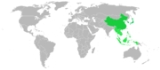
Asean Plus Three Members
ASEAN Plus Three is a forum that functions as a coordinator of cooperation between Association of Southeast Asian Nations
Association of Southeast Asian Nations

The Association of Southeast Asian Nations, commonly abbreviated ASEAN , is a geo-political and economic organization of 10 countries located in Southeast Asia, which was formed on 8 August 1967 by Indonesia, Malaysia, the Philippines, Singapore and Thailand....
 and the three East Asia
East Asia

East Asia is a subregion of Asia that can be defined in either Geography or cultural terms. Geography and geopolitically, it covers about 12,000,000 km?, or about 28 percent of the Asian continent, about 15 percent bigger than the area of Europe, though some categorize Tibet, Xinjiang, and Mongolia as Central Asia....
n nations of China
People's Republic of China

The People's Republic of China , commonly known as China, is the largest country in East Asia and the List of countries by population in the world with over 1.3 billion people, approximately a fifth of the world's population....
, Japan
Japan

Japan is an island country in East Asia. Located in the Pacific Ocean, it lies to the east of the Sea of Japan, People's Republic of China, North Korea, South Korea and Russia, stretching from the Sea of Okhotsk in the north to the East China Sea and Taiwan in the south....
, and South Korea
South Korea

South Korea, officially the Republic of Korea , ), often referred to as Korea and the "names of Korea#Revival of the names", is a Semi-presidential system republic in East Asia, located in the southern half of the Korean Peninsula....
.

The first leaders' meeting was held in 1997 and the group's significance and importance was strengthened by the Asian Financial Crisis. The grouping was institutionalised by 1999 . More recently however there has been the suggestion that the significance of the grouping is being eclipsed by the East Asia Summit
East Asia Summit

File:East Asian Community.PNGThe East Asia Summit is a forum held annually by leaders of 16 countries in the East Asian region. EAS meetings are held after annual ASEAN leaders? meetings....
 (EAS) but that is by no means certain given the current embryonic state of the EAS.

ASEAN Plus Three in establishing the Chiang Mai Initiative
Chiang Mai Initiative

The Chiang Mai Initiative is an initiative under the ASEAN+3 framework which aims for creation of a network of Bilateral Swap Arrangements among ASEAN+3 countries....
 has been credited as forming the basis for financial stability in Asia , the lack of such stability being a contributing factor to the Asian Financial Crisis. The Asian Currency Unit (ACU) is a proposed weighted index of currencies for ASEAN+3. The ACU was inspired by the now defunct European Currency Unit
European Currency Unit

The European Currency Unit was a basket of the currencies of the European Community member states, used as the unit of account of the European Community before being replaced by the euro on January 1, 1999, at parity....
, replaced by the Euro
Euro

The euro is the official currency of 16 out of 27 European Union member state of the European Union . The states, known collectively as the Eurozone are: Austria, Belgium, Cyprus, Finland, France, Germany, Greece, Republic of Ireland, Italy, Luxembourg, Malta, the Netherlands, Portugal, Slovakia, Slovenia, and Spain....
. The Asian Currency Unit's purpose is to help stabilize the region's financial markets. The ACU as it is proposed is a currency basket and not a real currency, i.e., a weighted index of East Asian currencies that will function as a benchmark for regional currency movements.

The Asian Development Bank
Asian Development Bank

The Asian Development Bank is a Multilateral development bank established in 1966 to promote economic and social development in Asian and Pacific countries through loans and technical assistance....
 is currently reviewing different options concerning the technical aspects related to the ACU calculation, including the nature of the basket, the choice of fixed weights vs. fixed units, the selection of currencies to be included in the basket, the choice of weights, the criteria for their periodical revision, and other aspects as well. The Asian Development Bank was to announce the details of the ACU in March 2006 or later. However external pressures delayed this announcement although the concept was still being studied in detail. A panel discussion in February 2007 cited technical and political obstacles as having prevented the project from advancing. The unit, limited to ASEAN+3, was still said to be moving forward by mid-July 2007.

AANZFTA

AANZFTA is a free trade area between ASEAN and ANZCERTA, which should be effective by December 2008