

Air India

Encyclopedia
Air India is the flag carrier
airline
of India
. It is part of the government of India
owned Air India Limited (AIL). The airline operates a fleet of Airbus
and Boeing
aircraft serving Asia
, Australia
, Europe
and North America
. Its corporate office is located at the Air India Building at Nariman Point
in South Mumbai
. Air India has two major domestic hubs at Indira Gandhi International Airport
and Chhatrapati Shivaji International Airport. An international hub at Dubai International Airport
is currently being planned.
Air India has the fourth largest share in India's domestic air travel market, behind Jet Airways
, Kingfisher
and IndiGo
. Following its merger with Indian
, Air India has faced multiple problems, including escalating financial losses and discontent among employees. Between September 2007 and May 2011, Air India's domestic market share declined from 19.2% to 14%, primarily due to stiff competition from private Indian carriers. In August 2011, Air India's invitation to join Star Alliance
was suspended due to its failure to meet the minimum standards for the membership. In October 2011, talks between the airline and Star Alliance have resumed.
in July 1932 as Tata Airlines
, a division of Tata Sons Ltd. (now Tata Group
). On 15 October 1932, J. R. D. Tata flew a single-engined De Havilland Puss Moth
carrying air mail (postal mail of Imperial Airways
) from Karachi
's Drigh Road Aerodrome to Bombay's Juhu Airstrip
via Ahmedabad
. The aircraft continued to Madras via Bellary
piloted by former Royal Air Force
pilot Nevill Vintcent
. In 1932 Air India was based out of a hut with a palm thatched roof at Juhu Aerodrome and had 1 pilot and 2 apprentice mechanics along with 2 piston engined aircraft, one Puss Moth
and one Leopard Moth
aircraft.
, regular commercial service was restored in India and Tata Airlines became a public limited company on 29 July 1946 under the name Air India. In 1948, after the independence of India, 49% of the airline was acquired by the Government of India
, with an option to purchase an additional 2%. In return, the airline was granted status to operate international services from India as the designated flag carrier under the name Air India International. On 8 June 1948, a Lockheed Constellation
L-749A named Malabar Princess (registered VT-CQP) took off from Bombay bound for London
via Cairo
and Geneva
. This marked the airline's first long-haul international flight, soon followed by service in 1950 to Nairobi
via Aden
.
On 25 August 1953, the Government of India exercised its option to purchase a majority stake in the carrier and Air India International Limited was born as one of the fruits of the Air Corporations Act that nationalised the air transportation industry. At the same time all domestic services were transferred to Indian Airlines (now renamed as Indian). In 1954, the airline took delivery of its first L-1049 Super Constellations
and inaugurated services to Bangkok
, Hong Kong
, Tokyo
and Singapore
.
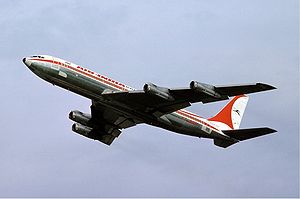
in 1960 when its first Boeing 707-420
, named Gauri Shankar (registered VT-DJJ), was delivered. Jet services to New York City
via London
were inaugurated that same year on 14 May 1960. On 8 June 1962, the airline's name was officially truncated to Air India. On 11 June 1962, Air India became the world's first all-jet airline.
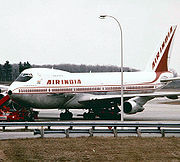
In 1971, the airline took delivery of its first Boeing 747-200B named Emperor Ashoka (registered VT-EBD). This coincided with the introduction of the 'Palace In The Sky' livery and branding. A feature of this livery is the paintwork around each aircraft window, in the cusped arch style of windows in Indian palaces. In 1986 Air India took delivery of the Airbus A310-300
; the airline is the largest operator of this type in passenger service. In 1988, Air India took delivery of two Boeing 747-300
Ms in mixed passenger-cargo configuration.
named Konark (registered VT-ESM) made history by operating the first non-stop flight between New York City
and Delhi
. In 1994 the airline was registered as Air India Ltd. In 1996, the airline inaugurated service to its second US gateway at O'Hare International Airport
in Chicago
. In 1999, the airline opened its dedicated Terminal 2-C at the renamed Chhatrapati Shivaji International Airport in Mumbai
.
and to its third US gateway at Newark Liberty International Airport
in Newark
. In May 2004, Air India launched a wholly owned low cost airline called Air-India Express
. Air India Express connecting cities in India with the Middle East, Southeast Asia and the Subcontinent. In 2004 Air India launched flights to its fourth US gateway at Los Angeles International Airport
in Los Angeles
(which has since been terminated) and expanded its international routes to include flights from Ahmedabad
, Amritsar
, Bangalore
and Hyderabad.
On 1 December 2009, Air India introduced services to its fifth US gateway at Washington Dulles International Airport
in Washington, D.C.
, accessed via a stopover at JFK Airport in New York City. This service has been terminated.
Re-privatisation plans
In 2001, Air India was put up for sale by the then NDA government
. One of the bids was by a consortium of Tata Group
-Singapore Airlines
. However the re-privatisation plans were shelved after Singapore Airlines pulled out and the global economy slumped.
Merger with Indian Airlines
In 2007, the Government of India announced that Air India would be merged with Indian Airlines. As part of the merger process, a new company called the National Aviation Company of India Limited
(NACIL) was established, into which both Air India (along with Air India Express) and Indian Airlines (along with Alliance Air
) will be merged.
On 27 February 2011, Air India and Indian Airlines merged along with their subsidiaries to form Air India Limited.
Financial crisis
Around 2006–2007, the airlines began showing signs of financial distress. The combined losses for Air India and Indian in 2006-07 were 770 crores ( 7.7 billion). After the merger of the airlines, this went up to 7,200 crores ( 72 billion) by March 2009. This was followed by restructuring plans which are still in progress. In July 2009, SBI Capital Markets Ltd
was appointed to prepare a road map for the recovery of the airline. The carrier sold three Airbus A300
and one Boeing 747-300
M in March 2009 for $18.75 million to survive the financial crunch.
As of March 2011, Air India has accumulated a debt of Rs. 42,570 crore (approximately $10 billion) and an operating loss of Rs. 22,000 crore, and is seeking Rs. 42,920 crore from the government. Air India’s recurring default ‘credit negative’ for its banks Mint-Wall Street Journal, August 9, 2011 For the past three months (June, July, August 2011), the carrier has been missing salary payments and interest payments and Moody’s Investor Service has warned that missing payments by Air India to creditors, such as the State Bank of India, will negatively affect the credit ratings of those banks. A report by the Comptroller and Auditor General (CAG) blamed the decision to buy 111 new planes as one of the major causes of the debt troubles in Air India; in addition it blamed on the ill timed merger with Indian Airlines as well,.
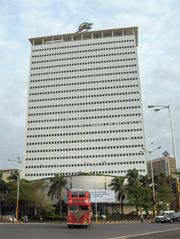
Air India's corporate headquarters is located at the Air India Building at Nariman Point
in South Mumbai
. The airline moved there in 1970. The Air India Building also serves as a regional office for Indian
.
Delhi Hub
On 1 March 2009, Air India had made Frankfurt Airport
at Frankfurt am Main as its international hub for onward connections to United States
from India; however, the airline shut down the Frankfurt hub on 30 October 2010. However on July 14, 2010, Air India chief, Arvind Jadhav announced their intention to make the new terminal 3 at Delhi's Indira Gandhi International Airport
the hub for international and domestic operations with the plans of starting new direct flights to Chicago
and Toronto
and also taking almost all international long haul flights away from its former Primary hub at Mumbai
's Chhatrapati Shivaji International Airport due to lack of space. This would also provide greater convenience for transit passengers who before had to transfer between the international and domestic terminals which were located on completely different sides of the airport. They will now be able to catch their connecting flights within the same terminal.
Return to profitability plans
The new Chairman and Managing director wants to change the order of some of the 111 planes ordered in 2006 to get narrow-body aircraft instead of the wide-body aircraft.
 Organization
Air India has three subsidiaries. Together Air India, Air India Cargo
, Air India Express and Air India Regional form the Air India Limited.
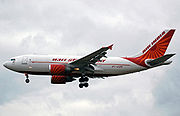
In 1954, Air India Cargo started its freighter operations with a Douglas DC-3 Dakota aircraft, giving Air India the distinction of being the first Asian airline to operate freighters. The airline operates cargo flights to many destinations. The airline also has ground truck-transportation arrangements on select destinations.
A member of IATA, Air India carries all types of cargo including dangerous goods (hazardous materials) and live animals, provided such shipments are tendered according to IATA Dangerous Goods Regulations and IATA Live Animals Regulations.
At the warehouse in Mumbai, Air India has developed a system of inventory management for cargo handling of import/export functions. This takes care of the entire management of cargo, supports Electronic Data Interface (EDI) messages with Indian Customs and replaces to a great extent existing paper correspondence between Customs, Airlines, and the custodians. This also replaces manual handling and binning of cargo at the warehouse in Mumbai by Air India.
Air India Express
Air India Express is the airline's low-cost subsidiary which was established in 2005 during the aviation boom in India. It operates scheduled passenger services primarily to the Persian Gulf
and South East Asia. Air India Express is currently the only airline in Air India Limited which posts profits. It operates a fleet of Next Generation Boeing 737-800
aircraft.Cochin International Airport
is the main hub of the airline from which it has connections to almost all the Gulf countries.
Air India Regional
Air India Regional (formerly known as Alliance Air) serves mainly on regional routes. Its main hub is Delhi's Indira Gandhi International Airport
.
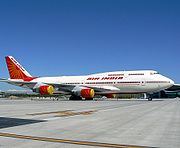 1970–2007 livery
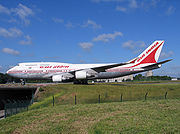
Air India's livery was mostly painted in red and white colours. The bottoms of the aircraft remain metal and unpainted but the upper portion is given a white background along with the airline's name written in red. The name is in Hindi on one side and in English on the other. The painted on red palace style carvings on the outside of the windows refer to their slogan "your palace in the sky" which is written on the back of the aircraft. Near the noses of Air India aircraft, the air plane is given a name. Most planes are named after powerful Indian kings or landmarks. Finally, the tail is mostly red with again, the carrier's name written in Hindi on one side and English on the other.
In 1989, to supplement its "Flying Palace" livery, Air India introduced a new livery that was mostly white with a golden spinning wheel (as seen on the flag of India) on a red tail. Only applied to around a half of Air India's fleet, the new livery did not succeed, as the Indian flying public complained about the phasing out of the classic colours. The livery was dropped after two years and the old scheme was returned.
Pre-merger livery
On 15 May 2007, Air India refreshed its livery, making the Rajasthani arches along the windows slightly smaller, extending a stylised cheatline from the vertical tail of the aircraft to the nose, and painting a small portion of the underbelly red. Additionally, engine nacelles are now deep red, and a gold-coloured version of the airline's stylized Konark trademark now adorns both the vertical tail and engine nacelles.
Post-merger livery
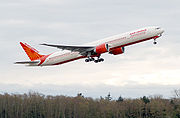
On May 22, 2007, Air India and Indian
unveiled their new livery. The logo of the new airline is a Flying Swan with the Konark Chakra placed inside it. The Flying Swan has been morphed from Air India’s characteristic logo, ‘The Centaur’ whereas the ‘Konark Chakra’ is reminiscent of Indian’s logo.
The new logo features prominently on the tail of the aircraft. Individually the Konark Chakra also features on all the engines of the aircraft. The choice of colours namely red for “Flying Swan” and orange for “Konark Chakra” are meant to signify vigour and advancement. Further the colours also have a strong association with two carriers thereby retaining the earlier imagery of traditional hospitality and service.
While the aircraft is ivory in colour, the base retains the red streak of Air India. Running parallel to each other is the Orange and Red speed lines from front door to the rear door, subtly signifying the individual identities merged into one. The brand name ‘Air India’ runs across the tail of the aircraft in hindi
.
, Europe and North America
.
Short-haul routes
Air India's short-haul routes mainly include domestic cities and cities in South East Asia and South West Asia. For short-haul routes its Airbus A310
, Airbus A330
, Boeing 747-400 and Boeing 777-200LR are used apart from Airbus A320 family
aircraft of Indian
which are operated with Air India callsign and code.
Long-haul routes
The airline has long-haul destinations in East Asia
, Europe and North America
which are served using Boeing 777-200LR and -300ER
aircraft.
* SkyTeam
member
^^ Star Alliance
members
Flag carrier
A flag carrier is a transportation company, such as an airline or shipping company, that, being locally registered in a given country, enjoys preferential rights or privileges, accorded by the government, for international operations. It may be a state-run, state-owned or private but...
airline
Airline
An airline provides air transport services for traveling passengers and freight. Airlines lease or own their aircraft with which to supply these services and may form partnerships or alliances with other airlines for mutual benefit...
of India
India
India , officially the Republic of India , is a country in South Asia. It is the seventh-largest country by geographical area, the second-most populous country with over 1.2 billion people, and the most populous democracy in the world...
. It is part of the government of India
Government of India
The Government of India, officially known as the Union Government, and also known as the Central Government, was established by the Constitution of India, and is the governing authority of the union of 28 states and seven union territories, collectively called the Republic of India...
owned Air India Limited (AIL). The airline operates a fleet of Airbus
Airbus
Airbus SAS is an aircraft manufacturing subsidiary of EADS, a European aerospace company. Based in Blagnac, France, surburb of Toulouse, and with significant activity across Europe, the company produces around half of the world's jet airliners....
and Boeing
Boeing
The Boeing Company is an American multinational aerospace and defense corporation, founded in 1916 by William E. Boeing in Seattle, Washington. Boeing has expanded over the years, merging with McDonnell Douglas in 1997. Boeing Corporate headquarters has been in Chicago, Illinois since 2001...
aircraft serving Asia
Asia
Asia is the world's largest and most populous continent, located primarily in the eastern and northern hemispheres. It covers 8.7% of the Earth's total surface area and with approximately 3.879 billion people, it hosts 60% of the world's current human population...
, Australia
Australia
Australia , officially the Commonwealth of Australia, is a country in the Southern Hemisphere comprising the mainland of the Australian continent, the island of Tasmania, and numerous smaller islands in the Indian and Pacific Oceans. It is the world's sixth-largest country by total area...
, Europe
Europe
Europe is, by convention, one of the world's seven continents. Comprising the westernmost peninsula of Eurasia, Europe is generally 'divided' from Asia to its east by the watershed divides of the Ural and Caucasus Mountains, the Ural River, the Caspian and Black Seas, and the waterways connecting...
and North America
North America
North America is a continent wholly within the Northern Hemisphere and almost wholly within the Western Hemisphere. It is also considered a northern subcontinent of the Americas...
. Its corporate office is located at the Air India Building at Nariman Point
Nariman Point
Nariman Point is Mumbai's premier business district and country's first central business district. It was named after Khursheed Framji Nariman, a Parsi visionary. The area is situated on land reclaimed from the sea. It had the distinction of having the highest commercial real estate rental space...
in South Mumbai
South Mumbai
South Mumbai , sometimes incorrectly referred to by English Media as "SoBo" , the southern-most precinct of the city of Mumbai, India, comprises the city's main business localities and its adjoining areas...
. Air India has two major domestic hubs at Indira Gandhi International Airport
Indira Gandhi International Airport
Indira Gandhi International Airport is the primary international airport of the National Capital Region of Delhi, India, situated in West Delhi, 16 km southwest of New Delhi city centre. Named after Indira Gandhi, the former Prime Minister of India, it is the busiest airport in India in...
and Chhatrapati Shivaji International Airport. An international hub at Dubai International Airport
Dubai International Airport
Dubai International Airport is an international airport serving Dubai, the largest city of the United Arab Emirates. It is a major aviation hub in the Middle East, and is the main airport of Dubai. It is situated in the Al Garhoud district, southeast of Dubai...
is currently being planned.
Air India has the fourth largest share in India's domestic air travel market, behind Jet Airways
Jet Airways
Jet Airways is a major Indian airline based in Mumbai, Maharashtra. It is India's largest airline and the market leader in the domestic sector. It operates over 400 flights daily to 76 destinations worldwide. Its main hub is Chhatrapati Shivaji International Airport, with secondary hubs at Delhi,...
, Kingfisher
Kingfisher Airlines
Kingfisher Airlines is an airline group based in India. Its head office is Kingfisher House in Vile Parle , Mumbai. Kingfisher Airlines, through its parent company United Breweries Group, has a 50% stake in low-cost carrier Kingfisher Red....
and IndiGo
Indigo
Indigo is a color named after the purple dye derived from the plant Indigofera tinctoria and related species. The color is placed on the electromagnetic spectrum between about 420 and 450 nm in wavelength, placing it between blue and violet...
. Following its merger with Indian
Indian (airline)
Indian , formerly Indian Airlines was a major Indian airline based in Delhi and focused primarily on domestic routes, along with several international services to neighbouring countries in Asia. It was state-owned, and was administered by the Ministry of Civil Aviation. It was one of the two flag...
, Air India has faced multiple problems, including escalating financial losses and discontent among employees. Between September 2007 and May 2011, Air India's domestic market share declined from 19.2% to 14%, primarily due to stiff competition from private Indian carriers. In August 2011, Air India's invitation to join Star Alliance
Star Alliance
Star Alliance is the world's first and largest airline alliance, headquartered in Frankfurt am Main, Germany . The alliance was founded in 1997 by five of the world's leading airlines: Air Canada, Lufthansa, Scandinavian Airlines, Thai Airways International and United Airlines...
was suspended due to its failure to meet the minimum standards for the membership. In October 2011, talks between the airline and Star Alliance have resumed.
History
Early years
Air India was founded by J. R. D. TataJ. R. D. Tata
Jehangir Ratanji Dadabhoy Tata was a pioneer aviator and important businessman of India. He was awarded India's highest civilian award, the Bharat Ratna in 1992 and the Legion of Honour from the French government in 1954.-Early life and education:J. R. D...
in July 1932 as Tata Airlines
Tata Airlines
Tata Airlines, a division of Tata Sons Ltd. was founded by J. R. D. Tata in 1932 as Tata Sons.It was started as a mail service between Karachi, Bombay and Madras.-The beginning:...
, a division of Tata Sons Ltd. (now Tata Group
Tata Group
Tata Group is an Indian multinational conglomerate company headquartered in Mumbai, Maharashtra, India. Tata Group is one of the largest companies in India by market capitalization and revenue. It has interests in communications and information technology, engineering, materials, services, energy,...
). On 15 October 1932, J. R. D. Tata flew a single-engined De Havilland Puss Moth
De Havilland Puss Moth
|-See also:-References:* Jackson, A.J. British Civil Aircraft since 1919 . London, Putnam, 1974. ISBN 0-370-10010-7-External links:*...
carrying air mail (postal mail of Imperial Airways
Imperial Airways
Imperial Airways was the early British commercial long range air transport company, operating from 1924 to 1939 and serving parts of Europe but especially the Empire routes to South Africa, India and the Far East...
) from Karachi
Karachi
Karachi is the largest city, main seaport and the main financial centre of Pakistan, as well as the capital of the province of Sindh. The city has an estimated population of 13 to 15 million, while the total metropolitan area has a population of over 18 million...
's Drigh Road Aerodrome to Bombay's Juhu Airstrip
Juhu Aerodrome
Juhu Aerodrome an airport serving Mumbai, was India's first civil aviation airport. It is currently used by small private aircraft and as a heliport....
via Ahmedabad
Ahmedabad
Ahmedabad also known as Karnavati is the largest city in Gujarat, India. It is the former capital of Gujarat and is also the judicial capital of Gujarat as the Gujarat High Court has its seat in Ahmedabad...
. The aircraft continued to Madras via Bellary
Bellary
Bellary is a historic city in Bellary District in Karnataka state, India.-Origins of the city's name:There are several legends about how Bellary got its name....
piloted by former Royal Air Force
Royal Air Force
The Royal Air Force is the aerial warfare service branch of the British Armed Forces. Formed on 1 April 1918, it is the oldest independent air force in the world...
pilot Nevill Vintcent
Nevill Vintcent
Nevill Vintcent, O.B.E., D.F.C. was a South African aviator and airline founder.He was the son of Charles Vintcent, a South African cricketer....
. In 1932 Air India was based out of a hut with a palm thatched roof at Juhu Aerodrome and had 1 pilot and 2 apprentice mechanics along with 2 piston engined aircraft, one Puss Moth
De Havilland Puss Moth
|-See also:-References:* Jackson, A.J. British Civil Aircraft since 1919 . London, Putnam, 1974. ISBN 0-370-10010-7-External links:*...
and one Leopard Moth
De Havilland Leopard Moth
-See also:...
aircraft.
Post-war expansion
Following the end of World War IIWorld War II
World War II, or the Second World War , was a global conflict lasting from 1939 to 1945, involving most of the world's nations—including all of the great powers—eventually forming two opposing military alliances: the Allies and the Axis...
, regular commercial service was restored in India and Tata Airlines became a public limited company on 29 July 1946 under the name Air India. In 1948, after the independence of India, 49% of the airline was acquired by the Government of India
Government of India
The Government of India, officially known as the Union Government, and also known as the Central Government, was established by the Constitution of India, and is the governing authority of the union of 28 states and seven union territories, collectively called the Republic of India...
, with an option to purchase an additional 2%. In return, the airline was granted status to operate international services from India as the designated flag carrier under the name Air India International. On 8 June 1948, a Lockheed Constellation
Lockheed Constellation
The Lockheed Constellation was a propeller-driven airliner powered by four 18-cylinder radial Wright R-3350 engines. It was built by Lockheed between 1943 and 1958 at its Burbank, California, USA, facility. A total of 856 aircraft were produced in numerous models, all distinguished by a...
L-749A named Malabar Princess (registered VT-CQP) took off from Bombay bound for London
London
London is the capital city of :England and the :United Kingdom, the largest metropolitan area in the United Kingdom, and the largest urban zone in the European Union by most measures. Located on the River Thames, London has been a major settlement for two millennia, its history going back to its...
via Cairo
Cairo
Cairo , is the capital of Egypt and the largest city in the Arab world and Africa, and the 16th largest metropolitan area in the world. Nicknamed "The City of a Thousand Minarets" for its preponderance of Islamic architecture, Cairo has long been a centre of the region's political and cultural life...
and Geneva
Geneva
Geneva In the national languages of Switzerland the city is known as Genf , Ginevra and Genevra is the second-most-populous city in Switzerland and is the most populous city of Romandie, the French-speaking part of Switzerland...
. This marked the airline's first long-haul international flight, soon followed by service in 1950 to Nairobi
Nairobi
Nairobi is the capital and largest city of Kenya. The city and its surrounding area also forms the Nairobi County. The name "Nairobi" comes from the Maasai phrase Enkare Nyirobi, which translates to "the place of cool waters". However, it is popularly known as the "Green City in the Sun" and is...
via Aden
Aden
Aden is a seaport city in Yemen, located by the eastern approach to the Red Sea , some 170 kilometres east of Bab-el-Mandeb. Its population is approximately 800,000. Aden's ancient, natural harbour lies in the crater of an extinct volcano which now forms a peninsula, joined to the mainland by a...
.
On 25 August 1953, the Government of India exercised its option to purchase a majority stake in the carrier and Air India International Limited was born as one of the fruits of the Air Corporations Act that nationalised the air transportation industry. At the same time all domestic services were transferred to Indian Airlines (now renamed as Indian). In 1954, the airline took delivery of its first L-1049 Super Constellations
Lockheed Constellation
The Lockheed Constellation was a propeller-driven airliner powered by four 18-cylinder radial Wright R-3350 engines. It was built by Lockheed between 1943 and 1958 at its Burbank, California, USA, facility. A total of 856 aircraft were produced in numerous models, all distinguished by a...
and inaugurated services to Bangkok
Bangkok
Bangkok is the capital and largest urban area city in Thailand. It is known in Thai as Krung Thep Maha Nakhon or simply Krung Thep , meaning "city of angels." The full name of Bangkok is Krung Thep Mahanakhon Amon Rattanakosin Mahintharayutthaya Mahadilok Phop Noppharat Ratchathani Burirom...
, Hong Kong
Hong Kong
Hong Kong is one of two Special Administrative Regions of the People's Republic of China , the other being Macau. A city-state situated on China's south coast and enclosed by the Pearl River Delta and South China Sea, it is renowned for its expansive skyline and deep natural harbour...
, Tokyo
Tokyo
, ; officially , is one of the 47 prefectures of Japan. Tokyo is the capital of Japan, the center of the Greater Tokyo Area, and the largest metropolitan area of Japan. It is the seat of the Japanese government and the Imperial Palace, and the home of the Japanese Imperial Family...
and Singapore
Singapore
Singapore , officially the Republic of Singapore, is a Southeast Asian city-state off the southern tip of the Malay Peninsula, north of the equator. An island country made up of 63 islands, it is separated from Malaysia by the Straits of Johor to its north and from Indonesia's Riau Islands by the...
.
The jet age
Air India International entered the jet ageJet age
The Jet Age is a period of history defined by the social change brought about by the advent of large aircraft powered by turbine engines. These aircraft are able to fly much higher, faster, and farther than older piston-powered propliners, making transcontinental and inter-continental travel...
in 1960 when its first Boeing 707-420
Boeing 707
The Boeing 707 is a four-engine narrow-body commercial passenger jet airliner developed by Boeing in the early 1950s. Its name is most commonly pronounced as "Seven Oh Seven". The first airline to operate the 707 was Pan American World Airways, inaugurating the type's first commercial flight on...
, named Gauri Shankar (registered VT-DJJ), was delivered. Jet services to New York City
New York City
New York is the most populous city in the United States and the center of the New York Metropolitan Area, one of the most populous metropolitan areas in the world. New York exerts a significant impact upon global commerce, finance, media, art, fashion, research, technology, education, and...
via London
London
London is the capital city of :England and the :United Kingdom, the largest metropolitan area in the United Kingdom, and the largest urban zone in the European Union by most measures. Located on the River Thames, London has been a major settlement for two millennia, its history going back to its...
were inaugurated that same year on 14 May 1960. On 8 June 1962, the airline's name was officially truncated to Air India. On 11 June 1962, Air India became the world's first all-jet airline.
In 1971, the airline took delivery of its first Boeing 747-200B named Emperor Ashoka (registered VT-EBD). This coincided with the introduction of the 'Palace In The Sky' livery and branding. A feature of this livery is the paintwork around each aircraft window, in the cusped arch style of windows in Indian palaces. In 1986 Air India took delivery of the Airbus A310-300
Airbus A310
The Airbus A310 is a medium- to long-range twin-engine widebody jet airliner. Launched in July 1978, it was the second aircraft created by Airbus Industrie,a consortium of European aerospace companies, Airbus is now fully owned by EADS and since 2001 has been known as Airbus SAS. the consortium of...
; the airline is the largest operator of this type in passenger service. In 1988, Air India took delivery of two Boeing 747-300
Boeing 747
The Boeing 747 is a wide-body commercial airliner and cargo transport, often referred to by its original nickname, Jumbo Jet, or Queen of the Skies. It is among the world's most recognizable aircraft, and was the first wide-body ever produced...
Ms in mixed passenger-cargo configuration.
Early 1990s
In 1993, Air India took delivery of the flagship of its fleet when the first Boeing 747-400Boeing 747-400
The Boeing 747-400 is a major development and the best-selling model of the Boeing 747 family of jet airliners. While retaining the four-engine wide-body layout of its predecessors, the 747-400 embodies numerous technological and structural changes to produce a more efficient airframe...
named Konark (registered VT-ESM) made history by operating the first non-stop flight between New York City
New York City
New York is the most populous city in the United States and the center of the New York Metropolitan Area, one of the most populous metropolitan areas in the world. New York exerts a significant impact upon global commerce, finance, media, art, fashion, research, technology, education, and...
and Delhi
Delhi
Delhi , officially National Capital Territory of Delhi , is the largest metropolis by area and the second-largest by population in India, next to Mumbai. It is the eighth largest metropolis in the world by population with 16,753,265 inhabitants in the Territory at the 2011 Census...
. In 1994 the airline was registered as Air India Ltd. In 1996, the airline inaugurated service to its second US gateway at O'Hare International Airport
O'Hare International Airport
Chicago O'Hare International Airport , also known as O'Hare Airport, O'Hare Field, Chicago Airport, Chicago International Airport, or simply O'Hare, is a major airport located in the northwestern-most corner of Chicago, Illinois, United States, northwest of the Chicago Loop...
in Chicago
Chicago
Chicago is the largest city in the US state of Illinois. With nearly 2.7 million residents, it is the most populous city in the Midwestern United States and the third most populous in the US, after New York City and Los Angeles...
. In 1999, the airline opened its dedicated Terminal 2-C at the renamed Chhatrapati Shivaji International Airport in Mumbai
Mumbai
Mumbai , formerly known as Bombay in English, is the capital of the Indian state of Maharashtra. It is the most populous city in India, and the fourth most populous city in the world, with a total metropolitan area population of approximately 20.5 million...
.
2000 – present
In 2000, Air India introduced services to ShanghaiShanghai
Shanghai is the largest city by population in China and the largest city proper in the world. It is one of the four province-level municipalities in the People's Republic of China, with a total population of over 23 million as of 2010...
and to its third US gateway at Newark Liberty International Airport
Newark Liberty International Airport
Newark Liberty International Airport , first named Newark Metropolitan Airport and later Newark International Airport, is an international airport within the city limits of both Newark and Elizabeth, New Jersey, United States...
in Newark
Newark, New Jersey
Newark is the largest city in the American state of New Jersey, and the seat of Essex County. As of the 2010 United States Census, Newark had a population of 277,140, maintaining its status as the largest municipality in New Jersey. It is the 68th largest city in the U.S...
. In May 2004, Air India launched a wholly owned low cost airline called Air-India Express
Air-India Express
Air India Express is a low-cost airline subsidiary of Air India, operating mainly from Indian state of Kerala. It operates services mainly to the Middle East and Southeast Asia. The airline belongs to Air India Charters Limited, a whole owned subsidiary of Air India Limited, which was formed in...
. Air India Express connecting cities in India with the Middle East, Southeast Asia and the Subcontinent. In 2004 Air India launched flights to its fourth US gateway at Los Angeles International Airport
Los Angeles International Airport
Los Angeles International Airport is the primary airport serving the Greater Los Angeles Area, the second-most populated metropolitan area in the United States. It is most often referred to by its IATA airport code LAX, with the letters pronounced individually...
in Los Angeles
Los Ángeles
Los Ángeles is the capital of the province of Biobío, in the commune of the same name, in Region VIII , in the center-south of Chile. It is located between the Laja and Biobío rivers. The population is 123,445 inhabitants...
(which has since been terminated) and expanded its international routes to include flights from Ahmedabad
Ahmedabad
Ahmedabad also known as Karnavati is the largest city in Gujarat, India. It is the former capital of Gujarat and is also the judicial capital of Gujarat as the Gujarat High Court has its seat in Ahmedabad...
, Amritsar
Amritsar
Amritsar is a city in the northern part of India and is the administrative headquarters of Amritsar district in the state of Punjab, India. The 2001 Indian census reported the population of the city to be over 1,500,000, with that of the entire district numbering 3,695,077...
, Bangalore
Bangalore
Bengaluru , formerly called Bengaluru is the capital of the Indian state of Karnataka. Bangalore is nicknamed the Garden City and was once called a pensioner's paradise. Located on the Deccan Plateau in the south-eastern part of Karnataka, Bangalore is India's third most populous city and...
and Hyderabad.
On 1 December 2009, Air India introduced services to its fifth US gateway at Washington Dulles International Airport
Washington Dulles International Airport
Washington Dulles International Airport is a public airport in Dulles, Virginia, 26 miles west of downtown Washington, D.C. The airport serves the Baltimore-Washington-Northern Virginia metropolitan area centered on the District of Columbia. It is named after John Foster Dulles, Secretary of...
in Washington, D.C.
Washington, D.C.
Washington, D.C., formally the District of Columbia and commonly referred to as Washington, "the District", or simply D.C., is the capital of the United States. On July 16, 1790, the United States Congress approved the creation of a permanent national capital as permitted by the U.S. Constitution....
, accessed via a stopover at JFK Airport in New York City. This service has been terminated.
Re-privatisation plans
In 2001, Air India was put up for sale by the then NDA government
National Democratic Alliance (India)
The National Democratic Alliance is a centre-right coalition of political parties in India. At the time of its formation in 1998, it was led by the Bharatiya Janata Party and had thirteen constituent parties. Its convenor is Sharad Yadav, and its honorary chairman is former prime minister Atal...
. One of the bids was by a consortium of Tata Group
Tata Group
Tata Group is an Indian multinational conglomerate company headquartered in Mumbai, Maharashtra, India. Tata Group is one of the largest companies in India by market capitalization and revenue. It has interests in communications and information technology, engineering, materials, services, energy,...
-Singapore Airlines
Singapore Airlines
Singapore Airlines Limited is the flag carrier airline of Singapore. Singapore Airlines operates a hub at Changi Airport and has a strong presence in the Southeast Asia, East Asia, South Asia, and "Kangaroo Route" markets...
. However the re-privatisation plans were shelved after Singapore Airlines pulled out and the global economy slumped.
Merger with Indian Airlines
In 2007, the Government of India announced that Air India would be merged with Indian Airlines. As part of the merger process, a new company called the National Aviation Company of India Limited
National Aviation Company of India Limited
Air India Limited is a company that was formed as National Aviation Company of India Limited by the government of India to oversee the merger of Air India and Indian. The company was renamed as Air India Limited on October 26, 2010...
(NACIL) was established, into which both Air India (along with Air India Express) and Indian Airlines (along with Alliance Air
Alliance Air
Air India Regional is an Indian airline which was started as a low-cost arm of Indian as Alliance Air . As part of Indian's merger with Air India, it was renamed Air India Regional. It operates 357 weekly flights to 25 domestic destinations as a subsidiary of Air India.- History :The airline was...
) will be merged.
On 27 February 2011, Air India and Indian Airlines merged along with their subsidiaries to form Air India Limited.
Financial crisis
Around 2006–2007, the airlines began showing signs of financial distress. The combined losses for Air India and Indian in 2006-07 were 770 crores ( 7.7 billion). After the merger of the airlines, this went up to 7,200 crores ( 72 billion) by March 2009. This was followed by restructuring plans which are still in progress. In July 2009, SBI Capital Markets Ltd
State Bank of India
The State Bank of India is the largest Indian banking and financial services company with its headquarters in Mumbai, India. It is state-owned. The bank traces its ancestry to British India, through the Imperial Bank of India, to the founding in 1806 of the Bank of Calcutta, making it the oldest...
was appointed to prepare a road map for the recovery of the airline. The carrier sold three Airbus A300
Airbus A300
The Airbus A300 is a short- to medium-range widebody jet airliner. Launched in 1972 as the world's first twin-engined widebody, it was the first product of Airbus Industrie, a consortium of European aerospace companies, wholly owned today by EADS...
and one Boeing 747-300
Boeing 747
The Boeing 747 is a wide-body commercial airliner and cargo transport, often referred to by its original nickname, Jumbo Jet, or Queen of the Skies. It is among the world's most recognizable aircraft, and was the first wide-body ever produced...
M in March 2009 for $18.75 million to survive the financial crunch.
As of March 2011, Air India has accumulated a debt of Rs. 42,570 crore (approximately $10 billion) and an operating loss of Rs. 22,000 crore, and is seeking Rs. 42,920 crore from the government. Air India’s recurring default ‘credit negative’ for its banks Mint-Wall Street Journal, August 9, 2011 For the past three months (June, July, August 2011), the carrier has been missing salary payments and interest payments and Moody’s Investor Service has warned that missing payments by Air India to creditors, such as the State Bank of India, will negatively affect the credit ratings of those banks. A report by the Comptroller and Auditor General (CAG) blamed the decision to buy 111 new planes as one of the major causes of the debt troubles in Air India; in addition it blamed on the ill timed merger with Indian Airlines as well,.
Air India's corporate headquarters is located at the Air India Building at Nariman Point
Nariman Point
Nariman Point is Mumbai's premier business district and country's first central business district. It was named after Khursheed Framji Nariman, a Parsi visionary. The area is situated on land reclaimed from the sea. It had the distinction of having the highest commercial real estate rental space...
in South Mumbai
South Mumbai
South Mumbai , sometimes incorrectly referred to by English Media as "SoBo" , the southern-most precinct of the city of Mumbai, India, comprises the city's main business localities and its adjoining areas...
. The airline moved there in 1970. The Air India Building also serves as a regional office for Indian
Indian (airline)
Indian , formerly Indian Airlines was a major Indian airline based in Delhi and focused primarily on domestic routes, along with several international services to neighbouring countries in Asia. It was state-owned, and was administered by the Ministry of Civil Aviation. It was one of the two flag...
.
Delhi Hub
On 1 March 2009, Air India had made Frankfurt Airport
Frankfurt Airport
Frankfurt Airport may refer to:Airports of Frankfurt, Germany:*Frankfurt Airport , the largest airport in Germany*Frankfurt Egelsbach Airport, a general aviation airport*Frankfurt-Hahn Airport , a converted U.S...
at Frankfurt am Main as its international hub for onward connections to United States
United States
The United States of America is a federal constitutional republic comprising fifty states and a federal district...
from India; however, the airline shut down the Frankfurt hub on 30 October 2010. However on July 14, 2010, Air India chief, Arvind Jadhav announced their intention to make the new terminal 3 at Delhi's Indira Gandhi International Airport
Indira Gandhi International Airport
Indira Gandhi International Airport is the primary international airport of the National Capital Region of Delhi, India, situated in West Delhi, 16 km southwest of New Delhi city centre. Named after Indira Gandhi, the former Prime Minister of India, it is the busiest airport in India in...
the hub for international and domestic operations with the plans of starting new direct flights to Chicago
Chicago
Chicago is the largest city in the US state of Illinois. With nearly 2.7 million residents, it is the most populous city in the Midwestern United States and the third most populous in the US, after New York City and Los Angeles...
and Toronto
Toronto
Toronto is the provincial capital of Ontario and the largest city in Canada. It is located in Southern Ontario on the northwestern shore of Lake Ontario. A relatively modern city, Toronto's history dates back to the late-18th century, when its land was first purchased by the British monarchy from...
and also taking almost all international long haul flights away from its former Primary hub at Mumbai
Mumbai
Mumbai , formerly known as Bombay in English, is the capital of the Indian state of Maharashtra. It is the most populous city in India, and the fourth most populous city in the world, with a total metropolitan area population of approximately 20.5 million...
's Chhatrapati Shivaji International Airport due to lack of space. This would also provide greater convenience for transit passengers who before had to transfer between the international and domestic terminals which were located on completely different sides of the airport. They will now be able to catch their connecting flights within the same terminal.
Return to profitability plans
The new Chairman and Managing director wants to change the order of some of the 111 planes ordered in 2006 to get narrow-body aircraft instead of the wide-body aircraft.
Corporate affairs and identity
Air India has three subsidiaries. Together Air India, Air India Cargo
Air India Cargo
Air India Cargo is the cargo division of Air India, it is based in Mumbai. The airline operates freighter services to twelve domestic and two international cities.-History:...
, Air India Express and Air India Regional form the Air India Limited.
Subsidiaries
Air India CargoIn 1954, Air India Cargo started its freighter operations with a Douglas DC-3 Dakota aircraft, giving Air India the distinction of being the first Asian airline to operate freighters. The airline operates cargo flights to many destinations. The airline also has ground truck-transportation arrangements on select destinations.
A member of IATA, Air India carries all types of cargo including dangerous goods (hazardous materials) and live animals, provided such shipments are tendered according to IATA Dangerous Goods Regulations and IATA Live Animals Regulations.
At the warehouse in Mumbai, Air India has developed a system of inventory management for cargo handling of import/export functions. This takes care of the entire management of cargo, supports Electronic Data Interface (EDI) messages with Indian Customs and replaces to a great extent existing paper correspondence between Customs, Airlines, and the custodians. This also replaces manual handling and binning of cargo at the warehouse in Mumbai by Air India.
Air India Express
Air India Express is the airline's low-cost subsidiary which was established in 2005 during the aviation boom in India. It operates scheduled passenger services primarily to the Persian Gulf
Persian Gulf
The Persian Gulf, in Southwest Asia, is an extension of the Indian Ocean located between Iran and the Arabian Peninsula.The Persian Gulf was the focus of the 1980–1988 Iran-Iraq War, in which each side attacked the other's oil tankers...
and South East Asia. Air India Express is currently the only airline in Air India Limited which posts profits. It operates a fleet of Next Generation Boeing 737-800
Boeing 737 Next Generation
The Boeing 737 Next Generation, commonly abbreviated as Boeing 737NG, is the name given to the -600/-700/-800/-900 series of the Boeing 737 after the introduction of the -300/-400/-500 Classic series. They are short- to medium-range, narrow-body jet airliners...
aircraft.Cochin International Airport
Cochin International Airport
Cochin International Airport is an international airport located in Nedumbassery, a suburb on the outskirts of the city of Kochi about northeast of downtown Kochi, in the state of Kerala, India. It is the busiest and largest airport in the state of Kerala...
is the main hub of the airline from which it has connections to almost all the Gulf countries.
Air India Regional
Air India Regional (formerly known as Alliance Air) serves mainly on regional routes. Its main hub is Delhi's Indira Gandhi International Airport
Indira Gandhi International Airport
Indira Gandhi International Airport is the primary international airport of the National Capital Region of Delhi, India, situated in West Delhi, 16 km southwest of New Delhi city centre. Named after Indira Gandhi, the former Prime Minister of India, it is the busiest airport in India in...
.
Livery
Air India's livery was mostly painted in red and white colours. The bottoms of the aircraft remain metal and unpainted but the upper portion is given a white background along with the airline's name written in red. The name is in Hindi on one side and in English on the other. The painted on red palace style carvings on the outside of the windows refer to their slogan "your palace in the sky" which is written on the back of the aircraft. Near the noses of Air India aircraft, the air plane is given a name. Most planes are named after powerful Indian kings or landmarks. Finally, the tail is mostly red with again, the carrier's name written in Hindi on one side and English on the other.
In 1989, to supplement its "Flying Palace" livery, Air India introduced a new livery that was mostly white with a golden spinning wheel (as seen on the flag of India) on a red tail. Only applied to around a half of Air India's fleet, the new livery did not succeed, as the Indian flying public complained about the phasing out of the classic colours. The livery was dropped after two years and the old scheme was returned.
Pre-merger livery
On 15 May 2007, Air India refreshed its livery, making the Rajasthani arches along the windows slightly smaller, extending a stylised cheatline from the vertical tail of the aircraft to the nose, and painting a small portion of the underbelly red. Additionally, engine nacelles are now deep red, and a gold-coloured version of the airline's stylized Konark trademark now adorns both the vertical tail and engine nacelles.
Post-merger livery
On May 22, 2007, Air India and Indian
Indian (airline)
Indian , formerly Indian Airlines was a major Indian airline based in Delhi and focused primarily on domestic routes, along with several international services to neighbouring countries in Asia. It was state-owned, and was administered by the Ministry of Civil Aviation. It was one of the two flag...
unveiled their new livery. The logo of the new airline is a Flying Swan with the Konark Chakra placed inside it. The Flying Swan has been morphed from Air India’s characteristic logo, ‘The Centaur’ whereas the ‘Konark Chakra’ is reminiscent of Indian’s logo.
The new logo features prominently on the tail of the aircraft. Individually the Konark Chakra also features on all the engines of the aircraft. The choice of colours namely red for “Flying Swan” and orange for “Konark Chakra” are meant to signify vigour and advancement. Further the colours also have a strong association with two carriers thereby retaining the earlier imagery of traditional hospitality and service.
While the aircraft is ivory in colour, the base retains the red streak of Air India. Running parallel to each other is the Orange and Red speed lines from front door to the rear door, subtly signifying the individual identities merged into one. The brand name ‘Air India’ runs across the tail of the aircraft in hindi
Hindi
Standard Hindi, or more precisely Modern Standard Hindi, also known as Manak Hindi , High Hindi, Nagari Hindi, and Literary Hindi, is a standardized and sanskritized register of the Hindustani language derived from the Khariboli dialect of Delhi...
.
Destinations
Air India serves 49 domestic destinations and 26 international destinations in 19 countries across AsiaAsia
Asia is the world's largest and most populous continent, located primarily in the eastern and northern hemispheres. It covers 8.7% of the Earth's total surface area and with approximately 3.879 billion people, it hosts 60% of the world's current human population...
, Europe and North America
North America
North America is a continent wholly within the Northern Hemisphere and almost wholly within the Western Hemisphere. It is also considered a northern subcontinent of the Americas...
.
Short-haul routes
Air India's short-haul routes mainly include domestic cities and cities in South East Asia and South West Asia. For short-haul routes its Airbus A310
Airbus A310
The Airbus A310 is a medium- to long-range twin-engine widebody jet airliner. Launched in July 1978, it was the second aircraft created by Airbus Industrie,a consortium of European aerospace companies, Airbus is now fully owned by EADS and since 2001 has been known as Airbus SAS. the consortium of...
, Airbus A330
Airbus A330
The Airbus A330 is a wide-body twin-engine jet airliner made by Airbus, a division of EADS. Versions of the A330 have a range of and can accommodate up to 335 passengers in a two-class layout or carry of cargo....
, Boeing 747-400 and Boeing 777-200LR are used apart from Airbus A320 family
Airbus A320 family
The Airbus A320 family is a family of short- to medium-range, narrow-body, commercial passenger jet airliners manufactured by Airbus Industrie.Airbus was originally a consortium of European aerospace companies, and is now fully owned by EADS. Airbus's name has been Airbus SAS since 2001...
aircraft of Indian
Indian (airline)
Indian , formerly Indian Airlines was a major Indian airline based in Delhi and focused primarily on domestic routes, along with several international services to neighbouring countries in Asia. It was state-owned, and was administered by the Ministry of Civil Aviation. It was one of the two flag...
which are operated with Air India callsign and code.
Long-haul routes
The airline has long-haul destinations in East Asia
East Asia
East Asia or Eastern Asia is a subregion of Asia that can be defined in either geographical or cultural terms...
, Europe and North America
North America
North America is a continent wholly within the Northern Hemisphere and almost wholly within the Western Hemisphere. It is also considered a northern subcontinent of the Americas...
which are served using Boeing 777-200LR and -300ER
Boeing 777
The Boeing 777 is a long-range, wide-body twin-engine jet airliner manufactured by Boeing Commercial Airplanes. It is the world's largest twinjet and is commonly referred to as the "Triple Seven". The aircraft has seating for over 300 passengers and has a range from , depending on model...
aircraft.
Codeshare agreements
Air India has codesharing agreements with the following airlines at August 2011:
|
Ethiopian Airlines Ethiopian Airlines , formerly Ethiopian Air Lines, often referred to as simply Ethiopian, is an airline headquartered on the grounds of Bole International Airport in Addis Ababa, Ethiopia. It serves as the country's flag carrier, and is wholly owned by the Government of Ethiopia... Kuwait Airways Kuwait Airways is the national airline of Kuwait, with its head office on the grounds of Kuwait International Airport, Al Farwaniyah Governorate. It operates scheduled international services throughout the Middle East, to the Indian subcontinent, Europe, Southeast Asia and North America, from its... Lufthansa Deutsche Lufthansa AG is the flag carrier of Germany and the largest airline in Europe in terms of overall passengers carried. The name of the company is derived from Luft , and Hansa .The airline is the world's fourth-largest airline in terms of overall passengers carried, operating... ^^ Singapore Airlines Singapore Airlines Limited is the flag carrier airline of Singapore. Singapore Airlines operates a hub at Changi Airport and has a strong presence in the Southeast Asia, East Asia, South Asia, and "Kangaroo Route" markets... ^^ South African Airways South African Airways is the national flag carrier and largest airline of South Africa, with headquarters in Airways Park on the grounds of OR Tambo International Airport in Kempton Park, Ekurhuleni, Gauteng. The airline flies to 36 destinations worldwide from its hub at OR Tambo International... ^^ |
SriLankan Airlines SriLankan Airlines Limited is the flag carrier airline of Sri Lanka. It operates to destinations in Asia and Europe from its base and hub at Bandaranaike International Airport . The airline's trademark phrase is 'You're Our World', and the company's logo features a stylized peacock... Turkish Airlines Turkish Airlines is the national flag carrier airline of Turkey, headquartered in the Turkish Airlines General Management Building on the grounds of Atatürk Airport in Yeşilköy, Bakirköy district, Istanbul... ^^ |
* SkyTeam
SkyTeam
SkyTeam, branded as SKYTEAM, is an airline alliance with its centralised management team, SkyTeam Central, based at the World Trade Center Schiphol Airport on the grounds of Amsterdam Airport Schiphol in Haarlemmermeer, Netherlands...
member
^^ Star Alliance
Star Alliance
Star Alliance is the world's first and largest airline alliance, headquartered in Frankfurt am Main, Germany . The alliance was founded in 1997 by five of the world's leading airlines: Air Canada, Lufthansa, Scandinavian Airlines, Thai Airways International and United Airlines...
members
Fleet
Fleet infoThe Boeing customer code for Air India is 37, meaning a model name of, for example, a 747-437 (an Air India 747-400). As of May 2010, the average age of the Air India fleet is 9.5 years.
New aircraft orders
- On 11 January 2006, Air India announced an order for fifty eight jets - eight Boeing 777-200LR Worldliners, twenty-three Boeing 777-300ER and twenty seven Boeing 787-8 Dreamliners
- The airlines received its first Boeing 777-200LR aircraft on 26 July 2007 and Boeing 777-300ER on 10 October 2007.
- In April 2010, the airline has orderd three Boeing 777-300ERs.
- Air India expects to get its first Boeing 787 Dreamliner in December 2011.
Frequent flyer programme
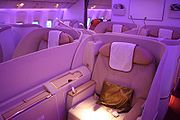
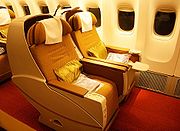
Flying Returns is Air India's frequent flyer programme. The programme is also shared by all other Air India Limited carriers.Premium lounges
International
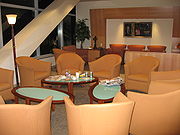
- London Heathrow AirportLondon Heathrow AirportLondon Heathrow Airport or Heathrow , in the London Borough of Hillingdon, is the busiest airport in the United Kingdom and the third busiest airport in the world in terms of total passenger traffic, handling more international passengers than any other airport around the globe...
- John F. Kennedy International AirportJohn F. Kennedy International AirportJohn F. Kennedy International Airport is an international airport located in the borough of Queens in New York City, about southeast of Lower Manhattan. It is the busiest international air passenger gateway to the United States, handling more international traffic than any other airport in North...
(New York)
India
- Bengaluru International Airport (Bangalore)
- Chhatrapati Shivaji International Airport (Mumbai)
- Indira Gandhi International AirportIndira Gandhi International AirportIndira Gandhi International Airport is the primary international airport of the National Capital Region of Delhi, India, situated in West Delhi, 16 km southwest of New Delhi city centre. Named after Indira Gandhi, the former Prime Minister of India, it is the busiest airport in India in...
(Delhi) - Rajiv Gandhi International Airport (Hyderabad)
In-flight entertainment
Air India's Boeing 777-200LR/-300ER as well as some refurbished Boeing 747-400 aircraft use the ThalesThales Group
The Thales Group is a French electronics company delivering information systems and services for the aerospace, defense, transportation and security markets...
TopSeries IFE systems for onboard in-flight entertainment. Airbus A310s do not have personal LCD screens. Airbus A330s have widescreen displays in Business and Economy classes but no personal IFEs.
Awards and recognitions
- Preferred International Airline award for travel and hospitality from Awaz Consumer Awards 2006
- Best International West Bound Airline out of India for three successive years by Galileo Express TravelWorld Award
- Best Corporate Social Responsibility Initiative. by Galileo Express TravelWorld Award
- Best Short-Haul International Airline by Galileo Express TravelWorld Award 2008
- The Mercury AwardThe Mercury AwardThis page is about The Mercury Award for air catering. For the Mercury Music Prize, see that article.The Mercury Award is an international award conferred by the International Travel Catering Association for setting high standards in in-flight catering.-Air India's wins:Air India has won a number...
for the years 1994 and 2003, from the International Flight Catering Association, for finest in-flight catering services. - Amity Corporate Excellence Award instituted by the Amity International Business School, Noida, Uttar Pradesh to honour Corporates with distinct vision, innovation, competitiveness and sustenance.
- Reader’s Digest Trusted Brand Award
- Dun and Bradstreet Award(D&B)- first in terms of revenue out of the top airline companies out of India
- Best South Asian Airline award by readers of TTG Asia, TTG China, TTG Mice and TTG-BT Mice China, all renowned Mice and business travel publications.
- Cargo Airline of the Year at the 26th Cargo Airline of the Year Awards
- The airline entered the Guinness Book of World Records for the most people evacuated by a civil airliner. Over 111,000 people were evacuated from Amman to Mumbai – a distance of 4,117 km, by operating 488 flights in association with Indian, from 13 August to 11 October 1990 – lasting 59 days. The operation was carried out during Persian Gulf WarGulf WarThe Persian Gulf War , commonly referred to as simply the Gulf War, was a war waged by a U.N.-authorized coalition force from 34 nations led by the United States, against Iraq in response to Iraq's invasion and annexation of Kuwait.The war is also known under other names, such as the First Gulf...
in 1990 to evacuate Indian expatriatesNon-resident Indian and Person of Indian OriginA Non-Resident Indian is an Indian citizen who has migrated to another country, a person of Indian origin who is born outside India, or a person of Indian origin who resides permanently outside India. Other terms with the same meaning are overseas Indian and expatriate Indian...
from Kuwait and Iraq. - The Montreal Protocol Public Awareness Award was awarded to Air India by the United NationsUnited NationsThe United Nations is an international organization whose stated aims are facilitating cooperation in international law, international security, economic development, social progress, human rights, and achievement of world peace...
for environmental protection, especially in the ozone layer. - World's first all-jet airline- June 1962
- World's largest operator of Airbus A310-300
- Air India's security department became the first aviation security organisation in the world to acquire ISO 9002 certification (31 January 2001).
- Air India's Department of Engineering has obtained the ISO 9002 for its Engineering facilities for meeting international standards.
Accidents and incidents
Ten Air India flights have fatally crashed, including those due to terrorist attacks. Air India has a record of 6.82 fatal events per million flights.1950s
- On 3 November 1950 Air India Flight 245Air India Flight 245Air India Flight 245 was a scheduled Air India passenger flight that crashed into Mont Blanc, France, on 3 November 1950. On the morning of 3 November 1950, Air India Flight 245, flown by the Lockheed L-749A Constellation Malabar Princess , carried 40 passengers and 8 crew on the route...
Malabar Princess a Lockheed L-749 ConstellationLockheed ConstellationThe Lockheed Constellation was a propeller-driven airliner powered by four 18-cylinder radial Wright R-3350 engines. It was built by Lockheed between 1943 and 1958 at its Burbank, California, USA, facility. A total of 856 aircraft were produced in numerous models, all distinguished by a...
(registered VT-CQP) carrying 48 people (40 passengers and 8 crew), flying on the Bombay-Cairo-Geneva-LondonLondonLondon is the capital city of :England and the :United Kingdom, the largest metropolitan area in the United Kingdom, and the largest urban zone in the European Union by most measures. Located on the River Thames, London has been a major settlement for two millennia, its history going back to its...
route, crashed on Mont BlancMont BlancMont Blanc or Monte Bianco , meaning "White Mountain", is the highest mountain in the Alps, Western Europe and the European Union. It rises above sea level and is ranked 11th in the world in topographic prominence...
, FranceFranceThe French Republic , The French Republic , The French Republic , (commonly known as France , is a unitary semi-presidential republic in Western Europe with several overseas territories and islands located on other continents and in the Indian, Pacific, and Atlantic oceans. Metropolitan France...
, killing all on board.
- On 11 April 1955 Kashmir PrincessKashmir PrincessThe Kashmir Princess was a chartered Lockheed L-749A Constellation aircraft owned by Air India, which exploded in midair and crashed into the South China Sea following a bomb explosion, on 11 April 1955 while en route from Bombay, India and Hong Kong to Jakarta, Indonesia. Sixteen of those on board...
a Lockheed L-749A ConstellationLockheed ConstellationThe Lockheed Constellation was a propeller-driven airliner powered by four 18-cylinder radial Wright R-3350 engines. It was built by Lockheed between 1943 and 1958 at its Burbank, California, USA, facility. A total of 856 aircraft were produced in numerous models, all distinguished by a...
registered (VT-DEP) carrying 19 people (11 passengers and 8 crew) was bombed in midair, killing 16 of the 19 on board.
- On 19 July 1959 Rani of Aera a Lockheed L-1049G Super ConstellationLockheed ConstellationThe Lockheed Constellation was a propeller-driven airliner powered by four 18-cylinder radial Wright R-3350 engines. It was built by Lockheed between 1943 and 1958 at its Burbank, California, USA, facility. A total of 856 aircraft were produced in numerous models, all distinguished by a...
(registered VT-DIN) carrying 46 people (39 passengers and 7 crew) approached Santacruz Airport in conditions of poor visibility due to rain. The captain was using an altimeter with the barometric pressure set at 29.92". An overshoot was delayed and the aircraft crashed and suffered damage beyond repair. There were no fatalities.
- On 24 January 1966 Air India Flight 101Air India Flight 101Air India Flight 101 was a scheduled Air India passenger flight that crashed into Mont Blanc in France on the morning of 24 January 1966.-Accident:...
Kanchenjunga a Boeing 707-420Boeing 707The Boeing 707 is a four-engine narrow-body commercial passenger jet airliner developed by Boeing in the early 1950s. Its name is most commonly pronounced as "Seven Oh Seven". The first airline to operate the 707 was Pan American World Airways, inaugurating the type's first commercial flight on...
(registered VT-DMN) carrying 117 people (106 passengers and 11 crew) crashed on Mont BlancMont BlancMont Blanc or Monte Bianco , meaning "White Mountain", is the highest mountain in the Alps, Western Europe and the European Union. It rises above sea level and is ranked 11th in the world in topographic prominence...
, France, on the border between France and ItalyItalyItaly , officially the Italian Republic languages]] under the European Charter for Regional or Minority Languages. In each of these, Italy's official name is as follows:;;;;;;;;), is a unitary parliamentary republic in South-Central Europe. To the north it borders France, Switzerland, Austria and...
, killing all on board. Among the dead was the noted Indian scientist, Homi J. BhabhaHomi J. BhabhaHomi Jehangir Bhabha, FRS was an Indian nuclear physicist and the chief architect of the Indian atomic energy program...
.
1970s
- On 1 January 1978 Air India Flight 855Air India Flight 855Air India Flight 855 was a scheduled passenger flight that crashed during the evening of 1 January 1978 about off the coast of Bandra, Bombay , India. All 213 lives on board were lost...
Emperor Ashoka a Boeing 747-237BBoeing 747The Boeing 747 is a wide-body commercial airliner and cargo transport, often referred to by its original nickname, Jumbo Jet, or Queen of the Skies. It is among the world's most recognizable aircraft, and was the first wide-body ever produced...
(registered VT-EBD) crashed into the Arabian SeaArabian SeaThe Arabian Sea is a region of the Indian Ocean bounded on the east by India, on the north by Pakistan and Iran, on the west by the Arabian Peninsula, on the south, approximately, by a line between Cape Guardafui in northeastern Somalia and Kanyakumari in India...
after takeoff from Sahar International Airport (now Chhatrapati Shivaji International Airport) in Mumbai, killing all on board (213 persons; 190 passengers, 23 crew).
1980s
- On 21 June 1982 Air India Flight 403Air India Flight 403Air India Flight 403 was a scheduled Air India passenger flight that crashed at Sahar International Airport in Bombay, India on the 21 June 1982.-Accident:...
Gouri Shankar a Boeing 707-420Boeing 707The Boeing 707 is a four-engine narrow-body commercial passenger jet airliner developed by Boeing in the early 1950s. Its name is most commonly pronounced as "Seven Oh Seven". The first airline to operate the 707 was Pan American World Airways, inaugurating the type's first commercial flight on...
(registered VT-DJJ) carrying 99 passengers and 12 crew from Kuala Lumpur International AirportKuala Lumpur International AirportKuala Lumpur International Airport , or KLIA serves the capital city of Malaysia, Kuala Lumpur, and is one of Southeast Asia's largest airports. It is also Malaysia's main international airport. It is situated in the Sepang district, in the south of the state of Selangor, about from Kuala Lumpur...
via Madras (now ChennaiChennaiChennai , formerly known as Madras or Madarasapatinam , is the capital city of the Indian state of Tamil Nadu, located on the Coromandel Coast off the Bay of Bengal. Chennai is the fourth most populous metropolitan area and the sixth most populous city in India...
) crashed at Sahar International Airport after a heavy landing during a rainstorm. The fuselage exploded after starting a late go-around. Two crew members and 15 passengers were killed.
- On 23 June 1985 Air India Flight 182Air India Flight 182Air India Flight 182 was an Air India flight operating on the Montreal–London–Delhi route. On 23 June 1985, the airplane operating on the route a Boeing 747-237B named after Emperor Kanishka was blown up by a bomb at an altitude of , and crashed into the Atlantic Ocean while in Irish airspace.A...
Emperor Kanishka a Boeing 747-237BBoeing 747The Boeing 747 is a wide-body commercial airliner and cargo transport, often referred to by its original nickname, Jumbo Jet, or Queen of the Skies. It is among the world's most recognizable aircraft, and was the first wide-body ever produced...
(registered VT-EFO) was blown up in mid-air, mid-flight by a suitcase-bomb planted by Babbar Khalsa TerroristsBabbar KhalsaBabbar Khalsa , also known as Babbar Khalsa International , is a Sikh armed organisation based in India. Many consider the Babbar Khalsa a Resistance movement, and it played a prominent role in the Punjab insurgency. Babbar Khalsa International was created in 1978, after a number of Sikhs were...
allegedly as revenge for the Indian Government's operationOperation Blue StarOperation Blue Star ) 3– 6 June 1984 was an Indian military operation, ordered by Indira Gandhi, then Prime Minister of India, to remove Sikh separatists from the Golden Temple in Amritsar...
on the Golden TempleHarmandir SahibThe Harmandir Sahib also Darbar Sahib , also referred to as the Golden Temple, is a prominent Sikh gurdwara located in the city of Amritsar, Punjab . Construction of the gurdwara was begun by Guru Ram Das, the fourth Sikh Guru, and completed by his successor, Guru Arjan Dev...
on June 1984. The flight was on the first leg on its MontrealMontrealMontreal is a city in Canada. It is the largest city in the province of Quebec, the second-largest city in Canada and the seventh largest in North America...
-LondonLondonLondon is the capital city of :England and the :United Kingdom, the largest metropolitan area in the United Kingdom, and the largest urban zone in the European Union by most measures. Located on the River Thames, London has been a major settlement for two millennia, its history going back to its...
-Delhi-Bombay flight when it exploded off the coast of CorkCounty CorkCounty Cork is a county in Ireland. It is located in the South-West Region and is also part of the province of Munster. It is named after the city of Cork . Cork County Council is the local authority for the county...
, IrelandIrelandIreland is an island to the northwest of continental Europe. It is the third-largest island in Europe and the twentieth-largest island on Earth...
. The plane crashed into the Atlantic Ocean. All 307 passengers and 22 crew on board died. After this incident Air India suspended all services to MontrealMontrealMontreal is a city in Canada. It is the largest city in the province of Quebec, the second-largest city in Canada and the seventh largest in North America...
.
1990s
- On 7 May 1990 Air India Flight 132 Emperor Vikramaditya a Boeing 747-237BBoeing 747The Boeing 747 is a wide-body commercial airliner and cargo transport, often referred to by its original nickname, Jumbo Jet, or Queen of the Skies. It is among the world's most recognizable aircraft, and was the first wide-body ever produced...
(registered VT-EBO) flying on the LondonLondonLondon is the capital city of :England and the :United Kingdom, the largest metropolitan area in the United Kingdom, and the largest urban zone in the European Union by most measures. Located on the River Thames, London has been a major settlement for two millennia, its history going back to its...
-Delhi-Bombay route and carrying 215 people (195 passengers and 20 crew) touched down at Delhi's Indira Gandhi International AirportIndira Gandhi International AirportIndira Gandhi International Airport is the primary international airport of the National Capital Region of Delhi, India, situated in West Delhi, 16 km southwest of New Delhi city centre. Named after Indira Gandhi, the former Prime Minister of India, it is the busiest airport in India in...
after a flight from LondonLondonLondon is the capital city of :England and the :United Kingdom, the largest metropolitan area in the United Kingdom, and the largest urban zone in the European Union by most measures. Located on the River Thames, London has been a major settlement for two millennia, its history going back to its...
's Heathrow Airport. On application of reverse thrust, a failure of the no. 1 engine pylon to wing attachment caused this engine to tilt nose down. Hot exhaustion gases caused a fire on the left wing. There were no fatalities but the aircraft was damaged beyond repair and written off.
- On 24 December 1999, Friday Indian Airlines Flight 814Indian Airlines Flight 814Indian Airlines Flight 814 commonly known as IC 814 was an Indian Airlines Airbus A300 en route from Tribhuvan International Airport in Kathmandu, Nepal to Indira Gandhi International Airport in Delhi, India on Friday, December 24, 1999, when it was hijacked...
(VT-EDW) had 178 passengers on board (most of whom were Indian nationals) that were coming to India after vacationing in NepalNepalNepal , officially the Federal Democratic Republic of Nepal, is a landlocked sovereign state located in South Asia. It is located in the Himalayas and bordered to the north by the People's Republic of China, and to the south, east, and west by the Republic of India...
. was hijacked, shortly after the aircraft entered Indian airspace at about 17:30 Indian Standard TimeIndian Standard TimeIndian Standard Time is the time observed throughout India and Sri Lanka, with a time offset of UTC+05:30. India does not observe daylight saving time or other seasonal adjustments, although DST was used briefly during the Sino–Indian War of 1962 and the Indo–Pakistani Wars of 1965 and 1971...
.The aircraft was hijacked by gunmen . After touching down in AmritsarAmritsarAmritsar is a city in the northern part of India and is the administrative headquarters of Amritsar district in the state of Punjab, India. The 2001 Indian census reported the population of the city to be over 1,500,000, with that of the entire district numbering 3,695,077...
, LahoreLahoreLahore is the capital of the Pakistani province of Punjab and the second largest city in the country. With a rich and fabulous history dating back to over a thousand years ago, Lahore is no doubt Pakistan's cultural capital. One of the most densely populated cities in the world, Lahore remains a...
and DubaiDubaiDubai is a city and emirate in the United Arab Emirates . The emirate is located south of the Persian Gulf on the Arabian Peninsula and has the largest population with the second-largest land territory by area of all the emirates, after Abu Dhabi...
, the hijackers forced the aircraft to land in Kandahar, Afghanistan. The hijackers released 27 of 176 passengers in DubaiDubaiDubai is a city and emirate in the United Arab Emirates . The emirate is located south of the Persian Gulf on the Arabian Peninsula and has the largest population with the second-largest land territory by area of all the emirates, after Abu Dhabi...
but fatally stabbed one and wounded several others.The hijacking lasted for seven days and ended after India released three militants — Mushtaq Ahmed ZargarMushtaq Ahmed ZargarMushtaq Ahmed Zargar was born in 1967 and grew up in the Jama Masjid area of Srinagar in Kashmir Valley. His father was a postman. Zargar was motivated to militancy at the age of 17 in 1984 and became a member of the Jammu and Kashmir Liberation Front when he was arrested for the first time.On...
, Ahmed Omar Saeed SheikhAhmed Omar Saeed SheikhAhmed Omar Saeed Sheikh is a British-born militant of Pakistani descent with links to various Islamist militant organisations, including Jaish-e-Mohammed, al-Qaeda, Harkat-ul-Mujahideen and the Taliban.He was arrested and served time in prison for...
and Maulana Masood AzharMaulana Masood AzharMaulana Masood Azhar is a Pakistani mujaheddin leader and the founder of the militant group Jaish-e-Mohammed, based mainly in the Pakistan-administered portion of the state of Kashmir....
.
2000s
- On 4 September 2009, Air India Flight 829Air India Flight 829Air India Flight 829 was a Boeing 747-437 which caught fire on the ground at Mumbai, India on 4 September 2009. A successful emergency evacuation was carried out with 21 minor injuries.-Aircraft:...
Konark a Boeing 747-437Boeing 747-400The Boeing 747-400 is a major development and the best-selling model of the Boeing 747 family of jet airliners. While retaining the four-engine wide-body layout of its predecessors, the 747-400 embodies numerous technological and structural changes to produce a more efficient airframe...
(registered VT-ESM) flying on the MumbaiMumbaiMumbai , formerly known as Bombay in English, is the capital of the Indian state of Maharashtra. It is the most populous city in India, and the fourth most populous city in the world, with a total metropolitan area population of approximately 20.5 million...
-RiyadhRiyadhRiyadh is the capital and largest city of Saudi Arabia. It is also the capital of Riyadh Province, and belongs to the historical regions of Najd and Al-Yamama. It is situated in the center of the Arabian Peninsula on a large plateau, and is home to 5,254,560 people, and the urban center of a...
route caught fire at Chhatrapati Shivaji International Airport. The fire started in number one engine while the aircraft was taxing to Runway 27 for take-off. An emergency evacuation was carried out with no injuries among the 228 people (213 passengers and 15 crew) on board.
See also
- Air India Limited
- Indian (airline)Indian (airline)Indian , formerly Indian Airlines was a major Indian airline based in Delhi and focused primarily on domestic routes, along with several international services to neighbouring countries in Asia. It was state-owned, and was administered by the Ministry of Civil Aviation. It was one of the two flag...
- Air India Regional
- Air India Air Transport ServicesAir India Air Transport ServicesAir India Air Transport Services Limited is a Public Sector Undertaking of the Government of India. AIATSL is a subsidiary of Air India and is headquartered in Mumbai, India. The company provides ground handling services at various airports in India...
- Air India OneAir India OneAir India One or AI 001 is the call sign of any aircraft carrying either the Prime Minister of India or the President of India. The aircraft are operated as VIP flights by the Indian Air Force...