
All Topics  
Boeing 777

 
Boeing 777

   Email Print
   Bookmark   Link


Boeing 777


The Boeing 777 is a long-range, wide-body
Wide-body aircraft

A wide-body aircraft is a large airliner with two passenger aisles, also known as a twin-aisle aircraft. The typical fuselage diameter is 5 to 6 metres ....
 twin-engine airliner
Airliner

An airliner is a large fixed-wing aircraft with the primary function of transporting paying passengers and carrying cargo. Such planes are owned by airlines....
 manufactured by Boeing Commercial Airplanes
Boeing Commercial Airplanes

Boeing Commercial Airplanes is a unit of Boeing, based in Renton, Washington, Washington consisting of the Seattle-based former Boeing Airplane Company , as well as the Long Beach, California-based Douglas Aircraft Company division of the former McDonnell Douglas....
. The world's largest twinjet
Twinjet

A twinjet is a jet aircraft powered by two jet engines. There are two common configurations of the engines; one sees either engine slung under a wing, and the other sees them mounted at the back of the fuselage....
 and commonly referred to as the "Triple Seven", the aircraft can carry between 283 and 368 passengers in a three-class configuration, and has a range from 5,235 to 9,380 nautical miles (9,695 to 17,370 km). Distinguishing features of the 777 include the six wheels on each main landing gear, its circular fuselage
Fuselage

The fuselage is an aircraft's main body section that holds crew and passengers or cargo. In single-engine aircraft it will usually contain an engine, although in some amphibious aircraft the single engine is mounted on a hardpoint attached to the fuselage which in turn is used as a floating Hull ....
 cross-section, the largest diameter turbofan
Turbofan

A turbofan is a type of aircraft engine consisting of a ducted fan which is powered by a gas turbine. Part of the airstream from the ducted fan passes through the gas turbine core, providing oxygen to burn fuel to create power....
 engines of any aircraft, and the blade-like end to the tail cone.

Designed to bridge the capacity difference between the 767
Boeing 767

The Boeing 767 is a mid-size, wide-body twinjet airliner produced by Boeing Commercial Airplanes. Passenger versions of the 767 can carry between 181 and 375 passengers, and have a range of 5,200 to 6,590 nautical miles depending on variant and seating configuration....
 and 747
Boeing 747

The Boeing 747 is a wide-body aircraft commercial airliner, often referred to by the nickname "Jumbo Jet". It is among the world's most recognizable aircraft, and was the first widebody ever produced....
, the Boeing 777 is produced in two fuselage lengths.


Discussion
Ask a question about 'Boeing 777'
Start a new discussion about 'Boeing 777'
Answer questions from other users
Full Discussion Forum


Recent Posts


Encyclopedia


The Boeing 777 is a long-range, wide-body
Wide-body aircraft

A wide-body aircraft is a large airliner with two passenger aisles, also known as a twin-aisle aircraft. The typical fuselage diameter is 5 to 6 metres ....
 twin-engine airliner
Airliner

An airliner is a large fixed-wing aircraft with the primary function of transporting paying passengers and carrying cargo. Such planes are owned by airlines....
 manufactured by Boeing Commercial Airplanes
Boeing Commercial Airplanes

Boeing Commercial Airplanes is a unit of Boeing, based in Renton, Washington, Washington consisting of the Seattle-based former Boeing Airplane Company , as well as the Long Beach, California-based Douglas Aircraft Company division of the former McDonnell Douglas....
. The world's largest twinjet
Twinjet

A twinjet is a jet aircraft powered by two jet engines. There are two common configurations of the engines; one sees either engine slung under a wing, and the other sees them mounted at the back of the fuselage....
 and commonly referred to as the "Triple Seven", the aircraft can carry between 283 and 368 passengers in a three-class configuration, and has a range from 5,235 to 9,380 nautical miles (9,695 to 17,370 km). Distinguishing features of the 777 include the six wheels on each main landing gear, its circular fuselage
Fuselage

The fuselage is an aircraft's main body section that holds crew and passengers or cargo. In single-engine aircraft it will usually contain an engine, although in some amphibious aircraft the single engine is mounted on a hardpoint attached to the fuselage which in turn is used as a floating Hull ....
 cross-section, the largest diameter turbofan
Turbofan

A turbofan is a type of aircraft engine consisting of a ducted fan which is powered by a gas turbine. Part of the airstream from the ducted fan passes through the gas turbine core, providing oxygen to burn fuel to create power....
 engines of any aircraft, and the blade-like end to the tail cone.

Designed to bridge the capacity difference between the 767
Boeing 767

The Boeing 767 is a mid-size, wide-body twinjet airliner produced by Boeing Commercial Airplanes. Passenger versions of the 767 can carry between 181 and 375 passengers, and have a range of 5,200 to 6,590 nautical miles depending on variant and seating configuration....
 and 747
Boeing 747

The Boeing 747 is a wide-body aircraft commercial airliner, often referred to by the nickname "Jumbo Jet". It is among the world's most recognizable aircraft, and was the first widebody ever produced....
, the Boeing 777 is produced in two fuselage lengths. The original 777-200
Boeing 777

The Boeing 777 is a long-range, Wide-body aircraft twin-engine airliner manufactured by Boeing Commercial Airplanes. The world's largest twinjet and commonly referred to as the "Triple Seven", the aircraft can carry between 283 and 368 passengers in a three-class configuration, and has a range from 5,235 to 9,380 nautical miles ....
 model first entered service in 1995, and the stretched 777-300
Boeing 777

The Boeing 777 is a long-range, Wide-body aircraft twin-engine airliner manufactured by Boeing Commercial Airplanes. The world's largest twinjet and commonly referred to as the "Triple Seven", the aircraft can carry between 283 and 368 passengers in a three-class configuration, and has a range from 5,235 to 9,380 nautical miles ....
, which is longer, was introduced in 1998. The longer-range 777-200LR
Boeing 777

The Boeing 777 is a long-range, Wide-body aircraft twin-engine airliner manufactured by Boeing Commercial Airplanes. The world's largest twinjet and commonly referred to as the "Triple Seven", the aircraft can carry between 283 and 368 passengers in a three-class configuration, and has a range from 5,235 to 9,380 nautical miles ....
 and 777-300ER
Boeing 777

The Boeing 777 is a long-range, Wide-body aircraft twin-engine airliner manufactured by Boeing Commercial Airplanes. The world's largest twinjet and commonly referred to as the "Triple Seven", the aircraft can carry between 283 and 368 passengers in a three-class configuration, and has a range from 5,235 to 9,380 nautical miles ....
 variants entered service in 2006 and 2004, respectively, while a freighter
Cargo airline

Cargo airlines are airlines dedicated to the transport of cargo. Some cargo airlines are divisions or subsidiaries of larger passenger airlines....
 version, the 777F
Boeing 777

The Boeing 777 is a long-range, Wide-body aircraft twin-engine airliner manufactured by Boeing Commercial Airplanes. The world's largest twinjet and commonly referred to as the "Triple Seven", the aircraft can carry between 283 and 368 passengers in a three-class configuration, and has a range from 5,235 to 9,380 nautical miles ....
, first flew in 2008. Both long range 777 models and the 777F are equipped with GE90
General Electric GE90

General Electric GE90 is a family of high-bypass turbofan engines built by GE-Aviation for the Boeing 777, with thrust ranging from 74,000 to 115,000 pound-force ....
 engines, wingtip extensions of , and raked wingtips. The 777-200LR is currently the world's longest-range airliner, and holds the record for longest distance flown by an unrefueled commercial airliner.

The Boeing 777 entered commercial airline service with United Airlines
United Airlines

United Air Lines, Inc., trading as United Airlines , is a major carrier of the United States. It is a subsidiary of UAL Corporation with corporate offices in Chicago at 77 West Wacker Drive, and its operations base in nearby Elk Grove Village, Illinois....
 in 1995, and Singapore Airlines
Singapore Airlines

Singapore Airlines Limited is the Flag carrier of Singapore. Singapore Airlines operates a hub at Singapore Changi Airport and has a strong presence in the Southeast Asia, East Asia, South Asia, and "Kangaroo Route" markets....
 operates the largest 777 fleet of any airline as of 2008. The most common 777 variant used worldwide is the 777-200ER
Boeing 777

The Boeing 777 is a long-range, Wide-body aircraft twin-engine airliner manufactured by Boeing Commercial Airplanes. The world's largest twinjet and commonly referred to as the "Triple Seven", the aircraft can carry between 283 and 368 passengers in a three-class configuration, and has a range from 5,235 to 9,380 nautical miles ....
, an extended range version of the original 777-200, with 408 aircraft delivered as of February 2009. As of February 2009, 56 customers have placed orders for 1,101 777s, with 763 delivered.

Through the 2000s, the Boeing 777 has emerged as one of its manufacturer's best-selling models. Due to rising fuel costs, airlines have acquired the 777 as a comparatively fuel-efficient alternative to other wide-body jets, and have increasingly used the aircraft on long-haul, transoceanic routes. Direct market competitors to the 777 include the Airbus A330-300
Airbus A330

The Airbus A330 is a large-capacity, wide-body aircraft, twinjet, medium-to-long-range commercial passenger airliner. It was developed at the same time as the four-engined Airbus A340....
 and A340
Airbus A340

The Airbus A340 is a long-range four-engined wide-body commercial passenger airliner manufactured by Airbus, a subsidiary of EADS. It seats between 261 and 380 passengers, and has a range between 6,700 and 9,000 nautical miles....
, with the upcoming, improved fuel efficiency
Fuel efficiency

Fuel efficiency, in its basic sense, is the same as thermal efficiency, meaning the efficiency of a process that converts chemical potential energy contained in a carrier fuel into kinetic energy or Mechanical work....
 A350 XWB
Airbus A350

The Airbus A350 is a long range, mid-sized, Wide-body aircraft family of airliners currently under development. The A350 will be the first Airbus with fuselage and wing structures made primarily of carbon fiber reinforced plastic....
 and Boeing 787
Boeing 787

The Boeing 787 Dreamliner is a mid-sized, Wide-body aircraft, twinjet jet airliner currently under development by Boeing Commercial Airplanes....
 programs currently in development.

Development


Background

The Boeing 747, Douglas DC-10
McDonnell Douglas DC-10

The McDonnell Douglas DC-10 is a trijet medium- to long-range widebody airliner, with two engines mounted on underwing pylons and a third engine at the base of the vertical stabilizer....
, and the Lockheed L-1011 TriStar became the first generation of wide-body
Wide-body aircraft

A wide-body aircraft is a large airliner with two passenger aisles, also known as a twin-aisle aircraft. The typical fuselage diameter is 5 to 6 metres ....
 passenger airliners to enter service by the early 1970s. In the late 1970s, Boeing unveiled three new models: the twin-engine 757
Boeing 757

The Boeing 757 is a Narrow-body aircraft commercial passenger fixed-wing aircraft manufactured by Boeing Commercial Airplanes. It was launched by Eastern Air Lines and British Airways to replace the Boeing 727 and entered service in 1983....
 to replace the venerable 727
Boeing 727

The Boeing 727 is a mid-size, Narrow-body aircraft, trijet, T-tailed Commercial airliner jet airliner. The 727's fuselage has an outer diameter of ....
, the twin-engine 767 to challenge the Airbus A300
Airbus A300

The Airbus A300 is a short- to medium-range Wide-body aircraft aircraft. Launched in 1972 as the world's first twin-engined widebody, it was the first product of the Airbus consortium of European aerospace companies, wholly owned today by EADS....
, and a trijet
Trijet

A trijet is an aircraft powered by three jet engines. Early twin-jet designs were limited by the Federal Aviation Administration's "ETOPS/LROPS", whereby the flight path of twin-engined jetliners was restricted to within 60 minutes' flying time from a suitable airport, in case of engine failure....
 777 concept to compete with the DC-10 and L-1011. The 757 and 767 twinjets were a success, due in part to the 1980s ETOPS (Extended-range Twin-engine Operational Performance Standards) regulations governing transoceanic twinjet operations. ETOPS regulatory approval allowed twinjet aircraft to fly long-distance overseas routes at up to three hours' distance from emergency diversionary airports. The trijet 777 was later cancelled, much like an earlier 757 trijet concept, due in part to the complexities of a trijet design and the absence of applicable engines. Boeing was left with a size and range gap in its product line between the 767-300ER
Boeing 767

The Boeing 767 is a mid-size, wide-body twinjet airliner produced by Boeing Commercial Airplanes. Passenger versions of the 767 can carry between 181 and 375 passengers, and have a range of 5,200 to 6,590 nautical miles depending on variant and seating configuration....
 and the 747-400
Boeing 747

The Boeing 747 is a wide-body aircraft commercial airliner, often referred to by the nickname "Jumbo Jet". It is among the world's most recognizable aircraft, and was the first widebody ever produced....
.

By the 1980s, the DC-10 and L-1011 were approaching retirement, prompting manufacturers to develop replacement designs. McDonnell Douglas was working on the MD-11, a stretched and upgraded version of the DC-10, while Airbus was developing the A330
Airbus A330

The Airbus A330 is a large-capacity, wide-body aircraft, twinjet, medium-to-long-range commercial passenger airliner. It was developed at the same time as the four-engined Airbus A340....
 and A340
Airbus A340

The Airbus A340 is a long-range four-engined wide-body commercial passenger airliner manufactured by Airbus, a subsidiary of EADS. It seats between 261 and 380 passengers, and has a range between 6,700 and 9,000 nautical miles....
. In the mid-1980s, Boeing produced proposals for an enlarged 767, dubbed 767-X, to target the replacement market for first generation wide-bodies like the DC-10. The 767-X had a longer fuselage and larger wings than the existing 767, and seated about 340 passengers with a maximum range of 7,300 nautical miles (13,500 km). Later versions of the proposed 767-X further expanded the fuselage cross-section, but still retained the existing 767 flight deck
Cockpit

A cockpit is the area, usually near the front of an aircraft, from which a pilot controls the aircraft. Most modern cockpits are enclosed, except on some small aircraft, and cockpits on large airliners are also physically separated from the cabin....
, nose, and other elements.

The airlines were unimpressed with the 767-X, and stated that they wanted short to intercontinental-range capability, a bigger cabin cross-section, a fully flexible cabin configuration, and an operating cost lower than any 767 stretch. Airline planners' requirements for larger aircraft had become increasingly more specific, adding to the heightened competition among aircraft manufacturers. By 1988, Boeing realized that the only answer was a new design, the 777 twinjet
Twinjet

A twinjet is a jet aircraft powered by two jet engines. There are two common configurations of the engines; one sees either engine slung under a wing, and the other sees them mounted at the back of the fuselage....
. On December 8, 1989, Boeing began issuing offers to airlines on its proposed new wide-body aircraft.

Design effort


The design phase of the Boeing 777 was different from previous Boeing jetliners. For the first time, eight major airlines, namely All Nippon Airways
All Nippon Airways

, also known as or ANA, is an airline headquartered at the Shiodome City Center in the Shiodome area in Minato, Tokyo, Tokyo, Japan. ANA is the country's second-largest international airline after Japan Airlines and the country's largest domestic airline....
, American
American Airlines

American Airlines, Inc. is a major carrier of the United States. It is the world's largest airlines in passenger miles transported and passenger fleet size; second largest, behind FedEx Express, in aircraft operated; and second behind Air France-KLM in operating revenues....
, British Airways
British Airways

British Airways plc is an airline of the United Kingdom. The airline has the largest fleet of aircraft of any United Kingdom airline, but is only second in terms of international passengers carried....
, Cathay Pacific
Cathay Pacific

Cathay Pacific Airways is the flag carrier of Hong Kong. Based at Hong Kong International Airport, the airline's operations include scheduled passenger and cargo services to 115 destinations worldwide....
, Delta
Delta Air Lines

Delta Air Lines, incorporation is a United States airline based and headquartered in Atlanta, Georgia . Delta operates an expansive domestic and international network, spanning North America, South America, Europe, Asia, Africa, the Middle East and the Caribbean....
, Japan Airlines
Japan Airlines

, or JAL, is the national airline and flag carrier of Japan. It is one of the largest airline operators in Asia, and is a member of the Oneworld global airline alliance....
, Qantas
Qantas

Qantas Airways Limited is the national airline of Australia. The name was originally "QANTAS", an acronym for "Queensland and Northern Territory Aerial Services"....
, and United
United Airlines

United Air Lines, Inc., trading as United Airlines , is a major carrier of the United States. It is a subsidiary of UAL Corporation with corporate offices in Chicago at 77 West Wacker Drive, and its operations base in nearby Elk Grove Village, Illinois....
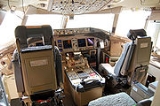
, had a role in the development of the plane. This was a departure from industry practice, where manufacturers typically conducted the design process with little airline input. The eight airlines that contributed to the 777 design process became known within Boeing as the "Working Together" group. At the first "Working Together" meeting in January 1990, a 23-page questionnaire was distributed to the airlines, asking each what it wanted in the new design. By March 1990, Boeing and the airlines had decided upon a basic design for the 777: a cabin cross-section close to the 747's, capacity up to 325 passengers, fly-by-wire controls, glass cockpit
Glass cockpit

A glass cockpit is an aircraft Cockpit that features electronic instrument Display device. Where a traditional cockpit relies on numerous mechanical gauges to display information, a glass cockpit utilizes several computer displays that can be adjusted to display flight information as needed....
, flexible interior, and 10% better seat-mile costs
Available seat miles

Available seat miles is a measure of an airline flight's passenger carrying capacity. It is equal to the number of seats available multiplied by the number of miles flown....
 than the A330 and MD-11.

In October 1990, United became the Boeing 777's launch customer when it placed an order for 34 Pratt & Whitney
Pratt & Whitney

Pratt & Whitney is an American aircraft engine manufacturer of products widely used in both civil and military aircraft list. As one of the "big three" aero-engine manufacturers, it competes with GE Aircraft Engines and Rolls-Royce plc, although it has also formed joint ventures with both of these companies....
-powered 777s with options
Option (aircraft purchasing)

An option, when purchasing aircraft, allows an airline to purchase additional aircraft in the future at an agreed price and date.When placing orders for new aircraft, airlines commonly obtain options from the aircraft manufacturer, for example Airbus or Boeing....
 on a further 34. The development of the 777 coincided with United Airlines' replacement program for its aging DC-10s. United Airlines required that the new aircraft needed to be capable of flying three different routes; Chicago
Chicago

Chicago is the largest city in the U.S. state of Illinois and the Midwestern United States, as well as the List of United States cities by population city in the United States with more than 2.8 million residents....
 to Hawaii
Hawaii

File:Pahoehoe and Aa flows at Hawaii.jpgThe State of Hawaii is a U.S. state in the United States, located on an archipelago in the central Pacific Ocean southwest of the continental United States, southeast of Japan, and northeast of Australia....
, Chicago to Europe
Europe

Europe is, conventionally, one of the world's seven continents. Comprising the westernmost peninsula of Eurasia, Europe is generally divided from Asia to its east by the water divide of the Ural Mountains, the Ural , the Caspian Sea, and by the Caucasus Mountains to the southeast....
, and non-stop from Denver, a hot and high
Hot and high

In aviation, hot and high refers to very warm climates or very high elevations that may compromise an aircraft's ability to operate safely.Air density decreases with increasing temperature and altitude....
 airport, to Hawaii. ETOPS certification was also a priority for United Airlines, given the overseas portion of United's Hawaii routes.

In January 1993, the 767-X was officially renamed the 777, and a team of United 777 developers joined other airline teams and the Boeing team at the Boeing Everett factory
Boeing Everett Factory

The Boeing Company's Everett, Washington Factory is where Boeing 747s, Boeing 767s, Boeing 777s, and the new Boeing 787 are built. Located on the northeast corner of Paine Field, it is the List of largest buildings in the world by volume at 13.3 million m? and covers 398,000 m? ....
 in Washington
Everett, Washington

Everett is the county seat of and the largest city in Snohomish County, Washington, Washington, United States. Named for Everett Colby, son of founder Charles L....
. Divided into 240 design teams of up to 40 members, working on individual components of the aircraft, almost 1,500 design issues were addressed. The fuselage diameter was further increased to suit Cathay Pacific, the baseline model grew longer for All Nippon Airways, and British Airways' input led to added built-in testing and interior flexibility.

The Boeing 777 was the first commercial aircraft to be designed entirely on computer
Computer

A computer is a machine that manipulates Data according to a list of Code .The first devices that resemble modern computers date to the mid-20th century , although the computer concept and various machines similar to computers existed earlier....
. All design drawings were created on a 3D CAD software system known as CATIA
CATIA

CATIA is a multi-platform Computer-aided design/Computer-aided manufacturing/Computer-aided engineering commercial software developed by the French company Dassault Systemes and marketed worldwide by IBM....
, sourced from Dassault Systemes
Dassault Systemes

Dassault Systemes is a leading company specializing in 3D and PLM software. In 2008, Dassault was the 17th largest software company in the world....
 and IBM
IBM

International Business Machines Corporation, abbreviated IBM and nicknamed "Big Blue" , is a multinational corporation computer technology and consulting corporation headquartered in Armonk, New York, New York, United States....
. This allowed a virtual 777 to be assembled, in simulation, to check for interferences and to verify proper fit of the many thousands of parts, thus reducing costly rework. Boeing was initially not convinced of the abilities of the program, and built a mock-up of the nose section
Boeing fuselage Section 41

Section 41 is the forward portion of a Boeing Commercial Airplanes aircraft, from the nose to aft of the Cockpit . In some models it includes the forward door and may extend to the first class cabin....
 to test the results. It was so successful that all further mock-ups were cancelled.

Production and testing


The production process for the Boeing 777 included substantial international content, with an unprecedented level of global subcontracting for a Boeing jetliner, exceeded only by the later 787
Boeing 787

The Boeing 787 Dreamliner is a mid-sized, Wide-body aircraft, twinjet jet airliner currently under development by Boeing Commercial Airplanes....
. International contributors included Mitsubishi Heavy Industries
Mitsubishi Heavy Industries

, or MHI, is a Japanese company. It is one of the core companies of Mitsubishi Group....
 and Kawasaki Heavy Industries
Kawasaki Heavy Industries

is an international corporation based in Japan. It has headquarters in both Chuo-ku, Kobe, Kobe and Minato, Tokyo.The company is named after its founder Shozo Kawasaki and has no connection with the city of Kawasaki, Kanagawa, Kanagawa....
 (fuselage panels), Fuji Heavy Industries, Ltd. (center wing section), Hawker De Havilland (elevators
Elevator (aircraft)

Elevators are control surfaces, usually at the rear of an aircraft, which control the aircraft's orientation by changing the Flight dynamics of the aircraft, and so also the angle of attack of the wing....
), ASTA (rudder) and Ilyushin
Ilyushin

Ilyushin , or Ilyushin Design Bureau is a Russian design bureau and aircraft manufacturer , founded by Sergey Ilyushin. It began operations on January 13, 1933, by order of the People's Commissar of the Heavy Industry of the USSR and the Head of the Main Department of Aviation Industry, P.I.Baranov....
 (jointly designed overhead baggage compartment). An agreement between Boeing and the Japan Aircraft Development Corporation (JADC), representing Japanese aerospace contractors, made the latter risk-sharing partners for 20% of the entire 777 program. The 777 was launched with propulsion options from three manufacturers, Pratt & Whitney
Pratt & Whitney

Pratt & Whitney is an American aircraft engine manufacturer of products widely used in both civil and military aircraft list. As one of the "big three" aero-engine manufacturers, it competes with GE Aircraft Engines and Rolls-Royce plc, although it has also formed joint ventures with both of these companies....
, General Electric
General Electric

The General Electric Company, or GE is a multinational corporation United States technology and Service s conglomerate incorporated in the State of New York....
, and Rolls-Royce
Rolls-Royce plc

Rolls-Royce Public limited company is a United Kingdom aircraft engine maker, and the second-largest in the world, behind GE Aviation. The company has related businesses in the defence aerospace, marine and energy markets....
, giving the airlines their choice of engines from competing firms.

Boeing selected its Everett factory, home of 747 production, as the site of 777 final assembly. To accommodate production of its new twinjet, Boeing doubled the size of the Everett factory to provide room for the addition of two new 777 assembly lines. The cost of upgrading the Everett factory for 777 production totaled nearly US$1.5 billion. Among new production methodologies developed for the 777, Boeing developed a turn machine which could rotate fuselage subassemblies 180 degrees, allowing workers access to 777 upper body sections. Production of the first 777 prototype began in January 1993. By the start of 777 production, the program had amassed 118 firm orders, with options for 95 more from ten airlines. Total investment in the 777 program was estimated at over US$4 billion from Boeing, with an additional US$2 billion from suppliers.

On April 9, 1994, the first Boeing 777, line number WA001, was rolled out in a series of fifteen ceremonies held during the day to accommodate the 100,000 invited guests. The first flight took place on June 14, 1994, piloted by 777 Chief Test Pilot John E. Cashman, marking the start of an eleven month flight test program more extensive than that seen on any previous Boeing model. Nine aircraft in total were used in the 777 flight test program, five powered by Pratt & Whitney PW4000
Pratt & Whitney PW4000

The Pratt & Whitney PW4000 is a family of turbofan#High-bypass turbofan engines aircraft engines with certified thrust ranging from 52,000 to 99,040 lbf ....
 engines, two by General Electric GE90
General Electric

The General Electric Company, or GE is a multinational corporation United States technology and Service s conglomerate incorporated in the State of New York....
 engines, and two by Rolls-Royce Trent 800 engines. Testing locations included the desert airfield at Edwards Air Force Base
Edwards Air Force Base

Edwards Air Force Base is a United States Air Force base located on the border of Kern County, California and Los Angeles County, California in the Antelope Valley....
 in California
California

California is a U.S. state on the West Coast of the United States of the United States, along the Pacific Ocean. It is bordered by Oregon to the north, Nevada to the east, Arizona to the southeast, and to the south the Mexico state of Baja California....
 and frigid conditions in Alaska
Alaska

Alaska is the largest U.S. state of the United States by area; it is situated in the northwest extremity of the North American continent, with Canada to the east, the Arctic Ocean to the north, and the Pacific Ocean to the west and south, with Russia further west across the Bering Strait....
. To satisfy ETOPS requirements, flight testing on the 777 included eight 180-minute single-engine diversion test flights. The first 777-200 built was used by Boeing's non-destructive testing (NDT) campaign in 1994–1995, and provided valuable data for the -200ER and -300 programs. At the conclusion of the successful test program, the 777 was awarded simultaneous airworthiness certification by the Federal Aviation Administration
Federal Aviation Administration

The Federal Aviation Administration is an agency of the United States Department of Transportation with authority to regulate and oversee all aspects of civil aviation in the U.S....
 (FAA) and Joint Aviation Authorities
Joint Aviation Authorities

The Joint Aviation Authorities, or JAA, is an associated body of the European Civil Aviation Conference representing the civil aviation regulatory authorities of a number of Europe States who have agreed to co-operate in developing and implementing common safety regulatory standards and procedures....
 (JAA) on April 19, 1995.

Entry into service


On May 15, 1995 Boeing delivered the first 777, registered N777UA, to United Airlines. The FAA awarded 180-minute ETOPS clearance ("ETOPS-180") for Pratt & Whitney PW4084 engined 777-200s on May 30, 1995, making the 777 the first aircraft to carry an ETOPS-180 rating at its entry into service. Longer ETOPS of 207 minutes was later approved. The 777's first commercial flight took place on June 7, 1995 from London's Heathrow Airport to Dulles International Airport near Washington D.C.

In November 1995, Boeing delivered the first 777 with General Electric GE90-77B
General Electric GE90

General Electric GE90 is a family of high-bypass turbofan engines built by GE-Aviation for the Boeing 777, with thrust ranging from 74,000 to 115,000 pound-force ....
 engines to launch customer British Airways, which subsequently placed the aircraft into service later that month. Initial service with the engine was affected by gearbox bearing wear issues, which caused British Airways to temporarily withdraw its GE90-77B engined aircraft from transatlantic service in 1997. British Airways' GE90-77B-engined 777s returned to full service later that year, and engine manufacturer General Electric subsequently announced upgraded GE90 versions.

The first Rolls-Royce Trent 877
Rolls-Royce Trent

Rolls Royce Trent is a family of Turbofan#High-bypass_turbofan_engines turbofan engines manufactured by Rolls-Royce plc. All are developments of the Rolls-Royce RB211 with thrust ratings of ....
-powered Boeing 777 was delivered to Thai Airways
Thai Airways

Thai Airways Company was the national domestic air carrier of Thailand. Its main base was the Domestic airport Airport terminal at Don Mueang International Airport: DMK ....
 in March 1996, completing the entry of all three 777 powerplants into service. All three 777 engine-airframe combinations had secured ETOPS-180 certification from the point of entry into service. By June 1997, total orders for the 777 numbered 323 from 25 customers, including satisfied launch customers which had ordered additional aircraft. Performance data from 777 operations established the consistent capabilities of the twin-engine airliner over long-haul transoceanic routes, leading to further sales. By 1998, dispatch reliability
Reliability engineering

Reliability engineering is an engineering field, that deals with the study of reliability: the ability of a system or component to perform its required functions under stated conditions for a specified period of time....
 rates (measuring takeoff without delay) for the Boeing 777 had reached 99.96% as 777 operations grew, and total fleet hours approached 900,000.

Further developments


After the initial 777-200 model, Boeing developed the 777-200ER, an increased gross weight variant, which first entered service with British Airways in 1997. The 777-200ER offered greater range and payload capability, and subsequently became the most popular version of the 777 in service. On April 2, 1997, a Malaysia Airlines
Malaysia Airlines

Malaysia Airlines is the flag carrier of Malaysia. Malaysia Airlines operates flights from its home base, Kuala Lumpur International Airport, and its secondary hub in Kota Kinabalu International Airport....
 Boeing 777-200ER dubbed "Super Ranger" broke the great circle
Great circle

A great circle of a sphere is a circle that runs along the surface of that sphere so as to cut it into two equal halves. The great circle therefore has both the same circumference and the same center as the sphere....
 "Distance Without Landing" record for an airliner by flying east, the "long way", from Boeing Field
Boeing Field

Boeing Field, officially King County International Airport , is a two-runway airport owned and run by King County, Washington, USA. In promotional literature, the airport is frequently referred to as KCIA, but this is not the airport identifier....
, Seattle, to Kuala Lumpur
Kuala Lumpur

Kuala Lumpur , is the largest city of Malaysia. The city proper, making up an area of , has an estimated population of 1.6 million in 2006. Greater Kuala Lumpur, also known as the Klang Valley, is an urban agglomeration of 7.2 million....
, Malaysia
Malaysia

Malaysia is a federation that consists of States of Malaysia in Southeast Asia with a total landmass of . The capital city is Kuala Lumpur, while Putrajaya is the seat of the federal government....
, a distance of 20,044 km (10,823 nautical miles), in 21 hours, 23 minutes.

Following the introduction of the 777-200ER, Boeing turned its attention to a stretched variant of the 777. On October 16, 1997, the first 777-300 made its first flight. At in length, the 777-300 became the longest airliner yet produced (until the A340-600), and had a 20% greater capacity than the standard 777-200. On May 4, 1998, the 777-300 was awarded type certification simultaneously from the FAA and JAA, and granted 180-minute ETOPS approval. The 777-300 entered service with launch customer Cathay Pacific later in that month.

By the late 1990s, Boeing was considering ultra-long-range versions of the 777-200 and 777-300. A more powerful engine was required, leading to active discussions between Boeing and the 777 engine manufacturers. General Electric offered to develop the GE90-115B engine, with a projected thrust of 115,000 lbf (512 kN), while Rolls-Royce proposed developing the Trent 8104 engine, with a thrust of 104,000 to 114,000 lbf (463 to 507 kN) and tested up to 117,000 lbf (520 kN). In 1999, Boeing announced an agreement with General Electric, beating out Rolls-Royce, which could not agree on risk-sharing for the project. As part of the deal with General Electric, Boeing agreed that GE90 engines would be exclusively offered on new long-range 777 models.

Next-generation 777s


In February 2000, Boeing began issuing offers to airlines on its next-generation long-range 777 program, initially called 777-X. The first model to emerge from the 777-X program, the 777-300ER, was launched with an order for ten aircraft from Air France
Air France

Air France , based in Paris, France, is one of the world's largest airlines. It is a subsidiary of the Air France-KLM Group and a founding member of the SkyTeam global airline alliance....
, along with additional undisclosed orders. Development of the next generation 777 aircraft was slowed by the airline industry downturn, which lasted through the early 2000s. The first flight of the 777-300ER occurred on February 24, 2003, and the first delivery to Air France occurred on April 29, 2004. The -300ER became one of Boeing's top-selling models, as airlines increasingly replaced four-engine models with the more fuel-efficient twin-engined 777.

The second model to originate from the 777-X program, the 777-200LR, rolled out on February 15, 2005 and completed its first flight on March 8, 2005. The -200LR was certified by both the FAA and European Aviation Safety Agency
European Aviation Safety Agency

European Aviation Safety Agency is an agency of the European Union with offices in Cologne, Germany, which has been given specific regulatory and executive tasks in the field of civilian aviation safety....
 (successor to the JAA) to enter into passenger service on February 2, 2006, and entered into service in January 2006 with Pakistan International Airlines
Pakistan International Airlines

Pakistan International Airlines Corporation, more commonly known as Pakistan International Airlines or PIA , is the flag carrier airline of Pakistan, based in Karachi....
. On November 10, 2005, the first 777-200LR set a record for the longest non-stop flight by passenger airliner by flying 11,664 nautical miles (13,422 statute miles, or 21,602 km) eastward (the westerly great circle route is only 5,209 nautical miles) from Hong Kong
Hong Kong

Hong Kong , officially the Hong Kong Special Administrative Region, is a territory located in Southern China in East Asia, bordering the province of Guangdong to the north and facing the South China Sea to the east, west and south....
 to London, taking 22 hours and 42 minutes, while carrying airline representatives and media guests. This was logged into the Guinness World Records
Guinness World Records

Guinness World Records, known until 2000 as The Guinness Book of Records , is a reference book published annually, containing an internationally recognized...
, and surpassed 777-200LR's operating range of 9,380 nautical miles (17,350 km).

In 2008, Boeing introduced the first 777 Freighter, based on the structural upgrades and engine specifications of the 777-200LR, with fuel tanks and landing gear derived from the 777-300ER. By 2007, sales of the next generation 777 family, comprised of the 777-200LR and 777-300ER, approached 350 aircraft, and the aircraft faced the possibility of increased competition from Airbus' planned A350 XWB and internally from proposed variants of the 787, both airliners that promise greater fuel efficiency
Fuel efficiency

Fuel efficiency, in its basic sense, is the same as thermal efficiency, meaning the efficiency of a process that converts chemical potential energy contained in a carrier fuel into kinetic energy or Mechanical work....
. In November 2007, Boeing announced that 777 production was sold out to 2012. According to industry reports, the current 777 may eventually be replaced by a new product family, the Boeing Yellowstone 3, which would draw upon technologies from the 787
Boeing 787

The Boeing 787 Dreamliner is a mid-sized, Wide-body aircraft, twinjet jet airliner currently under development by Boeing Commercial Airplanes....
.

Design


Boeing introduced a number of advanced technologies with the 777 design, including fully digital fly-by-wire (electrically, rather than mechanically operated) flight controls
Aircraft flight control systems

Aircraft flight control systems consist of flight control surfaces, the respective cockpit controls, connecting linkages, and the necessary operating mechanisms to control an aircraft's direction in flight....
, fully software-configurable avionics
Avionics

Avionics means "aviation electronics". It comprises Electronics systems for use on aircraft, artificial satellites and spacecraft, comprising communications, navigation and the display and management of multiple systems....
, Honeywell
Honeywell

Honeywell is a major United States multinational corporation list of conglomerates company that produces a variety of consumer products, engineering services, and aerospace systems for a wide variety of customers, from private consumers to major corporations and governments....
 LCD
Liquid crystal display

A liquid crystal display is an Electro-optic modulator shaped into a thin, flat panel made up of any number of color or monochrome pixels filled with liquid crystals and arrayed in front of a Light#Light sources or reflector....
 glass cockpit flight displays, and the first use of a fiber optic avionics network on a commercial airliner. Boeing also made use of work done on the cancelled Boeing 7J7
Boeing 7J7

The Boeing 7J7 was a short- to medium-range airliner proposed by the United States aircraft manufacturer Boeing in the 1980s. It would have carried 150 passengers and was touted as the successor to the successful Boeing 727....
 regional jet, which utilized similar versions of the chosen technologies.

The 777 wing employs a supercritical airfoil
Supercritical airfoil

A supercritical airfoil is an airfoil designed, primarily, to delay the onset of wave drag in the transonic speed range. Supercritical airfoils are characterized by their flattened upper surface, highly cambered aft section, and greater leading edge radius as compared to traditional airfoil shapes....
 design that is swept back at 31.6 degrees and optimized for cruising at Mach 0.83 (revised upward after flight tests to Mach 0.84). The wing was designed with increased thickness and a longer span than previous airliners, resulting in improved payload and range
Range (aircraft)

The maximal total range is the distance an aircraft can fly between takeoff and landing, as limited by fuel capacity in powered aircraft, or cross-country speed and environmental conditions in unpowered aircraft....
, improved takeoff
Takeoff

Takeoff is the phase of flight in which an aircraft goes through a transition from moving along the ground to flying in the air, usually starting on a runway....
 performance, and a higher cruising altitude than prior aircraft. Folding wing
Folding wing

A folding wing is a design feature of aircraft to save space, and is typical of naval aircraft that operate from the limited deck space of aircraft carriers....
tips were offered when the 777 was launched, to appeal to airlines who might use the aircraft in gates made to accommodate smaller aircraft, but no airline purchased this option.

The 777's design incorporates the use of composite material
Composite material

Composite materials are engineered materials made from two or more constituent materials with significantly different physical or chemical properties which remain separate and distinct on a macroscopic level within the finished structure....
s, which comprise nine percent of its original structural weight. Elements made from composite material include the cabin floor and rudder. The 777 also features the largest landing gear
Undercarriage

In aviation, the undercarriage or landing gear is the structure that supports an aircraft on the ground and allows it to taxiing....
 and the largest tires ever used in a commercial jetliner. Each main gear tire of a 777-300ER carries a maximum rated load of 64,583 lb (29,294 kg) when the aircraft is fully loaded, the heaviest load per tire of any production aircraft ever built.

In designing the 777 as its first fly-by-wire commercial aircraft, Boeing decided to retain conventional control yokes
Yoke (aircraft)

A yoke, alternatively known as control column, is a device used for piloting in most fixed-wing aircraft, analogous to a steering wheel in an automobile....
 rather than fit sidestick
Aircraft flight control systems

Aircraft flight control systems consist of flight control surfaces, the respective cockpit controls, connecting linkages, and the necessary operating mechanisms to control an aircraft's direction in flight....
 controllers as used in many fly-by-wire fighter aircraft and in some Airbus transports. Boeing viewed the traditional yoke and rudder
Aircraft flight control systems

Aircraft flight control systems consist of flight control surfaces, the respective cockpit controls, connecting linkages, and the necessary operating mechanisms to control an aircraft's direction in flight....
 controls as being more intuitive for pilots. The 777 fly-by-wire system also incorporates envelope protection, a system which guides pilot inputs within a computer-calculated framework of operating parameters, acting to prevent stalls and overly stressful maneuvers. This system can be overridden by the pilot in command if deemed necessary.

Interior


The interior of the Boeing 777, also known as the Boeing Signature Interior, features curved panels, larger overhead bins, and indirect lighting. Seating options range from six abreast in first class up to ten across in economy. The 777's by windows are the largest of any current commercial airliner. The 777 cabin features "Flexibility Zones," a feature which allows quick reconfiguration of the cabin by airlines as needed. The flex-zone design entails deliberate placement of water, electrical, pneumatic, and other hook-ups throughout the cabin space, allowing airlines to quickly move seats, galleys, and lavatories when adjusting cabin arrangements.

In 2003, Boeing introduced overhead crew rests as an option on the 777. Located above the main cabin and connected via staircases, the forward flight crew rest contains two seats and two bunk beds, while the aft cabin crew rest features multiple bunk beds. The 777 has also been fitted with VIP
VIP

selfref|On Wikipedia, ViP may refer to...
 interiors for non-airline use.

After its introduction on the 777, the Signature Interior has been used on other wide-body aircraft, including the 767-400ER
Boeing 767

The Boeing 767 is a mid-size, wide-body twinjet airliner produced by Boeing Commercial Airplanes. Passenger versions of the 767 can carry between 181 and 375 passengers, and have a range of 5,200 to 6,590 nautical miles depending on variant and seating configuration....
, 747-400ER
Boeing 747-400

The Boeing 747-400 is a wide-body aircraft commercial airliner, and is the most recent version of the Boeing 747 aircraft in service. The -400 series is the best selling and the most advanced model, currently flying, of the 747 family....
, and newer 767-200ERs
Boeing 767

The Boeing 767 is a mid-size, wide-body twinjet airliner produced by Boeing Commercial Airplanes. Passenger versions of the 767 can carry between 181 and 375 passengers, and have a range of 5,200 to 6,590 nautical miles depending on variant and seating configuration....
 and 767-300ERs
Boeing 767

The Boeing 767 is a mid-size, wide-body twinjet airliner produced by Boeing Commercial Airplanes. Passenger versions of the 767 can carry between 181 and 375 passengers, and have a range of 5,200 to 6,590 nautical miles depending on variant and seating configuration....
. The interiors on the Next Generation 737
Boeing 737 Next Generation

The Boeing 737 Next Generation is the name given to the -600/-700/-800/-900 series of the Boeing 737 after the introduction of the -300/-400/-500 Boeing 737 Classic series....
 and the Boeing 757-300
Boeing 757

The Boeing 757 is a Narrow-body aircraft commercial passenger fixed-wing aircraft manufactured by Boeing Commercial Airplanes. It was launched by Eastern Air Lines and British Airways to replace the Boeing 727 and entered service in 1983....
 narrowbodies also borrow elements from the 777 interior. Large, more rounded, 777-style windows have also been adopted for the 767-400ER, 747-8
Boeing 747-8

The Boeing 747-8 is a wide-body aircraft commercial airliner being developed by Boeing Commercial Airplanes. Officially announced in 2005, the 747-8 is the latest evolutionary variant of the Boeing 747, with lengthened fuselage, redesigned wings and improved efficiency....
, and 787, with the upcoming 787 having even larger windows.

Variants


Boeing uses two characteristics to define their 777 models. The first is the fuselage length, which affects the number of passengers and amount of cargo that can be carried. The 777-200 and derivatives are the base size, and the aircraft was stretched into the 777-300 in 1998. The second characteristic is range. Boeing defined these three segments:

  • A-market: 3,900 to 5,200 nautical miles (7,223 to 9,630 km)
  • B-market: 5,800 to 7,700 nautical miles (10,742 to 14,260 km)
  • C-market: 8,000 nautical miles (14,816 km) and greater


These markets are also used to compare the 777 to competitors such as the A340. When referring to variants of the 777, Boeing and the airlines often collapse the model (777) and the capacity designator (200 or 300) into a smaller form, either 772 or 773. Subsequent to that they may or may not append the range identifier. Accordingly, the base 777-200 may be referred to as a "772" or "772A", whereas a 777-300ER would be referred to as a "773ER", "773B" or "77W". Any of these notations may be found in aircraft manuals or airline timetables.

Initial models


777-200
The 777-200 (772A) was the initial A-market model. It is available with a maximum takeoff weight
Maximum Take-Off Weight

The Maximum Takeoff Weight or Maximum Takeoff Mass of an aircraft is the maximum weight at which the pilot of the aircraft is allowed to attempt to take off....
 (MTOW) from 505,000 to 545,000 lb (229,000 to 247,000 kg) and range capability between 3,780 and 5,235 nautical miles (7,000 to 9,695 km). The -200 is powered by the 77,000 lbf (343 kN) PW4077
Pratt & Whitney PW4000

The Pratt & Whitney PW4000 is a family of turbofan#High-bypass turbofan engines aircraft engines with certified thrust ranging from 52,000 to 99,040 lbf ....
, 77,000 lbf (343 kN) GE90-77B
General Electric GE90

General Electric GE90 is a family of high-bypass turbofan engines built by GE-Aviation for the Boeing 777, with thrust ranging from 74,000 to 115,000 pound-force ....
, or 76,000 lbf (338 kN) Trent 877
Rolls-Royce Trent

Rolls Royce Trent is a family of Turbofan#High-bypass_turbofan_engines turbofan engines manufactured by Rolls-Royce plc. All are developments of the Rolls-Royce RB211 with thrust ratings of ....
 turbofans. A total of 88 -200s have been delivered to ten different customers, and 86 -200s were in airline service as of August 2008. The directly competing aircraft from Airbus is the A330-300.

777-200ER

The 777-200ER ("ER" for Extended Range) was originally known as the 777-200IGW (for "increased gross weight") and 777B (referring to its range market). The 777-200ER features additional fuel capacity, with increased MTOW range from 580,000 to 631,000 lb (263,000 to 286,000 kg). Range capability is between 6,000 and 7,700 nautical miles (11,000 to 14,260 km).

777-200ER in flight.]] Engines offered for the 777-200ER include the 94,000 lbf (418 kN) GE90-94B
General Electric GE90

General Electric GE90 is a family of high-bypass turbofan engines built by GE-Aviation for the Boeing 777, with thrust ranging from 74,000 to 115,000 pound-force ....
, the 90,000 lbf (400 kN) PW4090
Pratt & Whitney PW4000

The Pratt & Whitney PW4000 is a family of turbofan#High-bypass turbofan engines aircraft engines with certified thrust ranging from 52,000 to 99,040 lbf ....
, and the Trent 895
Rolls-Royce Trent

Rolls Royce Trent is a family of Turbofan#High-bypass_turbofan_engines turbofan engines manufactured by Rolls-Royce plc. All are developments of the Rolls-Royce RB211 with thrust ratings of ....
. The Rolls-Royce Trent 800 series engine is the most common choice for operators of 777 aircraft, with a market share of over 40%. The first 777-200ER, powered by 84,000 lbf (378 kN) GE90-85B
General Electric GE90

General Electric GE90 is a family of high-bypass turbofan engines built by GE-Aviation for the Boeing 777, with thrust ranging from 74,000 to 115,000 pound-force ....
 engines, was delivered to British Airways in February 1997. In addition to breaking the eastbound great circle "Distance Without Landing" record, the 777-200ER also holds the record for the longest ETOPS-related emergency flight diversion
Diversion airport

Diversion airports are suitable airports capable of handling a particular ETOPS rated aircraft during an emergency landing and whose flying distance at the point of emergency shall not exceed the ETOPS diversion period of that particular aircraft....
 (177 minutes under one engine), on a United Airlines Boeing 777-200ER carrying 255 passengers on March 17, 2003 over the southern Pacific Ocean
Pacific Ocean

The Pacific Ocean is the largest of the Earth's oceanic divisions. Its name is derived from the Latin name Mare Pacificum, "peaceful sea", bestowed upon it by the Portugal explorer Ferdinand Magellan....
.

As of February 2008, 408 777-200ERs had been delivered with 26 unfilled orders. As of August 2008, 397 Boeing 777-200ER aircraft were in airline service. The directly competing aircraft to the 777-200ER from Airbus are the A340-300
Airbus A340

The Airbus A340 is a long-range four-engined wide-body commercial passenger airliner manufactured by Airbus, a subsidiary of EADS. It seats between 261 and 380 passengers, and has a range between 6,700 and 9,000 nautical miles....
 and the proposed A350-900
Airbus A350

The Airbus A350 is a long range, mid-sized, Wide-body aircraft family of airliners currently under development. The A350 will be the first Airbus with fuselage and wing structures made primarily of carbon fiber reinforced plastic....
.

777-300
Emirates
The stretched A-market 777-300 (773A) was designed as a replacement for 747-100s and -200s. Compared to the older 747s, the stretched 777 has comparable passenger capacity and range, and is designed to burn one-third less fuel and have 40% lower maintenance costs. The 777-300 features a 33 ft 3 in (10.1 m) fuselage stretch over the baseline 777-200, allowing seating for up to 550 passengers in a single class high-density configuration. The 777-300 is also 29,000 lb (13,000 kg) heavier, is equipped with a tailskid
Tailstrike

Tailstrike is an aviation term that describes an event in which the rear end of an aircraft touches the runway. This can happen during takeoff of a fixed-wing aircraft if the aviator pulls up too rapidly, leading to the rear end of the fuselage touching the runway....
, and due to the aircraft's length, also includes ground maneuvering cameras mounted on the horizontal tail and underneath the forward fuselage to aid pilots during taxi. The maximum operating range is 6,015 nautical miles (11,135 km). The 777-300 is powered by the following engines: 90,000 lbf (400 kN) PW4090
Pratt & Whitney PW4000

The Pratt & Whitney PW4000 is a family of turbofan#High-bypass turbofan engines aircraft engines with certified thrust ranging from 52,000 to 99,040 lbf ....
, 92,000 lbf (409 kN) Trent 892
Rolls-Royce Trent

Rolls Royce Trent is a family of Turbofan#High-bypass_turbofan_engines turbofan engines manufactured by Rolls-Royce plc. All are developments of the Rolls-Royce RB211 with thrust ratings of ....
 or GE90-92B
General Electric GE90

General Electric GE90 is a family of high-bypass turbofan engines built by GE-Aviation for the Boeing 777, with thrust ranging from 74,000 to 115,000 pound-force ....
, or 98,000 lbf (436 kN) PW-4098 turbofans.

Since the debut of the 777-300, a total of 60 -300s have been delivered to eight different customers, and all were in airline service as of August 2008. However, following the introduction of the longer range -300ER
Boeing 777

The Boeing 777 is a long-range, Wide-body aircraft twin-engine airliner manufactured by Boeing Commercial Airplanes. The world's largest twinjet and commonly referred to as the "Triple Seven", the aircraft can carry between 283 and 368 passengers in a three-class configuration, and has a range from 5,235 to 9,380 nautical miles ....
 in 2004, all operators have selected the ER version of the -300 model. The 777-300 has no direct Airbus rival, but the A340-600 is offered in competition.

Longer range models


777-200LR

The 777-200LR (772C) ("LR" for Longer Range) became the world's longest range commercial airliner when it entered service in 2006. Boeing named this plane the Worldliner, highlighting its ability to connect almost any two airports in the world, although it is still subject to ETOPS restrictions.

The 777-200LR is capable of flying 9,450 nautical miles (17,501 km, equivalent to 7/16 of the Earth's circumference) in 18 hours. Developed alongside the 777-300ER, the 777-200LR achieves this with either 110,000 lbf (489 kN) thrust GE90-110B1
General Electric GE90

General Electric GE90 is a family of high-bypass turbofan engines built by GE-Aviation for the Boeing 777, with thrust ranging from 74,000 to 115,000 pound-force ....
 turbofans, or as an option, GE90-115B turbofans used on the -300ER. The -200LR features a significantly increased MTOW and three optional auxiliary fuel tanks manufactured by Marshall Aerospace
Marshall Aerospace

The Marshall companies have been internationally associated with aerospace engineering for over ninety years. The Company employs over 1,800 people and is based on an site with of covered hangar space....
 in the rear cargo hold. Other new features include raked wingtips, a new main landing gear and additional structural strengthening.

The 777-200LR was initially proposed as a 777-100X, which would have been a shortened version of the 777-200 analogous to the 747SP
Boeing 747SP

The Boeing 747SP is a wide-body aircraft commercial airliner. It is a highly modified version of its predecessor, the Boeing 747#747-100 with SP standing for "special performance"....
. The shorter fuselage would allow more of the takeoff weight to be dedicated to fuel tankage, thus increasing the range. However, the aircraft would have carried fewer passengers while having similar operating costs, leading to a higher cost per seat. With the advent of more powerful engines, the 777-100X proposal was replaced by the 777-X program, which evolved into the 777-200LR.

The first 777-200LR was delivered to Pakistan International Airlines
Pakistan International Airlines

Pakistan International Airlines Corporation, more commonly known as Pakistan International Airlines or PIA , is the flag carrier airline of Pakistan, based in Karachi....
 on February 26, 2006, furthering the carrier's plans to replace older aircraft with 777s. In November 2005, Air Canada
Air Canada

Air Canada is Canada's largest airline and flag carrier. The airline, founded in 1936, provides scheduled and charter air transportation for passengers and cargo to 160 destinations worldwide....
 confirmed an order for the 777-200LR. Also that month, Emirates Airline
Emirates Airline

Emirates Airline is a subsidiary of The Emirates Group based in Dubai, United Arab Emirates . In 2008 the airline was the World's largest airlines#Scheduled international passengers carried airline in the world in terms of international passengers carried, and World's largest airlines#Scheduled international passenger-kilometres flown in th...
 announced an order for 42 777s, including ten -200LRs. In 2006, Qatar Airways
Qatar Airways

Qatar Airways Company Q.C.S.C. is the flag carrier airline of Qatar, based in Doha. It operates a hub and spoke network, linking over 80 international destinations....
 announced firm orders for the Boeing 777-200LR along with Boeing 777-300ER, and Delta Air Lines
Delta Air Lines

Delta Air Lines, incorporation is a United States airline based and headquartered in Atlanta, Georgia . Delta operates an expansive domestic and international network, spanning North America, South America, Europe, Asia, Africa, the Middle East and the Caribbean....
 ordered five examples. As of February 2009, 26 777-200LR aircraft had been delivered with 23 unfilled orders. A total of 19 -200LRs were in airline service as of August 2008. The closest Airbus competing aircraft in the market is the A340-500HGW
Airbus A340

The Airbus A340 is a long-range four-engined wide-body commercial passenger airliner manufactured by Airbus, a subsidiary of EADS. It seats between 261 and 380 passengers, and has a range between 6,700 and 9,000 nautical miles....
, and the proposed future A350-900R
Airbus A350

The Airbus A350 is a long range, mid-sized, Wide-body aircraft family of airliners currently under development. The A350 will be the first Airbus with fuselage and wing structures made primarily of carbon fiber reinforced plastic....
 model.

777-300ER

The 777-300ER ("ER" for Extended Range) is the long range version of the 777-300 and contains many modifications, including GE90-115B
General Electric GE90

General Electric GE90 is a family of high-bypass turbofan engines built by GE-Aviation for the Boeing 777, with thrust ranging from 74,000 to 115,000 pound-force ....
 engines, which are the world's most powerful jet engine with 115,300 lbf (513 kN) thrust. Other features include raked wingtips, a new main landing gear, extra fuel tanks (2,600 US gallons, 9,840 L), as well as strengthened fuselage, wings, empennage
Empennage

Empennage is an aviation term used to describe the tail portion of an aircraft. The empennage gives stability to the aircraft and controls the flight dynamics: pitch and yaw....
, nose gear, engine struts and nacelles, and a higher MTOW, 775,000 lb (347,450 kg) versus 660,000 lb (299,370 kg) for the 777-300. The maximum range is 7,930 nautical miles (14,685 km).

The 777-300ER's extra 1,935 nautical miles (3,550 km) range over the 777-300 is mainly due to the increase in the maximum takeoff weight (MTOW), along with the increased capacity for 2,600 gallons of additional fuel (45,220 to 47,890 US gal or 171,000 to 181,000 L). The -300ER weighs slightly more than the -300, and has engines that produce more thrust, but the -300ER can fly approximately 34% farther with a full load of passengers and cargo. After entering service, the 777-300ER demonstrated a 2% better fuel burn than expected, and further engine, wing, and weight modifications produced a 1.4% further reduction in fuel consumption. The first 777-300ER was delivered to Air France in April 2004. Since the introduction of the -300ER, all orders for the -300 series have been the ER variant.

The 777-300ER's direct competing aircraft from Airbus are the A340-600HGW and the proposed A350-1000. Over the last few years the 777, particularly the high gross weight 777-200ER and 777-300ER, have outsold the A340 by a wide margin. Although the larger GE90 engines on the 777-300ER burn considerably more fuel than the Trent 500s, using only two of them compared to four Trents has meant a typical operating cost advantage of around 8-9%.

The 365-seat 777-300ER is also replacing the 416-seat 747-400, which burns 20% more fuel per trip; airlines such as Air New Zealand
Air New Zealand

Air New Zealand Limited is the national airline and flag carrier of New Zealand. Based in Auckland, New Zealand, the airline operates scheduled passenger flights to over 40 destinations worldwide, and is currently the only airline to fly round the world....
 have ordered 777-300ERs to replace their 747-400s. As fuel prices rise and airlines look to cut expenses while keeping their higher margin customers, operators have retained premium seating and reduced economy capacity on 777-300ER flights previously served by the 747-400; Japan Airlines has introduced semi-partitioned 777 "suites" that offer 20% more space than prior first class seating. A total of 179 777-300ERs had been delivered with 218 unfilled orders as of February 2009.

777 Freighter

The 777 Freighter (777F) is an all-cargo version of the 777-200LR. It amalgamates features from the 777-200LR and the 777-300ER, using the -200LR's structural upgrades and 110,000 lbf (489 kN) GE90-110B1 engines, combined with the fuel tanks and undercarriage of the -300ER. The 777F was launched on May 23, 2005 with the expectation of entering service in late 2008. Air France-KLM
Air France-KLM

Air France-KLM is an European airline holding company incorporated under French law with its headquarters at Charles de Gaulle International Airport near Paris, France....
 is the 777F launch customer, ordering five aircraft. The 777F was unveiled in an official rollout ceremony in Everett, Washington on May 21, 2008, two days after a photo of the first 777 Freighter emerging from Boeing's paint hangar in Everett was released. The freighter took off on its inaugural flight on July 14, 2008 from Paine Field
Paine Field

Paine Field, also known as Snohomish County Airport is a general aviation and aerospace manufacturing airport located between Mukilteo, Washington, Washington and Everett, Washington, Washington....
, Washington.

With a maximum payload of 226,700 lb (103,000 kg), the 777F's capacity is similar to the 243,000 lb (110,000 kg) of 747 freighters, with a nearly identical payload density. Customers have targeted the 777F as a replacement for older freighters such as the 747-200F
Boeing 747

The Boeing 747 is a wide-body aircraft commercial airliner, often referred to by the nickname "Jumbo Jet". It is among the world's most recognizable aircraft, and was the first widebody ever produced....
, as the 777F promises improved operating economics compared to existing 220,000+ lb (100,000+ kg) payload freighters. With the same fuel capacity as the 777-300ER, the 777F will have a range of 4,895 nautical miles (9,065 km) at maximum payload, although greater range will be possible if less weight is carried. For example, carriers flying at lower density, emphasizing volume over weight, will be able to make farther flights. Rival Airbus currently has no comparable aircraft, but is developing two twinjet freighter models, the smaller A330-200F
Airbus A330

The Airbus A330 is a large-capacity, wide-body aircraft, twinjet, medium-to-long-range commercial passenger airliner. It was developed at the same time as the four-engined Airbus A340....
 and the proposed A350-900F
Airbus A350

The Airbus A350 is a long range, mid-sized, Wide-body aircraft family of airliners currently under development. The A350 will be the first Airbus with fuselage and wing structures made primarily of carbon fiber reinforced plastic....
.

On November 7, 2006, FedEx Express cancelled its order of ten Airbus A380-800Fs
Airbus A380

The Airbus A380 is a Double-deck aircraft, wide-body, four-engine jet airliner manufactured by the European corporation Airbus, a subsidiary of EADS....
, citing the delays in delivery. FedEx Express said it would buy 15 777Fs instead, with an option to purchase 15 additional 777Fs, adding that timely availability of the aircraft and its capabilities influenced its decision. In December 2008, FedEx decided to postpone its 777F deliveries by up to 17 months. In January 2009, FedEx exercised its options to buy 15 more 777 Freighters with an additional 15 options. On February 7, 2009, Boeing announced the 777 Freighter had received type certification from both the FAA and the EASA. Air France took delivery of the first 777 Freighter on February 19, 2009. A total of 73 777Fs were on order with two deliveries as of February 2009.

777 Tanker (KC-777)

The KC-777 is a proposed tanker version
Aerial refueling

Aerial refueling, also called air refueling, in-flight refueling , air-to-air refueling or tanking, is the process of transferring fuel from one aircraft to another during flight....
 of the 777. In September 2006, Boeing publicly announced that it was ready and willing to produce the KC-777, if the United States Air Force
United States Air Force

The United States Air Force is the aerial warfare branch of the Military of the United States and one of the uniformed services of the United States....
 (USAF) requires a bigger tanker than the KC-767
Boeing KC-767

The Boeing KC-767 is a military aerial refueling and strategic transport aircraft developed from the Boeing 767. The tanker received the designation KC-767A in 2002 after being selected by the US Air Force initially to replace older KC-135Es....
. In addition the tanker would be able to transport cargo or personnel. Boeing instead offered its KC-767 Advanced Tanker for USAF's KC-X
KC-X

KC-X is the name of the United States Air Force program to procure its next-generation aerial refueling tanker aircraft. This aircraft is intended to United States Air Force KC-135 replacement effort some of the older Boeing KC-135 Stratotankers....
 competition in April 2007.

Incidents and accidents

As of January 2009, no fatalities among Boeing 777 passengers or crew have occurred. The only known fatality involving a Boeing 777 occurred in a refueling fire at Denver International Airport
Denver International Airport

Denver International Airport , often called DIA, is, by land size at , the largest international airport in the United States, and the second largest international airport in the world after only King Fahd International Airport....
 on September 5, 2001, during which a ground worker sustained fatal burns. The aircraft, operated by British Airways, suffered scorching of the wings, and was repaired and put back into service. The type's first hull loss occurred on January 17, 2008 when British Airways Flight 38
British Airways Flight 38

British Airways Flight 38 was a scheduled flight from Beijing Capital International Airport which crash landed just short of the runway at its destination, London Heathrow Airport, London, on 17 January 2008 after an flight....
, a Rolls-Royce Trent 895 engined 777-200ER flying from Beijing
Beijing

is a metropolis in northern China and the Capital of the People's Republic of China. It is one of the four municipality of China, which are equivalent to province in China's Political divisions of China....
 to London, crash-landed approximately short of London Heathrow Airport's runway 27L, and slid onto the runway's threshold
Displaced threshold

A displaced threshold is a runway threshold located at a point other than the physical beginning or end of the runway. The portion of the runway so displaced may be used for takeoff but not for landing....
. There were thirteen injuries and no fatalities. The impact damaged the landing gear, wing roots and engines. The cause of the crash landing is believed to have been the presence of ice in the fuel system restricting fuel flow to both engines.

On 26 November 2008, Delta Air Lines
Delta Air Lines

Delta Air Lines, incorporation is a United States airline based and headquartered in Atlanta, Georgia . Delta operates an expansive domestic and international network, spanning North America, South America, Europe, Asia, Africa, the Middle East and the Caribbean....
 Flight 18 from Shanghai to Atlanta, also a 777-200ER with Rolls-Royce Trent 895 engines, experienced an uncommanded reduction in thrust of one engine while in cruise at . The crew descended to , followed manual recovery procedures and the flight continued without further incident. One of the U.S. NTSB investigators who worked on the BA Flight 38 investigation is making the inquiry into this incident, and on the lookout for any similarity between the two incidents. The NTSB preliminary report has been released.

Specifications

777-200777-200ER777-200LR777 Freighter777-300777-300ER
Flightdeck crew 2
Seating capacity,
typical
305 (3-class)
400 (2-class)
440 (maximum)
301 (3-class)
400 (2-class)
440 (maximum)
301 (3-class)
400 (2-class)
440 (maximum)
N/A (cargo) 368 (3-class)
451 (2-class)
550 (maximum)
365 (3-class)
451 (2-class)
550 (maximum)
Length 209 ft 1 in (63.7 m) 242 ft 4 in (73.9 m)
Wingspan 199 ft 11 in (60.9 m) 212 ft 7 in (64.8 m) 199 ft 11 in
(60.9 m)
212 ft 7 in
(64.8 m)
Wing sweepback 31.64°
Degree (angle)

A degree , usually denoted by ? , is a measurement of plane angle, representing 1/360 of a Turn ; one degree is equivalent to p/180 radians....
Tail height 60 ft 9 in (18.5 m) 61 ft 9 in (18.8 m) 61 ft 1 in (18.6 m) 60 ft 8 in
(18.5 m)
61 ft 5 in
(18.7 m)
Cabin width 19 ft 3 in (5.86 m)
Fuselage width 20 ft 4 in (6.19 m)
Cargo capacity 5,655 ft³ (160 m³)
14 LD3
5,302 ft³ (150 m³)
6 LD3
22,455 ft³ (636 m³)
37 pallets
7,080 ft³ (200 m³)
20 LD3
Empty weight 307,000 lb
Pound (mass)

The pound or pound-mass is a Units of measurement of massused in the Imperial unit, United States customary units and other systems of measurement....
 
(139,225 kg)
315,000 lb
(142,900 kg)
326,000 lb
(148,181 kg)
353,600 lb
(160,120 kg)
366,940 lb
(166,881 kg)
Maximum take-off weight (MTOW) 545,000 lb
(247,210 kg)
656,000 lb
(297,560 kg)
766,000 lb
(347,450 kg)
660,000 lb
(299,370 kg)
775,000 lb
(351,534 kg)
Cruising speed 0.84 Mach
Mach number

Mach number is the speed of an object moving through air, or any fluid substance, divided by the speed of sound as it is in that substance. It is commonly used to represent an object's speed, when it is travelling at the speed of sound....
 (560 mph, 905 km/h, 490 knots
Knot (speed)

The knot is a unit of speed equal to one nautical mile per hour. Its kn abbreviation is preferred by American and Canadian maritime authorities, and by the Institute of Electrical and Electronics Engineers; however, the kt and kts abbreviations also are used....
) at cruise altitude
Maximum cruise speed 0.89 Mach (587 mph, 945 km/h, 510 knots) at cruise altitude
Maximum payload range 3,250 nmi
Nautical mile

A nautical mile or sea mile is a unit of length. It corresponds approximately to one minute of arc of latitude along any meridian .It is a non-International System of Units unit used especially by navigators in the shipping and aviation industries....

(6,020 km)
5,800 nmi
(10,740 km)
7,500 nmi
(13,890 km)
4,895 nmi
(9,065 km)*
3,800 nmi
(7,035 km)
5,500 nmi
(10,190 km)
Maximum range 5,235 nmi
(9,695 km)
7,700 nmi
(14,260 km)
9,380 nmi
(17,370 km)
4,885 nmi
(9,045 km)*
6,015 nmi
(11,135 km)
7,930 nmi
(14,685 km)
Takeoff run at MTOW
Maximum Take-Off Weight

The Maximum Takeoff Weight or Maximum Takeoff Mass of an aircraft is the maximum weight at which the pilot of the aircraft is allowed to attempt to take off....
 ISA+15 MSL
8,200 ft
(2,500 m)
11,600 ft
(3,536 m)
11,200 ft
(3,410 m)
10,500 ft
(3,200 m)
Maximum fuel capacity 31,000 US gal
Gallon

A gallon is a measure of volume of approximately four litres. Historically it has had many different definitions, but there are three definitions in current use....

(117,000 L)
45,220 US gal
(171,160 L)
53,440 US gal
(202,290 L)
47,890 US gal
(181,280 L)
45,220 US gal
(171,160 L)
47,890 US gal
(181,280 L)
Service ceiling 43,100 ft (13,140 m)
Engine (x 2) PW 4077
Pratt & Whitney PW4000

The Pratt & Whitney PW4000 is a family of turbofan#High-bypass turbofan engines aircraft engines with certified thrust ranging from 52,000 to 99,040 lbf ....
 
RR 877
Rolls-Royce Trent

Rolls Royce Trent is a family of Turbofan#High-bypass_turbofan_engines turbofan engines manufactured by Rolls-Royce plc. All are developments of the Rolls-Royce RB211 with thrust ratings of ....
 
GE90-77B
General Electric GE90

General Electric GE90 is a family of high-bypass turbofan engines built by GE-Aviation for the Boeing 777, with thrust ranging from 74,000 to 115,000 pound-force ....
 
PW 4090
RR 895
GE90-94B
GE90-110B
GE90-115B
GE90-110B PW 4098
RR 892
GE90-94B
GE90-115B
Thrust (x 2) PW: 77,000 lbf
Pound-force

The pound-force or simply pound is a Units of measurement of force....
 (330 kN)
RR: 77,000 lbf (330 kN)
GE: 77,000 lbf (330 kN)
PW: 90,000 lbf (400 kN)
RR: 95,000 lbf (410 kN)
GE: 94,000 lbf (410 kN)
GE: 110,000 lbf (480 kN)
GE: 115,000 lbf (510 kN)
GE: 110,000 lbf (480 kN) PW: 98,000 lbf (430 kN)
RR: 95,000 lbf (400 kN)
GE: 94,000 lbf (410 kN)
GE: 115,000 lbf (510 kN)


Sources: Boeing 777 specifications, Boeing 777 Airport planning report, Civil Aircraft, Rolls-Royce Trent 800 series data
Note: *Preliminary range for aircraft not yet in service.

Operators

The customers that have received the most 777s are ILFC, Emirates Airline, Singapore Airlines, and United Airlines. A total of 714 Boeing 777 aircraft (all variants) were in airline service as of August 2008, with Singapore Airlines (75), Emirates Airline (59), United Airlines (52), Air France (51), American Airlines (47), All Nippon Airways (42), British Airways (42), Japan Airlines (40), Cathay Pacific (25), Saudi Arabian Airlines (23) and other operators with fewer aircraft of the type.

Orders and deliveries

Year total 2009 2008 2007 2006 2005 2004 2003 2002 2001 2000 1999 1998 1997 1996 1995 1994 1993 1992 1991 1990
Orders 1101 18 54 141 77 154 42 13 32 30 116 35 68 55 68 101 0 30 30 24 28
Deliveries 763 15 61 83 65 40 36 39 47 61 55 83 74 59 32 13 0 0 0 0 0


  • Data through February 2009. Updated on March 8, 2009.

See also

Boeing 777 taxing at Frankfurt Airport]]

Bibliography

  • Birtles, Philip (1998), Motorbooks International, Boeing 777, Jetliner for a New Century. ISBN 0-7603-0581-1.
  • Birtles, Philip (1999), Ian Allen Publishing, Modern Civil Aircraft: 6, Boeing 757/767/777, third edition. ISBN 0-7110-2665-3.
  • Eden, Paul, ed. (2008) Amber Books Ltd., Civil Aircraft Today: The World's Most Successful Commercial Aircraft. ISBN 1-8450-9324-0.
  • Norris, Guy and Wagner, Mark (1996), Motorbooks International, Boeing 777. ISBN 0-7603-0091-7.
  • Norris, Guy and Wagner, Mark (1999), Zenith Imprint, Modern Boeing Jetliners. ISBN 0-7603-0717-2.
  • Sabbagh, Karl (1995), Scribner, 21st Century Jet: The Making of the Boeing 777. ISBN 0-333-59803-2.


External links

  • and