


Indigo

Encyclopedia
Indigo is a color
named after the purple dye
derived from the plant Indigofera tinctoria
and related species. The color is placed on the electromagnetic spectrum
between about 420 and 450 nm
in wavelength
, placing it between blue
and violet
. Although traditionally considered one of seven divisions of the rainbow
or the optical spectrum, modern color scientists do not usually recognize indigo as a separate division and generally classify wavelengths shorter than about 450 nm as violet. Optical scientists Hardy and Perrin list indigo as between 446 and 464 nm wavelength.
The first recorded use of indigo as a color name in English
was in 1289.
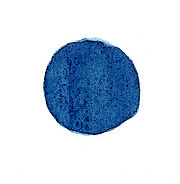 India
India
is believed to be the oldest center of indigo dyeing in the Old World. It was a primary supplier of indigo dye
, derived from the plant Indigofera tinctoria, to Europe
as early as the Greco-Roman era. The association of India with indigo is reflected in the Greek
word for the 'dye,' which was indikon (ινδικόν). The Romans
used the term indicum, which passed into Italian dialect and eventually into English as the word indigo. The country of El Salvador
has been the biggest producer of indigo.
The same indigo dye is contained in the woad plant, Isatis tinctoria, for a long time the main source of blue dye in Europe. Woad was replaced by true indigo as trade routes opened up, and both are now largely replaced by synthetic dyes.
Though the word indigo has existed in English since the 13th century, it may never have been a common part of the basic color-naming system. The mental maps of English speakers appear to contain just six basic spectral colors
: red, orange, yellow, green, blue and purple.
 It was Isaac Newton
who first introduced indigo as a spectral color. In the mid-1660s, when Newton bought a pair of prisms
at a fair near Cambridge
, the East India Company
was beginning to import indigo dye into England, supplanting the homegrown source of blue dye woad. In one of the pivotal experiments in the history of optics
, the young Newton shone a narrow beam of sunlight through a prism to produce a rainbow-like band of colors on the wall. In describing this optical spectrum he acknowledged that the spectrum had a continuum of colors, but specifically named seven colors: "The originall or primary colours are Red, yellow, Green, Blew, & a violet purple; together with Orang, Indico, & an indefinite varietie of intemediate gradations." He linked the seven prismatic colors to the seven notes of a western major scale
, as can be seen in his color wheel, with orange and indigo providing the semitones
, thinking that perhaps perception of the two was related in some way. Having decided upon seven colors, he asked a friend to repeatedly divide up the spectrum that was projected from the prism onto the wall:
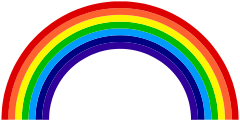
Indigo is accordingly counted as one of the traditional colors of the rainbow, the order of which is given by the mnemonic Roy G. Biv
. Maxwell and von Helmholz
accepted indigo as an appropriate name for the color flanking violet in the spectrum.
 It has been suggested that Newton was naming the colors differently to the present day understandings of them:
As Gary Waldman writes: "A careful reading of Newton's work indicates that the color he called indigo, we would normally call blue; his blue is then what we would name blue-green or cyan." If this is true, Newton's seven spectral colors would have been:
Red
: Orange
: Yellow
: Green
: Cyan
: Blue: Violet
:
The human eye is relatively insensitive to hue
changes in the wavelengths between blue and violet, and if this is where Newton meant indigo to be, most individuals find it hard to distinguish. As Isaac Asimov
noted, 'It is customary to list indigo as a color lying between blue and violet, but it has never seemed to me that indigo is worth the dignity of being considered a separate color. To my eyes it seems merely deep blue.' Color scientists typically divide the spectrum at about 450 nm between violet and blue, with no indigo.
, rose
, and violet
are the best-known), indigo gets its name from an object in the natural world—the plant named indigo once used for dyeing cloth (see also Indigo dye
).
The color electric indigo is an approximation of spectrum indigo. This is the brightest color indigo that can be approximated on a computer screen—it is a color located between the web color blue
and the color violet on the RGB color wheel
.
The web color blue violet or deep indigo is a tone of indigo brighter than pigment indigo but not as bright as electric indigo.
The color pigment indigo is equivalent to the web color indigo and approximates the color indigo that is usually reproduced in pigments and colored pencils.
The color of indigo dye is a different color than either spectrum indigo or pigment indigo. This is the actual color of the dye from the indigo plant when swatched onto raw fabric. A vat full of this dye is a darker color, approximating the web color midnight blue
.
Below are displayed these four major tones of indigo. When specifying the color indigo, it is important to indicate which of these four major tones is desired.
, spectral indigo and violet must be approximated by purples, that is, by mixing a little red with a lot of blue. Spectral indigo is closely approximated by the color electric indigo. This color is approximately equivalent to the color of the CIE chromaticity diagram at the 430 nanometer line. It is much brighter than the pigment indigo reproduced below. The color of spectrum Indigo fits nicely between spectrum violet
and spectrum blue
.
It is impossible to represent spectrum indigo exactly on a computer screen, because true spectrum indigo is outside the color triangle or gamut
of the RGB color space
defined by the monitor primaries.
Pigment indigo can be obtained by mixing 55% pigment cyan
with about 45% pigment magenta
.
Compare the subtractive colors to the additive colors in the two primary color charts in the article on primary colors
to see the distinction between electric colors as reproducible from light on a computer screen (additive colors) and the pigment colors reproducible with pigments (subtractive colors); the additive colors are a lot brighter because they are produced from light instead of pigment.
Pigment indigo (web color indigo) represents the way the color indigo was always reproduced in pigments, paints, or colored pencil
s in the 1950s.
By the 1970s, because of the advent of psychedelic art
, artists became used to brighter pigments, and pigments called "bright indigo" or "bright blue-violet" that are the pigment equivalent of the electric indigo reproduced in the section above became available in artists' pigments and colored pencils.
At right is shown the actual color of indigo dye
.
which resembles the shade of indigo used in Denim
. Crayola
created this color in 1993 as one of the new 16 colors.
Denim is the color of Denim
cloth, which after being dyed with Indigo dye
, is used to make jean
s.
The Denim Revolution
is a term used by the radical opposition in Belarus
and their supporters in the West, who support a color revolution
to implement the reintroduction of democracy
, to describe their effort and aspirations.
In the 1960s, denim symbolized youth culture because so many young baby boomer
s wore denim jeans.
The first recorded use of imperial blue as a color name in English
was in the 1820s (exact year uncertain).
Birds
Color
Color or colour is the visual perceptual property corresponding in humans to the categories called red, green, blue and others. Color derives from the spectrum of light interacting in the eye with the spectral sensitivities of the light receptors...
named after the purple dye
Indigo dye
Indigo dye is an organic compound with a distinctive blue color . Historically, indigo was a natural dye extracted from plants, and this process was important economically because blue dyes were once rare. Nearly all indigo dye produced today — several thousand tons each year — is synthetic...
derived from the plant Indigofera tinctoria
Indigofera tinctoria
Indigofera tinctoria bears the common name True indigo. The plant was one of the original sources of indigo dye. It has been naturalized to tropical and temperate Asia, as well as parts of Africa, but its native habitat is unknown since it has been in cultivation worldwide for many centuries. Today...
and related species. The color is placed on the electromagnetic spectrum
Electromagnetic spectrum
The electromagnetic spectrum is the range of all possible frequencies of electromagnetic radiation. The "electromagnetic spectrum" of an object is the characteristic distribution of electromagnetic radiation emitted or absorbed by that particular object....
between about 420 and 450 nm
Nanometre
A nanometre is a unit of length in the metric system, equal to one billionth of a metre. The name combines the SI prefix nano- with the parent unit name metre .The nanometre is often used to express dimensions on the atomic scale: the diameter...
in wavelength
Wavelength
In physics, the wavelength of a sinusoidal wave is the spatial period of the wave—the distance over which the wave's shape repeats.It is usually determined by considering the distance between consecutive corresponding points of the same phase, such as crests, troughs, or zero crossings, and is a...
, placing it between blue
Blue
Blue is a colour, the perception of which is evoked by light having a spectrum dominated by energy with a wavelength of roughly 440–490 nm. It is considered one of the additive primary colours. On the HSV Colour Wheel, the complement of blue is yellow; that is, a colour corresponding to an equal...
and violet
Violet (color)
As the name of a color, violet is synonymous with a bluish purple, when the word "purple" is used in the common English language sense of any color between blue and red, not including either blue or red...
. Although traditionally considered one of seven divisions of the rainbow
Rainbow
A rainbow is an optical and meteorological phenomenon that causes a spectrum of light to appear in the sky when the Sun shines on to droplets of moisture in the Earth's atmosphere. It takes the form of a multicoloured arc...
or the optical spectrum, modern color scientists do not usually recognize indigo as a separate division and generally classify wavelengths shorter than about 450 nm as violet. Optical scientists Hardy and Perrin list indigo as between 446 and 464 nm wavelength.
The first recorded use of indigo as a color name in English
English language
English is a West Germanic language that arose in the Anglo-Saxon kingdoms of England and spread into what was to become south-east Scotland under the influence of the Anglian medieval kingdom of Northumbria...
was in 1289.
History
India
India , officially the Republic of India , is a country in South Asia. It is the seventh-largest country by geographical area, the second-most populous country with over 1.2 billion people, and the most populous democracy in the world...
is believed to be the oldest center of indigo dyeing in the Old World. It was a primary supplier of indigo dye
Indigo dye
Indigo dye is an organic compound with a distinctive blue color . Historically, indigo was a natural dye extracted from plants, and this process was important economically because blue dyes were once rare. Nearly all indigo dye produced today — several thousand tons each year — is synthetic...
, derived from the plant Indigofera tinctoria, to Europe
Europe
Europe is, by convention, one of the world's seven continents. Comprising the westernmost peninsula of Eurasia, Europe is generally 'divided' from Asia to its east by the watershed divides of the Ural and Caucasus Mountains, the Ural River, the Caspian and Black Seas, and the waterways connecting...
as early as the Greco-Roman era. The association of India with indigo is reflected in the Greek
Greek language
Greek is an independent branch of the Indo-European family of languages. Native to the southern Balkans, it has the longest documented history of any Indo-European language, spanning 34 centuries of written records. Its writing system has been the Greek alphabet for the majority of its history;...
word for the 'dye,' which was indikon (ινδικόν). The Romans
Ancient Rome
Ancient Rome was a thriving civilization that grew on the Italian Peninsula as early as the 8th century BC. Located along the Mediterranean Sea and centered on the city of Rome, it expanded to one of the largest empires in the ancient world....
used the term indicum, which passed into Italian dialect and eventually into English as the word indigo. The country of El Salvador
El Salvador
El Salvador or simply Salvador is the smallest and the most densely populated country in Central America. The country's capital city and largest city is San Salvador; Santa Ana and San Miguel are also important cultural and commercial centers in the country and in all of Central America...
has been the biggest producer of indigo.
The same indigo dye is contained in the woad plant, Isatis tinctoria, for a long time the main source of blue dye in Europe. Woad was replaced by true indigo as trade routes opened up, and both are now largely replaced by synthetic dyes.
Though the word indigo has existed in English since the 13th century, it may never have been a common part of the basic color-naming system. The mental maps of English speakers appear to contain just six basic spectral colors
Spectral color
A spectral color is a color that is evoked by a single wavelength of light in the visible spectrum, or by a relatively narrow band of wavelengths...
: red, orange, yellow, green, blue and purple.
Classification as a spectral color
Isaac Newton
Sir Isaac Newton PRS was an English physicist, mathematician, astronomer, natural philosopher, alchemist, and theologian, who has been "considered by many to be the greatest and most influential scientist who ever lived."...
who first introduced indigo as a spectral color. In the mid-1660s, when Newton bought a pair of prisms
Dispersive prism
In optics, a dispersive prism is a type of optical prism, normally having the shape of a geometrical triangular prism. It is the most widely-known type of optical prism, although perhaps not the most common in actual use. Triangular prisms are used to disperse light, that is, to break light up into...
at a fair near Cambridge
Cambridge
The city of Cambridge is a university town and the administrative centre of the county of Cambridgeshire, England. It lies in East Anglia about north of London. Cambridge is at the heart of the high-technology centre known as Silicon Fen – a play on Silicon Valley and the fens surrounding the...
, the East India Company
East India Company
The East India Company was an early English joint-stock company that was formed initially for pursuing trade with the East Indies, but that ended up trading mainly with the Indian subcontinent and China...
was beginning to import indigo dye into England, supplanting the homegrown source of blue dye woad. In one of the pivotal experiments in the history of optics
History of optics
Optics began with the development of lenses by the ancient Egyptians and Mesopotamians, followed by theories on light and vision developed by ancient Greek and Indian philosophers, and the development of geometrical optics in the Greco-Roman world. The word optics is derived from the Greek term τα...
, the young Newton shone a narrow beam of sunlight through a prism to produce a rainbow-like band of colors on the wall. In describing this optical spectrum he acknowledged that the spectrum had a continuum of colors, but specifically named seven colors: "The originall or primary colours are Red, yellow, Green, Blew, & a violet purple; together with Orang, Indico, & an indefinite varietie of intemediate gradations." He linked the seven prismatic colors to the seven notes of a western major scale
Major scale
In music theory, the major scale or Ionian scale is one of the diatonic scales. It is made up of seven distinct notes, plus an eighth which duplicates the first an octave higher. In solfege these notes correspond to the syllables "Do, Re, Mi, Fa, Sol, La, Ti/Si, ", the "Do" in the parenthesis at...
, as can be seen in his color wheel, with orange and indigo providing the semitones
Semitone
A semitone, also called a half step or a half tone, is the smallest musical interval commonly used in Western tonal music, and it is considered the most dissonant when sounded harmonically....
, thinking that perhaps perception of the two was related in some way. Having decided upon seven colors, he asked a friend to repeatedly divide up the spectrum that was projected from the prism onto the wall:
"I desired a friend to draw with a pencil lines cross the image, or pillar of colours, where every one of the seven aforenamed colours was most full and brisk, and also where he judged the truest confines of them to be, whilst I held the paper so, that the said image might fall within a certain compass marked on it. And this I did, partly because my own eyes are not very critical in distinguishing colours, partly because another, to whom I had not communicated my thoughts about this matter, could have nothing but his eyes to determine his fancy in making those marks."
Indigo is accordingly counted as one of the traditional colors of the rainbow, the order of which is given by the mnemonic Roy G. Biv
Roy G. Biv
ROYGBIV is an acronym for the visible part of the electromagnetic light spectrum:* Red* Orange* Yellow* Green* Blue* Indigo* VioletA rainbow spans a continuous spectrum of colors; the distinct bands are an artifact of human color vision...
. Maxwell and von Helmholz
Hermann von Helmholtz
Hermann Ludwig Ferdinand von Helmholtz was a German physician and physicist who made significant contributions to several widely varied areas of modern science...
accepted indigo as an appropriate name for the color flanking violet in the spectrum.
As Gary Waldman writes: "A careful reading of Newton's work indicates that the color he called indigo, we would normally call blue; his blue is then what we would name blue-green or cyan." If this is true, Newton's seven spectral colors would have been:
Red
Red is any of a number of similar colors evoked by light consisting predominantly of the longest wavelengths of light discernible by the human eye, in the wavelength range of roughly 630–740 nm. Longer wavelengths than this are called infrared , and cannot be seen by the naked eye...
: Orange
Orange (colour)
The colour orange occurs between red and yellow in the visible spectrum at a wavelength of about 585–620 nm, and has a hue of 30° in HSV colour space. It is numerically halfway between red and yellow in a gamma-compressed RGB colour space, the expression of which is the RGB colour wheel. The...
: Yellow
Yellow
Yellow is the color evoked by light that stimulates both the L and M cone cells of the retina about equally, with no significant stimulation of the S cone cells. Light with a wavelength of 570–590 nm is yellow, as is light with a suitable mixture of red and green...
: Green
Green
Green is a color, the perception of which is evoked by light having a spectrum dominated by energy with a wavelength of roughly 520–570 nanometres. In the subtractive color system, it is not a primary color, but is created out of a mixture of yellow and blue, or yellow and cyan; it is considered...
: Cyan
Cyan
Cyan from , transliterated: kýanos, meaning "dark blue substance") may be used as the name of any of a number of colors in the blue/green range of the spectrum. In reference to the visible spectrum cyan is used to refer to the color obtained by mixing equal amounts of green and blue light or the...
: Blue: Violet
Violet (color)
As the name of a color, violet is synonymous with a bluish purple, when the word "purple" is used in the common English language sense of any color between blue and red, not including either blue or red...
:
The human eye is relatively insensitive to hue
Hue
Hue is one of the main properties of a color, defined technically , as "the degree to which a stimulus can be describedas similar to or different from stimuli that are described as red, green, blue, and yellow,"...
changes in the wavelengths between blue and violet, and if this is where Newton meant indigo to be, most individuals find it hard to distinguish. As Isaac Asimov
Isaac Asimov
Isaac Asimov was an American author and professor of biochemistry at Boston University, best known for his works of science fiction and for his popular science books. Asimov was one of the most prolific writers of all time, having written or edited more than 500 books and an estimated 90,000...
noted, 'It is customary to list indigo as a color lying between blue and violet, but it has never seemed to me that indigo is worth the dignity of being considered a separate color. To my eyes it seems merely deep blue.' Color scientists typically divide the spectrum at about 450 nm between violet and blue, with no indigo.
Distinction between four major tones of indigo
Like many other colors (orangeOrange (colour)
The colour orange occurs between red and yellow in the visible spectrum at a wavelength of about 585–620 nm, and has a hue of 30° in HSV colour space. It is numerically halfway between red and yellow in a gamma-compressed RGB colour space, the expression of which is the RGB colour wheel. The...
, rose
Rose (color)
Rose is the color halfway between red and magenta on the HSV color wheel, also known as the RGB color wheel, on which it is at hue angle of 330 degrees.Rose is one of the tertiary colors on the HSV color wheel...
, and violet
Violet (color)
As the name of a color, violet is synonymous with a bluish purple, when the word "purple" is used in the common English language sense of any color between blue and red, not including either blue or red...
are the best-known), indigo gets its name from an object in the natural world—the plant named indigo once used for dyeing cloth (see also Indigo dye
Indigo dye
Indigo dye is an organic compound with a distinctive blue color . Historically, indigo was a natural dye extracted from plants, and this process was important economically because blue dyes were once rare. Nearly all indigo dye produced today — several thousand tons each year — is synthetic...
).
The color electric indigo is an approximation of spectrum indigo. This is the brightest color indigo that can be approximated on a computer screen—it is a color located between the web color blue
Blue
Blue is a colour, the perception of which is evoked by light having a spectrum dominated by energy with a wavelength of roughly 440–490 nm. It is considered one of the additive primary colours. On the HSV Colour Wheel, the complement of blue is yellow; that is, a colour corresponding to an equal...
and the color violet on the RGB color wheel
RGB color space
An RGB color space is any additive color space based on the RGB color model. A particular RGB color space is defined by the three chromaticities of the red, green, and blue additive primaries, and can produce any chromaticity that is the triangle defined by those primary colors...
.
The web color blue violet or deep indigo is a tone of indigo brighter than pigment indigo but not as bright as electric indigo.
The color pigment indigo is equivalent to the web color indigo and approximates the color indigo that is usually reproduced in pigments and colored pencils.
The color of indigo dye is a different color than either spectrum indigo or pigment indigo. This is the actual color of the dye from the indigo plant when swatched onto raw fabric. A vat full of this dye is a darker color, approximating the web color midnight blue
Midnight Blue
Midnight blue is a dark shade of blue, close to black, that was named for its darkness. Midnight blue is the color of a vat full of Indigo dye; therefore, midnight blue may also be considered a dark shade of indigo...
.
Below are displayed these four major tones of indigo. When specifying the color indigo, it is important to indicate which of these four major tones is desired.
Electric indigo
In an RGB color spaceColor space
A color model is an abstract mathematical model describing the way colors can be represented as tuples of numbers, typically as three or four values or color components...
, spectral indigo and violet must be approximated by purples, that is, by mixing a little red with a lot of blue. Spectral indigo is closely approximated by the color electric indigo. This color is approximately equivalent to the color of the CIE chromaticity diagram at the 430 nanometer line. It is much brighter than the pigment indigo reproduced below. The color of spectrum Indigo fits nicely between spectrum violet
Violet (color)
As the name of a color, violet is synonymous with a bluish purple, when the word "purple" is used in the common English language sense of any color between blue and red, not including either blue or red...
and spectrum blue
Blue
Blue is a colour, the perception of which is evoked by light having a spectrum dominated by energy with a wavelength of roughly 440–490 nm. It is considered one of the additive primary colours. On the HSV Colour Wheel, the complement of blue is yellow; that is, a colour corresponding to an equal...
.
It is impossible to represent spectrum indigo exactly on a computer screen, because true spectrum indigo is outside the color triangle or gamut
Gamut
In color reproduction, including computer graphics and photography, the gamut, or color gamut , is a certain complete subset of colors. The most common usage refers to the subset of colors which can be accurately represented in a given circumstance, such as within a given color space or by a...
of the RGB color space
Color space
A color model is an abstract mathematical model describing the way colors can be represented as tuples of numbers, typically as three or four values or color components...
defined by the monitor primaries.
Deep indigo (web color blue-violet)
At right is displayed the web color blue-violet, a color intermediate in brightness between electric indigo and pigment indigo. This color is also called deep indigo.Pigment indigo (web color indigo)
The color box at right displays the web color Indigo which is equivalent to pigment indigo, the color indigo as it would be reproduced by artists' paints as opposed to the brighter indigo above (electric indigo) that it is possible to reproduce on a computer screen.Pigment indigo can be obtained by mixing 55% pigment cyan
Cyan
Cyan from , transliterated: kýanos, meaning "dark blue substance") may be used as the name of any of a number of colors in the blue/green range of the spectrum. In reference to the visible spectrum cyan is used to refer to the color obtained by mixing equal amounts of green and blue light or the...
with about 45% pigment magenta
Magenta
Magenta is a color evoked by light stronger in blue and red wavelengths than in yellowish-green wavelengths . In light experiments, magenta can be produced by removing the lime-green wavelengths from white light...
.
Compare the subtractive colors to the additive colors in the two primary color charts in the article on primary colors
Primary Colors
Primary Colors: A Novel of Politics is a roman à clef, a work of fiction that purports to describe real life characters and events — namely, Bill Clinton's first presidential campaign in 1992...
to see the distinction between electric colors as reproducible from light on a computer screen (additive colors) and the pigment colors reproducible with pigments (subtractive colors); the additive colors are a lot brighter because they are produced from light instead of pigment.
Pigment indigo (web color indigo) represents the way the color indigo was always reproduced in pigments, paints, or colored pencil
Pencil
A pencil is a writing implement or art medium usually constructed of a narrow, solid pigment core inside a protective casing. The case prevents the core from breaking, and also from marking the user’s hand during use....
s in the 1950s.
By the 1970s, because of the advent of psychedelic art
Psychedelic art
Psychedelic art is any kind of visual artwork inspired by psychedelic experiences induced by drugs such as LSD, mescaline, and psilocybin. The word "psychedelic" "mind manifesting". By that definition all artistic efforts to depict the inner world of the psyche may be considered "psychedelic"...
, artists became used to brighter pigments, and pigments called "bright indigo" or "bright blue-violet" that are the pigment equivalent of the electric indigo reproduced in the section above became available in artists' pigments and colored pencils.
Indigo dye
Indigo dye
Indigo dye is an organic compound with a distinctive blue color . Historically, indigo was a natural dye extracted from plants, and this process was important economically because blue dyes were once rare. Nearly all indigo dye produced today — several thousand tons each year — is synthetic...
.
Denim
Denim is a tone of indigo CrayolaCrayola
Crayola is a brand of artists' supplies manufactured by Crayola LLC, which was founded in 1885 as Binney & Smith. It is best known for its crayons...
which resembles the shade of indigo used in Denim
Denim
Denim is a rugged cotton twill textile, in which the weft passes under two or more warp threads. This produces the familiar diagonal ribbing identifiable on the reverse of the fabric, which distinguishes denim from cotton duck. Denim has been in American usage since the late 18th century...
. Crayola
Crayola
Crayola is a brand of artists' supplies manufactured by Crayola LLC, which was founded in 1885 as Binney & Smith. It is best known for its crayons...
created this color in 1993 as one of the new 16 colors.
Denim is the color of Denim
Denim
Denim is a rugged cotton twill textile, in which the weft passes under two or more warp threads. This produces the familiar diagonal ribbing identifiable on the reverse of the fabric, which distinguishes denim from cotton duck. Denim has been in American usage since the late 18th century...
cloth, which after being dyed with Indigo dye
Indigo dye
Indigo dye is an organic compound with a distinctive blue color . Historically, indigo was a natural dye extracted from plants, and this process was important economically because blue dyes were once rare. Nearly all indigo dye produced today — several thousand tons each year — is synthetic...
, is used to make jean
Jean
Jean may refer to:* Jeans, pants, trousers or high waist overalls made from denimPeople* Jean , pronounced , is the French form of John* Jean , pronounced and sometimes , is the Scottish form of Jane...
s.
The Denim Revolution
Jeans Revolution
The Jeans Revolution was a term used by the democratic opposition in Belarus and their supporters in the West to describe their effort and aspirations as regarding democratic changes in Belarus at the presidential elections of 2006...
is a term used by the radical opposition in Belarus
Belarus
Belarus , officially the Republic of Belarus, is a landlocked country in Eastern Europe, bordered clockwise by Russia to the northeast, Ukraine to the south, Poland to the west, and Lithuania and Latvia to the northwest. Its capital is Minsk; other major cities include Brest, Grodno , Gomel ,...
and their supporters in the West, who support a color revolution
Color revolution
Colour revolutions is a term that was widely used by the media to describe related movements that developed in several societies in the CIS and Balkan states during the early 2000s. The term has also been applied to a number of revolutions elsewhere, including in the Middle East...
to implement the reintroduction of democracy
Democracy
Democracy is generally defined as a form of government in which all adult citizens have an equal say in the decisions that affect their lives. Ideally, this includes equal participation in the proposal, development and passage of legislation into law...
, to describe their effort and aspirations.
In the 1960s, denim symbolized youth culture because so many young baby boomer
Baby boomer
A baby boomer is a person who was born during the demographic Post-World War II baby boom and who grew up during the period between 1946 and 1964. The term "baby boomer" is sometimes used in a cultural context. Therefore, it is impossible to achieve broad consensus of a precise definition, even...
s wore denim jeans.
Imperial Blue
At right is displayed the color imperial blue.The first recorded use of imperial blue as a color name in English
English language
English is a West Germanic language that arose in the Anglo-Saxon kingdoms of England and spread into what was to become south-east Scotland under the influence of the Anglian medieval kingdom of Northumbria...
was in the 1820s (exact year uncertain).
In nature
Fungi- Lactarius indigoLactarius indigoLactarius indigo, commonly known as the indigo milk cap, the indigo Lactarius, or the blue milk mushroom, is a species of fungus in the Russulaceae family of mushrooms. A widely distributed species, it grows naturally in eastern North America, East Asia, and Central America; it has also been...
is one of the very few species of mushroomMushroomA mushroom is the fleshy, spore-bearing fruiting body of a fungus, typically produced above ground on soil or on its food source. The standard for the name "mushroom" is the cultivated white button mushroom, Agaricus bisporus; hence the word "mushroom" is most often applied to those fungi that...
s that are colored tones of blueBlueBlue is a colour, the perception of which is evoked by light having a spectrum dominated by energy with a wavelength of roughly 440–490 nm. It is considered one of the additive primary colours. On the HSV Colour Wheel, the complement of blue is yellow; that is, a colour corresponding to an equal...
.
Birds
- The IndigobirdIndigobirdThe indigobirds and whydahs, are a family, Viduidae, of small passerine birds native to Africa.These are finch-like species which usually have black or indigo predominating in their plumage...
is a bird with a buff colored breast and indigo colored plumage and tailfeathers. - The Indigo BuntingIndigo BuntingThe Indigo Bunting, Passerina cyanea, is a small seed-eating bird in the family Cardinalidae. It is migratory, ranging from southern Canada to northern Florida during the breeding season, and from southern Florida to northern South America during the winter. It often migrates by night, using the...
is a small bird native to North America known for the male's brightly colored breeding plumage.
In computer graphics
- Electric Indigo is sometimes used as a glow color for computer graphics lightingComputer graphics lightingComputer graphics lighting refers to the simulation of light in computer graphics. This simulation can either be extremely accurate, as is the case in an application like Radiance which attempts to track the energy flow of light interacting with materials using radiosity computational techniques...
, possibly because it seems to change color from indigo to lavender when blended with white.
In food
- Scientists discovered in 2008 that when a bananaBananaBanana is the common name for herbaceous plants of the genus Musa and for the fruit they produce. Bananas come in a variety of sizes and colors when ripe, including yellow, purple, and red....
becomes ripe and ready to eat, it glows bright indigo under a black lightBlack lightA black light, also referred to as a UV light, ultraviolet light, or Wood's lamp, is a lamp that emits ultraviolet radiation in the long-wave range, and little visible light...
. It is thought that some insects, as well as birds and batBatBats are mammals of the order Chiroptera "hand" and pteron "wing") whose forelimbs form webbed wings, making them the only mammals naturally capable of true and sustained flight. By contrast, other mammals said to fly, such as flying squirrels, gliding possums, and colugos, glide rather than fly,...
s, animals that can see into the ultravioletUltravioletUltraviolet light is electromagnetic radiation with a wavelength shorter than that of visible light, but longer than X-rays, in the range 10 nm to 400 nm, and energies from 3 eV to 124 eV...
, can use this information to tell when a banana is ripe and ready to eat. The glow is the result of chemical that is created as the green chlorophyllChlorophyllChlorophyll is a green pigment found in almost all plants, algae, and cyanobacteria. Its name is derived from the Greek words χλωρος, chloros and φύλλον, phyllon . Chlorophyll is an extremely important biomolecule, critical in photosynthesis, which allows plants to obtain energy from light...
in the peel breaks down.
In music
- The Indigo GirlsIndigo GirlsThe Indigo Girls are an American folk rock music duo, consisting of Amy Ray and Emily Saliers. They met in elementary school and began performing together as high school students in Decatur, Georgia, part of the Atlanta metropolitan area...
are an AmericanUnited StatesThe United States of America is a federal constitutional republic comprising fifty states and a federal district...
folk rockFolk rockFolk rock is a musical genre combining elements of folk music and rock music. In its earliest and narrowest sense, the term referred to a genre that arose in the United States and the UK around the mid-1960s...
music duoDuet (music)A duet is a musical composition for two performers. In classical music, the term is most often used for a composition for two singers or pianists; with other instruments, the word duo is also often used. A piece performed by two pianists performing together on the same piano is referred to as...
.
In spiritualism
- The color electric indigo is used to symbolically represent the sixth chakraChakraChakra is a concept originating in Hindu texts, featured in tantric and yogic traditions of Hinduism and Buddhism. Its name derives from the Sanskrit word for "wheel" or "turning" .Chakra is a concept referring to wheel-like vortices...
(called Ajna), which is said to include the third eyeThird eyeThe third eye is a mystical and esoteric concept referring in part to the ajna chakra in certain spiritual traditions. It is also spoken of as the gate that leads within to inner realms and spaces of higher consciousness...
. This chakra is believed to be related to intuitionIntuition (knowledge)Intuition is the ability to acquire knowledge without inference or the use of reason. "The word 'intuition' comes from the Latin word 'intueri', which is often roughly translated as meaning 'to look inside'’ or 'to contemplate'." Intuition provides us with beliefs that we cannot necessarily justify...
and gnosisGnosisGnosis is the common Greek noun for knowledge . In the context of the English language gnosis generally refers to the word's meaning within the spheres of Christian mysticism, Mystery religions and Gnosticism where it signifies 'spiritual knowledge' in the sense of mystical enlightenment.-Related...
(spiritual knowledge). - In New AgeNew AgeThe New Age movement is a Western spiritual movement that developed in the second half of the 20th century. Its central precepts have been described as "drawing on both Eastern and Western spiritual and metaphysical traditions and then infusing them with influences from self-help and motivational...
philosophy, indigo is regarded as representing intuitionIntuition (knowledge)Intuition is the ability to acquire knowledge without inference or the use of reason. "The word 'intuition' comes from the Latin word 'intueri', which is often roughly translated as meaning 'to look inside'’ or 'to contemplate'." Intuition provides us with beliefs that we cannot necessarily justify...
. - PsychicPsychicA psychic is a person who professes an ability to perceive information hidden from the normal senses through extrasensory perception , or is said by others to have such abilities. It is also used to describe theatrical performers who use techniques such as prestidigitation, cold reading, and hot...
s who claim to be able to observe the auraAura (paranormal)In parapsychology and many forms of spiritual practice, an aura is a field of subtle, luminous radiation surrounding a person or object . The depiction of such an aura often connotes a person of particular power or holiness. Sometimes, however, it is said that all living things and all objects...
with their third eye generally associate indigo, in auras, with an interest in religionReligionReligion is a collection of cultural systems, belief systems, and worldviews that establishes symbols that relate humanity to spirituality and, sometimes, to moral values. Many religions have narratives, symbols, traditions and sacred histories that are intended to give meaning to life or to...
or with intense spiritualitySpiritualitySpirituality can refer to an ultimate or an alleged immaterial reality; an inner path enabling a person to discover the essence of his/her being; or the “deepest values and meanings by which people live.” Spiritual practices, including meditation, prayer and contemplation, are intended to develop...
and intuition. Indigo childrenIndigo childrenIndigo children is a pseudoscientific label given to children who are claimed to possess special, unusual and/or supernatural traits or abilities. The idea is based on New Age concepts developed in the 1970s by Nancy Ann Tappe...
are said to have predominately indigo auras. People with indigo auras are said to be in occupations such as computer analyst, animal caretakerAnimal husbandryAnimal husbandry is the agricultural practice of breeding and raising livestock.- History :Animal husbandry has been practiced for thousands of years, since the first domestication of animals....
, and counselorLicensed Professional CounselorLicensed professional counselor is a licensure for mental health professionals. The exact title varies by state, but the other most frequently used title is licensed mental health counselor . Several U.S. states, including Illinois, Maine, and Tennessee, have implemented a two-tier system whereby...
. - In the metaphysicsMetaphysicsMetaphysics is a branch of philosophy concerned with explaining the fundamental nature of being and the world, although the term is not easily defined. Traditionally, metaphysics attempts to answer two basic questions in the broadest possible terms:...
of the New AgeNew AgeThe New Age movement is a Western spiritual movement that developed in the second half of the 20th century. Its central precepts have been described as "drawing on both Eastern and Western spiritual and metaphysical traditions and then infusing them with influences from self-help and motivational...
Prophetess, Alice A. Bailey, in her system called the Seven RaysSeven RaysThe seven rays is an occult concept that has appeared in several religions and esoteric philosophies, since at least the 6th century BCE, of the Aryan peoples in both Western culture and in India...
which classifies humanHumanHumans are the only living species in the Homo genus...
s into seven different metaphysical psychological types, the second ray of love-wisdom is represented by the color indigo.
See also
- List of colors
- IndigloIndigloIndiglo is a brand name of Indiglo Corporation, solely owned by Timex for licensing purposes. Timex electroluminescent lamps, branded Indiglo, were introduced through Kmart in 1992 in the Ironman watch line...
, a brand name for a method of electroluminescenceElectroluminescenceElectroluminescence is an optical phenomenon and electrical phenomenon in which a material emits light in response to the passage of an electric current or to a strong electric field...
technology