


Harmandir Sahib

Encyclopedia
The Harmandir Sahib also Darbar Sahib (Punjabi
: ਦਰਬਾਰ ਸਾਹਿਬ, dəɾbɑɾ sɑhɪb), also referred to as the Golden Temple, is a prominent Sikh
gurdwara
located in the city of Amritsar
, Punjab (India)
. Construction of the gurdwara
was begun by Guru Ram Das
, the fourth Sikh Guru, and completed by his successor, Guru Arjan Dev
. In 1604, Guru Arjan Dev
completed the Adi Granth
, the holy scripture of Sikhism, and installed it in the Gurdwara. In 1634, Guru Hargobind left Amritsar
for the Shivalik Hills and for the remainder of the seventeenth century the city and gurdwara was in the hands of forces hostile to the Sikh Gurus
. During the eighteenth century, the Harmandir Sahib was the site of frequent fighting between the Sikhs on one side and either Mughal
or Afghan
forces on the other side and the gurdwara occasionally suffered damage. In the early nineteenth century, Maharaja Ranjit Singh
secured the Punjab region
from outside attack and covered the upper floors of the gurdwara with gold
, which gives it its distinctive appearance and English name of "Golden Temple".
The present day Golden Temple was rebuilt in 1764 by Maharaja Jassa Singh Ahluwalia
(1718-1783) with the help of other Misl
Sikh
chieftains. It was more beautified with adding more architecture. From (1802-1830) Ranjit singh did the sewa of Gold plating the Temple and adding marble to it as well as the interior was decorated with fresco work, Rubies, etc.
, Harmandir Sahib is considered holy by Sikhs because the eternal guru of Sikhism, the Sri Guru Granth Sahib, is always present inside it and its construction was mainly intended to build a place of worship for men and women from all walks of life and all religion to come and worship God equally. The Sri Guru Granth Sahib is the holiest literature in the Sikh religion, the tenth guru of Sikhism, Guru Gobind Singh, in 1708 at Nanded
made it the eternal Sikh Guru and the leader of Sikhism. Anywhere in the world where the Guru Granth Sahib is present is equally holy and precious to Sikhs.
, excavated a tank in 1577 CE which subsequently became known as Amritsar (meaning "Pool of the Nectar of Immortality"), giving its name to the city that grew around it. In due course, a splendid Sikh edifice, Harmandir Sahib (meaning "the abode of God"), rose in the middle of this tank and became the supreme centre of Sikhism
. Its sanctum came to house the Adi Granth
comprising compositions of Sikh gurus and other saints considered to have Sikh values and philosophies, e.g., Baba Farid, and Kabir
. The compilation of the Adi Granth was started by the fifth guru of Sikhism, Guru Arjan Dev
.
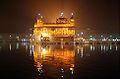 Originally built in 1574, the site of the temple was surrounded by a small lake in a thin forest. The third of the six grand Mughals, Emperor Akbar, who visited the third Sikh guru, Guru Amar Das
, in the neighbouring town of Goindval
, was so impressed by the way of life in the town that he gave a jagir
(the land and the revenues of several villages in the vicinity) to the guru's daughter Bhani as a gift on her marriage to Bhai Jetha, who later became the fourth Sikh guru, Guru Ram Das
. Guru Ram Das enlarged the lake and built a small township around it. The town was named after Guru Ram Das as Guru Ka Chak', Chak Ram Das or Ram Das Pura.
During the leadership of the fifth guru, Guru Arjan Dev
(1581–1606), the full-fledged Temple was built. In December 1588, the great Muslim Sufi saint of Lahore
, Hazrat Mian Mir, who was a close friend of Guru Arjan Dev Ji, initiated the construction of the temple by laying the first foundation stone (December 1588 CE). A mason then straightened the stone but Guru Arjan Dev told him that, as he had undone the work just completed by the holy man, a disaster might come to the Harmandir Sahib. It was later attacked by the Mughal
s.
The temple was completed in 1604. Guru Arjan Dev, installed the Guru Granth Sahib
in it and appointed Baba Buddha Ji as the first Granthi
(reader) of it on August 1604. In the mid-18th century it was attacked by the Afghans
, by one of Ahmed Shah Abdali's generals, Jahan Khan, and had to be substantially rebuilt in the 1760s. However, in response a Sikh Army was sent to hunt down the Afghan force. They were under orders to show no mercy and historical evidence suggests the Sikh Army was decisively victorious in the ensuing battle. Both forces met each other five miles outside Amritsar; Jahan Khan's army was destroyed.
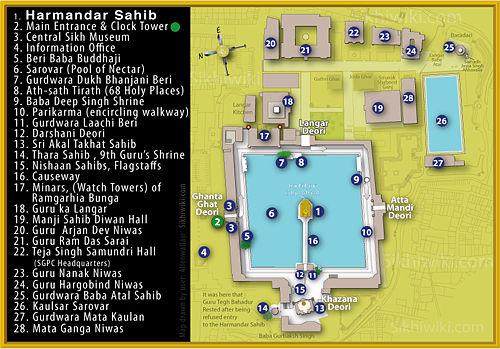
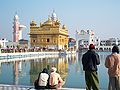
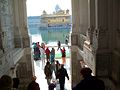 The temple is surrounded by a large lake, known as the Sarovar, which consists of Amrit ("holy water" or "immortal nectar"). There are four entrances to the temple, signifying the importance of acceptance and openness. Inside the temple complex there are many shrines to past Sikh gurus, saints and martyrs (see map). There are three holy trees (bers), each signifying a historical event or Sikh saint. Inside the temple there are many memorial plaques that commemorate past Sikh historical events, saints, martyrs and includes commemorative inscriptions of all the Sikh soldiers who died fighting in World Wars I and II.
In 1988, after Operation Black Thunder
, the government acquired a narrow peripheral strip of land (including buildings) in order to use their space as a security buffer. The acquisition process involved the displacement and relocation of a large number of residences and businesses. However, the project met with a strong resistance from both moderate and militant Sikh organisations and had to be abandoned following the murder of a senior government-employed engineer connected with the project. The project was revived only in 1993 by the Deputy Commissioner Karan Bir Singh Sidhu, who was also appointed as the project director of what became popularly known as the Galliara Project. He changed the concept of the periphery from that of a security belt to that of a second parikarma and created a serene landscape that was fully consistent with the ethereal beauty of the Harmandir Sahib. This was done in quiet consultation with the Shiromani Gurdwara Prabandhak Committee
(SGPC). Present-day pilgrims can travel by foot in the Galliara; no vehicles are permitted.
In keeping with the rule observed at all Sikh temples (Gurdwara
s) worldwide, the Harmandir Sahib is open to all persons regardless of their religion, colour, creed, or sex. The only restrictions on the Harmandir Sahib's visitors concern their behavior when entering and while visiting:
First-time visitors are advised to begin their visit at the information office highlighted in the map and then proceed to the Central Sikh Museum near the main entrance and clock tower.
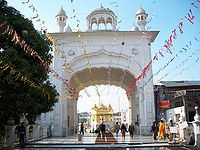 Much of the present decorative gilding and marblework dates from the early 19th century. All the gold and exquisite marble work were conducted under the patronage of Hukam Singh Chimni and Emperor Ranjit Singh
, Maharaja of the Sikh Empire of the Punjab. The Darshani Deorhi Arch stands at the beginning of the causeway
to the Harmandir Sahib; it is 202 feet (62 m) high and 21 feet (6 m) in width. The gold plating on the Harmandir Sahib was begun by Emperor Ranjit Singh and was finished in 1830. The Sher-e-Punjab (Lion of the Punjab) was a major donor of wealth and materials for the shrine and is remembered with much affection by the Punjabi people
in general and the Sikh community in particular. Maharaja Ranjit Singh also built two of the other most sacred temples in Sikhism. This was because Maharaja Ranjit Singh had a deep love for the tenth guru of Sikhism Guru Gobind Singh
. The other two most sacred temples in Sikhism, which he built, are Takht Sri Patna Sahib
(intiation or birth place of Guru Gobind Singh) and Takht Sri Hazur Sahib, the place of Guru Gobind Singh's Sikh ascension into heaven.
.jpg) One of the most important festivals is Vaisakhi
One of the most important festivals is Vaisakhi
, which is celebrated in the second week of April (usually the 13th). Sikhs celebrate the founding of the Khalsa on this day and it is celebrated with fervour in the Harmandir Sahib. Other important Sikh religious days such as the martyrdom day of Guru Teg Bahadur
, the birthday of Guru Nanak, etc., are also celebrated with religious piety. Similarly Diwali is one of the festivals which sees the Harmandir Sahib beautifully illuminated with Divas/Diyas (lamps); lights and fireworks are discharged. During these special occasions many thousands of people visit the holy shrine named Harmandir Sahib
Most Sikh people visit Amritsar and the Harmandir Sahib at least once during their lifetime, particularly and mostly during special occasions in their life such as birthdays, marriages, childbirth, etc.
. The airport can be reached directly by the international traveller from most major cities of the world including London
, New York
and Toronto
. Amritsar is also very well connected with New Delhi, there are scheduled morning, afternoon and evening flights from Indira Gandhi International Airport, Delhi to Amritsar and back. It is possible to do a same day trip to Delhi. Amritsar airport also has a direct free air-conditioned bus service from Airport to Harmandir Sahib Complex and back. Moreover, there is a rapidly expanding array of international hotels in the holy city that can be booked for overnight stays. Lonely Planet
Bluelist 2008 has voted the Harmandir Sahib as one of the world’s best spiritual sites. Since Amritsar is an big tourist spot, lot of five star hotels are getting attracted to open up properties here. Hotel Ista has become very popular with nonresident Indian (NRI) community. New properties by Radisson and Taj are coming up in this city. In the modern area of Amritsar(Ranjit Avenue/ Green Avenue/ Mall Road), one can find renowned three-star hotels as well- namely MK Hotel, Best West Merrion, and Hotel P.R. Residency. Others good hotels are Clarks Inn, Country Inn & Suites By Carlson, Hotel Ritz Plaza, Ranjit’s SVAASÁ, Hotel Lawrence.
led by General Kuldip Singh Brar
brought infantry, artillery, and tanks into the Harmandir Sahib to arrest Sant Jarnail Singh Bhindranwale.
The Harmandir Sahib complex and some of the surrounding houses were fortified. The Statesman reported on 4 July that light machine-guns and sophisticated self-loading rifles were known to have been brought into the compound.
Indira Gandhi
ordered the army to launch Operation Blue Star
.
Fierce fighting ensued between Bhindranwale's supporters and the soldiers, in which many of Bhindranwale's supporters were killed along with many soldiers. An official account tallies the deaths of 83 soldiers and 492 civilians. The Harmandir Sahib complex also suffered much damage due to the fighting, especially the holy Sri Akal Takhat Sahib.
Many Sikhs regarded the attack as a desecration of their holiest shrine and discrimination of a minority.
In 1986, the repairs performed on the holy Sri Akal Takhat Sahib, which the Rajiv Gandhi
Government had undertaken without consultation, were removed. A new Sri Akal Takhat Sahib was completed in 1999 by Kar Seva (free pilgrim service and work).
Punjabi language
Punjabi is an Indo-Aryan language spoken by inhabitants of the historical Punjab region . For Sikhs, the Punjabi language stands as the official language in which all ceremonies take place. In Pakistan, Punjabi is the most widely spoken language...
: ਦਰਬਾਰ ਸਾਹਿਬ, dəɾbɑɾ sɑhɪb), also referred to as the Golden Temple, is a prominent Sikh
Sikh
A Sikh is a follower of Sikhism. It primarily originated in the 15th century in the Punjab region of South Asia. The term "Sikh" has its origin in Sanskrit term शिष्य , meaning "disciple, student" or शिक्ष , meaning "instruction"...
gurdwara
Gurdwara
A Gurdwara , meaning the Gateway to the Guru, is the place of worship for Sikhs, the followers of Sikhism. A Gurdwara can be identified from a distance by tall flagpoles bearing the Nishan Sahib ....
located in the city of Amritsar
Amritsar
Amritsar is a city in the northern part of India and is the administrative headquarters of Amritsar district in the state of Punjab, India. The 2001 Indian census reported the population of the city to be over 1,500,000, with that of the entire district numbering 3,695,077...
, Punjab (India)
Punjab (India)
Punjab ) is a state in the northwest of the Republic of India, forming part of the larger Punjab region. The state is bordered by the Indian states of Himachal Pradesh to the east, Haryana to the south and southeast and Rajasthan to the southwest as well as the Pakistani province of Punjab to the...
. Construction of the gurdwara
Gurdwara
A Gurdwara , meaning the Gateway to the Guru, is the place of worship for Sikhs, the followers of Sikhism. A Gurdwara can be identified from a distance by tall flagpoles bearing the Nishan Sahib ....
was begun by Guru Ram Das
Guru Ram Das
Guru Ram Das was the fourth of the Ten Gurus of Sikhism and was given the title of Sikh Guru on 30 August 1574.-Early life:Ram Das was born in Lahore, Punjab on 24 September 1534[1] to a Sodhi family of the Khatri clan. His father was Hari Das and his mother Anup Devi. His wife was Bibi Bhani,...
, the fourth Sikh Guru, and completed by his successor, Guru Arjan Dev
Guru Arjan Dev
Guru Arjan Dev Ji was the fifth of the Ten Gurus of Sikhism. He was born in Goindval, Punjab, India, the youngest son of Guru Ram Das and Bibi Bhani, the daughter of Guru Amar Das. He became the Guru of the Sikhs on 1 September 1581 after the death of his father Guru Ram Das. Guru Arjan died in...
. In 1604, Guru Arjan Dev
Guru Arjan Dev
Guru Arjan Dev Ji was the fifth of the Ten Gurus of Sikhism. He was born in Goindval, Punjab, India, the youngest son of Guru Ram Das and Bibi Bhani, the daughter of Guru Amar Das. He became the Guru of the Sikhs on 1 September 1581 after the death of his father Guru Ram Das. Guru Arjan died in...
completed the Adi Granth
Adi Granth
Adi Granth is the early compilation of the Sikh Scriptures by Sri Guru Arjan Dev Ji, the fifth Sikh Guru, in 1604. This Granth is the Holy Scripture of the Sikhs. The tenth Sikh Guru, Guru Gobind Singh added further holy Shabads to this Granth during the period 1704 to 1706...
, the holy scripture of Sikhism, and installed it in the Gurdwara. In 1634, Guru Hargobind left Amritsar
Amritsar
Amritsar is a city in the northern part of India and is the administrative headquarters of Amritsar district in the state of Punjab, India. The 2001 Indian census reported the population of the city to be over 1,500,000, with that of the entire district numbering 3,695,077...
for the Shivalik Hills and for the remainder of the seventeenth century the city and gurdwara was in the hands of forces hostile to the Sikh Gurus
Sikh Gurus
The Sikh Gurus established Sikhism from over the centuries beginning in the year 1469. Sikhism was founded by the first guru, Guru Nanak, and subsequently, all in order were referred to as "Nanak", and as "Lights", making their teachings in the holy scriptures, equivalent...
. During the eighteenth century, the Harmandir Sahib was the site of frequent fighting between the Sikhs on one side and either Mughal
Mughal Empire
The Mughal Empire , or Mogul Empire in traditional English usage, was an imperial power from the Indian Subcontinent. The Mughal emperors were descendants of the Timurids...
or Afghan
Durrani Empire
The Durrani Empire was a Pashtun dynasty centered in Afghanistan and included northeastern Iran, the Kashmir region, the modern state of Pakistan, and northwestern India. It was established at Kandahar in 1747 by Ahmad Shah Durrani, an Afghan military commander under Nader Shah of Persia and chief...
forces on the other side and the gurdwara occasionally suffered damage. In the early nineteenth century, Maharaja Ranjit Singh
Ranjit Singh
Maharaja Ranjit Singh Ji was the first Maharaja of the Sikh Empire.-Early life:...
secured the Punjab region
Punjab region
The Punjab , also spelled Panjab |water]]s"), is a geographical region straddling the border between Pakistan and India which includes Punjab province in Pakistan and the states of the Punjab, Haryana, Himachal Pradesh, Chandigarh and some northern parts of the National Capital Territory of Delhi...
from outside attack and covered the upper floors of the gurdwara with gold
Gold
Gold is a chemical element with the symbol Au and an atomic number of 79. Gold is a dense, soft, shiny, malleable and ductile metal. Pure gold has a bright yellow color and luster traditionally considered attractive, which it maintains without oxidizing in air or water. Chemically, gold is a...
, which gives it its distinctive appearance and English name of "Golden Temple".
The present day Golden Temple was rebuilt in 1764 by Maharaja Jassa Singh Ahluwalia
Jassa Singh Ahluwalia
Sultan ul Quam Nawab Jassa Singh Ahluwalia was a prominent Sikh leader during the period of the Sikh Confederacy. He was also Misldar of the Ahluwalia Misl. This period was an interlude, lasting roughly from the time of the death of Banda Bahadur in 1716 to the founding of the Sikh Empire in 1801...
(1718-1783) with the help of other Misl
Misl
Misl generally refers to the twelve sovereign states in the Sikh Confederacy. The states formed a commonwealth that was described by Antoine Polier as an "aristocratic republic"...
Sikh
Sikh
A Sikh is a follower of Sikhism. It primarily originated in the 15th century in the Punjab region of South Asia. The term "Sikh" has its origin in Sanskrit term शिष्य , meaning "disciple, student" or शिक्ष , meaning "instruction"...
chieftains. It was more beautified with adding more architecture. From (1802-1830) Ranjit singh did the sewa of Gold plating the Temple and adding marble to it as well as the interior was decorated with fresco work, Rubies, etc.
General
Located in AmritsarAmritsar
Amritsar is a city in the northern part of India and is the administrative headquarters of Amritsar district in the state of Punjab, India. The 2001 Indian census reported the population of the city to be over 1,500,000, with that of the entire district numbering 3,695,077...
, Harmandir Sahib is considered holy by Sikhs because the eternal guru of Sikhism, the Sri Guru Granth Sahib, is always present inside it and its construction was mainly intended to build a place of worship for men and women from all walks of life and all religion to come and worship God equally. The Sri Guru Granth Sahib is the holiest literature in the Sikh religion, the tenth guru of Sikhism, Guru Gobind Singh, in 1708 at Nanded
Nanded
Nanded is the second largest city in the Marathwada region of Maharashtra, India. It is also headquarters of Nanded district in the Marathwada Division of the state. It is an important holy place for the Sikh faith and is famous for the Hazur Sahib Gurudwara. It is the district headquarters once...
made it the eternal Sikh Guru and the leader of Sikhism. Anywhere in the world where the Guru Granth Sahib is present is equally holy and precious to Sikhs.
History
Its name literally means Temple of Gods.The fourth guru of Sikhism, Guru Ram DasGuru Ram Das
Guru Ram Das was the fourth of the Ten Gurus of Sikhism and was given the title of Sikh Guru on 30 August 1574.-Early life:Ram Das was born in Lahore, Punjab on 24 September 1534[1] to a Sodhi family of the Khatri clan. His father was Hari Das and his mother Anup Devi. His wife was Bibi Bhani,...
, excavated a tank in 1577 CE which subsequently became known as Amritsar (meaning "Pool of the Nectar of Immortality"), giving its name to the city that grew around it. In due course, a splendid Sikh edifice, Harmandir Sahib (meaning "the abode of God"), rose in the middle of this tank and became the supreme centre of Sikhism
Sikhism
Sikhism is a monotheistic religion founded during the 15th century in the Punjab region, by Guru Nanak Dev and continued to progress with ten successive Sikh Gurus . It is the fifth-largest organized religion in the world and one of the fastest-growing...
. Its sanctum came to house the Adi Granth
Adi Granth
Adi Granth is the early compilation of the Sikh Scriptures by Sri Guru Arjan Dev Ji, the fifth Sikh Guru, in 1604. This Granth is the Holy Scripture of the Sikhs. The tenth Sikh Guru, Guru Gobind Singh added further holy Shabads to this Granth during the period 1704 to 1706...
comprising compositions of Sikh gurus and other saints considered to have Sikh values and philosophies, e.g., Baba Farid, and Kabir
Kabir
Kabīr was a mystic poet and saint of India, whose writings have greatly influenced the Bhakti movement...
. The compilation of the Adi Granth was started by the fifth guru of Sikhism, Guru Arjan Dev
Guru Arjan Dev
Guru Arjan Dev Ji was the fifth of the Ten Gurus of Sikhism. He was born in Goindval, Punjab, India, the youngest son of Guru Ram Das and Bibi Bhani, the daughter of Guru Amar Das. He became the Guru of the Sikhs on 1 September 1581 after the death of his father Guru Ram Das. Guru Arjan died in...
.
Construction of the Harmandir Sahib
Guru Amar Das
Guru Amar Das was the third of the Ten Gurus of Sikhism and was given the title of Sikh Guru on 26 March 1552.-His life:...
, in the neighbouring town of Goindval
Goindval
Goindval is a place in Amritsar district in the states of Punjab in India about 23 km. from Tarn Taran. It became an important center for the Sikh religion, during the Guruship of the Guru Amar Das...
, was so impressed by the way of life in the town that he gave a jagir
Jagir
In historic India, a jagir was a small territory granted by the ruler to an army chieftain in fairly short terms usually of three years but not extending beyond his lifetime, in recognition of his military service...
(the land and the revenues of several villages in the vicinity) to the guru's daughter Bhani as a gift on her marriage to Bhai Jetha, who later became the fourth Sikh guru, Guru Ram Das
Guru Ram Das
Guru Ram Das was the fourth of the Ten Gurus of Sikhism and was given the title of Sikh Guru on 30 August 1574.-Early life:Ram Das was born in Lahore, Punjab on 24 September 1534[1] to a Sodhi family of the Khatri clan. His father was Hari Das and his mother Anup Devi. His wife was Bibi Bhani,...
. Guru Ram Das enlarged the lake and built a small township around it. The town was named after Guru Ram Das as Guru Ka Chak', Chak Ram Das or Ram Das Pura.
During the leadership of the fifth guru, Guru Arjan Dev
Guru Arjan Dev
Guru Arjan Dev Ji was the fifth of the Ten Gurus of Sikhism. He was born in Goindval, Punjab, India, the youngest son of Guru Ram Das and Bibi Bhani, the daughter of Guru Amar Das. He became the Guru of the Sikhs on 1 September 1581 after the death of his father Guru Ram Das. Guru Arjan died in...
(1581–1606), the full-fledged Temple was built. In December 1588, the great Muslim Sufi saint of Lahore
Lahore
Lahore is the capital of the Pakistani province of Punjab and the second largest city in the country. With a rich and fabulous history dating back to over a thousand years ago, Lahore is no doubt Pakistan's cultural capital. One of the most densely populated cities in the world, Lahore remains a...
, Hazrat Mian Mir, who was a close friend of Guru Arjan Dev Ji, initiated the construction of the temple by laying the first foundation stone (December 1588 CE). A mason then straightened the stone but Guru Arjan Dev told him that, as he had undone the work just completed by the holy man, a disaster might come to the Harmandir Sahib. It was later attacked by the Mughal
Mughal Empire
The Mughal Empire , or Mogul Empire in traditional English usage, was an imperial power from the Indian Subcontinent. The Mughal emperors were descendants of the Timurids...
s.
The temple was completed in 1604. Guru Arjan Dev, installed the Guru Granth Sahib
Guru Granth Sahib
Sri Guru Granth Sahib , or Adi Granth, is the religious text of Sikhism. It is the final and eternal guru of the Sikhs. It is a voluminous text of 1430 angs, compiled and composed during the period of Sikh gurus, from 1469 to 1708...
in it and appointed Baba Buddha Ji as the first Granthi
Granthi
Granthi is any person of either gender, who performs the reading of the Guru Granth Sahib at congregational occasions, however this task can be performed by any individual who is part of the congregation...
(reader) of it on August 1604. In the mid-18th century it was attacked by the Afghans
Demographics of Afghanistan
The population of Afghanistan is around 29,835,392 as of the year 2011, which is unclear if the refugees living outside the country are included or not. The nation is composed of a multi-ethnic and multi-lingual society, reflecting its location astride historic trade and invasion routes between...
, by one of Ahmed Shah Abdali's generals, Jahan Khan, and had to be substantially rebuilt in the 1760s. However, in response a Sikh Army was sent to hunt down the Afghan force. They were under orders to show no mercy and historical evidence suggests the Sikh Army was decisively victorious in the ensuing battle. Both forces met each other five miles outside Amritsar; Jahan Khan's army was destroyed.
The Harmandir Sahib Complex and areas in its vicinity
In 1988, after Operation Black Thunder
Operation Black Thunder
Operation Black Thunder is the name given to two operations that took place in India in the late 1980s to flush out remaining Sikh extremists from the Golden Temple using 'Black Cat' commandos of the National Security Guards Like Operation Blue Star, these attacks were on Khalistani militants who...
, the government acquired a narrow peripheral strip of land (including buildings) in order to use their space as a security buffer. The acquisition process involved the displacement and relocation of a large number of residences and businesses. However, the project met with a strong resistance from both moderate and militant Sikh organisations and had to be abandoned following the murder of a senior government-employed engineer connected with the project. The project was revived only in 1993 by the Deputy Commissioner Karan Bir Singh Sidhu, who was also appointed as the project director of what became popularly known as the Galliara Project. He changed the concept of the periphery from that of a security belt to that of a second parikarma and created a serene landscape that was fully consistent with the ethereal beauty of the Harmandir Sahib. This was done in quiet consultation with the Shiromani Gurdwara Prabandhak Committee
Shiromani Gurdwara Prabandhak Committee
The Shiromani Gurdwara Parbandhak Committee is an organization in India responsible for the upkeep of gurdwaras, Sikh places of worship in three states of Punjab, Haryana and Himachal Pradesh. SGPC also administers Harmandir Sahib in Amritsar. Gurdwaras in Delhi are the administered by Delhi Sikh...
(SGPC). Present-day pilgrims can travel by foot in the Galliara; no vehicles are permitted.
In keeping with the rule observed at all Sikh temples (Gurdwara
Gurdwara
A Gurdwara , meaning the Gateway to the Guru, is the place of worship for Sikhs, the followers of Sikhism. A Gurdwara can be identified from a distance by tall flagpoles bearing the Nishan Sahib ....
s) worldwide, the Harmandir Sahib is open to all persons regardless of their religion, colour, creed, or sex. The only restrictions on the Harmandir Sahib's visitors concern their behavior when entering and while visiting:
- Maintaining the purity of the sacred space and of one's body while in it:
- Upon entering the premises, removing one's shoes (leaving them off for the duration of one's visit) and washing one's feet in the small pool of water provided;
- Not drinking alcohol, eating meat, or smoking cigarettes or other drugs while in the shrine
- Dressing appropriately:
- Wearing a head covering (a sign of respect) (the temple provides head scarves for visitors who have not brought a suitable covering);
- Not wearing shoes (see above).
- How to act:
- One must also sit on the ground while in the Darbar Sahib as a sign of inferiority to both the Guru Granth Sahib and God.
First-time visitors are advised to begin their visit at the information office highlighted in the map and then proceed to the Central Sikh Museum near the main entrance and clock tower.
Artwork and monument sculptures
Ranjit Singh
Maharaja Ranjit Singh Ji was the first Maharaja of the Sikh Empire.-Early life:...
, Maharaja of the Sikh Empire of the Punjab. The Darshani Deorhi Arch stands at the beginning of the causeway
Causeway
In modern usage, a causeway is a road or railway elevated, usually across a broad body of water or wetland.- Etymology :When first used, the word appeared in a form such as “causey way” making clear its derivation from the earlier form “causey”. This word seems to have come from the same source by...
to the Harmandir Sahib; it is 202 feet (62 m) high and 21 feet (6 m) in width. The gold plating on the Harmandir Sahib was begun by Emperor Ranjit Singh and was finished in 1830. The Sher-e-Punjab (Lion of the Punjab) was a major donor of wealth and materials for the shrine and is remembered with much affection by the Punjabi people
Punjabi people
The Punjabi people , ਪੰਜਾਬੀ ), also Panjabi people, are an Indo-Aryan group from South Asia. They are the second largest of the many ethnic groups in South Asia. They originate in the Punjab region, which has been been the location of some of the oldest civilizations in the world including, the...
in general and the Sikh community in particular. Maharaja Ranjit Singh also built two of the other most sacred temples in Sikhism. This was because Maharaja Ranjit Singh had a deep love for the tenth guru of Sikhism Guru Gobind Singh
Guru Gobind Singh
Guru Gobind Singh is the tenth and last Sikh guru in a sacred lineage of ten Sikh gurus. Born in Patna, Bihar in India, he was also a warrior, poet and philosopher. He succeeded his father Guru Tegh Bahadur as the leader of Sikhs at a young age of nine...
. The other two most sacred temples in Sikhism, which he built, are Takht Sri Patna Sahib
Takht Sri Patna Sahib
The Gurdwara at Patna Sahib was in remembrance of the birth place of Guru Gobind Singh, the tenth Guru of the Sikhs on 22 December 1666, and like many historical Gurdwara's in India and Pakistan, this Gurdwara too, was built by Maharaja Ranjit Singh , the first Maharaja of the Sikh Empire, on the...
(intiation or birth place of Guru Gobind Singh) and Takht Sri Hazur Sahib, the place of Guru Gobind Singh's Sikh ascension into heaven.
Celebrations at Harmandir Sahib
Vaisakhi
Vaisakhi is an ancient harvest festival celebrated across North Indian states, especially Punjab by all Punjabis regardless of religion. In Sikhism the Khalsa was founded on same day as the Vaisakhi festival, so Sikhs celebrate twice as much....
, which is celebrated in the second week of April (usually the 13th). Sikhs celebrate the founding of the Khalsa on this day and it is celebrated with fervour in the Harmandir Sahib. Other important Sikh religious days such as the martyrdom day of Guru Teg Bahadur
Guru Teg Bahadur
Guru Tegh Bahadur became the 9th Guru of Sikhi on 20 March 1665, following in the footsteps of his grand-nephew, Guru Har Krishan. Guru Tegh Bahadur was executed on the orders of Mughal Emperor Aurangzeb in Delhi....
, the birthday of Guru Nanak, etc., are also celebrated with religious piety. Similarly Diwali is one of the festivals which sees the Harmandir Sahib beautifully illuminated with Divas/Diyas (lamps); lights and fireworks are discharged. During these special occasions many thousands of people visit the holy shrine named Harmandir Sahib
Most Sikh people visit Amritsar and the Harmandir Sahib at least once during their lifetime, particularly and mostly during special occasions in their life such as birthdays, marriages, childbirth, etc.
Reaching the Harmandir Sahib from abroad
For the global Sikh pilgrim or international tourist visitor the fastest way to reach the Harmandir Sahib is by air travel. The holy city of Amritsar, where the Harmandir Sahib is located, has a rapidly expanding modern airport called Guru Ram Das Jee International AirportRaja Sansi International Airport
Sri Guru Ram Das Jee International Airport |Punjab]].The airport currently handles about 100 commercial flights a week, both international and domestic and is fast growing.- Expansion and renovation :International airport has increased in recent years...
. The airport can be reached directly by the international traveller from most major cities of the world including London
London
London is the capital city of :England and the :United Kingdom, the largest metropolitan area in the United Kingdom, and the largest urban zone in the European Union by most measures. Located on the River Thames, London has been a major settlement for two millennia, its history going back to its...
, New York
New York
New York is a state in the Northeastern region of the United States. It is the nation's third most populous state. New York is bordered by New Jersey and Pennsylvania to the south, and by Connecticut, Massachusetts and Vermont to the east...
and Toronto
Toronto
Toronto is the provincial capital of Ontario and the largest city in Canada. It is located in Southern Ontario on the northwestern shore of Lake Ontario. A relatively modern city, Toronto's history dates back to the late-18th century, when its land was first purchased by the British monarchy from...
. Amritsar is also very well connected with New Delhi, there are scheduled morning, afternoon and evening flights from Indira Gandhi International Airport, Delhi to Amritsar and back. It is possible to do a same day trip to Delhi. Amritsar airport also has a direct free air-conditioned bus service from Airport to Harmandir Sahib Complex and back. Moreover, there is a rapidly expanding array of international hotels in the holy city that can be booked for overnight stays. Lonely Planet
Lonely Planet
Lonely Planet is the largest travel guide book and digital media publisher in the world. The company is owned by BBC Worldwide, which bought a 75% share from the founders Maureen and Tony Wheeler in 2007 and the final 25% in February 2011...
Bluelist 2008 has voted the Harmandir Sahib as one of the world’s best spiritual sites. Since Amritsar is an big tourist spot, lot of five star hotels are getting attracted to open up properties here. Hotel Ista has become very popular with nonresident Indian (NRI) community. New properties by Radisson and Taj are coming up in this city. In the modern area of Amritsar(Ranjit Avenue/ Green Avenue/ Mall Road), one can find renowned three-star hotels as well- namely MK Hotel, Best West Merrion, and Hotel P.R. Residency. Others good hotels are Clarks Inn, Country Inn & Suites By Carlson, Hotel Ritz Plaza, Ranjit’s SVAASÁ, Hotel Lawrence.
Operation Blue Star
Operation Blue Star was commmenced on 3 June 1984 and ended on 6 June 1984. The Indian ArmyIndian Army
The Indian Army is the land based branch and the largest component of the Indian Armed Forces. With about 1,100,000 soldiers in active service and about 1,150,000 reserve troops, the Indian Army is the world's largest standing volunteer army...
led by General Kuldip Singh Brar
Kuldip Singh Brar
Kuldip Singh Brar is a retired Indian Army officer, who was involved in the Indo-Pakistani War of 1971, and commanded the highly controversial Operation Blue Star to flush out pro-Khalistan Sikh militants from the Golden Temple complex.-Early days:...
brought infantry, artillery, and tanks into the Harmandir Sahib to arrest Sant Jarnail Singh Bhindranwale.
The Harmandir Sahib complex and some of the surrounding houses were fortified. The Statesman reported on 4 July that light machine-guns and sophisticated self-loading rifles were known to have been brought into the compound.
Indira Gandhi
Indira Gandhi
Indira Priyadarshini Gandhara was an Indian politician who served as the third Prime Minister of India for three consecutive terms and a fourth term . She was assassinated by Sikh extremists...
ordered the army to launch Operation Blue Star
Operation Blue Star
Operation Blue Star ) 3– 6 June 1984 was an Indian military operation, ordered by Indira Gandhi, then Prime Minister of India, to remove Sikh separatists from the Golden Temple in Amritsar...
.
Fierce fighting ensued between Bhindranwale's supporters and the soldiers, in which many of Bhindranwale's supporters were killed along with many soldiers. An official account tallies the deaths of 83 soldiers and 492 civilians. The Harmandir Sahib complex also suffered much damage due to the fighting, especially the holy Sri Akal Takhat Sahib.
Many Sikhs regarded the attack as a desecration of their holiest shrine and discrimination of a minority.
In 1986, the repairs performed on the holy Sri Akal Takhat Sahib, which the Rajiv Gandhi
Rajiv Gandhi
Rajiv Ratna Gandhi was the sixth Prime Minister of India . He took office after his mother's assassination on 31 October 1984; he himself was assassinated on 21 May 1991. He became the youngest Prime Minister of India when he took office at the age of 40.Rajiv Gandhi was the elder son of Indira...
Government had undertaken without consultation, were removed. A new Sri Akal Takhat Sahib was completed in 1999 by Kar Seva (free pilgrim service and work).
Other gurdwaras
- Akal TakhtAkal TakhtThe Akal Takht of the Timeless One or Seat of God. It is one of the five seats of temporal authority of the Sikhs equivalent to any parliament of world sovereign country. Akal means The Timeless One - another term for God. Takht means 'seat' or 'throne' in Persian...
, Amritsar, India - Panja Sahib, Hasan Abdal, Pakistan
- Bangla Sahib, Delhi, India
- Hazur Sahib, Nanded, India
- Patna Sahib, Patna, India
- Damdama Sahib, Bathinda, India
- Keshgarh Sahib, Anandpur, India
- Sri Hemkunt SahibSri Hemkunt SahibIn the Indian epic and Puranic literature, Himalayan landscapes are described as the dwelling places of gods and goddesses. Pilgrimage shrines mark the places where the landforms themselves - mountains, rivers, forests, and lakes - are said to have acquired sacred qualities...
,
External links
- http://www.sgpc.net/golden-temple/index.asp Official website
- http://sgpc.net/liveaudio.asp Live audio