


Dubai International Airport

Encyclopedia
Dubai International Airport is an international airport
serving Dubai
, the largest city of the United Arab Emirates
. It is a major aviation hub
in the Middle East, and is the main airport of Dubai. It is situated in the Al Garhoud
district, 4 km (2.5 mi) southeast of Dubai. The airport is operated by the Department of Civil Aviation
and is the home base of Dubai's international airline, Emirates and Emirates SkyCargo
; the Emirates hub is the largest airline hub in the Middle East ; Emirates handles 60% of all passenger traffic, and accounts for 38% of all aircraft movements at the airport. Dubai Airport is also the base for low-cost carrier
, Flydubai
. As of July 2010, there are over 6,000 weekly flights operated by 130 airlines to over 220 destinations across every continent except Antarctica.
In 2010 DXB handled a record 47.2 million in passenger traffic, a 15.4% increase over the 2009 fiscal year. This made it the 13th busiest airport in the world by passenger traffic
and the 4th busiest airport in the world by international passenger traffic
. In addition to being an important passenger traffic hub, the airport was the 8th busiest cargo airport in world
, handling 2.27 million tonnes of cargo in 2010, a 17.8% increase compared to 2009 The total number of commercial aircraft movements was 292,662 in 2010. As of October 2011, DXB is the 7th busiest airport in the world by cargo traffic
, and the 12th busiest airport in the world by passenger traffic
.
The new $4.5 billion Terminal 3 opened on 14 October 2008, and was built exclusively for the use of Emirates Airline. Concourse 3 is also part of Terminal 3, and is expected to be completed by 2012. It will be built exclusively for the Emirates Airbus A380
. Terminal 3 is the single largest building in the world by floor space and brings the total capacity of the airport to over 62 million passengers and will increase to more than 80 million passengers by 2012 when Concourse 3 opens. Further extensions to Terminal 2 are also currently being made. The airport revealed its plans in May 2011, which involve construction of a new Concourse 4 which is expected to bring the total capacity of the airport to over 90 million passengers by 2018. The plan also involves Emirates solely operating from Concourse 1 along with Concourse 2 and 3 which it will already be operating.
Dubai International Airport will be complemented by Al Maktoum International Airport (Dubai World Central International Airport), a new 140 km² (54 sq mi) airport that will help handle the influx of travellers well into the future. It began cargo operations on 27 June 2010 and was expected to begin passenger operations in March 2011 but has been further delayed to 2012.
with rental of the base at about 440 Rupees per month – this included the guards' wages. The Empire Flying Boats also started operating once a week flying East to Karachi and West to Southampton, England. By February 1938, there were 4 flying boats a week.
In the 1940s flying from Dubai was by flying boat
s operated by British Overseas Airways Corporation
(BOAC), operating the Horseshoe line from Southern Africa
via the Persian Gulf
to Sydney.
On 29 October 2010, the airport marked its 50th anniversary. The airport has seen over 402 million passengers at an average annual growth rate of 15.5 per cent, and handled over 3.87 million aircraft at an average annual growth rate of 12.4 per cent.
, in 1959. It officially opened in 1960 with its first airfield, at which time it was able to handle aircraft the size of a Douglas DC-3
on a 1800 m (5,906 ft) long runway
made of compacted sand. Three turning-areas, an apron
and small terminal completed the airport that was constructed by Costain
.
With the expansion of the Airport Fire Services it was necessary to find more suitable accommodation and a hangar style building was made available to them at the end of 1976. This was located midway between the runway ends to facilitate efficient operations. A new building was also constructed to house the Airport Maintenance Engineer, Electronics Engineering section and Stores unit.
Expansion of the Airport Restaurant and Transit Lounge including the refurbishing of the upper level and the provision of a new kitchen was completed in December 1978.
In May 1963 construction of a 9200 ft (2,804 m) asphalt runway started. This new runway, alongside the original sand runway and taxiway
opened in May 1965, together with several new extensions were added to the Terminal Building, hangars erected, Airport and Navigational aids were installed. The installation of the lighting system continued after official opening and was completed in August of that year. During the second half of the 1960s several extensions, equipment upgrades like a VHF omnidirectional range
(VOR) and an instrument landing system
(ILS) as well as new buildings were constructed. By 1969, the airport was served by 9 airlines serving some 20 destinations.
The inauguration was on 15 May 1965 and was marked by the visits of the first big jets of Middle East Airlines
and Kuwait Airways
Comets.
The advent of wide body aircraft a need for further airport development in the 1970s which had already been foreseen by the Ruler of Dubai and plans for a new Terminal, runways and taxiways capable of coping with international flights.
The construction of a new terminal building consisting of a three storey building 110 metres long and included an enclosed floor area of 13,400 square metres. A new 28 metre control tower was also constructed.
Expansion continued in the early 1970s including ILS Category II equipment, lengthening existing runway to 12500 ft (3,810 m), installation of a non-directional beacon
(NDB), diesel generators, taxiways, etc. This work made handling the Boeing 747
and Concorde
possible. Several runway and apron extensions were carried out through the decade to meet growing demand.
The new precision category 2 Approach and Runway Lighting System was commissioned. The construction of the Airport Fire Station and the installation of the Generators were completed in December and was fully operational in March 1972. The ruler also commissioned and inaugurated the Long-range Surveillance System on 19 June 1973.
The next phase of development was the second runway, which was completed three months ahead of schedule and opened in April 1984. This runway, located 360 metres north of the existing runway and parallel to it and is equipped with the latest meteorological, airfield lighting and instrument landing systems to give the airport a Category II classification.
Also several extensions and upgrades of terminal facilities and supporting systems were carried out. On 23 December 1980 the airport became ordinary member of the Airports Council International
(ACI).
During the 1980s, Dubai was a stopping point for airlines such as Air India, Cathay Pacific
, Singapore Airlines, Malaysia Airlines
and others travelling between Asia and Europe that needed a refuelling point in the Persian Gulf
. This use was made redundant with the advent of longer-range aircraft introduced in the late 1980s and early 1990s such as the Airbus A340
, the Boeing 747-400
and the Boeing 777
series aircraft, which had the range to fly between Europe and Southeast Asia
nonstop.
Construction of Terminal 3 began in 2004 as next stage of phase 2 of the development, with an estimated cost of around $4.55 billion. Originally planned for completion in 2006, the date was delayed by two years.
On 30 May 2008, a topping out ceremony for the terminal was conducted. The terminal became operational on 14 October 2008, with Emirates Airline (EK2926) from Jeddah
, Saudi Arabia
, being the first flight to arrive at the new terminal, and EK843 to Doha
, Qatar
being the first departing flight.
The terminal increases the airport's maximum passenger capacity annually by 43 million, bringing the total annual capacity up to 60 million passengers.
With the arrival of the Airbus A380, the airport put into place modifications works costing $230 million. These included the building of 29 gates
capable of handling the large aircraft, five of which are in Terminal 3, and 2 which are in Terminal 1. Other important projects at the airport include the next stage of the phase 2 development, which includes the construction of Concourse 3. This will be a smaller version of Concourse 2, which is connected to Terminal 3. Construction has already begun and is expected to be completed within two years, with plans to open by late 2011.
Also as part of the expansion, the airport will be able to handle at least 75 (15 million) passengers per annum with the opening of Concourse 3 which will be part of Terminal 3. However, recent communications predict a further increase to 80 million passengers with additional reassessments of existing capacities. In 2009, Terminal 2 expanded its facilities to handle 5 million (2 million) passengers annually, taking the airport's total capacity to 62 million passengers. The Department of Civil Aviation
has also said that Terminal 2 will continuously be upgraded and expanded to bring the total capacity of the airport from the initial 75 million passengers to 80 million passenger capacity by 2012.
The Cargo Mega Terminal, which will have the capacity to handle 3 million tonnes of cargo a year, is a major development; it is going to be built in the long term. Completion for the Mega terminal is expected to be no later than 2018. Terminal 2 will be completely redeveloped to match the status of the other two terminals. With all of these projects completed by 2012, the airport expects to be able of handling at least 75-80 million passengers and over 5 million tonnes of cargo.
The airport's landside facilities went under a modification to allow two stations to be built of the Red Line
of Dubai Metro
. One station was constructed at Terminal 1 and the other at Terminal 3; both already operational. The line was launched on 9 September 2009, and opened in phases over the next year. The second Green Line
of the Dubai Metro will pass at the Airport Free Zone, and will serve the airport's north-eastern area with the Terminal 2 from mid-2011.
The proposed 52 kilometers Purple Line
will link Dubai International airport and Al Maktoum International Airport, which is currently being built at Jebel Ali
.
When the full expansion program of phase 2 will be completed by 2011, the airport will have three terminals
and three concourse
s, two cargo
mega terminals, an airport free zone, an expo centre with three large exhibition halls, a major aircraft maintenance
hub and a flower centre to handle perishable goods. A phase 3 which has been included in the masterplan involves the construction of a new Concourse 4.
{| class="collapsible wikitable collapsed" style="width:90%; font-size:85%; border:#999 solid 1px; text-align:lcenter; margin-bottom:0; margin:1em auto 1em auto;"
|-
! colspan="5" style="background:#8b8589;"| Summary of Dubai International Airport Masterplan
|- style="font-weight:bold; background:#d3d3d3;"
{|class="wikitable"
|-
!Phase!!Year!!Description
|-
|rowspan="3"|Phase 1||1997||Initial Capacity of 11 million Passenger Per Annum. $540 million phase 1 launched.
|-
|1998||Terminal 2 Inaugurated on 1 May 1998, to alleviate congestion from
Terminal 1, with a capacity of 2.5 million passengers annually.
|-
|2000||Sheikh Rashid Terminal - reopened 15 April 2000. Capable of handling 22 million passengers per annum
|-
|rowspan="8"|Phase 2
|-
|2002||$4.5bn ($545m for the civils on T3 and concourse projects) launched.
|-
|2003||Taxiways were strengthened. In addition, work on other taxiways in the area was expanded in order to complete the work associated with the newly commissioned second runway.
|-
||2005||Construction of Dubai Flower Centre completed.
|-
||2005||US$225 million VIP Pavilion for the Dubai Royal Wing opens in July
|-
||2008||Capable of handling 60 million Passengers per annum with the opening of Terminal 3 - Concourse 2
|-
|2012|| Extensions to Terminal 2 are completed - new check-in hall, departure area, and extends to the terminal building.
|-
|2013||New Concourse 3 constructed, enabling the airport to have a capacity of 75 million passengers, with further improvements 80 million is possible
|-
|2018||Capable of handling 4 million tons of freight per annum with the construction of a part of Cargo Mega Terminal.
|-
|Phase 3||Not fixed 2||Concourse 4 will be constructed.
|-
|rowspan="5"|General Expansion||2004–2008||Includes construction of Emirates Flight Catering Centre, Emirates Engineering Facility.
|-
|2006||Opening of Emirates Engineering Facility - largest aircraft hangars in the world.
|-
|2007||Opening of Emirates Flight Catering Centre, capable of producing 115,000 meals per day.
|-
|2008||New Executive Flights Center facility launched.
|-
|2009||Capable of handling 62 million passengers per annum with the expansion and refurbishment of Terminal 2
|}
Dubai's government has announced the construction of a new airport in Jebel Ali
termed Al Maktoum International Airport. It is expected upon completion to be the fourth largest airport in the world by physical size, though not by passenger metrics. It is expected to open in 2010, however construction is expected to finish by the year 2017. On completion, the airport is expected to be able to accommodate up to 160 million passengers. There has been an official plan to build the Dubai Metro Purple Line to connect Al Maktoum International Airport to Dubai International Airport; construction is set to begin in 2012. There have been rumours that the purple line is on hold, or even cancelled.
India's flag carrier, Air India
, plans to make Dubai a major hub for the carrier after ending hub operations in Europe.
Recreational flying to Dubai is catered for by the Dubai Aviation Club, which undertakes flying training for private pilots and provides facilities for private owners.
The Government of Dubai provides short and long range search and rescue
services, police support, medical evacuation and general purpose flights for the airport and all VIP flights to the airport.
, to attract passengers from the city of Dubai, rather than travel to the busier Sharjah International Airport
. The planned location originally was Jebel Ali
.
The original master plan for the existing airport initially involved a dual-terminal and one runway configuration over two phases with provisions for another two passenger terminals in the near future. Phase 1 included the construction for the first passenger terminal, the first runway, 70 aircraft parking bays, support facilities and structures, including a large maintenance hangar
, the first fire station, workshops and administrative offices, an airfreight complex, two cargo agents' buildings, in-flight catering kitchens and a 78 m (255.9 ft) control tower
. Construction for the second phase would commence immediately after the completion of Phase 1 and include the second runway, 50 new aircraft parking bays in addition to the existing 70 bays, a second fire station and a third cargo agent building.
The third phase included construction of a new terminal (now the parts of Terminal 1's main building and Concourse 1) and an additional 60 parking bays, as well as new aircraft maintenance facility. then, in the early 2000s a new master plan was introduced.
terminal (GAT) is located close by.
Situated beside Terminal 2 is the Executive Flights Terminal, which has its own check-in
facilities for premium passengers and where transportation to aircraft in any of the other terminals is by personal buggy.
All four terminals currently have a handling capacity of around 62 million passengers a year. Capacity will rise again to at least 80 million passengers a year when expansion works to Concourse 3 are complete by late 2012.
Terminals 1 and 3 cater to international passengers, whilst Terminal 2 is for budget passengers and passengers flying to the Sub-Continent and Persian Gulf region; Terminals 1 and 3 handle 90% of the travellers; and the Executive Flights terminal are for the higher end travellers and important guests.
Terminal 1 offers 221 check in counters, with a separate section for first
and business class
passengers.
In arrivals there are 40 passport control desks and 14 baggage claim
belts.
The Terminal was originally built to handle 21 million passengers, however with the extreme over congestion at the terminal, the airport was forced to expand the terminal to 30 million with the opening of 28 remote gates, 9 million. Over the years, more mobile gates were added to the airport bringing the total as of 2010 to 48.
Concourse 1
Concourse 1, part of Terminal 1, was opened in 2000 and it used to be the main concourse at Dubai International before Concourse 2 in Terminal 3 opened. It incorporates over 60 gates, including 32 air bridges and 48 remote gates located at a lower level of the terminal. The gates are labelled 101 - 150 in Terminal 1.
The concourse includes over 25 food and beverage cafes and restaurants, with the Food Court being located on the Departures Level. Also located in the concourse is a 78 deluxe 5 star hotel
with 6 junior suites and 2 royal suites, a business centre, a health club
, a 5400 m² (6,458.3 sq yd) duty-free shop
ping facility. Other facilities include prayer rooms, and a medical centre.
Emirates continues to maintain a presence in Concourse 1, operating 12 gates there as well as the Emirates first
Class and Business
Class Lounges at the Terminal. Other airline lounges include the Gulf Air
, British Airways
, KLM and the Star Alliance
have their own dedicated lounges.
, and Afghanistan
. The terminal was also being expanded as in recent years it has become extremely congested and overcrowded, used by approximately 26 airlines and offering 36 check in counters.
In June 2009, Terminal 2 became the hub of Flydubai
, and the terminal houses the airline's corporate head office.
Terminal 2 has undergone a major refurbishment recently, extending check-in and boarding facilities, changing the interior and exterior décor and offering more dining choices to passengers. Capacity was increased to 5 million, 2 million.
The terminal has now increased the number of facilities available to passengers. Check-in counters
have increased to 36.
The boarding area is more spacious, with more natural light. Also the new open boarding gates allow several flights to board simultaneously, improving passenger and aircraft movements. In June 2011, the airport authorities were beginning to expand Terminal 2, and involved a new check-in hall and departure area, and possibly extending the terminal building. The main hall include a check-in area, an immigration section, management offices, and a departure facility.
The Dubai duty-free shopping area covers 1400 m² (1,674.4 sq yd) in departures and 50 m² (59.8 sq yd) in arrivals. The 3437 m² (4,110.6 sq yd) extension included a larger arrivals hall as well.
gates at Concourse 2, and will have 18 at Concourse 3.
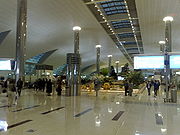
Terminal 3 is the largest building in the world by floor space, with over 1500000 m² (370.7 acre) of space, currently capable of handling 27 million passengers in a year. Once fully operational, Terminal 3 will have an annual capacity of 43 million passengers. A large part is located under the taxiway area and is directly connected to Concourse 2: the departure and arrival halls in the new structure are 10 m (32.8 ft) beneath the airport's apron. It has been operational since 14 October 2008, and opened in four phases to avoid collapse of baggage handling and other IT systems.
The main building of the Terminal contains 82 moving walkways, 97 escalators, eight skytrains (4 each at Arrivals and Departures), 157 elevators, and 27 truck lifts.
The building includes a multi level underground structure, first
and business
class lounges, restaurants, 180 check-in counters
and 2,600 car-parking spaces. The terminal offers more than double the previous retail area of concourse 1, by adding about 4800 m² (5,740.8 sq yd) and Concourse 2's 10700 m² (12,797.1 sq yd) of shopping facilities.
The baggage handling system
- largest system and also the deepest in the world - has a capacity to handle 8,000 bags per hour. The system includes 21 screening injection points, 49 make-up carousels, 90 km of conveyor belts capable of handling 15,000 items per hour at a speed of 27kmh, and 4,500 early baggage storage positions.
In departures
there are 126 check-in counters for economy class
passengers, and 36 for first
and business
class passengers. Also, there are 18 self service kiosks, 3 lounges for unaccompanied minor
s, 38 counters and 12 e-gates for Economy class passengers and 10 counters and 4 e-gates for First & Business class at immigration
.
In arrivals, the terminal contains 52 immigration counters, 14 baggage carousel
s, and 12 e-gates (Electronic Passport Control System) used at all entry point into the United Arab Emirates. There are also 4 baggage carousels for oversized luggage.
The car park includes 1,870 car spaces, 163 car rental spaces, 44 Emirates bus spaces, a check-in hall for baggage with an area of 4500 m² (5,382 sq yd), a mosque with an area 950 m² (1,136.2 sq yd) and 18 check-in counters. The entire car park has a total area of 177500 m² (212,288.2 sq yd).
On September 7, 2010, Terminal 3 saw its 50 millionth passenger pass through the terminal. Since opening in October 2008, the terminal has handled more than 197,920 flight movements (departures and arrivals), 50 million passengers and some 70 million pieces of luggage. Currently some 85,000 passengers pass through this terminal every day.
Concourse 2
Concourse 2 is directly connected to terminal 3, and is dedicated exclusively to Emirates. The total built up area of the concourse itself is 670000 m² (801,313.3 sq yd). The concourse is 924 m (3,031.5 ft) long, 90.8 m (297.9 ft) wide (at mid point) and 39.5 m (129.6 ft) high. The terminal has 10 floors (4 basement, Ground Floor, and 5 above floors). The building currently includes a multi-level structure for departures and arrivals and includes 26 gates, labelled 201 - 228 which include 59 passenger loading bridges.
It also includes 14 remote stands for Airbus A340 and Boeing 777 aircraft only. The remote gates have 5 boarding lounges. For transit passengers the concourse has 3 transfer areas, and 62 transfer desks.
The concourse also includes the Emirates first
and Business class lounges and the Marhaba lounge. The First class lounge has a capacity of 800 passengers and a total area of 6344 m² (7,587.4 sq yd). The Business class lounge has a capacity of 1200 passengers, and a total area of 6953 m² (8,315.7 sq yd). The Marhaba lounge, the smallest lounge at the concourse has a capacity of 140 passengers at a time.
The total retail area at the concourse is 10700 m² (12,797.1 sq yd) completely operated by Dubai Duty Free
, and the food court includes 16 restaurants.
There are also 2 hotels in the concourse; a 193 room and 14 suite 4 star hotel
, and a 38 room and 8 suite 5 star hotel
.
There is a direct connection to Sheikh Rashid Terminal (Concourse 1) located at the control tower structure through passenger walkways. There is also a 300-room hotel and health club including both five and four star rooms. Concourse 2 includes five aerobridges that are capable of handling the new Airbus A380.
Emirates Airline continues to maintain a presence in Concourse 1, operating 12 gates at the concourse as well as the Emirates First Class and Business Class Lounges.
Concourse 3
Concourse 3 will be connected to the two major public levels of Terminal 3 via an automated people mover (APM) in addition to the vehicular and baggage handling system utility tunnels for further transfer. The building, which follows the characteristic shape of Concourse 2, will be 645 m (2,116.1 ft) long, 90 m (295.3 ft) wide and 42 m (137.8 ft) high in the centre from the apron level, and will accommodate 20 aircraft stands, of which all 20 will be capable of handling the Airbus A380-800
.
The concourse will include one 4 star hotel
and one 5 star hotel
, first
and business class lounges, and duty-free areas. The total built-up area will be 528000 m² (631,482.7 sq yd).
Construction began in early 2008, and is expected to be completed by late 2011, handling an additional 15 million passengers a year bringing the total terminals capacity to 43 million, and the entire airport's to over 80 million passengers annually.
According to Dubai Airport officials, plans for Terminal 4 had begun and extensions would be made to Terminal 3. These are required to bring the capacity of the airport to 80–90 million passengers a year by 2015.
In May 2011, Paul Griffiths, chief executive of Dubai Airports revealed the Dubai Airport masterplan. It involves the construction of a Concourse 4 (previously Terminal 4). With a capacity of 15 million, it would bring the total capacity of the airport to 90 million passengers by 2018 - 15 million. It also will see Emirates take over the operation at Concourse 1, along with concourse 2 and 3 which it will already be operating. All remaining airlines will shift to Concourse 4, or move to Al Maktoum International Airport. The airport projects that international passenger and cargo traffic will increase at an average annual growth rate of 7.2 per cent and 6.7 per cent respectively and that by 2020 passenger numbers at Dubai International Airport will reach 98.5 million and cargo volumes will top 4.1 million tonnes.
. It also includes 8 aircraft hangars with a total built up area of 69,598 square-meters and maintenance hangars for Boeing 747s and Airbus A380s and a 1200 square metres (12,916.7 sq ft) gatehouse for VIP service. In 2010 there were 47,213 customers, 13,162 movements, and in 2009 there were a total of 43,968 customers and 14,896 movements.
Executive Flight Services (EFS) caters to those passengers of high class or special importance that often travel through Dubai International Airports. It is the largest dedicated business aviation terminal of its kind in the Middle East. It is located at the Dubai Airport Free Zone close to Dubai International’s Terminal 2. It only caters to private flights exclusive to the terminal. Airlines operating from the terminal are expected to maintain a lounge. In 2010 EFS handled 7,889 aircraft movements and 25,177 passengers.
The centre itself is located close to Terminal 2, and includes a 5,500 square-metre two-storey main building, a 3,700 square metre hangar, a 3,700 square metre ramp area for aircraft parking, and a special VIP car park for long term parking. The center also has its own immigration and customs sections, its own Dubai Duty Free outlet, a fully equipped business and conference centre, eight luxury private lounges and a limousine service between aircraft and the terminal.
The ramp area of the terminal can accommodate up to 22 small sized private jets, between eight and 12 medium sized jets, or up to three large sized jets such as the Boeing Business Jet
(BBJ), the Boeing 727 or the Airbus A319.
 The facility makes EFC the largest dedicated business aviation terminal in the Middle East.
Phase 1 of the cargo mega terminal was completed by 2004 and the next phase of expansion was scheduled for completion in late 2007. Presently the airport has a cargo capacity of 2.5 million tonnes, and will be expanded to handle 3 million.
The flower center is not yet finished and construction will continue in another two phases. The centre will offer an enhanced level of automation over a five to seven year period for processing flower products. It will begin with a semi-automated system with manual sorting before eventually becoming fully automated.
The centre when completed and functioning will have a floor area of approximately 100,000 m² including different export chambers and offices. The handling capacity of the centre is expected to be more than 300,000 tonnes of product throughput per annum. The entire facility (with the exception of the offices) will be maintained at an ambient temperature of just 2 °C to 4 °C.
aircraft safely under very poor weather conditions. The runways were recently expanded to accommodate the Airbus A380.
In 2009, it was announced that the airport installed a Category III landing system, allowing planes to land in low visibility conditions, such as fog. This system will be the first of its kind in the United Arab Emirates
.
Dubai airport is also investing $3.5 billion into a new Concourse 3, exclusively for handling Emirates Airline A380s. This is expected to be completed by early 2013. With the changes made, the airport does not expect embarking and disembarking passengers and baggage from the A380 to take longer than it does for Boeing 747-400s, which carry fewer passengers. On 16 July 2008, Dubai Airport unveiled the first of 2 specially-built gates capable of handling the aircraft. Costing $10 million, the gates will enable passengers to get on the upper cabin of the new 555-seater aircraft directly from the gate hold rooms. The hold rooms themselves have been enlarged to cater for the larger number of passengers flying the A380s. In addition to the 2 gates at Terminal 1, 5 more A380-capable gates were opened at concourse 3 on 14 October 2008.
service KUL to DXB continues onto Dammam, however they don't have traffic rights between DXB and DMM.
Singapore Airlines
service SIN to DXB continues onto Riyadh, however they don't have traffic rights between DXB and RUH.
Toumai Air Tchad
service NDJ to DXB routes via Jeddah, however they don't have traffic rights between JED and DXB.
United Airways
service DAC to DXB continues onto London-Gatwick, however they don't have traffic rights between DXB and LGW.
China Eastern Airlines
service PVG-KMN-DXB is operated using Shanghai Airlines
aircraft in full Shanghai Airlines colours but it is not a Shanghai Airlines flight.
Extensive upgrading work on existing retail areas since 2004 in Terminals 1 and 2 has increased sales. Dubai Duty Free
announced annual sales of Dhs3.95 billion (US$1.1 billion) in 2008, representing a 23 per cent increase on the previous year.
2008 saw the operation doubling its retail space from 7,000 square metres to 15,000 square metres with the inauguration of the new Emirates Terminal 3 in October 2008. The Duty Free outstrips other shopping malls in Dubai. Liquor and perfumes are particularly popular, accounting for over half of total retail sales, followed by watches and tobacco products. The airport enjoys "one of the highest concession revenues per passenger in the world" compared to other major international airports. Dubai Duty Free recorded more than 21 million transactions in 2008. As of August 2009, Dubai Duty Free was the biggest single airport retail operation in the world ahead of London Heathrow and Seoul Incheon
airports. According to Generation Research, Dubai Duty Free accounts for 5% of the airport duty-free business and 3% of the wider duty-free and travel-retail global business.
In addition to a wide array of duty-free shops and eating outlets, Dubai Airport has two open-air garden areas. Dubai Airport has numerous business centres located around the airport. Within the international transit area of the interconnected Terminals 1 and 2, internet and games facilities, prayer rooms, showers, spas, gym, swimming pool and a 3 hotels are provided. Various lounge areas are provided, some including children's play areas or televisions showing news, movie and sport channels.
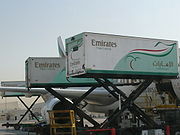
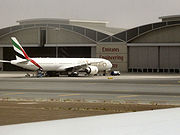 The X Factor will be Mosaic has turn to the season 2 in 2012.
Ground Handling Services.
Services include cargo ramp and technical support services to airlines at Dubai Airport.
Current facilities include:
In 2005, an upgrade in screening technology and rising security concerns led to luggage-screening processes being conducted behind closed doors, as opposed to them being done just before check-in previously within public view. Carry-on luggage and personal screening are conducted at the individual departure gates, while check-in luggage are screened in the backrooms and secured before loading. Dubai Airport Police plans to introduce a biometric identification system for access into restricted areas.
In view of the 2006 transatlantic aircraft plot, security screening checks have been stepped up on passengers and their hand-carry luggage, as well as checked-in luggage on flights bound for destinations in the United Kingdom and the United States from Dubai.
In early 2007, Dubai Airport introduced a new type of airport screening device which not only detected weapons, but also could screen the passenger for drugs in the blood. With the new system in place, travellers entering Dubai can be jailed for 4 years or more if found in possession (including in the bloodstream and the bottom of the shoes) of illegal drugs (even in quantities as small as 0.001g), including poppy seeds
from bagels and prescription and over-the-counter medicines such as codeine
. A senior Dubai judge was quoted on 11 February 2008, by the Dubai City News saying, "These laws help discourage anyone from carrying or using drugs. Even if the amount of illegal drugs found on someone is 0.05 grams, they will be found guilty. The penalty is a minimum four years. The message is clear — drugs will not be tolerated." A number of travellers have been held pending charge while Dubai authorities test their possessions, blood and urine for any trace of contraband.
! colspan="4" style="background:#4682b4; color:white; line-height:180%;"|Top destinations
|-
! colspan="4" style="background:lightgrey;"|By flight frequencies (weekly one-way)
|-
!Rank||Destination||02/08
|-
|1
| Qatar Doha
|139
|-
|2
| Bahrain Bahrain
|135
|-
|3
| Iran Tehran
|130
|-
|4
| India Mumbai
|129
|-
|5
| Oman Muscat
|128
|-
|6
| United Kingdom London Heathrow
|99
|-
|7
| Pakistan Karachi
|94
|-
|8
| Jordan Amman
|70
|-
! colspan="4" style="background:lightgrey;"|By monthly passengers carried
|-
!Rank||Destination||Outbound Passengers
|-
|1
| Kuwait Kuwait City
|477,759
|-
|2
| Qatar Doha
|413,597
|-
|3
| Afghanistan Kabul
|390,041
|-
|4
| United Kingdom London Heathrow
|359,349
|-
|5
| Bahrain Bahrain
|276,945
|-
|6
| Egypt Cairo
|254,481
|-
|7
| Iran Tehran
|249,577
|-
|8
| Oman Muscat
|232,226
|-
|9
| Malaysia Kuala Lumpur
|204,129
|-
|10
| Syria Damascus
|199,715
|}
As all passenger traffic out of the airport is international in nature, the three major terminals in operation are equipped with immigration-processing facilities for international travel.
Since there are international flights operating out from the airport, the terminals of the airport are equipped with immigration
processing facilities and security scanning for all passengers including domestic, and regional passengers. Terminals 1, and 3 handle 95% of the international flights, whilst Terminal 2 mainly caters to regional flights and international flights routed to other airports in Iran and Saudi Arabia. Emirates Airlines operate from only Terminal 3. Conversely, low cost carriers such as Flydubai operate flights out of terminal 2.
Passenger growth at the airport has been growing at an average rate of 18%. The airport successfully reached its capacity of 33 million passengers per annum by 2007, however this was still not enough to handle the growing over congestion at the airport. As 2009 the airport's capacity reached 62 million with the opening of Terminal 3 and expansion of Terminal 2.
In 2010 Dubai International Airport's passenger movements, growth in traffic significally increased, nearly hitting the 41 million passenger mark in 2009. The airport recorded an increase of 9.2% per cent in passenger traffic.
Passenger traffic for 2010 grew by 15.3 percent as 47.2 million passengers passed through Dubai International, compared to 40.9 during the corresponding period last year and 2.4 per cent more than the 46.1 million originally projected for the year.
In 2011, Passenger traffic rose by 13.2% in April to reach 4.23 million up 13.2 per cent compared to 3.74 million recorded during the same month in 2010. The year to date traffic stands at 16.5 million, an increase of 8.5 per cent over the corresponding period in 2010.
As of April 2011, Dubai International handled 686,679 tonnes, a contraction of 0.3 per cent compared to 688,537 tonnes for the corresponding period last year. In April the airport handled 179,397 tonnes of international air freight in April, up 5.6 per cent from the 169,902 tonnes recorded during the same period in 2010. The contraction in cargo traffic was due to the Arab Spring
of 2011.
has a station at Terminal 3, and at Terminal 1. The Metro provides services between 0600 and 2215 everyday except Friday, when it operates between 1300 and 2315. These timings differ during the Islamic holy month of Ramadan
. The stations are located in front of both terminals, and can be accessed directly from the arrivals areas.
The Green Line operates at another station in the Airport Free Zone, from which passengers can connect to Terminal 2.
, available at the Airport Ground Transportation Center and the Arrivals.
Bus stations are situated opposite both Terminal 1, 2, and 3. Local buses 4, 11, 15, 33 and 44 can be used to connect with Terminal 1 and 3, while bus 2 connects with Terminal 2. Dubai International Airport Buses provide air-conditioned transport into the city centre and over 80 hotels in the city.
Coach services are available to major cities and towns including Abu Dhabi
, Al Ain
, and Sharjah. Emirates offers a complimentary coach service, which operates 3 daily services to and from Al Ain, and 4 daily, to and from Abu Dhabi.
{| style="text-align:centre; font-size:95%; border:1px solid black;"
! Service!! Destination !! Notes
|-
! colspan="4" style="background:purple;color:white; height:35px;" | RTA Buses
|-
| style="background:purple;color:white;text-align:center;font-weight:bold;" | 4 || Al Rashidiya
Bus Station||
|-
| style="background:purple;color:white;text-align:center;font-weight:bold;" | 33 || Al Qusais
Industrial Station ||
|-
| style="background:purple;color:white;text-align:center;font-weight:bold;" | 34 || Al Rashidiya
Bus Station||
|-
| style="background:purple;color:white;text-align:center;font-weight:bold;" | 44 || Al Gubaiba Bus Station||
|-
| style="background:purple;color:white;text-align:center;font-weight:bold;" | 48 || Al Rashidiya
Bus Station||
|-
| style="background:purple;color:white;text-align:center;font-weight:bold;" | 64 || Ras Al Khor
Terminus ||
|-
| style="background:purple;color:white;text-align:center;font-weight:bold;" | 401 || Deira
Terminus ||
|-
| style="background:purple;color:white;text-align:center;font-weight:bold;" | 402 || Al Karama
Terminus||
|-
| style="background:purple;color:white;text-align:center;font-weight:bold;" | 11A || Awir Terminus ||
|-
| style="background:purple;color:white;text-align:center;font-weight:bold;" | 11C || CWC Terminus ||
|-
| style="background:purple;color:white;text-align:center;font-weight:bold;" | 32C || Satwa Bus Station ||
|-
| style="background:purple;color:white;text-align:center;font-weight:bold;" | 11M || Khawaneej ||
|-
| style="background:purple;color:white;text-align:center;font-weight:bold;" | C01 || Gold Souk Terminal Station||
|-
| style="background:purple;color:white;text-align:center;font-weight:bold;" | C8 || Zabeel
||
|-
| style="background:purple;color:white;text-align:center;font-weight:bold;" | C26 || Safa Park
||
|-
| style="background:purple;color:white;text-align:center;font-weight:bold;" | X28 || Jebel Ali
Terminus||
|-
{| style="text-align:left; font-size:95%; border:1px solid black;"
|-
! Service!! Destination !! Notes
|-
! colspan="3" style="background:orange;color:black; height:35px;" | Long-distance services
|-
| style="background:orange;color:black;text-align:center;font-weight:bold;" | Transport Company Bus|| Abu Dhabi
|-
| style="background:orange;color:black;text-align:center;font-weight:bold;" | Transport Company Bus|| Al Ain
|-
| style="background:orange;color:black;text-align:center;font-weight:bold;" | Transport Company Bus|| Sharjah
|}
International airport
An international airport is any airport that can accommodate flights from other countries and are typically equipped with customs and immigration facilities to handle these flights to and from other countries...
serving Dubai
Dubai
Dubai is a city and emirate in the United Arab Emirates . The emirate is located south of the Persian Gulf on the Arabian Peninsula and has the largest population with the second-largest land territory by area of all the emirates, after Abu Dhabi...
, the largest city of the United Arab Emirates
United Arab Emirates
The United Arab Emirates, abbreviated as the UAE, or shortened to "the Emirates", is a state situated in the southeast of the Arabian Peninsula in Western Asia on the Persian Gulf, bordering Oman, and Saudi Arabia, and sharing sea borders with Iraq, Kuwait, Bahrain, Qatar, and Iran.The UAE is a...
. It is a major aviation hub
Airline hub
An airline hub is an airport that an airline uses as a transfer point to get passengers to their intended destination. It is part of a hub and spoke model, where travelers moving between airports not served by direct flights change planes en route to their destinations...
in the Middle East, and is the main airport of Dubai. It is situated in the Al Garhoud
Al Garhoud
Al Garhoud is a commercial and residential locality in Dubai, United Arab Emirates. Al Garhoud is close to Dubai International Airport and therefore preferred by Emirates Airline airline pilots as a living place...
district, 4 km (2.5 mi) southeast of Dubai. The airport is operated by the Department of Civil Aviation
Department of Civil Aviation (Dubai)
The Department of Civil Aviation is the governing body which oversees aviation activities in Dubai, United Arab Emirates. The DCA was once the operator of Dubai International Airport, Dubai Cargo Village and Dubai Duty Free Zone. Management of Dubai's airports and cargo gateways have been...
and is the home base of Dubai's international airline, Emirates and Emirates SkyCargo
Emirates SkyCargo
Emirates SkyCargo is a cargo airline based in Dubai, United Arab Emirates. It is the air freight division of Emirates, which started operations in October 1985, the same year Emirates was formed. Since then it has been the main cargo division of Emirates, and the anchor cargo airline at Dubai...
; the Emirates hub is the largest airline hub in the Middle East ; Emirates handles 60% of all passenger traffic, and accounts for 38% of all aircraft movements at the airport. Dubai Airport is also the base for low-cost carrier
Low-cost carrier
A low-cost carrier or low-cost airline is an airline that generally has lower fares and fewer comforts...
, Flydubai
Flydubai
Dubai Aviation Corporation , trading as flydubai , is a low-cost airline with its head office and flight operations in Terminal 2 of Dubai International Airport.-History:...
. As of July 2010, there are over 6,000 weekly flights operated by 130 airlines to over 220 destinations across every continent except Antarctica.
In 2010 DXB handled a record 47.2 million in passenger traffic, a 15.4% increase over the 2009 fiscal year. This made it the 13th busiest airport in the world by passenger traffic
World's busiest airports by passenger traffic
The world's busiest airports by passenger traffic are measured by number of total passengers . One passenger is described as someone who arrives in, departs from, or transfers through the airport on a given day...
and the 4th busiest airport in the world by international passenger traffic
World's busiest airports by international passenger traffic
The following is a list of the world's busiest airports by international passenger traffic.London Heathrow has been the busiest since 2000-2010 year-to-date statistics:Airports Council International's year-to-date figures are as follows....
. In addition to being an important passenger traffic hub, the airport was the 8th busiest cargo airport in world
World's busiest airports by cargo traffic
The world's thirty busiest airports by cargo traffic for various periods . Numbers listed refer to loaded and unloaded freight in metric tonnes.-2010 final statistics:...
, handling 2.27 million tonnes of cargo in 2010, a 17.8% increase compared to 2009 The total number of commercial aircraft movements was 292,662 in 2010. As of October 2011, DXB is the 7th busiest airport in the world by cargo traffic
World's busiest airports by cargo traffic
The world's thirty busiest airports by cargo traffic for various periods . Numbers listed refer to loaded and unloaded freight in metric tonnes.-2010 final statistics:...
, and the 12th busiest airport in the world by passenger traffic
World's busiest airports by passenger traffic
The world's busiest airports by passenger traffic are measured by number of total passengers . One passenger is described as someone who arrives in, departs from, or transfers through the airport on a given day...
.
The new $4.5 billion Terminal 3 opened on 14 October 2008, and was built exclusively for the use of Emirates Airline. Concourse 3 is also part of Terminal 3, and is expected to be completed by 2012. It will be built exclusively for the Emirates Airbus A380
Airbus A380
The Airbus A380 is a double-deck, wide-body, four-engine jet airliner manufactured by the European corporation Airbus, a subsidiary of EADS. It is the largest passenger airliner in the world. Due to its size, many airports had to modify and improve facilities to accommodate it...
. Terminal 3 is the single largest building in the world by floor space and brings the total capacity of the airport to over 62 million passengers and will increase to more than 80 million passengers by 2012 when Concourse 3 opens. Further extensions to Terminal 2 are also currently being made. The airport revealed its plans in May 2011, which involve construction of a new Concourse 4 which is expected to bring the total capacity of the airport to over 90 million passengers by 2018. The plan also involves Emirates solely operating from Concourse 1 along with Concourse 2 and 3 which it will already be operating.
Dubai International Airport will be complemented by Al Maktoum International Airport (Dubai World Central International Airport), a new 140 km² (54 sq mi) airport that will help handle the influx of travellers well into the future. It began cargo operations on 27 June 2010 and was expected to begin passenger operations in March 2011 but has been further delayed to 2012.
History
The history of civil aviation in Dubai started in July 1937 when an air agreement was signed for a flying boat base for the aircraft of Imperial AirwaysImperial Airways
Imperial Airways was the early British commercial long range air transport company, operating from 1924 to 1939 and serving parts of Europe but especially the Empire routes to South Africa, India and the Far East...
with rental of the base at about 440 Rupees per month – this included the guards' wages. The Empire Flying Boats also started operating once a week flying East to Karachi and West to Southampton, England. By February 1938, there were 4 flying boats a week.
In the 1940s flying from Dubai was by flying boat
Flying boat
A flying boat is a fixed-winged seaplane with a hull, allowing it to land on water. It differs from a float plane as it uses a purpose-designed fuselage which can float, granting the aircraft buoyancy. Flying boats may be stabilized by under-wing floats or by wing-like projections from the fuselage...
s operated by British Overseas Airways Corporation
British Overseas Airways Corporation
The British Overseas Airways Corporation was the British state airline from 1939 until 1946 and the long-haul British state airline from 1946 to 1974. The company started life with a merger between Imperial Airways Ltd. and British Airways Ltd...
(BOAC), operating the Horseshoe line from Southern Africa
Southern Africa
Southern Africa is the southernmost region of the African continent, variably defined by geography or geopolitics. Within the region are numerous territories, including the Republic of South Africa ; nowadays, the simpler term South Africa is generally reserved for the country in English.-UN...
via the Persian Gulf
Persian Gulf
The Persian Gulf, in Southwest Asia, is an extension of the Indian Ocean located between Iran and the Arabian Peninsula.The Persian Gulf was the focus of the 1980–1988 Iran-Iraq War, in which each side attacked the other's oil tankers...
to Sydney.
On 29 October 2010, the airport marked its 50th anniversary. The airport has seen over 402 million passengers at an average annual growth rate of 15.5 per cent, and handled over 3.87 million aircraft at an average annual growth rate of 12.4 per cent.
Construction
Construction of the airport was ordered by the ruler of Dubai, Sheikh Rashid bin Saeed Al MaktoumRashid bin Saeed Al Maktoum
HH The Emir Sheikh Rashid bin Saeed Al Maktoum was the Vice-President and Prime Minister of United Arab Emirates and Emir of Dubai...
, in 1959. It officially opened in 1960 with its first airfield, at which time it was able to handle aircraft the size of a Douglas DC-3
Douglas DC-3
The Douglas DC-3 is an American fixed-wing propeller-driven aircraft whose speed and range revolutionized air transport in the 1930s and 1940s. Its lasting impact on the airline industry and World War II makes it one of the most significant transport aircraft ever made...
on a 1800 m (5,906 ft) long runway
Runway
According to ICAO a runway is a "defined rectangular area on a land aerodrome prepared for the landing and take-off of aircraft." Runways may be a man-made surface or a natural surface .- Orientation and dimensions :Runways are named by a number between 01 and 36, which is generally one tenth...
made of compacted sand. Three turning-areas, an apron
Airport ramp
The airport ramp or apron is part of an airport. It is usually the area where aircraft are parked, unloaded or loaded, refueled or boarded. Although the use of the apron is covered by regulations, such as lighting on vehicles, it is typically more accessible to users than the runway or taxiway...
and small terminal completed the airport that was constructed by Costain
Costain Group
Costain Group plc is a British construction and civil engineering company headquartered in Maidenhead. It was part of the original Channel Tunnel consortium and is involved in Private Finance Initiative projects.-History:...
.
With the expansion of the Airport Fire Services it was necessary to find more suitable accommodation and a hangar style building was made available to them at the end of 1976. This was located midway between the runway ends to facilitate efficient operations. A new building was also constructed to house the Airport Maintenance Engineer, Electronics Engineering section and Stores unit.
Expansion of the Airport Restaurant and Transit Lounge including the refurbishing of the upper level and the provision of a new kitchen was completed in December 1978.
In May 1963 construction of a 9200 ft (2,804 m) asphalt runway started. This new runway, alongside the original sand runway and taxiway
Taxiway
A taxiway is a path on an airport connecting runways with ramps, hangars, terminals and other facilities. They mostly have hard surface such as asphalt or concrete, although smaller airports sometimes use gravel or grass....
opened in May 1965, together with several new extensions were added to the Terminal Building, hangars erected, Airport and Navigational aids were installed. The installation of the lighting system continued after official opening and was completed in August of that year. During the second half of the 1960s several extensions, equipment upgrades like a VHF omnidirectional range
VHF omnidirectional range
VOR, short for VHF omnidirectional radio range, is a type of radio navigation system for aircraft. A VOR ground station broadcasts a VHF radio composite signal including the station's identifier, voice , and navigation signal. The identifier is typically a two- or three-letter string in Morse code...
(VOR) and an instrument landing system
Instrument Landing System
An instrument landing system is a ground-based instrument approach system that provides precision guidance to an aircraft approaching and landing on a runway, using a combination of radio signals and, in many cases, high-intensity lighting arrays to enable a safe landing during instrument...
(ILS) as well as new buildings were constructed. By 1969, the airport was served by 9 airlines serving some 20 destinations.
The inauguration was on 15 May 1965 and was marked by the visits of the first big jets of Middle East Airlines
Middle East Airlines
Middle East Airlines – Air Liban S.A.L. , more commonly known as Middle East Airlines , is the national flag-carrier airline of Lebanon, with its head office in Beirut, near Beirut Rafic Hariri International Airport...
and Kuwait Airways
Kuwait Airways
Kuwait Airways is the national airline of Kuwait, with its head office on the grounds of Kuwait International Airport, Al Farwaniyah Governorate. It operates scheduled international services throughout the Middle East, to the Indian subcontinent, Europe, Southeast Asia and North America, from its...
Comets.
The advent of wide body aircraft a need for further airport development in the 1970s which had already been foreseen by the Ruler of Dubai and plans for a new Terminal, runways and taxiways capable of coping with international flights.
The construction of a new terminal building consisting of a three storey building 110 metres long and included an enclosed floor area of 13,400 square metres. A new 28 metre control tower was also constructed.
Expansion continued in the early 1970s including ILS Category II equipment, lengthening existing runway to 12500 ft (3,810 m), installation of a non-directional beacon
Non-directional beacon
A non-directional beacon is a radio transmitter at a known location, used as an aviation or marine navigational aid. As the name implies, the signal transmitted does not include inherent directional information, in contrast to other navigational aids such as low frequency radio range, VHF...
(NDB), diesel generators, taxiways, etc. This work made handling the Boeing 747
Boeing 747
The Boeing 747 is a wide-body commercial airliner and cargo transport, often referred to by its original nickname, Jumbo Jet, or Queen of the Skies. It is among the world's most recognizable aircraft, and was the first wide-body ever produced...
and Concorde
Concorde
Aérospatiale-BAC Concorde was a turbojet-powered supersonic passenger airliner, a supersonic transport . It was a product of an Anglo-French government treaty, combining the manufacturing efforts of Aérospatiale and the British Aircraft Corporation...
possible. Several runway and apron extensions were carried out through the decade to meet growing demand.
The new precision category 2 Approach and Runway Lighting System was commissioned. The construction of the Airport Fire Station and the installation of the Generators were completed in December and was fully operational in March 1972. The ruler also commissioned and inaugurated the Long-range Surveillance System on 19 June 1973.
The next phase of development was the second runway, which was completed three months ahead of schedule and opened in April 1984. This runway, located 360 metres north of the existing runway and parallel to it and is equipped with the latest meteorological, airfield lighting and instrument landing systems to give the airport a Category II classification.
Also several extensions and upgrades of terminal facilities and supporting systems were carried out. On 23 December 1980 the airport became ordinary member of the Airports Council International
Airports Council International
Airports Council International is the association of the world’s airports. It is a non profit organization, whose prime purpose is to advance the interests of airports and to promote professional excellence in airport management and operations...
(ACI).
During the 1980s, Dubai was a stopping point for airlines such as Air India, Cathay Pacific
Cathay Pacific
Cathay Pacific is the flag carrier of Hong Kong, with its head office and main hub located at Hong Kong International Airport, although the airline's registered office is on the 33rd floor of One Pacific Place...
, Singapore Airlines, Malaysia Airlines
Malaysia Airlines
Malaysian Airline System Berhad , DBA Malaysia Airlines , is the government-owned flag carrier of Malaysia. Malaysia Airlines operates flights from its home base, Kuala Lumpur International Airport, and its eastern hub in Kota Kinabalu. It has its headquarters on the grounds of Sultan Abdul Aziz...
and others travelling between Asia and Europe that needed a refuelling point in the Persian Gulf
Persian Gulf
The Persian Gulf, in Southwest Asia, is an extension of the Indian Ocean located between Iran and the Arabian Peninsula.The Persian Gulf was the focus of the 1980–1988 Iran-Iraq War, in which each side attacked the other's oil tankers...
. This use was made redundant with the advent of longer-range aircraft introduced in the late 1980s and early 1990s such as the Airbus A340
Airbus A340
The Airbus A340 is a long-range four-engine wide-body commercial passenger jet airliner. Developed by Airbus Industrie,A consortium of European aerospace companies, Airbus is now fully owned by EADS and since 2001 has been known as Airbus SAS. a consortium of European aerospace companies, which is...
, the Boeing 747-400
Boeing 747-400
The Boeing 747-400 is a major development and the best-selling model of the Boeing 747 family of jet airliners. While retaining the four-engine wide-body layout of its predecessors, the 747-400 embodies numerous technological and structural changes to produce a more efficient airframe...
and the Boeing 777
Boeing 777
The Boeing 777 is a long-range, wide-body twin-engine jet airliner manufactured by Boeing Commercial Airplanes. It is the world's largest twinjet and is commonly referred to as the "Triple Seven". The aircraft has seating for over 300 passengers and has a range from , depending on model...
series aircraft, which had the range to fly between Europe and Southeast Asia
Southeast Asia
Southeast Asia, South-East Asia, South East Asia or Southeastern Asia is a subregion of Asia, consisting of the countries that are geographically south of China, east of India, west of New Guinea and north of Australia. The region lies on the intersection of geological plates, with heavy seismic...
nonstop.
Expansion
The opening of Terminal 2 in 1998 saw the first step of phase 1 of the new development master plan launched in 1997. As the second stage, Concourse 1 opened in April 2000 under the name of Sheikh Rashid Terminal. The concourse is 0.8 km (0.497098189319845 mi) in length and connects to the check-in area by a 0.3 km (0.186411820994942 mi) underground tunnel containing moving walkway (conveyor belt / travelators). It also contains a hotel, business centre, health club, exchanges, dining and entertainment facilities, internet services, medical center, post office, prayer room. The next step was the reconfiguration of the runway system, already part of phase 2, as well as aprons and taxiways were also expanded and strengthened in 2003-2004. In addition, as part of the development the opening of the Dubai Flower Centre occurred in 2005. The airport saw the need for this as the city is a flower hub for import and export of flowers and the airport required a specialist facility since these products need special conditions.Construction of Terminal 3 began in 2004 as next stage of phase 2 of the development, with an estimated cost of around $4.55 billion. Originally planned for completion in 2006, the date was delayed by two years.
On 30 May 2008, a topping out ceremony for the terminal was conducted. The terminal became operational on 14 October 2008, with Emirates Airline (EK2926) from Jeddah
Jeddah
Jeddah, Jiddah, Jidda, or Jedda is a city located on the coast of the Red Sea and is the major urban center of western Saudi Arabia. It is the largest city in Makkah Province, the largest sea port on the Red Sea, and the second largest city in Saudi Arabia after the capital city, Riyadh. The...
, Saudi Arabia
Saudi Arabia
The Kingdom of Saudi Arabia , commonly known in British English as Saudi Arabia and in Arabic as as-Sa‘ūdiyyah , is the largest state in Western Asia by land area, constituting the bulk of the Arabian Peninsula, and the second-largest in the Arab World...
, being the first flight to arrive at the new terminal, and EK843 to Doha
Doha
Doha is the capital city of the state of Qatar. Located on the Persian Gulf, it had a population of 998,651 in 2008, and is also one of the municipalities of Qatar...
, Qatar
Qatar
Qatar , also known as the State of Qatar or locally Dawlat Qaṭar, is a sovereign Arab state, located in the Middle East, occupying the small Qatar Peninsula on the northeasterly coast of the much larger Arabian Peninsula. Its sole land border is with Saudi Arabia to the south, with the rest of its...
being the first departing flight.
The terminal increases the airport's maximum passenger capacity annually by 43 million, bringing the total annual capacity up to 60 million passengers.
With the arrival of the Airbus A380, the airport put into place modifications works costing $230 million. These included the building of 29 gates
Gate (airport)
A gate in aviation is a long, movable, "bridge" that allows passengers to embark and disembark their aircraft.* Jetway bridges* Air stairs, either built into the aircraft or from a mobile vehicle* Mobile lounges...
capable of handling the large aircraft, five of which are in Terminal 3, and 2 which are in Terminal 1. Other important projects at the airport include the next stage of the phase 2 development, which includes the construction of Concourse 3. This will be a smaller version of Concourse 2, which is connected to Terminal 3. Construction has already begun and is expected to be completed within two years, with plans to open by late 2011.
Also as part of the expansion, the airport will be able to handle at least 75 (15 million) passengers per annum with the opening of Concourse 3 which will be part of Terminal 3. However, recent communications predict a further increase to 80 million passengers with additional reassessments of existing capacities. In 2009, Terminal 2 expanded its facilities to handle 5 million (2 million) passengers annually, taking the airport's total capacity to 62 million passengers. The Department of Civil Aviation
Civil Aviation Authority
This is a list of national and supra-national civil aviation authorities.-See also:* Air route authority between the United States and the People's Republic of China* National Transportation Safety Board -External links:****...
has also said that Terminal 2 will continuously be upgraded and expanded to bring the total capacity of the airport from the initial 75 million passengers to 80 million passenger capacity by 2012.
The Cargo Mega Terminal, which will have the capacity to handle 3 million tonnes of cargo a year, is a major development; it is going to be built in the long term. Completion for the Mega terminal is expected to be no later than 2018. Terminal 2 will be completely redeveloped to match the status of the other two terminals. With all of these projects completed by 2012, the airport expects to be able of handling at least 75-80 million passengers and over 5 million tonnes of cargo.
The airport's landside facilities went under a modification to allow two stations to be built of the Red Line
Red Line (Dubai Metro)
The Red Line is one of the two lines on the Dubai Metro network in Dubai, United Arab Emirates. The first section was inaugurated on 9 September 2009. Construction was declared complete on 28 April 2010.. The line has 29 stations spanning , which have been opened in phases from 2009 to 2011...
of Dubai Metro
Dubai Metro
The Dubai Metro is a driverless, fully automated metro network in the United Arab Emirates city of Dubai. The Red Line and Green Line are operational, with three further lines are planned. These first two lines run underground in the city centre and on elevated viaducts elsewhere...
. One station was constructed at Terminal 1 and the other at Terminal 3; both already operational. The line was launched on 9 September 2009, and opened in phases over the next year. The second Green Line
Green Line (Dubai Metro)
The Green Line is one of the two lines on the Dubai Metro network in Dubai, United Arab Emirates. It is currently opened in a limited phase, with 16 stations open from Etisalat to Dubai Healthcare City, though when completely operational; will have 18 stations spanning...
of the Dubai Metro will pass at the Airport Free Zone, and will serve the airport's north-eastern area with the Terminal 2 from mid-2011.
The proposed 52 kilometers Purple Line
Purple Line (Dubai Metro)
The Purple Line is a proposed line of the Dubai Metro network in Dubai, United Arab Emirates. The purple line will run between Dubai International Airport to Al Maktoum International Airport, along Al Khail Road...
will link Dubai International airport and Al Maktoum International Airport, which is currently being built at Jebel Ali
Jebel Ali
Jebel Ali is a port town, located 35 kilometres southwest of the city of Dubai in the United Arab Emirates . The village has a thriving expatriate community with over 300 residents. The area is also home to "5,500 companies from 120 countries"....
.
When the full expansion program of phase 2 will be completed by 2011, the airport will have three terminals
Airport terminal
An airport terminal is a building at an airport where passengers transfer between ground transportation and the facilities that allow them to board and disembark from aircraft....
and three concourse
Concourse
A concourse is a place where pathways or roads meet, such as in a hotel, a convention center, a railway station, an airport terminal, a hall, or other space.-Examples:Examples of concourses include:* Meeting halls* Universities* Railway stations...
s, two cargo
Cargo
Cargo is goods or produce transported, generally for commercial gain, by ship, aircraft, train, van or truck. In modern times, containers are used in most intermodal long-haul cargo transport.-Marine:...
mega terminals, an airport free zone, an expo centre with three large exhibition halls, a major aircraft maintenance
Aircraft maintenance
Aircraft maintenance is the overhaul, repair, inspection or modification of an aircraft or aircraft component.Maintenance includes the installation or removal of a component from an aircraft or aircraft subassembly, but does not include:...
hub and a flower centre to handle perishable goods. A phase 3 which has been included in the masterplan involves the construction of a new Concourse 4.
{| class="collapsible wikitable collapsed" style="width:90%; font-size:85%; border:#999 solid 1px; text-align:lcenter; margin-bottom:0; margin:1em auto 1em auto;"
|-
! colspan="5" style="background:#8b8589;"| Summary of Dubai International Airport Masterplan
|- style="font-weight:bold; background:#d3d3d3;"
{|class="wikitable"
|-
!Phase!!Year!!Description
|-
|rowspan="3"|Phase 1||1997||Initial Capacity of 11 million Passenger Per Annum. $540 million phase 1 launched.
|-
|1998||Terminal 2 Inaugurated on 1 May 1998, to alleviate congestion from
Terminal 1, with a capacity of 2.5 million passengers annually.
|-
|2000||Sheikh Rashid Terminal - reopened 15 April 2000. Capable of handling 22 million passengers per annum
|-
|rowspan="8"|Phase 2
|-
|2002||$4.5bn ($545m for the civils on T3 and concourse projects) launched.
|-
|2003||Taxiways were strengthened. In addition, work on other taxiways in the area was expanded in order to complete the work associated with the newly commissioned second runway.
|-
||2005||Construction of Dubai Flower Centre completed.
|-
||2005||US$225 million VIP Pavilion for the Dubai Royal Wing opens in July
|-
||2008||Capable of handling 60 million Passengers per annum with the opening of Terminal 3 - Concourse 2
|-
|2012|| Extensions to Terminal 2 are completed - new check-in hall, departure area, and extends to the terminal building.
|-
|2013||New Concourse 3 constructed, enabling the airport to have a capacity of 75 million passengers, with further improvements 80 million is possible
|-
|2018||Capable of handling 4 million tons of freight per annum with the construction of a part of Cargo Mega Terminal.
|-
|Phase 3||Not fixed 2||Concourse 4 will be constructed.
|-
|rowspan="5"|General Expansion||2004–2008||Includes construction of Emirates Flight Catering Centre, Emirates Engineering Facility.
|-
|2006||Opening of Emirates Engineering Facility - largest aircraft hangars in the world.
|-
|2007||Opening of Emirates Flight Catering Centre, capable of producing 115,000 meals per day.
|-
|2008||New Executive Flights Center facility launched.
|-
|2009||Capable of handling 62 million passengers per annum with the expansion and refurbishment of Terminal 2
|}
Dubai's government has announced the construction of a new airport in Jebel Ali
Jebel Ali
Jebel Ali is a port town, located 35 kilometres southwest of the city of Dubai in the United Arab Emirates . The village has a thriving expatriate community with over 300 residents. The area is also home to "5,500 companies from 120 countries"....
termed Al Maktoum International Airport. It is expected upon completion to be the fourth largest airport in the world by physical size, though not by passenger metrics. It is expected to open in 2010, however construction is expected to finish by the year 2017. On completion, the airport is expected to be able to accommodate up to 160 million passengers. There has been an official plan to build the Dubai Metro Purple Line to connect Al Maktoum International Airport to Dubai International Airport; construction is set to begin in 2012. There have been rumours that the purple line is on hold, or even cancelled.
Main airlines based at DXB
- Emirates Airline is the largest airline operating at the airport, with an all-wide-bodyWide-body aircraftA wide-body aircraft is a large airliner with two passenger aisles, also known as a widebody aircraft or twin-aisle aircraft. The typical fuselage diameter is . In the typical wide-body economy cabin, passengers are seated seven to ten abreast, allowing a total capacity of 200 to 850 passengers...
fleet of over 140 Airbus and Boeing aircraft based at Dubai, providing scheduled services to the Middle East, Africa, Asia, Europe, North America, South America, Australia and New Zealand. It operates exclusively from Terminal 3 and part of Terminal 1. - Emirates SkyCargo, a subsidiary of Emirates, operates scheduled all-cargo services between Dubai and the rest of the world.
- Flydubai, a new low-cost airline planning to operate over 50 aircraft on scheduled passenger services to and from Dubai, to the Middle East, Africa, Europe and South Asia. It operates from Terminal 2.
India's flag carrier, Air India
Air India
Air India is the flag carrier airline of India. It is part of the government of India owned Air India Limited . The airline operates a fleet of Airbus and Boeing aircraft serving Asia, Australia, Europe and North America. Its corporate office is located at the Air India Building at Nariman...
, plans to make Dubai a major hub for the carrier after ending hub operations in Europe.
Recreational flying to Dubai is catered for by the Dubai Aviation Club, which undertakes flying training for private pilots and provides facilities for private owners.
The Government of Dubai provides short and long range search and rescue
Search and rescue
Search and rescue is the search for and provision of aid to people who are in distress or imminent danger.The general field of search and rescue includes many specialty sub-fields, mostly based upon terrain considerations...
services, police support, medical evacuation and general purpose flights for the airport and all VIP flights to the airport.
Infrastructure
Dubai International Airport was conceptualised to function as Dubai's primary airport and the region's busiest for the foreseeable future without the need for relocation or the building of another airport when passenger figures increased. The area was chosen near to DubaiDubai
Dubai is a city and emirate in the United Arab Emirates . The emirate is located south of the Persian Gulf on the Arabian Peninsula and has the largest population with the second-largest land territory by area of all the emirates, after Abu Dhabi...
, to attract passengers from the city of Dubai, rather than travel to the busier Sharjah International Airport
Sharjah International Airport
Sharjah International Airport is located in Sharjah, United Arab Emirates.Sharjah Airport is the second largest Middle East Airfreight Hub in terms of cargo tonnage, according to official 2009 statistics from Airports Council International...
. The planned location originally was Jebel Ali
Jebel Ali
Jebel Ali is a port town, located 35 kilometres southwest of the city of Dubai in the United Arab Emirates . The village has a thriving expatriate community with over 300 residents. The area is also home to "5,500 companies from 120 countries"....
.
The original master plan for the existing airport initially involved a dual-terminal and one runway configuration over two phases with provisions for another two passenger terminals in the near future. Phase 1 included the construction for the first passenger terminal, the first runway, 70 aircraft parking bays, support facilities and structures, including a large maintenance hangar
Hangar
A hangar is a closed structure to hold aircraft or spacecraft in protective storage. Most hangars are built of metal, but other materials such as wood and concrete are also sometimes used...
, the first fire station, workshops and administrative offices, an airfreight complex, two cargo agents' buildings, in-flight catering kitchens and a 78 m (255.9 ft) control tower
Control tower
A control tower, or more specifically an Air Traffic Control Tower , is the name of the airport building from which the air traffic control unit controls the movement of aircraft on and around the airport. Control towers are also used to control the traffic for other forms of transportation such...
. Construction for the second phase would commence immediately after the completion of Phase 1 and include the second runway, 50 new aircraft parking bays in addition to the existing 70 bays, a second fire station and a third cargo agent building.
The third phase included construction of a new terminal (now the parts of Terminal 1's main building and Concourse 1) and an additional 60 parking bays, as well as new aircraft maintenance facility. then, in the early 2000s a new master plan was introduced.
Airport traffic control tower
The airport traffic control tower (ATCT) was constructed as part of phase two of the then-development plan.Terminals
Dubai International Airport has four terminals altogether. Terminal 1 has one concourse, Terminal 2 is set apart from the other two main buildings and Terminal 3 is divided into Concourse 2 and 3. The cargo terminal is capable of handling 3 million tonnes of cargo annually and a general aviationGeneral aviation
General aviation is one of the two categories of civil aviation. It refers to all flights other than military and scheduled airline and regular cargo flights, both private and commercial. General aviation flights range from gliders and powered parachutes to large, non-scheduled cargo jet flights...
terminal (GAT) is located close by.
Passenger terminals
Dubai Airport currently has three passenger terminals. Terminals 1 and 3 are directly connected with a common transit area, with airside passengers being able to move freely between the terminals without going through immigration, whilst Terminal 2 is built on the opposite end of the airport. For transiting passengers, a shuttle service runs between the terminals, with a journey time of around 20 minutes from Terminal 2 to Terminal 1, and 30 minutes to Terminal 3.Situated beside Terminal 2 is the Executive Flights Terminal, which has its own check-in
Check-in
Check-in is the process of announcing your arrival at a hotel, airport, sea port or social network service.-Airlines and airports :Check-in desks are found in the majority of commercial airports. Their main function is to take in luggage that passengers wish to, or are required to, place within the...
facilities for premium passengers and where transportation to aircraft in any of the other terminals is by personal buggy.
All four terminals currently have a handling capacity of around 62 million passengers a year. Capacity will rise again to at least 80 million passengers a year when expansion works to Concourse 3 are complete by late 2012.
Terminals 1 and 3 cater to international passengers, whilst Terminal 2 is for budget passengers and passengers flying to the Sub-Continent and Persian Gulf region; Terminals 1 and 3 handle 90% of the travellers; and the Executive Flights terminal are for the higher end travellers and important guests.
Terminal 1
Terminal 1 has an overall capacity of 30 million passengers. It is used by 75 airlines and is connected to Concourse 1, the so-called, 1 km (0.621372736649807 mi) long Sheikh Rashid Terminal by an underground, 300 m (984.3 ft) long tunnel.Terminal 1 offers 221 check in counters, with a separate section for first
First class (aviation)
First class is a luxury travel class on some airliners that exceeds business class, premium economy, and economy class. On a passenger jetliner, first class refers to a limited number of seats or cabins located in the front of the aircraft which are notable for their comfort, service, and privacy...
and business class
Business class
Business class is a travel class available on many commercial airlines and rail lines, known by brand names which vary by airline or rail company. In the airline industry, it was originally intended as an intermediate level of service between economy class and first class, but many airlines now...
passengers.
In arrivals there are 40 passport control desks and 14 baggage claim
Baggage claim
In airport terminals, a baggage claim area is an area where arriving passengers claim checked-in baggage after disembarking from an airline flight. The alternative term baggage reclaim is used to mean the same thing at many airports outside the USA In airport terminals, a baggage claim area is an...
belts.
The Terminal was originally built to handle 21 million passengers, however with the extreme over congestion at the terminal, the airport was forced to expand the terminal to 30 million with the opening of 28 remote gates, 9 million. Over the years, more mobile gates were added to the airport bringing the total as of 2010 to 48.
Concourse 1
Concourse 1, part of Terminal 1, was opened in 2000 and it used to be the main concourse at Dubai International before Concourse 2 in Terminal 3 opened. It incorporates over 60 gates, including 32 air bridges and 48 remote gates located at a lower level of the terminal. The gates are labelled 101 - 150 in Terminal 1.
The concourse includes over 25 food and beverage cafes and restaurants, with the Food Court being located on the Departures Level. Also located in the concourse is a 78 deluxe 5 star hotel
Star (classification)
Stars are often used as symbols for classification purposes. They are used by reviewers for ranking things such as movies, TV shows, restaurants, and hotels. For example, one to five stars is commonly employed to categorize hotels.-Restaurant ratings:...
with 6 junior suites and 2 royal suites, a business centre, a health club
Health club
A health club is a place which houses exercise equipment for the purpose of physical exercise.-Main workout area:...
, a 5400 m² (6,458.3 sq yd) duty-free shop
Duty-free shop
Duty-free shops are retail outlets that are exempt from the payment of certain local or national taxes and duties, on the requirement that the goods sold will be sold to travelers who will take them out of the country...
ping facility. Other facilities include prayer rooms, and a medical centre.
Emirates continues to maintain a presence in Concourse 1, operating 12 gates there as well as the Emirates first
First class (aviation)
First class is a luxury travel class on some airliners that exceeds business class, premium economy, and economy class. On a passenger jetliner, first class refers to a limited number of seats or cabins located in the front of the aircraft which are notable for their comfort, service, and privacy...
Class and Business
Business
A business is an organization engaged in the trade of goods, services, or both to consumers. Businesses are predominant in capitalist economies, where most of them are privately owned and administered to earn profit to increase the wealth of their owners. Businesses may also be not-for-profit...
Class Lounges at the Terminal. Other airline lounges include the Gulf Air
Gulf Air
Gulf Air is the principal flag carrier of the Kingdom of Bahrain. Headquartered in Muharraq, adjacent to Bahrain International Airport, the airline operates scheduled services to 45 destinations in 28 countries across Africa, Asia and Europe. Its main base is Bahrain International Airport...
, British Airways
British Airways
British Airways is the flag carrier airline of the United Kingdom, based in Waterside, near its main hub at London Heathrow Airport. British Airways is the largest airline in the UK based on fleet size, international flights and international destinations...
, KLM and the Star Alliance
Star Alliance
Star Alliance is the world's first and largest airline alliance, headquartered in Frankfurt am Main, Germany . The alliance was founded in 1997 by five of the world's leading airlines: Air Canada, Lufthansa, Scandinavian Airlines, Thai Airways International and United Airlines...
have their own dedicated lounges.
Terminal 2
Terminal 2 was built in 1998 and has a capacity of 5 million as of 2009, after several, decent reconstructions. It is mainly used by smaller airlines operating in the Persian Gulf region. Most flights operate to Iran, PakistanPakistan
Pakistan , officially the Islamic Republic of Pakistan is a sovereign state in South Asia. It has a coastline along the Arabian Sea and the Gulf of Oman in the south and is bordered by Afghanistan and Iran in the west, India in the east and China in the far northeast. In the north, Tajikistan...
, and Afghanistan
Afghanistan
Afghanistan , officially the Islamic Republic of Afghanistan, is a landlocked country located in the centre of Asia, forming South Asia, Central Asia and the Middle East. With a population of about 29 million, it has an area of , making it the 42nd most populous and 41st largest nation in the world...
. The terminal was also being expanded as in recent years it has become extremely congested and overcrowded, used by approximately 26 airlines and offering 36 check in counters.
In June 2009, Terminal 2 became the hub of Flydubai
Flydubai
Dubai Aviation Corporation , trading as flydubai , is a low-cost airline with its head office and flight operations in Terminal 2 of Dubai International Airport.-History:...
, and the terminal houses the airline's corporate head office.
Terminal 2 has undergone a major refurbishment recently, extending check-in and boarding facilities, changing the interior and exterior décor and offering more dining choices to passengers. Capacity was increased to 5 million, 2 million.
The terminal has now increased the number of facilities available to passengers. Check-in counters
Airport check-in
Airport check-in uses service counters found at commercial airports handling commercial air travel. The check-in is normally handled by an airline itself or a handling agent working on behalf of an airline...
have increased to 36.
The boarding area is more spacious, with more natural light. Also the new open boarding gates allow several flights to board simultaneously, improving passenger and aircraft movements. In June 2011, the airport authorities were beginning to expand Terminal 2, and involved a new check-in hall and departure area, and possibly extending the terminal building. The main hall include a check-in area, an immigration section, management offices, and a departure facility.
The Dubai duty-free shopping area covers 1400 m² (1,674.4 sq yd) in departures and 50 m² (59.8 sq yd) in arrivals. The 3437 m² (4,110.6 sq yd) extension included a larger arrivals hall as well.
Terminal 3
The partly underground Terminal 3 was built at a cost of US$4.5 billion, exclusively for Emirates and will have a capacity of 43 million passengers once fully complete. The terminal will have five Airbus A380Airbus A380
The Airbus A380 is a double-deck, wide-body, four-engine jet airliner manufactured by the European corporation Airbus, a subsidiary of EADS. It is the largest passenger airliner in the world. Due to its size, many airports had to modify and improve facilities to accommodate it...
gates at Concourse 2, and will have 18 at Concourse 3.
Terminal 3 is the largest building in the world by floor space, with over 1500000 m² (370.7 acre) of space, currently capable of handling 27 million passengers in a year. Once fully operational, Terminal 3 will have an annual capacity of 43 million passengers. A large part is located under the taxiway area and is directly connected to Concourse 2: the departure and arrival halls in the new structure are 10 m (32.8 ft) beneath the airport's apron. It has been operational since 14 October 2008, and opened in four phases to avoid collapse of baggage handling and other IT systems.
The main building of the Terminal contains 82 moving walkways, 97 escalators, eight skytrains (4 each at Arrivals and Departures), 157 elevators, and 27 truck lifts.
The building includes a multi level underground structure, first
First class (aviation)
First class is a luxury travel class on some airliners that exceeds business class, premium economy, and economy class. On a passenger jetliner, first class refers to a limited number of seats or cabins located in the front of the aircraft which are notable for their comfort, service, and privacy...
and business
Business
A business is an organization engaged in the trade of goods, services, or both to consumers. Businesses are predominant in capitalist economies, where most of them are privately owned and administered to earn profit to increase the wealth of their owners. Businesses may also be not-for-profit...
class lounges, restaurants, 180 check-in counters
Airport check-in
Airport check-in uses service counters found at commercial airports handling commercial air travel. The check-in is normally handled by an airline itself or a handling agent working on behalf of an airline...
and 2,600 car-parking spaces. The terminal offers more than double the previous retail area of concourse 1, by adding about 4800 m² (5,740.8 sq yd) and Concourse 2's 10700 m² (12,797.1 sq yd) of shopping facilities.
The baggage handling system
Baggage Handling System
A baggage handling system is a type of conveyor system installed in airports that transports checked luggage from ticket counters to areas where the bags can be loaded onto airplanes...
- largest system and also the deepest in the world - has a capacity to handle 8,000 bags per hour. The system includes 21 screening injection points, 49 make-up carousels, 90 km of conveyor belts capable of handling 15,000 items per hour at a speed of 27kmh, and 4,500 early baggage storage positions.
In departures
Departures
Departures is an adventure travel television series. An original Canadian production, the show aired on OLN from March 17, 2008 to June 19, 2010. The show is hosted by Scott Wilson and Justin Lukach, produced by Jessie Wallace and Steven N...
there are 126 check-in counters for economy class
Economy class
__FORCETOC__Economy class, also called coach class , steerage, or standard class, is the lowest class of seating in air travel, rail travel, and sometimes ferry or maritime travel....
passengers, and 36 for first
First class (aviation)
First class is a luxury travel class on some airliners that exceeds business class, premium economy, and economy class. On a passenger jetliner, first class refers to a limited number of seats or cabins located in the front of the aircraft which are notable for their comfort, service, and privacy...
and business
Business
A business is an organization engaged in the trade of goods, services, or both to consumers. Businesses are predominant in capitalist economies, where most of them are privately owned and administered to earn profit to increase the wealth of their owners. Businesses may also be not-for-profit...
class passengers. Also, there are 18 self service kiosks, 3 lounges for unaccompanied minor
Unaccompanied minor
An unaccompanied minor is a child without the presence of a legal guardian. This term is used in immigration law and in airline policies. The specific definition varies from country to country and from airline to airline.-Immigration Law:...
s, 38 counters and 12 e-gates for Economy class passengers and 10 counters and 4 e-gates for First & Business class at immigration
Immigration
Immigration is the act of foreigners passing or coming into a country for the purpose of permanent residence...
.
In arrivals, the terminal contains 52 immigration counters, 14 baggage carousel
Baggage carousel
A baggage carousel is a device, generally at an airport, that delivers checked luggage to the passengers at the baggage claim area at their final destination. Not all airports use these devices...
s, and 12 e-gates (Electronic Passport Control System) used at all entry point into the United Arab Emirates. There are also 4 baggage carousels for oversized luggage.
The car park includes 1,870 car spaces, 163 car rental spaces, 44 Emirates bus spaces, a check-in hall for baggage with an area of 4500 m² (5,382 sq yd), a mosque with an area 950 m² (1,136.2 sq yd) and 18 check-in counters. The entire car park has a total area of 177500 m² (212,288.2 sq yd).
On September 7, 2010, Terminal 3 saw its 50 millionth passenger pass through the terminal. Since opening in October 2008, the terminal has handled more than 197,920 flight movements (departures and arrivals), 50 million passengers and some 70 million pieces of luggage. Currently some 85,000 passengers pass through this terminal every day.
Concourse 2
Concourse 2 is directly connected to terminal 3, and is dedicated exclusively to Emirates. The total built up area of the concourse itself is 670000 m² (801,313.3 sq yd). The concourse is 924 m (3,031.5 ft) long, 90.8 m (297.9 ft) wide (at mid point) and 39.5 m (129.6 ft) high. The terminal has 10 floors (4 basement, Ground Floor, and 5 above floors). The building currently includes a multi-level structure for departures and arrivals and includes 26 gates, labelled 201 - 228 which include 59 passenger loading bridges.
It also includes 14 remote stands for Airbus A340 and Boeing 777 aircraft only. The remote gates have 5 boarding lounges. For transit passengers the concourse has 3 transfer areas, and 62 transfer desks.
The concourse also includes the Emirates first
First class (aviation)
First class is a luxury travel class on some airliners that exceeds business class, premium economy, and economy class. On a passenger jetliner, first class refers to a limited number of seats or cabins located in the front of the aircraft which are notable for their comfort, service, and privacy...
and Business class lounges and the Marhaba lounge. The First class lounge has a capacity of 800 passengers and a total area of 6344 m² (7,587.4 sq yd). The Business class lounge has a capacity of 1200 passengers, and a total area of 6953 m² (8,315.7 sq yd). The Marhaba lounge, the smallest lounge at the concourse has a capacity of 140 passengers at a time.
The total retail area at the concourse is 10700 m² (12,797.1 sq yd) completely operated by Dubai Duty Free
Dubai Duty Free
The Dubai Duty Free is a Group 1 flat horse race in the United Arab Emirates for four-year-old and above thoroughbreds run over a distance of 1,800 metres on the turf at Meydan Racecourse in Dubai during the Dubai World Cup Night in March....
, and the food court includes 16 restaurants.
There are also 2 hotels in the concourse; a 193 room and 14 suite 4 star hotel
Star (classification)
Stars are often used as symbols for classification purposes. They are used by reviewers for ranking things such as movies, TV shows, restaurants, and hotels. For example, one to five stars is commonly employed to categorize hotels.-Restaurant ratings:...
, and a 38 room and 8 suite 5 star hotel
Star (classification)
Stars are often used as symbols for classification purposes. They are used by reviewers for ranking things such as movies, TV shows, restaurants, and hotels. For example, one to five stars is commonly employed to categorize hotels.-Restaurant ratings:...
.
There is a direct connection to Sheikh Rashid Terminal (Concourse 1) located at the control tower structure through passenger walkways. There is also a 300-room hotel and health club including both five and four star rooms. Concourse 2 includes five aerobridges that are capable of handling the new Airbus A380.
Emirates Airline continues to maintain a presence in Concourse 1, operating 12 gates at the concourse as well as the Emirates First Class and Business Class Lounges.
Concourse 3
Concourse 3 will be connected to the two major public levels of Terminal 3 via an automated people mover (APM) in addition to the vehicular and baggage handling system utility tunnels for further transfer. The building, which follows the characteristic shape of Concourse 2, will be 645 m (2,116.1 ft) long, 90 m (295.3 ft) wide and 42 m (137.8 ft) high in the centre from the apron level, and will accommodate 20 aircraft stands, of which all 20 will be capable of handling the Airbus A380-800
Airbus A380
The Airbus A380 is a double-deck, wide-body, four-engine jet airliner manufactured by the European corporation Airbus, a subsidiary of EADS. It is the largest passenger airliner in the world. Due to its size, many airports had to modify and improve facilities to accommodate it...
.
The concourse will include one 4 star hotel
Star (classification)
Stars are often used as symbols for classification purposes. They are used by reviewers for ranking things such as movies, TV shows, restaurants, and hotels. For example, one to five stars is commonly employed to categorize hotels.-Restaurant ratings:...
and one 5 star hotel
Star (classification)
Stars are often used as symbols for classification purposes. They are used by reviewers for ranking things such as movies, TV shows, restaurants, and hotels. For example, one to five stars is commonly employed to categorize hotels.-Restaurant ratings:...
, first
First class (aviation)
First class is a luxury travel class on some airliners that exceeds business class, premium economy, and economy class. On a passenger jetliner, first class refers to a limited number of seats or cabins located in the front of the aircraft which are notable for their comfort, service, and privacy...
and business class lounges, and duty-free areas. The total built-up area will be 528000 m² (631,482.7 sq yd).
Construction began in early 2008, and is expected to be completed by late 2011, handling an additional 15 million passengers a year bringing the total terminals capacity to 43 million, and the entire airport's to over 80 million passengers annually.
Concourse 4
Planning begun for further expansion of Dubai Airport, with the construction of Terminal 4, it was revealed on the day Emirates completed its phased operations at the new Terminal 3, on 14 November 2008.According to Dubai Airport officials, plans for Terminal 4 had begun and extensions would be made to Terminal 3. These are required to bring the capacity of the airport to 80–90 million passengers a year by 2015.
In May 2011, Paul Griffiths, chief executive of Dubai Airports revealed the Dubai Airport masterplan. It involves the construction of a Concourse 4 (previously Terminal 4). With a capacity of 15 million, it would bring the total capacity of the airport to 90 million passengers by 2018 - 15 million. It also will see Emirates take over the operation at Concourse 1, along with concourse 2 and 3 which it will already be operating. All remaining airlines will shift to Concourse 4, or move to Al Maktoum International Airport. The airport projects that international passenger and cargo traffic will increase at an average annual growth rate of 7.2 per cent and 6.7 per cent respectively and that by 2020 passenger numbers at Dubai International Airport will reach 98.5 million and cargo volumes will top 4.1 million tonnes.
Al Majalis VIP Pavilion and Dubai Executive Flight Terminal
The AL Majalis VIP pavilion, was exclusively built for the Dubai Royal Air Wing and opened on July 1, 2008. The entire facility is a 3400 square-meter terminal, and includes a Royal Majlis, and an antenna farmAntenna farm
Antenna farm or satellite dish farm or just dish farm are terms used to describe an area dedicated to television or radio telecommunications transmitting or receiving antenna equipment, such as C, Ku or Ka band satellite dish antennas, UHF/VHF/AM/FM transmitter towers or mobile cell towers.In...
. It also includes 8 aircraft hangars with a total built up area of 69,598 square-meters and maintenance hangars for Boeing 747s and Airbus A380s and a 1200 square metres (12,916.7 sq ft) gatehouse for VIP service. In 2010 there were 47,213 customers, 13,162 movements, and in 2009 there were a total of 43,968 customers and 14,896 movements.
Executive Flight Services (EFS) caters to those passengers of high class or special importance that often travel through Dubai International Airports. It is the largest dedicated business aviation terminal of its kind in the Middle East. It is located at the Dubai Airport Free Zone close to Dubai International’s Terminal 2. It only caters to private flights exclusive to the terminal. Airlines operating from the terminal are expected to maintain a lounge. In 2010 EFS handled 7,889 aircraft movements and 25,177 passengers.
The centre itself is located close to Terminal 2, and includes a 5,500 square-metre two-storey main building, a 3,700 square metre hangar, a 3,700 square metre ramp area for aircraft parking, and a special VIP car park for long term parking. The center also has its own immigration and customs sections, its own Dubai Duty Free outlet, a fully equipped business and conference centre, eight luxury private lounges and a limousine service between aircraft and the terminal.
The ramp area of the terminal can accommodate up to 22 small sized private jets, between eight and 12 medium sized jets, or up to three large sized jets such as the Boeing Business Jet
Boeing Business Jet
|-External links:* .* .*...
(BBJ), the Boeing 727 or the Airbus A319.
Cargo Mega Terminal
The cargo village at Dubai International Airport is one of the world's largest and most central cargo hubs, with most of the cargo for Asia and Africa coming through the facility. Forecasts in 2004 for cargo growth predicted that additional major cargo handling facilities were needed to satisfy demands. Plans were put in progress to construct the first stage of the cargo mega terminal, which by 2018 will have the ability to handle three million tons of freight.Phase 1 of the cargo mega terminal was completed by 2004 and the next phase of expansion was scheduled for completion in late 2007. Presently the airport has a cargo capacity of 2.5 million tonnes, and will be expanded to handle 3 million.
Flower center
Dubai airport has constructed a flower center to handle flower imports and exports, as Dubai is a major hub for the import and export of flowers and the airport required a specialist facility since these products need special conditions. The flower center's first phase was completed in 2004 at a cost of $50 million.The flower center is not yet finished and construction will continue in another two phases. The centre will offer an enhanced level of automation over a five to seven year period for processing flower products. It will begin with a semi-automated system with manual sorting before eventually becoming fully automated.
The centre when completed and functioning will have a floor area of approximately 100,000 m² including different export chambers and offices. The handling capacity of the centre is expected to be more than 300,000 tonnes of product throughput per annum. The entire facility (with the exception of the offices) will be maintained at an ambient temperature of just 2 °C to 4 °C.
Runways
Dubai Airport has two parallel runways, 12R/30L is 4445m long while 12L/30R is 4001m long. Both runways are 60 m (196.9 ft) wide. The runways are equipped with four sets of ILS to guide landingLanding
thumb|A [[Mute Swan]] alighting. Note the ruffled feathers on top of the wings indicate that the swan is flying at the [[Stall |stall]]ing speed...
aircraft safely under very poor weather conditions. The runways were recently expanded to accommodate the Airbus A380.
In 2009, it was announced that the airport installed a Category III landing system, allowing planes to land in low visibility conditions, such as fog. This system will be the first of its kind in the United Arab Emirates
United Arab Emirates
The United Arab Emirates, abbreviated as the UAE, or shortened to "the Emirates", is a state situated in the southeast of the Arabian Peninsula in Western Asia on the Persian Gulf, bordering Oman, and Saudi Arabia, and sharing sea borders with Iraq, Kuwait, Bahrain, Qatar, and Iran.The UAE is a...
.
Accommodating the Airbus A380
With Dubai-based Emirates Airline being one of the launch customers for the Airbus A380 and also the largest customer, Dubai airport needed to expand its existing facilities to accommodate the very large aircraft. The Department of Civil Aviation spent $120 million in upgrading the two of its terminals and airport infrastructure, including enlarged gate holdrooms, new finger piers, enlarged runway, new airbridges and extended baggage belt carousels from the normal 70 metre.Dubai airport is also investing $3.5 billion into a new Concourse 3, exclusively for handling Emirates Airline A380s. This is expected to be completed by early 2013. With the changes made, the airport does not expect embarking and disembarking passengers and baggage from the A380 to take longer than it does for Boeing 747-400s, which carry fewer passengers. On 16 July 2008, Dubai Airport unveiled the first of 2 specially-built gates capable of handling the aircraft. Costing $10 million, the gates will enable passengers to get on the upper cabin of the new 555-seater aircraft directly from the gate hold rooms. The hold rooms themselves have been enlarged to cater for the larger number of passengers flying the A380s. In addition to the 2 gates at Terminal 1, 5 more A380-capable gates were opened at concourse 3 on 14 October 2008.
Passenger flights
Malaysia AirlinesMalaysia Airlines
Malaysian Airline System Berhad , DBA Malaysia Airlines , is the government-owned flag carrier of Malaysia. Malaysia Airlines operates flights from its home base, Kuala Lumpur International Airport, and its eastern hub in Kota Kinabalu. It has its headquarters on the grounds of Sultan Abdul Aziz...
service KUL to DXB continues onto Dammam, however they don't have traffic rights between DXB and DMM.
Singapore Airlines
Singapore Airlines
Singapore Airlines Limited is the flag carrier airline of Singapore. Singapore Airlines operates a hub at Changi Airport and has a strong presence in the Southeast Asia, East Asia, South Asia, and "Kangaroo Route" markets...
service SIN to DXB continues onto Riyadh, however they don't have traffic rights between DXB and RUH.
Toumai Air Tchad
Toumaï Air Tchad
Toumaï Air Chad is the national flag carrier airline of Chad. It operates domestic services within Chad as well as scheduled international services to other African nations. Its main base is N'Djamena International Airport. International flights appear to have been operated by primarily South...
service NDJ to DXB routes via Jeddah, however they don't have traffic rights between JED and DXB.
United Airways
United Airways
United Airways is an airline of Bangladesh. Other airlines of similar name are:*United Airways Limited, a British airline that operated between 1934 and 1935*British United Airways, an airline operating from 1960 to 1970*British United Island Airways...
service DAC to DXB continues onto London-Gatwick, however they don't have traffic rights between DXB and LGW.
China Eastern Airlines
China Eastern Airlines
China Eastern Airlines Corporation Limited is an airline headquartered on the grounds of Shanghai Hongqiao International Airport in Changning District, Shanghai, China. It is a major Chinese airline operating international, domestic and regional routes. Its main hubs are at Shanghai Pudong...
service PVG-KMN-DXB is operated using Shanghai Airlines
Shanghai Airlines
Shanghai Airlines is an airline headquartered in the Jing'an District, Shanghai, People's Republic of China. It is a wholly owned subsidiary of China Eastern Airlines, but its operations remain separate post-merger, retaining its distinct brand and livery....
aircraft in full Shanghai Airlines colours but it is not a Shanghai Airlines flight.
Terminal F (Cargo flights)
Passenger services
The airport has over 1729020 m² (18,611,016.4 sq ft) of space spread between its three main terminals for shopping and eating outlets, with Terminal 3 having the largest amount of retail space at 28,278 m2. The Dubai duty-free shopping area in Terminal 2 covers 1,400 m2 (15,000 sq ft) in departures and 50 m2 (540 sq ft) in arrivals. The 3,437 m2 (37,000 sq ft) extension included a larger arrivals hall as well.Extensive upgrading work on existing retail areas since 2004 in Terminals 1 and 2 has increased sales. Dubai Duty Free
Dubai Duty Free
The Dubai Duty Free is a Group 1 flat horse race in the United Arab Emirates for four-year-old and above thoroughbreds run over a distance of 1,800 metres on the turf at Meydan Racecourse in Dubai during the Dubai World Cup Night in March....
announced annual sales of Dhs3.95 billion (US$1.1 billion) in 2008, representing a 23 per cent increase on the previous year.
2008 saw the operation doubling its retail space from 7,000 square metres to 15,000 square metres with the inauguration of the new Emirates Terminal 3 in October 2008. The Duty Free outstrips other shopping malls in Dubai. Liquor and perfumes are particularly popular, accounting for over half of total retail sales, followed by watches and tobacco products. The airport enjoys "one of the highest concession revenues per passenger in the world" compared to other major international airports. Dubai Duty Free recorded more than 21 million transactions in 2008. As of August 2009, Dubai Duty Free was the biggest single airport retail operation in the world ahead of London Heathrow and Seoul Incheon
Incheon International Airport
Incheon International Airport is the largest airport in South Korea, the primary airport serving the Seoul national capital area, and one of the largest and busiest airports in the world...
airports. According to Generation Research, Dubai Duty Free accounts for 5% of the airport duty-free business and 3% of the wider duty-free and travel-retail global business.
In addition to a wide array of duty-free shops and eating outlets, Dubai Airport has two open-air garden areas. Dubai Airport has numerous business centres located around the airport. Within the international transit area of the interconnected Terminals 1 and 2, internet and games facilities, prayer rooms, showers, spas, gym, swimming pool and a 3 hotels are provided. Various lounge areas are provided, some including children's play areas or televisions showing news, movie and sport channels.
Ground handling
Ground handling services at Dubai International Airport has been provided by DnataDnata
Dnata is one of the largest suppliers of combined air services in the world offering ground handling, cargo, travel, and flight catering services across five continents. With a global footprint of 37 countries, Dnata employs over 20,000 employees for its operations worldwide.-History:Dnata was...
Ground Handling Services.
Services include cargo ramp and technical support services to airlines at Dubai Airport.
Aircraft maintenance
Emirates Engineering, based in Dubai, operates the aircraft maintenance and engine test cell technical facilities at the airport. Emirates Engineering currently provides full support for the Emirates Airline fleet and all the other international operations at the airport.Current facilities include:
- Seven aircraft hangars all capable of handling the A380 (currently the largest aircraft hangar in the world)
- Aircraft painting hangar
- Aircraft processing plant
- Aircraft engine run-up facility enclosure
- Engineering Line Maintenance facility
- Engine Test Cell
- Aircraft spare parts stores
Safety and security
The Civil Aviation Authority of Dubai manages the overall safety and security of the airport. Pre-screening takes place in all terminals at the entrance of the airport.In 2005, an upgrade in screening technology and rising security concerns led to luggage-screening processes being conducted behind closed doors, as opposed to them being done just before check-in previously within public view. Carry-on luggage and personal screening are conducted at the individual departure gates, while check-in luggage are screened in the backrooms and secured before loading. Dubai Airport Police plans to introduce a biometric identification system for access into restricted areas.
In view of the 2006 transatlantic aircraft plot, security screening checks have been stepped up on passengers and their hand-carry luggage, as well as checked-in luggage on flights bound for destinations in the United Kingdom and the United States from Dubai.
In early 2007, Dubai Airport introduced a new type of airport screening device which not only detected weapons, but also could screen the passenger for drugs in the blood. With the new system in place, travellers entering Dubai can be jailed for 4 years or more if found in possession (including in the bloodstream and the bottom of the shoes) of illegal drugs (even in quantities as small as 0.001g), including poppy seeds
Poppy Seeds
Poppy Seeds, released in 1971, was the second and final studio album from Vancouver, British Columbia band The Poppy Family. The album has yet to be released on modern formats and remains a rare vinyl....
from bagels and prescription and over-the-counter medicines such as codeine
Codeine
Codeine or 3-methylmorphine is an opiate used for its analgesic, antitussive, and antidiarrheal properties...
. A senior Dubai judge was quoted on 11 February 2008, by the Dubai City News saying, "These laws help discourage anyone from carrying or using drugs. Even if the amount of illegal drugs found on someone is 0.05 grams, they will be found guilty. The penalty is a minimum four years. The message is clear — drugs will not be tolerated." A number of travellers have been held pending charge while Dubai authorities test their possessions, blood and urine for any trace of contraband.
Passenger operations
{|class="infobox bordered vcard" style="font-size:80%; line-height:160%;"! colspan="4" style="background:#4682b4; color:white; line-height:180%;"|Top destinations
|-
! colspan="4" style="background:lightgrey;"|By flight frequencies (weekly one-way)
|-
!Rank||Destination||02/08
|-
|1
|
Qatar DohaDoha International Airport
Doha International Airport is the only commercial airport in Qatar. It has three mosques, free Wi-Fi, a duty-free area, a few eateries and 42 parking bays for aircraft. There are also 60 check-in gates, 8 baggage claim belts and over 1,000 car parking spaces.The airport suffers from...
|139
|-
|2
|
Bahrain BahrainBahrain International Airport
Bahrain International Airport is an international airport located in Muharraq, an island on the northern tip of Bahrain, about northeast of the capital Manama...
|135
|-
|3
|
Iran Tehran|130
|-
|4
|
India Mumbai|129
|-
|5
|
Oman Muscat|128
|-
|6
|
United Kingdom London HeathrowLondon Heathrow Airport
London Heathrow Airport or Heathrow , in the London Borough of Hillingdon, is the busiest airport in the United Kingdom and the third busiest airport in the world in terms of total passenger traffic, handling more international passengers than any other airport around the globe...
|99
|-
|7
|
Pakistan KarachiJinnah International Airport
Jinnah International Airport is Pakistan's largest international and domestic airport. It is located in Karachi, Pakistan, and its passenger terminal is also commonly known as the جناح ٹرمینل Jinnah Terminal...
|94
|-
|8
|
Jordan AmmanQueen Alia International Airport
Queen Alia International Airport is Jordan's largest airport that is situated in Zizya area, 20 miles south of Amman. The airport has three terminals: two passenger terminals and one cargo terminal. It is the home hub of Royal Jordanian Airlines, the national flag carrier, as well as being a...
|70
|-
! colspan="4" style="background:lightgrey;"|By monthly passengers carried
|-
!Rank||Destination||Outbound Passengers
|-
|1
|
Kuwait Kuwait CityKuwait International Airport
Kuwait International Airport is located in Farwaniyah, Kuwait, south of Kuwait City. It serves as hub for Jazeera Airways and Kuwait Airways. A portion of the airport complex is designated as Al Mubarak Air Base, which contains the headquarters of the Kuwait Air Force, as well as the Kuwait Air...
|477,759
|-
|2
|
Qatar DohaDoha International Airport
Doha International Airport is the only commercial airport in Qatar. It has three mosques, free Wi-Fi, a duty-free area, a few eateries and 42 parking bays for aircraft. There are also 60 check-in gates, 8 baggage claim belts and over 1,000 car parking spaces.The airport suffers from...
|413,597
|-
|3
|
Afghanistan KabulKabul International Airport
-Facilities:The airport has two terminal buildings, the modern for international flights and the Soviet built one for domestic flights. Several hangars along the runway are for military aircraft...
|390,041
|-
|4
|
United Kingdom London HeathrowLondon Heathrow Airport
London Heathrow Airport or Heathrow , in the London Borough of Hillingdon, is the busiest airport in the United Kingdom and the third busiest airport in the world in terms of total passenger traffic, handling more international passengers than any other airport around the globe...
|359,349
|-
|5
|
Bahrain BahrainBahrain International Airport
Bahrain International Airport is an international airport located in Muharraq, an island on the northern tip of Bahrain, about northeast of the capital Manama...
|276,945
|-
|6
|
Egypt CairoCairo International Airport
Cairo International Airport is the busiest airport in Egypt and the primary hub for Star Alliance member EgyptAir. The airport is located to the north-east of the city around from the business area of the city.The airport is administered by the Egyptian Holding Co...
|254,481
|-
|7
|
Iran Tehran|249,577
|-
|8
|
Oman Muscat|232,226
|-
|9
|
Malaysia Kuala LumpurKuala Lumpur International Airport
Kuala Lumpur International Airport , or KLIA serves the capital city of Malaysia, Kuala Lumpur, and is one of Southeast Asia's largest airports. It is also Malaysia's main international airport. It is situated in the Sepang district, in the south of the state of Selangor, about from Kuala Lumpur...
|204,129
|-
|10
|
Syria DamascusDamascus International Airport
Damascus International Airport is a public airport located in Damascus, the capital of Syria. Officially opened in the mid 1970s, DAM is Syria's busiest international airport. The airport is experiencing significant annual passenger growth rates...
|199,715
|}
As all passenger traffic out of the airport is international in nature, the three major terminals in operation are equipped with immigration-processing facilities for international travel.
Since there are international flights operating out from the airport, the terminals of the airport are equipped with immigration
Immigration
Immigration is the act of foreigners passing or coming into a country for the purpose of permanent residence...
processing facilities and security scanning for all passengers including domestic, and regional passengers. Terminals 1, and 3 handle 95% of the international flights, whilst Terminal 2 mainly caters to regional flights and international flights routed to other airports in Iran and Saudi Arabia. Emirates Airlines operate from only Terminal 3. Conversely, low cost carriers such as Flydubai operate flights out of terminal 2.
Passenger growth at the airport has been growing at an average rate of 18%. The airport successfully reached its capacity of 33 million passengers per annum by 2007, however this was still not enough to handle the growing over congestion at the airport. As 2009 the airport's capacity reached 62 million with the opening of Terminal 3 and expansion of Terminal 2.
In 2010 Dubai International Airport's passenger movements, growth in traffic significally increased, nearly hitting the 41 million passenger mark in 2009. The airport recorded an increase of 9.2% per cent in passenger traffic.
Passenger traffic for 2010 grew by 15.3 percent as 47.2 million passengers passed through Dubai International, compared to 40.9 during the corresponding period last year and 2.4 per cent more than the 46.1 million originally projected for the year.
In 2011, Passenger traffic rose by 13.2% in April to reach 4.23 million up 13.2 per cent compared to 3.74 million recorded during the same month in 2010. The year to date traffic stands at 16.5 million, an increase of 8.5 per cent over the corresponding period in 2010.
Cargo
Fueled by high economic growth from Emirates, the airport handled 2.27 million tonnes of air cargo in 2010, an increase of 17.7% over the 2009 fiscal year, making it the 8th-busiest airfreight hub in the world and the busiest in the Middle East.As of April 2011, Dubai International handled 686,679 tonnes, a contraction of 0.3 per cent compared to 688,537 tonnes for the corresponding period last year. In April the airport handled 179,397 tonnes of international air freight in April, up 5.6 per cent from the 169,902 tonnes recorded during the same period in 2010. The contraction in cargo traffic was due to the Arab Spring
Arab Spring
The Arab Spring , otherwise known as the Arab Awakening, is a revolutionary wave of demonstrations and protests occurring in the Arab world that began on Saturday, 18 December 2010...
of 2011.
Road
The airport is connected by the road D 89. One of the longest intra-city roads, D 89 begins at the Deira Corniche and runs perpendicular to D 85 (Baniyas Road). From Deira, the road progresses south-eastward towards Dubai International Airport, intersecting with E 311 (Emirates Road) past the airport.Rail
The airport is served by the Dubai Metro, which will operate 2 lines through the airport. The Red Line (Dubai Metro)Red Line (Dubai Metro)
The Red Line is one of the two lines on the Dubai Metro network in Dubai, United Arab Emirates. The first section was inaugurated on 9 September 2009. Construction was declared complete on 28 April 2010.. The line has 29 stations spanning , which have been opened in phases from 2009 to 2011...
has a station at Terminal 3, and at Terminal 1. The Metro provides services between 0600 and 2215 everyday except Friday, when it operates between 1300 and 2315. These timings differ during the Islamic holy month of Ramadan
Ramadan
Ramadan is the ninth month of the Islamic calendar, which lasts 29 or 30 days. It is the Islamic month of fasting, in which participating Muslims refrain from eating, drinking, smoking and sex during daylight hours and is intended to teach Muslims about patience, spirituality, humility and...
. The stations are located in front of both terminals, and can be accessed directly from the arrivals areas.
The Green Line operates at another station in the Airport Free Zone, from which passengers can connect to Terminal 2.
Bus
Dubai Buses operated by RTA run a number of routes to around the city but mainly DeiraDeira
Deira was a kingdom in Northern England during the 6th century AD. Itextended from the Humber to the Tees, and from the sea to the western edge of the Vale of York...
, available at the Airport Ground Transportation Center and the Arrivals.
Bus stations are situated opposite both Terminal 1, 2, and 3. Local buses 4, 11, 15, 33 and 44 can be used to connect with Terminal 1 and 3, while bus 2 connects with Terminal 2. Dubai International Airport Buses provide air-conditioned transport into the city centre and over 80 hotels in the city.
Coach services are available to major cities and towns including Abu Dhabi
Abu Dhabi
Abu Dhabi , literally Father of Gazelle, is the capital and the second largest city of the United Arab Emirates in terms of population and the largest of the seven member emirates of the United Arab Emirates. Abu Dhabi lies on a T-shaped island jutting into the Persian Gulf from the central western...
, Al Ain
Al Ain
Al Ain |Spring]]), also known as the Garden City due to its greenery, is the second largest city in the Emirate of Abu Dhabi and the fourth largest city in the United Arab Emirates. With a population of 374,000 , it is located approximately 160 km east of the capital Abu Dhabi and about...
, and Sharjah. Emirates offers a complimentary coach service, which operates 3 daily services to and from Al Ain, and 4 daily, to and from Abu Dhabi.
{| style="text-align:centre; font-size:95%; border:1px solid black;"
! Service!! Destination !! Notes
|-
! colspan="4" style="background:purple;color:white; height:35px;" | RTA Buses
|-
| style="background:purple;color:white;text-align:center;font-weight:bold;" | 4 || Al Rashidiya
Al Rashidiya
Al Rashidiya is a locality in Dubai, United Arab Emirates . Al Rashidiya is located south of Dubai International Airport in Deira, the eastern region of Dubai. The locality is bounded to the north by route D 89 , the west by route D 62 and the east by route E 311...
Bus Station||
|-
| style="background:purple;color:white;text-align:center;font-weight:bold;" | 33 || Al Qusais
Al Qusais
Al Qusais or Al Gusais is a large community in Dubai, United Arab Emirates . It is located in the Deira area of east Dubai. Al Qusais borders the localities of Hor Al Anz and Al Twar and is further subdivided into residential and industrial localities.Al Qusais residential areas are subdivided...
Industrial Station ||
|-
| style="background:purple;color:white;text-align:center;font-weight:bold;" | 34 || Al Rashidiya
Al Rashidiya
Al Rashidiya is a locality in Dubai, United Arab Emirates . Al Rashidiya is located south of Dubai International Airport in Deira, the eastern region of Dubai. The locality is bounded to the north by route D 89 , the west by route D 62 and the east by route E 311...
Bus Station||
|-
| style="background:purple;color:white;text-align:center;font-weight:bold;" | 44 || Al Gubaiba Bus Station||
|-
| style="background:purple;color:white;text-align:center;font-weight:bold;" | 48 || Al Rashidiya
Al Rashidiya
Al Rashidiya is a locality in Dubai, United Arab Emirates . Al Rashidiya is located south of Dubai International Airport in Deira, the eastern region of Dubai. The locality is bounded to the north by route D 89 , the west by route D 62 and the east by route E 311...
Bus Station||
|-
| style="background:purple;color:white;text-align:center;font-weight:bold;" | 64 || Ras Al Khor
Ras al Khor
Ras Al Khor Wildlife Sanctuary, , Dubai, United Arab Emirates, is a wetland reserve renowned for attracting migratory birds in large numbers. The wetlands have large numbers of birds, crustaceans, small mammals and fish....
Terminus ||
|-
| style="background:purple;color:white;text-align:center;font-weight:bold;" | 401 || Deira
Deira
Deira was a kingdom in Northern England during the 6th century AD. Itextended from the Humber to the Tees, and from the sea to the western edge of the Vale of York...
Terminus ||
|-
| style="background:purple;color:white;text-align:center;font-weight:bold;" | 402 || Al Karama
Al Karama, Dubai
Al Karama, or simply Karama , literally meaning dignity, is a residential district of Dubai close to Dubai Creek and part of the bustling older part of the city. It is outwardly distinctive due to the regularity of its low-rise residential buildings...
Terminus||
|-
| style="background:purple;color:white;text-align:center;font-weight:bold;" | 11A || Awir Terminus ||
|-
| style="background:purple;color:white;text-align:center;font-weight:bold;" | 11C || CWC Terminus ||
|-
| style="background:purple;color:white;text-align:center;font-weight:bold;" | 32C || Satwa Bus Station ||
|-
| style="background:purple;color:white;text-align:center;font-weight:bold;" | 11M || Khawaneej ||
|-
| style="background:purple;color:white;text-align:center;font-weight:bold;" | C01 || Gold Souk Terminal Station||
|-
| style="background:purple;color:white;text-align:center;font-weight:bold;" | C8 || Zabeel
Zabeel
Zabeel was a New Zealand-bred Australian racehorse who has retired to stud and become a champion sire. He is a bay son of Sir Tristram from the Nureyev mare Lady Giselle...
||
|-
| style="background:purple;color:white;text-align:center;font-weight:bold;" | C26 || Safa Park
Safa Park
Safa Park is a 64 hectare urban park located in Dubai, United Arab Emirates. It is 10.53 km southwest of the traditional center of Dubai along Sheikh Zayed Road. The park is bordered by Sheikh Zayed Road, Al Wasl Road, Al Hadiqa Street, and 55th Street.Created in 1975, Safa Park was...
||
|-
| style="background:purple;color:white;text-align:center;font-weight:bold;" | X28 || Jebel Ali
Jebel Ali
Jebel Ali is a port town, located 35 kilometres southwest of the city of Dubai in the United Arab Emirates . The village has a thriving expatriate community with over 300 residents. The area is also home to "5,500 companies from 120 countries"....
Terminus||
|-
{| style="text-align:left; font-size:95%; border:1px solid black;"
|-
! Service!! Destination !! Notes
|-
! colspan="3" style="background:orange;color:black; height:35px;" | Long-distance services
|-
| style="background:orange;color:black;text-align:center;font-weight:bold;" | Transport Company Bus|| Abu Dhabi
Abu Dhabi
Abu Dhabi , literally Father of Gazelle, is the capital and the second largest city of the United Arab Emirates in terms of population and the largest of the seven member emirates of the United Arab Emirates. Abu Dhabi lies on a T-shaped island jutting into the Persian Gulf from the central western...
|-
| style="background:orange;color:black;text-align:center;font-weight:bold;" | Transport Company Bus|| Al Ain
Al Ain
Al Ain |Spring]]), also known as the Garden City due to its greenery, is the second largest city in the Emirate of Abu Dhabi and the fourth largest city in the United Arab Emirates. With a population of 374,000 , it is located approximately 160 km east of the capital Abu Dhabi and about...
|-
| style="background:orange;color:black;text-align:center;font-weight:bold;" | Transport Company Bus|| Sharjah
|}
Taxi
The airport is served by the Government owned Dubai Taxi Agency, which provides 24 hour service at the arrivals in every terminal.Accidents and incidents
- In November 1974, British AirwaysBritish AirwaysBritish Airways is the flag carrier airline of the United Kingdom, based in Waterside, near its main hub at London Heathrow Airport. British Airways is the largest airline in the UK based on fleet size, international flights and international destinations...
Flight 870, a Vickers VC10Vickers VC10The Vickers VC10 is a long-range British airliner designed and built by Vickers-Armstrongs Ltd, and first flown in 1962. The airliner was designed to operate on long-distance routes with a high subsonic speed and also be capable of hot and high operations from African airports...
, from Dubai to HeathrowLondon Heathrow AirportLondon Heathrow Airport or Heathrow , in the London Borough of Hillingdon, is the busiest airport in the United Kingdom and the third busiest airport in the world in terms of total passenger traffic, handling more international passengers than any other airport around the globe...
, was hijackedAircraft hijackingAircraft hijacking is the unlawful seizure of an aircraft by an individual or a group. In most cases, the pilot is forced to fly according to the orders of the hijackers. Occasionally, however, the hijackers have flown the aircraft themselves, such as the September 11 attacks of 2001...
in Dubai, landing at TripoliTripoliTripoli is the capital and largest city in Libya. It is also known as Western Tripoli , to distinguish it from Tripoli, Lebanon. It is affectionately called The Mermaid of the Mediterranean , describing its turquoise waters and its whitewashed buildings. Tripoli is a Greek name that means "Three...
for refuelling before flying on to TunisTunisTunis is the capital of both the Tunisian Republic and the Tunis Governorate. It is Tunisia's largest city, with a population of 728,453 as of 2004; the greater metropolitan area holds some 2,412,500 inhabitants....
. One hostage was murdered before the hijackers eventually surrendered after 84 hours. Captain Jim Futcher was awarded the Queen's Gallantry MedalQueen's Gallantry MedalThe Queen's Gallantry Medal is the third level civil decoration of the United Kingdom and Commonwealth.It was instituted on 20 June 1974 to replace the Order of the British Empire for Gallantry, the British Empire Medal for Gallantry, and the Colonial Police Medal for Gallantry...
, the Guild of Air Pilots and Air NavigatorsGuild of Air Pilots and Air NavigatorsThe Guild of Air Pilots and Air Navigators is one of the Livery Companies of the City of London. The Guild was established in 1929 and was granted the status of a Livery Company in 1956...
Founders Medal, the British Air Line Pilots AssociationBritish Air Line Pilots AssociationThe British Air Line Pilots' Association represents well over 75% of all the fixed wing pilots and helicopter aircrew based in the UK - as well as many working overseas. The Association has a membership of over 10,000 professional flight crew, working in companies large and small...
Gold Medal and a Certificate of Commendation from British Airways for his actions during the hijacking, having returned to the aircraft to fly it knowing the hijackers were on board. - On 3 July 1988, Iran Air Flight 655Iran Air Flight 655Iran Air Flight 655 was a civilian jet airliner shot down by U.S. missiles on 3 July 1988, over the Strait of Hormuz, toward the end of the Iran–Iraq War...
, which was on a TehranTehranTehran , sometimes spelled Teheran, is the capital of Iran and Tehran Province. With an estimated population of 8,429,807; it is also Iran's largest urban area and city, one of the largest cities in Western Asia, and is the world's 19th largest city.In the 20th century, Tehran was subject to...
-Bandar AbbasBandar AbbasBandar-Abbas or Bandar-e ‘Abbās , also Romanized as Bandar ‘Abbās, Bandar ‘Abbāsī, and Bandar-e ‘Abbās; formerly known as Cambarão and Port Comorão to Portuguese traders, as Gombroon to English traders and as Gamrun or Gumrun to Dutch merchants) is a port city and capital of Hormozgān Province on...
-Dubai route, was shot down by USS VincennesUSS Vincennes (CG-49)The fourth USS Vincennes is a U.S. Navy Ticonderoga class Aegis guided missile cruiser. On July 3, 1988, the ship shot down Iran Air Flight 655 over the Persian Gulf, killing all 290 civilian passengers on board, including 38 non-Iranians and 66 children.The ship was launched 14 April 1984 and...
between Bandar Abbas and Dubai. All 290 passengers and crew, including 66 children, were killed in this incident. The Vincennes was traversing the Straits of Hormuz inside Iranian territorial waters and at the time of the attack, IR655 was within Iranian airspace. The USS has announced that the event was a mis-identifying of a passenger flight with attacking F-14 Tomcat fighter. The Iranian government maintained that the Vincennes "knowingly" shot down the civilian aircraft. - On 28 July 2001, a man named Djamel BeghalDjamel BeghalDjamel Beghal is a French Algerian man convicted of terrorism.In 28 July 2001, he was arrested at Dubai International Airport while transferring from a flight from Pakistan to a flight to Europe; he held a false French passport.Beghal confessed to UAE authorities that he was conspiring to destroy...
was arrested at Dubai International Airport while transferring from a flight from Pakistan to a flight to Europe. Beghal admitted to UAE interrogators that he was part of the Paris embassy attack plotParis embassy attack plotIn 2001, a suspected terrorist plot from Al-Qaida to destroy the United States embassy in Paris, France, as well as a munitions depot in Belgium was uncovered and stopped. The NATO headquarters in Brussels was also possibly targeted....
. The Al-QaedaAl-QaedaAl-Qaeda is a global broad-based militant Islamist terrorist organization founded by Osama bin Laden sometime between August 1988 and late 1989. It operates as a network comprising both a multinational, stateless army and a radical Sunni Muslim movement calling for global Jihad...
suspect was taken to France, where he recanted parts of his statement. The plot was dismantled by French, Belgian, and Dutch authorities. - Part of the airport's Terminal 3 collapsed on 28 September 2004 during the construction phase. The terminal was designed by Paul AndreuPaul AndreuPaul Andreu is a renowned French architect. He is best known for having planned numerous airports worldwide, notably Ninoy Aquino International Airport , Soekarno-Hatta International Airport , Shanghai Pudong International Airport Abu Dhabi International Airport, Dubai International Airport,...
, a French architect who also designed Paris-Charles de Gaulle Airport. - On 12 March 2007, the nose gearUndercarriageThe undercarriage or landing gear in aviation, is the structure that supports an aircraft on the ground and allows it to taxi, takeoff and land...
of Biman Bangladesh Airlines Flight BG006 (LHR-DXB-DAC), an Airbus A310-300Airbus A310The Airbus A310 is a medium- to long-range twin-engine widebody jet airliner. Launched in July 1978, it was the second aircraft created by Airbus Industrie,a consortium of European aerospace companies, Airbus is now fully owned by EADS and since 2001 has been known as Airbus SAS. the consortium of...
, collapsed while the aircraft was accelerating down the runway. The plane was carrying 236 passengers and crew. Fourteen people suffered minor injuries in the accident. The aircraft came to rest at the end of the runway and was evacuated, but the accident crippled the only active runway and forced the airport to close for eight hours, affecting 71 flights. - On 22 May 2010, an Air India Express Boeing 737Boeing 737The Boeing 737 is a short- to medium-range, twin-engine narrow-body jet airliner. Originally developed as a shorter, lower-cost twin-engine airliner derived from Boeing's 707 and 727, the 737 has developed into a family of nine passenger models with a capacity of 85 to 215 passengers...
operating a scheduled service to MangaloreMangaloreMangalore is the chief port city of the Indian state of Karnataka. It is located about west of the state capital, Bangalore. Mangalore lies between the Arabian Sea and the Western Ghat mountain ranges, and is the administrative headquarters of the Dakshina Kannada district in south western...
, India departed at the scheduled time 1:15 DXB time and reached Mangalore on time at 6:30 but crashed on landing, resulting in at least 160 fatalities. - On 3 September 2010, UPS Flight 6UPS Airlines Flight 6UPS Airlines Flight 6 was a cargo flight operated by UPS Airlines. On 3 September 2010, a Boeing 747-400 flying the route between Dubai International Airport and Cologne Bonn Airport crashed close to Dubai airport, killing the two crew members. The aircraft had departed Dubai International...
, operated by Boeing 747-44AFBoeing 747-400The Boeing 747-400 is a major development and the best-selling model of the Boeing 747 family of jet airliners. While retaining the four-engine wide-body layout of its predecessors, the 747-400 embodies numerous technological and structural changes to produce a more efficient airframe...
N571UP crashed shortly after take-off, killing both crew and destroying the aircraft. N571UP was operating an international cargo flight to Cologne Bonn AirportCologne Bonn AirportCologne/Bonn Airport is an international airport located in the district of Porz in the city of Cologne, Germany, and is surrounded by the Wahner Heide nature reserve. The airport is centrally located in the Cologne/Bonn Region southeast of Cologne city centre and northeast of Bonn...
, Germany.