
All Topics  
Thutmose I

 
Thutmose I

   Email Print
   Bookmark   Link


Thutmose I


Thutmose I (sometimes read as Thutmosis or Tuthmosis I) was the third Pharaoh
Pharaoh

Pharaoh is a title used in many modern discussions of the ancient Egyptian rulers of all periods. In antiquity this title began to be used for the ruler who was the religious and political leader of united ancient Egypt, only during the New Kingdom, specifically, during the middle of the Eighteenth dynasty of Egypt....
 of the 18th dynasty
Eighteenth dynasty of Egypt

The Eighteenth Dynasty is perhaps the best known of all the dynasties of ancient Egypt. As well as a number of Egypt's most powerful pharaohs, it included Tutankhamun, whose tomb, uncovered by Howard Carter in 1922, was one of the greatest of all archaeological discoveries, being completely undisturbed by tomb robbers....
 of Egypt
History of Ancient Egypt

The History of ancient Egypt spans the period from the early Predynastic Egypt settlements of the northern Nile Valley to the History of Roman Egypt in 30 BC....
. He was given the throne after the death of the previous king Amenhotep I
Amenhotep I

Amenhotep I was the second Pharaoh of the Eighteenth dynasty of Egypt of History of Ancient Egypt. His reign is Amenhotep I#Dates and length of reign....
. During his reign, he campaigned deep into the Levant and Nubia, pushing the borders of Egypt further than ever before. He also built many temples in Egypt and built a tomb for himself in the Valley of the Kings
Valley of the Kings

The Valley of the Kings is a valley in Egypt where, for a period of nearly 500 years from the 16th century BC to 11th century BC, tombs were constructed for the Pharaoh and powerful nobles of the Conventional Egyptian chronology#New Kingdom ....
; he is the first king confirmed to have done this (though Amenhotep I may have preceded him).


Discussion
Ask a question about 'Thutmose I'
Start a new discussion about 'Thutmose I'
Answer questions from other users
Full Discussion Forum


Recent Posts


Encyclopedia


Thutmose I (sometimes read as Thutmosis or Tuthmosis I) was the third Pharaoh
Pharaoh

Pharaoh is a title used in many modern discussions of the ancient Egyptian rulers of all periods. In antiquity this title began to be used for the ruler who was the religious and political leader of united ancient Egypt, only during the New Kingdom, specifically, during the middle of the Eighteenth dynasty of Egypt....
 of the 18th dynasty
Eighteenth dynasty of Egypt

The Eighteenth Dynasty is perhaps the best known of all the dynasties of ancient Egypt. As well as a number of Egypt's most powerful pharaohs, it included Tutankhamun, whose tomb, uncovered by Howard Carter in 1922, was one of the greatest of all archaeological discoveries, being completely undisturbed by tomb robbers....
 of Egypt
History of Ancient Egypt

The History of ancient Egypt spans the period from the early Predynastic Egypt settlements of the northern Nile Valley to the History of Roman Egypt in 30 BC....
. He was given the throne after the death of the previous king Amenhotep I
Amenhotep I

Amenhotep I was the second Pharaoh of the Eighteenth dynasty of Egypt of History of Ancient Egypt. His reign is Amenhotep I#Dates and length of reign....
. During his reign, he campaigned deep into the Levant and Nubia, pushing the borders of Egypt further than ever before. He also built many temples in Egypt and built a tomb for himself in the Valley of the Kings
Valley of the Kings

The Valley of the Kings is a valley in Egypt where, for a period of nearly 500 years from the 16th century BC to 11th century BC, tombs were constructed for the Pharaoh and powerful nobles of the Conventional Egyptian chronology#New Kingdom ....
; he is the first king confirmed to have done this (though Amenhotep I may have preceded him). He was succeeded by his son Thutmose II
Thutmose II

Thutmose II was the fourth Pharaoh of the Eighteenth dynasty of Egypt. He built some minor monuments and initiated at least two minor campaigns but did little else during his rule and was probably strongly influenced by his wife, Hatshepsut....
, who in turn was succeeded by Thutmose II's sister, Hatshepsut
Hatshepsut

Hatshepsut , meaning, Foremost of Noble Ladies, was the fifth pharaoh of the Eighteenth dynasty of Egypt of Ancient Egypt. She is generally regarded by Egyptologists as one of the most successful pharaohs, reigning longer than any other woman of an Indigenous peoples Egyptian dynasty....
. His reign is generally dated from 1506 to 1493
Thutmose I

Thutmose I was the third Pharaoh of the Eighteenth dynasty of Egypt of History of Ancient Egypt. He was given the throne after the death of the previous king Amenhotep I....
 BCE.

Family

Thutmose's father was a military man whose name is unknown, while his mother, Senseneb, was believed to have been a commoner. Queen Ahmose
Queen Ahmose

Queen Ahmose was the Ancient Egypt royal queen of pharaoh, Thutmose I, and the mother of queen and later, pharaoh, Hatshepsut. Ahmose was the Great Royal Wife of Thutmose I, a military general whose rise to pharaoh was likely assured because of her marriage to him....
, his great wife, was probably the daughter of Ahmose I
Ahmose I

Ahmose I was a pharaoh of ancient Egypt and the founder of the Eighteenth dynasty of Egypt. He was a member of the Thebes, Egypt royal house, the son of pharaoh Tao II the Brave and brother of the last pharaoh of the Seventeenth dynasty of Egypt, King Kamose....
 and the sister of Amenhotep I
Amenhotep I

Amenhotep I was the second Pharaoh of the Eighteenth dynasty of Egypt of History of Ancient Egypt. His reign is Amenhotep I#Dates and length of reign....
; however, she was never called "king's daughter," so there is some doubt about this with some historians of the view that she was Thutmose's own sister. Assuming she was related to Amenhotep, it could be thought that she was married to him in order to guarantee succession. However, this is known not to be the case for two reasons.Firstly, Amenhotep's alabaster bark built at Karnak
Karnak

The Karnak temple complex, universally known only as Karnak, describes a vast conglomeration of ruined temples, chapels, pylons and other buildings....
 associates Amenhotep's name with Thutmose's name well before Amenhotep's death. Secondly, Thutmose's first born son with Ahmose
Queen Ahmose

Queen Ahmose was the Ancient Egypt royal queen of pharaoh, Thutmose I, and the mother of queen and later, pharaoh, Hatshepsut. Ahmose was the Great Royal Wife of Thutmose I, a military general whose rise to pharaoh was likely assured because of her marriage to him....
, Amenmose, was apparently born long before Thutmose's coronation. He can be seen on a stela from Thutmose's fourth regnal year hunting near Memphis, and he became the "great army-commander of his father" sometime before his death, which was no later than Thutmose's own death in his 12th regnal year. Thutmose had another son, Wadjmose
Wadjmose

Wadjmose was an ancient Egyptian prince of the Eighteenth dynasty of Egypt; a son of Pharaoh Thutmose I.He is likely to have been born a few years before his father ascended the throne....
, and two daughters, Hatshepsut
Hatshepsut

Hatshepsut , meaning, Foremost of Noble Ladies, was the fifth pharaoh of the Eighteenth dynasty of Egypt of Ancient Egypt. She is generally regarded by Egyptologists as one of the most successful pharaohs, reigning longer than any other woman of an Indigenous peoples Egyptian dynasty....
 and Nefrubity
Nefrubity

Nefrubity was an ancient Egyptian princess of the Eighteenth dynasty of Egypt. She was the daughter of Pharaoh Thutmose I and Ahmose , the sister of Hatshepsut and the half-sister of Thutmose II....
, by Ahmose
Queen Ahmose

Queen Ahmose was the Ancient Egypt royal queen of pharaoh, Thutmose I, and the mother of queen and later, pharaoh, Hatshepsut. Ahmose was the Great Royal Wife of Thutmose I, a military general whose rise to pharaoh was likely assured because of her marriage to him....
. Wadjmose died before his father, and Nefrubity died as an infant. Thutmose had one son by another wife, Mutnofret. This son succeeded him as Thutmose II
Thutmose II

Thutmose II was the fourth Pharaoh of the Eighteenth dynasty of Egypt. He built some minor monuments and initiated at least two minor campaigns but did little else during his rule and was probably strongly influenced by his wife, Hatshepsut....
, whom Thutmose I married to his daughter, Hatshepsut
Hatshepsut

Hatshepsut , meaning, Foremost of Noble Ladies, was the fifth pharaoh of the Eighteenth dynasty of Egypt of Ancient Egypt. She is generally regarded by Egyptologists as one of the most successful pharaohs, reigning longer than any other woman of an Indigenous peoples Egyptian dynasty....
. It was later recorded by Hatshepsut that Thutmose willed the kingship to both Thutmose II and Hatshepsut. However, this is considered to be propaganda by Hatshepsut's supporters to legitimise her claim to the throne when she later assumed power.

Dates and length of reign

A heliacal rising
Heliacal rising

The heliacal rising of a star occurs when it first becomes visible above the eastern horizon at dawn, after a period when it was hidden below the horizon or when it was just above the horizon but hidden by the brightness of the sun....
 of Sothis
Sothis

Sothis is the name of a star that the Egyptians considered unusually significant. The star is not explicitly identified, but there are enough clues for modern scholars to be almost unanimous in identifying Sothis as Sirius....
 was recorded in the reign of Thutmose's predecessor, Amenhotep I, which has been dated to 1517 BC, assuming the observation was made at either Heliopolis
Heliopolis (ancient)

Heliopolis , meaning sun-city, was one of the most ancient cities of Egypt, and capital of the 13th Lower Egyptian Nome . Its name also refers to an unrelated Heliopolis of Cairo, also known as ??? ???????, Masr al-gidedah ....
 or Memphis
Memphis, Egypt

Memphis was the ancient capital of the first Nome of Lower Egypt, and of the Old Kingdom of Egypt from its foundation until around 2200 BC and later for shorter periods during the New Kingdom, and an administrative centre throughout ancient history....
. The year of Amenhotep's death and Thutmose's subsequent coronation can be accordingly derived, and is dated to 1506 BC by most modern scholars. However, if the observation were made at Thebes
Thebes, Egypt

Thebes was a city in Ancient Egypt located about 800 km south of the Mediterranean, on the east bank of the river Nile . It was the capital of Waset, the fourth Upper Egyptian Nome ....
, as a minority of scholars promote, Thutmose would have been crowned in 1526 BC Manetho records that Thutmose I's reign lasted 12 Years and 9 Months (or 13 Years) as a certain Mephres in his Epitome. This data is supported by 2 dated inscriptions from Years 8 and 9 of his reign bearing his cartouche found inscribed on a stone block in Karnak. Accordingly, Thutmose is usually given a reign from 1506 BC to 1493 BC in the low chronology, but a minority of scholars would date him from 1526 BC to 1513 BC

Military achievements

Upon Thutmose's coronation, Nubia rebelled against Egyptian rule. According to the tomb autobiography of Ahmose, son of Ebana
Ahmose, son of Ebana

Ahmose, son of Ebana served in the History of Ancient Egypt military under the pharaohs Tao II the Brave, Ahmose I, Amenhotep I, and Thutmose I of Egypt....
, Thutmose travelled down the Nile and fought in the battle, personally killing the Nubian king. Upon victory, he had the Nubian king's body hung from the prow of his ship, before he returned to Thebes. After that campaign, he led a second expedition against Nubia in his third year in the course of which he ordered the canal at the first cataract--which had been built under Sesostris III of the 12th Dynasty--to be dredge
Dredge

Dredging is an excavation activity or operation usually carried out at least partly underwater, in shallow seas or fresh water areas with the purpose of gathering up bottom sediments and disposing of them at a different location....
d in order to facilitate easier travel upstream from Egypt to Nubia. This helped integrate Nubia into the Egyptian empire. This expedition is mentioned in two separate inscriptions by the king's son Thure:

In the second year of Thutmose's reign, the king cut a stele
Stele

A stele is a stone or wooden slab, generally taller than it is wide, erected for funerals or commemorative purposes, most usually decorated with the names and titles of the deceased or living ? inscribed, carved in relief , or painted onto the slab....
 at Tombos, which records that he built a fortress at Tombos, near the third cataract, thus permanently extending the Egyptian military presence, which had previously stopped at Buhen
Buhen

Buhen was an ancient Egyptian settlement situated below the Cataracts of the Nile. It is well known for its fortress, probably constructed during the rule of Senusret III, around the year 1860 BC ....
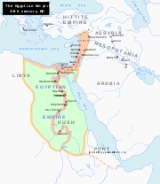
, at the second cataract. This indicates that he already fought a campaign in Syria; hence, his Syrian campaign may be placed at the beginning of his second regnal year. This second campaign was the farthest north any Egyptian ruler had ever campaigned. Although it has not been found in modern times, he apparently set up a stele when he crossed the Euphrates River. During this campaign, the Syrian princes declared allegiance to Thutmose. However, after he returned, they discontinued tribute and began fortifying against future incursions. Thutmose celebrated his victories with an elephant hunt in the area of Niy
Niya (kingdom)

Niya, Niye, and also Niy of Thutmose I's Ancient Egypt, also Nii of the Amarna letters, and Nihe, etc. was a kingdom in Syria, or northern Syria....
, near Apamea in Syria, and returned to Egypt with strange tales of the Euphrates, "that inverted water which flows upstream when it ought to be flowing downstream." The Euphrates was the first major river which the Egyptians had ever encountered which flowed from the north, which was downstream on the Nile, to the south, which was upstream on the Nile. Thus the river became known in Egypt as simply, "inverted water."

Thutmose had to face one more military threat, another rebellion by Nubia in his fourth year. His influence accordingly expanded even farther south, as an inscription dated to his reign has been found as far south as Kurgus, which was south of the fourth cataract. During his reign, he initiated a number of projects which effectively ended Nubian independence for the next 500 years. He enlarged a temple to Sesostris III and Khnum, opposite the Nile from Semna. There are also records of specific religious rites which the viceroy of El-Kab was to have performed in the temples in Nubia in proxy for the king. He also appointed a man called Turi to the position of viceroy of Cush, also known as the "King's Son of Cush." With a civilian representative of the king permanently established in Nubia itself, Nubia did not dare to revolt as often as it had and was easily controlled by future Egyptian kings.

Building projects

Stela of Tuthmosis I
Thutmose I organized great building projects during his reign, including many temples and tombs, but his greatest projects were at the Temple of Karnak under the supervision of the architect Ineni
Ineni

Ineni was an History of Ancient Egypt architect and government official of the Eighteenth dynasty of Egypt, responsible for major construction projects under the pharaohs Amenhotep I, Thutmose I of Egypt, Thutmose II of Egypt and the joint reigns of Hatshepsut of Egypt and Thutmose III of Egypt....
.. Previous to Thutmose, Karnak probably consisted only of a long road to a central platform, with a number of shrines for the solar bark along the side of the road. Thutmose was the first king to drastically enlarge the temple. Thutmose had the fifth pylon built along the temple's main road, along with a wall to run around the inner sanctuary and two flagpoles to flank the gateway. Outside of this, he built a fourth pylon and another enclosure wall. Between pylons four and five, he had a hypostyle hall constructed, with columns made of cedar
Cedar

Cedar is a genus of coniferous trees in the plant family Pinaceae. They are most closely related to the Firs , sharing a very similar cone structure....
 wood. This type of structure was common in ancient Egyptian temples, and supposedly represents a papyrus marsh, an Egyptian symbol of creation. Along the edge of this room he built colossal statues, each one alternating wearing the crown of Upper Egypt and the crown of Lower Egypt. Finally, outside of the fourth pylon, he erected four more flagpoles and two obelisks, although one of them, which now has fallen, was not inscribed until Thutmose III
Thutmose III

Thutmose III was the sixth Pharaoh of the Eighteenth dynasty of Egypt. During the first twenty-two years of Thutmose's reign he was co-regent with his aunt, Hatshepsut, who was named the pharaoh....
 inscribed it about 50 years later. The cedar columns in Thutmose I's hypostyle hall were replaced with stone columns by Thutmose III, however at least the northernmost two were replaced by Thutmose I himself. Hatshepsut also erected two of her own obelisks inside of Thutmose I's hypostyle hall.

In addition to Karnak, Thutmose I also built statues of the Ennead
Ennead

Ennead , an ancient Greek translation of the Egyptian word, Pesedjet, consists of a grouping of nine deity, most often appearing in the context of Egyptian mythology....
 at Abydos
Abydos, Egypt

Abydos , one of the most ancient cities of Upper and Lower Egypt, is about 11 km west of the Nile at latitude 26? 10' N. The Egyptian name of both the eighth Nome of Upper Egypt and its capital city was Abdju, technically, 3bdw as in the hieroglyphs shown to the right, the hill of the symbol or reliquary, in which...
, buildings at Armant, Ombos, el-Hiba, Memphis, and Edfu, as well as minor expansions to buildings in Nubia, at Semna, Buhen, Aniba, and Quban.

Thutmose I was the first king who definitely was buried in the Valley of the Kings
Valley of the Kings

The Valley of the Kings is a valley in Egypt where, for a period of nearly 500 years from the 16th century BC to 11th century BC, tombs were constructed for the Pharaoh and powerful nobles of the Conventional Egyptian chronology#New Kingdom ....
. Ineni was commissioned to dig this tomb, and presumably to build his mortuary temple. His mortuary temple has not been found, quite possibly because it was incorporated into or demolished by the construction of Hatshepsut's mortuary temple at Deir el-Bahri
Deir el-Bahri

Deir el-Bahri is a complex of mortuary temples and tombs located on the west bank of the Nile, opposite the city of Luxor, Egypt.In 1997, 58 tourists and 4 Egyptians were massacred here by Islamic terrorists from Al-Gama'a al-Islamiyya in what has become to be known as The 'Luxor massacre'....
. His tomb, however, has been identified as KV32
KV32

Tomb KV32, located in the Valley of the Kings in Egypt, is the burial site of Tiaa, wife of Amenhotep II, the wife of Amenhotep II and mother of Thutmose IV....
. In it was found a yellow quartzite sarcophagus bearing the name of Thutmose I. His body, however, may have been moved by Thutmose III into the tomb of Hatshepsut, KV20
KV20

KV20 is a tomb in the Valley of the Kings . It was probably the first royal tomb to be constructed in the valley. KV20 was the original burial place of Thutmose I and was later adapted by his daughter Hatshepsut to accommodate both herself and her father....
, which also contains a sarcophagus with the name of Thutmose I on it.

Death & Burial

Thutmose I was originally buried and then reburied in KV20
KV20

KV20 is a tomb in the Valley of the Kings . It was probably the first royal tomb to be constructed in the valley. KV20 was the original burial place of Thutmose I and was later adapted by his daughter Hatshepsut to accommodate both herself and her father....
 in a double burial with his daughter Hatshepsut rather than KV38
KV38

Tomb KV38, located in the Valley of the Kings in Egypt, was used for the burial of Pharaoh Thutmose I of the Eighteenth dynasty of Egypt, and was where his body was removed to by Thutmose III....
 which could only have been built for Thutmose I during the reign of his grandson Tuthmose III based on "a recent re-examination of the architecture and contents of KV38." The location of KV20, if not its original owner, had long been known since the Napoleonic expedition of 1799 and, in 1844, the Prussian scholar Karl Richard Lepsius
Karl Richard Lepsius

Karl Richard Lepsius was a pioneering Prussian Egyptologist and linguistics and pioneer of modern archaeology....
 had partially explored its upper passage. However, all its passageways "had become blocked by a solidified mass of rubble, small stones and rubbish which had been carried into the tomb by floodwaters" and it was not until the 1903-1904 excavation season that Howard Carter
Howard Carter

Howard Carter may refer to:* Howard Carter , English archaeologist who discovered Tutankhamun's tomb* Howard O'Neal Carter , American basketball player...
, after 2 previous seasons of strenuous work, was able to clear its corridors and enter its double burial chamber. Here, among the debris of broken pottery and shattered stone vessels from the burial chamber and lower passages were the remnants of two vases made for Queen Ahmose Nefertari which formed part of the original funerary equipment of Thutmose I; one of the vases contained a secondary inscription which states that Thutmose II "[made it] as his monument to his father." Other vessels which bore the names and titles of Thutmose I had also been inscribed by his son and successor, Thutmose II, as well as fragments of stone vessels made for Hatshepsut before she herself became king as well as other vessels which bore her royal name of 'Maatkare' which would have been made only after she took the throne in her own right.

Carter, however, also discovered 2 separate coffins in the burial chamber. The beautifully carved sarcophagus of Hatshepsut "was discovered open with no sign of a body, and with the lid lying discarded on the floor;" it is now housed in the Cairo Museum along with a matching yellow quartzite canopic chest. A second sarcophagus, was found lying on its side with its almost undamaged lid propped against the wall nearby; it was eventually presented to Theodore M. Davis
Theodore M. Davis

Theodore M. Davis was an United States lawyer and is best known for his excavations in Egypt's Valley of the Kings between 1902 and 1914....
, the excavation's financial sponsor as a gesture of appreciation for his generous financial support. Davis would, in turn, present it to the Museum of Fine Arts
Museum of Fine Arts, Boston

The Museum of Fine Arts in Boston, Massachusetts, Massachusetts, is one of the largest museums in the United States attracting over one million visitors a year....
 in Boston. The second quartzite sarcophagus had originally been engraved with the name of "the King of Upper and Lower Egypt, Maatkare Hatchepsut." However, when the sarcophagus was complete, Hatshepsut decided to commission an entirely new sarcophagus for herself while she donated the existing finished sarcophagus to her father, Thutmose I. The stonemasons then attempted to erase the original carvings by restoring the surface of the quartzite so that it could be re-carved with the name and titles of Tuthmose I instead. This quartzite sarcophagus measures 7 feet long by 3 feet wide with walls 5 inches thick and bears a dedication text which records Hatshepsut's generosity towards her father:

Tuthmose I was, however, not destined to lie alongside his daughter after Hatshepsut's death. Thutmose III, Hatshepsut's successor, decided to reinter his grandfather in an even more magnificient tomb, KV38
KV38

Tomb KV38, located in the Valley of the Kings in Egypt, was used for the burial of Pharaoh Thutmose I of the Eighteenth dynasty of Egypt, and was where his body was removed to by Thutmose III....
, which featured another yellow sarcophagus dedicated to Thutmose I and inscribed with texts which proclaimed this pharaoh's love for his deceased grandfather. Unfortunately, however, Thutmose I's remains would be disturbed late during the 20th dynasty when KV38
KV38

Tomb KV38, located in the Valley of the Kings in Egypt, was used for the burial of Pharaoh Thutmose I of the Eighteenth dynasty of Egypt, and was where his body was removed to by Thutmose III....
 was plundered; the sarcophagus' lid was broken and all this king's valuable precious jewellry and grave goods were stolen.

Thutmose I's mummy was ultimately discovered in the Deir el-Bahri
Deir el-Bahri

Deir el-Bahri is a complex of mortuary temples and tombs located on the west bank of the Nile, opposite the city of Luxor, Egypt.In 1997, 58 tourists and 4 Egyptians were massacred here by Islamic terrorists from Al-Gama'a al-Islamiyya in what has become to be known as The 'Luxor massacre'....
 Cache
DB320

Tomb DB320 is located next to Deir el-Bahri, in the Theban Necropolis, opposite modern Luxor contained an extraordinary cache of mummified remains and funeral equipment of more than 50 kings, queens, royals and various nobility....
 above the Mortuary Temple of Hatshepsut
Mortuary temple

Mortuary temples were temples constructed adjacent to, or in the vicinity of, royal tombs in the Middle Kingdom of Egypt and New Kingdom periods of Ancient Egypt....
, revealed in 1881. He had been interred along with those of other 18th and 19th dynasty leaders Ahmose I
Ahmose I

Ahmose I was a pharaoh of ancient Egypt and the founder of the Eighteenth dynasty of Egypt. He was a member of the Thebes, Egypt royal house, the son of pharaoh Tao II the Brave and brother of the last pharaoh of the Seventeenth dynasty of Egypt, King Kamose....
, Amenhotep I
Amenhotep I

Amenhotep I was the second Pharaoh of the Eighteenth dynasty of Egypt of History of Ancient Egypt. His reign is Amenhotep I#Dates and length of reign....
, Thutmose II
Thutmose II

Thutmose II was the fourth Pharaoh of the Eighteenth dynasty of Egypt. He built some minor monuments and initiated at least two minor campaigns but did little else during his rule and was probably strongly influenced by his wife, Hatshepsut....
, Thutmose III
Thutmose III

Thutmose III was the sixth Pharaoh of the Eighteenth dynasty of Egypt. During the first twenty-two years of Thutmose's reign he was co-regent with his aunt, Hatshepsut, who was named the pharaoh....
, Ramesses I
Ramesses I

Menpehtyre Ramesses I was the founding Pharaoh of Ancient Egypt's Nineteenth dynasty of Egypt. The dates for his short reign are not completely known but the time-line of late 1290s BC is frequently cited as well as 1290s BC....
, Seti I
Seti I

Menmaatre Seti I was a Pharaoh of Ancient Egypt , the son of Ramesses I and Queen Sitre, and the father of Ramesses II. As with all dates in Ancient Egypt, the actual dates of his reign are unclear, and various historians claim different dates, with 1294 BC – 1279 BC and 1290 BC to 1279 BC being the most commonly used by scholars today...
, Ramesses II
Ramesses II

Ramesses II was the third Egyptian pharaoh of the Nineteenth dynasty of Egypt. He is often regarded as Ancient Egypt's greatest, most celebrated, and most powerful pharaoh....
, and Ramesses IX
Ramesses IX

Ramesses IX...
, as well as the 21st dynasty pharaohs Pinedjem I
Pinedjem I

Pinedjem I was the High Priests of Amun at Thebes in Ancient Egypt from 1070 BC to 1032 BC and the de facto ruler of the south of the country from 1054 BC....
, Pinedjem II
Pinedjem II

Pinedjem II was a High Priests of Amun at Thebes in Ancient Egypt from 990 BC to 969 BC and was the de facto ruler of the south of the country....
, and Siamun
Siamun

Neterkheperre or Netjerkheperre-setepenamun Siamun was the sixth pharaoh of Ancient Egypt during the Twenty-first dynasty of Egypt. He built extensively in Lower Egypt for a king of the Third Intermediate Period and is regarded as one of the most powerful rulers of this Dynasty after Psusennes I....
.

The original coffin of Thutmose I was taken over and re-used by a later pharaoh of the 21st dynasty. The mummy of Thutmose I was thought to be lost, but Egyptologist Gaston Maspero
Gaston Maspero

Gaston Camille Charles Maspero was a France Egyptologist....
, largely on the strength of familial resemblance to the mummies of Thutmose II and Thutmose III, believed he had found his mummy in the otherwise unlabelled mummy #5283. This identification has been supported by subsequent examinations, revealing that the embalming techniques used came from the appropriate period of time, almost certainly after that of Ahmose I and made during the course of the Eighteenth dynasty.

Gaston Maspero described the mummy in the following manner:
The king was already advanced in age at the time of his death, being over fifty years old, to judge by the incisor teeth, which are worn and corroded by the impurities of which the Egyptian bread was full. The body, though small and emaciated, shows evidence of unusual muscular strength; the head is bald, the features are refined, and the mouth still bears an expression characteristic of shrewdness and cunning.


What has been thought to be his mummy can be viewed in the Egyptian Museum
Egyptian Museum

The Museum of Egyptian Antiquities, known commonly as the Egyptian Museums, in Cairo, Egypt, is home to the most extensive collection of ancient Egyptian antiquities in the world....
 in Cairo. However, in 2007, Dr. Zahi Hawass
Zahi Hawass

Zahi Hawass is an Egyptians archaeology and List of Egyptologists and the current Secretary General of the Egyptian Supreme Council of Antiquities....
 announced that the mummy which was previously thought to be Thutmose I [is] that of a thirty year old man who had died as a result of an arrow wound to the chest. Because of the young age of the mummy and the cause of death, it was determined that the mummy was probably not that of King Thutmose I himself.

See also

  • History of Ancient Egypt
    History of Ancient Egypt

    The History of ancient Egypt spans the period from the early Predynastic Egypt settlements of the northern Nile Valley to the History of Roman Egypt in 30 BC....
  • Eighteenth dynasty of Egypt Family Tree


Bibliography