
All Topics  
Amenhotep I

 
Amenhotep I

   Email Print
   Bookmark   Link


Amenhotep I


Amenhotep I (sometimes read as Amenophis I and meaning "Amun
Amun

Amun, reconstructed Egyptian language Yamanu , was the name of a deity in Egyptian mythology who gradually rose from being an abstract concept to the patron deity of Thebes, Egypt and one of the most important deities in Ancient Egypt before fading into obscurity....
 is satisfied") was the second Pharaoh
Pharaoh

Pharaoh is a title used in many modern discussions of the ancient Egyptian rulers of all periods. In antiquity this title began to be used for the ruler who was the religious and political leader of united ancient Egypt, only during the New Kingdom, specifically, during the middle of the Eighteenth dynasty of Egypt....
 of the 18th dynasty
Eighteenth dynasty of Egypt

The Eighteenth Dynasty is perhaps the best known of all the dynasties of ancient Egypt. As well as a number of Egypt's most powerful pharaohs, it included Tutankhamun, whose tomb, uncovered by Howard Carter in 1922, was one of the greatest of all archaeological discoveries, being completely undisturbed by tomb robbers....
 of Egypt
History of Ancient Egypt

The History of ancient Egypt spans the period from the early Predynastic Egypt settlements of the northern Nile Valley to the History of Roman Egypt in 30 BC....
. His reign is generally dated from 1526 to 1506 BC. He was born to Ahmose I
Ahmose I

Ahmose I was a pharaoh of ancient Egypt and the founder of the Eighteenth dynasty of Egypt. He was a member of the Thebes, Egypt royal house, the son of pharaoh Tao II the Brave and brother of the last pharaoh of the Seventeenth dynasty of Egypt, King Kamose....
 and Ahmose-Nefertari
Ahmose-Nefertari

Ahmose-Nefertari of Ancient Egypt was the royal sister and the Great Royal Wife of pharaoh, Ahmose I. Upon the death of Ahmose I, their heir, Kamose, became pharaoh, but was killed in war....
, but had at least two elder brothers, Ahmose-ankh
Ahmose-ankh

Ahmose-ankh was a prince during the early Eighteenth dynasty of Egypt. He was the son of Pharaoh Ahmose I and Queen Ahmose Nefertari. He was the crown prince but pre-deceased his father, thus the next pharaoh was his younger brother Amenhotep I....
 and Ahmose Sapair
Ahmose Sapair

Ahmose Sapair was a crown prince of the early 18th Dynasty of Ancient Egypt. He was probably the child of Ahmose I, however he preceded his father in death and his brother Amenhotep I took the throne instead....
, and was not expected to inherit the throne
Enthronement

An enthronement is a ceremony of inauguration, sitting for the first time on a throne. The throne is seen as a symbol of authority, both secular and religious....
. However, sometime in the eight years between Ahmose I's 17th regnal year
Regnal year

A regnal year is a year of the reign of a monarch. From Latin regnum meaning kingdom, rule.The oldest dating systems were in regnal years, and considered the date as an ordinal number, not a cardinal number....
 and his death, his heir apparent
Heir apparent

An heir apparent is an heir who cannot be displaced from inheriting; the term is used in contrast to heir presumptive, the term for a conditional heir who is currently in line to inherit but could be displaced at any time in the future....
 died and Amenhotep became crown prince
Crown Prince

A Crown Prince or Crown Princess is the heir apparent to the throne in a royal or imperial monarchy. The wife of a crown prince is also titled crown princess....
.


Discussion
Ask a question about 'Amenhotep I'
Start a new discussion about 'Amenhotep I'
Answer questions from other users
Full Discussion Forum


Encyclopedia


Amenhotep I (sometimes read as Amenophis I and meaning "Amun
Amun

Amun, reconstructed Egyptian language Yamanu , was the name of a deity in Egyptian mythology who gradually rose from being an abstract concept to the patron deity of Thebes, Egypt and one of the most important deities in Ancient Egypt before fading into obscurity....
 is satisfied") was the second Pharaoh
Pharaoh

Pharaoh is a title used in many modern discussions of the ancient Egyptian rulers of all periods. In antiquity this title began to be used for the ruler who was the religious and political leader of united ancient Egypt, only during the New Kingdom, specifically, during the middle of the Eighteenth dynasty of Egypt....
 of the 18th dynasty
Eighteenth dynasty of Egypt

The Eighteenth Dynasty is perhaps the best known of all the dynasties of ancient Egypt. As well as a number of Egypt's most powerful pharaohs, it included Tutankhamun, whose tomb, uncovered by Howard Carter in 1922, was one of the greatest of all archaeological discoveries, being completely undisturbed by tomb robbers....
 of Egypt
History of Ancient Egypt

The History of ancient Egypt spans the period from the early Predynastic Egypt settlements of the northern Nile Valley to the History of Roman Egypt in 30 BC....
. His reign is generally dated from 1526 to 1506 BC. He was born to Ahmose I
Ahmose I

Ahmose I was a pharaoh of ancient Egypt and the founder of the Eighteenth dynasty of Egypt. He was a member of the Thebes, Egypt royal house, the son of pharaoh Tao II the Brave and brother of the last pharaoh of the Seventeenth dynasty of Egypt, King Kamose....
 and Ahmose-Nefertari
Ahmose-Nefertari

Ahmose-Nefertari of Ancient Egypt was the royal sister and the Great Royal Wife of pharaoh, Ahmose I. Upon the death of Ahmose I, their heir, Kamose, became pharaoh, but was killed in war....
, but had at least two elder brothers, Ahmose-ankh
Ahmose-ankh

Ahmose-ankh was a prince during the early Eighteenth dynasty of Egypt. He was the son of Pharaoh Ahmose I and Queen Ahmose Nefertari. He was the crown prince but pre-deceased his father, thus the next pharaoh was his younger brother Amenhotep I....
 and Ahmose Sapair
Ahmose Sapair

Ahmose Sapair was a crown prince of the early 18th Dynasty of Ancient Egypt. He was probably the child of Ahmose I, however he preceded his father in death and his brother Amenhotep I took the throne instead....
, and was not expected to inherit the throne
Enthronement

An enthronement is a ceremony of inauguration, sitting for the first time on a throne. The throne is seen as a symbol of authority, both secular and religious....
. However, sometime in the eight years between Ahmose I's 17th regnal year
Regnal year

A regnal year is a year of the reign of a monarch. From Latin regnum meaning kingdom, rule.The oldest dating systems were in regnal years, and considered the date as an ordinal number, not a cardinal number....
 and his death, his heir apparent
Heir apparent

An heir apparent is an heir who cannot be displaced from inheriting; the term is used in contrast to heir presumptive, the term for a conditional heir who is currently in line to inherit but could be displaced at any time in the future....
 died and Amenhotep became crown prince
Crown Prince

A Crown Prince or Crown Princess is the heir apparent to the throne in a royal or imperial monarchy. The wife of a crown prince is also titled crown princess....
. He then acceded to the throne and ruled for about 21 years.

Although his reign is poorly documented, it is possible to piece together a basic history from available evidence. He inherited the kingdom formed by his father's military conquests and maintained dominance over Nubia
Nubia

Nubia is a region in Southern Egypt along the Nile and in what is now northern Sudan. Most of Nubia is situated in Sudan with about a quarter of its territory in Egypt....
 and the Nile Delta
Nile Delta

The Nile Delta is the River delta formed in Northern Egypt where the Nile River spreads out and drains into the Mediterranean Sea. It is one of the world's largest river deltas?from Alexandria in the west to Port Said in the east, it covers some 240 km of Mediterranean coastline?and is a rich agricultural region....
, but probably did not attempt to keep power in Syrio-Palestine
Levant

The Levant describes, traditionally, the Eastern Mediterranean at large, but can be used as a geographical term that denotes a large area in Western Asia formed by the lands bordering the Eastern shores of the Mediterranean, roughly bounded on the north by the Taurus Mountains, on the south by the Arabian Desert, and on the west by the M...
. He continued to rebuild temples in Upper Egypt
Upper Egypt

File:Ancient Egypt map-en.svgUpper Egypt is a narrow strip of land that extends from the Cataracts of the Nile section of Upper Egypt, between El-Ayait and Asyut is sometimes known as Middle Egypt....
, and revolutionized mortuary complex design by separating his tomb from his mortuary temple
Mortuary temple

Mortuary temples were temples constructed adjacent to, or in the vicinity of, royal tombs in the Middle Kingdom of Egypt and New Kingdom periods of Ancient Egypt....
, setting a trend which would persist throughout the New Kingdom
New Kingdom

The New Kingdom, sometimes referred to as the Egyptian Empire, is the period in ancient Egyptian History of Ancient Egypt between the 16th century BC and the 11th century BC, covering the Eighteenth dynasty of Egypt, Nineteenth dynasty of Egypt, and Twentieth dynasty of Egypt....
. After his death, he was deified
Deity

A deity is a postulated preternatural or supernatural immortal being, who may be thought of as holy, divinity, or sacred, held in high regard, and respected by human beings....
 into the patron god of Deir el-Medina
Deir al-Madinah

Deir el-Madinah is an ancient Egyptian village which was home to the artisans who built the temples and tombs ordered by the Pharaohs and other dignitaries in the Valley of the Kings during the New Kingdom period ...
.

Family

Amenhotep I was the son of Ahmose I
Ahmose I

Ahmose I was a pharaoh of ancient Egypt and the founder of the Eighteenth dynasty of Egypt. He was a member of the Thebes, Egypt royal house, the son of pharaoh Tao II the Brave and brother of the last pharaoh of the Seventeenth dynasty of Egypt, King Kamose....
 and Ahmose-Nefertari
Ahmose-Nefertari

Ahmose-Nefertari of Ancient Egypt was the royal sister and the Great Royal Wife of pharaoh, Ahmose I. Upon the death of Ahmose I, their heir, Kamose, became pharaoh, but was killed in war....
. His elder brothers, the crown prince Ahmose Sapair
Ahmose Sapair

Ahmose Sapair was a crown prince of the early 18th Dynasty of Ancient Egypt. He was probably the child of Ahmose I, however he preceded his father in death and his brother Amenhotep I took the throne instead....
 and Ahmose-ankh
Ahmose-ankh

Ahmose-ankh was a prince during the early Eighteenth dynasty of Egypt. He was the son of Pharaoh Ahmose I and Queen Ahmose Nefertari. He was the crown prince but pre-deceased his father, thus the next pharaoh was his younger brother Amenhotep I....
, died before him, thus clearing the way for his ascension to the throne. Amenhotep probably came to power while he was still young himself, and his mother, Ahmose-Nefertari, appears to have been regent for him for at least a short time. This is evidenced because both he and his mother are credited with opening a worker village at the site of Deir el-Medina. Amenhotep took his sister Ahmose-Meritamon
Ahmose-Meritamon

Ahmose-Meritamun was the royal daughter of Ahmose I and Ahmose Nefertari, and became the Great Royal Wife of her brother Amenhotep I, pharaoh of Ancient Egypt in the Eighteenth dynasty of Egypt....
 as his Great Royal Wife
Great Royal Wife

File:Ah hotep.jpgGreat Royal Wife or Chief King's Wife is the term used to refer to the chief wife of a male pharaoh of Ancient Egypt on the day of his coronation, as her status in the royal lineage was essential to gaining the position of pharaoh....
. Another wife's name, Sitkamose, is attested on a nineteenth dynasty stele
Stele

A stele is a stone or wooden slab, generally taller than it is wide, erected for funerals or commemorative purposes, most usually decorated with the names and titles of the deceased or living ? inscribed, carved in relief , or painted onto the slab....
.

Beyond this, his relation to all other possible family members has been questioned. Ahhotep II
Ahhotep II

Ahhotep II was believed to have been the wife of Kamose.References...
 is usually called his wife and sister, despite an alternate theory that she was his grandmother. He is thought to have had one son by Ahhotep II, Amenemhat, who died while still very young. This remains the consensus, although there are arguments against that relationship as well. With no living heirs, Amenhotep was succeeded by Thutmose I
Thutmose I

Thutmose I was the third Pharaoh of the Eighteenth dynasty of Egypt of History of Ancient Egypt. He was given the throne after the death of the previous king Amenhotep I....
, whom he married to his sister, Aahmes, although once again there is no definite proof that the two were related. Since Aahmes is never called "King's Daughter" in any inscription, some scholars doubt this relation as well.

Dates and length of reign

In the ninth year of Amenhotep I, a heliacal rise of Sothis
Sothic cycle

The Sothic cycle or Canicular period is a period of 1461 ancient Egyptian years or 1460 Julian calendar years . During a Sothic cycle, the 365-day year loses enough time that the start of the year once again coincides with the heliacal rising of the star Sirius ....
 was observed on the ninth day of the third month of summer. Modern astronomers have calculated that, if the observation was made from Memphis
Memphis, Egypt

Memphis was the ancient capital of the first Nome of Lower Egypt, and of the Old Kingdom of Egypt from its foundation until around 2200 BC and later for shorter periods during the New Kingdom, and an administrative centre throughout ancient history....
 or Heliopolis
Heliopolis (ancient)

Heliopolis , meaning sun-city, was one of the most ancient cities of Egypt, and capital of the 13th Lower Egyptian Nome . Its name also refers to an unrelated Heliopolis of Cairo, also known as ??? ???????, Masr al-gidedah ....
, such an observation could only have been made on that day in 1537 BC. If the observation was made in Thebes
Thebes, Egypt

Thebes was a city in Ancient Egypt located about 800 km south of the Mediterranean, on the east bank of the river Nile . It was the capital of Waset, the fourth Upper Egyptian Nome ....
, however, it could only have taken place in 1517. The latter choice is usually accepted as correct since Thebes was the capital of early 18th dynasty Egypt; hence, Amenhotep I is given an accession date in 1526 BC, although the possibility of 1546 BC is not entirely dismissed.

Manetho
Manetho

Manetho was an Egyptian historian and priest from Sebennytos who lived during the Ptolemaic dynasty, ca. 3rd century BC. Manetho wrote the Aegyptiaca ....
's Epitome states that Amenhotep I ruled Egypt for 20 Years and 7 Months or 21 Years, depending on the source
Manetho

Manetho was an Egyptian historian and priest from Sebennytos who lived during the Ptolemaic dynasty, ca. 3rd century BC. Manetho wrote the Aegyptiaca ....
. While Amenhotep I's highest attested official date is only his Year 10, Manetho's data is confirmed by information from a passage in the tomb autobiography of a Magician named Amenemhet. This individual explicitly states that he served under Amenhotep I for 21 Years. Thus, in the high chronology, Amenhotep I is given a reign from around 1546 to 1526 BC and, in the low chronology, from around 1526 to 1506 BC or 1525 to 1504 BC, though individual scholars may vary by a few years.

Foreign policy

Amenhotep I's Horus and Two Ladies names, "Bull who conquers the lands" and "He who inspires great terror," are generally interpreted to mean that Amenhotep I intended upon dominating the surrounding nations. Two tomb texts indicate that he led campaigns into Nubia. According to the tomb texts of Ahmose, son of Ebana
Ahmose, son of Ebana

Ahmose, son of Ebana served in the History of Ancient Egypt military under the pharaohs Tao II the Brave, Ahmose I, Amenhotep I, and Thutmose I of Egypt....
, Amenhotep later sought to expand Egypt's border southward into Nubia and he led an invasion force which defeated the Nubian army. The tomb biography of Ahmose Pen-Nekhebet
Ahmose Pen-Nekhebet

Ahmose Pen Nekhbet was an ancient Egyptian official who started his career under Ahmose I and served all the pharaohs until Thutmose III. His autobiographical inscriptions are important for the understanding of the history of the early New Kingdom, though less detailed than those of his contemporary Ahmose, son of Ebana....
 says he also fought in a campaign in Kush, however it is quite possible that it refers to the same campaign as Ahmose, son of Ebana. Amenhotep built a temple at Saļ
Saļ (island)

Sa? is a large island in the Nile River in Nubia between the second and third Cataracts of the Nile. It is 12 km long and 5.5 km wide. Sa? was intermittently occupied by the Ancient Egypt during the New Kingdom....
, showing that he had established Egyptian settlements almost as far as the third cataract.

A single reference in the tomb of Ahmose Pen-Nekhebet indicates another campaign in Iamu in the land of Kehek. Unfortunately, the location of Kehek is unknown. It was long believed that Kehek was a reference to the Libyan
History of Libya

The history of Libya includes the history of its rich mix of people added to the indigenous Berber people tribes. For most of their history, the people of Libya have been subjected to varying degrees of foreign control....
 tribe, Qeheq, and thus it was postulated that invaders from Libya
Libya

Libya , officially the Great Socialist People's Libyan Arab Jamahiriya , is a country located in North Africa. Bordering the Mediterranean Sea to the north, Libya lies between Egypt to the east, Sudan to the southeast, Chad and Niger to the south, and Algeria and Tunisia to the west....
 took advantage of the death of Ahmose to move into the western Nile Delta. Unfortunately for this theory, the Qeheq people only appeared in later times, and Kehek's identity remains unknown. Nubia is a possibility, since Amenhotep did campaign there, and the western desert and the oases have also been suggested, since these seem to have fallen under Egyptian control once again.

Egypt had lost the western desert and the oases during the second intermediate period, and during the revolt against the Hyksos
Hyksos

The Hyksos were an Asiatic people who invaded the eastern Nile Delta, in the Twelfth dynasty of Egypt initiating the Second Intermediate Period of Ancient Egypt....
, Kamose
Kamose

Kamose was the last king of the Thebes, Egypt Seventeenth dynasty of Egypt. He was probably the son of Tao II the Brave and Ahhotep I and the full brother of Ahmose I, founder of the Eighteenth dynasty of Egypt....
 thought it necessary to garrison them. It is uncertain when they were fully retaken, but on one stele, the title "Prince-Governor
Haty-a

?aty-a was an ancient Egyptian rank and title given to local princes, mayors, or governors. There is no standard translation for it, and it is frequently left transliterated in scholarly literature....
 of the oases" was used, which means that Amenhotep's reign forms the terminus ante quem
Terminus post quem

Terminus post quem and the related terminus ante quem are terms used to give an approximate date for a text. Terminus post quem is used to indicate the earliest point in time when the text may have been written, while Terminus ante quem signifies the latest date at which a text may have been written....
 for the return of Egyptian rule.

There are no recorded campaigns in Syrio-Palestine during Amenhotep I's reign. However, according to the Tombos Stela
Tombos Stela

The Tombos Stele is an stele erected by Thutmose I upon his conquest of Nubia as far as the third cataract in his second regnal year. According to the stele, after this campaign, Thutmose's empire theoretically reached from Tombos in the south to the Euphrates in the north....
 of his successor, Thutmose I, when Thutmose led a campaign into Asia all the way to the Euphrates, he found no one who fought against him. If Thutmose did not lead a campaign which has not been recorded into Asia before this recorded one, it would mean that the preceding pharaoh would have had to pacify Syria instead, which would indicate a possible Asiatic campaign of Amenhotep I. Two references to the Levant potentially written during his reign might be contemporary witnesses to such a campaign. One of the candidates for Amenhotep's tomb contains a reference to Qedmi, which is somewhere in Canaan
Canaan

Canaan is an ancient term for a region encompassing modern-day Israel and Lebanon, the Palestinian Territories, plus adjoining coastal lands and parts of Jordan, Syria and northeastern Egypt....
 or the Transjordan
Transjordan

The Emirate of Transjordan was a former Ottoman Empire territory incorporated into the British Mandate of Palestine in 1921 as an autonomous political division under Abdullah I of Jordan....
, and Amenemhet's tomb contains a hostile reference to Mitanni
Mitanni

Mitanni or Hanigalbat was a loosely organized Hurrian-speaking Hittite vassal state in northern Syria from ca. 1500 BC-1300 BC."The Assyrians called the lands of Mitanni Hanigalbat while to the Hittites it was the land of the Hurrians....
. However, neither of these references necessarily refer to campaigning, nor do they even necessarily date to Amenhotep's reign. The location of Amenhotep's tomb is not certain, and Amenemhet lived to serve under multiple kings who are known to have attacked Mitanni. Records from Amenhotep's reign are simply altogether too scant and too vague to reach a conclusion about any Syrian campaign.

Cultural and intellectual developments

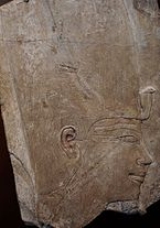
Amenhotep I
Large numbers of statues of Amenhotep have been found, but they are mostly from the Ramessid period, made for his posthumous funerary cult. This makes study of the art of his reign difficult. Based upon his few authentic statues, it appears that Amenhotep continued the practice of copying Middle Kingdom styles. Art in the early 18th dynasty was particularly similar to that of the early Middle Kingdom, and the statues produced by Amenhotep I clearly copied those of Mentuhotep II
Mentuhotep II

Nebhepetre Mentuhotep II was a Pharaoh of the Eleventh dynasty of Egypt, the son of Intef III of Egypt and a minor queen called Iah. His own wife was the 'king's mother' Tem....
 and Senusret I
Senusret I

Senusret I was the second pharaoh of the Twelfth dynasty of Egypt of Ancient Egypt. He ruled from 1971 BC to 1926 BC, and was one of the most powerful kings of this Dynasty....
. The two types are so similar that modern Egyptologists have had trouble telling the two apart.

It was probably Amenhotep I who opened the artisan's village at Deir el-Medina which was responsible for all the art which filled the tombs in Thebes' necropolis for the following generations of New Kingdom rulers and nobles. The earliest name found there is that of Thutmose I
Thutmose I

Thutmose I was the third Pharaoh of the Eighteenth dynasty of Egypt of History of Ancient Egypt. He was given the throne after the death of the previous king Amenhotep I....
, however Amenhotep was clearly an important figure to the city's workmen since he and his mother were both its patron deities.

Two important pieces of literature were developed during this period. First, the Book of What is in the Underworld
Amduat

The Amduat is an important Ancient Egyptian funerary text of the New Kingdom. Like many funerary texts, it was written on the inside of the tomb for reference by the deceased....
, an important funerary text used in the New Kingdom, is believed to have come into its final form during Amenhotep's reign, since it first appears in the tomb of Thutmose I. The Ebers papyrus
Ebers papyrus

The Ebers Papyrus of about 16th century BC is among the most important medical papyri of ancient Egypt. It is also commonly called Papyrus Ebers ....
, which is the main source for information on ancient Egyptian medicine, seems to date to this time (the mention of the Heliacal rise of Sothis by which the early New Kingdom chronology is usually calculated was found on the back of this document).

It appears that during Amenhotep I's reign the first water clock
Water clock

A water clock or clepsydra is any timekeeper operated by means of a regulated flow of liquid into or out from a vessel where the amount is then measured....
 was invented. Amenhotep's court astronomer Amenemheb took credit for creating this device in his tomb biography, although the oldest surviving mechanism dates to the reign of Amenhotep III
Amenhotep III

Amenhotep III was the ninth pharaoh of the Eighteenth dynasty of Egypt. According to different authors, he ruled Egypt from June 1391 BC-December 1353 BC or June 1388 BC to December 1351 BC/1350 BC after his father Thutmose IV died....
. This invention was of great benefit for timekeeping, because the Egyptian hour was not a fixed amount of time, but was measured as 1/12th of the night. When the nights were shorter in the summer, these waterclocks could be adjusted to measure the shorter hours accurately.

Building projects

Amenhotep's building projects have been mostly obliterated by later construction projects, so it is difficult to appraise the scope of his building program. From written sources it is known that he commissioned the architect Ineni
Ineni

Ineni was an History of Ancient Egypt architect and government official of the Eighteenth dynasty of Egypt, responsible for major construction projects under the pharaohs Amenhotep I, Thutmose I of Egypt, Thutmose II of Egypt and the joint reigns of Hatshepsut of Egypt and Thutmose III of Egypt....
 to expand the Temple of Karnak. Ineni's tomb biography indicates that he created a 20 cubit gate of limestone on the south side of Karnak. He constructed a sacred barque chapel of Amun out of alabaster and a copy of the White Chapel
White Chapel

For other uses, see Whitechapel Currently reconstructed in the Karnak Open Air Museum, the White Chapel of Senwosret I/Senusret I/Sesostris I, also referred to as the Jubilee Temple of Senwosret I, was built during the Middle Kingdom of Egypt....
 of Senusret III
Senusret III

Khakhaure Senusret III was a pharaoh of Ancient Egypt. He ruled from 1878 BC to 1839 BC, and was the fifth monarch of the Twelfth dynasty of Egypt of the Middle Kingdom of Egypt....
, however they were disassembled by Amenhotep III to fill his third pylon
Pylon (architecture)

Pylon is the Greek term for a monumental gateway of an Ancient Egyptian architecture It consists of two tapering towers, each surmounted by a cornice, joined by a less elevated section which enclosed the entrance between them....
. Karnak also contains structures which were apparently built for his Sed festival
Sed festival

The sed festival was an ancient Egyptian ceremony which was held to celebrate the continued rule of a pharaoh. The name derives from the name of an Egyptian wolf god, one of whose names was Wepwawet or Sed....
, but he died before he could use them. A temple was constructed in Nubia at Saļ
Sai

Sai or SAI may refer to:*Sai, Aomori, a village in Japan*Sa? , in the Nile, Sudan*Sai music, a traditional style of music from southern Chad#Culture...
, and he built structures in Upper Egypt at Elephantine, Kom Ombo, Abydos, and the Temple of Nekhbet, but did not build anything in Lower Egypt, like his father.

Mortuary complex

Amenhotep I was the first king of Egypt to separate his mortuary temple from his tomb, probably to keep tomb robbers from finding his tomb as easily. The remains of this temple are most probably to be found at the north end of Deir el-Bahri
Deir el-Bahri

Deir el-Bahri is a complex of mortuary temples and tombs located on the west bank of the Nile, opposite the city of Luxor, Egypt.In 1997, 58 tourists and 4 Egyptians were massacred here by Islamic terrorists from Al-Gama'a al-Islamiyya in what has become to be known as The 'Luxor massacre'....
. Deir el-Bahri appears to have had some sort of funerary significance for Amenhotep, since Theban Tomb 358, the tomb of his queen Ahmose-Meritamon
Ahmose-Meritamon

Ahmose-Meritamun was the royal daughter of Ahmose I and Ahmose Nefertari, and became the Great Royal Wife of her brother Amenhotep I, pharaoh of Ancient Egypt in the Eighteenth dynasty of Egypt....
, was also found nearby. However, Amenhotep's temple was located where Hatshepsut
Hatshepsut

Hatshepsut , meaning, Foremost of Noble Ladies, was the fifth pharaoh of the Eighteenth dynasty of Egypt of Ancient Egypt. She is generally regarded by Egyptologists as one of the most successful pharaohs, reigning longer than any other woman of an Indigenous peoples Egyptian dynasty....
 intended to build her mortuary temple. Hatshepsut's first plan may have spared the temple, however when she added the lower terrace it was torn down, and only a few bricks inscribed with Amenhotep's name remain. The royal statues inside of the temple were then moved into the nearby funerary temple of Mentuhotep II
Mentuhotep II

Nebhepetre Mentuhotep II was a Pharaoh of the Eleventh dynasty of Egypt, the son of Intef III of Egypt and a minor queen called Iah. His own wife was the 'king's mother' Tem....
.

The location of Amenhotep's tomb is as of yet unidentified. The tomb was known to be intact during the reign of Ramses IX, but its location was not disclosed. There are two possible sites for the location of Amenhotep I's undiscovered tomb, one high up in the Valley of the Kings
Valley of the Kings

The Valley of the Kings is a valley in Egypt where, for a period of nearly 500 years from the 16th century BC to 11th century BC, tombs were constructed for the Pharaoh and powerful nobles of the Conventional Egyptian chronology#New Kingdom ....
, KV39
KV39

Tomb KV39 in Egypt's Valley of the Kings is one of the possible locations of the tomb of Pharaoh Amenhotep I. It is located high in the cliffs, away from the main valley bottom and other royal burials....
 and the other at Dra' Abu el-Naga'
Dra' Abu el-Naga'

The necropolis of Dra' Abu el-Naga' is located on the West Bank of the Nile at Thebes, Egypt, just by the entrance of the dry bay that leads up to Deir el-Bahri, and north of the necropolis of el-Assasif....
, Tomb ANB. Tomb ANB is considered the more likely possibility, because it contains objects bearing his name and the names of some family members. Excavations at KV 39 have indicated that instead it was used as a previous storage area for the Deir el-Bahri Cache
DB320

Tomb DB320 is located next to Deir el-Bahri, in the Theban Necropolis, opposite modern Luxor contained an extraordinary cache of mummified remains and funeral equipment of more than 50 kings, queens, royals and various nobility....
 and Dra' Abu el-Naga' ANB is considered the more probable location.

Burial, succession, and legacy

Certain scholars have argued that Amenhotep I may have appointed Thutmose I as coregent before his own death. Thutmose I's name appears next to Amenhotep's name on a barque which was used as fill for the third pylon at Karnak, and this is often used as evidence that Amenhotep had appointed Thutmose as coregent. This, however, has failed to convince most scholars who note that it may be a simple case of Thutmose associating himself with his royal predecessor. Alternatively, one text has been interpreted to mean that Amenhotep may have appointed his infant son as coregent, who then preceded him in death. However, the scholarly consensus is that there is too little evidence for either coregency.

After Amenhotep died, wherever his tomb was located, his body did not remain there. Amenhotep I's body was found in the Deir el-Bahri Cache above the Mortuary Temple of Hatshepsut
Mortuary temple

Mortuary temples were temples constructed adjacent to, or in the vicinity of, royal tombs in the Middle Kingdom of Egypt and New Kingdom periods of Ancient Egypt....
 and is now in the Egyptian Museum
Egyptian Museum

The Museum of Egyptian Antiquities, known commonly as the Egyptian Museums, in Cairo, Egypt, is home to the most extensive collection of ancient Egyptian antiquities in the world....
 in Cairo. His mummy had apparently not been looted by the 21st dynasty, and the priests who moved the mummy took care to keep the Cartonnage
Cartonnage

Cartonnage is a type of material composing Egyptian funerary masks from the First Intermediate Period onward. It was made of layers of linen or papyrus covered with plaster....
 intact. Because of that exquisite face mask, Amenhotep's is the only royal mummy which has not been unwrapped and examined by modern Egyptologists.

Funerary Cult

Amenhotep was deified upon his death and made the patron deity of the village which he opened at Deir el-Medina. His mother, who lived at least one year longer than he did, was also deified upon her death and became part of his litany. As previously mentioned, the vast majority of Amenhotep's statuary comes in the form of a funerary idol from this cult during later periods. When being worshiped, he had three deific manifestations: "Amenhotep of the Town," "Amenhotep Beloved of Amun," and "Amenhotep of the Forecourt," and was known as a god who produced oracles. Some of the questions asked of him have been preserved on ostraca
Ostracon

An ostracon is a piece of pottery , usually broken off from a vase or other earthenware vessel. In archaeology, ostraca may contain scratched-in words or other forms of writing which may give clues as to the time when the piece was in use....
 from Deir el-Medina, and appear to have been phrased in such a way that the idol of the king could nod (or be caused to nod) the answer. He also had a number of feasts dedicated to him which were held throughout the year. During the first month, a festival was celebrated in honor of the appearance of Amenhotep to the necropolis workmen, which probably means his idol was taken to Deir el-Medina. Another feast was held on the thirtieth of the fourth month, and then two more were held in the seventh month. The first was the "spreading of the funeral couch for king Amenhotep," which probably commemorated the day of his death. The second, celebrated for four days at the very end of the month, was the "great festival of king Amenhotep lord of the town." Later in Egyptian history, the seventh month was named after this festival, "Phamenoth." Another festival was held on the 27th of the ninth month, and the last known festival was held for several days between at least the eleventh and thirteenth days of the eleventh month, which in all probability commemorated the date of Amenhotep's accession to the throne.

Further light is shed upon Amenhotep's funerary cult by multiple documents which appear to detail the rituals dedicated to Amenhotep. Three papyri from the time of Ramesses II
Ramesses II

Ramesses II was the third Egyptian pharaoh of the Nineteenth dynasty of Egypt. He is often regarded as Ancient Egypt's greatest, most celebrated, and most powerful pharaoh....
 record the liturgy used by the priests, and reliefs at Karnak and Medinet Habu illustrate select rites and spells. The bulk of the rituals concern preparing for and conducting the daily offerings of libations for the idol, including a recitation of a ?tp-d?-nsw formula, and purifying and sealing the shrine at the end of the day. The remainder of the rites concern how to conduct various feasts throughout the year. In these cases, Amenhotep's idol or a priest representing him is actually officiating the worship of Amun instead of being worshipped himself, which was not a typical cultic practice in ancient Egypt.

Print Sources


External links

  • Accessed May 20, 2007
  • Dunn, J. , Accessed August 1, 2006*Fingerson, R. , Accessed July 31