


Ay

Encyclopedia
Ay was the penultimate Pharaoh
of Ancient Egypt
's 18th dynasty
. He held the throne of Egypt for a brief four-year period (probably 1323–1319 BCE or 1327–1323 BCE, depending on which chronology is followed), although he was a close advisor to two and perhaps three of the pharaohs who ruled before him and was the power behind the throne during Tutankhamun
's reign. Ay's prenomen or royal name—Kheperkheperure—means "Everlasting are the Manifestations of Ra" while his birth name Ay it-netjer reads as 'Ay, Father of the God.' Records and monuments that can be clearly attributed to Ay are rare, not only due to his short length, but also because his successor, Horemheb
, instigated a campaign of damnatio memoriae
against him and other pharaohs associated with the unpopular Amarna Period
.
. During his short reign, he built a rock cut chapel in Akhmim and dedicated it to the local deity there: Min
. He may have been the son of Yuya
, who served as a member of the priesthood of Min at Akhmin as well as superintendent of herds in this city, and wife Tjuyu
. If so, Ay could have been of partial non-Egyptian, perhaps Syrian blood since the name Yuya was uncommon in Egypt and is suggestive of a foreign background. Yuya was an influential nobleman at the royal court of Amenhotep III
who was given the rare privilege of having a tomb built for his use in the royal Valley of the Kings presumably because he was the father of Tiye
, Amenhotep's chief Queen. There are also noted similarities in the physical likenesses of monuments attributed to Ay and those of the mummy of Yuya, and both held similar names and titles.
) at Amarna
during the reign of Akhenaten, he had achieved the title of "Overseer of All the Horses of His Majesty", the highest rank in the elite charioteering division of the army, which was just below the rank of General. Prior to this promotion he appears to have been first a Troop Commander and then a "regular" Overseer of Horses, titles which were found on a box thought to have been part of the original furnishings for his tomb. Other titles listed in this tomb include Fan-bearer on the Right Side of the King
, Acting Scribe of the King, beloved by him, and God's Father. The 'Fan-bearer on the Right Side of the King' was a very important position, and is viewed as showing that the bearer had the 'ear' of the ruler. The final God's Father title is the one most associated with Ay, and was later incorporated into his royal name when he became pharaoh.
This title could mean that he was the father-in-law of the pharaoh, suggesting that he was the son of Yuya
and Tjuyu
, thus being a brother or half-brother of Tiye
, brother-in-law to Amenhotep III
and the maternal uncle of Akhenaten. If Ay was the son of Yuya, who was a senior military officer during the reign of Amenhotep III, then he likely followed in his father's footsteps, finally inheriting his father's military functions upon his death. Alternatively, it could also mean that he may have had a daughter that married the pharaoh Akhenaten, possibly the father of Akhenaten's chief wife Nefertiti
. Ultimately there is no evidence to definitively prove either hypothesis. The two theories are not mutually exclusive, but either relationship would explain the exalted status to which Ay rose during Akhenaten's Amarna interlude
, when the royal family turned their backs on Egypt's traditional gods and experimented, for a dozen years or so, with monotheism
; an experiment that, whether out of conviction or convenience, Ay appears to have followed under the reign of Akhenaten.
The Great Hymn to the Aten
is also found in his Amarna tomb which was built during his service under Akhenaten. It is likely that this was required by Akhenaten, though not evidence that Ay agreed with Akhenaten's decision to promote the Aten above all other gods it is strongly suggestive that he did believe in Akhenaten's religious revolution.
His wife Tey
was born a commoner but was given the title Nurse of the Pharaoh's Great Wife. If she were the mother of Nefertiti she would be expected to have the royal title Mother of the Pharaoh's Great Wife instead, so if Ay was the father of Nefertiti, then Tey would have been her stepmother. In several Amarna tomb chapels there is a woman whose name began with "Mut" who had the title Sister of the Pharaoh's Great Wife. This could also be a daughter of Ay's by his wife Tey, and it is known that his successor Horemheb married a woman with the name Mutnodjimet.
, who ascended to the throne at the age of eight or nine, at a time of great tension between the new monotheism and the old polytheism. He was assisted in his kingly duties by his predecessor's two closest advisors: Grand Vizier
Ay and General of the Armies Horemheb
. Tutankhamun's nine-year reign, largely under Ay's direction, saw the gradual return of the old gods – and, with that, the restoration of the power of the Amun priest
hood, who had lost their influence over Egypt under Akhenaten.
Egyptologist Bob Brier
suggested that Ay murdered Tutankhamun in order to usurp the throne, a claim which was based on X-ray examinations of the body done in 1968. He also alleged that Ankhesenamen and the Hittite Prince she was about to marry were also murdered at his orders. This murder theory was not accepted by all scholars, and more detailed CT-scans of the mummy undertaken by National Geographic (published in late 2005) suggested that Tutankhamun did not die from a blow to his head as Brier had theorized. The National Geographic forensic researchers instead presented a new theory that Tutankhamun died from an infection caused by a badly broken leg since he is often portrayed as walking with a cane due to spina bifida
, a hereditary trait in his family on his father's side. The bone fragments found in Tutankhamun's skull were most likely the result of post-mortem damage caused by Howard Carter's initial examination of the boy king "because they show no evidence of being inundated with the embalming fluid used to preserve the pharaoh for the afterlife." However, Brier has stated that the bone fragment in the skull is not relevant to the issue of whether Tutankhamun was murdered, acknowledging that it was likely caused by the embalmers. The evidence Brier presents for the murder is a dark spot on the base of the skull, indicating a blow to the head. Dr. Gerald Irwin agrees with Brier on this point. ("The Murder of Tutankhamen" (March, 1999) ISBN 0-425-16689-9)
When the results of the CT-Scan examination had been published, many scientists accepted its findings, but some still believe the mystery of Tutankhamun's death is far from solved and continue to support the older murder theory. There are books that have subsequently been published that adhere to the original murder theory and dispute the conclusions reached by the CT scan team, though also citing other means of murder, such as poisoning. In 2010 a team led by Zahi Hawass
reported that he had died from complications caused by malaria
and Kohler's disease but another team from the Bernhard Noct Institute for Tropical Medicine in Hamburg believes his death was caused by sickle-cell disease. Tutankhamun could very well have died from this, combined with the infection in his knee. Ay was also buried in the tomb intended for Tutankhamun in the West Valley of the Kings (KV 23
), and Tutankhamun in Ay's intended tomb in the East Valley of the Kings (KV 62).
, had actually been designated as the "idnw" or "Deputy of the Lord of the Two Lands" under Tutankhamun and was presumed to be the boy king's heir apparent and successor. It appears that Horemheb was outmaneuvered to the throne by Ay who married Ankhesenamun
, the widow of Tutankhamun, in order to legitimise his claim to the throne. Ay was certainly a powerful figure: he was close to the centre of political power at the royal palace for some 25 years under both Tutankhamun and Akhenaten. But this was probably still not enough, however, to legitimize his claims to the throne in the highly hierarchical society of Ancient Egypt
, if he was of non-royal birth especially at a time of domestic upheaval without his marriage to Tutankhamun's widow. Since he was already advanced in age upon his accession, Ay ruled Egypt in his own right for only four years. During this period, he consolidated the return to the old religious ways that he had initiated as senior advisor and constructed a mortuary temple at Medinet Habu
for his own use. A stela of Nakhtmin
(Berlin 2074), a military officer under Tutankhamun and Ay—who was Ay's chosen successor— is dated to Year 4, IV Akhet day 1 of Ay's reign. Manetho
's Epitome assigns a reign length of 4 years and 1 month to Horemheb and this was usually assigned to Ay based on this Year 4 dated stela; however, it is now believed that figure should be raised by a decade to [1]4 years and 1 month and attributed to Horemheb instead as Manetho intended. Hence, Ay's precise reign length is unknown and he could have ruled for as long as 7 to 9 years since most of his monuments and his funerary temple at Medinet Habu were either destroyed or usurped by his successor, Horemheb
.
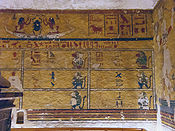 It appears that one of Horemheb's undertakings as Pharaoh was to eliminate all references to the monotheistic experiment, a process that included expunging the name of his immediate predecessors, especially Ay, from the historical record. Horemheb desecrated Ay's burial and had most of Ay's royal cartouches in his WV23
Tomb Wall paintings erased while his sarcophagus was smashed into numerous fragments. However, the sarcophagus lid was discovered in 1972 by Otto Schaden
, the US Egyptologist who opened Tomb KV63
in the Valley of the Kings in 2006. It still preserved Ay's cartouche. The sarcophagus had been buried under debris in this king's tomb. Horemheb also usurped Ay's mortuary temple at Medinet Habu
for his own use. Uvo Hölscher (1878–1963) who excavated the temple in the early 1930s provides these interesting details concerning the state of Ay-Horemheb's mortuary temple:
and Thuya, and therefore a brother of Queen Tiye
, wife of Amenhotep III
, and the Prophet of Amun, Anen
. Hence, he would be the uncle of pharoaohs Akhenaten
and Smenkhkare
. His assumed wife was Iuy, mother of Nakhtmin
, chosen successor of Ay. His Great Royal Wife was Tey
, Wet Nurse to Queen Nefertiti.
Ay is believed to be the father of Queen Nefertiti
, wife of Akhenaten, and Mutbenret
or Mutnodjmet depending on how the name is read, Mutnodjmet being the wife of Horemheb
. Their mother is plausibly the "Adoratrix of Min
, Songstress of Isis
" Iuy, who is known to be the mother of Nakhtmin, Ay's chosen successor, and presumed son.
Therefore he is believed to be the grandfather of Queen Meritaten
, Meketaten
, Queen Ankhesenamun
, Neferneferuaten Tasherit
, Neferneferure
and Setepenre
.
and Wolfgang Hohlbein
's Die Prophezeihung (The Prophecy). He is also a major character in Michelle Moran
's bestselling novel Nefertiti.
Pharaoh
Pharaoh is a title used in many modern discussions of the ancient Egyptian rulers of all periods. The title originates in the term "pr-aa" which means "great house" and describes the royal palace...
of Ancient Egypt
Ancient Egypt
Ancient Egypt was an ancient civilization of Northeastern Africa, concentrated along the lower reaches of the Nile River in what is now the modern country of Egypt. Egyptian civilization coalesced around 3150 BC with the political unification of Upper and Lower Egypt under the first pharaoh...
's 18th dynasty
Eighteenth dynasty of Egypt
The eighteenth dynasty of ancient Egypt is perhaps the best known of all the dynasties of ancient Egypt...
. He held the throne of Egypt for a brief four-year period (probably 1323–1319 BCE or 1327–1323 BCE, depending on which chronology is followed), although he was a close advisor to two and perhaps three of the pharaohs who ruled before him and was the power behind the throne during Tutankhamun
Tutankhamun
Tutankhamun , Egyptian , ; approx. 1341 BC – 1323 BC) was an Egyptian pharaoh of the 18th dynasty , during the period of Egyptian history known as the New Kingdom...
's reign. Ay's prenomen or royal name—Kheperkheperure—means "Everlasting are the Manifestations of Ra" while his birth name Ay it-netjer reads as 'Ay, Father of the God.' Records and monuments that can be clearly attributed to Ay are rare, not only due to his short length, but also because his successor, Horemheb
Horemheb
Horemheb was the last Pharaoh of the 18th Dynasty from either 1319 BC to late 1292 BC, or 1306 to late 1292 BC although he was not related to the preceding royal family and is believed to have been of common birth.Before he became pharaoh, Horemheb was the commander in chief...
, instigated a campaign of damnatio memoriae
Damnatio memoriae
Damnatio memoriae is the Latin phrase literally meaning "condemnation of memory" in the sense of a judgment that a person must not be remembered. It was a form of dishonor that could be passed by the Roman Senate upon traitors or others who brought discredit to the Roman State...
against him and other pharaohs associated with the unpopular Amarna Period
Amarna Period
The Amarna Period was an era of Egyptian history during the latter half of the Eighteenth Dynasty when the royal residence of the pharaoh and his queen was shifted to Akhetaten in what is now modern-day Amarna...
.
Origins
Ay is usually believed to be a native Egyptian from AkhmimAkhmim
Akhmim is a city in the Sohag Governorate of Upper Egypt. Referred to by the ancient Greeks as Khemmis, Chemmis and Panopolis, it is located on the east bank of the Nile, 4 miles to the northeast of Sohag.- History :Akhmim was known in Ancient Egypt as Ipu, Apu or Khent-min...
. During his short reign, he built a rock cut chapel in Akhmim and dedicated it to the local deity there: Min
Min (god)
Min is an Ancient Egyptian god whose cult originated in predynastic times . He was represented in many different forms, but was often represented in male human form, shown with an erect penis which he holds in his left hand and an upheld right arm holding a flail...
. He may have been the son of Yuya
Yuya
Yuya was a powerful Egyptian courtier during the eighteenth dynasty of Ancient Egypt...
, who served as a member of the priesthood of Min at Akhmin as well as superintendent of herds in this city, and wife Tjuyu
Tjuyu
Tjuyu was an Egyptian noble goddess, and the mother of queen Tiye, wife of pharaoh Amenhotep III...
. If so, Ay could have been of partial non-Egyptian, perhaps Syrian blood since the name Yuya was uncommon in Egypt and is suggestive of a foreign background. Yuya was an influential nobleman at the royal court of Amenhotep III
Amenhotep III
Amenhotep III also known as Amenhotep the Magnificent was the ninth pharaoh of the Eighteenth dynasty. According to different authors, he ruled Egypt from June 1386 to 1349 BC or June 1388 BC to December 1351 BC/1350 BC after his father Thutmose IV died...
who was given the rare privilege of having a tomb built for his use in the royal Valley of the Kings presumably because he was the father of Tiye
Tiye
Tiye was the daughter of Yuya and Tjuyu . She became the Great Royal Wife of the Egyptian pharaoh Amenhotep III....
, Amenhotep's chief Queen. There are also noted similarities in the physical likenesses of monuments attributed to Ay and those of the mummy of Yuya, and both held similar names and titles.
Amarna Period
All that is known for certain was that by the time he was permitted to build a tomb for himself (Southern Tomb 25Southern Tomb 25
Southern Tomb 25 at Amarna was intended for the burial of Ay, who later became Pharaoh, after Tutankhamun. The tomb was never finished, and he later buried in the Western Valley of the Valley of the Kings , in Thebes....
) at Amarna
Amarna
Amarna is an extensive Egyptian archaeological site that represents the remains of the capital city newly–established and built by the Pharaoh Akhenaten of the late Eighteenth Dynasty , and abandoned shortly afterwards...
during the reign of Akhenaten, he had achieved the title of "Overseer of All the Horses of His Majesty", the highest rank in the elite charioteering division of the army, which was just below the rank of General. Prior to this promotion he appears to have been first a Troop Commander and then a "regular" Overseer of Horses, titles which were found on a box thought to have been part of the original furnishings for his tomb. Other titles listed in this tomb include Fan-bearer on the Right Side of the King
Fan-bearer on the Right Side of the King
Fan-bearer on the Right Side of the King – sometimes also translated as Fanbearer on the King's Right Hand – or is a term used to describe an Ancient Egyptian courtier....
, Acting Scribe of the King, beloved by him, and God's Father. The 'Fan-bearer on the Right Side of the King' was a very important position, and is viewed as showing that the bearer had the 'ear' of the ruler. The final God's Father title is the one most associated with Ay, and was later incorporated into his royal name when he became pharaoh.
This title could mean that he was the father-in-law of the pharaoh, suggesting that he was the son of Yuya
Yuya
Yuya was a powerful Egyptian courtier during the eighteenth dynasty of Ancient Egypt...
and Tjuyu
Tjuyu
Tjuyu was an Egyptian noble goddess, and the mother of queen Tiye, wife of pharaoh Amenhotep III...
, thus being a brother or half-brother of Tiye
Tiye
Tiye was the daughter of Yuya and Tjuyu . She became the Great Royal Wife of the Egyptian pharaoh Amenhotep III....
, brother-in-law to Amenhotep III
Amenhotep III
Amenhotep III also known as Amenhotep the Magnificent was the ninth pharaoh of the Eighteenth dynasty. According to different authors, he ruled Egypt from June 1386 to 1349 BC or June 1388 BC to December 1351 BC/1350 BC after his father Thutmose IV died...
and the maternal uncle of Akhenaten. If Ay was the son of Yuya, who was a senior military officer during the reign of Amenhotep III, then he likely followed in his father's footsteps, finally inheriting his father's military functions upon his death. Alternatively, it could also mean that he may have had a daughter that married the pharaoh Akhenaten, possibly the father of Akhenaten's chief wife Nefertiti
Nefertiti
Nefertiti was the Great Royal Wife of the Egyptian Pharaoh Akhenaten. Nefertiti and her husband were known for a religious revolution, in which they started to worship one god only...
. Ultimately there is no evidence to definitively prove either hypothesis. The two theories are not mutually exclusive, but either relationship would explain the exalted status to which Ay rose during Akhenaten's Amarna interlude
Amarna
Amarna is an extensive Egyptian archaeological site that represents the remains of the capital city newly–established and built by the Pharaoh Akhenaten of the late Eighteenth Dynasty , and abandoned shortly afterwards...
, when the royal family turned their backs on Egypt's traditional gods and experimented, for a dozen years or so, with monotheism
Monotheism
Monotheism is the belief in the existence of one and only one god. Monotheism is characteristic of the Baha'i Faith, Christianity, Druzism, Hinduism, Islam, Judaism, Samaritanism, Sikhism and Zoroastrianism.While they profess the existence of only one deity, monotheistic religions may still...
; an experiment that, whether out of conviction or convenience, Ay appears to have followed under the reign of Akhenaten.
The Great Hymn to the Aten
Great Hymn to the Aten
The Great Hymn to the Aten is an ancient Egyptian hymn to the sun god Aten. It is attributed to Pharaoh Akhenaten, who attempted to convert Egypt to monotheism, with Aten being the only god. It was found, in its most complete form, in the tomb of Ay in the rock tombs at Amarna...
is also found in his Amarna tomb which was built during his service under Akhenaten. It is likely that this was required by Akhenaten, though not evidence that Ay agreed with Akhenaten's decision to promote the Aten above all other gods it is strongly suggestive that he did believe in Akhenaten's religious revolution.
His wife Tey
Tey
Tey was the wife of Kheperkheprure Ay , who was the penultimate pharaoh of Ancient Egypt's 18th dynasty. She was also the wetnurse of Queen Nefertiti....
was born a commoner but was given the title Nurse of the Pharaoh's Great Wife. If she were the mother of Nefertiti she would be expected to have the royal title Mother of the Pharaoh's Great Wife instead, so if Ay was the father of Nefertiti, then Tey would have been her stepmother. In several Amarna tomb chapels there is a woman whose name began with "Mut" who had the title Sister of the Pharaoh's Great Wife. This could also be a daughter of Ay's by his wife Tey, and it is known that his successor Horemheb married a woman with the name Mutnodjimet.
Tutankhamun
Ay's reign was preceded by that of King TutankhamunTutankhamun
Tutankhamun , Egyptian , ; approx. 1341 BC – 1323 BC) was an Egyptian pharaoh of the 18th dynasty , during the period of Egyptian history known as the New Kingdom...
, who ascended to the throne at the age of eight or nine, at a time of great tension between the new monotheism and the old polytheism. He was assisted in his kingly duties by his predecessor's two closest advisors: Grand Vizier
Vizier (Ancient Egypt)
The vizier was the highest official in Ancient Egypt to serve the king, or pharaoh during the Old, Middle, and New Kingdoms. Vizier is the generally accepted rendering of ancient Egyptian tjati, tjaty etc, among Egyptologists...
Ay and General of the Armies Horemheb
Horemheb
Horemheb was the last Pharaoh of the 18th Dynasty from either 1319 BC to late 1292 BC, or 1306 to late 1292 BC although he was not related to the preceding royal family and is believed to have been of common birth.Before he became pharaoh, Horemheb was the commander in chief...
. Tutankhamun's nine-year reign, largely under Ay's direction, saw the gradual return of the old gods – and, with that, the restoration of the power of the Amun priest
Priest
A priest is a person authorized to perform the sacred rites of a religion, especially as a mediatory agent between humans and deities. They also have the authority or power to administer religious rites; in particular, rites of sacrifice to, and propitiation of, a deity or deities...
hood, who had lost their influence over Egypt under Akhenaten.
Egyptologist Bob Brier
Bob Brier
Robert Brier , also known as Mr. Mummy, is an American Egyptologist specializing in paleopathology. A Senior Research Fellow at the C.W...
suggested that Ay murdered Tutankhamun in order to usurp the throne, a claim which was based on X-ray examinations of the body done in 1968. He also alleged that Ankhesenamen and the Hittite Prince she was about to marry were also murdered at his orders. This murder theory was not accepted by all scholars, and more detailed CT-scans of the mummy undertaken by National Geographic (published in late 2005) suggested that Tutankhamun did not die from a blow to his head as Brier had theorized. The National Geographic forensic researchers instead presented a new theory that Tutankhamun died from an infection caused by a badly broken leg since he is often portrayed as walking with a cane due to spina bifida
Spina bifida
Spina bifida is a developmental congenital disorder caused by the incomplete closing of the embryonic neural tube. Some vertebrae overlying the spinal cord are not fully formed and remain unfused and open. If the opening is large enough, this allows a portion of the spinal cord to protrude through...
, a hereditary trait in his family on his father's side. The bone fragments found in Tutankhamun's skull were most likely the result of post-mortem damage caused by Howard Carter's initial examination of the boy king "because they show no evidence of being inundated with the embalming fluid used to preserve the pharaoh for the afterlife." However, Brier has stated that the bone fragment in the skull is not relevant to the issue of whether Tutankhamun was murdered, acknowledging that it was likely caused by the embalmers. The evidence Brier presents for the murder is a dark spot on the base of the skull, indicating a blow to the head. Dr. Gerald Irwin agrees with Brier on this point. ("The Murder of Tutankhamen" (March, 1999) ISBN 0-425-16689-9)
When the results of the CT-Scan examination had been published, many scientists accepted its findings, but some still believe the mystery of Tutankhamun's death is far from solved and continue to support the older murder theory. There are books that have subsequently been published that adhere to the original murder theory and dispute the conclusions reached by the CT scan team, though also citing other means of murder, such as poisoning. In 2010 a team led by Zahi Hawass
Zahi Hawass
Zahi Hawass is an Egyptian archaeologist, an Egyptologist, and former Minister of State for Antiquities Affairs. He has also worked at archaeological sites in the Nile Delta, the Western Desert, and the Upper Nile Valley....
reported that he had died from complications caused by malaria
Malaria
Malaria is a mosquito-borne infectious disease of humans and other animals caused by eukaryotic protists of the genus Plasmodium. The disease results from the multiplication of Plasmodium parasites within red blood cells, causing symptoms that typically include fever and headache, in severe cases...
and Kohler's disease but another team from the Bernhard Noct Institute for Tropical Medicine in Hamburg believes his death was caused by sickle-cell disease. Tutankhamun could very well have died from this, combined with the infection in his knee. Ay was also buried in the tomb intended for Tutankhamun in the West Valley of the Kings (KV 23
WV23
Tomb WV23, located at the end of the Western Valley of the Kings near modern-day Luxor, was the final resting place of Pharaoh Ay of the 18th Dynasty....
), and Tutankhamun in Ay's intended tomb in the East Valley of the Kings (KV 62).
Rule as pharaoh
Tutankhamun's death at the age of 18 or 19, together with his failure to produce an heir, left a power vacuum that his Grand Vizier Ay was quick to fill: Ay is depicted conducting the funerary rites for the deceased monarch and assuming the role of heir. The grounds on which Ay based his successful claim to power are not entirely clear. The Commander of the Army, HoremhebHoremheb
Horemheb was the last Pharaoh of the 18th Dynasty from either 1319 BC to late 1292 BC, or 1306 to late 1292 BC although he was not related to the preceding royal family and is believed to have been of common birth.Before he became pharaoh, Horemheb was the commander in chief...
, had actually been designated as the "idnw" or "Deputy of the Lord of the Two Lands" under Tutankhamun and was presumed to be the boy king's heir apparent and successor. It appears that Horemheb was outmaneuvered to the throne by Ay who married Ankhesenamun
Ankhesenamun
Ankhesenamun was a queen of the Eighteenth dynasty of Egypt. Born as Ankhesenpaaten, she was the third of six known daughters of the Egyptian Pharaoh Akhenaten and his Great Royal Wife Nefertiti, and became the Great Royal Wife of her cousin Tutankhamun. The change in her name reflects the changes...
, the widow of Tutankhamun, in order to legitimise his claim to the throne. Ay was certainly a powerful figure: he was close to the centre of political power at the royal palace for some 25 years under both Tutankhamun and Akhenaten. But this was probably still not enough, however, to legitimize his claims to the throne in the highly hierarchical society of Ancient Egypt
Ancient Egypt
Ancient Egypt was an ancient civilization of Northeastern Africa, concentrated along the lower reaches of the Nile River in what is now the modern country of Egypt. Egyptian civilization coalesced around 3150 BC with the political unification of Upper and Lower Egypt under the first pharaoh...
, if he was of non-royal birth especially at a time of domestic upheaval without his marriage to Tutankhamun's widow. Since he was already advanced in age upon his accession, Ay ruled Egypt in his own right for only four years. During this period, he consolidated the return to the old religious ways that he had initiated as senior advisor and constructed a mortuary temple at Medinet Habu
Medinet Habu (temple)
Medinet Habu is the name commonly given to the Mortuary Temple of Ramesses III, an important New Kingdom period structure in the location of the same name on the West Bank of Luxor in Egypt...
for his own use. A stela of Nakhtmin
Nakhtmin
Nakhtmin held the position of generalissimo during the reign of Pharaoh Tutankhamun of the eighteenth dynasty of Ancient Egypt. His titles during the reign of Tutankhamun included "the true servant who is beneficial to his lord, the king's scribe", "the servant beloved of his lord", "the fan-bearer...
(Berlin 2074), a military officer under Tutankhamun and Ay—who was Ay's chosen successor— is dated to Year 4, IV Akhet day 1 of Ay's reign. Manetho
Manetho
Manetho was an Egyptian historian and priest from Sebennytos who lived during the Ptolemaic era, approximately during the 3rd century BC. Manetho wrote the Aegyptiaca...
's Epitome assigns a reign length of 4 years and 1 month to Horemheb and this was usually assigned to Ay based on this Year 4 dated stela; however, it is now believed that figure should be raised by a decade to [1]4 years and 1 month and attributed to Horemheb instead as Manetho intended. Hence, Ay's precise reign length is unknown and he could have ruled for as long as 7 to 9 years since most of his monuments and his funerary temple at Medinet Habu were either destroyed or usurped by his successor, Horemheb
Horemheb
Horemheb was the last Pharaoh of the 18th Dynasty from either 1319 BC to late 1292 BC, or 1306 to late 1292 BC although he was not related to the preceding royal family and is believed to have been of common birth.Before he became pharaoh, Horemheb was the commander in chief...
.
Royal succession
Prior to his death, Ay designated Nakhtmin to succeed him as pharaoh. However, Ay's plan for his succession went awry since Horemheb became the last king of Egypt's 18th Dynasty instead of Nakhtmin. The fact that Nakhtmin was Ay's intended heir is strongly implied by an inscription carved on a dyad funerary statue of Nakhtmin and his spouse which was presumably made during Ay's reign. Nakhtmin is clearly given the titles rpat (Crown Prince) and zA nzw (King's Son). The only conclusion which can be drawn here is that Nakhtmin was either a son or an adopted son of Ay and that Ay was grooming Nakhtmin for the royal succession instead of Horemheb. The Egyptologists Aidan Dodson and Dyan Hilton observe that the aforementioned statue:- "is broken after the signs for 'King's Son of', and there has been considerable debate as to whether it continued to say 'Kush', making Nakhtmin a Viceroy of Nubia, or 'of his body', making him an actual royal son. Since there is no other evidence for Nakhtmin as a Viceroy--with another man [Paser I]http://euler.slu.edu/Dept/Faculty/bart/egyptianhtml/kings%20and%20Queens/Viceroy_of_Kush_(or_Nubia).html attested in office at this period as well--the latter suggestion seems the most likely. As Nakhtmin donated items to the burial of Tutankhamun without such a title, it follows that he only became a King's Son subsequently, presumably under Ay. This theory is supported by the evidence of intentional damage to Nakhtmin's statue, since Ay was amongst the Amarna pharaohs whose memories were execrated under later rulers."
Aftermath
WV23
Tomb WV23, located at the end of the Western Valley of the Kings near modern-day Luxor, was the final resting place of Pharaoh Ay of the 18th Dynasty....
Tomb Wall paintings erased while his sarcophagus was smashed into numerous fragments. However, the sarcophagus lid was discovered in 1972 by Otto Schaden
Otto Schaden
Otto J. Schaden is an American Egyptologist. He is currently the Field Director of the Amenmesse Tomb Project of the University of Memphis . In addition to his ongoing work on the tomb of Amenmesse in the main arm of the Valley of the Kings, he has also cleared and reinvestigated tombs WV23, WV24,...
, the US Egyptologist who opened Tomb KV63
KV63
KV63 is the most recently opened chamber in Egypt's Valley of the Kings pharaonic necropolis. Initially believed to be a royal tomb, it is now believed to have been a storage chamber for the mummification process....
in the Valley of the Kings in 2006. It still preserved Ay's cartouche. The sarcophagus had been buried under debris in this king's tomb. Horemheb also usurped Ay's mortuary temple at Medinet Habu
Medinet Habu
Medinet Habu is an important Egyptian archaeological and tourist locality on the West Bank of the modern city of Luxor.Somewhat ambiguously, the toponym Medinet Habu can refer to either:...
for his own use. Uvo Hölscher (1878–1963) who excavated the temple in the early 1930s provides these interesting details concerning the state of Ay-Horemheb's mortuary temple:
- 'Wherever a cartouche has been preserved, the name of Eye [ie: Ay] has been erased and replaced by that of his successor Harmhab. In all but a single instance had it been overlooked and no change made. Thus the temple, which Eye had begun and finished, at least in the rear rooms with their fine paintings, was usurped by his successor and was thenceforth known as the temple of Harmhab. Seals on stoppers of wine jars from the temple magazines read: "Wine from the temple of Harmhab."'
Family
Ay is believed to be the son of YuyaYuya
Yuya was a powerful Egyptian courtier during the eighteenth dynasty of Ancient Egypt...
and Thuya, and therefore a brother of Queen Tiye
Tiye
Tiye was the daughter of Yuya and Tjuyu . She became the Great Royal Wife of the Egyptian pharaoh Amenhotep III....
, wife of Amenhotep III
Amenhotep III
Amenhotep III also known as Amenhotep the Magnificent was the ninth pharaoh of the Eighteenth dynasty. According to different authors, he ruled Egypt from June 1386 to 1349 BC or June 1388 BC to December 1351 BC/1350 BC after his father Thutmose IV died...
, and the Prophet of Amun, Anen
Anen
Anen was an Ancient Egyptian official during the late Eighteenth dynasty of Egypt. He was the son of Yuya and Tjuyu and the brother of Queen Tiye, the wife of Pharaoh Amenhotep III...
. Hence, he would be the uncle of pharoaohs Akhenaten
Akhenaten
Akhenaten also spelled Echnaton,Ikhnaton,and Khuenaten;meaning "living spirit of Aten") known before the fifth year of his reign as Amenhotep IV , was a Pharaoh of the Eighteenth dynasty of Egypt who ruled for 17 years and died perhaps in 1336 BC or 1334 BC...
and Smenkhkare
Smenkhkare
Smenkhkare was an ephemeral Ancient Egyptian Pharaoh of the late Eighteenth Dynasty, of whom very little is known for certain...
. His assumed wife was Iuy, mother of Nakhtmin
Nakhtmin
Nakhtmin held the position of generalissimo during the reign of Pharaoh Tutankhamun of the eighteenth dynasty of Ancient Egypt. His titles during the reign of Tutankhamun included "the true servant who is beneficial to his lord, the king's scribe", "the servant beloved of his lord", "the fan-bearer...
, chosen successor of Ay. His Great Royal Wife was Tey
Tey
Tey was the wife of Kheperkheprure Ay , who was the penultimate pharaoh of Ancient Egypt's 18th dynasty. She was also the wetnurse of Queen Nefertiti....
, Wet Nurse to Queen Nefertiti.
Ay is believed to be the father of Queen Nefertiti
Nefertiti
Nefertiti was the Great Royal Wife of the Egyptian Pharaoh Akhenaten. Nefertiti and her husband were known for a religious revolution, in which they started to worship one god only...
, wife of Akhenaten, and Mutbenret
Mutbenret
Mutbenret was an Egyptian noblewoman, and said to be the Sister of the Great Royal Wife Nefertiti. Her name used to be read as Mutnedjemet. The hieroglyphs for nedjem and bener are similar and so is their meaning...
or Mutnodjmet depending on how the name is read, Mutnodjmet being the wife of Horemheb
Horemheb
Horemheb was the last Pharaoh of the 18th Dynasty from either 1319 BC to late 1292 BC, or 1306 to late 1292 BC although he was not related to the preceding royal family and is believed to have been of common birth.Before he became pharaoh, Horemheb was the commander in chief...
. Their mother is plausibly the "Adoratrix of Min
Min
Min may refer to:*Min , an Egyptian fertility god*Min , a modern working copy of an Ancient Egyptian ship of Hatshepsut's time*Min , a South Korean celebrity most popularly known as a member of miss A*Min *Min River...
, Songstress of Isis
Isis
Isis or in original more likely Aset is a goddess in Ancient Egyptian religious beliefs, whose worship spread throughout the Greco-Roman world. She was worshipped as the ideal mother and wife as well as the matron of nature and magic...
" Iuy, who is known to be the mother of Nakhtmin, Ay's chosen successor, and presumed son.
Therefore he is believed to be the grandfather of Queen Meritaten
Meritaten
Meritaten also spelled Merytaten or Meryetaten was an ancient Egyptian queen of the eighteenth dynasty, who held the position of Great Royal Wife to Pharaoh Smenkhkare, who may have been a brother or son of Akhenaten...
, Meketaten
Meketaten
Meketaten was the second daughter of six born to the Egyptian Pharaoh Akhenaten and his Great Royal Wife Nefertiti. She was probably born in year 4 of Akhenaten's reign...
, Queen Ankhesenamun
Ankhesenamun
Ankhesenamun was a queen of the Eighteenth dynasty of Egypt. Born as Ankhesenpaaten, she was the third of six known daughters of the Egyptian Pharaoh Akhenaten and his Great Royal Wife Nefertiti, and became the Great Royal Wife of her cousin Tutankhamun. The change in her name reflects the changes...
, Neferneferuaten Tasherit
Neferneferuaten Tasherit
Neferneferuaten Tasherit or Neferneferuaten junior was an Ancient Egyptian princess of the 18th dynasty and the fourth daughter of Pharaoh Akhenaten and his Great Royal Wife Nefertiti.-Family:...
, Neferneferure
Neferneferure
Neferneferure was an Ancient Egyptian princess of the 18th dynasty. She was the fifth of six known daughters of Pharaoh Akhenaten and Great Royal Wife Nefertiti.-Family:...
and Setepenre
Setepenre (princess)
Setepenre was an ancient Egyptian princess of the 18th dynasty; sixth and last daughter of Pharaoh Akhenaten and his chief queen Nefertiti.-Family:...
.
In fiction
Ay appears as a major character in P. C. Doherty's trilogy of Ancient Egyptian novels, An Evil Spirit Out of the West, The Season of the Hyaena and The Year of the Cobra. He is also a character in Mika Waltari's historical novel The EgyptianThe Egyptian
The Egyptian is a historical novel by Mika Waltari. It was first published in Finnish in 1945, and in an abridged English translation by Naomi Walford in 1949. It was adapted into a film in 1954....
and Wolfgang Hohlbein
Wolfgang Hohlbein
Wolfgang Hohlbein is a German writer of science fiction, fantasy and horror fiction who lives near Neuss, North Rhine-Westphalia. His wife, Heike, is also a writer and often works with her husband. She often comes up with the story ideas and therefore is generally credited as co-author...
's Die Prophezeihung (The Prophecy). He is also a major character in Michelle Moran
Michelle Moran
Michelle Moran is an American novelist. She was born in California's San Fernando Valley. She took an interest in writing from an early age, purchasing Writer's Market and submitting her stories and novellas to publishers from the time she was twelve...
's bestselling novel Nefertiti.
Further reading
- Jürgen von BeckerathJürgen von BeckerathJürgen von Beckerath is a prominent German Egyptologist. He is a prolific writer who has published countless articles in journals such as Orientalia, Göttinger Miszellen , Journal of the American Research Center in Egypt , Archiv für Orientforschung and Studien zur Altägyptischen Kultur among...
, Chronologie des Pharaonischen Ägypten, MÄS 46 (Philip von Zabern, Mainz: 1997), pp. 201