

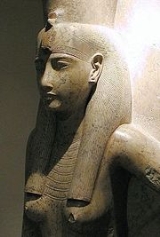
Mut

Encyclopedia

Egyptian language
Egyptian is the oldest known indigenous language of Egypt and a branch of the Afroasiatic language family. Written records of the Egyptian language have been dated from about 3400 BC, making it one of the oldest recorded languages known. Egyptian was spoken until the late 17th century AD in the...
, was an ancient Egypt
Ancient Egypt
Ancient Egypt was an ancient civilization of Northeastern Africa, concentrated along the lower reaches of the Nile River in what is now the modern country of Egypt. Egyptian civilization coalesced around 3150 BC with the political unification of Upper and Lower Egypt under the first pharaoh...
ian mother goddess
Mother goddess
Mother goddess is a term used to refer to a goddess who represents motherhood, fertility, creation or embodies the bounty of the Earth. When equated with the Earth or the natural world such goddesses are sometimes referred to as Mother Earth or as the Earth Mother.Many different goddesses have...
with multiple aspects that changed over the thousands of years of the culture. Alternative spellings are Maut and Mout. She was considered a primal deity, associated with the waters from which everything was born through parthenogenesis
Parthenogenesis
Parthenogenesis is a form of asexual reproduction found in females, where growth and development of embryos occur without fertilization by a male...
. She also was depicted as a woman with the crowns of Egypt upon her head. The rulers of Egypt each supported her worship in their own way to emphasize their own authority and right to rule through an association with Mut.
Some of Mut's many titles included World-Mother, Eye of Ra, Queen of the Goddesses, Lady of Heaven, Mother of the Gods, and She Who Gives Birth, But Was Herself Not Born of Any.
Changes of mythological position
Mut was a title of the primordial waters of the cosmos, NaunetNaunet
In Egyptian mythology, Nu or Nun is the deification of the primordial watery abyss. In the Ogdoad cosmogony, the name nu means "abyss"....
, in the Ogdoad
Ogdoad
In Egyptian mythology, the Ogdoad were eight deities worshipped in Hermopolis during what is called the Old Kingdom, the third through sixth dynasties, dated between 2686 to 2134 BC...
cosmogony during what is called the Old Kingdom
Old Kingdom
Old Kingdom is the name given to the period in the 3rd millennium BC when Egypt attained its first continuous peak of civilization in complexity and achievement – the first of three so-called "Kingdom" periods, which mark the high points of civilization in the lower Nile Valley .The term itself was...
, the third through sixth dynasties, dated between 2,686 to 2,134 B.C. However, the distinction between motherhood and cosmic water later diversified and lead to the separation of these identities, and Mut gained aspects of a creator
Creator deity
A creator deity is a deity responsible for the creation of the world . In monotheism, the single God is often also the creator deity, while polytheistic traditions may or may not have creator deities...
goddess, since she was the mother from which the cosmos emerged.
The hieroglyph for Mut's name, and for mother itself, was that of a white vulture
Egyptian Vulture
The Egyptian Vulture is a small Old World vulture, found widely distributed from southwestern Europe and northern Africa to southern Asia. It is the only living member of the genus Neophron. It has sometimes also been known as the White Scavenger Vulture or Pharaoh's Chicken...
, which the Egyptians
Egyptians
Egyptians are nation an ethnic group made up of Mediterranean North Africans, the indigenous people of Egypt.Egyptian identity is closely tied to geography. The population of Egypt is concentrated in the lower Nile Valley, the small strip of cultivable land stretching from the First Cataract to...
believed were very maternal creatures. Indeed, since Egyptian white vultures have no significant differing markings between female and male of the species, being without sexual dimorphism
Sexual dimorphism
Sexual dimorphism is a phenotypic difference between males and females of the same species. Examples of such differences include differences in morphology, ornamentation, and behavior.-Examples:-Ornamentation / coloration:...
, the Egyptians believed they were all females, who conceived their offspring by the wind herself, another parthenogenic concept.
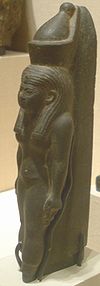
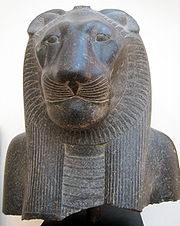
Making up a complete triad of deities for the later pantheon of Thebes, it was said that Mut had adopted Menthu
Menthu
In Ancient Egyptian religion, Monthu was a falcon-god of war. Monthu's name, shown in Egyptian hieroglyphs to the right, is technically transcribed as mntw...
, god of war. This choice of completion for the triad should have proved popular, but because the isheru, the sacred lake outside Mut's ancient temple in Karnak
Karnak
The Karnak Temple Complex—usually called Karnak—comprises a vast mix of decayed temples, chapels, pylons, and other buildings, notably the Great Temple of Amun and a massive structure begun by Pharaoh Ramses II . Sacred Lake is part of the site as well. It is located near Luxor, some...
at Thebes, was the shape of a crescent moon
Moon
The Moon is Earth's only known natural satellite,There are a number of near-Earth asteroids including 3753 Cruithne that are co-orbital with Earth: their orbits bring them close to Earth for periods of time but then alter in the long term . These are quasi-satellites and not true moons. For more...
, Khonsu, the moon god eventually replaced Menthu as Mut's adopted son.
Lower
Lower Egypt
Lower Egypt is the northern-most section of Egypt. It refers to the fertile Nile Delta region, which stretches from the area between El-Aiyat and Zawyet Dahshur, south of modern-day Cairo, and the Mediterranean Sea....
and upper Egypt
Upper Egypt
Upper Egypt is the strip of land, on both sides of the Nile valley, that extends from the cataract boundaries of modern-day Aswan north to the area between El-Ayait and Zawyet Dahshur . The northern section of Upper Egypt, between El-Ayait and Sohag is sometimes known as Middle Egypt...
both already had patron deities–Wadjet
Wadjet
In Egyptian mythology, Wadjet, or the Green One , was originally the ancient local goddess of the city of Dep , which became part of the city that the Egyptians named Per-Wadjet, House of...
and Nekhbet
Nekhbet
In Egyptian mythology, Nekhbet was an early predynastic local goddess who was the patron of the city of Nekheb, her name meaning of Nekheb...
–respectively, indeed they also had lioness protector deities–Bast
Bast (goddess)
Bastet is the name commonly used by scholars today to refer to a feline goddess of ancient Egyptian religion who was worshipped at least since the Second Dynasty...
and Sekhmet
Sekhmet
In Egyptian mythology, Sekhmet , was originally the warrior goddess as well as goddess of healing for Upper Egypt. She is depicted as a lioness, the fiercest hunter known to the Egyptians. It was said that her breath created the desert...
–respectively. When Thebes rose to greater prominence, Mut absorbed these warrior goddesses as some of her aspects. First, Mut became Mut-Wadjet-Bast, then Mut-Sekhmet-Bast (Wadjet having merged into Bast), then Mut also assimilated Menhit
Menhit
In Egyptian mythology, Menhit was originally a foreign war goddess. Her name depicts a warrior status, as it means massacres.When included among the Egyptian deities, she became the female counterpart of Anhur...
, who was also a lioness goddess, and her adopted son's wife, becoming Mut-Sekhmet-Bast-Menhit, and finally becoming Mut-Nekhbet.
Later in ancient Egyptian mythology deities of the pantheon were identified as equal pairs, female and male counterparts, having the same functions. In the later Middle Kingdom
Middle Kingdom of Egypt
The Middle Kingdom of Egypt is the period in the history of ancient Egypt stretching from the establishment of the Eleventh Dynasty to the end of the Fourteenth Dynasty, between 2055 BC and 1650 BC, although some writers include the Thirteenth and Fourteenth dynasties in the Second Intermediate...
, when Thebes
Thebes, Egypt
Thebes is the Greek name for a city in Ancient Egypt located about 800 km south of the Mediterranean, on the east bank of the river Nile within the modern city of Luxor. The Theban Necropolis is situated nearby on the west bank of the Nile.-History:...
grew in importance, its patron, Amun
Amun
Amun, reconstructed Egyptian Yamānu , was a god in Egyptian mythology who in the form of Amun-Ra became the focus of the most complex system of theology in Ancient Egypt...
also became more significant, and so Amaunet, who had been his female counterpart, was replaced with a more substantial mother-goddess, namely Mut, who became his wife. In that phase, Mut and Amun had a son, Khonsu, another moon deity.
The authority of Thebes waned later and Amun was assimilated into Ra
Ra
Ra is the ancient Egyptian sun god. By the Fifth Dynasty he had become a major deity in ancient Egyptian religion, identified primarily with the mid-day sun...
. Mut, the doting mother, was assimilated into Hathor
Hathor
Hathor , is an Ancient Egyptian goddess who personified the principles of love, beauty, music, motherhood and joy. She was one of the most important and popular deities throughout the history of Ancient Egypt...
, the cow-goddess and mother of Horus
Horus
Horus is one of the oldest and most significant deities in the Ancient Egyptian religion, who was worshipped from at least the late Predynastic period through to Greco-Roman times. Different forms of Horus are recorded in history and these are treated as distinct gods by Egyptologists...
who had become identified as Ra's wife. Subsequently, when Ra assimilated Atum
Atum
Atum, sometimes rendered as Atem or Tem, is an important deity in Egyptian mythology.- Name :Atum's name is thought to be derived from the word 'tem' which means to complete or finish. Thus he has been interpreted as being the 'complete one' and also the finisher of the world, which he returns to...
, the Ennead
Ennead
The Ennead was a group ofnine deities in Egyptian mythology. The Ennead were worshipped at Heliopolis and consisted of the god Atum, his children Shu and Tefnut, their children Geb and Nut and their children Osiris, Isis, Horus, Set and Nephthys.-Terminology:Egyptian mythology established multiple...
was absorbed as well, and so Mut-Hathor became identified as Isis
Isis
Isis or in original more likely Aset is a goddess in Ancient Egyptian religious beliefs, whose worship spread throughout the Greco-Roman world. She was worshipped as the ideal mother and wife as well as the matron of nature and magic...
(either as Isis-Hathor or Mut-Isis-Nekhbet), the most important of the females in the Ennead (the nine), and the patron of the queen. The Ennead proved to be a much more successful identity and the compound triad of Mut, Hathor, and Isis, became known as Isis alone—a cult that endured into the 7th century A.D. and spread to Greece, Rome, and Britain.
Depictions
In artArt
Art is the product or process of deliberately arranging items in a way that influences and affects one or more of the senses, emotions, and intellect....
, Mut was pictured as a woman with the wings of a white vulture
Egyptian Vulture
The Egyptian Vulture is a small Old World vulture, found widely distributed from southwestern Europe and northern Africa to southern Asia. It is the only living member of the genus Neophron. It has sometimes also been known as the White Scavenger Vulture or Pharaoh's Chicken...
, holding an ankh
Ankh
The ankh , also known as key of life, the key of the Nile or crux ansata, was the ancient Egyptian hieroglyphic character that read "eternal life", a triliteral sign for the consonants ʻ-n-ḫ...
, wearing the united crown
Crown (headgear)
A crown is the traditional symbolic form of headgear worn by a monarch or by a deity, for whom the crown traditionally represents power, legitimacy, immortality, righteousness, victory, triumph, resurrection, honour and glory of life after death. In art, the crown may be shown being offered to...
of Upper and Lower Egypt and a dress of bright red or blue, with the feather
Feather
Feathers are one of the epidermal growths that form the distinctive outer covering, or plumage, on birds and some non-avian theropod dinosaurs. They are considered the most complex integumentary structures found in vertebrates, and indeed a premier example of a complex evolutionary novelty. They...
of the goddess Ma'at at her feet.
Alternatively, as a result of her assimilations, Mut is sometimes depicted as a cobra
Cobra
Cobra is a venomous snake belonging to the family Elapidae. However, not all snakes commonly referred to as cobras are of the same genus, or even of the same family. The name is short for cobra capo or capa Snake, which is Portuguese for "snake with hood", or "hood-snake"...
, a cat
Cat
The cat , also known as the domestic cat or housecat to distinguish it from other felids and felines, is a small, usually furry, domesticated, carnivorous mammal that is valued by humans for its companionship and for its ability to hunt vermin and household pests...
, a cow, or as a lion
Lion
The lion is one of the four big cats in the genus Panthera, and a member of the family Felidae. With some males exceeding 250 kg in weight, it is the second-largest living cat after the tiger...
ess as well as the white vulture.
In Karnak

Karnak
The Karnak Temple Complex—usually called Karnak—comprises a vast mix of decayed temples, chapels, pylons, and other buildings, notably the Great Temple of Amun and a massive structure begun by Pharaoh Ramses II . Sacred Lake is part of the site as well. It is located near Luxor, some...
. That temple had the statue that was regarded as an embodiment of her real ka
Egyptian soul
The ancient Egyptians believed that a human soul was made up of five parts: the Ren, the Ba, the Ka, the Sheut, and the Ib. In addition to these components of the soul there was the human body...
. Her devotions included daily rituals by the pharaoh
Pharaoh
Pharaoh is a title used in many modern discussions of the ancient Egyptian rulers of all periods. The title originates in the term "pr-aa" which means "great house" and describes the royal palace...
and her priest
Priest
A priest is a person authorized to perform the sacred rites of a religion, especially as a mediatory agent between humans and deities. They also have the authority or power to administer religious rites; in particular, rites of sacrifice to, and propitiation of, a deity or deities...
esses. Interior reliefs depict scenes of the priestesses, currently the only known remaining example of worship in ancient Egypt that was exclusively administered by women.
Usually the queen, who always carried the royal lineage among the rulers of Egypt, served as the chief priestess in the temple rituals. The pharaoh participated also and would become a deity after death. In the case when the pharaoh was female, records of one example indicate that she had her daughter serve as the high priestess in her place. Often priests served in the administration of temples and oracles where priestesses performed the traditional religious rites. These rituals included music and drinking.
The pharaoh Hatshepsut
Hatshepsut
Hatshepsut also Hatchepsut; meaning Foremost of Noble Ladies;1508–1458 BC) was the fifth pharaoh of the eighteenth dynasty of Ancient Egypt...
had the ancient temple to Mut
Precinct of Mut
The Precinct of Mut, located near Luxor, Egypt, is one of the four main temple enclosures that make up the immense Karnak Temple Complex and occupies some 150,000 m². It is dedicated to the Egyptian goddess Mut, the mother goddess. The area in which the precinct is located, originally was known as...
at Karnak rebuilt during her rule in the Eighteenth Dynasty
Eighteenth dynasty of Egypt
The eighteenth dynasty of ancient Egypt is perhaps the best known of all the dynasties of ancient Egypt...
. Previous excavators had thought that Amenhotep III
Amenhotep III
Amenhotep III also known as Amenhotep the Magnificent was the ninth pharaoh of the Eighteenth dynasty. According to different authors, he ruled Egypt from June 1386 to 1349 BC or June 1388 BC to December 1351 BC/1350 BC after his father Thutmose IV died...
had the temple built because of the hundreds of statues found there of Sekhmet
Sekhmet
In Egyptian mythology, Sekhmet , was originally the warrior goddess as well as goddess of healing for Upper Egypt. She is depicted as a lioness, the fiercest hunter known to the Egyptians. It was said that her breath created the desert...
that bore his name. However, Hatshepsut, who completed an enormous number of temples and public buildings, had completed the work seventy-five years earlier. She began the custom of depicting Mut with the crown of both Upper and Lower Egypt. It is thought that Amenhotep III removed most signs of Hatshepsut, while taking credit for the projects she had built.
Hatshepsut was a pharaoh who brought Mut to the fore again in the Egyptian pantheon
Egyptian pantheon
The Egyptian pantheon consisted of the many gods worshipped by the Ancient Egyptians. A number of major deities are addressed as the creator of the cosmos. These include Atum, Ra, Amun and Ptah amongst others, as well as composite forms of these gods such as Amun-Ra. This was not seen as...
, identifying strongly with the goddess. She stated that she was a descendant of Mut. She also associated herself with the image of Sekhmet
Sekhmet
In Egyptian mythology, Sekhmet , was originally the warrior goddess as well as goddess of healing for Upper Egypt. She is depicted as a lioness, the fiercest hunter known to the Egyptians. It was said that her breath created the desert...
, as the more aggressive aspect of the goddess, having served as a very successful warrior
Warrior
A warrior is a person skilled in combat or warfare, especially within the context of a tribal or clan-based society that recognizes a separate warrior class.-Warrior classes in tribal culture:...
during the early portion of her reign as pharaoh.
Later in the same dynasty, Akhenaten
Akhenaten
Akhenaten also spelled Echnaton,Ikhnaton,and Khuenaten;meaning "living spirit of Aten") known before the fifth year of his reign as Amenhotep IV , was a Pharaoh of the Eighteenth dynasty of Egypt who ruled for 17 years and died perhaps in 1336 BC or 1334 BC...
suppressed the worship of Mut as well as the other deities when he promoted the monotheistic worship of his sun god, Aten
Aten
Aten is the disk of the sun in ancient Egyptian mythology, and originally an aspect of Ra. The deified Aten is the focus of the monolatristic, henotheistic, or monotheistic religion of Atenism established by Amenhotep IV, who later took the name Akhenaten in worship in recognition of Aten...
. Tutankhamun later re-established her worship and his successors continued to associate themselves with Mut afterward.
Ramesses II
Ramesses II
Ramesses II , referred to as Ramesses the Great, was the third Egyptian pharaoh of the Nineteenth dynasty. He is often regarded as the greatest, most celebrated, and most powerful pharaoh of the Egyptian Empire...
added more work on the Mut temple during the nineteenth dynasy
Nineteenth dynasty of Egypt
The Nineteenth Dynasty of ancient Egypt was one of the periods of the Egyptian New Kingdom. Founded by Vizier Ramesses I, whom Pharaoh Horemheb chose as his successor to the throne, this dynasty is best known for its military conquests in Palestine, Lebanon, and Syria.The warrior kings of the...
, as well as rebuilding an earlier temple in the same area, rededicating it to Amun and himself. He placed it so that people would have to pass his temple on their way to that of Mut.
Kushite pharaohs expanded the Mut temple and modified the Ramesses temple for use as the shrine of the celebrated birth of Amun and Khonsu, trying to integrate themselves into divine succession. They also installed their own priest
Priest
A priest is a person authorized to perform the sacred rites of a religion, especially as a mediatory agent between humans and deities. They also have the authority or power to administer religious rites; in particular, rites of sacrifice to, and propitiation of, a deity or deities...
esses among the ranks of the priestesses who officiated at the temple of Mut.
The Greek Ptolemaic dynasty
Ptolemaic dynasty
The Ptolemaic dynasty, was a Macedonian Greek royal family which ruled the Ptolemaic Empire in Egypt during the Hellenistic period. Their rule lasted for 275 years, from 305 BC to 30 BC...
added its own decorations and priestesses at the temple as well and used the authority of Mut to emphasize their own interests.
Later, the Roman emperor Tiberius
Tiberius
Tiberius , was Roman Emperor from 14 AD to 37 AD. Tiberius was by birth a Claudian, son of Tiberius Claudius Nero and Livia Drusilla. His mother divorced Nero and married Augustus in 39 BC, making him a step-son of Octavian...
rebuilt the site after a severe flood and his successors supported the temple until it fell into disuse, sometime around the third century A.D. Some of the later Roman officials used the stones from the temple for their own building projects, often without altering the images carved upon them.
Personal piety
In the wake of AkhenatenAkhenaten
Akhenaten also spelled Echnaton,Ikhnaton,and Khuenaten;meaning "living spirit of Aten") known before the fifth year of his reign as Amenhotep IV , was a Pharaoh of the Eighteenth dynasty of Egypt who ruled for 17 years and died perhaps in 1336 BC or 1334 BC...
's revolution, and the subsequent restoration of traditional beliefs and practices, the emphasis in personal piety moved towards greater reliance on divine, rather than human, protection for the individual. During the reign of Rameses II a follower of the goddess Mut donated all his property to her temple and recorded in his tomb:
And he [Kiki] found Mut at the head of the gods, Fate and fortune in her hand, Lifetime and breathSail (hieroglyph)The Ancient Egyptian Sail hieroglyph is Gardiner sign listed no. P5 for the sail of a ship. The hieroglyph shows a hoisted sail, curved because of wind filling it...
of life are hers to command...I have not chosen a protector among men. I have not sought myself a protector among the great...My heart is filled with my mistress. I have no fear of anyone. I spend the night in quiet sleep, because I have a protector.