


Giza pyramid complex

Encyclopedia
The Giza Necropolis is an archaeological site on the Giza Plateau
, on the outskirts of Cairo
, Egypt
. This complex of ancient monuments includes the three pyramid
complexes known as the Great Pyramids, the massive sculpture known as the Great Sphinx, several cemeteries, a workers' village and an industrial complex. It is located some 9 km (5 mi) inland into the desert
from the old town of Giza on the Nile
, some 25 km (15 mi) southwest of Cairo city centre. The pyramids, which have always loomed large as emblems of ancient Egypt in the Western imagination, were popularised in Hellenistic
times, when the Great Pyramid was listed by Antipater of Sidon
as one of the Seven Wonders of the World. It is by far the oldest of the ancient Wonders and the only one still in existence.
 The Pyramids of Giza consist of the Great Pyramid of Giza
(known as the Great Pyramid and the Pyramid of Cheops or Khufu
), the somewhat smaller Pyramid of Khafre (or Chephren) a few hundred meters to the south-west, and the relatively modest-sized Pyramid of Menkaure (or Mykerinos) a few hundred meters further south-west. The Great Sphinx lies on the east side of the complex. Current consensus among Egyptologists is that the head of the Great Sphinx is that of Khafre. Along with these major monuments are a number of smaller satellite edifices, known as "queens" pyramids, causeways and valley pyramids.
The Giza pyramids have been recorded in the Giza Plateau Mapping Project run by the Ancient Egypt Research Associates, directed by Dr. Mark Lehner
. In addition, Lehner's team undertook radiocarbon dating on material recovered from the exterior of the Great Pyramid. Aera's 2009 field season was recorded in a blog.
’s pyramid complex consists of a Valley Temple, now buried beneath the village of Nazlet el-Samman; basalt paving and limestone walls have been found but the site has not been excavated. The Valley Temple was connected to a causeway which was largely destroyed when the village was constructed. The Causeway led to the Mortuary Temple of Khufu. From this temple only the basalt pavement remains. The mortuary temple was connected to the king’s pyramid. The king’s pyramid has three smaller queen’s pyramids associated with it and five boat pits. The boat pits contain a ship, and the two pits on the south side of the pyramid still contained intact ships. One of these ships has been restored and is on display.
Khufu's Pyramid maintains a limited collection of casing stones at its base. These casing stones were made of fine white limestone quarried from the nearby Muqattam range.
.
Khafre's Pyramid appears larger than the adjacent Khufu Pyramid by virtue of its more elevated location, and the steeper angle of inclination of its construction – it is, in fact, smaller in both height and volume. Khafre's Pyramid retains a prominent display of casing stones at its apex.
a smaller ante-temple was added on to the Valley temple. The Mortuary temple also yielded several statues of Menkaure. The king’s pyramid has three subsidiary or Queen’s pyramids.
Of the four major monuments, only Menkaure's Pyramid is seen today without any of its original polished limestone
casing.
dedicated a new temple to Hauron-Haremakhet and this structure was added onto by later rulers.
was buried in Giza. Her tomb is known as LG 100 and G 8400 and is located in the Central Field, near the pyramid of Menkaure. The pyramid complex of Queen Khentkaus includes: her pyramid, a boat pit, a Valley Temple and a pyramid town.
In building the pyramids, the architects might have developed their techniques over time. They would select a site on a relatively flat area of bedrock—not sand—which provided a stable foundation. After carefully surveying the site and laying down the first level of stones, they constructed the pyramids in horizontal levels, one on top of the other.
For the Great Pyramid of Giza
, most of the stone for the interior seems to have been quarried immediately to the south of the construction site. The smooth exterior of the pyramid was made of a fine grade of white limestone that was quarried across the Nile
. These exterior blocks had to be carefully cut, transported by river barge to Giza, and dragged up ramps to the construction site. Only a few exterior blocks remain in place at the bottom of the Great Pyramid. During the Middle Ages (5th century to 15th century) people may have taken the rest away for building projects in the city of Cairo.
To ensure that the pyramid remained symmetrical, the exterior casing stones all had to be equal in height and width. Workers might have marked all the blocks to indicate the angle of the pyramid wall and trimmed the surfaces carefully so that the blocks fit together. During construction the outer surface of the stone was smooth limestone; excess stone has eroded as time has passed.
s who ruled over Ancient Egypt
. A portion of the Pharaoh's spirit called his ba was believed to remain with his corpse. Proper care of the remains was necessary in order for the "former Pharaoh to perform his new duties as king of the dead." It's theorized the pyramid not only served as a tomb for the Pharaoh but also as storage for the various items he would need in the afterlife. "The people of Ancient Egypt believed that death on Earth was the start of a journey to the next world. The embalmed body of the King was entombed underneath or within the pyramid to protect it and allow his transformation and ascension to the afterlife."
visited Giza in 450 BC, he was told by Egyptian priests that "the Great Pyramid
had taken 400,000 men 20 years to build, working in three-month shifts 100,000 men at a time." Evidence from the tombs indicates that a workforce of 10,000 laborers working in three month shifts took around 30 years to build a pyramid.
The Giza pyramid complex is surrounded by a large stone wall, outside which Mark Lehner
and his team have discovered a town where the workers on the pyramids were housed. This town is located to the southeast of the Khafre and Menkaure complexes. Among the discoveries at the worker's village are communal sleeping quarters, bakeries, breweries and kitchens (with evidence showing that bread, beef and fish were staples of the diet), a hospital and a cemetery (where some of the skeletons were found with signs of trauma associated with accidents on a building site). The worker's town discovered appears to date to the middle 4th dynasty
(2520–2472 BC), after the accepted time of Khufu and completion of the Great Pyramid. According to Mark Lehner
and the AERA team;
Without carbon dating, using only pottery shards, seal impressions, and stratigraphy to date the site, the team further concludes;
.svg.png) As the pyramids were constructed the mastaba
As the pyramids were constructed the mastaba
s for lesser royals were constructed around them. Near the pyramid of Khufu the main cemetery is G 7000 which lies in the East Field located to the east of the main pyramid and next to the Queen’s pyramids. These cemeteries around the pyramids were arranged along streets and avenues. Cemetery G 7000 was one of the earliest and contained tombs of wives, sons and daughters of these 4th dynasty
rulers. On the other side of the pyramid in the West Field the royals sons Wepemnofret and Hemiunu were buried in Cemetery G 1200 and Cemetery G 4000 respectively. These cemeteries were further expanded during the 5th
and 6th dynasty
.
’s pyramid. It is divided up into smaller areas such as the cemeteries referred to as the Abu Bakr Excavations (1949-50, 1950-1,1952 and 1953), and several cemeteries named based on the mastaba
numbers such as Cemetery G 1000, Cemetery G 1100, etc. The West Field contains Cemetery G1000 – Cemetery G1600, and Cemetery G 1900. Further cemeteries in this field are: Cemeteries G 2000, G 2200, G 2500, G 3000, G 4000, and G 6000. Three other cemeteries are named after their excavators: Junker Cemetery West, Junker Cemetery East and Steindorff Cemetery.
The cemetery also includes mastabas from tenants and priests of the pyramids dated to the 5th dynasty and 6th dynasty.
. Tombs from the time of Menkaure include the mastabas of the royal chamberlain Khaemnefert, the King’s son Khufudjedef who was master of the royal largesse, and an official named Niankhre.
| to the 5th dynasty
or even later.
Tombs dating to the Saite and later period were found near the causeway of Khafre and the Great Sphinx
. These tombs include the tomb of a commander of the army named Ahmose and his mother Queen Nakhtubasterau, who was the wife of Pharaoh
Amasis II
.
and 3rd dynasty
. One of these early dynastic tombs is referred to as the Covington tomb. Other tombs date to the late Old Kingdom
(5th and 6th dynasty).
The south section of the field contains several tombs dating to the Saite period and later.
Giza was still an active site. A brick built chapel was erected near the Sphinx during the early 18th dynasty
, probably by king Tuthmosis I. Amenhotep II
built a temple dedicated to Hauron-Haremakhet near the Sphinx. Pharaoh Tuthmosis IV visited the pyramids and the Sphinx as a prince and in a dream was told that clearing the sand form the Sphinx would be awarded with kingship. This event is recorded in the Dream stela. During the early years of his reign Tuthmosis IV together with his wife Queen Nefertari had stelae erected at Giza. Pharaoh Tutankhamen had a structure built which is now referred to as the king’s resthouse.
During the 19th dynasty
, Sethi I added to the temple of Hauron-Haremakhet, and his son Ramesses II
erected a stela in the chapel before the Sphinx and usurped the resthouse of Tutankhamen.
the Temple of Isis Mistress-of-the-Pyramids was reconstructed. During the 26th dynasty
a stela mentions Khufu and his Queen Henutsen
.
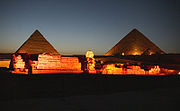 The sides of all three of the Giza pyramids were astronomically oriented to the be north-south and east-west within a small fraction of a degree. Among recent attempts to explain such a clearly deliberate pattern are those of S. Haack, O. Neugebauer, K. Spence, D. Rawlins
, K. Pickering, and J. Belmonte. The arrangement of the pyramids is a disputed representation of the Orion constellation in the Orion Correlation Theory
.
Giza Plateau
The Giza Plateau is a plateau that is located in Giza, Egypt. The famous Giza Necropolis is located in this geographical area, which is characterized by a sandy, desert climate and terrain with little vegetation....
, on the outskirts of Cairo
Cairo
Cairo , is the capital of Egypt and the largest city in the Arab world and Africa, and the 16th largest metropolitan area in the world. Nicknamed "The City of a Thousand Minarets" for its preponderance of Islamic architecture, Cairo has long been a centre of the region's political and cultural life...
, Egypt
Egypt
Egypt , officially the Arab Republic of Egypt, Arabic: , is a country mainly in North Africa, with the Sinai Peninsula forming a land bridge in Southwest Asia. Egypt is thus a transcontinental country, and a major power in Africa, the Mediterranean Basin, the Middle East and the Muslim world...
. This complex of ancient monuments includes the three pyramid
Pyramid
A pyramid is a structure whose outer surfaces are triangular and converge at a single point. The base of a pyramid can be trilateral, quadrilateral, or any polygon shape, meaning that a pyramid has at least three triangular surfaces...
complexes known as the Great Pyramids, the massive sculpture known as the Great Sphinx, several cemeteries, a workers' village and an industrial complex. It is located some 9 km (5 mi) inland into the desert
Desert
A desert is a landscape or region that receives an extremely low amount of precipitation, less than enough to support growth of most plants. Most deserts have an average annual precipitation of less than...
from the old town of Giza on the Nile
Nile
The Nile is a major north-flowing river in North Africa, generally regarded as the longest river in the world. It is long. It runs through the ten countries of Sudan, South Sudan, Burundi, Rwanda, Democratic Republic of the Congo, Tanzania, Kenya, Ethiopia, Uganda and Egypt.The Nile has two major...
, some 25 km (15 mi) southwest of Cairo city centre. The pyramids, which have always loomed large as emblems of ancient Egypt in the Western imagination, were popularised in Hellenistic
Hellenistic civilization
Hellenistic civilization represents the zenith of Greek influence in the ancient world from 323 BCE to about 146 BCE...
times, when the Great Pyramid was listed by Antipater of Sidon
Antipater of Sidon
Antipater of Sidon , Antipatros or Antipatros Sidonios in the Anthologies, was a Greek poet in the second half of the 2nd century BC....
as one of the Seven Wonders of the World. It is by far the oldest of the ancient Wonders and the only one still in existence.
The Pyramids and the Sphinx
Great Pyramid of Giza
The Great Pyramid of Giza is the oldest and largest of the three pyramids in the Giza Necropolis bordering what is now El Giza, Egypt. It is the oldest of the Seven Wonders of the Ancient World, and the only one to remain largely intact...
(known as the Great Pyramid and the Pyramid of Cheops or Khufu
Khufu
Khufu , also known as Cheops or, in Manetho, Suphis , was a Pharaoh of Ancient Egypt's Old Kingdom. He reigned from around 2589 to 2566 BC. Khufu was the second pharaoh of the Fourth Dynasty. He is generally accepted as being the builder of the Great Pyramid of Giza, one of the Seven Wonders of...
), the somewhat smaller Pyramid of Khafre (or Chephren) a few hundred meters to the south-west, and the relatively modest-sized Pyramid of Menkaure (or Mykerinos) a few hundred meters further south-west. The Great Sphinx lies on the east side of the complex. Current consensus among Egyptologists is that the head of the Great Sphinx is that of Khafre. Along with these major monuments are a number of smaller satellite edifices, known as "queens" pyramids, causeways and valley pyramids.
The Giza pyramids have been recorded in the Giza Plateau Mapping Project run by the Ancient Egypt Research Associates, directed by Dr. Mark Lehner
Mark Lehner
Mark Lehner PhD is an American archaeologist with more than 30 years of experience excavating in Egypt. His approach, as director of Ancient Egypt Research Associates , is to conduct interdisciplinary archaeological investigation. Every excavated object is examined by specialists to create an...
. In addition, Lehner's team undertook radiocarbon dating on material recovered from the exterior of the Great Pyramid. Aera's 2009 field season was recorded in a blog.
Khufu’s pyramid complex
KhufuKhufu
Khufu , also known as Cheops or, in Manetho, Suphis , was a Pharaoh of Ancient Egypt's Old Kingdom. He reigned from around 2589 to 2566 BC. Khufu was the second pharaoh of the Fourth Dynasty. He is generally accepted as being the builder of the Great Pyramid of Giza, one of the Seven Wonders of...
’s pyramid complex consists of a Valley Temple, now buried beneath the village of Nazlet el-Samman; basalt paving and limestone walls have been found but the site has not been excavated. The Valley Temple was connected to a causeway which was largely destroyed when the village was constructed. The Causeway led to the Mortuary Temple of Khufu. From this temple only the basalt pavement remains. The mortuary temple was connected to the king’s pyramid. The king’s pyramid has three smaller queen’s pyramids associated with it and five boat pits. The boat pits contain a ship, and the two pits on the south side of the pyramid still contained intact ships. One of these ships has been restored and is on display.
Khufu's Pyramid maintains a limited collection of casing stones at its base. These casing stones were made of fine white limestone quarried from the nearby Muqattam range.
Khafre’s pyramid complex
Khafre’s pyramid complex consists of a Valley temple (sometimes referred to as the Sphinx temple), a causeway, a mortuary temple and the king’s pyramid. The Valley Temple yielded several statues of Khafre. Several were found in a well in the floor of the temple by Mariette in 1860. Others were found during successive excavations by Sieglin (1909–10), Junker, Reisner, and Hassan. Khafre’s complex contained five boat-pits and a subsidiary pyramid with a serdabSerdab
A serdab , literally meaning "cold water", which became a loan word in Persian for 'cellar') is an ancient Egyptian tomb structure that served as a chamber for the Ka statue of a deceased individual. Used during the Old Kingdom, the serdab was a sealed chamber with a small slit or hole to allow the...
.
Khafre's Pyramid appears larger than the adjacent Khufu Pyramid by virtue of its more elevated location, and the steeper angle of inclination of its construction – it is, in fact, smaller in both height and volume. Khafre's Pyramid retains a prominent display of casing stones at its apex.
Menkaure’s pyramid complex
Menkaure’s pyramid complex consistes of a Valley Temple, a causeway, a mortuary temple, and the king’s pyramid. The Valley Temple contained several statues of Menkaure. During the 5th dynastyFifth dynasty of Egypt
The fifth dynasty of ancient Egypt is often combined with Dynasties III, IV and VI under the group title the Old Kingdom. Dynasty V dates approximately from 2494 to 2345 BC.-Rulers:...
a smaller ante-temple was added on to the Valley temple. The Mortuary temple also yielded several statues of Menkaure. The king’s pyramid has three subsidiary or Queen’s pyramids.
Of the four major monuments, only Menkaure's Pyramid is seen today without any of its original polished limestone
Limestone
Limestone is a sedimentary rock composed largely of the minerals calcite and aragonite, which are different crystal forms of calcium carbonate . Many limestones are composed from skeletal fragments of marine organisms such as coral or foraminifera....
casing.
The Sphinx
The Sphinx dates to the reign of king Khafre. A chapel was located between its forepaws. During the New Kingdom Amenhotep IIAmenhotep II
Amenhotep II was the seventh Pharaoh of the 18th dynasty of Egypt. Amenhotep inherited a vast kingdom from his father Thutmose III, and held it by means of a few military campaigns in Syria; however, he fought much less than his father, and his reign saw the effective cessation of hostilities...
dedicated a new temple to Hauron-Haremakhet and this structure was added onto by later rulers.
Tomb of Queen Khentkaues I
Khentkaus IKhentkaus I
Khentkaus I was a Queen of Ancient Egypt during the 4th dynasty. She may have been a daughter of Pharaoh Menkaure, wife of Shepseskaf and mother of Userkaf, but this is by no means certain. Her Mastaba at Giza - tomb LG100 - is located very close to Menkaure's pyramid complex...
was buried in Giza. Her tomb is known as LG 100 and G 8400 and is located in the Central Field, near the pyramid of Menkaure. The pyramid complex of Queen Khentkaus includes: her pyramid, a boat pit, a Valley Temple and a pyramid town.
Construction
Most construction theories are based on the idea that the pyramids were built by moving huge stones from a quarry and dragging and lifting them into place. The disagreements center on the method by which the stones were conveyed and placed and how possible the method was. A recent though unpopular theory proposes that the building blocks were manufactured in-place from a kind of "limestone concrete".In building the pyramids, the architects might have developed their techniques over time. They would select a site on a relatively flat area of bedrock—not sand—which provided a stable foundation. After carefully surveying the site and laying down the first level of stones, they constructed the pyramids in horizontal levels, one on top of the other.
For the Great Pyramid of Giza
Great Pyramid of Giza
The Great Pyramid of Giza is the oldest and largest of the three pyramids in the Giza Necropolis bordering what is now El Giza, Egypt. It is the oldest of the Seven Wonders of the Ancient World, and the only one to remain largely intact...
, most of the stone for the interior seems to have been quarried immediately to the south of the construction site. The smooth exterior of the pyramid was made of a fine grade of white limestone that was quarried across the Nile
Nile
The Nile is a major north-flowing river in North Africa, generally regarded as the longest river in the world. It is long. It runs through the ten countries of Sudan, South Sudan, Burundi, Rwanda, Democratic Republic of the Congo, Tanzania, Kenya, Ethiopia, Uganda and Egypt.The Nile has two major...
. These exterior blocks had to be carefully cut, transported by river barge to Giza, and dragged up ramps to the construction site. Only a few exterior blocks remain in place at the bottom of the Great Pyramid. During the Middle Ages (5th century to 15th century) people may have taken the rest away for building projects in the city of Cairo.
To ensure that the pyramid remained symmetrical, the exterior casing stones all had to be equal in height and width. Workers might have marked all the blocks to indicate the angle of the pyramid wall and trimmed the surfaces carefully so that the blocks fit together. During construction the outer surface of the stone was smooth limestone; excess stone has eroded as time has passed.
Purpose
The Pyramids of Giza and others are thought to have been constructed to house the remains of the deceased PharaohPharaoh
Pharaoh is a title used in many modern discussions of the ancient Egyptian rulers of all periods. The title originates in the term "pr-aa" which means "great house" and describes the royal palace...
s who ruled over Ancient Egypt
Ancient Egypt
Ancient Egypt was an ancient civilization of Northeastern Africa, concentrated along the lower reaches of the Nile River in what is now the modern country of Egypt. Egyptian civilization coalesced around 3150 BC with the political unification of Upper and Lower Egypt under the first pharaoh...
. A portion of the Pharaoh's spirit called his ba was believed to remain with his corpse. Proper care of the remains was necessary in order for the "former Pharaoh to perform his new duties as king of the dead." It's theorized the pyramid not only served as a tomb for the Pharaoh but also as storage for the various items he would need in the afterlife. "The people of Ancient Egypt believed that death on Earth was the start of a journey to the next world. The embalmed body of the King was entombed underneath or within the pyramid to protect it and allow his transformation and ascension to the afterlife."
Workers' village
The work of quarrying, moving, setting, and sculpting the huge amount of stone used to build the pyramids might have been accomplished by several thousand skilled workers, unskilled laborers and supporting workers. Bakers, carpenters, water carriers, and others were also needed for the project. Along with the methods utilized to construct the pyramids, there is also wide speculation regarding the exact number of workers needed for a building project of this magnitude. When Greek historian HerodotusHerodotus
Herodotus was an ancient Greek historian who was born in Halicarnassus, Caria and lived in the 5th century BC . He has been called the "Father of History", and was the first historian known to collect his materials systematically, test their accuracy to a certain extent and arrange them in a...
visited Giza in 450 BC, he was told by Egyptian priests that "the Great Pyramid
Great Pyramid of Giza
The Great Pyramid of Giza is the oldest and largest of the three pyramids in the Giza Necropolis bordering what is now El Giza, Egypt. It is the oldest of the Seven Wonders of the Ancient World, and the only one to remain largely intact...
had taken 400,000 men 20 years to build, working in three-month shifts 100,000 men at a time." Evidence from the tombs indicates that a workforce of 10,000 laborers working in three month shifts took around 30 years to build a pyramid.
The Giza pyramid complex is surrounded by a large stone wall, outside which Mark Lehner
Mark Lehner
Mark Lehner PhD is an American archaeologist with more than 30 years of experience excavating in Egypt. His approach, as director of Ancient Egypt Research Associates , is to conduct interdisciplinary archaeological investigation. Every excavated object is examined by specialists to create an...
and his team have discovered a town where the workers on the pyramids were housed. This town is located to the southeast of the Khafre and Menkaure complexes. Among the discoveries at the worker's village are communal sleeping quarters, bakeries, breweries and kitchens (with evidence showing that bread, beef and fish were staples of the diet), a hospital and a cemetery (where some of the skeletons were found with signs of trauma associated with accidents on a building site). The worker's town discovered appears to date to the middle 4th dynasty
Fourth dynasty of Egypt
The fourth dynasty of ancient Egypt is characterized as a "golden age" of the Old Kingdom. Dynasty IV lasted from ca. 2613 to 2494 BC...
(2520–2472 BC), after the accepted time of Khufu and completion of the Great Pyramid. According to Mark Lehner
Mark Lehner
Mark Lehner PhD is an American archaeologist with more than 30 years of experience excavating in Egypt. His approach, as director of Ancient Egypt Research Associates , is to conduct interdisciplinary archaeological investigation. Every excavated object is examined by specialists to create an...
and the AERA team;
- "The development of this urban complex must have been quite rapid. All of the construction probably happened in the 35 to 50 years that spanned the reigns of Khafre and Menkaure, builders of the Second and Third Giza Pyramids".
Without carbon dating, using only pottery shards, seal impressions, and stratigraphy to date the site, the team further concludes;
- "The picture that emerges is that of a planned settlement, some of the world's earliest urban planning, securely dated to the reigns of two Giza pyramid builders: Khafre (2520–2494 BC) and Menkaure (2490–2472 BC)".
Cemeteries
Mastaba
A mastaba, or "pr-djt" , is a type of ancient Egyptian tomb in the form of a flat-roofed, rectangular structure with outward sloping sides that marked the burial site of many eminent Egyptians of Egypt's ancient period...
s for lesser royals were constructed around them. Near the pyramid of Khufu the main cemetery is G 7000 which lies in the East Field located to the east of the main pyramid and next to the Queen’s pyramids. These cemeteries around the pyramids were arranged along streets and avenues. Cemetery G 7000 was one of the earliest and contained tombs of wives, sons and daughters of these 4th dynasty
Fourth dynasty of Egypt
The fourth dynasty of ancient Egypt is characterized as a "golden age" of the Old Kingdom. Dynasty IV lasted from ca. 2613 to 2494 BC...
rulers. On the other side of the pyramid in the West Field the royals sons Wepemnofret and Hemiunu were buried in Cemetery G 1200 and Cemetery G 4000 respectively. These cemeteries were further expanded during the 5th
Fifth dynasty of Egypt
The fifth dynasty of ancient Egypt is often combined with Dynasties III, IV and VI under the group title the Old Kingdom. Dynasty V dates approximately from 2494 to 2345 BC.-Rulers:...
and 6th dynasty
Sixth dynasty of Egypt
The sixth dynasty of ancient Egypt is often combined with Dynasties III, IV and V under the group title the Old Kingdom.-Pharaohs:...
.
West Field
The West Field is located to the west of KhufuKhufu
Khufu , also known as Cheops or, in Manetho, Suphis , was a Pharaoh of Ancient Egypt's Old Kingdom. He reigned from around 2589 to 2566 BC. Khufu was the second pharaoh of the Fourth Dynasty. He is generally accepted as being the builder of the Great Pyramid of Giza, one of the Seven Wonders of...
’s pyramid. It is divided up into smaller areas such as the cemeteries referred to as the Abu Bakr Excavations (1949-50, 1950-1,1952 and 1953), and several cemeteries named based on the mastaba
Mastaba
A mastaba, or "pr-djt" , is a type of ancient Egyptian tomb in the form of a flat-roofed, rectangular structure with outward sloping sides that marked the burial site of many eminent Egyptians of Egypt's ancient period...
numbers such as Cemetery G 1000, Cemetery G 1100, etc. The West Field contains Cemetery G1000 – Cemetery G1600, and Cemetery G 1900. Further cemeteries in this field are: Cemeteries G 2000, G 2200, G 2500, G 3000, G 4000, and G 6000. Three other cemeteries are named after their excavators: Junker Cemetery West, Junker Cemetery East and Steindorff Cemetery.
| Cemetery | Time Period | Excavation | Comments | |
|---|---|---|---|---|
| Abu Bakr Excavations | the 5th Fifth dynasty of Egypt The fifth dynasty of ancient Egypt is often combined with Dynasties III, IV and VI under the group title the Old Kingdom. Dynasty V dates approximately from 2494 to 2345 BC.-Rulers:... and 6th dynasty Sixth dynasty of Egypt The sixth dynasty of ancient Egypt is often combined with Dynasties III, IV and V under the group title the Old Kingdom.-Pharaohs:... |
(1949–53) | ||
| Cemetery G 1000 | the 5th and 6th dynasty | Reisner (1903–05) | Stone built mastabas | |
| Cemetery G 1100 | the 5th and 6th dynasty | Reisner (1903–05) | Brick built mastabas | |
| Cemetery G 1200 | Mainly 4th dynasty Fourth dynasty of Egypt The fourth dynasty of ancient Egypt is characterized as a "golden age" of the Old Kingdom. Dynasty IV lasted from ca. 2613 to 2494 BC... |
Reisner (1903–05) | Some members of Khufu Khufu Khufu , also known as Cheops or, in Manetho, Suphis , was a Pharaoh of Ancient Egypt's Old Kingdom. He reigned from around 2589 to 2566 BC. Khufu was the second pharaoh of the Fourth Dynasty. He is generally accepted as being the builder of the Great Pyramid of Giza, one of the Seven Wonders of... ’s family are buried here; Wepemnefert (King’s Son), Kaem-ah (King’s Son), Nefertiabet Nefertiabet Nefertiabet was an ancient Egyptian princess of the 4th dynasty. She was possibly a daughter of Pharaoh Khufu.-Tomb:Her tomb at Giza is known . The mastaba is about 24.25 x 11.05 m. in size.... (King’s Daughter) |
|
| Cemetery G 1300 | the 5th and 6th dynasty | Reisner (1903–05) | Brick built mastabas | |
| Cemetery G 1400 | the 5th dynasty or later | Reisner (1903–05) | Two men who were prophets of Khufu | |
| Cemetery G 1500 | Reisner (1931?) | Only one mastabas (G 1601) | ||
| Cemetery G 1600 | the 5th dynasty or later | Reisner (1931) | Two men who were prophets of Khufu | |
| Cemetery G 1900 | Reisner (1931) | Only one mastabas (G 1903) | ||
| Cemetery G 2000 | the 5th and 6th dynasty | Reisner (1905–06) | ||
| Cemetery G 2100 | the 4th and 5th dynasty and later | Reisner (1931) | G 2100 belongs to Merib, a King’s (grand-)Son and G2101 belongs to a 5th dynasty king’s daughter. | |
| Cemetery G 2200 | Late 4th or early 5th dynasty | Reisner ? | Mastaba G 2220 | |
| Cemetery G 2300 | 5th dynasty and 6th dynasty | Reisner (1911–13) | Includes mastabas of Vizier Senedjemib-Inti and his family. | |
| Cemetery G 2400 | 5th dynasty and 6th dynasty | Reisner (1911–13) | . | |
| Cemetery G 2500 | Reisner | |||
| Cemetery G 3000 | 6th dynasty | Fisher and Eckley Case Jr (1915) | ||
| Cemetery G 4000 | 4th dynasty and later | Junker and Reisner (1931) | Includes tomb of the Vizier Hemiunu | |
| Cemetery G 6000 | 5th dynasty | Reisner (1925–26) | ||
| Junker Cemetery (West) | Late Old Kingdom Old Kingdom Old Kingdom is the name given to the period in the 3rd millennium BC when Egypt attained its first continuous peak of civilization in complexity and achievement – the first of three so-called "Kingdom" periods, which mark the high points of civilization in the lower Nile Valley .The term itself was... |
Junker (1926-7) | Includes mastaba of the dwarf Seneb Seneb Seneb was a dwarf who served as a high-ranking court official in the Old Kingdom of Ancient Egypt, circa 2520 BC. He is depicted with his wife and children in a painted sculpture from his tomb that is a famous example of Old Kingdom art... |
|
| Steindorff Cemetery | 5th dynasty and 6th dynasty | Steindorff (1903–07) | ||
| Junker Cemetery (East) | Late Old Kingdom | Junker |
East Field
The East Field is located to the east of Khufu’s pyramid and contains cemetery G 7000 . This cemetery was a burial place for some of the family members of Khufu.The cemetery also includes mastabas from tenants and priests of the pyramids dated to the 5th dynasty and 6th dynasty.
| Tomb number | Owner | Comments |
|---|---|---|
| G 7000 X | Queen Hetepheres I Hetepheres I Queen Hetepheres I was a Queen of Egypt during the 4th dynasty.- Biography :Hetepheres I may have been a daughter of pharaoh Huni. Her title God's Daughter suggests she was the daughter of a king and the most likely candidate is Huni, the predecessor of Sneferu... |
Mother of Khufu Khufu Khufu , also known as Cheops or, in Manetho, Suphis , was a Pharaoh of Ancient Egypt's Old Kingdom. He reigned from around 2589 to 2566 BC. Khufu was the second pharaoh of the Fourth Dynasty. He is generally accepted as being the builder of the Great Pyramid of Giza, one of the Seven Wonders of... |
| G 7010 | Nefertkau I | Daughter of Sneferu Sneferu Sneferu, also spelled as Snephru, Snefru or Snofru , was the founder of the Fourth dynasty of Egypt. Estimates of his reign vary, with for instance The Oxford History of Ancient Egypt suggesting a reign from around 2613 BC to 2589 BC, a reign of 24 years, while Rolf Krauss suggests a 30-year reign... , half-sister of Khufu |
| G 7060 | Nefermaat I | Son of Nefertkau I and Vizier of Khafra Khafra Khafra — also Khafre — was an Egyptian pharaoh of the Fourth dynasty, who had his capital at Memphis. According to some authors he was the son and successor of Khufu, but it is more commonly accepted that Djedefre was Khufu's successor and Khafra was Djedefre's... |
| G 7070 | Sneferukhaf Sneferukhaf s-nfr-f:r-wSneferukhaf was an Egyptian prince who lived during 4th dynasty. He was a son of Prince Nefermaat II and unknown woman, and thus a grandson of Princess Nefertkau I. He was named after his great-grandfather, Pharaoh Sneferu. He had two sons. He was buried in mastaba G 7070 at Giza.-... |
Son of Nefermaat II Nefermaat II Nefermaat II was an Egyptian prince during the 4th dynasty and vizier of his cousin Khafra.- Etymology :Nefer means "beautiful", and maat means "order". Ma'at is a goddess of order and justice. So, Nefermaat means "beautiful Ma'at".- Biography :... |
| G 7110-7120 | Kawab Kawab Kawab was an ancient Egyptian prince of the 4th Dynasty. He was the eldest son of King Khufu and Queen Meritites I. Kawab served as vizier and was buried in the double mastaba G 7110 - 7120 in the east field which is part of the Giza Necropolis.- Biography:Kawab was the eldest son of Pharaoh... and Hetepheres II Hetepheres II - Birth and family :Queen Hetepheres II may have been one of the longest-lived members of the royal family of the Fourth dynasty of Egypt, which lasted from ca. 2723 to 2563 BC. She was a daughter of Khufu and was either born during the reign of her grandfather Sneferu or during the early years of... |
Kawab was the eldest son of Khufu |
| G 7130-7140 | Khufukhaf I and Nefertkau II Nefertkau II Nefertkau II was an Ancient Egyptian princess consort, the wife of Prince Khufukhaf I, son of pharaoh Khufu.Nefertkau and Khufukhaf had several children including two sons named Wetka and Iuenka, as well as an unnamed daughter. Both sons Wetka and Iuenka appear in the tomb of Khufukhaf and... |
King’s Son and Vizier and his wife |
| G 7210-7220 | Djedefhor Djedefhor Djedefhor or Hordjedef was an ancient Egyptian prince of the 4th dynasty. His name means "Enduring Like Horus".-Biography:Djedefhor was a son of Pharaoh Khufu and half-brother of pharaohs Djedefre and Khafre... |
King’s Son of Khufu and Meritites |
| G 7350 | Hetepheres II Hetepheres II - Birth and family :Queen Hetepheres II may have been one of the longest-lived members of the royal family of the Fourth dynasty of Egypt, which lasted from ca. 2723 to 2563 BC. She was a daughter of Khufu and was either born during the reign of her grandfather Sneferu or during the early years of... |
Wife of Kawab Kawab Kawab was an ancient Egyptian prince of the 4th Dynasty. He was the eldest son of King Khufu and Queen Meritites I. Kawab served as vizier and was buried in the double mastaba G 7110 - 7120 in the east field which is part of the Giza Necropolis.- Biography:Kawab was the eldest son of Pharaoh... and later wife of Djedefre |
| G 7410-7420 | Meresankh II Meresankh II Meresankh II was a Queen of Egypt who lived during 4th dynasty.-Family:Meresankh II's parents are assumed to be King Khufu and Queen Meritites I given that they are mentioned in Meresankh's mastaba. She is never explicitly called their daughter however... and Horbaef Horbaef Horbaef was an Ancient Egyptian prince of the 4th dynasty. His title was "king's son". He was named after god Horus.- Biography :... |
Meresankh was a king’s daughter and king’s wife |
| G 7430-7440 | Minkhaf I | Son of Khufu and Vizier Vizier (Ancient Egypt) The vizier was the highest official in Ancient Egypt to serve the king, or pharaoh during the Old, Middle, and New Kingdoms. Vizier is the generally accepted rendering of ancient Egyptian tjati, tjaty etc, among Egyptologists... of Khafra Khafra Khafra — also Khafre — was an Egyptian pharaoh of the Fourth dynasty, who had his capital at Memphis. According to some authors he was the son and successor of Khufu, but it is more commonly accepted that Djedefre was Khufu's successor and Khafra was Djedefre's... |
| G 7510 | Ankhhaf Ankhhaf Prince Ankhhaf was an Egyptian prince and served as vizier and overseer of works to the Pharaoh Khafre, who was Ankhhaf's nephew. He lived during 4th dynasty of Egypt.-Biography:... |
Son of Sneferu Sneferu Sneferu, also spelled as Snephru, Snefru or Snofru , was the founder of the Fourth dynasty of Egypt. Estimates of his reign vary, with for instance The Oxford History of Ancient Egypt suggesting a reign from around 2613 BC to 2589 BC, a reign of 24 years, while Rolf Krauss suggests a 30-year reign... and Vizier of Khafra Khafra Khafra — also Khafre — was an Egyptian pharaoh of the Fourth dynasty, who had his capital at Memphis. According to some authors he was the son and successor of Khufu, but it is more commonly accepted that Djedefre was Khufu's successor and Khafra was Djedefre's... |
| G 7530-7540 | Meresankh III Meresankh III Queen Meresankh III was the daughter of Hetepheres II and Prince Kawab and a grand-daughter of the Egyptian pharaoh Khufu. She was the wife of King Khafre.-History:... |
Daughter of Kawab Kawab Kawab was an ancient Egyptian prince of the 4th Dynasty. He was the eldest son of King Khufu and Queen Meritites I. Kawab served as vizier and was buried in the double mastaba G 7110 - 7120 in the east field which is part of the Giza Necropolis.- Biography:Kawab was the eldest son of Pharaoh... and Hetepheres II Hetepheres II - Birth and family :Queen Hetepheres II may have been one of the longest-lived members of the royal family of the Fourth dynasty of Egypt, which lasted from ca. 2723 to 2563 BC. She was a daughter of Khufu and was either born during the reign of her grandfather Sneferu or during the early years of... , wife of Khafra Khafra Khafra — also Khafre — was an Egyptian pharaoh of the Fourth dynasty, who had his capital at Memphis. According to some authors he was the son and successor of Khufu, but it is more commonly accepted that Djedefre was Khufu's successor and Khafra was Djedefre's... |
| G 7550 | Duaenhor Duaenhor - Family :Duaenhor is thought by some to be a son of Crown Prince Kawab and Queen Hetepheres II. If so, he would have been a grandson of Pharaoh Khufu and Queen Meritites I. On the other hand, based on his titles, he may be one of the younger sons of Khufu .Duaenhor's brothers were Kaemsekhem and... |
Probably son of Kawab Kawab Kawab was an ancient Egyptian prince of the 4th Dynasty. He was the eldest son of King Khufu and Queen Meritites I. Kawab served as vizier and was buried in the double mastaba G 7110 - 7120 in the east field which is part of the Giza Necropolis.- Biography:Kawab was the eldest son of Pharaoh... and thus a grand-son of Khufu |
| G 7560 | Akhethotep and Meritites II Meritites II Meritites II or Meritites A was a 4th dynasty Princess of Ancient Egypt, and likely a daughter of King Khufu. She may have been a daughter of Meritites I besed on the fact that this queen is mentioned in mastaba G 7650... |
Meritites is a daughter of Khufu |
| G 7660 | Kaemsekhem Kaemsekhem Kaemsekhem was an Ancient Egyptian nobleman, and likely the son of Crown Prince Kawab and Hetepheres II. He later served as the director of the palace. He was buried in mastaba G 7660 in the east field which is part of the Giza Necropolis.- Family :... |
Son of Kawab, a grandson of Khufu, served as Director of the Palace |
| G7760 | Mindjedef Mindjedef Mindjedef was a Prince of Egypt, who lived during the 4th dynasty. His name means "Enduring Like Min". Min is an Egyptian fertility god.- Family :... |
Son of Kawab, a grandson of Khufu, served as Treasurer |
| G 7810 | Djaty Djaty Djaty I was a nobleman who lived in the ancient Egypt during the 4th dynasty. He was an Overseer of the expedition.- Biography :... |
Son of Queen Meresankh II Meresankh II Meresankh II was a Queen of Egypt who lived during 4th dynasty.-Family:Meresankh II's parents are assumed to be King Khufu and Queen Meritites I given that they are mentioned in Meresankh's mastaba. She is never explicitly called their daughter however... |
Cemetery GIS
This cemetery was dated to the time of Menkaure (Junker) or earlier (Reisner) but contains several stone built mastabas dating to as late as the 6th dynastySixth dynasty of Egypt
The sixth dynasty of ancient Egypt is often combined with Dynasties III, IV and V under the group title the Old Kingdom.-Pharaohs:...
. Tombs from the time of Menkaure include the mastabas of the royal chamberlain Khaemnefert, the King’s son Khufudjedef who was master of the royal largesse, and an official named Niankhre.
Central Field
The Central Field contains several burials of royal family members. The tombs range in date from the end of the 4th dynastyFourth dynasty of Egypt
The fourth dynasty of ancient Egypt is characterized as a "golden age" of the Old Kingdom. Dynasty IV lasted from ca. 2613 to 2494 BC...
| to the 5th dynasty
Fifth dynasty of Egypt
The fifth dynasty of ancient Egypt is often combined with Dynasties III, IV and VI under the group title the Old Kingdom. Dynasty V dates approximately from 2494 to 2345 BC.-Rulers:...
or even later.
| Tomb number | Owner | Comments |
|---|---|---|
| G 8172 (LG 86) | Nebemakhet Nebemakhet Nebemakhet was a king's son and a vizier during the 4th Dynasty. Nebemakhet was the son of King Khafre and Queen Meresankh III. He is shown in his mother's tomb and in his own tomb at Giza.-Family:... |
Son of Khafre , served as Vizier |
| G 8158 (LG 87) | Nikaure Nikaure Nikaure was an ancient Egyptian prince and vizier during the 4th dynasty. His titles include king's eldest son of his body , as well as chief justice and vizier .-Family:... |
Son of Khafre and Persenet, served as Vizier |
| G 8156 (LG 88) | Persenet Persenet Persenet was an ancient Egyptian queen consort of the 4th dynasty. She may have been a daughter of King Khufu and a wife of King Khafra... |
Wife of Khafre |
| G 8154 (LG 89) | Sekhemkare Sekhemkare (Vizier) Sekhemkare was a vizier from the Fifth dynasty of Egypt. He was a son of king Khafre and queen Hekenuhedjet. He served as vizier during the beginning of the next dynasty, during the reigns of Userkaf and Sahure.-Family:... |
Son of Khafre and Hekenuhedjet Hekenuhedjet Hekenuhedjet was an ancient Egyptian queen consort of the 4th dynasty, a wife of Pharaoh Khafra. She is depicted in the tomb of her son the Vizier Sekhemkare.... |
| G 8140 | Niuserre | Son of Khafre, Vizier in the 5th dynasty |
| G 8130 | Niankhre | King’s Son, probably 5th dynasty |
| G 8080 (LG 92) | Iunmin | King’s Son, end of 4th dynasty |
| G 8260 | Babaef | Son of Khafre, end of 4th dynasty |
| G 8466 | Iunre Iunre Iunre was an ancient Egyptian prince of the 4th dynasty. He was the son of king Khafre. He was named after Ra.-Titles:His titles include:* the King of Upper and Lower Egypt, Khafre, His Eldest Son of His Body... |
Son of Khafre, end of 4th dynasty |
| G 8464 | Hemetre Hemetre Hemetre was an ancient Egyptian royal woman of the 4th dynasty. Hemetre may have been a daughter or granddaughter of Khafre. She did not hold the title king's wife and may have even married a non-royal. She is mainly known from her tomb, which is located in the central field of Giza... |
Probably daughter of Khafre, end of 4th dynasty or 5th dynasty |
| G 8460 | Ankhmare Ankhmare Ankhmare was an ancient Egyptian prince and vizier of the 4th dynasty. His titles include king's eldest son of his body , as well as chief justice and vizier... |
King’s son and Vizier, end of 4th dynasty |
| G 8530 | Rekhetre Rekhetre Rekhetre was an ancient Egyptian queen from the late 4th dynasty or early 5th dynasty. She was a daughter of Pharaoh Khafra. Her husband is never mentioned, but Rekhetre would have been the wife of one of Khafre's successors, possibly Menkaure.-Titles:... |
King’s daughter (of Khafre) and Queen, end of 4th dynasty or 5th dynasty |
| G 8408 | Bunefer Bunefer Bunefer was an Ancient Egyptian queen from the 4th or 5th dynasty. It is not known which king she was married to. Bunefer was buried in tomb G 8408 in the Central Field of the Giza Necropolis... |
King’s daughter and Queen, end of 4th dynasty or 5th dynasty |
| G 8978 | Khamerernebty I Khamerernebty I Khamerernebty I was an ancient Egyptian queen of the 4th dynasty. She was probably a wife of King Khafre and the mother of King Menkaure and Queen Khamerernebty II... |
King’s daughter and Queen, middle to end of 4th dynasty. Also known as the Galarza Tomb |
Tombs dating to the Saite and later period were found near the causeway of Khafre and the Great Sphinx
Great Sphinx of Giza
The Great Sphinx of Giza , commonly referred to as the Sphinx, is a limestone statue of a reclining or couchant sphinx that stands on the Giza Plateau on the west bank of the Nile in Giza, Egypt....
. These tombs include the tomb of a commander of the army named Ahmose and his mother Queen Nakhtubasterau, who was the wife of Pharaoh
Pharaoh
Pharaoh is a title used in many modern discussions of the ancient Egyptian rulers of all periods. The title originates in the term "pr-aa" which means "great house" and describes the royal palace...
Amasis II
Amasis II
Amasis II or Ahmose II was a pharaoh of the Twenty-sixth dynasty of Egypt, the successor of Apries at Sais. He was the last great ruler of Egypt before the Persian conquest.-Life:...
.
South Field
The South Field includes some mastabas dating to the 2nd dynastySecond dynasty of Egypt
The second dynasty of ancient Egypt is often combined with Dynasty I under the group title Early Dynastic Period. It dates approximately from 2890 to 2686 BC. The capital at that time was Thinis.-Rulers:...
and 3rd dynasty
Third dynasty of Egypt
For the Sumerian Renaissance, see Third Dynasty of Ur.The Third Dynasty of ancient Egypt is the first dynasty of the Old Kingdom. Other dynasties of the Old Kingdom include the Fourth, Fifth and Sixth...
. One of these early dynastic tombs is referred to as the Covington tomb. Other tombs date to the late Old Kingdom
Old Kingdom
Old Kingdom is the name given to the period in the 3rd millennium BC when Egypt attained its first continuous peak of civilization in complexity and achievement – the first of three so-called "Kingdom" periods, which mark the high points of civilization in the lower Nile Valley .The term itself was...
(5th and 6th dynasty).
The south section of the field contains several tombs dating to the Saite period and later.
Tombs of the pyramid builders
In 1990, tombs belonging to the pyramid workers were discovered alongside the pyramids with an additional burial site found nearby in 2009. Although not mummified they had been buried in mud-brick tombs with beer and bread to support them in the afterlife. The tombs' proximity to the pyramids and manner of burial supports that they were paid laborers who took great pride in their work and were not slaves, as was previously thought. The myth of slaves building the pyramids was popularized by Hollywood films based on the belief that they could not have been built without forced labor. Evidence from the tombs indicates that a workforce of 10,000 laborers working in three month shifts took around 30 years to build a pyramid. Most of the workers appear to have been from poor families. Farms supplied the laborers with 21 cattle and 23 sheep daily. Specialists such as architects, masons, metalworkers and carpenters, were permanently employed by the king to fill positions that required the most skill.New Kingdom
During the New KingdomNew Kingdom
The New Kingdom of Egypt, also referred to as the Egyptian Empire is the period in ancient Egyptian history between the 16th century BC and the 11th century BC, covering the Eighteenth, Nineteenth, and Twentieth Dynasties of Egypt....
Giza was still an active site. A brick built chapel was erected near the Sphinx during the early 18th dynasty
Eighteenth dynasty of Egypt
The eighteenth dynasty of ancient Egypt is perhaps the best known of all the dynasties of ancient Egypt...
, probably by king Tuthmosis I. Amenhotep II
Amenhotep II
Amenhotep II was the seventh Pharaoh of the 18th dynasty of Egypt. Amenhotep inherited a vast kingdom from his father Thutmose III, and held it by means of a few military campaigns in Syria; however, he fought much less than his father, and his reign saw the effective cessation of hostilities...
built a temple dedicated to Hauron-Haremakhet near the Sphinx. Pharaoh Tuthmosis IV visited the pyramids and the Sphinx as a prince and in a dream was told that clearing the sand form the Sphinx would be awarded with kingship. This event is recorded in the Dream stela. During the early years of his reign Tuthmosis IV together with his wife Queen Nefertari had stelae erected at Giza. Pharaoh Tutankhamen had a structure built which is now referred to as the king’s resthouse.
During the 19th dynasty
Nineteenth dynasty of Egypt
The Nineteenth Dynasty of ancient Egypt was one of the periods of the Egyptian New Kingdom. Founded by Vizier Ramesses I, whom Pharaoh Horemheb chose as his successor to the throne, this dynasty is best known for its military conquests in Palestine, Lebanon, and Syria.The warrior kings of the...
, Sethi I added to the temple of Hauron-Haremakhet, and his son Ramesses II
Ramesses II
Ramesses II , referred to as Ramesses the Great, was the third Egyptian pharaoh of the Nineteenth dynasty. He is often regarded as the greatest, most celebrated, and most powerful pharaoh of the Egyptian Empire...
erected a stela in the chapel before the Sphinx and usurped the resthouse of Tutankhamen.
Late Period
During the 21st dynastyTwenty-first dynasty of Egypt
The Twenty-First, Twenty-Second, Twenty-Third, Twenty-Fourth, and Twenty-Fifth Dynasties of ancient Egypt are often combined under the group title, Third Intermediate Period.-Rulers:...
the Temple of Isis Mistress-of-the-Pyramids was reconstructed. During the 26th dynasty
Twenty-sixth dynasty of Egypt
The Twenty-sixth Dynasty of Egypt was the last native dynasty to rule Egypt before the Persian conquest in 525 BC . The Dynasty's reign The Twenty-sixth Dynasty of Egypt (also written Dynasty XXVI or Dynasty 26) was the last native dynasty to rule Egypt before the Persian conquest in 525 BC...
a stela mentions Khufu and his Queen Henutsen
Henutsen
Henutsen was an ancient Egyptian queen of the 4th dynasty.- Biography :Henutsen was a daughter of Pharaoh Sneferu and his third wife. Henutsen married her elder half-brother Khufu. Her name is known only from a 16th dynasty stela, found next to an Isis' temple which was built during the reign of...
.
Astronomy
Dennis Rawlins
Dennis Rawlins is an American astronomer, historian, and publisher.-Polar controversies:While studying historical magnetic declination data in polar regions, Rawlins was surprised to find that there were no such data from the 1909 expedition of Robert E. Peary, eventually leading him to become...
, K. Pickering, and J. Belmonte. The arrangement of the pyramids is a disputed representation of the Orion constellation in the Orion Correlation Theory
Orion Correlation Theory
The Orion Correlation Theory is a hypothesis in pyramidology. Its central claim is that there is a correlation between the location of the 3 largest pyramids of the Giza pyramid complex and the three middle stars of the constellation Orion, and that this correlation was intended as such by the...
.
See also
- Egyptian pyramidsEgyptian pyramidsThe Egyptian pyramids are ancient pyramid-shaped masonry structures located in Egypt.There are 138 pyramids discovered in Egypt as of 2008. Most were built as tombs for the country's Pharaohs and their consorts during the Old and Middle Kingdom periods.The earliest known Egyptian pyramids are found...
- List of archaeoastronomical sites sorted by country
- List of Egypt-related topics
- List of Egyptian pyramids
- List of megalithic sites includes section on calculating weight of megaliths
External links
- Pyramids in Giza Pictures of Giza Pyramids published under Creative Commons License
- 3D virtual tour explaining Houdin's theory (plug in needed)
- A 3D virtual Panoramic with zooming showing the Great site
- Giza Necropolis 3D Photosynth of Giza Necropolis (requires Silverlight)
- Gizapyramids.org