


Hieratic

Encyclopedia
Hieratic refers to a cursive
writing system that was used in the provenance of the pharaohs in Egypt
and Nubia
that developed alongside the hieroglyphic
system, to which it is intimately related. It was primarily written in ink with a reed brush on papyrus, allowing scribes to write quickly without resorting to the time-consuming hieroglyphs.
In the 2nd century AD, the term hieratic was first used by Saint Clement of Alexandria. It derives from the Greek phrase (grammata hieratika; literally "priestly writing"), as at that time hieratic was used only for religious texts, as had been the case for the previous thousand years.
Hieratic can also be an adjective
meaning "[o]f or associated with sacred persons or offices; sacerdotal."
, well after hieratic had been established as a scribal practice. The two writing systems, therefore, are related, parallel developments, rather than a single linear one.
Hieratic was used throughout the pharaonic period and into the Graeco-Roman Period. Around 660 BC, the Demotic script (and later Greek) replaced hieratic in most secular writing, but hieratic continued to be used by the priest
ly class for several more centuries, at least into the 3rd century AD.
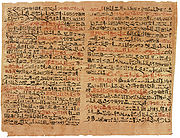 The Edwin Smith papyrus
(c. 1600 BC) is the world's oldest surviving surgical document. It is written in hieratic script and describes anatomical observations and the examination, diagnosis, treatment, and prognosis of forty-eight types of medical problems in exquisite detail.
Among the treatments described are closing wounds with sutures, preventing and curing infection
with honey
and moldy bread
(both of which are today known to contain antibiotic
s), stopping bleeding
with raw meat, and immobilization of head and spinal cord injuries. Translated in 1930, the document reveals the sophistication and practicality of ancient Egyptian medicine. Plate 6 and 7 of the papyrus, pictured here, discuss facial trauma.
 Through most of its long history, hieratic was used for writing administrative documents, accounts, legal texts, and letters, as well as mathematical, medical, literary, and religious texts. During the Graeco-Roman period, when Demotic (and later Greek
) had become the chief administrative script, hieratic was limited primarily to religious texts. In general, hieratic was much more important than hieroglyphs throughout Egypt's history, being the script used in daily life. It was also the writing system first taught to students, knowledge of hieroglyphs being limited to a small minority who were given additional training. In fact, it is often possible to detect errors in hieroglyphic texts that came about due to a misunderstanding of an original hieratic text.
Most often, hieratic script was written in ink
with a reed
brush
on papyrus
, wood, or stone and pottery ostraca
. Thousands of limestone ostraca have been found at the site of Deir al-Madinah
, revealing an intimate picture of the lives of common Egyptian workmen. Besides papyrus, stone, ceramic shards, and wood, there are hieratic texts on leather rolls, though few have survived. There are also hieratic texts written on cloth, especially on linen used in mummification
. There are some hieratic texts inscribed on stone, a variety known as lapidary
hieratic; these are particularly common on stelae from the 22nd Dynasty
.
During the late 6th Dynasty
, hieratic was sometimes incised into mud tablets with a stylus
, similar to cuneiform
. About five hundred of these tablets have been discovered in the governor's palace at Ayn Asil (Balat), and a single example from the site of Ayn al-Gazzarin, both in the Dakhla Oasis. At the time the tablets were made, Dakhla was located far from centers of papyrus
production. These tablets record inventories, name-lists, accounts, and approximately fifty letters. Of the letters, many are internal letters that were circulated within the palace and the local settlement, but others were sent from other villages in the oasis to the governor.
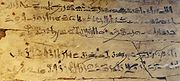 Hieratic script (unlike cursive hieroglyphs
) always reads from right to left. Initially hieratic could be written in either columns or horizontal lines, but after the 12th Dynasty
(specifically during the reign of Amenemhat III
), horizontal writing became the standard.
Hieratic is noted for its cursive nature and use of ligatures for a number of characters. Hieratic script also uses a much more standardized orthography
than hieroglyphs; texts written in the latter often had to take into account extra-textual concerns, such as decorative uses and religious concerns that were not present in, say, a tax receipt. There are also some signs that are unique to hieratic, though Egyptologists have invented equivalent hieroglyphic forms for hieroglyphic transcriptions and typesetting. Several hieratic characters have diacritical additions so that similar signs could easily be distinguished. Particularly complicated signs could be written with a single stroke.
Hieratic is often present in any given period in two forms, a highly ligatured, cursive businesshand used for administrative documents, and a broad uncial
bookhand used for literary, scientific, and religious texts. These two forms can often be significantly different from one another. Letters, in particular, used very cursive forms for quick writing, often with large numbers of abbreviations for formulaic phrases, similar to shorthand
.
A highly cursive form of hieratic known as "Abnormal Hieratic" was used in the Theban
area from the second half of the 20th dynasty
until the beginning of the 26th Dynasty
. It derives from the script of Upper Egyptian administrative documents and was used primarily for legal texts, land leases, letters, and other texts. This type of writing was superseded by Demotic—a Lower Egyptian scribal tradition—during the 26th Dynasty when Demotic was established as a standard administrative script throughout a re-unified Egypt.
, its direct descendant. Related to this are the Demotic signs of the Meroitic script
and the borrowed Demotic characters used in the Coptic alphabet
and Old Nubian
.
Outside of the Nile Valley, many of the signs used in the Byblos syllabary
were apparently borrowed from Old Kingdom
hieratic signs. It is also known that early Hebrew
used hieratic numerals
.
were typeset into fonts at an early date and the typeset used has become quite standard, hieratic being a cursive writing system has proven difficult to typeset. In 1997, Prof. Sheldon Gosline, while at the Institute for the History of Ancient Civilizations, devised an new approach to analyzing Egyptian hieratic via breaking up the component parts of each sign into brush strokes. His approach was inspired by the traditional approach to organizing Chinese scripts. The first publication that introduced this new approach presented part of a Late Egyptian
text as a teaching exercise. Soon after, Prof. Gosline founded the Hieratic Font Project and released the first in a series of reference works on hieratic.
There are several goals of the Hieratic Font Project. First is to make the study of cursive
Egyptian script more attainable. Second is to provide a scientific tool for script analysis and comparison. Third is to generate a representative set of fonts to represent hieratic script in publications. The fonts produced to date can already reproduce a wide range of handwriting styles. There are 12 basic brush strokes and the same number of related turning traces, thus each sign can be reduced to a numeric code, that also serves to describe the most likely brush stroke sequence. This illustration shows two versions of the same text. The most recent publication is concerned with Late Egyptian Letters
and the two scripts have been unified. Hieroglyphs themselves were added to the Unicode
Standard in October, 2009 with the release of version 5.2.
Cursive
Cursive, also known as joined-up writing, joint writing, or running writing, is any style of handwriting in which the symbols of the language are written in a simplified and/or flowing manner, generally for the purpose of making writing easier or faster...
writing system that was used in the provenance of the pharaohs in Egypt
Egypt
Egypt , officially the Arab Republic of Egypt, Arabic: , is a country mainly in North Africa, with the Sinai Peninsula forming a land bridge in Southwest Asia. Egypt is thus a transcontinental country, and a major power in Africa, the Mediterranean Basin, the Middle East and the Muslim world...
and Nubia
Nubia
Nubia is a region along the Nile river, which is located in northern Sudan and southern Egypt.There were a number of small Nubian kingdoms throughout the Middle Ages, the last of which collapsed in 1504, when Nubia became divided between Egypt and the Sennar sultanate resulting in the Arabization...
that developed alongside the hieroglyphic
Egyptian hieroglyphs
Egyptian hieroglyphs were a formal writing system used by the ancient Egyptians that combined logographic and alphabetic elements. Egyptians used cursive hieroglyphs for religious literature on papyrus and wood...
system, to which it is intimately related. It was primarily written in ink with a reed brush on papyrus, allowing scribes to write quickly without resorting to the time-consuming hieroglyphs.
In the 2nd century AD, the term hieratic was first used by Saint Clement of Alexandria. It derives from the Greek phrase (grammata hieratika; literally "priestly writing"), as at that time hieratic was used only for religious texts, as had been the case for the previous thousand years.
Hieratic can also be an adjective
Adjective
In grammar, an adjective is a 'describing' word; the main syntactic role of which is to qualify a noun or noun phrase, giving more information about the object signified....
meaning "[o]f or associated with sacred persons or offices; sacerdotal."
Development
In the Proto-Dynastic Period of Egypt, hieratic first appeared and developed alongside the more formal hieroglyphic script. It is an error to view hieratic as a derivative of hieroglyphic writing. Indeed, the earliest texts from Egypt are produced with ink and brush, with no indication their signs are descendants of hieroglyphs. True monumental hieroglyphs carved in stone did not appear until the 1st DynastyFirst dynasty of Egypt
The first dynasty of Ancient Egypt is often combined with the Dynasty II under the group title, Early Dynastic Period of Egypt...
, well after hieratic had been established as a scribal practice. The two writing systems, therefore, are related, parallel developments, rather than a single linear one.
Hieratic was used throughout the pharaonic period and into the Graeco-Roman Period. Around 660 BC, the Demotic script (and later Greek) replaced hieratic in most secular writing, but hieratic continued to be used by the priest
Priest
A priest is a person authorized to perform the sacred rites of a religion, especially as a mediatory agent between humans and deities. They also have the authority or power to administer religious rites; in particular, rites of sacrifice to, and propitiation of, a deity or deities...
ly class for several more centuries, at least into the 3rd century AD.
Oldest remaining surgical document
Edwin Smith papyrus
The Edwin Smith Papyrus is an Ancient Egyptian medical text and the oldest known surgical treatise on trauma. It dates to Dynasties 16-17 of the Second Intermediate Period in Ancient Egypt, ca. 1500 BCE. The Edwin Smith papyrus is unique among the four principal medical papyri in existencethat...
(c. 1600 BC) is the world's oldest surviving surgical document. It is written in hieratic script and describes anatomical observations and the examination, diagnosis, treatment, and prognosis of forty-eight types of medical problems in exquisite detail.
Among the treatments described are closing wounds with sutures, preventing and curing infection
Infection
An infection is the colonization of a host organism by parasite species. Infecting parasites seek to use the host's resources to reproduce, often resulting in disease...
with honey
Honey
Honey is a sweet food made by bees using nectar from flowers. The variety produced by honey bees is the one most commonly referred to and is the type of honey collected by beekeepers and consumed by humans...
and moldy bread
Mold
Molds are fungi that grow in the form of multicellular filaments called hyphae. Molds are not considered to be microbes but microscopic fungi that grow as single cells called yeasts...
(both of which are today known to contain antibiotic
Antibiotic
An antibacterial is a compound or substance that kills or slows down the growth of bacteria.The term is often used synonymously with the term antibiotic; today, however, with increased knowledge of the causative agents of various infectious diseases, antibiotic has come to denote a broader range of...
s), stopping bleeding
Bleeding
Bleeding, technically known as hemorrhaging or haemorrhaging is the loss of blood or blood escape from the circulatory system...
with raw meat, and immobilization of head and spinal cord injuries. Translated in 1930, the document reveals the sophistication and practicality of ancient Egyptian medicine. Plate 6 and 7 of the papyrus, pictured here, discuss facial trauma.
Uses and materials
Greek alphabet
The Greek alphabet is the script that has been used to write the Greek language since at least 730 BC . The alphabet in its classical and modern form consists of 24 letters ordered in sequence from alpha to omega...
) had become the chief administrative script, hieratic was limited primarily to religious texts. In general, hieratic was much more important than hieroglyphs throughout Egypt's history, being the script used in daily life. It was also the writing system first taught to students, knowledge of hieroglyphs being limited to a small minority who were given additional training. In fact, it is often possible to detect errors in hieroglyphic texts that came about due to a misunderstanding of an original hieratic text.
Most often, hieratic script was written in ink
Ink
Ink is a liquid or paste that contains pigments and/or dyes and is used to color a surface to produce an image, text, or design. Ink is used for drawing and/or writing with a pen, brush, or quill...
with a reed
Phragmites
Phragmites, the Common reed, is a large perennial grass found in wetlands throughout temperate and tropical regions of the world. Phragmites australis is sometimes regarded as the sole species of the genus Phragmites, though some botanists divide Phragmites australis into three or four species...
brush
Brush
A brush is a tool with bristles, wire or other filaments, used for cleaning, grooming hair, make up, painting, surface finishing and for many other purposes. It is one of the most basic and versatile tools known to mankind, and the average household may contain several dozen varieties...
on papyrus
Papyrus
Papyrus is a thick paper-like material produced from the pith of the papyrus plant, Cyperus papyrus, a wetland sedge that was once abundant in the Nile Delta of Egypt....
, wood, or stone and pottery ostraca
Ostracon
An ostracon is a piece of pottery , usually broken off from a vase or other earthenware vessel. In archaeology, ostraca may contain scratched-in words or other forms of writing which may give clues as to the time when the piece was in use...
. Thousands of limestone ostraca have been found at the site of Deir al-Madinah
Deir al-Madinah
Deir el-Medina is an ancient Egyptian village which was home to the artisans who worked on the tombs in the Valley of the Kings during the 18th to 20th dynasties of the New Kingdom period The settlement's ancient name was "Set Maat" , and the workmen who lived there were called “Servants in the...
, revealing an intimate picture of the lives of common Egyptian workmen. Besides papyrus, stone, ceramic shards, and wood, there are hieratic texts on leather rolls, though few have survived. There are also hieratic texts written on cloth, especially on linen used in mummification
Mummy
A mummy is a body, human or animal, whose skin and organs have been preserved by either intentional or incidental exposure to chemicals, extreme coldness , very low humidity, or lack of air when bodies are submerged in bogs, so that the recovered body will not decay further if kept in cool and dry...
. There are some hieratic texts inscribed on stone, a variety known as lapidary
Lapidary
A lapidary is an artist or artisan who forms stone, mineral, gemstones, and other suitably durable materials into decorative items such as engraved gems, including cameos, or cabochons, and faceted designs...
hieratic; these are particularly common on stelae from the 22nd Dynasty
Twenty-second dynasty of Egypt
The Twenty-First, Twenty-Second, Twenty-Third, Twenty-Fourth and Twenty-Fifth Dynasties of ancient Egypt are often combined under the group title, Third Intermediate Period.-Rulers:...
.
During the late 6th Dynasty
Sixth dynasty of Egypt
The sixth dynasty of ancient Egypt is often combined with Dynasties III, IV and V under the group title the Old Kingdom.-Pharaohs:...
, hieratic was sometimes incised into mud tablets with a stylus
Stylus
A stylus is a writing utensil, or a small tool for some other form of marking or shaping, for example in pottery. The word is also used for a computer accessory . It usually refers to a narrow elongated staff, similar to a modern ballpoint pen. Many styli are heavily curved to be held more easily...
, similar to cuneiform
Cuneiform script
Cuneiform script )) is one of the earliest known forms of written expression. Emerging in Sumer around the 30th century BC, with predecessors reaching into the late 4th millennium , cuneiform writing began as a system of pictographs...
. About five hundred of these tablets have been discovered in the governor's palace at Ayn Asil (Balat), and a single example from the site of Ayn al-Gazzarin, both in the Dakhla Oasis. At the time the tablets were made, Dakhla was located far from centers of papyrus
Papyrus
Papyrus is a thick paper-like material produced from the pith of the papyrus plant, Cyperus papyrus, a wetland sedge that was once abundant in the Nile Delta of Egypt....
production. These tablets record inventories, name-lists, accounts, and approximately fifty letters. Of the letters, many are internal letters that were circulated within the palace and the local settlement, but others were sent from other villages in the oasis to the governor.
Characteristics
Cursive hieroglyphs
Cursive hieroglyphs are a variety of Egyptian hieroglyphs commonly used for religious documents written on papyrus, such as the Book of the Dead. It was particularly common during the Ramesside Period and many famous documents, such as the Papyrus of Ani, utilize it...
) always reads from right to left. Initially hieratic could be written in either columns or horizontal lines, but after the 12th Dynasty
Twelfth dynasty of Egypt
The twelfth dynasty of ancient Egypt is often combined with Dynasties XI, XIII and XIV under the group title Middle Kingdom.-Rulers:Known rulers of the twelfth dynasty are as follows :...
(specifically during the reign of Amenemhat III
Amenemhat III
Amenemhat III, also spelled Amenemhet III was a pharaoh of the Twelfth Dynasty of Egypt. He ruled from c.1860 BC to c.1814 BC, the latest known date being found in a papyrus dated to Regnal Year 46, I Akhet 22 of his rule. He is regarded as the greatest monarch of the Middle Kingdom...
), horizontal writing became the standard.
Hieratic is noted for its cursive nature and use of ligatures for a number of characters. Hieratic script also uses a much more standardized orthography
Orthography
The orthography of a language specifies a standardized way of using a specific writing system to write the language. Where more than one writing system is used for a language, for example Kurdish, Uyghur, Serbian or Inuktitut, there can be more than one orthography...
than hieroglyphs; texts written in the latter often had to take into account extra-textual concerns, such as decorative uses and religious concerns that were not present in, say, a tax receipt. There are also some signs that are unique to hieratic, though Egyptologists have invented equivalent hieroglyphic forms for hieroglyphic transcriptions and typesetting. Several hieratic characters have diacritical additions so that similar signs could easily be distinguished. Particularly complicated signs could be written with a single stroke.
Hieratic is often present in any given period in two forms, a highly ligatured, cursive businesshand used for administrative documents, and a broad uncial
Uncial
Uncial is a majuscule script commonly used from the 3rd to 8th centuries AD by Latin and Greek scribes. Uncial letters are written in either Greek, Latin, or Gothic.-Development:...
bookhand used for literary, scientific, and religious texts. These two forms can often be significantly different from one another. Letters, in particular, used very cursive forms for quick writing, often with large numbers of abbreviations for formulaic phrases, similar to shorthand
Shorthand
Shorthand is an abbreviated symbolic writing method that increases speed or brevity of writing as compared to a normal method of writing a language. The process of writing in shorthand is called stenography, from the Greek stenos and graphē or graphie...
.
A highly cursive form of hieratic known as "Abnormal Hieratic" was used in the Theban
Thebes, Egypt
Thebes is the Greek name for a city in Ancient Egypt located about 800 km south of the Mediterranean, on the east bank of the river Nile within the modern city of Luxor. The Theban Necropolis is situated nearby on the west bank of the Nile.-History:...
area from the second half of the 20th dynasty
Twentieth dynasty of Egypt
The Eighteenth, Nineteenth, and Twentieth Dynasties of ancient Egypt are often combined under the group title, New Kingdom. This dynasty is considered to be the last one of the New Kingdom of Egypt, and was followed by the Third Intermediate Period....
until the beginning of the 26th Dynasty
Twenty-sixth dynasty of Egypt
The Twenty-sixth Dynasty of Egypt was the last native dynasty to rule Egypt before the Persian conquest in 525 BC . The Dynasty's reign The Twenty-sixth Dynasty of Egypt (also written Dynasty XXVI or Dynasty 26) was the last native dynasty to rule Egypt before the Persian conquest in 525 BC...
. It derives from the script of Upper Egyptian administrative documents and was used primarily for legal texts, land leases, letters, and other texts. This type of writing was superseded by Demotic—a Lower Egyptian scribal tradition—during the 26th Dynasty when Demotic was established as a standard administrative script throughout a re-unified Egypt.
Influence
Hieratic has had influence on a number of other writing systems. The most obvious is that on DemoticDemotic (Egyptian)
Demotic refers to either the ancient Egyptian script derived from northern forms of hieratic used in the Delta, or the stage of the Egyptian language following Late Egyptian and preceding Coptic. The term was first used by the Greek historian Herodotus to distinguish it from hieratic and...
, its direct descendant. Related to this are the Demotic signs of the Meroitic script
Meroitic script
The Meroitic script is an alphabetic script originally derived from Egyptian hieroglyphs, used to write the Meroitic language of the Kingdom of Meroë/Kush. It was developed in the Napatan Period , and first appears in the 2nd century BCE. For a time, it was also possibly used to write the Nubian...
and the borrowed Demotic characters used in the Coptic alphabet
Coptic alphabet
The Coptic alphabet is the script used for writing the Coptic language. The repertoire of glyphs is based on the Greek alphabet augmented by letters borrowed from the Demotic and is the first alphabetic script used for the Egyptian language...
and Old Nubian
Old Nubian language
Old Nubian is an ancient variety of Nubian, attested in writing from the 8th to the 15th century . It is ancestral to modern-day Nobiin and related to other Nubian languages such as Dongolawi. It was used throughout the medieval Christian kingdom of Makuria and its satellite Nobadia...
.
Outside of the Nile Valley, many of the signs used in the Byblos syllabary
Byblos syllabary
The Byblos syllabary, also known as the Pseudo-hieroglyphic script, Proto-Byblian, Proto-Byblic, or Byblic, is officially an undeciphered writing system, known from ten inscriptions found in Byblos. The inscriptions are engraved on bronze plates and spatulas, and carved in stone...
were apparently borrowed from Old Kingdom
Old Kingdom
Old Kingdom is the name given to the period in the 3rd millennium BC when Egypt attained its first continuous peak of civilization in complexity and achievement – the first of three so-called "Kingdom" periods, which mark the high points of civilization in the lower Nile Valley .The term itself was...
hieratic signs. It is also known that early Hebrew
Hebrew alphabet
The Hebrew alphabet , known variously by scholars as the Jewish script, square script, block script, or more historically, the Assyrian script, is used in the writing of the Hebrew language, as well as other Jewish languages, most notably Yiddish, Ladino, and Judeo-Arabic. There have been two...
used hieratic numerals
Egyptian numerals
The system of Ancient Egyptian numerals was used in Ancient Egypt until the early first millennium AD. It was a decimal system, often rounded off to the higher power, written in hieroglyphs. The hieratic form of numerals stressed an exact finite series notation, ciphered one to one onto the...
.
Hieratic Font Project
While both Egyptian hieroglyphsHieroglyphs
Hieroglyph or hieroglyphics may refer to:*Anatolian hieroglyphs*Chinese character*Cretan hieroglyphs*Cursive hieroglyphs*Dongba script*Egyptian hieroglyphs*Hieroglyphic Luwian*Mayan hieroglyphs...
were typeset into fonts at an early date and the typeset used has become quite standard, hieratic being a cursive writing system has proven difficult to typeset. In 1997, Prof. Sheldon Gosline, while at the Institute for the History of Ancient Civilizations, devised an new approach to analyzing Egyptian hieratic via breaking up the component parts of each sign into brush strokes. His approach was inspired by the traditional approach to organizing Chinese scripts. The first publication that introduced this new approach presented part of a Late Egyptian
Late Egyptian
Late Egyptian is the stage of the Egyptian language that was written by the time of the New Kingdom around 1350 BC – the Amarna period. Texts written wholly in Late Egyptian date to the Ramesside Period and later...
text as a teaching exercise. Soon after, Prof. Gosline founded the Hieratic Font Project and released the first in a series of reference works on hieratic.
There are several goals of the Hieratic Font Project. First is to make the study of cursive
Cursive
Cursive, also known as joined-up writing, joint writing, or running writing, is any style of handwriting in which the symbols of the language are written in a simplified and/or flowing manner, generally for the purpose of making writing easier or faster...
Egyptian script more attainable. Second is to provide a scientific tool for script analysis and comparison. Third is to generate a representative set of fonts to represent hieratic script in publications. The fonts produced to date can already reproduce a wide range of handwriting styles. There are 12 basic brush strokes and the same number of related turning traces, thus each sign can be reduced to a numeric code, that also serves to describe the most likely brush stroke sequence. This illustration shows two versions of the same text. The most recent publication is concerned with Late Egyptian Letters
Unicode
The Unicode standard considers Hieratic characters font variants of the Egyptian hieroglyphsHieroglyphs
Hieroglyph or hieroglyphics may refer to:*Anatolian hieroglyphs*Chinese character*Cretan hieroglyphs*Cursive hieroglyphs*Dongba script*Egyptian hieroglyphs*Hieroglyphic Luwian*Mayan hieroglyphs...
and the two scripts have been unified. Hieroglyphs themselves were added to the Unicode
Unicode
Unicode is a computing industry standard for the consistent encoding, representation and handling of text expressed in most of the world's writing systems...
Standard in October, 2009 with the release of version 5.2.
See also
- Coptic alphabetCoptic alphabetThe Coptic alphabet is the script used for writing the Coptic language. The repertoire of glyphs is based on the Greek alphabet augmented by letters borrowed from the Demotic and is the first alphabetic script used for the Egyptian language...
- Cursive hieroglyphsCursive hieroglyphsCursive hieroglyphs are a variety of Egyptian hieroglyphs commonly used for religious documents written on papyrus, such as the Book of the Dead. It was particularly common during the Ramesside Period and many famous documents, such as the Papyrus of Ani, utilize it...
- Demotic
- Egyptian hieroglyphsEgyptian hieroglyphsEgyptian hieroglyphs were a formal writing system used by the ancient Egyptians that combined logographic and alphabetic elements. Egyptians used cursive hieroglyphs for religious literature on papyrus and wood...
- Egyptian languages
- Egyptian numeralsEgyptian numeralsThe system of Ancient Egyptian numerals was used in Ancient Egypt until the early first millennium AD. It was a decimal system, often rounded off to the higher power, written in hieroglyphs. The hieratic form of numerals stressed an exact finite series notation, ciphered one to one onto the...
- Reformed EgyptianReformed EgyptianAccording to the Book of Mormon, that scripture of the Latter Day Saint movement was originally written in reformed Egyptian characters on plates of "ore" by prophets living in the Western Hemisphere from perhaps as early as 2600 BC until as late as AD 421. Joseph Smith, Jr., the founder of the...