

Ramesses I

Encyclopedia
Menpehtyre Ramesses I was the founding Pharaoh
of Ancient Egypt
's 19th dynasty
. The dates for his short reign are not completely known but the time-line of late 1292-1290 BC
is frequently cited as well as 1295-1294 BC
. While Ramesses I was the founder of the 19th Dynasty, in reality his brief reign marked the transition between the reign of Horemheb
who had stabilised Egypt in the late 18th dynasty and the rule of the powerful Pharaohs of this dynasty, in particular his son Seti I
and grandson Ramesses II
, who would bring Egypt up to new heights of imperial power.
region, perhaps near the former Hyksos
capital of Avaris
, or from Tanis
. He was a son of a troop commander called Seti
. His uncle Khaemwaset, an army officer married Tamwadjesy, the matron of the Harem of Amun
, who was a relative of Huy, the Viceroy of Kush
, an important state post. This shows the high status of Ramesses' family. Ramesses I found favor with Horemheb
, the last pharaoh of the tumultuous Eighteenth dynasty
, who appointed the former as his Vizier
. Ramesses also served as the High Priest
of Amun
– as such, he would have played an important role in the restoration of the old religion following the Amarna
heresy
of a generation earlier, under Akhenaten
.
Horemheb himself had been a nobleman from outside the immediate royal family, who rose through the ranks of the Egyptian army to serve as the royal advisor to Tutankhamun and Ay and, ultimately, Pharaoh. Since Horemheb was childless, he ultimately chose Ramesses to be his heir in the final years of his reign presumably because Ramesses I was both an able administrator and had a son (Seti I) and a grandson (the future Ramesses II
) to succeed him and thus avoid any succession difficulties.
Upon his accession, Ramesses assumed a prenomen, or royal name, which is written in Egyptian hieroglyphs to the right. When transliterated, the name is mn-pḥty-r‘, which is usually interpreted as Menpehtyre, meaning "Established by the strength of Ra
". However, he is better known by his nomen, or personal name. This is transliterated as r‘-ms-sw, and is usually realised as Ramessu or Ramesses, meaning 'Ra bore him'. Already an old man when he was crowned, Ramesses appointed his son, the later pharaoh Seti I
, to serve as the Crown Prince and chosen successor. Seti was charged with undertaking several military operations during this time– in particular, an attempt to recoup some of Egypt's lost possessions in Syria
. Ramesses appears to have taken charge of domestic matters: most memorably, he completed the second pylon
at Karnak Temple
, begun under Horemheb.
 Ramesses I enjoyed a very brief reign, as evidenced by the general paucity of contemporary monuments mentioning him: the king had little time to build any major buildings in his reign and was hurriedly buried in a small and hastily finished tomb. The Egyptian priest Manetho
assigns him a reign of 16 months, but this pharaoh certainly ruled Egypt for a minimum of 17 months based on his highest known date which is a Year 2 II Peret day 20 (Louvre C57) stela which ordered the provision of new endowments of food and priests for the temple
of Ptah
within the Egyptian fortress of Buhen. Jürgen von Beckerath observes that Ramesses I died just 5 months later—in June 1290 BC—since his son Seti I succeeded to power on III Shemu day 24. Ramesses I's only known action was to order the provision of endowments for the aforementioned Nubian temple at Buhen and "the construction of a chapel and a temple (which was to be finished by his son) at Abydos." The aged Ramesses was buried in the Valley of the Kings. His tomb, discovered by Giovanni Belzoni in 1817 and designated KV16
, is small in size and gives the impression of having been completed with haste. Joyce Tyldesley
states that Ramesses I's tomb consisted of a single corridor and one unfinished room whose
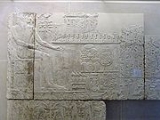
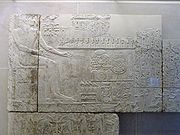
Seti I, his son, and successor, later built a small chapel with fine reliefs in memory of his deceased father Ramesses I at Abydos
. In 1911, John Pierpont Morgan donated several exquisite reliefs from this chapel to the Metropolitan Museum of Art
in New York.
. It was then placed in the Niagara Museum and Daredevil Hall of Fame
in Ontario
, Canada
. Ramesses I remained there, his identity unknown, next to other curiosities and so-called freaks of nature for more than 130 years. When the owner of the museum decided to sell his property, Canadian businessman William Jamieson purchased the contents of the museum. In 1999, Jamieson sold the Egyptian artifacts in the collection, including the various mummies, to the Michael C. Carlos Museum
at Emory University
in Atlanta, Georgia for US $2 million. His identity cannot be conclusively determined, but is persuasively deduced from CT scans, X-rays, skull measurements and radio-carbon dating tests by researchers at the University, as well as aesthetic interpretations of family resemblance. Moreover, the mummy's arms were found crossed high across his chest which was a position reserved solely for Egyptian royalty until 600 BC. His mummy was returned to Egypt on October 24, 2003 with full official honors and is on display at the Luxor Museum.
Pharaoh
Pharaoh is a title used in many modern discussions of the ancient Egyptian rulers of all periods. The title originates in the term "pr-aa" which means "great house" and describes the royal palace...
of Ancient Egypt
Ancient Egypt
Ancient Egypt was an ancient civilization of Northeastern Africa, concentrated along the lower reaches of the Nile River in what is now the modern country of Egypt. Egyptian civilization coalesced around 3150 BC with the political unification of Upper and Lower Egypt under the first pharaoh...
's 19th dynasty
Nineteenth dynasty of Egypt
The Nineteenth Dynasty of ancient Egypt was one of the periods of the Egyptian New Kingdom. Founded by Vizier Ramesses I, whom Pharaoh Horemheb chose as his successor to the throne, this dynasty is best known for its military conquests in Palestine, Lebanon, and Syria.The warrior kings of the...
. The dates for his short reign are not completely known but the time-line of late 1292-1290 BC
1290s BC
-Events and trends:* c. 1295 BC–1186 BC–Great Temple of Amun, Karnak, is built. New Kingdom.* 1292 BC—End of the Eighteenth dynasty of Egypt, start of the Nineteenth Dynasty.* 1292 BC—The coronation of Ramses I....
is frequently cited as well as 1295-1294 BC
1290s BC
-Events and trends:* c. 1295 BC–1186 BC–Great Temple of Amun, Karnak, is built. New Kingdom.* 1292 BC—End of the Eighteenth dynasty of Egypt, start of the Nineteenth Dynasty.* 1292 BC—The coronation of Ramses I....
. While Ramesses I was the founder of the 19th Dynasty, in reality his brief reign marked the transition between the reign of Horemheb
Horemheb
Horemheb was the last Pharaoh of the 18th Dynasty from either 1319 BC to late 1292 BC, or 1306 to late 1292 BC although he was not related to the preceding royal family and is believed to have been of common birth.Before he became pharaoh, Horemheb was the commander in chief...
who had stabilised Egypt in the late 18th dynasty and the rule of the powerful Pharaohs of this dynasty, in particular his son Seti I
Seti I
Menmaatre Seti I was a Pharaoh of Ancient Egypt , the son of Ramesses I and Queen Sitre, and the father of Ramesses II...
and grandson Ramesses II
Ramesses II
Ramesses II , referred to as Ramesses the Great, was the third Egyptian pharaoh of the Nineteenth dynasty. He is often regarded as the greatest, most celebrated, and most powerful pharaoh of the Egyptian Empire...
, who would bring Egypt up to new heights of imperial power.
Origins
Originally called Pa-ra-mes-su, Ramesses I was of non-royal birth, being born into a noble military family from the Nile deltaLower Egypt
Lower Egypt is the northern-most section of Egypt. It refers to the fertile Nile Delta region, which stretches from the area between El-Aiyat and Zawyet Dahshur, south of modern-day Cairo, and the Mediterranean Sea....
region, perhaps near the former Hyksos
Hyksos
The Hyksos were an Asiatic people who took over the eastern Nile Delta during the twelfth dynasty, initiating the Second Intermediate Period of ancient Egypt....
capital of Avaris
Avaris
Avaris , capital of Egypt under the Hyksos , was located near modern Tell el-Dab'a in the northeastern region of the Nile Delta, at the juncture of the 8th, 14th, 19th and 20th Nomes...
, or from Tanis
Tanis, Egypt
Tanis , the Greek name of ancient Djanet , is a city in the north-eastern Nile delta of Egypt. It is located on the Tanitic branch of the Nile which has long since silted up.-History:...
. He was a son of a troop commander called Seti
Seti (commander)
Seti or Suti was an ancient Egyptian soldier during the late 18th dynasty , the commander of the army, later mentioned as vizier on monuments of his son, Pharaoh Ramesses I....
. His uncle Khaemwaset, an army officer married Tamwadjesy, the matron of the Harem of Amun
Amun
Amun, reconstructed Egyptian Yamānu , was a god in Egyptian mythology who in the form of Amun-Ra became the focus of the most complex system of theology in Ancient Egypt...
, who was a relative of Huy, the Viceroy of Kush
Kingdom of Kush
The native name of the Kingdom was likely kaš, recorded in Egyptian as .The name Kash is probably connected to Cush in the Hebrew Bible , son of Ham ....
, an important state post. This shows the high status of Ramesses' family. Ramesses I found favor with Horemheb
Horemheb
Horemheb was the last Pharaoh of the 18th Dynasty from either 1319 BC to late 1292 BC, or 1306 to late 1292 BC although he was not related to the preceding royal family and is believed to have been of common birth.Before he became pharaoh, Horemheb was the commander in chief...
, the last pharaoh of the tumultuous Eighteenth dynasty
Eighteenth dynasty of Egypt
The eighteenth dynasty of ancient Egypt is perhaps the best known of all the dynasties of ancient Egypt...
, who appointed the former as his Vizier
Vizier (Ancient Egypt)
The vizier was the highest official in Ancient Egypt to serve the king, or pharaoh during the Old, Middle, and New Kingdoms. Vizier is the generally accepted rendering of ancient Egyptian tjati, tjaty etc, among Egyptologists...
. Ramesses also served as the High Priest
Priest
A priest is a person authorized to perform the sacred rites of a religion, especially as a mediatory agent between humans and deities. They also have the authority or power to administer religious rites; in particular, rites of sacrifice to, and propitiation of, a deity or deities...
of Amun
Amun
Amun, reconstructed Egyptian Yamānu , was a god in Egyptian mythology who in the form of Amun-Ra became the focus of the most complex system of theology in Ancient Egypt...
– as such, he would have played an important role in the restoration of the old religion following the Amarna
Amarna
Amarna is an extensive Egyptian archaeological site that represents the remains of the capital city newly–established and built by the Pharaoh Akhenaten of the late Eighteenth Dynasty , and abandoned shortly afterwards...
heresy
Heresy
Heresy is a controversial or novel change to a system of beliefs, especially a religion, that conflicts with established dogma. It is distinct from apostasy, which is the formal denunciation of one's religion, principles or cause, and blasphemy, which is irreverence toward religion...
of a generation earlier, under Akhenaten
Akhenaten
Akhenaten also spelled Echnaton,Ikhnaton,and Khuenaten;meaning "living spirit of Aten") known before the fifth year of his reign as Amenhotep IV , was a Pharaoh of the Eighteenth dynasty of Egypt who ruled for 17 years and died perhaps in 1336 BC or 1334 BC...
.
Horemheb himself had been a nobleman from outside the immediate royal family, who rose through the ranks of the Egyptian army to serve as the royal advisor to Tutankhamun and Ay and, ultimately, Pharaoh. Since Horemheb was childless, he ultimately chose Ramesses to be his heir in the final years of his reign presumably because Ramesses I was both an able administrator and had a son (Seti I) and a grandson (the future Ramesses II
Ramesses II
Ramesses II , referred to as Ramesses the Great, was the third Egyptian pharaoh of the Nineteenth dynasty. He is often regarded as the greatest, most celebrated, and most powerful pharaoh of the Egyptian Empire...
) to succeed him and thus avoid any succession difficulties.
Upon his accession, Ramesses assumed a prenomen, or royal name, which is written in Egyptian hieroglyphs to the right. When transliterated, the name is mn-pḥty-r‘, which is usually interpreted as Menpehtyre, meaning "Established by the strength of Ra
Ra
Ra is the ancient Egyptian sun god. By the Fifth Dynasty he had become a major deity in ancient Egyptian religion, identified primarily with the mid-day sun...
". However, he is better known by his nomen, or personal name. This is transliterated as r‘-ms-sw, and is usually realised as Ramessu or Ramesses, meaning 'Ra bore him'. Already an old man when he was crowned, Ramesses appointed his son, the later pharaoh Seti I
Seti I
Menmaatre Seti I was a Pharaoh of Ancient Egypt , the son of Ramesses I and Queen Sitre, and the father of Ramesses II...
, to serve as the Crown Prince and chosen successor. Seti was charged with undertaking several military operations during this time– in particular, an attempt to recoup some of Egypt's lost possessions in Syria
Syria
Syria , officially the Syrian Arab Republic , is a country in Western Asia, bordering Lebanon and the Mediterranean Sea to the West, Turkey to the north, Iraq to the east, Jordan to the south, and Israel to the southwest....
. Ramesses appears to have taken charge of domestic matters: most memorably, he completed the second pylon
Pylon (architecture)
Pylon is the Greek term for a monumental gateway of an Egyptian temple It consists of two tapering towers, each surmounted by a cornice, joined by a less elevated section which enclosed the entrance between them. The entrance was generally about half the height of the towers...
at Karnak Temple
Karnak
The Karnak Temple Complex—usually called Karnak—comprises a vast mix of decayed temples, chapels, pylons, and other buildings, notably the Great Temple of Amun and a massive structure begun by Pharaoh Ramses II . Sacred Lake is part of the site as well. It is located near Luxor, some...
, begun under Horemheb.
Death
Manetho
Manetho was an Egyptian historian and priest from Sebennytos who lived during the Ptolemaic era, approximately during the 3rd century BC. Manetho wrote the Aegyptiaca...
assigns him a reign of 16 months, but this pharaoh certainly ruled Egypt for a minimum of 17 months based on his highest known date which is a Year 2 II Peret day 20 (Louvre C57) stela which ordered the provision of new endowments of food and priests for the temple
Egyptian temple
Egyptian temples were built for the official worship of the gods and commemoration of pharaohs in Ancient Egypt and in regions under Egyptian control. These temples were seen as houses for the gods or kings to whom they were dedicated...
of Ptah
Ptah
In Ancient Egyptian Religion, Ptah was the deification of the primordial mound in the Ennead cosmogony, which was more literally referred to as Ta-tenen , meaning risen land, or as Tanen, meaning submerged land, though Tatenen was a god in his...
within the Egyptian fortress of Buhen. Jürgen von Beckerath observes that Ramesses I died just 5 months later—in June 1290 BC—since his son Seti I succeeded to power on III Shemu day 24. Ramesses I's only known action was to order the provision of endowments for the aforementioned Nubian temple at Buhen and "the construction of a chapel and a temple (which was to be finished by his son) at Abydos." The aged Ramesses was buried in the Valley of the Kings. His tomb, discovered by Giovanni Belzoni in 1817 and designated KV16
KV16
Tomb KV16, located in the Valley of the Kings in Egypt, was used for the burial of Pharaoh Ramesses I of the Nineteenth Dynasty. It was discovered by Giovanni Belzoni in October 1817....
, is small in size and gives the impression of having been completed with haste. Joyce Tyldesley
Joyce Tyldesley
Joyce Tyldesley is a British archaeologist and Egyptologist, academic, writer and broadcaster.Tyldesley was born in Bolton, Lancashire and attended Bolton School. In 1981, she earned a first-class honours degree in archaeology from Liverpool University, and a doctorate in Prehistoric Archaeology...
states that Ramesses I's tomb consisted of a single corridor and one unfinished room whose
Seti I, his son, and successor, later built a small chapel with fine reliefs in memory of his deceased father Ramesses I at Abydos
Abydos, Egypt
Abydos is one of the most ancient cities of Upper Egypt, and also of the eight Upper Nome, of which it was the capital city. It is located about 11 kilometres west of the Nile at latitude 26° 10' N, near the modern Egyptian towns of el-'Araba el Madfuna and al-Balyana...
. In 1911, John Pierpont Morgan donated several exquisite reliefs from this chapel to the Metropolitan Museum of Art
Metropolitan Museum of Art
The Metropolitan Museum of Art is a renowned art museum in New York City. Its permanent collection contains more than two million works, divided into nineteen curatorial departments. The main building, located on the eastern edge of Central Park along Manhattan's Museum Mile, is one of the...
in New York.
Rediscovery and repatriation
According to current theory, his mummy was stolen by the Abu-Rassul family of grave robbers and brought to North America around 1860 by Dr. James DouglasJames Douglas (businessman)
James S. Douglas was a Canadian mining engineer and businessman who introduced a number of metallurgical innovations in copper mining....
. It was then placed in the Niagara Museum and Daredevil Hall of Fame
The Niagara Falls Museum
Niagara Falls Museum was a museum most notable for being the oldest Canadian museum , as well as for having housed the mummy of Ramses I for 140 years before its return to Egypt in 2003...
in Ontario
Ontario
Ontario is a province of Canada, located in east-central Canada. It is Canada's most populous province and second largest in total area. It is home to the nation's most populous city, Toronto, and the nation's capital, Ottawa....
, Canada
Canada
Canada is a North American country consisting of ten provinces and three territories. Located in the northern part of the continent, it extends from the Atlantic Ocean in the east to the Pacific Ocean in the west, and northward into the Arctic Ocean...
. Ramesses I remained there, his identity unknown, next to other curiosities and so-called freaks of nature for more than 130 years. When the owner of the museum decided to sell his property, Canadian businessman William Jamieson purchased the contents of the museum. In 1999, Jamieson sold the Egyptian artifacts in the collection, including the various mummies, to the Michael C. Carlos Museum
Michael C. Carlos Museum
The Michael C. Carlos Museum is an art museum located in Atlanta on the historic quadrangle of Emory University's main campus. The Carlos Museum has the largest ancient art collections in the Southeast, including objects from ancient Egypt, Greece, Rome, the Near East, and the ancient Americas...
at Emory University
Emory University
Emory University is a private research university in metropolitan Atlanta, located in the Druid Hills section of unincorporated DeKalb County, Georgia, United States. The university was founded as Emory College in 1836 in Oxford, Georgia by a small group of Methodists and was named in honor of...
in Atlanta, Georgia for US $2 million. His identity cannot be conclusively determined, but is persuasively deduced from CT scans, X-rays, skull measurements and radio-carbon dating tests by researchers at the University, as well as aesthetic interpretations of family resemblance. Moreover, the mummy's arms were found crossed high across his chest which was a position reserved solely for Egyptian royalty until 600 BC. His mummy was returned to Egypt on October 24, 2003 with full official honors and is on display at the Luxor Museum.