


Universal power

Encyclopedia
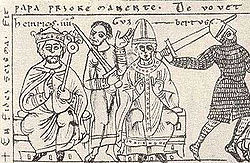
Middle Ages
The Middle Ages is a periodization of European history from the 5th century to the 15th century. The Middle Ages follows the fall of the Western Roman Empire in 476 and precedes the Early Modern Era. It is the middle period of a three-period division of Western history: Classic, Medieval and Modern...
, the term universal powers referred to the Holy Roman Emperor
Holy Roman Emperor
The Holy Roman Emperor is a term used by historians to denote a medieval ruler who, as German King, had also received the title of "Emperor of the Romans" from the Pope...
and the Pope
Pope
The Pope is the Bishop of Rome, a position that makes him the leader of the worldwide Catholic Church . In the Catholic Church, the Pope is regarded as the successor of Saint Peter, the Apostle...
. Both were struggling for the so-called Dominium mundi
Dominium mundi
Dominium mundi is an idea of universal dominion developed in the Middle Ages. Inspired by the memory of the Roman Empire, dominium mundi implied the recognition of one supreme authority, which generated a prolonged political and spiritual struggle between imperial and ecclesiastical power...
, or world dominium, in terms of political and spiritual supremacy. The emperor and the pope maintained their respective authorities through diverse factors such as territorial dispersion, low level of technic and productive development in feudal mode of production
Mode of production
In the writings of Karl Marx and the Marxist theory of historical materialism, a mode of production is a specific combination of:...
, and social and political tendency of feudalism
Feudalism
Feudalism was a set of legal and military customs in medieval Europe that flourished between the 9th and 15th centuries, which, broadly defined, was a system for ordering society around relationships derived from the holding of land in exchange for service or labour.Although derived from the...
to decentralization
Decentralization
__FORCETOC__Decentralization or decentralisation is the process of dispersing decision-making governance closer to the people and/or citizens. It includes the dispersal of administration or governance in sectors or areas like engineering, management science, political science, political economy,...
of power
Political power
Political power is a type of power held by a group in a society which allows administration of some or all of public resources, including labour, and wealth. There are many ways to obtain possession of such power. At the nation-state level political legitimacy for political power is held by the...
.
The universal powers continued into the early 19th century until the Napoleonic Wars
Napoleonic Wars
The Napoleonic Wars were a series of wars declared against Napoleon's French Empire by opposing coalitions that ran from 1803 to 1815. As a continuation of the wars sparked by the French Revolution of 1789, they revolutionised European armies and played out on an unprecedented scale, mainly due to...
. The reshaping of Europe meant the effective end of the Empire. Although the Papacy had its territorial limits confined to the Vatican
Vatican City
Vatican City , or Vatican City State, in Italian officially Stato della Città del Vaticano , which translates literally as State of the City of the Vatican, is a landlocked sovereign city-state whose territory consists of a walled enclave within the city of Rome, Italy. It has an area of...
and lost influence in international relations
International relations
International relations is the study of relationships between countries, including the roles of states, inter-governmental organizations , international nongovernmental organizations , non-governmental organizations and multinational corporations...
, it retained its spiritual influence in the contemporary world.
Origins
Given the CaesaropapismCaesaropapism
Caesaropapism is the idea of combining the power of secular government with, or making it superior to, the spiritual authority of the Church; especially concerning the connection of the Church with government. The term caesaropapism was coined by Max Weber, who defined it as follows: “a secular,...
of the Byzantine Empire
Byzantine Empire
The Byzantine Empire was the Eastern Roman Empire during the periods of Late Antiquity and the Middle Ages, centred on the capital of Constantinople. Known simply as the Roman Empire or Romania to its inhabitants and neighbours, the Empire was the direct continuation of the Ancient Roman State...
, the situation in the Western World
Western world
The Western world, also known as the West and the Occident , is a term referring to the countries of Western Europe , the countries of the Americas, as well all countries of Northern and Central Europe, Australia and New Zealand...
after the decline of the Roman Empire
Decline of the Roman Empire
The decline of the Roman Empire refers to the gradual societal collapse of the Western Roman Empire. Many theories of causality prevail, but most concern the disintegration of political, economic, military, and other social institutions, in tandem with foreign invasions and usurpers from within the...
assumed an exceptionally powerful position of the Bishop of Rome. As the only patriarch
Patriarch
Originally a patriarch was a man who exercised autocratic authority as a pater familias over an extended family. The system of such rule of families by senior males is called patriarchy. This is a Greek word, a compound of πατριά , "lineage, descent", esp...
in the Western World, his status was soon converted into that of a primate
Primate
A primate is a mammal of the order Primates , which contains prosimians and simians. Primates arose from ancestors that lived in the trees of tropical forests; many primate characteristics represent adaptations to life in this challenging three-dimensional environment...
. In addition to this spiritual power, the Bishop of Rome sought to gain temporal power over a territory held by various Germanic Kingdoms in order to make it a true theocracy
Theocracy
Theocracy is a form of organization in which the official policy is to be governed by immediate divine guidance or by officials who are regarded as divinely guided, or simply pursuant to the doctrine of a particular religious sect or religion....
. The Bishop of Rome tried to extend his territory from the city of Rome
Rome
Rome is the capital of Italy and the country's largest and most populated city and comune, with over 2.7 million residents in . The city is located in the central-western portion of the Italian Peninsula, on the Tiber River within the Lazio region of Italy.Rome's history spans two and a half...
to the whole of Italy
Italy
Italy , officially the Italian Republic languages]] under the European Charter for Regional or Minority Languages. In each of these, Italy's official name is as follows:;;;;;;;;), is a unitary parliamentary republic in South-Central Europe. To the north it borders France, Switzerland, Austria and...
and further to the whole of the Western Roman Empire
Western Roman Empire
The Western Roman Empire was the western half of the Roman Empire after its division by Diocletian in 285; the other half of the Roman Empire was the Eastern Roman Empire, commonly referred to today as the Byzantine Empire....
(in accordance with the Donation of Constantine
Donation of Constantine
The Donation of Constantine is a forged Roman imperial decree by which the emperor Constantine I supposedly transferred authority over Rome and the western part of the Roman Empire to the pope. During the Middle Ages, the document was often cited in support of the Roman Church's claims to...
). The coronation of Charlemagne
Charlemagne
Charlemagne was King of the Franks from 768 and Emperor of the Romans from 800 to his death in 814. He expanded the Frankish kingdom into an empire that incorporated much of Western and Central Europe. During his reign, he conquered Italy and was crowned by Pope Leo III on 25 December 800...
in the year 800, which began the Carolingian Empire
Carolingian Empire
Carolingian Empire is a historiographical term which has been used to refer to the realm of the Franks under the Carolingian dynasty in the Early Middle Ages. This dynasty is seen as the founders of France and Germany, and its beginning date is based on the crowning of Charlemagne, or Charles the...
, marked the appearance of a secular authority with universal claims. The two century long coexistence of the Pontiff and the Empire (regnum et sacerdocium) was difficult and yielded the Investiture Controversy
Investiture Controversy
The Investiture Controversy or Investiture Contest was the most significant conflict between Church and state in medieval Europe. In the 11th and 12th centuries, a series of Popes challenged the authority of European monarchies over control of appointments, or investitures, of church officials such...
and several different ideological formulations (the theory of the two swords
Divine Right of Kings
The divine right of kings or divine-right theory of kingship is a political and religious doctrine of royal and political legitimacy. It asserts that a monarch is subject to no earthly authority, deriving his right to rule directly from the will of God...
, Plenitutdo postestatis, Dictatus papae
Dictatus papae
Dictatus papae is a compilation of 27 axiomatic statements of powers arrogated to the Pope that was included in Pope Gregory VII's register under the year 1075. Some historians argue that it was written by Gregory VII himself; others argue that it has been inserted in the register at a later...
, condemnations of simony
Simony
Simony is the act of paying for sacraments and consequently for holy offices or for positions in the hierarchy of a church, named after Simon Magus , who appears in the Acts of the Apostles 8:9-24...
, and nicolaism). In these the Pope tried to establish the supremacy of religious authority over civil authority
Civil authority
Civil authority is that apparatus of the state other than its military units that enforces law and order. It is also used to distinguish between religious authority and secular authority...
, which has come to be called political augustinism. Meanwhile, the Emperor tried to enforce the legitimacy of his position, which claimed to come from the old Roman Empire (Translatio imperii
Translatio imperii
Translatio imperii, Latin for "transfer of rule", is a concept invented in the Middle Ages for describing history as a linear succession of transfers of imperium, that is of supreme power concentrated with a series of single rulers .-Origin:...
). In order to do this, he established his military capability to impose his territorial power and extend his power over religious life. This was done in a manner similar to that of his equivalent in the East. Both efforts fell far short of their goals.
Evolution
The division of the Carolingian Empire between the heirs of Louis the PiousLouis the Pious
Louis the Pious , also called the Fair, and the Debonaire, was the King of Aquitaine from 781. He was also King of the Franks and co-Emperor with his father, Charlemagne, from 813...
and the claims of different dynasties, such as the Ottonian and the House of Hohenstaufen, to the imperial title, debilitated the power of the emperors and subjected them to a system of election. The system of election made them dependent on a delicate game of alliances between the nobles that held the title of Prince-Elector
Prince-elector
The Prince-electors of the Holy Roman Empire were the members of the electoral college of the Holy Roman Empire, having the function of electing the Roman king or, from the middle of the 16th century onwards, directly the Holy Roman Emperor.The heir-apparent to a prince-elector was known as an...
, some laymen and others clergymen. Notwithstanding, he would periodically try to regain imperial power (Otto III
Otto III, Holy Roman Emperor
Otto III , a King of Germany, was the fourth ruler of the Saxon or Ottonian dynasty of the Holy Roman Empire. He was elected King in 983 on the death of his father Otto II and was crowned Holy Roman Emperor in 996.-Early reign:...
, Henry II
Henry II, Holy Roman Emperor
Henry II , also referred to as Saint Henry, Obl.S.B., was the fifth and last Holy Roman Emperor of the Ottonian dynasty, from his coronation in Rome in 1014 until his death a decade later. He was crowned King of the Germans in 1002 and King of Italy in 1004...
). At times this led to spectacular confrontations (Henry IV
Henry IV, Holy Roman Emperor
Henry IV was King of the Romans from 1056 and Holy Roman Emperor from 1084 until his forced abdication in 1105. He was the third emperor of the Salian dynasty and one of the most powerful and important figures of the 11th century...
, Frederick I Barbarossa
Frederick I, Holy Roman Emperor
Frederick I Barbarossa was a German Holy Roman Emperor. He was elected King of Germany at Frankfurt on 4 March 1152 and crowned in Aachen on 9 March, crowned King of Italy in Pavia in 1155, and finally crowned Roman Emperor by Pope Adrian IV, on 18 June 1155, and two years later in 1157 the term...
, Frederick II
Frederick II, Holy Roman Emperor
Frederick II , was one of the most powerful Holy Roman Emperors of the Middle Ages and head of the House of Hohenstaufen. His political and cultural ambitions, based in Sicily and stretching through Italy to Germany, and even to Jerusalem, were enormous...
). The strengthening of the power of the papacy was very important from Pope Gregory I
Pope Gregory I
Pope Gregory I , better known in English as Gregory the Great, was pope from 3 September 590 until his death...
on, and depended on the support of the monastic orders, above all the Order of Cluny
Cluny Abbey
Cluny Abbey is a Benedictine monastery in Cluny, Saône-et-Loire, France. It was built in the Romanesque style, with three churches built in succession from the 10th to the early 12th centuries....
. The constitution of many of these new kingdoms made them feudally obligated to the Pope, which liberated them from the theoretical feudal subjugation of the emperor or another king (such was the case of Portugal
Portugal
Portugal , officially the Portuguese Republic is a country situated in southwestern Europe on the Iberian Peninsula. Portugal is the westernmost country of Europe, and is bordered by the Atlantic Ocean to the West and South and by Spain to the North and East. The Atlantic archipelagos of the...
). In the territory of the Sacred Empire, the rivalry between the Guelphs, supporting the Papacy, and Ghibellines, supporting the Emperor, dominated German
Germany
Germany , officially the Federal Republic of Germany , is a federal parliamentary republic in Europe. The country consists of 16 states while the capital and largest city is Berlin. Germany covers an area of 357,021 km2 and has a largely temperate seasonal climate...
and Italian
Italy
Italy , officially the Italian Republic languages]] under the European Charter for Regional or Minority Languages. In each of these, Italy's official name is as follows:;;;;;;;;), is a unitary parliamentary republic in South-Central Europe. To the north it borders France, Switzerland, Austria and...
political life from the 12th to the 15th century.
Eventually, the authority of the Emperor was converted into something purely theoretical, lacking a strong economic or military base. He was incapable of not only standing up to the feudal monarchies definitively free of all subordination Rex superiorem non recognoscens in regno suo est Imperator (Decretal Per Venerabilem by Innocent III, 1202), but to his own territorial princes or Italian city-states. The papal authority also decayed. The Crusades
Crusades
The Crusades were a series of religious wars, blessed by the Pope and the Catholic Church with the main goal of restoring Christian access to the holy places in and near Jerusalem...
, advocated by the pope, did not give him more control of the briefly conquered territories in the Holy Land
Holy Land
The Holy Land is a term which in Judaism refers to the Kingdom of Israel as defined in the Tanakh. For Jews, the Land's identifiction of being Holy is defined in Judaism by its differentiation from other lands by virtue of the practice of Judaism often possible only in the Land of Israel...
, the European kingdoms, or of the new religious orders. With the Avignon Papacy
Avignon Papacy
The Avignon Papacy was the period from 1309 to 1376 during which seven Popes resided in Avignon, in modern-day France. This arose from the conflict between the Papacy and the French crown....
and the Western Schism
Western Schism
The Western Schism or Papal Schism was a split within the Catholic Church from 1378 to 1417. Two men simultaneously claimed to be the true pope. Driven by politics rather than any theological disagreement, the schism was ended by the Council of Constance . The simultaneous claims to the papal chair...
, the French Monarchy subjugated the Papacy to its control. This further weakened the Pope's power and undermined the intimidating power of excommunication
Excommunication
Excommunication is a religious censure used to deprive, suspend or limit membership in a religious community. The word means putting [someone] out of communion. In some religions, excommunication includes spiritual condemnation of the member or group...
, which had been greatly feared.
The production of theoretical arguments on the theme of universal power, on the other hand, continued and included contributions such as those of Marsilius of Padua
Marsilius of Padua
Marsilius of Padua Marsilius of Padua Marsilius of Padua (Italian Marsilio or Marsiglio da Padova; (circa 1275 – circa 1342) was an Italian scholar, trained in medicine who practiced a variety of professions. He was also an important 14th century political figure...
, Defensor Pacis or William of Ockham
William of Ockham
William of Ockham was an English Franciscan friar and scholastic philosopher, who is believed to have been born in Ockham, a small village in Surrey. He is considered to be one of the major figures of medieval thought and was at the centre of the major intellectual and political controversies of...
, Eight Questions about the Authority of the Pope (1342) and De imperatorum et pontificum potestate (1347). Such works continued to undermine the universal ambitions of both authorities and were produced by the most important authors of the scholasticism crisis. The scholasticism crisis debated the adoption and extension of new legal ideas taken from Roman Law
Roman law
Roman law is the legal system of ancient Rome, and the legal developments which occurred before the 7th century AD — when the Roman–Byzantine state adopted Greek as the language of government. The development of Roman law comprises more than a thousand years of jurisprudence — from the Twelve...
, with the jus commune
Jus commune
Jus commune or ius commune is Latin for "common law" in certain jurisdictions. It is often used by civil law jurists to refer to those aspects of the civil law system's invariate legal principles, sometimes called "the law of the land" in English law...
of the School of Bologna on one side and conciliarism
Conciliarism
Conciliarism, or the conciliar movement, was a reform movement in the 14th, 15th and 16th century Roman Catholic Church which held that final authority in spiritual matters resided with the Roman Church as a corporation of Christians, embodied by a general church council, not with the pope...
of the Counsel of Florence on the other.
End
Both universal powers entered the Modern AgeModern Age
Modern Age is an American conservative academic quarterly journal, founded in 1957 by Russell Kirk in close collaboration with Henry Regnery...
very debilitated, although their power continued to be notable. They tried to recoup what was lost. These attempts, however, proved unsuccessful, as in the cases of the emperor Charles V
Charles V, Holy Roman Emperor
Charles V was ruler of the Holy Roman Empire from 1519 and, as Charles I, of the Spanish Empire from 1516 until his voluntary retirement and abdication in favor of his younger brother Ferdinand I and his son Philip II in 1556.As...
and the pontiffs of the Renaissance
Renaissance
The Renaissance was a cultural movement that spanned roughly the 14th to the 17th century, beginning in Italy in the Late Middle Ages and later spreading to the rest of Europe. The term is also used more loosely to refer to the historical era, but since the changes of the Renaissance were not...
(Alexander VI and Julius II), whose ambitions proved impossible, especially after the Protestant Reformation
Protestant Reformation
The Protestant Reformation was a 16th-century split within Western Christianity initiated by Martin Luther, John Calvin and other early Protestants. The efforts of the self-described "reformers", who objected to the doctrines, rituals and ecclesiastical structure of the Roman Catholic Church, led...
. The reality that was imposed during the Ancien Régime was that of new authoritarian monarchies (such as the Catholic Monarchy
Catholic Monarchs
The Catholic Monarchs is the collective title used in history for Queen Isabella I of Castile and King Ferdinand II of Aragon. They were both from the House of Trastámara and were second cousins, being both descended from John I of Castile; they were given a papal dispensation to deal with...
) that evolved towards absolutism
Absolute monarchy
Absolute monarchy is a monarchical form of government in which the monarch exercises ultimate governing authority as head of state and head of government, his or her power not being limited by a constitution or by the law. An absolute monarch thus wields unrestricted political power over the...
(as in France
France
The French Republic , The French Republic , The French Republic , (commonly known as France , is a unitary semi-presidential republic in Western Europe with several overseas territories and islands located on other continents and in the Indian, Pacific, and Atlantic oceans. Metropolitan France...
) or towards the bourgeois revolutions (as in the Netherlands with the Dutch Revolt
Dutch Revolt
The Dutch Revolt or the Revolt of the Netherlands This article adopts 1568 as the starting date of the war, as this was the year of the first battles between armies. However, since there is a long period of Protestant vs...
and in England
England
England is a country that is part of the United Kingdom. It shares land borders with Scotland to the north and Wales to the west; the Irish Sea is to the north west, the Celtic Sea to the south west, with the North Sea to the east and the English Channel to the south separating it from continental...
with the English Civil War
English Civil War
The English Civil War was a series of armed conflicts and political machinations between Parliamentarians and Royalists...
). In 1648 the Treaty of Westphalia definitively supplanted the role of the universal powers and brought about modern, secularized
Secularization
Secularization is the transformation of a society from close identification with religious values and institutions toward non-religious values and secular institutions...
international relations
International relations
International relations is the study of relationships between countries, including the roles of states, inter-governmental organizations , international nongovernmental organizations , non-governmental organizations and multinational corporations...
based on pragmatism
Pragmatism
Pragmatism is a philosophical tradition centered on the linking of practice and theory. It describes a process where theory is extracted from practice, and applied back to practice to form what is called intelligent practice...
and the prominence of states
Sovereign state
A sovereign state, or simply, state, is a state with a defined territory on which it exercises internal and external sovereignty, a permanent population, a government, and the capacity to enter into relations with other sovereign states. It is also normally understood to be a state which is neither...
. Even within Catholic countries, the theory that only monarch could grant royalties
Royalties
Royalties are usage-based payments made by one party to another for the right to ongoing use of an asset, sometimes an intellectual property...
effectively limited the pontifical power.
The 19th century was the end of both universal powers as territorial entities: the Sacro Imperio was formally abolished by Napoleon Bonaparte, who created his own empire, and although Napoleon's empire was defeated, the Holy Roman Empire was not restored in the redrawing of the European map following the Congress of Vienna
Congress of Vienna
The Congress of Vienna was a conference of ambassadors of European states chaired by Klemens Wenzel von Metternich, and held in Vienna from September, 1814 to June, 1815. The objective of the Congress was to settle the many issues arising from the French Revolutionary Wars, the Napoleonic Wars,...
(1814–1815). The territories recuperated by the Habsburg dynasty were transformed into a multinational state, first as the Austrian Empire
Austrian Empire
The Austrian Empire was a modern era successor empire, which was centered on what is today's Austria and which officially lasted from 1804 to 1867. It was followed by the Empire of Austria-Hungary, whose proclamation was a diplomatic move that elevated Hungary's status within the Austrian Empire...
and later as a dual monarchy, the Austro-Hungarian Empire, which lasted until 1918. Additionally, the leadership of Prussia
Prussia
Prussia was a German kingdom and historic state originating out of the Duchy of Prussia and the Margraviate of Brandenburg. For centuries, the House of Hohenzollern ruled Prussia, successfully expanding its size by way of an unusually well-organized and effective army. Prussia shaped the history...
in the recently created German Confederation
German Confederation
The German Confederation was the loose association of Central European states created by the Congress of Vienna in 1815 to coordinate the economies of separate German-speaking countries. It acted as a buffer between the powerful states of Austria and Prussia...
brought about the constitution of the Second German Empire in 1871.
Simultaneously, the relations of the Pope with the French Revolution
French Revolution
The French Revolution , sometimes distinguished as the 'Great French Revolution' , was a period of radical social and political upheaval in France and Europe. The absolute monarchy that had ruled France for centuries collapsed in three years...
and Napoleon, as with ideological liberalism
Liberalism
Liberalism is the belief in the importance of liberty and equal rights. Liberals espouse a wide array of views depending on their understanding of these principles, but generally, liberals support ideas such as constitutionalism, liberal democracy, free and fair elections, human rights,...
itself, oscillated between direct opposition and forced coexistence. In 1860, the new Kingdom of Italy
Kingdom of Italy (1861–1946)
The Kingdom of Italy was a state forged in 1861 by the unification of Italy under the influence of the Kingdom of Sardinia, which was its legal predecessor state...
, formed by the Kingdom of Piedmont-Sardinia, conquered the Papal States'
Papal States
The Papal State, State of the Church, or Pontifical States were among the major historical states of Italy from roughly the 6th century until the Italian peninsula was unified in 1861 by the Kingdom of Piedmont-Sardinia .The Papal States comprised territories under...
territorial base (called Marche
Marche
The population density in the region is below the national average. In 2008, it was 161.5 inhabitants per km2, compared to the national figure of 198.8. It is highest in the province of Ancona , and lowest in the province of Macerata...
) in the center of Italy. The Kingdom of Italy did not take Rome itself, however, until 1871 when the Second French Empire
Second French Empire
The Second French Empire or French Empire was the Imperial Bonapartist regime of Napoleon III from 1852 to 1870, between the Second Republic and the Third Republic, in France.-Rule of Napoleon III:...
of Napoleon III withdrew its garrison in Rome which had served to protect the Papal States. The Pope's rejection of the situation and the voluntary confinement of the popes in the Vatican continued until the Lateran Pacts of 1929 with the Italian fascist Benito Mussolini
Benito Mussolini
Benito Amilcare Andrea Mussolini was an Italian politician who led the National Fascist Party and is credited with being one of the key figures in the creation of Fascism....
.
Since then, the efforts of the Pope in the international scene and in the internal business of Catholic countries have transcended the territorial dimensions of the Vatican City, demonstrating that the religious dimension is very decisive. It has also shown that what has come to be called soft power
Soft power
Soft power is the ability to obtain what one wants through co-option and attraction. It can be contrasted with 'hard power', that is the use of coercion and payment...
, though subtle, can be effective because of its moral, ideological, and cultural weight. A calculation attributed to Joseph Stalin
Joseph Stalin
Joseph Vissarionovich Stalin was the Premier of the Soviet Union from 6 May 1941 to 5 March 1953. He was among the Bolshevik revolutionaries who brought about the October Revolution and had held the position of first General Secretary of the Communist Party of the Soviet Union's Central Committee...
, which translated the effective power of the pope into divisions, makes this clear.
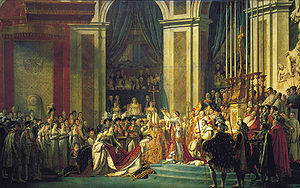
Perseverance of the term
The name of "empireEmpire
The term empire derives from the Latin imperium . Politically, an empire is a geographically extensive group of states and peoples united and ruled either by a monarch or an oligarchy....
" has been applied to types of political entities that have not had a universal function (theocratic or Caesaropapist), but to those with a global, secularized one. This has been possible in geostrategic
Geostrategy
Geostrategy, a subfield of geopolitics, is a type of foreign policy guided principally by geographical factors as they inform, constrain, or affect political and military planning...
terms for the first time since the coming about of a global economy. Although the first empires to form (the Portuguese Empire
Portuguese Empire
The Portuguese Empire , also known as the Portuguese Overseas Empire or the Portuguese Colonial Empire , was the first global empire in history...
and Spanish Empire
Spanish Empire
The Spanish Empire comprised territories and colonies administered directly by Spain in Europe, in America, Africa, Asia and Oceania. It originated during the Age of Exploration and was therefore one of the first global empires. At the time of Habsburgs, Spain reached the peak of its world power....
in the 16th century) in their day did not refer to themselves as empires, (the Spanish self defined, in providentialist
Providentialism
Providentialism is a belief that God's will is evident in all occurrences. It can further be described as a belief that the power of God is so complete that humans cannot equal His abilities, or fully understand His plan...
terms, as the Catholic Monarchy), the name typically has been applied by historiography
Historiography
Historiography refers either to the study of the history and methodology of history as a discipline, or to a body of historical work on a specialized topic...
(which applies "empire" to any political form of the past with multinational dimensions: Turk Empire
Göktürks
The Göktürks or Kök Türks, were a nomadic confederation of peoples in medieval Inner Asia. Known in Chinese sources as 突厥 , the Göktürks under the leadership of Bumin Qaghan The Göktürks or Kök Türks, (Old Turkic: Türük or Kök Türük or Türük; Celestial Turks) were a nomadic confederation of...
, Mongol Empire
Mongol Empire
The Mongol Empire , initially named as Greater Mongol State was a great empire during the 13th and 14th centuries...
, Inca Empire
Inca Empire
The Inca Empire, or Inka Empire , was the largest empire in pre-Columbian America. The administrative, political and military center of the empire was located in Cusco in modern-day Peru. The Inca civilization arose from the highlands of Peru sometime in the early 13th century...
).
Consequently, this is done to the Russian Empire
Russian Empire
The Russian Empire was a state that existed from 1721 until the Russian Revolution of 1917. It was the successor to the Tsardom of Russia and the predecessor of the Soviet Union...
, which claimed to be a third Rome
New Rome
The term "New Rome" has been used in the following contexts:* "Nova Roma" is traditionally reported to be the Latin name given by emperor Constantine the Great to the new imperial capital he founded in 324 at the city on the European coast of the Bosporus strait, known as Byzantium until then and...
after the fall of Constantinople
Fall of Constantinople
The Fall of Constantinople was the capture of the capital of the Byzantine Empire, which occurred after a siege by the Ottoman Empire, under the command of Ottoman Sultan Mehmed II, against the defending army commanded by Byzantine Emperor Constantine XI...
in 1453 (the title Czar is derived from Caesar
Caesar (title)
Caesar is a title of imperial character. It derives from the cognomen of Julius Caesar, the Roman dictator...
).
The term is also applied to the overseas territorial possessions of the European states:
- the British EmpireBritish EmpireThe British Empire comprised the dominions, colonies, protectorates, mandates and other territories ruled or administered by the United Kingdom. It originated with the overseas colonies and trading posts established by England in the late 16th and early 17th centuries. At its height, it was the...
- justified by the Hindu RajRajRaj and Rajya mean "royalty" or "kingdom" in many Sanskrit and Hindu languages, and may refer to:- Indian history :*British Raj, the British Empire in India...
who made Queen Victoria empress of India - the French EmpireFranceThe French Republic , The French Republic , The French Republic , (commonly known as France , is a unitary semi-presidential republic in Western Europe with several overseas territories and islands located on other continents and in the Indian, Pacific, and Atlantic oceans. Metropolitan France...
- that of the first Napoleon and that of the Third, although the name continued to be used for the colonies of the Third Republic - the Italian EmpireItalian EmpireThe Italian Empire was created after the Kingdom of Italy joined other European powers in establishing colonies overseas during the "scramble for Africa". Modern Italy as a unified state only existed from 1861. By this time France, Spain, Portugal, Britain, and the Netherlands, had already carved...
- that Mussolini sought in Africa
Analogously, the name "empire" is also used to refer to non-European entities, such as the Chinese Empire
History of China
Chinese civilization originated in various regional centers along both the Yellow River and the Yangtze River valleys in the Neolithic era, but the Yellow River is said to be the Cradle of Chinese Civilization. With thousands of years of continuous history, China is one of the world's oldest...
and the Japanese Empire, or give the title of emperor to those like the Negus
Negus
Negus is a title in Ge'ez, Tigrinya, Tigre and Amharic, used for a king and at times also a vassal ruler in pre-1974 Ethiopia and pre-1890 Eritrea. It is subsequently used to translate the word "king" in Biblical and other literature...
of Ethiopia
Ethiopia
Ethiopia , officially known as the Federal Democratic Republic of Ethiopia, is a country located in the Horn of Africa. It is the second-most populous nation in Africa, with over 82 million inhabitants, and the tenth-largest by area, occupying 1,100,000 km2...
, the Shah
Shah
Shāh is the title of the ruler of certain Southwest Asian and Central Asian countries, especially Persia , and derives from the Persian word shah, meaning "king".-History:...
of Persia, and the Sultan
Sultan
Sultan is a title with several historical meanings. Originally, it was an Arabic language abstract noun meaning "strength", "authority", "rulership", and "dictatorship", derived from the masdar سلطة , meaning "authority" or "power". Later, it came to be used as the title of certain rulers who...
of Morocco
Morocco
Morocco , officially the Kingdom of Morocco , is a country located in North Africa. It has a population of more than 32 million and an area of 710,850 km², and also primarily administers the disputed region of the Western Sahara...
. In most cases, this is a "diplomatic courtesy." Since the Cold War
Cold War
The Cold War was the continuing state from roughly 1946 to 1991 of political conflict, military tension, proxy wars, and economic competition between the Communist World—primarily the Soviet Union and its satellite states and allies—and the powers of the Western world, primarily the United States...
, it has also been common to refer to the two rival superpowers as the American Empire and the Soviet Empire.
See also
- Guelphs and GhibellinesGuelphs and GhibellinesThe Guelphs and Ghibellines were factions supporting the Pope and the Holy Roman Emperor, respectively, in central and northern Italy. During the 12th and 13th centuries, the split between these two parties was a particularly important aspect of the internal policy of the Italian city-states...
- Investiture ControversyInvestiture ControversyThe Investiture Controversy or Investiture Contest was the most significant conflict between Church and state in medieval Europe. In the 11th and 12th centuries, a series of Popes challenged the authority of European monarchies over control of appointments, or investitures, of church officials such...
- Cesaropapism
- TheocracyTheocracyTheocracy is a form of organization in which the official policy is to be governed by immediate divine guidance or by officials who are regarded as divinely guided, or simply pursuant to the doctrine of a particular religious sect or religion....
- Translatio imperiiTranslatio imperiiTranslatio imperii, Latin for "transfer of rule", is a concept invented in the Middle Ages for describing history as a linear succession of transfers of imperium, that is of supreme power concentrated with a series of single rulers .-Origin:...
- Dictatus papaeDictatus papaeDictatus papae is a compilation of 27 axiomatic statements of powers arrogated to the Pope that was included in Pope Gregory VII's register under the year 1075. Some historians argue that it was written by Gregory VII himself; others argue that it has been inserted in the register at a later...