
All Topics  
Royalties


   Email Print
   Bookmark   Link


Royalties


Royalties (sometimes, running royalties) are usage-based payments made by one party (the "licensee") to another (the "licensor") for ongoing use of an asset, sometimes an intellectual propertyIntellectual property

In law, intellectual property is an umbrella term for various legal entitlements which attach to certain types of informati...
 (IP) right.

Royalties can be determined as a percentage of gross or net sales derived from use of the asset or a fixed price per unit sold. but there are also other modes and metrics of compensation. A royalty interest is the right to collect a stream of future royalty payments, often used in the oil industry and music industryMusic industry

The music industry is the industry that creates, performs, promotes, and preserves music....
 to describe a percentage ownership of future production or revenues from a given leaseholdLeasehold

Leasehold is a form of property tenure where one party buys the right to occupy land or a building for a given length of tim...
, which may be divested from the original owner of the asset.

License agreements

A license agreement defines the terms under which a resource or property such as petroleumPetroleum

Petroleum or crude oil is a black, dark brown or greenish liquid found in porous rock formations in the earth....
, minerals, patentPatent

A patent is a set of exclusive rights granted by a state to a patentee for a fixed period of time in exchange for the regul...
s, trademarkTrademark

A trademark, trade mark, ' or ' is a distinctive sign of some kind which is used by a business to uniquely...
s, and copyrightCopyright

Copyright is a set of exclusive rights regulating the use of a particular expression of an idea or information....
s are licenseLicense

To grant license or licence is to give permission....
d by one party to another, either without restriction or subject to a limitation on term, business or geographic territory, type of product, etc. License agreements can be regulated, particularly where a government is the resource owner, or they can be private contracts that follow a general structure. However, certain types of franchiseFranchising

Franchising is a method of doing business wherein a franchisor licenses trademarks and tried and proven metho...
 agreements have comparable provisions.

Non-renewable resource royalties

The owner of petroleum and mineral resources may licence a party to extract those resources, paying a resource rentResource rent

Resource rent is an economic term of abnormal or supernormal profit which derives from the exploitation of natural resources...
, or a royalty on the value or the resultant profits. Where a governmentGovernment Summary

A government is a body that has the authority to make and the power to enforce laws within a civil, corporate, religious, a...
 is the owner of the resource the terms of the licence and the royalty rate are typically legislated or regulated. An example from CanadaCanada

Canada is the world's second-largest country by total area, occupying most of northern North America....
's North is the federalFederal

Federal may refer to:*Federal, an adjective describing federalism or a federation...
 frontier landsFrontier Lands

Frontier lands are Crown owned lands in Canada's North and offshore areas not under the jurisdiction of a federal/provincial...
 petroleum royalty regime. The royalty rate is determined as an incremental rate from 1-5% of gross revenues until costs have been recovered, at which point the royalty rate increases to 30% of net revenues or 5% of gross revenues. In this manner risks and profits are shared between the Government of Canada as resource owner and the petroleum developer. This attractive royalty rate is intended to encourage oil and gas exploration in the remote Canadian frontier lands where costs and risks are higher than other locations.

Patent royalties

A patentFacts About Patent

A patent is a set of exclusive rights granted by a state to a patentee for a fixed period of time in exchange for the regul...
 gives the owner an exclusive rightExclusive right

In Anglo-Saxon law, an exclusive right is a de facto, non-tangible prerogative existing in law to perform an action or acqui...
 to prevent others from practicing the patented technology in the country issuing the patent for the term of the patentTerm of patent

The term of a patent is the maximum period during which it can be maintained into force....
. The right may be enforced in a lawsuit for monetary damagesMonetary damages

Monetary damages, in civil law, refers to compensation given to an injured party by a liable party....
 or to prohibit use of the patent. In a patent license, royalties are paid to the patent owner in exchange for a licenseLicense

To grant license or licence is to give permission....
 to practice one or more of the four basic patent rights: to manufacture, use, sale, or advertise for sale, a patented technology.

Patent rights may be divided and licensed out in various ways, on an exclusive or nonexclusive basis. The license may be subject to limitations as to time or territory. A license may encompass an entire technology or it may involve a mere component or improvement on a technology. In the United States, "reasonable" royalties may be imposed, both after-the-fact and prospectively, by a court as a remedy for infringementFacts About Infringement

Infringement, when used alone, has several possible meanings in the English language....
.

Know-how royalties

In addition to licensing the applicable patents, a company may need to learn how to manufacture a product. This knowledge, standing alone or together with a patent license, may be obtained through a know-how license. Know-how is trade secretTrade secret

A trade secret is a formula, practice, process, design, instrument, pattern, or compilation of information used by a busines...
 information in combination with data, techniques, or human and intellectual expertise, that helps a company exploit a licensed technology. Know-how may help a company achieve better operational efficiency, manufacturing productivity, or product/system quality. Know-how royalties may be stated as distinct from patent royalties since their periods of validity vary. The rates vary widely.

Trademark royalties

Trademarks are words, logos, slogans, sounds, or other distinctive expressions that distinguish the source, origin, or sponsorship of a good or service (in which they are generally known as service markService mark

In some countries, notably the United States, a trademark used to identify a service rather than a product is called a service ...
s). Trademarks offer the public a means of identifying and assuring themselves of the quality of the good or service. They may bring consumers a sense of security, integrity, belonging, and a variety of intangible appeals. The value that inures to a trademark in terms of public recognition and acceptance is known as goodwill.

A trademark right is an exclusive right to sell or market under that mark within a geographic territory. The rights may be licensed to allow a company other than the owner to sell goods or services under the mark. A company may seek to license a trademark it did not create in order to achieve instant name recognitionName recognition Overview

Name recognition is a concept used in politics to describe number of people who are aware of a politician....
 rather than accepting the cost and risk of entering the market under its own brand that the public does not necessarily know or accept. Licensing a trademark allows the company to take advantage of already-established goodwill and brand identification.

Like patent royalties, trademark royalties may be assessed and divided in a variety of different ways, and are expressed as a percentage of sales volume or income, or a fixed fee per unit sold. When negotiating rates, one way companies value a trademark is to assess the additional profit they will make from increased sales and higher prices (sometimes known as the "relief from royalty") method.

Trademark rights and royalties are often tied up in a variety of other arrangements. Trademarks are often applied to an entire brandBrand

A brand is a collection of images and ideas representing an economic producer; more specifically, it refers to the concrete ...
 of products and not just a single one. Because trademark law has as a public interest goal the protection of a consumer, in terms of getting what they are paying for, trademark licenses are only effective if the company owning the trademark also obtains some assurance in return that the goods will meet its quality standards. When the rights of trademark are licensed along with a know-how, supplies, pooled advertising, etc., the result is often a franchiseFranchising

Franchising is a method of doing business wherein a franchisor licenses trademarks and tried and proven metho...
 relationship. Franchise relationships may not specifically assign royalty payments to the trademark license, but may involve monthly fees and percentages of sales, among other payments.

Copyright royalties

Copyright law gives the owner the right to prevent others from copying, creating derivative workDerivative work

In copyright law, a derivative work is an artistic creation that includes major, basic copyrighted aspects of an original, p...
s, or publicly performing their works. Copyrights, like patent rights, can be divided in many different ways, by the right implicated, by specific geographic or market territories, or by more specific criteria. Each may be the subject of a separate license and royalty arrangements.

Copyright royalties are often very specific to the nature of work and field of endeavor. With respect to music, royalties for performance rights in the United States are set by the Library of CongressLibrary of Congress

The Library of Congress is the de facto national library of the United States and the research arm of the United States ...
' Copyright Royalty BoardCopyright Royalty Board

The Copyright Royalty Board is a U.S....
. Mechanical rightsMechanical license

A mechanical license gives the holder permission to create copies of a recorded song which they did not write and/or do not ...
 to recordingRecording

Historical records of events have been made for thousands of years in one form or another....
s of a performance are usually managed by one of several performance rights organizations. Payments from these organizations to performing artistArtist Overview

Artist is a descriptive term applied to a person who engages in an activity deemed to be an art....
s are known as residualsResidual (entertainment industry)

A residual is a payment made to the creator of performance art for subsequent showings or screenings of the work....
. Royalty free musicRoyalty free music

Royalty-free music commonly refers to stock or 'library music' licensed for a single fee, without the need to pay any subseq...
 provides more direct compensation to the artists. In 1999, recording artists formed the Recording Artists' CoalitionFacts About Recording Artists' Coalition

The Recording Artists' Coalition is an American music industry organization that represents recording artists, and attempts...
 to repeal supposedly "technical revisions" to American copyright statutes which would have classified all "sound recordings" as "works for hire," effectively assigning artists' copyrights to record labelRecord label

In the music industry, a record label is a brand and a trademark associated with the marketing of sound recordings and music...
s.

Book authorAuthor

An author is the person who creates a written work, such as a book, story, article, or the like, whether short or long, fict...
s may sell their copyrightCopyright

Copyright is a set of exclusive rights regulating the use of a particular expression of an idea or information....
 to the publisherPublishing

Publishing is the industry concerned with the production and dissemination of literature or information – the activity of ma...
. Alternately, they might receive as a royalty a certain amount per book sold.

Some photographerPhotographer

A photographer is a person who takes a photograph using a camera....
s and musicianMusician

A musician is a person who plays or composes music....
s may choose to publish their works for a one-time payment. This is known as a royalty-free license.

Other royalty arrangements

The term 'royalty' also covers areas outside of IP and technology licensing, such as oil, gas, and mineral royalties paid to the owner of a property by a resources development company in exchange for the right to exploit the resource. In a business project the promoter, financier, LHS enabled the transaction but are no longer actively interested may have a royalty right to a portion of the income, or profits, of the business. This sort of royalty is often expressed as a contract right to receive money based on a royalty formula, rather than an actual ownership interest in the business. In some businesses this sort of royalty is sometimes called an override.

Other compensation modes

Royalties are only one among many ways of compensating owners for use of an asset. Others include:
  • buying the asset outright, possibly with a leasebackFacts About Leaseback

    Leaseback property is a type of finance transaction. ...
     arrangement
  • offering the licensor an equityEquity

    Equity is the name given to the set of legal principles, in countries following the English common law tradition , which sup...
     position in the licensee company
  • staged milestoneMilestone

    A milestone or kilometre sign is one of a series of numbered markers placed along a road at regular intervals, typical...
     payments (as in drug developmentDrug development

    Drug Development or Preclinical Development is defined in many pharmaceutical companies as the process of taking a new...
     and commissioned software arrangements)
  • lump sumLump sum

    Lump sum is a one-time payment of money....
     payment made to the licensor in one or more installments
  • cross-licensingCross-licensing

    In patent law, a cross-licensing agreement is an agreement according to which two parties grant a license to each other for ...
     agreements with or without cash payments , and
  • entering into a strategic allianceStrategic alliance

    A Strategic Alliance is a mutually beneficial long-term formal relationship formed between two or more parties to pursue a s...
    .


In discussing the licensing of IP, the terms valuationIntellectual property valuation

Valuation is considered as one of the most critical areas in finance; it plays a key role in many areas of finance such as buy/sel...
and evaluation need to be appreciated.

Evaluation is the process of assessing a license in terms of the specific metrics of a particular negotiation, which may include its circumstances, the geographical spread of licensed rights, product range, market width, licensee competitiveness, growth prospects, etc.

On the other hand, valuation is the fair market valueFair market value Overview

Fair Market Value is a term in both law and accounting to describe an appraisal based on an estimate of what a buyer would p...
 (FMV)of the asset - trademark, patent or know-how - at which it can be sold between a willing buyer and willing seller in the context of best awareness of circumstances. The FMV of the IP, where assessable, may itself be a metric for evaluation.

If an emerging company is listed on the stock marketStock market

A stock market is a market for the trading of company stock, and derivatives of same; both of these are securities listed on...
, the market valueMarket capitalization

Market capitalization, often abbreviated to market cap, is a measurement of corporate size that refers to the current ...
 of its intellectual property can be estimated from the data of the balance sheetBalance sheet

A balance sheet, in formal bookkeeping and accounting, is a statement of the book value of a business or other organization ...
 using the equivalence:

Market Capitalization = Net Working CapitalWorking capital

Working capital is a valuation metric that is calculated as current assets minus current liabilities....
 + Net Fixed AssetsFixed asset

Fixed asset, also known as property, plant, and equipment, is a term used in accountancy for assets and property which...
 + Routine Intangible AssetsFacts About Intangible asset

Intangible assets are defined as assets that are not physical in nature....
 + IP

where the IP is the residual after deducting the other components from the market valuation of the stock. One of the most significant intangibles may be the work-force.

The method may be quite useful for valuing trademarks of a listed company if it is mainly or the only IP in play (franchising companies).

Approaches to Royalty Rate: Intellectual Property

The rate of royalty applied in a given case is determined by various factors, the most notable of which are:

  • market drivers and demand structure
  • territorial extent of rights
  • exclusivity of rights
  • level of innovation and stage of development (see The Technology Life CycleThe Technology Life Cycle

    The Technology Life Cycle is an important tool...
    )
  • sustainability of the technology
  • degree and competitive availability of other technologies
  • inherent risk
  • strategic need
  • the portfolio of rights negotiated
  • fundability
  • deal-reward structure (negotiation strength)


To correctly gauge royalty rates, the following criteria must be taken into consideration:

* the transaction is at "arms-length"
* there is a willing buyer and a willing seller
* the transaction is not under compulsion

Approaches to Royalty Rate Determination and Illustrative Royalties

There are three general approaches to assess the applicable royalty rate in the licensing of intellectual property. They are:

1. The Cost Approach
2. The Comparable Market Approach
3. The Income Approach

For a fair evaluation of the royalty rate, the relationship of the parties to the contract should:

- be at 'arms-length' (related parties such as the subsidiary and the parent
company need to transact as though they were independent parties)
- be viewed as acting free and without compulsion

The Cost Approach

The Cost Approach considers all the elements of cost that have been employed to create the intellectual property and to seek a royalty rate that will recapture the expense of its development and obtain a return that is commensurate with its expected life. Costs considered could include R&D expenditures, pilot-plant and test-marketing costs, technology upgrading expenses, patent applicationPatent application Summary

A patent application is a request pending at a patent office for the grant of a patent for the invention described and claim...
  expenditure and the like.

The method has limited utility since the technology is not priced competitively on 'what the market can bear' principles or in the context of the price of similar technologies. More importantly, by lacking optimization (through additional expense), it may earn below its potential.

However, the method may be appropriate when a technology is licensed out during its R&D phase as happens with venture capitalVenture capital

Venture capital is capital provided by somewhat outside investors for financing of new, growing or struggling businesses....
 investments or it is licensed out during one of the stages of clinical trialClinical trial

In medicine, a clinical trial is a research study. ...
s of a pharmaceutical.

In the former case, the venture capitalist obtains an equity position in the company (developing the technology) in exchange for financing a part of the development cost (recovering it, and obtaining an appropriate margin, when the company gets acquired or it goes public through the IPO route).

Recovery of costs, with opportunity of gain, is also feasible when development can be followed stage-wise as shown below for a pharmaceutical undergoing clinical trials (the licensee pays higher royalties for the product as it moves through the normal stages of its development):

Success State of development Royalty rates,% Nature
------------------------------------------- ----------------------
Pre-clinical success 0-5 in-vitro
Phase I (safety) 5-10100 healthy people
Phase II (efficacy) 8-15300 subjects
Phase III (effectiveness) 10-20several thousand patients
Launched product 20+ regulatory body approval

A similar approach is used when custom softwareCustom software

Custom software is a type of software developed either for a specific organization or function that differs from other alrea...
 is licensed (an in-license). The product is accepted on a royalty schedule depending on the software meeting set stage-wise specifications with acceptable error levels in performance tests.

The Comparable Market Approach

Here the cost and the risk of development are disregarded. The royalty rate is determined from comparing competing or similar technologies in an industry, modified by considerations of useful 'remaining life' of the technology in that industry and contracting elements such as exclusivity provisions, front-end royalties, field of use restrictions, geographic limitations and the 'technology bundle' (the mix of patents, know-how, trade-mark rights, etc.) accompanying it.

Although widely used, the prime difficulty with this method is obtaining access to data on comparable technologies and the terms of the agreements that incorporate them. Fortunately, there are several recognized organizations, among them, RoyaltySource, Royaltystat, Knowledge Express, etc (see 'Royalty Rate Websites' listed at the end of this article) who have comprehensive information on both royalty rates and the principal terms of the agreements of which they are a part. There are also IP-related organizations, such as the Licensing Executives Society, which enable its members to access and share privately assembled data.

The two tables shown below are drawn, selectively, from information that is available with an IP-related organization and on-line. The first depicts the range and distribution of royalty rates in agreements. The second shows the royalty rate ranges in select technology sectors (latter data sourced from: Dan McGavock of IPC Group, Chicago, USA).

Royalty Distribution Analysis in Industry
Industry Licenses (nos.) Min. Royalty,% Max. Royalty,% Average,% Median,%
Automotive 35 1.0 15.0 4.7 4.0
Computers 68 0.2 15.0 5.2 4.0
Consumer Gds 90 0.0 17.0 5.5 5.0
Electronics 132 0.5 15.0 4.3 4.0
Healthcare 280 0.1 77.0 5.8 4.8
Internet 47 0.3 40.0 11.7 7.5
Mach.Tools. 84 0.5 26 5.2 4.6
Pharma/Bio 328 0.1 40.0 7.0 5.1
Software 119 0.0 70.0 10.5 6.8


Royalty Rate Segmentation in Some Technology Sectors
Industry 2-2% 2-5% 5-10% 10-15% 15-20% 20-25%
Aerospace 50% 50%    
Chemical 16.5% 58.1% 24.3% 0.8% 0.4% 
Computer 62.5% 31.3% 6.3%   
Electronics  50.0% 25.0% 25.0%  
Healthcare 3.3% 51.7% 45.0%   
Pharmaceuticals 23.6% 32.1% 29.3% 12.5% 1.1% 0.7%
Telecom 40.0% 37.3% 23.6%   


Commercial sources also provide information that is invaluable for making comparisons. The following table provides typical information that is obtainable, for instance, from Royaltystat:

Sample License Parameters


Reference: 7787 Effective Date: 10/01/1998
SIC Code: 2870 SEC Filed Date: 07/26/2005
SEC Filer: Eden Bioscience Corp Royalty Rate: 2.000 (%)
SEC Filing: 10-Q Royalty Base: Net Sales
Agreement Type: Patent Exclusive: Yes
Licensor: Cornell Research Foundation, Inc.
Licensee: Eden Bioscience Corp.
Lump-Sum Pay: Research support is $150,000 for 1 year.
Duration: 17 year(s)
Territory: Worldwide
Coverage : Exclusive patent license to make, have made, use and sell products incorporating biological materialBiological material

Biological material may refer to:...
s, including genes, proteins and peptide fragments, expression systems, cells, and antibodies, for the field of plant disease


The comparability between transactions requires a comparison of the significant economic conditions that may affect the contracting parties:

- similarity of geographies
- relevant date
- same industry
- market size and its economic development;
contracting or expanding markets
- market activity: whether wholesale, retail, other
- relative market shares of contracting entities
- location-specific costs of production and distribution
- competitive environment in each geography
- fair alternatives to contracting parties

The Income Approach

The Income approach focuses on Todd the licensor estimating the profits generated by the licensee and obtaining an appropriate share of the generated profit. It is unrelated to costs of technology development or the costs of competing technologies.

The approach requires the licensee (or licensor): (a) to generate a cash-flow projection of incomes and expenses over the life-span of the license under an agreed scenario of incomes and costs (b) determining the Net Present ValueNet present value

Net present value is a standard method for evaluating competing long-term projects in capital budgeting....
, NPV of the profit stream, based on a selected discount factorDiscount

In finance and economics, discounting is the process of finding the present value of an amount of cash at some future date, ...
, and c) negotiating the division of such profit between the licensor and the licensee.

The NPV of a future income is always lower than its current value because an income in the future is attended by risk. In other words, an income in the future needs to be discounted, in some manner, to obtain its present equivalent. The factor by which a future income is reduced is known as the 'discount rate'. Thus, $1.00 received a year from now is worth $0.9091 at a 10% discount rateDiscount rate

The discount rate is different from a more normal interest rate....
, and its discounted value will be still lower two years down the line.

The actual discount factor used depends on the risk assumed by the principal gainer in the transaction. For instance, a mature technology worked in different geographies, will carry a lower risk of non-performance (thus, a lower discount rate) than a technology being applied for the first time. A similar situation arises when there is the option of working the technology in one of two different regions; the risk elements in each region would be different.

The method is treated in greater detail, using illustrative data, in Royalty AssessmentRoyalty rate assessment

Royalty rate assessment is a practical tool to gauge the impact of a royalty commitment in a technology contract to the busi...
.

The licensor's share of the income is usually set by the '25% rule of thumb', which is said to be even used by tax authorities in the US and Europe for arms-length transactions. The share is on the operating profit of the licensee firm. Even where such division is held contentious, the rule can still be the starting point of negotiations.

Three aspects to the profit of the enterprise must be noted:

the profit that accrues to the licensee may not arise solely through the engine of the technology. There are returns from the mix of assets it employs such as fixed and working capital and the returns from intangible assets such as distribution systems, trained workforce, etc. Allowances need to be made for them.

(b) profits are also generated by thrusts in the general economy, gains from infrastructure, and the basket of licensed rights - patents, trademark, know-how. A lower royalty rate may apply in an advanced country where large market volumes can be commanded, or where protection to the technology is more secure than in an emerging economy (or perhaps, for other reasons, the inverse).


the royalty rate is only one aspect of the negotiation. Contractual provisions such as an exclusive license, rights to sub-license, warranties on the performance of technology etc may enhance the advantages to the licensee, which is not compensated by the 25% metric.

The basic advantage of this approach, which is perhaps the most widely applied, is that the royalty rate can be negotiated without comparative data on how other agreements have been transacted. In fact, it is almost ideal for a case where precedent does not exist.

It is, perhaps, relevant to note that the IRS also uses these three methods, in modified form, to assess the attributable income, or division of income, from a royalty-based transaction between a US company and its foreign subsidiary. (since US lawLaw of the United States

The law of the United States was originally largely derived from the common law of the system of English law, which was in f...
 requires that a foreign subsidiary pay an appropriate royalty to the parent companyHolding company Summary

A holding company or parent company is a company that owns enough voting stock in another firm to control management a...
).

Patent royalty rates

Patent royalty rates are influenced by the importance of the patent and its value to the products. Some realms of business have conventions regarding royalty rates and other license terms. Royalties are often computed as a percentage of the value of the finished product made by using the patent. To illustrate, the following are prevalent rates within the United States pharmaceutical industry:

  • a pending patent on a strong business planBusiness plan

    A business plan is a summary of how a business owner, manager, or entrepreneur intends to organize an entrepreneurial endeav...
    , royalties of the order of 1%
  • issued patent, 1%+ to 2%
  • the pharmaceutical with pre-clinical testing, 2-3%
  • with clinical trials, 3-4%
  • proven drug with US FDA approval, 5-7%
  • drug with market shareMarket share

    Market share, in strategic management and marketing, is the percentage or proportion of the total available market or market...
    , 8-10%


Royalty rates may also be affected by whether a patent is strong (i.e. broadly written, seemingly valid) or weak; whether it is a fundamental patent or merely a slight improvement on a known technology; whether substitute technologies are available or an ability to work around the patent; the extent of the contribution of the patented technology to the value of the final product and whether there are other patents that must also be licensed (in which case there is a practical limit on how much royalty can be paid to license each).

With regards to the actual rates of royalty payments in the industry, the Licensing Economics Review , , reported in 2002 that in a review of 458 license agreements, over a 16-year period, it found that an average royalty rate of 7.0%. However, the range extended from zero percent to 50 percent. All of these agreements may not have been at 'arms length'.

Trademark royalty rates

In a long-running dispute involving the valuation of the DHL trademark of DHL Corporation, it was reported that experts employed by the IRS surveyed a wide range of businesses and found a broad range of royalties for trademark use from a low of 0.7% to a high of 15%.

Music Royalties

Unlike other forms of intellectual property, music royalties have a strong linkage to individuals - composers (score), songwriters (lyrics) and writers of musical plays - in that they can own the exclusive copyright to created music and can license it for performance independent of corporates. Recording companies and the performing artists that create a 'sound recording' of the music enjoy a separate set of royalties from the sale of recordings and from their digital transmission (depending on national laws).

With the advent of pop music and major innovations in technology in the communication and presentations of media, the subject of music royalties has become a complex field with considerable change in the making.

A musical compositionMusical composition

Musical composition is:* an original piece of music...
 obtains protection in copyright law immediate to its reduction to tangible form - a score on paper or a taping; but it is not protected from infringed use unless registered with the copyright authority; for instance, the Copyright Office in the United States, administered by the Library of CongressLibrary of Congress

The Library of Congress is the de facto national library of the United States and the research arm of the United States ...
. No person or entity, other than the copyright owner, can use or employ the music for gain without obtaining a license from the composer/songwriter.

Inherently, as copyright, it confers on its owner, a distinctive 'bundle' of five exclusive rights:

(a) to make copies of the songs through print or recordings
(b) to distribute them to the public for profit
(c) to the 'public performance right'; live or through a recording
(d) to create a derivative work to include elements of the original music; and
(e) to 'display' it (not very relevant in context).

Where the score and the lyric of a composition are contributions of different persons, each of them is an equal owner of such rights.

These exclusivities have led to the evolution of distinct commercial terminology used in the music industry.

They take four forms:
(1) royalties from 'print rights'
(2) mechanical royalties from the recording of composed music on, CDs and tape
(3) performance royalties from the performance of the compositions/songs on stage or television through artists and bands, and
(4) synch (for synchronization) royalties from using or adapting the musical score in the movies, television advertisements, etc. and


With the advent of the internet, an additional set of royalties has come into play : the digital rights from simulcasting, webcasting, streaming, downloading, and online "on-demand service".

In the following the terms 'composer' and 'songwriter' (either lyric or score) are synonymous.

Mechanical Royalties

The term 'mechanical' and mechanical licenseMechanical license

A mechanical license gives the holder permission to create copies of a recorded song which they did not write and/or do not ...
 has its origins in the 'piano rolls' on which music was recorded in the early part of the 20th Century. Although its concept is now primarily oriented to royalty incomeRoyalty income

#REDIRECT Royalties ...
 from sale of CDs, its scope is wider and covers any copyrighted audio composition that is rendered mechanically, i.e. without human performers:

*tape recordings
*music videos
*ringtones
*MIDI files
*downloaded tracks
*DVDs, VHS, UMDs
*computer games
*musical toys etc.

The United States treatment of mechanical royalties is in sharp contrast to international practice.

In the United States, while the right to use copyrighted music for making records for public distribution (for private use) is an exclusive right of the composer, the Copyright ActCopyright Act Summary

Several countries have laws named Copyright Act:...
 provides that once the music is so recorded, anyone else can record the composition/song without a negotiated license but on the payment of the statutory compulsory royalty. Thus, its use by different artists could lead to several separately-owned copyrighted 'sound recordings'.

The following is a partial segment of the compulsory rates as they have applied from 1998 to 2007 in the United States . The royalty rates in the table comprise of two elements: (i) a minimum rate applies for a duration equivalent to 5 minutes, or less, of a musical composition/song and (ii) a per-minute rate if the composition exceeds it, whichever is greater.

Compulsory Mechanical Royalty Rates - United States
Period Royalty Rate
01-01-1998 - 12-31-1999 7.10 cents or 1.35 cents/min
01-01-2000 - 12-31-2001 7.55 cents or 1.43 cents/min
01-01-2002 - 12-31-2003 8.00 cents or 1.55 cents/min
01-01-2004 - 12-31-2005 8.50 cents or 1.65 cents/min
01-01-2006 - 12-31-2007 9.10 cents or 1.75 cents/min


In the predominant case, the composer assigns the song copyright to a publishing company under a 'co-publishing agreement' which makes the publisher a co-owner of the composition (the composer may also be the publisher). The publisher's role is to promote the music by extending the written music to recordings of vocal, instrumental and orchestral arrangements and to administer the collection of royalties (which, as will shortly be seen, is in reality done by specialized companies). The publisher also licenses 'subpublishers' in other countries to similarly promote the music and administer the collection of royalties.

Normally, of every 100 units of currency that flows to the publisher gets divided as follows: 50 units go to the songwriter and 50 units to the publisher. However, the music writer obtains a further 25 units from the publisher's share (as a co-publisher). In effect, the co-publishing agreement is a 75/25 share of royalties in favor of the songwriter if administrative costs of publishing are disregarded. This is near international practice.

When a company (recording label) records the composed music, say, on a CD master, it obtains a distinctly separate copyright to the sound recording, with all the exclusivities that flow to such copyright. The main obligation of the recording label to the songwriter and her publisher is to pay the contracted royalties on the license received.

While the compulsory rates remain unaffected, recording companies, in the US, will, typically, negotiate to pay not more than 75% of the compulsory rate where the songwriter is also the recording artist . and will further (in the US) extend that to a maximum of 10 songs, even though the marketed recording may carry more than that number. This 'reduced rate' results from the incorporation of a "controlled composition" clause in the licensing contract since the composer as recording artist is seen to control the content of the recording.

Mechanical royalties for music produced outside of the United States are negotiated - there being no compulsory licensingCompulsory license

In a compulsory license, the government forces the holder of a patent, copyright, or other exclusive right to grant use to t...
 - and royalty payments to the composer and her publisher for recordings are based on the wholesale, retail, or 'suggested retail value' of the marketed CDs.

Recording artists earn royalties only from the sale of CDs and tapes and, as will be seen later, from sales arising from digital rightsDigital rights Overview

The term "Digital Rights" is indicative of the freedom of individuals to perform actions involving the use of a computer, electron...
. Where the song-writerSongwriter

A songwriter is someone who writes the lyrics to songs, the musical composition or melody to songs, or both....
 is also the recording artist, royalties from CD sales add to those from the recording contractFacts About Recording contract

A recording contract is a legal agreement between a record label and a recording artist, where the artist makes a record for...
.

In the US, recording artists earn royalties amounting to 10%-25% (of the suggested retail priceSuggested retail price Summary

The suggested retail price, list price or recommended retail price of a product is the price the manufacturer re...
 of the recording (http://www.ascap.com/musicbiz/money-recording.html) depending on their popularity but such is before deductions for 'packaging', 'breakage','promotion sales' and holdback for 'returns', which act to significantly reduce net royalty incomes.

In the US, the Harry Fox AgencyHarry Fox Agency

The Harry Fox Agency is one of the main US agencies for collecting and distributing licence fees on behalf of music publishe...
, HFA, is the predominant licensor, collector and distributor for mechanical royalties, although there are several small competing organizations. For its operations, it charges about 6% as commission. HFA, like its counterparts in other countries, is a state-approved quasi-monopoly and is expected to act in the interests of the composers/song-writers - and thus obtains the right to audit record company sales.

In the U.K. the Mechanical-Copyright Protection SocietyMechanical-Copyright Protection Society

The Mechanical-Copyright Protection Society is the United Kingdom body responsible for collecting and distributing royalties...
, MCPS (now in alliance with PRS), acts to collect (and distribute) royalties to composers, songwriters and publishers for CDs and for digital formats. It is a not-for-profit organizationNon-profit organization

A nonprofit organization is an organization whose primary objective is to support some issue or matter of private interest o...
 which funds its work through a commissions on aggregate revenues. The royalty rate for licensing tracks is 6.5 per cent of retail price (or 8.5 per cent of the published wholesale price.

In Europe, the major licensing and mechanical royalty collection societies are:

SACEMSociété des auteurs, compositeurs et éditeurs de musique

Soci?t? des auteurs, compositeurs et ?diteurs de musique is a French professional association collecting payments of artist...
 in France (http://www.sacem.fr/portailSacem/jsp/ep/home.do?tabId=0)
GEMA (http://www.gema.de/) in Germany, and
SFA in Italy (http://www.scfitalia.it/webnew/).


SACEM acts collectively for 'francophone' countries in Africa. The UK society also has strong links with English-speaking African countries.

Mechanical societies for other countries can be found at:
http://www.bemuso.com/musicbiz/collectionsocieties.html#themainnationalcollectionsocieties


The mechanical royalty rate paid to the publisher in Europe is about 6.5% on the PPD (Published Price to Dealers.

Record companies are responsible for paying royalties to those artists who have performed for a recording based on for the sale of CDs sold through stores and on-line.

Performance Royalties

‘Performance’ in the music industry can include any of the following:

*a performance of a song or composition — live, recorded or broadcast
*a live performance by any musician
*a performance by any musician through a recording on physical media
*performance through the playing of recorded music
*music performed through the web (digital transmissions)


It is useful to treat these royalties under two classifications:

those associated with conventional forms of music distribution which have prevailed for most part of the 20th Century, and
those from emerging 'digital rights' associated with newer forms of communication, entertainment and media technologies (from 'ring tones' to 'downloads' to 'live internet streaming'.
Conventional Forms of Royalty Payment
In the conventional context, royalties are paid to composers and publishers and record labels for public performances of their music on vehicles such as the jukebox, stage, radio or TV. Users of music need to obtain a ‘performing rights license’ from music societies - as will be explained shortly - to use the music. Performing rights extend both to live and recorded music played in such diverse areas as cafés, skating rinks, etc.

Licensing is generally done by music societies called ‘Performing Rights Organizations’ (PROs), some of which are government-approved or government-owned, to which the composer, the publisher, performer (in some cases) or the record label have subscribed.

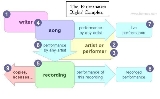
The diagram on the right titled 'The Performance Rights Complex' (Courtesy http://www.bemuso.com) shows the general sequences by which a song or a composition gets to be titled a 'performance' and which brings royalties to song-writers/publishers, performing artists and record labels. How, and to whom, royalties are paid is different in the United States from what it is, for example, in the UK. Most countries have practices more in common with the UK than the US.

In the United Kingdom there are three principal organizations:

PPL (for Phonographic Performance Ltd)
PRS (for Performing Rights Society), and
MCPS (for Mechanical Copyright Protection Society)

who license music (to music-users) and act as royalty collection and distribution agencies for their members.

PPL(http://www.ppluk.com/) - claimed to be the largest in the world - issues performance licenses to all UK radio, TV and broadcast stations, as also to such diverse users as clubs and bars who employ sound recordings (tapes, CDs), in entertaining the public and collects and distributes royalties to the record label for the sound recording and to featured UK performers in the recording. Performers do not earn from sound recordings on video and film.

PRS, which is now in alliance with MCPS, (http://www.mcps-prs-alliance.co.uk/Pages/default.aspx) collects royalties from music-users and distributes them directly to song-writers and publishers whose works are performed live, radio or on TV on a 50:50 basis. MCPS licenses music for broadcast in the range 3– 5.25% of net advertising revenues

MCPS also collects and disburses mechanical royalties to writers and publishers in a manner similar to PRS. Although allied, they serve, for now, as separate organizations for membership.

The next diagram (Courtesy: http://www.bemuso.com) shows the sequences in the licensing of performances and the royalty collection and distribution process in the UK. Every song or recording has a unique identity by which they are licensed and tracked. Details of songs or recordings are notified to the PROs directly, or through Catco, an electronic tracking system. It needs to be clarified that while blanket licenses are commonly issued to music-users, the latter are responsible for 'usage returns' - the actual frequency of performances under the license - which then becomes the basis for the PRO to apportion royalties to writers, publishers and record labels.(DIY 'indies' are 'do-it-yourself' independent song-writers (and, often, the performers as well) who record and publish under their own labels).

In the UK., music is licensed (and royalties 'paid on it) at the track level.

There is also a separate organization, VPL (http://www.vpluk.com), in the UK, which is the collecting society set up by the record industry in 1984 to grant licences to users of music videos, e.g. broadcasters, program-makers, video jukebox system suppliers. The licensing income collected from users is paid out to the society's members after deduction of administrative costs.

There are different models for royalty collection in the European countries. In some of them, mechanical and performing rights are administered jointly. SACEM (France), SABAM (Belgium), GEMA (Germany) and JASRAC (Japan) work that way.

In the United States, on the other hand, the ASCAPAmerican Society of Composers, Authors, and Publishers

The American Society of Composers, Authors, and Publishers is an organization known as a performing right organization that...
, BMI (Broadcast Music, Inc) and SESACSESAC

SESAC, originally the Society of European Stage Authors & Composers, is the smallest of three performing rights organi...
 (Society of European Stage Authors & Composers) are the three principal Performance Rights Organizations (PROs), although smaller societies exist. The royalty that is paid to the composer and publisher is determined by the method of assessment used by the PRO to gage the utilization of the music, there being no external metrics as in mechanical royalties or the reporting system used in the UK. Very basically, a PRO aggregates the royalties that are due to all of the composers/songwriters who are its members and each composer and publisher is paid royalties based on the assessed frequency of the music’s performance, post deductions of charges (which are many). The PROs are audited agencies. They directly pay the songwriter and the publisher their respective shares. (If part of the publisher's share is retained by the songwriter, the publisher pays the songwriter that part of the publisher's share).

Typically, the PRO negotiates blanket licenses with radio stations, television networks and other ‘music users', each of whom receives the right to perform any of the music in the repertoire of the PRO for a set sum of money.

PROs use different types of surveys to determine the frequency of usage of a composition/song. ASCAP uses random samplingSampling (statistics)

Sampling is that part of statistical practice concerned with the selection of individual observations intended to yield some...
, SESAC utilizes cue sheets for TV performances and ‘digital pattern recognition’ for radio performances while BMI employs more scientific methods.

It is to noted that in the United States only the composer and the publisher are paid performance royalties and not performing artists (digital rights being a different matter). Likewise, the record label, whose music is used in a performance, is not entitled to royalties in the US on the premise that performances lead sales of records.

Where a performance has co-writers along with the composer/songwriter - as in a musical play - they will share the royalty.
UK Legislation
The United Kingdom adopted the European Copyright Directive EUCDEUCD

EUCD may refer to:* EU Copyright Directive...
 in 2003 and the meaning of broadcast performance was broadened to cover “communicating to the public”. This then included music distribution through the internet and the transmission of ringtones to mobiles. Thus a music download was a copy of proprietary music and hence required to be licensed.

After a prolonged battle on royalties between online music companies such as AOL, Napster and the recording companies (but not all of them), represented by the British Phonographic Industry, and organizations representing the interests of songwriters (MCPS and PRS) a compromise was reached, leading to a subsequent 3-year interim legislation (2007) adopted by the UK Copyright Tribunal under the Copyright, Designs and Patents Act, . The legislation, referring to a new JOL (Joint Online License), applies only to music purchased within UK.

The applicable royalties are given in the Table below which, interestingly, also includes music downloads and music services through mobile devices. This path-breaking legislation is expected to become the model for EU (which is yet to develop comprehensive legislation), and perhaps even extend to the US.

Note that the new legislation includes the distinction between downloads of musical tracks from iTunes and other stores, which were considered 'sales' and the webcasts considered 'performances'.

In brief, the compromise reached is that songwriters will receive 8% of gross revenues (definition follows), less VATVat

Vat may refer to:* a type of barrel used for storage....
, as royalty for each track downloaded bridging the demand of the artists demanding a 12% royalty rate (what was, otherwise, the norm for a CD) and music companies holding out for 6.5%, slightly higher than the 5.7% paid for a 79p track sold by iTunes . A minimum of four pence will be paid, in the new legislation, if tracks are discounted.

The terms used in the legislated Table are explained following it.

Digital Royalties - Interim Settlement, United Kingdom - 2007
Service Royalty Rate Minimum
Permanent Download 8% £0.04 per download - reducing by degrees for larger bundles of tracks, or certain older tracks, to £0.02 (in respect of a bundle 0f 30 tracks+)
Limited Download or On Demand Service 8%Mobile subscription: £0.60/subscriber/month
PC subscription: £0.40/subscriber/month
Limited Subscription: £0.20/subscriber/month
All others: £0.0022 per musical work communicated to the public
Special Webcasting
(premium or interactive
service where 50%+ of
content is by single
band/artist)
8% Subscription: £0.0022 per musical work (if not subscription);
if the service is subscription, minimum to be negotiated
Premium or interactive webcasting 6.5% Subscription: £0.22/subscriber/month;otherwise, £0.00085 per musical work communicated to the public
Pure webcasting 6.5% Subscription £0.22/subscriber/month; otherwise 0.0006/musical work communicated to the public


Service Royalty Rate and Minimum
Mobile or Permanent downloads and other mobile servicesRates and minima as per services above, except that: For mobile Permanent Downloads, revenue is reduced by 15%
For all other Mobile services revenue is reduced by 7.5%

The above reductions to apply until prices converge with non-mobile services.


It should be noted that not all music providers in the UK were part of the compromise that led to the legislation. For those not participating - principally, AOL, Yahoo and RealNetworks - the Tribunal set the royalty rate for pure webcasting at 5.75%.

UK legislation recognizes the term online as referring to downloading digital files from the internet and mobile network operators. Offline is the term used for the delivery of music through physical media such as a CD or a DVD,

A stream is a file of continuous music listened to through a consumer’s receiving device with no playable copy of the music remaining.

Permanent Downloads are transfers (sale) of music from a website to a computer or mobile telephone for permanent retention and use whenever the purchaser wishes, analogous to the purchase of a CD.

A Limited Download is similar to a permanent
download but differs from it in that the consumer’s use of the copy is in some
way restricted by associated technology; for instance, becomes unusable when the subscription ends ( say, through an encoding , such as DRMDRM

The acronym DRM can stand for:*Data Reference Model - US federal guidelines for computer data standards...
, of the downloaded music).

On demand streaming is music streamed to the listener on the computer or mobile to enable her to listen to the music once, twice or a number of times during the period of subscription to the service.

Pure Webcasting is where the user receives a stream of pre-programmed music chosen by the music service provider. It is non-interactive to the extent that even pausing or skipping of tracks is not possible.

Premium and Interactive Webcasting are personalized subscription services intermediate between pure webcasting and downloading.

Special webcasting is a service where the user can choose a stream of music, the majority of which comprises works from one source – an artist, group or particular concert.

Simulcasting, although not in the Table above, is the simultaneous re-transmission by a licensed transmission of the program of a radio or TV station over the internet of an otherwise traditional broadcast. The person receiving the simulcast normally makes no permanent copy of it. It is defined in the legislation as an offline service.

’Gross Revenue’, which is comprehensively defined in the legislation, summarized here, means, all revenue received (or receivable) by the licensee from Users, all revenue received through advertisements associated with the music service, sponsorship fees,commissions from third parties and revenue arising from barter or contra deals. No deductions are permitted except for refunds of unused music due to technical faults.

The advertising revenue which is shared between the artist and music provider is defined as:

  • when the advertising is in-stream;
  • when the music offered forms the only content of a page featuring advertising (excluding the advert itself); and
  • when the music offered forms more than 75% of a page featuring advertising (excluding the advert itself).

Synchronization Royalties

The term synchronizationFacts About Synchronization

Synchronization is a problem in timekeeping which requires the coordination of events to operate a system in unison....
 comes from the early days of the talkies when music was first synchronized with film. The terminology originated in US industry but has now spread worldwide.

Because it would be impractical to join music to film or images without making a “copy” of the music, it is clear that some sort of license is needed – but the legal argument is difficult to construct. In the UK and elsewhere, with the exception of the US,, there is apparently no legal prohibition to the combination of audio and visual images and no explicit statutory right for the collection of synch royalties. In the US, however, the Copyright Act defines the audiovisual format as that of combining images with music for use in machines but there is no explicit rate set such as the ‘compulsory royalty rate’ for copying music but there are instances of courts implying the synchronization right (http://www.clintons.co.uk/?news_id=38,fuller version at http://www.ca9.uscourts.gov/ca9/newopinions.nsf/6128717C16DB42D8882573C400597DC7/$file/0655102.pdf?openelement) but even so it is an amorphous colloquial commercial term of acceptance.

Synchronization royalties('synch licenses') are paid
for the use of copyrighted music in (largely) audiovisual productions, such as in DVDs, movies, and advertisements. Music used in news tracks are also synch licenses. Synchronization can extend to live media performances, such as plays and live theatre. They become extremely important for new media - the usage of music in the form of mp3MP3 Overview

MPEG-1 Audio Layer 3, more commonly referred to as MP3, is a popular digital audio encoding and lossy compression form...
, wavWAV

WAV , short for Waveform audio format, is a Microsoft and IBM audio file format standard for storing audio on PCs....
, flacFLAC

FLAC, an acronym for Free Lossless Audio Codec, is a popular file format for audio compression....
 files and for usage in webcasts, embedded media in microchips (e.g. karaokeKaraoke

Karaoke is a form of entertainment in which an amateur singer or singers sing along with recorded music on microphone....
), etc but the legal conventions are yet to be drawn.

Synchronization royalties are due to the composer/song-writer or her publisher. They are strictly contractual in nature and vary greatly in amount depending on the subjective importance of the music, the mode of production and the media used. The royalty payable is that of mutual acceptance but is conditioned by industry practice.

It is useful to note in this connection the concept of the ‘needle drop’ (now laser drop) in that the synch royalty becomes payable every time the needle drops 'on the record player' in a public performance! All openings and closings, every cut to advertisements, every cut back from ads, all re-runs shown by every TV company, in every country in the world generates a 'synchro', although a single payment may be renegotiable in advance.

A sample of a UK synchro contract can be seen at http://i.current.com/pdf/music_sync_uk.pdf

It might be noted that there is a category of royalty-free music in the field of synchronization. This refers to the use of music in a ‘library’ for which a one-time royalty has been negotiated. It is an alternative to needle-drop negotiation.

In terms of numbers, royalties can range from, say. $500-2000 for a "festival-use license" to $250,000 or more for a movie film score. For low budget films, which are deemed less than $2 million, the royalties range from 3%-6% (http://www.musesmuse.com/pubart.html) or it could be per song per usage.

See also

  • Advance against royaltiesAdvance against royalties

    In the field of intellectual property licensing, an advance against royalties is a payment made by the licensee to the licen...
  • Intellectual propertyIntellectual property

    In law, intellectual property is an umbrella term for various legal entitlements which attach to certain types of informati...


External links