


The Third Temple

Encyclopedia
The Third Temple, or Ezekiel
's Temple (Hebrew Beit ha Mikdash hashalisi בית המקדש השלישי), is a temple architecturally described in the Book of Ezekiel
. It is noted by Ezekiel as an eternal edifice and permanent dwelling place of the God of Israel on the Temple Mount
in Jerusalem.
of the Hebrew calender 3372, Ezekiel prophesies the third temple architecture as well as envisioning the permanent entrance of the God of Israel through the Eastern gate of the third temple wall.
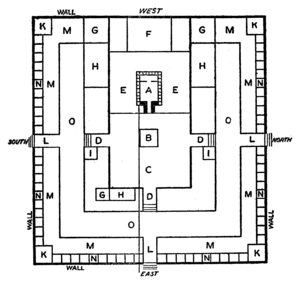
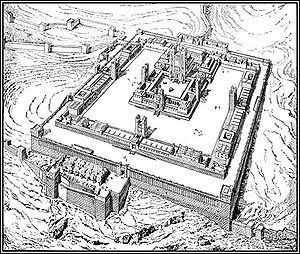 The architecture of the temple is described in detail in Chapters 40 to 42 of Ezekiel. Maimonides
quantified those chapters as complex for the common reader and even for the seasoned scholar. Bible commentators who have ventured into explaining the design detail directly from the Hebrew Bible
text include Rashi
, David Kimhi
, Yom-Tov Lipmann Heller
, and Meir Leibush ben Yehiel Michal - all producing slightly varying sketches of the temple envisioned by Ezekiel.
rooted and expressed in many of Judaism's prayers for the return and rebuilding of the Temple in Jerusalem
that had once stood as the First and Second
Temples that were destroyed by the ancient Babylonians and the Romans.
Since the destruction of the Second Temple
in AD 70, religious Jews have expressed their desire to see the building of a Third Temple on the Temple Mount
. Prayer for this is a formal part of the Jewish tradition of thrice daily Amidah
prayer. Though it remains unbuilt, the notion of and desire for a Third Temple is sacred in Judaism, particularly Orthodox Judaism
, and anticipated as a soon to be built place of worship. The prophets in the Tanakh
called for its construction to be fulfilled prior to, or in tandem with, the Messianic age
. The rebuilding of the Third Temple also plays a major role in some interpretations of Christian eschatology.
Architectural plans for the third Temple exist most notably in Chapters 40–47 of the Book of Ezekiel (Ezekiel's vision pre-dates the Second Temple
) and some scholars entertain the notion that the Temple Scroll
also describes the Third Temple.
Since a number of Jewish scholars have stated that the deadline for the arrival of the Jewish Messiah
is the Jewish Year 6000
(2240 CE), this would also seem to be a deadline for beginning the construction of the Third Temple.
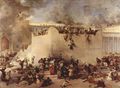 Orthodox Judaism
believes in the rebuilding of a Third Temple and the resumption of sacrificial worship
, although there is disagreement about how rebuilding should take place. Orthodox scholars and rabbinic authorities generally believe that rebuilding should occur in the era of the Jewish Messiah
at the hand of Divine Providence
, although a minority position, following the opinion of Maimonides
, holds that Jews should endeavour to rebuild the temple themselves, whenever possible. Orthodox authorities generally predict the resumption of the complete traditional system of sacrifices, but Conservative
, Reform
, and Reconstructionist
authorities disavow all belief in the resumption of Korban. This belief is embedded in Orthodox Jewish prayer services. Three times a day, Orthodox Jews pray the Amidah
, which contains prayers for the Temple's restoration and for sacrificial worship's resumption, and every day there is a recitation of the order of the day's sacrifices and the psalms the Levites would have sung that day.
The generally accepted position among Orthodox Jews is that the full order of the sacrifices will be resumed upon the building of the Temple. Although Maimonides
wrote in his early work "A Guide for the Perplexed
" "that God
deliberately has moved Jews away from sacrifices towards prayer, as prayer is a higher form of worship,", however his definitive book "Mishneh Torah
" - which is considered by some to be the final authority on Jewish law - states that animal sacrifices will resume in the third temple, and details how they will be carried out. Some attribute to Rabbi Abraham Isaac Kook
the view that animal sacrifices will not be reinstituted. These views on the Temple service are sometimes misconstrued (for example, in Olat Re'ayah, commenting on the prophecy of Malachi
("Then the grain-offering of Judah and Jerusalem will be pleasing to God as in the days of old and as in former years" [Malachi 3:4]), he indicates that only grain offerings will be offered in the reinstated Temple service, while in a related essay from Otzarot Hare'ayah he suggests otherwise).
s used to sing in the Temple. Following the weekday Torah reading
there is a prayer to "restore the House of our lives and to cause the Shekhinah
(Divine Presence) to dwell among us", and the Amidah
contains prayers for acceptance of "the fire-offerings of Israel" and ends with a meditation for the restoration of the Temple. ("And may the grain-offering of Judah and Jerusalem be pleasing, as in former days and ancient times" (Malachi
3:4). In addition, the theological and poetic language of Hebrew
is filled with words with dual connotations, which are both literal references to elements of Temple architecture or ritual, and also have metaphorical theological and poetic meanings regarding the relationship between the worshipper and God. Translations and commentary on prayers with this language tend to discuss both meanings in Orthodox Judaism. (Examples of dual-meaning words: deshen refers to both the ashes left after a burnt-offering, and also means "acceptance with favor"; kodesh refers to "the Holy", i.e. the Sanctuary
portion of the Temple, and also means "holy" generally; and chatzrot refers to the courtyards of the Temple, and also connotes nearness to God; "korban" means both "sacrifice" and "drawing near".)
ceremony) became impossible in the absence of the Temple and its rites, Rabbinic Judaism, and later Orthodox Judaism, considered Jews obligated to observe such laws of ritual purity as are possible, and retained a large number of the rules as principles for ordinary life. The laws of "family purity
" are directly based, in function and terminology, on the Temple rules. A number of other requirements, such as the practices of immersing in a mikveh before Yom Kippur
, washing the hands in the morning, before meals, and after a funeral, derive from these principles. Many contemporary and seemingly unconnected rules for ordinary living are intimately linked with these Temple rituals and rules. For example, the Shema Yisrael
prayer is said at the time of day when Kohanim who were tamei completed a portion of their purification ritual, and the kind of plant material that can be put on the roof of a contemporary Sukkah
is the kind that is not susceptible to tumah. In addition, authorities who permit Jews to ascend the Temple Mount require observance of a larger set of ritual purity rules than have been retained in daily life, such as a requirement of immersion following a seminal emission.
the chief rabbi of the IDF
(and later chief rabbi of the State of Israel) began organizing public prayer for Jews on the Temple Mount. Rabbi Goren was also well-known for his controversial positions concerning Jewish sovereignty over the Temple Mount
. On August 15, 1967, shortly after the Six-Day War
, Goren led a group of fifty Jews onto the Temple Mount
, where, fighting off protesting Muslim guards and Israeli police, they defiantly held a prayer service. Goren continued to pray for many years in the Makhkame building overlooking the Temple Mount where he conducted yearly High Holiday services. His call for the establishment of a synagogue on the Temple Mount has subsequently been reiterated by his brother-in-law the Chief Rabbi of Haifa, She'ar Yashuv Cohen
.
Goren was sharply criticized by the Israeli Defense Ministry
, who, noting Goren's senior rank, called his behaviour inappropriate. The episode led the Chief Rabbis of the time to restate the accepted laws of Judaism that no Jews were allowed on the mount due to issues of ritual impurity. The secular authorities welcomed this ruling as it preserved the status quo with the Waqf
, the Islamic authority. Disagreeing with his colleagues, Goren continually maintained that Jews were not only permitted, but commanded, to ascend and pray on the mount.
Goren repeatedly advocated or supported building a Third Temple on the Temple Mount from the 1960s onward, and was associated with various messianic projects involving the site. In the summer of 1983, Goren and several other rabbis joined Rabbi Yehuda Getz, who worked for the Religious Affairs Ministry at the Western Wall
, in touring a chamber underneath the mount that Getz had excavated, where the two claimed to have seen the Ark of the Covenant
. The tunnel was shortly discovered and resulted in a massive brawl between young Jews and Arabs in the area. The tunnel was quickly sealed with concrete by Israeli police. The sealed entrance can be seen from the Western Wall Tunnel
, which opened to the public in 1996.
The Chief Rabbis of Israel
, Isser Yehuda Unterman
and Yitzhak Nissim
, together with other leading rabbis, asserted that "For generations we have warned against and refrained from entering any part of the Temple Mount." A recent study of this rabbinical ruling suggests that it was both "unprecedented" and possibly prompted by governmental pressure on the rabbis, as well as "brilliant" in preventing Muslim-Jewish friction on the Mount. Rabbinical consensus in the Religious Zionist
stream of Orthodox Judaism
continue to hold that it is forbidden for Jews to enter any part of the Temple Mount and in January 2005 a declaration was signed confirming the 1967 decision.
believes in a Messiah
and in a rebuilt Temple, but does not believe in the restoration of sacrifices. Accordingly, Conservative Judaism's Committee on Jewish Law and Standards
has modified the prayers. Conservative prayerbooks call for the restoration of Temple, but do not ask for resumption of sacrifices. The Orthodox study session on sacrifices in the daily morning
service has been replaced with the Talmudic passages teaching that deeds of loving-kindness now atone for sin.
In the daily Amidah
prayer, the central prayer in Jewish services
, the petitions to accept the "fire offerings of Israel" and "the grain-offering of Judah and Jerusalem" (Malachi
3:4) are removed. In the special Mussaf
Amidah
prayer said on Shabbat
and Jewish holidays, the Hebrew phrase na'ase ve'nakriv (we will present and sacrifice) is modified to read to asu ve'hikrivu (they presented and sacrificed), implying that sacrifices are a thing of the past. The prayer for the restoration of "the House of our lives" and the Shekhinah
to dwell "among us" in the weekday Torah reading
service is retained in Conservative prayer books, although not all Conservative services say it. In Conservative prayer books, words and phrases that have dual meaning, referring to both Temple features and theological or poetic concepts, are generally retained. Translations and commentaries, however, generally refer to the poetic or theological meanings only. Conservative Judaism also takes an intermediate position on Kohanim and Levites, preserving patrilineal tribal descent and some aspects of their roles, but lifting restrictions on whom Kohanim are permitted to marry.
In 2006, the Committee on Jewish Law and Standards
adapted a series of responsa on the subject of the role of Niddah
in Conservative Judaism, in which it discussed Conservative Judaism's view of the role of Temple-related concepts of ritual purity in contemporary Judaism. One responsum adopted by a majority of the Committee held that concepts of ritual purity relevant to entry into the Temple are no longer applicable to contemporary Judaism and accepted a proposal to change the term "family purity
" to "family holiness" and to explain the continuing observance of niddah
on a different basis from continuity with Temple practices. Another responsum, also adopted by a majority of the Committee, called for retaining existing observances, terminology, and rationale, and held that these Temple-related observances and concepts continued to have contemporary impact and meaning. Thus, consistent with Conservative Judaism's philosophy of pluralism, both views of the continuing relevance of Temple-related concepts of ritual purity are permissible Conservative views.
and Reconstructionist Judaism
do not believe in the rebuilding of a central Temple or a restoration of Temple sacrifices or worship. They regard the Temple and sacrificial era as a period of a more primitive form of ritual which Judaism (in their view) has evolved out of and should not return to. They also believe a special role for Kohanim and Levites represents a caste
system incompatible with modern principles of egalitarianism
, and do not preserve these roles. Furthermore, there is a Reform view that the shul or synagogue is a modern Temple; hence, "Temple" appears in numerous congregation names in Reform Judaism. Indeed, the re-designation of the synagogue as "temple" was one of the hallmarks of early Reform in 19th century Germany, when Berlin was declared the new Jerusalem, and Reform Jewry sought to demonstrate their staunch German nationalism. The Anti-Zionism
that characterized Reform Judaism throughout much of its history subsided somewhat with the Holocaust in Europe and the later successes of the modern state of Israel
. The belief in the return of the Jews to the Temple in Jerusalem is not part of mainstream Reform Judaism.
, more commonly known as Simon bar Kokhba, captured Jerusalem from the Romans in AD 132
, and construction of a new temple began, as well as renewed temple services. The failure of this revolt led to the writing of the Mishna
, as the religious leaders believed that the next attempt to rebuild the temple might be centuries away and memory of the practices and ceremonies would otherwise be lost.
emperor Julian
(361
–363
) to allow the Jews to build a "Third Temple", part of Julian's empire-wide program of restoring/strengthening local religious cults. Rabbi Hilkiyah, one of the leading rabbi
s of the time, spurned Julian's money, arguing that gentile
s should play no part in the rebuilding of the temple.
According to various sources of that time, including Sozomen
(c. 400–450) in his Historia Ecclesiastica and the pagan historian and close friend of Julian, Ammianus Marcellinus
, the project of rebuilding the temple was aborted because each time the workers were trying to build the temple, using the existing substructure, they were burned by terrible flames coming from inside the earth and an earthquake negated what work was made:
The failure to rebuild the Temple has been ascribed to the Galilee earthquake of 363
, and to the Jews' ambivalence about the project. Sabotage is a possibility, as is an accidental fire. Divine intervention was the common view among Christian historians of the time. Shortly thereafter, Julian was killed in battle, and the Christians reasserted control over the empire.
drove the Byzantine Empire
out of the Middle East, giving the Jews control of Jerusalem for the first time in centuries. The new rulers soon ordered the restart of animal sacrifice for the first time since the time of Bar Kochba. Shortly, before the Byzantines took the area back, the Persians gave control to the Christian population, who tore down the partly built edifice, which is what it was when the Caliph Omar
took the city in the 630s.
, states that the Jews and Arabs were quarreling amongst each other about their differences of religion
during the Siege of Jerusalem in 637 CE
but "a man of the sons of Ishmael named Muhammad" gave a "sermon of the Way of Truth, supposedly at God's command" to them saying that they, both the Jews and the Arabs, should unite under the banner of their father Abraham
and enter the Holy Land
http://rbedrosian.com/seb9.htm. The scholar Robert Wright
in his book The Evolution of God
says that the Jews began to rebuild their Temple on the Mount
but were chased away http://books.google.com/books?id=Hm15lrKLpIEC&printsec=frontcover&dq=evolution+of+god&hl=en&ei=hkyBTcDwHcWztwfr6cjZBA&sa=X&oi=book_result&ct=result&resnum=1&ved=0CDgQ6AEwAA#v=onepage&q=armenian&f=false.
, an interregnum
period between the complete domination of Palestine by the Crusader states
until 1260 and the conquest of Palestine by the Mamluks in 1291, Nahmanides
wrote a letter to his son. It contained the following references to the land and the Temple:
and to Divine Providence
, a number of organizations, generally representing a small minority of even Orthodox Jews, have been formed with the objective of realizing the immediate construction of a Third Temple in present times. These organizations include:
states that its goal is to build the Third Temple on the Temple Mount (Mount Moriah).
The Temple Institute
states that its goal is to build the Third Temple on Mount Moriah
. The Temple Institute has already made several items to be used in the Third Temple.
, are built on top of the Temple Mount
. The Dome of the Rock
is regarded as occupying the actual space where the Temple once stood, and Israel
has undertaken to preserve access to these buildings as part of international obligations. Any efforts to damage or reduce access to these sites, or to build Jewish structures within, between, beneath, beside, cantilevered on top of, or instead of them, would lead to severe international conflicts, given the association of the Muslim
world with these holy places. However, some 20th and 21st century scholars believe that the Dome of the Rock is not the actual location of the First and Second Temples, and that the Temples were actually located either just north of or just south of the Dome of the Rock. The most recent theory would put the temple in between The Dome of the Rock
and the Al Aqsa Mosque.
In addition, most Jewish-Orthodox scholars reject any attempts to build the Temple before the coming of Messiah. This is because there are many doubts as to the exact location in which it is required to be built. For example, while measurements are given in cubit
s, there exists a controversy whether this unit of measurement equals approximately 1.5 foot (0.4572 m) or 2 foot (0.6096 m). (For the most part, however, even those who advocate the 2 ft (0.6096 m) interpretation do so only as a stringency, and accept the 1-1/2 ft. understanding as normative.) Without exact knowledge of the size of a cubit, the altar
could not be built. Indeed, the Talmud
recounts that the building of the second Temple was only possible under the direct prophetic guidance of Haggai
, Zechariah, and Malachi
. Without valid prophetic revelation, it would be impossible to rebuild the Temple, even if the mosques no longer occupied its location.
Despite obstacles, efforts are under-way by various analytical groups to articulate the benefits to local and regional constituents and participants to encourage developments that would progressively align in support. It is known from the Talmud that in the time of King Agrippa Jerusalem was filled with millions of visitors, pilgrims from the entire region. Today the potential of spiritual tourism would support the growth goals of the Mayor of Jerusalem for 10 million annual tourists. This would provide a significant boost to the economy and would benefit people locally and regionally, many of whom live in poverty. Since the ultimate building of the Temple can come only through a process of peace, it must be proceeded by numerous efforts, including the financial and project infrastructures to support such a large increase in tourism, local and regional co-operation agreements to enable its ultimate construction and the success of modern attempts to revive the Sanhedrin
, the authority required to be empowered for such an event to occur.
currently restricts access by Jews to the Temple Mount
on both religious and political grounds. Many religious authorities, including the Chief Rabbinate, interpret halakha
(Jewish law) as prohibiting entering the area to prevent inadvertently entering and desecrating forbidden areas (such as the Kadosh Kadoshim), as the Temple area is regarded as still retaining its full sanctity and restrictions. Moreover, political authorities, concerned about past violent clashes at the Temple Mount including one which inaugurated the Palestinian Intifada
, seek to reduce the likelihood of further violent confrontations between Jewish religious activists and Muslims worshipping at the mosques, which could further damage the area's delicate archeological and political fabric.
During the Sukkot
festival in 2006 Uri Ariel
, a National Union
member of the Knesset
, ascended the Mount http://www.haaretz.com/hasen/spages/772340.html and said that he is preparing a plan where a synagogue will be built on the Mount. His suggested synagogue won't be built instead of the mosques but in a separate area in accordance with rulings of the prominent rabbis. He said he believed that this will be correcting an historical injustice and that it is an opportunity for the Muslim world to prove that it is tolerant to all faiths.
with regard to the significance or the requirement of a third temple being built in Jerusalem
, according to the writers of the New Testament the New Covenant
(spoken of in Jeremiah
31:31-34) is marked by the indwelling of the Holy Spirit
in the believer (Ezekiel
36:26-27) and that, as such, the body is the temple, or that the temple has been superseded
. Paul
illustrates this concept in his letter to the believers at Corinth
:
This idea is related to the belief that Christ himself, having claimed to be and do what the temple was and did, is the new temple , and that his people, as a part of the "body of Christ
" (meaning the church
), are part of this temple as well . The result, according to N. T. Wright, is that the earthly temple (along with the city of Jerusalem and the Land of Israel) is no longer of any spiritual significance:
In the teaching of both Jesus and Paul, then, according to Wright,
Ben F. Meyer
, also, argued that Jesus applied prophecy regarding Zion
and temple to himself and his followers:
Some would therefore see the need for a third temple as being diminished, redundant, or entirely foreclosed, while others take a position that the building of the third temple is an integral part of end-time prophecy
. The various perspectives on the significance of the building of a third temple within Christianity are therefore generally linked to a number of factors including: the level of literal or spiritual interpretation applied to what is taken to be "end-time" prophecy; the perceived relationships between various scriptures such as Daniel
, the Olivet discourse
, 2 Thessalonians and Ezekiel
(amongst others); whether or not a dual-covenant
is considered to be in place; and whether Old Testament
promises of the restoration of Israel remain unfulfilled or have all come true in the Messiah (2 Corinthians 1:20). Such factors determine, for example, whether Daniel or 2 Thessalonians are read as referring to a still-future physically restored third temple.
A number of these perspectives are illustrated below.
of the sacrifice Jesus
made for the sins of the world through his crucifixion and shedding of his blood on the first day of Passover
. The Epistle to the Hebrews
is often cited in support of this view: the temple sacrifices are described as being imperfect, since they require repeating (ch. 10:1–4), and as belonging to a covenant
that was "becoming obsolete and growing old" and was "ready to vanish away" (ch. 8:13, ESV
). See also Abrogation of Old Covenant laws
. Christ's crucifixion, being a sacrifice which dealt with sin once and for all, negated any need for further animal sacrifice. Christ himself is compared to the High Priest
who was always standing and performing rituals and sacrifices. Christ, however, having performed his sacrifice, "sat down" — perfection having been finally attained (ch. 10:11–14,18). Further, the veil or curtain to the Holy of Holies
is seen as having been torn asunder at the crucifixion – figuratively in connection with this theology (Ch 10:19–21), and literally according to the Gospel of Matthew
(ch 27:50–51). For these reasons, a third temple, whose partial purpose would be the re-institution of animal sacrifices, is seen as unnecessary.
Additionally Jesus himself stated when asked where to worship, "neither on this mountain nor in Jerusalem... But in spirit and in truth". He stated of the Herodian temple, "Not one stone will be left on another; every one of them will be thrown down" – John 4:21, Luke 21:6.
 Those Protestants who do believe in the importance of a future rebuilt temple (viz., some dispensationalists
) hold that the importance of the sacrificial system shifts to a Memorial of the Cross, given the text of Ezekiel Chapters 39 and following (in addition to Millennial references to the Temple in other Old Testament passages); since Ezekiel explains at length the construction and nature of the Millennial temple, in which Jews will once again hold the priesthood; some others hold that perhaps it was not completely eliminated with Jesus' sacrifice for sin, but is a ceremonial object lesson for confession and forgiveness (somewhat like water baptism and Communion are today); and that such animal sacrifices would still be appropriate for ritual cleansing and for acts of celebration and thanksgiving toward God. Some dispensationalists believe this will be the case with the Second Coming of Christ when Jesus
reigns over earth from the city of New Jerusalem
.
interprets a passage in the Book of Daniel
, Daniel 12:11, as a prophecy that the end of this age will occur shortly after sacrifices are ended in the newly rebuilt temple.
Christians believe that New Testament prophecies associated with the Jewish Temple, such as Matthew 24-25 and 2 Thessalonians 2:1-12, were not completely fulfilled during the Roman destruction of Jerusalem in AD 70 (a belief of Full Preterism) and that these prophecies refer to a future temple. This view is a core part of Dispensationalism
, an interpretative framework of the Bible that stresses Biblical literalism
and asserts that the Jews remain God's chosen people
. According to Dispensationalist theologians, such as Hal Lindsey
and Tim LaHaye
, the Third Temple will be rebuilt when the Anti-Christ, often identified as the political leader of a trans-national alliance such as the European Union
or the United Nations
, secures a peace treaty between the modern nation of Israel and its Muslim neighbours following a war in which Russia and the United States are destroyed or crippled as the result of a nuclear war and/or the Rapture
. The Anti-Christ later uses the temple as a venue for proclaiming himself as God and the long-awaited Messiah, demanding worship from humanity.
and Orthodox Christians believe that the Eucharist
, which they hold to be one in substance with the one self-sacrifice of Christ
on the Cross
, is a far superior offering when compared with the merely preparatory temple sacrifices, as explained in the Epistle to the Hebrews
. They also believe that Christ Himself is the New Temple, as spoken of in the Book of Revelation and that Revelation can best be understood as the Eucharist, heaven on earth. Their church buildings are meant to model Solomon's Temple
, with the Tabernacle
, containing the Eucharist, being considered the new "Holy of Holies." Therefore they do not attach any significance to a possible future rebuilding of the Jerusalem Temple.
The Orthodox also quote Daniel 9:27 ("... he will put a stop to sacrifice and oblation ...") to show that the sacrifices would stop with the arrival of the Messiah, and mention that according to Jesus, St. Paul and the Holy Fathers, the temple will only be rebuilt in the times of the Antichrist. (Quotations: Matthew 24:15, "'So when you see the appalling abomination, of which the prophet Daniel spoke, set up in the holy place (let the reader understand),"; 2 Thessalonians 2:3-4: "Never let anyone deceive you in any way. It cannot happen until the Great Revolt has taken place and there has appeared the wicked One, the lost One, the Enemy, who raises himself above every so-called God or object of worship to enthrone himself in God's sanctuary and flaunts the claim that he is God.".)
, the Third Temple could be built right next to the Dome of the Rock
. http://www.wnd.com/news/article.asp?ARTICLE_ID=42898 He believes, based on the theory of Dr. Asher Kaufman regarding the location of the Eastern Gate, that the Dome of the Rock was built on what the Bible refers to as the Court of the Gentiles. He states that according to Revelation 11:1-2, the rebuilding of the Third Temple was not to include the section of the temple mount known as The Court of the Gentiles. Therefore, he believes that the Third Temple and the Dome of the Rock could stand side by side.
believe that the Jews will build the Third Temple and after the Second Coming of Jesus Christ
, the Jews will accept Jesus as the Messiah and most Jews will convert to Mormonism
. Then, it is believed, the Third Temple will become an LDS Temple and will be one of the two most important LDS Temples along with the New Jerusalem Temple that it is believed will be constructed on the Temple Lot
in Independence, Missouri
, United States
. The Jerusalem Temple will function as the resurrected Jesus Christ's Eastern Hemisphere
headquarters, and the New Jerusalem Temple in Independence, Missouri will function as the resurrected Jesus Christ's Western Hemisphere
headquarters. Both of these two temples will have throne
s for Jesus Christ to sit on during his millennial reign.
was occupied during the six days war.
view the prophecy of the Third Temple was fulfilled with the writing of the Súriy-i-Haykal by Bahá'u'lláh
in pentacle form. The Súriy-i-Haykal or Tablet of the Temple, is a composite work which consists of a tablet followed by five messages addressed to world leaders; shortly after its completion, Bahá'u'lláh instructed the tablet be written in the form of a pentacle
, symbolizing the human temple and added to it the conclusion:
Shoghi Effendi
, the Guardian of the Bahá'í Faith, explained that this verse refers to the prophecy in the Hebrew Bible where Zechariah
had promised the rebuilding of the Temple in the End Times as fulfilled in the return of the Manifestation of God
, Bahá'u'lláh, in a human temple. Throughout the tablet, Bahá'u'lláh addresses the Temple (himself) and explains the glory which is invested in it allowing all the nations of the world to find redemption. In the tablet, Bahá'u'lláh states that the Manifestation of God is a pure mirror that reflects the sovereignty of God and manifests God's beauty and grandeur to mankind. In essence, Bahá'u'lláh explains that the Manifestation of God is a "Living Temple" and Bahá'u'lláh addresses the organs and limbs of the human body and bids each to focus on God and not the earthly world.
Ezekiel
Ezekiel , "God will strengthen" , is the central protagonist of the Book of Ezekiel in the Hebrew Bible. In Judaism, Christianity and Islam, Ezekiel is acknowledged as a Hebrew prophet...
's Temple (Hebrew Beit ha Mikdash hashalisi בית המקדש השלישי), is a temple architecturally described in the Book of Ezekiel
Book of Ezekiel
The Book of Ezekiel is the third of the Latter Prophets in the Hebrew Bible, following the books of Isaiah and Jeremiah and preceding the Book of the Twelve....
. It is noted by Ezekiel as an eternal edifice and permanent dwelling place of the God of Israel on the Temple Mount
Temple Mount
The Temple Mount, known in Hebrew as , and in Arabic as the Haram Ash-Sharif , is one of the most important religious sites in the Old City of Jerusalem. It has been used as a religious site for thousands of years...
in Jerusalem.
Introduction
The initial text discussing the Third Temple is written in the Book of Ezekiel chapter 40, where, on the day of Yom KippurYom Kippur
Yom Kippur , also known as Day of Atonement, is the holiest and most solemn day of the year for the Jews. Its central themes are atonement and repentance. Jews traditionally observe this holy day with a 25-hour period of fasting and intensive prayer, often spending most of the day in synagogue...
of the Hebrew calender 3372, Ezekiel prophesies the third temple architecture as well as envisioning the permanent entrance of the God of Israel through the Eastern gate of the third temple wall.
Architecture
Maimonides
Moses ben-Maimon, called Maimonides and also known as Mūsā ibn Maymūn in Arabic, or Rambam , was a preeminent medieval Jewish philosopher and one of the greatest Torah scholars and physicians of the Middle Ages...
quantified those chapters as complex for the common reader and even for the seasoned scholar. Bible commentators who have ventured into explaining the design detail directly from the Hebrew Bible
Hebrew Bible
The Hebrew Bible is a term used by biblical scholars outside of Judaism to refer to the Tanakh , a canonical collection of Jewish texts, and the common textual antecedent of the several canonical editions of the Christian Old Testament...
text include Rashi
Rashi
Shlomo Yitzhaki , or in Latin Salomon Isaacides, and today generally known by the acronym Rashi , was a medieval French rabbi famed as the author of a comprehensive commentary on the Talmud, as well as a comprehensive commentary on the Tanakh...
, David Kimhi
David Kimhi
David Kimhi , also known by the Hebrew acronym as the RaDaK , was a medieval rabbi, biblical commentator, philosopher, and grammarian. Born in Narbonne, Provence, he was the son of Rabbi Joseph Kimhi and the brother of Rabbi Moses Kimhi, both biblical commentators and grammarians...
, Yom-Tov Lipmann Heller
Yom-Tov Lipmann Heller
Yom-Tov Lipmann ben Nathan ha-Levi Heller, , was a Bohemian rabbi and Talmudist, best-known for writing a commentary on the Mishnah called the Tosafot Yom-Tov...
, and Meir Leibush ben Yehiel Michal - all producing slightly varying sketches of the temple envisioned by Ezekiel.
In Jewish prayer
The Third Temple is also portrayed as a religious notion and desire in JudaismJudaism
Judaism ) is the "religion, philosophy, and way of life" of the Jewish people...
rooted and expressed in many of Judaism's prayers for the return and rebuilding of the Temple in Jerusalem
Temple in Jerusalem
The Temple in Jerusalem or Holy Temple , refers to one of a series of structures which were historically located on the Temple Mount in the Old City of Jerusalem, the current site of the Dome of the Rock. Historically, these successive temples stood at this location and functioned as the centre of...
that had once stood as the First and Second
Second Temple
The Jewish Second Temple was an important shrine which stood on the Temple Mount in Jerusalem between 516 BCE and 70 CE. It replaced the First Temple which was destroyed in 586 BCE, when the Jewish nation was exiled to Babylon...
Temples that were destroyed by the ancient Babylonians and the Romans.
Since the destruction of the Second Temple
Siege of Jerusalem (70)
The Siege of Jerusalem in the year 70 AD was the decisive event of the First Jewish-Roman War. The Roman army, led by the future Emperor Titus, with Tiberius Julius Alexander as his second-in-command, besieged and conquered the city of Jerusalem, which had been occupied by its Jewish defenders in...
in AD 70, religious Jews have expressed their desire to see the building of a Third Temple on the Temple Mount
Temple Mount
The Temple Mount, known in Hebrew as , and in Arabic as the Haram Ash-Sharif , is one of the most important religious sites in the Old City of Jerusalem. It has been used as a religious site for thousands of years...
. Prayer for this is a formal part of the Jewish tradition of thrice daily Amidah
Amidah
The Amidah , also called the Shmoneh Esreh , is the central prayer of the Jewish liturgy. This prayer, among others, is found in the siddur, the traditional Jewish prayer book...
prayer. Though it remains unbuilt, the notion of and desire for a Third Temple is sacred in Judaism, particularly Orthodox Judaism
Orthodox Judaism
Orthodox Judaism , is the approach to Judaism which adheres to the traditional interpretation and application of the laws and ethics of the Torah as legislated in the Talmudic texts by the Sanhedrin and subsequently developed and applied by the later authorities known as the Gaonim, Rishonim, and...
, and anticipated as a soon to be built place of worship. The prophets in the Tanakh
Tanakh
The Tanakh is a name used in Judaism for the canon of the Hebrew Bible. The Tanakh is also known as the Masoretic Text or the Miqra. The name is an acronym formed from the initial Hebrew letters of the Masoretic Text's three traditional subdivisions: The Torah , Nevi'im and Ketuvim —hence...
called for its construction to be fulfilled prior to, or in tandem with, the Messianic age
Messianic Age
Messianic Age is a theological term referring to a future time of universal peace and brotherhood on the earth, without crime, war and poverty. Many religions believe that there will be such an age; some refer to it as the "Kingdom of God" or the "World to Come".- Terminology: "messianic" and...
. The rebuilding of the Third Temple also plays a major role in some interpretations of Christian eschatology.
Architectural plans for the third Temple exist most notably in Chapters 40–47 of the Book of Ezekiel (Ezekiel's vision pre-dates the Second Temple
Second Temple
The Jewish Second Temple was an important shrine which stood on the Temple Mount in Jerusalem between 516 BCE and 70 CE. It replaced the First Temple which was destroyed in 586 BCE, when the Jewish nation was exiled to Babylon...
) and some scholars entertain the notion that the Temple Scroll
Temple Scroll
The Temple Scroll is one of the longest of the Dead Sea Scrolls. Among the discoveries at Qumran it is designated: 11QTemple Scrolla.1 It describes a Jewish temple which has never been built along with extensive detailed regulations about sacrifices and temple practices...
also describes the Third Temple.
Since a number of Jewish scholars have stated that the deadline for the arrival of the Jewish Messiah
Jewish Messiah
Messiah, ; mashiah, moshiah, mashiach, or moshiach, is a term used in the Hebrew Bible to describe priests and kings, who were traditionally anointed with holy anointing oil as described in Exodus 30:22-25...
is the Jewish Year 6000
Year 6000
According to classical Jewish sources, the Hebrew year 6000 marks the latest time for the initiation of the Messianic Age. The Talmud, the Midrash, and the Kabbalistic work, the Zohar, state that the 'deadline' by which the Messiah must appear is 6,000 years from creation...
(2240 CE), this would also seem to be a deadline for beginning the construction of the Third Temple.
General views
Orthodox Judaism
Orthodox Judaism , is the approach to Judaism which adheres to the traditional interpretation and application of the laws and ethics of the Torah as legislated in the Talmudic texts by the Sanhedrin and subsequently developed and applied by the later authorities known as the Gaonim, Rishonim, and...
believes in the rebuilding of a Third Temple and the resumption of sacrificial worship
Korban
The term offering as found in the Hebrew Bible in relation to the worship of Ancient Israel is mainly represented by the Hebrew noun korban whether for an animal or other offering...
, although there is disagreement about how rebuilding should take place. Orthodox scholars and rabbinic authorities generally believe that rebuilding should occur in the era of the Jewish Messiah
Jewish Messiah
Messiah, ; mashiah, moshiah, mashiach, or moshiach, is a term used in the Hebrew Bible to describe priests and kings, who were traditionally anointed with holy anointing oil as described in Exodus 30:22-25...
at the hand of Divine Providence
Divine Providence
In Christian theology, divine providence, or simply providence, is God's activity in the world. " Providence" is also used as a title of God exercising His providence, and then the word are usually capitalized...
, although a minority position, following the opinion of Maimonides
Maimonides
Moses ben-Maimon, called Maimonides and also known as Mūsā ibn Maymūn in Arabic, or Rambam , was a preeminent medieval Jewish philosopher and one of the greatest Torah scholars and physicians of the Middle Ages...
, holds that Jews should endeavour to rebuild the temple themselves, whenever possible. Orthodox authorities generally predict the resumption of the complete traditional system of sacrifices, but Conservative
Conservative Judaism
Conservative Judaism is a modern stream of Judaism that arose out of intellectual currents in Germany in the mid-19th century and took institutional form in the United States in the early 1900s.Conservative Judaism has its roots in the school of thought known as Positive-Historical Judaism,...
, Reform
Reform Judaism
Reform Judaism refers to various beliefs, practices and organizations associated with the Reform Jewish movement in North America, the United Kingdom and elsewhere. In general, it maintains that Judaism and Jewish traditions should be modernized and should be compatible with participation in the...
, and Reconstructionist
Reconstructionist Judaism
Reconstructionist Judaism is a modern American-based Jewish movement based on the ideas of Mordecai Kaplan . The movement views Judaism as a progressively evolving civilization. It originated as a branch of Conservative Judaism, before it splintered...
authorities disavow all belief in the resumption of Korban. This belief is embedded in Orthodox Jewish prayer services. Three times a day, Orthodox Jews pray the Amidah
Amidah
The Amidah , also called the Shmoneh Esreh , is the central prayer of the Jewish liturgy. This prayer, among others, is found in the siddur, the traditional Jewish prayer book...
, which contains prayers for the Temple's restoration and for sacrificial worship's resumption, and every day there is a recitation of the order of the day's sacrifices and the psalms the Levites would have sung that day.
The generally accepted position among Orthodox Jews is that the full order of the sacrifices will be resumed upon the building of the Temple. Although Maimonides
Maimonides
Moses ben-Maimon, called Maimonides and also known as Mūsā ibn Maymūn in Arabic, or Rambam , was a preeminent medieval Jewish philosopher and one of the greatest Torah scholars and physicians of the Middle Ages...
wrote in his early work "A Guide for the Perplexed
Guide for the Perplexed
The Guide for the Perplexed is one of the major works of Rabbi Moshe ben Maimon, better known as Maimonides or "the Rambam"...
" "that God
God
God is the English name given to a singular being in theistic and deistic religions who is either the sole deity in monotheism, or a single deity in polytheism....
deliberately has moved Jews away from sacrifices towards prayer, as prayer is a higher form of worship,", however his definitive book "Mishneh Torah
Mishneh Torah
The Mishneh Torah subtitled Sefer Yad ha-Hazaka is a code of Jewish religious law authored by Maimonides , one of history's foremost rabbis...
" - which is considered by some to be the final authority on Jewish law - states that animal sacrifices will resume in the third temple, and details how they will be carried out. Some attribute to Rabbi Abraham Isaac Kook
Abraham Isaac Kook
Abraham Isaac Kook was the first Ashkenazi chief rabbi of the British Mandate for Palestine, the founder of the Religious Zionist Yeshiva Merkaz HaRav, Jewish thinker, Halachist, Kabbalist and a renowned Torah scholar...
the view that animal sacrifices will not be reinstituted. These views on the Temple service are sometimes misconstrued (for example, in Olat Re'ayah, commenting on the prophecy of Malachi
Malachi
Malachi, Malachias or Mal'achi was a Jewish prophet in the Hebrew Bible. He had two brothers, Nathaniel and Josiah. Malachi was the writer of the Book of Malachi, the last book of the Neviim section in the Jewish Tanakh...
("Then the grain-offering of Judah and Jerusalem will be pleasing to God as in the days of old and as in former years" [Malachi 3:4]), he indicates that only grain offerings will be offered in the reinstated Temple service, while in a related essay from Otzarot Hare'ayah he suggests otherwise).
Role in prayer
Orthodox Jewish prayers include, in every prayer service and at the times when corresponding sacrifices would have been offered in the Temple, a prayer for the its reconstruction and resumption of sacrifices. The morning prayer service also includes a study session of the daily Temple ritual and offerings as a reminder, including detailed study of the animal sacrifices and incense offerings. The service also contains the daily and special-occasion psalms the LeviteLevite
In Jewish tradition, a Levite is a member of the Hebrew tribe of Levi. When Joshua led the Israelites into the land of Canaan, the Levites were the only Israelite tribe that received cities but were not allowed to be landowners "because the Lord the God of Israel himself is their inheritance"...
s used to sing in the Temple. Following the weekday Torah reading
Torah reading
Torah reading is a Jewish religious ritual that involves the public reading of a set of passages from a Torah scroll. The term often refers to the entire ceremony of removing the Torah scroll from the ark, chanting the appropriate excerpt with special cantillation, and returning the scroll to...
there is a prayer to "restore the House of our lives and to cause the Shekhinah
Shekhinah
Shekinah is the English spelling of a grammatically feminine Hebrew word that means the dwelling or settling, and is used to denote the dwelling or settling divine presence of God, especially in the Temple in Jerusalem.-Etymology:Shekinah is derived...
(Divine Presence) to dwell among us", and the Amidah
Amidah
The Amidah , also called the Shmoneh Esreh , is the central prayer of the Jewish liturgy. This prayer, among others, is found in the siddur, the traditional Jewish prayer book...
contains prayers for acceptance of "the fire-offerings of Israel" and ends with a meditation for the restoration of the Temple. ("And may the grain-offering of Judah and Jerusalem be pleasing, as in former days and ancient times" (Malachi
Malachi
Malachi, Malachias or Mal'achi was a Jewish prophet in the Hebrew Bible. He had two brothers, Nathaniel and Josiah. Malachi was the writer of the Book of Malachi, the last book of the Neviim section in the Jewish Tanakh...
3:4). In addition, the theological and poetic language of Hebrew
Hebrew language
Hebrew is a Semitic language of the Afroasiatic language family. Culturally, is it considered by Jews and other religious groups as the language of the Jewish people, though other Jewish languages had originated among diaspora Jews, and the Hebrew language is also used by non-Jewish groups, such...
is filled with words with dual connotations, which are both literal references to elements of Temple architecture or ritual, and also have metaphorical theological and poetic meanings regarding the relationship between the worshipper and God. Translations and commentary on prayers with this language tend to discuss both meanings in Orthodox Judaism. (Examples of dual-meaning words: deshen refers to both the ashes left after a burnt-offering, and also means "acceptance with favor"; kodesh refers to "the Holy", i.e. the Sanctuary
Hekhal
The Hebrew noun hekhal in Classical Hebrew means a large building. This can be either the main building of the Temple in Jerusalem, that is the nave or sanctuary of the Temple, or a palace, such as the "palace" of Ahab king of Samaria, or the "palace" of the King of Babylon.-Usage:It is used 80...
portion of the Temple, and also means "holy" generally; and chatzrot refers to the courtyards of the Temple, and also connotes nearness to God; "korban" means both "sacrifice" and "drawing near".)
Preservation of rules of tumah
The Temple had elaborate rules of ritual purity forbidding entry to people with tumah, ritual impurity, arising from contact with the dead, seminal emissions and menstrual blood, contact with non-kosher (unclean) animals, certain diseases, and a number of other sources. While many of the original purification ceremonies involved (such as the Red HeiferRed heifer
The red heifer or red cow was a sacrifice in the Hebrew Bible the ashes of which are used for the ritual purification of an ancient Israelite who had come into contact with a corpse.- Hebrew Bible :...
ceremony) became impossible in the absence of the Temple and its rites, Rabbinic Judaism, and later Orthodox Judaism, considered Jews obligated to observe such laws of ritual purity as are possible, and retained a large number of the rules as principles for ordinary life. The laws of "family purity
Niddah
Niddah is a Hebrew term describing a woman during menstruation, or a woman who has menstruated and not yet completed the associated requirement of immersion in a mikveh ....
" are directly based, in function and terminology, on the Temple rules. A number of other requirements, such as the practices of immersing in a mikveh before Yom Kippur
Yom Kippur
Yom Kippur , also known as Day of Atonement, is the holiest and most solemn day of the year for the Jews. Its central themes are atonement and repentance. Jews traditionally observe this holy day with a 25-hour period of fasting and intensive prayer, often spending most of the day in synagogue...
, washing the hands in the morning, before meals, and after a funeral, derive from these principles. Many contemporary and seemingly unconnected rules for ordinary living are intimately linked with these Temple rituals and rules. For example, the Shema Yisrael
Shema Yisrael
Shema Yisrael are the first two words of a section of the Torah that is a centerpiece of the morning and evening Jewish prayer services...
prayer is said at the time of day when Kohanim who were tamei completed a portion of their purification ritual, and the kind of plant material that can be put on the roof of a contemporary Sukkah
Sukkah
A sukkah is a temporary hut constructed for use during the week-long Jewish festival of Sukkot. It is topped with branches and often well decorated with autumnal, harvest or Judaic themes...
is the kind that is not susceptible to tumah. In addition, authorities who permit Jews to ascend the Temple Mount require observance of a larger set of ritual purity rules than have been retained in daily life, such as a requirement of immersion following a seminal emission.
Attempts to re-establish a Jewish Presence on the Temple Mount
In August 1967 after Israel's capture of the Mount, Rabbi Shlomo GorenShlomo Goren
Shlomo Goren , was an Orthodox Religious Zionist rabbi in Israel who founded and served as the first head of the Military Rabbinate of the Israel Defense Forces and subsequently as the third Ashkenazi Chief Rabbi of Israel from 1973 to 1983.He served in the Israel Defense Forces during three wars,...
the chief rabbi of the IDF
Israel Defense Forces
The Israel Defense Forces , commonly known in Israel by the Hebrew acronym Tzahal , are the military forces of the State of Israel. They consist of the ground forces, air force and navy. It is the sole military wing of the Israeli security forces, and has no civilian jurisdiction within Israel...
(and later chief rabbi of the State of Israel) began organizing public prayer for Jews on the Temple Mount. Rabbi Goren was also well-known for his controversial positions concerning Jewish sovereignty over the Temple Mount
Temple Mount
The Temple Mount, known in Hebrew as , and in Arabic as the Haram Ash-Sharif , is one of the most important religious sites in the Old City of Jerusalem. It has been used as a religious site for thousands of years...
. On August 15, 1967, shortly after the Six-Day War
Six-Day War
The Six-Day War , also known as the June War, 1967 Arab-Israeli War, or Third Arab-Israeli War, was fought between June 5 and 10, 1967, by Israel and the neighboring states of Egypt , Jordan, and Syria...
, Goren led a group of fifty Jews onto the Temple Mount
Temple Mount
The Temple Mount, known in Hebrew as , and in Arabic as the Haram Ash-Sharif , is one of the most important religious sites in the Old City of Jerusalem. It has been used as a religious site for thousands of years...
, where, fighting off protesting Muslim guards and Israeli police, they defiantly held a prayer service. Goren continued to pray for many years in the Makhkame building overlooking the Temple Mount where he conducted yearly High Holiday services. His call for the establishment of a synagogue on the Temple Mount has subsequently been reiterated by his brother-in-law the Chief Rabbi of Haifa, She'ar Yashuv Cohen
She'ar Yashuv Cohen
Eliyahu Yosef She'ar Yashuv Cohen was the Ashkenazi Chief Rabbi of Haifa, Israel and the President of its rabbinical courts .- Biography :...
.
Goren was sharply criticized by the Israeli Defense Ministry
Ministry of Defense (Israel)
The Ministry of Defence of the government of Israel, is the governmental department responsible for defending the State of Israel from internal and external military threats...
, who, noting Goren's senior rank, called his behaviour inappropriate. The episode led the Chief Rabbis of the time to restate the accepted laws of Judaism that no Jews were allowed on the mount due to issues of ritual impurity. The secular authorities welcomed this ruling as it preserved the status quo with the Waqf
Waqf
A waqf also spelled wakf formally known as wakf-alal-aulad is an inalienable religious endowment in Islamic law, typically denoting a building or plot of land for Muslim religious or charitable purposes. The donated assets are held by a charitable trust...
, the Islamic authority. Disagreeing with his colleagues, Goren continually maintained that Jews were not only permitted, but commanded, to ascend and pray on the mount.
Goren repeatedly advocated or supported building a Third Temple on the Temple Mount from the 1960s onward, and was associated with various messianic projects involving the site. In the summer of 1983, Goren and several other rabbis joined Rabbi Yehuda Getz, who worked for the Religious Affairs Ministry at the Western Wall
Western Wall
The Western Wall, Wailing Wall or Kotel is located in the Old City of Jerusalem at the foot of the western side of the Temple Mount...
, in touring a chamber underneath the mount that Getz had excavated, where the two claimed to have seen the Ark of the Covenant
Ark of the Covenant
The Ark of the Covenant , also known as the Ark of the Testimony, is a chest described in Book of Exodus as solely containing the Tablets of Stone on which the Ten Commandments were inscribed...
. The tunnel was shortly discovered and resulted in a massive brawl between young Jews and Arabs in the area. The tunnel was quickly sealed with concrete by Israeli police. The sealed entrance can be seen from the Western Wall Tunnel
Western Wall Tunnel
The Western Wall Tunnel is an underground tunnel exposing the full length of the Western Wall. The tunnel is adjacent to the Western Wall and is located under buildings of the Old City of Jerusalem, Israel. While the open-air portion of the Western Wall is approximately long, the majority of its...
, which opened to the public in 1996.
The Chief Rabbis of Israel
Chief Rabbinate of Israel
The Chief Rabbinate of Israel is recognized by law as the supreme halakhic and spiritual authority for the Jewish people in Israel. The Chief Rabbinate Council assists the two chief rabbis, who alternate in its presidency. It has legal and administrative authority to organize religious...
, Isser Yehuda Unterman
Isser Yehuda Unterman
Rabbi Isser Yehuda Unterman was the Ashkenazi Chief Rabbi of Israel from 1964 until 1972.Born in Brest-Litovsk in modern Belarus, Unterman was educated at the Etz Chaim Yeshiva in Maltsch. There, he became a pupil of its Rosh Yeshiva, Rabbi Shimon Shkop...
and Yitzhak Nissim
Yitzhak Nissim
Rabbi Yitzhak Nissim was a former Sephardic chief rabbi of Israel. Rabbi Nissim was born in Baghdad and immigrated to Palestine in 1925....
, together with other leading rabbis, asserted that "For generations we have warned against and refrained from entering any part of the Temple Mount." A recent study of this rabbinical ruling suggests that it was both "unprecedented" and possibly prompted by governmental pressure on the rabbis, as well as "brilliant" in preventing Muslim-Jewish friction on the Mount. Rabbinical consensus in the Religious Zionist
Religious Zionism
Religious Zionism is an ideology that combines Zionism and Jewish religious faith...
stream of Orthodox Judaism
Orthodox Judaism
Orthodox Judaism , is the approach to Judaism which adheres to the traditional interpretation and application of the laws and ethics of the Torah as legislated in the Talmudic texts by the Sanhedrin and subsequently developed and applied by the later authorities known as the Gaonim, Rishonim, and...
continue to hold that it is forbidden for Jews to enter any part of the Temple Mount and in January 2005 a declaration was signed confirming the 1967 decision.
Role in Conservative Judaism
Conservative JudaismConservative Judaism
Conservative Judaism is a modern stream of Judaism that arose out of intellectual currents in Germany in the mid-19th century and took institutional form in the United States in the early 1900s.Conservative Judaism has its roots in the school of thought known as Positive-Historical Judaism,...
believes in a Messiah
Jewish Messiah
Messiah, ; mashiah, moshiah, mashiach, or moshiach, is a term used in the Hebrew Bible to describe priests and kings, who were traditionally anointed with holy anointing oil as described in Exodus 30:22-25...
and in a rebuilt Temple, but does not believe in the restoration of sacrifices. Accordingly, Conservative Judaism's Committee on Jewish Law and Standards
Committee on Jewish Law and Standards
The Committee on Jewish Law and Standards is the central authority on halakha within Conservative Judaism; it is one of the most active and widely known committees on the Conservative movement's Rabbinical Assembly. Within the movement it is known as the CJLS...
has modified the prayers. Conservative prayerbooks call for the restoration of Temple, but do not ask for resumption of sacrifices. The Orthodox study session on sacrifices in the daily morning
Shacharit
Shacharit is the the daily morning Tefillah of the Jewish people, one of the three times there is prayer each day.Shacharit is said to have been established by the patriarch Abraham when he prayed in the morning...
service has been replaced with the Talmudic passages teaching that deeds of loving-kindness now atone for sin.
In the daily Amidah
Amidah
The Amidah , also called the Shmoneh Esreh , is the central prayer of the Jewish liturgy. This prayer, among others, is found in the siddur, the traditional Jewish prayer book...
prayer, the central prayer in Jewish services
Jewish services
Jewish prayer are the prayer recitations that form part of the observance of Judaism. These prayers, often with instructions and commentary, are found in the siddur, the traditional Jewish prayer book....
, the petitions to accept the "fire offerings of Israel" and "the grain-offering of Judah and Jerusalem" (Malachi
Malachi
Malachi, Malachias or Mal'achi was a Jewish prophet in the Hebrew Bible. He had two brothers, Nathaniel and Josiah. Malachi was the writer of the Book of Malachi, the last book of the Neviim section in the Jewish Tanakh...
3:4) are removed. In the special Mussaf
Mussaf
Mussaf is an additional service that is recited on Shabbat, Yom Tov, Chol Hamoed, and Rosh Chodesh. The service, which is traditionally combined with the Shacharit in synagogues, is considered to be additional to the regular services of Shacharit, Mincha, and Maariv.During the days of the Holy...
Amidah
Amidah
The Amidah , also called the Shmoneh Esreh , is the central prayer of the Jewish liturgy. This prayer, among others, is found in the siddur, the traditional Jewish prayer book...
prayer said on Shabbat
Shabbat
Shabbat is the seventh day of the Jewish week and a day of rest in Judaism. Shabbat is observed from a few minutes before sunset on Friday evening until a few minutes after when one would expect to be able to see three stars in the sky on Saturday night. The exact times, therefore, differ from...
and Jewish holidays, the Hebrew phrase na'ase ve'nakriv (we will present and sacrifice) is modified to read to asu ve'hikrivu (they presented and sacrificed), implying that sacrifices are a thing of the past. The prayer for the restoration of "the House of our lives" and the Shekhinah
Shekhinah
Shekinah is the English spelling of a grammatically feminine Hebrew word that means the dwelling or settling, and is used to denote the dwelling or settling divine presence of God, especially in the Temple in Jerusalem.-Etymology:Shekinah is derived...
to dwell "among us" in the weekday Torah reading
Torah reading
Torah reading is a Jewish religious ritual that involves the public reading of a set of passages from a Torah scroll. The term often refers to the entire ceremony of removing the Torah scroll from the ark, chanting the appropriate excerpt with special cantillation, and returning the scroll to...
service is retained in Conservative prayer books, although not all Conservative services say it. In Conservative prayer books, words and phrases that have dual meaning, referring to both Temple features and theological or poetic concepts, are generally retained. Translations and commentaries, however, generally refer to the poetic or theological meanings only. Conservative Judaism also takes an intermediate position on Kohanim and Levites, preserving patrilineal tribal descent and some aspects of their roles, but lifting restrictions on whom Kohanim are permitted to marry.
In 2006, the Committee on Jewish Law and Standards
Committee on Jewish Law and Standards
The Committee on Jewish Law and Standards is the central authority on halakha within Conservative Judaism; it is one of the most active and widely known committees on the Conservative movement's Rabbinical Assembly. Within the movement it is known as the CJLS...
adapted a series of responsa on the subject of the role of Niddah
Niddah
Niddah is a Hebrew term describing a woman during menstruation, or a woman who has menstruated and not yet completed the associated requirement of immersion in a mikveh ....
in Conservative Judaism, in which it discussed Conservative Judaism's view of the role of Temple-related concepts of ritual purity in contemporary Judaism. One responsum adopted by a majority of the Committee held that concepts of ritual purity relevant to entry into the Temple are no longer applicable to contemporary Judaism and accepted a proposal to change the term "family purity
Niddah
Niddah is a Hebrew term describing a woman during menstruation, or a woman who has menstruated and not yet completed the associated requirement of immersion in a mikveh ....
" to "family holiness" and to explain the continuing observance of niddah
Niddah
Niddah is a Hebrew term describing a woman during menstruation, or a woman who has menstruated and not yet completed the associated requirement of immersion in a mikveh ....
on a different basis from continuity with Temple practices. Another responsum, also adopted by a majority of the Committee, called for retaining existing observances, terminology, and rationale, and held that these Temple-related observances and concepts continued to have contemporary impact and meaning. Thus, consistent with Conservative Judaism's philosophy of pluralism, both views of the continuing relevance of Temple-related concepts of ritual purity are permissible Conservative views.
Role in Reform and Reconstructionist Judaism
ReformReform Judaism
Reform Judaism refers to various beliefs, practices and organizations associated with the Reform Jewish movement in North America, the United Kingdom and elsewhere. In general, it maintains that Judaism and Jewish traditions should be modernized and should be compatible with participation in the...
and Reconstructionist Judaism
Reconstructionist Judaism
Reconstructionist Judaism is a modern American-based Jewish movement based on the ideas of Mordecai Kaplan . The movement views Judaism as a progressively evolving civilization. It originated as a branch of Conservative Judaism, before it splintered...
do not believe in the rebuilding of a central Temple or a restoration of Temple sacrifices or worship. They regard the Temple and sacrificial era as a period of a more primitive form of ritual which Judaism (in their view) has evolved out of and should not return to. They also believe a special role for Kohanim and Levites represents a caste
Caste
Caste is an elaborate and complex social system that combines elements of endogamy, occupation, culture, social class, tribal affiliation and political power. It should not be confused with race or social class, e.g. members of different castes in one society may belong to the same race, as in India...
system incompatible with modern principles of egalitarianism
Egalitarianism
Egalitarianism is a trend of thought that favors equality of some sort among moral agents, whether persons or animals. Emphasis is placed upon the fact that equality contains the idea of equity of quality...
, and do not preserve these roles. Furthermore, there is a Reform view that the shul or synagogue is a modern Temple; hence, "Temple" appears in numerous congregation names in Reform Judaism. Indeed, the re-designation of the synagogue as "temple" was one of the hallmarks of early Reform in 19th century Germany, when Berlin was declared the new Jerusalem, and Reform Jewry sought to demonstrate their staunch German nationalism. The Anti-Zionism
Anti-Zionism
Anti-Zionism is opposition to Zionistic views or opposition to the state of Israel. The term is used to describe various religious, moral and political points of view in opposition to these, but their diversity of motivation and expression is sufficiently different that "anti-Zionism" cannot be...
that characterized Reform Judaism throughout much of its history subsided somewhat with the Holocaust in Europe and the later successes of the modern state of Israel
Israel
The State of Israel is a parliamentary republic located in the Middle East, along the eastern shore of the Mediterranean Sea...
. The belief in the return of the Jews to the Temple in Jerusalem is not part of mainstream Reform Judaism.
Bar Kochba revolt
The forces of Shimon ben KosibaSimon bar Kokhba
Simon bar Kokhba was the Jewish leader of what is known as the Bar Kokhba revolt against the Roman Empire in 132 CE, establishing an independent Jewish state of Israel which he ruled for three years as Nasi...
, more commonly known as Simon bar Kokhba, captured Jerusalem from the Romans in AD 132
132
Year 132 was a leap year starting on Monday of the Julian calendar. At the time, it was known as the Year of the Consulship of Serius and Sergianus...
, and construction of a new temple began, as well as renewed temple services. The failure of this revolt led to the writing of the Mishna
Mishnah
The Mishnah or Mishna is the first major written redaction of the Jewish oral traditions called the "Oral Torah". It is also the first major work of Rabbinic Judaism. It was redacted c...
, as the religious leaders believed that the next attempt to rebuild the temple might be centuries away and memory of the practices and ceremonies would otherwise be lost.
Julian
There was an aborted project by the RomanRoman Empire
The Roman Empire was the post-Republican period of the ancient Roman civilization, characterised by an autocratic form of government and large territorial holdings in Europe and around the Mediterranean....
emperor Julian
Julian the Apostate
Julian "the Apostate" , commonly known as Julian, or also Julian the Philosopher, was Roman Emperor from 361 to 363 and a noted philosopher and Greek writer....
(361
361
Year 361 was a common year starting on Monday of the Julian calendar. At the time, it was known as the Year of the Consulship of Taurus and Florentius...
–363
363
Year 363 was a common year starting on Wednesday of the Julian calendar. At the time, it was known as the Year of the Consulship of Iulianus and Sallustius...
) to allow the Jews to build a "Third Temple", part of Julian's empire-wide program of restoring/strengthening local religious cults. Rabbi Hilkiyah, one of the leading rabbi
Rabbi
In Judaism, a rabbi is a teacher of Torah. This title derives from the Hebrew word רבי , meaning "My Master" , which is the way a student would address a master of Torah...
s of the time, spurned Julian's money, arguing that gentile
Gentile
The term Gentile refers to non-Israelite peoples or nations in English translations of the Bible....
s should play no part in the rebuilding of the temple.
According to various sources of that time, including Sozomen
Sozomen
Salminius Hermias Sozomenus was a historian of the Christian church.-Family and Home:He was born around 400 in Bethelia, a small town near Gaza, into a wealthy Christian family of Palestine....
(c. 400–450) in his Historia Ecclesiastica and the pagan historian and close friend of Julian, Ammianus Marcellinus
Ammianus Marcellinus
Ammianus Marcellinus was a fourth-century Roman historian. He wrote the penultimate major historical account surviving from Antiquity...
, the project of rebuilding the temple was aborted because each time the workers were trying to build the temple, using the existing substructure, they were burned by terrible flames coming from inside the earth and an earthquake negated what work was made:
The failure to rebuild the Temple has been ascribed to the Galilee earthquake of 363
Galilee earthquake of 363
The Galilee earthquake of 363 was a severe earthquake that shook the Galilee and nearby regions in 363 CE.-Impact:* Tzippori was severely damaged.* Nabratein and the Nabratein synagogue were destroyed....
, and to the Jews' ambivalence about the project. Sabotage is a possibility, as is an accidental fire. Divine intervention was the common view among Christian historians of the time. Shortly thereafter, Julian was killed in battle, and the Christians reasserted control over the empire.
Sassanid vassal state
In 610, the Sassanid EmpireSassanid Empire
The Sassanid Empire , known to its inhabitants as Ērānshahr and Ērān in Middle Persian and resulting in the New Persian terms Iranshahr and Iran , was the last pre-Islamic Persian Empire, ruled by the Sasanian Dynasty from 224 to 651...
drove the Byzantine Empire
Byzantine Empire
The Byzantine Empire was the Eastern Roman Empire during the periods of Late Antiquity and the Middle Ages, centred on the capital of Constantinople. Known simply as the Roman Empire or Romania to its inhabitants and neighbours, the Empire was the direct continuation of the Ancient Roman State...
out of the Middle East, giving the Jews control of Jerusalem for the first time in centuries. The new rulers soon ordered the restart of animal sacrifice for the first time since the time of Bar Kochba. Shortly, before the Byzantines took the area back, the Persians gave control to the Christian population, who tore down the partly built edifice, which is what it was when the Caliph Omar
Omar
Omar can refer to:-Name:* Omar , including a list of people with the given name or surname Omar, Omer or Umar as well-Places:* Omar, Konar, a village in Afghanistan...
took the city in the 630s.
Muslim conquest of Syria
An Armenian chronicle from the 7th Century CE, allegedly written by the bishop SebeosSebeos
Sebeos was a 7th century Armenian bishop and historian who participated in the first Council of Dvin in 645.The history of Sebeos contains detailed descriptions from the period of Sassanid supremacy in Armenia up to the Islamic conquest in 661...
, states that the Jews and Arabs were quarreling amongst each other about their differences of religion
Islam and Judaism
Islamic–Jewish relations started in the 7th century CE with the origin and spread of Islam in the Arabian peninsula. The two religions share similar values, guidelines, and principles. Islam also incorporates Jewish history as a part of its own. Muslims regard the Children of Israel as an important...
during the Siege of Jerusalem in 637 CE
Siege of Jerusalem (637)
The Siege of Jerusalem was a part of a military conflict which took place in the year 637 between the Byzantine Empire and the Rashidun Caliphate. It began when the Rashidun army, under the command of Abu Ubaidah, besieged Jerusalem in November 636. After six months, the Patriarch Sophronius...
but "a man of the sons of Ishmael named Muhammad" gave a "sermon of the Way of Truth, supposedly at God's command" to them saying that they, both the Jews and the Arabs, should unite under the banner of their father Abraham
Abraham
Abraham , whose birth name was Abram, is the eponym of the Abrahamic religions, among which are Judaism, Christianity and Islam...
and enter the Holy Land
Holy Land
The Holy Land is a term which in Judaism refers to the Kingdom of Israel as defined in the Tanakh. For Jews, the Land's identifiction of being Holy is defined in Judaism by its differentiation from other lands by virtue of the practice of Judaism often possible only in the Land of Israel...
http://rbedrosian.com/seb9.htm. The scholar Robert Wright
Robert Wright (journalist)
Robert Wright is an American journalist, scholar, and prize-winning author of best-selling books about science, evolutionary psychology, history, religion, and game theory, including The Evolution of God, Nonzero: The Logic of Human Destiny, The Moral Animal, and Three Scientists and Their Gods:...
in his book The Evolution of God
The Evolution of God
The Evolution of God is a 2009 book by Robert Wright that explores the history of the concept of God in the three Abrahamic religions through a variety of means, including archeology, history, theology, and evolutionary psychology...
says that the Jews began to rebuild their Temple on the Mount
Temple Mount
The Temple Mount, known in Hebrew as , and in Arabic as the Haram Ash-Sharif , is one of the most important religious sites in the Old City of Jerusalem. It has been used as a religious site for thousands of years...
but were chased away http://books.google.com/books?id=Hm15lrKLpIEC&printsec=frontcover&dq=evolution+of+god&hl=en&ei=hkyBTcDwHcWztwfr6cjZBA&sa=X&oi=book_result&ct=result&resnum=1&ved=0CDgQ6AEwAA#v=onepage&q=armenian&f=false.
During the Mongol raids into Syria
In 1267, during the Mongol raids into SyriaMongol raids into Palestine
Mongol raids into Palestine took place towards the end of the Crusades, as a follow-up to the temporarily successful Mongol invasions of Syria, primarily in 1260 and 1300...
, an interregnum
Interregnum
An interregnum is a period of discontinuity or "gap" in a government, organization, or social order...
period between the complete domination of Palestine by the Crusader states
Crusader states
The Crusader states were a number of mostly 12th- and 13th-century feudal states created by Western European crusaders in Asia Minor, Greece and the Holy Land , and during the Northern Crusades in the eastern Baltic area...
until 1260 and the conquest of Palestine by the Mamluks in 1291, Nahmanides
Nahmanides
Nahmanides, also known as Rabbi Moses ben Naḥman Girondi, Bonastruc ça Porta and by his acronym Ramban, , was a leading medieval Jewish scholar, Catalan rabbi, philosopher, physician, kabbalist, and biblical commentator.-Name:"Nahmanides" is a Greek-influenced formation meaning "son of Naḥman"...
wrote a letter to his son. It contained the following references to the land and the Temple:
Modern rebuilding efforts
Although in mainstream Orthodox Judaism the rebuilding of the Temple is generally left to the coming of the Jewish MessiahJewish Messiah
Messiah, ; mashiah, moshiah, mashiach, or moshiach, is a term used in the Hebrew Bible to describe priests and kings, who were traditionally anointed with holy anointing oil as described in Exodus 30:22-25...
and to Divine Providence
Divine Providence
In Christian theology, divine providence, or simply providence, is God's activity in the world. " Providence" is also used as a title of God exercising His providence, and then the word are usually capitalized...
, a number of organizations, generally representing a small minority of even Orthodox Jews, have been formed with the objective of realizing the immediate construction of a Third Temple in present times. These organizations include:
Organizations
The Temple Mount and Eretz Yisrael Faithful MovementTemple Mount and Eretz Yisrael Faithful Movement
The Temple Mount and Eretz Yisrael Faithful Movement is an Orthodox Jewish movement, based in Jerusalem, Israel whose goal is to rebuild the Third Jewish Temple on the Temple Mount in Jerusalem and re-institute the practice of ritual sacrifice. The Movement was founded by former Israel Defence...
states that its goal is to build the Third Temple on the Temple Mount (Mount Moriah).
The Temple Institute
Temple Institute
The Temple Institute, known in Hebrew as Machon HaMikdash , is an organization in Israel focusing on the controversial endeavor of establishing the Third Temple. Its long-term aims are to build the third Jewish temple on the Temple Mount, on the site currently occupied by the Dome of the Rock, and...
states that its goal is to build the Third Temple on Mount Moriah
Temple Mount
The Temple Mount, known in Hebrew as , and in Arabic as the Haram Ash-Sharif , is one of the most important religious sites in the Old City of Jerusalem. It has been used as a religious site for thousands of years...
. The Temple Institute has already made several items to be used in the Third Temple.
Obstacles
The most immediate and obvious obstacle to realization of these goals is the fact that two historic Islamic structures which are 13 centuries old, namely the Al Aqsa Mosque and the Dome of the RockDome of the Rock
The Dome of the Rock is a shrine located on the Temple Mount in the Old City of Jerusalem. The structure has been refurbished many times since its initial completion in 691 CE at the order of Umayyad Caliph Abd al-Malik...
, are built on top of the Temple Mount
Temple Mount
The Temple Mount, known in Hebrew as , and in Arabic as the Haram Ash-Sharif , is one of the most important religious sites in the Old City of Jerusalem. It has been used as a religious site for thousands of years...
. The Dome of the Rock
Dome of the Rock
The Dome of the Rock is a shrine located on the Temple Mount in the Old City of Jerusalem. The structure has been refurbished many times since its initial completion in 691 CE at the order of Umayyad Caliph Abd al-Malik...
is regarded as occupying the actual space where the Temple once stood, and Israel
Israel
The State of Israel is a parliamentary republic located in the Middle East, along the eastern shore of the Mediterranean Sea...
has undertaken to preserve access to these buildings as part of international obligations. Any efforts to damage or reduce access to these sites, or to build Jewish structures within, between, beneath, beside, cantilevered on top of, or instead of them, would lead to severe international conflicts, given the association of the Muslim
Muslim
A Muslim, also spelled Moslem, is an adherent of Islam, a monotheistic, Abrahamic religion based on the Quran, which Muslims consider the verbatim word of God as revealed to prophet Muhammad. "Muslim" is the Arabic term for "submitter" .Muslims believe that God is one and incomparable...
world with these holy places. However, some 20th and 21st century scholars believe that the Dome of the Rock is not the actual location of the First and Second Temples, and that the Temples were actually located either just north of or just south of the Dome of the Rock. The most recent theory would put the temple in between The Dome of the Rock
Dome of the Rock
The Dome of the Rock is a shrine located on the Temple Mount in the Old City of Jerusalem. The structure has been refurbished many times since its initial completion in 691 CE at the order of Umayyad Caliph Abd al-Malik...
and the Al Aqsa Mosque.
In addition, most Jewish-Orthodox scholars reject any attempts to build the Temple before the coming of Messiah. This is because there are many doubts as to the exact location in which it is required to be built. For example, while measurements are given in cubit
Cubit
The cubit is a traditional unit of length, based on the length of the forearm. Cubits of various lengths were employed in many parts of the world in Antiquity, in the Middle Ages and into Early Modern Times....
s, there exists a controversy whether this unit of measurement equals approximately 1.5 foot (0.4572 m) or 2 foot (0.6096 m). (For the most part, however, even those who advocate the 2 ft (0.6096 m) interpretation do so only as a stringency, and accept the 1-1/2 ft. understanding as normative.) Without exact knowledge of the size of a cubit, the altar
Altar
An altar is any structure upon which offerings such as sacrifices are made for religious purposes. Altars are usually found at shrines, and they can be located in temples, churches and other places of worship...
could not be built. Indeed, the Talmud
Talmud
The Talmud is a central text of mainstream Judaism. It takes the form of a record of rabbinic discussions pertaining to Jewish law, ethics, philosophy, customs and history....
recounts that the building of the second Temple was only possible under the direct prophetic guidance of Haggai
Haggai
Haggai was a Hebrew prophet during the building of the Second Temple in Jerusalem, and one of the twelve minor prophets in the Hebrew Bible and the author of the Book of Haggai. His name means "my holiday"...
, Zechariah, and Malachi
Malachi
Malachi, Malachias or Mal'achi was a Jewish prophet in the Hebrew Bible. He had two brothers, Nathaniel and Josiah. Malachi was the writer of the Book of Malachi, the last book of the Neviim section in the Jewish Tanakh...
. Without valid prophetic revelation, it would be impossible to rebuild the Temple, even if the mosques no longer occupied its location.
Despite obstacles, efforts are under-way by various analytical groups to articulate the benefits to local and regional constituents and participants to encourage developments that would progressively align in support. It is known from the Talmud that in the time of King Agrippa Jerusalem was filled with millions of visitors, pilgrims from the entire region. Today the potential of spiritual tourism would support the growth goals of the Mayor of Jerusalem for 10 million annual tourists. This would provide a significant boost to the economy and would benefit people locally and regionally, many of whom live in poverty. Since the ultimate building of the Temple can come only through a process of peace, it must be proceeded by numerous efforts, including the financial and project infrastructures to support such a large increase in tourism, local and regional co-operation agreements to enable its ultimate construction and the success of modern attempts to revive the Sanhedrin
Modern attempts to revive the Sanhedrin
Modern attempts to revive the Sanhedrin are the efforts from 1538 CE until the present day to renew the Sanhedrin which was dissolved in 358 CE by the edict of the Byzantine emperor. The latest effort was in 2004 when a group of seventy one rabbis claiming to represent varied communities in Israel...
, the authority required to be empowered for such an event to occur.
Status of Temple Mount
IsraelIsrael
The State of Israel is a parliamentary republic located in the Middle East, along the eastern shore of the Mediterranean Sea...
currently restricts access by Jews to the Temple Mount
Temple Mount
The Temple Mount, known in Hebrew as , and in Arabic as the Haram Ash-Sharif , is one of the most important religious sites in the Old City of Jerusalem. It has been used as a religious site for thousands of years...
on both religious and political grounds. Many religious authorities, including the Chief Rabbinate, interpret halakha
Halakha
Halakha — also transliterated Halocho , or Halacha — is the collective body of Jewish law, including biblical law and later talmudic and rabbinic law, as well as customs and traditions.Judaism classically draws no distinction in its laws between religious and ostensibly non-religious life; Jewish...
(Jewish law) as prohibiting entering the area to prevent inadvertently entering and desecrating forbidden areas (such as the Kadosh Kadoshim), as the Temple area is regarded as still retaining its full sanctity and restrictions. Moreover, political authorities, concerned about past violent clashes at the Temple Mount including one which inaugurated the Palestinian Intifada
Al-Aqsa Intifada
The Second Intifada, also known as the Al-Aqsa Intifada and the Oslo War, was the second Palestinian uprising, a period of intensified Palestinian-Israeli violence, which began in late September 2000...
, seek to reduce the likelihood of further violent confrontations between Jewish religious activists and Muslims worshipping at the mosques, which could further damage the area's delicate archeological and political fabric.
During the Sukkot
Sukkot
Sukkot is a Biblical holiday celebrated on the 15th day of the month of Tishrei . It is one of the three biblically mandated festivals Shalosh regalim on which Hebrews were commanded to make a pilgrimage to the Temple in Jerusalem.The holiday lasts seven days...
festival in 2006 Uri Ariel
Uri Ariel
Uri Yehuda Ariel is an Israeli politician who current serves as a member of the Knesset for the National Union.-Biography:Born in Afula, Ariel served in a combat unit called Palsar 7 in the Israel Defense Forces and retired as a major...
, a National Union
National Union (Israel)
The National Union is an alliance of nationalist political parties in Israel. In the 2009 elections the National Union consisted of four parties: Moledet, Hatikva, Eretz Yisrael Shelanu, and Tkuma.-Background:...
member of the Knesset
Knesset
The Knesset is the unicameral legislature of Israel, located in Givat Ram, Jerusalem.-Role in Israeli Government :The legislative branch of the Israeli government, the Knesset passes all laws, elects the President and Prime Minister , approves the cabinet, and supervises the work of the government...
, ascended the Mount http://www.haaretz.com/hasen/spages/772340.html and said that he is preparing a plan where a synagogue will be built on the Mount. His suggested synagogue won't be built instead of the mosques but in a separate area in accordance with rulings of the prominent rabbis. He said he believed that this will be correcting an historical injustice and that it is an opportunity for the Muslim world to prove that it is tolerant to all faiths.
Christian views
While there are a number of differing views amongst ChristianityChristianity
Christianity is a monotheistic religion based on the life and teachings of Jesus as presented in canonical gospels and other New Testament writings...
with regard to the significance or the requirement of a third temple being built in Jerusalem
Jerusalem in Christianity
For Christians, Jerusalem's place in the ministry of Jesus and the Apostolic Age gives it great importance, in addition to its place in the Old Testament, the Hebrew Bible.-Jerusalem in the New Testament and early Christianity:...
, according to the writers of the New Testament the New Covenant
New Covenant
The New Covenant is a concept originally derived from the Hebrew Bible. The term "New Covenant" is used in the Bible to refer to an epochal relationship of restoration and peace following a period of trial and judgment...
(spoken of in Jeremiah
Jeremiah
Jeremiah Hebrew:יִרְמְיָה , Modern Hebrew:Yirməyāhū, IPA: jirməˈjaːhu, Tiberian:Yirmĭyahu, Greek:Ἰερεμίας), meaning "Yahweh exalts", or called the "Weeping prophet" was one of the main prophets of the Hebrew Bible...
31:31-34) is marked by the indwelling of the Holy Spirit
Holy Spirit
Holy Spirit is a term introduced in English translations of the Hebrew Bible, but understood differently in the main Abrahamic religions.While the general concept of a "Spirit" that permeates the cosmos has been used in various religions Holy Spirit is a term introduced in English translations of...
in the believer (Ezekiel
Ezekiel
Ezekiel , "God will strengthen" , is the central protagonist of the Book of Ezekiel in the Hebrew Bible. In Judaism, Christianity and Islam, Ezekiel is acknowledged as a Hebrew prophet...
36:26-27) and that, as such, the body is the temple, or that the temple has been superseded
Supersessionism
Supersessionism is a term for the dominant Christian view of the Old Covenant, also called fulfillment theology and replacement theology, though the latter term is disputed...
. Paul
Paul of Tarsus
Paul the Apostle , also known as Saul of Tarsus, is described in the Christian New Testament as one of the most influential early Christian missionaries, with the writings ascribed to him by the church forming a considerable portion of the New Testament...
illustrates this concept in his letter to the believers at Corinth
Corinth
Corinth is a city and former municipality in Corinthia, Peloponnese, Greece. Since the 2011 local government reform it is part of the municipality Corinth, of which it is the seat and a municipal unit...
:
This idea is related to the belief that Christ himself, having claimed to be and do what the temple was and did, is the new temple , and that his people, as a part of the "body of Christ
Body of Christ
In Christian theology, the term Body of Christ has two separate connotations: it may refer to Jesus's statement about the Eucharist at the Last Supper that "This is my body" in , or the explicit usage of the term by the Apostle Paul in to refer to the Christian Church.Although in general usage the...
" (meaning the church
Christian Church
The Christian Church is the assembly or association of followers of Jesus Christ. The Greek term ἐκκλησία that in its appearances in the New Testament is usually translated as "church" basically means "assembly"...
), are part of this temple as well . The result, according to N. T. Wright, is that the earthly temple (along with the city of Jerusalem and the Land of Israel) is no longer of any spiritual significance:
- [Paul] refers to the church, and indeed to individual Christians, as the ‘temple of the living God’ (1 Cor. 3:16, 6:19). To Western Christians, thinking anachronistically of the temple as simply the Jewish equivalent of a cathedralCathedralA cathedral is a Christian church that contains the seat of a bishop...
, the image is simply one metaphor among many and without much apparent significance. For a first-century Jew, however, the Temple had an enormous significance; as a result, when Paul uses such an image within twenty-five years of the CrucifixionCrucifixion of JesusThe crucifixion of Jesus and his ensuing death is an event that occurred during the 1st century AD. Jesus, who Christians believe is the Son of God as well as the Messiah, was arrested, tried, and sentenced by Pontius Pilate to be scourged, and finally executed on a cross...
(with the actual temple still standing), it is a striking index of the immense change that has taken place in his thought. The Temple had been supersededSupersessionismSupersessionism is a term for the dominant Christian view of the Old Covenant, also called fulfillment theology and replacement theology, though the latter term is disputed...
by the ChurchChristian ChurchThe Christian Church is the assembly or association of followers of Jesus Christ. The Greek term ἐκκλησία that in its appearances in the New Testament is usually translated as "church" basically means "assembly"...
. If this is so for the Temple, and in Romans 4 for the LandHoly LandThe Holy Land is a term which in Judaism refers to the Kingdom of Israel as defined in the Tanakh. For Jews, the Land's identifiction of being Holy is defined in Judaism by its differentiation from other lands by virtue of the practice of Judaism often possible only in the Land of Israel...
, then it must a fortiori be the case for JerusalemJerusalem in ChristianityFor Christians, Jerusalem's place in the ministry of Jesus and the Apostolic Age gives it great importance, in addition to its place in the Old Testament, the Hebrew Bible.-Jerusalem in the New Testament and early Christianity:...
, which formed the concentric circle in between those two in the normal Jewish worldview.
In the teaching of both Jesus and Paul, then, according to Wright,
Ben F. Meyer
Ben F. Meyer
Ben Meyer studied with the Jesuits, his studies taking him to California, Strasbourg, Göttingen, and Rome, where he received his doctorate from the Universita Gregoriana in 1965...
, also, argued that Jesus applied prophecy regarding Zion
Zion
Zion is a place name often used as a synonym for Jerusalem. The word is first found in Samuel II, 5:7 dating to c.630-540 BCE...
and temple to himself and his followers:
- [Jesus] affirmed the prophecies of salvation with their end-time imagery Zion and the temple—belonging to the eschatological themes that the "pilgrimage of the peoples" evoked. But contrary to the common expectation of his contemporaries, Jesus expected the destruction of the temple in the coming eschatological ordeal (Mark 13:2=Matt 24:2=Luke 21:6). The combination seems contradictory. How could he simultaneously predict the ruin of the temple in the ordeal and affirm the end-time fulfilment of promise and prophecy on Zion and temple? The paradox is irresolvable until one takes note of another trait of Jesus' words on the imagery of Zion and temple, namely, the consistent application to his own disciplesDisciple (Christianity)In Christianity, the disciples were the students of Jesus during his ministry. While Jesus attracted a large following, the term disciple is commonly used to refer specifically to "the Twelve", an inner circle of men whose number perhaps represented the twelve tribes of Israel...
of Zion- and temple-imagery: the city on the mountain (Matt 5:14; cf. Thomas, 32), the cosmic rock (Matt 16:18; cf. John 1:42), the new sanctuary (Mark 14:58; Matt 26:61). The mass of promise and prophecy will come to fulfilment in this eschatological and messianic circle of believers.
Some would therefore see the need for a third temple as being diminished, redundant, or entirely foreclosed, while others take a position that the building of the third temple is an integral part of end-time prophecy
Christian eschatology
Christian eschatology is a major branch of study within Christian theology. Eschatology, from two Greek words meaning last and study , is the study of the end of things, whether the end of an individual life, the end of the age, or the end of the world...
. The various perspectives on the significance of the building of a third temple within Christianity are therefore generally linked to a number of factors including: the level of literal or spiritual interpretation applied to what is taken to be "end-time" prophecy; the perceived relationships between various scriptures such as Daniel
Daniel
Daniel is the protagonist in the Book of Daniel of the Hebrew Bible. In the narrative, when Daniel was a young man, he was taken into Babylonian captivity where he was educated in Chaldean thought. However, he never converted to Neo-Babylonian ways...
, the Olivet discourse
Olivet discourse
The Olivet discourse or Olivet prophecy is a biblical passage found in the Synoptic Gospels of Mark 13, Matthew 24, Luke 21. It is known as the "Little Apocalypse" because it includes Jesus' descriptions of the end times, the use of apocalyptic language, and Jesus' warning to his followers that...
, 2 Thessalonians and Ezekiel
Ezekiel
Ezekiel , "God will strengthen" , is the central protagonist of the Book of Ezekiel in the Hebrew Bible. In Judaism, Christianity and Islam, Ezekiel is acknowledged as a Hebrew prophet...
(amongst others); whether or not a dual-covenant
Dual-covenant theology
Dual-covenant theology is a Liberal Christian view that holds that Jews may simply keep the Law of Moses, because of the "everlasting covenant" between Abraham and God expressed in the Hebrew Bible, whereas Gentiles must convert to Christianity or alternatively accept the Seven Laws of Noah...
is considered to be in place; and whether Old Testament
Old Testament
The Old Testament, of which Christians hold different views, is a Christian term for the religious writings of ancient Israel held sacred and inspired by Christians which overlaps with the 24-book canon of the Masoretic Text of Judaism...
promises of the restoration of Israel remain unfulfilled or have all come true in the Messiah (2 Corinthians 1:20). Such factors determine, for example, whether Daniel or 2 Thessalonians are read as referring to a still-future physically restored third temple.
A number of these perspectives are illustrated below.
Mainstream
The dominant view within Protestant Christianity is that animal sacrifices within the Temple were a foreshadowingTypology (theology)
Typology in Christian theology and Biblical exegesis is a doctrine or theory concerning the relationship between the Old and New Testaments...
of the sacrifice Jesus
Jesus
Jesus of Nazareth , commonly referred to as Jesus Christ or simply as Jesus or Christ, is the central figure of Christianity...
made for the sins of the world through his crucifixion and shedding of his blood on the first day of Passover
Passover
Passover is a Jewish holiday and festival. It commemorates the story of the Exodus, in which the ancient Israelites were freed from slavery in Egypt...
. The Epistle to the Hebrews
Epistle to the Hebrews
The Epistle to the Hebrews is one of the books in the New Testament. Its author is not known.The primary purpose of the Letter to the Hebrews is to exhort Christians to persevere in the face of persecution. The central thought of the entire Epistle is the doctrine of the Person of Christ and his...
is often cited in support of this view: the temple sacrifices are described as being imperfect, since they require repeating (ch. 10:1–4), and as belonging to a covenant
Covenant (biblical)
A biblical covenant is an agreement found in the Bible between God and His people in which God makes specific promises and demands. It is the customary word used to translate the Hebrew word berith. It it is used in the Tanakh 286 times . All Abrahamic religions consider the Biblical covenant...
that was "becoming obsolete and growing old" and was "ready to vanish away" (ch. 8:13, ESV
English Standard Version
The English Standard Version is an English translation of the Christian Bible. It is a revision of the 1971 edition of the Revised Standard Version...
). See also Abrogation of Old Covenant laws
Abrogation of Old Covenant laws
While many Christian theology systems reflect the view that at least some Mosaic laws have been set aside under the New Covenant, there are some theology systems that view the entire Mosaic or Old Covenant as abrogated in that all of the Mosaic laws are set aside for the Law of Christ...
. Christ's crucifixion, being a sacrifice which dealt with sin once and for all, negated any need for further animal sacrifice. Christ himself is compared to the High Priest
Kohen Gadol
The High Priest was the chief religious official of Israelite religion and of classical Judaism from the rise of the Israelite nation until the destruction of the Second Temple of Jerusalem...
who was always standing and performing rituals and sacrifices. Christ, however, having performed his sacrifice, "sat down" — perfection having been finally attained (ch. 10:11–14,18). Further, the veil or curtain to the Holy of Holies
Holy of Holies
The Holy of Holies is a term in the Hebrew Bible which refers to the inner sanctuary of the Tabernacle and later the Temple in Jerusalem where the Ark of the Covenant was kept during the First Temple, which could be entered only by the High Priest on Yom Kippur...
is seen as having been torn asunder at the crucifixion – figuratively in connection with this theology (Ch 10:19–21), and literally according to the Gospel of Matthew
Gospel of Matthew
The Gospel According to Matthew is one of the four canonical gospels, one of the three synoptic gospels, and the first book of the New Testament. It tells of the life, ministry, death, and resurrection of Jesus of Nazareth...
(ch 27:50–51). For these reasons, a third temple, whose partial purpose would be the re-institution of animal sacrifices, is seen as unnecessary.
Additionally Jesus himself stated when asked where to worship, "neither on this mountain nor in Jerusalem... But in spirit and in truth". He stated of the Herodian temple, "Not one stone will be left on another; every one of them will be thrown down" – John 4:21, Luke 21:6.
Dispensationalist
Dispensationalism
Dispensationalism is a nineteenth-century evangelical development based on a futurist biblical hermeneutic that sees a series of chronologically successive "dispensations" or periods in history in which God relates to human beings in different ways under different Biblical covenants.As a system,...
) hold that the importance of the sacrificial system shifts to a Memorial of the Cross, given the text of Ezekiel Chapters 39 and following (in addition to Millennial references to the Temple in other Old Testament passages); since Ezekiel explains at length the construction and nature of the Millennial temple, in which Jews will once again hold the priesthood; some others hold that perhaps it was not completely eliminated with Jesus' sacrifice for sin, but is a ceremonial object lesson for confession and forgiveness (somewhat like water baptism and Communion are today); and that such animal sacrifices would still be appropriate for ritual cleansing and for acts of celebration and thanksgiving toward God. Some dispensationalists believe this will be the case with the Second Coming of Christ when Jesus
Jesus
Jesus of Nazareth , commonly referred to as Jesus Christ or simply as Jesus or Christ, is the central figure of Christianity...
reigns over earth from the city of New Jerusalem
New Jerusalem
In the book of Ezekiel, the Prophecy of New Jerusalem is Ezekiel's prophetic vision of a city to be established to the south of the Temple Mount that will be inhabited by the twelve tribes of Israel in the...
.
interprets a passage in the Book of Daniel
Book of Daniel
The Book of Daniel is a book in the Hebrew Bible. The book tells of how Daniel, and his Judean companions, were inducted into Babylon during Jewish exile, and how their positions elevated in the court of Nebuchadnezzar. The court tales span events that occur during the reigns of Nebuchadnezzar,...
, Daniel 12:11, as a prophecy that the end of this age will occur shortly after sacrifices are ended in the newly rebuilt temple.
Dispensational Evangelical
Many EvangelicalEvangelicalism
Evangelicalism is a Protestant Christian movement which began in Great Britain in the 1730s and gained popularity in the United States during the series of Great Awakenings of the 18th and 19th century.Its key commitments are:...
Christians believe that New Testament prophecies associated with the Jewish Temple, such as Matthew 24-25 and 2 Thessalonians 2:1-12, were not completely fulfilled during the Roman destruction of Jerusalem in AD 70 (a belief of Full Preterism) and that these prophecies refer to a future temple. This view is a core part of Dispensationalism
Dispensationalism
Dispensationalism is a nineteenth-century evangelical development based on a futurist biblical hermeneutic that sees a series of chronologically successive "dispensations" or periods in history in which God relates to human beings in different ways under different Biblical covenants.As a system,...
, an interpretative framework of the Bible that stresses Biblical literalism
Biblical literalism
Biblical literalism is the interpretation or translation of the explicit and primary sense of words in the Bible. A literal Biblical interpretation is associated with the fundamentalist and evangelical hermeneutical approach to Scripture, and is used almost exclusively by conservative Christians...
and asserts that the Jews remain God's chosen people
Chosen people
Throughout history and even today various groups of people have considered themselves as chosen by a deity for some purpose such as to act as the deity's agent on earth. In monotheistic faiths, like Abrahamic religions, references to God are used in constructs such as "God's Chosen People"...
. According to Dispensationalist theologians, such as Hal Lindsey
Hal Lindsey
Harold Lee "Hal" Lindsey is an American evangelist and Christian writer. He is a Christian Zionist and dispensationalist author. He currently resides in Texas.-Biography:...
and Tim LaHaye
Tim LaHaye
Timothy F. LaHaye is an American evangelical Christian minister, author, and speaker. He is best known for the Left Behind series of apocalyptic fiction, which he co-wrote with Jerry B. Jenkins. He has written over 50 books, both fiction and non-fiction.-Early life:LaHaye was born in Detroit,...
, the Third Temple will be rebuilt when the Anti-Christ, often identified as the political leader of a trans-national alliance such as the European Union
European Union
The European Union is an economic and political union of 27 independent member states which are located primarily in Europe. The EU traces its origins from the European Coal and Steel Community and the European Economic Community , formed by six countries in 1958...
or the United Nations
United Nations
The United Nations is an international organization whose stated aims are facilitating cooperation in international law, international security, economic development, social progress, human rights, and achievement of world peace...
, secures a peace treaty between the modern nation of Israel and its Muslim neighbours following a war in which Russia and the United States are destroyed or crippled as the result of a nuclear war and/or the Rapture
Rapture
The rapture is a reference to the "being caught up" referred to in 1 Thessalonians 4:17, when the "dead in Christ" and "we who are alive and remain" will be caught up in the clouds to meet "the Lord"....
. The Anti-Christ later uses the temple as a venue for proclaiming himself as God and the long-awaited Messiah, demanding worship from humanity.
Roman Catholic and Eastern Orthodox
CatholicRoman Catholic Church
The Catholic Church, also known as the Roman Catholic Church, is the world's largest Christian church, with over a billion members. Led by the Pope, it defines its mission as spreading the gospel of Jesus Christ, administering the sacraments and exercising charity...
and Orthodox Christians believe that the Eucharist
Eucharist
The Eucharist , also called Holy Communion, the Sacrament of the Altar, the Blessed Sacrament, the Lord's Supper, and other names, is a Christian sacrament or ordinance...
, which they hold to be one in substance with the one self-sacrifice of Christ
Christ
Christ is the English term for the Greek meaning "the anointed one". It is a translation of the Hebrew , usually transliterated into English as Messiah or Mashiach...
on the Cross
Cross
A cross is a geometrical figure consisting of two lines or bars perpendicular to each other, dividing one or two of the lines in half. The lines usually run vertically and horizontally; if they run obliquely, the design is technically termed a saltire, although the arms of a saltire need not meet...
, is a far superior offering when compared with the merely preparatory temple sacrifices, as explained in the Epistle to the Hebrews
Epistle to the Hebrews
The Epistle to the Hebrews is one of the books in the New Testament. Its author is not known.The primary purpose of the Letter to the Hebrews is to exhort Christians to persevere in the face of persecution. The central thought of the entire Epistle is the doctrine of the Person of Christ and his...
. They also believe that Christ Himself is the New Temple, as spoken of in the Book of Revelation and that Revelation can best be understood as the Eucharist, heaven on earth. Their church buildings are meant to model Solomon's Temple
Solomon's Temple
Solomon's Temple, also known as the First Temple, was the main temple in ancient Jerusalem, on the Temple Mount , before its destruction by Nebuchadnezzar II after the Siege of Jerusalem of 587 BCE....
, with the Tabernacle
Tabernacle
The Tabernacle , according to the Hebrew Torah/Old Testament, was the portable dwelling place for the divine presence from the time of the Exodus from Egypt through the conquering of the land of Canaan. Built to specifications revealed by God to Moses at Mount Sinai, it accompanied the Israelites...
, containing the Eucharist, being considered the new "Holy of Holies." Therefore they do not attach any significance to a possible future rebuilding of the Jerusalem Temple.
The Orthodox also quote Daniel 9:27 ("... he will put a stop to sacrifice and oblation ...") to show that the sacrifices would stop with the arrival of the Messiah, and mention that according to Jesus, St. Paul and the Holy Fathers, the temple will only be rebuilt in the times of the Antichrist. (Quotations: Matthew 24:15, "'So when you see the appalling abomination, of which the prophet Daniel spoke, set up in the holy place (let the reader understand),"; 2 Thessalonians 2:3-4: "Never let anyone deceive you in any way. It cannot happen until the Great Revolt has taken place and there has appeared the wicked One, the lost One, the Enemy, who raises himself above every so-called God or object of worship to enthrone himself in God's sanctuary and flaunts the claim that he is God.".)
Hal Lindsey
According to American fundamentalist Protestant author Hal LindseyHal Lindsey
Harold Lee "Hal" Lindsey is an American evangelist and Christian writer. He is a Christian Zionist and dispensationalist author. He currently resides in Texas.-Biography:...
, the Third Temple could be built right next to the Dome of the Rock
Dome of the Rock
The Dome of the Rock is a shrine located on the Temple Mount in the Old City of Jerusalem. The structure has been refurbished many times since its initial completion in 691 CE at the order of Umayyad Caliph Abd al-Malik...
. http://www.wnd.com/news/article.asp?ARTICLE_ID=42898 He believes, based on the theory of Dr. Asher Kaufman regarding the location of the Eastern Gate, that the Dome of the Rock was built on what the Bible refers to as the Court of the Gentiles. He states that according to Revelation 11:1-2, the rebuilding of the Third Temple was not to include the section of the temple mount known as The Court of the Gentiles. Therefore, he believes that the Third Temple and the Dome of the Rock could stand side by side.
Latter Day Saints
Latter Day SaintsLatter Day Saint movement
The Latter Day Saint movement is a group of independent churches tracing their origin to a Christian primitivist movement founded by Joseph Smith, Jr. in the late 1820s. Collectively, these churches have over 14 million members...
believe that the Jews will build the Third Temple and after the Second Coming of Jesus Christ
Second Coming (LDS Church)
Like many other Christian adherents, members of The Church of Jesus Christ of Latter-day Saints believe that there will be a Second Coming of Jesus Christ to the earth sometime in the future...
, the Jews will accept Jesus as the Messiah and most Jews will convert to Mormonism
Mormonism
Mormonism is the religion practiced by Mormons, and is the predominant religious tradition of the Latter Day Saint movement. This movement was founded by Joseph Smith, Jr. beginning in the 1820s as a form of Christian primitivism. During the 1830s and 1840s, Mormonism gradually distinguished itself...
. Then, it is believed, the Third Temple will become an LDS Temple and will be one of the two most important LDS Temples along with the New Jerusalem Temple that it is believed will be constructed on the Temple Lot
Temple Lot
The Temple Lot, located in Independence, Jackson County, Missouri, is the first site to be dedicated for the construction of a temple in the Latter Day Saint movement...
in Independence, Missouri
Independence, Missouri
Independence is the fourth largest city in the U.S. state of Missouri, and is contained within the counties of Jackson and Clay. It is part of the Kansas City Metropolitan Area...
, United States
United States
The United States of America is a federal constitutional republic comprising fifty states and a federal district...
. The Jerusalem Temple will function as the resurrected Jesus Christ's Eastern Hemisphere
Eastern Hemisphere
The Eastern Hemisphere, also Eastern hemisphere or eastern hemisphere, is a geographical term for the half of the Earth that is east of the Prime Meridian and west of 180° longitude. It is also used to refer to Europe, Asia, Africa, and Australasia, vis-à-vis the Western Hemisphere, which includes...
headquarters, and the New Jerusalem Temple in Independence, Missouri will function as the resurrected Jesus Christ's Western Hemisphere
Western Hemisphere
The Western Hemisphere or western hemisphere is mainly used as a geographical term for the half of the Earth that lies west of the Prime Meridian and east of the Antimeridian , the other half being called the Eastern Hemisphere.In this sense, the western hemisphere consists of the western portions...
headquarters. Both of these two temples will have throne
Throne
A throne is the official chair or seat upon which a monarch is seated on state or ceremonial occasions. "Throne" in an abstract sense can also refer to the monarchy or the Crown itself, an instance of metonymy, and is also used in many expressions such as "the power behind the...
s for Jesus Christ to sit on during his millennial reign.
Muslim view
As previously mentioned, most Muslims view the movement for the building of a Third Temple on the Temple Mount as an affront to Islam due to the presence of the Al-Aqsa Mosque and the Dome of the Rock in the stead of the former Holy Temple. Today the area is regarded by the majority of Muslims as the third holiest site in Islam. Furthermore, the mosque and the shrine have been on the mountain for a greater quantity of time than the Temples were. However, this ignores the fact that the Jewish temples existed not only before the Muslim structures, but before the founding of Islam. Nonetheless, Muslims are resolute in calling for recognition of their exclusive rights over the site and demand that it be wholly transferred over to Muslim sovereignty; furthermore, some Muslims deny any association with the Mount to the former Jewish Temples which stood at the site. Calls for violent reaction against any presence of non-Muslims on the site have often been made by Muslim authorities since East JerusalemEast Jerusalem
East Jerusalem or Eastern Jerusalem refer to the parts of Jerusalem captured and annexed by Jordan in the 1948 Arab-Israeli War and then captured and annexed by Israel in the 1967 Six-Day War...
was occupied during the six days war.
Bahá'í view
In the Bahá'íBahá'í Faith
The Bahá'í Faith is a monotheistic religion founded by Bahá'u'lláh in 19th-century Persia, emphasizing the spiritual unity of all humankind. There are an estimated five to six million Bahá'ís around the world in more than 200 countries and territories....
view the prophecy of the Third Temple was fulfilled with the writing of the Súriy-i-Haykal by Bahá'u'lláh
Bahá'u'lláh
Bahá'u'lláh , born ' , was the founder of the Bahá'í Faith. He claimed to be the prophetic fulfilment of Bábism, a 19th-century outgrowth of Shí‘ism, but in a broader sense claimed to be a messenger from God referring to the fulfilment of the eschatological expectations of Islam, Christianity, and...
in pentacle form. The Súriy-i-Haykal or Tablet of the Temple, is a composite work which consists of a tablet followed by five messages addressed to world leaders; shortly after its completion, Bahá'u'lláh instructed the tablet be written in the form of a pentacle
Pentacle
A pentacle is an amulet used in magical evocation, generally made of parchment, paper or metal , on which the symbol of a spirit or energy being evoked is drawn. It is often worn around the neck, or placed within the triangle of evocation...
, symbolizing the human temple and added to it the conclusion:
Shoghi Effendi
Shoghi Effendi
Shoghí Effendí Rabbání , better known as Shoghi Effendi, was the Guardian and appointed head of the Bahá'í Faith from 1921 until his death in 1957...
, the Guardian of the Bahá'í Faith, explained that this verse refers to the prophecy in the Hebrew Bible where Zechariah
Book of Zechariah
The Book of Zechariah is the penultimate book of the twelve minor prophets in the Hebrew and Christian Bible, attributed to the prophet Zechariah.-Historical context:...
had promised the rebuilding of the Temple in the End Times as fulfilled in the return of the Manifestation of God
Manifestation of God
The Manifestation of God is a concept in the Bahá'í Faith that refers to what are commonly called prophets. The Manifestations of God are a series of personages who reflect the attributes of the divine into the human world for the progress and advancement of human morals and civilization...
, Bahá'u'lláh, in a human temple. Throughout the tablet, Bahá'u'lláh addresses the Temple (himself) and explains the glory which is invested in it allowing all the nations of the world to find redemption. In the tablet, Bahá'u'lláh states that the Manifestation of God is a pure mirror that reflects the sovereignty of God and manifests God's beauty and grandeur to mankind. In essence, Bahá'u'lláh explains that the Manifestation of God is a "Living Temple" and Bahá'u'lláh addresses the organs and limbs of the human body and bids each to focus on God and not the earthly world.
See also
- Church of the Holy SepulchreChurch of the Holy SepulchreThe Church of the Holy Sepulchre, also called the Church of the Resurrection by Eastern Christians, is a church within the walled Old City of Jerusalem. It is a few steps away from the Muristan....
- New JerusalemNew JerusalemIn the book of Ezekiel, the Prophecy of New Jerusalem is Ezekiel's prophetic vision of a city to be established to the south of the Temple Mount that will be inhabited by the twelve tribes of Israel in the...
- Tzvi Hirsh Kaliszer
- Temple of Divine Providence
- Temple in JerusalemTemple in JerusalemThe Temple in Jerusalem or Holy Temple , refers to one of a series of structures which were historically located on the Temple Mount in the Old City of Jerusalem, the current site of the Dome of the Rock. Historically, these successive temples stood at this location and functioned as the centre of...
- Solomon's TempleSolomon's TempleSolomon's Temple, also known as the First Temple, was the main temple in ancient Jerusalem, on the Temple Mount , before its destruction by Nebuchadnezzar II after the Siege of Jerusalem of 587 BCE....
- Second TempleSecond TempleThe Jewish Second Temple was an important shrine which stood on the Temple Mount in Jerusalem between 516 BCE and 70 CE. It replaced the First Temple which was destroyed in 586 BCE, when the Jewish nation was exiled to Babylon...
- Herod's Temple
- TempleTempleA temple is a structure reserved for religious or spiritual activities, such as prayer and sacrifice, or analogous rites. A templum constituted a sacred precinct as defined by a priest, or augur. It has the same root as the word "template," a plan in preparation of the building that was marked out...
- Jewish servicesJewish servicesJewish prayer are the prayer recitations that form part of the observance of Judaism. These prayers, often with instructions and commentary, are found in the siddur, the traditional Jewish prayer book....
- AmidahAmidahThe Amidah , also called the Shmoneh Esreh , is the central prayer of the Jewish liturgy. This prayer, among others, is found in the siddur, the traditional Jewish prayer book...
- EcclesiaEcclesia-Ecclesia:* the Christian Church**See Church militant and church triumphant for ecclesia militans, ecclesia penitens, ecclesia triumphans* Congregation among many English-speaking Christadelphians....
- Red heiferRed heiferThe red heifer or red cow was a sacrifice in the Hebrew Bible the ashes of which are used for the ritual purification of an ancient Israelite who had come into contact with a corpse.- Hebrew Bible :...
- PassoverPassoverPassover is a Jewish holiday and festival. It commemorates the story of the Exodus, in which the ancient Israelites were freed from slavery in Egypt...
- Passover SederPassover SederThe Passover Seder is a Jewish ritual feast that marks the beginning of the Jewish holiday of Passover. It is conducted on the evenings of the 14th day of Nisan in the Hebrew calendar, and on the 15th by traditionally observant Jews living outside Israel. This corresponds to late March or April in...
- Book of EzekielBook of EzekielThe Book of Ezekiel is the third of the Latter Prophets in the Hebrew Bible, following the books of Isaiah and Jeremiah and preceding the Book of the Twelve....
Chapters 40-48
Further reading
- Gorenberg, Gershom. The End of Days : Fundamentalism and the Struggle for the Temple Mount. Free Press, 2000. ISBN 0-684-87179-3 (Journalist's view)
- David Ha'ivriDavid Ha'ivriDavid Ha'ivri is an Israeli settler and political activist. He emigrated with his family from the United States to Israel at the age of 11 and served in the IDF. Ha'ivri lives with his wife and eight children in Kfar Tapuach in the northern West Bank...
. Reclaiming the Temple Mount. HaMeir L'David, 2006. ISBN 965-90509-6-8 (Overview of the History of the Temple Mount and advocacy of immediate rebuilding of a Third Temple) - Grant R. Jeffrey. The New Temple and The Second Coming. WaterBrook Press, 2007. ISBN 978-1-4000-7107-4
- N. T. Wright, "Jerusalem in the New Testament" (1994) (Jesus claimed to do and be what the Temple was and did)
- Ben F. Meyer. "The Temple at the Navel of the Earth," in Christus Faber: the master builder and the house of God. Princeton Theological Monograph Series no. 29. Allison Park, Pa.: Pickwick Publications, 1992. (Arguing that, for Jesus, the real referents of the imagery of biblical promise—Zion, or cosmic rock and, on it, God's gleaming temple of the end of days—were himself and his messianic remnant of believers.)