

Kohen Gadol

Encyclopedia
The High Priest was the chief religious official of Israelite
religion and of classical
Judaism
from the rise of the Israelite nation until the destruction of the Second Temple of Jerusalem. The high priests belonged to the Jewish priestly
families that trace their paternal line back to Aaron
, the first high priest and elder brother of Moses
.
 Aaron
Aaron
, though he is but rarely called "the great priest," being generally simply designated as "ha-kohen" (the priest), was the first incumbent of the office, to which he was appointed by God
(Book of Exodus ; ).
The succession
was to be through one of his sons, and was to remain in his own family . If he had no son, the office devolved upon the brother next of age: such appears to have been the practise in the Hasmonean
period. In the time of Eli, however , the office passed to the collateral branch of Ithamar
(see Eleazar
). But King Solomon is reported to have deposed
the High Priest Abiathar
, and to have appointed Zadok
, a descendant of Eleazar, in his stead . After the Exile
, the succession seems to have been, at first, in a direct line from father to son; but later the civil authorities arrogated to themselves the right of appointment. Antiochus IV Epiphanes
for instance, deposed Onias III
in favor of Jason
, who was followed by Menelaus
.
Herod the Great
nominated no less than six high priests; Archelaus
, two. The Roman legate Quirinius
and his successors exercised the right of appointment, as did Agrippa I
, Herod of Chalcis
, and Agrippa II
. Even the people occasionally elected candidates to the office. The high priests before the Exile were, it seems, appointed for life; in fact, from Aaron to the Captivity the number of the high priests was not greater than during the sixty years preceding the fall of the Second Temple
.
; but according to rabbinical tradition it was twenty. Aristobulus, however, was only seventeen when appointed by Herod; but the son of Onias III was too young (νηπιος) to succeed his father.
Legitimacy of birth was essential; hence the care in the keeping of the genealogical records and the distrust of one whose mother had been captured in war. The high priest had to abstain from ritual defilement. He may marry only an Israelite
maiden . In this restriction is extended to all kohanim (priests), an exception being made in favor of the widow
of a priest (see Levirate marriage
). He was not permitted to come in contact with the bodies of the dead, even of his closest relatives; and he was not permitted, as a sign of mourning, to leave his hair disheveled, to expose it, or to rend his garments ( et seq.). According to Josephus, birth on foreign soil was not a disqualification; but the disqualifications of et seq. applied to the high priest as well as to other priests.
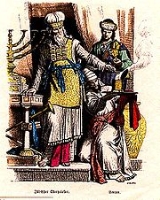
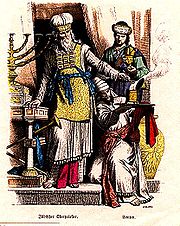
provides for specific vestments to be worn by the priests when they are ministering in the Tabernacle
: "And you shall make holy garments for Aaron your brother, for dignity and for beauty" . These garments are described in detail in , and . The high priest wore eight holy garments (bigdei kodesh). Of these, four were of the same type worn by all priests, and four were unique to the Kohen Gadol.
Those vestments which were common to all priests, were:
The vestments that were unique to the High Priest were:
The High Priest, like all priests, would minister barefoot when he was serving in the Temple. Like all of the priests, he had to immerse himself in the ritual bath
before vesting and wash his hands and his feet before performing any sacred act. The Talmud
teaches that neither the kohanim nor the Kohen Gadol were fit to minister unless they wore their priestly vestments: "While they are clothed in the priestly garments, they are clothed in the priesthood; but when they are not wearing the garments, the priesthood is not upon them" (B.Zevachim 17:B). It is further taught that just as the sacrifices facilitate an atonement
for sin
, so do the priestly garments (B.Zevachim 88b)
The High Priest had two sets of holy garments: the "Golden Garments" detailed above, and a set of white "Linen Garments" (bigdei ha-bad) which he wore only on the Day of Atonement
(Yom Kippur) . On that day, he would change his holy garments four times, beginning in the golden garments but changing into the Linen Garments for the two moments when he would enter the Holy of Holies
(the first time to offer the blood of atonement and the incense, and the second time to retrieve the censer), and then change back again into the golden garments after each time. He would immerse in the ritual bath before each change of garments, washing his hands and his feet after removing the garments and again before putting the other set on. The linen garments were only four in number, those corresponding to the garments worn by all priests (undergarments, tunic, sash and turban), but made only of white linen, with no embroidery. They could be worn only once, new sets being made each year.
; the "filling" of the hands; the smearing with blood. But Aaron the high priest was anointed with sacred oil
, hence the title of the "anointed priest"; other passages have it that all priests were anointed .
The first consecration was performed by Moses; the Bible does not state who consecrated subsequent high priests. states emphatically that every new high priest shall be anointed; and et seq. commands that the official garments worn by his predecessor shall be worn by the new incumbent while he is anointed and during the seven days of his consecration (comp. ; ).
he alone entered the Holy of Holies
, to make atonement for his house and for the people (Lev. xvi). He alone could offer the sacrifices for the sins of the priests, or of the people, or of himself (Lev. iv.); and only he could officiate at the sacrifices following his own or another priest's consecration (Lev. ix.). He also offered a meal- offering every morning and evening for himself and the whole body of the priesthood (Lev. vi. 14-15, though the wording of the law is not altogether definite). Other information concerning his functions is not given. Though other priests would serve only when it was their week on rotation and on feast days (and even then their function was decided by lot), he was privileged to take part at his own pleasure in any of the priestly rites at any time. Josephus
contends that the high priest almost invariably participated in the ceremonies on Shabbat
, the New Moon
, and the festivals. This may also be inferred from the glowing description given in the Wisdom of Sirach i. of the high priest's appearance at the altar
.
alone had the right to appoint, or confirm the appointment of, the high priest. His consecration might take place only in the day-time. Two high priests must not be appointed together. Every high priest had a "mishneh" (a second) called the Segan
, or "memunneh", to stand at his right; another assistant was the "Catholicos
" ("Yad," l.c. 16-17). The right of succession was in the direct, or, the direct failing, the collateral, line, provided the conditions concerning physical fitness were fulfilled (ib. 20; Ket. 103b; Sifra, Ḳedoshim).
For offenses which entailed flagellation the high priest could be sentenced by a court of three; after submitting to the penalty he could resume his office ("Yad," l.c. 22). The high priest was expected to be superior to all other priests in physique, in wisdom, in dignity, and in material wealth; if he was poor his brother priests contributed to make him rich (Yoma 18a; "Yad," l.c. v. 1); but none of these conditions was indispensable.
The high priest was required to be mindful of his honor. He might not mingle with the common people, nor permit himself to be seen disrobed, or in a public bath, etc.; but he might invite others to bathe with him (Tosef., Sanh. iv.; "Yad," l.c. v. 3). He might not participate in a public banquet, but he might pay a visit of consolation to mourners, though even then his dignity was guarded by prescribed etiquette (Sanh. 18-19; "Yad," l.c. v. 4).
was at his right, the next in rank and the people at his left. The people said: "We are thy atonement." He answered: "Be ye blessed from heaven" ("Yad," l.c. v. 5; and Mishneh Kesef, ad loc.). During the offering of consolation he sat on a stool, the people on the floor; he rent his garments, not from above, but from below, near the feet, the penalty for rending them from above being flagellation (Semag, Lawin, 61-62). He could not permit his hair to be disheveled, nor could he cut it ("Yad," l.c. v. 6). He had one house attached to the Temple (Mid. 71b), and another in the city of Jerusalem. His honor required that he should spend most of his time in the Sanctuary ("Yad," l.c. v. 7). The high priest was subject to the jurisdiction of the courts, but if accused of a crime entailing capital punishment he was tried by the Great Sanhedrin; he could, however, refuse to give testimony (Sanh. 18).
The high priest must be married, and "should only marry a virgin"; to guard against contingencies it was proposed to hold a second wife in readiness immediately before the Day of Atonement
(Yoma i. 1); but polygamy
on his part was not encouraged ( = "one wife"; Yoma 13a; "Yad," l.c. v. 10). He could give the "halizah
," and it could be given to his widow, as she also was subject to the Levirate; his divorced wife could marry again (l.c.; Sanh. 18). When entering the Temple ("Hekal") he was supported to the curtain by three men (Tamid 67a; this may perhaps have reference to his entering the Holy of Holies; but see "Yad," l.c. v. 11, and the Mishneh Kesef ad loc.). He could take part in the service whenever he desired ("Yad," l.c. v. 12; Yoma i. 2; Tamid 67b; see Rashi ad loc.). On the Day of Atonement only he wore white garments, while on other occasions he wore his golden vestments (Yoma 60a; comp. 68b). The seven days preceding the Day of Atonement were devoted to preparing for his high function, precautions being taken to prevent any accident that might render him Levitically impure (Yoma i. 1 et seq.). The ceremonial for that day is described in detail in Mishnah Yoma (see also Haneberg, "Die Religiösen Alterthümer der Bibel," pp. 659–671, Munich, 1869). For other regulations concerning the high priest see "Yad," Biat ha-Miḳdash, ii. 1, 8; for details in regard to the vestments see "Yad," Kele ha-Miḳdash, viii. 2-4, 5 (in reference to soiled vestments: the white could be worn only once); l.c. vii. 1 ("ẓiẓ"), vii. 3 ("me'il"), vii. 6 ("ḥoshen"), vii. 9 (ephod), ix.
Josephus enumerates only fifty-two pontificates under the Second Temple, omitting the second appointments of Hyrcanus II
., Hananeel, and Joazar.
 After the Babylonian Exile, Joshua appears vested with the prominence that P
ascribes to the high priest (Zech. iii.; Hag. vi. 13). In Ezra
and Nehemiah
, again, but little consideration is shown for the high priest. The post-exilic high priests traced their pedigree back to Zadok, appointed as chief priest at Jerusalem by Solomon (I Kings ii. 35), and Zadok was held to be a descendant of Eleazar, the son of Aaron (II Chron. v. 34). Immediately after the return from the Captivity, as is clearly to be inferred from Zechariah
and Haggai
, political authority was not vested in the high priest. Political (Messianic) sovereignty was represented by, or attributed to, a member of the royal house, while religious affairs were reserved to the high-priesthood, represented in the Book of Zechariah by Joshua. But in the course of time, as the Messianic hope, or even the hope of autonomy under foreign (Persian, Greek
, Egypt
ian,or Syrian) suzerainty became weaker, the high priest also became a political chief of the congregation, as much, perhaps, through the consideration shown him by the suzerain powers and their viceroys as through the effect of the increasingly thorough acceptance of the Levitical code by pious Judea
ns. In this connection the report (I Macc. vii. 14) that the rigorists received Alcimus
, the high priest, with confidence because he was "a priest of the seed of Aaron" is significant.
) l. is another evidence of the great reverence in which the high priest was held. The assumption of the princely authority by the Maccabean
high priests (the Hasmoneans) was merely the final link in this development, which, beginning with the death of Zerubbabel
, was to combine the two ideals, the politico-Messianic
and the religio-Levitical, in one office. But after the brief heyday of national independence had come to an inglorious close, the high-priesthood changed again in character, insofar as it ceased to be a hereditary and a life office. High priests were appointed and removed with great frequency (see above). This may account for the otherwise strange use of the title in the plural (ἀρχιερεῖς) in the New Testament and in Josephus ("Vita," § 38; "B. J." ii. 12, § 6; iv. 3, §§ 7, 9; iv. 4, § 3). The deposed high priests seem to have retained the title, and to have continued to exercise certain functions; the ministration on the Day of Atonement, however, may have been reserved for the actual incumbent. This, however, is not clear; Hor. iii. 1-4 mentions as distinctive the exclusive sacrifice of a bull by the high priest on the Day of Atonement and the tenth of the ephah (that is, the twelve "ḥallot"; comp. Meg. i. 9; Macc. ii. 6). But even in the latest periods the office was restricted to a few families of great distinction (probably the bene kohanim gedolim; Ket. xiii. 1-2; Oh. xvii. 5; comp. Josephus, "B. J." vi. 2, § 2; see Schürer, "Gesch." 3d ed., ii. 222). 001
(the Zuggim) at the head of the yeshivot presided over the great Sanhedrin also (Ḥag. ii. 2). However, a careful reading of the sources ("Ant." xx. 10; "Contra Ap." ii., § 23; comp. "Ant." iv. 8, § 14; xiv. 9, §§ 3-5 [Hyrcanus II. as president]; xx. 9, § 1 [Ananus]), as well as the fact that in the post-Maccabean period the high priest was looked upon as exercising in all things, political, legal, and sacerdotal, the supreme authority, shows it to be almost certain that the presidency of the Sanhedrin was vested in the high priest (see Isidore Loeb in "R. E. J." 1889, xix. 188-201; Jelski, "Die Innere Einrichtung des Grossen Synhedrions," pp. 22–28, according to whom the "Nasi
" was the high priest, while the "Av Beth Din" was a Pharisaic tanna).
Israelite
According to the Bible the Israelites were a Hebrew-speaking people of the Ancient Near East who inhabited the Land of Canaan during the monarchic period .The word "Israelite" derives from the Biblical Hebrew ישראל...
religion and of classical
Classical antiquity
Classical antiquity is a broad term for a long period of cultural history centered on the Mediterranean Sea, comprising the interlocking civilizations of ancient Greece and ancient Rome, collectively known as the Greco-Roman world...
Judaism
Judaism
Judaism ) is the "religion, philosophy, and way of life" of the Jewish people...
from the rise of the Israelite nation until the destruction of the Second Temple of Jerusalem. The high priests belonged to the Jewish priestly
Kohen
A Kohen is the Hebrew word for priest. Jewish Kohens are traditionally believed and halachically required to be of direct patrilineal descent from the Biblical Aaron....
families that trace their paternal line back to Aaron
Aaron
In the Hebrew Bible and the Qur'an, Aaron : Ααρών ), who is often called "'Aaron the Priest"' and once Aaron the Levite , was the older brother of Moses, and a prophet of God. He represented the priestly functions of his tribe, becoming the first High Priest of the Israelites...
, the first high priest and elder brother of Moses
Moses
Moses was, according to the Hebrew Bible and Qur'an, a religious leader, lawgiver and prophet, to whom the authorship of the Torah is traditionally attributed...
.
Biblical data
Aaron
In the Hebrew Bible and the Qur'an, Aaron : Ααρών ), who is often called "'Aaron the Priest"' and once Aaron the Levite , was the older brother of Moses, and a prophet of God. He represented the priestly functions of his tribe, becoming the first High Priest of the Israelites...
, though he is but rarely called "the great priest," being generally simply designated as "ha-kohen" (the priest), was the first incumbent of the office, to which he was appointed by God
God
God is the English name given to a singular being in theistic and deistic religions who is either the sole deity in monotheism, or a single deity in polytheism....
(Book of Exodus ; ).
The succession
Order of succession
An order of succession is a formula or algorithm that determines who inherits an office upon the death, resignation, or removal of its current occupant.-Monarchies and nobility:...
was to be through one of his sons, and was to remain in his own family . If he had no son, the office devolved upon the brother next of age: such appears to have been the practise in the Hasmonean
Hasmonean
The Hasmonean dynasty , was the ruling dynasty of Judea and surrounding regions during classical antiquity. Between c. 140 and c. 116 BCE, the dynasty ruled semi-autonomously from the Seleucids in the region of Judea...
period. In the time of Eli, however , the office passed to the collateral branch of Ithamar
Ithamar
In the Torah, Ithamar is mentioned as the youngest son of Aaron the High Priest. After the death of his two eldest brothers Nadab and Abihu when they had been punished by the Lord for performing an unauthorized sacrificial offering, Ithamar served as a priest along with his elder brother, Eleazar...
(see Eleazar
Eleazar
Eleazar , was a priest in the Hebrew Bible, the second Kohen Gadol - succeeding his father Aaron. He was a nephew of Moses.-Life:...
). But King Solomon is reported to have deposed
Deposition (politics)
Deposition by political means concerns the removal of a politician or monarch. It may be done by coup, impeachment, invasion or forced abdication...
the High Priest Abiathar
Abiathar
Abiathar , in the Hebrew Bible, son of Achimelech or Ahijah, High Priest at Nob, the fourth in descent from Eli and the last of Eli's House...
, and to have appointed Zadok
Zadok (High Priest)
Zadok , was a priest descended from Eleazar the son of Aaron, who aided King David during the revolt of his son Absalom, and was consequently instrumental in bringing King Solomon to throne...
, a descendant of Eleazar, in his stead . After the Exile
Jewish diaspora
The Jewish diaspora is the English term used to describe the Galut גלות , or 'exile', of the Jews from the region of the Kingdom of Judah and Roman Iudaea and later emigration from wider Eretz Israel....
, the succession seems to have been, at first, in a direct line from father to son; but later the civil authorities arrogated to themselves the right of appointment. Antiochus IV Epiphanes
Antiochus IV Epiphanes
Antiochus IV Epiphanes ruled the Seleucid Empire from 175 BC until his death in 164 BC. He was a son of King Antiochus III the Great. His original name was Mithridates; he assumed the name Antiochus after he ascended the throne....
for instance, deposed Onias III
Onias III
Onias III was a Jewish High Priest, the son of Simon II. He is described as a pious man who, unlike the Hellenizers, fought for Judaism. Seleucus Philopator defrayed all the expenses connected with the sanctuary and was friendly to the Jews...
in favor of Jason
Jason (high priest)
Jason of the Oniad family, brother to Onias III, was a High Priest in the Temple in Jerusalem.Jason became high priest in 175 BCE after the accession of Antiochus Epiphanes to the throne of the Seleucid Empire....
, who was followed by Menelaus
Menelaus (High Priest)
Menelaus was High Priest in Jerusalem from 171 BC to about 161 BC. He was the successor of Jason, the brother of Onias III.The sources are divided as to his origin...
.
Herod the Great
Herod the Great
Herod , also known as Herod the Great , was a Roman client king of Judea. His epithet of "the Great" is widely disputed as he is described as "a madman who murdered his own family and a great many rabbis." He is also known for his colossal building projects in Jerusalem and elsewhere, including his...
nominated no less than six high priests; Archelaus
Herod Archelaus
Herod Archelaus was the ethnarch of Samaria, Judea, and Idumea from 4 BC to 6 AD. He was the son of Herod the Great and Malthace the Samaritan, the brother of Herod Antipas, and the half-brother of Herod Philip I....
, two. The Roman legate Quirinius
Quirinius
Publius Sulpicius Quirinius was a Roman aristocrat. After the banishment of the ethnarch Herod Archelaus from the tetrarchy of Judea in AD 6, Quirinius was appointed legate governor of Syria, to which the province of Iudaea had been added for the purpose of a census.-Life:Born in the neighborhood...
and his successors exercised the right of appointment, as did Agrippa I
Agrippa I
Agrippa I also known as Herod Agrippa or simply Herod , King of the Jews, was the grandson of Herod the Great, and son of Aristobulus IV and Berenice. His original name was Marcus Julius Agrippa, so named in honour of Roman statesman Marcus Vipsanius Agrippa, and he is the king named Herod in the...
, Herod of Chalcis
Herod of Chalcis
Herod of Chalcis , also known as Herod V, was a son of Aristobulus IV, and the grandson of Herod the Great, Roman client king of Judaea. He was the brother of Herod Agrippa I and Herodias....
, and Agrippa II
Agrippa II
Agrippa II , son of Agrippa I, and like him originally named Marcus Julius Agrippa, was the seventh and last king of the family of Herod the Great, thus last of the Herodians. He was the brother of Berenice, Mariamne, and Drusilla...
. Even the people occasionally elected candidates to the office. The high priests before the Exile were, it seems, appointed for life; in fact, from Aaron to the Captivity the number of the high priests was not greater than during the sixty years preceding the fall of the Second Temple
Second Temple
The Jewish Second Temple was an important shrine which stood on the Temple Mount in Jerusalem between 516 BCE and 70 CE. It replaced the First Temple which was destroyed in 586 BCE, when the Jewish nation was exiled to Babylon...
.
Age and qualifications
The age of eligibility for the office is not fixed in the LawTorah
Torah- A scroll containing the first five books of the BibleThe Torah , is name given by Jews to the first five books of the bible—Genesis , Exodus , Leviticus , Numbers and Deuteronomy Torah- A scroll containing the first five books of the BibleThe Torah , is name given by Jews to the first five...
; but according to rabbinical tradition it was twenty. Aristobulus, however, was only seventeen when appointed by Herod; but the son of Onias III was too young (νηπιος) to succeed his father.
Legitimacy of birth was essential; hence the care in the keeping of the genealogical records and the distrust of one whose mother had been captured in war. The high priest had to abstain from ritual defilement. He may marry only an Israelite
Israelite
According to the Bible the Israelites were a Hebrew-speaking people of the Ancient Near East who inhabited the Land of Canaan during the monarchic period .The word "Israelite" derives from the Biblical Hebrew ישראל...
maiden . In this restriction is extended to all kohanim (priests), an exception being made in favor of the widow
Widow
A widow is a woman whose spouse has died, while a widower is a man whose spouse has died. The state of having lost one's spouse to death is termed widowhood or occasionally viduity. The adjective form is widowed...
of a priest (see Levirate marriage
Levirate marriage
Levirate marriage is a type of marriage in which the brother of a deceased man is obligated to marry his brother's widow, and the widow is obligated to marry her deceased husband's brother....
). He was not permitted to come in contact with the bodies of the dead, even of his closest relatives; and he was not permitted, as a sign of mourning, to leave his hair disheveled, to expose it, or to rend his garments ( et seq.). According to Josephus, birth on foreign soil was not a disqualification; but the disqualifications of et seq. applied to the high priest as well as to other priests.
His vestments
The TorahTorah
Torah- A scroll containing the first five books of the BibleThe Torah , is name given by Jews to the first five books of the bible—Genesis , Exodus , Leviticus , Numbers and Deuteronomy Torah- A scroll containing the first five books of the BibleThe Torah , is name given by Jews to the first five...
provides for specific vestments to be worn by the priests when they are ministering in the Tabernacle
Tabernacle
The Tabernacle , according to the Hebrew Torah/Old Testament, was the portable dwelling place for the divine presence from the time of the Exodus from Egypt through the conquering of the land of Canaan. Built to specifications revealed by God to Moses at Mount Sinai, it accompanied the Israelites...
: "And you shall make holy garments for Aaron your brother, for dignity and for beauty" . These garments are described in detail in , and . The high priest wore eight holy garments (bigdei kodesh). Of these, four were of the same type worn by all priests, and four were unique to the Kohen Gadol.
Those vestments which were common to all priests, were:
- Priestly undergarments (Hebrew michnasayim) (breeches)—linenLinenLinen is a textile made from the fibers of the flax plant, Linum usitatissimum. Linen is labor-intensive to manufacture, but when it is made into garments, it is valued for its exceptional coolness and freshness in hot weather....
pants reaching from the waist to the knees "to cover their nakedness" - Priestly tunic (Hebrew ketonet) (tunicTunicA tunic is any of several types of clothing for the body, of various lengths reaching from the shoulders to somewhere between the hips and the ankles...
)—made of pure linen, covering the entire body from the neck to the feet, with sleeves reaching to the wrists. That of the High Priest was embroidered ; those of the priests were plain . - Priestly sash (Hebrew avnet) (sash)—that of the High Priest was of fine linen with "embroidered workEmbroideryEmbroidery is the art or handicraft of decorating fabric or other materials with needle and thread or yarn. Embroidery may also incorporate other materials such as metal strips, pearls, beads, quills, and sequins....
" in blue and purple and scarlet ; those worn by the priests were of white, twined linen. - Priestly turban (Hebrew mitznefet)—that of the High Priest was much larger than that of the priests and wound so that it formed a broad, flat-topped turban; that for priests was wound so that it formed a cone-shaped turban, called a migbahat.
- On the front of the turban was a golden plateTzitzThe priestly crown or frontlet was the golden plate or tiara worn by the Jewish High Priest on his mitre or turban whenever he would minister in the Tabernacle or the Temple in Jerusalem.-Etymology:...
inscribed with the words: "Holiness unto YHWH" was attached to the mitznefet.
The vestments that were unique to the High Priest were:
- Priestly robe (me'il) ("Robe of the Ephod")—a sleeveless, blue robe, the lower hem of which was fringed with small golden bells alternating with pomegranatePomegranateThe pomegranate , Punica granatum, is a fruit-bearing deciduous shrub or small tree growing between five and eight meters tall.Native to the area of modern day Iran, the pomegranate has been cultivated in the Caucasus since ancient times. From there it spread to Asian areas such as the Caucasus as...
-shaped tassels in blue, purple, and scarlet - tekheletTekheletTekhelet, , Tekheleth, Techelet or Techeiles is a blue dye mentioned 50 times in the Hebrew Bible and translated by the Septuagint as hyakinthinos . Its uses include the clothing of the High Priest, the tapestries in the Tabernacle, and the tassels to be affixed to the corners of one's garments...
, argaman, tolaat shani. - EphodEphodAn ephod was an article of clothing, and a worship object, in ancient Israelite culture, and was closely connected with oracular practices....
—a richly embroidered vest or apron with two onyxOnyxOnyx is a banded variety of chalcedony. The colors of its bands range from white to almost every color . Commonly, specimens of onyx contain bands of black and/or white.-Etymology:...
engraved gemstones on the shoulders, on which were engraved the names of the tribes of Israel - Priestly breastplate (Hebrew hoshen) — with twelve gems, each engraved with the name of one of the tribes; a pouch in which he probably carried the Urim and ThummimUrim and ThummimIn ancient Israelite religion and culture, Urim and Thummim is a phrase from the Hebrew Scriptures or Torah associated with the Hoshen , divination in general, and cleromancy in particular...
. It was fastened to the Ephod
The High Priest, like all priests, would minister barefoot when he was serving in the Temple. Like all of the priests, he had to immerse himself in the ritual bath
Mikvah
Mikveh is a bath used for the purpose of ritual immersion in Judaism...
before vesting and wash his hands and his feet before performing any sacred act. The Talmud
Talmud
The Talmud is a central text of mainstream Judaism. It takes the form of a record of rabbinic discussions pertaining to Jewish law, ethics, philosophy, customs and history....
teaches that neither the kohanim nor the Kohen Gadol were fit to minister unless they wore their priestly vestments: "While they are clothed in the priestly garments, they are clothed in the priesthood; but when they are not wearing the garments, the priesthood is not upon them" (B.Zevachim 17:B). It is further taught that just as the sacrifices facilitate an atonement
Atonement in Judaism
Atonement in Judaism is the process of causing a transgression to be forgiven or pardoned.- In Rabbinic Judaism :In Rabbinic Judaism, atonement is achieved through some combination of*repentance*Temple service Atonement in Judaism is the process of causing a transgression to be forgiven or...
for sin
Sin
In religion, sin is the violation or deviation of an eternal divine law or standard. The term sin may also refer to the state of having committed such a violation. Christians believe the moral code of conduct is decreed by God In religion, sin (also called peccancy) is the violation or deviation...
, so do the priestly garments (B.Zevachim 88b)
The High Priest had two sets of holy garments: the "Golden Garments" detailed above, and a set of white "Linen Garments" (bigdei ha-bad) which he wore only on the Day of Atonement
Yom Kippur
Yom Kippur , also known as Day of Atonement, is the holiest and most solemn day of the year for the Jews. Its central themes are atonement and repentance. Jews traditionally observe this holy day with a 25-hour period of fasting and intensive prayer, often spending most of the day in synagogue...
(Yom Kippur) . On that day, he would change his holy garments four times, beginning in the golden garments but changing into the Linen Garments for the two moments when he would enter the Holy of Holies
Holy of Holies
The Holy of Holies is a term in the Hebrew Bible which refers to the inner sanctuary of the Tabernacle and later the Temple in Jerusalem where the Ark of the Covenant was kept during the First Temple, which could be entered only by the High Priest on Yom Kippur...
(the first time to offer the blood of atonement and the incense, and the second time to retrieve the censer), and then change back again into the golden garments after each time. He would immerse in the ritual bath before each change of garments, washing his hands and his feet after removing the garments and again before putting the other set on. The linen garments were only four in number, those corresponding to the garments worn by all priests (undergarments, tunic, sash and turban), but made only of white linen, with no embroidery. They could be worn only once, new sets being made each year.
Consecration
The ceremonial of consecration, extending through an entire week (-; ), included certain rites which all priests were required to undergo: purification; the sacrificesKorban
The term offering as found in the Hebrew Bible in relation to the worship of Ancient Israel is mainly represented by the Hebrew noun korban whether for an animal or other offering...
; the "filling" of the hands; the smearing with blood. But Aaron the high priest was anointed with sacred oil
Holy anointing oil
The holy anointing oil , formed an integral part of the ordination of the priesthood and the high priest as well as in the consecration of the articles of the tabernacle and subsequent temples in Jerusalem...
, hence the title of the "anointed priest"; other passages have it that all priests were anointed .
The first consecration was performed by Moses; the Bible does not state who consecrated subsequent high priests. states emphatically that every new high priest shall be anointed; and et seq. commands that the official garments worn by his predecessor shall be worn by the new incumbent while he is anointed and during the seven days of his consecration (comp. ; ).
Sanctity and functions
The distinguished rank of the high priest is apparent from the fact that his sins are regarded as belonging also to the people (Lev. iv. 3, 22). He was entrusted with the stewardship of the Urim and Thummim (Num. xxvii. 20 et seq.). On Yom KippurYom Kippur
Yom Kippur , also known as Day of Atonement, is the holiest and most solemn day of the year for the Jews. Its central themes are atonement and repentance. Jews traditionally observe this holy day with a 25-hour period of fasting and intensive prayer, often spending most of the day in synagogue...
he alone entered the Holy of Holies
Holy of Holies
The Holy of Holies is a term in the Hebrew Bible which refers to the inner sanctuary of the Tabernacle and later the Temple in Jerusalem where the Ark of the Covenant was kept during the First Temple, which could be entered only by the High Priest on Yom Kippur...
, to make atonement for his house and for the people (Lev. xvi). He alone could offer the sacrifices for the sins of the priests, or of the people, or of himself (Lev. iv.); and only he could officiate at the sacrifices following his own or another priest's consecration (Lev. ix.). He also offered a meal- offering every morning and evening for himself and the whole body of the priesthood (Lev. vi. 14-15, though the wording of the law is not altogether definite). Other information concerning his functions is not given. Though other priests would serve only when it was their week on rotation and on feast days (and even then their function was decided by lot), he was privileged to take part at his own pleasure in any of the priestly rites at any time. Josephus
Josephus
Titus Flavius Josephus , also called Joseph ben Matityahu , was a 1st-century Romano-Jewish historian and hagiographer of priestly and royal ancestry who recorded Jewish history, with special emphasis on the 1st century AD and the First Jewish–Roman War, which resulted in the Destruction of...
contends that the high priest almost invariably participated in the ceremonies on Shabbat
Shabbat
Shabbat is the seventh day of the Jewish week and a day of rest in Judaism. Shabbat is observed from a few minutes before sunset on Friday evening until a few minutes after when one would expect to be able to see three stars in the sky on Saturday night. The exact times, therefore, differ from...
, the New Moon
Rosh Chodesh
Rosh Chodesh or Rosh ḥodesh is the name for the first day of every month in the Hebrew calendar, marked by the appearance of the new moon. The new moon is marked by the day and hour that the new crescent is observed...
, and the festivals. This may also be inferred from the glowing description given in the Wisdom of Sirach i. of the high priest's appearance at the altar
Altar
An altar is any structure upon which offerings such as sacrifices are made for religious purposes. Altars are usually found at shrines, and they can be located in temples, churches and other places of worship...
.
In rabbinical literature
The high priest is the chief of all the priests; he should be anointed and invested with the pontifical garments; but if the sacred oil is not obtainable, investiture with the additional garments (see Biblical Data, above) is regarded as sufficient. A high priest so invested is known as merubbeh begadim. This investiture consists of arraying him in the eight pieces of dress and in removing them again on eight successive days, though (the anointing and) the investiture on the first day suffices to qualify him for the functions of the office. The only distinction between the "anointed" and the "invested" high priest is that the former offers the bull for an unintentional transgression.His powers
The Great SanhedrinSanhedrin
The Sanhedrin was an assembly of twenty-three judges appointed in every city in the Biblical Land of Israel.The Great Sanhedrin was the supreme court of ancient Israel made of 71 members...
alone had the right to appoint, or confirm the appointment of, the high priest. His consecration might take place only in the day-time. Two high priests must not be appointed together. Every high priest had a "mishneh" (a second) called the Segan
Segan
The Aramaic term segan or segan hakohanim in the Talmud is the title for a Jewish Priest of the Temple in Jerusalem.-Hebrew Bible:...
, or "memunneh", to stand at his right; another assistant was the "Catholicos
Catholicos
Catholicos, plural Catholicoi, is a title used for the head of certain churches in some Eastern Christian traditions. The title implies autocephaly and in some cases is borne by the designated head of an autonomous church, in which case the holder might have other titles such as Patriarch...
" ("Yad," l.c. 16-17). The right of succession was in the direct, or, the direct failing, the collateral, line, provided the conditions concerning physical fitness were fulfilled (ib. 20; Ket. 103b; Sifra, Ḳedoshim).
For offenses which entailed flagellation the high priest could be sentenced by a court of three; after submitting to the penalty he could resume his office ("Yad," l.c. 22). The high priest was expected to be superior to all other priests in physique, in wisdom, in dignity, and in material wealth; if he was poor his brother priests contributed to make him rich (Yoma 18a; "Yad," l.c. v. 1); but none of these conditions was indispensable.
The high priest was required to be mindful of his honor. He might not mingle with the common people, nor permit himself to be seen disrobed, or in a public bath, etc.; but he might invite others to bathe with him (Tosef., Sanh. iv.; "Yad," l.c. v. 3). He might not participate in a public banquet, but he might pay a visit of consolation to mourners, though even then his dignity was guarded by prescribed etiquette (Sanh. 18-19; "Yad," l.c. v. 4).
Restrictions
The high priest might not follow the bier of one in his own family who had died, nor leave the Temple or his house during the time of mourning. The people visited him to offer consolation; in receiving them, the SeganSegan
The Aramaic term segan or segan hakohanim in the Talmud is the title for a Jewish Priest of the Temple in Jerusalem.-Hebrew Bible:...
was at his right, the next in rank and the people at his left. The people said: "We are thy atonement." He answered: "Be ye blessed from heaven" ("Yad," l.c. v. 5; and Mishneh Kesef, ad loc.). During the offering of consolation he sat on a stool, the people on the floor; he rent his garments, not from above, but from below, near the feet, the penalty for rending them from above being flagellation (Semag, Lawin, 61-62). He could not permit his hair to be disheveled, nor could he cut it ("Yad," l.c. v. 6). He had one house attached to the Temple (Mid. 71b), and another in the city of Jerusalem. His honor required that he should spend most of his time in the Sanctuary ("Yad," l.c. v. 7). The high priest was subject to the jurisdiction of the courts, but if accused of a crime entailing capital punishment he was tried by the Great Sanhedrin; he could, however, refuse to give testimony (Sanh. 18).
The high priest must be married, and "should only marry a virgin"; to guard against contingencies it was proposed to hold a second wife in readiness immediately before the Day of Atonement
Yom Kippur
Yom Kippur , also known as Day of Atonement, is the holiest and most solemn day of the year for the Jews. Its central themes are atonement and repentance. Jews traditionally observe this holy day with a 25-hour period of fasting and intensive prayer, often spending most of the day in synagogue...
(Yoma i. 1); but polygamy
Polygamy
Polygamy is a marriage which includes more than two partners...
on his part was not encouraged ( = "one wife"; Yoma 13a; "Yad," l.c. v. 10). He could give the "halizah
Halizah
Under the Biblical system of levirate marriage known as Yibbum, Halizah is the ceremony by which a widow and her husband's brother could avoid the duty to marry after the husband's death....
," and it could be given to his widow, as she also was subject to the Levirate; his divorced wife could marry again (l.c.; Sanh. 18). When entering the Temple ("Hekal") he was supported to the curtain by three men (Tamid 67a; this may perhaps have reference to his entering the Holy of Holies; but see "Yad," l.c. v. 11, and the Mishneh Kesef ad loc.). He could take part in the service whenever he desired ("Yad," l.c. v. 12; Yoma i. 2; Tamid 67b; see Rashi ad loc.). On the Day of Atonement only he wore white garments, while on other occasions he wore his golden vestments (Yoma 60a; comp. 68b). The seven days preceding the Day of Atonement were devoted to preparing for his high function, precautions being taken to prevent any accident that might render him Levitically impure (Yoma i. 1 et seq.). The ceremonial for that day is described in detail in Mishnah Yoma (see also Haneberg, "Die Religiösen Alterthümer der Bibel," pp. 659–671, Munich, 1869). For other regulations concerning the high priest see "Yad," Biat ha-Miḳdash, ii. 1, 8; for details in regard to the vestments see "Yad," Kele ha-Miḳdash, viii. 2-4, 5 (in reference to soiled vestments: the white could be worn only once); l.c. vii. 1 ("ẓiẓ"), vii. 3 ("me'il"), vii. 6 ("ḥoshen"), vii. 9 (ephod), ix.
Josephus enumerates only fifty-two pontificates under the Second Temple, omitting the second appointments of Hyrcanus II
Hyrcanus II
Hyrcanus II, a member of the Hasmonean dynasty, was the Jewish High Priest and King of Judea in the 1st century BC.-Accession:Hyrcanus was the eldest son of Alexander Jannaeus, King and High Priest, and Alexandra Salome...
., Hananeel, and Joazar.
Post-Exilic conditions
Priestly source
The Priestly Source is one of the sources of the Torah/Pentateuch in the bible. Primarily a product of the post-Exilic period when Judah was a province of the Persian empire , P was written to show that even when all seemed lost, God remained present with Israel...
ascribes to the high priest (Zech. iii.; Hag. vi. 13). In Ezra
Book of Ezra
The Book of Ezra is a book of the Hebrew Bible. Originally combined with the Book of Nehemiah in a single book of Ezra-Nehemiah, the two became separated in the early centuries of the Christian era...
and Nehemiah
Book of Nehemiah
The Book of Nehemiah is a book of the Hebrew Bible. Told largely in the form of a first-person memoir, it concerns the rebuilding of the walls of Jerusalem by Nehemiah, a Jew who is a high official at the Persian court, and the dedication of the city and its people to God's laws...
, again, but little consideration is shown for the high priest. The post-exilic high priests traced their pedigree back to Zadok, appointed as chief priest at Jerusalem by Solomon (I Kings ii. 35), and Zadok was held to be a descendant of Eleazar, the son of Aaron (II Chron. v. 34). Immediately after the return from the Captivity, as is clearly to be inferred from Zechariah
Book of Zechariah
The Book of Zechariah is the penultimate book of the twelve minor prophets in the Hebrew and Christian Bible, attributed to the prophet Zechariah.-Historical context:...
and Haggai
Book of Haggai
The Book of Haggai is a book of the Hebrew Bible or Tanak, and has its place as the antepenultimate of the Minor Prophets or the "Book of the Twelve." It is a short book, consisting of only two chapters. The historical setting dates around 520 BCE before the Temple has been rebuilt...
, political authority was not vested in the high priest. Political (Messianic) sovereignty was represented by, or attributed to, a member of the royal house, while religious affairs were reserved to the high-priesthood, represented in the Book of Zechariah by Joshua. But in the course of time, as the Messianic hope, or even the hope of autonomy under foreign (Persian, Greek
Greece
Greece , officially the Hellenic Republic , and historically Hellas or the Republic of Greece in English, is a country in southeastern Europe....
, Egypt
Egypt
Egypt , officially the Arab Republic of Egypt, Arabic: , is a country mainly in North Africa, with the Sinai Peninsula forming a land bridge in Southwest Asia. Egypt is thus a transcontinental country, and a major power in Africa, the Mediterranean Basin, the Middle East and the Muslim world...
ian,or Syrian) suzerainty became weaker, the high priest also became a political chief of the congregation, as much, perhaps, through the consideration shown him by the suzerain powers and their viceroys as through the effect of the increasingly thorough acceptance of the Levitical code by pious Judea
Judea
Judea or Judæa was the name of the mountainous southern part of the historic Land of Israel from the 8th century BCE to the 2nd century CE, when Roman Judea was renamed Syria Palaestina following the Jewish Bar Kokhba revolt.-Etymology:The...
ns. In this connection the report (I Macc. vii. 14) that the rigorists received Alcimus
Alcimus
Alcimus , also called Jacimus, or Joachim , was a High Priest of Israel for three years, 162 BCE-159 BCE, who espoused the Syrian cause....
, the high priest, with confidence because he was "a priest of the seed of Aaron" is significant.
Political aspects
Ecclus. (SirachSirach
The Book of the All-Virtuous Wisdom of Jesus ben Sira , commonly called the Wisdom of Sirach or simply Sirach, and also known as Ecclesiasticus or Siracides , is a work from the early 2nd century B.C. written by the Jewish scribe Jesus ben Sirach of Jerusalem...
) l. is another evidence of the great reverence in which the high priest was held. The assumption of the princely authority by the Maccabean
Maccabees
The Maccabees were a Jewish rebel army who took control of Judea, which had been a client state of the Seleucid Empire. They founded the Hasmonean dynasty, which ruled from 164 BCE to 63 BCE, reasserting the Jewish religion, expanding the boundaries of the Land of Israel and reducing the influence...
high priests (the Hasmoneans) was merely the final link in this development, which, beginning with the death of Zerubbabel
Zerubbabel
Zerubbabel was a governor of the Persian Province of Judah and the grandson of Jehoiachin, penultimate king of Judah. Zerubbabel led the first group of Jews, numbering 42,360, who returned from the Babylonian Captivity in the first year of Cyrus, King of Persia . The date is generally thought to...
, was to combine the two ideals, the politico-Messianic
Messiah
A messiah is a redeemer figure expected or foretold in one form or another by a religion. Slightly more widely, a messiah is any redeemer figure. Messianic beliefs or theories generally relate to eschatological improvement of the state of humanity or the world, in other words the World to...
and the religio-Levitical, in one office. But after the brief heyday of national independence had come to an inglorious close, the high-priesthood changed again in character, insofar as it ceased to be a hereditary and a life office. High priests were appointed and removed with great frequency (see above). This may account for the otherwise strange use of the title in the plural (ἀρχιερεῖς) in the New Testament and in Josephus ("Vita," § 38; "B. J." ii. 12, § 6; iv. 3, §§ 7, 9; iv. 4, § 3). The deposed high priests seem to have retained the title, and to have continued to exercise certain functions; the ministration on the Day of Atonement, however, may have been reserved for the actual incumbent. This, however, is not clear; Hor. iii. 1-4 mentions as distinctive the exclusive sacrifice of a bull by the high priest on the Day of Atonement and the tenth of the ephah (that is, the twelve "ḥallot"; comp. Meg. i. 9; Macc. ii. 6). But even in the latest periods the office was restricted to a few families of great distinction (probably the bene kohanim gedolim; Ket. xiii. 1-2; Oh. xvii. 5; comp. Josephus, "B. J." vi. 2, § 2; see Schürer, "Gesch." 3d ed., ii. 222). 001
Connection with Sanhedrin
The high priest was the presiding officer of the Sanhedrin. This view conflicts with the later Jewish tradition according to which the Pharisee tannaimTannaim
The Tannaim were the Rabbinic sages whose views are recorded in the Mishnah, from approximately 70-200 CE. The period of the Tannaim, also referred to as the Mishnaic period, lasted about 130 years...
(the Zuggim) at the head of the yeshivot presided over the great Sanhedrin also (Ḥag. ii. 2). However, a careful reading of the sources ("Ant." xx. 10; "Contra Ap." ii., § 23; comp. "Ant." iv. 8, § 14; xiv. 9, §§ 3-5 [Hyrcanus II. as president]; xx. 9, § 1 [Ananus]), as well as the fact that in the post-Maccabean period the high priest was looked upon as exercising in all things, political, legal, and sacerdotal, the supreme authority, shows it to be almost certain that the presidency of the Sanhedrin was vested in the high priest (see Isidore Loeb in "R. E. J." 1889, xix. 188-201; Jelski, "Die Innere Einrichtung des Grossen Synhedrions," pp. 22–28, according to whom the "Nasi
Nasi
Nāśī’ is a Hebrew title meaning prince in Biblical Hebrew, Prince in Mishnaic Hebrew, or president in Modern Hebrew.-Genesis and Ancient Israel:...
" was the high priest, while the "Av Beth Din" was a Pharisaic tanna).
See also
- KohenKohenA Kohen is the Hebrew word for priest. Jewish Kohens are traditionally believed and halachically required to be of direct patrilineal descent from the Biblical Aaron....
- List of High Priests of Israel
- SeganSeganThe Aramaic term segan or segan hakohanim in the Talmud is the title for a Jewish Priest of the Temple in Jerusalem.-Hebrew Bible:...
- Deputy High Priest - Samaritan High PriestSamaritan High PriestThe Samaritan High Priest is the high priest of the Samaritan community in the Middle East.According to Samaritan tradition, the office has existed continuously since Aaron, the brother of Moses, and has been held by 132 people...