

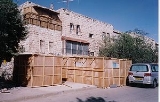
Sukkah

Encyclopedia
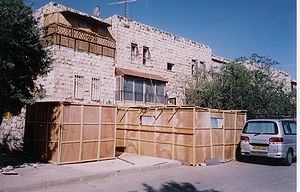
Sukkot
Sukkot is a Biblical holiday celebrated on the 15th day of the month of Tishrei . It is one of the three biblically mandated festivals Shalosh regalim on which Hebrews were commanded to make a pilgrimage to the Temple in Jerusalem.The holiday lasts seven days...
. It is topped with branches and often well decorated with autumnal, harvest or Judaic themes. The Book of Vayyiqra (Leviticus
Leviticus
The Book of Leviticus is the third book of the Hebrew Bible, and the third of five books of the Torah ....
) describes it as a symbolic wilderness
Wilderness
Wilderness or wildland is a natural environment on Earth that has not been significantly modified by human activity. It may also be defined as: "The most intact, undisturbed wild natural areas left on our planet—those last truly wild places that humans do not control and have not developed with...
shelter, commemorating the time God provided for the Israelites in the wilderness they inhabited after they were freed from slavery in Egypt. It is common for Jews to eat, sleep and otherwise spend time in the sukkah. In Judaism, Sukkot is considered a joyous occasion and is referred to in Hebrew as Yom Simchateinu (the day of our rejoicing) or Z'man Simchateinu (the time of our rejoicing), but the sukkah itself symbolizes the frailty and transience of life and its dependence on God.
Associated activities

Halakha
Halakha — also transliterated Halocho , or Halacha — is the collective body of Jewish law, including biblical law and later talmudic and rabbinic law, as well as customs and traditions.Judaism classically draws no distinction in its laws between religious and ostensibly non-religious life; Jewish...
requires that eating of all meals and sleeping should be conducted in the sukkah. However, Jews are not expected to remain in the sukkah if they would be very uncomfortable there. For this reason, Jews living at northern latitudes will generally not sleep in the sukkah due to the cold temperatures of autumn nights. Some Jews in these locales will spend some time in the sukkah eating and relaxing but go indoors to sleep.
When rain falls on the sukkah, one is not required to stay inside. The Mishna in Sukkah 28b compares rain falling on a sukkah to a master who receives a drink from his servant and then throws it back in the servant's face. The analogy is that through the rainfall, God is showing displeasure with our performance of the mitzvah by not allowing us to fulfill our obligation of sitting in the sukkah.
In Israel and other temperate climates (such as Florida
Florida
Florida is a state in the southeastern United States, located on the nation's Atlantic and Gulf coasts. It is bordered to the west by the Gulf of Mexico, to the north by Alabama and Georgia and to the east by the Atlantic Ocean. With a population of 18,801,310 as measured by the 2010 census, it...
, Australia
Australia
Australia , officially the Commonwealth of Australia, is a country in the Southern Hemisphere comprising the mainland of the Australian continent, the island of Tasmania, and numerous smaller islands in the Indian and Pacific Oceans. It is the world's sixth-largest country by total area...
, and Southern California
Southern California
Southern California is a megaregion, or megapolitan area, in the southern area of the U.S. state of California. Large urban areas include Greater Los Angeles and Greater San Diego. The urban area stretches along the coast from Ventura through the Southland and Inland Empire to San Diego...
), observant Jews will often conduct all their eating, studying, and sleeping activities in the sukkah. Many Jews will not eat or drink anything outside the sukkah. Others will drink or eat fruit outside the sukkah.
In Israel, it is common practice for hotels, restaurants, snack shops, and outdoor tourist attractions (such as zoos) to provide a sukkah for customers to dine in.
Lubavitcher and Belz
Belz
Belz , a small city in the Lviv Oblast of Western Ukraine, near the border with Poland, is located between the Solokiya river and the Rzeczyca stream....
er Hasidim differ from other Orthodox Jews in that they do not sleep in the sukkah due to its intrinsic holiness. Though the halakha doesn't obligate one to eat or sleep in the sukkah if it is raining, Lubavitcher Hasidim will still eat there.
A popular social activity which involves people visiting each others' Sukkot has become known as "Sukkah hopping". Food is laid out so that participants will be able to recite the various required blessings.
Structure

Life
Life is a characteristic that distinguishes objects that have signaling and self-sustaining processes from those that do not, either because such functions have ceased , or else because they lack such functions and are classified as inanimate...
material which has been disconnected from the ground (the S'chach
S'chach
S'chach is the hebrew name for the material used as a roof for a sukkah. S'chach has to derive from things that have "grown from the ground", such as Palm leaves, bamboo sticks and pine tree branches. Some types of wooden slats and other types of organic material can be used for S'chach, unless...
). A sukkah must have 3 walls. It should be at least three feet tall, and be positioned so that all or part of its roof is open to the sky (only the part which is under the sky is kosher.)
In practice, the walls of a sukkah can be constructed from any material which will withstand a normally anticipated terrestrial wind. If the material is not rigid, and therefore will sway in the wind, the sukkah is not kosher (Talmud, Sukkah 24b). Accordingly, there is a discussion among contemporary halakhic authorities whether canvas may be used for walls: Some, such as R. Ovadiah Yosef (Shu"t Yechaveh Da'at 3:46) hold that even the slightest degree of swaying in the wind will disqualify the sukkah walls, and thus canvas cannot realistically be employed. Others, such as the Chazon Ish, permit motion to and fro of less than three handbreadths, thereby facilitating the usage of canvas walls. The specific details of what constitutes a wall, the minimum and maximum wall heights, whether there can be spaces between the walls and the roof, and the exact material required for the s'chach (roofing) can be found in various exegetical
Exegesis
Exegesis is a critical explanation or interpretation of a text, especially a religious text. Traditionally the term was used primarily for exegesis of the Bible; however, in contemporary usage it has broadened to mean a critical explanation of any text, and the term "Biblical exegesis" is used...
texts.
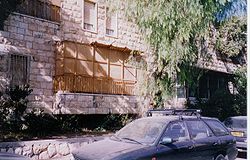
Roof covering

Hebrew language
Hebrew is a Semitic language of the Afroasiatic language family. Culturally, is it considered by Jews and other religious groups as the language of the Jewish people, though other Jewish languages had originated among diaspora Jews, and the Hebrew language is also used by non-Jewish groups, such...
, must consist of something that grew from the earth but is currently disconnected from it. Palm leaves, bamboo sticks
Bamboo
Bamboo is a group of perennial evergreens in the true grass family Poaceae, subfamily Bambusoideae, tribe Bambuseae. Giant bamboos are the largest members of the grass family....
, pine
Pine
Pines are trees in the genus Pinus ,in the family Pinaceae. They make up the monotypic subfamily Pinoideae. There are about 115 species of pine, although different authorities accept between 105 and 125 species.-Etymology:...
branches, wood
Wood
Wood is a hard, fibrous tissue found in many trees. It has been used for hundreds of thousands of years for both fuel and as a construction material. It is an organic material, a natural composite of cellulose fibers embedded in a matrix of lignin which resists compression...
and the like can all be used for s'chach, unless they were processed previously for a different use.
There must be enough s'chach that inside the sukkah there should be more shade than sun. However, there must be sufficient gaps between the pieces of s'chach so that rain could come through.
Decorations
Etrog
Etrog refers to the yellow citron or Citrus medica used by Jews on the week-long holiday of Sukkot.While in modern Hebrew this is the name for any variety of citron, its English usage applies to those varieties and specimens used as one of the Four Species...
s and the seven species for which Israel is praised (wheat, barley, grapes, figs, pomegranates, olives and dates; see Deuteronomy
Deuteronomy
The Book of Deuteronomy is the fifth book of the Hebrew Bible, and of the Jewish Torah/Pentateuch...
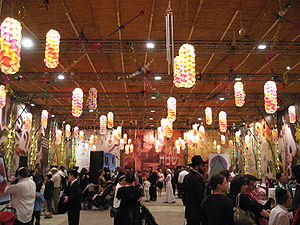
8:8) — are popular decorations.
Some families also line the interior walls with white sheeting, in order to recall the "Clouds of Glory" that surrounded the Jewish nation during their wanderings in the desert. The Chabad
Chabad
Chabad or Chabad-Lubavitch is a major branch of Hasidic Judaism.Chabad may also refer to:*Chabad-Strashelye, a defunct branch of the Chabad school of Hasidic Judaism*Chabad-Kapust or Kapust, a defunct branch of the Chabad school of Hasidic Judaism...
custom is not to decorate the sukkah, as the sukkah itself is considered to be an object of beauty.
Drive-through
Bet Shira CongregationBet Shira Congregation
Bet Shira Congregation is a Conservative synagogue located at 7500 SW 120th Street in Miami, Florida. It numbers over 550 member families.-History:...
in Miami, Florida, erects what is believed to be the first and only drive-through Sukkah, a tent in the parking lot of the synagogue that it calls the "McBet Shira Sukkah", allowing the community to participate in the celebration of the holiday from the convenience of their cars. Members of the public can drive into the sukkah, park, lower their car window, and say the blessings for the holiday, including shaking a lulav and etrog, as volunteers hand them snacks at the end of their visit.
Blessing
According to Jewish law, one must recite the following blessing when using the sukkah. The blessing is normally recited after the blessing made on food, such as on bread or cake:Transliteration: Barukh ata Adonai Eloheinu melekh ha‑olam, asher kid'shanu b'mitzvotav v'tzivanu leishev ba‑sukah.
Translation: "Blessed are You, LORD, our God, King of the universe, who has sanctified us with His commandments and commanded us to dwell in the sukkah."
Ushpizin
During the holiday, some Jews recite the ushpizin prayer which symbolizes the welcoming of seven "exalted guests" into the sukkah. These ushpizin, or guests, represent the seven shepherds of Israel: AbrahamAbraham
Abraham , whose birth name was Abram, is the eponym of the Abrahamic religions, among which are Judaism, Christianity and Islam...
, Isaac
Isaac
Isaac as described in the Hebrew Bible, was the only son Abraham had with his wife Sarah, and was the father of Jacob and Esau. Isaac was one of the three patriarchs of the Israelites...
, Jacob
Jacob
Jacob "heel" or "leg-puller"), also later known as Israel , as described in the Hebrew Bible, the Talmud, the New Testament and the Qur'an was the third patriarch of the Hebrew people with whom God made a covenant, and ancestor of the tribes of Israel, which were named after his descendants.In the...
, Moses
Moses
Moses was, according to the Hebrew Bible and Qur'an, a religious leader, lawgiver and prophet, to whom the authorship of the Torah is traditionally attributed...
, Aaron
Aaron
In the Hebrew Bible and the Qur'an, Aaron : Ααρών ), who is often called "'Aaron the Priest"' and once Aaron the Levite , was the older brother of Moses, and a prophet of God. He represented the priestly functions of his tribe, becoming the first High Priest of the Israelites...
, Joseph
Joseph (Hebrew Bible)
Joseph is an important character in the Hebrew bible, where he connects the story of Abraham, Isaac and Jacob in Canaan to the subsequent story of the liberation of the Israelites from slavery in Egypt....
and David
David
David was the second king of the united Kingdom of Israel according to the Hebrew Bible and, according to the Gospels of Matthew and Luke, an ancestor of Jesus Christ through both Saint Joseph and Mary...
. According to tradition, each night a different guest enters the sukkah followed by the other six. Each of the ushpizin parallels the spiritual focus of the day on which they visit.
In Chabad tradition, an additional set of corresponding "chasidic" ushpizin enter the sukkah, beginning with the Baal Shem Tov and the Maggid of Mezeritch and continuing with the consecutive rebbes of the Chabad
Chabad
Chabad or Chabad-Lubavitch is a major branch of Hasidic Judaism.Chabad may also refer to:*Chabad-Strashelye, a defunct branch of the Chabad school of Hasidic Judaism*Chabad-Kapust or Kapust, a defunct branch of the Chabad school of Hasidic Judaism...
Hasidic dynasty.
Sukkah City
Sukkah CitySukkah City
Sukkah City is an Architectural design competition and work of installation art planned in partnership with the Union Square Partnership for New York City's Union Square Park in September 2010....
is a public art and architecture competition planned for New York City
New York City
New York is the most populous city in the United States and the center of the New York Metropolitan Area, one of the most populous metropolitan areas in the world. New York exerts a significant impact upon global commerce, finance, media, art, fashion, research, technology, education, and...
's Union Square Park. The winning design will be chosen as the City Sukkah, to stand, starting on September 22, 2010, for the requisite seven days of the harvest holiday. A committee of art critics and celebrated architects will select the 12 finalists from a field of entries. Twelve sukkahs will be constructed between September 19 and September 21, 2010. The winning entry will stand in the Park from September 22 through the 7 day holiday of Sukkot.
External links
- Sukkah City - slideshow by The New York TimesThe New York TimesThe New York Times is an American daily newspaper founded and continuously published in New York City since 1851. The New York Times has won 106 Pulitzer Prizes, the most of any news organization...
- What On Earth Is A Sukkah? - slideshow by NPRNPRNPR, formerly National Public Radio, is a privately and publicly funded non-profit membership media organization that serves as a national syndicator to a network of 900 public radio stations in the United States. NPR was created in 1970, following congressional passage of the Public Broadcasting...
- Sukkahs - Two Modern Examples
- sukkahsoftheworld.org pictures of sukkahs from Sharon to Shanghai