

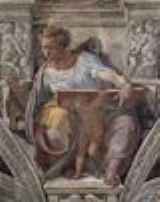
Daniel

Encyclopedia
Daniel is the protagonist
in the Book of Daniel
of the Hebrew Bible
. In the narrative, when Daniel was a young man, he was taken into Babylonian captivity
where he was educated in Chaldea
n thought. However, he never converted to Neo-Babylonian ways. By Divine Wisdom from his God, YHVH, he interpreted dreams and visions of kings, thus becoming a prominent figure in the court of Babylon. Eventually, he had apocalyptic visions
of his own that have been interpreted as the Four monarchies
. Some of the most famous tales of Daniel are: Shadrach, Meshach, and Abednego
, The writing on the wall
and Daniel in the lions' den
.
(BC 606), Daniel and his friends Hananiah, Mishael, and Azariah were among the young Jewish nobility carried off to Babylon
. The four were chosen for their intellect and beauty to be trained as advisors to the Babylonian court, Daniel was given the name Belteshazzar, i.e., prince of Bel, or Bel protect the king!(not to be confused with the neo-Babylonian king, Belshazzar). Hananiah, Mishael, and Azariah were given the Babylonian names, Shadrach, Meshach, and Abednego
, respectively.
, to see the King.[v.13-16] Daniel prays for God’s mercy to receive a revelation from the King’s dream.[v.15-18] God then reveals the mystery to Daniel in a vision that night.[v.19] Daniel praises his God with a doxology
.[v.20-23] After meeting with Arioch again, Daniel is granted access to the king[v.24-30] and relays the description of the dream,[v.31-36] followed by its interpretation.[v.37-45] With Daniel's successful interpretation of the dream, the king expresses homage,[v.46] followed by his own doxology that affirms that Daniel's God is God of gods for revealing this mystery of his dream.[v.47] Daniel is then promoted as chief governor over the whole province of Babylon.[v.48] At Daniel’s request, his companions are also promoted, thus they remain at the king’s court.[v.49]
's impious feast (in which Belshazzar and his concubines drank wine out of the royal Jewish ceremonial goblets of the Temple), Daniel was called in at the suggestion of the queen-mother to interpret the mysterious handwriting on the wall. For successfully reading the cryptic handwriting by an angel of God, Daniel was rewarded by the Babylonians with a purple robe and elevation to the rank of "third ruler" of the kingdom. It is believed that the place of "second ruler" was held by Belshazzar as associated with his father, Nabonidus
, on the throne , though nowhere in the book of Daniel is Nabonidus mentioned by name and according to the book of Daniel Nebuchadnezzar was the father of Belshazzar. Nabonidus left Babylon in his son Belshazzar's care when he fled because of his refusal to accept the role of Marduk as the prime deity. The Hebrew word translated in the book of Daniel as "son" can mean any descendant. Belshazzar was actually the grandson of Nebuchadnezzar. Daniel interpreted the handwriting, and "in that night was Belshazzar the king of the Chaldeans slain".
, and was thus practically at the head of state affairs, with the ability to influence the prospects of the captive Jews , whom he had at last the happiness of seeing restored to their own land; although he did not return with them, but remained still in Babylon.
Daniel's fidelity to God exposed him to persecution by jealous rivals within the king's administration. The fact that he had just interpreted the emperors' dream had resulted in his promotion and that of his companions. Being favored by the King, Darius the Mede, he was untouchable. His companions were vulnerable to the accusation that had them thrown into the furnace for refusing to worship the Babylonian King, Nebuchadnezzar as a god; but they were miraculously saved, and Daniel would years later be cast into a den of lions
(for continuing to practice his faith in YHWH), but was miraculously delivered; after which Darius issued a decree enjoining reverence for "the God of Daniel" . He "prospered in the reign of Darius, and in the reign of Cyrus the Great
," whom he probably greatly influenced in the decree which put an end to the Jewish Captivity (BC 536).
, Jeremiah
and Ezekiel
whose backgrounds are the basis for their revelations.
From Chapter 7 to the end of the book of Daniel, an apocalyptic
vision is being described, supposedly from the perspective of Daniel. This marks a change in the narrative from Daniel interpreting to messengers of God interpreting for Daniel. Daniel dreams of four beasts that come out of the sea: a lion with eagles wings, a bear with three tusks, a leopard with four wings and four heads, and a beast with iron teeth, ten horns and one little horn and human eyes. These beasts are all present at a convening of the divine counsel. Presiding over the counsel is the Ancient of Days, which may, in fact, be the Israelite God. The Ancient One proceeds to put to death the beast with the one little horn. Daniel also describes the fates of the other beasts saying that while their dominion was taken away, their lives were prolonged. This introduction leads into a series of dreams and visions where these events are expressed in greater detail.
Scholars argue that each of these beasts represent an emperor or kingdom that ruled over the Israelites. The first being Babylon, then Media, then Persia, and finally the Greeks
. The horns of the last beast may be symbolic of the rulers that replaced Alexander the Great upon his death, culminating with the little horn, or Antiochus IV. There are additional details in the text that allude to Antiochus IV, including some form of desecration to the temple and persecution . The final message of the second half of Daniel is that God will deliver the people from oppression, the latest of which is Antiochus IV.
. He would have been almost 100 years old at that point, having been brought to Babylon when he was in his teens, more than 80 years previously. Many posit that he possibly died at Susa
in Iran
. Tradition holds that his tomb is located in Susa at a site known as Shush-e Daniyal. Other locations have been claimed as the site of his burial, including Daniel's Tomb in Kirkuk, Iraq, as well as Babylon, Egypt, Tarsus and, notably, Samarkand
, which claims a tomb of Daniel (see "The Ruins of Afrasiab" in the Samarkand
article), with some traditions suggesting that his remains were removed, perhaps by Tamerlane, from Susa to Samarkand (see, for instance, Itinerary of Benjamin of Tudela, section 153).
, with whom Daniel was a contemporary, describes a Daniel as a "pattern of righteousness" in the Book of Ezekiel
14:14, 20 and "wisdom" (28:3). In the Book of Daniel, the name is spelled with a middle letter suggesting the i of that name — but this letter is not included in Ezekiel, suggesting that the reference there may be to another person, possibly the "Danel
" ("Judgement of God") known from Caananite Ugaritic literature (such as the Epic of Aqhat and Anat
), whose reputation for wisdom and righteousness had made him legendary. (Vowel-points were not added to the consonantal Hebrew text before well into the Common Era, and the scribes may then have slipped in a vowel-point for "i" as a middle syllable.)
, the prophet Habakkuk
is miraculously transported by an angel to take a meal to Daniel while he is in the lions' den. In response, Daniel prays, "Thou hast remembered me, O God; neither hast thou forsaken them that seek Thee and love Thee".
, Kirkuk
and Muqdadiyah
in Iraq
, Susa
and Malamir in Iran
, and Samarkand
in Uzbekistan
.
to King Hezekiah
in these words, "and they shall be eunuchs in the palace of the king of Babylon".
According to this view, Daniel and his friends were eunuchs, and were consequently able to prove the groundlessness of charges of immorality brought against them, which had almost caused their death at the hands of the king.
liturgical calendar
, the feast days celebrating St. Daniel the Prophet together with the Three Young Men
, falls on December 17
(during the Nativity Fast
), on the Sunday of the Holy Forefathers (the Sunday which falls between 11 and 17 December), and on the Sunday before Nativity. Daniel's prophesy regarding the stone which smashed the idol is often used in Orthodox hymns as a metaphor for the Incarnation
: the "stone cut out" being symbolic of the Logos
(Christ), and the fact that it was cut "without hands" being symbolic of the virgin birth. Thus the hymns will refer to the Theotokos
(Virgin Mary) as the "uncut mountain"
In the West, the Roman Catholic Church
commemorates Daniel on July 21.
He is commemorated as a prophet in the Calendar of Saints
of the Lutheran Church - Missouri Synod
together with the Three Young Men (Shadrach, Meshach, and Abednego
), on December 17.
He is commemorated as a prophet in the Coptic Church on the 23rd day of the Coptic month of Baramhat.
s traditionally consider Daniel (Arabic: دانيال, Danyal) as an Islamic prophet
, alongside the other major prophet
s of the Old Testament
. Although Daniel is not mentioned in the Qur'an
, there are accounts of Daniel's life which feature in later Muslim literature. There are debates, however, that go on about Daniel's time of preaching and some Muslims believe that he was not a prophet but a saintly man. Daniel is listed as a prophet
in all major versions of Stories of the Prophets
. When the Muslim
s conquered Alexandria
in 641 C.E, a mosque
was immediately built dedicated to Daniel.
exegesis
, including Tabari's History of the Prophets and Kings narrates that Daniel was carried off to Babylon
after Nebuchadnezzar
's attack on Jerusalem. It goes onto state that there he was thrown into the den of the lions, but was later rescued. In one such account, Daniel is aided by Jeremiah
, who comes to Babylon
to help Daniel in the lions den. In the apocryphal Bel and the Dragon
, however, there is a very similar tale which states that the Hebrew prophet
Habbakuk was miraculously transported to the den of the lions, to give a meal to Daniel.
All sources, classical
and modern, describe Daniel as a saintly and spiritual man. Abdullah Yusuf Ali
, in his Qur'anic commentary says:
Protagonist
A protagonist is the main character of a literary, theatrical, cinematic, or musical narrative, around whom the events of the narrative's plot revolve and with whom the audience is intended to most identify...
in the Book of Daniel
Book of Daniel
The Book of Daniel is a book in the Hebrew Bible. The book tells of how Daniel, and his Judean companions, were inducted into Babylon during Jewish exile, and how their positions elevated in the court of Nebuchadnezzar. The court tales span events that occur during the reigns of Nebuchadnezzar,...
of the Hebrew Bible
Hebrew Bible
The Hebrew Bible is a term used by biblical scholars outside of Judaism to refer to the Tanakh , a canonical collection of Jewish texts, and the common textual antecedent of the several canonical editions of the Christian Old Testament...
. In the narrative, when Daniel was a young man, he was taken into Babylonian captivity
Babylonian captivity
The Babylonian captivity was the period in Jewish history during which the Jews of the ancient Kingdom of Judah were captives in Babylon—conventionally 587–538 BCE....
where he was educated in Chaldea
Chaldea
Chaldea or Chaldaea , from Greek , Chaldaia; Akkadian ; Hebrew כשדים, Kaśdim; Aramaic: ܟܐܠܕܘ, Kaldo) was a marshy land located in modern-day southern Iraq which came to briefly rule Babylon...
n thought. However, he never converted to Neo-Babylonian ways. By Divine Wisdom from his God, YHVH, he interpreted dreams and visions of kings, thus becoming a prominent figure in the court of Babylon. Eventually, he had apocalyptic visions
Apocalypse
An Apocalypse is a disclosure of something hidden from the majority of mankind in an era dominated by falsehood and misconception, i.e. the veil to be lifted. The Apocalypse of John is the Book of Revelation, the last book of the New Testament...
of his own that have been interpreted as the Four monarchies
Four monarchies
The four kingdoms refers to four monarchies, or world empires, described in dreams and visions in the Book of Daniel of the Hebrew Bible. The actual term "four kingdoms" occurs once, found in Daniel 8:22. These four kingdoms are described in different ways throughout Daniel, beginning with chapter...
. Some of the most famous tales of Daniel are: Shadrach, Meshach, and Abednego
Shadrach, Meshach, and Abednego
Shadrach, Meshach and Abednego are characters in the biblical Hebrew book of Daniel Chapters 1 – 3, known for their exclusive devotion to God. In particular, they are known for being saved by divine intervention from the Babylonian execution of being burned alive in a fiery furnace...
, The writing on the wall
The writing on the wall
"The writing on the wall" , an idiom, is a portent of doom or misfortune. It originates in the Biblical book of Daniel—where supernatural writing foretells the demise of the Babylonian Empire...
and Daniel in the lions' den
Daniel in the lions' den
The story of Daniel in the lions' den is found in the sixth chapter of the Book of Daniel in the Hebrew Bible. Daniel is an official in the Persian empire under King Darius, who had made a decree that no-one was to offer prayer to any god or man except him for a period of thirty days...
.
Induction into Babylon
In the third year of the reign of JehoiakimJehoiakim
Jehoiakim .On Josiah's death, Jehoiakim's younger brother Jehoahaz was proclaimed king, but after three months pharaoh Necho II deposed him and replaced him with the eldest son, Eliakim, who adopted the name Jehoiakim and became king at the age of twenty-five...
(BC 606), Daniel and his friends Hananiah, Mishael, and Azariah were among the young Jewish nobility carried off to Babylon
Babylon
Babylon was an Akkadian city-state of ancient Mesopotamia, the remains of which are found in present-day Al Hillah, Babil Province, Iraq, about 85 kilometers south of Baghdad...
. The four were chosen for their intellect and beauty to be trained as advisors to the Babylonian court, Daniel was given the name Belteshazzar, i.e., prince of Bel, or Bel protect the king!(not to be confused with the neo-Babylonian king, Belshazzar). Hananiah, Mishael, and Azariah were given the Babylonian names, Shadrach, Meshach, and Abednego
Shadrach, Meshach, and Abednego
Shadrach, Meshach and Abednego are characters in the biblical Hebrew book of Daniel Chapters 1 – 3, known for their exclusive devotion to God. In particular, they are known for being saved by divine intervention from the Babylonian execution of being burned alive in a fiery furnace...
, respectively.
Daniel and Nebuchadnezzar
In the narrative of Daniel chapter 2, it is the second year of the reign of Nebuchadnezzar and the king is distressed by his dreams.[v.1] Thus he summons his interpreters,[v.2] however, they are unable to relay or interpret the dreams.[v.10-11] The King acts in fury and demands the execution of all the wise men in Babylon.[v.12] When Daniel discovers the King's executive order, he requests from the captain of the guard, AriochArioch
Arioch is a Hebrew name that means "fierce lion". It originally appears in the Book of Genesis chapter 14 as the name of the "King of Ellasar", part of the confederation of kings who did battle with the kings of Sodom and Gomorrah and with Abraham in the Battle of the Vale of Siddim...
, to see the King.[v.13-16] Daniel prays for God’s mercy to receive a revelation from the King’s dream.[v.15-18] God then reveals the mystery to Daniel in a vision that night.[v.19] Daniel praises his God with a doxology
Doxology
A doxology is a short hymn of praises to God in various Christian worship services, often added to the end of canticles, psalms, and hymns...
.[v.20-23] After meeting with Arioch again, Daniel is granted access to the king[v.24-30] and relays the description of the dream,[v.31-36] followed by its interpretation.[v.37-45] With Daniel's successful interpretation of the dream, the king expresses homage,[v.46] followed by his own doxology that affirms that Daniel's God is God of gods for revealing this mystery of his dream.[v.47] Daniel is then promoted as chief governor over the whole province of Babylon.[v.48] At Daniel’s request, his companions are also promoted, thus they remain at the king’s court.[v.49]
Daniel and Belshazzar
In Daniel's later years, after the alarm and consternation of the night of BelshazzarBelshazzar
Belshazzar, or Balthazar , was a 6th century BC prince of Babylon, the son of Nabonidus and the last king of Babylon according to the Book of Daniel . Like his father, it is believed by many scholars that he was an Assyrian. In Daniel Belshazzar, or Balthazar , was a 6th century BC prince of...
's impious feast (in which Belshazzar and his concubines drank wine out of the royal Jewish ceremonial goblets of the Temple), Daniel was called in at the suggestion of the queen-mother to interpret the mysterious handwriting on the wall. For successfully reading the cryptic handwriting by an angel of God, Daniel was rewarded by the Babylonians with a purple robe and elevation to the rank of "third ruler" of the kingdom. It is believed that the place of "second ruler" was held by Belshazzar as associated with his father, Nabonidus
Nabonidus
Nabonidus was the last king of the Neo-Babylonian Empire, reigning from 556-539 BCE.-Historiography on Nabonidus:...
, on the throne , though nowhere in the book of Daniel is Nabonidus mentioned by name and according to the book of Daniel Nebuchadnezzar was the father of Belshazzar. Nabonidus left Babylon in his son Belshazzar's care when he fled because of his refusal to accept the role of Marduk as the prime deity. The Hebrew word translated in the book of Daniel as "son" can mean any descendant. Belshazzar was actually the grandson of Nebuchadnezzar. Daniel interpreted the handwriting, and "in that night was Belshazzar the king of the Chaldeans slain".
Daniel and Darius the Mede
After the Persian conquest of Babylon, Daniel held the office of the first of the "three presidents" of the empire under the reign of Darius the MedeDarius the Mede
Darius the Mede is a biblical person in the Book of Daniel, Chapters 6-9, who rules over Babylon after King Belshazzar is deposed. The author of the book of Daniel indicated that Darius was about 62 years old when he was 'made king over Babylon.[5:31] He is best known for having been forced into...
, and was thus practically at the head of state affairs, with the ability to influence the prospects of the captive Jews , whom he had at last the happiness of seeing restored to their own land; although he did not return with them, but remained still in Babylon.
Daniel's fidelity to God exposed him to persecution by jealous rivals within the king's administration. The fact that he had just interpreted the emperors' dream had resulted in his promotion and that of his companions. Being favored by the King, Darius the Mede, he was untouchable. His companions were vulnerable to the accusation that had them thrown into the furnace for refusing to worship the Babylonian King, Nebuchadnezzar as a god; but they were miraculously saved, and Daniel would years later be cast into a den of lions
Daniel in the lions' den
The story of Daniel in the lions' den is found in the sixth chapter of the Book of Daniel in the Hebrew Bible. Daniel is an official in the Persian empire under King Darius, who had made a decree that no-one was to offer prayer to any god or man except him for a period of thirty days...
(for continuing to practice his faith in YHWH), but was miraculously delivered; after which Darius issued a decree enjoining reverence for "the God of Daniel" . He "prospered in the reign of Darius, and in the reign of Cyrus the Great
Cyrus the Great
Cyrus II of Persia , commonly known as Cyrus the Great, also known as Cyrus the Elder, was the founder of the Achaemenid Empire. Under his rule, the empire embraced all the previous civilized states of the ancient Near East, expanded vastly and eventually conquered most of Southwest Asia and much...
," whom he probably greatly influenced in the decree which put an end to the Jewish Captivity (BC 536).
Daniel's visions
Daniel's ministry as a prophet began late in life. Whereas his early exploits were a matter of common knowledge within his community, these same events, with his pious reputation, serve as the basis for his prophetic ministry. The recognition for his prophetic message is that of other prophets like IsaiahIsaiah
Isaiah ; Greek: ', Ēsaïās ; "Yahu is salvation") was a prophet in the 8th-century BC Kingdom of Judah.Jews and Christians consider the Book of Isaiah a part of their Biblical canon; he is the first listed of the neviim akharonim, the later prophets. Many of the New Testament teachings of Jesus...
, Jeremiah
Jeremiah
Jeremiah Hebrew:יִרְמְיָה , Modern Hebrew:Yirməyāhū, IPA: jirməˈjaːhu, Tiberian:Yirmĭyahu, Greek:Ἰερεμίας), meaning "Yahweh exalts", or called the "Weeping prophet" was one of the main prophets of the Hebrew Bible...
and Ezekiel
Ezekiel
Ezekiel , "God will strengthen" , is the central protagonist of the Book of Ezekiel in the Hebrew Bible. In Judaism, Christianity and Islam, Ezekiel is acknowledged as a Hebrew prophet...
whose backgrounds are the basis for their revelations.
From Chapter 7 to the end of the book of Daniel, an apocalyptic
Apocalyptic literature
Apocalyptic literature is a genre of prophetical writing that developed in post-Exilic Jewish culture and was popular among millennialist early Christians....
vision is being described, supposedly from the perspective of Daniel. This marks a change in the narrative from Daniel interpreting to messengers of God interpreting for Daniel. Daniel dreams of four beasts that come out of the sea: a lion with eagles wings, a bear with three tusks, a leopard with four wings and four heads, and a beast with iron teeth, ten horns and one little horn and human eyes. These beasts are all present at a convening of the divine counsel. Presiding over the counsel is the Ancient of Days, which may, in fact, be the Israelite God. The Ancient One proceeds to put to death the beast with the one little horn. Daniel also describes the fates of the other beasts saying that while their dominion was taken away, their lives were prolonged. This introduction leads into a series of dreams and visions where these events are expressed in greater detail.
Scholars argue that each of these beasts represent an emperor or kingdom that ruled over the Israelites. The first being Babylon, then Media, then Persia, and finally the Greeks
Greeks
The Greeks, also known as the Hellenes , are a nation and ethnic group native to Greece, Cyprus and neighboring regions. They also form a significant diaspora, with Greek communities established around the world....
. The horns of the last beast may be symbolic of the rulers that replaced Alexander the Great upon his death, culminating with the little horn, or Antiochus IV. There are additional details in the text that allude to Antiochus IV, including some form of desecration to the temple and persecution . The final message of the second half of Daniel is that God will deliver the people from oppression, the latest of which is Antiochus IV.
Daniel's final days
The time and circumstances of Daniel's death have not been recorded. However, tradition maintains that Daniel was still alive in the third year of Cyrus according to the TanakhTanakh
The Tanakh is a name used in Judaism for the canon of the Hebrew Bible. The Tanakh is also known as the Masoretic Text or the Miqra. The name is an acronym formed from the initial Hebrew letters of the Masoretic Text's three traditional subdivisions: The Torah , Nevi'im and Ketuvim —hence...
. He would have been almost 100 years old at that point, having been brought to Babylon when he was in his teens, more than 80 years previously. Many posit that he possibly died at Susa
Susa
Susa was an ancient city of the Elamite, Persian and Parthian empires of Iran. It is located in the lower Zagros Mountains about east of the Tigris River, between the Karkheh and Dez Rivers....
in Iran
Iran
Iran , officially the Islamic Republic of Iran , is a country in Southern and Western Asia. The name "Iran" has been in use natively since the Sassanian era and came into use internationally in 1935, before which the country was known to the Western world as Persia...
. Tradition holds that his tomb is located in Susa at a site known as Shush-e Daniyal. Other locations have been claimed as the site of his burial, including Daniel's Tomb in Kirkuk, Iraq, as well as Babylon, Egypt, Tarsus and, notably, Samarkand
Samarkand
Although a Persian-speaking region, it was not united politically with Iran most of the times between the disintegration of the Seleucid Empire and the Arab conquest . In the 6th century it was within the domain of the Turkic kingdom of the Göktürks.At the start of the 8th century Samarkand came...
, which claims a tomb of Daniel (see "The Ruins of Afrasiab" in the Samarkand
Samarkand
Although a Persian-speaking region, it was not united politically with Iran most of the times between the disintegration of the Seleucid Empire and the Arab conquest . In the 6th century it was within the domain of the Turkic kingdom of the Göktürks.At the start of the 8th century Samarkand came...
article), with some traditions suggesting that his remains were removed, perhaps by Tamerlane, from Susa to Samarkand (see, for instance, Itinerary of Benjamin of Tudela, section 153).
Book of Ezekiel
The prophet EzekielEzekiel
Ezekiel , "God will strengthen" , is the central protagonist of the Book of Ezekiel in the Hebrew Bible. In Judaism, Christianity and Islam, Ezekiel is acknowledged as a Hebrew prophet...
, with whom Daniel was a contemporary, describes a Daniel as a "pattern of righteousness" in the Book of Ezekiel
Book of Ezekiel
The Book of Ezekiel is the third of the Latter Prophets in the Hebrew Bible, following the books of Isaiah and Jeremiah and preceding the Book of the Twelve....
14:14, 20 and "wisdom" (28:3). In the Book of Daniel, the name is spelled with a middle letter suggesting the i of that name — but this letter is not included in Ezekiel, suggesting that the reference there may be to another person, possibly the "Danel
Danel
Danel was a culture hero who appears in an incomplete Ugaritic text of the fourteenth century BCE at Ugarit , Syria, where the name is rendered DN'IL, "El is judge".- Danel :...
" ("Judgement of God") known from Caananite Ugaritic literature (such as the Epic of Aqhat and Anat
Anat
Anat, also ‘Anat is a major northwest Semitic goddess.-‘Anat in Ugarit:In the Ugaritic Ba‘al/Hadad cycle ‘Anat is a violent war-goddess, a virgin in Ugarit though the sister and lover of the great Ba‘al known as Hadad elsewhere. Ba‘al is usually called the son of Dagon and sometimes the son of El....
), whose reputation for wisdom and righteousness had made him legendary. (Vowel-points were not added to the consonantal Hebrew text before well into the Common Era, and the scribes may then have slipped in a vowel-point for "i" as a middle syllable.)
Bel and the Dragon
In the Deuterocanonical portion of Daniel known as Bel and the DragonBel and the Dragon
The narrative of Bel and the Dragon incorporated as chapter 14 of the extended Book of Daniel exists only in Greek in the Septuagint. This chapter, along with chapter 13, is referred to as deuterocanonical, in that it is not universally accepted among Christians as belonging to the canonical works...
, the prophet Habakkuk
Habakkuk
Habakkuk , also spelled Habacuc, was a prophet in the Hebrew Bible. The etymology of the name of Habakkuk is not clear. The name is possibly related to the Akkadian khabbaququ, the name of a fragrant plant, or the Hebrew root חבק, meaning "embrace"...
is miraculously transported by an angel to take a meal to Daniel while he is in the lions' den. In response, Daniel prays, "Thou hast remembered me, O God; neither hast thou forsaken them that seek Thee and love Thee".
Six tombs of Daniel
There are six different locations claiming to be the site of the tomb of the biblical figure Daniel: BabylonBabylon
Babylon was an Akkadian city-state of ancient Mesopotamia, the remains of which are found in present-day Al Hillah, Babil Province, Iraq, about 85 kilometers south of Baghdad...
, Kirkuk
Kirkuk
Kirkuk is a city in Iraq and the capital of Kirkuk Governorate.It is located in the Iraqi governorate of Kirkuk, north of the capital, Baghdad...
and Muqdadiyah
Muqdadiyah
Muqdadiyah is a city in the Diyala Governorate of Iraq. The city is located at , about 80 km northeast of Baghdad and 30 km northeast of Baquba, the capital of Diyala...
in Iraq
Iraq
Iraq ; officially the Republic of Iraq is a country in Western Asia spanning most of the northwestern end of the Zagros mountain range, the eastern part of the Syrian Desert and the northern part of the Arabian Desert....
, Susa
Susa
Susa was an ancient city of the Elamite, Persian and Parthian empires of Iran. It is located in the lower Zagros Mountains about east of the Tigris River, between the Karkheh and Dez Rivers....
and Malamir in Iran
Iran
Iran , officially the Islamic Republic of Iran , is a country in Southern and Western Asia. The name "Iran" has been in use natively since the Sassanian era and came into use internationally in 1935, before which the country was known to the Western world as Persia...
, and Samarkand
Samarkand
Although a Persian-speaking region, it was not united politically with Iran most of the times between the disintegration of the Seleucid Empire and the Arab conquest . In the 6th century it was within the domain of the Turkic kingdom of the Göktürks.At the start of the 8th century Samarkand came...
in Uzbekistan
Uzbekistan
Uzbekistan , officially the Republic of Uzbekistan is a doubly landlocked country in Central Asia and one of the six independent Turkic states. It shares borders with Kazakhstan to the west and to the north, Kyrgyzstan and Tajikistan to the east, and Afghanistan and Turkmenistan to the south....
.
Rabbinic literature
According to Rabbinical tradition, Daniel was of royal descent; and his fate, together with that of his three friends, Hananiah, Mishael, and Azariah, was foretold by the prophet IsaiahIsaiah
Isaiah ; Greek: ', Ēsaïās ; "Yahu is salvation") was a prophet in the 8th-century BC Kingdom of Judah.Jews and Christians consider the Book of Isaiah a part of their Biblical canon; he is the first listed of the neviim akharonim, the later prophets. Many of the New Testament teachings of Jesus...
to King Hezekiah
Hezekiah
Hezekiah was the son of Ahaz and the 14th king of Judah. Edwin Thiele has concluded that his reign was between c. 715 and 686 BC. He is also one of the most prominent kings of Judah mentioned in the Hebrew Bible....
in these words, "and they shall be eunuchs in the palace of the king of Babylon".
According to this view, Daniel and his friends were eunuchs, and were consequently able to prove the groundlessness of charges of immorality brought against them, which had almost caused their death at the hands of the king.
Eastern Orthodox commemorations
On the Eastern OrthodoxEastern Orthodox Church
The Orthodox Church, officially called the Orthodox Catholic Church and commonly referred to as the Eastern Orthodox Church, is the second largest Christian denomination in the world, with an estimated 300 million adherents mainly in the countries of Belarus, Bulgaria, Cyprus, Georgia, Greece,...
liturgical calendar
Eastern Orthodox liturgical calendar
The Eastern Orthodox liturgical calendar describes and dictates the rhythm of the life of the Eastern Orthodox Church. Associated with each date are passages of Holy Scripture, Saints and events for commemoration, and many times special rules for fasting or feasting that correspond to the day of...
, the feast days celebrating St. Daniel the Prophet together with the Three Young Men
Shadrach, Meshach, and Abednego
Shadrach, Meshach and Abednego are characters in the biblical Hebrew book of Daniel Chapters 1 – 3, known for their exclusive devotion to God. In particular, they are known for being saved by divine intervention from the Babylonian execution of being burned alive in a fiery furnace...
, falls on December 17
December 17 (Eastern Orthodox liturgics)
Dec. 16 - Eastern Orthodox Church calendar - Dec. 18All fixed commemorations below celebrated on Dec. 30 by Old Calendarists-Saints:* Prophet Daniel and Ananias, Azarias, and Misael, the Three Holy Youths * Saint Dionysios...
(during the Nativity Fast
Nativity Fast
The Nativity Fast is a period of abstinence and penance practiced by the Eastern Orthodox, Oriental Orthodox, and Eastern Catholic Churches, in preparation for the Nativity of Christ, . The fast is similar to the Western Advent, except that it runs for 40 days instead of four weeks. The fast is...
), on the Sunday of the Holy Forefathers (the Sunday which falls between 11 and 17 December), and on the Sunday before Nativity. Daniel's prophesy regarding the stone which smashed the idol is often used in Orthodox hymns as a metaphor for the Incarnation
Incarnation (Christianity)
The Incarnation in traditional Christianity is the belief that Jesus Christ the second person of the Trinity, also known as God the Son or the Logos , "became flesh" by being conceived in the womb of a woman, the Virgin Mary, also known as the Theotokos .The Incarnation is a fundamental theological...
: the "stone cut out" being symbolic of the Logos
Logos
' is an important term in philosophy, psychology, rhetoric and religion. Originally a word meaning "a ground", "a plea", "an opinion", "an expectation", "word," "speech," "account," "reason," it became a technical term in philosophy, beginning with Heraclitus ' is an important term in...
(Christ), and the fact that it was cut "without hands" being symbolic of the virgin birth. Thus the hymns will refer to the Theotokos
Theotokos
Theotokos is the Greek title of Mary, the mother of Jesus used especially in the Eastern Orthodox, Oriental Orthodox, and Eastern Catholic Churches. Its literal English translations include God-bearer and the one who gives birth to God. Less literal translations include Mother of God...
(Virgin Mary) as the "uncut mountain"
In the West, the Roman Catholic Church
Roman Catholic Church
The Catholic Church, also known as the Roman Catholic Church, is the world's largest Christian church, with over a billion members. Led by the Pope, it defines its mission as spreading the gospel of Jesus Christ, administering the sacraments and exercising charity...
commemorates Daniel on July 21.
He is commemorated as a prophet in the Calendar of Saints
Calendar of Saints (Lutheran)
The Lutheran Calendar of Saints is a listing which details the primary annual festivals and events that are celebrated liturgically by some Lutheran Churches in the United States. The calendars of the Evangelical Lutheran Church in America and the Lutheran Church - Missouri Synod are from the...
of the Lutheran Church - Missouri Synod
Lutheran Church - Missouri Synod
The Lutheran Church–Missouri Synod is a traditional, confessional Lutheran denomination in the United States. With 2.3 million members, it is both the eighth largest Protestant denomination and the second-largest Lutheran body in the U.S. after the Evangelical Lutheran Church in America. The Synod...
together with the Three Young Men (Shadrach, Meshach, and Abednego
Shadrach, Meshach, and Abednego
Shadrach, Meshach and Abednego are characters in the biblical Hebrew book of Daniel Chapters 1 – 3, known for their exclusive devotion to God. In particular, they are known for being saved by divine intervention from the Babylonian execution of being burned alive in a fiery furnace...
), on December 17.
He is commemorated as a prophet in the Coptic Church on the 23rd day of the Coptic month of Baramhat.
Islamic views
MuslimMuslim
A Muslim, also spelled Moslem, is an adherent of Islam, a monotheistic, Abrahamic religion based on the Quran, which Muslims consider the verbatim word of God as revealed to prophet Muhammad. "Muslim" is the Arabic term for "submitter" .Muslims believe that God is one and incomparable...
s traditionally consider Daniel (Arabic: دانيال, Danyal) as an Islamic prophet
Prophets of Islam
Muslims identify the Prophets of Islam as those humans chosen by God and given revelation to deliver to mankind. Muslims believe that every prophet was given a belief to worship God and their respective followers believed it as well...
, alongside the other major prophet
Major prophet
A major prophet is a book in the Major Prophets section of the Christian Old Testament in the Bible. The term "major prophet" is typically a Christian term as the Jewish Hebrew Bible does not group these books together and does not include the deuterocanonical/apocryphal Book of Baruch. The...
s of the Old Testament
Old Testament
The Old Testament, of which Christians hold different views, is a Christian term for the religious writings of ancient Israel held sacred and inspired by Christians which overlaps with the 24-book canon of the Masoretic Text of Judaism...
. Although Daniel is not mentioned in the Qur'an
Qur'an
The Quran , also transliterated Qur'an, Koran, Alcoran, Qur’ān, Coran, Kuran, and al-Qur’ān, is the central religious text of Islam, which Muslims consider the verbatim word of God . It is regarded widely as the finest piece of literature in the Arabic language...
, there are accounts of Daniel's life which feature in later Muslim literature. There are debates, however, that go on about Daniel's time of preaching and some Muslims believe that he was not a prophet but a saintly man. Daniel is listed as a prophet
Prophet
In religion, a prophet, from the Greek word προφήτης profitis meaning "foreteller", is an individual who is claimed to have been contacted by the supernatural or the divine, and serves as an intermediary with humanity, delivering this newfound knowledge from the supernatural entity to other people...
in all major versions of Stories of the Prophets
Stories of The Prophets
Stories of The Prophets or Qasas al-anbiya is a famous work of Islamic literature, written by the Muslim scholar Ibn Kathir. In the book, Kathir has compiled all accounts of information regarding various prophets and messengers through Islamic history...
. When the Muslim
Muslim
A Muslim, also spelled Moslem, is an adherent of Islam, a monotheistic, Abrahamic religion based on the Quran, which Muslims consider the verbatim word of God as revealed to prophet Muhammad. "Muslim" is the Arabic term for "submitter" .Muslims believe that God is one and incomparable...
s conquered Alexandria
Alexandria
Alexandria is the second-largest city of Egypt, with a population of 4.1 million, extending about along the coast of the Mediterranean Sea in the north central part of the country; it is also the largest city lying directly on the Mediterranean coast. It is Egypt's largest seaport, serving...
in 641 C.E, a mosque
Mosque
A mosque is a place of worship for followers of Islam. The word is likely to have entered the English language through French , from Portuguese , from Spanish , and from Berber , ultimately originating in — . The Arabic word masjid literally means a place of prostration...
was immediately built dedicated to Daniel.
Muslim literature
MuslimMuslim
A Muslim, also spelled Moslem, is an adherent of Islam, a monotheistic, Abrahamic religion based on the Quran, which Muslims consider the verbatim word of God as revealed to prophet Muhammad. "Muslim" is the Arabic term for "submitter" .Muslims believe that God is one and incomparable...
exegesis
Exegesis
Exegesis is a critical explanation or interpretation of a text, especially a religious text. Traditionally the term was used primarily for exegesis of the Bible; however, in contemporary usage it has broadened to mean a critical explanation of any text, and the term "Biblical exegesis" is used...
, including Tabari's History of the Prophets and Kings narrates that Daniel was carried off to Babylon
Babylon
Babylon was an Akkadian city-state of ancient Mesopotamia, the remains of which are found in present-day Al Hillah, Babil Province, Iraq, about 85 kilometers south of Baghdad...
after Nebuchadnezzar
Nebuchadnezzar
Nebuchadnezzar was the name of several kings of Babylonia.* Nebuchadnezzar I, who ruled the Babylonian Empire in the 12th century BC* Nebuchadnezzar II , the Babylonian ruler mentioned in the biblical Book of Daniel...
's attack on Jerusalem. It goes onto state that there he was thrown into the den of the lions, but was later rescued. In one such account, Daniel is aided by Jeremiah
Jeremiah
Jeremiah Hebrew:יִרְמְיָה , Modern Hebrew:Yirməyāhū, IPA: jirməˈjaːhu, Tiberian:Yirmĭyahu, Greek:Ἰερεμίας), meaning "Yahweh exalts", or called the "Weeping prophet" was one of the main prophets of the Hebrew Bible...
, who comes to Babylon
Babylon
Babylon was an Akkadian city-state of ancient Mesopotamia, the remains of which are found in present-day Al Hillah, Babil Province, Iraq, about 85 kilometers south of Baghdad...
to help Daniel in the lions den. In the apocryphal Bel and the Dragon
Bel and the Dragon
The narrative of Bel and the Dragon incorporated as chapter 14 of the extended Book of Daniel exists only in Greek in the Septuagint. This chapter, along with chapter 13, is referred to as deuterocanonical, in that it is not universally accepted among Christians as belonging to the canonical works...
, however, there is a very similar tale which states that the Hebrew prophet
Prophet
In religion, a prophet, from the Greek word προφήτης profitis meaning "foreteller", is an individual who is claimed to have been contacted by the supernatural or the divine, and serves as an intermediary with humanity, delivering this newfound knowledge from the supernatural entity to other people...
Habbakuk was miraculously transported to the den of the lions, to give a meal to Daniel.
All sources, classical
Islamic Golden Age
During the Islamic Golden Age philosophers, scientists and engineers of the Islamic world contributed enormously to technology and culture, both by preserving earlier traditions and by adding their own inventions and innovations...
and modern, describe Daniel as a saintly and spiritual man. Abdullah Yusuf Ali
Abdullah Yusuf Ali
Hafiz Abdullah Yusuf Ali, CBE, FRSL was an Indian Islamic scholar who translated the Qur'an into English. His translation of the Qur'an is one of the most widely-known and used in the English-speaking world....
, in his Qur'anic commentary says:
See also
- Book of DanielBook of DanielThe Book of Daniel is a book in the Hebrew Bible. The book tells of how Daniel, and his Judean companions, were inducted into Babylon during Jewish exile, and how their positions elevated in the court of Nebuchadnezzar. The court tales span events that occur during the reigns of Nebuchadnezzar,...
- List of names referring to ElTheophory in the BibleTheophory refers to the practice of embedding the name of a god or a deity in, usually, a proper name. Much Hebrew theophory occurs in the Bible, particularly in the Old Testament...
- Nebuchadnezzar II, King of Neo-Babylon
- AriochAriochArioch is a Hebrew name that means "fierce lion". It originally appears in the Book of Genesis chapter 14 as the name of the "King of Ellasar", part of the confederation of kings who did battle with the kings of Sodom and Gomorrah and with Abraham in the Battle of the Vale of Siddim...
, Captain of the guard - Hananiah, Mishael, and Azariah, Daniel's narrative companions
- BelshazzarBelshazzarBelshazzar, or Balthazar , was a 6th century BC prince of Babylon, the son of Nabonidus and the last king of Babylon according to the Book of Daniel . Like his father, it is believed by many scholars that he was an Assyrian. In Daniel Belshazzar, or Balthazar , was a 6th century BC prince of...
, possible last King of Neo-Babylon - Darius the MedeDarius the MedeDarius the Mede is a biblical person in the Book of Daniel, Chapters 6-9, who rules over Babylon after King Belshazzar is deposed. The author of the book of Daniel indicated that Darius was about 62 years old when he was 'made king over Babylon.[5:31] He is best known for having been forced into...
- Cyrus the PersianCyrus the GreatCyrus II of Persia , commonly known as Cyrus the Great, also known as Cyrus the Elder, was the founder of the Achaemenid Empire. Under his rule, the empire embraced all the previous civilized states of the ancient Near East, expanded vastly and eventually conquered most of Southwest Asia and much...
, King of Achaemenid EmpireAchaemenid EmpireThe Achaemenid Empire , sometimes known as First Persian Empire and/or Persian Empire, was founded in the 6th century BCE by Cyrus the Great who overthrew the Median confederation... - EzekielEzekielEzekiel , "God will strengthen" , is the central protagonist of the Book of Ezekiel in the Hebrew Bible. In Judaism, Christianity and Islam, Ezekiel is acknowledged as a Hebrew prophet...
, Daniel's narrative contemporary - Persian JewsPersian JewsPersian Jews , are Jews historically associated with Iran, traditionally known as Persia in Western sources.Judaism is one of the oldest religions practiced in Iran. The Book of Esther contains some references to the experiences of Jews in Persia...
- Apocalypse of DanielApocalypse of DanielThe Apocalypse of Daniel is an ancient pseudepigraphic text, which is allegedly attributed to the Hebrew prophet Daniel, and so is associated with the Hebrew Bible. However, no Jewish or Christian group regards this text as canonical or indeed as authoritative scripture...
External links
- Book of Daniel (Biblical Passage)
- Daniel by Rob Bradshaw Detailed dictionary-style article.
- Daniel in the TaNaKh Detailed authorized Jewish translation of the original
- Who is Ezekiel's Daniel? : The Ugaritic Danel
- Daniel 11 in Context Overview of the allusions to the Syrian Wars in Daniel 11