


Laurentia

Encyclopedia
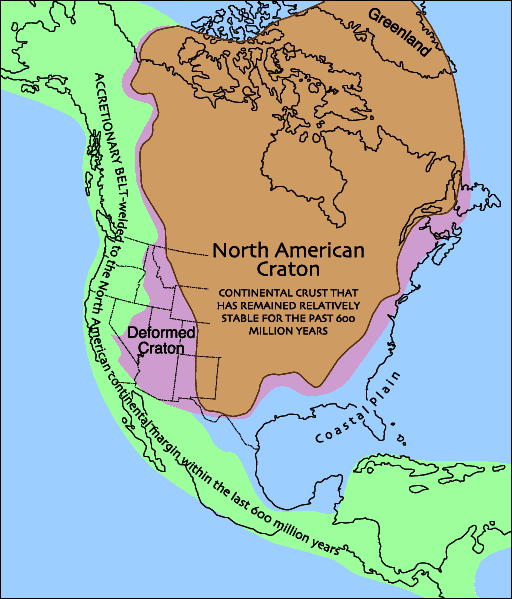
Craton
A craton is an old and stable part of the continental lithosphere. Having often survived cycles of merging and rifting of continents, cratons are generally found in the interiors of tectonic plates. They are characteristically composed of ancient crystalline basement rock, which may be covered by...
, which forms the ancient geological core of the North American continent. Many times in its past, Laurentia has been a separate continent
Continent
A continent is one of several very large landmasses on Earth. They are generally identified by convention rather than any strict criteria, with seven regions commonly regarded as continents—they are : Asia, Africa, North America, South America, Antarctica, Europe, and Australia.Plate tectonics is...
as it is now in the form of North America, although originally it also included the cratonic areas of Greenland and also the northwestern part of Scotland, known as the Hebridean Terrane
Hebridean Terrane
The Hebridean Terrane is one of the terranes that form part of the Caledonian orogenic belt in northwest Scotland. Its boundary with the neighbouring Northern Highland Terrane is formed by the Moine Thrust Belt...
. During other times in its past, Laurentia has been part of larger continents and supercontinents. It is named after the Laurentian Shield, which in turn is named after the St. Lawrence River.
Laurentia owes its existence to a network of Early Proterozoic
Proterozoic
The Proterozoic is a geological eon representing a period before the first abundant complex life on Earth. The name Proterozoic comes from the Greek "earlier life"...
orogenic belts. Small microcontinents and oceanic islands collided with the ever-growing Laurentia, and together formed the stable Archean
Archean
The Archean , also spelled Archeozoic or Archæozoic) is a geologic eon before the Paleoproterozoic Era of the Proterozoic Eon, before 2.5 Ga ago. Instead of being based on stratigraphy, this date is defined chronometrically...
craton
Craton
A craton is an old and stable part of the continental lithosphere. Having often survived cycles of merging and rifting of continents, cratons are generally found in the interiors of tectonic plates. They are characteristically composed of ancient crystalline basement rock, which may be covered by...
we see today.
Interior platform
In eastern and central Canada, much of the stable craton is exposed at the surface as the Canadian ShieldCanadian Shield
The Canadian Shield, also called the Laurentian Plateau, or Bouclier Canadien , is a vast geological shield covered by a thin layer of soil that forms the nucleus of the North American or Laurentia craton. It is an area mostly composed of igneous rock which relates to its long volcanic history...
. In the United States the craton bedrock is covered with sedimentary rocks of the interior platform except in northern Minnesota, Wisconsin, the Adirondacks
Adirondack Mountains
The Adirondack Mountains are a mountain range located in the northeastern part of New York, that runs through Clinton, Essex, Franklin, Fulton, Hamilton, Herkimer, Lewis, Saint Lawrence, Saratoga, Warren, and Washington counties....
of New York and the Upper Peninsula of Michigan. The sequence of rocks varies from approximately 1,000 to in excess of 6,100 metres (3,500–20,000 ft) in thickness. The cratonic rocks are metamorphic
Metamorphic rock
Metamorphic rock is the transformation of an existing rock type, the protolith, in a process called metamorphism, which means "change in form". The protolith is subjected to heat and pressure causing profound physical and/or chemical change...
and igneous while the overlying sedimentary rock
Sedimentary rock
Sedimentary rock are types of rock that are formed by the deposition of material at the Earth's surface and within bodies of water. Sedimentation is the collective name for processes that cause mineral and/or organic particles to settle and accumulate or minerals to precipitate from a solution....
s are composed mostly of limestone
Limestone
Limestone is a sedimentary rock composed largely of the minerals calcite and aragonite, which are different crystal forms of calcium carbonate . Many limestones are composed from skeletal fragments of marine organisms such as coral or foraminifera....
s, sandstone
Sandstone
Sandstone is a sedimentary rock composed mainly of sand-sized minerals or rock grains.Most sandstone is composed of quartz and/or feldspar because these are the most common minerals in the Earth's crust. Like sand, sandstone may be any colour, but the most common colours are tan, brown, yellow,...
s, and shale
Shale
Shale is a fine-grained, clastic sedimentary rock composed of mud that is a mix of flakes of clay minerals and tiny fragments of other minerals, especially quartz and calcite. The ratio of clay to other minerals is variable. Shale is characterized by breaks along thin laminae or parallel layering...
s. These sedimentary rocks were deposited from 650 to 290 million years ago.
Tectonic setting
The metamorphic and igneous rocks of the "basement complex" were created 1.5 to 1.0 billion years ago in a tectonically active setting. It was a setting of great pressure and temperature. The younger sedimentary rocks that were deposited on top of this basement complex were formed in a setting of quiet marine and river waters. During much of Mississippian time, the craton was the site of an extensive marine carbonate platform on which mainly limestones and some dolostones and evaporites were deposited. This platform extended either from the present Appalachian Mountains or Mississippi Valley to the present Great Basin. The craton was covered by shallow, warm, tropical epicontinental or epicratonic sea (meaning literally "on the craton") that had maximum depths of only about 60 metres (200 ft) at the shelf edge. Sometimes land masses or mountainMountain
Image:Himalaya_annotated.jpg|thumb|right|The Himalayan mountain range with Mount Everestrect 58 14 160 49 Chomo Lonzorect 200 28 335 52 Makalurect 378 24 566 45 Mount Everestrect 188 581 920 656 Tibetan Plateaurect 250 406 340 427 Rong River...
chains rose up on the distant edges of the craton and then eroded down, shedding their sand across the landscape.
Volcanism
The southwestern portion of Laurentia consists of Precambrian basement rocks deformed by continental collisions (violet area of the image above). This area has been subjected to considerable rifting as the Basin and Range Province and has been stretched up to 100% of its original width. The area contains numerous large volcanic eruptionsLarge volume volcanic eruptions in the Basin and Range Province
Th Large volume volcanic eruptions in the Basin and Range Province include Basin and Range eruptions in California, Idaho, Colorado, New Mexico, Texas, Arizona, Nevada, Wyoming, and Oregon, as well as those of the Long Valley Caldera geological province and the Yellowstone hotspot.-Volcanic...
.
Geological history
- Around 2.5 Ga, ArcticaArcticaArctica was an ancient continent which formed approximately 2.5 billion years ago in the Neoarchean era.Arctica consisted of the Canadian and Siberian shields, and is now roughly situated in the Arctic around the current North Pole.- History :...
formed as an independent continent. - Around 2.45 Ga, Arctica was part of the major supercontinent KenorlandKenorlandKenorland was one of the earliest supercontinents on Earth. It is believed to have formed during the Neoarchaean Era ~2.7 billion years ago by the accretion of Neoarchaean cratons and the formation of new continental crust...
. - Around 2.1 Ga, when Kenorland shattered, the Arctican craton was part of the minor supercontinent NenaNena (supercontinent)Nena was an ancient minor supercontinent that consisted of the cratons of Arctica, Baltica, and East Antarctica. Forming about 1.8 billion years ago, the continent was part of the global supercontinent, Columbia. Nena is an acronym that derives from Northern Europe and North...
along with BalticaBalticaBaltica is a name applied by geologists to a late-Proterozoic, early-Palaeozoic continent that now includes the East European craton of northwestern Eurasia. Baltica was created as an entity not earlier than 1.8 billion years ago. Before this time, the three segments/continents that now comprise...
and Eastern AntarcticaEast Antarctic cratonThe East Antarctic craton is an ancient craton that forms most of Antarctica. The East Antarctic craton was part of the Nena supercontinent 1.8 billion years ago.During the early Paleozoic Era East Antarctica joined the Gondwana supercontinent.- Breakup :...
. - Around 1.8 Ga, Laurentia was part of the major supercontinent ColumbiaColumbia (supercontinent)Columbia, also known as Nuna and Hudsonland, was one of Earth's oldest supercontinents. It was first proposed by J.J.W. Rogers and M. Santosh and is thought to have existed approximately 1.8 to 1.5 billion years ago in the Paleoproterozoic Era. Zhao et al...
. - Around 1.5 Ga, Laurentia was an independent continent.
- Around 1.1 Ga, Laurentia was part of the major supercontinent RodiniaRodiniaIn geology, Rodinia is the name of a supercontinent, a continent which contained most or all of Earth's landmass. According to plate tectonic reconstructions, Rodinia existed between 1.1 billion and 750 million years ago, in the Neoproterozoic era...
. - Around 750 Ma, Laurentia was part of the minor supercontinent Protolaurasia. Laurentia nearly rifted apart.
- Around 600 Ma, Laurentia was part of the major supercontinent PannotiaPannotiaPannotia, first described by Ian W. D. Dalziel in 1997, is a hypothetical supercontinent that existed from the Pan-African orogeny about six hundred million years ago to the end of the Precambrian about five hundred and fifty million years ago. It is also known as the Vendian supercontinent...
. - Around CambrianCambrianThe Cambrian is the first geological period of the Paleozoic Era, lasting from Mya ; it is succeeded by the Ordovician. Its subdivisions, and indeed its base, are somewhat in flux. The period was established by Adam Sedgwick, who named it after Cambria, the Latin name for Wales, where Britain's...
(542 ±0.3 to 488.3 ±1.7 Ma), Laurentia was an independent continent. - Around OrdovicianOrdovicianThe Ordovician is a geologic period and system, the second of six of the Paleozoic Era, and covers the time between 488.3±1.7 to 443.7±1.5 million years ago . It follows the Cambrian Period and is followed by the Silurian Period...
(488.3 ±1.7 to 443.7 ±1.5 Ma), Laurentia was shrinking and Baltica got bigger. - Around DevonianDevonianThe Devonian is a geologic period and system of the Paleozoic Era spanning from the end of the Silurian Period, about 416.0 ± 2.8 Mya , to the beginning of the Carboniferous Period, about 359.2 ± 2.5 Mya...
(416 ±2.8 to 359.2 ±2.5 Ma), Laurentia collided against Baltica, forming the minor supercontinent EuramericaEuramericaEuramerica was a minor supercontinent created in the Devonian as the result of a collision between the Laurentian, Baltica, and Avalonia cratons .300 million years ago in the Late Carboniferous tropical rainforests lay over the equator of Euramerica...
. - Around PermianPermianThe PermianThe term "Permian" was introduced into geology in 1841 by Sir Sir R. I. Murchison, president of the Geological Society of London, who identified typical strata in extensive Russian explorations undertaken with Edouard de Verneuil; Murchison asserted in 1841 that he named his "Permian...
(299.0 ±0.8 to 251.0 ±0.4 Ma), all major continents collide against each other for forming the major supercontinent PangaeaPangaeaPangaea, Pangæa, or Pangea is hypothesized as a supercontinent that existed during the Paleozoic and Mesozoic eras about 250 million years ago, before the component continents were separated into their current configuration....
. - Around JurassicJurassicThe Jurassic is a geologic period and system that extends from about Mya to Mya, that is, from the end of the Triassic to the beginning of the Cretaceous. The Jurassic constitutes the middle period of the Mesozoic era, also known as the age of reptiles. The start of the period is marked by...
(199.6 ±0.6 to 145.5 ±4 Ma), Pangaea rifted into two minor supercontinents: LaurasiaLaurasiaIn paleogeography, Laurasia was the northernmost of two supercontinents that formed part of the Pangaea supercontinent from approximately...
and GondwanaGondwanaIn paleogeography, Gondwana , originally Gondwanaland, was the southernmost of two supercontinents that later became parts of the Pangaea supercontinent. It existed from approximately 510 to 180 million years ago . Gondwana is believed to have sutured between ca. 570 and 510 Mya,...
. Laurentia was part of the minor supercontinent Laurasia. - Around CretaceousCretaceousThe Cretaceous , derived from the Latin "creta" , usually abbreviated K for its German translation Kreide , is a geologic period and system from circa to million years ago. In the geologic timescale, the Cretaceous follows the Jurassic period and is followed by the Paleogene period of the...
(145.5 ±4 to 65.5 ±0.3 Ma), Laurentia was an independent continent called North America. - Around NeogeneNeogeneThe Neogene is a geologic period and system in the International Commission on Stratigraphy Geologic Timescale starting 23.03 ± 0.05 million years ago and ending 2.588 million years ago...
(23.03 ±0.05 Ma until today or ending 2.588 Ma), Laurentia, in the form of North America, crashed into South AmericaSouth AmericaSouth America is a continent situated in the Western Hemisphere, mostly in the Southern Hemisphere, with a relatively small portion in the Northern Hemisphere. The continent is also considered a subcontinent of the Americas. It is bordered on the west by the Pacific Ocean and on the north and east...
, forming the minor supercontinent America. - Around 250 Ma from now, all continents may crash together, forming the major supercontinent Pangaea UltimaPangaea UltimaPangaea Ultima is a possible future supercontinent configuration and an alternative to the Amasia supercontinent. Consistent with the supercontinent cycle, Pangaea Ultima could occur within the next 250 million years...
. Laurentia would be part of Pangaea Ultima. - Around 450-600 Ma from now, Pangea Ultima will eventually rift apart. Laurentia may break off.
External links
- Paleogeography of the Southwestern US, paleogeographic history of southwestern Laurentia, goes back to 1.7 billion years ago.
- Mesozoic Paleogeography and Tectonic History, Western North America - Paleogeographic history of western Laurentia, goes back to the Permian period.
- USGS Interior Plains Region web site
- The Dynamic Earth, United Plates of America from The Smithsonian National Museum of Natural History
- Map of Laurentia
