
In Depth
See Also

Evaporation

Evaporation is one of the two forms of vaporization. It is the process whereby atom Atom

In chemistry [i] and physics [i], an atom is the smallest possible particle of a chemical element [i] t ... 

s or molecule Molecule

In chemistry, a molecule is an aggregate of two or more atom [i]s in a definite arrangement held togethe ... 

s in a liquid Liquid

A liquid is one of the main phases of matter [i]. ... 

 state gain sufficient energy to enter the gaseous state. It is the opposite process of condensation Condensation

[i] to a [[liquid]... 

. The thermal motion of a molecule of liquid must be sufficient to overcome the surface tension Surface tension

In physics [i], surface tension is an effect within the surface layer of a liquid [i] that causes that l ... 

 and evaporate, that is, its kinetic energy must exceed the work function of cohesion at the surface. Evaporation therefore, proceeds more quickly at higher temperature, at higher flow rates between the gaseous and liquid phase and in liquids with lower surface tension .

Discussions

  Discussion Features

   Ask a question about 'Evaporation'

   Start a new discussion about 'Evaporation'

   Answer questions about 'Evaporation'

   'Evaporation' discussion forum


Encyclopedia


Evaporation is one of the two forms of vaporization. It is the process whereby atom Atom

In chemistry [i] and physics [i], an atom is the smallest possible particle of a chemical element [i] t ... 

s or molecule Molecule

In chemistry, a molecule is an aggregate of two or more atom [i]s in a definite arrangement held togethe ... 

s in a liquid Liquid

A liquid is one of the main phases of matter [i]. ... 

 state gain sufficient energy to enter the gaseous state. It is the opposite process of condensation Condensation

[i] to a [[liquid]... 

.

The thermal motion of a molecule of liquid must be sufficient to overcome the surface tension Surface tension

In physics [i], surface tension is an effect within the surface layer of a liquid [i] that causes that l ... 

 and evaporate, that is, its kinetic energy must exceed the work function of cohesion at the surface. Evaporation therefore, proceeds more quickly at higher temperature, at higher flow rates between the gaseous and liquid phase and in liquids with lower surface tension . Since only a small proportion of the molecules are located near the surface and are moving in the proper direction to escape at any given instant, the rate of evaporation is limited. Also, as the faster-moving molecules escape, the remaining molecules have lower average kinetic energy, and the temperature of the liquid thus decreases. This phenomenon is also called evaporative cooling. This is the reason that evaporating sweat cools the human body.

Gas has less order than liquid or solid matter, and thus the entropy Entropy

In thermodynamics [i], entropy, symbolized by S, is a state function [i] of a thermodynamic system [i] ... 

 of the system is increased, which always requires energy input. This means that the enthalpy change for evaporation is always positive.
Evaporation is a cooling process.

Evaporation is a critical component of the water cycle Water cycle

The water cycle — technically known as the hydrologic cycle — is the continuous circul... 

, which is responsible for clouds Cloud

A cloud is a visible mass of condensed droplets [i] or frozen crystal [i]s suspended in the atmosphere [i] ... 

 and rain Rain

Rain is a form of precipitation [i], other forms of which include snow [i], sleet [i], hail [i]... 

. Solar energy Solar power

Solar power is the technology of obtaining usable energy [i] from the light [i] of the Sun [i]. ... 

 drives evaporation of water from ocean Ocean

Oceans cover almost three quarters of the surface of the Earth [i], and nearly half of the world's mar ... 

s, lake Lake

A lake is a body of water or other liquid of considerable size surrounded by land.... 

s, moisture in the soil, and other sources of water. In hydrology Hydrology

Hydrology is the study of the movement, distribution, and quality of water [i] throughout the Earth, an ... 

, evaporation and transpiration  are collectively termed evapotranspiration Evapotranspiration

Evapotranspiration is the sum of evaporation [i] and plant [i] transpiration [i]. ... 

.

Evaporative equilibrium

If the evaporation takes place in a closed vessel, the escaping molecules accumulate as a vapour Vapor

Vapor or vapour is the gas [i]eous state of matter that is a solid or liquid at normal room temp ... 

 above the liquid. Many of the molecules return to the liquid, with returning molecules becoming more frequent as the density and pressure Pressure

Pressure is the force [i] per unit area [i] applied on a surface in a direction perpendicular [i] ... 

 of the vapour increases. When the process of escape and return reaches an equilibrium, the vapour is said to be "saturated," and no further change in either vapor pressure and density or liquid temperature will occur.

Evaporation of water

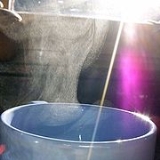
The meaning of evaporation is when a liquid turns into a gas due to heat energy allowing the atoms to escape. However, when levels of heat energy decrease, the gas cools down, thus condensing or turning into a liquid. For example as the tea cools, the water vapor condenses. An example of both condensation and evaporation is a nuclear reactor which smashes the molecules, produces heat energy to heat the water and turns it into water vapor by evaporation to move turbines and when the water vapor moves out of the turbines it condenses. Another example of both is when you have a shower or a bath. When the water in the bathtub heats, it starts to evaporate but when it comes in contact with the cooler surface of the mirror it condenses.

The ratio of the heat loss from a pond by evaporation to the heat loss due to convection, independent of wind speed, is given by:

where is the heat loss from the pond by convection, in W/,
is the heat loss from the pond by evaporation, in W/,
and are the Kelvin temperatures of the water and air, and
and are the vapor pressures of the pond surface and air, and
is the barometric pressure, with all pressures in mm Hg.

Factors influencing rate of evaporation


  • Concentration of the substance evaporating in the air. If the air already has a high concentration of the substance evaporating, then the given substance will evaporate more slowly.
  • Concentration Concentration

    In chemistry [i], concentration is the measure of how much of a given substance [i] t... 

     of other substances in the air. If the air is already saturated with other substances, it can have a lower capacity for the substance evaporating.
  • Flow rate of air. This is in part related to the concentration points above. If fresh air is moving over the substance all the time, then the concentration of the substance in the air is less likely to go up with time, thus encouraging faster evaporation. In addition, molecules in motion have more energy than those at rest, and so the stronger the flow of air, the greater the evaporating power of the air molecules.
  • Concentration Concentration

    In chemistry [i], concentration is the measure of how much of a given substance [i] t... 

     of other substances in the liquid. If the liquid contains other substances , it will have a lower capacity for evaporation. This is due to Raoult's law.
  • Temperature of the substance. If the substance is hotter, then evaporation will be faster.
  • Inter-molecular forces. The stronger the forces keeping the molecules together in the liquid or solid state the more energy that must be input in order to evaporate them.
  • Surface Area: A substance which has a larger surface area will evaporate faster due to the fact that there are more surface molecules which are able to escape.

Applied evaporation


Forced evaporation

Forced evaporation or distillation Distillation

Distillation is a method of separation [i] of substance [i]s based on differences in ... 

 is a process used in the separation of mixtures, in which a mixture is heated to drive off the more volatile component with a higher vapor pressure.

Combustion vaporisation

The fuel droplet Drop (liquid)

A drop is a small volume of liquid [i], bounded completely or almost completely by free surfaces. ... 

s vaporize as they receive heat by mixing with the hot gases in the combustion chamber. Heat can also be received by radiation from any hot refractory wall of the combustion chamber.

Film deposition

Evaporation is a common method of thin film deposition used in industry. Sputtering Sputtering

Sputtering is a physical [i] process whereby atom [i]s in a solid target material are ejected in ... 

 tends to be slower compared to evaporative deposition. However plastic substrates typically cannot tolerate the bombardment with energetic neutral atoms that unavoidably occurs in a sputter chamber. An important example of an evaporative process is the production of aluminized Aluminium

Aluminium or aluminum is the chemical element in the periodic table that has the symbol Al ... 

 PET film  packaging film in a roll-to-roll web system. Often, the aluminum layer in this material is not thick enough to be entirely opaque since a thinner layer can be deposited more cheaply than a thick one. The main purpose of the aluminum is to isolate the product from the external environment by creating a barrier to the passage of light Light

Light is electromagnetic radiation [i] with a wavelength [i] that is visible to the eye [i] or, in a technical [i] ... 

, oxygen Oxygen

Oxygen is a chemical element [i] with the chemical symbol O and atomic number [i] 8.... 

, or water vapor.

For some applications, the fact that evaporative deposition proceeds in a line-of-sight fashion is an important advantage. The energy distribution of evaporated material tends to be Maxwellian Maxwell–Boltzmann distribution

The MaxwellBoltzmann distribution is a probability distribution [i] with applications in physics [i] and ... 

, with a temperature derived from the evaporation source. In contrast, the plasmas Plasma

Plasma may refer to:
  • Plasma [i], an ionized gas

... 

 encountered in sputtering systems are far from thermal equilibrium and may have high-energy tails that contain particles with large random velocities. Evaporation is therefore a gentler process with a better defined beam of source material that can be used to coat just one side of a substrate or even the side of etched surface features, as in MEMS Microelectromechanical systems

Microelectromechanical Systems is the technology of the very small, and merges at the nanoscale into "N... 

 processing.


The three main kinds of evaporation are thermal, electron-beam and resistive. In the thermal method, the crucible that holds the source material is radiatively heated by a filament that winds around it. In the electron-beam method, the current that heats the crucible is boiled off a filament and is attracted to the crucible by a high voltage. Electron-beam evaporation is used with the highest melting elements. Resistive evaporation is accomplished by passing a large current through a wire or foil of the material that is to be deposited. Molecular beam epitaxy Molecular beam epitaxy

Molecular beam epitaxy [i], is one of several methods of thin-film deposition [i]. ... 

 is a particularly sophisticated kind of thermal evaporation.

See also

  • heat of vaporization
  • evapotranspiration Evapotranspiration

    Evapotranspiration is the sum of evaporation [i] and plant [i] transpiration [i]. ... 

  • flash evaporation
  • crystallisation Crystallization

    Crystallization is the process of formation of solid crystal [i]s from a solution [i].... 

  • Coffee ring
  • Latent heat
  • Distillation Distillation

    Distillation is a method of separation [i] of substance [i]s based on differences in ... 

  • Desalination Desalination

    Desalination refers to any of several processes that remove the excess salt [i] and othe... 


External links


References

Semiconductor Devices: Physics and Technology, by S.M. Sze, ISBN 0-471-33372-7, has an especially detailed discussion of film deposition by evaporation.