
|
|
|
|
Negative feedback
|
| |
|
| |
Negative feedback feeds part of a system's output, inverted, into the system's input; generally with the result that fluctuations are attenuated. Many real-world systems have one or several points around which the system gravitates. In response to a perturbation, a negative feedback system with such point(s) will tend to re-establish equilibrium.
any physical and biological systems, qualitatively different influences can oppose each other.

Discussion
Ask a question about 'Negative feedback'
Start a new discussion about 'Negative feedback'
Answer questions from other users
|
Recent Posts

Encyclopedia
Negative feedback feeds part of a system's output, inverted, into the system's input; generally with the result that fluctuations are attenuated. Many real-world systems have one or several points around which the system gravitates. In response to a perturbation, a negative feedback system with such point(s) will tend to re-establish equilibrium.
Overview
In many physical and biological systems, qualitatively different influences can oppose each other. For example, in biochemistry, one set of chemicals drives the system in a given direction, whereas another set of chemicals drives it in an opposing direction. If one, or both of these opposing influences are non-linear, equilibrium point(s) result.
In biology, this process (generally biochemical) is often referred to as homeostasis; whereas in mechanics, the more common term is equilibrium.
In engineering, mathematics and the physical and biological sciences, common terms for the points around which the system gravitates include: attractors, stable states, eigenstates/eigenfunctions, equilibrium points, and setpoints.
Negative refers to the sign of the multiplier in mathematical models for feedback. In delta notation, -output is added to or mixed into the input. In multivariate systems, vectors help to illustrate how several influences can both partially complement and partially oppose each other.
In contrast, positive feedback is a feedback in which the system responds in the same direction as the perturbation, resulting in amplification of the original signal instead of stabilizing the signal. Both positive and negative feedback require a feedback loop to operate, as opposed to feedforward, which does not rely on a feedback loop for its control of the system.
Examples
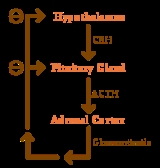
Examples of the use of negative feedback to control its system are: thermostat control, phase-locked loop, hormonal regulation (see diagram above), and temperature regulation in animals.
A simple and practical example is a thermostat. When the temperature in a heated room reaches a certain upper limit the room heating is switched off so that the temperature begins to fall. When the temperature drops to a lower limit, the heating is switched on again. Provided the limits are close to each other, a steady room temperature is maintained. The same applies to a cooling system, such as an air conditioner, a refrigerator, or a freezer.
Some biological systems exhibit negative feedback such as the baroreflex in blood pressure regulation and erythropoiesis. Many biological process (e.g., in the human anatomy) use negative feedback. Examples of this are numerous, from the regulating of body temperature, to the regulating of blood glucose levels. The disruption of negative feedback can lead to undesirable results: in the case of blood glucose levels, if negative feedback fails, the glucose levels in the blood may begin to rise dramatically, thus resulting in diabetes.
Electronic amplifiers
The negative feedback amplifier was invented by Harold Stephen Black at Bell Laboratories in 1927, and patented by him in 1934. Fundamentally, all electronic devices (e.g. vacuum tubes, bipolar transistors, MOS transistors) exhibit some nonlinear behavior. Negative feedback corrects this by trading unused gain for higher linearity (lower distortion). An amplifier with too large of an open-loop gain, possibly in a specific frequency range, will additionally produce too large of a feedback signal in that same range. This feedback signal, when subtracted from the original input, will act to reduce the original input, also by "too large" an amount. This "too small" input will be amplified again by the "too large" open-loop gain, creating a signal that is "just right". The net result is a flattening of the amplifier's gain over all frequencies (desensitising). Thus, though much more accurate, amplifiers with negative feedback can become unstable if not designed correctly, causing them to oscillate. Harry Nyquist of Bell Laboratories managed to work out a theory regarding how to make it stable.
Negative feedback is used in this way in many types of amplification systems to stabilize and improve their operating characteristics (see e.g., operational amplifiers).
See also
External links
|
| |
|
|