
Home      Discussion      Topics      Dictionary      Almanac
Signup       Login
Proterozoic

Proterozoic

Overview
The Proterozoic is a geological eon representing a period before the first abundant complex life on Earth
Earth
Earth is the third planet from the Sun, and the densest and fifth-largest of the eight planets in the Solar System. It is also the largest of the Solar System's four terrestrial planets...

. The name Proterozoic comes from the Greek "earlier life". The Proterozoic Eon extended from to (million years ago), and is the most recent part of the old, informally named ‘Precambrian
Precambrian
The Precambrian is the name which describes the large span of time in Earth's history before the current Phanerozoic Eon, and is a Supereon divided into several eons of the geologic time scale...

’ time.
Discussion
Ask a question about 'Proterozoic'
Start a new discussion about 'Proterozoic'
Answer questions from other users
Full Discussion Forum
 
Unanswered Questions
Encyclopedia
The Proterozoic is a geological eon representing a period before the first abundant complex life on Earth
Earth
Earth is the third planet from the Sun, and the densest and fifth-largest of the eight planets in the Solar System. It is also the largest of the Solar System's four terrestrial planets...

. The name Proterozoic comes from the Greek "earlier life". The Proterozoic Eon extended from to (million years ago), and is the most recent part of the old, informally named ‘Precambrian
Precambrian
The Precambrian is the name which describes the large span of time in Earth's history before the current Phanerozoic Eon, and is a Supereon divided into several eons of the geologic time scale...

’ time.

The Proterozoic consists of 3 geologic eras, from oldest to youngest:
  • Paleoproterozoic
    Paleoproterozoic
    The Paleoproterozoic is the first of the three sub-divisions of the Proterozoic occurring between . This is when the continents first stabilized...

  • Mesoproterozoic
    Mesoproterozoic
    The Mesoproterozoic Era is a geologic era that occurred between 1600 Ma and 1000 Ma . The Mesoproterozoic was the first period of Earth's history with a respectable geological record. Continents existed in the Paleoproterozoic, but we know little about them...

  • Neoproterozoic
    Neoproterozoic
    The Neoproterozoic Era is the unit of geologic time from 1,000 to 542.0 ± 1.0 million years ago. The terminal Era of the formal Proterozoic Eon , it is further subdivided into the Tonian, Cryogenian, and Ediacaran Periods...


The well-identified events were:
  • The transition to an oxygen
    Oxygen
    Oxygen is the element with atomic number 8 and represented by the symbol O. Its name derives from the Greek roots ὀξύς and -γενής , because at the time of naming, it was mistakenly thought that all acids required oxygen in their composition...

    ated atmosphere
    Atmosphere
    An atmosphere is a layer of gases that may surround a material body of sufficient mass, and that is held in place by the gravity of the body. An atmosphere may be retained for a longer duration, if the gravity is high and the atmosphere's temperature is low...

     during the Mesoproterozoic
    Mesoproterozoic
    The Mesoproterozoic Era is a geologic era that occurred between 1600 Ma and 1000 Ma . The Mesoproterozoic was the first period of Earth's history with a respectable geological record. Continents existed in the Paleoproterozoic, but we know little about them...

    .
  • Several glaciations
    Glacier
    A glacier is a large persistent body of ice that forms where the accumulation of snow exceeds its ablation over many years, often centuries. At least 0.1 km² in area and 50 m thick, but often much larger, a glacier slowly deforms and flows due to stresses induced by its weight...

    , including the hypothesized Snowball Earth
    Snowball Earth
    The Snowball Earth hypothesis posits that the Earth's surface became entirely or nearly entirely frozen at least once, some time earlier than 650 Ma . Proponents of the hypothesis argue that it best explains sedimentary deposits generally regarded as of glacial origin at tropical...

     during the Cryogenian
    Cryogenian
    The Cryogenian is a geologic period that lasted from . It forms the second geologic period of the Neoproterozoic Era, preceded by the Tonian Period and followed by the Ediacaran...

     period in the late Neoproterozoic
    Neoproterozoic
    The Neoproterozoic Era is the unit of geologic time from 1,000 to 542.0 ± 1.0 million years ago. The terminal Era of the formal Proterozoic Eon , it is further subdivided into the Tonian, Cryogenian, and Ediacaran Periods...

    .
  • The Ediacaran
    Ediacaran
    The Ediacaran Period , named after the Ediacara Hills of South Australia, is the last geological period of the Neoproterozoic Era and of the Proterozoic Eon, immediately preceding the Cambrian Period, the first period of the Paleozoic Era and of the Phanerozoic Eon...

     Period (635 to 542 Ma) which is characterized by the evolution of abundant soft-bodied multicellular organisms.

The Proterozoic record


The geologic record of the Proterozoic is much better than that for the preceding Archean
Archean
The Archean , also spelled Archeozoic or Archæozoic) is a geologic eon before the Paleoproterozoic Era of the Proterozoic Eon, before 2.5 Ga ago. Instead of being based on stratigraphy, this date is defined chronometrically...

. In contrast to the deep-water deposits of the Archean, the Proterozoic features many strata
Stratum
In geology and related fields, a stratum is a layer of sedimentary rock or soil with internally consistent characteristics that distinguish it from other layers...

 that were laid down in extensive shallow epicontinental seas
Epeiric Sea
An epeiric sea is a shallow sea that extends over part of a continent.Epeiric seas are usually associated with the marine transgressions of the geologic past, which have variously been due to either global eustatic sea level changes, local tectonic deformation, or both, and are occasionally...

; furthermore, many of these rocks are less metamorphosed
Metamorphic rock
Metamorphic rock is the transformation of an existing rock type, the protolith, in a process called metamorphism, which means "change in form". The protolith is subjected to heat and pressure causing profound physical and/or chemical change...

 than Archean-age ones, and plenty are unaltered. Study of these rocks shows that the eon continued the massive continent
Continent
A continent is one of several very large landmasses on Earth. They are generally identified by convention rather than any strict criteria, with seven regions commonly regarded as continents—they are : Asia, Africa, North America, South America, Antarctica, Europe, and Australia.Plate tectonics is...

al accretion that had begun late in the Archean, as well as featured the first definitive supercontinent cycle
Supercontinent cycle
The supercontinent cycle describes the quasi-periodic aggregation and dispersal of Earth's continental crust. There are varying opinions as to whether the amount of continental crust is increasing, decreasing, or staying about the same, but it is agreed that the Earth's crust is constantly being...

s and wholly modern orogenic
Orogeny
Orogeny refers to forces and events leading to a severe structural deformation of the Earth's crust due to the engagement of tectonic plates. Response to such engagement results in the formation of long tracts of highly deformed rock called orogens or orogenic belts...

 activity.

The first known glaciations occurred during the Proterozoic; one began shortly after the beginning of the eon, while there were at least four during the Neoproterozoic, climaxing with the Snowball Earth
Snowball Earth
The Snowball Earth hypothesis posits that the Earth's surface became entirely or nearly entirely frozen at least once, some time earlier than 650 Ma . Proponents of the hypothesis argue that it best explains sedimentary deposits generally regarded as of glacial origin at tropical...

 of the Varangian glaciation.

The buildup of oxygen


One of the most important events of the Proterozoic was the gathering up of oxygen
Oxygen Catastrophe
The Great Oxygenation Event , also called the Oxygen Catastrophe or Oxygen Crisis or Great Oxidation, was the biologically induced appearance of free oxygen in Earth's atmosphere. This major environmental change happened around 2.4 billion years ago.Photosynthesis was producing oxygen both before...

 in the Earth's atmosphere. Though oxygen was undoubtedly released by photosynthesis
Photosynthesis
Photosynthesis is a chemical process that converts carbon dioxide into organic compounds, especially sugars, using the energy from sunlight. Photosynthesis occurs in plants, algae, and many species of bacteria, but not in archaea. Photosynthetic organisms are called photoautotrophs, since they can...

 well back in Archean
Archean
The Archean , also spelled Archeozoic or Archæozoic) is a geologic eon before the Paleoproterozoic Era of the Proterozoic Eon, before 2.5 Ga ago. Instead of being based on stratigraphy, this date is defined chronometrically...

 times, it could not build up to any significant degree until chemical sinks — unoxidized sulfur
Sulfur
Sulfur or sulphur is the chemical element with atomic number 16. In the periodic table it is represented by the symbol S. It is an abundant, multivalent non-metal. Under normal conditions, sulfur atoms form cyclic octatomic molecules with chemical formula S8. Elemental sulfur is a bright yellow...

 and iron
Iron
Iron is a chemical element with the symbol Fe and atomic number 26. It is a metal in the first transition series. It is the most common element forming the planet Earth as a whole, forming much of Earth's outer and inner core. It is the fourth most common element in the Earth's crust...

 — had been filled; until roughly 2.3 billion years ago, oxygen was probably only 1% to 2% of its current level. Banded iron formation
Banded iron formation
Banded iron formations are distinctive units of sedimentary rock that are almost always of Precambrian age. A typical BIF consists of repeated, thin layers of iron oxides, either magnetite or hematite , alternating with bands of iron-poor shale and chert...

s, which provide most of the world's iron ore, were also a prominent chemical sink; most accumulation ceased after 1.9 billion years ago, either due to an increase in oxygen or a more thorough mixing of the oceanic water column.

Red beds, which are colored by hematite
Hematite
Hematite, also spelled as haematite, is the mineral form of iron oxide , one of several iron oxides. Hematite crystallizes in the rhombohedral system, and it has the same crystal structure as ilmenite and corundum...

, indicate an increase in atmospheric oxygen after 2 billion years ago; they are not found in older rocks. The oxygen buildup was probably due to two factors: a filling of the chemical sinks, and an increase in carbon
Carbon
Carbon is the chemical element with symbol C and atomic number 6. As a member of group 14 on the periodic table, it is nonmetallic and tetravalent—making four electrons available to form covalent chemical bonds...

 burial, which sequestered organic compound
Organic compound
An organic compound is any member of a large class of gaseous, liquid, or solid chemical compounds whose molecules contain carbon. For historical reasons discussed below, a few types of carbon-containing compounds such as carbides, carbonates, simple oxides of carbon, and cyanides, as well as the...

s that would have otherwise been oxidized by the atmosphere.

Paleogeography


The Mackenzie dike swarm
Mackenzie dike swarm
The Mackenzie dike swarm, also called the Mackenzie dikes, form a large igneous province in the western Canadian Shield of Canada. It is part of the larger Mackenzie Large Igneous Province and is one of more than three dozen dike swarms in various parts of the Canadian Shield...

 in Canada's Canadian Shield
Canadian Shield
The Canadian Shield, also called the Laurentian Plateau, or Bouclier Canadien , is a vast geological shield covered by a thin layer of soil that forms the nucleus of the North American or Laurentia craton. It is an area mostly composed of igneous rock which relates to its long volcanic history...

 is the largest known dike swarm
Dike swarm
A dike swarm or dyke swarm is a large geological structure consisting of a major group of parallel, linear, or radially oriented dikes intruded within continental crust. They consist of several to hundreds of dikes emplaced more or less contemporaneously during a single intrusive event and are...

 on Earth, and was a source for significant massive flood basalt
Flood basalt
A flood basalt or trap basalt is the result of a giant volcanic eruption or series of eruptions that coats large stretches of land or the ocean floor with basalt lava. Flood basalts have occurred on continental scales in prehistory, creating great plateaus and mountain ranges...

 eruptions throughout the Proterozoic period. The source for the Mackenzie dike swarm is thought to have been a mantle plume
Mantle plume
A mantle plume is a hypothetical thermal diapir of abnormally hot rock that nucleates at the core-mantle boundary and rises through the Earth's mantle. Such plumes were invoked in 1971 to explain volcanic regions that were not thought to be explicable by the then-new theory of plate tectonics. Some...

 center called the Mackenzie hotspot
Mackenzie hotspot
The Mackenzie hotspot was a volcanic hotspot that existed about 1,267 million years ago across Canada from the Northwest Territories and Nunavut. It is responsible for the creation of the Mackenzie Large Igneous Province, which contains the largest dike swarm on Earth...

.

Proterozoic life


The first advanced single-celled, eukaryotes and multi-cellular life, Francevillian Group Fossil
Francevillian Group Fossil
The Francevillian Group Fossil is an early, macroscopic organism. They were centimeter-sized highly organized, spatially discrete colonial organisms. Their fossils are found in the west-African country of Gabon in the Palaeoproterozoic Francevillian B Formation, a 2.1-Gyr-old black shale...

s, roughly coincides with the start of the accumulation of free oxygen. This may have been due to an increase in the oxidized nitrate
Nitrate
The nitrate ion is a polyatomic ion with the molecular formula NO and a molecular mass of 62.0049 g/mol. It is the conjugate base of nitric acid, consisting of one central nitrogen atom surrounded by three identically-bonded oxygen atoms in a trigonal planar arrangement. The nitrate ion carries a...

s that eukaryotes use, as opposed to cyanobacteria. It was also during the Proterozoic that the first symbiotic
Symbiosis
Symbiosis is close and often long-term interaction between different biological species. In 1877 Bennett used the word symbiosis to describe the mutualistic relationship in lichens...

 relationships between mitochondria (for nearly all eukaryotes) and chloroplast
Chloroplast
Chloroplasts are organelles found in plant cells and other eukaryotic organisms that conduct photosynthesis. Chloroplasts capture light energy to conserve free energy in the form of ATP and reduce NADP to NADPH through a complex set of processes called photosynthesis.Chloroplasts are green...

s (for plant
Plant
Plants are living organisms belonging to the kingdom Plantae. Precise definitions of the kingdom vary, but as the term is used here, plants include familiar organisms such as trees, flowers, herbs, bushes, grasses, vines, ferns, mosses, and green algae. The group is also called green plants or...

s and some protist
Protist
Protists are a diverse group of eukaryotic microorganisms. Historically, protists were treated as the kingdom Protista, which includes mostly unicellular organisms that do not fit into the other kingdoms, but this group is contested in modern taxonomy...

s only) and their hosts evolved.

The blossoming of eukaryotes such as acritarch
Acritarch
Acritarchs are small organic fossils, present from approximately to the present. Their diversity reflects major ecological events such as the appearance of predation and the Cambrian explosion.-Definition:In general, any small, non-acid soluble Acritarchs are small organic fossils, present from...

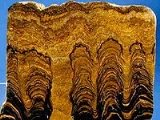
s did not preclude the expansion of cyanobacteria; in fact, stromatolites reached their greatest abundance and diversity during the Proterozoic, peaking roughly 1.2 billion years ago.

Classically, the boundary between the Proterozoic and the Phanerozoic
Phanerozoic
The Phanerozoic Eon is the current eon in the geologic timescale, and the one during which abundant animal life has existed. It covers roughly 542 million years and goes back to the time when diverse hard-shelled animals first appeared...

 eons was set at the base of the Cambrian
Cambrian
The Cambrian is the first geological period of the Paleozoic Era, lasting from Mya ; it is succeeded by the Ordovician. Its subdivisions, and indeed its base, are somewhat in flux. The period was established by Adam Sedgwick, who named it after Cambria, the Latin name for Wales, where Britain's...

 period when the first fossils of animals including trilobite
Trilobite
Trilobites are a well-known fossil group of extinct marine arthropods that form the class Trilobita. The first appearance of trilobites in the fossil record defines the base of the Atdabanian stage of the Early Cambrian period , and they flourished throughout the lower Paleozoic era before...

s and archeocyathids
Archaeocyatha
The Archaeocyatha or archaeocyathids were sessile, reef-building marine organisms of warm tropical and subtropical waters that lived during the early Cambrian period. It is believed that the centre of the Archaeocyatha origin is in East Siberia, where they are first known from the beginning of...

 appeared. In the second half of the 20th century, a number of fossil forms have been found in Proterozoic rocks, but the upper boundary of the Proterozoic has remained fixed at the base of the Cambrian
Cambrian
The Cambrian is the first geological period of the Paleozoic Era, lasting from Mya ; it is succeeded by the Ordovician. Its subdivisions, and indeed its base, are somewhat in flux. The period was established by Adam Sedgwick, who named it after Cambria, the Latin name for Wales, where Britain's...

, which is currently placed at 542 Ma.

Proterozoic supercontinents


Throughout the history of the Earth, there have been times when the continental mass came together to form a supercontinent, followed by the break-up of the supercontinent and new continents moving apart again. This repetition of tectonic events is called a Wilson cycle. It is at least clear that, about 1,000–830 Ma, most continental mass was united in the supercontinent Rodinia
Rodinia
In geology, Rodinia is the name of a supercontinent, a continent which contained most or all of Earth's landmass. According to plate tectonic reconstructions, Rodinia existed between 1.1 billion and 750 million years ago, in the Neoproterozoic era...

. Rodinia was not the first supercontinent; it formed at about 1.0 Ga by accretion and collision of fragments produced by breakup of the older supercontinent, called Nuna or Columbia, which was assembled by global-scale 2.0–1.8 Ga collisional events. This means plate tectonic processes similar to today's must have been active during the Proterozoic.

After the break-up of Rodinia about 800 Ma, it is possible the continents joined again around 550 Ma. The hypothetical supercontinent is sometimes referred to as Pannotia or Vendia
Pannotia
Pannotia, first described by Ian W. D. Dalziel in 1997, is a hypothetical supercontinent that existed from the Pan-African orogeny about six hundred million years ago to the end of the Precambrian about five hundred and fifty million years ago. It is also known as the Vendian supercontinent...

. The evidence for it is a phase of continental collision
Continental collision
Continental collision is a phenomenon of the plate tectonics of Earth that occurs at convergent boundaries. Continental collision is a variation on the fundamental process of subduction, whereby the subduction zone is destroyed, mountains produced, and two continents sutured together...

 known as the Pan-African orogeny
Pan-African orogeny
The Pan-African orogeny was a series of major Neoproterozoic orogenic events which related to the formation of the supercontinents Gondwana and Pannotia about 600 million years ago....

, which joined the continental masses of current-day Africa, South-America, Antarctica and Australia. It is extremely likely, however, that the aggregation of continental masses was not completed, since a continent called Laurentia
Laurentia
Laurentia is a large area of continental craton, which forms the ancient geological core of the North American continent...

 (roughly equivalent to current-day North America) had already started breaking off around 610 Ma. It is at least certain that by the end of the Proterozoic eon, most of the continental mass lay united in a position around the south pole.

External links