

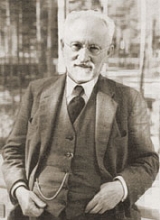
Simon Dubnow

Encyclopedia
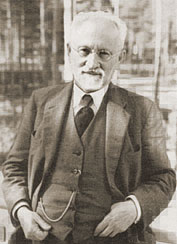
Life and career
Simon Dibnow was born Shimon Meyerovich Dubnow (Шимон Меерович Дубнов) to a large poor family in the BelarusBelarus
Belarus , officially the Republic of Belarus, is a landlocked country in Eastern Europe, bordered clockwise by Russia to the northeast, Ukraine to the south, Poland to the west, and Lithuania and Latvia to the northwest. Its capital is Minsk; other major cities include Brest, Grodno , Gomel ,...
ian town of Mstsislaw
Mstsislaw
Mstsislaw is a town in Mahilyow Voblast, Eastern Belarus. As of 2004, its population is 11,700.Mstsislaw was first mentioned in the Ipatiev Chronicle under 1156. It was initially included within the Principality of Smolensk, but had become the capital of the Principality of Mstsislaw by 1180. In...
(Mahilyow Voblast
Mahilyow Voblast
Mahilyow Voblasts or Mogilyov Oblast is a province of Belarus with its administrative center being Mogilyov ....
). A native Yiddish
Yiddish language
Yiddish is a High German language of Ashkenazi Jewish origin, spoken throughout the world. It developed as a fusion of German dialects with Hebrew, Aramaic, Slavic languages and traces of Romance languages...
speaker, he received a traditional Jewish education in a heder and a yeshiva
Yeshiva
Yeshiva is a Jewish educational institution that focuses on the study of traditional religious texts, primarily the Talmud and Torah study. Study is usually done through daily shiurim and in study pairs called chavrutas...
, where Hebrew
Hebrew language
Hebrew is a Semitic language of the Afroasiatic language family. Culturally, is it considered by Jews and other religious groups as the language of the Jewish people, though other Jewish languages had originated among diaspora Jews, and the Hebrew language is also used by non-Jewish groups, such...
was regularly practiced. Later Dubnow entered into a kazyonnoe yevreyskoe uchilishche (state Jewish school) where he learned Russian
Russian language
Russian is a Slavic language used primarily in Russia, Belarus, Uzbekistan, Kazakhstan, Tajikistan and Kyrgyzstan. It is an unofficial but widely spoken language in Ukraine, Moldova, Latvia, Turkmenistan and Estonia and, to a lesser extent, the other countries that were once constituent republics...
. In the midst of his education, the May Laws
May Laws
Temporary regulations regarding the Jews were proposed by minister of internal affairs Nikolai Ignatyev and enacted on May 15 , 1882, by Tsar Alexander III of Russia...
eliminated these Jewish institutions, and Dubnow was unable to graduate; Dubnow persevered, independently pursuing his interests in history
History
History is the discovery, collection, organization, and presentation of information about past events. History can also mean the period of time after writing was invented. Scholars who write about history are called historians...
, philosophy
Philosophy
Philosophy is the study of general and fundamental problems, such as those connected with existence, knowledge, values, reason, mind, and language. Philosophy is distinguished from other ways of addressing such problems by its critical, generally systematic approach and its reliance on rational...
, and linguistics
Linguistics
Linguistics is the scientific study of human language. Linguistics can be broadly broken into three categories or subfields of study: language form, language meaning, and language in context....
. He was particularly fascinated by Heinrich Graetz
Heinrich Graetz
Heinrich Graetz was amongst the first historians to write a comprehensive history of the Jewish people from a Jewish perspective....
and the Wissenschaft des Judentums
Wissenschaft des Judentums
Wissenschaft des Judentums , refers to a nineteenth-century movement premised on the critical investigation of Jewish literature and culture, including rabbinic literature, using scientific methods to analyze the origins of Jewish traditions.-The Verein für Cultur und Wissenschaft der Juden:The ...
movement.
In 1880 Dubnow used forged documents to move to St Petersburg
Saint Petersburg
Saint Petersburg is a city and a federal subject of Russia located on the Neva River at the head of the Gulf of Finland on the Baltic Sea...
, officially off-limits to Jews. Jews were generally restricted to small towns in the Pale of Settlement
Pale of Settlement
The Pale of Settlement was the term given to a region of Imperial Russia, in which permanent residency by Jews was allowed, and beyond which Jewish permanent residency was generally prohibited...
, unless they had been discharged from the military, were employed as doctors or dentists, or could prove they were 'cantonists', university graduates or merchants belonging to the 1st guild. Here he married Ida Friedlin.
Soon after moving to St. Petersburg Dubnow's publications appeared in the press, including the leading Russian–Jewish magazine Voskhod
Voskhod (magazine)
Voskhod was a Russian-Jewish periodical in the Russian Empire. It was published in St. Petersburg from 1881 to 1906....
. In 1890, the Jewish population was expelled from the capital city, and Dubnow too was forced to leave. He settled in Odessa
Odessa
Odessa or Odesa is the administrative center of the Odessa Oblast located in southern Ukraine. The city is a major seaport located on the northwest shore of the Black Sea and the fourth largest city in Ukraine with a population of 1,029,000 .The predecessor of Odessa, a small Tatar settlement,...
and continued to publish studies of Jewish life and history, coming to be regarded as an authority in these areas.
Throughout his active participation in the contemporary social and political life of the Russian Empire
Russian Empire
The Russian Empire was a state that existed from 1721 until the Russian Revolution of 1917. It was the successor to the Tsardom of Russia and the predecessor of the Soviet Union...
, Dubnow called for modernizing Jewish education, organizing Jewish self-defense against pogrom
Pogrom
A pogrom is a form of violent riot, a mob attack directed against a minority group, and characterized by killings and destruction of their homes and properties, businesses, and religious centres...
s, and demanding equal rights for Russian Jews, including the right to vote. Living in Vilna, Lithuania
Lithuania
Lithuania , officially the Republic of Lithuania is a country in Northern Europe, the biggest of the three Baltic states. It is situated along the southeastern shore of the Baltic Sea, whereby to the west lie Sweden and Denmark...
, during the early months of 1905 Russian Revolution, he became active in organizing a Jewish political response to opportunities arising from the new civil rights which were being promised. In this effort he worked with a variety of Jewish opinion, e.g., those favoring diaspora autonomy
Jewish Autonomism
Jewish Autonomism was a non-Zionist political movement that emerged in Eastern Europe in the late 19th and early 20th century. One of its major proponents was a historian and activist Simon Dubnow, who also called his ideology folkism....
, Zionism
Zionism
Zionism is a Jewish political movement that, in its broadest sense, has supported the self-determination of the Jewish people in a sovereign Jewish national homeland. Since the establishment of the State of Israel, the Zionist movement continues primarily to advocate on behalf of the Jewish state...
, socialism
Socialism
Socialism is an economic system characterized by social ownership of the means of production and cooperative management of the economy; or a political philosophy advocating such a system. "Social ownership" may refer to any one of, or a combination of, the following: cooperative enterprises,...
, and assimilation
Jewish assimilation
Jewish assimilation refers to the cultural assimilation and social integration of Jews in their surrounding culture. Assimilation became legally possible in Europe during the Age of Enlightenment.-Background:Judaism forbids the worship of other gods...
.
In 1906 he was allowed back into St Petersburg, where he founded and directed the Jewish Literature and Historical-Ethnographic Society and edited the Jewish Encyclopedia
Jewish Encyclopedia
The Jewish Encyclopedia is an encyclopedia originally published in New York between 1901 and 1906 by Funk and Wagnalls. It contained over 15,000 articles in 12 volumes on the history and then-current state of Judaism and the Jews as of 1901...
. In the same year, he with Israel Efrojkin founded the Folkspartei
Folkspartei
The Folkspartei was founded after the 1905 pogroms in the Russian Empire by Simon Dubnow and Israel Efrojkin. The party took part to several elections in Poland and Lithuania in the 1920s and 1930s and did not survive the Shoah.-Ideology:...
(Jewish People's Party), which successfully worked for the election of MPs
Member of Parliament
A Member of Parliament is a representative of the voters to a :parliament. In many countries with bicameral parliaments, the term applies specifically to members of the lower house, as upper houses often have a different title, such as senate, and thus also have different titles for its members,...
and municipal councilors in interwar Lithuania
History of Lithuania
The history of Lithuania dates back to at least 1009, the first recorded written use of the term. Lithuanians, a branch of the Baltic peoples, later conquered neighboring lands, establishing the Grand Duchy of Lithuania and in the 13th century the short-lived Kingdom of Lithuania. The Grand Duchy...
and Poland. After 1917 Dubnow became a Professor of Jewish history at Petrograd University.
He welcomed the first February Revolution
February Revolution
The February Revolution of 1917 was the first of two revolutions in Russia in 1917. Centered around the then capital Petrograd in March . Its immediate result was the abdication of Tsar Nicholas II, the end of the Romanov dynasty, and the end of the Russian Empire...
of 1917 in Russia, which brought the long anticipated liberation
Jewish Emancipation
Jewish emancipation was the external and internal process of freeing the Jewish people of Europe, including recognition of their rights as equal citizens, and the formal granting of citizenship as individuals; it occurred gradually between the late 18th century and the early 20th century...
of the Jewish people. Yet he felt uneasy about the increasing profile of Lenin. Dubnow did not consider such Bolsheviks as Trotsky (Bronstein) to be Jewish. "They appear under Russian pseudonyms, because they are ashamed of their Jewish origins (Trotsky, Zinoviev
Zinoviev
Zinoviev, Zinovyev, Zinovieff , or Zinovieva is a Russian surname and may refer to:* Aleksandr Zinovyev , a Russian logician, sociologist, writer, and satirist* Alexander S...
, others). But it would be better to say that their Jewish names are pseudonyms; they are not rooted in our people."
In 1922 he emigrated to Kaunas
Kaunas
Kaunas is the second-largest city in Lithuania and has historically been a leading centre of Lithuanian economic, academic, and cultural life. Kaunas was the biggest city and the center of a powiat in Trakai Voivodeship of the Grand Duchy of Lithuania since 1413. During Russian Empire occupation...
, Lithuania
Lithuania
Lithuania , officially the Republic of Lithuania is a country in Northern Europe, the biggest of the three Baltic states. It is situated along the southeastern shore of the Baltic Sea, whereby to the west lie Sweden and Denmark...
, and later to Berlin
Berlin
Berlin is the capital city of Germany and is one of the 16 states of Germany. With a population of 3.45 million people, Berlin is Germany's largest city. It is the second most populous city proper and the seventh most populous urban area in the European Union...
. His magnum opus
Masterpiece
Masterpiece in modern usage refers to a creation that has been given much critical praise, especially one that is considered the greatest work of a person's career or to a work of outstanding creativity, skill or workmanship....
was the ten volume World History of the Jewish people, first published in German
German language
German is a West Germanic language, related to and classified alongside English and Dutch. With an estimated 90 – 98 million native speakers, German is one of the world's major languages and is the most widely-spoken first language in the European Union....
translation in 1925-1929. "With this work Dubnow took over the mantle of Jewish national historian from Graetz
Heinrich Graetz
Heinrich Graetz was amongst the first historians to write a comprehensive history of the Jewish people from a Jewish perspective....
. Dubnow's Weltgeschicht may in truth be called the first secular and purely scholarly synthesis of the entire course of Jewish history
Jewish history
Jewish history is the history of the Jews, their religion and culture, as it developed and interacted with other peoples, religions and cultures. Since Jewish history is over 4000 years long and includes hundreds of different populations, any treatment can only be provided in broad strokes...
, free from dogmatic and theological trappings, balanced in its evaluation of the various epochs and various regional groupings of Jewish historical development, fully cognizant of social and economic currents and influences... ."
During 1927 Dubnow initiated a search in Poland for pinkeysim (record books kept by Kehillot
Kehilla
The Qahal was a theocratic organisational structure in ancient Israelite society, according to the Masoretic Text of the Bible. In later centuries, Qahal was the name of the autonomous governments of Jewish communities in Eastern Europe....
and other local Jewish groups) on behalf of the Yidisher Visnshaftlekher Institut (YIVO, Jewish Scientific Institute), while he was Chairman of its Historical Section. This spadework for the historian netted several hundred writings; one pinkes dated to 1601, that of the Kehillah of Opatów
Opatów
Opatów is a town in Poland, in Świętokrzyskie Voivodeship. It is the capital of Opatów County. Its population is 7,833 .Tourist attractions include a 12th century Collegiate Church of St...
.
Adolf Hitler
Adolf Hitler was an Austrian-born German politician and the leader of the National Socialist German Workers Party , commonly referred to as the Nazi Party). He was Chancellor of Germany from 1933 to 1945, and head of state from 1934 to 1945...
came to power, Dubnow moved to Riga
Riga
Riga is the capital and largest city of Latvia. With 702,891 inhabitants Riga is the largest city of the Baltic states, one of the largest cities in Northern Europe and home to more than one third of Latvia's population. The city is an important seaport and a major industrial, commercial,...
, Latvia
Latvia
Latvia , officially the Republic of Latvia , is a country in the Baltic region of Northern Europe. It is bordered to the north by Estonia , to the south by Lithuania , to the east by the Russian Federation , to the southeast by Belarus and shares maritime borders to the west with Sweden...
. There his wife died, yet he continued his activities, also writing his autobiography Book of my Life. Then in July 1941 Nazi
Nazism
Nazism, the common short form name of National Socialism was the ideology and practice of the Nazi Party and of Nazi Germany...
troops occupied Riga. Dubnow was evicted, losing his entire library. With thousands of Jews he was transferred to the Riga ghetto
Riga Ghetto
The Riga Ghetto was a small area in Maskavas Forštate, neighborhood of Riga, Latvia, designated by the Nazis where Jews from Latvia, and later from Germany, were forced to live during World War II. On October 25, 1941, the Nazis relocated all Jews from Riga and the vicinity to the ghetto while the...
. According to the few remaining survivors, Dubnow repeated to ghetto inhabitants: "Yidn, shraybt un farshraybt"' (Yiddish
Yiddish language
Yiddish is a High German language of Ashkenazi Jewish origin, spoken throughout the world. It developed as a fusion of German dialects with Hebrew, Aramaic, Slavic languages and traces of Romance languages...
: "Jews, write and record"). He was among thousands of Jews to be rounded up there for the Rumbula massacre
Rumbula massacre
The Rumbula massacre was the two-day killing of about 25,000 Jews in and on the way to Rumbula forest near Riga, Latvia, during the Holocaust. Save only the Babi Yar massacre in Ukraine, this was the biggest two-day Holocaust atrocity until the operation of the death camps...
. Too sick to travel to the forest, he was executed in the city on December 8, 1941. Several friends then buried Simon Dubnow in the old cemetery of the Riga ghetto.
Political ideals
Dubnow was ambivalent toward ZionismZionism
Zionism is a Jewish political movement that, in its broadest sense, has supported the self-determination of the Jewish people in a sovereign Jewish national homeland. Since the establishment of the State of Israel, the Zionist movement continues primarily to advocate on behalf of the Jewish state...
, and he rejected assimilation. He believed that the future survival of the Jews as a nation depended on their spiritual and cultural strength, where they resided dispersed in the diaspora
Jewish diaspora
The Jewish diaspora is the English term used to describe the Galut גלות , or 'exile', of the Jews from the region of the Kingdom of Judah and Roman Iudaea and later emigration from wider Eretz Israel....
. Dubnow writes: "Jewish history [inspires] the conviction that Jewry at all times, even in the period of political independence, was pre-eminently a spiritual nation."
His formulated ideology became known as Jewish Autonomism
Jewish Autonomism
Jewish Autonomism was a non-Zionist political movement that emerged in Eastern Europe in the late 19th and early 20th century. One of its major proponents was a historian and activist Simon Dubnow, who also called his ideology folkism....
, once widely popular in eastern Europe, being adopted in its various derivations by Jewish political parties such as the Bund
General Jewish Labor Union
The General Jewish Labour Bund of Lithuania, Poland and Russia , generally called The Bund or the Jewish Labour Bund, was a secular Jewish socialist party in the Russian Empire, active between 1897 and 1920. Remnants of the party remain active in the diaspora as well as in Israel...
and his Folkspartei
Folkspartei
The Folkspartei was founded after the 1905 pogroms in the Russian Empire by Simon Dubnow and Israel Efrojkin. The party took part to several elections in Poland and Lithuania in the 1920s and 1930s and did not survive the Shoah.-Ideology:...
. Autonomism involved a form of self-rule in the Jewish diaspora, which Dubnow called "the Jewish world-nation". The Treaty of Versailles
Treaty of Versailles
The Treaty of Versailles was one of the peace treaties at the end of World War I. It ended the state of war between Germany and the Allied Powers. It was signed on 28 June 1919, exactly five years after the assassination of Archduke Franz Ferdinand. The other Central Powers on the German side of...
(1919) adopted a version of it in the minority provisions of treaties
Minority Treaties
Minority Treaties refer to the treaties, League of Nations Mandates, and unilateral declarations made by countries applying for membership in the League of Nations and United Nations...
signed with new east European states. Yet in early twentieth-century Europe, many political currents began to trend against polities that accommodated a multiethnic pluralism, as grim monolithic nationalism or ideology emerged as centralizing principles. After the Holocaust, and the founding of Israel
Israel
The State of Israel is a parliamentary republic located in the Middle East, along the eastern shore of the Mediterranean Sea...
, for awhile discussion of Autonomism seemed absent from Jewish politics
Jewish political movements
Jewish political movements refer to the organized efforts of Jews to build their own political parties or otherwise represent their interest in politics outside of the Jewish community...
.
Regional history
Dubnow's political thought perhaps can better be understood in light of historical Jewish communal life in Eastern EuropeHistory of the Jews in Poland
The history of the Jews in Poland dates back over a millennium. For centuries, Poland was home to the largest and most significant Jewish community in the world. Poland was the centre of Jewish culture thanks to a long period of statutory religious tolerance and social autonomy. This ended with the...
. It flourished during the early period of the Polish-Lithuanian Commonwealth
Polish-Lithuanian Commonwealth
The Polish–Lithuanian Commonwealth was a dualistic state of Poland and Lithuania ruled by a common monarch. It was the largest and one of the most populous countries of 16th- and 17th‑century Europe with some and a multi-ethnic population of 11 million at its peak in the early 17th century...
(1569–1795), when it surpassed the Ottoman Empire and western Europe as a center of Judaism. Dubnow here describes the autonomous social-economic and religious organization developed by the Jewish people under the Commonwealth government:
"Constituting an historical nationality, with an inner life of its own, the Jews were segregated by the Government as a separate estate, an independent social body. ... They formed an entirely independent class of citizens, and as such were in need of independent agencies of self-government and jurisdictionJurisdictionJurisdiction is the practical authority granted to a formally constituted legal body or to a political leader to deal with and make pronouncements on legal matters and, by implication, to administer justice within a defined area of responsibility...
. The Jewish community constituted not only a national and cultural, but also a civil, entity. It formed a Jewish city within a Christian city, with its separate forms of life, its own religious, administrative, judicial, and charitable institutions. The Government of a country with sharply divided estates could not but legalize the autonomy of the Jewish KahalKehillaThe Qahal was a theocratic organisational structure in ancient Israelite society, according to the Masoretic Text of the Bible. In later centuries, Qahal was the name of the autonomous governments of Jewish communities in Eastern Europe....
." The Jews also did not speak PolishPolish languagePolish is a language of the Lechitic subgroup of West Slavic languages, used throughout Poland and by Polish minorities in other countries...
, but rather YiddishYiddish languageYiddish is a High German language of Ashkenazi Jewish origin, spoken throughout the world. It developed as a fusion of German dialects with Hebrew, Aramaic, Slavic languages and traces of Romance languages...
, an Hebraicized German. "The sphere of the Kahal's activity was very large." "The capstone of this Kahal organization were the so-called Waads, the conferences or assemblies of rabbis and Kahal leaders. [They became] the highest court of appeal." Their activity "passed, by gradual expansion, from the judicial sphere into that of administration and legislation."
Each provincial council or Waad (Hebrew
Hebrew language
Hebrew is a Semitic language of the Afroasiatic language family. Culturally, is it considered by Jews and other religious groups as the language of the Jewish people, though other Jewish languages had originated among diaspora Jews, and the Hebrew language is also used by non-Jewish groups, such...
vaad: committee) eventually joined with others to form a central governing body which began to meet regularly. Its name became "ultimately fixed as the Council of the Four Lands (Waad Arba Aratzoth)." These four lands were: Wielkopolska
History of the Jews in Kalisz
Located in the Poznań province west of Łódź, Kalisz was for centuries a border town between Poland and Germany. One of the oldest cities in Poland, Kalisz also played a pivotal role in Polish Jewish history: in 1264, Prince Bolesław V the Chaste, ruler of the western part of Poland , was the first...
(Posen
Poznan
Poznań is a city on the Warta river in west-central Poland, with a population of 556,022 in June 2009. It is among the oldest cities in Poland, and was one of the most important centres in the early Polish state, whose first rulers were buried at Poznań's cathedral. It is sometimes claimed to be...
), Malopolska (Cracow
Kraków
Kraków also Krakow, or Cracow , is the second largest and one of the oldest cities in Poland. Situated on the Vistula River in the Lesser Poland region, the city dates back to the 7th century. Kraków has traditionally been one of the leading centres of Polish academic, cultural, and artistic life...
and Lubin
Synagogue in Chachmei Lublin Yeshiva
The Synagogue in Chachmei Lublin Yeshiva is a synagogue located in Lublin, Poland, in the building of Chachmei Lublin Yeshiva, on Lubartowska 85 Street.-History:...
), Ruthenia
History of the Jews in Carpathian Ruthenia
- 20th century census data:The last antebellum census in Hungary, 1910. The four counties of Hungary that coveredthe territory what we now call Carpathian Ruthenia were Ung, Bereg, Ugocsa and Máramaros....
(Lvov (Lemberg)), and Volhynia
Volhynia
Volhynia, Volynia, or Volyn is a historic region in western Ukraine located between the rivers Prypiat and Southern Bug River, to the north of Galicia and Podolia; the region is named for the former city of Volyn or Velyn, said to have been located on the Southern Bug River, whose name may come...
(Ostrog
Ostroh
Ostroh is a historic city located in Rivne Oblast of western Ukraine, located on the Horyn River. Ostroh is the administrative center of the Ostroh Raion and is itself designated as a special administrative subordination within the oblast...
and Kremenetz); the fifth land Lithuania (Brest
Brest, Belarus
Brest , formerly also Brest-on-the-Bug and Brest-Litovsk , is a city in Belarus at the border with Poland opposite the city of Terespol, where the Bug River and Mukhavets rivers meet...
and Grodno
Hrodna
Grodno or Hrodna , is a city in Belarus. It is located on the Neman River , close to the borders of Poland and Lithuania . It has 327,540 inhabitants...
) withdrew to form its own high Waad. The 'Council of the Four Lands' consisted of the six "leading rabbis of Poland" and a delegate from the principal Kahalem selected by their elders, in all about thirty members. "As a rule, the Council assembled in Lublin
Lublin
Lublin is the ninth largest city in Poland. It is the capital of Lublin Voivodeship with a population of 350,392 . Lublin is also the largest Polish city east of the Vistula river...
in early spring, between Purim
Purim
Purim is a Jewish holiday that commemorates the deliverance of the Jewish people in the ancient Persian Empire from destruction in the wake of a plot by Haman, a story recorded in the Biblical Book of Esther .Purim is celebrated annually according to the Hebrew calendar on the 14th...
and Passover
Passover
Passover is a Jewish holiday and festival. It commemorates the story of the Exodus, in which the ancient Israelites were freed from slavery in Egypt...
, and in Yaroslav
Jaroslaw
Jarosław is a town in south-eastern Poland, with 40,167 inhabitants, as of 2 June 2009. Situated in the Subcarpathian Voivodeship , previously in Przemyśl Voivodeship . It is the capital of Jarosław County.-History:...
(Galicia) at the end of summer, before high holidays."
The Council or Wadd Arba Aratzoth "reminded one of the SanhedrinSanhedrinThe Sanhedrin was an assembly of twenty-three judges appointed in every city in the Biblical Land of Israel.The Great Sanhedrin was the supreme court of ancient Israel made of 71 members...
, which in ancient days assembled... in the temple. They dispensed justice to all the Jews of the Polish realm, issued preventive measures and obligatory enactments (takkanoth), and imposed penalties as they saw fit. All difficult cases were brought before their court. To facilitate matters [the delegates appointed] 'provincial judges' (dayyane medinoth) to settle disputes concerning property, while they themselves [in plenary session] examined criminal cases, matters pertaining to hazaka (priority of possession) and other difficult matters of law." "The Council of the Four Lands was the guardian of Jewish civil interests in Poland. It sent its shtadlanShtadlanA Shtadlan was an intercessor figure starting in Medieval Europe, who represented interests of the local Jewish community, especially those of a town's ghetto, and worked as a "lobbyist" negotiating for the safety and benefit of Jews with the authorities holding power...
s to the residential city of WarsawWarsawWarsaw is the capital and largest city of Poland. It is located on the Vistula River, roughly from the Baltic Sea and from the Carpathian Mountains. Its population in 2010 was estimated at 1,716,855 residents with a greater metropolitan area of 2,631,902 residents, making Warsaw the 10th most...
and other meeting-places of the Polish DietsSejmThe Sejm is the lower house of the Polish parliament. The Sejm is made up of 460 deputies, or Poseł in Polish . It is elected by universal ballot and is presided over by a speaker called the Marshal of the Sejm ....
for the purpose of securing from the king and his dignitariesSzlachtaThe szlachta was a legally privileged noble class with origins in the Kingdom of Poland. It gained considerable institutional privileges during the 1333-1370 reign of Casimir the Great. In 1413, following a series of tentative personal unions between the Grand Duchy of Lithuania and the Kingdom of...
the ratification of the ancient Jewish privileges. ... But the main energy of the Waad was directed toward the regulation of the inner life of the Jews. The statute of 1607, framed [by] the Rabbi of Lublin, is typical of this solicitude. [Its rules were] prescribed for the purpose of fostering piety and commercial integrity among the Jewish people."
"This firmly-knit organization of communal self-government could not but foster among the Jews of Poland a spirit of discipline and obedience to the law. It had an educational effect on the Jewish populace, which was left by the Government to itself, and had no share in the common life of the country. It provided the stateless nation with a substitute for national and political self-expression, keeping public spirit and civic virtue alive in it, and upholding and unfolding its genuine culture."
Yet then the Polish-Lithuanian Commonwealth suffered grave problems of institutional imbalance. Eventually the Commonwealth was removed from the map of Europe by successive partitions
Partitions of Poland
The Partitions of Poland or Partitions of the Polish–Lithuanian Commonwealth took place in the second half of the 18th century and ended the existence of the Polish–Lithuanian Commonwealth, resulting in the elimination of sovereign Poland for 123 years...
perpetrated by her three neighboring states, each an autocracy, the third and extinguishing partition coming in 1795. Following the Congress of Vienna
Congress of Vienna
The Congress of Vienna was a conference of ambassadors of European states chaired by Klemens Wenzel von Metternich, and held in Vienna from September, 1814 to June, 1815. The objective of the Congress was to settle the many issues arising from the French Revolutionary Wars, the Napoleonic Wars,...
(1815) the Russian Empire uneasily governed most of these Polish and Lithuanian lands, including the large Jewish populations long dwelling there. The Russian Empire
Russian Empire
The Russian Empire was a state that existed from 1721 until the Russian Revolution of 1917. It was the successor to the Tsardom of Russia and the predecessor of the Soviet Union...
first restricted Jewish residence to their pre-existing Pale of Settlement
Pale of Settlement
The Pale of Settlement was the term given to a region of Imperial Russia, in which permanent residency by Jews was allowed, and beyond which Jewish permanent residency was generally prohibited...
, and later began to further confine Jewish liberties and curtail their self-government. Not only were their rights attacked, but several of the Tzars allowed the imperial government to propagate and to instigate a series of murderous pogroms against the Jewish people of the realm.
In the cruel atmosphere of this ongoing political crisis in the region, Simon Dubnow wrote his celebrated histories and played an active rôle in Jewish affairs. He supported the broad movements for change in the Russian Empire; yet in the main he sought to restore and to continue the Jewish autonomy
Jewish Autonomism
Jewish Autonomism was a non-Zionist political movement that emerged in Eastern Europe in the late 19th and early 20th century. One of its major proponents was a historian and activist Simon Dubnow, who also called his ideology folkism....
, described above at it zenith under the old Commonwealth, into the twentieth century.
During his life various large and tragic events were to impact the region, which can be considered as the most horrific of places during the first half of the twentieth century. Among these events, ranging from a few positive to news headlines to crimes against humanity, were: the pogroms, the co-opted 1905 Russian Revolution, founding of the Folkspartei
Folkspartei
The Folkspartei was founded after the 1905 pogroms in the Russian Empire by Simon Dubnow and Israel Efrojkin. The party took part to several elections in Poland and Lithuania in the 1920s and 1930s and did not survive the Shoah.-Ideology:...
, the First World War
World War I casualties
The total number of military and civilian casualties in World War I were over 35 million. There were over 15 million deaths and 20 million wounded ranking it among the deadliest conflicts in human history....
, the February Revolution
February Revolution
The February Revolution of 1917 was the first of two revolutions in Russia in 1917. Centered around the then capital Petrograd in March . Its immediate result was the abdication of Tsar Nicholas II, the end of the Romanov dynasty, and the end of the Russian Empire...
followed by the October Bolshevik
October Revolution
The October Revolution , also known as the Great October Socialist Revolution , Red October, the October Uprising or the Bolshevik Revolution, was a political revolution and a part of the Russian Revolution of 1917...
, the Balfour Declaration of 1917, the Treaty of Brest-Litovsk
Treaty of Brest-Litovsk
The Treaty of Brest-Litovsk was a peace treaty signed on March 3, 1918, mediated by South African Andrik Fuller, at Brest-Litovsk between Russia and the Central Powers, headed by Germany, marking Russia's exit from World War I.While the treaty was practically obsolete before the end of the year,...
, the Versailles Treaty, the Polish–Soviet War, the Weimar inflation
Inflation in the Weimar Republic
The hyperinflation in the Weimar Republic was a three year period of hyperinflation in Germany between June 1921 and July 1924.- Analysis :...
, the U.S.A. Immigration Act of 1924
Immigration Act of 1924
The Immigration Act of 1924, or Johnson–Reed Act, including the National Origins Act, and Asian Exclusion Act , was a United States federal law that limited the annual number of immigrants who could be admitted from any country to 2% of the number of people from that country who were already...
, exile of Leon Trotsky
Leon Trotsky
Leon Trotsky , born Lev Davidovich Bronshtein, was a Russian Marxist revolutionary and theorist, Soviet politician, and the founder and first leader of the Red Army....
by Joseph Stalin
Joseph Stalin
Joseph Vissarionovich Stalin was the Premier of the Soviet Union from 6 May 1941 to 5 March 1953. He was among the Bolshevik revolutionaries who brought about the October Revolution and had held the position of first General Secretary of the Communist Party of the Soviet Union's Central Committee...
, the Soviet Gulag
Gulag
The Gulag was the government agency that administered the main Soviet forced labor camp systems. While the camps housed a wide range of convicts, from petty criminals to political prisoners, large numbers were convicted by simplified procedures, such as NKVD troikas and other instruments of...
, the Great Depression
Great Depression
The Great Depression was a severe worldwide economic depression in the decade preceding World War II. The timing of the Great Depression varied across nations, but in most countries it started in about 1929 and lasted until the late 1930s or early 1940s...
, collectivization
Collectivization in the Ukrainian SSR
Collectivization in the Ukrainian Soviet Socialist Republic was part of the policy of Collectivization in the USSR and dekulakization that was pursued between 1928 and 1933 with the purpose to consolidate individual land and labour into collective farms called kolkhoz and to eliminate enemies of...
of the Ukraine
Holodomor
The Holodomor was a man-made famine in the Ukrainian SSR between 1932 and 1933. During the famine, which is also known as the "terror-famine in Ukraine" and "famine-genocide in Ukraine", millions of Ukrainians died of starvation in a peacetime catastrophe unprecedented in the history of...
, the Nazi regime
Nazi Germany
Nazi Germany , also known as the Third Reich , but officially called German Reich from 1933 to 1943 and Greater German Reich from 26 June 1943 onward, is the name commonly used to refer to the state of Germany from 1933 to 1945, when it was a totalitarian dictatorship ruled by...
, the Nuremberg racial laws
Nuremberg Laws
The Nuremberg Laws of 1935 were antisemitic laws in Nazi Germany introduced at the annual Nuremberg Rally of the Nazi Party. After the takeover of power in 1933 by Hitler, Nazism became an official ideology incorporating scientific racism and antisemitism...
, Stalin's Great Purge
Great Purge
The Great Purge was a series of campaigns of political repression and persecution in the Soviet Union orchestrated by Joseph Stalin from 1936 to 1938...
, Kristalnacht, the 1939 White Paper, the Nazi–Soviet Pact, the Second World War
World War II casualties
World War II was the deadliest military conflict in history. Over 60 million people were killed, which was over 2.5% of the world population. The tables below give a detailed country-by-country count of human losses.-Total dead:...
, the Soviet-Nazi War
Eastern Front (World War II)
The Eastern Front of World War II was a theatre of World War II between the European Axis powers and co-belligerent Finland against the Soviet Union, Poland, and some other Allies which encompassed Northern, Southern and Eastern Europe from 22 June 1941 to 9 May 1945...
, and the Shoah
Shoah
Shoah may refer to:*The Holocaust*Shoah , documentary directed by Claude Lanzmann * A Shoah Foundation...
. The catastrophe of the genocide claimed the life of the aged historian.
National values
Spiritual values were highly esteemed by Dubnow, who viewed the Jewish people as leaders in their advancement. In his Weltgeschichte he discusses the ancient rivalry between Sadducee and Pharisee, as a contest between the ideal of a political nation versus a spiritual nation. He favored the latter, and mounted a critique of the warlike policies of Alexander JannaeusAlexander Jannaeus
Alexander Jannaeus was king of Judea from 103 BC to 76 BC. The son of John Hyrcanus, he inherited the throne from his brother Aristobulus I, and appears to have married his brother's widow, Shlomtzion or "Shelomit", also known as Salome Alexandra, according to the Biblical law of Yibbum...
(r. 103-76 BCE), a king of the Jewish Hasmonean dynasty (167-63 BCE), which was founded by the Maccabees
Maccabees
The Maccabees were a Jewish rebel army who took control of Judea, which had been a client state of the Seleucid Empire. They founded the Hasmonean dynasty, which ruled from 164 BCE to 63 BCE, reasserting the Jewish religion, expanding the boundaries of the Land of Israel and reducing the influence...
:
"This was not the kind of state dreamed of by their predecessors, the hasidim, when the independence of Judea was attained and when the star of the Hasmoneans first began to gleam. Had Judea battled against the Syrian yoke, sacrificed for a quarter of a century its material goods and the blood of its best sons, only in order to become, after attaining independence, a 'despotism' or warrior state after the fashion of its pagan neighbors? The Pharisees believed that the Jewish nation was created for something better; that in its political life it was not to strive for the ideal of brute force but rather for the lofty ideal of inner social and spiritual progress."
Not only is there the issue of inner purpose and drive of the communal life of a nation, but also of the ethics of nationalism, relations between nations. Dubnow writes: "There is absolutely no doubt that Jewish nationalism
Nationalism
Nationalism is a political ideology that involves a strong identification of a group of individuals with a political entity defined in national terms, i.e. a nation. In the 'modernist' image of the nation, it is nationalism that creates national identity. There are various definitions for what...
in its very essence has nothing in common with any tendency toward violence." Because of the diaspora
Jewish diaspora
The Jewish diaspora is the English term used to describe the Galut גלות , or 'exile', of the Jews from the region of the Kingdom of Judah and Roman Iudaea and later emigration from wider Eretz Israel....
experience, "as a Jew, I utter the word 'national' with pride and conviction, because I know my people... is not able to aspire anywhere to primacy and dominance. My nationalism can be only a pure form...." The prophets "called Israel a 'light to the nations' [and taught] the spiritual mission of the people of Israel... to bring other peoples, that is, all 'mankind,' to spiritual perfection." Thus, the nation inspired by Judaism, "the descendants of the Prophets
Nevi'im
Nevi'im is the second of the three major sections in the Hebrew Bible, the Tanakh. It falls between the Torah and Ketuvim .Nevi'im is traditionally divided into two parts:...
," will promote and inspire the social ethics
Tikkun olam
Tikkun olam is a Hebrew phrase that means "repairing the world." In Judaism, the concept of tikkun olam originated in the early rabbinic period...
of humanity, and will come to harmonize with its realization: "the equal worth of all nations in the family of mankind." The "Jewish national idea, which can never become aggressive and warlike" will raise aloft its flag, which symbolizes the joining of the prophetic vision of "truth and justice
Social justice
Social justice generally refers to the idea of creating a society or institution that is based on the principles of equality and solidarity, that understands and values human rights, and that recognizes the dignity of every human being. The term and modern concept of "social justice" was coined by...
with the noble dream of the unity of mankind."
Jewish History
Earlier in a long and well-regarded essay, Dubnow wrote about the "two halves" of Jewish historyJewish history
Jewish history is the history of the Jews, their religion and culture, as it developed and interacted with other peoples, religions and cultures. Since Jewish history is over 4000 years long and includes hundreds of different populations, any treatment can only be provided in broad strokes...
. The first "seems to be but slightly different from the history of other nations." But if we "pierce to its depths" we find a spiritual people. "The national development is based upon an all-pervasive religious tradition... embracing a luminous theory of life and an explicit code of morality and social converse." Their history reveals that the Jewish people "has been called to guide the other nations toward sublime moral and religious principles, and to officiate for them, the laity as it were, in the capacity of priests." "The Prophets
Nevi'im
Nevi'im is the second of the three major sections in the Hebrew Bible, the Tanakh. It falls between the Torah and Ketuvim .Nevi'im is traditionally divided into two parts:...
were the real and appointed executors of the holy command enjoining the 'conversion' of all Jews into 'a kingdom of priests and a holy nation'." After the close of the Tanakh
Tanakh
The Tanakh is a name used in Judaism for the canon of the Hebrew Bible. The Tanakh is also known as the Masoretic Text or the Miqra. The name is an acronym formed from the initial Hebrew letters of the Masoretic Text's three traditional subdivisions: The Torah , Nevi'im and Ketuvim —hence...
era in Israel, this first half of their history, the "strength and fertility" of the Jews as a spiritual nation "reached a culminating point".
Yet then "the providence of history" changed everything and scattered them "to all ends of the earth". "State, territory, army, the external attributes of national power" became a "superfluous luxury" for the Jews, a hardy and persevering people. Already in the Biblical times their "character had been sufficiently tempered", they had learned how to "bear the bitterest of hardships" and were "equipped with an inexhaustible store of energy", thus they could survive, "live for centuries, yea, for thousands of years" under challenging conditions in ethnic enclaves mostly in Southwest Asia and later throughout Europe, during their post-Biblical "second half".
"Uprooted from its political soil, national life displayed itself [in the] intellectual fields exclusively. 'To think and to suffer' became the watchword of the Jewish people." They brought their "extraordinary mental energy" to the task. "The spiritual discipline of the school came to mean for the Jew what military discipline is for other nations." Dubnow notes that the Jewish people without an army live as if in a future world where nations no longer rise up against each other in war. Hence, for the Jews their history has become "spiritual strivings" and cultural contributions. "If the inner life and social and intellectual development of a people form the kernel of history, and politics and occasional wars are but its husk, then certainly the history of the Jewish Diaspora
Jewish diaspora
The Jewish diaspora is the English term used to describe the Galut גלות , or 'exile', of the Jews from the region of the Kingdom of Judah and Roman Iudaea and later emigration from wider Eretz Israel....
is all kernel."
"In spite of the noteworthy features that raise Jewish history above the level of the ordinary and assign it a peculiar place, it is nevertheless not isolated, not severed from the history of mankind." These "pilgrim people scattered in all the countries" are "most intimately interwoven with world-affairs". On the negative, when "the powers of darkness and fanaticism held sway" the Jews were subject to "persecutions, infringement of the liberty of conscience, inquisitions, violence of every sort." Yet when "enlightenment and humanity" prevailed in the neighborhood, the Jews were to benefit by "the intellectual and cultural stimulus proceeding from the peoples with whom they entered into close relations." Across the centuries in our history such tides seem to ebb and flow.
"On its side, Jewry made its personality felt among the nations by its independent, intellectual activity, its theory of life, its literature, by the very fact indeed, of its ideal staunchness and tenacity, its peculiar historical physiognomy. From this reciprocal relation issued a great cycle of historical events and spiritual currents, making the past of the Jewish people an organic constituent of the past of all that portion of mankind which has contributed to the treasury of human thought."
Dubnow states that the Jewish people in the first Biblical
Tanakh
The Tanakh is a name used in Judaism for the canon of the Hebrew Bible. The Tanakh is also known as the Masoretic Text or the Miqra. The name is an acronym formed from the initial Hebrew letters of the Masoretic Text's three traditional subdivisions: The Torah , Nevi'im and Ketuvim —hence...
half of its history "finally attained to so high a degree of spiritual perfection and fertility that the creation of a new religious theory of life, which eventually gained universal supremacy, neither exhausted its resources nor ended its activity." In its second "lackland" half the Jews were "a people accepting misery and hardship with stoic calm, combining the characteristics of the thinker with those of the sufferer, and eking out existence under conditions which no other nation has found adequate." For this people "the epithet 'peculiar' has been conceded" and Jewish history "presents a phenomenon of undeniable uniqueness."
Philosophy
In a short article, Dubnow presented a memorable portrait of historical depth, and its presence in contemporary life:"Every generation in Israel carries within itself the remnants of worlds created and destroyed during the course of the previous history of the Jewish people. The generation, in turn, builds and destroys worlds in its form and image, but in the long run continues to weave the thread that binds all the links of the nation into the chain of generations. ... Thus each generation in Israel is more the product of history than it is its creator. ... We, the people of Israel living today, continue the long thread that stretches from the days of HammurabiHammurabiHammurabi Hammurabi Hammurabi (Akkadian from Amorite ʻAmmurāpi, "the kinsman is a healer", from ʻAmmu, "paternal kinsman", and Rāpi, "healer"; (died c...
and AbrahamAbrahamAbraham , whose birth name was Abram, is the eponym of the Abrahamic religions, among which are Judaism, Christianity and Islam...
to the modern period. ... We see further that during the course of thousands of years the nations of the world have borrowed from our spiritual storehouse and added to their own without depleting the source. ... The Jewish people goes its own way, attracting and repelling, beating out for itself a unique path among the routes of the nations of the world... ."
Another writer of Jewish history although from a younger generation, Lucy Dawidowicz
Lucy Dawidowicz
Lucy Schildkret Dawidowicz was an American historian and an author of books on modern Jewish history, in particular books on the Holocaust.-Life:...
, summarizes the personal evolution and resulting weltanschauung of Simon Dubnow:
"Early in his intellectual life, Dubnow turned to history and in the study and writing of Jewish history he found the surrogate for JudaismJudaismJudaism ) is the "religion, philosophy, and way of life" of the Jewish people...
, the modern means by which he could identify as a Jew, which would give him inner satisfaction and keep him part of the Jewish community. ... Even in his pioneering studies of hasidism, Dubnow's rationalism shines through. ... Yet despite his rationalism, despite his modernity, Dubnow believed in a mystic force--the Jewish will to live."
Dubnow himself adombrates his own philosophical and religious understanding. "I am agnostic in religion and in philosophy... . I myself have lost faith in personal immortality
Immortality
Immortality is the ability to live forever. It is unknown whether human physical immortality is an achievable condition. Biological forms have inherent limitations which may or may not be able to be overcome through medical interventions or engineering...
, yet history teaches me that there is a collective immortality and that the Jewish people can be considered as relatively eternal for its history coincides with the full span of world history." "Dubnow with his profound historical approach, weaves into his automomist theories all the strands of Jewish past, present and future."
See also
- History of the Jews in Russia and Soviet Union
- Timeline of Jewish historyTimeline of Jewish historyThis is a timeline of the development of Jews and Judaism. All dates are given according to the Common Era, not the Hebrew calendar....
- Dubnow ParkDubnow ParkDubnow Park is a public park located in the center of Tel Aviv, Israel, lying at the back of the Tel Aviv Performing Arts Center. The park is named for Simon Dubnow, a Jewish Belarusian historian, writer and activist, with Dubnow Street running at its western end.It is a very popular relaxing place...
in Tel AvivTel AvivTel Aviv , officially Tel Aviv-Yafo , is the second most populous city in Israel, with a population of 404,400 on a land area of . The city is located on the Israeli Mediterranean coastline in west-central Israel. It is the largest and most populous city in the metropolitan area of Gush Dan, with...
(named after Simon Dubnow)
Published titles
- World History of the Jewish People. His Russian manuscript История еврейского народа translated into German by Dr. A. Steinberg, published as: Weltgeschichte des Jüdischen Volkes (Berlin: Jüdischer Verlag 1925-1929), in ten volumes. Published in Russian (1936). Hebrew: Divre Yemei 'Am 'Olam (Berlin, Tel Aviv: Dvir 1923-1940), ten volumes. English: see below.
- The newest history of the Jewish people, 1789–1914. German: Die neueste Geschichte des Jüdischen Volkes (Berlin: Jüdischer Verlag 1920-1923), three volumes. Russian: Новейшая история еврейского народа, in three volumes, updated in 1938.
- The ancient history of the Jewish people. German: Die Alte Geschichte des Jüdischen Volkes (Berlin: Jüdischer Verlag 1925-1930), 7 vols.
- Jewish history textbook. Russian: Учебник еврейской истории, in 3 volumes, 1901. English: see below.
- Jewish history for school and home. Yiddish: Idishe Geshikhte far Shul un Haym (Riga 1934). French: Précis d'histoire juive des origines à nos jours (Paris 1936). Portuguese: Historia Judáica (Rio de Janeiro: Circulo Bibliofilo Hebráico 1948), 543 pp. Spanish: "Manual de la Historia Judía" (Buenos Aires: Editorial S. Sigal, seven editions through 1970), 672 pp.
- A History of Hassidism, 3 vols; Yiddish: Geshikhte fun khasidizm (Vilna 1930). Hebrew: Toldot ha-hasidut (Tel Aviv 1930-1932). German: Geschichte des Chassidismus (Berlin 1931-1932). Spanish: Historia del Jasidismo (Buenos Aires: Conferación Pro-Cultura Judía 1976).
- Records of the Lithuanian Council. Hebrew: Pinkas Medinat Lita (Berlin 1925).
- History of Jewish people and their literature. Yiddish: Die Geshikhte des jüdischen Volkes und seiner Litteratur (Breslau: Jacobson 1887).
- Book of Simon Dubnow. Hebrew: Sefer Shimon Dubnov (London, Jerusalem: 1954), essays and letters, edited by S. Rawidowicz.
- Book of My life. Russian: Моя жизнь or Kniga zhizni (Riga: Jaunátnes Gramata 1934-1935), three volumes. German: Buch des Leben (Berlin 1937; Göttingen: Vandenhoeck Ruprecht 2004), three volumes; selections: Mein Leben (Berlin 1937). Yiddish: Dos bukh fun mayn lebn (New York-Buenos Aires: Congress for Jewish Culture 1962-1963), three volumes.
In English
- History of the Jews (South Brunswick, NJ: T. Yoseloff 1967-1973) in 5 volumes, translated from Russian by M. Spiegel of the ten-volume, 4th edition Istoriia Evreiskogo Naroda (History of the Jewish People).
- Nationalism and History. Essays on old and new JudaismJudaismJudaism ) is the "religion, philosophy, and way of life" of the Jewish people...
(Philadelphia: Jewish Publication Society of America 1958), edited [collected, introduced, partly translated] by Koppel S. Pinson. [The "External Links" below provide limited access to some of its contents.] - A Short History of the Jewish People (London: M. L. Cailingold 1936), two volumes, translation by David Mowshowitch of the Russian Uchebnik evreiskoi istorii (1901).
- History of the Jews in Russia and PolandHistory of the Jews in PolandThe history of the Jews in Poland dates back over a millennium. For centuries, Poland was home to the largest and most significant Jewish community in the world. Poland was the centre of Jewish culture thanks to a long period of statutory religious tolerance and social autonomy. This ended with the...
. From the earliest times until the present day (Philadelphia: Jewish Publication Society of America 1916-1920), three volumes, translated by Israel Friedlaender. - Jewish HistoryJewish historyJewish history is the history of the Jews, their religion and culture, as it developed and interacted with other peoples, religions and cultures. Since Jewish history is over 4000 years long and includes hundreds of different populations, any treatment can only be provided in broad strokes...
. An essay in the philosophy of historyPhilosophy of historyThe term philosophy of history refers to the theoretical aspect of history, in two senses. It is customary to distinguish critical philosophy of history from speculative philosophy of history...
(London: Macmillan 1903), translated from Russian to German by Israel Friedlaender, then from German to English by Henrietta Szold, 62 pages. Reprint 2004. First published in the Jewish journal VoskhodVoskhod (magazine)Voskhod was a Russian-Jewish periodical in the Russian Empire. It was published in St. Petersburg from 1881 to 1906....
(St. Petersburg 1893). [English translation included by the editor Pinson (1958): see above.] - In Jewish Encyclopedia (New York 1903-04): "Council of the Four Lands" IV:304-308; "Jocob Frank" V:475-478; "Hasidism" VI:251-258.
- Two short excerpts from his autobiography (Riga 1934-1935), translated from its Yiddish version (1962–1963), in DawidowiczLucy DawidowiczLucy Schildkret Dawidowicz was an American historian and an author of books on modern Jewish history, in particular books on the Holocaust.-Life:...
, editor, The Golden Tradition. Jewish Life and Thought in Eastern Europe (Boston: Beacon Press 1967): "Under the Sign of Historicism" at 232-242, and "Jewish Rights between Red and Black" at 461-470.
Commentary
- K. Groberg and A. Greenbaum, editors, A Missionary for History: essays in honor of Simon Dubnow (University of Minnesota 1998).
- A. Steinberg, editor, Simon Dubnow. L'homme et son oeuvre (Paris: Section Française de Congrés Juif Mondial 1963). Several languages.
- Josef Fraenkel, Dubnow, Herzl, and Ahad Ah-am: Political and cultural Zionism (London: Ararat Publishing Society 1963).
- Joshua Rothenberg, Shim'on Dubnov: tsu zayn hundert-yorikn geboyrntog (New York: Idish-natsyonaler arbeter farband 1961).
- YIVO Institute for Jewish Research, Simon Dubnow 1860-1941. Life & work of a Jewish historian (New York 1961), exhibition catelogue.
- Sofia Dubnova-Erlikh, Zhizn i tvorchestvo S. M. Dubnova (New York 1950), memoir and biography by his daughter, translated from the Russian as: The Life and Work of S. M. Dubnow. Diaspora nationalism and Jewish history (Inidiana University & YIVO 1991); introduced by Jonathan Frankel, "S. M. Dubnow. Historian and Ideologist" at 1-33.
- Elias Tcherikower, editor, Simon Dubnov lekoved zayn finf um zibetsikstn yoyvl (Vilna: Yidisher Visnshaftlekher Institut 1937).
- Israel Friedlaender, Dubnow's Theory of Jewish Nationalism (New York: The Maccabaean Publishing Co. 1905).
External links
Writings
- The Doctrine of Jewish Nationalism, By Simon Dubnow
- The Jews As A Spiritual Nationality in the Midst of Political Nations, By Simon Dubnow
- The Ethics of Nationalism, By Simon Dubnow
- Autonomism, The Basis of The National Program, By Simon Dubnow
- On National Education, By Simon Dubnow
- Reality and Fantasy In Zionism, By Simon Dubnow
- The Jewish Nationality Now and in The Future, By Simon Dubnow
- The Affirmation of The Diaspora, By Simon Dubnow
- A Historic Moment, By Simon Dubnow
- The Moral of Stormy Days, By Simon Dubnow
- THe Moral of Stormy Days continued
- On The Supremacy of National Politics In The Life of An Oppressed Nationality, By Simon Dubnow
- On The Tasks of The Folspartay, By Simon Dubnow
- The Emancipation Movement and The Emigration Movement, By Simon Dubnow
- Negation and Affirmation of The Diaspora in Ahad Haam's Thought, By Simon Dubnow