


Maccabees

Encyclopedia
The Maccabees were a Jewish rebel army who took control of Judea
, which had been a client state
of the Seleucid Empire
. They founded the Hasmonean
dynasty
, which ruled from 164 BCE to 63 BCE, reasserting the Jewish religion, expanding the boundaries of the Land of Israel
and reducing the influence of Hellenism
and Hellenistic Judaism
. Some scholars argue that the "Jewish biblical canon"
was fixed by the Hasmonean dynasty.
lay between the Ptolemaic Kingdom
based in Egypt
and the Seleucid empire
based in Syria
, kingdoms formed after the death of Alexander the Great (336–323 BCE). Previously under the Ptolemies, Judea had fallen to the Seleucids in ca.200 BCE. Since the rule of Alexander in the near east, there had been a process of Hellenization
, which affected Judea. Some Jews, mainly those of the urban upper class, notably the Tobiad family, wished to dispense with Jewish law and to adopt a Greek lifestyle. According to the historian Victor Tcherikover
, the main motive for the Tobiads' Hellenism was economic and political. Hellenizing Jews
had built a gymnasium
, competed internationally in Greek games, "removed their marks of circumcision and repudiated the holy covenant
".
When Antiochus IV Epiphanes
(ca. 215–164 BCE), became ruler of the Seleucid Empire in 175 BCE, the High Priest
in Jerusalem was Onias III
. Antiochus was insensitive to the views of religious Jews and treated the High Priest as a political appointee and one from whom money could be made. To Antiochus, the High Priest was merely a local governor within his realm, who could be appointed or dismissed at will, while to orthodox Jews he was divinely appointed. Jason
, the brother of Onias, bribed Antiochus to make him High Priest instead. Jason abolished the traditional theocracy and constituted Jerusalem as a Greek polis
. Menelaus
(who was not even a member of the Levite
priestly family) then bribed Antiochus and was appointed High Priest in place of Jason. Menelaus had Onias assassinated. His brother Lysimachus took holy vessels from the Temple, causing riots and the thief's death at the hands of the rioters. Menelaus was arrested and arraigned before Antiochus, but he bribed his way out of trouble. Jason subsequently drove out Menelaus and became High Priest again. Antiochus pillaged the Temple, attacked Jerusalem and "led captive the women and children". From this point onwards, Antiochus pursued a Hellenizing policy with zeal. This effectively meant banning traditional Jewish religious practice. In 167 BCE Jewish sacrifice was forbidden, sabbaths and feasts were banned and circumcision
was outlawed. Altars to Greek gods were set up and animals prohibited to Jews were sacrificed on them. The Olympian Zeus
was placed on the altar of the Temple. Possession of Jewish scriptures was made a capital offence. The motives of Antiochus are unclear. He may have been incensed at the overthrow of his appointee, Menelaus, or he may have been responding to an orthodox Jewish revolt that drew on the Temple and the Torah
for its strength and encouraged by a group of radical Hellenizers among the Jews.
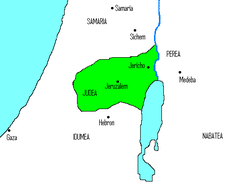
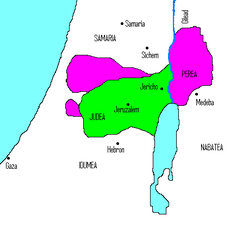
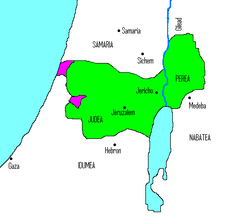 In the narrative of I Maccabees, after Antiochus issued his decrees forbidding Jewish religious practice, a rural Jewish priest
from Modiin, Mattathias
the Hasmonean
, sparked the revolt against the Seleucid Empire
by refusing to worship the Greek gods. Mattathias killed a Hellenistic Jew
who stepped forward to offer a sacrifice to an idol in Mattathias' place. He and his five sons fled to the wilderness of Judah. After Mattathias' death about one year later in 166 BCE, his son Judas Maccabee led an army of Jewish dissidents to victory over the Seleucid dynasty in guerrilla warfare
, which at first was directed against Hellenizing Jews, of whom there were many. The Maccabees destroyed pagan altars in the villages, circumcised boys and forced Jews into outlawry. The term Maccabees as used to describe the Jewish army is taken from the Hebrew word for "hammer".
The revolt itself involved many battles, in which the Maccabean forces gained notoriety among the Syrian army for their use of guerrilla tactics. After the victory, the Maccabees entered Jerusalem in triumph and ritually cleansed the Temple, reestablishing traditional Jewish worship
there and installing Jonathan Maccabee as high priest. A large Syrian army was sent to quash the revolt, but returned to Syria on the death of Antiochus IV. Its commander Lysias, preoccupied with internal Syrian affairs, agreed to a political compromise that restored religious freedom.
The Jewish festival of Hanukkah
celebrates the re-dedication of the Temple following Judah Maccabee's victory over the Seleucids. According to Rabbinic tradition, the victorious Maccabees could only find a small jug of oil that had remained uncontaminated by virtue of a seal, and although it only contained enough oil to sustain the Menorah for one day, it miraculously lasted for eight days, by which time further oil could be procured.
and Sadducees
under later Hasmonean monarchs such as Alexander Jannaeus
. Those who sought the continuation of the war were led by Judah Maccabee.
On his death in battle in 160 BCE, Judah was succeeded as army commander by his younger brother, Jonathan, who was already High Priest. Jonathan made treaties with various foreign states, causing further dissent between those who merely desired religious freedom and those who sought greater power.
In 142 BCE Jonathan was assassinated by Diodotus Tryphon
, a pretender to the Seleucid throne, and was succeeded by Simon Maccabee, the last remaining son of Mattathias. Simon gave support to Demetrius II Nicator
, the Seleucid king, and in return Demetrius exempted the Maccabees from tribute
. Simon conquered the port of Joppa
and the fortress of Gezer
and expelled the garrison from the Acra in Jerusalem. In 140 BCE, he was recognised by an assembly of the priests, leaders and elders as high priest, military commander and ruler of Israel. Their decree became the basis of the Hasmonean kingdom. Shortly after, the Roman senate
renewed its alliance with the Hasmonean kingdom and commanded its allies in the eastern Mediterranean to do so also . Although the Maccabees won autonomy, the region remained a province of the Seleucid empire and Simon was required to provide troops to Antiochus VII Sidetes
, the brother of Demetrius II. When Simon refused to give up the territory he had conquered, Antiochus took them by force.
Simon was murdered in 134 BCE by his son-in-law Ptolemy, and was succeeded as high priest and king by his son John Hyrcanus I. Antiochus conquered the entire district of Judea, but refrained from attacking the Temple or interfering with Jewish observances. Judea was freed from Seleucid rule on the death of Antiochus in 129 BCE.
Hasmonean rule lasted until 63 BCE, when the Roman general Pompey
captured Jerusalem and subjected Israel to Roman rule, while the Hasmonean dynasty itself ended in 37 BCE when the Idumean Herod the Great
became king of Israel and king of the Jews.
and 2 Maccabees
, which are part of the Septuagint, and in 3 Maccabees
and 4 Maccabees
, which are not. 1 Maccabees
and 2 Maccabees
are part of the Catholic
and Eastern Orthodox Old Testaments, but not the Hebrew Bible
.
, but the Maccabees proper were Judah Maccabee and his four brothers. The name Maccabee was a personal epithet of Judah, and the later generations were not his direct descendants. Although there is no definitive explanation of what the term means, one suggestion is that the name derives from the Aramaic maqqaba, "the hammer", in recognition of his ferocity in battle. The name Maccabee is also an acronym for the Torah
verse "Mi chamocha ba'elim YHWH", "Who is like unto thee among the mighty, O Lord!", as well as an acronym for "Matithyahu
Kohen ben Yoḥanan.
According to one tradition, their individual names are Habim,
Antonin, Guriah, Eleazar, Eusebon, Hadim (Halim), Marcellus, their mother Solomonia, and their teacher Eleazar
.
The Eastern Orthodox Church
celebrates the Holy Maccabean Martyrs on August 1, the first day of the Dormition Fast. The Roman Catholic Church
includes them in its official list of saints, assigning them 1 August as their feast day. From the time of the Tridentine Calendar
until 1960, they were mentioned through a commemoration
within the feast of St. Peter ad Vincula
. When, among other second feasts of a single saint, Pope John XXIII
suppressed this feast of Saint Peter, the Maccabees continued to be only commemorated, but this time within the Mass of the feria.
Some continue to use this calendar of John XXIII
, or indeed an older one, but the General Roman Calendar
officially in force since 1969 has omitted this commemoration. The Holy Maccabees are still recognized as saints and martyrs, and as such may be venerated by all Catholics everywhere on their feast and at other times.
In addition, the three Ethiopian books of Meqabyan
(canonical in the Ethiopian Orthodox Church, but quite distinct works from the other four books of Maccabees) refer to the martyred Maccabees. The first of these books states that their father was a Benjamite named Maccabeus, and that three of the brothers, who are called Abya, Seela, and Fentos, were captured and martyred for leading a guerilla war against Antiochus Epiphanes.
 The author of the First Book of Maccabees regarded the Maccabean revolt as a rising of pious Jews against the Seleucid king who had tried to eradicate their religion and against the Jews who supported him. The author of the Second Book of Maccabees presented the conflict as a struggle between "Judaism" and "Hellenism", words that he was the first to use.
Most modern scholars argue that the king was intervening in a civil war
between traditionalist Jews in the countryside and Hellenized Jews in Jerusalem. According to Joseph P. Schultz, modern scholarship "considers the Maccabean revolt less as an uprising against foreign oppression than as a civil war between the orthodox and reformist parties in the Jewish camp." In the conflict over the office of High Priest, traditionalists with Hebrew/Aramaic names like Onias
contested with Hellenizers with Greek names like Jason
and Menelaus
. Other authors point to social and economic factors in the conflict. What began as a civil war took on the character of an invasion when the Hellenistic kingdom of Syria sided with the Hellenizing Jews
against the traditionalists. As the conflict escalated, Antiochus prohibited the practices of the traditionalists, thereby, in a departure from usual Seleucid practice, banning the religion of an entire people. Other scholars argue that while the rising began as a religious rebellion, it was gradually transformed into a war of national liberation.
Judea
Judea or Judæa was the name of the mountainous southern part of the historic Land of Israel from the 8th century BCE to the 2nd century CE, when Roman Judea was renamed Syria Palaestina following the Jewish Bar Kokhba revolt.-Etymology:The...
, which had been a client state
Client state
Client state is one of several terms used to describe the economic, political and/or military subordination of one state to a more powerful state in international affairs...
of the Seleucid Empire
Seleucid Empire
The Seleucid Empire was a Greek-Macedonian state that was created out of the eastern conquests of Alexander the Great. At the height of its power, it included central Anatolia, the Levant, Mesopotamia, Persia, today's Turkmenistan, Pamir and parts of Pakistan.The Seleucid Empire was a major centre...
. They founded the Hasmonean
Hasmonean
The Hasmonean dynasty , was the ruling dynasty of Judea and surrounding regions during classical antiquity. Between c. 140 and c. 116 BCE, the dynasty ruled semi-autonomously from the Seleucids in the region of Judea...
dynasty
Dynasty
A dynasty is a sequence of rulers considered members of the same family. Historians traditionally consider many sovereign states' history within a framework of successive dynasties, e.g., China, Ancient Egypt and the Persian Empire...
, which ruled from 164 BCE to 63 BCE, reasserting the Jewish religion, expanding the boundaries of the Land of Israel
Land of Israel
The Land of Israel is the Biblical name for the territory roughly corresponding to the area encompassed by the Southern Levant, also known as Canaan and Palestine, Promised Land and Holy Land. The belief that the area is a God-given homeland of the Jewish people is based on the narrative of the...
and reducing the influence of Hellenism
Hellenization
Hellenization is a term used to describe the spread of ancient Greek culture, and, to a lesser extent, language. It is mainly used to describe the spread of Hellenistic civilization during the Hellenistic period following the campaigns of Alexander the Great of Macedon...
and Hellenistic Judaism
Hellenistic Judaism
Hellenistic Judaism was a movement which existed in the Jewish diaspora that sought to establish a Hebraic-Jewish religious tradition within the culture and language of Hellenism...
. Some scholars argue that the "Jewish biblical canon"
Development of the Jewish Bible canon
Rabbinic Judaism recognizes the 24 books of the Masoretic Text, commonly called the Tanakh or Hebrew Bible, as authoritative. Evidence suggests that the process of canonization occurred between 200 BCE and 200 CE. A popular former theory is that the Torah was canonized c. 400 BCE, the Prophets c....
was fixed by the Hasmonean dynasty.
Background
In the 2nd century BCE, JudeaJudea
Judea or Judæa was the name of the mountainous southern part of the historic Land of Israel from the 8th century BCE to the 2nd century CE, when Roman Judea was renamed Syria Palaestina following the Jewish Bar Kokhba revolt.-Etymology:The...
lay between the Ptolemaic Kingdom
Ptolemaic Kingdom
The Ptolemaic Kingdom in and around Egypt began following Alexander the Great's conquest in 332 BC and ended with the death of Cleopatra VII and the Roman conquest in 30 BC. It was founded when Ptolemy I Soter declared himself Pharaoh of Egypt, creating a powerful Hellenistic state stretching from...
based in Egypt
Egypt
Egypt , officially the Arab Republic of Egypt, Arabic: , is a country mainly in North Africa, with the Sinai Peninsula forming a land bridge in Southwest Asia. Egypt is thus a transcontinental country, and a major power in Africa, the Mediterranean Basin, the Middle East and the Muslim world...
and the Seleucid empire
Seleucid Empire
The Seleucid Empire was a Greek-Macedonian state that was created out of the eastern conquests of Alexander the Great. At the height of its power, it included central Anatolia, the Levant, Mesopotamia, Persia, today's Turkmenistan, Pamir and parts of Pakistan.The Seleucid Empire was a major centre...
based in Syria
Syria
Syria , officially the Syrian Arab Republic , is a country in Western Asia, bordering Lebanon and the Mediterranean Sea to the West, Turkey to the north, Iraq to the east, Jordan to the south, and Israel to the southwest....
, kingdoms formed after the death of Alexander the Great (336–323 BCE). Previously under the Ptolemies, Judea had fallen to the Seleucids in ca.200 BCE. Since the rule of Alexander in the near east, there had been a process of Hellenization
Hellenization
Hellenization is a term used to describe the spread of ancient Greek culture, and, to a lesser extent, language. It is mainly used to describe the spread of Hellenistic civilization during the Hellenistic period following the campaigns of Alexander the Great of Macedon...
, which affected Judea. Some Jews, mainly those of the urban upper class, notably the Tobiad family, wished to dispense with Jewish law and to adopt a Greek lifestyle. According to the historian Victor Tcherikover
Victor Tcherikover
-Biography:Born in Russia, he settled in Palestine in 1925. He was one of the first teachers at the Hebrew University of Jerusalem, and headed the departments of general history and classical studies...
, the main motive for the Tobiads' Hellenism was economic and political. Hellenizing Jews
Hellenistic Judaism
Hellenistic Judaism was a movement which existed in the Jewish diaspora that sought to establish a Hebraic-Jewish religious tradition within the culture and language of Hellenism...
had built a gymnasium
Gymnasium (ancient Greece)
The gymnasium in ancient Greece functioned as a training facility for competitors in public games. It was also a place for socializing and engaging in intellectual pursuits. The name comes from the Ancient Greek term gymnós meaning "naked". Athletes competed in the nude, a practice said to...
, competed internationally in Greek games, "removed their marks of circumcision and repudiated the holy covenant
Antinomianism
Antinomianism is defined as holding that, under the gospel dispensation of grace, moral law is of no use or obligation because faith alone is necessary to salvation....
".
When Antiochus IV Epiphanes
Antiochus IV Epiphanes
Antiochus IV Epiphanes ruled the Seleucid Empire from 175 BC until his death in 164 BC. He was a son of King Antiochus III the Great. His original name was Mithridates; he assumed the name Antiochus after he ascended the throne....
(ca. 215–164 BCE), became ruler of the Seleucid Empire in 175 BCE, the High Priest
Kohen Gadol
The High Priest was the chief religious official of Israelite religion and of classical Judaism from the rise of the Israelite nation until the destruction of the Second Temple of Jerusalem...
in Jerusalem was Onias III
Onias III
Onias III was a Jewish High Priest, the son of Simon II. He is described as a pious man who, unlike the Hellenizers, fought for Judaism. Seleucus Philopator defrayed all the expenses connected with the sanctuary and was friendly to the Jews...
. Antiochus was insensitive to the views of religious Jews and treated the High Priest as a political appointee and one from whom money could be made. To Antiochus, the High Priest was merely a local governor within his realm, who could be appointed or dismissed at will, while to orthodox Jews he was divinely appointed. Jason
Jason (high priest)
Jason of the Oniad family, brother to Onias III, was a High Priest in the Temple in Jerusalem.Jason became high priest in 175 BCE after the accession of Antiochus Epiphanes to the throne of the Seleucid Empire....
, the brother of Onias, bribed Antiochus to make him High Priest instead. Jason abolished the traditional theocracy and constituted Jerusalem as a Greek polis
Polis
Polis , plural poleis , literally means city in Greek. It could also mean citizenship and body of citizens. In modern historiography "polis" is normally used to indicate the ancient Greek city-states, like Classical Athens and its contemporaries, so polis is often translated as "city-state."The...
. Menelaus
Menelaus (High Priest)
Menelaus was High Priest in Jerusalem from 171 BC to about 161 BC. He was the successor of Jason, the brother of Onias III.The sources are divided as to his origin...
(who was not even a member of the Levite
Levite
In Jewish tradition, a Levite is a member of the Hebrew tribe of Levi. When Joshua led the Israelites into the land of Canaan, the Levites were the only Israelite tribe that received cities but were not allowed to be landowners "because the Lord the God of Israel himself is their inheritance"...
priestly family) then bribed Antiochus and was appointed High Priest in place of Jason. Menelaus had Onias assassinated. His brother Lysimachus took holy vessels from the Temple, causing riots and the thief's death at the hands of the rioters. Menelaus was arrested and arraigned before Antiochus, but he bribed his way out of trouble. Jason subsequently drove out Menelaus and became High Priest again. Antiochus pillaged the Temple, attacked Jerusalem and "led captive the women and children". From this point onwards, Antiochus pursued a Hellenizing policy with zeal. This effectively meant banning traditional Jewish religious practice. In 167 BCE Jewish sacrifice was forbidden, sabbaths and feasts were banned and circumcision
Circumcision in the Bible
Religious male circumcision generally occurs shortly after birth, during childhood or around puberty as part of a rite of passage. Circumcision is most prevalent in Muslim countries and Israel, and is most prevalent in the Jewish and Muslim faiths, although also common in the United States, the...
was outlawed. Altars to Greek gods were set up and animals prohibited to Jews were sacrificed on them. The Olympian Zeus
Zeus
In the ancient Greek religion, Zeus was the "Father of Gods and men" who ruled the Olympians of Mount Olympus as a father ruled the family. He was the god of sky and thunder in Greek mythology. His Roman counterpart is Jupiter and his Etruscan counterpart is Tinia.Zeus was the child of Cronus...
was placed on the altar of the Temple. Possession of Jewish scriptures was made a capital offence. The motives of Antiochus are unclear. He may have been incensed at the overthrow of his appointee, Menelaus, or he may have been responding to an orthodox Jewish revolt that drew on the Temple and the Torah
Torah
Torah- A scroll containing the first five books of the BibleThe Torah , is name given by Jews to the first five books of the bible—Genesis , Exodus , Leviticus , Numbers and Deuteronomy Torah- A scroll containing the first five books of the BibleThe Torah , is name given by Jews to the first five...
for its strength and encouraged by a group of radical Hellenizers among the Jews.
The revolt
Priest
A priest is a person authorized to perform the sacred rites of a religion, especially as a mediatory agent between humans and deities. They also have the authority or power to administer religious rites; in particular, rites of sacrifice to, and propitiation of, a deity or deities...
from Modiin, Mattathias
Mattathias
Mattathias ben Johanan was a Jewish priest whose role in the Jewish revolt against the Syrian Greeks is related in the Books of the Maccabees...
the Hasmonean
Hasmonean
The Hasmonean dynasty , was the ruling dynasty of Judea and surrounding regions during classical antiquity. Between c. 140 and c. 116 BCE, the dynasty ruled semi-autonomously from the Seleucids in the region of Judea...
, sparked the revolt against the Seleucid Empire
Seleucid Empire
The Seleucid Empire was a Greek-Macedonian state that was created out of the eastern conquests of Alexander the Great. At the height of its power, it included central Anatolia, the Levant, Mesopotamia, Persia, today's Turkmenistan, Pamir and parts of Pakistan.The Seleucid Empire was a major centre...
by refusing to worship the Greek gods. Mattathias killed a Hellenistic Jew
Hellenistic Judaism
Hellenistic Judaism was a movement which existed in the Jewish diaspora that sought to establish a Hebraic-Jewish religious tradition within the culture and language of Hellenism...
who stepped forward to offer a sacrifice to an idol in Mattathias' place. He and his five sons fled to the wilderness of Judah. After Mattathias' death about one year later in 166 BCE, his son Judas Maccabee led an army of Jewish dissidents to victory over the Seleucid dynasty in guerrilla warfare
Guerrilla warfare
Guerrilla warfare is a form of irregular warfare and refers to conflicts in which a small group of combatants including, but not limited to, armed civilians use military tactics, such as ambushes, sabotage, raids, the element of surprise, and extraordinary mobility to harass a larger and...
, which at first was directed against Hellenizing Jews, of whom there were many. The Maccabees destroyed pagan altars in the villages, circumcised boys and forced Jews into outlawry. The term Maccabees as used to describe the Jewish army is taken from the Hebrew word for "hammer".
The revolt itself involved many battles, in which the Maccabean forces gained notoriety among the Syrian army for their use of guerrilla tactics. After the victory, the Maccabees entered Jerusalem in triumph and ritually cleansed the Temple, reestablishing traditional Jewish worship
Jewish services
Jewish prayer are the prayer recitations that form part of the observance of Judaism. These prayers, often with instructions and commentary, are found in the siddur, the traditional Jewish prayer book....
there and installing Jonathan Maccabee as high priest. A large Syrian army was sent to quash the revolt, but returned to Syria on the death of Antiochus IV. Its commander Lysias, preoccupied with internal Syrian affairs, agreed to a political compromise that restored religious freedom.
The Jewish festival of Hanukkah
Hanukkah
Hanukkah , also known as the Festival of Lights, is an eight-day Jewish holiday commemorating the rededication of the Holy Temple in Jerusalem at the time of the Maccabean Revolt of the 2nd century BCE...
celebrates the re-dedication of the Temple following Judah Maccabee's victory over the Seleucids. According to Rabbinic tradition, the victorious Maccabees could only find a small jug of oil that had remained uncontaminated by virtue of a seal, and although it only contained enough oil to sustain the Menorah for one day, it miraculously lasted for eight days, by which time further oil could be procured.
Maccabean rule
Following the re-dedication of the temple, the supporters of the Maccabees were divided over the question of whether to continue fighting or not. When the revolt began under the leadership of Mattathias, it was seen as a war for religious freedom to end the oppression of the Seleucids. However, as the Maccabees realized how successful they had been, many wanted to continue the revolt and conquer other lands with Jewish populations or to convert their peoples. This policy exacerbated the divide between the PhariseesPharisees
The Pharisees were at various times a political party, a social movement, and a school of thought among Jews during the Second Temple period beginning under the Hasmonean dynasty in the wake of...
and Sadducees
Sadducees
The Sadducees were a sect or group of Jews that were active in Ancient Israel during the Second Temple period, starting from the second century BC through the destruction of the Temple in 70 AD. The sect was identified by Josephus with the upper social and economic echelon of Judean society...
under later Hasmonean monarchs such as Alexander Jannaeus
Alexander Jannaeus
Alexander Jannaeus was king of Judea from 103 BC to 76 BC. The son of John Hyrcanus, he inherited the throne from his brother Aristobulus I, and appears to have married his brother's widow, Shlomtzion or "Shelomit", also known as Salome Alexandra, according to the Biblical law of Yibbum...
. Those who sought the continuation of the war were led by Judah Maccabee.
On his death in battle in 160 BCE, Judah was succeeded as army commander by his younger brother, Jonathan, who was already High Priest. Jonathan made treaties with various foreign states, causing further dissent between those who merely desired religious freedom and those who sought greater power.
In 142 BCE Jonathan was assassinated by Diodotus Tryphon
Diodotus Tryphon
Diodotus Tryphon was king of the Hellenistic Seleucid kingdom. As a general of the army, he promoted the claims of Antiochus VI Dionysus, the infant son of Alexander Balas, in Antioch after Alexander's death, but then in 142 deposed the child and himself seized power in Coele-Syria where Demetrius...
, a pretender to the Seleucid throne, and was succeeded by Simon Maccabee, the last remaining son of Mattathias. Simon gave support to Demetrius II Nicator
Demetrius II Nicator
For the similarly named Macedonian ruler, see Demetrius II of Macedon. For the Macedonian prince, see Demetrius the Fair.Demetrius II , called Nicator , was one of the sons of Demetrius I Soter, brother of Antiochus VII Sidetes and his mother could have been Laodice V...
, the Seleucid king, and in return Demetrius exempted the Maccabees from tribute
Tribute
A tribute is wealth, often in kind, that one party gives to another as a sign of respect or, as was often the case in historical contexts, of submission or allegiance. Various ancient states, which could be called suzerains, exacted tribute from areas they had conquered or threatened to conquer...
. Simon conquered the port of Joppa
Jaffa
Jaffa is an ancient port city believed to be one of the oldest in the world. Jaffa was incorporated with Tel Aviv creating the city of Tel Aviv-Yafo, Israel. Jaffa is famous for its association with the biblical story of the prophet Jonah.-Etymology:...
and the fortress of Gezer
Gezer
Gezer was a Canaanite city-state and biblical town in ancient Israel. Tel Gezer , an archaeological site midway between Jerusalem and Tel Aviv, is now an Israeli national park....
and expelled the garrison from the Acra in Jerusalem. In 140 BCE, he was recognised by an assembly of the priests, leaders and elders as high priest, military commander and ruler of Israel. Their decree became the basis of the Hasmonean kingdom. Shortly after, the Roman senate
Roman Senate
The Senate of the Roman Republic was a political institution in the ancient Roman Republic, however, it was not an elected body, but one whose members were appointed by the consuls, and later by the censors. After a magistrate served his term in office, it usually was followed with automatic...
renewed its alliance with the Hasmonean kingdom and commanded its allies in the eastern Mediterranean to do so also . Although the Maccabees won autonomy, the region remained a province of the Seleucid empire and Simon was required to provide troops to Antiochus VII Sidetes
Antiochus VII Sidetes
Antiochus VII Euergetes, nicknamed Sidetes , ruler of the Hellenistic Seleucid Empire, reigned from 138 to 129 BC. He was the last Seleucid king of any stature....
, the brother of Demetrius II. When Simon refused to give up the territory he had conquered, Antiochus took them by force.
Simon was murdered in 134 BCE by his son-in-law Ptolemy, and was succeeded as high priest and king by his son John Hyrcanus I. Antiochus conquered the entire district of Judea, but refrained from attacking the Temple or interfering with Jewish observances. Judea was freed from Seleucid rule on the death of Antiochus in 129 BCE.
Hasmonean rule lasted until 63 BCE, when the Roman general Pompey
Pompey
Gnaeus Pompeius Magnus, also known as Pompey or Pompey the Great , was a military and political leader of the late Roman Republic...
captured Jerusalem and subjected Israel to Roman rule, while the Hasmonean dynasty itself ended in 37 BCE when the Idumean Herod the Great
Herod the Great
Herod , also known as Herod the Great , was a Roman client king of Judea. His epithet of "the Great" is widely disputed as he is described as "a madman who murdered his own family and a great many rabbis." He is also known for his colossal building projects in Jerusalem and elsewhere, including his...
became king of Israel and king of the Jews.
Mention in deuterocanon
The story of the Maccabees is told in 1 Maccabees1 Maccabees
The First book of Maccabees is a book written in Hebrew by a Jewish author after the restoration of an independent Jewish kingdom, about the latter part of the 2nd century BC. The original Hebrew is lost and the most important surviving version is the Greek translation contained in the Septuagint...
and 2 Maccabees
2 Maccabees
2 Maccabees is a deuterocanonical book of the Bible, which focuses on the Jews' revolt against Antiochus IV Epiphanes and concludes with the defeat of the Syrian general Nicanor in 161 BC by Judas Maccabeus, the hero of the work....
, which are part of the Septuagint, and in 3 Maccabees
3 Maccabees
The book of the 3 Maccabees is found in most Orthodox Bibles as a part of the Anagignoskomena, while Protestants and Catholics consider it non-canonical, except the Moravian Brethren who included it in the Apocrypha of the Czech Kralicka Bible...
and 4 Maccabees
4 Maccabees
The book of 4 Maccabees is a homily or philosophic discourse praising the supremacy of pious reason over passion. It is not in the Bible for most churches, but is an appendix to the Greek Bible, and in the canon of the Georgian Bible...
, which are not. 1 Maccabees
1 Maccabees
The First book of Maccabees is a book written in Hebrew by a Jewish author after the restoration of an independent Jewish kingdom, about the latter part of the 2nd century BC. The original Hebrew is lost and the most important surviving version is the Greek translation contained in the Septuagint...
and 2 Maccabees
2 Maccabees
2 Maccabees is a deuterocanonical book of the Bible, which focuses on the Jews' revolt against Antiochus IV Epiphanes and concludes with the defeat of the Syrian general Nicanor in 161 BC by Judas Maccabeus, the hero of the work....
are part of the Catholic
Catholic
The word catholic comes from the Greek phrase , meaning "on the whole," "according to the whole" or "in general", and is a combination of the Greek words meaning "about" and meaning "whole"...
and Eastern Orthodox Old Testaments, but not the Hebrew Bible
Tanakh
The Tanakh is a name used in Judaism for the canon of the Hebrew Bible. The Tanakh is also known as the Masoretic Text or the Miqra. The name is an acronym formed from the initial Hebrew letters of the Masoretic Text's three traditional subdivisions: The Torah , Nevi'im and Ketuvim —hence...
.
Origin of name
The name Maccabee is sometimes seen used as a synonym for the entire Hasmonean DynastyHasmonean
The Hasmonean dynasty , was the ruling dynasty of Judea and surrounding regions during classical antiquity. Between c. 140 and c. 116 BCE, the dynasty ruled semi-autonomously from the Seleucids in the region of Judea...
, but the Maccabees proper were Judah Maccabee and his four brothers. The name Maccabee was a personal epithet of Judah, and the later generations were not his direct descendants. Although there is no definitive explanation of what the term means, one suggestion is that the name derives from the Aramaic maqqaba, "the hammer", in recognition of his ferocity in battle. The name Maccabee is also an acronym for the Torah
Torah
Torah- A scroll containing the first five books of the BibleThe Torah , is name given by Jews to the first five books of the bible—Genesis , Exodus , Leviticus , Numbers and Deuteronomy Torah- A scroll containing the first five books of the BibleThe Torah , is name given by Jews to the first five...
verse "Mi chamocha ba'elim YHWH", "Who is like unto thee among the mighty, O Lord!", as well as an acronym for "Matithyahu
Mattathias
Mattathias ben Johanan was a Jewish priest whose role in the Jewish revolt against the Syrian Greeks is related in the Books of the Maccabees...
Kohen ben Yoḥanan.
Holy Maccabean Martyrs
Seven Jewish brothers, their mother and their teacher are known in Christianity as the Holy Maccabean Martyrs or Holy Maccabees, although they are not said to be of the Maccabee family. They are so named from the description of their martyrdom in 2 and 4 Maccabees.According to one tradition, their individual names are Habim,
Antonin, Guriah, Eleazar, Eusebon, Hadim (Halim), Marcellus, their mother Solomonia, and their teacher Eleazar
Eleazar (2 Maccabees)
Eleazar is a Jewish martyr portrayed in 2 Maccabees 6. Verse 18 describes him as "one of the leading teachers of the law," and "of distinguished bearing." We learn from verse 24 that he was ninety at the time of his death. Under a persecution instigated by Antiochus IV Epiphanes, Eleazar was forced...
.
The Eastern Orthodox Church
Eastern Orthodox Church
The Orthodox Church, officially called the Orthodox Catholic Church and commonly referred to as the Eastern Orthodox Church, is the second largest Christian denomination in the world, with an estimated 300 million adherents mainly in the countries of Belarus, Bulgaria, Cyprus, Georgia, Greece,...
celebrates the Holy Maccabean Martyrs on August 1, the first day of the Dormition Fast. The Roman Catholic Church
Roman Catholic Church
The Catholic Church, also known as the Roman Catholic Church, is the world's largest Christian church, with over a billion members. Led by the Pope, it defines its mission as spreading the gospel of Jesus Christ, administering the sacraments and exercising charity...
includes them in its official list of saints, assigning them 1 August as their feast day. From the time of the Tridentine Calendar
Tridentine Calendar
The Tridentine Calendar is the calendar of saints to be honoured in the course of the liturgical year in the official liturgy of the Roman Rite as reformed by Pope Pius V, implementing a decision of the Council of Trent, which entrusted the task to the Pope....
until 1960, they were mentioned through a commemoration
Commemoration (prayer)
In the Roman Rite, when a higher-ranked liturgical celebration impedes the celebration of a lesser one that, either permanently or by coincidence, falls on the same day, the prayer of the lower-ranked celebration is usually added to that of the higher...
within the feast of St. Peter ad Vincula
Liberation of Saint Peter
The Liberation of Saint Peter is a story told in the Acts of the Apostles in which Saint Peter is rescued from prison by an angel. Although described in a short textual passage, the tale has given rise to theological discussions and has been the subject of a number of artworks.-Biblical...
. When, among other second feasts of a single saint, Pope John XXIII
Pope John XXIII
-Papal election:Following the death of Pope Pius XII in 1958, Roncalli was elected Pope, to his great surprise. He had even arrived in the Vatican with a return train ticket to Venice. Many had considered Giovanni Battista Montini, Archbishop of Milan, a possible candidate, but, although archbishop...
suppressed this feast of Saint Peter, the Maccabees continued to be only commemorated, but this time within the Mass of the feria.
Some continue to use this calendar of John XXIII
General Roman Calendar of 1962
This article lists the feast days of the General Roman Calendar as it was in 1962, following the reforms that Pope John XXIII introduced with his motu proprio Rubricarum instructum of 23 July 1960...
, or indeed an older one, but the General Roman Calendar
Roman Catholic calendar of saints
The General Roman Calendar indicates the days of the year to which are assigned the liturgical celebrations of saints and of the mysteries of the Lord that are to be observed wherever the Roman Rite is used...
officially in force since 1969 has omitted this commemoration. The Holy Maccabees are still recognized as saints and martyrs, and as such may be venerated by all Catholics everywhere on their feast and at other times.
In addition, the three Ethiopian books of Meqabyan
Meqabyan
I, II, and III Meqabyan are three books in the Ethiopian Orthodox Old Testament Biblical canon....
(canonical in the Ethiopian Orthodox Church, but quite distinct works from the other four books of Maccabees) refer to the martyred Maccabees. The first of these books states that their father was a Benjamite named Maccabeus, and that three of the brothers, who are called Abya, Seela, and Fentos, were captured and martyred for leading a guerilla war against Antiochus Epiphanes.
Modern perception
Most modern scholars argue that the king was intervening in a civil war
Civil war
A civil war is a war between organized groups within the same nation state or republic, or, less commonly, between two countries created from a formerly-united nation state....
between traditionalist Jews in the countryside and Hellenized Jews in Jerusalem. According to Joseph P. Schultz, modern scholarship "considers the Maccabean revolt less as an uprising against foreign oppression than as a civil war between the orthodox and reformist parties in the Jewish camp." In the conflict over the office of High Priest, traditionalists with Hebrew/Aramaic names like Onias
Onias III
Onias III was a Jewish High Priest, the son of Simon II. He is described as a pious man who, unlike the Hellenizers, fought for Judaism. Seleucus Philopator defrayed all the expenses connected with the sanctuary and was friendly to the Jews...
contested with Hellenizers with Greek names like Jason
Jason
Jason was a late ancient Greek mythological hero from the late 10th Century BC, famous as the leader of the Argonauts and their quest for the Golden Fleece. He was the son of Aeson, the rightful king of Iolcus...
and Menelaus
Menelaus
Menelaus may refer to;*Menelaus, one of the two most known Atrides, a king of Sparta and son of Atreus and Aerope*Menelaus on the Moon, named after Menelaus of Alexandria.*Menelaus , brother of Ptolemy I Soter...
. Other authors point to social and economic factors in the conflict. What began as a civil war took on the character of an invasion when the Hellenistic kingdom of Syria sided with the Hellenizing Jews
Hellenistic Judaism
Hellenistic Judaism was a movement which existed in the Jewish diaspora that sought to establish a Hebraic-Jewish religious tradition within the culture and language of Hellenism...
against the traditionalists. As the conflict escalated, Antiochus prohibited the practices of the traditionalists, thereby, in a departure from usual Seleucid practice, banning the religion of an entire people. Other scholars argue that while the rising began as a religious rebellion, it was gradually transformed into a war of national liberation.
See also
- Alexander JannaeusAlexander JannaeusAlexander Jannaeus was king of Judea from 103 BC to 76 BC. The son of John Hyrcanus, he inherited the throne from his brother Aristobulus I, and appears to have married his brother's widow, Shlomtzion or "Shelomit", also known as Salome Alexandra, according to the Biblical law of Yibbum...
- Antinomianism in the Books of the Maccabees
- Aristobulus I
- Aristobulus IIAristobulus IIAristobulus II was the Jewish High Priest and King of Judea, 66 BC to 63 BC, from the Hasmonean Dynasty.-Family:Aristobulus was the younger son of Alexander Jannaeus, King and High Priest, and Alexandra Salome. After the death of Alexander in 76 BC, his widow succeeded to the rule of Judea and...
- HasmoneanHasmoneanThe Hasmonean dynasty , was the ruling dynasty of Judea and surrounding regions during classical antiquity. Between c. 140 and c. 116 BCE, the dynasty ruled semi-autonomously from the Seleucids in the region of Judea...
- Hellenistic JudaismHellenistic JudaismHellenistic Judaism was a movement which existed in the Jewish diaspora that sought to establish a Hebraic-Jewish religious tradition within the culture and language of Hellenism...
- Hyrcanus IIHyrcanus IIHyrcanus II, a member of the Hasmonean dynasty, was the Jewish High Priest and King of Judea in the 1st century BC.-Accession:Hyrcanus was the eldest son of Alexander Jannaeus, King and High Priest, and Alexandra Salome...
- Jewish nationalism
- John GaddiJohn GaddiJohn Gaddi was the oldest of the sons of Mattathias, and brother of Judas Maccabeus. His 'nickname' Gaddi is a Hebrew term, meaning "My Fortune"...
- John HyrcanusJohn HyrcanusJohn Hyrcanus was a Hasmonean leader of the 2nd century BC.-Name:...
- Jonathan Apphus
- Judas MaccabeusJudas MaccabeusJudah Maccabee was a Kohen and a son of the Jewish priest Mattathias...
- MattathiasMattathiasMattathias ben Johanan was a Jewish priest whose role in the Jewish revolt against the Syrian Greeks is related in the Books of the Maccabees...
- My Glorious BrothersMy Glorious BrothersMy Glorious Brothers is a historical novel by the Jewish American novelist Howard Fast, depicting the 167 BC Maccabeean revolt against the Greek-Seleucid Empire. The book, which deals with Jewish independence and self-determination, was published in 1948, during the Israeli War of Independence.The...
, novel by Howard FastHoward FastHoward Melvin Fast was an American novelist and television writer. Fast also wrote under the pen names E. V. Cunningham and Walter Ericson.-Early life:Fast was born in New York City... - Salome AlexandraSalome AlexandraSalome Alexandra or Alexandra of Jerusalem , was the only Jewish regnant queen, with the exception of her own husband's mother whom he had prevented from ruling as his dying father had wished, and of the much earlier usurper Athaliah...
- Simon Thassi
- TobiadsTobiadsThe Tobiads were a Jewish or Ammonite faction at the beginning of the Maccabean period. They were phil-Hellene, in other words supporters of the Hellenistic tendencies in Judaism in the early years of the 2nd century BCE.-Accounts:...