


Dura-Europos

Encyclopedia
Dura-Europos , also spelled Dura-Europus, was a Hellenistic, Parthian
Parthian Empire
The Parthian Empire , also known as the Arsacid Empire , was a major Iranian political and cultural power in ancient Persia...
and Roman
Ancient Rome
Ancient Rome was a thriving civilization that grew on the Italian Peninsula as early as the 8th century BC. Located along the Mediterranean Sea and centered on the city of Rome, it expanded to one of the largest empires in the ancient world....
border city
City
A city is a relatively large and permanent settlement. Although there is no agreement on how a city is distinguished from a town within general English language meanings, many cities have a particular administrative, legal, or historical status based on local law.For example, in the U.S...
built on an escarpment
Escarpment
An escarpment is a steep slope or long cliff that occurs from erosion or faulting and separates two relatively level areas of differing elevations.-Description and variants:...
90 m above the right bank of the Euphrates
Euphrates
The Euphrates is the longest and one of the most historically important rivers of Western Asia. Together with the Tigris, it is one of the two defining rivers of Mesopotamia...
river. It is located near the village of Salhiyé, in today's Syria
Syria
Syria , officially the Syrian Arab Republic , is a country in Western Asia, bordering Lebanon and the Mediterranean Sea to the West, Turkey to the north, Iraq to the east, Jordan to the south, and Israel to the southwest....
.
Dura-Europos is extremely important for archaeological reasons. As it was abandoned after its conquest in 256–7, nothing was built over it and no later building programs obscured the architectonic features of the ancient city. Its location on the edge of empires meant for a co-mingling of cultural traditions, much of which was preserved under the city's ruins. Some remarkable finds have been brought to light, including numerous temples, wall decorations, inscriptions, military equipment, tombs, and even dramatic evidence of the Sassanian siege
Siege
A siege is a military blockade of a city or fortress with the intent of conquering by attrition or assault. The term derives from sedere, Latin for "to sit". Generally speaking, siege warfare is a form of constant, low intensity conflict characterized by one party holding a strong, static...
during the Imperial Roman
Roman Empire
The Roman Empire was the post-Republican period of the ancient Roman civilization, characterised by an autocratic form of government and large territorial holdings in Europe and around the Mediterranean....
period which led to the site's abandonment.
Hellenistic Era
It was founded in 303 BC303 BC
Year 303 BC was a year of the pre-Julian Roman calendar. At the time, it was known as the Year of the Consulship of Lentulus and Aventinensis...
by the Seleucids
Seleucid Empire
The Seleucid Empire was a Greek-Macedonian state that was created out of the eastern conquests of Alexander the Great. At the height of its power, it included central Anatolia, the Levant, Mesopotamia, Persia, today's Turkmenistan, Pamir and parts of Pakistan.The Seleucid Empire was a major centre...
on the intersection of an east-west trade route and the trade route along the Euphrates. The new city controlled the river crossing on the route between his newly founded cities of Antioch
Antioch
Antioch on the Orontes was an ancient city on the eastern side of the Orontes River. It is near the modern city of Antakya, Turkey.Founded near the end of the 4th century BC by Seleucus I Nicator, one of Alexander the Great's generals, Antioch eventually rivaled Alexandria as the chief city of the...
and Seleucia on the Tigris
Seleucia on the Tigris
Seleucia , also known as Seleucia on the Tigris, was one of the great cities of the world during Hellenistic and Roman times. It stood in Mesopotamia, on the west bank of the Tigris River, opposite the smaller town of Ctesiphon, in present day Babil Governorate, Iraq.-Seleucid empire:Seleucia,...
. Its rebuilding as a great city built after the Hippodamian model, with rectangular blocks defined by cross-streets ranged round a large central agora
Agora
The Agora was an open "place of assembly" in ancient Greek city-states. Early in Greek history , free-born male land-owners who were citizens would gather in the Agora for military duty or to hear statements of the ruling king or council. Later, the Agora also served as a marketplace where...
, was formally laid out in the 2nd century BC. The traditional view of Dura-Europos as a great caravan city is becoming nuanced by the discoveries of locally made manufactures and traces of close ties with Palmyra
Palmyra
Palmyra was an ancient city in Syria. In the age of antiquity, it was an important city of central Syria, located in an oasis 215 km northeast of Damascus and 180 km southwest of the Euphrates at Deir ez-Zor. It had long been a vital caravan city for travellers crossing the Syrian desert...
(James).
During the later 2nd century BC it came under Parthian
Parthian Empire
The Parthian Empire , also known as the Arsacid Empire , was a major Iranian political and cultural power in ancient Persia...
control and in the 1st century BC, it served as a frontier fortress of the Arsacid Parthian Empire
Parthian Empire
The Parthian Empire , also known as the Arsacid Empire , was a major Iranian political and cultural power in ancient Persia...
, with a multicultural population, as inscriptions in Greek
Greek language
Greek is an independent branch of the Indo-European family of languages. Native to the southern Balkans, it has the longest documented history of any Indo-European language, spanning 34 centuries of written records. Its writing system has been the Greek alphabet for the majority of its history;...
, Latin
Latin
Latin is an Italic language originally spoken in Latium and Ancient Rome. It, along with most European languages, is a descendant of the ancient Proto-Indo-European language. Although it is considered a dead language, a number of scholars and members of the Christian clergy speak it fluently, and...
, Aramaic, Hebrew
Hebrew language
Hebrew is a Semitic language of the Afroasiatic language family. Culturally, is it considered by Jews and other religious groups as the language of the Jewish people, though other Jewish languages had originated among diaspora Jews, and the Hebrew language is also used by non-Jewish groups, such...
, Syriac, Hatrian, Palmyrenean, Middle Persian
Middle Persian
Middle Persian , indigenously known as "Pârsig" sometimes referred to as Pahlavi or Pehlevi, is the Middle Iranian language/ethnolect of Southwestern Iran that during Sassanid times became a prestige dialect and so came to be spoken in other regions as well. Middle Persian is classified as a...
and Safaitic Pahlavi testify. It was captured by the Romans
Ancient Rome
Ancient Rome was a thriving civilization that grew on the Italian Peninsula as early as the 8th century BC. Located along the Mediterranean Sea and centered on the city of Rome, it expanded to one of the largest empires in the ancient world....
in 165
165
Year 165 was a common year starting on Monday of the Julian calendar. At the time, it was known as the Year of the Consulship of Orfitus and Pudens...
and abandoned after a Sassanian siege in 256
256
Year 256 was a leap year starting on Tuesday of the Julian calendar. At the time, it was known as the Year of the Consulship of Claudius and Glabrio...
-257
257
Year 257 was a common year starting on Thursday of the Julian calendar. At the time, it was known as the Year of the Consulship of Valerianus and Gallienus...
. After it was abandoned, it was covered by sand and mud and disappeared from sight.
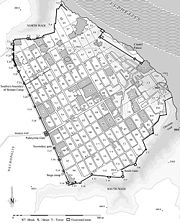
Archaeology
Although the existence of Dura-Europos was long known through literary sources, it was not rediscovered until British troops under Capt. Murphy made the first discovery in the aftermath of World War IWorld War I
World War I , which was predominantly called the World War or the Great War from its occurrence until 1939, and the First World War or World War I thereafter, was a major war centred in Europe that began on 28 July 1914 and lasted until 11 November 1918...
and the Arab Revolt
Arab Revolt
The Arab Revolt was initiated by the Sherif Hussein bin Ali with the aim of securing independence from the ruling Ottoman Turks and creating a single unified Arab state spanning from Aleppo in Syria to Aden in Yemen.- Background :...
. On March 30, 1920, a soldier digging a trench uncovered brilliantly fresh wall-paintings. The American archeologist James Henry Breasted
James Henry Breasted
James Henry Breasted was an American archaeologist and historian. After completing his PhD at the University of Berlin in 1894, he joined the faculty of the University of Chicago. In 1901 he became director of the Haskell Oriental Museum at the University of Chicago, where he continued to...
, then at Baghdad
Baghdad
Baghdad is the capital of Iraq, as well as the coterminous Baghdad Governorate. The population of Baghdad in 2011 is approximately 7,216,040...
, was alerted. Major excavations were carried out in the 1920s and 1930s by French and American teams. The first archaeology on the site, undertaken by Franz Cumont
Franz Cumont
Franz-Valéry-Marie Cumont was a Belgian archaeologist and historian, a philologist and student of epigraphy, who brought these often isolated specialties to bear on the syncretic mystery religions of Late Antiquity, notably Mithraism. Cumont was a graduate of the University of Ghent...
and published in 1922-23, identified the site with Dura-Europos, and uncovered a temple, before renewed hostilities in the area closed it to archaeology. Later, renewed campaigns directed by Michael Rostovtzeff
Michael Rostovtzeff
Mikhail Ivanovich Rostovtzeff, or Rostovtsev was one of the 20th century's foremost authorities on ancient Greek, Iranian, and Roman history....
continued until 1937, when funds ran out with only part of the excavations published. World War II
World War II
World War II, or the Second World War , was a global conflict lasting from 1939 to 1945, involving most of the world's nations—including all of the great powers—eventually forming two opposing military alliances: the Allies and the Axis...
intervened. Since 1986 excavations have resumed in a joint Franco-Syrian effort under the direction of Pierre Leriche.
Not the least of the finds were astonishingly well-preserved arms and armour
Armour
Armour or armor is protective covering used to prevent damage from being inflicted to an object, individual or a vehicle through use of direct contact weapons or projectiles, usually during combat, or from damage caused by a potentially dangerous environment or action...
belonging to the Roman
Roman army
The Roman army is the generic term for the terrestrial armed forces deployed by the kingdom of Rome , the Roman Republic , the Roman Empire and its successor, the Byzantine empire...
garrison at the time of the final Sassanian siege of 256. Finds included painted wooden shields and complete horse armour, preserved by the very finality of the destruction of the city that journalists have called "the Pompeii
Pompeii
The city of Pompeii is a partially buried Roman town-city near modern Naples in the Italian region of Campania, in the territory of the comune of Pompei. Along with Herculaneum, Pompeii was destroyed and completely buried during a long catastrophic eruption of the volcano Mount Vesuvius spanning...
of the desert". Finds from Dura-Europos are on display in the Deir ez-Zor Museum
Deir ez-Zor Museum
The Deir ez-Zor Museum is a museum devoted to the archaeology and history of northeastern Syria, an area more commonly known as the Jezirah, or Upper Mesopotamia. The museum is located in Deir ez-Zor, the capital of Deir ez-Zor Governorate, Syria. It was founded in 1974 and housed in a gallery of...
.
Culture
Dura-Europos was a cosmopolitan society, controlled by a tolerant MacedonMacedon
Macedonia or Macedon was an ancient kingdom, centered in the northeastern part of the Greek peninsula, bordered by Epirus to the west, Paeonia to the north, the region of Thrace to the east and Thessaly to the south....
ian aristocracy
Aristocracy
Aristocracy , is a form of government in which a few elite citizens rule. The term derives from the Greek aristokratia, meaning "rule of the best". In origin in Ancient Greece, it was conceived of as rule by the best qualified citizens, and contrasted with monarchy...
descended from the original settlers. In the course of its excavation, over a hundred parchment
Parchment
Parchment is a thin material made from calfskin, sheepskin or goatskin, often split. Its most common use was as a material for writing on, for documents, notes, or the pages of a book, codex or manuscript. It is distinct from leather in that parchment is limed but not tanned; therefore, it is very...
and papyrus
Papyrus
Papyrus is a thick paper-like material produced from the pith of the papyrus plant, Cyperus papyrus, a wetland sedge that was once abundant in the Nile Delta of Egypt....
fragments and many inscriptions have revealed texts in Greek
Greek language
Greek is an independent branch of the Indo-European family of languages. Native to the southern Balkans, it has the longest documented history of any Indo-European language, spanning 34 centuries of written records. Its writing system has been the Greek alphabet for the majority of its history;...
and Latin
Latin
Latin is an Italic language originally spoken in Latium and Ancient Rome. It, along with most European languages, is a descendant of the ancient Proto-Indo-European language. Although it is considered a dead language, a number of scholars and members of the Christian clergy speak it fluently, and...
(the latter including a sator square), Palmyrenean, Hebrew
Hebrew language
Hebrew is a Semitic language of the Afroasiatic language family. Culturally, is it considered by Jews and other religious groups as the language of the Jewish people, though other Jewish languages had originated among diaspora Jews, and the Hebrew language is also used by non-Jewish groups, such...
, Hatrian, Safaitic, and Pahlavi. The excavations revealed temples to Greek
Greek mythology
Greek mythology is the body of myths and legends belonging to the ancient Greeks, concerning their gods and heroes, the nature of the world, and the origins and significance of their own cult and ritual practices. They were a part of religion in ancient Greece...
, Roman
Ancient Rome
Ancient Rome was a thriving civilization that grew on the Italian Peninsula as early as the 8th century BC. Located along the Mediterranean Sea and centered on the city of Rome, it expanded to one of the largest empires in the ancient world....
and Palmyrene
Palmyrene Empire
The Palmyrene Empire was a splinter empire, that broke off of the Roman Empire during the Crisis of the Third Century. It encompassed the Roman provinces of Syria Palaestina, Egypt and large parts of Asia Minor....
gods. There was a Mithraeum
Mithraeum
A Mithraeum is a place of worship for the followers of the mystery religion of Mithraism.The Mithraeum was either an adapted natural cave or cavern or an artificial building imitating a cavern. Mithraea were dark and windowless, even if they were not actually in a subterranean space or in a natural...
, as one would expect in a Roman military city.
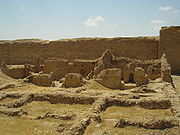
The synagogue
The JewishJudaism
Judaism ) is the "religion, philosophy, and way of life" of the Jewish people...
synagogue
Synagogue
A synagogue is a Jewish house of prayer. This use of the Greek term synagogue originates in the Septuagint where it sometimes translates the Hebrew word for assembly, kahal...
, located by the western wall between towers 18 and 19, the last phase of which was dated by an Aramaic
Aramaic language
Aramaic is a group of languages belonging to the Afroasiatic language phylum. The name of the language is based on the name of Aram, an ancient region in central Syria. Within this family, Aramaic belongs to the Semitic family, and more specifically, is a part of the Northwest Semitic subfamily,...
inscription to 244. It is the best preserved of the many ancient synagogues of that era that have been uncovered by archaeologists. It was preserved, ironically, when it had to be infilled with earth to strengthen the city's fortifications against a Sassanian assault in 256. It was uncovered in 1932 by Clark Hopkins, who found that it contains a forecourt and house of assembly with fresco
Fresco
Fresco is any of several related mural painting types, executed on plaster on walls or ceilings. The word fresco comes from the Greek word affresca which derives from the Latin word for "fresh". Frescoes first developed in the ancient world and continued to be popular through the Renaissance...
ed walls depicting people and animals, and a Torah
Torah
Torah- A scroll containing the first five books of the BibleThe Torah , is name given by Jews to the first five books of the bible—Genesis , Exodus , Leviticus , Numbers and Deuteronomy Torah- A scroll containing the first five books of the BibleThe Torah , is name given by Jews to the first five...
shrine in the western wall facing Jerusalem. At first, it was mistaken for a Greek temple. The synagogue paintings, the earliest continuous surviving biblical narrative cycle, are conserved at Damascus
Damascus
Damascus , commonly known in Syria as Al Sham , and as the City of Jasmine , is the capital and the second largest city of Syria after Aleppo, both are part of the country's 14 governorates. In addition to being one of the oldest continuously inhabited cities in the world, Damascus is a major...
, together with the complete Roman horse-armour.

The house church
There was also the identified the Dura-Europos churchDura-Europos church
The Dura-Europos church is the earliest identified Christian house church. It is located in Dura-Europos in Syria and dates from 235 AD...
, the earliest Christian
Christian
A Christian is a person who adheres to Christianity, an Abrahamic, monotheistic religion based on the life and teachings of Jesus of Nazareth as recorded in the Canonical gospels and the letters of the New Testament...
house church
House church
House church, or "home church", is used to describe an independent assembly of Christians who gather in a home. Sometimes this occurs because the group is small, and a home is the most appropriate place to gather, as in the beginning phase of the British New Church Movement...
, located by the 17th tower and preserved by the same defensive fill that saved the synagogue. "Their evidently open and tolerated presence in the middle of a major Roman garrison
Garrison
Garrison is the collective term for a body of troops stationed in a particular location, originally to guard it, but now often simply using it as a home base....
town reveals that the history of the early Church was not simply a story of pagan
Paganism
Paganism is a blanket term, typically used to refer to non-Abrahamic, indigenous polytheistic religious traditions....
persecution". The building consists of a house conjoined to a separate hall-like room, which functioned as the meeting room for the church. The surviving frescoes of the baptistry room are probably the most ancient Christian painting
Painting
Painting is the practice of applying paint, pigment, color or other medium to a surface . The application of the medium is commonly applied to the base with a brush but other objects can be used. In art, the term painting describes both the act and the result of the action. However, painting is...
s. We can see the "Good Shepherd
Good Shepherd
Good Shepherd may refer to:In Christianity:* The Good Shepherd , pericope found in John 10:1-21, and a popular image in which the Good Shepherd represents Jesus...
" (this iconography had a very long history in the Classical world), the "Healing of the paralytic" and "Christ and Peter walking on the water". These earliest depictions of Jesus Christ ever found anywhere date back to 235 A.D.
A much larger fresco depicts two women (and a third, mostly lost) approaching a large sarcophagus, i.e. probably the three Marys
The Three Marys
The Three Marys are the three biblical Marys who came to the sepulchre of Jesus in the Gospels and were companions of Mary, the mother of Jesus. In Eastern Orthodoxy they are among the Myrrhbearers, traditionally including a larger number of people. All four gospels mention the women going to the...
visiting Christ's tomb. The name Salome was painted near one of the women. There were also frescoes of Adam and Eve as well as David and Goliath. The frescoes clearly followed the Hellenistic Jewish iconographic tradition but they are more crudely done than the paintings of the nearby synagogue.
Fragments of parchment
Parchment
Parchment is a thin material made from calfskin, sheepskin or goatskin, often split. Its most common use was as a material for writing on, for documents, notes, or the pages of a book, codex or manuscript. It is distinct from leather in that parchment is limed but not tanned; therefore, it is very...
scrolls with Hebrew texts have also been unearthed; they resisted meaningful translation until J.L. Teicher pointed out that they were Christian Eucharistic prayers, so closely connected with the prayers in Didache
Didache
The Didache or The Teaching of the Twelve Apostles is a brief early Christian treatise, dated by most scholars to the late first or early 2nd century...
that he was able to fill lacunae in the light of the Didache text.
In 1933, among fragments of text recovered from the town dump outside the Palmyrene Gate, a fragmentary text was unearthed from an unknown Greek harmony of the gospel accounts — comparable to Tatian
Tatian
Tatian the Assyrian was an Assyrian early Christian writer and theologian of the 2nd century.Tatian's most influential work is the Diatessaron, a Biblical paraphrase, or "harmony", of the four gospels that became the standard text of the four gospels in the Syriac-speaking churches until the...
's Diatessaron
Diatessaron
The Diatessaron is the most prominent Gospel harmony created by Tatian, an early Christian apologist and ascetic. The term "diatessaron" is from Middle English by way of Latin, diatessarōn , and ultimately Greek, διὰ τεσσάρων The Diatessaron (c 160 - 175) is the most prominent Gospel harmony...
, but independent of it.
The Mithraeum
Also partially preserved by the defensive embankment was the MithraeumMithraeum
A Mithraeum is a place of worship for the followers of the mystery religion of Mithraism.The Mithraeum was either an adapted natural cave or cavern or an artificial building imitating a cavern. Mithraea were dark and windowless, even if they were not actually in a subterranean space or in a natural...
(CIMRM
CIMRM
Corpus Inscriptionum et Monumentorum Religionis Mithriacae is a two volume collection of inscriptions and monuments relating primarily to the Mithraic Mysteries. It was compiled by Maarten Jozef Vermaseren and published at the Hague by Martinus Nijhoff, 1956, 1960 in 2 vols...
34-70), located between towers 23 and 24. It was unearthed in January 1934 after years of expectation as to whether Dura would reveal traces of the Roman Mithras cult. The earliest archaeological traces found within the temple are from between AD 168 and 171, which coincides with the arrival of Lucius Verus and his troops. At this stage it was still a room in a private home. It was extended and renovated between 209 and 211, and most of the frescoes are from this period. The tabula ansata of 210 offers salutation to Septimus Severus, Caracalla and Geta. The construction was managed by a centurio principe praepositus of the legio IIII Scythicae et XVI Flaviae firmae (CIMRM 53), and it seems that construction was done by imperial troops. The mithraeum was enlarged again in 240, but in 256—with war with Sassanians looming—the sanctuary was filled in and became part of the strengthened fortifications. Following excavations, the temple was transported in pieces to New Haven, Connecticut, where it was rebuilt (and is now on display) at Yale University's Gallery of Fine Arts.
The surviving frescoes, graffiti and dipinti (which number in the dozens) are of enormous interest to the study of the social composition of the cult. The statuary and altars were found intact, as also the typical relief of Mithras slaying the bull, with the hero-god dressed as usual in "oriental" costume ("trousers, boots, and pointed cap"). As is typical for mithraea in the Roman provinces in the Greek East, the inscriptions and graffiti are mostly in Greek, with the rest in Palmyrene (and some Hellenized Hebrew). The end of the sanctuary features an arch with a seated figure on each of the two supporting columns. Inside and following the form of the arch is a series of depictions of the zodiac
Zodiac
In astronomy, the zodiac is a circle of twelve 30° divisions of celestial longitude which are centred upon the ecliptic: the apparent path of the Sun across the celestial sphere over the course of the year...
. Within the framework of the now-obsolete theory that the Roman cult was "a Roman form of Mazdaism" ("la forme romaine du mazdeisme"), Cumont supposed that the two Dura friezes represented the two primary figures of his Les Mages hellénisés, i.e. "Zoroaster" and "Ostanes". This reading has not found a footing; "the two figures are Palmyrene in all their characteristic traits" and are more probably portraits of leading members of that mithraeum's congregation of Syrian auxiliaries
Auxiliaries (Roman military)
Auxiliaries formed the standing non-citizen corps of the Roman army of the Principate , alongside the citizen legions...
.
The Fall of Dura
The reason for the good state of preservation of these buildings and their frescoes was due to their location, close to the main city wall facing west, and the military necessity to strengthen the wall. The Sassanid Persians had become adept at tunneling under such walls in order to undermine them and create breaches. As a countermeasure the Roman garrison decided to sacrifice the street and the buildings along the wall by filling them with rubble to bolster the wall in case of a Persian mining operation, so the Christian chapel, the synagogue, the Mithraeum and many other buildings were entombed. They also buttressed the walls from the outside with an earthen mound forming a glacisGlacis
A glacis in military engineering is an artificial slope of earth used in late European fortresses so constructed as to keep any potential assailant under the fire of the defenders until the last possible moment...
and sealed it with a casing of mud brick to prevent erosion.
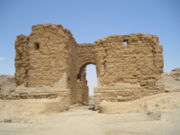
Undermining
The buttressing of the walls would be tested in AD 256 when Shapur IShapur I
Shapur I or also known as Shapur I the Great was the second Sassanid King of the Second Persian Empire. The dates of his reign are commonly given as 240/42 - 270/72, but it is likely that he also reigned as co-regent prior to his father's death in 242 .-Early years:Shapur was the son of Ardashir I...
besieged the city. True to fears, Shapur set his engineers to undermine what archaeologists called Tower 19, two towers north of the Palmyrene Gate. When the Romans became aware of the threat, they dug a countermine with the aim of meeting the Persian effort and attack them before they could finish their work. The Persians had already dug complex galleries along the wall by the time the Roman countermine reached them. They managed to fight off the Roman attack, and when the city defenders noticed the flight of soldiers from the countermine, it was quickly sealed. The wounded and stragglers were trapped inside, where they died. (It was the coins found with these Roman soldiers that dated the siege to AD 256.) The countermine was successful, for the Persians abandoned their operations at Tower 19.
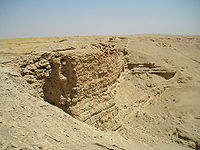
This brought a third approach to entering the city. A ramp was raised again attacking Tower 14, but, as it was being built and the garrison fought to stop the progress of the ramp, another mine was started near the ramp. Its scope was not to cause a collapse of the wall—the buttress had been successful—but to pass under it and penetrate the city. This tunnel was built to allow the Persians four abreast to move through it. It eventually entered the city and pierced the inner embankment and, when the ramp was completed, Dura's end had come. As Persian troops charged up the ramp, their counterparts in the tunnel would have invaded the city with little opposition, as nearly all the defenders would have been on the wall attempting to repulse the attack from the ramp. City survivors would have been marched off to Ctesiphon
Ctesiphon
Ctesiphon, the imperial capital of the Parthian Arsacids and of the Persian Sassanids, was one of the great cities of ancient Mesopotamia.The ruins of the city are located on the east bank of the Tigris, across the river from the Hellenistic city of Seleucia...
and there sold as slaves. The city, once pillaged, was never rebuilt.
Chemical warfare
In January 2009, researchers claimed they had found evidence that the Persian EmpireSassanid Empire
The Sassanid Empire , known to its inhabitants as Ērānshahr and Ērān in Middle Persian and resulting in the New Persian terms Iranshahr and Iran , was the last pre-Islamic Persian Empire, ruled by the Sasanian Dynasty from 224 to 651...
used poisonous gases on Dura against the Roman defenders during the siege. Excavations at Dura have discovered the remains of 19 Roman and 1 Persian soldiers at the base of the city walls. An archaeologist at the University of Leicester suggested that bitumen and sulphur crystals were ignited to create poisonous gas, which was then funnelled through the tunnel with the use of underground chimneys and bellows. The Roman soldiers had been constructing a countermine, and Sassanian forces are believed to have released the gas when their mine was breached by the Roman countermine. The lone Persian soldier discovered among the bodies is believed to be the individual responsible for releasing the gas before the fumes overcame him as well.