

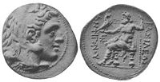
Antigonus I Monophthalmus

Encyclopedia
Antigonus I Monophthalmus , son of Philip
from Elimeia
, was a Macedon
ian nobleman, general, and satrap
under Alexander the Great. During his early life he served under Philip II
, and he was a major figure in the Wars of the Diadochi
after Alexander's death, declaring himself king in 306 BC and establishing the Antigonid dynasty
.
in 333 BC. He was primarily responsible for defending Alexander's lines of supply and communication during the latter's extended campaign against the Achaemenid Persian Empire. Following Alexander's victory at Issus
, the Persian mercenary commander Memnon of Rhodes
ordered a counter-attack into Asia Minor in an attempt to sever Alexander's lines of supply and communication; however, Antigonus defeated the Persian forces in three separate battles.
As part of the division of the provinces after Alexander's death in 323 BC, Antigonus also received Pamphylia
and Lycia
from Perdiccas
, regent
of the empire, at the Partition of Babylon
. He incurred the enmity of Perdiccas, the regent, by refusing to assist Eumenes
to obtain possession of the provinces allotted to him, Paphlagonia
and Cappadocia
. Leonnatos had left with his army for Greece, leaving Antigonus alone to deal with Cappadocia, a task he apparently couldn't complete without additional aid.
Perdiccas seems to have viewed this as a direct affront to his authority and went up with the royal army himself to conquer the area. From there Perdiccas turned west towards Phrygia in order to humble Antigonus, who escaped with his son Demetrius
to Greece, where he obtained the favour of Antipater, regent of Macedonia (321 BC), and Craterus
.
With the death of Perdiccas in 321 BC, a new attempt at division of the empire took place at Triparadisus and Antigonus found himself entrusted with the command of the war against Eumenes
, who had joined Perdiccas against the coalition of Antipater
, Antigonus, Ptolemy, Craterus, and the other generals. Eumenes was defeated and forced to retire to the fortress of Nora in Cappadocia
, and a new army that was marching to his relief was routed by Antigonus.
When Antipater died in 319 BC, he gave the regentship to Polyperchon
, excluding Cassander
, his son. Antigonus and the other dynasts refused to recognize Polyperchon, since it would undermine their own ambitions. He entered into negotiations with Eumenes, but Eumenes had already been swayed by Polyperchon, who also gave him authority over anyone within the empire. Effecting his escape from Nora, he raised an army and built a fleet in Cilicia and Phoenicia, and soon after formed a coalition with the satraps of the eastern provinces. Antigonus fought against Eumenes in two great battles at Paraitacene
in 317 BC and Gabiene
in 316 BC. Both were inconclusive, however. Yet in the aftermath of the second battle, Antigonus managed to capture the family and riches of the Silver Shields, an elite regiment within Eumenes' army, who in turn handed over Eumenes to Antigonus in return for their release. After some deliberation, Antigonus had Eumenes executed.
As a result, Antigonus now was in possession of the empire's Asian territories, his authority stretching from the eastern satrapies to Syria and Asia Minor in the west. He seized the treasures at Susa
and entered Babylon
. The governor of the city, Seleucus
fled to Ptolemy and entered into a league with him, Lysimachus
and Cassander (315 BC) against Antigonus. In 314 BC Antigonus invaded Phoenicia, under Ptolemy's control, and besieged Tyre for more than a year. His son Demetrius was defeated at the Battle of Gaza
by Ptolemy in 312 BC, and after the battle, Seleucus made his way back to Babylonia
. Seleucus return to Babylon
let him build up a base of his own, and he soon established control of the eastern satrapies. The Babylonian War
began between Antigonus and Seleucus, where Seleucus defeated both Demetrius and Antigonus, and secured Babylonia.
After the war had been carried on with varying success from 315 to 311, peace was concluded, by which the government of Asia Minor and Syria was provisionally secured to Antigonus. This agreement was soon violated on the pretext that garrisons had been placed in some of the free Greek cities by Antigonus, and Ptolemy and Cassander renewed hostilities against him. Demetrius Poliorcetes, the son of Antigonus, wrested part of Greece from Cassander. At first Ptolemy made a successful descent upon Asia Minor and on several of the islands of the Archipelago, but he was at length totally defeated by Demetrius at the naval
Battle of Salamis
.
Demetrius conquered Cyprus
in 306 BC. Following the victory Antigonus assumed the title king and bestowed the same upon his son, a declaration that he now was independent from the empire. The other dynasts, Cassander, Ptolemy, Lysimachus and Seleucus, soon followed. He now prepared a large army and a formidable fleet, the command of which he gave to Demetrius, and hastened to attack Ptolemy in his own dominions. His invasion of Egypt
, however, proved a failure; he was unable to penetrate Ptolemy's defences and was obliged to retire, yet inflicting high losses on Ptolemy. Demetrius in 305 BC attempted the reduction of Rhodes
, which had refused to assist Antigonus against Egypt. The siege of Rhodes
lasted a year and ended in 304 BC when Demetrius meeting with obstinate resistance, he was obliged to make a peace treaty upon the terms that the Rhodians would build ships for Antigonus and aid him against any enemy except for Ptolemy, on whom they bestowed the title Soter (savior) for his aid during the lengthy siege.
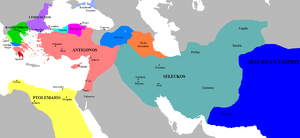 The most powerful dynasts of the empire, now kings in their own right, Cassander, Seleucus, Ptolemy and Lysimachus, responded to Antigonus's successes by allying each other, often through marriage. Antigonus soon found himself at war with all four, largely because his territory shared borders with each of them. Once he had Cassander in a bad position, having gained the support of the Greeks and defeating him repeatedly, he demanded from Cassander the unconditional submission of Macedonia. Seleucus, Lysimachus and Ptolemy responded by joining forces and attacking him. Lysimachus invaded Asia Minor from Thrace, crossing the Hellespont. He had soon secured most of the Ionian cities, and Seleucus was on his way marching through Mesopotamia and Cappadocia. Antigonus was obliged to recall Demetrius from Greece, where his son had recently had a sterile encounter with Cassander in Thessaly; the two men, and their army, then moved against Lysimachus.
However, the army of father and son was defeated by the united forces of Seleucus and Lysimachus at the decisive Battle of Ipsus
in 301 BC. Antigonus himself died in the battle after being struck by a javelin, in the eighty-first year of his life. Prior to Ipsus, he had never before lost a battle. With his death, any plans the court of Antigonus may have had of reuniting Alexander's empire came to an end. Antigonus's kingdom was divided up, with most ending up in the hands of new kingdoms under Lysimachus and Seleucus. The victors largely followed Antigonus's precedent and had themselves named as kings, but they did not claim power over the erstwhile empire of Alexander nor each other. Instead, these kings established a troubled (and in the end failed) modus vivendi
with each other, and accepted their kingdoms as separate realms.
Meanwhile, Antigonus's surviving son Demetrius took control of Macedon in 294 BC; Antigonus's descendants held this possession, off and on, until it was conquered by the Roman Republic
at the Battle of Pydna
in 168 BC.
, in Funeral Games, translates the sobriquet into English: "One Eye."
In the 2004 Oliver Stone
film Alexander, Antigonus is played by Ian Beattie.
Philip (son of Machatas)
Philip , son of Machatas, was an officer in the service of Alexander the Great, who was appointed by him in 327 BC satrap of India, including the provinces westward of the Hydaspes, as far south as the junction of the Indus with the Acesines...
from Elimeia
Elimiotis
Elimiotis or Elimeia or Elimaea was a region of Upper Macedonia that was located along the Haliacmon, north of Perrhaebia/Thessaly, west of Pieria, east of Parauaea, and south of Orestis. In earlier times, it was independent, but later was incorporated into the Argead kingdom of Macedon...
, was a Macedon
Macedon
Macedonia or Macedon was an ancient kingdom, centered in the northeastern part of the Greek peninsula, bordered by Epirus to the west, Paeonia to the north, the region of Thrace to the east and Thessaly to the south....
ian nobleman, general, and satrap
Satrap
Satrap was the name given to the governors of the provinces of the ancient Median and Achaemenid Empires and in several of their successors, such as the Sassanid Empire and the Hellenistic empires....
under Alexander the Great. During his early life he served under Philip II
Philip II of Macedon
Philip II of Macedon "friend" + ἵππος "horse" — transliterated ; 382 – 336 BC), was a king of Macedon from 359 BC until his assassination in 336 BC. He was the father of Alexander the Great and Philip III.-Biography:...
, and he was a major figure in the Wars of the Diadochi
Wars of the Diadochi
The Wars of the Diadochi were a series of conflicts fought between Alexander the Great's generals over the rule of his empire between 322 and 275 BC.-Background:...
after Alexander's death, declaring himself king in 306 BC and establishing the Antigonid dynasty
Antigonid dynasty
The Antigonid dynasty was a dynasty of Hellenistic kings descended from Alexander the Great's general Antigonus I Monophthalmus .-History:...
.
Career
Antigonus was appointed governor of Greater PhrygiaPhrygia
In antiquity, Phrygia was a kingdom in the west central part of Anatolia, in what is now modern-day Turkey. The Phrygians initially lived in the southern Balkans; according to Herodotus, under the name of Bryges , changing it to Phruges after their final migration to Anatolia, via the...
in 333 BC. He was primarily responsible for defending Alexander's lines of supply and communication during the latter's extended campaign against the Achaemenid Persian Empire. Following Alexander's victory at Issus
Battle of Issus
The Battle of Issus occurred in southern Anatolia, in November 333 BC. The invading troops, led by the young Alexander of Macedonia, defeated the army personally led by Darius III of Achaemenid Persia in the second great battle for primacy in Asia...
, the Persian mercenary commander Memnon of Rhodes
Memnon of Rhodes
Memnon of Rhodes was the commander of the Greek mercenaries working for the Persian king Darius III when Alexander the Great of Macedonia invaded Persia in 334 BC. He commanded the mercenaries at the Battle of the Granicus River, where his troops were massacred by the victorious Macedonians...
ordered a counter-attack into Asia Minor in an attempt to sever Alexander's lines of supply and communication; however, Antigonus defeated the Persian forces in three separate battles.
As part of the division of the provinces after Alexander's death in 323 BC, Antigonus also received Pamphylia
Pamphylia
In ancient geography, Pamphylia was the region in the south of Asia Minor, between Lycia and Cilicia, extending from the Mediterranean to Mount Taurus . It was bounded on the north by Pisidia and was therefore a country of small extent, having a coast-line of only about 75 miles with a breadth of...
and Lycia
Lycia
Lycia Lycian: Trm̃mis; ) was a region in Anatolia in what are now the provinces of Antalya and Muğla on the southern coast of Turkey. It was a federation of ancient cities in the region and later a province of the Roman Empire...
from Perdiccas
Perdiccas
Perdiccas was one of Alexander the Great's generals. After Alexander's death in 323 BC he became regent of all Alexander's empire.Arrian tells us he was son of Orontes, a descendant of the independent princes of the Macedonian province of Orestis...
, regent
Regent
A regent, from the Latin regens "one who reigns", is a person selected to act as head of state because the ruler is a minor, not present, or debilitated. Currently there are only two ruling Regencies in the world, sovereign Liechtenstein and the Malaysian constitutive state of Terengganu...
of the empire, at the Partition of Babylon
Partition of Babylon
The Partition of Babylon designates the attribution of the territories of Alexander the Great between his generals after his death in 323 BC.-Background:...
. He incurred the enmity of Perdiccas, the regent, by refusing to assist Eumenes
Eumenes
Eumenes of Cardia was a Thracian general and scholar. He participated in the wars of the Diadochi as a supporter of the Macedonian Argead royal house.-Career:...
to obtain possession of the provinces allotted to him, Paphlagonia
Paphlagonia
Paphlagonia was an ancient area on the Black Sea coast of north central Anatolia, situated between Bithynia to the west and Pontus to the east, and separated from Phrygia by a prolongation to the east of the Bithynian Olympus...
and Cappadocia
Cappadocia
Cappadocia is a historical region in Central Anatolia, largely in Nevşehir Province.In the time of Herodotus, the Cappadocians were reported as occupying the whole region from Mount Taurus to the vicinity of the Euxine...
. Leonnatos had left with his army for Greece, leaving Antigonus alone to deal with Cappadocia, a task he apparently couldn't complete without additional aid.
Perdiccas seems to have viewed this as a direct affront to his authority and went up with the royal army himself to conquer the area. From there Perdiccas turned west towards Phrygia in order to humble Antigonus, who escaped with his son Demetrius
Demetrius I of Macedon
Demetrius I , called Poliorcetes , son of Antigonus I Monophthalmus and Stratonice, was a king of Macedon...
to Greece, where he obtained the favour of Antipater, regent of Macedonia (321 BC), and Craterus
Craterus
Craterus was a Macedonian general under Alexander the Great and one of the Diadochi.He was the son of a Macedonian nobleman named Alexander from Orestis and brother of admiral Amphoterus. Craterus commanded the phalanx and all infantry on the left wing in Battle of Issus...
.
With the death of Perdiccas in 321 BC, a new attempt at division of the empire took place at Triparadisus and Antigonus found himself entrusted with the command of the war against Eumenes
Eumenes
Eumenes of Cardia was a Thracian general and scholar. He participated in the wars of the Diadochi as a supporter of the Macedonian Argead royal house.-Career:...
, who had joined Perdiccas against the coalition of Antipater
Antipater
Antipater was a Macedonian general and a supporter of kings Philip II of Macedon and Alexander the Great. In 320 BC, he became Regent of all of Alexander's Empire. Antipater was one of the sons of a Macedonian nobleman called Iollas or Iolaus and his family were distant collateral relatives to the...
, Antigonus, Ptolemy, Craterus, and the other generals. Eumenes was defeated and forced to retire to the fortress of Nora in Cappadocia
Cappadocia
Cappadocia is a historical region in Central Anatolia, largely in Nevşehir Province.In the time of Herodotus, the Cappadocians were reported as occupying the whole region from Mount Taurus to the vicinity of the Euxine...
, and a new army that was marching to his relief was routed by Antigonus.
When Antipater died in 319 BC, he gave the regentship to Polyperchon
Polyperchon
Polyperchon , son of Simmias from Tymphaia in Epirus, was a Macedonian general who served under Philip II and Alexander the Great, accompanying Alexander throughout his long journeys. After the return to Babylon, Polyperchon was sent back to Macedon with Craterus, but had only reached Cilicia by...
, excluding Cassander
Cassander
Cassander , King of Macedonia , was a son of Antipater, and founder of the Antipatrid dynasty...
, his son. Antigonus and the other dynasts refused to recognize Polyperchon, since it would undermine their own ambitions. He entered into negotiations with Eumenes, but Eumenes had already been swayed by Polyperchon, who also gave him authority over anyone within the empire. Effecting his escape from Nora, he raised an army and built a fleet in Cilicia and Phoenicia, and soon after formed a coalition with the satraps of the eastern provinces. Antigonus fought against Eumenes in two great battles at Paraitacene
Battle of Paraitacene
The Battle of Paraitacene was a battle in the wars of the successors of Alexander the Great between Antigonus I Monophthalmus and Eumenes. It was fought in 317 BC.-Background:...
in 317 BC and Gabiene
Battle of Gabiene
Battle of Gabiene was a second great battle between two of Alexander the Great's successors: Antigonus and Eumenes in the wars of the Diadochi.-Background:...
in 316 BC. Both were inconclusive, however. Yet in the aftermath of the second battle, Antigonus managed to capture the family and riches of the Silver Shields, an elite regiment within Eumenes' army, who in turn handed over Eumenes to Antigonus in return for their release. After some deliberation, Antigonus had Eumenes executed.
As a result, Antigonus now was in possession of the empire's Asian territories, his authority stretching from the eastern satrapies to Syria and Asia Minor in the west. He seized the treasures at Susa
Susa
Susa was an ancient city of the Elamite, Persian and Parthian empires of Iran. It is located in the lower Zagros Mountains about east of the Tigris River, between the Karkheh and Dez Rivers....
and entered Babylon
Babylon
Babylon was an Akkadian city-state of ancient Mesopotamia, the remains of which are found in present-day Al Hillah, Babil Province, Iraq, about 85 kilometers south of Baghdad...
. The governor of the city, Seleucus
Seleucus I Nicator
Seleucus I was a Macedonian officer of Alexander the Great and one of the Diadochi. In the Wars of the Diadochi that took place after Alexander's death, Seleucus established the Seleucid dynasty and the Seleucid Empire...
fled to Ptolemy and entered into a league with him, Lysimachus
Lysimachus
Lysimachus was a Macedonian officer and diadochus of Alexander the Great, who became a basileus in 306 BC, ruling Thrace, Asia Minor and Macedon.-Early Life & Career:...
and Cassander (315 BC) against Antigonus. In 314 BC Antigonus invaded Phoenicia, under Ptolemy's control, and besieged Tyre for more than a year. His son Demetrius was defeated at the Battle of Gaza
Battle of Gaza (312 BC)
The Battle of Gaza was a battle of the Third war of the Diadochi between Ptolemy and Demetrius .Ptolemy launched an invasion of Syria...
by Ptolemy in 312 BC, and after the battle, Seleucus made his way back to Babylonia
Babylonia
Babylonia was an ancient cultural region in central-southern Mesopotamia , with Babylon as its capital. Babylonia emerged as a major power when Hammurabi Babylonia was an ancient cultural region in central-southern Mesopotamia (present-day Iraq), with Babylon as its capital. Babylonia emerged as...
. Seleucus return to Babylon
Babylon
Babylon was an Akkadian city-state of ancient Mesopotamia, the remains of which are found in present-day Al Hillah, Babil Province, Iraq, about 85 kilometers south of Baghdad...
let him build up a base of his own, and he soon established control of the eastern satrapies. The Babylonian War
Babylonian War
The Babylonian War was a conflict fought between 311-309 BC between the Diadochi kings Antigonus Monophthalmus and Seleucus I Nicator, ending in a victory for the latter...
began between Antigonus and Seleucus, where Seleucus defeated both Demetrius and Antigonus, and secured Babylonia.
After the war had been carried on with varying success from 315 to 311, peace was concluded, by which the government of Asia Minor and Syria was provisionally secured to Antigonus. This agreement was soon violated on the pretext that garrisons had been placed in some of the free Greek cities by Antigonus, and Ptolemy and Cassander renewed hostilities against him. Demetrius Poliorcetes, the son of Antigonus, wrested part of Greece from Cassander. At first Ptolemy made a successful descent upon Asia Minor and on several of the islands of the Archipelago, but he was at length totally defeated by Demetrius at the naval
Naval battle
A naval battle is a battle fought using boats, ships or other waterborne vessels. Most naval battles have occurred at sea, but a few have taken place on lakes or rivers. The earliest recorded naval battle took place in 1210 BC near Cyprus...
Battle of Salamis
Battle of Salamis in Cyprus (306 BC)
The naval Battle of Salamis took place in 306 BC near Salamis, Cyprus between the fleets of Ptolemy I of Egypt and Demetrius, two of the diadochi, the successors to Alexander the Great...
.
Demetrius conquered Cyprus
Cyprus
Cyprus , officially the Republic of Cyprus , is a Eurasian island country, member of the European Union, in the Eastern Mediterranean, east of Greece, south of Turkey, west of Syria and north of Egypt. It is the third largest island in the Mediterranean Sea.The earliest known human activity on the...
in 306 BC. Following the victory Antigonus assumed the title king and bestowed the same upon his son, a declaration that he now was independent from the empire. The other dynasts, Cassander, Ptolemy, Lysimachus and Seleucus, soon followed. He now prepared a large army and a formidable fleet, the command of which he gave to Demetrius, and hastened to attack Ptolemy in his own dominions. His invasion of Egypt
Egypt
Egypt , officially the Arab Republic of Egypt, Arabic: , is a country mainly in North Africa, with the Sinai Peninsula forming a land bridge in Southwest Asia. Egypt is thus a transcontinental country, and a major power in Africa, the Mediterranean Basin, the Middle East and the Muslim world...
, however, proved a failure; he was unable to penetrate Ptolemy's defences and was obliged to retire, yet inflicting high losses on Ptolemy. Demetrius in 305 BC attempted the reduction of Rhodes
Rhodes
Rhodes is an island in Greece, located in the eastern Aegean Sea. It is the largest of the Dodecanese islands in terms of both land area and population, with a population of 117,007, and also the island group's historical capital. Administratively the island forms a separate municipality within...
, which had refused to assist Antigonus against Egypt. The siege of Rhodes
Siege of Rhodes
The Siege of Rhodes was one of the most notable sieges of Antiquity, when Demetrius Poliorcetes, son of Antigonus I, besieged Rhodes in an attempt to break its alliance with Ptolemaic Egypt.- Background :...
lasted a year and ended in 304 BC when Demetrius meeting with obstinate resistance, he was obliged to make a peace treaty upon the terms that the Rhodians would build ships for Antigonus and aid him against any enemy except for Ptolemy, on whom they bestowed the title Soter (savior) for his aid during the lengthy siege.
The dynasts unite against Antigonus
However, the army of father and son was defeated by the united forces of Seleucus and Lysimachus at the decisive Battle of Ipsus
Battle of Ipsus
The Battle of Ipsus was fought between some of the Diadochi in 301 BC near the village of that name in Phrygia...
in 301 BC. Antigonus himself died in the battle after being struck by a javelin, in the eighty-first year of his life. Prior to Ipsus, he had never before lost a battle. With his death, any plans the court of Antigonus may have had of reuniting Alexander's empire came to an end. Antigonus's kingdom was divided up, with most ending up in the hands of new kingdoms under Lysimachus and Seleucus. The victors largely followed Antigonus's precedent and had themselves named as kings, but they did not claim power over the erstwhile empire of Alexander nor each other. Instead, these kings established a troubled (and in the end failed) modus vivendi
Modus vivendi
Modus vivendi is a Latin phrase signifying an agreement between those whose opinions differ, such that they agree to disagree.Modus means mode, way. Vivendi means of living. Together, way of living, implies an accommodation between disputing parties to allow life to go on. It usually describes...
with each other, and accepted their kingdoms as separate realms.
Meanwhile, Antigonus's surviving son Demetrius took control of Macedon in 294 BC; Antigonus's descendants held this possession, off and on, until it was conquered by the Roman Republic
Roman Republic
The Roman Republic was the period of the ancient Roman civilization where the government operated as a republic. It began with the overthrow of the Roman monarchy, traditionally dated around 508 BC, and its replacement by a government headed by two consuls, elected annually by the citizens and...
at the Battle of Pydna
Battle of Pydna
The Battle of Pydna in 168 BC between Rome and the Macedonian Antigonid dynasty saw the further ascendancy of Rome in the Hellenic/Hellenistic world and the end of the Antigonid line of kings, whose power traced back to Alexander the Great.Paul K...
in 168 BC.
Monophthalmus in historical fiction
Mary RenaultMary Renault
Mary Renault born Eileen Mary Challans, was an English writer best known for her historical novels set in Ancient Greece...
, in Funeral Games, translates the sobriquet into English: "One Eye."
In the 2004 Oliver Stone
Oliver Stone
William Oliver Stone is an American film director, producer and screenwriter. Stone became well known in the late 1980s and the early 1990s for directing a series of films about the Vietnam War, for which he had previously participated as an infantry soldier. His work frequently focuses on...
film Alexander, Antigonus is played by Ian Beattie.
External links
- A genealogical tree of Antigonus
- Antigonus I Monophthalmus entry in historical sourcebook by Mahlon H. Smith