


Kabul River

Encyclopedia
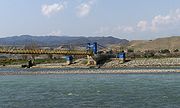
Kabul River the classical Cophes (icon), is a 700 km long river that starts in the Sanglakh Range
Sanglakh Range
The Sanglakh Range is an offshoot of the Hindukush, just west of Kabul. Its main peak is the Unai; Both the Helmand River and the Kabul River rise in the Sanglakh Range, separated by the Unai Pass....
of the Hindu Kush
Hindu Kush
The Hindu Kush is an mountain range that stretches between central Afghanistan and northern Pakistan. The highest point in the Hindu Kush is Tirich Mir in the Chitral region of Khyber-Pakhtunkhwa, Pakistan.It is the westernmost extension of the Pamir Mountains, the Karakoram Range, and is a...
Mountains in Afghanistan
Afghanistan
Afghanistan , officially the Islamic Republic of Afghanistan, is a landlocked country located in the centre of Asia, forming South Asia, Central Asia and the Middle East. With a population of about 29 million, it has an area of , making it the 42nd most populous and 41st largest nation in the world...
and ends in the Indus River
Indus River
The Indus River is a major river which flows through Pakistan. It also has courses through China and India.Originating in the Tibetan plateau of western China in the vicinity of Lake Mansarovar in Tibet Autonomous Region, the river runs a course through the Ladakh district of Jammu and Kashmir and...
near Attock
Attock
Attock is a city located in the northern border of the Punjab province of Pakistan and the headquarters of Attock District...
, Pakistan
Pakistan
Pakistan , officially the Islamic Republic of Pakistan is a sovereign state in South Asia. It has a coastline along the Arabian Sea and the Gulf of Oman in the south and is bordered by Afghanistan and Iran in the west, India in the east and China in the far northeast. In the north, Tajikistan...
. It is the main river in eastern Afghanistan and is separated from the watershed of the Helmand
Helmand River
The Helmand River is the longest river in Afghanistan and the primarily watershed for the endorheic Sistan Basin....
by the Unai Pass
Unai Pass
Unai Pass traverses the Sanglakh Range, an offshoot of the Hindukush, west of Kabul. It is the main road connection of Kabul with Hazarajat....
. It passes through the cities of Kabul
Kabul
Kabul , spelt Caubul in some classic literatures, is the capital and largest city of Afghanistan. It is also the capital of the Kabul Province, located in the eastern section of Afghanistan...
, Chaharbagh
Chaharbagh
Chaharbagh , also Romanized as Chahār Dāngeh) is a city in and the capital of Chaharbagh District, in Savojbolagh County, Alborz Province, Iran. At the 2006 census, its population was 5,577, in 1,448 families....
and Jalalabad
Jalalabad
Jalalabad , formerly called Adinapour, as documented by the 7th century Hsüan-tsang, is a city in eastern Afghanistan. Located at the junction of the Kabul River and Kunar River near the Laghman valley, Jalalabad is the capital of Nangarhar province. It is linked by approximately of highway with...
in Afghanistan before flowing into Pakistan some 25 km north of the Pak-Afghan Border crossing at Torkham
Torkham
Torkham is a border crossing town in the Nangarhar province of Afghanistan and the Khyber Agency of Pakistan's Federally Administered Tribal Areas, right on the Durand Line border....
. The major tributaries of the Kabul River are the Logar
Logar River
Logar River is a river of Afghanistan. It gives the name to the Logar Valley and Logar Province.The Logar River drains a wide tract of country, rising in the southern slopes of the Sanglakh Range and receiving tributaries from the Kharwar hills, north-east of Ghazni. It joins the Kabul River a...
, Panjshir
Panjshir River
The Panjshir River flows through the Panjshir Valley in northeastern Afghanistan, 150km north of Kabul. It flows southward through the Hindu Kush and adjoins the Kabul River near Sarobi. At this junction, a dam was built in the 1950s to supply water from the Panjshir River to the Kabul River....
, Kunar
Kunar River
The Kunar River is about 480 km long, located in eastern Afghanistan and north-western Pakistan. The Kunar river system is fed from melting glaciers and snow of the Hindu Kush mountains....
, Alingar
Alingar River
The Alingar River is a river in eastern Afghanistan. It is one of the major tributaries of the Kabul River. It gives its name to Alingar District in Laghman Province and also passes through Mihtarlam in Mihtarlam District....
and Bara
Bara River
Bara River is river in Federally Administered Tribal Areas, Pakistan. The Bara River enters the Peshawar of south Jamrud Fort and flows in the North-easterly direction to the Nowshera District, eventually joining the Kabul River near camp korona, Akbarpura. Due to its higher elevation, very...
rivers.
The Kabul River is little more than a trickle for most of the year, but swells in summer due to melting snows in the Hindu Kush
Hindu Kush
The Hindu Kush is an mountain range that stretches between central Afghanistan and northern Pakistan. The highest point in the Hindu Kush is Tirich Mir in the Chitral region of Khyber-Pakhtunkhwa, Pakistan.It is the westernmost extension of the Pamir Mountains, the Karakoram Range, and is a...
Range. Its largest tributary is the Kunar River, which starts out as the Mastuj River, flowing from the Chiantar glacier in Chitral
Chitral District
Chitral is a district in the Khyber-Pakhtunkhwa province of Pakistan that contains the town of Chitral. It has an area of 14,850 km² and a population of 318,689 at the 1998 Census, which had subsequently risen to about 378,000 people by 2004. It has one of the highest mountains of the world,...
, Pakistan and after flowing south into Afghanistan it is met by the Bashgal river flowing from Nurestan
Nurestan Province
Nuristān , also spelled Nurestān or Nooristan, is a region in Afghanistan embedded in the south of the Hindu Kush valleys. Its administrative center is Parun...
. The Kunar meets the Kabul near Jalalabad. In spite of the Kunar carrying more water than the Kabul, the river continues as the Kabul River after this confluence, mainly for the political and historical significance of the name.
The Kabul River is impounded by Warsak Dam
Warsak Dam
Warsak Dam is a mass concrete gravity dam located on the Kabul River approximately 20 km northwest of the city of Peshawar in Khyber Pakhtunkhwa province of Pakistan.- History :...
in Pakistan, which is situated approximately 20 km northwest of the city of Peshawar
Peshawar
Peshawar is the capital of Khyber-Pakhtunkhwa and the administrative center and central economic hub for the Federally Administered Tribal Areas of Pakistan....
.
Expedition of Alexander the Great into Asia
In Arrian's "History of Expedition of Alexander the Great & conquest of Persia" Translated by Mr. Rooke, The River Kabul is referred to as Cophen.In Sanskrit & Avesta
The word Kubhā which is the ancient name of the river is both a Sanskrit and Avestan word. Alexander Cunningham derived it from the Scythian ku ("water"). Many of the rivers of Pakistan and Afghanistan are mentioned in the Rig Veda. The Sanskrit word later changed to Kābul.Al Biruni
Biruni also called it "the River of Ghorwand".The Kabul River later gave its name to the region and eventually to the settlement of Kabul
Kabul
Kabul , spelt Caubul in some classic literatures, is the capital and largest city of Afghanistan. It is also the capital of the Kabul Province, located in the eastern section of Afghanistan...
.