

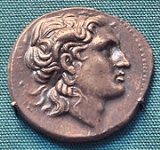
Lysimachus

Encyclopedia
Lysimachus was a Macedonian officer and diadochus
(i.e. "successor") of Alexander the Great, who became a basileus
("King") in 306 BC, ruling Thrace
, Asia Minor
and Macedon
.
nobleman who was a Macedonian
Thessalian
. He was born in 362/361 BC, as the second son of Agathocles
and his wife, perhaps named Arsinoe and his paternal grandfather may have been called Alcimachus. His father was a nobleman of high rank who was an intimate friend of Philip II of Macedon
, who shared in Philip II’s councils and became a favorite in the Argead court
. Lysimachus with his brothers grew up with the status of Macedonians; he with his brothers enjoyed prominent positions in Alexander’s circle and Lysimachus with his brothers were educated at the court at Pella
.
He was probably appointed Somatophylax
during the reign of Philip II. During Alexander's Persian
campaigns, he was one of his immediate bodyguards. In 324 BC
, in Susa, he was crowned in recognition for his actions in India. After Alexander’s death in 323 BC, he was appointed to the government of Thrace as strategos
.
, Ptolemy I Soter
and Seleucus I Nicator
against Antigonus I Monophthalmus
, who, however, diverted his attention by stirring up Thracian and Scythia
n tribes against him. In 309 BC, he founded Lysimachia
in a commanding situation on the neck connecting the Chersonese with the mainland. He followed the example of Antigonus I in taking the title of king.
In 306/305 BC, he assumed the title of "King", which he held until his death at Corupedium in 282/1 BC.
In 302 BC, when the second affiance between Cassander, Ptolemy I and Seleucus I was made, Lysimachus, reinforced by troops from Cassander, entered Asia Minor, where he met with little resistance. On the approach of Antigonus I he retired into winter quarters near Heraclea
, marrying its widowed queen Amastris
, a Persian princess. Seleucus I joined him in 301 BC, and at the battle of Ipsus
Antigonus I was defeated and slain. His dominions were divided among the victors. Lysimachus' share was Lydia
, Ionia
, Phrygia
and the north coast of Asia Minor.
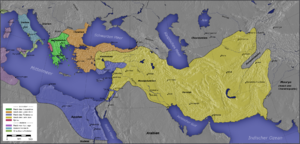 Feeling that Seleucus I was becoming dangerously great, Lysimachus now allied himself with Ptolemy I, marrying his daughter Arsinoe II of Egypt. Amastris, who had divorced herself from him, returned to Heraclea. When Antigonus I’s son Demetrius I renewed hostilities (297 BC), during his absence in Greece
, Lysimachus seized his towns in Asia Minor, but in 294 BC concluded a peace whereby Demetrius I was recognized as ruler of Macedonia. He tried to carry his power beyond the Danube
, but was defeated and taken prisoner by the Getae
king Dromichaetes
(Dromihete), who, however, set him free on amicable terms. Demetrius I subsequently threatened Thrace, but had to retire due to a sudden uprising in Boeotia
, and an attack from the King Pyrrhus of Epirus
.
In 288 BC, Lysimachus and Pyrrhus of Epirus in turn invaded Macedonia, and drove Demetrius I out of the country. Lysimachus left Pyrrhus of Epirus in possession of Macedonia with the title of king for around seven months before Lysimachus invaded. For a short while the two ruled jointly but in 285 BC Lysimachus expelled Pyrrhus.
, intrigued against him with the help of Arsinoe II’s paternal half-brother Ptolemy Keraunos
; they accused him of conspiring with Seleucus I to seize the throne, and he was put to death.
This atrocious deed of Lysimachus aroused great indignation. Many of the cities of Asia Minor revolted, and his most trusted friends deserted him. The widow of Agathocles and their children fled to Seleucus I, who at once invaded the territory of Lysimachus in Asia. In 281 BC, Lysimachus crossed the Hellespont
into Lydia
and at the decisive Battle of Corupedium
was killed. After some days his body was found on the field, protected from birds of prey by his faithful dog. Lysimachus' body was given over to another son Alexander, by whom it was interred at Lysimachia
.
Nicaea most probably died by 302 BC.
From an Odrysian concubine
he had a son borne to him called Alexander.
Diadochi
The Diadochi were the rival generals, family and friends of Alexander the Great who fought for the control of Alexander's empire after his death in 323 BC...
(i.e. "successor") of Alexander the Great, who became a basileus
Basileus
Basileus is a Greek term and title that has signified various types of monarchs in history. It is perhaps best known in English as a title used by the Byzantine Emperors, but also has a longer history of use for persons of authority and sovereigns in ancient Greece, as well as for the kings of...
("King") in 306 BC, ruling Thrace
Thrace
Thrace is a historical and geographic area in southeast Europe. As a geographical concept, Thrace designates a region bounded by the Balkan Mountains on the north, Rhodope Mountains and the Aegean Sea on the south, and by the Black Sea and the Sea of Marmara on the east...
, Asia Minor
Anatolia
Anatolia is a geographic and historical term denoting the westernmost protrusion of Asia, comprising the majority of the Republic of Turkey...
and Macedon
Macedonia (Greece)
Macedonia is a geographical and historical region of Greece in Southern Europe. Macedonia is the largest and second most populous Greek region...
.
Early Life & Career
Lysimachus was a GreekGreeks
The Greeks, also known as the Hellenes , are a nation and ethnic group native to Greece, Cyprus and neighboring regions. They also form a significant diaspora, with Greek communities established around the world....
nobleman who was a Macedonian
Macedonia (Greece)
Macedonia is a geographical and historical region of Greece in Southern Europe. Macedonia is the largest and second most populous Greek region...
Thessalian
Thessaly
Thessaly is a traditional geographical region and an administrative region of Greece, comprising most of the ancient region of the same name. Before the Greek Dark Ages, Thessaly was known as Aeolia, and appears thus in Homer's Odyssey....
. He was born in 362/361 BC, as the second son of Agathocles
Agathocles of Pella
Agathocles was a Greek nobleman who was a contemporary to King Philip II of Macedon who reigned 359 BC-336 BC.Agathocles was a Thessalian Serf from Crannon. His father’s name may have been Alcimachus. It was through his flattery, that Agathocles became an intimate friend of Philip II.Philip II...
and his wife, perhaps named Arsinoe and his paternal grandfather may have been called Alcimachus. His father was a nobleman of high rank who was an intimate friend of Philip II of Macedon
Philip II of Macedon
Philip II of Macedon "friend" + ἵππος "horse" — transliterated ; 382 – 336 BC), was a king of Macedon from 359 BC until his assassination in 336 BC. He was the father of Alexander the Great and Philip III.-Biography:...
, who shared in Philip II’s councils and became a favorite in the Argead court
Argead dynasty
The Argead dynasty was an ancient Greek royal house. They were the ruling dynasty of Macedonia from about 700 to 310 BC. Their tradition, as described in ancient Greek historiography, traced their origins to Argos, in southern Greece...
. Lysimachus with his brothers grew up with the status of Macedonians; he with his brothers enjoyed prominent positions in Alexander’s circle and Lysimachus with his brothers were educated at the court at Pella
Pella
Pella , an ancient Greek city located in Pella Prefecture of Macedonia in Greece, was the capital of the ancient kingdom of Macedonia.-Etymology:...
.
He was probably appointed Somatophylax
Somatophylakes
Somatophylakes , in its literal English translation from Greek, means "bodyguards".The most famous body of somatophylakes were those of Philip of Macedon and Alexander the Great. They consisted of seven men, drawn from the Macedonian nobility, who also acted as high-ranking military officers,...
during the reign of Philip II. During Alexander's Persian
Achaemenid Empire
The Achaemenid Empire , sometimes known as First Persian Empire and/or Persian Empire, was founded in the 6th century BCE by Cyrus the Great who overthrew the Median confederation...
campaigns, he was one of his immediate bodyguards. In 324 BC
324 BC
Year 324 BC was a year of the pre-Julian Roman calendar. At the time, it was known as the Year of the Dictatorship of Cursor...
, in Susa, he was crowned in recognition for his actions in India. After Alexander’s death in 323 BC, he was appointed to the government of Thrace as strategos
Strategos
Strategos, plural strategoi, is used in Greek to mean "general". In the Hellenistic and Byzantine Empires the term was also used to describe a military governor...
.
Diadochi
In 315 BC, he joined CassanderCassander
Cassander , King of Macedonia , was a son of Antipater, and founder of the Antipatrid dynasty...
, Ptolemy I Soter
Ptolemy I Soter
Ptolemy I Soter I , also known as Ptolemy Lagides, c. 367 BC – c. 283 BC, was a Macedonian general under Alexander the Great, who became ruler of Egypt and founder of both the Ptolemaic Kingdom and the Ptolemaic Dynasty...
and Seleucus I Nicator
Seleucus I Nicator
Seleucus I was a Macedonian officer of Alexander the Great and one of the Diadochi. In the Wars of the Diadochi that took place after Alexander's death, Seleucus established the Seleucid dynasty and the Seleucid Empire...
against Antigonus I Monophthalmus
Antigonus I Monophthalmus
Antigonus I Monophthalmus , son of Philip from Elimeia, was a Macedonian nobleman, general, and satrap under Alexander the Great. During his early life he served under Philip II, and he was a major figure in the Wars of the Diadochi after Alexander's death, declaring himself king in 306 BC and...
, who, however, diverted his attention by stirring up Thracian and Scythia
Scythia
In antiquity, Scythian or Scyths were terms used by the Greeks to refer to certain Iranian groups of horse-riding nomadic pastoralists who dwelt on the Pontic-Caspian steppe...
n tribes against him. In 309 BC, he founded Lysimachia
Lysimachia (Thrace)
Lysimachia was an important Hellenistic Greek town on the north-western extremity of the Thracian Chersonese in what is now the European part of Turkey, not far from the bay of Melas .- History :...
in a commanding situation on the neck connecting the Chersonese with the mainland. He followed the example of Antigonus I in taking the title of king.
In 306/305 BC, he assumed the title of "King", which he held until his death at Corupedium in 282/1 BC.
In 302 BC, when the second affiance between Cassander, Ptolemy I and Seleucus I was made, Lysimachus, reinforced by troops from Cassander, entered Asia Minor, where he met with little resistance. On the approach of Antigonus I he retired into winter quarters near Heraclea
Heraclea Pontica
Heraclea Pontica , an ancient city on the coast of Bithynia in Asia Minor, at the mouth of the river Lycus. It was founded by the Greek city-state of Megara c.560-558 and was named after Heracles who the Greeks believed entered the underworld at a cave on the adjoining Archerusian promontory .The...
, marrying its widowed queen Amastris
Amastris
Amastris also called Amastrine, was a Persian Princess. She was the daughter of Oxyathres, the brother of the Persian King Darius III.-Marriages:...
, a Persian princess. Seleucus I joined him in 301 BC, and at the battle of Ipsus
Battle of Ipsus
The Battle of Ipsus was fought between some of the Diadochi in 301 BC near the village of that name in Phrygia...
Antigonus I was defeated and slain. His dominions were divided among the victors. Lysimachus' share was Lydia
Lydia
Lydia was an Iron Age kingdom of western Asia Minor located generally east of ancient Ionia in the modern Turkish provinces of Manisa and inland İzmir. Its population spoke an Anatolian language known as Lydian....
, Ionia
Ionia
Ionia is an ancient region of central coastal Anatolia in present-day Turkey, the region nearest İzmir, which was historically Smyrna. It consisted of the northernmost territories of the Ionian League of Greek settlements...
, Phrygia
Phrygia
In antiquity, Phrygia was a kingdom in the west central part of Anatolia, in what is now modern-day Turkey. The Phrygians initially lived in the southern Balkans; according to Herodotus, under the name of Bryges , changing it to Phruges after their final migration to Anatolia, via the...
and the north coast of Asia Minor.
Greece
Greece , officially the Hellenic Republic , and historically Hellas or the Republic of Greece in English, is a country in southeastern Europe....
, Lysimachus seized his towns in Asia Minor, but in 294 BC concluded a peace whereby Demetrius I was recognized as ruler of Macedonia. He tried to carry his power beyond the Danube
Danube
The Danube is a river in the Central Europe and the Europe's second longest river after the Volga. It is classified as an international waterway....
, but was defeated and taken prisoner by the Getae
Getae
The Getae was the name given by the Greeks to several Thracian tribes that occupied the regions south of the Lower Danube, in what is today northern Bulgaria, and north of the Lower Danube, in Romania...
king Dromichaetes
Dromichaetes
Dromichaetes was king of the Getae on both sides of the lower Danube around 300 BC.- Background :The Getae had been federated in the Odrysian kingdom in the 5th century BC. It is not known how the relations between Getae and Odrysians developed...
(Dromihete), who, however, set him free on amicable terms. Demetrius I subsequently threatened Thrace, but had to retire due to a sudden uprising in Boeotia
Boeotia
Boeotia, also spelled Beotia and Bœotia , is one of the regional units of Greece. It is part of the region of Central Greece. It was also a region of ancient Greece. Its capital is Livadeia, the second largest city being Thebes.-Geography:...
, and an attack from the King Pyrrhus of Epirus
Pyrrhus of Epirus
Pyrrhus or Pyrrhos was a Greek general and statesman of the Hellenistic era. He was king of the Greek tribe of Molossians, of the royal Aeacid house , and later he became king of Epirus and Macedon . He was one of the strongest opponents of early Rome...
.
In 288 BC, Lysimachus and Pyrrhus of Epirus in turn invaded Macedonia, and drove Demetrius I out of the country. Lysimachus left Pyrrhus of Epirus in possession of Macedonia with the title of king for around seven months before Lysimachus invaded. For a short while the two ruled jointly but in 285 BC Lysimachus expelled Pyrrhus.
Later Years
Domestic troubles embittered the last years of Lysimachus’ life. Amastris had been murdered by her two sons; Lysimachus treacherously put them to death. On his return, Arsinoe II asked the gift of Heraclea, and he granted her request, though he had promised to free the city. In 284 BC Arsinoe II, desirous of gaining the succession for her sons in preference to Lysimachus’ first child, AgathoclesAgathocles (son of Lysimachus)
Agathocles was a Greek Prince who was of Macedonian and Thessalian descent. He was the son born to the diadochus Lysimachus from his first wife the Queen consort, Nicaea a daughter of the powerful regent Antipater...
, intrigued against him with the help of Arsinoe II’s paternal half-brother Ptolemy Keraunos
Ptolemy Keraunos
Ptolemy Keraunos was the King of Macedon from 281 BC to 279 BC. His epithet Keraunos is Greek for "Thunder" or "Thunderbolt".He was the eldest son of Ptolemy I Soter, ruler of Egypt, and his third wife Eurydice, daughter of the regent Antipater. His younger half-brother, also called Ptolemy,...
; they accused him of conspiring with Seleucus I to seize the throne, and he was put to death.
This atrocious deed of Lysimachus aroused great indignation. Many of the cities of Asia Minor revolted, and his most trusted friends deserted him. The widow of Agathocles and their children fled to Seleucus I, who at once invaded the territory of Lysimachus in Asia. In 281 BC, Lysimachus crossed the Hellespont
Dardanelles
The Dardanelles , formerly known as the Hellespont, is a narrow strait in northwestern Turkey connecting the Aegean Sea to the Sea of Marmara. It is one of the Turkish Straits, along with its counterpart the Bosphorus. It is located at approximately...
into Lydia
Lydia
Lydia was an Iron Age kingdom of western Asia Minor located generally east of ancient Ionia in the modern Turkish provinces of Manisa and inland İzmir. Its population spoke an Anatolian language known as Lydian....
and at the decisive Battle of Corupedium
Battle of Corupedium
The Battle of Corupedium, also called Corupedion or Curupedion is the name of the last battle of the Diadochi, the rival successors to Alexander the Great. It was fought in 281 BC between the armies of Lysimachus and Seleucus I Nicator. Lysimachus had ruled Thrace for decades and parts of modern...
was killed. After some days his body was found on the field, protected from birds of prey by his faithful dog. Lysimachus' body was given over to another son Alexander, by whom it was interred at Lysimachia
Lysimachia (Thrace)
Lysimachia was an important Hellenistic Greek town on the north-western extremity of the Thracian Chersonese in what is now the European part of Turkey, not far from the bay of Melas .- History :...
.
Marriages & Children
Lysimachus was married three times and his wives were:- First marriage: Nicaea a Greek Macedonian noblewoman and daughter of the powerful RegentRegentA regent, from the Latin regens "one who reigns", is a person selected to act as head of state because the ruler is a minor, not present, or debilitated. Currently there are only two ruling Regencies in the world, sovereign Liechtenstein and the Malaysian constitutive state of Terengganu...
AntipaterAntipaterAntipater was a Macedonian general and a supporter of kings Philip II of Macedon and Alexander the Great. In 320 BC, he became Regent of all of Alexander's Empire. Antipater was one of the sons of a Macedonian nobleman called Iollas or Iolaus and his family were distant collateral relatives to the...
. Lysimachus and Nicaea married in c.321 BC. Nicaea bore Lysimachus three children:- Son, AgathoclesAgathocles (son of Lysimachus)Agathocles was a Greek Prince who was of Macedonian and Thessalian descent. He was the son born to the diadochus Lysimachus from his first wife the Queen consort, Nicaea a daughter of the powerful regent Antipater...
- Daughter, EurydiceEurydice (wife of Antipater II of Macedon)Eurydice was a Greek Princess who was of Macedonian and Thessalian descent.She was the first daughter and second child born to the diadochus who was King of Thrace, Asia Minor and Macedonia, Lysimachus from his first wife the Queen consort, Nicaea of Macedon. Eurydice had one older brother called...
- Daughter, Arsinoe I
- Son, Agathocles
Nicaea most probably died by 302 BC.
- Second marriage: Persian Princess AmastrisAmastrisAmastris also called Amastrine, was a Persian Princess. She was the daughter of Oxyathres, the brother of the Persian King Darius III.-Marriages:...
. Lysimachus married her in 302 BC. Amastris and Lysimachus’ union was brief, as he ended their marriage and divorced her in 300/299 BC. Amastris had two sons from a previous marriage. During their brief marriage, Amastris may have borne Lysimachus a child, perhaps a daughter who may have been the first wife of Ptolemy KeraunosPtolemy KeraunosPtolemy Keraunos was the King of Macedon from 281 BC to 279 BC. His epithet Keraunos is Greek for "Thunder" or "Thunderbolt".He was the eldest son of Ptolemy I Soter, ruler of Egypt, and his third wife Eurydice, daughter of the regent Antipater. His younger half-brother, also called Ptolemy,...
. - Third marriage: Ptolemaic Greek PrincessPtolemaic dynastyThe Ptolemaic dynasty, was a Macedonian Greek royal family which ruled the Ptolemaic Empire in Egypt during the Hellenistic period. Their rule lasted for 275 years, from 305 BC to 30 BC...
Arsinoe II. Arsinoe II married Lysimachus in 300/299 BC and remained with him until his death in 281 BC. Arsinoe II bore Lysimachus three sons:- Ptolemy I Epigone
- Lysimachus
- Philip
From an Odrysian concubine
Odrysian kingdom
The Odrysian kingdom was a union of Thracian tribes that endured between the 5th and 3rd centuries BC. It consisted largely of present-day Bulgaria, spreading to parts of Northern Dobruja, parts of Northern Greece and modern-day European Turkey...
he had a son borne to him called Alexander.
Sources
- ArrianArrianLucius Flavius Arrianus 'Xenophon , known in English as Arrian , and Arrian of Nicomedia, was a Roman historian, public servant, a military commander and a philosopher of the 2nd-century Roman period...
, Anabasis v. 13, vi. 28 - Justin xv. 3, 4, xvii. I
- Quintus Curtius RufusQuintus Curtius RufusQuintus Curtius Rufus was a Roman historian, writing probably during the reign of the Emperor Claudius or Vespasian. His only surviving work, Historiae Alexandri Magni, is a biography of Alexander the Great in Latin in ten books, of which the first two are lost, and the remaining eight are...
V. 3, x. 30 - Diodorus SiculusDiodorus SiculusDiodorus Siculus was a Greek historian who flourished between 60 and 30 BC. According to Diodorus' own work, he was born at Agyrium in Sicily . With one exception, antiquity affords no further information about Diodorus' life and doings beyond what is to be found in his own work, Bibliotheca...
xviii. 3 - PolybiusPolybiusPolybius , Greek ) was a Greek historian of the Hellenistic Period noted for his work, The Histories, which covered the period of 220–146 BC in detail. The work describes in part the rise of the Roman Republic and its gradual domination over Greece...
v. 67 - PlutarchPlutarchPlutarch then named, on his becoming a Roman citizen, Lucius Mestrius Plutarchus , c. 46 – 120 AD, was a Greek historian, biographer, essayist, and Middle Platonist known primarily for his Parallel Lives and Moralia...
, Demetrius, 31. 52, Pyrrhus, 12 - AppianAppianAppian of Alexandria was a Roman historian of Greek ethnicity who flourished during the reigns of Trajan, Hadrian, and Antoninus Pius.He was born ca. 95 in Alexandria. He tells us that, after having filled the chief offices in the province of Egypt, he went to Rome ca. 120, where he practised as...
, Syriaca, 62 - Connop ThirlwallConnop ThirlwallConnop Thirlwall was an English bishop and historian.-Early life:Thirlwall was born at Stepney, London, of a Northumbrian family. He was a prodigy, learning Latin at three, Greek at four, and writing sermons at seven.He went to Charterhouse School, where George Grote and Julius Hare were among...
, History of Greece, vol. viii. (1847) - John Pentland MahaffyJohn Pentland MahaffyThe Rev. John Pentland Mahaffy GBE CVO was an Irish classicist and polymathic scholar.-Education and interests:...
, Story of Alexander’s Empire - Johann Gustav DroysenJohann Gustav DroysenJohann Gustav Droysen was a German historian. His history of Alexander the Great was the first work representing a new school of German historical thought that idealized power held by so-called "great" men...
, Hellenismus (2nd ed., 1877) - Adolf Holm, Griechische Geschichte, vol. iv. (1894)
- Benedikt NieseBenedikt NieseJürgen Anton Benedikt Niese , also known as Benedict, Benediktus or Benedictus Niese, was a German classical scholar....
, Geschichte der griechischen und makedonischen Staaten, vols. i. and ii. (1893, 1899) - Karl Julius BelochKarl Julius BelochKarl Julius Beloch was a German classical and economic historian.In 1870 he moved to Italy for health reasons, where he subsequently studied in Palermo and Rome. In 1875 he received his doctorate from the University of Heidelberg...
, Griechische Geschichte vol. iii. (1904) - Hunerwadel, Forschungen zur Gesch. des Könige Lysimachus (1900)
- Possenti, Il Re Lisimaco di Tracia (1901)
- Ghione, "Note sul regno di Lisimaco" (Atti d. real. Accad. di Torino, xxxix.)
- H. Bengtson, Griechische Geschichte von den Anfängen bis in die römische Kaiserzeit, C.H.Beck, 1977
- R.A. Billows, Kings and colonists: aspects of Macedonian imperialism, BRILL, 1995
- H.S. Lund, Lysimachus: A Study in Early Hellenistic Kingship, Routledge, 2002
- W. Heckel, Who’s who in the age of Alexander the Great: prosopography of Alexander’s empire, Wiley-Blackwell, 2006
- Lysimachus’ article at Livius.org
- Ptolemaic Genealogy: Ptolemy Ceraunus
- Ptolemaic Genealogy: Unknown wife of Ptolemy Ceraunus
- Ptolemaic Genealogy: Ptolemy ‘the Son’
External links
- Lysimachus
- Lysimachus' Dog & Nisaean Horses - Informative but non-scholarly essay on Lysimachus (Annotated with Sources)