

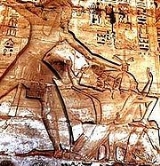
Tjeker

Encyclopedia
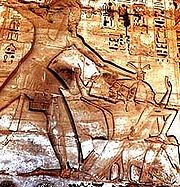
Sea Peoples
The Sea Peoples were a confederacy of seafaring raiders of the second millennium BC who sailed into the eastern Mediterranean, caused political unrest, and attempted to enter or control Egyptian territory during the late 19th dynasty and especially during year 8 of Ramesses III of the 20th Dynasty...
and are known mainly from the Story of Wenamun
Story of Wenamun
The Story of Wenamun is a literary text written in hieratic in the Late Egyptian language...
. The name tkr/skl has been transliterated variously as Tjekru, Tjekker, skl, Sikil, Djekker, etc. and they are thought to be the people who developed the port of Dor
Dor
Tel Dor , is an archeological site located on Israel's Mediterranean coast, about 30 km south of Haifa. Lying on a small headland at the north side of a protected inlet, it is identified with D-jr of Egyptian sources, Biblical Dor, and with Dor/Dora of Greek and Roman sources...
during the 12th century BCE from a small Bronze Age town to a large city. They are also documented at Medinet Habu
Medinet Habu
Medinet Habu is an important Egyptian archaeological and tourist locality on the West Bank of the modern city of Luxor.Somewhat ambiguously, the toponym Medinet Habu can refer to either:...
as raiders defeated by Pharaoh
Pharaoh
Pharaoh is a title used in many modern discussions of the ancient Egyptian rulers of all periods. The title originates in the term "pr-aa" which means "great house" and describes the royal palace...
Ramesses III
Ramesses III
Usimare Ramesses III was the second Pharaoh of the Twentieth Dynasty and is considered to be the last great New Kingdom king to wield any substantial authority over Egypt. He was the son of Setnakhte and Queen Tiy-Merenese. Ramesses III is believed to have reigned from March 1186 to April 1155 BCE...
of Egypt
Ancient Egypt
Ancient Egypt was an ancient civilization of Northeastern Africa, concentrated along the lower reaches of the Nile River in what is now the modern country of Egypt. Egyptian civilization coalesced around 3150 BC with the political unification of Upper and Lower Egypt under the first pharaoh...
in years 5, 8 and 12 of his reign.
Origin
The origins of Tjeker is uncertain. A possible linguistic connection has been suggested with the Teucri, a tribe described by ancient sources as inhabiting northwest Anatolia to the south of TroyTroy
Troy was a city, both factual and legendary, located in northwest Anatolia in what is now Turkey, southeast of the Dardanelles and beside Mount Ida...
. However, this has been dismissed as "pure speculation" by Trevor Bryce
Trevor R. Bryce
Trevor Robert Bryce is a Hittitologist specializing in ancient and classical Near-eastern history. He lives in Brisbane in a small unit where he is semi retired. He has two children and five grand kids. His son is a widely acclaimed Doctor who has produced documentaries associated with Aboriginal...
.
Settlement at Dor
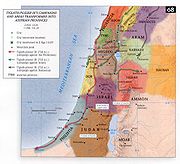
Dor
Tel Dor , is an archeological site located on Israel's Mediterranean coast, about 30 km south of Haifa. Lying on a small headland at the north side of a protected inlet, it is identified with D-jr of Egyptian sources, Biblical Dor, and with Dor/Dora of Greek and Roman sources...
, on the coast of Canaan
Canaan
Canaan is a historical region roughly corresponding to modern-day Israel, Palestine, Lebanon, and the western parts of Jordan...
near modern Haifa
Haifa
Haifa is the largest city in northern Israel, and the third-largest city in the country, with a population of over 268,000. Another 300,000 people live in towns directly adjacent to the city including the cities of the Krayot, as well as, Tirat Carmel, Daliyat al-Karmel and Nesher...
, and turned it into a large, well-fortified city, the center of a Tjeker kingdom that is confirmed archaeologically in the northern Sharon plain; it was violently destroyed in the mid-11th century BCE, firing the mud bricks red and depositing a huge layer of ash and debris. Ephraim Stern connects the destruction with the contemporary expansion of the Phoenicia
Phoenicia
Phoenicia , was an ancient civilization in Canaan which covered most of the western, coastal part of the Fertile Crescent. Several major Phoenician cities were built on the coastline of the Mediterranean. It was an enterprising maritime trading culture that spread across the Mediterranean from 1550...
ns, which was checked by the Philistines
Philistines
Philistines , Pleshet or Peleset, were a people who occupied the southern coast of Canaan at the beginning of the Iron Age . According to the Bible, they ruled the five city-states of Gaza, Askelon, Ashdod, Ekron and Gath, from the Wadi Gaza in the south to the Yarqon River in the north, but with...
further south and the Israelites
United Monarchy
According to Biblical tradition, the united Kingdom of Israel was a kingdom that existed in the Land of Israel, a period referred to by scholars as the United Monarchy. Biblical historians date the kingdom from c. 1020 BCE to c...
. No mention of the Tjeker is made after that time, the period of archaeological and literary silence. The Tjeker are one of the few of the Sea Peoples for whom a ruler's name is recorded - in the 11th-century papyrus
Papyrus
Papyrus is a thick paper-like material produced from the pith of the papyrus plant, Cyperus papyrus, a wetland sedge that was once abundant in the Nile Delta of Egypt....
account of Wenamun, an Egyptian priest, the ruler of Dor is given as "Beder".
After two intermediate occupations, the earlier of which has yielded imported Cypriote
Cyprus
Cyprus , officially the Republic of Cyprus , is a Eurasian island country, member of the European Union, in the Eastern Mediterranean, east of Greece, south of Turkey, west of Syria and north of Egypt. It is the third largest island in the Mediterranean Sea.The earliest known human activity on the...
ceramics as well as Phoenician wares and is followed by a well-stratified and important Phoenicia
Phoenicia
Phoenicia , was an ancient civilization in Canaan which covered most of the western, coastal part of the Fertile Crescent. Several major Phoenician cities were built on the coastline of the Mediterranean. It was an enterprising maritime trading culture that spread across the Mediterranean from 1550...
n presence in the early 10th century the site of Dor fell to the Israelites under David
David
David was the second king of the united Kingdom of Israel according to the Hebrew Bible and, according to the Gospels of Matthew and Luke, an ancestor of Jesus Christ through both Saint Joseph and Mary...
.
Mythology
An ethnic identity, the Tjeker must have formed during a long period of common residency, polity and language. The tradition offers basically two candidates for a homeland: CreteCrete
Crete is the largest and most populous of the Greek islands, the fifth largest island in the Mediterranean Sea, and one of the thirteen administrative regions of Greece. It forms a significant part of the economy and cultural heritage of Greece while retaining its own local cultural traits...
or the Greek mainland, especially Attica
Attica
Attica is a historical region of Greece, containing Athens, the current capital of Greece. The historical region is centered on the Attic peninsula, which projects into the Aegean Sea...
. There is no sign of them in Attica beyond the words of a few late mythographers. Cretan mythology is intertwined with their story.
Minoan archaeology would do very well as evidence except that it is not ethnic-specific. The Minoan language remains unknown. Cretan mythology is not tied to any one people. No Tjeker are mentioned in Linear B
Linear B
Linear B is a syllabic script that was used for writing Mycenaean Greek, an early form of Greek. It pre-dated the Greek alphabet by several centuries and seems to have died out with the fall of Mycenaean civilization...
and possibilities in Linear A
Linear A
Linear A is one of two scripts used in ancient Crete before Mycenaean Greek Linear B; Cretan hieroglyphs is the second script. In Minoan times, before the Mycenaean Greek dominion, Linear A was the official script for the palaces and religious activities, and hieroglyphs were mainly used on seals....
depend on the brand of partial "decipherment"; i.e., there is no real decipherment and therefore no reference to the Tjeker.
As a last resort the early scholars in the field turned to modern names; specifically, it was probably Flinders Petrie who proposed a linguistic relation to Zakro
Zakros
Zakros is a site on the eastern coast of the island of Crete, Greece, containing ruins from the Minoan civilization. The site is often known to archaeologists as Zakro or Kato Zakro...
. On the one hand there is no evidence whatever to support the connection. On the other, nothing prevents such a speculation; in fact, a Minoan community and palace has been found at Zakro, the name has the right consonants, modern names do appear in Linear B
Linear B
Linear B is a syllabic script that was used for writing Mycenaean Greek, an early form of Greek. It pre-dated the Greek alphabet by several centuries and seems to have died out with the fall of Mycenaean civilization...
(though not Zakro), and the eastern Crete location faces the Levant
Levant
The Levant or ) is the geographic region and culture zone of the "eastern Mediterranean littoral between Anatolia and Egypt" . The Levant includes most of modern Lebanon, Syria, Jordan, Israel, the Palestinian territories, and sometimes parts of Turkey and Iraq, and corresponds roughly to the...
. Some modern scholars do accept the association.