

Sicels

Encyclopedia
- Not to be confused with the SzekelySzékelyThe Székelys or Székely , sometimes also referred to as Szeklers , are a subgroup of the Hungarian people living mostly in the Székely Land, an ethno-cultural region in eastern Transylvania, Romania...
, also called Siculi in Latin.
The Sicels were an Italic people who inhabited ancient Sicily
Sicily
Sicily is a region of Italy, and is the largest island in the Mediterranean Sea. Along with the surrounding minor islands, it constitutes an autonomous region of Italy, the Regione Autonoma Siciliana Sicily has a rich and unique culture, especially with regard to the arts, music, literature,...
. The Sicels gave Sicily
Sicily
Sicily is a region of Italy, and is the largest island in the Mediterranean Sea. Along with the surrounding minor islands, it constitutes an autonomous region of Italy, the Regione Autonoma Siciliana Sicily has a rich and unique culture, especially with regard to the arts, music, literature,...
the name it has held since antiquity, but they rapidly fused into the culture of Magna Graecia
Magna Graecia
Magna Græcia is the name of the coastal areas of Southern Italy on the Tarentine Gulf that were extensively colonized by Greek settlers; particularly the Achaean colonies of Tarentum, Crotone, and Sybaris, but also, more loosely, the cities of Cumae and Neapolis to the north...
.
History
Modern linguistic studies have determined that the Sicels spoke an Indo-European languageIndo-European languages
The Indo-European languages are a family of several hundred related languages and dialects, including most major current languages of Europe, the Iranian plateau, and South Asia and also historically predominant in Anatolia...
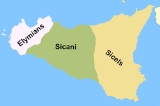
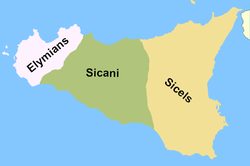
and occupied eastern Sicily as well as southern Italy whereas the Sicani
Sicani
The Sicani or Sicanians were one of three ancient peoples of Sicily present at the time of Phoenician and Greek colonization.-History:The Sicani are thought to be the oldest inhabitants of Sicily with a recorded name...
(Greek: Sikanoi) and Elymi
Elymians
The Elymians were an ancient people who inhabited the western part of Sicily during the Bronze Age and Classical antiquity.-Origins:...
(Greek Elymoi) inhabited central and western Sicily. It is likely that the two latter peoples spoke non-Indo-European languages, although this is not quite certain, particularly with regard to the Elymian language
Elymian language
The Elymian language is the extinct language of the ancient Elymian people of western Sicily. It is not known whether Elymian was an Indo-European tongue...
, which some would consider related to Ligurian or to Anatolian
Anatolian languages
The Anatolian languages comprise a group of extinct Indo-European languages that were spoken in Asia Minor, the best attested of them being the Hittite language.-Origins:...
. The common assumption is that the Sicels were the more recent arrivals; they introduced the use of iron into Bronze Age
Bronze Age
The Bronze Age is a period characterized by the use of copper and its alloy bronze as the chief hard materials in the manufacture of some implements and weapons. Chronologically, it stands between the Stone Age and Iron Age...
Sicily and brought the domesticated horse. Their arrival on the island has been tentatively set in the first half of the first millennium BCE. The Sicel necropolis of Pantalica
Necropolis of Pantalica
The Necropolis of Pantalica is a large necropolis in Sicily with over 5000 tombs dating from the 13th to the 7th centuries BC. Pantalica is situated in the valleys of the rivers Anapo and Calcinara, between the towns of Ferla and Sortino in south-eastern Sicily...
, near Syracuse is the best known, but a Sicel necropolis has also been found at Noto
Noto
Noto is a city and comune in the Province of Syracuse, Sicily . Its located 32 km southwest of the city of Syracuse at the foot of the Iblean Mountains and gives its name to the surrounding valley, Val di Noto...
; their elite tombs "a forno" or "oven-shaped" take the form of beehives.
Thucydides and other classical writers were aware of the traditions according to which the Sicels had once lived in Central Italy, east and even north of Rome. Thence they were dislodged by Umbrian and Sabine
Sabine
The Sabines were an Italic tribe that lived in the central Appennines of ancient Italy, also inhabiting Latium north of the Anio before the founding of Rome...
tribes, and finally crossed into Sicily. Their social organization appears to have been tribal, their economy, agricultural. According to Diodorus Siculus
Diodorus Siculus
Diodorus Siculus was a Greek historian who flourished between 60 and 30 BC. According to Diodorus' own work, he was born at Agyrium in Sicily . With one exception, antiquity affords no further information about Diodorus' life and doings beyond what is to be found in his own work, Bibliotheca...
, after a series of conflicts with the Sicani, the river Salso
Salso River
The River Salso , also known as the Imera Meridionale , is a river of Sicily. It rises in the Madonie Mountains and, traversing the provinces of Enna and Caltanissetta, flows into the Mediterranean at the western end of the Gulf of Gela at the seaport of Licata, in the Province of...
was declared the boundary between their respective territories.
The chief Sicel towns were: Agyrium (Agira
Agira
Agira is a town and comune in the province of Enna, Sicily . It is located in the mid-valley of the River Salso, 35 km from Enna...
); Centuripa or Centuripae (Centorbi, but now once again called Centuripe
Centuripe
Centuripe is a town and comune in the province of Enna . The city is located 61 km from Enna, in the hill country between the Rivers Dittaìno and Salso.The economy is mostly based on agriculture...
); Henna
Enna
Enna is a city and comune located roughly at the center of Sicily, southern Italy, in the province of Enna, towering above the surrounding countryside...
(later Castrogiovanni, which is a corruption of Castrum Hennae through the Arabic Qasr-janni, but since the 1920s once again called Enna
Enna
Enna is a city and comune located roughly at the center of Sicily, southern Italy, in the province of Enna, towering above the surrounding countryside...
); and three sites named Hybla: Hybla Major
Hybla Major
Hybla Major or Hybla Maior or Hybla Magna – the "Greater Hybla" – was a used to identify the most important of the ancient cities named Hybla in Sicily.-Controversy:...
, called Geleatis or Gereatis, on the river Symaethus; Hybla Minor, on the east coast north of Syracuse (possibly pre-dating the Dorian colony of Hyblaean Megara
Megara Hyblaea
Megara Hyblaea – perhaps identical with Hybla Major – is the name of an ancient Greek colony in Sicily, situated near Augusta on the east coast, north-northwest of Syracuse, Italy, on the deep bay formed by the Xiphonian promontory...
); and Hybla Heraea
Hybla Heraea
Hybla Heraea or Hybla Hera was an ancient city of Sicily; its site is at the modern località of Ibla, in the comune of Ragusa...
in the south of Sicily.
With the coming of Greek colonists— both Chalcidians
Chalcis
Chalcis or Chalkida , the chief town of the island of Euboea in Greece, is situated on the strait of the Evripos at its narrowest point. The name is preserved from antiquity and is derived from the Greek χαλκός , though there is no trace of any mines in the area...
, who maintained good relations with the Sicels, and Dorians, who did not— and the growing influence of Greek civilization, the Sicels were forced out of most of the advantageous port sites and withdrew by degrees into the hinterland. Sixty kilometres (forty miles) from the coast of the Ionian Sea
Ionian Sea
The Ionian Sea , is an arm of the Mediterranean Sea, south of the Adriatic Sea. It is bounded by southern Italy including Calabria, Sicily and the Salento peninsula to the west, southern Albania to the north, and a large number of Greek islands, including Corfu, Zante, Kephalonia, Ithaka, and...
, Sicels and Greeks exceptionally lived side by side in Morgantina
Morgantina
Morgantina is an archaeological site in east central Sicily, southern Italy. It is sixty kilometres from the coast of the Ionian Sea, in the province of Enna. The closest modern town is Aidone, two kilometres southwest of the site...
to the extent that historians argue whether it was a Greek polis
Polis
Polis , plural poleis , literally means city in Greek. It could also mean citizenship and body of citizens. In modern historiography "polis" is normally used to indicate the ancient Greek city-states, like Classical Athens and its contemporaries, so polis is often translated as "city-state."The...
or a Sicel city. Greek goods, especially pottery, moved along natural routes, and eventually Hellenistic influences can be observed in regularised Sicel town planning. However, in the middle of the fifth century BCE a Sicel leader, Ducetius
Ducetius
Ducetius was a Hellenized leader of the Sicels and founder of a united Sicilian state and numerous cities. It is thought he may have been born around the town of Mineo. His story is told through the Greek historian Diodorus Siculus in the 1st century BCE, who drew on the work of Timaeus...
, was able to create an organised Sicel state as a unitary domain in opposition to Greek Syracusa, including several cities in the central and south of the island. After a few years of independence, his army was defeated by the Greeks in 450 BCE, and he died ten years later. Without his charisma, the movement collapsed and the increasingly Hellenized culture of the Sicels lost its distinctive character. But in the winter of 426/5 Thucydides noted the presence among the allies of Athens in the siege of Syracuse
Siege of Syracuse
There have been several sieges of the city of Syracuse in Sicily:* Siege of Syracuse by the Athenians during the Sicilian Expedition* Siege of Syracuse by the Carthaginians....
of Sicels who had "previously been allies of Syracuse, but had been harshly governed by the Syracusans and had now revolted" (Thucydides 3.103.1)
Aside from Thucydides, the Greek literary sources on Sicels and other pre-Hellenic peoples of Sicily are to be found in fragmentary scattered quotes from the lost material of Hellanicus of Lesbos
Hellanicus of Lesbos
Hellanicus of Lesbos was an ancient Greek logographer who flourished during the latter half of the 5th century BC. He was born in Mytilene on the isle of Lesbos in 490 BC and is reputed to have lived to the age of 85...
and Antiochus of Syracuse
Antiochus of Syracuse
Antiochus of Syracuse was a Greek historian, who flourished around 420 BC. Little is known of his life, but his works, of which only fragments remain, enjoyed a high reputation because of their accuracy...
.
Language
Modern linguistic studies have determined that the Sicels spoke an Indo-European languageIndo-European languages
The Indo-European languages are a family of several hundred related languages and dialects, including most major current languages of Europe, the Iranian plateau, and South Asia and also historically predominant in Anatolia...
and occupied eastern Sicily as well as southern Italy whereas the Sicani
Sicani
The Sicani or Sicanians were one of three ancient peoples of Sicily present at the time of Phoenician and Greek colonization.-History:The Sicani are thought to be the oldest inhabitants of Sicily with a recorded name...
(Greek: Sikanoi) and Elymi
Elymians
The Elymians were an ancient people who inhabited the western part of Sicily during the Bronze Age and Classical antiquity.-Origins:...
(Greek Elymoi) inhabited central and western Sicily. It is likely that the two latter peoples spoke non-Indo-European languages, although this is not quite certain, particularly with regard to the Elymian language
Elymian language
The Elymian language is the extinct language of the ancient Elymian people of western Sicily. It is not known whether Elymian was an Indo-European tongue...
, which some would consider related to Ligurian or to Anatolian
Anatolian languages
The Anatolian languages comprise a group of extinct Indo-European languages that were spoken in Asia Minor, the best attested of them being the Hittite language.-Origins:...
. The common assumption is that the Sicels were the more recent arrivals; they introduced the use of iron into Bronze Age
Bronze Age
The Bronze Age is a period characterized by the use of copper and its alloy bronze as the chief hard materials in the manufacture of some implements and weapons. Chronologically, it stands between the Stone Age and Iron Age...
Sicily and brought the domesticated horse. Their arrival on the island has been tentatively in the first half of the first millennium BCE The Sicel necropolis of Pantalica
Necropolis of Pantalica
The Necropolis of Pantalica is a large necropolis in Sicily with over 5000 tombs dating from the 13th to the 7th centuries BC. Pantalica is situated in the valleys of the rivers Anapo and Calcinara, between the towns of Ferla and Sortino in south-eastern Sicily...
, near Syracuse is the best known, but a Sicel necropolis has also been found at Noto
Noto
Noto is a city and comune in the Province of Syracuse, Sicily . Its located 32 km southwest of the city of Syracuse at the foot of the Iblean Mountains and gives its name to the surrounding valley, Val di Noto...
; their elite tombs "a forno" or "oven-shaped" take the form of beehives.
Of the Sicel language
Sicel language
Sicel was an ancient language spoken by the Sicels , one of the three indigenous tribes of Sicily; the Elymians and the Sicani were the other two. According to some authors the speakers of Sicel entered Sicily from the Italian mainland, and the language is quite likely of Indo-European origin...
the little that is known is derived from glosses of ancient writers and from a very few inscriptions, not all of which are demonstrably Siculan. It is thought that the Sicels did not employ writing until they were influenced by the Greek colonists. The first inscription, of ninety-nine Greek letters, was found on a spouted jug found in 1824 at Centuripe
Centuripe
Centuripe is a town and comune in the province of Enna . The city is located 61 km from Enna, in the hill country between the Rivers Dittaìno and Salso.The economy is mostly based on agriculture...
; it uses a Greek alphabet of the fifth or sixth century BCE. Four Sicel inscriptions have been found in recent decades. An important inscription has been found at Centuripe.
Mythology
Their characteristic cult of the PaliciPalici
The Palici , or Palaci, were a pair of indigenous Sicilian chthonic deities in Roman mythology, and to a lesser extent in Greek mythology. They are mentioned in Ovid V, 406, and in Virgil IX, 585...
is influenced by Greek myth in the version that has survived, in which the local nymph Talia bore to Adranus
Adranus
Adranus or Adranos was a fire god worshipped by the Sicels, an ancient population of the island of Sicily. His worship occurred all over the island, but particularly in the town of Adranus, modern Adrano, near Mount Etna. Adranus himself was said to have lived under Mount Etna before being...
, the volcanic god whom the Greeks identified with Hephaestus
Hephaestus
Hephaestus was a Greek god whose Roman equivalent was Vulcan. He is the son of Zeus and Hera, the King and Queen of the Gods - or else, according to some accounts, of Hera alone. He was the god of technology, blacksmiths, craftsmen, artisans, sculptors, metals, metallurgy, fire and volcanoes...
, twin sons, who were "twice-born (palin "again"; ikein "to come"), born first of their nymph mother, and then of the earth, because of the "jealousy" of Hera
Hera
Hera was the wife and one of three sisters of Zeus in the Olympian pantheon of Greek mythology and religion. Her chief function was as the goddess of women and marriage. Her counterpart in the religion of ancient Rome was Juno. The cow and the peacock were sacred to her...
, who urged Mother Earth, Gaia
Gaia (mythology)
Gaia was the primordial Earth-goddess in ancient Greek religion. Gaia was the great mother of all: the heavenly gods and Titans were descended from her union with Uranus , the sea-gods from her union with Pontus , the Giants from her mating with Tartarus and mortal creatures were sprung or born...
, to swallow up the nymph. Then the soil parted, giving birth to the twins, who were venerated in Sicily as patrons of navigation and of agriculture. In the most archaic level of Greek mythology
Greek mythology
Greek mythology is the body of myths and legends belonging to the ancient Greeks, concerning their gods and heroes, the nature of the world, and the origins and significance of their own cult and ritual practices. They were a part of religion in ancient Greece...
, a titan
Titan (mythology)
In Greek mythology, the Titans were a race of powerful deities, descendants of Gaia and Uranus, that ruled during the legendary Golden Age....
, Tityos, grew so large that he split his mother's womb and had to be carried to term by Gaia herself. He came to the attention of later Greek mythographers only when he attempted to waylay Leto
Leto
In Greek mythology, Leto is a daughter of the Titans Coeus and Phoebe. The island of Kos is claimed as her birthplace. In the Olympian scheme, Zeus is the father of her twins, Apollo and Artemis, the Letoides, which Leto conceived after her hidden beauty accidentally caught the eyes of Zeus...
near Delphi. If such a mytheme
Mytheme
In the study of mythology, a mytheme is the essential kernel of a myth—an irreducible, unchanging element, a minimal unit that is always found shared with other, related mythemes and reassembled in various ways—"bundled" was Claude Lévi-Strauss's image— or linked in more...
is set into action as ritual
Ritual
A ritual is a set of actions, performed mainly for their symbolic value. It may be prescribed by a religion or by the traditions of a community. The term usually excludes actions which are arbitrarily chosen by the performers....
, it is usual to see a pair of sacrificial children laid in the earth to encourage the green growth.
In the temple to Adranus, father of the Palici
Palici
The Palici , or Palaci, were a pair of indigenous Sicilian chthonic deities in Roman mythology, and to a lesser extent in Greek mythology. They are mentioned in Ovid V, 406, and in Virgil IX, 585...
, the Sicels kept an eternal fire. A god Hybla (or goddess Hyblaea), after whom three towns were named, had a sanctuary at Hybla Gereatis
Hybla Gereatis
Hybla Gereatis , is the name of an ancient city of Sicily, located on the southern slope of Mount Etna, not far from the river Symaethus, in the modern comune of Paternò...
. The connection of Demeter
Demeter
In Greek mythology, Demeter is the goddess of the harvest, who presided over grains, the fertility of the earth, and the seasons . Her common surnames are Sito as the giver of food or corn/grain and Thesmophoros as a mark of the civilized existence of agricultural society...
and Kore
Persephone
In Greek mythology, Persephone , also called Kore , is the daughter of Zeus and the harvest-goddess Demeter, and queen of the underworld; she was abducted by Hades, the god-king of the underworld....
with Henna
Enna
Enna is a city and comune located roughly at the center of Sicily, southern Italy, in the province of Enna, towering above the surrounding countryside...
(the rape of Proserpine) and of the nymph Arethusa
Arethusa (mythology)
For other uses, see ArethusaArethusa means "the waterer". In Greek mythology, she was a nymph and daughter of Nereus , and later became a fountain on the island of Ortygia in Syracuse, Sicily....
with Syracuse
Syracuse, Italy
Syracuse is a historic city in Sicily, the capital of the province of Syracuse. The city is notable for its rich Greek history, culture, amphitheatres, architecture, and as the birthplace of the preeminent mathematician and engineer Archimedes. This 2,700-year-old city played a key role in...
is due to Greek influence.
Sources
- ThucydidesThucydidesThucydides was a Greek historian and author from Alimos. His History of the Peloponnesian War recounts the 5th century BC war between Sparta and Athens to the year 411 BC...
, vi.2 and vi.4.6 - Price, Glanville Encyclopedia of the Languages of Europe s.v. "Sicel (Siculan)"
Further reading
- L. Bernabò Brea, 1966. Sicily Before the Greeks (revised edition; originally published in Italian, 1966)
External links
- Archaic Italy: the Siculi (URL Checked 2006-03-26)
- Sicilian Peoples: The Sicels by Vincenzo Salerno http://www.bestofsicily.com/mag/art147.htm
Italy°N date=July 2009°W