
All Topics  
Habiru


   Email Print
   Bookmark   Link


Habiru


Habiru (Ha biru) or Apiru or pr.w (Egyptian)was the name given by various Sumeria
Sumeria

Sumeria may refer to:*A misnomer for Sumer, the city states of Ancient Mesopotamia. *1970 Sumeria, an asteroid discovered in 1954 by Miguel Itzigsohn....
n, Egyptian
History of Ancient Egypt

The History of ancient Egypt spans the period from the early Predynastic Egypt settlements of the northern Nile Valley to the History of Roman Egypt in 30 BC....
, Akkad
Akkad

The Akkadian Empire was an empire centered in the city of Akkad Sumerian language: Agade KUR A.GA.D?KI "land of Akkad". ; Biblical Accad) and its surrounding region Akkadian URU Akkad KI in central Mesopotamia....
ian, Hittite
Hittites

The Hittites were an ancient Anatolian people who spoke a Hittite language of the Anatolian languages of the Indo-European languages family, and established a kingdom centered at Hattusa in north-central Anatolia ca....
, Mitanni
Mitanni

Mitanni or Hanigalbat was a loosely organized Hurrian-speaking Hittite vassal state in northern Syria from ca. 1500 BC-1300 BC."The Assyrians called the lands of Mitanni Hanigalbat while to the Hittites it was the land of the Hurrians....
, and Ugarit
Ugarit

Ugarit was an ancient cosmopolitan port city, sited on the Mediterranean coast. Ugarit sent tribute to Ancient Egypt and maintained trade and diplomatic connections with Cyprus , documented in the archives recovered from the site and corroborated by Mycenaean Greece and Cypriot pottery found there....
ic sources (dated, roughly, from before 2000 BC to around 1200 BC) to a group of people living as nomadic invaders in areas of the Fertile Crescent
Fertile Crescent

The Fertile Crescent is a region in the Near East, incorporating the Levant and Mesopotamia, and often extended to Lower Egypt. Mesopotamia is considered the Cradle of civilization and saw the development of the earliest human civilizations and is the History_of_writing#Bronze_Age_writing and Wheel#History....
 from Northeastern Mesopotamia
Mesopotamia

Mesopotamia is the area of the Tigris-Euphrates river system, along the Tigris and Euphrates rivers, largely corresponding to modern Iraq, as well as some parts of northeastern Syria, some parts of southeastern Turkey, and some parts of the Khuzestan Province of southwestern Iran....
 and Iran
Iran

Iran , officially the Islamic Republic of Iran and formerly known internationally as Persian Empire until 1935, is a country in Central Eurasia, located on the northeastern shore of the Persian Gulf and the southern shore of the Caspian Sea....
 to the borders of Egypt
Egypt

Egypt is a country mainly in North Africa, with the Sinai Peninsula forming a land bridge in Western Asia. Covering an area of about , Egypt borders the Mediterranean Sea to the north, the Gaza Strip and Israel to the northeast, the Red Sea to the east, Sudan to the south and Libya to the west....
 in Canaan
Canaan

Canaan is an ancient term for a region encompassing modern-day Israel and Lebanon, the Palestinian Territories, plus adjoining coastal lands and parts of Jordan, Syria and northeastern Egypt....
  Depending on the source and epoch, these Habiru are variously described as nomadic or semi-nomadic, rebels, outlaws, raiders, mercenaries, and bowmen, servants, slaves, migrant laborers, etc.

The names Habiru and Apiru are used in Akkadian
Akkadian language

Akkadian or Assyrian-Babylonian is a Semitic language that was spoken in ancient Mesopotamia. The earliest attested Semitic language, it used the cuneiform writing system derived ultimately from ancient Sumerian language, an unrelated language isolate....
 cuneiform
Cuneiform script

Cuneiform script is one of the earliest known forms of writing system. Emerging in Sumer around the 30th century BC, with predecessors reaching into the late 4th millennium , cuneiform writing began as a system of pictography....
 texts.


Discussion
Ask a question about 'Habiru'
Start a new discussion about 'Habiru'
Answer questions from other users
Full Discussion Forum


Encyclopedia


Habiru (Ha biru) or Apiru or pr.w (Egyptian)was the name given by various Sumeria
Sumeria

Sumeria may refer to:*A misnomer for Sumer, the city states of Ancient Mesopotamia. *1970 Sumeria, an asteroid discovered in 1954 by Miguel Itzigsohn....
n, Egyptian
History of Ancient Egypt

The History of ancient Egypt spans the period from the early Predynastic Egypt settlements of the northern Nile Valley to the History of Roman Egypt in 30 BC....
, Akkad
Akkad

The Akkadian Empire was an empire centered in the city of Akkad Sumerian language: Agade KUR A.GA.D?KI "land of Akkad". ; Biblical Accad) and its surrounding region Akkadian URU Akkad KI in central Mesopotamia....
ian, Hittite
Hittites

The Hittites were an ancient Anatolian people who spoke a Hittite language of the Anatolian languages of the Indo-European languages family, and established a kingdom centered at Hattusa in north-central Anatolia ca....
, Mitanni
Mitanni

Mitanni or Hanigalbat was a loosely organized Hurrian-speaking Hittite vassal state in northern Syria from ca. 1500 BC-1300 BC."The Assyrians called the lands of Mitanni Hanigalbat while to the Hittites it was the land of the Hurrians....
, and Ugarit
Ugarit

Ugarit was an ancient cosmopolitan port city, sited on the Mediterranean coast. Ugarit sent tribute to Ancient Egypt and maintained trade and diplomatic connections with Cyprus , documented in the archives recovered from the site and corroborated by Mycenaean Greece and Cypriot pottery found there....
ic sources (dated, roughly, from before 2000 BC to around 1200 BC) to a group of people living as nomadic invaders in areas of the Fertile Crescent
Fertile Crescent

The Fertile Crescent is a region in the Near East, incorporating the Levant and Mesopotamia, and often extended to Lower Egypt. Mesopotamia is considered the Cradle of civilization and saw the development of the earliest human civilizations and is the History_of_writing#Bronze_Age_writing and Wheel#History....
 from Northeastern Mesopotamia
Mesopotamia

Mesopotamia is the area of the Tigris-Euphrates river system, along the Tigris and Euphrates rivers, largely corresponding to modern Iraq, as well as some parts of northeastern Syria, some parts of southeastern Turkey, and some parts of the Khuzestan Province of southwestern Iran....
 and Iran
Iran

Iran , officially the Islamic Republic of Iran and formerly known internationally as Persian Empire until 1935, is a country in Central Eurasia, located on the northeastern shore of the Persian Gulf and the southern shore of the Caspian Sea....
 to the borders of Egypt
Egypt

Egypt is a country mainly in North Africa, with the Sinai Peninsula forming a land bridge in Western Asia. Covering an area of about , Egypt borders the Mediterranean Sea to the north, the Gaza Strip and Israel to the northeast, the Red Sea to the east, Sudan to the south and Libya to the west....
 in Canaan
Canaan

Canaan is an ancient term for a region encompassing modern-day Israel and Lebanon, the Palestinian Territories, plus adjoining coastal lands and parts of Jordan, Syria and northeastern Egypt....
  Depending on the source and epoch, these Habiru are variously described as nomadic or semi-nomadic, rebels, outlaws, raiders, mercenaries, and bowmen, servants, slaves, migrant laborers, etc.

The names Habiru and Apiru are used in Akkadian
Akkadian language

Akkadian or Assyrian-Babylonian is a Semitic language that was spoken in ancient Mesopotamia. The earliest attested Semitic language, it used the cuneiform writing system derived ultimately from ancient Sumerian language, an unrelated language isolate....
 cuneiform
Cuneiform script

Cuneiform script is one of the earliest known forms of writing system. Emerging in Sumer around the 30th century BC, with predecessors reaching into the late 4th millennium , cuneiform writing began as a system of pictography....
 texts. The corresponding name in the consonant-only Egyptian script
Egyptian language

Egyptian is a branch of the Afro-Asiatic languages language family along with the Chadic languages, Berber languages, Semitic languages, Cushitic languages and possibly Omotic languages languages....
 appears to be `PR.W`, conventionally pronounced Apiru (W being the Egyptian
Egyptian language

Egyptian is a branch of the Afro-Asiatic languages language family along with the Chadic languages, Berber languages, Semitic languages, Cushitic languages and possibly Omotic languages languages....
 plural suffix). In Mesopotamia
Mesopotamia

Mesopotamia is the area of the Tigris-Euphrates river system, along the Tigris and Euphrates rivers, largely corresponding to modern Iraq, as well as some parts of northeastern Syria, some parts of southeastern Turkey, and some parts of the Khuzestan Province of southwestern Iran....
n records they are also identified by the Sumerian
Sumerian

Sumerian may refer to:*Sumerian language*Cuneiform script*Sumer, including**History of Sumer**Sumerian architecture**Mesopotamian mythology...
 logogram
Logogram

A logogram, or logograph, is a grapheme which represents a word or a morpheme . This stands in contrast to phonogram , which represent phonemes or combinations of phonemes, and determinatives, which mark semantics....
 `SA.GAZ`, of unknown pronunciation. The name Habiru was also found in the Amarna letters
Amarna letters

The Amarna letters are an archive of correspondence on clay tablets, mostly diplomatic, between the Ancient Egypt administration and its representatives in Canaan and Amurru during the New Kingdom....
, which again include many names of Canaan
Canaan

Canaan is an ancient term for a region encompassing modern-day Israel and Lebanon, the Palestinian Territories, plus adjoining coastal lands and parts of Jordan, Syria and northeastern Egypt....
ite peoples written in Akkadian
Akkadian language

Akkadian or Assyrian-Babylonian is a Semitic language that was spoken in ancient Mesopotamia. The earliest attested Semitic language, it used the cuneiform writing system derived ultimately from ancient Sumerian language, an unrelated language isolate....
. The Amarna letters written to Egyptian pharaohs in the 14th century BC) document a time of unrest in Canaan that goes back before the battle of Kadesh
Battle of Kadesh

The Battle of Kadesh took place between the forces of the Egyptian Empire under Ramesses II and the Hittite Empire under Muwatalli II at the city of Kadesh on the Orontes River, in what is now the Syrian Arab Republic....
 to the time of Thutmose I
Thutmose I

Thutmose I was the third Pharaoh of the Eighteenth dynasty of Egypt of History of Ancient Egypt. He was given the throne after the death of the previous king Amenhotep I....
.

The sources

Scholars pointed out similarities to Biblical accounts of "Hebrews" (i.e. `BRY (adj. form of the Hebrew word Eber
Eber

Eber or Heber, is a person from the Hebrew Bible and Muslim Qur'an. He was a great-grandson of Noah's son Shem and the father of Peleg and Joktan....
) putting people under the ban as they moved along the route of the kings highway through Edom and Moab into the territory of Ammon, Aram and the Amurru and realized that those records seemed to provide independent confirmation of the invasion of Canaan by "Habiru" fighting under Joshua
Joshua

Joshua, Jehoshuah or Yehoshua , born in Egypt, was a biblical Israelite leader who succeeded Moses. His story is told in the Hebrew Bible, chiefly in the books Book of Exodus, Book of Numbers and Book of Joshua....
, Saul
Saul

Saul or Shaul may also refer to:...
, and David
David

David , was the second king of the united Kingdom of Israel according to the Hebrew Bible/Old Testament. He is depicted as a righteous king, although not without fault, as well as an acclaimed warrior, musician and poet ....
.

As more texts were uncovered throughout the Near East, however, it became clear that the Habiru were found mentioned in contexts ranging from unemployed agricultural workers and vagrants to mounted mercenary bowmen. The context differed depending upon where the references were found.

Though found throughout most of the Fertile Crescent
Fertile Crescent

The Fertile Crescent is a region in the Near East, incorporating the Levant and Mesopotamia, and often extended to Lower Egypt. Mesopotamia is considered the Cradle of civilization and saw the development of the earliest human civilizations and is the History_of_writing#Bronze_Age_writing and Wheel#History....
, the arc of civilization "extending from the Tigris-Euphrates river basins over to the Mediterranean littoral and down through the Nile Valley during the Second Millennium, the principal area of historical interest is in their engagement with Egypt."

Carol Redmount who wrote 'Bitter Lives: Israel in and out of Egypt' in The Oxford History of the Biblical World concluded that the term "Habiru" had no common ethnic affiliations, that they spoke no common language, and that they normally led a marginal and sometimes lawless existence on the fringes of settled society. She defines the various Apiru/Habiru as "a loosely defined, inferior social class composed of shifting and shifty population elements without secure ties to settled communities" who are referred to "as outlaws, mercenaries, and slaves" in ancient texts.

In that vein, some modern scholars consider the Habiru to be more of a social designation than an ethnic or a tribal one. That does not, however, exclude the possibility that the Biblical Hebrews were descended from one specific group of Habiru and that with them it eventually became an ethnic name; such shifts in the meaning of names and designations are well-known elsewhere.

Abdi-Heba
Abdi-Heba

Abdi-Heba was king of Jerusalem during the Amarna period . Abdi-Heba's name can be translated as "servant of Hebat", a Hurrian goddess. Some scholars believe the correct reading is Ebed-Nob....
, the Egyptian vassal ruler of Jerusalem
Jerusalem

Jerusalem is the capital of Israel and its List of Israeli cities in both population and area, with a population of 747,600 residents over an area of if Positions on Jerusalem East Jerusalem is included....
 in the Amarna
Amarna

The site of Amarna is located on the east bank of the Nile River in the modern Egyptian province of Minya Governorate, some 58 km south of the city of al-Minya, 312 km south of the Egyptian capital Cairo and 402 km north of Luxor....
 period (mid-1330s BC), wrote a series of letters to the Egyptian king in which he complained about the activities of the "Habiru." The Habiru were plundering the lands of the king.

Abdi-Heba wanted to know why the king was letting them behave in this way; why was he not sending archers to protect his, the king's properties? If he did not send military help the whole land would fall to the Habiru.

Sumerian records

Sumerian documents from the reign of Shulgi
Shulgi

Shulgi of Urim was the second king of the "Sumerian Renaissance". He reigned for 48 years, dated to 2047 BC–1999 BC short chronology . Shulgi was the son of Ur-Nammu king of Ur; according to one later text , by a daughter of the former king Utu-hengal of Uruk and was a member of the Third dynasty of Ur....
 of Ur
Ur

Ur is modern Tell el-Mukayyar, Iraq, and was a city in ancient Sumer. Once a coastal city near the mouth of the then Euphrates river on the Persian Gulf, Ur is now well inland....
 (around 2150 BC) describe a class of "unclothed people, who travel in dead silence, who destroy everything, whose menfolk go where they will — they establish their tents and their camps — they spend their time in the countryside without observing the decrees of my king".

Those people are designated by a two-character cuneiform logogram
Logogram

A logogram, or logograph, is a grapheme which represents a word or a morpheme . This stands in contrast to phonogram , which represent phonemes or combinations of phonemes, and determinatives, which mark semantics....
 of unknown pronunciation, which is conventionally transcribed as SA.GAZ. Although the logogram occurs in Sumerian literature, the two symbols have no separate meaning in Sumerian
Sumerian language

Sumerian was the language of ancient Sumer, spoken in Southern Mesopotamia since at least the 4th millennium BC. It was gradually replaced by Akkadian language as a spoken language somewhere around the turn of the 3rd and the 2nd millennium BC , but continued to be used as a sacred, ceremonial, literary and scientific language in Mesopotamia...
. Some scholars have proposed that the logogram was pronounced GUB.IRU in Sumerian.

The SA.GAZ logogram in some ancient vocabulary lists is gloss
Gloss

A gloss is a brief summary of a word's meaning, equivalent to the dictionary entry of that word, but only a word or two in length. It is typically used for the meaning of a word in another language, and hence a simple translation....
ed as the Akkadian
Akkadian language

Akkadian or Assyrian-Babylonian is a Semitic language that was spoken in ancient Mesopotamia. The earliest attested Semitic language, it used the cuneiform writing system derived ultimately from ancient Sumerian language, an unrelated language isolate....
 word habbatu which means a "brigand" or "highway robber".

Early Mesopotamian sources

The Sumerian logogram SA.GAZ appears in texts from Southern Mesopotamia, dated from about 1850 BC, where it is applied to small bands of soldiers, apparently mercenaries at the service of local city-states and being supplied with food or sheep.

One of those texts uses the Akkadian
Akkadian language

Akkadian or Assyrian-Babylonian is a Semitic language that was spoken in ancient Mesopotamia. The earliest attested Semitic language, it used the cuneiform writing system derived ultimately from ancient Sumerian language, an unrelated language isolate....
 cuneiform word Hapiri instead of the logogram; another described them as "soldiers from the West". Their names are predominantly Akkadian; some are West Semitic, some unknown. Their origins, when recorded, are in local towns.

A letter to an Old Assyrian merchant resident in Ali?ar requests his aid in freeing or ransoming some Hapiri, formerly attached to the palace of Shalahshuwe (as yet unidentified), now prisoners of the local authorities.

The Tikunani Prism
Tikunani Prism

The Tikunani Prism is an 8? inch clay artifact with an Akkadian language Cuneiform script inscription listing the names of the Habiru soldiers of King Tunip-Tessup of Tikunani ....
, dated from around 1550 BC, lists the names of 438 Habiru soldiers or servants of king Tunip-Tessup of Tikunani
Tikunani

Tikunani was a small city-state in Mesopotamia which thrived around the middle of the 2nd millennium BC.Tikunani is best-known for a cuneiform document from the reign of Tunip-Teššup containing a list of names of Habiru soldiers; see Tikunani Prism....
, a small city-state in central Mesopotamia. The majority of these names are typically Hurrian
Hurrians

The Hurrians were a people of the Ancient Near East, who lived in northern Mesopotamia and areas to the immediate east and west, beginning approximately 2500 BC....
 (Northeast Caucasian
Northeast Caucasian languages

The Northeast Caucasian languages, also called East Caucasian, Caspian, Nakho-Dagestanian, or Dagestanian, are a family of languages spoken in the Russian republics of Dagestan, Chechnya, and Ingushetia, in northern Azerbaijan, and in Georgia , as well as in diaspora populations....
), the rest are Semitic
Semitic

In linguistics and ethnology, Semitic was first used to refer to a language family of largely Middle Eastern origin, now called the Semitic languages....
, one is Kassite
Kassites

The Kassites were an ancient Near Eastern tribe who gained control of Babylonia after the fall of the Old Babylonian Empire after ca. 1531 BC to ca....
.

Another text from around 1500 BC describes the Hapiru as soldiers or laborers, organized into bands of various sizes commanded by SA.GAZ leaders: one band from Tapduwa has 15 soldiers, another from Sarkuhe has 29, and another from Alalakh
Alalakh

Alalakh , is the name of an ancient Amorite city and its associated city-state of the Amuq River, located in the Hatay Province region of southern Turkey, now represented by an extensive city-mound....
 has 1,436.

Canaanite sources

A number of the Amarna letters
Amarna letters

The Amarna letters are an archive of correspondence on clay tablets, mostly diplomatic, between the Ancient Egypt administration and its representatives in Canaan and Amurru during the New Kingdom....
—sent to pharaohs Amenhotep III
Amenhotep III

Amenhotep III was the ninth pharaoh of the Eighteenth dynasty of Egypt. According to different authors, he ruled Egypt from June 1391 BC-December 1353 BC or June 1388 BC to December 1351 BC/1350 BC after his father Thutmose IV died....
, Akhenaten
Akhenaten

Akhenaten , was a Pharaoh of the Eighteenth dynasty of Egypt, who died 1336 BC or 1334 BC. He is especially noted for attempting to compel the Egyptian population in the monotheism worship of Aten, although there are doubts as to how successful he was at this....
 (Amenhotep IV) and, briefly, his two successors from vassal kings in Canaan
Canaan

Canaan is an ancient term for a region encompassing modern-day Israel and Lebanon, the Palestinian Territories, plus adjoining coastal lands and parts of Jordan, Syria and northeastern Egypt....
 and Syria in the 1300s BCE — mention the "Habiru". These letters, written by Canaan
Canaan

Canaan is an ancient term for a region encompassing modern-day Israel and Lebanon, the Palestinian Territories, plus adjoining coastal lands and parts of Jordan, Syria and northeastern Egypt....
ite scribes in the cuneiform
Cuneiform

Cuneiform can refer to:*Cuneiform script, an ancient writing system originating in Mesopotamia in the 4th millennium BC*Cuneiform , three bones in the human foot...
-based Akkadian language
Akkadian language

Akkadian or Assyrian-Babylonian is a Semitic language that was spoken in ancient Mesopotamia. The earliest attested Semitic language, it used the cuneiform writing system derived ultimately from ancient Sumerian language, an unrelated language isolate....
, complain about attacks by armed groups who were willing to fight and plunder on any side of the local wars in exchange for equipment, provisions, and quarters.

Those people are identified by the Sumerian logogram SA.GAZ in most of the letters, and by the Akkadian name Hapiru in a few from the area of Jerusalem. They appear to be active on a broad area including Syria
Syria

Syria , officially the Syrian Arab Republic , is an Arab-majority country in Southwest Asia, bordering Lebanon and the Mediterranean Sea to the west, Israel to the southwest, Jordan to the south, Iraq to the east, and Turkey to the north....
 (at Upe
UPE

UPE can refer to:* The United People of Earth* The Unix Programming Environment* Upsilon Pi Epsilon* UPE Beam* Universidade de Pernambuco...
 near Damascus
Damascus

Damascus is the capital and largest city of Syria. It is List of oldest continuously inhabited cities and its current population is estimated at about 4,000,000....
), Phoenicia
Phoenicia

Phoenicia was an ancient civilization centered in the north of ancient Canaan, with its heartland along the coastal regions of modern day Lebanon, extending to parts of Israel, Syria and the Palestinian territories....
 (Sumur, Batrun and Byblos
Byblos

Byblos is the Greek language name of the Phoenician city Gebal . It is a Mediterranean city in the Mount Lebanon Governorate of present-day Lebanon under the current Arabic language name of Jbeil and was also referred to as Gibelet during the Crusades....
), and to the south as far as Jerusalem
Jerusalem

Jerusalem is the capital of Israel and its List of Israeli cities in both population and area, with a population of 747,600 residents over an area of if Positions on Jerusalem East Jerusalem is included....
 . None of the kings of the region, with the possible exception of one Abdi-Ashirta
Abdi-Ashirta

Abdi-Ashirta was the ruler of Amurru, a new kingdom in southern Syria subject to nominal Egyptian control, that was in conflict with King Rib-Hadda of Byblos....
, are called Habiru or SA.GAZ.

Sources also discuss one Labayu, who had been an Egyptian vassal, and set up for himself. Attacking Megiddo
Megiddo

Megiddo is a Hebrew place name that can refer to:* Tel Megiddo, site of an ancient city in northern Israel's Jezreel valley** Megiddo, Israel, a kibbutz in Israel...
, he assembled a group of Hapiru who consisted of both dispossessed local people and invaders. Having won Megiddo for himself, he gave his supporters Shechem
Shechem

Shechem was Canaanite city mentioned in the Amarna letters, and later became an Israelite city in the tribe of Manasseh. It was the first capital of the Kingdom of Israel....
 for their own. (Harrelson, van der Steen)

Egyptian sources

Several Egyptian sources, both before and after the Amarna letters, mention a people called `PR.W in the consonant-only Egyptian script
Egyptian language

Egyptian is a branch of the Afro-Asiatic languages language family along with the Chadic languages, Berber languages, Semitic languages, Cushitic languages and possibly Omotic languages languages....
, where .W is the plural marker. The pronunciation of this word has been reconstructed as apiru. From similarity of context and description, it is believed that the Egyptian `PR.W are equivalent to the Akkadian Habiru/Hapiru.

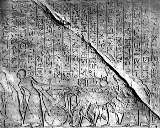
This image from the inscriptians recording the Battle of Kadesh shows one of the ibrw or mounted bowmen used as scouts by the Egyptians. ibr is the Egyptian word for horse and w is the plural.

In his account of the conquest of Joppa, General Toth of pharaoh
Pharaoh

Pharaoh is a title used in many modern discussions of the ancient Egyptian rulers of all periods. In antiquity this title began to be used for the ruler who was the religious and political leader of united ancient Egypt, only during the New Kingdom, specifically, during the middle of the Eighteenth dynasty of Egypt....
 Thutmose III of Egypt (around 1440 BC) asks at some point that his horses be taken inside the city, lest they be stolen by a passing Apir.

On two stelae at Memphis
Memphis, Egypt

Memphis was the ancient capital of the first Nome of Lower Egypt, and of the Old Kingdom of Egypt from its foundation until around 2200 BC and later for shorter periods during the New Kingdom, and an administrative centre throughout ancient history....
 and Karnak
Karnak

The Karnak temple complex, universally known only as Karnak, describes a vast conglomeration of ruined temples, chapels, pylons and other buildings....
, Thutmose III's son Amenhotep II
Amenhotep II

Amenhotep II was the seventh Pharaoh of the Eighteenth dynasty of Egypt of History of Ancient Egypt. Amenhotep inherited a vast kingdom from his father Thutmose III, and held it by means of a few military campaigns in Syria; however, he fought much less than his father, and his reign saw the effective cessation of hostilities between Egypt a...
 boasts of having made 89,600 prisoners in his campaign in Canaan (around 1420 BC), including "127 princes and 179 nobles(?) of Retenu
Retenu

Retjenu , was an Ancient Egyptian name for the region north of Canaan the watershed of the Orontes River overlapping the borders of lebanon and Syria....
, 3600 Apiru, 15,200 Shasu
Shasu

Shasu is an Egyptian language term for nomads who appeared in the Levant from the fifteenth century BCE all the way to the Third Intermediate Period....
, 36,600 Hurrians
Hurrians

The Hurrians were a people of the Ancient Near East, who lived in northern Mesopotamia and areas to the immediate east and west, beginning approximately 2500 BC....
", etc.

A stela from the reign of Seti I
Seti I

Menmaatre Seti I was a Pharaoh of Ancient Egypt , the son of Ramesses I and Queen Sitre, and the father of Ramesses II. As with all dates in Ancient Egypt, the actual dates of his reign are unclear, and various historians claim different dates, with 1294 BC – 1279 BC and 1290 BC to 1279 BC being the most commonly used by scholars today...
 (around 1300 BC) tells that the pharaoh sent an expedition into the Levant, in response to an attack of "the apiru from Mount Yarmuta" upon a local town.

A list of goods bequeathed to several temples by Pharaoh Ramesses III
Ramesses III

Usimare Ramesses III was the second Pharaoh of the Twentieth dynasty of Egypt and is considered to be the last great New Kingdom king to wield any substantial authority over Egypt....
 (around 1160 BC) includes many serfs, Egyptian and foreign: 86,486 to Thebes (2607 foreigners), 12,364 to Heliopolis
Heliopolis (ancient)

Heliopolis , meaning sun-city, was one of the most ancient cities of Egypt, and capital of the 13th Lower Egyptian Nome . Its name also refers to an unrelated Heliopolis of Cairo, also known as ??? ???????, Masr al-gidedah ....
 (2093 foreign), and 3079 to Memphis
Memphis, Egypt

Memphis was the ancient capital of the first Nome of Lower Egypt, and of the Old Kingdom of Egypt from its foundation until around 2200 BC and later for shorter periods during the New Kingdom, and an administrative centre throughout ancient history....
 (205 foreign). The foreign serfs are described as "maryanu (soldiers), apiru, and people already settled in the temple estate".

The laborers that Ramesses IV
Ramesses IV

Heqamaatre Ramesses IV was the third pharaoh of the Twentieth Dynasty of the New Kingdom of Ancient Egypt. His name prior to assuming the crown was Amonhirkhopshef....
 sent to the quarry of Wadi Hammamat
Wadi Hammamat

is a wadi in Egypt's Eastern Desert, about halfway between Qusier and Qena. It was a major mining region and trade route east from the Nile Valley in ancient times, and three thousand years of rock carvings and graffiti make it a major scientific and tourist site today....
 in his third year included 5,000 soldiers, 2,000 men attached to the temples of Pharaoh as well as 800 Apiru. This is the last known reference to the Apiru in Egyptian documents.

Hittite sources

The SA.GAZ are mentioned in at least a dozen documents from the Hittite
Hittites

The Hittites were an ancient Anatolian people who spoke a Hittite language of the Anatolian languages of the Indo-European languages family, and established a kingdom centered at Hattusa in north-central Anatolia ca....
 kingdom, starting from 1500 BC or earlier. Several documents contain the phrase "the troops from Hatti and the SA.GAZ troops", Hatti being the core region of the Hittite kingdom.

Two oaths from the reigns of Suppiluliuma (probably Suppiluliuma I
Suppiluliuma I

Suppiluliuma I was king of the Hittites . He achieved fame as a great warrior and statesman, successfully challenging the then-dominant New Kingdom for control of the lands between the Mediterranean and the Euphrates....
, reigned ca. 1358 BC ? 1323 BC) and Mursilis II
Mursili II

Mursili II was a king of the Hittite Empire ca. 1321 ? 1295 BC . He was the younger son of Suppiluliuma I, one of the most powerful rulers of the Hittite Empire....
 (around 1300 BC) invoke, among a long list of deities, "...the Lulahhi gods (and) the Hapiri gods, Ereskigal, the gods and goddesses of the Hatti
Hatti

Hatti in Bronze Age Anatolia refers to:*the area of Hattusa, roughly delimited by the Halys bend*the Hattians of the 3rd millennium BC and 2nd millennium BC millennia BC...
 land, the gods and goddesses of Amurru
Amurru

Amurru are names given in Akkadian language and Sumerian language texts to the god of the Amorite/Amurru people, often forming part of personal names....
 land, ...".

Another mention occurs in a treaty between kings Duppi-Teshub of Amurru
Amurru

Amurru are names given in Akkadian language and Sumerian language texts to the god of the Amorite/Amurru people, often forming part of personal names....
 and Tudhaliya of Carchemish
Carchemish

Carchemish was an important ancient city of the Mitanni and Hittites empires, now on the frontier between Turkey and Syria. It was the location of an Battle of Carchemish between the Babylonians and Egyptians, mentioned in the Bible....
, arbitrated by Mursili II
Mursili II

Mursili II was a king of the Hittite Empire ca. 1321 ? 1295 BC . He was the younger son of Suppiluliuma I, one of the most powerful rulers of the Hittite Empire....
. The Hittite monarch recalls how he had restored king Abiradda to the throne of Jaruwatta, a town in the land of Barga
Barga (kingdom)

Barga was a city-state in the Amarna letters period of 1350 BC-1335 BC and later. It is mentioned as the "land of Barga" by Mursilis II in treaties, ....
, which had been captured by the Hurrians
Hurrians

The Hurrians were a people of the Ancient Near East, who lived in northern Mesopotamia and areas to the immediate east and west, beginning approximately 2500 BC....
 and given to "the grandfather of Tette, the SA.GAZ".

Another text record the existence of a Habiru settlement somewhere near a Hittite temple; one from Tahurpa names two female SA.GAZ singers.

Mitanni sources

An inscription on a statue found at Alalakh
Alalakh

Alalakh , is the name of an ancient Amorite city and its associated city-state of the Amuq River, located in the Hatay Province region of southern Turkey, now represented by an extensive city-mound....
 in southeastern Anatolia
Anatolia

Anatolia or Asia Minor is a region of Western Asia, comprising most of the modern Republic of Turkey. It is a geographic region bounded by the Black Sea to the north, the Caucasus to the northeast, the Aegean Sea to the west, the Mediterranean Sea to the south, and the Iranian plateau to the east and southeast....
 , the Mitanni
Mitanni

Mitanni or Hanigalbat was a loosely organized Hurrian-speaking Hittite vassal state in northern Syria from ca. 1500 BC-1300 BC."The Assyrians called the lands of Mitanni Hanigalbat while to the Hittites it was the land of the Hurrians....
 prince Idrimi
Idrimi

Idrimi was the king of Alalakh in the 15th century BC.Idrimi was a Hurrianised Semitic son of the king of Aleppo who had been deposed by the new regional master, Barattarna, king of the Mitanni....
 of Aleppo
Aleppo

Aleppo is a city in northern Syria, capital of the Aleppo Governorate; the Governorate extends around the city for over 16,000 km? and has a population of 4,393,000, making it the largest Governorate in Syria by population....
 (who lived from about 1500 BC to 1450 BC), tells that, after his family had been forced to flee to Emar
Emar

Emar was an ancient Amorite city on the great bend in the mid-Euphrates in northeastern Syria, now on the shoreline of the man-made Lake Assad....
, he left them and joined the "Hapiru people" in "Ammija in the land of Canaan".

At the Battle of Kadesh the Egyptians employed ibrw mounted bowmen as messengers.

The Hapiru recognized him as the "son of their overlord" and "gathered around him;" they are said to include "natives of Halab, of the country of Mukish, of the country Nihi and also warriors from the country Amae." After living among them for seven years, he led his Habiru warriors in a successful attack by sea on the city-state of Alalakh, where he became king.

Several detailed lists of SA.GAZ troops have been found on the same site, enumerating eighty in all. Their names are predominantly Hurrian; seven are perhaps Semitic. They come from a variety of settlements scattered around the region. One had been a thief, another a slave, two others, priests; most became infantry, a handful were charioteers, one a messenger.

Like the SA.GAZ soldiers of the earlier Mesopotamian city-states, they received payment, or perhaps rations, in the form of sheep. A general enumeration of SA.GAZ soldiers within the city counts 1436 in all.

At Nuzi
Nuzi

Nuzi was an ancient Mesopotamian city southwest of Kirkuk in modern Al-Tamin governorate of Iraq, located near the Tigris river. The site consists of...
 in Mesopotamia, documents from the household of an official named Tehiptilla record a number of Habiru voluntarily entering long-term service in exchange for food, clothing, and shelter. Public records from the same city tally handouts of food and clothing to Habiru, the former to groups, the latter to individuals. One is given feed for a horse, perhaps indicating a military role. Another document allocates Habiru laborers to various individuals.

The local population was predominantly Hurrian, while approximately 2/3 of the Habiru names are Semitic; of these, all are East Semitic (Akkadian), none West Semitic.

Ugarit

In the port town of Ugarit
Ugarit

Ugarit was an ancient cosmopolitan port city, sited on the Mediterranean coast. Ugarit sent tribute to Ancient Egypt and maintained trade and diplomatic connections with Cyprus , documented in the archives recovered from the site and corroborated by Mycenaean Greece and Cypriot pottery found there....
 in northern Syria
Syria

Syria , officially the Syrian Arab Republic , is an Arab-majority country in Southwest Asia, bordering Lebanon and the Mediterranean Sea to the west, Israel to the southwest, Jordan to the south, Iraq to the east, and Turkey to the north....
, a cuneiform tablet that was still being baked when the city was destroyed (around 1200 BC) mentions the PRM (which are assumed to be the Hapiru, -M being the Ugaritic plural suffix). Tax lists from the city record the existence of "Aleppo of the PRM" (in Ugaritic) and "Aleppo of the SAG.GAZ" (in Akkadian; the logogram is slightly modified from the usual SA.GAZ).

Being found in lists of four Aleppos that are otherwise the same, these are certainly the same location, but it is unclear whether they are separate settlements or quarters of one city.

Interpretations


Habiru as a loose ethnic group

Scholars since Moshe Greenberg
Moshe Greenberg

Moshe Greenberg is an American Jewish Bible scholar and professor emeritus of the Hebrew University of Jerusalem.Greenberg was born in Philadelphia in 1928....
 have envisioned the Hapiru, like the 17th century Cossack
Cossack

The term Cossacks is applied to specific militaristic communities of various ethnicities living in the southern steppe regions of Ukraine and Russia....
 bands of the Eastern European steppes, as being formed out of outlaws and drop-outs from neighbouring agricultural societies. The numbers of the Habiru of the 2nd millennium BC grew from the peasants who had fled the increasingly oppressive economic conditions of the Assyria
Assyria

Assyria was a political state centered on the Upper Tigris river, in Mesopotamia , that came to rule regional empires a number of times in history....
n and Babylonia
Babylonia

Babylonia was a state in Lower Mesopotamia , Babylon as its franklin. Babylonia emerged when Hammurabi created an empire out of the territories of the former kingdoms of Sumer and Akkad....
n kingdoms.

Some scholars have seen the Habiru legacy preserved in the place-names of Iranian Kabira, the Khabur River
Khabur River

The Khabur River is a river that begins in southeastern Turkey and flows south to eastern Syria, where it empties into the Euphrates River near the town of Busayrah....
 valley of the Northern Euphrates
Euphrates

The Euphrates is the western of the two great rivers that define Mesopotamia which flows from Anatolia....
 and perhaps also the Hebron valley, although the Hebrew and Arabic root for Hebron more likely derives from the word for "friend" (haver/habib)named for Abraham as a "friend of God".

Habiru and the Hebrews

When the Amarna letters were translated, some scholars eagerly equated these Apiru with the Biblical Hebrews
Hebrews

Hebrews are an ancient people defined as descendants of biblical Patriarch Abraham , a descendent of Noah.In the Bible, the patriarch Abraham is referred to a single time as the ivri, which is the singular form of the Hebrew-language word for Hebrew ....
 (Hebrew: ????? or ??????, ?Ivrim, ?Ivriyyim). Besides the similarity of their spellings, the description of the Apiru attacking cities in Canaan
Canaan

Canaan is an ancient term for a region encompassing modern-day Israel and Lebanon, the Palestinian Territories, plus adjoining coastal lands and parts of Jordan, Syria and northeastern Egypt....
 seemed to fit, loosely, the Biblical account of the conquest of that land by Israelites under Joshua
Joshua

Joshua, Jehoshuah or Yehoshua , born in Egypt, was a biblical Israelite leader who succeeded Moses. His story is told in the Hebrew Bible, chiefly in the books Book of Exodus, Book of Numbers and Book of Joshua....
.

The photographs from the 1904 Brested Expedition to Egypt, especially those of incribed at Abu Simbal provide one of the first the first recorded mentions of the ha ibr u in the context of an army that messengers rushed to fetch to the battle.

Scholarly opinion remains divided on this issue. Some scholars argue that the Hapiru were a component of the later peoples who inhabited the kingdoms ruled by Saul
Saul the King

Saul is identified in the Books of Samuel, Books of Chronicles and Qur'an as the first king of the ancient united United Monarchy. Saul was anointed by the prophet Samuel and reigned from Gibeah during the closing decades of the 2nd millennium BC....
, David
David

David , was the second king of the united Kingdom of Israel according to the Hebrew Bible/Old Testament. He is depicted as a righteous king, although not without fault, as well as an acclaimed warrior, musician and poet ....
, Solomon
Solomon

Solomon is a figure described in the Hebrew Bible and the Qur'an. The biblical accounts identify Solomon as the son of David. He is also called Jedidiah in the Tanakh , and is described as the third king of the United Monarchy, and the final king before the northern Kingdom of Israel and the southern Kingdom of Judah split; following th...
 and their successors in Judah
Kingdom of Judah

The Kingdom of Judah existed at two periods in Jewish history. According to the Hebrew Bible, a kingdom emerged in Judah after the death of Saul, when the tribe of Judah elevated David to rule over it....
 and Israel
Kingdom of Israel

The Kingdom of Israel was one of the successor states to the older United Monarchy . It existed roughly from the 930s BC until about the 720s BC....
. Rainey argues that Hapiru is a generic term for bandits, not attached to a specific population. He proposes that, in the Amarna letters, Hebrews are referred as Shasu
Shasu

Shasu is an Egyptian language term for nomads who appeared in the Levant from the fifteenth century BCE all the way to the Third Intermediate Period....
.

Footnotes


Near Eastern References


  • 2. Nelson Glueck
  • 3. William H McNeil and Jean W Sedlar,
  • 4. Andrew George, Includes toponyms for Canaan
  • 5. James B. Pritchard, Jerusalim, siege and fall
  • 6. Shaika Haya Ali Al Khalifa and Michael Rice,
  • 7. Dr. Muhammed Abdul Nayeem,
  • 8. Michael Roaf
  • 9. Nicholas Awde and Putros Samano
  • 10. Gerard Herm


Egyptological References


  • 13. Gardiner
  • 14. Antonio Loprieno
  • 15. Michael Rice
  • 16. Gillings
  • 17. Somers Clarke and R. Englebach


Further reading


See also

  • Shasu
    Shasu

    Shasu is an Egyptian language term for nomads who appeared in the Levant from the fifteenth century BCE all the way to the Third Intermediate Period....


External links

  • (A religious site).