

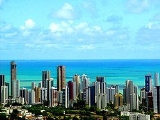
Recife

Encyclopedia
Recife is the fifth-largest metropolitan area
in Brazil
with 4,136,506 inhabitants, the largest metropolitan area of the North/Northeast Regions, the 5th-largest metropolitan influence area in Brazil, and the capital and largest city of the state of Pernambuco
. The population of the city proper was 1,561,659 in 2009. Recife is located where the Beberibe River
meets the Capibaribe River
to flow into the Atlantic Ocean. It is a major port on the Atlantic Ocean. Its name is an allusion to the coral reef
s that are present by the city's shores. The many rivers, small islands and over 50 bridges found in Recife city center characterize its geography and gives it the moniker of the "Brazilian Venice
."
The Metropolitan Region of Recife
is the main industrial zone of the State of Pernambuco
; most relevant products are those derived from cane
(sugar and ethanol
), electronics, food, and others; thanks to the fiscal incentives of government, many industrial enterprises were started in the 1970s and 1980s. Recife has a tradition of being the most important commercial center
of the North/Northeastern region of Brazil with more than 52,500 business enterprises in Recife itself plus 32,500 in the Metro Area which totals more than 85,000.
A combination of a large supply of labor
and significant private investments turned Recife into Brazil's second largest medical center (second only to São Paulo
); modern hospitals with state-of-the-art equipment receive patients from several neighboring States. Like all other cities in the Northeast
, Recife is developing its tourist sector
. The beach of Porto de Galinhas
, 60 kilometres (37.3 mi) south of the city, has been repeatedly awarded the title of best beach in Brazil and has drawn many tourists. Recife's infrastructure is among the most developed in Brazil for travellers and business people, though there is wide room for improvement.
The city is also a renowned educational center, and home to the Federal University of Pernambuco
, the largest university in Pernambuco. Several Brazilian historical figures, such as the poet and abolitionist Castro Alves
, moved to Recife to attain their education.
Together with Natal
these are the only Brazilian cities with direct flights to the islands of Fernando de Noronha
, World Heritage Site since 2001.
, Recife weather is generally warm. Recife has a number of islands, rivers, waterways and bridges that crisscross the city.
Recife is located amidst tropical forests which are distinguished by high rainfall levels resulting in poor soil quality as the rainfall washes away the nutrients.
There is an absence of extreme temperatures and a cool breeze due to the trade winds from the Atlantic Ocean.
trees. The city of Recife is formed by three islands (Recife, Santo Antônio, and Boa Vista). Between the islands are the rivers Beberibe and Capibaribe.
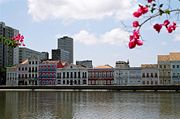 Rivers
Beaches
Lakes
Large water supplier (Dam
s)
, with warm to hot temperatures and high relative humidity throughout the year. However, these conditions are relieved by a near absence of extreme temperatures and pleasant trade winds blowing from the ocean. Under the Koppen climate classification
, the city's climate straddles a tropical monsoon climate
and a tropical wet and dry climate. January is the warmest month, with mean temperatures ranging from 30 °C (86 °F) to 25 °C (77 °F), with sun; July experiences the coolest temperatures, with mean temperatures ranging from 27 °C (80.6 °F) to 22 °C (71.6 °F), with rain. June is the wettest month and the second-cloudiest, receiving an average of 390 mm (15.4 in) of precipitation, and surpassed in cloudiness only by August. Indeed, August is incredibly cloudy in Recife, with a mere daily average of 3.5 hours of sunshine throughout the month. The driest and sunniest month is November, when maximum temperatures hover around 30°C and an average of 48 mm (1.9 in) of precipitation is recorded.
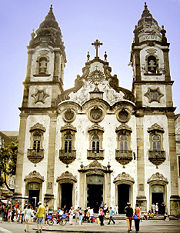
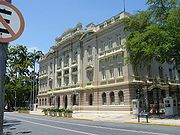
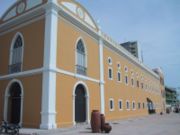
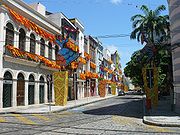 The area around Recife was one of the first in Brazil to be settled by the Portuguese Crown.
In 1537, John III of Portugal
divided Brazil into Hereditary Captaincies (Capitanias Hereditárias, in Portuguese); the Portuguese realized that they had no human or financial resources to invest in such a large and distant colony, and decided to assign this task to private entrepreneurs, called Donatários (this system had already been successful in the settlement of the Portuguese colonies in Africa).
Because of several problems (the most obvious being the lack of support from the Portuguese metropolis), most Captaincies failed. One of the few to prosper was the Captaincy of Pernambuco
, which was assigned to Duarte Coelho Pereira (the man who founded Olinda
which has its historic town center considered a World Heritage site
by UNESCO
and became famous for expressing his enchantment with the beauty of the place, giving the name to the city).
Pernambuco prospered from the sugarcane
industry (beet
sugar was not industrially produced in Europe until the beginning of the 19th century). At the time, in Europe, sugarcane plantations could be grown only in Andalusia
and the Algarve; in the 1420s, sugarcane was carried to the Canary Islands
, Madeira
and the Azores
; the sugar from Brazil was very much appreciated in Europe. Duarte Coelho found in Pernambuco plenty of fertile land and an excellent climate for the cultivation of cane; all he needed was labor to work the crops and to keep the "engenhos" (rustic wooden machinery) moving.
At first, the Portuguese tried to use the indigenous peoples of Brazil, but since Portugal was the country with the strongest black slave market because of their previous expeditions to Africa, using black slaves would not only be easier to handle, but it would be cheaper as well; from the 16th to the 19th century, Pernambuco received many African slaves, making it one of the Brazilian States where black African culture has the most visible traces (in dance, music, culinary, etc.).
From 1580 to 1640, the kingdoms of Spain and Portugal were unified under the rule of the former. Spain was engaged in a war against the Netherlands, and determined that the Dutch, who were the main distributors of Brazilian sugar in Europe, would be prohibited from coming to Brazil.
The Dutch decided to invade several sugar producing cities in Brazil, including Salvador
and Natal
. From 1630 to 1654, they took control of Recife and Olinda, making Recife the new capital of Dutch Brazil
, the city of Mauritsstad
. During this period, Mauritsstad became one of the most cosmopolitan cities of the world. Unlike the Portuguese, the Dutch did not prohibit Judaism. The first Jewish community and the first synagogue
in the Americas
was founded in the city.
The inhabitants fought on their own to expel the Dutch, being helped by the involvement of the Dutch in the First Anglo-Dutch War
. This was known as the Insurreição Pernambucana (Pernambucan Insurrection). Most of the Jews fled to Amsterdam
; others fled to North America, starting the first Jewish community of New Amsterdam
(now known as New York City).
During the 18th century, riots spread throughout the city, in which the rich farmers of Olinda
and the traders from Recife clashed. Recife had a clear advantage in relation to Olinda: Olinda has no harbour, while Recife's Harbor is one of the largest on the Atlantic Ocean. Recife's victory asserted the supremacy of its bourgeoisie
over the decadent sugar aristocrats of Olinda. This was a decisive factor for Recife's growth. Recife is now a large city whereas Olinda is a small historical town. Recife is a historical city, distinguished by the opulence of its colonial buildings, with its colonization rooted in different nations; Portugal, the Netherlands, France, England.
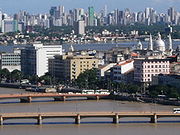
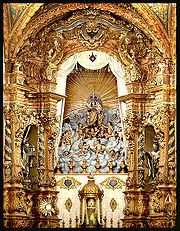 According to the IBGE of 2008, there were 3,737,000 people residing in the Metropolitan Region of Recife. The population density was 6422 PD/sqkm (in the urban area). The last PNAD (National Research for Sample of Domiciles) census revealed the following percentage: 1,976,000 Brown (Multiracial) people (52.88%), 1,454,000 White
people (38.90%), 280,000 Black
people (7.49%), 16,000 Amerindian
people (0.43%), 7,000 Asian
people (0.20%).
The Metropolitan Region
of Recife is the 4th most populous of Brazil
, after São Paulo
, Rio de Janeiro
, Belo Horizonte
, and the 1st in the Northeast region
. The city is the 9th most populous of the country with 1,561,659 inhabitants, and third largest city in the Northeast region
,according with IBGE 2009. The most populous neighborhoods of Recife in 2008 were Boa Viagem
(100,388), Casa Amarela (69,134), and Várzea (64,512).
>
Year
Inhabitants
1920
238,843
1940
348,424
1950
524,682
1960
788,336
1970
1,060,701
1980
1,203,899
1990
1,288,607
2000
1,422,905
2006
1,515,052
of Recife is Our Lady of Mount Carmel (Nossa Senhora do Carmo), dating back one hundred years ago (1909). Every July 16, her day, she is remembered by the Catholics in Recife, in her church.
Source: IBGE 2000.
Recife is one of Brazil
's prime business centers, largely because it has one International Airport and two International port
s. One is located in the town itself, and the other, the port of Suape, is located about 40 kilometres (24.9 mi) away. Just south of Recife is the region
's main industrial area
, where the following industries can be found: brewing and canning, automotive electronics, tube manufacturing, chocolate manufacturing, textiles, etc.
Recife has shared in the prosperity of Northeastern Brazil
that resulted from development promoted after 1960 by Sudene
(Superintendência para o Desenvolvimento do Nordeste), a federal
organization
. Although its retail and wholesale trade have grown in response to the region's increases in population and wealth, the market area and the walkways of the city's bridges are crowded with vendors selling small items.
The GDP for the city was R$ 20,718,107,000 (2007), and the per capita income
for the city was R$ 13,510 which is the highest for the Northeastern Capitals of Brazil.
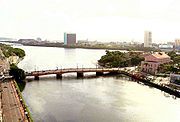 Recife has an area dedicated to information technology called "Porto Digital" (Digital Port) with more than 90 companies and 3,000 High Tech Jobs. It was founded in July 2000 and has since attracted major investments. Generating some R$10 billion (Brazilian Reais) a year, it produces technology that is exported to Japan, China, among other countries. Software manufacturing
is the main activity in the Porto Digital. The Porto Digital cluster comprises small and median companies, but multinationals like Accenture
, Motorola
, Samsung
, Dell
and Sun Microsystems
are also installed in Porto Digital. IBM
and Microsoft
transferred their regional headquarters to Recife.
Porto Digital's startups can count on a ready pool of talent, courtesy of the Federal University of Pernambuco
(UFPE), which boasts one of the best computer-science departments in all of Latin America. The school began teaching programmers to use Sun Microsystems Inc.'s (SUNW) Java language in 1996, the year it was introduced. Professors at the school also teamed up to launch Centro de Estudos e Sistemas Avançados do Recife (C.E.S.A.R), a business
incubator that has played a vital role in the birth of some 30 companies
.
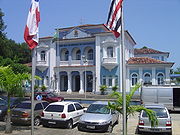 The Metropolitan Region
of Recife has the 2nd largest medical pool in Brazil
, after São Paulo
. Together they make up 417 hospitals and clinics with 72,000 employees in the Metro Area and more than 120,000 in the State of Pernambuco. The medical pool offers a total of 8,990 beds and, according to the Union of the Hospitals of Pernambuco, recorded in the year 2000 an invoicing of R$220 million (Brazilian Reals). It is thanks to the pool that Pernambuco
has access to more computed tomography
devices than more developed countries such as Canada or France.
A large portion of the modern hospitals included in the pool are located between the neighbourhoods of Derby and of the Ilha do Leite. The Hospital Real Português de Beneficência Portuguesa em Pernambuco, or "Hospital Português" (Portuguese Hospital) for short, is one of the most renowned hospitals in the country. Many people from neighbouring states go to Recife for treatment, as it has the largest and best medical facilities in the North–Northeast of Brazil
. Recife has three universities for medicine
, 2 public, Federal University of Pernambuco
and University of Pernambuco; and 1 private, Escola Pernambucana de Medicina FBV/IMIP (Medical School of Pernambuco).
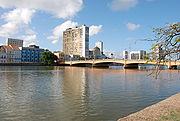
, Recife is considered one of the biggest logistics centers in Brazil. Logistic and Communications Economic sector employees 4% of the people in Recife, 12,3% in Jaboatão dos Guararapes
and over 9% in the Metropolitan Area
. These numbers could increase by the end of 2010 with the conclusion of the Transnordestina (main NE Trainline with a 1,800/1,118 km/mi extension, which will cross 3 and connect 7 States (34 municipalities in Pernambuco alone) products with Suape port
(PE) and Pecem Port (CE)) with costs that are estimated to be around 4.5 BR$.
Recife has historically benefited from its central location in the Northeast region
. In a 200 miles (321.9 km) radius from Recife, it is possible to find four state capitals, two internationals and three regional airports, five international ports
, 12 million people, 51% of the research centres of Northeast
and 35% of the region's GDP. Similarly, in a 500 miles (804.7 km) radius there are seven state capitals, five international and five regional airports, nine international ports and two fluvial
ports, almost 30 million people and 90% of the northeast region
GDP.
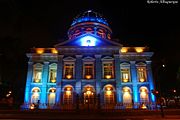
And because of its geographic location, tourism and city infrastructurem Recife's Convention Centres are of a high standard:
The 3rd largest convention centre in Brazil
with 2 large theatres with 2,800 seats, 4 Auditory rooms with 1,600 seats, 17 business meetings rooms, VIP rooms, large cultural multi-purpose lobby, more than 1,800 parking spots, in a total area of 75,000 square metres. It's considered one of the most developed in South America and fit for any kind of event.
Modern theatre with 1,931 seats and 2,071 square metres of exposition area located in the University Campus.
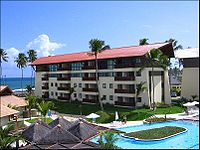
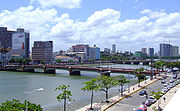
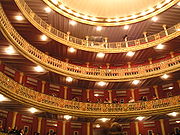
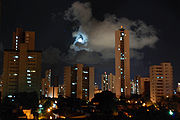
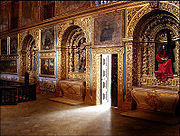 The celebrations, holidays and other events are numerous during the whole year. Thus the New Year
begins at the beach, Praia de Boa Viagem
and in Old Recife
. The carnival
of Recife and Olinda
(which has its historic town center considered world heritage site by UNESCO
in 1982) begins many weeks ahead in December with innumerable balls and parades. In the city, the carnival festivities begin in December, as locals begin preparing for the official Carnival
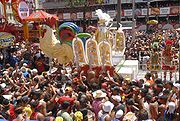
, which starts the week before Ash Wednesday. The pre-Carnival parties usually consist of percussion groups practicing in local clubs, city streets and squares, and even Carnival balls. There is a variety of rhythms from different cultures. Carnival officially starts with the Galo da Madrugada
, a party in Downtown Recife
attracting many people from several States of Brazil, and other parts of the world.
Recife has many quality 3, 4 and 5-Star International Hotels as well Pousadas
(traditional Bed & breakfast) and Apart-Hotels totaling more than 11,500 bedrooms and this number increase to over 30,000 Metropolitan Area
.
Mercado de São José
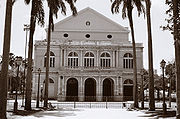
(Market of Saint Joseph) is an old, iron construction with a very popular market nearby. In the Fort Cinco Pontes (Fort of Five Points) is the state museum, (Museu do Estado de Pernambuco). At the rectangular Pátio de São Pedro are the Cathedral São Pedro (Cathedral of Saint Peter) dating from the year 1782 and restored colonial houses, with numerous restaurants, bistros and bars. In the Bairro Santo Antônio (Saint Anthony Neighborhood), at the meeting place of the rivers Capibaribe and Beberibe, is the Praça da República (Square of the Republic) with the Teatro Santa Isabel (Theatre of Saint Isabel), with its neoclassic front - well worth seeing, the Law Courts, and the Palácio da Justiça (Palace of the Justice). Casa da Cultura (House of Culture) is an old prison that has been converted into a cultural space and shopping centre.
Built between 1835 and 1855, the Malakoff Tower
, a monument constructed in Tunisia
n style, which used to be an observatory
and now is a cultural centre and a place for popular gatherings. It is located at Arsenal da Marinha Square. It has been registered as a Historical Patrimony and was named after a similar monument on Crimean peninsula, used as a defence center for Sebastopol.
Recife has a zoo called Dois Irmãos Park
, 387 hectares of Atlantic Forest reserve and 14 hectares of botanical garden
s. There are also 800 wild animals, the Natural Science Museum and various ecological trails. The metropolitan area
has also a giant water park 20 km (12.4 mi) North of Recife, called Veneza water park
which has nearly one million sq/ft of area, ten millions litres of water and lots of water slides for the youngsters.
Among Recife's main tourist attractions are:
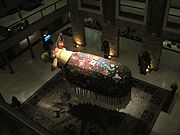 Shopping Center Recife, the first Shopping Center in the North/Northeastern
region, was inaugurated in 1980 through the initiatives of two large groups of entrepreneurs: Ancar and Ecisa. After twenty-three years and three expansion
project
s, Shopping Center Recife has been transformed into one of the largest in Latin America, and the first "mega-mall"
in Northeastern Brazil
. With a total area of nearly two million square feet, 70% of which is mall-space, the shopping centre has 465 stores, 10 movie theatres, 8 restaurants, 4 food service courts with 57 fast food
mini-restaurants, and 5,000 parking spaces available. 90,000 customers per day pass through its doors, while 32,400,000 consumers per year use the facilities.
Other shopping centres include:
Jaboatão
beaches
Olinda
beaches
South beaches
North beaches
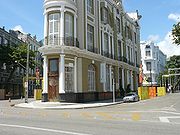 Portuguese
is the official national language, and thus the primary language taught in schools. But English and Spanish are part of the official high school
curriculum. There are also international schools, such as the American School of Recife
and the ABA Maple Bear Canadian School.
Recife is home to several higher education institutions (83), notably several public-owned universities:
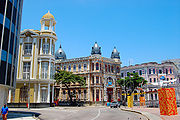
.jpg)
 Recife is the home of several artists, musicians and writers. It is also home to the frevo
, a regional dance and music, typical in carnival, and Mangue Beat, a type of Brazilian rock with mixture of Maracatu
, Ciranda, Rap
and other musical styles. During carnival, downtown Recife holds one of the most authentic and democratic celebrations: every year more than one and a half million people open the festivities of the Brazilian Carnival at Galo da Madrugada. Recife and Olinda combined have 25 museums, 38 art galleries, 2 Orchestra houses, 15 theatres, 1 opera house and more than 40 movie theatres.
was housed in a 19th century mansion in Recife, the "Museu do Estado de Pernambuco (MEPE)" dates back to 1929. From Masters who portrayed the Colonial period, as well as the Dutch invasion (1630) to 20th and 21st century, the museum comprises over 12 thousand art pieces.
Kahal Zur Israel Synagogue
Sinagoga Kahal Zur Israel, the historic Recife synagogue
in Recife Antigo, is the oldest in the Americas, dating back to the 17th Century. Reopened recently, Kahal is an important part of Pernambuco's historic patrimony. It was founded by Jews who were once expelled from Portugal and settled in the Netherlands. Some of those Jews emigrated to "New Holland
" when the Dutch invaded the Northeastern portion of Brazilian lands occupied by the Portuguese. When the Portuguese, helped by Portuguese-Brazilians, reconquered the land, Recife Portuguese-Brazilian Jews moved further north with the Dutch
, and founded "New Amsterdam
" on Manhattan Island. Thus, the first New York City synagogue was created in lower Manhattan by the founders of the first synagogue in the New World in Recife. It later moved to the Upper West Side, where it is still called "The Portuguese and Spanish Synagogue
."
Gilberto Freyre Foundation
This farmhouse, from the 18th century, was Gilberto Freyre
's old residence. Artworks, arts and crafts, book collections and objects that belonged to the Pernambucan writer and sociologist are displayed here.
Ricardo Brennand Institute
Set up in a reproduction of a medieval-style castle, there is a collection of pieces from the Dutch domination period in Recife, as well as daggers and armor from medieval Europe.
Recife City Museum
Located in a room in Cinco Pontas Fort (the five-pointed Fort), it houses pictures, reproductions of old paintings and objects that encapsulate Recife since the period of Dutch rule.
Also known as Recife Audiovisual Festival or Cine-PE, Recife Cinema Festival is a competitive film and audiovisual festival that is held in Recife. It is dedicated to the Brazilian and state
production of feature
& short films; as well as videos
and documentaries. It was founded in 1997 by the Alfredo & Sandra Bertini, who have been the directors since then. Between 1997 and 2008, 1806 films (through either competitive applications or National & International invitations) of all types and genre
s for a public of over 250,000 people have been a part of it.
Recife and consequently Pernambuco
has a tradition in the Brazilian film making history. In the pioneer times of the Brazil
ian cinema emerged the Regional movements. One of those, was designated Ciclo de Recife (Recife cycle), between 1922-1931. Despite adverse conditions, during this cycle was realized in Recife 13 feature film
s (usually about drama & Romance) and 7 realistic films (usually ordered by authorities to show their public works). Despite pervasive influence of U.S.
and European cinemas in the silent film
times, the Recife cycle was one of the most important, regional and produtive of them. One of the most important movie was Aitaré da Praia
, which is recognized for pioneering the rise of regional themes (1925). Anothers large successful films was Retribuição (1923) and A Filha do Advogado (1926). Another important phase of the Pernambuco/Recife film history was in the 1970s with a movement called Super 8
, often used for home video
s and documentaries realized by students, curious and aspirant film makers, due to the utilization of 8 mm film, proportionated by the new technology released by Kodak
.
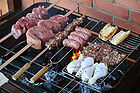 Recife cuisine
is the cuisine of its region, Pernambuco
and the Northeast, and the culinary influences of the area can be traced to a dynamic assortment of cultures: the Portuguese, Dutch
, Spanish
, Moors
, Africans
and Indigenous
. Many dishes come with a delicious coconut
sauce, palm oil
(dendê) and feature corn, manioc roots, yam
, fresh seafood (shrimp, crab, lobster cooked with exotic sauces) and native fruits. Grilled meats are also big here, especially goat
and beef
dishes.
The typical regional main dishes include caldeirada (seafood stew with octopus cooked with various spices and coconut milk, may be served with white beans or farofa
), feijoada
Pernambucana (made with brown beans instead of black), sarapatel, buchada (goat stew), dobradinha (bean stew
), roast goat, mão de vaca (cow's foot stew), Rabada (ox tail stew with manioc flour), cozido Pernambucano (beef stew), chambaril, galinha de cabidela (chicken in blood sauce), peixada Pernambucana (fish stew), macaxeira com charque (cassava with beef jerky), quiabada (okra
s with beef), feijão com arroz (rice and beans
), guaiamuns (giant crabs
) and one of the most traditional dish, is Carne-de-sol
(Sun-dried beef), which consists of beef dried in the sun and usually served with green beans. For dessert, it has bolo de rolo (cake roll), cake Souza Leão, cartola (top hat cake) which consists of fried long bananas with cheese topped with cinnamon and sugar. The diversity continues for the breakfast as one person can find cuscus
of sweet corn or manioc, yams and cassava with charque (corned beef or beef jerky), sweet potato, goiabada
,fried long banana, mugunzá, regional fruits, bread, tapioca
, rice pudding
, porridge, yogurt, queijo coalho
, corn bread, hominy and pamonha
. This meal is often accompanied by coffee with/or milk and juice
s from regional fruits such as from cashew
, pineapple
, mango
es, acerola
, guava
, passion fruit, umbu, hog plum, pitanga, jackfruit
, orange
, avocado
and the regional most famous caldo-de-cana
and água-de-coco
juices.
According to Abrasel (Brazilian Association of Bars & Restaurants) Recife has over than 1.7 thousands bars and restaurants which served regional (partially listed above), Brazilian (such as moqueca
, bobó de camarão
, açaí
)and International dishes from all over the world; which has made it the first gastronomic pole of the Northeast and the third one in the whole country after São Paulo
and Rio
.
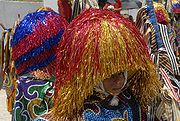 Festa Junina
was introduced to Northeastern Brazil
by the Portuguese
for whom St John's day (also celebrated as Midsummer
Day in several European countries), on the 24th of June, is one of the oldest and most popular celebrations of the year. Differently from what happens on the European Midsummer
Day. The festivities in Brazil do not take place during the summer solstice
but during the tropical winter solstice
. The festivities traditionally begin after the 12th of June, on the eve of St Anthony's day, and last until the 29th, which is Saint Peter's day. During these fifteen days, there are bonfire
s, fireworks
, and folk dancing in the streets. Typical foods and beverages are served. It should be noted that, like during Carnival, these festivities involve costumes-wearing (in this case, peasant costumes), dancing, drinking, and visual spectacles (fireworks display and folk dancing). Like what happens on Midsummer
and St John's Day in Europe, bonfires are a central part of these festivities in Brazil.
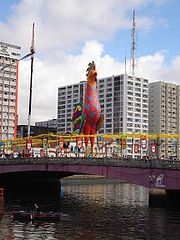 The four-day period before Lent leading up to Ash Wednesday is carnival
time in Brazil
. Rich and poor alike forget their cares as they party in the streets. Pernambuco
has large Carnival celebrations with more than 3000 shows in the street historic center performed for over than 430 local groups, including the Frevo
, typical Pernambuco
music. Another famous carnival music style from Pernambuco is Maracatu. The cities of Recife and Olinda
hold the most authentic and democratic carnaval
celebrations in Brazil
. The largest carnival in Brazil is Galo da Madrugada, which takes place in Downtown Recife
on Carnival Saturday. Another famous event is the "Noite dos Tambores Silenciosos." Carnival Recife's joyous Carnival is nationally known, attracting thousands of people every year. The party starts a week before the official date, with electric trios "shaking" the Boa Viagem
Neighborhood. On Friday, people take to the streets to dance to the sound of frevo
and to dance with maracatu, ciranda, caboclinhos, afoxé, reggae and manguebeat groups. There are still many other entertainment poles spread out around the city, featuring local and national artists. One of the highlights is Saturday when more than one and a half million people follow the Galo da Madrugada
group. From Sunday to Monday, there is the Night of the Silent Drums, on the Pátio do Terço, where Maracatu
s honor slaves that died in prison
s.
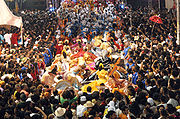 "Frevo
" was born from the confluence of European
and Afro-Brazilian
cultures
, as probably did all the other musical genres consolidated in Brazil. Historians from Pernambuco say that, before the term appeared in Recife's 'Jornal Pequeno', it was already heard and danced in a symbiosis of polkas, 'modinhas', 'dobrados' e 'maxixes' e 'jogos pastoris' (stick and rope formations) along the streets of Pernambuco
's capital. The music band
s (civilian or military) of the time helped giving the sound the defining character we have come to know as the Frevo
, a musical mass defined by the brasses. About the Street-Frevo
, conductor Guerra Peixe said once that "it is the only popular genre that does not admit the 'play-by-ear composer'. He was referring to the technical hardship of this kind of music, and stressing the role of conductors who led the 'frevistical' troupes.
 Guararapes International Airport, also known as Gilberto Freyre
International Airport, is the airport serving Recife, has been open in its newest structure since July 2004 and is 52,000 square meters in area. .
, is located in the administrative area of the small town of Ipojuca
, inside the metropolitan region. Suape serves ships 365 days a year without any restrictions with regard to tidal schedules. To assist in the docking operation of the ships, the port offers a monitoring system and laser ship docking system that enables effective, secure control and upholds the same technical standards as the most important ports across the globe. The port moves over 8.4 million tons of cargo a year. More than 95 Companies from almost all Industries are already installed in Suape which includes a Petrobras Refinary, the largest Ship Builder in South American and a large Petrochemical Company as many others.
 Port of Recife
is located in the city of Recife. Road access to Port of Recife is accomplished, mainly, through the federal highways BR-232 (linking the interior of the state) and BR-101 (linking to other States to the north and the south of the State of Pernambuco). The main producing and consuming centers of the interior of the state and of the rest of the Northeast
, are linked to Port
by paved highways.
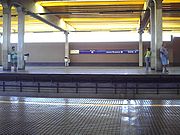
expansion has been in progress. When ready, Recife Metro
will become the second largest in Brazil
,
after São Paulo
. It already reaches from Recife central station to Jaboatão, Timbi (Camaragibe) and Mall (Shopping Recife).
This system also integrates with several bus lines connected to the bus
/metro
integration terminals
, such as Barro and Joana Bezerra stations. It is possible to ride the metro and the connected bus line by purchasing one ticket only. Since March 2009, Recife Metro
has finished one more phase of expansion. The system now has 28 stations (11 integrated with buses) and is 39.5 km (24.5 mi) long.
-PE (Transportation State Bureau Administrator) in 2009, the city of Recife has a total fleet of over 464 thousand motor vehicle
s on its streets. 54,335 cargo vehicles, 318,520 passenger vehicles, 72,719 motorbikes, 14,142 others and 4,855 buses (split between private and public). These buses transport almost two million passengers daily in the metropolitan area
, distributed between 17 local bus companies.
is crossed by 3 main Federal highways:
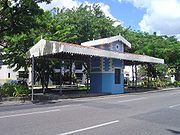
 The city has 6 Regions Political Administrative RPA, which contains all 94 neighborhoods:
began in 1902, when English and Dutch
sailors landed in Recife and played a game of soccer on the beach. The new game aroused the interest of the people of Pernambuco, and they soon started playing.
Recife provides visitors and residents with various sporting activities. There are several soccer clubs based in Recife, such as Sport
(39 times state champion and once national champion (87) and Brazil's Cup champion (08)), Santa Cruz
the current 2011 State Champion (24 times state champion) and Náutico
(21 times state champion and unique 6 consecutives). The Campeonato Pernambucano
(Pernambuco's State Championship) is divided into Taça Tabocas e Guararapes and Taça Confederação do Equador. They both have the same format: standard round-robin, in which all teams play each other once. A round-robin tournament or all-play-all tournament
is a type of group tournament in which each participant plays every other participant an equal number of times. If a team wins both Taça Tabocas e Guararapes and Taça Confederação do Equador, it is crowned the state champion
. If not, a home-and-away playoff with the winners
is disputed, and the winner is declared the state champion.
Also, the city has traditions in another sports as:
Basketball, Hockey, Golf, Tenis, Table tenis, Volleyball, beach volley, Handball, Surf, Bodysurf, Swimning pool and Futsal. Provided by clubs such as:
Nautico, Sport, Santa Cruz, Portuguese Club of Recife, Caxanga Golf & Country Club, Mauricio de Nassau University, School of Tenis Recife as others.
, for which Brazil
is the host nation. The Metropolitan Recife
project consists of a new Sports City to be built in São Lourenço da Mata
in an intersection area near to Recife, Jaboatão dos Guararapes
and Camaragibe
. The new Sports complex is 19 km (11.8 mi) west of Recife city center and 19 km (11.8 mi) from the Airport.
The sports complex 'City' will have a new stadium (Arena Cidade da Copa
) with 45,000 seats, 9,000 flats, 6,000 car parking spaces, 1 hospital, 1 technical school, 1 shopping center, 1 integrated metro/bus station and improvement of federal roads, all with an estimated cost of R$ 1.6 billion. Further expenses will be necessary in the metro area for remodelling of roads and airport expansion.
This is the second time Recife has been chosen to be one of the host cities of the FIFA World Cup
. In 1950
, Recife hosted just one game in the Brazil World Cup between Chile
and the United States. At this time, it was the only city which represented the Northeast
of Brazil
.
 Recife's reputation for safety is not one of the best of the country which placed the city as 9th most violent city in Brazil
, and 2nd as capital, after only Maceió
. As one of the largest Recife metropolitan area
(4th) of the country with large urban concentrations of unskilled people in the peripheral suburbs.
PESP plan
The State Governor Eduardo Campos introduced the PESP plan (Security state Plan - Plano Estadual de Seguranca Publica) on second of May 2009, which will try to reduce homicides by 12% each year until they reach half of the previous rate. The plan is based on the fact that 60% of the murders are committed by people related to criminal activities and reaches from the prevention stage until the correctional stage.
Carnival Security plan
ISS servers managed 50 Pelco Spectra PTZ camera
s to capture all activity within the city's celebratory areas. Continued deployment of this project
at Recife, will continue towards a short term goal of over 1000 cameras blanketing the city. Immediate statistic
s during the Carnival period indicate a reduction in violent crime
of over 30%.
Sex tourism
There has been a growing number of foreign tourists who come to Brazil looking for sex, mostly Germans
, Italians
, and other Europeans. These tourists come to Recife not for the culture and beaches, but for sex, often with minors. Brazil has a supply of young girls desperate to escape poverty, and the demand from foreign men is rising all the time. In Recife, where a growing population of children sleep on park benches or fall drugged or drunk on the curbs outside bars catering to a brisk trade in sex tourism
, many girls who live on the streets have begun slashing themselves with razor blades, often on their forearms. Recife's secretary for tourism, Romeo Batista, says the long-term antidote to the sex trade lies in better social policies so that Brazilian girls have less need for foreign men and money. Several countries worldwide have their own legislation that prosecutes tourists in their homeland if they engage in illicit sexual conduct in a foreign country with children.
 UNICEF is an international development agency, which supports locally initiated projects with an emphasis on children. Recife offered an environment to utilize its rich cultural heritage to develop programs aimed at its most serious issues. One of the most hands-on projects was a radio program named "Jovens Comunicadores" (Communicating Youth). It trained a group of eighteen adolescents to produce a weekly radio program focusing on child labour. The program is recorded and sent to community radio stations, most of which are broadcast in the sugar cane area where many children work. Jovens Comunicadores advocates and lobbies against exploitation, all produced and edited by teens. As a radio program, it also plays regional music, giving a boost to local culture
.
"Criança Feliz" (Happy Child) had the same objective, eliminating child exploitation, but used a different approach. It was begun by a women's organization and offered after-school activities with the goal of discouraging children and adolescents from working in sex tourism. Besides giving classes and training in computers, English, art, and karate, it also offered psychological services and group therapy
. These combined services sought to equip children not only with skills but also a positive self image and respect to not fall into prostitution
. As all the kids came from very poor backgrounds, the financial pull of prostitution is very high. Criança Feliz worked at educating them about the high costs in the long term. This was a very interesting project, since it was actually a house with groups of kids divided into participating in different activities.
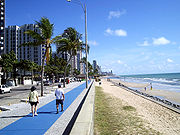 In recent years, the number of shark attack
s on the beaches of Recife has increased. This was addressed on the National Geographic Channel
series Hunter Hunted
in the episode "Shark Invasion." Surfing
has been outlawed since 1995 on the urban beaches (Pina, Boa Viagem
, Piedade, and Candeias) because of the risk the sport poses to its practitioners due to shark
attacks. It's strongly recommended you do not climb over and swim behind the reefs because of strong, unpredictable currents and the possible presence of bull sharks. Several beach
es have messages alerting people of the danger of finding shark
s, although this is very rare as in most parts of Brazil
.
Before the 1990s, there were virtually no attacks reported here. But since 1992, there have been 47 shark attacks along a 20 km (12.4 mi) stretch of coast. Sixteen of them were fatal. In 2004, there were seven reported attacks. Two of the victims died. However, in absolute
term
s, there are more shark attacks in the U.S. State of Florida
and Australia than in Brazil. Since mid-1992, 50 encounters involving humans and sharks, 19 of them fatal, have been recorded along the short strip of coast. By comparison, a relatively modest 18 unprovoked shark attacks were reported along the 1926 kilometres (1,196.8 mi) of Florida coast in 2005, according to the International Shark Attack File
compiled by the American Elasmobranch Society
and the Florida Museum of Natural History
. At the same rate per kilometer per year as Recife, Florida
would suffer nearly 350 attacks a year.
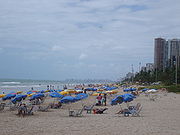 A state-funded investigation has focused on the long-term ecological effect
s of a new port
, to the south of Recife. Port of Suape opened for business in 1984, and today handles more than four million tonnes of cargo per year. To facilitate its initial construction, two freshwater estuaries, which had discharged into the Atlantic Ocean, were sealed off. Based on that finding, local human rights
lawyers are considering a symbolic legal challenge to the State of Pernambuco
, with the aim of securing compensation for the victims of attacks.
Via CEMIT, Pernambuco
state officials have attempted to reduce the risk of shark attacks through education
al campaign
s, oversight and research
. A CEMIT patrol
boat has captured 14 shark
s found too close to the coast for comfort over two years. Other public
policies include the posting of warning signs every 350 meters (1,150 ft) along the beach
and the prohibition of surfing
in threatened areas.
Nevertheless, when the beach has low waves, natives and tourists protected by the natural reefs do go swimming.
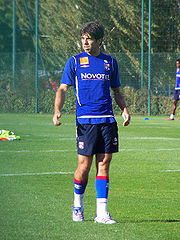
Tourism
Recife metropolitan area
Recife Metropolitan Area is the largest urban metropolitan area of the Northeast/North regions and the fifth in Brazil with 3,768,902 inhabitants in 2008.Is among with another large cities the first nine established metropolitan regions in Brazil...
in Brazil
Brazil
Brazil , officially the Federative Republic of Brazil , is the largest country in South America. It is the world's fifth largest country, both by geographical area and by population with over 192 million people...
with 4,136,506 inhabitants, the largest metropolitan area of the North/Northeast Regions, the 5th-largest metropolitan influence area in Brazil, and the capital and largest city of the state of Pernambuco
Pernambuco
Pernambuco is a state of Brazil, located in the Northeast region of the country. To the north are the states of Paraíba and Ceará, to the west is Piauí, to the south are Alagoas and Bahia, and to the east is the Atlantic Ocean. There are about of beaches, some of the most beautiful in the...
. The population of the city proper was 1,561,659 in 2009. Recife is located where the Beberibe River
Beberibe River
Beberibe River, its a river located in Pernambuco, Brazil. The river rises in the city of Camaragibe from the confluence of the rivers Araçá and Pacas, and is 23.7 km long. Its drainage basin measures 81 square kilometers and includes the following cities: Recife , Olinda and Camaragibe...
meets the Capibaribe River
Capibaribe River
The Capibaribe River is a river located in Pernambuco state, Brazil, with a length of 240 kilometers. The Capibaribe originates in the Serra do Jacarará, in the municipality of Poção, and flows to the Atlantic Ocean.-Etymology:...
to flow into the Atlantic Ocean. It is a major port on the Atlantic Ocean. Its name is an allusion to the coral reef
Reef
In nautical terminology, a reef is a rock, sandbar, or other feature lying beneath the surface of the water ....
s that are present by the city's shores. The many rivers, small islands and over 50 bridges found in Recife city center characterize its geography and gives it the moniker of the "Brazilian Venice
Venice
Venice is a city in northern Italy which is renowned for the beauty of its setting, its architecture and its artworks. It is the capital of the Veneto region...
."
The Metropolitan Region of Recife
Recife metropolitan area
Recife Metropolitan Area is the largest urban metropolitan area of the Northeast/North regions and the fifth in Brazil with 3,768,902 inhabitants in 2008.Is among with another large cities the first nine established metropolitan regions in Brazil...
is the main industrial zone of the State of Pernambuco
Pernambuco
Pernambuco is a state of Brazil, located in the Northeast region of the country. To the north are the states of Paraíba and Ceará, to the west is Piauí, to the south are Alagoas and Bahia, and to the east is the Atlantic Ocean. There are about of beaches, some of the most beautiful in the...
; most relevant products are those derived from cane
Sugarcane
Sugarcane refers to any of six to 37 species of tall perennial grasses of the genus Saccharum . Native to the warm temperate to tropical regions of South Asia, they have stout, jointed, fibrous stalks that are rich in sugar, and measure two to six metres tall...
(sugar and ethanol
Ethanol fuel in Brazil
Brazil is the world's second largest producer of ethanol fuel and the world's largest exporter. Together, Brazil and the United States lead the industrial production of ethanol fuel, accounting together for 87.8% of the world's production in 2010. In 2010 Brazil produced 26.2 billion litres Brazil...
), electronics, food, and others; thanks to the fiscal incentives of government, many industrial enterprises were started in the 1970s and 1980s. Recife has a tradition of being the most important commercial center
Commerce
While business refers to the value-creating activities of an organization for profit, commerce means the whole system of an economy that constitutes an environment for business. The system includes legal, economic, political, social, cultural, and technological systems that are in operation in any...
of the North/Northeastern region of Brazil with more than 52,500 business enterprises in Recife itself plus 32,500 in the Metro Area which totals more than 85,000.
A combination of a large supply of labor
Workforce
The workforce is the labour pool in employment. It is generally used to describe those working for a single company or industry, but can also apply to a geographic region like a city, country, state, etc. The term generally excludes the employers or management, and implies those involved in...
and significant private investments turned Recife into Brazil's second largest medical center (second only to São Paulo
São Paulo
São Paulo is the largest city in Brazil, the largest city in the southern hemisphere and South America, and the world's seventh largest city by population. The metropolis is anchor to the São Paulo metropolitan area, ranked as the second-most populous metropolitan area in the Americas and among...
); modern hospitals with state-of-the-art equipment receive patients from several neighboring States. Like all other cities in the Northeast
Northeast Region, Brazil
The Northeast Region of Brazil is composed of the following states: Maranhão, Piauí, Ceará, Rio Grande do Norte, Paraíba, Pernambuco, Alagoas, Sergipe and Bahia, and it represents 18.26% of the Brazilian territory....
, Recife is developing its tourist sector
Tourism
Tourism is travel for recreational, leisure or business purposes. The World Tourism Organization defines tourists as people "traveling to and staying in places outside their usual environment for not more than one consecutive year for leisure, business and other purposes".Tourism has become a...
. The beach of Porto de Galinhas
Porto de Galinhas
Porto de Galinhas is a beach in the municipality of Ipojuca, Pernambuco, Brazil. Porto de Galinhas is a major tourist destination. The beach is famous for its bright-water beaches and the natural pools.It is part of the municipality of Ipojuca, and located south of the state capital, Recife.It has...
, 60 kilometres (37.3 mi) south of the city, has been repeatedly awarded the title of best beach in Brazil and has drawn many tourists. Recife's infrastructure is among the most developed in Brazil for travellers and business people, though there is wide room for improvement.
The city is also a renowned educational center, and home to the Federal University of Pernambuco
Federal University of Pernambuco
The Federal University of Pernambuco is a public university located in Recife, Brazil, and established in 1946. UFPE has 70 undergraduate courses and 175 postgraduate courses. As of 2007, UFPE had near 35,000 students and about 2,000 professors. The university has three campuses: Recife, Vitória...
, the largest university in Pernambuco. Several Brazilian historical figures, such as the poet and abolitionist Castro Alves
Castro Alves
Antônio Frederico de Castro Alves was a Brazilian poet and playwright, famous for his Abolitionist and Republican poems...
, moved to Recife to attain their education.
Together with Natal
Natal, Rio Grande do Norte
-History:The northeastern tip of South America, Cabo São Roque, to the north of Natal and the closest point to Europe from Latin America, was first visited by European navigators in 1501, in the 1501–1502 Portuguese expedition led by Amerigo Vespucci, who named the spot after the saint of the day...
these are the only Brazilian cities with direct flights to the islands of Fernando de Noronha
Fernando de Noronha
Fernando de Noronha is an archipelago of 21 islands and islets in the Atlantic Ocean, offshore from the Brazilian coast. The main island has an area of and had a population of 3,012 in the year 2010...
, World Heritage Site since 2001.
Geography
Due to the city's proximity to the equatorEquator
An equator is the intersection of a sphere's surface with the plane perpendicular to the sphere's axis of rotation and containing the sphere's center of mass....
, Recife weather is generally warm. Recife has a number of islands, rivers, waterways and bridges that crisscross the city.
Recife is located amidst tropical forests which are distinguished by high rainfall levels resulting in poor soil quality as the rainfall washes away the nutrients.
There is an absence of extreme temperatures and a cool breeze due to the trade winds from the Atlantic Ocean.
Vegetation
Recife has a tropical forest. Rainforests are characterized by high rainfall, with definitions setting minimum normal annual rainfall between 2000 millimetres (78.7 in) and 1700 millimetres (66.9 in). The soil can be poor because high rainfall tends to leach out soluble nutrients. There are several common characteristics of tropical rainforestRainforest
Rainforests are forests characterized by high rainfall, with definitions based on a minimum normal annual rainfall of 1750-2000 mm...
trees. The city of Recife is formed by three islands (Recife, Santo Antônio, and Boa Vista). Between the islands are the rivers Beberibe and Capibaribe.
Hydrography
- CapibaribeCapibaribe RiverThe Capibaribe River is a river located in Pernambuco state, Brazil, with a length of 240 kilometers. The Capibaribe originates in the Serra do Jacarará, in the municipality of Poção, and flows to the Atlantic Ocean.-Etymology:...
, BeberibeBeberibeBeberibe is a municipality in the state of Ceará in Brazil. Its estimated population in 2006 is 46,439.The current mayor of Beberibe is Marcos de Queiroz Ferreira. His term ends in 2008. The municipality was created on June 5, 1892, and incorporated July 18, 1892...
, Jiquiá, Tejipió, Jordão and Pina.
Beaches
- Boa ViagemBoa Viagem, RecifeBoa Viagem is a neighborhood in the city of Recife, Pernambuco in the privileged southern zone of the town. The neighborhood has one of the most visited beaches in Northeastern Brazil, Boa Viagem beach....
, Pina and Brasilia Teimosa
Lakes
- Araçá
Large water supplier (Dam
Dam
A dam is a barrier that impounds water or underground streams. Dams generally serve the primary purpose of retaining water, while other structures such as floodgates or levees are used to manage or prevent water flow into specific land regions. Hydropower and pumped-storage hydroelectricity are...
s)
- Prata do Meio and Apipucos
Climate
Recife has a year-round tropical climateTropical climate
A tropical climate is a climate of the tropics. In the Köppen climate classification it is a non-arid climate in which all twelve months have mean temperatures above...
, with warm to hot temperatures and high relative humidity throughout the year. However, these conditions are relieved by a near absence of extreme temperatures and pleasant trade winds blowing from the ocean. Under the Koppen climate classification
Köppen climate classification
The Köppen climate classification is one of the most widely used climate classification systems. It was first published by Crimea German climatologist Wladimir Köppen in 1884, with several later modifications by Köppen himself, notably in 1918 and 1936...
, the city's climate straddles a tropical monsoon climate
Tropical monsoon climate
Tropical monsoon climate, occasionally also known as a tropical wet climate or tropical monsoon and trade-wind littoral climate in climate classification, is a relatively rare type of climate that corresponds to the Köppen climate classification category "Am."Tropical monsoon climates have monthly...
and a tropical wet and dry climate. January is the warmest month, with mean temperatures ranging from 30 °C (86 °F) to 25 °C (77 °F), with sun; July experiences the coolest temperatures, with mean temperatures ranging from 27 °C (80.6 °F) to 22 °C (71.6 °F), with rain. June is the wettest month and the second-cloudiest, receiving an average of 390 mm (15.4 in) of precipitation, and surpassed in cloudiness only by August. Indeed, August is incredibly cloudy in Recife, with a mere daily average of 3.5 hours of sunshine throughout the month. The driest and sunniest month is November, when maximum temperatures hover around 30°C and an average of 48 mm (1.9 in) of precipitation is recorded.
History
In 1537, John III of Portugal
John III of Portugal
John III , nicknamed o Piedoso , was the fifteenth King of Portugal and the Algarves. He was the son of King Manuel I and Maria of Aragon, the third daughter of King Ferdinand II of Aragon and Queen Isabella I of Castile...
divided Brazil into Hereditary Captaincies (Capitanias Hereditárias, in Portuguese); the Portuguese realized that they had no human or financial resources to invest in such a large and distant colony, and decided to assign this task to private entrepreneurs, called Donatários (this system had already been successful in the settlement of the Portuguese colonies in Africa).
Because of several problems (the most obvious being the lack of support from the Portuguese metropolis), most Captaincies failed. One of the few to prosper was the Captaincy of Pernambuco
Pernambuco
Pernambuco is a state of Brazil, located in the Northeast region of the country. To the north are the states of Paraíba and Ceará, to the west is Piauí, to the south are Alagoas and Bahia, and to the east is the Atlantic Ocean. There are about of beaches, some of the most beautiful in the...
, which was assigned to Duarte Coelho Pereira (the man who founded Olinda
Olinda
Olinda is a historic city in the Brazilian state of Pernambuco, located on the country's northeastern Atlantic Ocean coast, just north of Recife and south of Paulista...
which has its historic town center considered a World Heritage site
World Heritage Site
A UNESCO World Heritage Site is a place that is listed by the UNESCO as of special cultural or physical significance...
by UNESCO
UNESCO
The United Nations Educational, Scientific and Cultural Organization is a specialized agency of the United Nations...
and became famous for expressing his enchantment with the beauty of the place, giving the name to the city).
Pernambuco prospered from the sugarcane
Sugarcane
Sugarcane refers to any of six to 37 species of tall perennial grasses of the genus Saccharum . Native to the warm temperate to tropical regions of South Asia, they have stout, jointed, fibrous stalks that are rich in sugar, and measure two to six metres tall...
industry (beet
Beet
The beet is a plant in the Chenopodiaceae family which is now included in Amaranthaceae family. It is best known in its numerous cultivated varieties, the most well known of which is the purple root vegetable known as the beetroot or garden beet...
sugar was not industrially produced in Europe until the beginning of the 19th century). At the time, in Europe, sugarcane plantations could be grown only in Andalusia
Andalusia
Andalusia is the most populous and the second largest in area of the autonomous communities of Spain. The Andalusian autonomous community is officially recognised as a nationality of Spain. The territory is divided into eight provinces: Huelva, Seville, Cádiz, Córdoba, Málaga, Jaén, Granada and...
and the Algarve; in the 1420s, sugarcane was carried to the Canary Islands
Canary Islands
The Canary Islands , also known as the Canaries , is a Spanish archipelago located just off the northwest coast of mainland Africa, 100 km west of the border between Morocco and the Western Sahara. The Canaries are a Spanish autonomous community and an outermost region of the European Union...
, Madeira
Madeira
Madeira is a Portuguese archipelago that lies between and , just under 400 km north of Tenerife, Canary Islands, in the north Atlantic Ocean and an outermost region of the European Union...
and the Azores
Azores
The Archipelago of the Azores is composed of nine volcanic islands situated in the middle of the North Atlantic Ocean, and is located about west from Lisbon and about east from the east coast of North America. The islands, and their economic exclusion zone, form the Autonomous Region of the...
; the sugar from Brazil was very much appreciated in Europe. Duarte Coelho found in Pernambuco plenty of fertile land and an excellent climate for the cultivation of cane; all he needed was labor to work the crops and to keep the "engenhos" (rustic wooden machinery) moving.
At first, the Portuguese tried to use the indigenous peoples of Brazil, but since Portugal was the country with the strongest black slave market because of their previous expeditions to Africa, using black slaves would not only be easier to handle, but it would be cheaper as well; from the 16th to the 19th century, Pernambuco received many African slaves, making it one of the Brazilian States where black African culture has the most visible traces (in dance, music, culinary, etc.).
From 1580 to 1640, the kingdoms of Spain and Portugal were unified under the rule of the former. Spain was engaged in a war against the Netherlands, and determined that the Dutch, who were the main distributors of Brazilian sugar in Europe, would be prohibited from coming to Brazil.
The Dutch decided to invade several sugar producing cities in Brazil, including Salvador
Salvador, Bahia
Salvador is the largest city on the northeast coast of Brazil and the capital of the Northeastern Brazilian state of Bahia. Salvador is also known as Brazil's capital of happiness due to its easygoing population and countless popular outdoor parties, including its street carnival. The first...
and Natal
Natal, Rio Grande do Norte
-History:The northeastern tip of South America, Cabo São Roque, to the north of Natal and the closest point to Europe from Latin America, was first visited by European navigators in 1501, in the 1501–1502 Portuguese expedition led by Amerigo Vespucci, who named the spot after the saint of the day...
. From 1630 to 1654, they took control of Recife and Olinda, making Recife the new capital of Dutch Brazil
Dutch Brazil
Dutch Brazil, also known as New Holland, was the northern portion of Brazil, ruled by the Dutch during the Dutch colonization of the Americas between 1630 and 1654...
, the city of Mauritsstad
Mauritsstad
Mauritsstad was the capital of Dutch Brazil, and is now a part of the Brazilian city of Recife.The city was built on the island of Antonio Vaz opposite Recife, and designed by architect Pieter Post. It was named after Governor Johan Maurits van Nassau-Siegen, who had founded the city and palace...
. During this period, Mauritsstad became one of the most cosmopolitan cities of the world. Unlike the Portuguese, the Dutch did not prohibit Judaism. The first Jewish community and the first synagogue
Synagogue
A synagogue is a Jewish house of prayer. This use of the Greek term synagogue originates in the Septuagint where it sometimes translates the Hebrew word for assembly, kahal...
in the Americas
Americas
The Americas, or America , are lands in the Western hemisphere, also known as the New World. In English, the plural form the Americas is often used to refer to the landmasses of North America and South America with their associated islands and regions, while the singular form America is primarily...
was founded in the city.
The inhabitants fought on their own to expel the Dutch, being helped by the involvement of the Dutch in the First Anglo-Dutch War
First Anglo-Dutch War
The First Anglo–Dutch War was the first of the four Anglo–Dutch Wars. It was fought entirely at sea between the navies of the Commonwealth of England and the United Provinces of the Netherlands. Caused by disputes over trade, the war began with English attacks on Dutch merchant shipping, but...
. This was known as the Insurreição Pernambucana (Pernambucan Insurrection). Most of the Jews fled to Amsterdam
Amsterdam
Amsterdam is the largest city and the capital of the Netherlands. The current position of Amsterdam as capital city of the Kingdom of the Netherlands is governed by the constitution of August 24, 1815 and its successors. Amsterdam has a population of 783,364 within city limits, an urban population...
; others fled to North America, starting the first Jewish community of New Amsterdam
New Amsterdam
New Amsterdam was a 17th-century Dutch colonial settlement that served as the capital of New Netherland. It later became New York City....
(now known as New York City).
During the 18th century, riots spread throughout the city, in which the rich farmers of Olinda
Olinda
Olinda is a historic city in the Brazilian state of Pernambuco, located on the country's northeastern Atlantic Ocean coast, just north of Recife and south of Paulista...
and the traders from Recife clashed. Recife had a clear advantage in relation to Olinda: Olinda has no harbour, while Recife's Harbor is one of the largest on the Atlantic Ocean. Recife's victory asserted the supremacy of its bourgeoisie
Bourgeoisie
In sociology and political science, bourgeoisie describes a range of groups across history. In the Western world, between the late 18th century and the present day, the bourgeoisie is a social class "characterized by their ownership of capital and their related culture." A member of the...
over the decadent sugar aristocrats of Olinda. This was a decisive factor for Recife's growth. Recife is now a large city whereas Olinda is a small historical town. Recife is a historical city, distinguished by the opulence of its colonial buildings, with its colonization rooted in different nations; Portugal, the Netherlands, France, England.
Demographics
White Brazilian
White Brazilians make up 48.4% of Brazil's population, or around 92 million people, according to the IBGE's 2008 PNAD . Whites are present in the entire territory of Brazil, although the main concentrations are found in the South and Southeastern parts of the country...
people (38.90%), 280,000 Black
Afro-Brazilian
In Brazil, the term "preto" is one of the five categories used by the Brazilian Census, along with "branco" , "pardo" , "amarelo" and "indígena"...
people (7.49%), 16,000 Amerindian
Indigenous peoples in Brazil
The Indigenous peoples in Brazil comprise a large number of distinct ethnic groups who inhabited the country prior to the European invasion around 1500...
people (0.43%), 7,000 Asian
Asian Brazilian
An Asian Brazilian is is a Brazilian citizen of full or partial Asian ancestry, who remains culturally connected to Asia, or an Asian-born person permanently residing in Brazil. Brazil received many immigrants from Asia, both from Middle East and East Asia...
people (0.20%).
The Metropolitan Region
Recife metropolitan area
Recife Metropolitan Area is the largest urban metropolitan area of the Northeast/North regions and the fifth in Brazil with 3,768,902 inhabitants in 2008.Is among with another large cities the first nine established metropolitan regions in Brazil...
of Recife is the 4th most populous of Brazil
Brazil
Brazil , officially the Federative Republic of Brazil , is the largest country in South America. It is the world's fifth largest country, both by geographical area and by population with over 192 million people...
, after São Paulo
São Paulo
São Paulo is the largest city in Brazil, the largest city in the southern hemisphere and South America, and the world's seventh largest city by population. The metropolis is anchor to the São Paulo metropolitan area, ranked as the second-most populous metropolitan area in the Americas and among...
, Rio de Janeiro
Rio de Janeiro
Rio de Janeiro , commonly referred to simply as Rio, is the capital city of the State of Rio de Janeiro, the second largest city of Brazil, and the third largest metropolitan area and agglomeration in South America, boasting approximately 6.3 million people within the city proper, making it the 6th...
, Belo Horizonte
Belo Horizonte
Belo Horizonte is the capital of and largest city in the state of Minas Gerais, located in the southeastern region of Brazil. It is the third largest metropolitan area in the country...
, and the 1st in the Northeast region
Northeast Region, Brazil
The Northeast Region of Brazil is composed of the following states: Maranhão, Piauí, Ceará, Rio Grande do Norte, Paraíba, Pernambuco, Alagoas, Sergipe and Bahia, and it represents 18.26% of the Brazilian territory....
. The city is the 9th most populous of the country with 1,561,659 inhabitants, and third largest city in the Northeast region
Northeast Region, Brazil
The Northeast Region of Brazil is composed of the following states: Maranhão, Piauí, Ceará, Rio Grande do Norte, Paraíba, Pernambuco, Alagoas, Sergipe and Bahia, and it represents 18.26% of the Brazilian territory....
,according with IBGE 2009. The most populous neighborhoods of Recife in 2008 were Boa Viagem
Boa Viagem, Recife
Boa Viagem is a neighborhood in the city of Recife, Pernambuco in the privileged southern zone of the town. The neighborhood has one of the most visited beaches in Northeastern Brazil, Boa Viagem beach....
(100,388), Casa Amarela (69,134), and Várzea (64,512).
| > | Year | Inhabitants |
|---|---|
| 1630 | 7,000 |
| 1654 | 8,000 |
| 1709 | 12,000 |
| 1790 | 15,000 |
| 1810 | 25,000 |
| 1838 | 60,000 |
| 1872 | 126,671 |
| 1890 | 111,000 |
| 1900 | 113,106 |
Religion
The Patroness SaintPatron saint
A patron saint is a saint who is regarded as the intercessor and advocate in heaven of a nation, place, craft, activity, class, clan, family, or person...
of Recife is Our Lady of Mount Carmel (Nossa Senhora do Carmo), dating back one hundred years ago (1909). Every July 16, her day, she is remembered by the Catholics in Recife, in her church.
| Religion | Percentage | Number |
|---|---|---|
| Catholic | 68.02% | 976,807 |
| Protestant | 23.78% | 358,564 |
| No religion | 5.1% | 87,910 |
| Spiritist Spiritism Spiritism is a loose corpus of religious faiths having in common the general belief in the survival of a spirit after death. In a stricter sense, it is the religion, beliefs and practices of the people affiliated to the International Spiritist Union, based on the works of Allan Kardec and others... |
1.53% | 30,782 |
Source: IBGE 2000.
Economy
According to 2007 IBGE statistics, the GDP was estimated at R$ 20.7 billion (Brazilian Reais), not counting agricultural activities. Manufacturing represented 17.4% and the sector of the commerce and service 82.53%. In 2006, IBGE estimates indicate that the GDP just of the city had grown to R$ 18.3 billion.Recife is one of Brazil
Brazil
Brazil , officially the Federative Republic of Brazil , is the largest country in South America. It is the world's fifth largest country, both by geographical area and by population with over 192 million people...
's prime business centers, largely because it has one International Airport and two International port
Port
A port is a location on a coast or shore containing one or more harbors where ships can dock and transfer people or cargo to or from land....
s. One is located in the town itself, and the other, the port of Suape, is located about 40 kilometres (24.9 mi) away. Just south of Recife is the region
Recife metropolitan area
Recife Metropolitan Area is the largest urban metropolitan area of the Northeast/North regions and the fifth in Brazil with 3,768,902 inhabitants in 2008.Is among with another large cities the first nine established metropolitan regions in Brazil...
's main industrial area
Industry
Industry refers to the production of an economic good or service within an economy.-Industrial sectors:There are four key industrial economic sectors: the primary sector, largely raw material extraction industries such as mining and farming; the secondary sector, involving refining, construction,...
, where the following industries can be found: brewing and canning, automotive electronics, tube manufacturing, chocolate manufacturing, textiles, etc.
Recife has shared in the prosperity of Northeastern Brazil
Northeast Region, Brazil
The Northeast Region of Brazil is composed of the following states: Maranhão, Piauí, Ceará, Rio Grande do Norte, Paraíba, Pernambuco, Alagoas, Sergipe and Bahia, and it represents 18.26% of the Brazilian territory....
that resulted from development promoted after 1960 by Sudene
Sudene
The Superintendency for the Development of the Northeast , or Sudene for short, is a Brazilian governmental agency created in 1959, during the government of President Juscelino Kubitschek , to stimulate economic growth in the northeastern region of Brazil, one of the poorest of the country, that...
(Superintendência para o Desenvolvimento do Nordeste), a federal
Central government
A central government also known as a national government, union government and in federal states, the federal government, is the government at the level of the nation-state. The structure of central governments varies from institution to institution...
organization
Organization
An organization is a social group which distributes tasks for a collective goal. The word itself is derived from the Greek word organon, itself derived from the better-known word ergon - as we know `organ` - and it means a compartment for a particular job.There are a variety of legal types of...
. Although its retail and wholesale trade have grown in response to the region's increases in population and wealth, the market area and the walkways of the city's bridges are crowded with vendors selling small items.
The GDP for the city was R$ 20,718,107,000 (2007), and the per capita income
Per capita income
Per capita income or income per person is a measure of mean income within an economic aggregate, such as a country or city. It is calculated by taking a measure of all sources of income in the aggregate and dividing it by the total population...
for the city was R$ 13,510 which is the highest for the Northeastern Capitals of Brazil.
Information technology industry
Software manufacturing
Software manufacturing is the process of producing software in ways similar to the manufacturing of tangible goods. In this way of conducting business, each copy of the software is priced and sold as though it was a tangible product...
is the main activity in the Porto Digital. The Porto Digital cluster comprises small and median companies, but multinationals like Accenture
Accenture
Accenture plc is a global management consulting, technology services and outsourcing company headquartered in Dublin, Republic of Ireland. It is the largest consulting firm in the world and is a Fortune Global 500 company. As of September 2011, the company had more than 236,000 employees across...
, Motorola
Motorola
Motorola, Inc. was an American multinational telecommunications company based in Schaumburg, Illinois, which was eventually divided into two independent public companies, Motorola Mobility and Motorola Solutions on January 4, 2011, after losing $4.3 billion from 2007 to 2009...
, Samsung
Samsung
The Samsung Group is a South Korean multinational conglomerate corporation headquartered in Samsung Town, Seoul, South Korea...
, Dell
Dell
Dell, Inc. is an American multinational information technology corporation based in 1 Dell Way, Round Rock, Texas, United States, that develops, sells and supports computers and related products and services. Bearing the name of its founder, Michael Dell, the company is one of the largest...
and Sun Microsystems
Sun Microsystems
Sun Microsystems, Inc. was a company that sold :computers, computer components, :computer software, and :information technology services. Sun was founded on February 24, 1982...
are also installed in Porto Digital. IBM
IBM
International Business Machines Corporation or IBM is an American multinational technology and consulting corporation headquartered in Armonk, New York, United States. IBM manufactures and sells computer hardware and software, and it offers infrastructure, hosting and consulting services in areas...
and Microsoft
Microsoft
Microsoft Corporation is an American public multinational corporation headquartered in Redmond, Washington, USA that develops, manufactures, licenses, and supports a wide range of products and services predominantly related to computing through its various product divisions...
transferred their regional headquarters to Recife.
Porto Digital's startups can count on a ready pool of talent, courtesy of the Federal University of Pernambuco
Federal University of Pernambuco
The Federal University of Pernambuco is a public university located in Recife, Brazil, and established in 1946. UFPE has 70 undergraduate courses and 175 postgraduate courses. As of 2007, UFPE had near 35,000 students and about 2,000 professors. The university has three campuses: Recife, Vitória...
(UFPE), which boasts one of the best computer-science departments in all of Latin America. The school began teaching programmers to use Sun Microsystems Inc.'s (SUNW) Java language in 1996, the year it was introduced. Professors at the school also teamed up to launch Centro de Estudos e Sistemas Avançados do Recife (C.E.S.A.R), a business
Business
A business is an organization engaged in the trade of goods, services, or both to consumers. Businesses are predominant in capitalist economies, where most of them are privately owned and administered to earn profit to increase the wealth of their owners. Businesses may also be not-for-profit...
incubator that has played a vital role in the birth of some 30 companies
Company
A company is a form of business organization. It is an association or collection of individual real persons and/or other companies, who each provide some form of capital. This group has a common purpose or focus and an aim of gaining profits. This collection, group or association of persons can be...
.
Medical facilities
Recife metropolitan area
Recife Metropolitan Area is the largest urban metropolitan area of the Northeast/North regions and the fifth in Brazil with 3,768,902 inhabitants in 2008.Is among with another large cities the first nine established metropolitan regions in Brazil...
of Recife has the 2nd largest medical pool in Brazil
Brazil
Brazil , officially the Federative Republic of Brazil , is the largest country in South America. It is the world's fifth largest country, both by geographical area and by population with over 192 million people...
, after São Paulo
São Paulo
São Paulo is the largest city in Brazil, the largest city in the southern hemisphere and South America, and the world's seventh largest city by population. The metropolis is anchor to the São Paulo metropolitan area, ranked as the second-most populous metropolitan area in the Americas and among...
. Together they make up 417 hospitals and clinics with 72,000 employees in the Metro Area and more than 120,000 in the State of Pernambuco. The medical pool offers a total of 8,990 beds and, according to the Union of the Hospitals of Pernambuco, recorded in the year 2000 an invoicing of R$220 million (Brazilian Reals). It is thanks to the pool that Pernambuco
Pernambuco
Pernambuco is a state of Brazil, located in the Northeast region of the country. To the north are the states of Paraíba and Ceará, to the west is Piauí, to the south are Alagoas and Bahia, and to the east is the Atlantic Ocean. There are about of beaches, some of the most beautiful in the...
has access to more computed tomography
Computed tomography
X-ray computed tomography or Computer tomography , is a medical imaging method employing tomography created by computer processing...
devices than more developed countries such as Canada or France.
A large portion of the modern hospitals included in the pool are located between the neighbourhoods of Derby and of the Ilha do Leite. The Hospital Real Português de Beneficência Portuguesa em Pernambuco, or "Hospital Português" (Portuguese Hospital) for short, is one of the most renowned hospitals in the country. Many people from neighbouring states go to Recife for treatment, as it has the largest and best medical facilities in the North–Northeast of Brazil
Brazil
Brazil , officially the Federative Republic of Brazil , is the largest country in South America. It is the world's fifth largest country, both by geographical area and by population with over 192 million people...
. Recife has three universities for medicine
Medicine
Medicine is the science and art of healing. It encompasses a variety of health care practices evolved to maintain and restore health by the prevention and treatment of illness....
, 2 public, Federal University of Pernambuco
Federal University of Pernambuco
The Federal University of Pernambuco is a public university located in Recife, Brazil, and established in 1946. UFPE has 70 undergraduate courses and 175 postgraduate courses. As of 2007, UFPE had near 35,000 students and about 2,000 professors. The university has three campuses: Recife, Vitória...
and University of Pernambuco; and 1 private, Escola Pernambucana de Medicina FBV/IMIP (Medical School of Pernambuco).
Logistics center
Due to its ports, airport, and geographic location in the northeastern region of BrazilBrazil
Brazil , officially the Federative Republic of Brazil , is the largest country in South America. It is the world's fifth largest country, both by geographical area and by population with over 192 million people...
, Recife is considered one of the biggest logistics centers in Brazil. Logistic and Communications Economic sector employees 4% of the people in Recife, 12,3% in Jaboatão dos Guararapes
Jaboatão dos Guararapes
Jaboatão dos Guararapes is a city in the state of Pernambuco, Brazil. It is a part of the Recife metro area. The population was 687,688 according to the Brazilian Institute of Geography and Statistics in 2009, making it the second most-populous city in the state of Pernambuco and the 26th in...
and over 9% in the Metropolitan Area
Recife metropolitan area
Recife Metropolitan Area is the largest urban metropolitan area of the Northeast/North regions and the fifth in Brazil with 3,768,902 inhabitants in 2008.Is among with another large cities the first nine established metropolitan regions in Brazil...
. These numbers could increase by the end of 2010 with the conclusion of the Transnordestina (main NE Trainline with a 1,800/1,118 km/mi extension, which will cross 3 and connect 7 States (34 municipalities in Pernambuco alone) products with Suape port
Suape port
Suape Port is a Brazilian International Port located in the city of Ipojuca state of Pernambuco, among the municipalities of Ipojuca and Cabo de Santo Agostinho, inside the Recife metropolitan area and distant 40 km South of the capital . Suape serves ships 365 days a year without any restriction...
(PE) and Pecem Port (CE)) with costs that are estimated to be around 4.5 BR$.
Recife has historically benefited from its central location in the Northeast region
Northeast Region, Brazil
The Northeast Region of Brazil is composed of the following states: Maranhão, Piauí, Ceará, Rio Grande do Norte, Paraíba, Pernambuco, Alagoas, Sergipe and Bahia, and it represents 18.26% of the Brazilian territory....
. In a 200 miles (321.9 km) radius from Recife, it is possible to find four state capitals, two internationals and three regional airports, five international ports
Suape port
Suape Port is a Brazilian International Port located in the city of Ipojuca state of Pernambuco, among the municipalities of Ipojuca and Cabo de Santo Agostinho, inside the Recife metropolitan area and distant 40 km South of the capital . Suape serves ships 365 days a year without any restriction...
, 12 million people, 51% of the research centres of Northeast
Northeast Region, Brazil
The Northeast Region of Brazil is composed of the following states: Maranhão, Piauí, Ceará, Rio Grande do Norte, Paraíba, Pernambuco, Alagoas, Sergipe and Bahia, and it represents 18.26% of the Brazilian territory....
and 35% of the region's GDP. Similarly, in a 500 miles (804.7 km) radius there are seven state capitals, five international and five regional airports, nine international ports and two fluvial
Fluvial
Fluvial is used in geography and Earth science to refer to the processes associated with rivers and streams and the deposits and landforms created by them...
ports, almost 30 million people and 90% of the northeast region
Northeast Region, Brazil
The Northeast Region of Brazil is composed of the following states: Maranhão, Piauí, Ceará, Rio Grande do Norte, Paraíba, Pernambuco, Alagoas, Sergipe and Bahia, and it represents 18.26% of the Brazilian territory....
GDP.
Convention centres
According to the International Congress and Convention Associations (ICCA) Recife is ranked 6th in terms of Brazilian cities with the most International events. Many events taking place during the year include:- O Virtuosi, Festival International de Musica de Pernambuco (International Music Festival);
- O Mimo, Mostra International de Musica em OlindaOlindaOlinda is a historic city in the Brazilian state of Pernambuco, located on the country's northeastern Atlantic Ocean coast, just north of Recife and south of Paulista...
(International Music Show in OlindaOlindaOlinda is a historic city in the Brazilian state of Pernambuco, located on the country's northeastern Atlantic Ocean coast, just north of Recife and south of Paulista...
); - A feira da Musica Brasil/Porto Musical (Brasil Music Port);
- A Fispal Recife, Feira Internacional da Alimentacao (International Food Festival);
- Recife and Olinda CarnivalCarnivalCarnaval is a festive season which occurs immediately before Lent; the main events are usually during February. Carnaval typically involves a public celebration or parade combining some elements of a circus, mask and public street party...
.
And because of its geographic location, tourism and city infrastructurem Recife's Convention Centres are of a high standard:
- Centro de Convenções de Pernambuco (PernambucoPernambucoPernambuco is a state of Brazil, located in the Northeast region of the country. To the north are the states of Paraíba and Ceará, to the west is Piauí, to the south are Alagoas and Bahia, and to the east is the Atlantic Ocean. There are about of beaches, some of the most beautiful in the...
Convention Centre)
The 3rd largest convention centre in Brazil
Brazil
Brazil , officially the Federative Republic of Brazil , is the largest country in South America. It is the world's fifth largest country, both by geographical area and by population with over 192 million people...
with 2 large theatres with 2,800 seats, 4 Auditory rooms with 1,600 seats, 17 business meetings rooms, VIP rooms, large cultural multi-purpose lobby, more than 1,800 parking spots, in a total area of 75,000 square metres. It's considered one of the most developed in South America and fit for any kind of event.
- Centro de Convenções da UFPEFederal University of PernambucoThe Federal University of Pernambuco is a public university located in Recife, Brazil, and established in 1946. UFPE has 70 undergraduate courses and 175 postgraduate courses. As of 2007, UFPE had near 35,000 students and about 2,000 professors. The university has three campuses: Recife, Vitória...
(Federal University of Pernambuco Convention Centre)
Modern theatre with 1,931 seats and 2,071 square metres of exposition area located in the University Campus.
Tourism and recreation
New Year
The New Year is the day that marks the time of the beginning of a new calendar year, and is the day on which the year count of the specific calendar used is incremented. For many cultures, the event is celebrated in some manner....
begins at the beach, Praia de Boa Viagem
Boa Viagem, Recife
Boa Viagem is a neighborhood in the city of Recife, Pernambuco in the privileged southern zone of the town. The neighborhood has one of the most visited beaches in Northeastern Brazil, Boa Viagem beach....
and in Old Recife
Recife Antigo
Recife Antigo is the historical section of central Recife. It is located on the Island of Recife, near the Recife harbor. This historic area has been recently recovered and now holds several clubs, bars and a high-tech center called Porto Digital.-History:Recife Antigo consists of the initial...
. The carnival
Carnival
Carnaval is a festive season which occurs immediately before Lent; the main events are usually during February. Carnaval typically involves a public celebration or parade combining some elements of a circus, mask and public street party...
of Recife and Olinda
Olinda
Olinda is a historic city in the Brazilian state of Pernambuco, located on the country's northeastern Atlantic Ocean coast, just north of Recife and south of Paulista...
(which has its historic town center considered world heritage site by UNESCO
UNESCO
The United Nations Educational, Scientific and Cultural Organization is a specialized agency of the United Nations...
in 1982) begins many weeks ahead in December with innumerable balls and parades. In the city, the carnival festivities begin in December, as locals begin preparing for the official Carnival
Carnival
Carnaval is a festive season which occurs immediately before Lent; the main events are usually during February. Carnaval typically involves a public celebration or parade combining some elements of a circus, mask and public street party...
, which starts the week before Ash Wednesday. The pre-Carnival parties usually consist of percussion groups practicing in local clubs, city streets and squares, and even Carnival balls. There is a variety of rhythms from different cultures. Carnival officially starts with the Galo da Madrugada
Galo da Madrugada
The Galo da Madrugada is a carnival parade that happens every carnival Saturday, to the left of the São José district in downtown Recife, the state capital of Pernambuco, Brazil....
, a party in Downtown Recife
Recife Antigo
Recife Antigo is the historical section of central Recife. It is located on the Island of Recife, near the Recife harbor. This historic area has been recently recovered and now holds several clubs, bars and a high-tech center called Porto Digital.-History:Recife Antigo consists of the initial...
attracting many people from several States of Brazil, and other parts of the world.
Recife has many quality 3, 4 and 5-Star International Hotels as well Pousadas
Hostel
Hostels provide budget oriented, sociable accommodation where guests can rent a bed, usually a bunk bed, in a dormitory and share a bathroom, lounge and sometimes a kitchen. Rooms can be mixed or single-sex, although private rooms may also be available...
(traditional Bed & breakfast) and Apart-Hotels totaling more than 11,500 bedrooms and this number increase to over 30,000 Metropolitan Area
Recife metropolitan area
Recife Metropolitan Area is the largest urban metropolitan area of the Northeast/North regions and the fifth in Brazil with 3,768,902 inhabitants in 2008.Is among with another large cities the first nine established metropolitan regions in Brazil...
.
Mercado de São José
Mercado de São José
Mercado de São José is a public market in Recife, Pernambuco. Founded in 1871, it is the oldest brazilian building constructed of pre-manufactured iron....
(Market of Saint Joseph) is an old, iron construction with a very popular market nearby. In the Fort Cinco Pontes (Fort of Five Points) is the state museum, (Museu do Estado de Pernambuco). At the rectangular Pátio de São Pedro are the Cathedral São Pedro (Cathedral of Saint Peter) dating from the year 1782 and restored colonial houses, with numerous restaurants, bistros and bars. In the Bairro Santo Antônio (Saint Anthony Neighborhood), at the meeting place of the rivers Capibaribe and Beberibe, is the Praça da República (Square of the Republic) with the Teatro Santa Isabel (Theatre of Saint Isabel), with its neoclassic front - well worth seeing, the Law Courts, and the Palácio da Justiça (Palace of the Justice). Casa da Cultura (House of Culture) is an old prison that has been converted into a cultural space and shopping centre.
Built between 1835 and 1855, the Malakoff Tower
Malakoff Tower
Malakoff Tower is a tower located in Recife Antigo, Recife. This monument was built between 1835 and 1855 to be used as an observatory and as the main entrance and gateway for Arsenal da Marinha square...
, a monument constructed in Tunisia
Tunisia
Tunisia , officially the Tunisian RepublicThe long name of Tunisia in other languages used in the country is: , is the northernmost country in Africa. It is a Maghreb country and is bordered by Algeria to the west, Libya to the southeast, and the Mediterranean Sea to the north and east. Its area...
n style, which used to be an observatory
Observatory
An observatory is a location used for observing terrestrial or celestial events. Astronomy, climatology/meteorology, geology, oceanography and volcanology are examples of disciplines for which observatories have been constructed...
and now is a cultural centre and a place for popular gatherings. It is located at Arsenal da Marinha Square. It has been registered as a Historical Patrimony and was named after a similar monument on Crimean peninsula, used as a defence center for Sebastopol.
Recife has a zoo called Dois Irmãos Park
Zoo Botanical Park Dois Irmaos
The Zoo Botanical Park Dois Irmãos, is located in the city of Recife, state of Pernambuco - Brazil. The park has an area of 387.4 ha, 14 of which is dedicated for the Zoo Botanical and a Natural Science Museum, and the remaining area for an Atlantic Forest reserve...
, 387 hectares of Atlantic Forest reserve and 14 hectares of botanical garden
Botanical garden
A botanical garden The terms botanic and botanical, and garden or gardens are used more-or-less interchangeably, although the word botanic is generally reserved for the earlier, more traditional gardens. is a well-tended area displaying a wide range of plants labelled with their botanical names...
s. There are also 800 wild animals, the Natural Science Museum and various ecological trails. The metropolitan area
Recife metropolitan area
Recife Metropolitan Area is the largest urban metropolitan area of the Northeast/North regions and the fifth in Brazil with 3,768,902 inhabitants in 2008.Is among with another large cities the first nine established metropolitan regions in Brazil...
has also a giant water park 20 km (12.4 mi) North of Recife, called Veneza water park
Veneza water park
Veneza water park or Venice water park in English, is a giant aquatic park located in the beach of Maria farinha in Paulista, Pernambuco. Contains the largest artificially slow river of Brazil called Amazon river, and has an area nearly 1 million sq/ft with 10 million liters of water...
which has nearly one million sq/ft of area, ten millions litres of water and lots of water slides for the youngsters.
Among Recife's main tourist attractions are:
- Churches, historical monuments, public markets including 17th and 18th century constructions from PortuguesePortuguese peopleThe Portuguese are a nation and ethnic group native to the country of Portugal, in the west of the Iberian peninsula of south-west Europe. Their language is Portuguese, and Roman Catholicism is the predominant religion....
and DutchDutch peopleThe Dutch people are an ethnic group native to the Netherlands. They share a common culture and speak the Dutch language. Dutch people and their descendants are found in migrant communities worldwide, notably in Suriname, Chile, Brazil, Canada, Australia, South Africa, New Zealand, and the United...
colonisers; - Francisco BrennandFrancisco BrennandFrancisco Brennand, or Francisco de Paula de Almeida Brennand, is a Brazilian sculptor. He works in several different media, and is best known for his work in ceramic sculpture.-Brennand's works:...
's atelier of ceramic art; - Ricardo Brennand InstituteRicardo Brennand InstituteThe Ricardo Brennand Institute is a cultural institution located in the city of Recife, Brazil. It is a not-for-profit private organization, inaugurated in 2002 by the Brazilian collector and businessman Ricardo Brennand...
: cultural institute with museum, pinacotec and library; - Recife AntigoRecife AntigoRecife Antigo is the historical section of central Recife. It is located on the Island of Recife, near the Recife harbor. This historic area has been recently recovered and now holds several clubs, bars and a high-tech center called Porto Digital.-History:Recife Antigo consists of the initial...
(Old Recife) buildings; - Boa Viagem beachBoa Viagem, RecifeBoa Viagem is a neighborhood in the city of Recife, Pernambuco in the privileged southern zone of the town. The neighborhood has one of the most visited beaches in Northeastern Brazil, Boa Viagem beach....
(the inside city's most important beach) and many beautiful beaches in the metropolitan and state areaPernambuco beachesThe Pernambuco coast has 187 kilometres long plus the Fernando de Noronha islands coast.In Pernambuco are located dozens of beaches of all types, since virgins until urban beaches...
; - Casa da Cultura: souvenir shops in an Historic prison building;
- The CarnivalCarnivalCarnaval is a festive season which occurs immediately before Lent; the main events are usually during February. Carnaval typically involves a public celebration or parade combining some elements of a circus, mask and public street party...
at locations such as downtown and Recife Antigo; - OlindaOlindaOlinda is a historic city in the Brazilian state of Pernambuco, located on the country's northeastern Atlantic Ocean coast, just north of Recife and south of Paulista...
's historic town centre, considered a world heritage site by UNESCOUNESCOThe United Nations Educational, Scientific and Cultural Organization is a specialized agency of the United Nations...
; - News and Historic Cinemas, Theatres and Art galleries.
Shopping centers
Northeast Region, Brazil
The Northeast Region of Brazil is composed of the following states: Maranhão, Piauí, Ceará, Rio Grande do Norte, Paraíba, Pernambuco, Alagoas, Sergipe and Bahia, and it represents 18.26% of the Brazilian territory....
region, was inaugurated in 1980 through the initiatives of two large groups of entrepreneurs: Ancar and Ecisa. After twenty-three years and three expansion
Economic expansion
An economic expansion is an increase in the level of economic activity, and of the goods and services available in the market place. It is a period of economic growth as measured by a rise in real GDP.The explanation of such fluctuations in aggregate economic activity is one of the primary...
project
Project
A project in business and science is typically defined as a collaborative enterprise, frequently involving research or design, that is carefully planned to achieve a particular aim. Projects can be further defined as temporary rather than permanent social systems that are constituted by teams...
s, Shopping Center Recife has been transformed into one of the largest in Latin America, and the first "mega-mall"
Shopping mall
A shopping mall, shopping centre, shopping arcade, shopping precinct or simply mall is one or more buildings forming a complex of shops representing merchandisers, with interconnecting walkways enabling visitors to easily walk from unit to unit, along with a parking area — a modern, indoor version...
in Northeastern Brazil
Northeast Region, Brazil
The Northeast Region of Brazil is composed of the following states: Maranhão, Piauí, Ceará, Rio Grande do Norte, Paraíba, Pernambuco, Alagoas, Sergipe and Bahia, and it represents 18.26% of the Brazilian territory....
. With a total area of nearly two million square feet, 70% of which is mall-space, the shopping centre has 465 stores, 10 movie theatres, 8 restaurants, 4 food service courts with 57 fast food
Fast food
Fast food is the term given to food that can be prepared and served very quickly. While any meal with low preparation time can be considered to be fast food, typically the term refers to food sold in a restaurant or store with preheated or precooked ingredients, and served to the customer in a...
mini-restaurants, and 5,000 parking spaces available. 90,000 customers per day pass through its doors, while 32,400,000 consumers per year use the facilities.
Other shopping centres include:
- Shopping Center Tacaruna. The first centre for purchases in the North/West zone of the Recife Metropolitan RegionMetropolitan areaThe term metropolitan area refers to a region consisting of a densely populated urban core and its less-populated surrounding territories, sharing industry, infrastructure, and housing. A metropolitan area usually encompasses multiple jurisdictions and municipalities: neighborhoods, townships,...
was inaugurated on April 29, 1997, with the intention of improving the economies the cities of Recife, OlindaOlindaOlinda is a historic city in the Brazilian state of Pernambuco, located on the country's northeastern Atlantic Ocean coast, just north of Recife and south of Paulista...
, and PaulistaPaulistaPaulista is a city in Pernambuco, Brazil, population according to IBGE/2009, 319.373 people making it the 4th most populous city in PE). Its near 6 cities plus the ocean and has the highest HDI of the metro area. It is the birthplace of footballer Rivaldo, and is also famous for its beaches;...
. . - Shopping Paço da Alfândega
- Plaza Shopping Casa Forte was inaugurated in November 1998.
Beaches
Recife beaches- Boa Viagem, Pina and Brasilia Teimosa
Jaboatão
Jaboatão dos Guararapes
Jaboatão dos Guararapes is a city in the state of Pernambuco, Brazil. It is a part of the Recife metro area. The population was 687,688 according to the Brazilian Institute of Geography and Statistics in 2009, making it the second most-populous city in the state of Pernambuco and the 26th in...
beaches
- Piedade, Candeias and Barra de Jangada
Olinda
Olinda
Olinda is a historic city in the Brazilian state of Pernambuco, located on the country's northeastern Atlantic Ocean coast, just north of Recife and south of Paulista...
beaches
- Rio Doce , Casa Caiada and Nossa Senhora do Ó
South beaches
- Gaibu, Calhetas, Itapuama, Pedra Xaréu, Cabo, Enseada dos Corais (Cabo de Santo AgostinhoCabo de Santo AgostinhoCabo de Santo Agostinho is 35 km south of the city of Recife, Pernambuco, Brazil. Although the official Portuguese discovery of Brazil was by Pedro Cabral on April 21, 1500, some historians believe that Vicente Yáñez Pinzón already had set anchor in a bay in Cabo de Santo Agostinho on January...
RMR) 30/50 km S - Porto De Galinhas, Muro Alto, Maracaipe, Serrambi, Toquinho, Gamboa (IpojucaIpojucaIpojuca is a municipality in Pernambuco. As of 2009 the population according to IBGE was 75,512 and the per capita income was R$76.418 making it one of the highest in Brazil. The settlement dates to 1560, but the official founding date is 1861 and the community was incorporated as a town in 1864...
RMR) 50/75 km S - Barra de Sirinhaém, Carneiros, Barreiros, Tamandaré, San José da Coroa Grande (in other cities) 75/110 km S
North beaches
- Janga, Pau Amarelo, Conceição and Maria Farinha (with one of the largest water park in Brazil - Veneza water parkVeneza water parkVeneza water park or Venice water park in English, is a giant aquatic park located in the beach of Maria farinha in Paulista, Pernambuco. Contains the largest artificially slow river of Brazil called Amazon river, and has an area nearly 1 million sq/ft with 10 million liters of water...
(Paulista RMR) 18/29 km N - Gavoa, Itamaracá and Jaguaribe. Itamaracá Island has many beaches such as Coroa do Avião, Forte Orange, Quatro cantos and Pontal (ItamaracáItamaracáItamaracá is an island and a city in Pernambuco, Brazil, in the Atlantic Ocean. The name means "stone shaker" in Tupi, from the words itá and mbara'ká . Itamaracá has a total area of 65.41 square kilometers and had an estimated population of 18,658 inhabitants in 2009 according with IBGE...
RMR) 30/45 km N - Catuama, Carne de Vaca, Ponta de Pedras (anothers cities) 45/80 km N
Education
Portuguese language
Portuguese is a Romance language that arose in the medieval Kingdom of Galicia, nowadays Galicia and Northern Portugal. The southern part of the Kingdom of Galicia became independent as the County of Portugal in 1095...
is the official national language, and thus the primary language taught in schools. But English and Spanish are part of the official high school
High school
High school is a term used in parts of the English speaking world to describe institutions which provide all or part of secondary education. The term is often incorporated into the name of such institutions....
curriculum. There are also international schools, such as the American School of Recife
American School of Recife
The American School of Recife is a bilingual school located in the city of Recife, Brazil....
and the ABA Maple Bear Canadian School.
Recife is home to several higher education institutions (83), notably several public-owned universities:
- Universidade Federal de Pernambuco; UFPE (federal, free);
- Universidade Católica de PernambucoUniversidade Católica de PernambucoThe Universidade Católica de Pernambuco is a private and non-profit Catholic university, located in Recife, the capital of the State of Pernambuco. It is one of the largest and most prestigious Brazilian universities...
; UNICAP (private, run by the Catholic Church, paid); - Universidade de PernambucoUniversidade de PernambucoThe University of Pernambuco is a public state university located in Recife, Pernambuco, Brazil.- History :...
; UPE (state-owned, free); - Universidade Federal Rural de Pernambuco; UFRPE (federal, oriented to agriculture, free);
- Faculdade Integrada do Recife; FIR (private, paid);
- Faculdade Marista do Recife; FMR (private, run by the Marist congregation, paid)
- Faculdade Maurício de Nassau; FMN (private, paid)
- Instituto Federal de Educação, Ciência e Tecnologia de Pernambuco; IFPE (technological college, federal, free);
- Faculdade de Tecnologia de Pernambuco; FATEC-PE (technological college, state-owned, free).
Culture
Frevo
Frevo is a wide range of musical styles originating from Recife, Pernambuco, Brazil, all of which are traditionally associated with Brazilian Carnival. The word frevo is said to come from frever, a misspeaking of the Portuguese word ferver . It is said that the sound of the frevo will make...
, a regional dance and music, typical in carnival, and Mangue Beat, a type of Brazilian rock with mixture of Maracatu
Maracatu
Maracatu is a term common to two distinct performance genres found in Pernambuco state in northeastern Brazil: maracatu de nação and maracatu rural . A third style, maracatu cearense , is found in Fortaleza, in the northeastern state of Ceará...
, Ciranda, Rap
Hip hop music
Hip hop music, also called hip-hop, rap music or hip-hop music, is a musical genre consisting of a stylized rhythmic music that commonly accompanies rapping, a rhythmic and rhyming speech that is chanted...
and other musical styles. During carnival, downtown Recife holds one of the most authentic and democratic celebrations: every year more than one and a half million people open the festivities of the Brazilian Carnival at Galo da Madrugada. Recife and Olinda combined have 25 museums, 38 art galleries, 2 Orchestra houses, 15 theatres, 1 opera house and more than 40 movie theatres.
Museums
The Museum of Pernambuco StateMuseu do Estado de Pernambuco
The Museu do Estado de Pernambuco is housed in a 19th century mansion on the Av. Rui Barbosa in Recife, capital of Pernambuco state, Brazil...
was housed in a 19th century mansion in Recife, the "Museu do Estado de Pernambuco (MEPE)" dates back to 1929. From Masters who portrayed the Colonial period, as well as the Dutch invasion (1630) to 20th and 21st century, the museum comprises over 12 thousand art pieces.
Kahal Zur Israel Synagogue
Kahal Zur Israel Synagogue
Kahal Zur Israel , located in Recife, Brazil, was the first Jewish congregation in the New World. It was established by immigrants from the Netherlands and joined by New Christians who were already living in the colony. There is now a museum on this site of the oldest synagogue site in the...
Sinagoga Kahal Zur Israel, the historic Recife synagogue
Synagogue
A synagogue is a Jewish house of prayer. This use of the Greek term synagogue originates in the Septuagint where it sometimes translates the Hebrew word for assembly, kahal...
in Recife Antigo, is the oldest in the Americas, dating back to the 17th Century. Reopened recently, Kahal is an important part of Pernambuco's historic patrimony. It was founded by Jews who were once expelled from Portugal and settled in the Netherlands. Some of those Jews emigrated to "New Holland
Dutch Brazil
Dutch Brazil, also known as New Holland, was the northern portion of Brazil, ruled by the Dutch during the Dutch colonization of the Americas between 1630 and 1654...
" when the Dutch invaded the Northeastern portion of Brazilian lands occupied by the Portuguese. When the Portuguese, helped by Portuguese-Brazilians, reconquered the land, Recife Portuguese-Brazilian Jews moved further north with the Dutch
Dutch people
The Dutch people are an ethnic group native to the Netherlands. They share a common culture and speak the Dutch language. Dutch people and their descendants are found in migrant communities worldwide, notably in Suriname, Chile, Brazil, Canada, Australia, South Africa, New Zealand, and the United...
, and founded "New Amsterdam
New Amsterdam
New Amsterdam was a 17th-century Dutch colonial settlement that served as the capital of New Netherland. It later became New York City....
" on Manhattan Island. Thus, the first New York City synagogue was created in lower Manhattan by the founders of the first synagogue in the New World in Recife. It later moved to the Upper West Side, where it is still called "The Portuguese and Spanish Synagogue
Congregation Shearith Israel
Congregation Shearith Israel, often called The Spanish and Portuguese Synagogue, is the oldest Jewish congregation in the United States. It was established in 1654....
."
Gilberto Freyre Foundation
This farmhouse, from the 18th century, was Gilberto Freyre
Gilberto Freyre
Gilberto de Mello Freyre was a Brazilian sociologist, anthropologist, historian, writer, painter and congressman. His best-known work is a sociological treatise named Casa-Grande & Senzala...
's old residence. Artworks, arts and crafts, book collections and objects that belonged to the Pernambucan writer and sociologist are displayed here.
Ricardo Brennand Institute
Set up in a reproduction of a medieval-style castle, there is a collection of pieces from the Dutch domination period in Recife, as well as daggers and armor from medieval Europe.
Recife City Museum
Located in a room in Cinco Pontas Fort (the five-pointed Fort), it houses pictures, reproductions of old paintings and objects that encapsulate Recife since the period of Dutch rule.
Cinema
Also known as Recife Audiovisual Festival or Cine-PE, Recife Cinema Festival is a competitive film and audiovisual festival that is held in Recife. It is dedicated to the Brazilian and state
Pernambuco
Pernambuco is a state of Brazil, located in the Northeast region of the country. To the north are the states of Paraíba and Ceará, to the west is Piauí, to the south are Alagoas and Bahia, and to the east is the Atlantic Ocean. There are about of beaches, some of the most beautiful in the...
production of feature
Feature film
In the film industry, a feature film is a film production made for initial distribution in theaters and being the main attraction of the screening, rather than a short film screened before it; a full length movie...
& short films; as well as videos
Streaming media
Streaming media is multimedia that is constantly received by and presented to an end-user while being delivered by a streaming provider.The term "presented" is used in this article in a general sense that includes audio or video playback. The name refers to the delivery method of the medium rather...
and documentaries. It was founded in 1997 by the Alfredo & Sandra Bertini, who have been the directors since then. Between 1997 and 2008, 1806 films (through either competitive applications or National & International invitations) of all types and genre
Genre
Genre , Greek: genos, γένος) is the term for any category of literature or other forms of art or culture, e.g. music, and in general, any type of discourse, whether written or spoken, audial or visual, based on some set of stylistic criteria. Genres are formed by conventions that change over time...
s for a public of over 250,000 people have been a part of it.
Recife and consequently Pernambuco
Pernambuco
Pernambuco is a state of Brazil, located in the Northeast region of the country. To the north are the states of Paraíba and Ceará, to the west is Piauí, to the south are Alagoas and Bahia, and to the east is the Atlantic Ocean. There are about of beaches, some of the most beautiful in the...
has a tradition in the Brazilian film making history. In the pioneer times of the Brazil
Brazil
Brazil , officially the Federative Republic of Brazil , is the largest country in South America. It is the world's fifth largest country, both by geographical area and by population with over 192 million people...
ian cinema emerged the Regional movements. One of those, was designated Ciclo de Recife (Recife cycle), between 1922-1931. Despite adverse conditions, during this cycle was realized in Recife 13 feature film
Feature film
In the film industry, a feature film is a film production made for initial distribution in theaters and being the main attraction of the screening, rather than a short film screened before it; a full length movie...
s (usually about drama & Romance) and 7 realistic films (usually ordered by authorities to show their public works). Despite pervasive influence of U.S.
Cinema of the United States
The cinema of the United States, also known as Hollywood, has had a profound effect on cinema across the world since the early 20th century. Its history is sometimes separated into four main periods: the silent film era, classical Hollywood cinema, New Hollywood, and the contemporary period...
and European cinemas in the silent film
Silent film
A silent film is a film with no synchronized recorded sound, especially with no spoken dialogue. In silent films for entertainment the dialogue is transmitted through muted gestures, pantomime and title cards...
times, the Recife cycle was one of the most important, regional and produtive of them. One of the most important movie was Aitaré da Praia
Aitaré da Praia
Aitaré da Praia is a 1925 Brazilian film directed by Gentil Roiz in the city of Recife. Its genre is included in the categories of Drama and romance; and is considered a feature and silent film. Its also known as Raft of death.- Synopsis :...
, which is recognized for pioneering the rise of regional themes (1925). Anothers large successful films was Retribuição (1923) and A Filha do Advogado (1926). Another important phase of the Pernambuco/Recife film history was in the 1970s with a movement called Super 8
Super 8 mm film
Super 8 mm film is a motion picture film format released in 1965 by Eastman Kodak as an improvement of the older "Double" or "Regular" 8 mm home movie format....
, often used for home video
Video
Video is the technology of electronically capturing, recording, processing, storing, transmitting, and reconstructing a sequence of still images representing scenes in motion.- History :...
s and documentaries realized by students, curious and aspirant film makers, due to the utilization of 8 mm film, proportionated by the new technology released by Kodak
Eastman Kodak
Eastman Kodak Company is a multinational imaging and photographic equipment, materials and services company headquarted in Rochester, New York, United States. It was founded by George Eastman in 1892....
.
Cuisine
Cuisine
Cuisine is a characteristic style of cooking practices and traditions, often associated with a specific culture. Cuisines are often named after the geographic areas or regions that they originate from...
is the cuisine of its region, Pernambuco
Pernambuco
Pernambuco is a state of Brazil, located in the Northeast region of the country. To the north are the states of Paraíba and Ceará, to the west is Piauí, to the south are Alagoas and Bahia, and to the east is the Atlantic Ocean. There are about of beaches, some of the most beautiful in the...
and the Northeast, and the culinary influences of the area can be traced to a dynamic assortment of cultures: the Portuguese, Dutch
Dutch Brazilian
A Dutch Brazilian is a Brazilian of full or partial Dutch ancestry. Dutch Brazilians are mainly descendants of immigrants from the Netherlands, but there are few who are descendants of Flemish or Afrikaner immigrants....
, Spanish
Spanish immigration to Brazil
Spanish emigration peaked in the late 19th and early 20th centuries, and it was concentrated to Argentina and Cuba. Between 1882 and 1930, 3,297,312 Spaniards emigrated, of whom 1,594,622 went to Argentina and 1,118,960 went to Cuba...
, Moors
Moors
The description Moors has referred to several historic and modern populations of the Maghreb region who are predominately of Berber and Arab descent. They came to conquer and rule the Iberian Peninsula for nearly 800 years. At that time they were Muslim, although earlier the people had followed...
, Africans
Afro-Brazilian
In Brazil, the term "preto" is one of the five categories used by the Brazilian Census, along with "branco" , "pardo" , "amarelo" and "indígena"...
and Indigenous
Indigenous peoples in Brazil
The Indigenous peoples in Brazil comprise a large number of distinct ethnic groups who inhabited the country prior to the European invasion around 1500...
. Many dishes come with a delicious coconut
Coconut
The coconut palm, Cocos nucifera, is a member of the family Arecaceae . It is the only accepted species in the genus Cocos. The term coconut can refer to the entire coconut palm, the seed, or the fruit, which is not a botanical nut. The spelling cocoanut is an old-fashioned form of the word...
sauce, palm oil
Palm oil
Palm oil, coconut oil and palm kernel oil are edible plant oils derived from the fruits of palm trees. Palm oil is extracted from the pulp of the fruit of the oil palm Elaeis guineensis; palm kernel oil is derived from the kernel of the oil palm and coconut oil is derived from the kernel of the...
(dendê) and feature corn, manioc roots, yam
Yam (vegetable)
Yam is the common name for some species in the genus Dioscorea . These are perennial herbaceous vines cultivated for the consumption of their starchy tubers in Africa, Asia, Latin America and Oceania...
, fresh seafood (shrimp, crab, lobster cooked with exotic sauces) and native fruits. Grilled meats are also big here, especially goat
Goat
The domestic goat is a subspecies of goat domesticated from the wild goat of southwest Asia and Eastern Europe. The goat is a member of the Bovidae family and is closely related to the sheep as both are in the goat-antelope subfamily Caprinae. There are over three hundred distinct breeds of...
and beef
Beef
Beef is the culinary name for meat from bovines, especially domestic cattle. Beef can be harvested from cows, bulls, heifers or steers. It is one of the principal meats used in the cuisine of the Middle East , Australia, Argentina, Brazil, Europe and the United States, and is also important in...
dishes.
The typical regional main dishes include caldeirada (seafood stew with octopus cooked with various spices and coconut milk, may be served with white beans or farofa
Farofa
Farofa is a toasted manioc flour mixture, though variants are made with maize flour , and flavors can vary. It is eaten in South America and West Africa, especially in Brazil and Nigeria, where a variant is known as gari. It can be found commercially produced and packaged but is often prepared at...
), feijoada
Feijoada
Feijoada is a stew of beans with beef and pork, which is a typical from Brazilian Cuisine, is also typical in Angola, Mozambique, Goa, India and other former Portuguese colonies. In Brazil, feijoada is considered by many as the national dish...
Pernambucana (made with brown beans instead of black), sarapatel, buchada (goat stew), dobradinha (bean stew
Stew
A stew is a combination of solid food ingredients that have been cooked in liquid and served in the resultant gravy. Ingredients in a stew can include any combination of vegetables , meat, especially tougher meats suitable for slow-cooking, such as beef. Poultry, sausages, and seafood are also used...
), roast goat, mão de vaca (cow's foot stew), Rabada (ox tail stew with manioc flour), cozido Pernambucano (beef stew), chambaril, galinha de cabidela (chicken in blood sauce), peixada Pernambucana (fish stew), macaxeira com charque (cassava with beef jerky), quiabada (okra
Okra
Okra is a flowering plant in the mallow family. It is valued for its edible green seed pods. The geographical origin of okra is disputed, with supporters of South Asian, Ethiopian and West African origins...
s with beef), feijão com arroz (rice and beans
Rice and beans
Rice and beans is a very popular dish in Latin America, the Caribbean, and in communities of Latino, Caribbean or Sephardic...
), guaiamuns (giant crabs
Callinectes
Callinectes is a genus of crabs, containing 16 species, including the Atlantic blue crab, C. sapidus:*Callinectes affinis Fausto, 1980*Callinectes amnicola *Callinectes arcuatus Ordway, 1863...
) and one of the most traditional dish, is Carne-de-sol
Carne-de-sol
Carne de sol , also called jabá is a dish from northeastern Brazil. It consists of heavily salted beef, which is exposed to the sun for one or two days to cure....
(Sun-dried beef), which consists of beef dried in the sun and usually served with green beans. For dessert, it has bolo de rolo (cake roll), cake Souza Leão, cartola (top hat cake) which consists of fried long bananas with cheese topped with cinnamon and sugar. The diversity continues for the breakfast as one person can find cuscus
Couscous
Couscous is a Berber dish of semolina traditionally served with a meat or vegetable stew spooned over it. Couscous is a staple food throughout Algeria, Morocco and Tunisia.-Etymology:...
of sweet corn or manioc, yams and cassava with charque (corned beef or beef jerky), sweet potato, goiabada
Goiabada
Goiabada is a popular dessert throughout the Portuguese-speaking countries of the world, dating back to the colonial days in Brazil, where guavas were used as a substitute for the quinces used to make marmelada . Abundance of sugar and slave labour were crucial for its confection, in large...
,fried long banana, mugunzá, regional fruits, bread, tapioca
Tapioca
Tapioca is a starch extracted Manihot esculenta. This species, native to the Amazon, Brazil, Colombia, Venezuela, Cuba, Puerto Rico, Haiti, the Dominican Republic, Honduras, and most of the West Indies, is now cultivated worldwide and has many names, including cassava, manioc, aipim,...
, rice pudding
Rice pudding
Rice pudding is a dish made from rice mixed with water or milk and sometimes other ingredients such as cinnamon and raisins. Different variants are used for either desserts or dinners. When used as a dessert, it is commonly combined with a sweetener such as sugar.-Rice pudding around the world:Rice...
, porridge, yogurt, queijo coalho
Queijo coalho
Queijo coalho or Queijo de coalho is a firm but very lightweight cheese produced in Brazil, with an almost 'squeaky' texture when bitten into. It is a popular and cheap snack on the beach in Brazil, where walking vendors brown rectangular slabs of it in hand-held charcoal ovens, often with a...
, corn bread, hominy and pamonha
Pamonha
Pamonha is a traditional Brazilian food. It is a paste made from fresh corn and milk, boiled wrapped in corn husks. Variations may include coconut milk. Pamonhas can be savoury or sweet, the latter being the norm in north-east Brazil...
. This meal is often accompanied by coffee with/or milk and juice
Juice
Juice is the liquid that is naturally contained in fruit or vegetable tissue.Juice is prepared by mechanically squeezing or macerating fruit or vegetable flesh without the application of heat or solvents. For example, orange juice is the liquid extract of the fruit of the orange tree...
s from regional fruits such as from cashew
Cashew
The cashew is a tree in the family Anacardiaceae. Its English name derives from the Portuguese name for the fruit of the cashew tree, caju, which in turn derives from the indigenous Tupi name, acajú. It is now widely grown in tropical climates for its cashew nuts and cashew apples.-Etymology:The...
, pineapple
Pineapple
Pineapple is the common name for a tropical plant and its edible fruit, which is actually a multiple fruit consisting of coalesced berries. It was given the name pineapple due to its resemblance to a pine cone. The pineapple is by far the most economically important plant in the Bromeliaceae...
, mango
Mango
The mango is a fleshy stone fruit belonging to the genus Mangifera, consisting of numerous tropical fruiting trees in the flowering plant family Anacardiaceae. The mango is native to India from where it spread all over the world. It is also the most cultivated fruit of the tropical world. While...
es, acerola
Acerola
Malpighia emarginata is a tropical fruit-bearing shrub or small tree in the family Malpighiaceae. Common names include acerola, Barbados cherry, West Indian cherry and wild crapemyrtle....
, guava
Guava
Guavas are plants in the myrtle family genus Psidium , which contains about 100 species of tropical shrubs and small trees. They are native to Mexico, Central America, and northern South America...
, passion fruit, umbu, hog plum, pitanga, jackfruit
Jackfruit
The jackfruit is a species of tree in the Artocarpus genus of the mulberry family . It is native to parts of Southern and Southeast Asia. It is the national fruit of Bangladesh, . The jackfruit tree is believed to be indigenous to the southwestern rain forests of India...
, orange
Orange juice
Orange juice is a popular beverage made from oranges. It is made by extraction from the fresh fruit, by desiccation and subsequent reconstitution of dried juice, or by concentration of the juice and the subsequent addition of water to the concentrate...
, avocado
Avocado
The avocado is a tree native to Central Mexico, classified in the flowering plant family Lauraceae along with cinnamon, camphor and bay laurel...
and the regional most famous caldo-de-cana
Sugarcane juice
Sugarcane juice is the juice extracted from pressed sugarcane. It is consumed as a beverage worldwide, and especially in regions where sugarcane is commercially grown such as Southeast Asia, South Asia, and Latin America....
and água-de-coco
Coconut water
Coconut water is the clear liquid inside young coconuts . As the fruit matures, the coconut water is gradually replaced by the coconut meat and air. A very young coconut has very little meat; the meat that it has is very tender, almost a gel...
juices.
According to Abrasel (Brazilian Association of Bars & Restaurants) Recife has over than 1.7 thousands bars and restaurants which served regional (partially listed above), Brazilian (such as moqueca
Moqueca
Moqueca is a traditional Brazilian seafood stew. Brazilians have been making Moquecas for 300 years.It basically consists of fish, onions, garlic, tomatoes, cilantro, and additional ingredients...
, bobó de camarão
Bobó de camarão
Bobó de camarão, sometimes referred to as shrimp bobo by Brazilian immigrant communities in the US, is a Brazilian dish of fresh shrimp in a puree of dried shrimp, manioc meal, coconut milk and nuts, flavored with a palm oil called dendê....
, açaí
Açaí na tigela
Açaí na tigela is a typical Brazilian dish made of frozen and mashed açaí palm fruit from the Amazonian region. Its preparation in Brazilian southern and northeastern is different from how it is prepared in the Amazonian region...
)and International dishes from all over the world; which has made it the first gastronomic pole of the Northeast and the third one in the whole country after São Paulo
São Paulo
São Paulo is the largest city in Brazil, the largest city in the southern hemisphere and South America, and the world's seventh largest city by population. The metropolis is anchor to the São Paulo metropolitan area, ranked as the second-most populous metropolitan area in the Americas and among...
and Rio
Rio de Janeiro
Rio de Janeiro , commonly referred to simply as Rio, is the capital city of the State of Rio de Janeiro, the second largest city of Brazil, and the third largest metropolitan area and agglomeration in South America, boasting approximately 6.3 million people within the city proper, making it the 6th...
.
Festa Junina (Saint John Festival)
Festa Junina
Festa Junina , also known as festa de São João for their part in celebrating the nativity of St. John the Baptist, are the annual Brazilian celebrations historically related to European Midsummer that take place in the beginning of the Brazilian winter...
was introduced to Northeastern Brazil
Brazil
Brazil , officially the Federative Republic of Brazil , is the largest country in South America. It is the world's fifth largest country, both by geographical area and by population with over 192 million people...
by the Portuguese
Portugal
Portugal , officially the Portuguese Republic is a country situated in southwestern Europe on the Iberian Peninsula. Portugal is the westernmost country of Europe, and is bordered by the Atlantic Ocean to the West and South and by Spain to the North and East. The Atlantic archipelagos of the...
for whom St John's day (also celebrated as Midsummer
Midsummer
Midsummer may simply refer to the period of time centered upon the summer solstice, but more often refers to specific European celebrations that accompany the actual solstice, or that take place on a day between June 21 and June 24, and the preceding evening. The exact dates vary between different...
Day in several European countries), on the 24th of June, is one of the oldest and most popular celebrations of the year. Differently from what happens on the European Midsummer
Midsummer
Midsummer may simply refer to the period of time centered upon the summer solstice, but more often refers to specific European celebrations that accompany the actual solstice, or that take place on a day between June 21 and June 24, and the preceding evening. The exact dates vary between different...
Day. The festivities in Brazil do not take place during the summer solstice
Summer solstice
The summer solstice occurs exactly when the axial tilt of a planet's semi-axis in a given hemisphere is most inclined towards the star that it orbits. Earth's maximum axial tilt to our star, the Sun, during a solstice is 23° 26'. Though the summer solstice is an instant in time, the term is also...
but during the tropical winter solstice
Winter solstice
Winter solstice may refer to:* Winter solstice, astronomical event* Winter Solstice , former band* Winter Solstice: North , seasonal songs* Winter Solstice , 2005 American film...
. The festivities traditionally begin after the 12th of June, on the eve of St Anthony's day, and last until the 29th, which is Saint Peter's day. During these fifteen days, there are bonfire
Bonfire
A bonfire is a controlled outdoor fire used for informal disposal of burnable waste material or as part of a celebration. Celebratory bonfires are typically designed to burn quickly and may be very large...
s, fireworks
Fireworks
Fireworks are a class of explosive pyrotechnic devices used for aesthetic and entertainment purposes. The most common use of a firework is as part of a fireworks display. A fireworks event is a display of the effects produced by firework devices...
, and folk dancing in the streets. Typical foods and beverages are served. It should be noted that, like during Carnival, these festivities involve costumes-wearing (in this case, peasant costumes), dancing, drinking, and visual spectacles (fireworks display and folk dancing). Like what happens on Midsummer
Midsummer
Midsummer may simply refer to the period of time centered upon the summer solstice, but more often refers to specific European celebrations that accompany the actual solstice, or that take place on a day between June 21 and June 24, and the preceding evening. The exact dates vary between different...
and St John's Day in Europe, bonfires are a central part of these festivities in Brazil.
Carnaval/Carnival
Carnival
Carnaval is a festive season which occurs immediately before Lent; the main events are usually during February. Carnaval typically involves a public celebration or parade combining some elements of a circus, mask and public street party...
time in Brazil
Brazil
Brazil , officially the Federative Republic of Brazil , is the largest country in South America. It is the world's fifth largest country, both by geographical area and by population with over 192 million people...
. Rich and poor alike forget their cares as they party in the streets. Pernambuco
Pernambuco
Pernambuco is a state of Brazil, located in the Northeast region of the country. To the north are the states of Paraíba and Ceará, to the west is Piauí, to the south are Alagoas and Bahia, and to the east is the Atlantic Ocean. There are about of beaches, some of the most beautiful in the...
has large Carnival celebrations with more than 3000 shows in the street historic center performed for over than 430 local groups, including the Frevo
Frevo
Frevo is a wide range of musical styles originating from Recife, Pernambuco, Brazil, all of which are traditionally associated with Brazilian Carnival. The word frevo is said to come from frever, a misspeaking of the Portuguese word ferver . It is said that the sound of the frevo will make...
, typical Pernambuco
Pernambuco
Pernambuco is a state of Brazil, located in the Northeast region of the country. To the north are the states of Paraíba and Ceará, to the west is Piauí, to the south are Alagoas and Bahia, and to the east is the Atlantic Ocean. There are about of beaches, some of the most beautiful in the...
music. Another famous carnival music style from Pernambuco is Maracatu. The cities of Recife and Olinda
Olinda
Olinda is a historic city in the Brazilian state of Pernambuco, located on the country's northeastern Atlantic Ocean coast, just north of Recife and south of Paulista...
hold the most authentic and democratic carnaval
Brazilian Carnival
The Carnival of Brazil is an annual festival held forty-six days before Easter. On certain days of Lent, Roman Catholics and some other Christians traditionally abstained from the consumption of meat and poultry, hence the term "carnival," from carnelevare, "to remove meat." Carnival celebrations...
celebrations in Brazil
Brazil
Brazil , officially the Federative Republic of Brazil , is the largest country in South America. It is the world's fifth largest country, both by geographical area and by population with over 192 million people...
. The largest carnival in Brazil is Galo da Madrugada, which takes place in Downtown Recife
Recife Antigo
Recife Antigo is the historical section of central Recife. It is located on the Island of Recife, near the Recife harbor. This historic area has been recently recovered and now holds several clubs, bars and a high-tech center called Porto Digital.-History:Recife Antigo consists of the initial...
on Carnival Saturday. Another famous event is the "Noite dos Tambores Silenciosos." Carnival Recife's joyous Carnival is nationally known, attracting thousands of people every year. The party starts a week before the official date, with electric trios "shaking" the Boa Viagem
Boa Viagem, Recife
Boa Viagem is a neighborhood in the city of Recife, Pernambuco in the privileged southern zone of the town. The neighborhood has one of the most visited beaches in Northeastern Brazil, Boa Viagem beach....
Neighborhood. On Friday, people take to the streets to dance to the sound of frevo
Frevo
Frevo is a wide range of musical styles originating from Recife, Pernambuco, Brazil, all of which are traditionally associated with Brazilian Carnival. The word frevo is said to come from frever, a misspeaking of the Portuguese word ferver . It is said that the sound of the frevo will make...
and to dance with maracatu, ciranda, caboclinhos, afoxé, reggae and manguebeat groups. There are still many other entertainment poles spread out around the city, featuring local and national artists. One of the highlights is Saturday when more than one and a half million people follow the Galo da Madrugada
Galo da Madrugada
The Galo da Madrugada is a carnival parade that happens every carnival Saturday, to the left of the São José district in downtown Recife, the state capital of Pernambuco, Brazil....
group. From Sunday to Monday, there is the Night of the Silent Drums, on the Pátio do Terço, where Maracatu
Maracatu
Maracatu is a term common to two distinct performance genres found in Pernambuco state in northeastern Brazil: maracatu de nação and maracatu rural . A third style, maracatu cearense , is found in Fortaleza, in the northeastern state of Ceará...
s honor slaves that died in prison
Prison
A prison is a place in which people are physically confined and, usually, deprived of a range of personal freedoms. Imprisonment or incarceration is a legal penalty that may be imposed by the state for the commission of a crime...
s.
Frevo
Frevo is a wide range of musical styles originating from Recife, Pernambuco, Brazil, all of which are traditionally associated with Brazilian Carnival. The word frevo is said to come from frever, a misspeaking of the Portuguese word ferver . It is said that the sound of the frevo will make...
" was born from the confluence of European
White Brazilian
White Brazilians make up 48.4% of Brazil's population, or around 92 million people, according to the IBGE's 2008 PNAD . Whites are present in the entire territory of Brazil, although the main concentrations are found in the South and Southeastern parts of the country...
and Afro-Brazilian
Afro-Brazilian
In Brazil, the term "preto" is one of the five categories used by the Brazilian Census, along with "branco" , "pardo" , "amarelo" and "indígena"...
cultures
Culture of Brazil
The culture of Brazil presents a very diverse nature reflecting an ethnic and cultural mixing occurred in the colonial period involving mostly Native Americans, Portuguese and Africans...
, as probably did all the other musical genres consolidated in Brazil. Historians from Pernambuco say that, before the term appeared in Recife's 'Jornal Pequeno', it was already heard and danced in a symbiosis of polkas, 'modinhas', 'dobrados' e 'maxixes' e 'jogos pastoris' (stick and rope formations) along the streets of Pernambuco
Pernambuco
Pernambuco is a state of Brazil, located in the Northeast region of the country. To the north are the states of Paraíba and Ceará, to the west is Piauí, to the south are Alagoas and Bahia, and to the east is the Atlantic Ocean. There are about of beaches, some of the most beautiful in the...
's capital. The music band
Musical ensemble
A musical ensemble is a group of people who perform instrumental or vocal music. In classical music, trios or quartets either blend the sounds of musical instrument families or group together instruments from the same instrument family, such as string ensembles or wind ensembles...
s (civilian or military) of the time helped giving the sound the defining character we have come to know as the Frevo
Frevo
Frevo is a wide range of musical styles originating from Recife, Pernambuco, Brazil, all of which are traditionally associated with Brazilian Carnival. The word frevo is said to come from frever, a misspeaking of the Portuguese word ferver . It is said that the sound of the frevo will make...
, a musical mass defined by the brasses. About the Street-Frevo
Frevo
Frevo is a wide range of musical styles originating from Recife, Pernambuco, Brazil, all of which are traditionally associated with Brazilian Carnival. The word frevo is said to come from frever, a misspeaking of the Portuguese word ferver . It is said that the sound of the frevo will make...
, conductor Guerra Peixe said once that "it is the only popular genre that does not admit the 'play-by-ear composer'. He was referring to the technical hardship of this kind of music, and stressing the role of conductors who led the 'frevistical' troupes.
International airport
Gilberto Freyre
Gilberto de Mello Freyre was a Brazilian sociologist, anthropologist, historian, writer, painter and congressman. His best-known work is a sociological treatise named Casa-Grande & Senzala...
International Airport, is the airport serving Recife, has been open in its newest structure since July 2004 and is 52,000 square meters in area. .
Ports
Suape PortSuape port
Suape Port is a Brazilian International Port located in the city of Ipojuca state of Pernambuco, among the municipalities of Ipojuca and Cabo de Santo Agostinho, inside the Recife metropolitan area and distant 40 km South of the capital . Suape serves ships 365 days a year without any restriction...
, is located in the administrative area of the small town of Ipojuca
Ipojuca
Ipojuca is a municipality in Pernambuco. As of 2009 the population according to IBGE was 75,512 and the per capita income was R$76.418 making it one of the highest in Brazil. The settlement dates to 1560, but the official founding date is 1861 and the community was incorporated as a town in 1864...
, inside the metropolitan region. Suape serves ships 365 days a year without any restrictions with regard to tidal schedules. To assist in the docking operation of the ships, the port offers a monitoring system and laser ship docking system that enables effective, secure control and upholds the same technical standards as the most important ports across the globe. The port moves over 8.4 million tons of cargo a year. More than 95 Companies from almost all Industries are already installed in Suape which includes a Petrobras Refinary, the largest Ship Builder in South American and a large Petrochemical Company as many others.
Recife port
Recife Port, is located in Recife Antigo in the city of Recife. This international port serves the RMR and has two main operational areas: Cruises and cargo. Its located on the eastern island of Recife antigo on the banks of rivers Capibaribe and Beberibe...
is located in the city of Recife. Road access to Port of Recife is accomplished, mainly, through the federal highways BR-232 (linking the interior of the state) and BR-101 (linking to other States to the north and the south of the State of Pernambuco). The main producing and consuming centers of the interior of the state and of the rest of the Northeast
Northeast Region, Brazil
The Northeast Region of Brazil is composed of the following states: Maranhão, Piauí, Ceará, Rio Grande do Norte, Paraíba, Pernambuco, Alagoas, Sergipe and Bahia, and it represents 18.26% of the Brazilian territory....
, are linked to Port
Recife port
Recife Port, is located in Recife Antigo in the city of Recife. This international port serves the RMR and has two main operational areas: Cruises and cargo. Its located on the eastern island of Recife antigo on the banks of rivers Capibaribe and Beberibe...
by paved highways.
Metro
Since 1998, building of the MetroRapid transit
A rapid transit, underground, subway, elevated railway, metro or metropolitan railway system is an electric passenger railway in an urban area with a high capacity and frequency, and grade separation from other traffic. Rapid transit systems are typically located either in underground tunnels or on...
expansion has been in progress. When ready, Recife Metro
Recife Metro
The Recife Metro is operated by CBTU/Metrorec, is currently 28 stations and 39.5 km long.-System Characteristics:...
will become the second largest in Brazil
Brazil
Brazil , officially the Federative Republic of Brazil , is the largest country in South America. It is the world's fifth largest country, both by geographical area and by population with over 192 million people...
,
after São Paulo
São Paulo
São Paulo is the largest city in Brazil, the largest city in the southern hemisphere and South America, and the world's seventh largest city by population. The metropolis is anchor to the São Paulo metropolitan area, ranked as the second-most populous metropolitan area in the Americas and among...
. It already reaches from Recife central station to Jaboatão, Timbi (Camaragibe) and Mall (Shopping Recife).
This system also integrates with several bus lines connected to the bus
Bus
A bus is a road vehicle designed to carry passengers. Buses can have a capacity as high as 300 passengers. The most common type of bus is the single-decker bus, with larger loads carried by double-decker buses and articulated buses, and smaller loads carried by midibuses and minibuses; coaches are...
/metro
Rapid transit
A rapid transit, underground, subway, elevated railway, metro or metropolitan railway system is an electric passenger railway in an urban area with a high capacity and frequency, and grade separation from other traffic. Rapid transit systems are typically located either in underground tunnels or on...
integration terminals
Bus terminus
A bus terminus is a designated place where a bus or coach starts or ends its scheduled route. The terminus is the designated place that a timetable is timed from. Termini can be located at bus stations, interchanges, bus garages or simple bus stops. Termini can both start and stop at the same...
, such as Barro and Joana Bezerra stations. It is possible to ride the metro and the connected bus line by purchasing one ticket only. Since March 2009, Recife Metro
Recife Metro
The Recife Metro is operated by CBTU/Metrorec, is currently 28 stations and 39.5 km long.-System Characteristics:...
has finished one more phase of expansion. The system now has 28 stations (11 integrated with buses) and is 39.5 km (24.5 mi) long.
Fleet
According to DetranVehicle registration plates of Brazil
Brazilian vehicle number plates are issued by the states. Each state has a Departamento de Trânsito that is charged with vehicle registration and car tax collection, but plates are standardized across the country and form a national vehicle registration database.The current system was created in...
-PE (Transportation State Bureau Administrator) in 2009, the city of Recife has a total fleet of over 464 thousand motor vehicle
Motor vehicle
A motor vehicle or road vehicle is a self-propelled wheeled vehicle that does not operate on rails, such as trains or trolleys. The vehicle propulsion is provided by an engine or motor, usually by an internal combustion engine, or an electric motor, or some combination of the two, such as hybrid...
s on its streets. 54,335 cargo vehicles, 318,520 passenger vehicles, 72,719 motorbikes, 14,142 others and 4,855 buses (split between private and public). These buses transport almost two million passengers daily in the metropolitan area
Recife metropolitan area
Recife Metropolitan Area is the largest urban metropolitan area of the Northeast/North regions and the fifth in Brazil with 3,768,902 inhabitants in 2008.Is among with another large cities the first nine established metropolitan regions in Brazil...
, distributed between 17 local bus companies.
Highways
Recife metropolitan areaRecife metropolitan area
Recife Metropolitan Area is the largest urban metropolitan area of the Northeast/North regions and the fifth in Brazil with 3,768,902 inhabitants in 2008.Is among with another large cities the first nine established metropolitan regions in Brazil...
is crossed by 3 main Federal highways:
- BR-101 North - ParaíbaParaíbaParaíba Paraíba Paraíba (Tupi: pa'ra a'íba: "bad to navigation"; Brazilian Portuguese pronunciation: is a state of Brazil. It is located in the Brazilian Northeast, and is bordered by Rio Grande do Norte to the north, Ceará to the west, Pernambuco to the south and the Atlantic Ocean to the east...
and Rio Grande do NorteRio Grande do NorteRio Grande do Norte is one of the states of Brazil, located in the northeastern region of the country, occupying the northeasternmost tip of the South American continent. Because of its geographic position, Rio Grande do Norte has a strategic importance. The capital and largest city is Natal...
; - BR-101 South - AlagoasAlagoasAlagoas is one of the 27 federative units of Brazil and is situated in the eastern part of the Northeast Region. It borders: Pernambuco ; Sergipe ; Bahia ; and the Atlantic Ocean . It occupies an area of 27,767 km², being slightly larger than Haiti...
, BahiaSalvador, BahiaSalvador is the largest city on the northeast coast of Brazil and the capital of the Northeastern Brazilian state of Bahia. Salvador is also known as Brazil's capital of happiness due to its easygoing population and countless popular outdoor parties, including its street carnival. The first...
, Minas GeraisMinas GeraisMinas Gerais is one of the 26 states of Brazil, of which it is the second most populous, the third richest, and the fourth largest in area. Minas Gerais is the Brazilian state with the largest number of Presidents of Brazil, the current one, Dilma Rousseff, being one of them. The capital is the...
, Rio de JaneiroRio de JaneiroRio de Janeiro , commonly referred to simply as Rio, is the capital city of the State of Rio de Janeiro, the second largest city of Brazil, and the third largest metropolitan area and agglomeration in South America, boasting approximately 6.3 million people within the city proper, making it the 6th...
, São PauloSão PauloSão Paulo is the largest city in Brazil, the largest city in the southern hemisphere and South America, and the world's seventh largest city by population. The metropolis is anchor to the São Paulo metropolitan area, ranked as the second-most populous metropolitan area in the Americas and among...
, ParanáParaná (state)Paraná is one of the states of Brazil, located in the South of the country, bordered on the north by São Paulo state, on the east by the Atlantic Ocean, on the south by Santa Catarina state and the Misiones Province of Argentina, and on the west by Mato Grosso do Sul and the republic of Paraguay,...
and Rio Grande do SulRio Grande do SulRio Grande do Sul is the southernmost state in Brazil, and the state with the fifth highest Human Development Index in the country. In this state is located the southernmost city in the country, Chuí, on the border with Uruguay. In the region of Bento Gonçalves and Caxias do Sul, the largest wine...
; - BR-232 West - GravatáGravatáGravatá is a city in the state of Pernambuco, Brazil, located about 75 km from the state's capital Recife . The population of Gravatá in 2009 was 75.229 inhabitants, according with IBGE.- Geography :...
, CaruaruCaruaruCaruaru is a Brazilian city in the Pernambuco state. The most populous city in the interior of the state, it's located in the zone named Agreste and because of its cultural importance, it's known by its people as the Capital do Agreste and Princesinha do Agreste.130 kilometers from...
, Belo JardimBelo JardimBelo Jardim a Brazilian municipality in the state of Pernambuco. Has an estimated population in 2009 of 74.028. Total area of 647.7 km²...
, ArcoverdeArcoverdeArcoverde is a municipality in Pernambuco, Brazil. It's located in the mesoregion of Sertão Pernambucano . Arcoverde has a total area of 353.4 square kilometers and had an estimated population of 68.000 inhabitants in 2009 according with IBGE.-Geography:* State - Pernambuco* Region - Sertao...
, SalgueiroSalgueiroSalgueiro is a city in Pernambuco, Brazil. It's located in the mesoregion of Sertão Pernambucano . Salgueiro has a total area of 1639.3 square kilometers and had an estimated population of 55.435 inhabitants in 2009 according with IBGE....
and Parnamirim; - BR-408 NW - CarpinaCarpinaCarpina is a city in Pernambuco, Brazil. Its economy is based on commerce and footwear industry. Its current mayor is Manoel Botafogo.-Geography:* State - Pernambuco* Region - Zona da mata Pernambucana...
, TimbaúbaTimbaúbaTimbaúba is a city in Pernambuco, Brazil. According with IBGE, has an estimated population of 51.770 inhabitants in 2009.-Geography:* State - Pernambuco* Region - Zona da mata Pernambucana...
and Campina GrandeCampina GrandeCampina Grande is the second most populous Brazilian city in the State of Paraíba after João Pessoa, the capital. It is considered to be the most important city of the Northeastern Brazilian subregion called agreste. It is considered one of the main industrial, technological and educational...
;
Neighborhoods
- Aflitos, Afogados, Água Fria,
- Alto do Mandu, Alto José Bonifácio,
- Alto José do Pinho, Alto Santa Terezinha,
- Apipucos, Areias, Arruda, Barro,
- Beberibe, Boa ViagemBoa Viagem, RecifeBoa Viagem is a neighborhood in the city of Recife, Pernambuco in the privileged southern zone of the town. The neighborhood has one of the most visited beaches in Northeastern Brazil, Boa Viagem beach....
, Boa Vista, - Bomba do Hemetério, Bongi ,
- Brasília Teimosa ,Brejo da Guabiraba ,
- Brejo de Beberibe ,Cabanga ,Caçote ,
- Cajueiro, Campina do Barreto ,
- Campo Grande, Casa Amarela ,
- Casa Forte ,Caxangá,Cidade Universitária ,
- Coelhos, Coqueiral, Cordeiro ,
- Córrego do Jenipapo ,Curado, Derby ,
- Dois Irmãos ,Dois Unidos ,Encruzilhada ,
- Engenho do Meio ,Espinheiro ,Estância ,
- Fundão, Graças, Guabiraba ,
- Hipódromo ,Ibura ,Ibura de Cima (Cohab),
- Ilha do Leite, Ilha do Retiro ,
- Ilha Joana Bezerra ,Imbiribeira ,Ipsep ,
- Iputinga, Jaqueira, Jardim São Paulo ,
- Jiquiá, Jordão, Jordão Baixo ,
- Linha do Tiro ,Macaxeira, Madalena ,
- Mangabeira, Mangueira, Monteiro ,
- Morro da Conceição, Mustardinha ,
- Nova Descoberta, Passarinho ,
- Paissandu, Parnamirim, Pau Ferro ,
- Peixinhos, Pina, Poço ,
- Ponto de Parada, Porto da Madeira ,
- Prado, Bairro do Recife (Recife AntigoRecife AntigoRecife Antigo is the historical section of central Recife. It is located on the Island of Recife, near the Recife harbor. This historic area has been recently recovered and now holds several clubs, bars and a high-tech center called Porto Digital.-History:Recife Antigo consists of the initial...
) , - Rosarinho, San Martin, Sancho ,
- Santana, Santo Amaro, Santo Antônio ,
- São José, Sítio dos Pintos ,
- Soledade, Tamarineira, Tejipió ,
- Torre, Torreão, Torrões ,
- Totó, Várzea ,
- Vasco da Gama, Zumbi .
Sports
Soccer in PernambucoPernambuco
Pernambuco is a state of Brazil, located in the Northeast region of the country. To the north are the states of Paraíba and Ceará, to the west is Piauí, to the south are Alagoas and Bahia, and to the east is the Atlantic Ocean. There are about of beaches, some of the most beautiful in the...
began in 1902, when English and Dutch
Dutch people
The Dutch people are an ethnic group native to the Netherlands. They share a common culture and speak the Dutch language. Dutch people and their descendants are found in migrant communities worldwide, notably in Suriname, Chile, Brazil, Canada, Australia, South Africa, New Zealand, and the United...
sailors landed in Recife and played a game of soccer on the beach. The new game aroused the interest of the people of Pernambuco, and they soon started playing.
Recife provides visitors and residents with various sporting activities. There are several soccer clubs based in Recife, such as Sport
Sport Club do Recife
Sport Club do Recife, more popularly known as Sport in Recife or Sport Recife in Northeastern Brazil, is a football team from Recife, Pernambuco.-1905 - Foundation:...
(39 times state champion and once national champion (87) and Brazil's Cup champion (08)), Santa Cruz
Santa Cruz Futebol Clube
Santa Cruz Futebol Clube, or simply Santa Cruz is a Brazilian football club in Recife, Pernambuco.-Early history:On February 3, 1914, eleven young men aging from 14 to 16 years founded a football society...
the current 2011 State Champion (24 times state champion) and Náutico
Clube Náutico Capibaribe
Clube Náutico Capibaribe, also known as Náutico, is a Brazilian sports club, including a professional football team, in Recife, Pernambuco....
(21 times state champion and unique 6 consecutives). The Campeonato Pernambucano
Campeonato Pernambucano
The Campeonato Pernambucano de Futebol is the football championship of Pernambuco state, Brazil, and is organized by the Pernambuco Football Federation....
(Pernambuco's State Championship) is divided into Taça Tabocas e Guararapes and Taça Confederação do Equador. They both have the same format: standard round-robin, in which all teams play each other once. A round-robin tournament or all-play-all tournament
Tournament
A tournament is a competition involving a relatively large number of competitors, all participating in a sport or game. More specifically, the term may be used in either of two overlapping senses:...
is a type of group tournament in which each participant plays every other participant an equal number of times. If a team wins both Taça Tabocas e Guararapes and Taça Confederação do Equador, it is crowned the state champion
Champion
A champion is the victor in a challenge, contest or competition.There can be a territorial pyramid of championships, e.g. local, regional / provincial, state, national, continental and world championships, and even further divisions at one or more of these levels, as in soccer. Their champions...
. If not, a home-and-away playoff with the winners
Champion
A champion is the victor in a challenge, contest or competition.There can be a territorial pyramid of championships, e.g. local, regional / provincial, state, national, continental and world championships, and even further divisions at one or more of these levels, as in soccer. Their champions...
is disputed, and the winner is declared the state champion.
Also, the city has traditions in another sports as:
Basketball, Hockey, Golf, Tenis, Table tenis, Volleyball, beach volley, Handball, Surf, Bodysurf, Swimning pool and Futsal. Provided by clubs such as:
Nautico, Sport, Santa Cruz, Portuguese Club of Recife, Caxanga Golf & Country Club, Mauricio de Nassau University, School of Tenis Recife as others.
2014 FIFA World Cup
Recife is one of the 12 cities to host games for the 2014 FIFA World Cup2014 FIFA World Cup
The 2014 FIFA World Cup will be the 20th FIFA World Cup, an international association football tournament that will take place in Brazil from 12 June to 13 July 2014....
, for which Brazil
Brazil
Brazil , officially the Federative Republic of Brazil , is the largest country in South America. It is the world's fifth largest country, both by geographical area and by population with over 192 million people...
is the host nation. The Metropolitan Recife
Recife metropolitan area
Recife Metropolitan Area is the largest urban metropolitan area of the Northeast/North regions and the fifth in Brazil with 3,768,902 inhabitants in 2008.Is among with another large cities the first nine established metropolitan regions in Brazil...
project consists of a new Sports City to be built in São Lourenço da Mata
São Lourenço da Mata
São Lourenço da Mata is a city located in the greater Recife metropolitan area in the state of Pernambuco, with a population of 102,945 inhabitants . The city will be one of the hosts of the 2014 FIFA World Cup together with Recife...
in an intersection area near to Recife, Jaboatão dos Guararapes
Jaboatão dos Guararapes
Jaboatão dos Guararapes is a city in the state of Pernambuco, Brazil. It is a part of the Recife metro area. The population was 687,688 according to the Brazilian Institute of Geography and Statistics in 2009, making it the second most-populous city in the state of Pernambuco and the 26th in...
and Camaragibe
Camaragibe
Camaragibe is a city in northeastern Brazil, in the State of Pernambuco. It lies near Recife at 8.00° South, 35.04° West.Currently, Camaragibe is run by João Lemos and Denivaldo Freire .The lands now belonging to the city were used as a reserve of wood, and then for sugar planting...
. The new Sports complex is 19 km (11.8 mi) west of Recife city center and 19 km (11.8 mi) from the Airport.
The sports complex 'City' will have a new stadium (Arena Cidade da Copa
Arena Cidade da Copa
Arena Cidade da Copa is a new multi-use stadium in Recife, Brazil, that is currently in the planning stages. Once completed, it will be used mostly for football matches and will be used to host matches during the 2014 FIFA World Cup. The stadium will have a capacity of 46,160 people.-External...
) with 45,000 seats, 9,000 flats, 6,000 car parking spaces, 1 hospital, 1 technical school, 1 shopping center, 1 integrated metro/bus station and improvement of federal roads, all with an estimated cost of R$ 1.6 billion. Further expenses will be necessary in the metro area for remodelling of roads and airport expansion.
This is the second time Recife has been chosen to be one of the host cities of the FIFA World Cup
FIFA World Cup
The FIFA World Cup, often simply the World Cup, is an international association football competition contested by the senior men's national teams of the members of Fédération Internationale de Football Association , the sport's global governing body...
. In 1950
1950 FIFA World Cup
The 1950 FIFA World Cup, held in Brazil from 24 June to 16 July, was the fourth FIFA World Cup. It was the first World Cup since 1938, the planned 1942 and 1946 competitions having been canceled owing to World War II...
, Recife hosted just one game in the Brazil World Cup between Chile
Chile
Chile ,officially the Republic of Chile , is a country in South America occupying a long, narrow coastal strip between the Andes mountains to the east and the Pacific Ocean to the west. It borders Peru to the north, Bolivia to the northeast, Argentina to the east, and the Drake Passage in the far...
and the United States. At this time, it was the only city which represented the Northeast
Northeast Region, Brazil
The Northeast Region of Brazil is composed of the following states: Maranhão, Piauí, Ceará, Rio Grande do Norte, Paraíba, Pernambuco, Alagoas, Sergipe and Bahia, and it represents 18.26% of the Brazilian territory....
of Brazil
Brazil
Brazil , officially the Federative Republic of Brazil , is the largest country in South America. It is the world's fifth largest country, both by geographical area and by population with over 192 million people...
.
Social and environmental issues
ViolenceBrazil
Brazil , officially the Federative Republic of Brazil , is the largest country in South America. It is the world's fifth largest country, both by geographical area and by population with over 192 million people...
, and 2nd as capital, after only Maceió
Maceió
Maceió is the capital and the largest city of the coastal state Alagoas, Brazil. The name "maceió" is of Indian origin, and designates the natural spontaneously courses of water which flow out of the soil...
. As one of the largest Recife metropolitan area
Metropolitan area
The term metropolitan area refers to a region consisting of a densely populated urban core and its less-populated surrounding territories, sharing industry, infrastructure, and housing. A metropolitan area usually encompasses multiple jurisdictions and municipalities: neighborhoods, townships,...
(4th) of the country with large urban concentrations of unskilled people in the peripheral suburbs.
PESP plan
The State Governor Eduardo Campos introduced the PESP plan (Security state Plan - Plano Estadual de Seguranca Publica) on second of May 2009, which will try to reduce homicides by 12% each year until they reach half of the previous rate. The plan is based on the fact that 60% of the murders are committed by people related to criminal activities and reaches from the prevention stage until the correctional stage.
Carnival Security plan
ISS servers managed 50 Pelco Spectra PTZ camera
Camera
A camera is a device that records and stores images. These images may be still photographs or moving images such as videos or movies. The term camera comes from the camera obscura , an early mechanism for projecting images...
s to capture all activity within the city's celebratory areas. Continued deployment of this project
Project
A project in business and science is typically defined as a collaborative enterprise, frequently involving research or design, that is carefully planned to achieve a particular aim. Projects can be further defined as temporary rather than permanent social systems that are constituted by teams...
at Recife, will continue towards a short term goal of over 1000 cameras blanketing the city. Immediate statistic
Statistic
A statistic is a single measure of some attribute of a sample . It is calculated by applying a function to the values of the items comprising the sample which are known together as a set of data.More formally, statistical theory defines a statistic as a function of a sample where the function...
s during the Carnival period indicate a reduction in violent crime
Violent crime
A violent crime or crime of violence is a crime in which the offender uses or threatens to use violent force upon the victim. This entails both crimes in which the violent act is the objective, such as murder, as well as crimes in which violence is the means to an end, such as robbery. Violent...
of over 30%.
Sex tourism
Germans
The Germans are a Germanic ethnic group native to Central Europe. The English term Germans has referred to the German-speaking population of the Holy Roman Empire since the Late Middle Ages....
, Italians
Italian people
The Italian people are an ethnic group that share a common Italian culture, ancestry and speak the Italian language as a mother tongue. Within Italy, Italians are defined by citizenship, regardless of ancestry or country of residence , and are distinguished from people...
, and other Europeans. These tourists come to Recife not for the culture and beaches, but for sex, often with minors. Brazil has a supply of young girls desperate to escape poverty, and the demand from foreign men is rising all the time. In Recife, where a growing population of children sleep on park benches or fall drugged or drunk on the curbs outside bars catering to a brisk trade in sex tourism
Sex tourism
Sex tourism is travel to engage in sexual activity with prostitutes.The World Tourism Organization, a specialized agency of the United Nations, defines sex tourism as "trips organized from within the tourism sector, or from outside this sector but using its structures and networks, with the primary...
, many girls who live on the streets have begun slashing themselves with razor blades, often on their forearms. Recife's secretary for tourism, Romeo Batista, says the long-term antidote to the sex trade lies in better social policies so that Brazilian girls have less need for foreign men and money. Several countries worldwide have their own legislation that prosecutes tourists in their homeland if they engage in illicit sexual conduct in a foreign country with children.
Recuperation program
Culture of Brazil
The culture of Brazil presents a very diverse nature reflecting an ethnic and cultural mixing occurred in the colonial period involving mostly Native Americans, Portuguese and Africans...
.
"Criança Feliz" (Happy Child) had the same objective, eliminating child exploitation, but used a different approach. It was begun by a women's organization and offered after-school activities with the goal of discouraging children and adolescents from working in sex tourism. Besides giving classes and training in computers, English, art, and karate, it also offered psychological services and group therapy
Group therapy
Group psychotherapy or group therapy is a form of psychotherapy in which one or more therapists treat a small group of clients together as a group...
. These combined services sought to equip children not only with skills but also a positive self image and respect to not fall into prostitution
Prostitution
Prostitution is the act or practice of providing sexual services to another person in return for payment. The person who receives payment for sexual services is called a prostitute and the person who receives such services is known by a multitude of terms, including a "john". Prostitution is one of...
. As all the kids came from very poor backgrounds, the financial pull of prostitution is very high. Criança Feliz worked at educating them about the high costs in the long term. This was a very interesting project, since it was actually a house with groups of kids divided into participating in different activities.
Shark attacks
Shark attack
A shark attack is an attack on a human by a shark. Every year around 60 shark attacks are reported worldwide, although death is quite unusual. Despite the relative rarity of shark attacks, the fear of sharks is a common phenomenon, having been fueled by the occasional instances of serial attacks,...
s on the beaches of Recife has increased. This was addressed on the National Geographic Channel
National Geographic Channel
National Geographic Channel, also commercially abbreviated and trademarked as Nat Geo, is a subscription television channel that airs non-fiction television programs produced by the National Geographic Society. Like History and the Discovery Channel, the channel features documentaries with factual...
series Hunter Hunted
Hunter Hunted (TV series)
Hunter and Hunted is a documentary on the National Geographic Channel. It is a show similar to CSI but focuses on animal attacks.-Episodes:*Ambushed *Horns of Death *Danger in the Delta...
in the episode "Shark Invasion." Surfing
Surfing
Surfing' is a surface water sport in which the surfer rides a surfboard on the crest and face of a wave which is carrying the surfer towards the shore...
has been outlawed since 1995 on the urban beaches (Pina, Boa Viagem
Boa Viagem, Recife
Boa Viagem is a neighborhood in the city of Recife, Pernambuco in the privileged southern zone of the town. The neighborhood has one of the most visited beaches in Northeastern Brazil, Boa Viagem beach....
, Piedade, and Candeias) because of the risk the sport poses to its practitioners due to shark
Shark
Sharks are a type of fish with a full cartilaginous skeleton and a highly streamlined body. The earliest known sharks date from more than 420 million years ago....
attacks. It's strongly recommended you do not climb over and swim behind the reefs because of strong, unpredictable currents and the possible presence of bull sharks. Several beach
Beach
A beach is a geological landform along the shoreline of an ocean, sea, lake or river. It usually consists of loose particles which are often composed of rock, such as sand, gravel, shingle, pebbles or cobblestones...
es have messages alerting people of the danger of finding shark
Shark
Sharks are a type of fish with a full cartilaginous skeleton and a highly streamlined body. The earliest known sharks date from more than 420 million years ago....
s, although this is very rare as in most parts of Brazil
Brazil
Brazil , officially the Federative Republic of Brazil , is the largest country in South America. It is the world's fifth largest country, both by geographical area and by population with over 192 million people...
.
Before the 1990s, there were virtually no attacks reported here. But since 1992, there have been 47 shark attacks along a 20 km (12.4 mi) stretch of coast. Sixteen of them were fatal. In 2004, there were seven reported attacks. Two of the victims died. However, in absolute
Absolute value
In mathematics, the absolute value |a| of a real number a is the numerical value of a without regard to its sign. So, for example, the absolute value of 3 is 3, and the absolute value of -3 is also 3...
term
Terminology
Terminology is the study of terms and their use. Terms are words and compound words that in specific contexts are given specific meanings, meanings that may deviate from the meaning the same words have in other contexts and in everyday language. The discipline Terminology studies among other...
s, there are more shark attacks in the U.S. State of Florida
Florida
Florida is a state in the southeastern United States, located on the nation's Atlantic and Gulf coasts. It is bordered to the west by the Gulf of Mexico, to the north by Alabama and Georgia and to the east by the Atlantic Ocean. With a population of 18,801,310 as measured by the 2010 census, it...
and Australia than in Brazil. Since mid-1992, 50 encounters involving humans and sharks, 19 of them fatal, have been recorded along the short strip of coast. By comparison, a relatively modest 18 unprovoked shark attacks were reported along the 1926 kilometres (1,196.8 mi) of Florida coast in 2005, according to the International Shark Attack File
International Shark Attack File
The International Shark Attack File is a global database of shark attacks. It began as an attempt to catalogue shark attacks on servicemen during World War II. The Office of Naval Research funded it from 1958 until 1968. During that time a panel of shark experts developed a standard system for...
compiled by the American Elasmobranch Society
American Elasmobranch Society
The American Elasmobranch Society is a professional society devoted to the scientific study of living and fossil chondrichthyans . Other aims include the promotion of education, conservation, and wise utilization of natural resources. Established in 1983 by Dr...
and the Florida Museum of Natural History
Florida Museum of Natural History
The Florida Museum of Natural History is the State of Florida's official state-sponsored and chartered natural history museum. Its main facilities are located on the campus of the University of Florida in Gainesville, Florida....
. At the same rate per kilometer per year as Recife, Florida
Florida
Florida is a state in the southeastern United States, located on the nation's Atlantic and Gulf coasts. It is bordered to the west by the Gulf of Mexico, to the north by Alabama and Georgia and to the east by the Atlantic Ocean. With a population of 18,801,310 as measured by the 2010 census, it...
would suffer nearly 350 attacks a year.
Result
A result is the final consequence of a sequence of actions or events expressed qualitatively or quantitatively. Possible results include advantage, disadvantage, gain, injury, loss, value and victory. There may be a range of possible outcomes associated with an event depending on the point of...
s of a new port
Port
A port is a location on a coast or shore containing one or more harbors where ships can dock and transfer people or cargo to or from land....
, to the south of Recife. Port of Suape opened for business in 1984, and today handles more than four million tonnes of cargo per year. To facilitate its initial construction, two freshwater estuaries, which had discharged into the Atlantic Ocean, were sealed off. Based on that finding, local human rights
Human rights in Brazil
Human rights in Brazil are legally protected by the Brazilian Constitution, statutes and laws. However, there are serious issues in regard to human rights abuses. Brazil had a remarkably poor record during the dictatorship of the 1960s, and still has many problems today...
lawyers are considering a symbolic legal challenge to the State of Pernambuco
Pernambuco
Pernambuco is a state of Brazil, located in the Northeast region of the country. To the north are the states of Paraíba and Ceará, to the west is Piauí, to the south are Alagoas and Bahia, and to the east is the Atlantic Ocean. There are about of beaches, some of the most beautiful in the...
, with the aim of securing compensation for the victims of attacks.
Via CEMIT, Pernambuco
Pernambuco
Pernambuco is a state of Brazil, located in the Northeast region of the country. To the north are the states of Paraíba and Ceará, to the west is Piauí, to the south are Alagoas and Bahia, and to the east is the Atlantic Ocean. There are about of beaches, some of the most beautiful in the...
state officials have attempted to reduce the risk of shark attacks through education
Education
Education in its broadest, general sense is the means through which the aims and habits of a group of people lives on from one generation to the next. Generally, it occurs through any experience that has a formative effect on the way one thinks, feels, or acts...
al campaign
Civil society campaign
A civil society campaign is one that is intended to mobilize public support and use democratic tools such as lobbying in order to instigate social change. Civil society campaigns can seek local, national or international objectives...
s, oversight and research
Research
Research can be defined as the scientific search for knowledge, or as any systematic investigation, to establish novel facts, solve new or existing problems, prove new ideas, or develop new theories, usually using a scientific method...
. A CEMIT patrol
Patrol
A patrol is commonly a group of personnel, such as police officers or soldiers, that are assigned to monitor a specific geographic area.- Military :...
boat has captured 14 shark
Shark
Sharks are a type of fish with a full cartilaginous skeleton and a highly streamlined body. The earliest known sharks date from more than 420 million years ago....
s found too close to the coast for comfort over two years. Other public
Public
In public relations and communication science, publics are groups of individuals, and the public is the totality of such groupings. This is a different concept to the sociological concept of the Öffentlichkeit or public sphere. The concept of a public has also been defined in political science,...
policies include the posting of warning signs every 350 meters (1,150 ft) along the beach
Beach
A beach is a geological landform along the shoreline of an ocean, sea, lake or river. It usually consists of loose particles which are often composed of rock, such as sand, gravel, shingle, pebbles or cobblestones...
and the prohibition of surfing
Surfing
Surfing' is a surface water sport in which the surfer rides a surfboard on the crest and face of a wave which is carrying the surfer towards the shore...
in threatened areas.
Nevertheless, when the beach has low waves, natives and tourists protected by the natural reefs do go swimming.
Notable people
- Alexandre José Barbosa Lima Sobrinho, a lawyer, writer, historian, essayist, journalist and politician.
- Francisco BrennandFrancisco BrennandFrancisco Brennand, or Francisco de Paula de Almeida Brennand, is a Brazilian sculptor. He works in several different media, and is best known for his work in ceramic sculpture.-Brennand's works:...
, sculptor, painter and ceramist. (1927-) - Gilberto FreyreGilberto FreyreGilberto de Mello Freyre was a Brazilian sociologist, anthropologist, historian, writer, painter and congressman. His best-known work is a sociological treatise named Casa-Grande & Senzala...
, sociologist, poet and writer. - Antônio MariaAntônio MariaAntônio Maria , sports commentator, poet, composer, pop music lyrics writer and chronicler, was born in Recife, Pernambuco....
, composer. - Alceu ValençaAlceu ValençaAlceu Valença is a Brazilian composer, writer, performer, actor, and poet.Alceu Valenca was born in countryside Pernambuco, Northeast Brazil...
, composer. - Bruno GarciaBruno GarciaBruno Garcia da Silva is a Brazilian film, television and stage actor.-Filmography:*2006 - Saneamento Básico*2006 - Cleópatra*2005 - Sal de Prata*2003 - Bala na marca do Pênalti...
, actor. - Capiba, composer and musician
- Chico ScienceChico ScienceFrancisco de Assis França , better known as Chico Science, was a Brazilian singer and composer and one of the founders of the Mangue Beat cultural movement...
, composer. - Nelson FerreiraNelson FerreiraNelson Ferreira is a Swiss and Portuguese footballer. He plays for FC Luzern.He played for FC Thun from July 2001 until summer 2001. He joined FC Luzern in summer 2008...
, composer and musician - Fred Zero Quatro, composer.
- João Cabral de Melo NetoJoão Cabral de Melo NetoJoão Cabral de Melo Neto was born in the state of Pernambuco, Brazil, and is considered one of the greatest Brazilian poets of all time.He is often quoted saying "I try not to perfume the flower"...
, poet and writer. - José Leite LopesJosé Leite LopesJosé Leite Lopes , noted Brazilian theoretical physicist in the field of quantum field theory and particle physics.-Life:...
, physicist. - Josué de CastroJosué de CastroJosué de Castro, born Josué Apolônio de Castro , was a Brazilian physician, expert on nutrition, geographer, writer, public administrator, and activist against world hunger....
, humanist and writer - Juninho PernambucanoJuninho PernambucanoAntônio Augusto Ribeiro Reis Jr. , commonly known as Juninho or Juninho Pernambucano, is a Brazilian footballer and dead-ball specialist, currently playing as a midfielder for Campeonato Brasileiro Serie A club CR Vasco da Gama. He is considered to be one of the greatest free kick takers of all time...
, footballer. - Joaquim NabucoJoaquim NabucoJoaquim Aurélio Barreto Nabuco de Araújo was a Brazilian writer, statesman, and a leading voice in the abolitionist movement of his country.-Biography:...
, writer, journalist and diplomat. - Lenine, composer.
- Manuel BandeiraManuel BandeiraManuel Carneiro de Sousa Bandeira Filho was a poet, literary critic, and translator.Bandeira wrote over 20 books of poetry and prose. In 1904, he found out that he suffered from tuberculosis, which encouraged him to move from São Paulo to Rio de Janeiro, because of Rio's tropical beach weather...
, poet and writer. - Naná VasconcelosNaná VasconcelosNaná Vasconcelos is a Brazilian Latin jazz percussionist, vocalist and berimbau player, most notable for his works with Pat Metheny, Don Cherry, Egberto Gismonti, and Gato Barbieri....
, composer. - Nelson RodriguesNélson RodriguesNelson Falcão Rodrigues was a Brazilian playwright, journalist and novelist. In 1943, he helped usher in a new era in Brazilian theater with his play Vestido de Noiva , considered revolutionary for the complex exploration of its characters' psychology and its use of colloquial dialog...
, poet and writer. - OttoOttoOtto is a given name of Germanic origin meaning wealthy.-Given name:*Otto , mayor of the palace of Austrasia briefly in the mid-seventh century*Otto I, Duke of Saxony*the Ottonian dynasty...
, composer. - Paulo FreirePaulo FreirePaulo Reglus Neves Freire was a Brazilian educator and influential theorist of critical pedagogy.-Biography:...
, educator, poet and writer. - RivaldoRivaldoRivaldo Vítor Borba Ferreira , commonly known simply as Rivaldo , is a Brazilian professional footballer who plays for São Paulo, on loan from Mogi Mirim, as an attacking midfielder and sometimes as a supporting striker.He most notably played five years with Spanish club FC Barcelona, with whom he...
, footballer. - Robyn RegehrRobyn RegehrRobyn Regehr is a Canadian professional ice hockey defenceman for the Buffalo Sabres of the National Hockey League . He was a first round draft pick of the Colorado Avalanche, selected 19th overall at the 1998 NHL Entry Draft, but was traded to Calgary while still playing junior hockey for the...
, ice hockey player. - VaváVaváVavá, real name Edvaldo Izídio Neto, was an association footballer who is widely considered one of the best strikers of his generation. His nickname was "Peito de Aço"...
, footballer. - Sidney Silva, mixed martial artist.
- Junior AssuncaoJunior AssuncaoCleuder F. "Junior" Assunção is a Brazilian mixed martial artist. He competes in the lightweight and featherweight divisions.-Biography:Originally from Northeastern Brazil, Junior grew up in Miami, and now resides in Atlanta...
, mixed martial artist. - Guilherme BerenguerGuilherme BerenguerGuilherme Berenguer is a Brazilian TV actor, best known for his roles in Malhação as Gustavo and Bang-Bang as Neon....
, actor. - Marco NaniniMarco NaniniMarco Antônio Barroso Nanini is a Brazilian theater, film and TV actor of Italian descent. Most of his activities have been in comedy. He is in the permanent casting of Rede Globo....
, actor. - Mário SchenbergMário SchenbergMário Schenberg, , var. Mário Schönberg, Mario Schonberg, Mário Schoenberg), was a Jewish Brazilian electrical engineer, physicist, art critic and writer.-The Urca process:...
, electrical engineer, physicist, art critic and writer. - Romero BrittoRomero BrittoRomero Britto is a Brazilian Neo-pop artist, painter, serigrapher, and sculptor. He combines elements of cubism, pop art and graffiti painting in his work. He is known for his contemporary work. Britto has lived in Miami, Florida since 1989...
, Sculptor and painter. (1963-) - Virgínia Cavendish, Brazilian actress.
- Walter Wanderley, organist and pianist.
Sister cities
Recife's sister cities are:| Country | ity | tate / Region | ince |
|---|---|---|---|
 Portugal Portugal Portugal PortugalPortugal Portugal , officially the Portuguese Republic is a country situated in southwestern Europe on the Iberian Peninsula. Portugal is the westernmost country of Europe, and is bordered by the Atlantic Ocean to the West and South and by Spain to the North and East. The Atlantic archipelagos of the... |
 Porto PortoPorto Porto , also known as Oporto in English, is the second largest city in Portugal and one of the major urban areas in the Iberian Peninsula. Its administrative limits include a population of 237,559 inhabitants distributed within 15 civil parishes... |
 Norte Region Norte Region |
1987 |
 Early Modern France France Early Modern France FranceFrance The French Republic , The French Republic , The French Republic , (commonly known as France , is a unitary semi-presidential republic in Western Europe with several overseas territories and islands located on other continents and in the Indian, Pacific, and Atlantic oceans. Metropolitan France... |
 Nantes NantesNantes Nantes is a city in western France, located on the Loire River, from the Atlantic coast. The city is the 6th largest in France, while its metropolitan area ranks 8th with over 800,000 inhabitants.... |
Pays de la Loire Pays de la Loire Pays de la Loire is one of the 27 regions of France. It is one of the regions created in the late 20th century to serve as a zone of influence for its capital, Nantes, one of a handful so-called "balancing metropolises" ¹... |
2003 |
 Mainland China China Mainland China ChinaChina Chinese civilization may refer to:* China for more general discussion of the country.* Chinese culture* Greater China, the transnational community of ethnic Chinese.* History of China* Sinosphere, the area historically affected by Chinese culture... |
 Guangzhou Guangzhou , known historically as Canton or Kwangchow, is the capital and largest city of the Guangdong province in the People's Republic of China. Located in southern China on the Pearl River, about north-northwest of Hong Kong, Guangzhou is a key national transportation hub and trading port... |
 Guangdong Guangdong is a province on the South China Sea coast of the People's Republic of China. The province was previously often written with the alternative English name Kwangtung Province... |
2007 |
 Netherlands Netherlands Netherlands NetherlandsNetherlands The Netherlands is a constituent country of the Kingdom of the Netherlands, located mainly in North-West Europe and with several islands in the Caribbean. Mainland Netherlands borders the North Sea to the north and west, Belgium to the south, and Germany to the east, and shares maritime borders... |
Amsterdam Amsterdam Amsterdam is the largest city and the capital of the Netherlands. The current position of Amsterdam as capital city of the Kingdom of the Netherlands is governed by the constitution of August 24, 1815 and its successors. Amsterdam has a population of 783,364 within city limits, an urban population... |
 North Holland North Holland |West Frisian]]: Noard-Holland) is a province situated on the North Sea in the northwest part of the Netherlands. The provincial capital is Haarlem and its largest city is Amsterdam.-Geography:... |
1900 |
 United States United States United States United StatesUnited States The United States of America is a federal constitutional republic comprising fifty states and a federal district... |
Dallas |  Texas Texas is the second largest U.S. state by both area and population, and the largest state by area in the contiguous United States.The name, based on the Caddo word "Tejas" meaning "friends" or "allies", was applied by the Spanish to the Caddo themselves and to the region of their settlement in... |
1948 |
External links
Official Official homepageTourism