
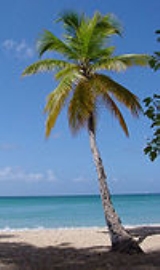
The coconut palm,
Cocos nucifera, is a member of the
familyIn biological classification, family is* a taxonomic rank. Other well-known ranks are life, domain, kingdom, phylum, class, order, genus, and species, with family fitting between order and genus. As for the other well-known ranks, there is the option of an immediately lower rank, indicated by the...
ArecaceaeArecaceae or Palmae , are a family of flowering plants, the only family in the monocot order Arecales. There are roughly 202 currently known genera with around 2600 species, most of which are restricted to tropical, subtropical, and warm temperate climates...
(
palmArecaceae or Palmae , are a family of flowering plants, the only family in the monocot order Arecales. There are roughly 202 currently known genera with around 2600 species, most of which are restricted to tropical, subtropical, and warm temperate climates...
family). It is the only accepted species in the
genusIn biology, a genus is a low-level taxonomic rank used in the biological classification of living and fossil organisms, which is an example of definition by genus and differentia...
Cocos. The term coconut can refer to the entire coconut palm, the
seedA seed is a small embryonic plant enclosed in a covering called the seed coat, usually with some stored food. It is the product of the ripened ovule of gymnosperm and angiosperm plants which occurs after fertilization and some growth within the mother plant...
, or the fruit, which is not a botanical nut. The spelling cocoanut is an old-fashioned form of the word. The term is derived from 16th century
PortuguesePortuguese is a Romance language that arose in the medieval Kingdom of Galicia, nowadays Galicia and Northern Portugal. The southern part of the Kingdom of Galicia became independent as the County of Portugal in 1095...
and
SpanishSpanish , also known as Castilian , is a Romance language in the Ibero-Romance group that evolved from several languages and dialects in central-northern Iberia around the 9th century and gradually spread with the expansion of the Kingdom of Castile into central and southern Iberia during the...
cocos, meaning "grinning face", from the three small holes on the coconut shell that resemble human facial features.
Found across much of the tropic and subtropic area, the coconut is known for its great versatility as seen in the many domestic, commercial, and industrial uses of its different parts. Coconuts are part of the daily diet of many people. Its
endospermEndosperm is the tissue produced inside the seeds of most flowering plants around the time of fertilization. It surrounds the embryo and provides nutrition in the form of starch, though it can also contain oils and protein. This makes endosperm an important source of nutrition in human diet...
is known as the edible "flesh" of the coconut; when dried it is called
copraCopra is the dried meat, or kernel, of the coconut. Coconut oil extracted from it has made copra an important agricultural commodity for many coconut-producing countries. It also yields coconut cake which is mainly used as feed for livestock.-Production:...
. The
oilCoconut oil is an edible oil extracted from the kernel or meat of matured coconuts harvested from the coconut palm . Throughout the tropical world, it has provided the primary source of fat in the diets of millions of people for generations. It has various applications in food, medicine, and industry...
and
milkCoconut milk is the water that comes from the grated meat of a coconut. The colour and rich taste of the milk can be attributed to the high oil content. In many parts of the world, the term coconut milk is also used to refer to coconut water, the naturally occurring liquid found inside the hollow...
derived from it are commonly used in cooking and frying; coconut oil is also widely used in
soapIn chemistry, soap is a salt of a fatty acid.IUPAC. "" Compendium of Chemical Terminology, 2nd ed. . Compiled by A. D. McNaught and A. Wilkinson. Blackwell Scientific Publications, Oxford . XML on-line corrected version: created by M. Nic, J. Jirat, B. Kosata; updates compiled by A. Jenkins. ISBN...
s and
cosmeticCosmetic may refer to:*Cosmetics, or make-up, substances to enhance the beauty of the human body, apart from simple cleaning*Cosmetic, an adjective describing beauty, aesthetics, or appearance, especially concerning the human body...
s. The clear liquid
coconut waterCoconut water is the clear liquid inside young coconuts . As the fruit matures, the coconut water is gradually replaced by the coconut meat and air. A very young coconut has very little meat; the meat that it has is very tender, almost a gel...
within is a refreshing drink and can be processed to create alcohol. The husks and leaves can be used as material to make a variety of products for furnishing and decorating. It also has cultural and religious significance in many societies that use it.
Plant
Cocos nucifera is a large palm, growing up to 30 metres (98.4 ft) tall, with
pinnatePinnate is a term used to describe feather-like or multi-divided features arising from both sides of a common axis in plant or animal structures, and comes from the Latin word pinna meaning "feather", "wing", or "fin". A similar term is pectinate, which refers to a comb-like arrangement of parts...
leaves 4–6 m (13.1–19.7 ft) long, and pinnae 60–90 cm long; old leaves break away cleanly, leaving the
trunkIn botany, trunk refers to the main wooden axis of a tree that supports the branches and is supported by and directly attached to the roots. The trunk is covered by the bark, which is an important diagnostic feature in tree identification, and which often differs markedly from the bottom of the...
smooth. Coconuts are generally classified into two general types: tall and dwarf. On very fertile land a tall coconut palm tree can yield up to 75 fruits per year, but more often yields less than 30 mainly due to poor cultural practices. In recent years, improvements in cultivation practices and breeding has produced coconut trees that can yield more.
Fruit
BotanicallyBotany, plant science, or plant biology is a branch of biology that involves the scientific study of plant life. Traditionally, botany also included the study of fungi, algae and viruses...
the coconut
fruitIn broad terms, a fruit is a structure of a plant that contains its seeds.The term has different meanings dependent on context. In non-technical usage, such as food preparation, fruit normally means the fleshy seed-associated structures of certain plants that are sweet and edible in the raw state,...
is a
drupeIn botany, a drupe is a fruit in which an outer fleshy part surrounds a shell of hardened endocarp with a seed inside. These fruits develop from a single carpel, and mostly from flowers with superior ovaries...
, not a true
nutA nut is a hard-shelled fruit of some plants having an indehiscent seed. While a wide variety of dried seeds and fruits are called nuts in English, only a certain number of them are considered by biologists to be true nuts...
. Like other fruits it has
three layersFruit anatomy is the internal structure of fruit, the mature ovary or ovaries from one or more flowers. In fleshy fruits, the outer and often edible layer is the pericarp, which is the tissue that develops from the ovary wall of the flower and surrounds the seeds. Some edible "vegetables" such as...
: exocarp, mesocarp, and endocarp. The exocarp and mesocarp make up the husk of the coconut. Coconuts sold in the shops of non-tropical countries often have had the exocarp (outermost layer) removed. The mesocarp is composed of fibers called
coirCoir is a natural fibre extracted from the husk of coconut and used in products such as floor mats, doormats, brushes, mattresses etc. Technically coir is the fibrous material found between the hard, internal shell and the outer coat of a coconut. Other uses of brown coir are in upholstery...
which have many traditional and commercial uses. The shell has three
germinationGermination is the process in which a plant or fungus emerges from a seed or spore, respectively, and begins growth. The most common example of germination is the sprouting of a seedling from a seed of an angiosperm or gymnosperm. However the growth of a sporeling from a spore, for example the...
pores (
stomaIn botany, a stoma is a pore, found in the leaf and stem epidermis that is used forgas exchange. The pore is bordered by a pair of specialized parenchyma cells known as guard cells that are responsible for regulating the size of the opening...
) or eyes that are clearly visible on its outside surface once the husk is removed.
A full-sized coconut weighs about 1.44 kilograms (3.2 lb). It takes around 6000 full-grown coconuts to produce a tonne of copra.
Seed
Within the shell is a single seed. When the seed germinates, the root (
radicleIn botany, the radicle is the first part of a seedling to emerge from the seed during the process of germination. The radicle is the embryonic root of the plant, and grows downward in the soil...
) of its
embryoAn embryo is a multicellular diploid eukaryote in its earliest stage of development, from the time of first cell division until birth, hatching, or germination...
pushes out through one of the eyes of the shell. The outermost layer of the seed, the testa, adheres to the inside of the shell. In a mature coconut, a thick albuminous
endospermEndosperm is the tissue produced inside the seeds of most flowering plants around the time of fertilization. It surrounds the embryo and provides nutrition in the form of starch, though it can also contain oils and protein. This makes endosperm an important source of nutrition in human diet...
adheres to the inside of the testa. This endosperm or meat is the white and fleshy edible part of the coconut. Although coconut meat contains less
fatFats consist of a wide group of compounds that are generally soluble in organic solvents and generally insoluble in water. Chemically, fats are triglycerides, triesters of glycerol and any of several fatty acids. Fats may be either solid or liquid at room temperature, depending on their structure...
than many oilseeds and seeds such as
almondThe almond , is a species of tree native to the Middle East and South Asia. Almond is also the name of the edible and widely cultivated seed of this tree...
s, it is noted for its high amount of medium-chain
saturated fatSaturated fat is fat that consists of triglycerides containing only saturated fatty acids. Saturated fatty acids have no double bonds between the individual carbon atoms of the fatty acid chain. That is, the chain of carbon atoms is fully "saturated" with hydrogen atoms...
. About 90% of the fat found in coconut meat is saturated, a proportion exceeding that of foods such as
lardLard is pig fat in both its rendered and unrendered forms. Lard was commonly used in many cuisines as a cooking fat or shortening, or as a spread similar to butter. Its use in contemporary cuisine has diminished because of health concerns posed by its saturated-fat content and its often negative...
,
butterButter is a dairy product made by churning fresh or fermented cream or milk. It is generally used as a spread and a condiment, as well as in cooking applications, such as baking, sauce making, and pan frying...
, and
tallowTallow is a rendered form of beef or mutton fat, processed from suet. It is solid at room temperature. Unlike suet, tallow can be stored for extended periods without the need for refrigeration to prevent decomposition, provided it is kept in an airtight container to prevent oxidation.In industry,...
. There has been some debate as to whether or not the saturated fat in coconuts is healthier than other forms of saturated fat (see coconut oil). Like most nut meats, coconut meat contains less
sugarSugar is a class of edible crystalline carbohydrates, mainly sucrose, lactose, and fructose, characterized by a sweet flavor.Sucrose in its refined form primarily comes from sugar cane and sugar beet...
and more
proteinProteins are biochemical compounds consisting of one or more polypeptides typically folded into a globular or fibrous form, facilitating a biological function. A polypeptide is a single linear polymer chain of amino acids bonded together by peptide bonds between the carboxyl and amino groups of...
than popular fruits such as bananas, apples and oranges. It is relatively high in
mineralsDietary minerals are the chemical elements required by living organisms, other than the four elements carbon, hydrogen, nitrogen, and oxygen present in common organic molecules. Examples of mineral elements include calcium, magnesium, potassium, sodium, zinc, and iodine...
such as
ironIron is a chemical element with the symbol Fe and atomic number 26. It is a metal in the first transition series. It is the most common element forming the planet Earth as a whole, forming much of Earth's outer and inner core. It is the fourth most common element in the Earth's crust...
,
phosphorusPhosphorus is the chemical element that has the symbol P and atomic number 15. A multivalent nonmetal of the nitrogen group, phosphorus as a mineral is almost always present in its maximally oxidized state, as inorganic phosphate rocks...
and
zincZinc , or spelter , is a metallic chemical element; it has the symbol Zn and atomic number 30. It is the first element in group 12 of the periodic table. Zinc is, in some respects, chemically similar to magnesium, because its ion is of similar size and its only common oxidation state is +2...
.
The endosperm surrounds a hollow interior space, filled with air and often a liquid referred to as
coconut waterCoconut water is the clear liquid inside young coconuts . As the fruit matures, the coconut water is gradually replaced by the coconut meat and air. A very young coconut has very little meat; the meat that it has is very tender, almost a gel...
(distinct from
coconut milkCoconut milk is the water that comes from the grated meat of a coconut. The colour and rich taste of the milk can be attributed to the high oil content. In many parts of the world, the term coconut milk is also used to refer to coconut water, the naturally occurring liquid found inside the hollow...
). Immature coconuts are more likely to contain coconut water and less meat. They are often sold with a small portion of the husk cut away to allow access to the coconut water. Young coconuts used for coconut water are called tender coconuts. The water of a tender coconut is liquid endosperm. It is sweet (mild) with an aerated feel when cut fresh. Depending on its size a tender contains 300 to 1,000 ml of coconut water.
The meat in a green young coconut is softer and more gelatinous than that in a mature coconut—so much so that it is sometimes known as coconut jelly. When the coconut has ripened and the outer husk has turned brown, a few months later, it will fall from the palm of its own accord. At that time the endosperm has thickened and hardened, while the coconut water has become somewhat bitter.
When the coconut fruit is still green, the husk is very hard, but green coconuts only fall if they have been attacked by molds or other blights. By the time the coconut naturally falls, the husk has become brown, the coir has become drier and softer, and the coconut is less likely to cause damage when it drops, although there have been instances of coconuts falling from palms and injuring people, and claims of some fatalities. This was the subject of a paper published in 1984 that won the
Ig Nobel PrizeThe Ig Nobel Prizes are an American parody of the Nobel Prizes and are given each year in early October for ten unusual or trivial achievements in scientific research. The stated aim of the prizes is to "first make people laugh, and then make them think"...
in 2001. Falling coconut deaths are often used as a comparison to shark attacks; the claim is often made that a person is more likely to be killed by a falling coconut than by a shark, yet such evidence as there is would suggest that the number of deaths due to falling coconuts is small.
A small number of writings about coconuts mention the existence of the
coconut pearlThe coconut pearl is alleged to be a coconut-produced gemstone. Claimed to be the rarest botanical gem in the world, the coconut pearl supposedly grows inside the coconut. However, the existence of these pearls is in dispute, and some claim that published photos are hoaxes...
. This is generally considered a hoax. Professor Armstrong, of
Palomar CollegePalomar College is a community college with one campus and six education sites in San Diego County, California. The main campus is located in San Marcos, while the six education sites are located elsewhere throughout north San Diego County. The largest of these is the education center located in...
, says "most eyewitness records of coconut pearls cited in the literature are secondhand accounts that were not observed by the authors of these articles. There are a few firsthand, published accounts of pearls observed inside coconuts, but these have been shown to be fraudulent."
The shell composition is shown in the tables below.
EWLINE
| Coconut shell compound (dry basis Dry basis is a expression of the calculation in chemistry, chemical engineering and related subjects, in which the presence of water is ignored for the purposes of the calculation... ) |
| Compound |
Percent |
| Cellulose |
33.61 |
| Lignin |
36.51 |
| Pentosans |
29.27 |
| Ash |
0.61 |
Source: Jasper Guy Woodroof (1979). "Coconuts: Production, Processing, Products". 2nd ed. AVI Publishing Co. Inc. |
|
EWLINE
| Coconut shell ash compound |
| Compound |
Percent |
| K2O |
45.01 |
| Na2O |
15.42 |
| CaO |
6.26 |
| MgO |
1.32 |
| Fe2O3 + Al2O3 |
1.39 |
| P2O5 |
4.64 |
| SO3 |
5.75 |
| SiO2 |
4.64 |
Source: Jasper Guy Woodroof (1979). "Coconuts: Production, Processing, Products". 2nd ed. AVI Publishing Co. Inc. |
|
Roots
Unlike some other
plantPlants are living organisms belonging to the kingdom Plantae. Precise definitions of the kingdom vary, but as the term is used here, plants include familiar organisms such as trees, flowers, herbs, bushes, grasses, vines, ferns, mosses, and green algae. The group is also called green plants or...
s, the palm tree has neither tap root nor
root hairA root hair, the rhizoid of a vascular plant, is a tubular outgrowth of a trichoblast, a hair-forming cell on the epidermis of a plant root. That is, root hairs are lateral extensions of a single cell and only rarely branched, thus invisible to the naked eye. They are found only in the region of...
s; but has a
fibrous root systemA fibrous root system is the opposite of a taproot system. It is usually formed by thin, moderately branching roots growing from the stem...
.
Inflorescence
On the same
inflorescenceAn inflorescence is a group or cluster of flowers arranged on a stem that is composed of a main branch or a complicated arrangement of branches. Strictly, it is the part of the shoot of seed plants where flowers are formed and which is accordingly modified...
, the palm produces both the female and male
flowerA flower, sometimes known as a bloom or blossom, is the reproductive structure found in flowering plants . The biological function of a flower is to effect reproduction, usually by providing a mechanism for the union of sperm with eggs...
s; thus the palm is monoecious. Other sources use the term
polygamomonoeciousThe term polygamomonoecious has two meanings in botany:*an individual plant with male, female, and perfect flowers on the same plant, called trimonoecious or polygamomonoecious plants;...
. The female flower is much larger than the male flower. Flowering occurs continuously. Coconut palms are believed to be largely cross-
pollinatedPollination is the process by which pollen is transferred in plants, thereby enabling fertilisation and sexual reproduction. Pollen grains transport the male gametes to where the female gamete are contained within the carpel; in gymnosperms the pollen is directly applied to the ovule itself...
, although some dwarf varieties are self-pollinating.
Etymology
One of the earliest mentions of the coconut also dates back to the One Thousand and One Nights story of
Sinbad the SailorSinbad the Sailor is a fictional sailor from Basrah, living during the Abbasid Caliphate – the hero of a story-cycle of Middle Eastern origin...
, he is known to have bought and sold coconuts during his Fifth Voyage. Tenga was the term used in the detailed description of coconut found in
ItinerarioItinerario is a refereed international academic history journal published three times a year by Cambridge University Press on behalf of the Leiden Institute for History, Leiden University. The journal's stated purpose is to provide a publishing platform for researchers studying the expansion of...
by
Ludovico di VarthemaLudovico di Varthema, also known as Barthema and Vertomannus was an Italian traveller and diarist, known for being the first non-Muslim European to enter Mecca as a pilgrim...
published in 1510 and also in the later Hortus Indicus Malabaricus. Even earlier it was called nux indica, a name used by
Marco PoloMarco Polo was a Venetian merchant traveler from the Venetian Republic whose travels are recorded in Il Milione, a book which did much to introduce Europeans to Central Asia and China. He learned about trading whilst his father and uncle, Niccolò and Maffeo, travelled through Asia and apparently...
in 1280 while in
SumatraSumatra is an island in western Indonesia, westernmost of the Sunda Islands. It is the largest island entirely in Indonesia , and the sixth largest island in the world at 473,481 km2 with a population of 50,365,538...
, taken from the Arabs who called it جوز هندي jawz hindī. Both names translate to "Indian nut." In the earliest description of the coconut palm known, given by
Cosmos of AlexandriaCosmas Indicopleustes was an Alexandrian merchant and later hermit, probably of Nestorian tendencies. He was a 6th-century traveller, who made several voyages to India during the reign of emperor Justinian...
in his Topographia Christiana written about 545 A.D., there is a reference to the Argell Tree and its fruit, the great nut of India.
Historical evidence favors the European origin of the name "coconut", for there is nothing similar in any of the languages of India, where the Portuguese first found the fruit; and indeed
BarbosaDuarte Barbosa was a Portuguese writer and Portuguese India officer between 1500 and 1516–17, with the post of scrivener in Cannanore factory and sometimes interpreter of the local language...
, Barros, and Garcia, in mentioning the Malayalam name tenga, and Canarese narle, expressly say 'we call these fruits quoquos', 'our people have given it the name of coco', 'that which we call coco, and the Malabars temga'."
The OED states: "Portuguese and Spanish authors of the 16th c. agree in identifying the word with Portuguese and Spanish coco "grinning face, grin, grimace", also "bugbear, scarecrow", cognate with cocar "to grin, make a grimace"; the name being said to refer to the face-like appearance of the base of the shell, with its three holes. According to Losada, the name came from
PortugueseThe Portuguese are a nation and ethnic group native to the country of Portugal, in the west of the Iberian peninsula of south-west Europe. Their language is Portuguese, and Roman Catholicism is the predominant religion....
explorers, the sailors of
Vasco da GamaVasco da Gama, 1st Count of Vidigueira was a Portuguese explorer, one of the most successful in the Age of Discovery and the commander of the first ships to sail directly from Europe to India...
in
IndiaIndia , officially the Republic of India , is a country in South Asia. It is the seventh-largest country by geographical area, the second-most populous country with over 1.2 billion people, and the most populous democracy in the world...
, who first brought them to
EuropeEurope is, by convention, one of the world's seven continents. Comprising the westernmost peninsula of Eurasia, Europe is generally 'divided' from Asia to its east by the watershed divides of the Ural and Caucasus Mountains, the Ural River, the Caspian and Black Seas, and the waterways connecting...
. The coconut shell reminded them of a
ghostIn traditional belief and fiction, a ghost is the soul or spirit of a deceased person or animal that can appear, in visible form or other manifestation, to the living. Descriptions of the apparition of ghosts vary widely from an invisible presence to translucent or barely visible wispy shapes, to...
or witch in Portuguese folklore called
cocoThe Coco is a mythical ghost-monster; equivalent to the boogeyman, found in many Hispanic and Lusophone countries. He can also be considered a Hispanic version of a bugbear, as it is a commonly used figure of speech representing an irrational or exaggerated fear...
(also côca). The first known recorded usage of the term is 1555.
The specific name nucifera is Latin for nut-bearing.
Origin
The origin of the plant is the subject of debate.
Many authorities suggest an Indo-Pacific origin either around
MelanesiaMelanesia is a subregion of Oceania extending from the western end of the Pacific Ocean to the Arafura Sea, and eastward to Fiji. The region comprises most of the islands immediately north and northeast of Australia...
and
MalesiaMalesia is a biogeographical region straddling the boundaries of the Indomalaya ecozone and Australasia ecozone, and also a phytogeographical floristic region in the Paleotropical Kingdom.-Floristic province:...
or the
Indian OceanThe Indian Ocean is the third largest of the world's oceanic divisions, covering approximately 20% of the water on the Earth's surface. It is bounded on the north by the Indian Subcontinent and Arabian Peninsula ; on the west by eastern Africa; on the east by Indochina, the Sunda Islands, and...
, while others see the origin in northwestern
South AmericaSouth America is a continent situated in the Western Hemisphere, mostly in the Southern Hemisphere, with a relatively small portion in the Northern Hemisphere. The continent is also considered a subcontinent of the Americas. It is bordered on the west by the Pacific Ocean and on the north and east...
. The oldest fossils known of the modern coconut date from the
EoceneThe Eocene Epoch, lasting from about 56 to 34 million years ago , is a major division of the geologic timescale and the second epoch of the Paleogene Period in the Cenozoic Era. The Eocene spans the time from the end of the Palaeocene Epoch to the beginning of the Oligocene Epoch. The start of the...
period from around 37 to 55 million years ago and were found in
AustraliaAustralia , officially the Commonwealth of Australia, is a country in the Southern Hemisphere comprising the mainland of the Australian continent, the island of Tasmania, and numerous smaller islands in the Indian and Pacific Oceans. It is the world's sixth-largest country by total area...
and
IndiaIndia , officially the Republic of India , is a country in South Asia. It is the seventh-largest country by geographical area, the second-most populous country with over 1.2 billion people, and the most populous democracy in the world...
. However, there are older palm fossils like some of
nipaNypa fruticans, known as the attap palm , nipa palm , and mangrove palm or buah atap , buah nipah , dừa nước , Ging Pol in Sinhala in Sri Lanka and gol pata , dani . It is the only palm considered a mangrove in the Mangroves Biome...
fruit that have been found in the Americas.
Dispersal
Genomic analysis of cultivated coconut (Coco nucifera L.) has shed light on the movements of Austronesian peoples. By examining 10 microsatelite loci, researchers found that there are 2 genetically distinct supopulations of coconut – one originating in the Indian Ocean, the Other in the Pacific Ocean. However, there is evidence of
admixtureGenetic admixture occurs when individuals from two or more previously separated populations begin interbreeding. Admixture results in the introduction of new genetic lineages into a population. It has been known to slow local adaptation by introducing foreign, unadapted genotypes...
, the transfer of genetic material, between the two populations. Given that coconuts are ideally suited for ocean dispersal, it seems possible that individuals from one population could have floated to the other. However, the locations of the admixture events are limited to
MadagascarThe Republic of Madagascar is an island country located in the Indian Ocean off the southeastern coast of Africa...
and coastal east Africa and exclude the
SeychellesSeychelles , officially the Republic of Seychelles , is an island country spanning an archipelago of 115 islands in the Indian Ocean, some east of mainland Africa, northeast of the island of Madagascar....
. This pattern coincides with the known trade routes of Austronesian sailors. Additionally, there is a genetically distinct subpopulation of coconut on the eastern coast of South America which has undergone a genetic bottleneck resulting from a founder effect, however its ancestral population is the pacific coconut which suggests that Austronesian peoples may have sailed as far east as the Americas
Distribution
The coconut has spread across much of the tropics, probably aided in many cases by seafaring people. Coconut fruit in the wild is light, buoyant and highly water resistant, and evolved to disperse significant distances via marine currents. It has been collected from the sea as far north as
NorwayNorway , officially the Kingdom of Norway, is a Nordic unitary constitutional monarchy whose territory comprises the western portion of the Scandinavian Peninsula, Jan Mayen, and the Arctic archipelago of Svalbard and Bouvet Island. Norway has a total area of and a population of about 4.9 million...
. In the
Hawaiian IslandsThe Hawaiian Islands are an archipelago of eight major islands, several atolls, numerous smaller islets, and undersea seamounts in the North Pacific Ocean, extending some 1,500 miles from the island of Hawaii in the south to northernmost Kure Atoll...
, the coconut is regarded as a
PolynesiaPolynesia is a subregion of Oceania, made up of over 1,000 islands scattered over the central and southern Pacific Ocean. The indigenous people who inhabit the islands of Polynesia are termed Polynesians and they share many similar traits including language, culture and beliefs...
n
introductionAn introduced species — or neozoon, alien, exotic, non-indigenous, or non-native species, or simply an introduction, is a species living outside its indigenous or native distributional range, and has arrived in an ecosystem or plant community by human activity, either deliberate or accidental...
, first brought to the islands by early Polynesian voyagers from their homelands in
OceaniaOceania is a region centered on the islands of the tropical Pacific Ocean. Conceptions of what constitutes Oceania range from the coral atolls and volcanic islands of the South Pacific to the entire insular region between Asia and the Americas, including Australasia and the Malay Archipelago...
. They have been found in the Caribbean and the Atlantic coasts of
AfricaAfrica is the world's second largest and second most populous continent, after Asia. At about 30.2 million km² including adjacent islands, it covers 6% of the Earth's total surface area and 20.4% of the total land area...
and
South AmericaSouth America is a continent situated in the Western Hemisphere, mostly in the Southern Hemisphere, with a relatively small portion in the Northern Hemisphere. The continent is also considered a subcontinent of the Americas. It is bordered on the west by the Pacific Ocean and on the north and east...
for less than 500 years but there is evidence that their presence on the Pacific coast of South America predates
Christopher ColumbusChristopher Columbus was an explorer, colonizer, and navigator, born in the Republic of Genoa, in northwestern Italy. Under the auspices of the Catholic Monarchs of Spain, he completed four voyages across the Atlantic Ocean that led to general European awareness of the American continents in the...
's arrival in the Americas. They are now almost ubiquitous between 26°N and 26°S except for the interiors of Africa and South America.
Natural habitat
The coconut palm thrives on sandy soils and is highly tolerant of
salinitySalinity is the saltiness or dissolved salt content of a body of water. It is a general term used to describe the levels of different salts such as sodium chloride, magnesium and calcium sulfates, and bicarbonates...
. It prefers areas with abundant sunlight and regular rainfall (150 cm to 250 cm annually), which makes colonizing shorelines of the tropics relatively straightforward. Coconuts also need high
humidityHumidity is a term for the amount of water vapor in the air, and can refer to any one of several measurements of humidity. Formally, humid air is not "moist air" but a mixture of water vapor and other constituents of air, and humidity is defined in terms of the water content of this mixture,...
(70–80%+) for optimum growth, which is why they are rarely seen in areas with low humidity, like the south eastern Mediterranean or
AndalusiaAndalusia is the most populous and the second largest in area of the autonomous communities of Spain. The Andalusian autonomous community is officially recognised as a nationality of Spain. The territory is divided into eight provinces: Huelva, Seville, Cádiz, Córdoba, Málaga, Jaén, Granada and...
, even where temperatures are high enough (regularly above 24°C or 75.2°F).
Coconut palms require warm conditions for successful growth, and are intolerant of cold weather. Optimum growth is with a mean annual temperature of 27 °C (80.6 °F), and growth is reduced below 21 °C (69.8 °F). Some seasonal variation is tolerated, with good growth where mean summer temperatures are between 28 –, and survival as long as winter temperatures are above 4 –; they will survive brief drops to 0 °C (32 °F). Severe frost is usually fatal, although they have been known to recover from temperatures of -4 °C. They may grow but not fruit properly in areas where there is not sufficient warmth, like
BermudaBermuda is a British overseas territory in the North Atlantic Ocean. Located off the east coast of the United States, its nearest landmass is Cape Hatteras, North Carolina, about to the west-northwest. It is about south of Halifax, Nova Scotia, Canada, and northeast of Miami, Florida...
.
The conditions required for coconut trees to grow without any care are:
- mean daily temperature above 12–13 °C (53.6–55.4 °F) every day of the year
- 50 year low temperature above freezing
- mean yearly rainfall above 1000 mm (39.37")
- no or very little overhead canopy, since even small trees require a lot of sun
The main limiting factor is that most locations which satisfy the first three requirements do not satisfy the fourth, except near the coast where the sandy soil and salt spray limit the growth of most other trees.
Diseases
Coconuts are susceptible to the
phytoplasmaPhytoplasma are specialised bacteria that are obligate parasites of plant phloem tissue and transmitting insects . They were first discovered by scientists in 1967 and were named mycoplasma-like organisms or MLOs. They cannot be cultured in vitro in cell-free media...
disease
lethal yellowingthumb|Palm tree dying of lethal yellowingLethal Yellowing is a phytoplasma disease that attacks many species of palms, including some commercially important species such as the Coconut and Date Palm. It is spread by the planthopper Haplaxius crudus which is native to Florida, parts of the...
. One recently selected
cultivarA cultivar'Cultivar has two meanings as explained under Formal definition. When used in reference to a taxon, the word does not apply to an individual plant but to all those plants sharing the unique characteristics that define the cultivar. is a plant or group of plants selected for desirable...
, the
MaypanMaypan is an F1 hybrid coconut [palm] that was developed by the Research Department of the Coconut Industry Board of Jamaica to be resistant to Lethal Yellowing disease...
, has been bred for resistance to this disease.
Pests
The coconut palm is damaged by the
larvaA larva is a distinct juvenile form many animals undergo before metamorphosis into adults. Animals with indirect development such as insects, amphibians, or cnidarians typically have a larval phase of their life cycle...
e of many
lepidopteraLepidoptera is a large order of insects that includes moths and butterflies . It is one of the most widespread and widely recognizable insect orders in the world, encompassing moths and the three superfamilies of butterflies, skipper butterflies, and moth-butterflies...
(
butterflyA butterfly is a mainly day-flying insect of the order Lepidoptera, which includes the butterflies and moths. Like other holometabolous insects, the butterfly's life cycle consists of four parts: egg, larva, pupa and adult. Most species are diurnal. Butterflies have large, often brightly coloured...
and
mothA moth is an insect closely related to the butterfly, both being of the order Lepidoptera. Moths form the majority of this order; there are thought to be 150,000 to 250,000 different species of moth , with thousands of species yet to be described...
) species which feed on it, including
BatrachedraBatrachedra is the largest genus in the moth family Batrachedridae.It includes the following species:*Batrachedra acrodeta*Batrachedra agaura*Batrachedra albanica*Batrachedra albicapitella*Batrachedra albistrigella...
spp: B. arenosella, B. atriloqua (feeds exclusively on Cocos nucifera), B. mathesoni (feeds exclusively on Cocos nucifera), and B. nuciferae.
Brontispa longissimaBrontispa longissima is a leaf beetle that feeds on young leaves and damages seedlings and mature coconut palms...
(the "coconut leaf beetle") feeds on young leaves and damages seedlings and mature coconut
palmsArecaceae or Palmae , are a family of flowering plants, the only family in the monocot order Arecales. There are roughly 202 currently known genera with around 2600 species, most of which are restricted to tropical, subtropical, and warm temperate climates...
. In 2007, the
PhilippinesThe Philippines , officially known as the Republic of the Philippines , is a country in Southeast Asia in the western Pacific Ocean. To its north across the Luzon Strait lies Taiwan. West across the South China Sea sits Vietnam...
imposed a
quarantineQuarantine is compulsory isolation, typically to contain the spread of something considered dangerous, often but not always disease. The word comes from the Italian quarantena, meaning forty-day period....
in
Metro ManilaMetropolitan Manila , the National Capital Region , or simply Metro Manila, is the metropolitan region encompassing the City of Manila and its surrounding areas in the Philippines...
and 26 provinces to stop the spread of the pest and protect the $800 million Philippine coconut industry.
The fruit may also be damaged by
eriophyidEriophyidae is a family of more than 200 genera of mites, which live as plant parasites, commonly causing galls or other damage to the plant tissues and hence known as gall mites. About 3,600 species have been described, but this is probably less than 10% of the actual number existing in this...
coconut mites (Eriophyes guerreronis). This mite infests coconut plantations, and is devastating: it can destroy up to 90% of coconut production. The immature nuts are infested and desapped by larvae staying in the portion covered by the perianth of the immature nut; the nuts then drop off or survive deformed. Spraying with wettable sulfur 0.4% or with
neemAzadirachta indica is a tree in the mahogany family Meliaceae. It is one of two species in the genus Azadirachta, and is native to India growing in tropical and semi-tropical regions. Its fruits and seeds are the source of neem oil...
-based pesticides can give some relief, but is cumbersome and labor intensive.
In
Keralaor Keralam is an Indian state located on the Malabar coast of south-west India. It was created on 1 November 1956 by the States Reorganisation Act by combining various Malayalam speaking regions....
the main coconut pests are the coconut mite, the rhinoceros beetle, the red palm weevil and the coconut leaf caterpillar. Research on this topic has produced no results, and researchers from the Kerala Agricultural University and the Central Plantation Crop Research Institute, Kasaragode are still searching for a cure. The
Krishi Vigyan Kendra, Kannur under
Kerala Agricultural UniversityKerala Agricultural University is the primary and the principal instrumentality of the Kerala state in providing human resources, and skills and technology, required for the sustainable development of its agriculture, defined broadly encompassing all production activities based on land and water,...
has developed an innovative extension approach called compact area group approach (CAGA) to combat coconut mites.
Cultivation
| Top ten coconut producers — 19 December 2009 |
| Country |
Production (tonne The tonne, known as the metric ton in the US , often put pleonastically as "metric tonne" to avoid confusion with ton, is a metric system unit of mass equal to 1000 kilograms. The tonne is not an International System of Units unit, but is accepted for use with the SI... s) |
Footnote |
| |
19,500,000 |
* |
| |
15,319,500 |
|
| |
10,894,000 |
|
| |
2,759,044 |
|
| |
2,200,000 |
F |
| |
1,721,640 |
F |
| |
1,246,400 |
F |
| |
1,086,000 |
A |
| |
677,000 |
F |
| |
555,120 |
|
| |
370,000 |
F |
| World |
54,716,444 |
A |
No symbol = official figure, P = official figure, F = FAO estimate, * = Unofficial/Semi-official/mirror data, C = Calculated figure, A = Aggregate (may include official, semi-official or estimates);
Source: Food And Agriculture Organization of the United Nations: Economic And Social Department: The Statistical Division |
Coconut palms are grown in more than 80 countries of the world, with a total production of 61 million tonnes per year. Coconut trees are very hard to establish in dry climates, and cannot grow there without frequent irrigation; in drought conditions, the new leaves do not open well, and older leaves may become desiccated; fruit also tends to be shed.
The extent of cultivation in the tropics is threatening a number of habitats such as mangroves; an example of such damage to an ecoregion is in the Petenes mangroves of the
YucatanYucatán officially Estado Libre y Soberano de Yucatán is one of the 31 states which, with the Federal District, comprise the 32 Federal Entities of Mexico. It is divided in 106 municipalities and its capital city is Mérida....
.
Harvesting
In some parts of the world (Thailand and Malaysia), trained
pig-tailed macaquesThe southern pig-tailed macaque is a medium-sized Old World monkey found in the southern half of the Malay Peninsula , Borneo, Sumatra and Bangka Island. This omnivorous macaque is mostly found in forest, but will also enter plantations and gardens...
are used to harvest coconuts. Training schools for pig-tailed macaques still exist both in southern
ThailandThailand , officially the Kingdom of Thailand , formerly known as Siam , is a country located at the centre of the Indochina peninsula and Southeast Asia. It is bordered to the north by Burma and Laos, to the east by Laos and Cambodia, to the south by the Gulf of Thailand and Malaysia, and to the...
, and in the
Malaysian state of
KelantanKelantan is a state of Malaysia. The capital and royal seat is Kota Bharu. The Arabic honorific of the state is Darul Naim, ....
. Competitions are held each year to find the fastest harvester.
India
Traditional areas of coconut cultivation in India are the states of
Keralaor Keralam is an Indian state located on the Malabar coast of south-west India. It was created on 1 November 1956 by the States Reorganisation Act by combining various Malayalam speaking regions....
,
Tamil NaduTamil Nadu is one of the 28 states of India. Its capital and largest city is Chennai. Tamil Nadu lies in the southernmost part of the Indian Peninsula and is bordered by the union territory of Pondicherry, and the states of Kerala, Karnataka, and Andhra Pradesh...
,
KarnatakaKarnataka , the land of the Kannadigas, is a state in South West India. It was created on 1 November 1956, with the passing of the States Reorganisation Act and this day is annually celebrated as Karnataka Rajyotsava...
,
GoaGoa , a former Portuguese colony, is India's smallest state by area and the fourth smallest by population. Located in South West India in the region known as the Konkan, it is bounded by the state of Maharashtra to the north, and by Karnataka to the east and south, while the Arabian Sea forms its...
,
Andhra PradeshAndhra Pradesh , is one of the 28 states of India, situated on the southeastern coast of India. It is India's fourth largest state by area and fifth largest by population. Its capital and largest city by population is Hyderabad.The total GDP of Andhra Pradesh is $100 billion and is ranked third...
,
OrissaOrissa , officially Odisha since Nov 2011, is a state of India, located on the east coast of India, by the Bay of Bengal. It is the modern name of the ancient nation of Kalinga, which was invaded by the Maurya Emperor Ashoka in 261 BC. The modern state of Orissa was established on 1 April...
,
West BengalWest Bengal is a state in the eastern region of India and is the nation's fourth-most populous. It is also the seventh-most populous sub-national entity in the world, with over 91 million inhabitants. A major agricultural producer, West Bengal is the sixth-largest contributor to India's GDP...
, Pondicherry,
MaharashtraMaharashtra is a state located in India. It is the second most populous after Uttar Pradesh and third largest state by area in India...
and the islands of
LakshadweepLakshadweep , formerly known as the Laccadive, Minicoy, and Amindivi Islands, is a group of islands in the Laccadive Sea, 200 to 440 km off the coast of the South West Indian state of Kerala...
and Andaman and Nicobar. Four southern states put together account for almost 92% of the total production in the country: Kerala (45.22%), Tamil Nadu (26.56%), Karnataka (10.85%), and Andhra Pradesh (8.93%). Other states like Goa, Maharashtra, Orissa, West Bengal, and those in the northeast like
TripuraTripura is a state in North-East India, with an area of . It is the third smallest state of India, according to area. Tripura is surrounded by Bangladesh on the north, south, and west. The Indian states of Assam and Mizoram lie to the east. The capital is Agartala and the main languages spoken are...
and
AssamAssam , also, rarely, Assam Valley and formerly the Assam Province , is a northeastern state of India and is one of the most culturally and geographically distinct regions of the country...
account for the remaining 8.44%. Kerala, which has the largest number of coconut trees, is famous for its coconut-based products like coconut water, copra,
coconut oilCoconut oil is an edible oil extracted from the kernel or meat of matured coconuts harvested from the coconut palm . Throughout the tropical world, it has provided the primary source of fat in the diets of millions of people for generations. It has various applications in food, medicine, and industry...
, coconut cake (also called coconut meal, copra cake, or copra meal), coconut toddy, coconut shell-based products, coconut wood-based products, coconut leaves, and coir pith.
The Southern Indian state of Kerala is named after the coconut tree. "Kera" = Coconut tree, "Alam" = Land: so
"Land of Coconut Trees" Various terms like Copra, Coir are derived from the native Malayalam language. In Kerala,
coconut tree is called as "Kalpa Vriksham" which essentially means all parts of a Coconut tree is useful some way or other.
Maldives
The coconut is the national tree of the
MaldivesThe Maldives , , officially Republic of Maldives , also referred to as the Maldive Islands, is an island nation in the Indian Ocean formed by a double chain of twenty-six atolls oriented north-south off India's Lakshadweep islands, between Minicoy Island and...
and is considered the most important plant in the country. A coconut tree is also included in the country's national emblem or coat of arms. Coconut trees are grown on all the islands. Before modern construction methods were introduced to the Maldives, coconut leaves were used as a roofing material for many houses in the islands while coconut timber was used to build houses and boats.
Middle East
The main coconut producing area in the
Middle EastThe Middle East is a region that encompasses Western Asia and Northern Africa. It is often used as a synonym for Near East, in opposition to Far East...
is the
DhofarThe Dhofar region lies in Southern Oman, on the eastern border with Yemen. Its mountainous area covers and has a population of 215,960 as of the 2003 census. The largest town in the region is Salalah. Historically, it was the chief source of frankincense in the world. However, its frankincense...
region of
OmanOman , officially called the Sultanate of Oman , is an Arab state in southwest Asia on the southeast coast of the Arabian Peninsula. It is bordered by the United Arab Emirates to the northwest, Saudi Arabia to the west, and Yemen to the southwest. The coast is formed by the Arabian Sea on the...
. However, they can be grown all along the
Persian GulfThe Persian Gulf, in Southwest Asia, is an extension of the Indian Ocean located between Iran and the Arabian Peninsula.The Persian Gulf was the focus of the 1980–1988 Iran-Iraq War, in which each side attacked the other's oil tankers...
coast,
Arabian SeaThe Arabian Sea is a region of the Indian Ocean bounded on the east by India, on the north by Pakistan and Iran, on the west by the Arabian Peninsula, on the south, approximately, by a line between Cape Guardafui in northeastern Somalia and Kanyakumari in India...
and
Red SeaThe Red Sea is a seawater inlet of the Indian Ocean, lying between Africa and Asia. The connection to the ocean is in the south through the Bab el Mandeb strait and the Gulf of Aden. In the north, there is the Sinai Peninsula, the Gulf of Aqaba, and the Gulf of Suez...
coast because these seas are tropical and provide enough humidity (through sea water evaporation) for coconut trees to grow. The young coconut plants need to be nursed and irrigated with drip pipes until they are old enough (stem bulb development) to be irrigated with brackish water or sea water alone, after which they can be replanted on the beaches. In particular, the area around
SalalahSalalah , is the capital and seat of the governor or Wali of the southern Omani province of Dhofar. The population of Salalah was 197,169 in 2009....
maintains large coconut plantations similar to those found across the
Arabian SeaThe Arabian Sea is a region of the Indian Ocean bounded on the east by India, on the north by Pakistan and Iran, on the west by the Arabian Peninsula, on the south, approximately, by a line between Cape Guardafui in northeastern Somalia and Kanyakumari in India...
in Kerala. The reasons why coconut are cultivated only in
YemenThe Republic of Yemen , commonly known as Yemen , is a country located in the Middle East, occupying the southwestern to southern end of the Arabian Peninsula. It is bordered by Saudi Arabia to the north, the Red Sea to the west, and Oman to the east....
's Al Mahrah and Hadramaut governorates and in the Sultanate of Oman, but not in other suitable areas in the
Arabian PeninsulaThe Arabian Peninsula is a land mass situated north-east of Africa. Also known as Arabia or the Arabian subcontinent, it is the world's largest peninsula and covers 3,237,500 km2...
, may originate from the fact that Oman and Hadramaut had long
dhowDhow is the generic name of a number of traditional sailing vessels with one or more masts with lateen sails used in the Red Sea and Indian Ocean region. Some historians believe the dhow was invented by Arabs but this is disputed by some others. Dhows typically weigh 300 to 500 tons, and have a...
trade relations with Burma, Malaysia, Indonesia, East Africa and
ZanzibarZanzibar ,Persian: زنگبار, from suffix bār: "coast" and Zangi: "bruin" ; is a semi-autonomous part of Tanzania, in East Africa. It comprises the Zanzibar Archipelago in the Indian Ocean, off the coast of the mainland, and consists of numerous small islands and two large ones: Unguja , and Pemba...
as well as southern India and
ChinaChinese civilization may refer to:* China for more general discussion of the country.* Chinese culture* Greater China, the transnational community of ethnic Chinese.* History of China* Sinosphere, the area historically affected by Chinese culture...
. Omani people needed the
coirCoir is a natural fibre extracted from the husk of coconut and used in products such as floor mats, doormats, brushes, mattresses etc. Technically coir is the fibrous material found between the hard, internal shell and the outer coat of a coconut. Other uses of brown coir are in upholstery...
rope from the coconut fiber rope to stitch together their traditional high sea going dhow vessels in which nails were never used. The 'know how' of coconut cultivation and necessary soil fixation and irrigation may have found its way into Omani and Hadrami and Al-Mahra culture by people who returned from those oversea areas. The coconut cultivars grown in Oman are generally of the drought-resistant Indian "West Coast tall" (WC Tall) variety. Unlike the UAE, which grows mostly non-native dwarf or hybrid coconut cultivars imported from Florida for ornamental purposes, the slender tall Omani coconut cultivars are relatively well adapted to the Middle East's hot dry seasons, but need longer to reach maturity. The Middle East's hot, dry climate favors the development of coconut mites, which cause immature nut dropping and may cause brownish gray discoloration on the coconut's outer green fiber.
The ancient coconut groves of Dhofar were mentioned by the medieval Moroccan traveller
Ibn BattutaAbu Abdullah Muhammad Ibn Battuta , or simply Ibn Battuta, also known as Shams ad–Din , was a Muslim Moroccan Berber explorer, known for his extensive travels published in the Rihla...
in his writings, known as Al
RihlaRihla is a medieval book which recounts the journey of the 14th-century Berber Moroccan scholar and traveler Ibn Battuta.The oeuvre was written by Ibn Juzayy after he was commissioned by the Marinid Sultan Abu Inan who was impressed by the story and journey of Ibn Battuta.The term Rihla is a...
. The annual rainy season known locally as
KhareefKhareef is a colloquial Arabic term used in southern Oman and southeastern Yemen for the south east monsoon. The monsoon affects Dhofar Governorate and Al Mahrah Governorate from about June to early September. Towns such as Salalah depend upon the khareef for water supply...
or
MonsoonMonsoon is traditionally defined as a seasonal reversing wind accompanied by corresponding changes in precipitation, but is now used to describe seasonal changes in atmospheric circulation and precipitation associated with the asymmetric heating of land and sea...
makes coconut cultivation easy on the Arabian east coast.
Coconut trees also are increasingly grown for decorative purposes along the coasts of the UAE and Saudi Arabia with the help of irrigation. The UAE has, however, imposed strict laws on mature coconut tree imports from other countries to reduce the spread of pests to other native palm trees, as the mixing of date and coconut trees poses a risk of cross species palm pests, such as
rhinoceros beetleThe Rhinoceros Beetles or Rhino Beetles are a subfamily of the scarab beetle family . Other common names – some for particular groups of rhino beetles – are for example Hercules beetles, unicorn beetles or horn beetles...
and red palm weevil. The artificial landscaping adopted in Florida may have been the cause for
lethal yellowingthumb|Palm tree dying of lethal yellowingLethal Yellowing is a phytoplasma disease that attacks many species of palms, including some commercially important species such as the Coconut and Date Palm. It is spread by the planthopper Haplaxius crudus which is native to Florida, parts of the...
, a viral coconut palm disease that leads to the death of the tree. It is spread by host insects, that thrive on heavy turf grasses. Therefore heavy turf grass environments (beach resorts and
golf courseA golf course comprises a series of holes, each consisting of a teeing ground, fairway, rough and other hazards, and a green with a flagstick and cup, all designed for the game of golf. A standard round of golf consists of playing 18 holes, thus most golf courses have this number of holes...
s) also pose a major threat to local coconut trees. Traditionally, dessert banana plants and local wild beach flora such as
Scaevola taccadaScaevola is a genus of flowering plants in the Goodenia family, Goodeniaceae. It consists of more than 130 tropical species, with the center of diversity being Australia and Polynesia, including Hawaii....
and
Ipomoea pes-capraeIpomoea pes-caprae, also known as Beach Morning Glory or Goat's Foot, is a common pantropical creeping vine belonging to the family Convolvulaceae. It grows on the upper parts of beaches and endures salted air. It is one of the most common and most widely distributed salt tolerant plants and...
were used as humidity supplying green undergrowth for coconut trees, mixed with sea almond and sea hibiscus. Due to growing sedentary life style and heavy handed landscaping, there has been a decline in these traditional farming and soil fixing techniques.
Sri Lanka
An early mention of the planting of coconuts is found in the
MahavamsaThe Mahavamsa is a historical poem written in the Pali language, of the kings of Sri Lanka...
during the reign of Agrabodhi II around 589 A.D. Coconuts are common in the Sri Lankan diet and the main source of dietary fat. Sri Lanka is home to the Coconut Research Institute of Sri Lanka.
United States of America
The only places in the U.S. where coconut palms can be grown and reproduced outdoors without irrigation are
HawaiiHawaii is the newest of the 50 U.S. states , and is the only U.S. state made up entirely of islands. It is the northernmost island group in Polynesia, occupying most of an archipelago in the central Pacific Ocean, southwest of the continental United States, southeast of Japan, and northeast of...
, south
FloridaFlorida is a state in the southeastern United States, located on the nation's Atlantic and Gulf coasts. It is bordered to the west by the Gulf of Mexico, to the north by Alabama and Georgia and to the east by the Atlantic Ocean. With a population of 18,801,310 as measured by the 2010 census, it...
and the U.S. territories of
Puerto RicoPuerto Rico , officially the Commonwealth of Puerto Rico , is an unincorporated territory of the United States, located in the northeastern Caribbean, east of the Dominican Republic and west of both the United States Virgin Islands and the British Virgin Islands.Puerto Rico comprises an...
,
GuamGuam is an organized, unincorporated territory of the United States located in the western Pacific Ocean. It is one of five U.S. territories with an established civilian government. Guam is listed as one of 16 Non-Self-Governing Territories by the Special Committee on Decolonization of the United...
, American Samoa,
Virgin IslandsThe Virgin Islands are the western island group of the Leeward Islands, which are the northern part of the Lesser Antilles, which form the border between the Caribbean Sea and the Atlantic Ocean...
and the Commonwealth of the Northern Mariana Islands. Coconut palms will grow from coastal Pinellas County and
St. PetersburgSt. Petersburg is a city in Pinellas County, Florida, United States. It is known as a vacation destination for both American and foreign tourists. As of 2008, the population estimate by the U.S. Census Bureau is 245,314, making St...
southwards on Florida's west coast, and
MelbourneMelbourne is a city in Brevard County, Florida, United States. As of 2009, the population estimated by the U.S. Census Bureau is 78,323. The municipal area is the second largest by size and by population in the county. Melbourne is a principal city of the Palm Bay – Melbourne – Titusville, Florida...
southwards on Florida's east coast. The occasional coconut palm is seen north of these areas in favored microclimates in the Tampa and Clearwater metro area and around Cape Canaveral, as well as the Orlando-Kissimmee-Daytona Beach metro area. They may likewise be grown in favored microclimates in the
Rio Grande ValleyThe Rio Grande Valley or the Lower Rio Grande Valley, informally called The Valley, is an area located in the southernmost tip of South Texas...
area of Deep South Texas near
BrownsvilleBrownsville is a city in the southernmost tip of the state of Texas, in the United States. It is located on the northern bank of the Rio Grande, directly north and across the border from Matamoros, Tamaulipas, Mexico. Brownsville is the 16th largest city in the state of Texas with a population of...
and on the upper northeast Texas Coast at
Galveston IslandGalveston Island is a barrier island on the Texas Gulf coast in the United States, about 50 miles southeast of Houston. The entire island, with the exception of Jamaica Beach, is within the city limits of the City of Galveston....
. They may reach fruiting maturity, but are damaged or killed by the occasional winter freezes in these areas. Most of the coconut palms, even full grown specimens, in central Florida that were not adjacent to water were killed by the freeze event in January 2010. Even those on the water were damaged, but are recovering. While coconut palms flourish in south Florida, unusually bitter cold snaps can kill or injure coconut palms there as well. Only the
Florida KeysThe Florida Keys are a coral archipelago in southeast United States. They begin at the southeastern tip of the Florida peninsula, about south of Miami, and extend in a gentle arc south-southwest and then westward to Key West, the westernmost of the inhabited islands, and on to the uninhabited Dry...
and the coastlines provide safe havens from the cold for growing coconut palms on the U.S. mainland.
The farthest north in the United States a coconut palm has been known to grow outdoors is in Newport Beach,
CaliforniaCalifornia is a state located on the West Coast of the United States. It is by far the most populous U.S. state, and the third-largest by land area...
along the Pacific Coast Highway. For coconut palms to survive in
Southern CaliforniaSouthern California is a megaregion, or megapolitan area, in the southern area of the U.S. state of California. Large urban areas include Greater Los Angeles and Greater San Diego. The urban area stretches along the coast from Ventura through the Southland and Inland Empire to San Diego...
, they need sandy soil and minimal water in the winter to prevent root rot, and would benefit from root heating coils.
Australia
Coconuts are commonly grown around the north coast of Australia. They can be grown in some warmer parts of New South Wales.
Bermuda
Coconuts can be grown with care in Bermuda, but cooler temperatures in winter prevent most of them from successfully producing fruit.
Cooler climates
In cooler climates (but not less than
USDA Zone 9A hardiness zone is a geographically defined area in which a specific category of plant life is capable of growing, as defined by climatic conditions, including its ability to withstand the minimum temperatures of the zone...
), a similar palm, the queen palm (Syagrus romanzoffiana), is used in
landscapingLandscaping refers to any activity that modifies the visible features of an area of land, including:# living elements, such as flora or fauna; or what is commonly referred to as gardening, the art and craft of growing plants with a goal of creating a beautiful environment within the landscape.#...
. Its fruits are very similar to the coconut, but much smaller. The queen palm was originally classified in the genus Cocos along with the coconut, but was later reclassified in
SyagrusSyagrus is a genus of 30 to 42 species of Arecaceae , native to South America, with one species endemic to the Lesser Antilles. The genus is closely related to the Cocos, or coconut genus, and many Syagrus species produce edible seeds similar to the coconut.-Description:Palms in this group have...
. A recently discovered palm,
Beccariophoenix alfrediiBeccariophoenix alfredii, also known as the High Plateau Coconut Palm, is a recently discovered species of Arecaceae , endemic to Madagascar. It is in the genus Beccariophoenix, and is closely related to the genus Cocos...
from
MadagascarThe Republic of Madagascar is an island country located in the Indian Ocean off the southeastern coast of Africa...
, is nearly identical to the coconut, more so than the queen palm and can also be grown in slightly cooler climates than the coconut palm. Coconuts can only be grown in temperatures above 18°C (64°F), but need a daily temperature above 22°C (72°F) in order to produce fruit. Most of the cooler areas in mid-Florida can produce coconuts, but with little or no fruit production
Overview of uses
The coconut palm is grown throughout the
tropicsThe tropics is a region of the Earth surrounding the Equator. It is limited in latitude by the Tropic of Cancer in the northern hemisphere at approximately N and the Tropic of Capricorn in the southern hemisphere at S; these latitudes correspond to the axial tilt of the Earth...
for decoration, as well as for its many culinary and non-culinary uses; virtually every part of the coconut palm can be utilized by humans in some manner. Coconuts' versatility is sometimes noted in its naming. In
SanskritSanskrit , is a historical Indo-Aryan language and the primary liturgical language of Hinduism, Jainism and Buddhism.Buddhism: besides Pali, see Buddhist Hybrid Sanskrit Today, it is listed as one of the 22 scheduled languages of India and is an official language of the state of Uttarakhand...
it is kalpa vriksha ("the tree which provides all the necessities of life"). In the
Malay languageMalay is a major language of the Austronesian family. It is the official language of Malaysia , Indonesia , Brunei and Singapore...
, it is pokok seribu guna ("the tree of a thousand uses"). In the Philippines, the coconut is commonly called the "
Tree of LifeThe concept of a tree of life, a many-branched tree illustrating the idea that all life on earth is related, has been used in science , religion, philosophy, mythology, and other areas...
". Nearly all parts of the palm are useful, and it has significant economic value.
Culinary use
The various parts of the coconut have a number of culinary uses. The nut provides oil for frying, cooking, and making margarine. The white, fleshy part of the seed—the coconut meat—is edible and used fresh or dried in cooking especially in confections and desserts like macaroons. Desiccated coconut can be used as an ingredient or to produce coconut milk which is frequently added to curry dishes and other savory viands. Coconut flour has also been developed for use in baking and to combat malnutrition. Coconut chips have been sold in tourist regions like Hawaii and the Caribbean. Coconut butter is often used to describe solidified coconut oil, but has also been adopted as a name by certain specialty products made out of coconut milk solids or
puréePurée and mash are general terms for cooked food, usually vegetables or legumes, that have been ground, pressed, blended, and/or sieved to the consistency of a soft creamy paste or thick liquid. Purées of specific foods are often known by specific names, e.g., mashed potatoes or apple sauce...
d coconut meat and oil.
Coconut water
Coconut water contains sugar,
fiberDietary fiber, dietary fibre, or sometimes roughage is the indigestible portion of plant foods having two main components:* soluble fiber that is readily fermented in the colon into gases and physiologically active byproducts, and* insoluble fiber that is metabolically inert, absorbing water as it...
, proteins, antioxidants, vitamins and minerals, and provides an isotonic
electrolyteIn chemistry, an electrolyte is any substance containing free ions that make the substance electrically conductive. The most typical electrolyte is an ionic solution, but molten electrolytes and solid electrolytes are also possible....
balance. It is consumed as a refreshing drink throughout the humid tropics and is gaining popularity as an isotonic sports drink. Mature fruits have significantly less liquid than young immature coconuts, barring spoilage. Coconut water can be fermented to produce coconut vinegar.
Coconut milk
Coconut milk, not to be confused with coconut water, is obtained primarily by extracting juice by pressing the grated coconut's white kernel or by passing hot water or milk through grated coconut, which extracts the oil and aromatic compounds. It has a fat content around 17%. When refrigerated and left to set,
coconut creamCoconut cream is very similar to coconut milk but contains less water. The difference is mainly consistency. It has a thicker, more paste-like consistency, while coconut milk is generally a liquid...
will rise to the top and separate from the milk. The milk can be used to produce virgin coconut oil by controlled heating and removal of the oil fraction.
Toddy and nectar
The sap derived from incising the flower clusters of the coconut is drunk as
neeraNeera, also called Sweet Toddy or Palm Nectar is a sap extracted from Inflorescence of various species of Toddy palms. It is sweet, oyster white, and translucent. It is widely consumed in India, Srilanka, Africa, Malaysia, Thailand, Myanmar...
also known as toddy or tuba (Philippines), tuak (Indonesia and Malaysia) or karewe (fresh and not fermented, collected twice a day, for breakfast and dinner) in
KiribatiKiribati , officially the Republic of Kiribati, is an island nation located in the central tropical Pacific Ocean. The permanent population exceeds just over 100,000 , and is composed of 32 atolls and one raised coral island, dispersed over 3.5 million square kilometres, straddling the...
. When left to ferment on its own it becomes
palm winePalm wine also called Palm Toddy also called "Kallu" written in Malayalam and கள்ளு in Tamil or simply Toddy is an alcoholic beverage created from the sap of various species of palm tree such as the palmyra, and coconut palms...
. Palm wine is distilled to produce
arrackArrack is a distilled alcoholic drink typically produced in South Asia and South East Asia, made from either the fermented sap of coconut flowers, sugarcane, grain or fruit depending upon the country of origin...
. In the Philippines this alcoholic drink is called lambanog or "coconut vodka".
The sap can be reduced by boiling to create a sweet syrup or candy such as te kamamai in
KiribatiKiribati , officially the Republic of Kiribati, is an island nation located in the central tropical Pacific Ocean. The permanent population exceeds just over 100,000 , and is composed of 32 atolls and one raised coral island, dispersed over 3.5 million square kilometres, straddling the...
or dhiyaa hakuru and Addu bondi in Maldives. It can be reduced further to yield
coconut sugarCoconut sugar is a sugar produced from the sap of cut flower buds of coconuts. Coconut sugar has been used as a traditional sweetener for thousands of years in the South and SouthEast Asian regions where the coconut tree is in abundant supply. The world's largest producer of coconut is the...
also referred to as
palm sugarPalm sugar was originally made from the sugary sap of the Palmyra palm, the date palm or sugar date palm . Now it is also made from the sap of the sago, arenga pinnata and coconut palms, and may be sold as "arenga sugar" or "coconut sugar".-Description:It is quickly gaining popularity in the...
or
jaggeryJaggery is a traditional unrefined non-centrifugal whole cane sugar consumed in Asia, Africa, Latin America, and the Caribbean. It is a concentrated product of cane juice without separation of the molasses and crystals, and can vary from golden brown to dark brown in color...
. A young well-maintained tree can produce around 300 litres (634 US pt) of toddy per year while a forty year old tree may yield around 400 litres (845.4 US pt).
Heart of palm and coconut sprout
Apical buds of adult plants are edible, and are known as "palm cabbage" or
heart of palmHeart of palm, also called palm heart, palmito, burglar's thigh, chonta, palm cabbage or swamp cabbage, is a vegetable harvested from the inner core and growing bud of certain palm trees Heart of palm, also called palm heart, palmito, burglar's thigh, chonta, palm cabbage or swamp cabbage, is a...
. They are considered a rare delicacy, as harvesting the buds kills the palms. Hearts of palm are eaten in salads, sometimes called "millionaire's salad". Newly germinated coconuts contain an edible fluff of marshmallow-like consistency called coconut sprout, produced as the endosperm nourishes the developing embryo.
Philippines
In the Philippines, rice is wrapped in coconut leaves for cooking and subsequent storage; these packets are called puso. Coconut milk, known as gata, and grated coconut flakes are used in the preparation of dishes like laing, ginataan,
bibingkaBibingka is a type of rice cake from the Philippines. It is traditionally eaten during Christmas season.-Preparation:Bibingka is made with rice flour and coconut milk or water. Other ingredients can vary greatly, but the most common secondary ingredients are eggs and milk. The traditional...
, ube halaya, pitsi-pitsi, palitaw, buko pie and more. Coconut jam is made by mixing muscovado sugar with coconut milk. Coconut
sport fruitA bud sport is a part of a plant or tree, for example, a leaf, shoot or flower, which due to a genetic mutation clearly differs from the rest of the plant, and which can also be grafted to grow new plants which retain this genetic difference as a new cultivar....
s are also harvested. One such variety of coconut is known as macapuno. Its meat is sweetened, cut into strands and sold in glass jars as coconut strings and sometimes labeled "gelatinous mutant coconut". Coconut water can be fermented to make a different gelatinous product
nata de cocoNata de coco is a chewy, translucent, jelly-like food product produced by the fermentation of coconut water, which gels through the production of microbial cellulose by Acetobacter xylinus. Nata de coco is most commonly sweetened as a candy or dessert, and can accompany many things including...
also called coconut gel.
Vietnam
In
VietnamVietnam – sometimes spelled Viet Nam , officially the Socialist Republic of Vietnam – is the easternmost country on the Indochina Peninsula in Southeast Asia. It is bordered by China to the north, Laos to the northwest, Cambodia to the southwest, and the South China Sea –...
, coconut is grown mainly in
Ben Tre ProvinceBến Tre is a province of Vietnam. It is one of the country's southern provinces, being situated in the delta of the Mekong River.-Administration:Politically, Ben Tre is divided into eight districts:*Ba Tri*Bình Đại*Châu Thành*Chợ Lách*Giồng Trôm...
, often called the "land of the coconut". It is used to make
coconut candyCoconut candy most commonly refers to the candy produced in Bến Tre province, Vietnam, made with coconut milk and coconut cream. The Ben Tre Province is nicknamed by Vietnamese as the "Land of Coconut" . The Vietnamese term for coconut candy is "kẹo dừa", with kẹo = candy and dừa = coconut...
, caramel and jelly. Coconut juice and coconut milk are used, especially in Vietnam's Southern style of cooking, including
khoKho is a cooking technique in Vietnamese cuisine in which a protein source such as fish, shrimp, poultry, pork, beef, or fried tofu is braised on low heat in a mixture of fish sauce, sugar, and water or a water substitute such as young coconut juice...
and
chèChè is a Vietnamese term that refers to any traditional Vietnamese sweet dessert soup or pudding.As such, it may, with the addition of qualifying adjectives, refer to a wide variety of distinct soups or puddings, which may be served either hot or cold...
.
India
In Kerala, the most common way of cooking vegetables is to add grated coconut and then steam them with spices after frying in a little oil. People from Kerala also make
chutneyChutney is a a condiment used in South Asian cuisine that usually contains a spice and vegetable mix.Chutneys are wet or dry, having a coarse to fine texture. The Anglo-Indian loan word refers to fresh and pickled preparations indiscriminately, with preserves often sweetened. At least several...
, which involves grinding the coconut with salt, chillies, and whole spices. The uruttu chammanthi as the granulated chutney is known is eaten with rice or kanji (rice gruel). It is also invariably the main side dish served with
idli, vadai, and dosai. Coconut ground with spices is also mixed in
sambar and other various lunch dishes for extra taste. Dishes that are garnished with grated coconut are generally referred to as
podutholPoduthol is a South Indian North Malabar side dish. This is avery famous and used on daily basis in all the families irrespective of religion in this region. This is generally cooked to have with cooked rice during lunch and dinner...
in
North MalabarNorth Malabar , is a historic as well as geographic distinction in India used to refer the area covering; present Kasaragod and Kannur Districts, Mananthavady taluk of Wayanad District and Koyilandy & Vatakara taluks of Kozhikode District in modern Kerala and the entire Mahé sub-Division of...
and thoran in rest of Kerala.
PuttuPuttu is a South Indian and Sri Lankan breakfast dish of steamed cylinders of ground rice layered with coconut. It is popular in the Indian states of Kerala and Tamil Nadu as well as in areas of Sri Lanka, where it is also known as pittu...
is a culinary delicacy of Kerala and Tamil Nadu, in which layers of coconut alternate with layers of powdered rice, all of which fit into a bamboo stalk. In recent times this has been replaced with steel or aluminium tubes, which is then steamed over a pot. Coconut is regularly broken in the middle class families in Tamil Nadu for food. Coconut meat can be eaten as a snack sweetened with
jaggeryJaggery is a traditional unrefined non-centrifugal whole cane sugar consumed in Asia, Africa, Latin America, and the Caribbean. It is a concentrated product of cane juice without separation of the molasses and crystals, and can vary from golden brown to dark brown in color...
or
molassesMolasses is a viscous by-product of the processing of sugar cane, grapes or sugar beets into sugar. The word molasses comes from the Portuguese word melaço, which ultimately comes from mel, the Latin word for "honey". The quality of molasses depends on the maturity of the sugar cane or sugar beet,...
.
Coir
CoirCoir is a natural fibre extracted from the husk of coconut and used in products such as floor mats, doormats, brushes, mattresses etc. Technically coir is the fibrous material found between the hard, internal shell and the outer coat of a coconut. Other uses of brown coir are in upholstery...
(the fiber from the husk of the coconut) is used in ropes, mats, brushes, sacks, caulking for boats and as stuffing fiber for mattresses. It is used in
horticultureHorticulture is the industry and science of plant cultivation including the process of preparing soil for the planting of seeds, tubers, or cuttings. Horticulturists work and conduct research in the disciplines of plant propagation and cultivation, crop production, plant breeding and genetic...
in potting compost, especially in orchid mix.
Coconut leaves
The stiff mid-ribs of coconut leaves are used for making brooms in India, Indonesia and Malaysia (called sapu lidi in Indonesia). The green of the leaves (lamina) are stripped away leaving the vein (a wooden-like, thin, long strip) which are tied together to form a broom or brush. A long handle made from some other wood may be inserted into the base of the bundle and used as a two-handed broom. The leaves also provide material for baskets that can draw well water and for roofing thatch; they can be woven into mats, cooking skewers, and kindling arrows as well. Two leaves (especially the younger, yellowish shoots) weaved into a tight shell the size of the palm are filled with rice and cooked to make ketupat. Dried coconut leaves can be burned to ash, which can be harvested for
limeLime is a general term for calcium-containing inorganic materials, in which carbonates, oxides and hydroxides predominate. Strictly speaking, lime is calcium oxide or calcium hydroxide. It is also the name for a single mineral of the CaO composition, occurring very rarely...
. In India, particularly in Kerala, Karnataka and Tamil Nadu, the woven coconut leaves are used as 'pandals' (temporary sheds) for the marriage functions.
Copra
Copra is the dried meat of the seed and after processing produces coconut oil and coconut meal. Coconut oil, aside from being used in cooking as an ingredient and for frying, is used in soaps and cosmetics. In Vanuatu coconut palms for
copraCopra is the dried meat, or kernel, of the coconut. Coconut oil extracted from it has made copra an important agricultural commodity for many coconut-producing countries. It also yields coconut cake which is mainly used as feed for livestock.-Production:...
production are generally spaced 9 meters apart, allowing a tree density of 100–160 trees per hectare.
Husks and shells
The husk and shells can be used for fuel and are a source of
charcoalCharcoal is the dark grey residue consisting of carbon, and any remaining ash, obtained by removing water and other volatile constituents from animal and vegetation substances. Charcoal is usually produced by slow pyrolysis, the heating of wood or other substances in the absence of oxygen...
. Activated carbon manufactured from coconut shell is considered superior to those obtained from other sources, mainly because of small macropores structure which renders it more effective for the adsorption of gas and vapor and for the removal of color, oxidants, impurities and odor of compounds.
A dried half coconut shell with husk can be used to buff floors. It is known as a bunot in the Philippines and simply a "coconut brush" in
JamaicaJamaica is an island nation of the Greater Antilles, in length, up to in width and 10,990 square kilometres in area. It is situated in the Caribbean Sea, about south of Cuba, and west of Hispaniola, the island harbouring the nation-states Haiti and the Dominican Republic...
. The fresh husk of a brown coconut may serve as a dish sponge or body sponge. Tempurung as the shell is called in the Malay language can be used as a soup bowl and—if fixed with a handle—a ladle. In India, coconut shells are also used as bowls and in the manufacture of various handicrafts, including buttons carved out of dried coconut shell. Coconut buttons are often used for Hawaiian
Aloha shirtThe Aloha shirt commonly referred to as a Hawaiian shirt is a style of dress shirt originating in Hawaii. It is currently the premier textile export of the Hawaii manufacturing industry. The shirts are printed, mostly short-sleeved, and collared. They usually have buttons, sometimes as a complete...
s. In Thailand, the coconut husk is used as a potting medium to produce healthy forest tree saplings. The process of husk extraction from the coir bypasses the retting process, using a custom-built coconut husk extractor designed by ASEAN-Canada Forest Tree Seed Centre (ACFTSC) in 1986. Fresh husks contains more
tanninA tannin is an astringent, bitter plant polyphenolic compound that binds to and precipitates proteins and various other organic compounds including amino acids and alkaloids.The term tannin refers to the use of...
than old husks. Tannin produces negative effects on sapling growth. In parts of South India, the shell and husk are burned for smoke to repel mosquitoes.
Half coconut shells are used in
theatreTheatre is a collaborative form of fine art that uses live performers to present the experience of a real or imagined event before a live audience in a specific place. The performers may communicate this experience to the audience through combinations of gesture, speech, song, music or dance...
Foley sound effects work, banged together to create the sound effect of a horse's hoofbeats. Dried half coconut shells are used as the bodies of musical instruments, including the Chinese
yehuThe instrument comes in various sizes. In Chaozhou music it is a leading instrument, and is tuned quite high. In Cantonese music it can be quite large and is often tuned to a relatively low pitch, lower than the erhu...
and
banhuThe banhu is a Chinese traditional bowed string instrument in the huqin family of instruments. It is used primarily in northern China. Ban means a piece of wood and hu is short for huqin....
, along with the Vietnamese đàn gáo and Arabo-Turkic
rebabThe rebab , also rebap, rabab, rebeb, rababah, or al-rababa) is a type of string instrument so named no later than the 8th century and spread via Islamic trading routes over much of North Africa, the Middle East, parts of Europe, and the Far East...
. In the Philippines, dried half shells are also used as a music instrument in a folk dance called
maglalatikThe Maglalatik is an indigenous dance from the Philippines in which coconut shell halves that are secured onto the dancers' hands and on vests upon which are hung four or six more coconut shell halves...
.
In
World War IIWorld War II, or the Second World War , was a global conflict lasting from 1939 to 1945, involving most of the world's nations—including all of the great powers—eventually forming two opposing military alliances: the Allies and the Axis...
,
coastwatcherThe Coastwatchers, also known as the Coast Watch Organisation, Combined Field Intelligence Service or Section C, Allied Intelligence Bureau, were Allied military intelligence operatives stationed on remote Pacific islands during World War II to observe enemy movements and rescue stranded Allied...
scout Biuki Gasa was the first of two from the
Solomon IslandsSolomon Islands is a sovereign state in Oceania, east of Papua New Guinea, consisting of nearly one thousand islands. It covers a land mass of . The capital, Honiara, is located on the island of Guadalcanal...
to reach the shipwrecked, wounded, and exhausted crew of
Motor Torpedo Boat PT-109PT-109 was a PT boat last commanded by Lieutenant, junior grade John F. Kennedy in the Pacific Theater during World War II...
commanded by future U.S. president
John F. KennedyJohn Fitzgerald "Jack" Kennedy , often referred to by his initials JFK, was the 35th President of the United States, serving from 1961 until his assassination in 1963....
. Gasa suggested, for lack of paper, delivering by dugout canoe a message inscribed on a husked coconut shell. This coconut was later kept on the president's desk, and is now in the
John F. Kennedy LibraryThe John F. Kennedy Presidential Library and Museum is the presidential library and museum of the 35th President of the United States, John F. Kennedy. It is located on Columbia Point in the Dorchester neighborhood of Boston, Massachusetts, USA, next to the Boston campus of the University of...
.
Coconut trunk
Coconut trunks are used for building small bridges; they are preferred for their straightness, strength and salt resistance. In Kerala (India), coconut trunks are used for house construction. Coconut timber comes from the trunk, and is increasingly being used as an ecologically sound substitute for endangered hardwoods. It has applications in furniture and specialized construction, as notably demonstrated in Manila's
Coconut PalaceThe Coconut Palace, also known as Tahanang Pilipino , is the official residence and principal workplace of the Vice President of the Philippines. Located at the CCP Complex, in Pasay, south of the centre of Manila, it was commissioned by former First Lady Imelda Marcos for Pope John Paul II's visit...
.
Hawaiians hollowed the trunk to form drums, containers, or small canoes. The "branches" (leaf petioles) are strong and flexible enough to make a
switchA switch is a flexible rod, typically used for corporal punishment of the birching type, called switching after it, especially when using a single branch: multiple branches are rather called a rod, a less flexible single rod is rather called a cane, an inflexible one a stick; a paddle is broader...
. The use of coconut branches in corporal punishment was revived in the Gilbertese community on Choiseul in the
Solomon IslandsSolomon Islands is a sovereign state in Oceania, east of Papua New Guinea, consisting of nearly one thousand islands. It covers a land mass of . The capital, Honiara, is located on the island of Guadalcanal...
in 2005.
Coconut roots
The roots are used as a dye, a mouthwash, and a medicine for diarrhea and
dysenteryDysentery is an inflammatory disorder of the intestine, especially of the colon, that results in severe diarrhea containing mucus and/or blood in the faeces with fever and abdominal pain. If left untreated, dysentery can be fatal.There are differences between dysentery and normal bloody diarrhoea...
. A frayed piece of root can also be used as a toothbrush.
Role in culture and religion
In the
Ilocos regionThe Ilocos region or Region I is a Region of the Philippines and is located in the northwest of Luzon. It borders to the east the regions of the Cordillera Administrative Region and Cagayan Valley and to the south the region of Central Luzon...
of northern Philippines, the Ilocano people fill two halved coconut shells with diket (cooked sweet rice), and place liningta nga itlog (halved boiled egg) on top of it. This ritual is known as niniyogan and is an offering made to the deceased and one's past ancestors. This accompanies the palagip (prayer to the dead).
A coconut is an essential element of rituals in
HinduHindu refers to an identity associated with the philosophical, religious and cultural systems that are indigenous to the Indian subcontinent. As used in the Constitution of India, the word "Hindu" is also attributed to all persons professing any Indian religion...
tradition. Often it is decorated with bright metal foils and other symbols of auspiciousness. It is offered during worship to a Hindu god or goddess. Irrespective of their religious affiliation, fishermen of India often offer it to the rivers and seas in the hopes of having bountiful catches. Hindus often initiate the beginning of any new activity by breaking a coconut to ensure the blessings of the gods and successful completion of the activity. The Hindu goddess of well-being and wealth,
LakshmiLakshmi or Lakumi is the Hindu goddess of wealth, prosperity , light, wisdom, fortune, fertility, generosity and courage; and the embodiment of beauty, grace and charm. Representations of Lakshmi are also found in Jain monuments...
, is often shown holding a coconut. In the foothills of the temple town of
PalaniPalani is a city and a municipality in the Dindigul district of the South Indian state of Tamil Nadu, located about 100 km South of Coimbatore City and 60 km west of Dindigul...
, before going to worship
MuruganMurugan also called Kartikeya, Skanda and Subrahmanya, is a popular Hindu deity especially among Tamil Hindus, worshipped primarily in areas with Tamil influences, especially South India, Singapore, Sri Lanka, Malaysia, Mauritius and Reunion Island. His six most important shrines in India are the...
for the Ganesha, coconuts are broken at a place marked for the purpose. Every day, thousands of coconuts are broken, and some devotees break even 108 coconuts at a time as per the prayer. In
tantricTantra , anglicised tantricism or tantrism or tantram, is the name scholars give to an inter-religious spiritual movement that arose in medieval India, expressed in scriptures ....
practices, coconuts are sometimes used as substitutes for human skulls.
In Hindu wedding ceremonies, a coconut is placed over the opening of a pot, representing a womb. Coconut flowers are auspicious symbols and are fixtures at
HinduHindu refers to an identity associated with the philosophical, religious and cultural systems that are indigenous to the Indian subcontinent. As used in the Constitution of India, the word "Hindu" is also attributed to all persons professing any Indian religion...
and Buddhist weddings and other important occasions. In
Keralaor Keralam is an Indian state located on the Malabar coast of south-west India. It was created on 1 November 1956 by the States Reorganisation Act by combining various Malayalam speaking regions....
, coconut flowers must be present during a marriage ceremony. The flowers are inserted into a barrel of unhusked rice (paddy) and placed within sight of the wedding ceremony. Similarly in
Sri LankaSri Lanka, officially the Democratic Socialist Republic of Sri Lanka is a country off the southern coast of the Indian subcontinent. Known until 1972 as Ceylon , Sri Lanka is an island surrounded by the Indian Ocean, the Gulf of Mannar and the Palk Strait, and lies in the vicinity of India and the...
coconut flowers, standing in brass urns, are placed in prominent positions.
The Zulu Social Aid and Pleasure Club of New Orleans traditionally throws hand decorated coconuts—the most valuable of Mardi Gras souvenirs—to parade revelers. The "Tramps" began the tradition ca. 1901. In 1987, a "coconut law" was signed by
Gov. EdwardsEdwin Washington Edwards served as the Governor of Louisiana for four terms , twice as many terms as any other Louisiana chief executive has served. Edwards was also Louisiana's first Roman Catholic governor in the 20th century...
exempting from insurance liability any decorated coconut handed from a Zulu float.
The coconut is also used as a target and prize in the traditional British fairground game "coconut shy". The player buys some small balls which he throws as hard as he can at the coconuts which are balanced on sticks. The aim is to knock a coconut off the stand and win it.
Medicinal uses
Coconuts may help
benign prostatic hyperplasiaBenign prostatic hyperplasia also known as benign prostatic hypertrophy , benign enlargement of the prostate , and adenofibromyomatous hyperplasia, refers to the increase in size of the prostate....
. In rats, virgin coconut oil reduced total cholesterol, triglycerides, phospholipids, LDL, and VLDL cholesterol levels and increased HDL cholesterol in serum and tissues. The hexane fraction of coconut peel may contain novel anticancer compounds. Young coconut juice has estrogen-like characteristics. Inside a coconut is a cavity filled with coconut water, which is sterile until opened. It mixes easily with blood, and was used during World War II in emergency transfusions. It can also serve as an emergency short-term intravenous hydration fluid. This is possible because the coconut water has a high level of sugar and other salts that makes it possible to be used in the bloodstream, much like the modern lactated ringer solution or a dextrose/water solution as an IV. Coconut is also commonly used as a traditional remedy in
PakistanPakistan , officially the Islamic Republic of Pakistan is a sovereign state in South Asia. It has a coastline along the Arabian Sea and the Gulf of Oman in the south and is bordered by Afghanistan and Iran in the west, India in the east and China in the far northeast. In the north, Tajikistan...
to treat bites from rats. In Brazil coconut is known as coco-da-Bahia or coqueiro-da-India. The tea from the husk fiber is widely used to treat several inflammatory disorders.
Other uses
The leftover fiber from coconut oil and coconut milk production—coconut meal—is used as livestock feed. The dried calyx of the coconut is used as fuel in wood fired stoves. Coconut water is traditionally used as a growth supplement in plant tissue culture/micropropagation. The smell of coconuts comes from the 6-pentyloxan-2-one molecule, known as delta-decalactone in the food and fragrance industry.
Tool and shelter for animals
Researchers from the
Melbourne MuseumMelbourne Museum is located in the Carlton Gardens in Melbourne, Australia, adjacent the Royal Exhibition Building.It is the largest museum in the Southern Hemisphere, and is a venue of Museum Victoria, which also operates the Immigration Museum and Scienceworks Museum.The museum has seven main...
in
AustraliaAustralia , officially the Commonwealth of Australia, is a country in the Southern Hemisphere comprising the mainland of the Australian continent, the island of Tasmania, and numerous smaller islands in the Indian and Pacific Oceans. It is the world's sixth-largest country by total area...
observed the
octopusThe octopus is a cephalopod mollusc of the order Octopoda. Octopuses have two eyes and four pairs of arms, and like other cephalopods they are bilaterally symmetric. An octopus has a hard beak, with its mouth at the center point of the arms...
species Amphioctopus marginatus
use of toolsTools are used by some animals, particularly primates, to perform simple tasks such as the acquisition of food, or grooming. Originally thought to be a skill only possessed by humans, tool use requires some level of intelligence. Primates have been observed exploiting sticks and stones to...
, specifically coconut shells, for defense and shelter. The discovery of this behavior, observed in
BaliBali is an Indonesian island located in the westernmost end of the Lesser Sunda Islands, lying between Java to the west and Lombok to the east...
and
North SulawesiNorth Sulawesi is a province of Indonesia. It is on the island of Sulawesi, and borders the province of Gorontalo to the west . The islands of Sangihe and Talaud form the northern part of the province, which border Davao del Sur in the Philippines.The capital and largest city in North Sulawesi is...
in Indonesia between 1998 and 2008, was published in the journal
Current BiologyCurrent Biology is a scientific journal that covers all areas of biology, especially molecular biology, cell biology, genetics, neurobiology, ecology and evolutionary biology. The journal is published twice a month and includes peer-reviewed research articles, various types of review articles, as...
in December 2009. Amphioctopus marginatus is the first
invertebrateAn invertebrate is an animal without a backbone. The group includes 97% of all animal species – all animals except those in the chordate subphylum Vertebrata .Invertebrates form a paraphyletic group...
known to be able to use tools.
A coconut can be hollowed out and used as a home for a rodent or small birds. Halved, drained coconuts can also be hung up as bird feeders, and after the flesh has gone, can be filled with fat in winter to attract tits.
Food allergies
Coconut can be a food allergen. It is a top five food allergy in India where coconut is a common food source. On the other hand, food allergies to coconut are considered rare in Australia, the U.K., and U.S. As a result, commercial extracts of coconut are not currently available for skin prick testing in Australia or New Zealand.
Despite a low prevalence of allergies to coconut in the U.S., the U.S. Food and Drug Administration (FDA) began identifying coconut as a tree nut in October 2006. Based on FDA guidance and federal U.S. law, coconut must be disclosed as an ingredient.
Topical allergies
Coconut-derived products can cause
contact dermatitisContact dermatitis is a term for a skin reaction resulting from exposure to allergens or irritants . Phototoxic dermatitis occurs when the allergen or irritant is activated by sunlight....
. They can be present in cosmetics including some hair shampoos, moisturizers, soaps, cleansers and hand washing liquids. Coconut-derived products known to cause contact dermatitis include: coconut diethanolamide, cocamide sulphate, cocamide DEA, CDEA,
Sodium Laureth SulfateSodium laureth sulfate, or sodium lauryl ether sulfate , is a detergent and surfactant found in many personal care products . SLES is an inexpensive and very effective foaming agent. SLES, SLS and ALS are surfactants that are used in many cosmetic products for their cleansing and emulsifying...
, Sodium Lauroyl Sulfate, Ammonium Laureth Sulfate, Ammonium Lauryl Sulfate, Sodium Lauroyl Sarcosinate, Sodium Cocoyl Sarcosinate, Potassium Coco Hydrolysed Collagan, TEA Triethanolamin Laureth Sulfate, Caprylic/Capric Triglyceride, Also watch TEA compounds (Triethanolamine) Laureth Sulfate, Lauryl or Cocoyl Sarcosime, Disodium Oleamide Sulfocuccina, Laureth Sulfasuccinate & Disodium Dioctyl Sulfosuccinate.
See also
- Coconut charcoal
- Coir Board of India
Coir Board is a statutory body established by the Government of India under a legislation enacted by the Parliament namely 'Coir Industry Act 1953 ' for the promotion and development of Coir Industry in India....
- Voanioala
Voanioala gerardii, commonly known as the Forest Coconut, is a species of flowering plant in the Arecaceae family. It is a large Coconut relative that is monotypic within the genus Voanioala.It is endemic to Madagascar....
gerardii – Forest coconut, the closest relative of the modern coconut
Further reading
- Adkins S.W., M. Foale and Y.M.S. Samosir. (Eds.). (2006). Coconut revival – new possibilities for the ‘tree of life’. Proceedings of the International Coconut Forum held in Cairns, Australia, 22–24 November 2005. ACIAR Proceedings No. 125. ISBN 1 86320 515 2
- Frison, E.A.; Putter, C.A.J.; Diekmann, M. (eds.). (1993). Coconut. ISBN 978-92-9043-156-5.
- International Plant Genetic Resources Institute (IPGRI). (1995). Descriptors for Coconut (Cocos nucifera L.). ISBN 978-92-9043-215-9.
- Mathur, P.N.; Muralidharan, K.; Parthasarathy, V.A.; Batugal, P.; Bonnot, F. (2008). Data Analysis Manual for Coconut Researchers. ISBN 978-92-9043-736-9.
- Salunkhe, D.K., J.K. Chavan, R.N. Adsule, and S.S. Kadam. (1992). World Oilseeds – Chemistry, Technology, and Utilization. Springer. ISBN 9780442001124.
External links