
|
|
|
|
Jackfruit
|
| |
|
| |
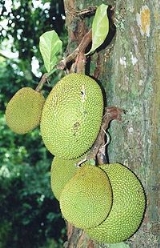
The jackfruit (Artocarpus heterophyllus) is a species of tree of the mulberry family (Moraceae) native to parts of South and Southeast Asia. It is well suited to tropical lowlands. Its fruit is the largest tree borne fruit in the world, seldom less than about 25 cm (10 in) in diameter. Even a relatively thin tree, around 10 cm (4 in) diameter, can bear large fruit. The fruits can reach 36 kg (80 lbs) in weight and up to 90 cm (36 in) long and 50 cm (20 in) in diameter.

Discussion
Ask a question about 'Jackfruit'
Start a new discussion about 'Jackfruit'
Answer questions from other users
|
Recent Posts

Encyclopedia
The jackfruit (Artocarpus heterophyllus) is a species of tree of the mulberry family (Moraceae) native to parts of South and Southeast Asia. It is well suited to tropical lowlands. Its fruit is the largest tree borne fruit in the world, seldom less than about 25 cm (10 in) in diameter. Even a relatively thin tree, around 10 cm (4 in) diameter, can bear large fruit. The fruits can reach 36 kg (80 lbs) in weight and up to 90 cm (36 in) long and 50 cm (20 in) in diameter. The jackfruit is something of an acquired taste, but it is very popular in many parts of the world. The sweet yellow sheaths around the seeds are about 3–5 mm thick and have a taste similar to that of pineapple, but milder and less juicy.
Cultivation & Ecology
The jackfruit (not to be confused with the Durian fruit) is native to India, Bangladesh, and Nepal. It is also possibly native to the Malay Peninsula, though it is more likely that it was introduced there by humans. It is commercially grown and sold in South, Southeast Asia and northern Australia. It is also grown in parts of Hawaii, Brazil, Suriname, Madagascar, and in islands of the West Indies such as Jamaica and Trinidad. It is the national fruit of Bangladesh and Indonesia. All jackfruit plants are frost sensitive. The jackfruit bears fruit three years after planting.
The jackfruit has played a significant role in the Indian agriculture (and culture) from time immemorial. Archeological findings in India have revealed that jackfruit was cultivated in India 3000 to 6000 years ago. Findings also indicate that Indian Emperor Ashoka the Great (274–237 BC) encouraged arbori-horticulture of various fruits including jackfruit. Varahamihira, the Indian astronomer, mathematician, and astrologer wrote a chapter on the treatment of trees in his Brhat Samhita. His treatise includes a specific reference on grafting to be performed on trees such as jackfruit.
Recently, the jackfruit has been considered as an invasive species in Brazil, specially in the Tijuca Forest National Park in Rio de Janeiro where the species has expanded thanks to its fruits being eaten by mammals such as the common marmoset and the coati; as both animals also prey on bird's eggs and nestlings, the supply of jackfruit as a ready source of food has allowed them to expand their populations at the expense of avian life. Also, the jackfruit itself competes with native tree-species; therefore the fact that, between 2002 and 2007,55,662 jackfruit saplings have been destroyed in the Tijuca Forest area alone in a deliberate culling effort by the park's management; at the same time, 1,921 young trees were felled and 881 mature ones were killed by having their bark stripped (anelagem) .
Commercial availability
Outside of its countries of origin, fresh jackfruit can be found at Asian food markets. It is also extensively cultivated in the Brazilian coastal region, being commercialized in local markets. It may also be available canned in sugar syrup or frozen. Sweet jackfruit chips are produced by various manufacturers.
Parts
Skin
Jackfruits have prickly skins which in the Philippines are a source of imagination and creativity for woodcarvers. They use the figure of the jackfruit to make bowls and they add the prickly texture of the jackfruit's skin to make it more realistic.
Flesh
Jackfruit flesh is one of the most edible parts of the jackfruit for it carries the most fragrant smell and taste in the fruit. It contains a high level of fiber which can help cure illnesses like constipation.
Seeds
Jackfruit seeds carry the fibrous role above all the other parts of the fruit. Natives prefer to roast them or boil to make it edible for them. Current researches say that turning the seeds into flour adds fiber a little bit compared to eating it by roasting or boiling.
Dishes and preparations
Jackfruit is commonly used in South and Southeast Asian cuisines. It can be eaten unripe (young) or ripe, and cooked or uncooked. The seeds can also be eaten cooked or baked like beans; they taste similar to chestnuts. The leaves are sometimes used as a wrapping for steamed Idlis.
Young fruit
Unripe (young) jackfruit can also be eaten whole. Young jackfruit has a mild flavour and distinctive texture. The cuisines of India, Bangladesh, Sri Lanka, Indonesia, Cambodia, and Vietnam use cooked young jackfruit. In many cultures, jackfruit is boiled and used in curries as a food staple.
Dishes
- Kathal Subzee: Spicy vegetable with raw jackfruit from Uttar Pradesh, Punjab and Assam, India.
- Gidde: Famous in South karnataka such as Udupi and Mangalore.
- In Udupi and Mangalore, a dish is prepared by soaking the unriped fruit in salt garins for months.
- Kathal Aachar: Pickle made of jackfruit from Assam.
- Pilakkai Kandbu and Dosa: Sweet dishes made with ripe jackfruit from Mangalore, India.
- Gujjeda Kajipu: Dry spicy curry of raw jackfruit from Mangalore, India.
- Ghariyo: Jackfruit sweet dish from Mangalore, India.
- Saath: Jackfruit Pappad as a snack from Goa and Mangalore, India.
- Jackfruit Halwa: made from ripen jackfruit a sweet dish, part of Udupi cuisine.
- Chakka Pradaman: Jackfruit pudding from Kerala, India.
- Enchorer Torkari: Curry made from unripe jackfruit from West Bengal, India.
- Chakka Varattiyathu: Rip jackfruit jam (with jaggery and ghee) from Kerala, India.
- Chakka Varauthathu: Jackfruit Chips from Kerala, India.
- Idiyan chakka: Whole tender jackfruit cooked with spices and pounded, from Kerala, India.
- Chakka aviyal, Chakka erisseri: Preparations with sliced unripe jackfruit and other vegetable, from Kerala, India.
- Panasa Koora/Panasa Pottu Koora: Traditional Jackfruit Curry made from unripe jackfruit from coastal Andhra, India.
- Gudeg: traditional dish from Yogyakarta, Central Java, Indonesia.
- Lodeh: traditional Indonesian vegetable dish with coconut milk.
- Gule Nangka: traditional Indonesia spicy curry Indonesia.
- Raithey: sour curry with boiled young jackfruit, raw mango & raw papaya part of Navayath cuisine from Bhatkal,Karnataka, India.
- Fansa Nevaryo: Navayath sweet dish of rice ground with ripen jackfruit stuffed with coconut and jaggery and steamed after wrapping in banyan leaves from Bhatkal,Karnataka, India.
- Humba Nangka:curry made from unripe jackfruit and coconut milk Bohol, Philippines.
- Gatti or Gidde in Tulu where ripe jackfruit is ground with rava to form thick paste which is put on a teak wood leaf and then cooked in steam. The gidde is ready.
- An optional ingredient in Sayur asam (Indonesian clear soup; the name means tamarind vegetables)
- Also ingredient in Indonesian traditional Minangkabau cuisine.
- Jackfruit salad: Vietnamese dish with boiled young jackfruit.
- Kiri Kos: A creamy jackfruit curry cooked with coconut milk from Sri Lanka.
- Polos Ambul: Tender jackfuits cooked with spices from Sri Lanka.
- Kalupol Maluwa: Jackfruit nuts cooked with spices and mixed with scraped coconut from Sri Lanka.
- Fanas Poli: Sun dried Jackfruit pulp with sugar from Konkan.
Also used in Vitamin Water
- G?i mít: jackfruit salad dish in Vietnam.
- Nhút mít: salted jackfruit popular in Central Vietnam.
Other preparations
- Jackfruit chips (for example, the Nafiri brand from Surabaya, Indonesia).
- Asian ice desserts (including Indonesian and Filipino versions).
- Turon, a Filipino dessert made of banana and jackfruit wrapped in an eggroll wrapper.
- Sometimes an added ingredient for cassava cake.
- An optional ingredient in kolak, an Indonesian mung bean and coconut based dessert.
- It is thought that jackfruit is the basis for the flavour of Juicy Fruit chewing gum.
- Jackfruit candy.
- Vitamin Water sells a jackfruit–guava (a Vitamin B and theanine) beverage.
- Jackfruit smoothies or milkshakes.
- Atu Kos is smoked jackfuit – a way of preserving it, to use when it is out of season in Sri Lanka.
Wood
The wood of the tree is used for the production of various musical instruments. In Indonesia it forms part of the gamelan and in the Philippines, its soft wood is made into the hull of a kutiyapi, a type of Philippine boat lute. It is also used to make the body of the Indian drums mridangam and kanjira. It is also widely used in the manufacture of furniture.
Jackfruit wood is also used in roof constructions and doors and windows in older houses.
The heartwood of the jackfruit tree is used by Buddhist forest monastics in Southeast Asia as a dye, giving the robes of the monks in those traditions their traditional off-brown colors.
Names The fruit is called a variety of names around the world. The English one, jackfruit, is generally cited as deriving from the Malayalam chakka or cakkai via the Portuguese jaca, the name for it used by the physician and naturalist Garcia de Orta in his 1563 book Colóquios dos simples e drogas da India. A botanist, Ralph Randles Stewart has suggested that it was named after William Jack (1795-1822), a Scottish botanist who worked for the East India Company in Bengal, Sumatra and Malaysia. The fruit, however, was called a "Jack" in English before William Jack was born: for instance, in Dampier's 1699 A new voyage round the world.
South Asian names
- Assamese: Kothal
- Bengali: ?????? Cãttal (National fruit of Bangladesh), Enchor (the unripe fruit, used in curries)
- Bhojpuri: Katahar
- Kannada: General : Halasu ???? Unripe: Halasina Kaayi ????? ???? Ripe: Halasina hannu ????? ?????
- Tulu: Gujje (unripe) and Pilakkai (ripe)
- Konkani:"Ponos"
- Gujarati: Phannasa
- Hindi: Katahal
- Nepali: ??? ??? (Rukh kut-a-herr)
- Malayalam: Chakka(????)
- Marathi: ??? Phanas
- Oriya: Panasa
- Maldivian, ???????? sakkeyo (only the ripe fruitpulp is used)
- Sinhala: Kos. Varaka / Vela (in its ripe state)
- Tamil: Palaa(???) / Varukkai (old Tamil)
- Telugu: General : Panasa; Unripe: Panasa Kaaya (???? ???); Ripe: Panasa Pandu (???? ????)
- Sanskrit: Panasam
Southeast Asian names
East Asian names
West Asian name
African names
European and Latin American names
The earliest European citation of the name is chaqui in an account c. 1328 by the French Dominican missionary Jordanus.
See also
External links
|
| |
|
|