
All Topics  
Tapioca


   Email Print
   Bookmark   Link


Tapioca


Tapioca is a flavorless, colorless, odorless starch
Starch

File:Amylose2.svgFile:Amylopektin Sessel.svgStarch or amylum is a polysaccharide carbohydrate consisting of a large number of glucose units joined together by glycosidic bonds....
 extracted from the root of the plant species Manihot esculenta. This species, native to South America
South America

South America is the southern continent of the Americas, situated entirely in the Western Hemisphere and mostly in the Southern Hemisphere, with a relatively small portion in the Northern Hemisphere....
, is now cultivated worldwide and has many names, including cassava
Cassava

The cassava, cassadaIn page 25, Darwin says "Mandioca or cassada is likewise cultivated in great quantity."See it also in ,yuca, 'manioc, 'mogo...
, bitter-cassava, manioc, "mandioca", "aipim", "macaxeira", "manioca", "boba", "yuca
Yuca

Yuca can refer to:*Yuca, Cassava *Yuca , a disparaging Venezuelan term used to refer to rock musicSee also*Yucca *Yuka ...
" (not to be confused with yucca
Yucca

The yuccas comprise the genus Yucca of 40-50 species of perennial plants, shrubs, and trees in the agave family Agavaceae, notable for their rosettes of evergreen, tough, sword-shaped Leaf and large terminal clusters of white or whitish flowers....
), "Sabudana" and "kappa".


Nutrition Facts


Discussion
Ask a question about 'Tapioca'
Start a new discussion about 'Tapioca'
Answer questions from other users
Full Discussion Forum


Encyclopedia


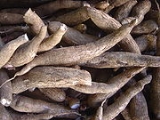
Manihot Esculenta Dsc07325


Tapioca is a flavorless, colorless, odorless starch
Starch

File:Amylose2.svgFile:Amylopektin Sessel.svgStarch or amylum is a polysaccharide carbohydrate consisting of a large number of glucose units joined together by glycosidic bonds....
 extracted from the root of the plant species Manihot esculenta. This species, native to South America
South America

South America is the southern continent of the Americas, situated entirely in the Western Hemisphere and mostly in the Southern Hemisphere, with a relatively small portion in the Northern Hemisphere....
, is now cultivated worldwide and has many names, including cassava
Cassava

The cassava,
cassadaIn page 25, Darwin says "Mandioca or cassada is likewise cultivated in great quantity."See it also in ,yuca, 'manioc, 'mogo...
, bitter-cassava, manioc, "mandioca", "aipim", "macaxeira", "manioca", "boba", "yuca
Yuca

Yuca can refer to:*Yuca, Cassava *Yuca , a disparaging Venezuelan term used to refer to rock musicSee also*Yucca *Yuka ...
" (not to be confused with yucca
Yucca

The yuccas comprise the genus Yucca of 40-50 species of perennial plants, shrubs, and trees in the agave family Agavaceae, notable for their rosettes of evergreen, tough, sword-shaped Leaf and large terminal clusters of white or whitish flowers....
), "Sabudana" and "kappa". Tapioca is a staple food in some regions and is used worldwide as a thickening agent
Thickening agent

Thickening agents, or thickeners, are substances which, when added to an aqueous mixture, increase its viscosity without substantially modifying its other properties, such as taste....
, principally in foods. Tapioca is gluten
Gluten

Gluten is a composite of the proteins gliadin and glutenin. These exist, conjoined with starch, in the endosperms of some Triticeae glutens cereal, notably wheat, rye, and barley....
 free, and nearly protein
Protein

Proteins are organic compounds made of amino acids arranged in a linear chain and joined together by peptide bonds between the carboxyl and amino groups of adjacent amino acid Residue ....
 free. The commercial form of tapioca most familiar to many people is pearl tapioca.

The name tapioca is a word derived from tipi'óka, the name for this starch in Tupi
Tupi-Guarani languages

Tupi-Guarani is the name of the most important subfamily of the Tupi languages of South America. It includes 53 languages in 11 groups, as well as the best-known languages of this family, like Guarani language and Old Tupi....
 This Tupi word refers to the process by which the starch is made edible. However, as the word moved out of South America it came to refer to similar preparations made with other esculents. 'Tapioca' in Britain often refers to a rice pudding thickened with arrowroot
Arrowroot

Arrowroot, or obedience plant , is a large perennial plant herb of genus Maranta found in rainforest habitats. Arrowroot is also the name of the edible starch from the rhizomes of West Indian arrowroot....
, while in Asia the sap of the sago palm is often part of its preparation.

Pearl tapioca is similar to pearl sago
Sago

Sago is a starch extracted from the pith of sago palm stems, Metroxylon sagu. It is a major staple food for the lowland peoples of Papua New Guinea and the Moluccas, where it is called saksak and sagu....
, which is used in essentially the same ways. Consequently, tapioca may be called sago, and vice versa.

Production

The cassava
Cassava

The cassava,
cassadaIn page 25, Darwin says "Mandioca or cassada is likewise cultivated in great quantity."See it also in ,yuca, 'manioc, 'mogo...
 plant can have either red or green branches. The toxin found in the root of the red-branched variant is less harmful to humans than the green-branched variety. Therefore, while the root of the red/purple-branched variant can be consumed directly, the root of the green-branched variant requires treatment to remove the toxin. Konzo
Konzo

Konzo is an epidemic paralytic disease. The outbreaks are associated with several weeks of almost exclusive consumption of insufficiently processed bitter cassava....
 (also called mantakassa) is a paralytic disease associated with several weeks of almost exclusive consumption of insufficiently processed bitter cassava.

Commercially, the starch is processed into several forms: powder, fine or coarse flakes or meal ("flour"), sticks, and "pearls". Flakes, rectangular sticks, and spherical pearls must be soaked well before cooking, to rehydrate them; they will easily absorb water equal to twice their volume, becoming leathery and swollen. All these products traditionally are white, but sticks and pearls may be colored. The oldest and most common color is brown, but pastel colors are now available. In all its forms tapioca starch is opaque before cooking; after cooking it becomes translucent.

Pearl tapioca

Pearls are made in several sizes, ranging from about 1mm to 5mm. In the United States, 2–3mm pearls are the most common size and are labeled "small". In good quality pearl tapioca, the pearls are very uniform in size, smooth, and few are broken. The pearls must be further prepared before use. For use in tapioca pudding
Tapioca pudding

Tapioca pudding is a sweet pudding made with tapioca and either milk, or in lactose intolerant cultures, coconut milk. It is made in many cultures with equally varying styles....
, pearls are prepared simply by soaking them overnight in water. For use in tapioca drinks, they are prepared by boiling for 25 minutes, until they are cooked thoroughly and are chewy, not gummy, then allowed to cool. If not used immediately, they may be kept for hours in a syrup of sugar or honey.

Pearl tapioca is easily confused with pearl sago
Sago

Sago is a starch extracted from the pith of sago palm stems, Metroxylon sagu. It is a major staple food for the lowland peoples of Papua New Guinea and the Moluccas, where it is called saksak and sagu....
, an equivalent product made from a different starch.

Uses

In Southeast Asia, the cassava root is commonly cut into slices, wedges or strips, fried, and served as a snack, similar to potato chips, wedges
Potato wedges

File:KFC potato wedges.JPGPotato wedges are a variation of the ubiquitous french fry. As its name suggests, they are large, often unpeeled wedge shaped chunks of potato that are either baked or fried....
 or french fries
French fries

French fries , chips , fries, or French-fried potatoes are thin strips of potato that have been deep-frying. A distinction is sometimes made between fries and chips; whereby North Americans sometimes refer to any elongated pieces of fried potatoes as fries, while in the UK, long slices of potatoes are sometimes called '...
. Another method is to boil large blocks until soft, and served with grated coconut
Coconut

The Coconut Palm is a member of the Family Arecaceae . It is the only species in the genus Cocos, and is a large palm, growing to 30 m tall, with pinnate leaf 4-6 m long, pinnae 60-90 cm long; old leaves break away cleanly leaving the trunk smooth....
 as a dessert, either slightly salted or sweetened, usually with palm sugar
Palm sugar

Palm sugar was originally made from the sugary sap of the Palmyra palm or the date palm. Now it is also made from the sap of the sago and coconut palms and may be sold as "coconut sugar." The sugar is a golden brown paste, sold in tubes, blocks or tin cans....
 syrup. Tapai
Tapai

Tapai or tape , sometimes referred to as peuyeum , is a traditional Fermentation found throughout much of East Asia and Southeast Asia....
 is made by fermenting large blocks with a yeast-like bacteria culture to produce a sweet and slightly alcoholic dessert. A variation of the chips popular amongst the Malays is kerepek pedas, where the crisps are coated with a hot, sweet and tangy chili
Chili pepper

Chili pepper is the fruit of the plants from the genus Capsicum, members of the Solanaceae, Solanaceae. Botany considers the plant a berry bush....
 and onion
Onion

Onion is a term used for many plants in the genus Allium. They are known by the common name "onion" but, used without qualifiers, it usually refers to Allium cepa....
 paste, or sambal
Sambal

Sambal is a condiment popular in Indonesia, Malaysia, Singapore, the southern Philippines and Sri Lanka, as well as the Netherlands through Indonesian influence, and in Suriname....
, usually with fried anchovies
Anchovy

The anchovies are a Family of small, common salt-water fish. There are about 140 species in 16 genera, found in the Atlantic, Indian, and Pacific Oceans....
 and peanut
Peanut

The peanut, or groundnut , is a species in the legume Fabaceae native to South America, Mexico and Central America. It is an annual plant herbaceous plant growing to 30 to 50 cm tall....
s added.

Commercially prepared tapioca has many uses. The powder is commonly used as a thickener for soups and other liquid foods, and is also used as a binder in pharmaceutical tablets
Tablet

A tablet is a mixture of active substances and excipients, usually in Powder form, pressed or compacted into a solid. The excipients include binders, glidants and lubricants to ensure efficient tabletting; disintegrants to ensure that the tablet breaks up in the digestive tract; sweeteners or flavours to mask the taste of bad-tasting activ...
 and natural paints. The flour is used to make tender breads, cakes, cookies, and other delicacies (see Maida flour
Maida flour

Maida flour is a finely-milled flour used to make a wide variety of food items, including Puri , chappathi, parotta, luchi and paratha. Maida is sometimes referred to as "all-purpose flour", but it more closely resembles cake flour or even pure starch....
). Flakes are used to thicken the filling of pie
Pie

A pie is a baked dish which is usually made of a pastry dough shell that covers or completely contains a filling of various sweetness or savoury ingredients....
s made with fruits having a high water content.

A typical recipe for tapioca jelly can be made by washing 2 tablespoonfuls of tapioca, pouring a pint of water over it, and soaking for three hours. It is then placed over low heat and simmered until quite clear. If too thick, a little boiling water can be added. It can be sweetened with white sugar, flavored with coconut milk or a little wine, and eaten alone or with cream.

In southern parts of India, especially the state of Kerala, a lot of tapioca is consumed, either boiled or cooked with spices. Tapioca and fish curry could be considered official food of Kerala. Tapioca is also available in Andhra Pradesh and coastal regions and is called with the name "Karapendalam" in Telugu. Cassava is called "Pendalam" in Telugu. In southern states like Kerala, tapioca is thinly sliced in and made into wafers like salted potato wafers. In the south India
India

India, officially the Republic of India , is a country in South Asia. It is the List of countries and outlying territories by total area country by geographical area, the List of countries by population country, and the most populous liberal democracy in the world....
n state of Kerala
Kerala

Kerala is a Indian Union States and territories of India located in the southwestern part of India. With an Arabian Sea coastline on the west, it is bordered on the north by Karnataka and by Tamil Nadu on the south and east....
, cassava, often referred to as tapioca in English, and kappa or kolly or maracheeni in Malayalam, is a staple food. Tapioca is used to make a granules like product called chowwary in Malayalam. This is used to make a light porridge by adding milk or buttermilk, recommended for patients recovering from illness. In Kannada, the actual cassava root is called kolli. It is commonly used as a food after fasting (popularly called khichdi) among some Hindus in Western and central part of India (Gujarat & Maharashtra region). In Tamil
Tamil language

Tamil is a Dravidian language spoken predominantly by Tamil people of the Indian subcontinent. It has Official language in India, Sri Lanka and Singapore....
, the roots of tapioca are called Maravallikezangu, and are used to prepare chips. Tapioca is also used to prepare maida flour
Maida flour

Maida flour is a finely-milled flour used to make a wide variety of food items, including Puri , chappathi, parotta, luchi and paratha. Maida is sometimes referred to as "all-purpose flour", but it more closely resembles cake flour or even pure starch....
. Tapioca chips are also prepared in parts of South India.

During World War II
World War II

World War II, or the Second World War , was a global military conflict which involved a Participants in World War II, including all of the great powers, organised into two opposing military alliances: the Allies of World War II and the Axis powers....
's Japan
Japan

Japan is an island country in East Asia. Located in the Pacific Ocean, it lies to the east of the Sea of Japan, People's Republic of China, North Korea, South Korea and Russia, stretching from the Sea of Okhotsk in the north to the East China Sea and Taiwan in the south....
ese occupation of Southeast Asia, many refugees survived on tapioca, as the plant is easily propagated by stem-cutting, grows well even in low-nutrient soils, and can be harvested every two months. The plant thus provided much needed carbohydrate and protein then.

In Brazilian cuisine
Cuisine of Brazil

The cuisine of Brazil, like Brazil itself, varies greatly by region. This diversity reflects the country's mix of native Indigenous peoples in Brazils, Portuguese Brazilian, Afro-Brazilianns, Italo Brazilianns, Spanish Brazilian, German-Brazilian, Polish Brazilianes, Arab Brazilianns, Arab Brazilian and Japanese Brazilianese among others wh...
, tapioca is used for different types of meals. The tapioca is stirred, drained through a sieve, fried into a tortilla
Tortilla

This aticle contains information about corn tortilla.For fluor tortilla, see: Flour tortilla For spanish tortilla, see: Tortilla_de_patatas...
 shape, and often sprinkled with coconut. Then it may be buttered and eaten as a toast (its most common use as a breakfast dish), or it may be filled or topped with either doces (sweet) or salgados (salty) ingredients, which define the kind of meal the tapioca is used for: breakfast, afternoon tea or dessert. Choices range from butter, cheese, chocolate
Chocolate

Chocolate comprises a number of raw and processed foods that are produced from the seed of the tropical cacao tree.Chocolate has become one of the most popular flavors in the world....
, banana
Banana

File:Banana and cross section.jpgBanana is the common name for a fruit and also the herbaceous plants of the genus Musa which produce this commonly eaten fruit....
s with condensed milk
Condensed milk

Condensed milk, also known as sweetened condensed milk, is Milk#Cow's milk from which water has been removed and to which sugar has been added, yielding a very thick, sweet product that can last for years without refrigeration if unopened....
, chocolate with bananas, to various forms of meat
Meat

In modern English usage, meat most often refers to animal biological tissue used as food, mostly skeletal muscle and associated fat, but it may also refer to offal, including livers, skin, brains, bone marrow, kidneys, in some countries lungs, and a variety of other internal organs as well as blood....
s and served warm. A restaurant which specializes in tapioca-based dishes (mostly fillings) is called in Brazil a tapiocaria. In Colombia
Colombia

Colombia , officially the Republic of Colombia , is a country in north-western South America. Colombia is bordered to the east by Venezuela and Brazil; to the south by Ecuador and Peru; to the north by the Caribbean Sea; to the north west by Panama; and to the west by the Pacific Ocean....
 and Venezuela
Venezuela

Venezuela , officially the Bolivarian Republic of Venezuela , is a country on the northern coast of South America.The country comprises a continental mainland and numerous islands located off the Venezuelan coastline in the Caribbean Sea....
, arepa
Arepa

An arepa is a bread made of maize originating from the northern Andes in South America, and which has now spread to other areas in Latin America ....
s may be made with tapioca flour rather than cornmeal. Tapioca arepas probably predate cornmeal arepas; among traditional cultures of the Caribbean the name for them is casabe.

Flatbreads

A casabe is a thin flatbread
Flatbread

A flatbread is a simple bread made from flattened dough. Many flatbreads are unleavened—made without yeast or sourdough culture. They can range from one millimeter to a few centimeters thick....
 made from bitter cassava
Cassava

The cassava,
cassadaIn page 25, Darwin says "Mandioca or cassada is likewise cultivated in great quantity."See it also in ,yuca, 'manioc, 'mogo...
 root without leavening. It was originally produced by the Native American
Indigenous peoples of the Americas

The indigenous peoples of the Americas are the pre-Columbian inhabitants of the Americas, their descendants, and many ethnic groups who identify with those peoples....
 Arawak
Arawak

The term Arawak , was used to designate some of the peoples encountered by the Spain in the West Indies in 1492 and thereafter. These include the Ta?no, who occupied the Greater Antilles and the Bahamas and Bimini Florida, the Nepoya and Suppoyo of Trinidad and the Igneri, who were supposed to have preceded the Caribs in the Lesser Anti...
 and Carib
Carib

Carib, Island Carib or Kalinago people, after whom the Caribbean Sea was named, live in the Lesser Antilles islands. They are an Amerindian people whose origins lie in the southern West Indies and the northern coast of South America....
 nations because these roots were a very common plant of the rain forests where they lived. In eastern Venezuela
Venezuela

Venezuela , officially the Bolivarian Republic of Venezuela , is a country on the northern coast of South America.The country comprises a continental mainland and numerous islands located off the Venezuelan coastline in the Caribbean Sea....
 many Native American ethnic groups still make casabe and it remains their main bread-like food. Native American communities including the Ye-Kuana, Kari-Ña, Yanomami, Guarao or Warao
Warao

The Warao are an Indigenous peoples in South America inhabiting northeastern Venezuela and western Guyana. Alternate common spellings of Warao are Waroa, Guarauno, Guarao, and Warrau....
 are from either the Caribe or Arawac Nations and still make casabe.

To make casabe, the starchy root of bitter cassava is ground to a pulp, then squeezed to expel a milky, bitter liquid called yare which carries the poisonous substances with it out of the pulp. Traditionally, this squeezing is done in a sebucan, an 8 to long tube-shaped pressure strainer woven in a characteristic helical pattern from from palm
Arecaceae

Palm or Palmae or Panamea , the palm family, is a family of flowering plants belonging to the Monocotyledon order, Arecales. There are roughly 202 currently known Genus with around 2600 species, most of which are restricted to tropics, subtropics, and warm temperate climates....
 leaves
Leaves

Leaves are an Iceland five-piece alternative rock band who formed in 2001. They came to prominence in 2002 with their debut album, Breathe, drawing comparisons to groups such as Coldplay and Doves....
. The sebucan usually is hung from a tree branch or ceiling pole, and it has a closed bottom with a loop that is attached to a fixed stick or lever, which is used to stretch the sebucan. When the lever is pushed down, stretching the sebucan, the helical weaving pattern causes the strainer to squeeze the pulp inside. This is similar to the action of a Chinese finger trap
Chinese finger trap

A Chinese finger trap is a joke toy used to play a practical joke on children and unsuspecting adults. The finger trap is a simple puzzle that traps the victim's fingers in both ends of a small, woven bamboo cylinder....
. The pulp is then spread in thin, round cakes about in diameter on a budare' to roast or toast.

Thin and crisp cakes of casabe are often broken apart and eaten like crackers. Like bread, casabe can be eaten alone or with other dishes. Thicker casabe usually are eaten slightly moistened. Just a subtle sprinkle of a few drops of liquid
Liquid

Liquid is one of the principal states of matter. A liquid is a fluid that has the particles loose and can freely form a distinct surface at the boundaries of its bulk material....
 is enough to transform a very dry casabe into a very soft and smooth bread very similar to the softest slice of a wheat bread loaf
Loaf

A loaf is a shaped, usually rounded or oblong, mass of food. It may refer to a bread or other moulded foods, such as meatloaf.The term "loaf" sometimes refers to "head" from the rhyming slang "loaf of bread" ....
, an incredible change in texture. Because of its capacity to absorb liquid immediately, casabe may cause someone to choke, but goes down quickly with a sip of liquid.

Pearl tapioca

Pearl tapioca is a common ingredient in Southeast Asia
Southeast Asia

Southeast Asia or Southeastern Asia is a subregion of Asia, consisting of the countries that are geographically south of China, east of India and north of Australia....
n dessert
Dessert

Dessert is a course that typically comes at the end of a meal, usually consisting of sweet food but sometimes of a strongly-flavored one, such as some cheeses....
s such as kolak
Kolak

Kolak or Kolek is an Indonesian dessert made with palm sugar and coconut milk, with pandanus leaf for flavour. In some versions, mung beans are also used, and cooked till soft....
, in tapioca pudding
Tapioca pudding

Tapioca pudding is a sweet pudding made with tapioca and either milk, or in lactose intolerant cultures, coconut milk. It is made in many cultures with equally varying styles....
, and in sweet drinks such as bubble tea
Bubble tea

Bubble tea Arelene, also called "Boba" tea, is a tea drink containing gelatinous tapioca pearls. It originated in Taiwan in the 1980s, spread to nearby East Asian countries, and migrated to Canada before spreading to Chinatown in New York City, then to various spots throughout the West Coast of the United States....
 and taho
Taho

Tah? is a Philippines snack food made of fresh Tofu#Varieties Tofu, arnibal , and Sago . This staple comfort food is a signature sweet and can be found all over the country....
, where they provide a chewy contrast to the sweetness of the drink. Small pearls are preferred for use in puddings; large pearls are preferred for use in drinks. These large pearls most often are brown, not white (and traditionally are used in black tea
Black tea

Black tea is a variety of tea that is more oxidization than the oolong, green tea, and White tea varieties.All four varieties are made from leaves of Camellia sinensis. Black tea is generally stronger in flavor and contains more caffeine than the less Redox teas....
 drinks), but are available in a wide variety of pastel colors.

In various Asian countries (India, Bangladesh, Myanmar, Malaysia) tapioca pearls are used and can be mistaken for sago pearls also known as sabudana (Pearl Sago) also called 'Seeme Akki' in Kannada
Kannada language

Kannada is one of the major Dravidian languages of India, spoken predominantly in the state of Karnataka. Kannada, whose native speakers are called Kannadigas , number roughly 35 million, making it the 27th most spoken language in the world....
. Also the pearls (sabudana) are used to make snacks. In Tamil Nadu, a large number of tapioca industries are found in Attur Taluk, Salem District. Salem City has a marketing center for the sago
Sago

Sago is a starch extracted from the pith of sago palm stems, Metroxylon sagu. It is a major staple food for the lowland peoples of Papua New Guinea and the Moluccas, where it is called saksak and sagu....
 (known as "Javvarisi").

In Indian cuisine
Indian cuisine

The cuisine of India is characterized by its sophisticated and subtle use of many spices and vegetables grown across India and also for the widespread practice of vegetarianism across its society....
, the granular preparation of cassava starch is known as tapioca. It can also be used to thicken puddings. While frequently associated with dessert in the United States, tapioca is now being used by some cooks in other courses as well. Chef Thomas Keller
Thomas Keller

Thomas Keller is an United States chef, restaurateur, and cookbook writer. He and his landmark restaurant, French Laundry in Yountville, California, in the Napa Valley, have won multiple awards from the James Beard Foundation, notably the Best California Chef in 1996 and the Best Chef in America in 1997, and the restaurant is a perennial wi...
 serves oysters on tapioca. The pairing, called "Oysters and Pearls," is considered Keller's "signature dish."

See also

  • Pandeyuca
    Pandeyuca

    Pandeyuca is a type of bread made of cassava starch and cheese typical of Southern Colombia....


External links

  • shows traditional preparation of cassava into casabe.