


Rainbow

Encyclopedia
Optics
Optics is the branch of physics which involves the behavior and properties of light, including its interactions with matter and the construction of instruments that use or detect it. Optics usually describes the behavior of visible, ultraviolet, and infrared light...
and meteorological
Meteorology
Meteorology is the interdisciplinary scientific study of the atmosphere. Studies in the field stretch back millennia, though significant progress in meteorology did not occur until the 18th century. The 19th century saw breakthroughs occur after observing networks developed across several countries...
phenomenon that causes a spectrum of light
Light
Light or visible light is electromagnetic radiation that is visible to the human eye, and is responsible for the sense of sight. Visible light has wavelength in a range from about 380 nanometres to about 740 nm, with a frequency range of about 405 THz to 790 THz...
to appear in the sky when the Sun shines on to droplets of moisture in the Earth's atmosphere
Earth's atmosphere
The atmosphere of Earth is a layer of gases surrounding the planet Earth that is retained by Earth's gravity. The atmosphere protects life on Earth by absorbing ultraviolet solar radiation, warming the surface through heat retention , and reducing temperature extremes between day and night...
. It takes the form of a multicoloured
Color
Color or colour is the visual perceptual property corresponding in humans to the categories called red, green, blue and others. Color derives from the spectrum of light interacting in the eye with the spectral sensitivities of the light receptors...
arc
Arc (geometry)
In geometry, an arc is a closed segment of a differentiable curve in the two-dimensional plane; for example, a circular arc is a segment of the circumference of a circle...
. Rainbows caused by sunlight always appear in the section of sky directly opposite the sun.
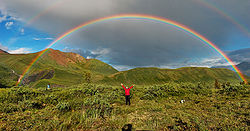
In a so-called "primary rainbow" (the lowest, and also normally the brightest rainbow) the arc of a rainbow shows red on the outer (or upper) part of the arc, and violet on the inner section. This rainbow is caused by light being refracted then reflected once in droplets of water. In a double rainbow, a second arc may be seen above and outside the primary arc, and has the order of its colours reversed (red faces inward toward the other rainbow, in both rainbows). This second rainbow is caused by light reflecting twice inside water droplets. The region between a double rainbow is dark, and is known as "Alexander's band
Alexander's band
thumb|200px|Ray paths of the primary rainbowthumb|200px|Ray paths of the secondary rainbowthumb|400px|Alexander's BandAlexander's band or Alexander's dark band is an optical phenomenon associated with rainbows which was named after Alexander of Aphrodisias who first described it. It occurs due to...
" or "Alexander's dark band". The reason for this dark band is that, while light below the primary rainbow comes from droplet reflection, and light above the upper (secondary) rainbow also comes from droplet reflection, there is no mechanism for the region between a double rainbow to show any light reflected from water drops.
It is impossible for an observer to manoeuvre to see any rainbow from water droplets at any angle other than the customary one (which is 42 degrees from the direction opposite the Sun). Even if an observer sees another observer who seems "under" or "at the end" of a rainbow, the second observer will see a different rainbow further off-yet, at the same angle as seen by the first observer. Thus, a "rainbow" is not a physical object, and cannot be physically approached.
A rainbow spans a continuous spectrum of colours; the distinct bands (including the number of bands) are an artefact of human colour vision
Color vision
Color vision is the capacity of an organism or machine to distinguish objects based on the wavelengths of the light they reflect, emit, or transmit...
, and no banding of any type is seen in a black-and-white photo of a rainbow (only a smooth gradation of intensity to a maximum, then fading to a minimum at the other side of the arc). For colours seen by a normal human eye, the most commonly cited and remembered sequence, in English, is Newton's
Isaac Newton
Sir Isaac Newton PRS was an English physicist, mathematician, astronomer, natural philosopher, alchemist, and theologian, who has been "considered by many to be the greatest and most influential scientist who ever lived."...
sevenfold red, orange, yellow, green, blue, indigo
Indigo
Indigo is a color named after the purple dye derived from the plant Indigofera tinctoria and related species. The color is placed on the electromagnetic spectrum between about 420 and 450 nm in wavelength, placing it between blue and violet...
and violet (popularly memorized by mnemonics like Roy G. Biv
Roy G. Biv
ROYGBIV is an acronym for the visible part of the electromagnetic light spectrum:* Red* Orange* Yellow* Green* Blue* Indigo* VioletA rainbow spans a continuous spectrum of colors; the distinct bands are an artifact of human color vision...
). However, colour-blind persons will see fewer colours.
Rainbows can be caused by many forms of airborne water. These include not only rain, but also mist, spray, and airborne dew
Dew
[Image:Dew on a flower.jpg|right|220px|thumb|Some dew on an iris in Sequoia National Park]]Dew is water in the form of droplets that appears on thin, exposed objects in the morning or evening...
.
Visibility
Rainbows can be observed whenever there are water dropsDrop (liquid)
A drop or droplet is a small column of liquid, bounded completely or almost completely by free surfaces. A drop may form when liquid accumulates at the lower end of a tube or other surface boundary, producing a hanging drop called a pendant drop...
in the air and sunlight
Sunlight
Sunlight, in the broad sense, is the total frequency spectrum of electromagnetic radiation given off by the Sun. On Earth, sunlight is filtered through the Earth's atmosphere, and solar radiation is obvious as daylight when the Sun is above the horizon.When the direct solar radiation is not blocked...
shining from behind at a low altitude
Altitude
Altitude or height is defined based on the context in which it is used . As a general definition, altitude is a distance measurement, usually in the vertical or "up" direction, between a reference datum and a point or object. The reference datum also often varies according to the context...
angle
Angle
In geometry, an angle is the figure formed by two rays sharing a common endpoint, called the vertex of the angle.Angles are usually presumed to be in a Euclidean plane with the circle taken for standard with regard to direction. In fact, an angle is frequently viewed as a measure of an circular arc...
. The most spectacular rainbow displays happen when half the sky is still dark with raining cloud
Cloud
A cloud is a visible mass of liquid droplets or frozen crystals made of water and/or various chemicals suspended in the atmosphere above the surface of a planetary body. They are also known as aerosols. Clouds in Earth's atmosphere are studied in the cloud physics branch of meteorology...
s and the observer is at a spot with clear sky in the direction of the sun. The result is a luminous rainbow that contrasts with the darkened background.
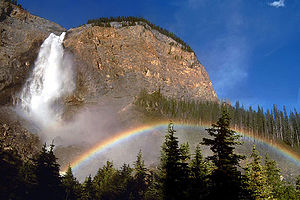
The rainbow effect is also commonly seen near waterfall
Waterfall
A waterfall is a place where flowing water rapidly drops in elevation as it flows over a steep region or a cliff.-Formation:Waterfalls are commonly formed when a river is young. At these times the channel is often narrow and deep. When the river courses over resistant bedrock, erosion happens...
s or fountain
Fountain
A fountain is a piece of architecture which pours water into a basin or jets it into the air either to supply drinking water or for decorative or dramatic effect....
s. In addition, the effect can be artificially created by dispersing water droplets into the air during a sunny day. Rarely, a moonbow
Moonbow
A moonbow is a rainbow produced by light reflected off the surface of the moon rather than from direct sunlight. Moonbows are relatively faint, due to the smaller amount of light reflected from the surface of the moon...
, lunar rainbow or nighttime rainbow, can be seen on strongly moonlit nights. As human visual perception
Visual perception
Visual perception is the ability to interpret information and surroundings from the effects of visible light reaching the eye. The resulting perception is also known as eyesight, sight, or vision...
for colour is poor in low light, moonbows are often perceived to be white. It is difficult to photograph the complete semicircle of a rainbow in one frame, as this would require an angle of view
Angle of view
In photography, angle of view describes the angular extent of a given scene that is imaged by a camera. It is used interchangeably with the more general term field of view....
of 84°. For a 35 mm
135 film
The term 135 was introduced by Kodak in 1934 as a designation for cartridge film wide, specifically for still photography. It quickly grew in popularity, surpassing 120 film by the late 1960s to become the most popular photographic film format...
camera, a lens with a focal length of 19 mm or less wide-angle lens
Wide-angle lens
From a design perspective, a wide angle lens is one that projects a substantially larger image circle than would be typical for a standard design lens of the same focal length; this enables either large tilt & shift movements with a view camera, or lenses with wide fields of view.More informally,...
would be required. Now that powerful software for stitching several images into a panorama is available, images of the entire arc and even secondary arcs can be created fairly easily from a series of overlapping frames. From an aeroplane
Fixed-wing aircraft
A fixed-wing aircraft is an aircraft capable of flight using wings that generate lift due to the vehicle's forward airspeed. Fixed-wing aircraft are distinct from rotary-wing aircraft in which wings rotate about a fixed mast and ornithopters in which lift is generated by flapping wings.A powered...
, one has the opportunity to see the whole circle of the rainbow, with the plane's shadow in the centre. This phenomenon can be confused with the glory
Glory (optical phenomenon)
A glory is an optical phenomenon that resembles an iconic saint's halo about the shadow of the observer's head. The effect is produced by light backscattered towards its source by a cloud of uniformly sized water droplets...
, but a glory is usually much smaller, covering only 5–20°.
At good visibility conditions (for example, a dark cloud behind the rainbow), the second arc can be seen, with inverse order of colours. At the background of the blue sky, the second arc is barely visible.
Spectrum
A rainbow spans a continuous spectrum of colours—there are no "bands." The apparent discreteness is an artefact of the photopigments in the human eye and of the neural processing of our photoreceptor outputs in the brain. Because the peak response of human colour receptors varies from person to person, different individuals will see slightly different colours, and persons with colour blindness will see a smaller set of colours. However, the seven colours listed below are thought to be representative of how humans everywhere, with normal colour vision, see the rainbow.Newton originally (1672) named only five primary colours: red, yellow, green, blue and violet. Later he included orange
Orange (colour)
The colour orange occurs between red and yellow in the visible spectrum at a wavelength of about 585–620 nm, and has a hue of 30° in HSV colour space. It is numerically halfway between red and yellow in a gamma-compressed RGB colour space, the expression of which is the RGB colour wheel. The...
and indigo, giving seven colours by analogy to the number of notes in a musical scale.
| Red | Orange | Yellow | Green | Blue | Indigo | Violet |
Explanation
The light is first refractedRefraction
Refraction is the change in direction of a wave due to a change in its speed. It is essentially a surface phenomenon . The phenomenon is mainly in governance to the law of conservation of energy. The proper explanation would be that due to change of medium, the phase velocity of the wave is changed...
entering the surface of the raindrop, reflected
Reflection (physics)
Reflection is the change in direction of a wavefront at an interface between two differentmedia so that the wavefront returns into the medium from which it originated. Common examples include the reflection of light, sound and water waves...
off the back of the drop, and again refracted as it leaves the drop. The overall effect is that the incoming light is reflected back over a wide range of angle
Angle
In geometry, an angle is the figure formed by two rays sharing a common endpoint, called the vertex of the angle.Angles are usually presumed to be in a Euclidean plane with the circle taken for standard with regard to direction. In fact, an angle is frequently viewed as a measure of an circular arc...
s, with the most intense light at an angle of 40–42°. The angle is independent of the size of the drop, but does depend on its refractive index
Refractive index
In optics the refractive index or index of refraction of a substance or medium is a measure of the speed of light in that medium. It is expressed as a ratio of the speed of light in vacuum relative to that in the considered medium....
. Seawater has a higher refractive index than rain water, so the radius of a "rainbow" in sea spray is smaller than a true rainbow. This is visible to the naked eye by a misalignment of these bows.
The amount by which light is refracted depends upon its wavelength
Wavelength
In physics, the wavelength of a sinusoidal wave is the spatial period of the wave—the distance over which the wave's shape repeats.It is usually determined by considering the distance between consecutive corresponding points of the same phase, such as crests, troughs, or zero crossings, and is a...
, and hence its colour. This effect is called dispersion
Dispersion (optics)
In optics, dispersion is the phenomenon in which the phase velocity of a wave depends on its frequency, or alternatively when the group velocity depends on the frequency.Media having such a property are termed dispersive media...
. Blue light (shorter wavelength) is refracted at a greater angle than red light, but due to the reflection of light rays from the back of the droplet, the blue light emerges from the droplet at a smaller angle to the original incident white light ray than the red light. Due to this angle, blue is seen on the inside of the arc of the primary rainbow, and red on the outside.
Contrary to popular belief, the light at the back of the raindrop does not undergo total internal reflection
Total internal reflection
Total internal reflection is an optical phenomenon that happens when a ray of light strikes a medium boundary at an angle larger than a particular critical angle with respect to the normal to the surface. If the refractive index is lower on the other side of the boundary and the incident angle is...
, and some light does emerge from the back. However, light coming out the back of the raindrop does not create a rainbow between the observer and the Sun because spectra emitted from the back of the raindrop do not have a maximum of intensity, as the other visible rainbows do, and thus the colours blend together rather than forming a rainbow.
A rainbow does not actually exist at a particular location in the sky. Its apparent position depends on the observer's location and the position of the Sun. All raindrops refract and reflect the sunlight in the same way, but only the light from some raindrops reaches the observer's eye. This light is what constitutes the rainbow for that observer. The position of a rainbow in the sky is always in the opposite direction of the Sun with respect to the observer, and the interior is always slightly brighter than the exterior. The bow is centred on the shadow of the observer's head, or more exactly at the antisolar point
Antisolar point
The antisolar point is the imaginary point on the celestial sphere exactly opposite the Sun. It is where anticrepuscular rays appear to converge, and on a moonless night away from city lights, it is often possible to see the gegenschein there. The apex of a rainbow will also form roughly 42...
(which is below the horizon
Horizon
The horizon is the apparent line that separates earth from sky, the line that divides all visible directions into two categories: those that intersect the Earth's surface, and those that do not. At many locations, the true horizon is obscured by trees, buildings, mountains, etc., and the resulting...
during the daytime), appearing at an angle of 40–42° to the line between the observer's head and its shadow. As a result, if the Sun is higher than 42°, then the rainbow is below the horizon and usually cannot be seen as there are not usually sufficient raindrops between the horizon (that is: eye height) and the ground, to contribute. Exceptions occur when the observer is high above the ground, for example in an aeroplane (see above), on top of a mountain, or above a waterfall.
Multiple rainbows
.jpg)
Alexander's band
thumb|200px|Ray paths of the primary rainbowthumb|200px|Ray paths of the secondary rainbowthumb|400px|Alexander's BandAlexander's band or Alexander's dark band is an optical phenomenon associated with rainbows which was named after Alexander of Aphrodisias who first described it. It occurs due to...
, after Alexander of Aphrodisias
Alexander of Aphrodisias
Alexander of Aphrodisias was a Peripatetic philosopher and the most celebrated of the Ancient Greek commentators on the writings of Aristotle. He was a native of Aphrodisias in Caria, and lived and taught in Athens at the beginning of the 3rd century, where he held a position as head of the...
who first described it.
Very dim tertiary (triple) and even quaternary (quadruple) rainbows have been photographed. These are caused by triple or quadruple reflections of sunlight inside the raindrops. Such rainbows appear on the same side of the sky as the sun, at about 40° from the sun for tertiary and 45° from the sun for quaternary rainbows. It is difficult to see these types of rainbows with the naked eye because of the sun's glare.
Higher-order rainbows were described by Felix Billet (1808–1882) who depicted angular positions up to the 19th-order rainbow, a pattern he called a "rose of rainbows". In the laboratory, it is possible to observe higher-order rainbows by using extremely bright and well collimated light produced by laser
Laser
A laser is a device that emits light through a process of optical amplification based on the stimulated emission of photons. The term "laser" originated as an acronym for Light Amplification by Stimulated Emission of Radiation...
s. Up to the 200th-order rainbow was reported by Ng et al. in 1998 using a similar method but an argon ion laser beam.
Supernumerary rainbow
A supernumerary rainbow—also known as a stacker rainbow—is an infrequent phenomenon, consisting of several faint rainbows on the inner side of the primary rainbow, and very rarely also outside the secondary rainbow. Supernumerary rainbows are slightly detached and have pastel colour bands that do not fit the usual pattern.It is not possible to explain their existence using classical geometric optics
Optics
Optics is the branch of physics which involves the behavior and properties of light, including its interactions with matter and the construction of instruments that use or detect it. Optics usually describes the behavior of visible, ultraviolet, and infrared light...
. The alternating faint rainbows are caused by interference between rays of light following slightly different paths with slightly varying lengths within the raindrops. Some rays are in phase
Phase (waves)
Phase in waves is the fraction of a wave cycle which has elapsed relative to an arbitrary point.-Formula:The phase of an oscillation or wave refers to a sinusoidal function such as the following:...
, reinforcing each other through constructive interference, creating a bright band; others are out of phase by up to half a wavelength, cancelling each other out through destructive interference, and creating a gap. Given the different angles of refraction for rays of different colours, the patterns of interference are slightly different for rays of different colours, so each bright band is differentiated in colour, creating a miniature rainbow. Supernumerary rainbows are clearest when raindrops are small and of similar size. The very existence of supernumerary rainbows was historically a first indication of the wave
Wave
In physics, a wave is a disturbance that travels through space and time, accompanied by the transfer of energy.Waves travel and the wave motion transfers energy from one point to another, often with no permanent displacement of the particles of the medium—that is, with little or no associated mass...
nature of light, and the first explanation was provided by Thomas Young
Thomas Young (scientist)
Thomas Young was an English polymath. He is famous for having partly deciphered Egyptian hieroglyphics before Jean-François Champollion eventually expanded on his work...
in 1804.
Tertiary and quaternary rainbows
In addition to the primary and secondary rainbows seen in a direction opposite to the sun, it is also possible (but very rare) to see two faint rainbows in the direction of the sun. These are the tertiary and quaternary rainbows, formed by light that has reflected three and four times within the rain drops, respectively. Photographic evidence for the tertiary and quaternary rainbows was published, apparently for the first time, in 2011.Reflected rainbow, reflection rainbow
When a rainbow appears above a body of water, two complementary mirror bows may be seen below and above the horizon, originating from different light paths. Their names are slightly different. A reflected rainbow will appear as a mirror image in the water surface below the horizon, if the surface is quiet (see photo above). The sunlight is first deflected by the raindrops, and then reflected off the body of water, before reaching the observer. The reflected rainbow is frequently visible, at least partially, even in small puddles.Where sunlight reflects off a body of water before reaching the raindrops (see diagram), it may produce a reflection rainbow (see photo at the right), if the water body is large, quiet over its entire surface, and close to the rain curtain. The reflection rainbow appears above the horizon. It intersects the normal rainbow at the horizon, and its arc reaches higher in the sky, with its centre as high above the horizon as the normal rainbow's centre is below it. Due to the combination of requirements, a reflection rainbow is rarely visible.

Six (or even eight) bows may be distinguished if the reflection of the reflection bow, and the secondary bow with its reflections happen to appear simultaneously.
Monochrome rainbow
Occasionally a shower may happen at sunrise or sunset, where the shorter wavelengths like blue and green have been scattered and essentially removed from the spectrum. Further scattering may occur due to the rain, and the result can be the rare and dramatic monochrome rainbow.Rainbows under moonlight (Moonbow
Moonbow
A moonbow is a rainbow produced by light reflected off the surface of the moon rather than from direct sunlight. Moonbows are relatively faint, due to the smaller amount of light reflected from the surface of the moon...
s) are often perceived as white and may be thought of as monochrome. Technically, the full spectrum is present but our eyes are not normally sensitive enough to see the colours. Long exposure photographs will sometimes show the colour in this type of rainbow.
Circumhorizontal arc
The circumhorizontal arcCircumhorizontal arc
A circumhorizontal arc is an optical phenomenon - an ice-halo formed by plate-shaped ice crystals in high level cirrus clouds.The current accepted names are circumhorizon arc or lower symmetric 46° plate arc The complete halo is a huge, multi-coloured band running parallel to the horizon with its...
is sometimes referred to by the misnomer "fire rainbow". As it originates in ice crystals, it is not a rainbow but a halo
Halo (optical phenomenon)
A halo from Greek ἅλως; also known as a nimbus, icebow or gloriole) is an optical phenomenon produced by ice crystals creating colored or white arcs and spots in the sky. Many are near the sun or moon but others are elsewhere and even in the opposite part of the sky...
.
Rainbows on Titan
It has been suggested that rainbows might exist on Saturn's moon TitanTitan (moon)
Titan , or Saturn VI, is the largest moon of Saturn, the only natural satellite known to have a dense atmosphere, and the only object other than Earth for which clear evidence of stable bodies of surface liquid has been found....
, as it has a wet surface and humid clouds. The radius of a Titan rainbow would be about 49° instead of 42°, because the fluid in that cold environment is methane instead of water. A visitor might need infrared
Infrared
Infrared light is electromagnetic radiation with a wavelength longer than that of visible light, measured from the nominal edge of visible red light at 0.74 micrometres , and extending conventionally to 300 µm...
goggles to see the rainbow, as Titan's atmosphere is more transparent for those wavelengths.
Scientific history
The classical GreekAncient Greece
Ancient Greece is a civilization belonging to a period of Greek history that lasted from the Archaic period of the 8th to 6th centuries BC to the end of antiquity. Immediately following this period was the beginning of the Early Middle Ages and the Byzantine era. Included in Ancient Greece is the...
scholar Aristotle
Aristotle
Aristotle was a Greek philosopher and polymath, a student of Plato and teacher of Alexander the Great. His writings cover many subjects, including physics, metaphysics, poetry, theater, music, logic, rhetoric, linguistics, politics, government, ethics, biology, and zoology...
(384–322 BC) was first to devote serious attention to the rainbow. According to Raymond L. Lee and Alistair B. Fraser, "Despite its many flaws and its appeal to Pythagorean numerology, Aristotle's qualitative explanation showed an inventiveness and relative consistency that was unmatched for centuries. After Aristotle's death, much rainbow theory consisted of reaction to his work, although not all of this was uncritical."
In the Naturales Quaestiones
Naturales quaestiones
Naturales quaestiones is an encyclopedia of the natural world written by Seneca around 65 AD. It is much shorter than the Naturalis Historia produced by Pliny the Elder some ten years later, however.-Content:...
(ca. 65 AD), Seneca
Seneca the Younger
Lucius Annaeus Seneca was a Roman Stoic philosopher, statesman, dramatist, and in one work humorist, of the Silver Age of Latin literature. He was tutor and later advisor to emperor Nero...
devotes a whole book to rainbows, heaping up a number of observations and hypotheses. He notices that rainbows appear always opposite to the sun, that they appear in water sprayed by a rower or even in the water spat by a launderer
Fullo
A fullo was a Roman fuller or cloth-launderer , known from many inscriptions from Italy and the western half of the Roman Empire and references in Latin literature, e.g. by Plautus, Martialis and Pliny the Elder. A fullo worked in a fullery or fullonica...
on dresses; he even speaks of rainbows produced by small rods (virgulae) of glass, anticipating Newton
Isaac Newton
Sir Isaac Newton PRS was an English physicist, mathematician, astronomer, natural philosopher, alchemist, and theologian, who has been "considered by many to be the greatest and most influential scientist who ever lived."...
's experiences with prisms. He takes into account two theories: one, that the rainbow is produced by the sun reflecting in each water-drop, the other, that it is produced by the sun reflected in a cloud shaped like a concave mirror. He favors the latter theory. He observes other phenomena related with rainbows: the mysterious "virgae" (rods) and the parhelia
Sun dog
A sun dog or sundog, scientific name parhelion ; , also called a mock sun or a phantom sun, is an atmospheric phenomenon that creates bright spots of light in the sky, often on a luminous ring or halo on either side of the sun.Sundogs may appear as a colored patch of light to the left or right of...
.
The Persian physicist and polymath
Polymath
A polymath is a person whose expertise spans a significant number of different subject areas. In less formal terms, a polymath may simply be someone who is very knowledgeable...
, Ibn al-Haytham (Alhazen; 965–1039), attempted to provide a scientific explanation for the rainbow phenomenon. In his Maqala fi al-Hala wa Qaws Quzah (On the Rainbow and Halo), he "explained the formation of rainbow as an image, which forms at a concave mirror. If the rays of light coming from a farther light source reflect to any point on axis of the concave mirror, they form concentric circles in that point. When it is supposed that the sun as a farther light source, the eye of viewer as a point on the axis of mirror and a cloud as a reflecting surface, then it can be observed the concentric circles are forming on the axis." He was not able to verify this because his theory that "light from the sun is reflected by a cloud before reaching the eye" did not allow for a possible experiment
Experiment
An experiment is a methodical procedure carried out with the goal of verifying, falsifying, or establishing the validity of a hypothesis. Experiments vary greatly in their goal and scale, but always rely on repeatable procedure and logical analysis of the results...
al verification. This explanation was later repeated by Averroes
Averroes
' , better known just as Ibn Rushd , and in European literature as Averroes , was a Muslim polymath; a master of Aristotelian philosophy, Islamic philosophy, Islamic theology, Maliki law and jurisprudence, logic, psychology, politics, Arabic music theory, and the sciences of medicine, astronomy,...
, and, though incorrect, provided the groundwork for the correct explanations later given by Kamāl al-Dīn al-Fārisī (1267–ca. 1319/1320) and Theodoric of Freiberg
Theodoric of Freiberg
Theodoric of Freiberg was a German member of the Dominican order and a theologian and physicist...
(c.1250–1310). Ibn al-Haytham supported the Aristotelian
Aristotelian physics
Aristotelian Physics the natural sciences, are described in the works of the Greek philosopher Aristotle . In the Physics, Aristotle established general principles of change that govern all natural bodies; both living and inanimate, celestial and terrestrial—including all motion, change in respect...
views that the rainbow is caused by reflection alone and that its colours are not real like object colours.
Ibn al-Haytham's contemporary, the Persian philosopher
Early Islamic philosophy
Early Islamic philosophy or classical Islamic philosophy is a period of intense philosophical development beginning in the 2nd century AH of the Islamic calendar and lasting until the 6th century AH...
and polymath Ibn Sīnā (Avicenna; 980–1037), provided an alternative explanation, writing "that the bow is not formed in the dark cloud but rather in the very thin mist lying between the cloud and the sun or observer. The cloud, he thought, serves simply as the background of this thin substance, much as a quicksilver lining is placed upon the rear surface of the glass in a mirror. Ibn Sīnā would change the place not only of the bow, but also of the colour formation, holding the iridescence to be merely a subjective sensation in the eye." This explanation, however, was also incorrect. Ibn Sīnā's account accepts many of Aristotle's arguments on the rainbow.
In Song Dynasty China
Song Dynasty
The Song Dynasty was a ruling dynasty in China between 960 and 1279; it succeeded the Five Dynasties and Ten Kingdoms Period, and was followed by the Yuan Dynasty. It was the first government in world history to issue banknotes or paper money, and the first Chinese government to establish a...
(960–1279), a polymathic scholar-official named Shen Kuo
Shen Kuo
Shen Kuo or Shen Gua , style name Cunzhong and pseudonym Mengqi Weng , was a polymathic Chinese scientist and statesman of the Song Dynasty...
(1031–1095) hypothesized—as a certain Sun Sikong (1015–1076) did before him—that rainbows were formed by a phenomenon of sunlight encountering droplets of rain in the air. Paul Dong writes that Shen's explanation of the rainbow as a phenomenon of atmospheric refraction
Atmospheric refraction
Atmospheric refraction is the deviation of light or other things like humanelectromagnetic wave from a straight line as it passes through the atmosphere due to the variation in air density as a function of altitude...
"is basically in accord with modern scientific principles."
The Persian astronomer, Qutb al-Din al-Shirazi
Qutb al-Din al-Shirazi
Qotb al-Din Shirazi or Qutb al-Din al-Shirazi was a 13th century Persian Muslim polymath and Persian poet who made contributions astronomy, mathematics, medicine, physics, music theory, philosophy and Sufism.- Biography :...
(1236–1311), gave a fairly accurate explanation for the rainbow phenomenon. This was elaborated on by his student, Kamāl al-Dīn al-Fārisī (1260–1320), who gave a more mathematically satisfactory explanation of the rainbow. He "proposed a model where the ray of light from the sun was refracted twice by a water droplet, one or more reflections occurring between the two refractions." An experiment with a water-filled glass sphere was conducted and al-Farisi showed the additional refractions due to the glass could be ignored in his model. As he noted in his Kitab Tanqih al-Manazir (The Revision of the Optics), al-Farisi used a large clear vessel of glass in the shape of a sphere, which was filled with water, in order to have an experimental large-scale model of a rain drop. He then placed this model within a camera obscura that has a controlled aperture
Aperture
In optics, an aperture is a hole or an opening through which light travels. More specifically, the aperture of an optical system is the opening that determines the cone angle of a bundle of rays that come to a focus in the image plane. The aperture determines how collimated the admitted rays are,...
for the introduction of light. He projected light unto the sphere and ultimately deduced through several trials and detailed observations of reflections and refractions of light that the colours of the rainbow are phenomena of the decomposition of light. His research had resonances with the studies of his contemporary Theodoric of Freiberg
Theodoric of Freiberg
Theodoric of Freiberg was a German member of the Dominican order and a theologian and physicist...
(without any contacts between them; even though they both relied on Aristotle's and Ibn al-Haytham's legacy), and later with the experiments of Descartes and Newton
Isaac Newton
Sir Isaac Newton PRS was an English physicist, mathematician, astronomer, natural philosopher, alchemist, and theologian, who has been "considered by many to be the greatest and most influential scientist who ever lived."...
in dioptrics (for instance, Newton conducted a similar experiment at Trinity College, though using a prism rather than a sphere).
In Europe, Ibn al-Haytham's Book of Optics
Book of Optics
The Book of Optics ; ; Latin: De Aspectibus or Opticae Thesaurus: Alhazeni Arabis; Italian: Deli Aspecti) is a seven-volume treatise on optics and other fields of study composed by the medieval Muslim scholar Alhazen .-See also:* Science in medieval Islam...
was translated into Latin and studied by Robert Grosseteste
Robert Grosseteste
Robert Grosseteste or Grossetete was an English statesman, scholastic philosopher, theologian and Bishop of Lincoln. He was born of humble parents at Stradbroke in Suffolk. A.C...
. His work on light was continued by Roger Bacon
Roger Bacon
Roger Bacon, O.F.M. , also known as Doctor Mirabilis , was an English philosopher and Franciscan friar who placed considerable emphasis on the study of nature through empirical methods...
, who wrote in his Opus Majus
Opus Majus
The Opus Majus is the most important work of Roger Bacon. It was written in Medieval Latin, at the request of Pope Clement IV, to explain the work that Bacon had undertaken. The 840-page treatise ranges over all aspects of natural science, from grammar and logic to mathematics, physics, and...
of 1268 about experiments with light shining through crystals and water droplets showing the colours of the rainbow. In addition, Bacon was the first to calculate the angular size of the rainbow. He stated that the rainbow summit can not appear higher than 42° above the horizon. Theodoric of Freiberg
Theodoric of Freiberg
Theodoric of Freiberg was a German member of the Dominican order and a theologian and physicist...
is known to have given an accurate theoretical explanation of both the primary and secondary rainbows in 1307. He explained the primary rainbow, noting that "when sunlight falls on individual drops of moisture, the rays undergo two refractions (upon ingress and egress) and one reflection (at the back of the drop) before transmission into the eye of the observer". He explained the secondary rainbow through a similar analysis involving two refractions and two reflections.
Descartes
René Descartes
René Descartes ; was a French philosopher and writer who spent most of his adult life in the Dutch Republic. He has been dubbed the 'Father of Modern Philosophy', and much subsequent Western philosophy is a response to his writings, which are studied closely to this day...
' 1637 treatise, Discourse on Method
Discourse on Method
The Discourse on the Method is a philosophical and autobiographical treatise published by René Descartes in 1637. Its full name is Discourse on the Method of Rightly Conducting One's Reason and of Seeking Truth in the Sciences .The Discourse on Method is best known...
, further advanced this explanation. Knowing that the size of raindrops did not appear to affect the observed rainbow, he experimented with passing rays of light through a large glass sphere filled with water. By measuring the angles that the rays emerged, he concluded that the primary bow was caused by a single internal reflection inside the raindrop and that a secondary bow could be caused by two internal reflections. He supported this conclusion with a derivation of the law of refraction
Refraction
Refraction is the change in direction of a wave due to a change in its speed. It is essentially a surface phenomenon . The phenomenon is mainly in governance to the law of conservation of energy. The proper explanation would be that due to change of medium, the phase velocity of the wave is changed...
(subsequently to, but independently of, Snell
Snell's law
In optics and physics, Snell's law is a formula used to describe the relationship between the angles of incidence and refraction, when referring to light or other waves passing through a boundary between two different isotropic media, such as water and glass...
) and correctly calculated the angles for both bows. His explanation of the colours, however, was based on a mechanical version of the traditional theory that colours were produced by a modification of white light.
Isaac Newton
Isaac Newton
Sir Isaac Newton PRS was an English physicist, mathematician, astronomer, natural philosopher, alchemist, and theologian, who has been "considered by many to be the greatest and most influential scientist who ever lived."...
demonstrated that white light was composed of the light of all the colours of the rainbow, which a glass prism
Prism (optics)
In optics, a prism is a transparent optical element with flat, polished surfaces that refract light. The exact angles between the surfaces depend on the application. The traditional geometrical shape is that of a triangular prism with a triangular base and rectangular sides, and in colloquial use...
could separate into the full spectrum of colours, rejecting the theory that the colours were produced by a modification of white light. He also showed that red light is refracted less than blue light, which led to the first scientific explanation of the major features of the rainbow. Newton's corpuscular theory of light was unable to explain supernumerary rainbows, and a satisfactory explanation was not found until Thomas Young
Thomas Young (scientist)
Thomas Young was an English polymath. He is famous for having partly deciphered Egyptian hieroglyphics before Jean-François Champollion eventually expanded on his work...
realised that light behaves as a wave under certain conditions, and can interfere with itself.
Young's work was refined in the 1820s by George Biddell Airy
George Biddell Airy
Sir George Biddell Airy PRS KCB was an English mathematician and astronomer, Astronomer Royal from 1835 to 1881...
, who explained the dependence of the strength of the colours of the rainbow on the size of the water droplets. Modern physical descriptions of the rainbow are based on Mie scattering, work published by Gustav Mie
Gustav Mie
Gustav Adolf Feodor Wilhelm Ludwig Mie was a German physicist.-Biography:Mie was born in Rostock. From 1886 he studied mathematics and physics at the University of Rostock. In addition to his major subjects, he also attended lectures in chemistry, zoology, geology, mineralogy, astronomy as well as...
in 1908. Advances in computational methods and optical theory continue to lead to a fuller understanding of rainbows. For example, Nussenzveig
Herch Moysés Nussenzveig
Herch Moysés Nussenzveig is a Brazilian physicist, professor at Universidade Federal do Rio de Janeiro and member of the Brazilian Academy of Sciences...
provides a modern overview.
Religious Belief
The rainbow has a place in legend owing to its beauty and the historical difficulty in explaining the phenomenon.In Greco-Roman mythology, the rainbow was considered to be a path made by a messenger (Iris
Iris (mythology)
In Greek mythology, Iris is the personification of the rainbow and messenger of the gods. As the sun unites Earth and heaven, Iris links the gods to humanity...
) between Earth and Heaven.
In Chinese mythology
Chinese mythology
Chinese mythology is a collection of cultural history, folktales, and religions that have been passed down in oral or written tradition. These include creation myths and legends and myths concerning the founding of Chinese culture and the Chinese state...
, the rainbow was a slit in the sky sealed by goddess Nüwa
Nüwa
Nüwa is a goddess in ancient Chinese mythology best known for creating mankind and repairing the wall of heaven.-Primary sources:...
using stones of five different colours.
In Hindu religion, the rainbow is called Indradhanush, meaning "the bow
Bow (weapon)
The bow and arrow is a projectile weapon system that predates recorded history and is common to most cultures.-Description:A bow is a flexible arc that shoots aerodynamic projectiles by means of elastic energy. Essentially, the bow is a form of spring powered by a string or cord...
(Sanskrit
Sanskrit
Sanskrit , is a historical Indo-Aryan language and the primary liturgical language of Hinduism, Jainism and Buddhism.Buddhism: besides Pali, see Buddhist Hybrid Sanskrit Today, it is listed as one of the 22 scheduled languages of India and is an official language of the state of Uttarakhand...
and Hindi
Hindi
Standard Hindi, or more precisely Modern Standard Hindi, also known as Manak Hindi , High Hindi, Nagari Hindi, and Literary Hindi, is a standardized and sanskritized register of the Hindustani language derived from the Khariboli dialect of Delhi...
: dhanush is bow) of Indra
Indra
' or is the King of the demi-gods or Devas and Lord of Heaven or Svargaloka in Hindu mythology. He is also the God of War, Storms, and Rainfall.Indra is one of the chief deities in the Rigveda...
, the god of lightning
Lightning
Lightning is an atmospheric electrostatic discharge accompanied by thunder, which typically occurs during thunderstorms, and sometimes during volcanic eruptions or dust storms...
, thunder
Thunder
Thunder is the sound made by lightning. Depending on the nature of the lightning and distance of the listener, thunder can range from a sharp, loud crack to a long, low rumble . The sudden increase in pressure and temperature from lightning produces rapid expansion of the air surrounding and within...
and rain
Rain
Rain is liquid precipitation, as opposed to non-liquid kinds of precipitation such as snow, hail and sleet. Rain requires the presence of a thick layer of the atmosphere to have temperatures above the melting point of water near and above the Earth's surface...
". Another Indian mythology says the rainbow is the bow of Rama
Rama
Rama or full name Ramachandra is considered to be the seventh avatar of Vishnu in Hinduism, and a king of Ayodhya in ancient Indian...
, the incarnation of Vishnu
Vishnu
Vishnu is the Supreme god in the Vaishnavite tradition of Hinduism. Smarta followers of Adi Shankara, among others, venerate Vishnu as one of the five primary forms of God....
. It is called Rangdhonu in Bengali
Bengali language
Bengali or Bangla is an eastern Indo-Aryan language. It is native to the region of eastern South Asia known as Bengal, which comprises present day Bangladesh, the Indian state of West Bengal, and parts of the Indian states of Tripura and Assam. It is written with the Bengali script...
, dhonu (dhanush) meaning bow. Likewise, in mythology of Arabian Peninsula, the rainbow, called Qaus Quzaħ in Arabic, is the war bow of the god Quzaħ.
In Armenian mythology
Armenian mythology
Very little is known about pre-Christian Armenian mythology, the oldest source being the legends of Xorenatsi's History of Armenia.Armenian mythology was strongly influenced by Zoroastrianism, with deities such as Aramazd, Mihr or Anahit, as well as Assyrian traditions, such as Barsamin, but there...
rainbow - is a belt of Tir
TIR
Tir, tir or TIR may mean:* The French term for Schützenfest, a target-shooting competition* Tir , the fourth month in the Iranian calendar* Occasional spelling of the Old Norse theonym Tyr...
, which was originally a god Sun, and then - god of knowledge. Eating options are apricot's belt, Belt of Our Lady or the Arch of God.
In Norse Mythology
Norse mythology
Norse mythology, a subset of Germanic mythology, is the overall term for the myths, legends and beliefs about supernatural beings of Norse pagans. It flourished prior to the Christianization of Scandinavia, during the Early Middle Ages, and passed into Nordic folklore, with some aspects surviving...
, a rainbow called the Bifröst
Bifröst
In Norse mythology, Bifrost or Bilröst is a burning rainbow bridge that reaches between Midgard and Asgard, the realm of the gods...
Bridge connects the realms of Ásgard
Asgard
In Norse religion, Asgard is one of the Nine Worlds and is the country or capital city of the Norse Gods surrounded by an incomplete wall attributed to a Hrimthurs riding the stallion Svadilfari, according to Gylfaginning. Valhalla is located within Asgard...
and Midgard
Midgard
Midgard is one of the Nine Worlds and is an old Germanic name for our world and is the home of Humans, with the literal meaning "middle enclosure".-Etymology:...
, homes of the gods and humans, respectively. The Irish leprechaun
Leprechaun
A leprechaun is a type of fairy in Irish folklore, usually taking the form of an old man, clad in a red or green coat, who enjoys partaking in mischief. Like other fairy creatures, leprechauns have been linked to the Tuatha Dé Danann of Irish mythology...
's secret hiding place for his pot of gold is usually said to be at the end of the rainbow. This place is impossible to reach, because the rainbow is an optical effect which depends on the location of the viewer. When walking towards the end of a rainbow, it will appear to "move" further away (two people who simultaneously observe a rainbow at different locations will disagree about where a rainbow is).
Another ancient portrayal of the rainbow is given in the Epic of Gilgamesh
Epic of Gilgamesh
Epic of Gilgamesh is an epic poem from Mesopotamia and is among the earliest known works of literature. Scholars believe that it originated as a series of Sumerian legends and poems about the protagonist of the story, Gilgamesh king of Uruk, which were fashioned into a longer Akkadian epic much...
: the rainbow is the "jewelled necklace of the Great Mother Ishtar
Ishtar
Ishtar is the Assyrian and Babylonian goddess of fertility, love, war, and sex. She is the counterpart to the Sumerian Inanna and to the cognate north-west Semitic goddess Astarte.-Characteristics:...
" that she lifts into the sky as a promise that she "will never forget these days of the great flood" that destroyed her children. (The Epic of Gilgamesh, Tablet Eleven)
Then Ishtar arrived. She lifted up the necklace of great jewels that her father, Anu, had created to please her and said, "Heavenly gods, as surely as this jewelled necklace hangs upon my neck, I will never forget these days of the great flood. Let all of the gods except Enlil come to the offering. Enlil may not come, for without reason he brought forth the flood that destroyed my people."
According to Christian
Christian
A Christian is a person who adheres to Christianity, an Abrahamic, monotheistic religion based on the life and teachings of Jesus of Nazareth as recorded in the Canonical gospels and the letters of the New Testament...
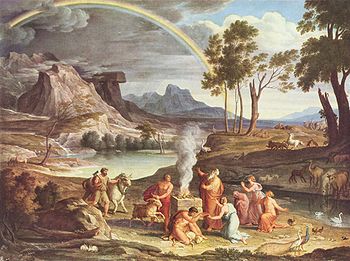
religion and Judaic religion, after Noah's flood God put the rainbow in the sky as the sign of His promise that He would never again destroy the earth with flood (Genesis 9:13–17):
I do set my bow in the cloud, and it shall be for a token of a covenant between me and the earth. And it shall come to pass, when I bring a cloud over the earth, that the bow shall be seen in the cloud: And I will remember my covenant, which is between me and you and every living creature of all flesh; and the waters shall no more become a flood to destroy all flesh. And the bow shall be in the cloud; and I will look upon it, that I may remember the everlasting covenant between God and every living creature of all flesh that is upon the earth. And God said unto Noah, This is the token of the covenant, which I have established between me and all flesh that is upon the earth.
The Church of Jesus Christ of Latter-Day Saints founder and prophet Joseph Smith stated that the second coming of the Christ would not occur in any year in which a rainbow is seen.
"The Lord deals with this people as a tender parent with a child, communicating light and intelligence and the knowledge of his ways as they can bear it. The inhabitants of the earth are asleep; they know not the day of their visitation. The Lord hath set the bow in the cloud for a sign that while it shall be seen, seed time and harvest, summer and winter shall not fail; but when it shall disappear woe to that generation, for behold the end cometh quickly."
Teachings of the Prophet Joseph Smith, Section Six 1843-44, p.305
"I have asked of the Lord concerning His coming; and while asking the Lord, He gave a sign and said, "In the days of Noah I set a bow in the heavens as a sign and token that in any year that the bow should be seen the Lord would not come; but there should be seed time and harvest during that year: but whenever you see the bow withdrawn, it shall be a token that there shall be famine, pestilence, and great distress among the nations, and that the coming of the Messiah is not far distant." Teachings of the Prophet Joseph Smith, Section Six 1843-44, p.340
"But I will take the responsibility upon myself to prophesy in the name of the Lord, that Christ will not come this year, as Father Miller has prophesied, for we have seen the bow; and I also prophesy, in the name of the Lord, that Christ will not come in forty years; and if God ever spoke by my mouth, He will not come in that length of time. Brethren, when you go home, write it down, that it may be remembered."
Teachings of the Prophet Joseph Smith, Section Six 1843-44, p.341
In the Dreamtime
Dreamtime
In the animist framework of Australian Aboriginal mythology, The Dreaming is a sacred era in which ancestral Totemic Spirit Beings formed The Creation.-The Dreaming of the Aboriginal times:...
of Australian Aboriginal mythology
Australian Aboriginal mythology
Australian Aboriginal myths are the stories traditionally performed by Aboriginal peoples within each of the language groups across Australia....
, the rainbow snake is the deity governing water
Water
Water is a chemical substance with the chemical formula H2O. A water molecule contains one oxygen and two hydrogen atoms connected by covalent bonds. Water is a liquid at ambient conditions, but it often co-exists on Earth with its solid state, ice, and gaseous state . Water also exists in a...
.
In Amazonian cultures, rainbows have long been associated with malign spirits that cause harm, such as miscarriages and (especially) skin problems. In the Amuesha
Yanesha' language
Yanesha , also called Amuesha or Amoesha is a language spoken by the Amuesha people of Peru in central and eastern Pasco Region.Due to the influence and domination of the Inca Empire, Yanesha' has many loanwords from Quechua, including some core vocabulary...
language of central Peru
Peru
Peru , officially the Republic of Peru , is a country in western South America. It is bordered on the north by Ecuador and Colombia, on the east by Brazil, on the southeast by Bolivia, on the south by Chile, and on the west by the Pacific Ocean....
, certain diseases are called ayona’achartan, meaning "the rainbow hurt my skin". A tradition of closing one's mouth at the sight of a rainbow in order to avoid disease appears to pre-date the Incan empire.
In New Age
New Age
The New Age movement is a Western spiritual movement that developed in the second half of the 20th century. Its central precepts have been described as "drawing on both Eastern and Western spiritual and metaphysical traditions and then infusing them with influences from self-help and motivational...
and Hindu philosophy
Hindu philosophy
Hindu philosophy is divided into six schools of thought, or , which accept the Vedas as supreme revealed scriptures. Three other schools do not accept the Vedas as authoritative...
, the seven colours of the rainbow represent the seven chakra
Chakra
Chakra is a concept originating in Hindu texts, featured in tantric and yogic traditions of Hinduism and Buddhism. Its name derives from the Sanskrit word for "wheel" or "turning" .Chakra is a concept referring to wheel-like vortices...
s, from the first chakra (red) to the seventh chakra (violet).
Art
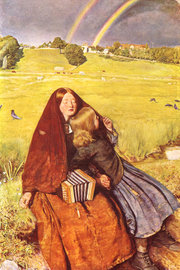
Rainbows are generally described as very colourful and peaceful. The rainbow occurs often in paintings. Frequently these have a symbolic or programmatic significance (for example, Albrecht DürerAlbrecht Dürer
Albrecht Dürer was a German painter, printmaker, engraver, mathematician, and theorist from Nuremberg. His prints established his reputation across Europe when he was still in his twenties, and he has been conventionally regarded as the greatest artist of the Northern Renaissance ever since...
's Melancholia I). In particular, the rainbow appears regularly in religious art (for example, Joseph Anton Koch
Joseph Anton Koch
Joseph Anton Koch was an Austrian painter of the German Romantic movement.-Biography:The Tyrolese painter was born in Elbigenalp. He started life tending cattle. Through the recommendation of Bishop Umgelder , he received academic training in the Karlsschule Stuttgart, a strict military academy...
's Noah's Thanksoffering). Romantic landscape painters such as Turner
J. M. W. Turner
Joseph Mallord William Turner RA was an English Romantic landscape painter, watercolourist and printmaker. Turner was considered a controversial figure in his day, but is now regarded as the artist who elevated landscape painting to an eminence rivalling history painting...
and Constable
John Constable
John Constable was an English Romantic painter. Born in Suffolk, he is known principally for his landscape paintings of Dedham Vale, the area surrounding his home—now known as "Constable Country"—which he invested with an intensity of affection...
were more concerned with recording fleeting effects of light (for example, Constable's Salisbury Cathedral from the Meadows
Salisbury Cathedral from the Meadows
Salisbury Cathedral from the Meadows was painted by John Constable in 1831, one year after his wife’s death. He later added nine lines from “The Seasons” by 18th Century poet James Thomson that reveal the painting's meaning: That the rainbow is a symbol of hope after a storm that follows on the...
). Other notable examples appear in work by Hans Memling
Hans Memling
Hans Memling was a German-born Early Netherlandish painter.-Life and works:Born in Seligenstadt, near Frankfurt in the Middle Rhein region, it is believed that Memling served his apprenticeship at Mainz or Cologne, and later worked in the Netherlands under Rogier van der Weyden...
, Caspar David Friedrich
Caspar David Friedrich
Caspar David Friedrich was a 19th-century German Romantic landscape painter, generally considered the most important German artist of his generation. He is best known for his mid-period allegorical landscapes which typically feature contemplative figures silhouetted against night skies, morning...
, and Peter Paul Rubens.
 |
 |
Literature
The rainbow inspires metaphor and simile. Virginia WoolfVirginia Woolf
Adeline Virginia Woolf was an English author, essayist, publisher, and writer of short stories, regarded as one of the foremost modernist literary figures of the twentieth century....
in To the Lighthouse
To the Lighthouse
To the Lighthouse is a novel by Virginia Woolf. A novel set on the Ramsays and their visits to the Isle of Skye in Scotland between 1910 and 1920, it skilfully manipulates temporal and psychological elements....
highlights the transience of life and Man's mortality through Mrs Ramsey's thought,
- "it was all as ephemeral as a rainbow"
Wordsworth's
William Wordsworth
William Wordsworth was a major English Romantic poet who, with Samuel Taylor Coleridge, helped to launch the Romantic Age in English literature with the 1798 joint publication Lyrical Ballads....
1802 poem "My Heart Leaps Up
My Heart Leaps Up
My Heart Leaps Up When I BeholdMy heart leaps up when I beholdA rainbow in the sky:So was it when my life began;So is it now I am a man;So be it when I shall grow old,Or let me die!The Child is father of the Man;And I could wish my days to be...
" begins:
- My heart leaps up when I behold
- A rainbow in the sky:
- So was it when my life began;
- So is it now I am a man;
- So be it when I shall grow old,
- Or let me die!...
The Newtonian
Isaac Newton
Sir Isaac Newton PRS was an English physicist, mathematician, astronomer, natural philosopher, alchemist, and theologian, who has been "considered by many to be the greatest and most influential scientist who ever lived."...
deconstruction of the rainbow is said to have provoked John Keats
John Keats
John Keats was an English Romantic poet. Along with Lord Byron and Percy Bysshe Shelley, he was one of the key figures in the second generation of the Romantic movement, despite the fact that his work had been in publication for only four years before his death.Although his poems were not...
to lament in his 1820 poem "Lamia":
- Do not all charms fly
- At the mere touch of cold philosophy?
- There was an awful rainbow once in heaven:
- We know her woof, her texture; she is given
- In the dull catalogue of common things.
- Philosophy will clip an Angel's wings,
- Conquer all mysteries by rule and line,
- Empty the haunted air, and gnomed mine –
- Unweave a rainbow
In contrast to this is Richard Dawkins
Richard Dawkins
Clinton Richard Dawkins, FRS, FRSL , known as Richard Dawkins, is a British ethologist, evolutionary biologist and author...
; talking about his book Unweaving the Rainbow
Unweaving the Rainbow
Unweaving the Rainbow is a 1998 book by Richard Dawkins, discussing the relationship between science and the arts from the perspective of a scientist....
: Science, Delusion and the Appetite for Wonder:
"My title is from Keats, who believed that NewtonIsaac NewtonSir Isaac Newton PRS was an English physicist, mathematician, astronomer, natural philosopher, alchemist, and theologian, who has been "considered by many to be the greatest and most influential scientist who ever lived."...
had destroyed all the poetry of the rainbow by reducing it to the prismatic colours. Keats could hardly have been more wrong, and my aim is to guide all who are tempted by a similar view, towards the opposite conclusion. Science is, or ought to be, the inspiration for great poetry."
Music
- In Rainbow Connection, a song known for being sung by Kermit the FrogKermit the FrogKermit the Frog is puppeteer Jim Henson's most famous Muppet creation, first introduced in 1955. He is the protagonist of many Muppet projects, most notably as the host of The Muppet Show, and has appeared in various sketches on Sesame Street, in commercials and in public service announcements over...
, the idea of a rainbow is seen as something to wish on, as it is popularly seen as a vision, or symbol of hope. - In End of the Rainbow by SeptemberSeptember (singer)Petra Linnea Paula Marklund who is better known as September is a Swedish singer and songwriter.-Early life and career:...
, the singer sings about the rainbow, and how she will be at the end of the rainbow and her ex could see her there when he reaches the end of the rainbow. - End of the RainbowEnd of the rainbowEnd of the Rainbow is a musical drama by Peter Quilter, centred upon the intriguing personality of Judy Garland in the months leading up to her death...
is an award winning stage play with music (or musical drama) by Peter QuilterPeter QuilterPeter Quilter is a playwright whose plays have been translated into 20 languages and performed in 33 countries. His shows have been performed in cities across six continents, including London, Cape Town, Rome, Prague, Warsaw, Amsterdam, Rio de Janeiro, Toronto, Chicago, Madrid, Sydney and New...
. - The group RainbowRainbow (band)Rainbow were an English rock band, controlled by guitarist Ritchie Blackmore from 1975 to 1984 and 1994 to 1997. It was originally established with American rock band Elf's members, though over the years Rainbow went through many line-up changes with no two studio albums featuring the same line-up...
and the song Rainbow Demon by Uriah HeepUriah Heep (band)Uriah Heep are an English rock band formed in London in 1969 and regarded as a seminal classic hard rock act of the 1970s. Uriah Heep's progressive/art rock/heavy metal fusion's distinctive features have always been massive keyboards sound, strong vocal harmonies and David Byron's operatic vocals...
. - I Can Sing a RainbowI Can Sing a Rainbow"I Can Sing a Rainbow" is a popular song written by Arthur Hamilton. It was featured in the 1955 film Pete Kelly's Blues where it was sung by Peggy Lee...
is a popular children's classic song written by Arthur Hamilton, despite the name of the song, not all the colours mentioned are actually colours of the rainbow. - Ronnie James DioRonnie James DioRonald James Padavona , better known as Ronnie James Dio, was an American heavy metal vocalist and songwriter. He performed with, amongst others, Elf, Rainbow, Black Sabbath, Heaven & Hell, and his own band Dio, which means God in Italian. Other musical projects include the collective fundraiser...
used rainbows as a thematic element in many of his songs, particularly as singer and lyrics-writer for Ritchie BlackmoreRitchie BlackmoreRichard Hugh "Ritchie" Blackmore is an English guitarist and songwriter, who was known as one of the first guitarists to fuse Classical music elements with rock. He fronted his own band Rainbow after leaving Deep Purple where he was unhappy because his favourite musical style wasn't adequately...
's band RainbowRainbow (band)Rainbow were an English rock band, controlled by guitarist Ritchie Blackmore from 1975 to 1984 and 1994 to 1997. It was originally established with American rock band Elf's members, though over the years Rainbow went through many line-up changes with no two studio albums featuring the same line-up...
. Most notable among these are the songs Catch the RainbowRitchie Blackmore's RainbowNote: On the cassette version of the album, Side One features the last five tracks, while Side Two plays the first four. Also, on the case insert and on the cassette itself, "Sixteenth Century Greensleeves" is written as "Sixteen Century Greensleeves"....
, Rainbow EyesLong Live Rock 'n' Roll-Personnel:*Ritchie Blackmore – guitars, bass*Ronnie James Dio – lead vocals*Cozy Powell – drums, percussion*David Stone – keyboards on "Gates of Babylon", "Kill the King", "The Shed". Piano outro on "L.A...
and the DioDio (band)Dio was an American heavy metal band from Portsmouth, New Hampshire. Formed in 1982 and led by vocalist Ronnie James Dio, after he left Black Sabbath with intentions to form a new band with fellow former Black Sabbath member, drummer Vinny Appice. Naming the band Dio made sense from a commercial...
song Rainbow in the DarkRainbow in the Dark"Rainbow in the Dark" was the second single released by heavy metal band Dio, taken from their 1983 album, Holy Diver. It was numbered 13 on VH1's "Top 40 Greatest Metal Songs."...
. - The band RadioheadRadioheadRadiohead are an English rock band from Abingdon, Oxfordshire, formed in 1985. The band consists of Thom Yorke , Jonny Greenwood , Ed O'Brien , Colin Greenwood and Phil Selway .Radiohead released their debut single "Creep" in 1992...
released an album in 2007 named, In RainbowsIn RainbowsIn Rainbows is the seventh studio album by the English rock band Radiohead. It was first released on 10 October 2007 as a digital download self-released, that customers could order for whatever price they saw fit, followed by a standard CD release in most countries during the last week of 2007. The...
. - The South Korean band Rainbow
- Somewhere Over the RainbowOver the Rainbow"Over the Rainbow" is a classic Academy Award-winning ballad song with music by Harold Arlen and lyrics by E.Y. Harburg. It was written for the movie The Wizard of Oz, and was sung by Judy Garland in the movie...
, a song sung by the character Dorothy (Judy GarlandJudy GarlandJudy Garland was an American actress and singer. Through a career that spanned 45 of her 47 years and for her renowned contralto voice, she attained international stardom as an actress in musical and dramatic roles, as a recording artist and on the concert stage...
) in the musical film The Wizard of OzThe Wizard of Oz (1939 film)The Wizard of Oz is a 1939 American musical fantasy film produced by Metro-Goldwyn-Mayer. It was directed primarily by Victor Fleming. Noel Langley, Florence Ryerson and Edgar Allan Woolf received credit for the screenplay, but there were uncredited contributions by others. The lyrics for the songs...
. - Japanese singer, Ayumi HamasakiAyumi Hamasakiis a Japanese singer-songwriter, record producer, model, lyricist, and actress. Also called "Ayu" by her fans, Hamasaki has been dubbed the "Empress of Pop" because of her popularity and widespread influence in Japan and throughout Asia. Born and raised in Fukuoka, she moved to Tokyo at fourteen to...
, has an album named RAINBOWRainbow (Ayumi Hamasaki album)Upon its release, the album received mixed reviews. Adam Greenberg of Allmusic stated, "[Rainbow] came after a string of high-charting albums, itself not reaching the same heights thanks to some interesting but uneven experimentation with her sound"...
with the same song name.
Films
- In A Shine of RainbowsA Shine of Rainbows (film)A Shine of Rainbows, also known as Tomás and the Rainbows, is a 2009 Irish family drama, directed and co-written by Vic Sarin and is a film adaptation of the novel A Shine of Rainbows by Lillian Beckwith.-Plot:...
, the young protagonist is promised to be taken into a rainbow. - In MarianneMarianne (2011 film)Marianne is a 2011 Swedish horror film, directed by Filip Tegstedt, that premiered at the 2011 Fantasia International Film Festival on 2 August 2011....
, a double rainbow was filmed by chance when Sandra is introduced for the first time. - In RainbowRainbow (1996 film)Rainbow is a 1996 family adventure film directed by Bob Hoskins, written by Ashley Sidaway and Robert Sidaway and starring Bob Hoskins, Terry Finn, Jacob Tierney, Saul Rubinek and Dan Aykroyd...
, damage to a rainbow threatens the world at large. - In the film The Wizard of OzThe Wizard of Oz (1939 film)The Wizard of Oz is a 1939 American musical fantasy film produced by Metro-Goldwyn-Mayer. It was directed primarily by Victor Fleming. Noel Langley, Florence Ryerson and Edgar Allan Woolf received credit for the screenplay, but there were uncredited contributions by others. The lyrics for the songs...
, lead character Dorothy GaleDorothy GaleDorothy Gale is the protagonist of many of the Oz novels by American author L. Frank Baum, and the best friend of Oz's ruler Princess Ozma. Dorothy first appears in Baum's classic children's novel The Wonderful Wizard of Oz and reappears in most of its sequels...
sings the song "Over the RainbowOver the Rainbow"Over the Rainbow" is a classic Academy Award-winning ballad song with music by Harold Arlen and lyrics by E.Y. Harburg. It was written for the movie The Wizard of Oz, and was sung by Judy Garland in the movie...
" where she fantasises about a place over the rainbow, where the world is in peace and harmony.
Flags
Rainbow flags tend to be used as a sign of a new era, of hope, or of social change. Rainbow flags have been used in many places over the centuries: in the German Peasants' WarGerman Peasants' War
The German Peasants' War or Great Peasants' Revolt was a widespread popular revolt in the German-speaking areas of Central Europe, 1524–1526. At its height in the spring and summer of 1525, the conflict involved an estimated 300,000 peasants: contemporary estimates put the dead at 100,000...
in the 16th century, as a symbol of the Cooperative
Cooperative
A cooperative is a business organization owned and operated by a group of individuals for their mutual benefit...
movement; as a symbol of peace, especially in Italy; to represent the Tawantin Suyu, or Inca territory, mainly in Peru
Peru
Peru , officially the Republic of Peru , is a country in western South America. It is bordered on the north by Ecuador and Colombia, on the east by Brazil, on the southeast by Bolivia, on the south by Chile, and on the west by the Pacific Ocean....
and Bolivia
Bolivia
Bolivia officially known as Plurinational State of Bolivia , is a landlocked country in central South America. It is the poorest country in South America...
; by some Druze
Druze
The Druze are an esoteric, monotheistic religious community, found primarily in Syria, Lebanon, Israel, and Jordan, which emerged during the 11th century from Ismailism. The Druze have an eclectic set of beliefs that incorporate several elements from Abrahamic religions, Gnosticism, Neoplatonism...
communities in the Middle east; by the Jewish Autonomous Oblast
Jewish Autonomous Oblast
The Jewish Autonomous Oblast is a federal subject of Russia situated in the Russian Far East, bordering Khabarovsk Krai and Amur Oblast of Russia and Heilongjiang province of China. Its administrative center is the town of Birobidzhan....
; to represent the International Order of Rainbow for Girls since the early 1920s; and as a symbol of gay pride
Gay pride
LGBT pride or gay pride is the concept that lesbian, gay, bisexual, and transgender people should be proud of their sexual orientation and gender identity...
and LGBT social movements
LGBT social movements
Lesbian, gay, bisexual, and transgender social movements share inter-related goals of social acceptance of sexual and gender minorities. Lesbian, gay, bisexual, and transgender people and their allies have a long history of campaigning for what is generally called LGBT rights, also called gay...
since the 1970s.
See also
- Atmospheric opticsAtmospheric opticsAtmospheric optics deals with how the unique optical properties of the Earth's atmosphere cause a wide range of spectacular optical phenomena. The blue color of the sky is a direct result of Rayleigh scattering which redirects higher frequency sunlight back into the field of view of the observer...
- Circumzenithal arcCircumzenithal arcThe circumzenithal arc or circumzenith arc , also called the Bravais' arc, is an optical phenomenon similar in appearance to a rainbow; but it arises from refraction of sunlight through horizontally-oriented ice crystals, generally in cirrus clouds, rather than from raindrops...
- Fog bowFog bowA fog bow is a similar phenomenon to a rainbow, however, as its name suggests, it appears as a bow in fog rather than rain. Because of the very small size of water droplets that cause fog—smaller than —the fog bow has only very weak colors, with a red outer edge and bluish inner.In many cases when...
- GloryGlory (optical phenomenon)A glory is an optical phenomenon that resembles an iconic saint's halo about the shadow of the observer's head. The effect is produced by light backscattered towards its source by a cloud of uniformly sized water droplets...
- HaloHalo (optical phenomenon)A halo from Greek ἅλως; also known as a nimbus, icebow or gloriole) is an optical phenomenon produced by ice crystals creating colored or white arcs and spots in the sky. Many are near the sun or moon but others are elsewhere and even in the opposite part of the sky...
- Iridescent colours in soap bubbles
- MoonbowMoonbowA moonbow is a rainbow produced by light reflected off the surface of the moon rather than from direct sunlight. Moonbows are relatively faint, due to the smaller amount of light reflected from the surface of the moon...
- Sun dogSun dogA sun dog or sundog, scientific name parhelion ; , also called a mock sun or a phantom sun, is an atmospheric phenomenon that creates bright spots of light in the sky, often on a luminous ring or halo on either side of the sun.Sundogs may appear as a colored patch of light to the left or right of...
External links
- Images by Crayford Manor House Astronomical Society
- National Center for Atmospheric Research, About Rainbows
- Supernumerary and Multiple Rainbows
- Incredible Rainbows Worldwide - slideshow by Life magazine
- Interactive simulation of light refraction in a drop (java applet)
- Spectacular rainbow at Elam Bend (McFall, Missouri)
- Walter Lewin's Discussion on colours and rainbow physics
- Straight Dope on double rainbows
- Rare photo of the ‘end’ of the rainbow
- Rainbow seen through infrared filter and through ultraviolet filter
- Double Rainbow (viral video)Double Rainbow (viral video)Double Rainbow refers to a viral video posted by Paul "Bear" Vasquez. The clip, filmed in his front yard just outside Yosemite National Park, in the U.S. state of California, chronicles his sighting of and Stendhal syndrome-like reaction to a double rainbow...
- Atmospheric Optics website by Les Cowley - Description of multiple types of bows, including: "bows that cross, red bows, twinned bows, coloured fringes, dark bands, spokes", etc.